Why Pop Culture Makes Me Grateful

With Thanksgiving quickly approaching, I have been reflecting on what I am thankful for this year.  Of course, I am most thankful for my faith, family, friends, and good health like most people.  But I have been looking deeper, exploring gifts I don’t always appreciate.

Kids today are growing up in a digital society, and social media has always been part of their lives – that will shape them and the way they learn and interact.  When I grew up in the 1960s and 1970s, our technology was television. I have been thinking about the way that shaped who I am, and I have been meditating on what I have learned from being a pop culture kid.

Here are some of the things I am thankful for that I have learned from sitcoms.

  1. Gracie Allen and Blanche Morton taught me having a best friend you can sit down and talk with over coffee is important. On Burns and Allen, every good or bad thing that occurred in their lives was shared and analyzed over a cup of quality roast coffee. Most of the time, these two women shared laughter, but your closest friends understand when it’s the time for tears as well. Having someone to navigate life with who totally gets you and never judges you (but can pull you back to reality with a loving reprimand when necessary) makes the journey much easier.


  1. Ann Marie taught me fashion is fun, and you can develop your own fashion sense. The last seasons of That Girl coincided with my middle grade school years when clothes were beginning to take on new importance. Before that, we basically had Sunday clothes, school clothes, and play clothes and didn’t give much thought to what was in our closet. During these years I was lucky to have a grandmother who bought me beautiful Sunday dresses and a friend who passed her clothes down to me. I remember that one of my Sunday best was a pink and white gingham skirt (with suspenders!) and a matching blazer. It came from Sak’s Fifth Avenue, and made me feel like a model when I wore it.  I didn’t understand the cost of expensive clothing, but I did know that Sak’s Fifth Avenue and Tiffany boxes were very desirable.  Thank you Lisa Spahr.  School clothes were always a dress or skirt with high knee socks until fourth grade.  That was the year that forced us to think more about our daily outfits because, for the first time, we were allowed to wear pants to school.  Not any pants, however; it had to be a pantsuit.  For Christmas that year I received a navy combination with red trim around the collar – a bit of a naval theme. Play clothes also began to change that year because our play changed.  No longer were we only running through the neighborhood; we were going to the movies, the Y, and other places where we might run into certain people – people like boys. My favorite outfit that year was a pair of ecru bell bottoms that had navy and maroon flowers splashed across them, paired with a navy blouse with a very straight collar and three buttons on the cuff.  I was convinced if I ran into Keith Partridge or Bobby Sherman in that outfit, they would notice me for sure. I also remember hot pants coming into fashion, and I had a pair of striped brown, tan, and orange ones that I wore with an orange tank with a zipper.  Be still my heart.  But my most special purchase was a black maxi coat that made me feel just like Ann Marie. Yes, she was a great fashion coach. I still love to watch the show to see what she is wearing.


  1. The Collins family helped me develop several interests. Dark Shadows came on not long after we arrived home from school, and we never wanted to miss it. As a neighborhood clan, we often played Dark Shadows, and all the girls wanted to be Daphne or Laura. I have not remained an avid Dark Shadows fan, but it did spark two passions for me.  No, not vampires and ghosts but mysteries and Maine. Mysteries were my favorite books to read during grade school and junior high. My first memory of the Bookmobile coming to our school was seeing several Nancy Drew books on the library carts. I checked them out, and I was hooked. I read through many series after that – The Dana Girls, Ginny Gordon, and Donna Parker – and then I moved on to reading adult authors that our local librarian had to approve for me to take out.  I especially loved Phyllis Whitney. I must have loved books more than clothing, because one year I received a pair of jeans for Christmas that I didn’t really like.  I was allowed to take them to Leitzinger’s Department Store myself to exchange them.  Exchange them I did for 8 Trixie Belden books.   That was not my mother’s expectation, but I thought it was a much better deal.  Dark Shadows also gave me a fondness for Maine. I’ve only been there once, but I am looking forward to returning to New England next fall. I loved the large, old homes, the rocky beaches, and the quaint little towns. Something about that area spoke to my soul and drew me in.


  1. Steve Douglas provided me with sage advice and security. My dad and I had a great relationship when I was very little and later when I was an adult and a parent myself, but those years in between were a bit unpleasant at times, due to some personal demons he was dealing with. My Three Sons began the year before I was born and continued on the air until I was 12. After that, it was on television in reruns for most of my school life. In his sweater and holding a pipe, Steve Douglas became a surrogate father for me. I felt like I was a member of the Douglas family. Steve always had time to listen and had great wisdom.  He also understood kids would be kids and you had to pick your battles. He was kind and gentle. When I was dealing with a difficult issue, I would often consider what advice he might give me. When I was pregnant with our first child, a boy it turns out, I gave Dan a Steve Douglas cardigan to announce it. I think it was fitting that I ended up with three children – all boys.  Spending time with the Douglas family while growing up helped me understand what it was like to raise three boys. This show has always tugged at my heart.  On our first date, the show just happened to be on when we got back to my apartment.  Then we had three boys. Our youngest was named Seth for several reasons, one of them being that Seth Bryant had founded the town of Bryant Park where the Douglas clan lived. Somehow, I think I always knew I would have my own three sons.


  1. Hawkeye Pierce and BJ Hunnicutt taught me laughter is an essential part of life. During my formative tween years, especially in dealing with my father, I began to realize that life wasn’t always sunshine and rainbows. I learned that life held some highs and some lows, but most of life is lived on the bridges between the mountains and the valleys.  M*A*S*H taught me the importance of joy and laughter during these times. Humor became an important life skill which helped in making friends and getting through bumpy times.  We moved a lot between 8th and 11th grades – I was basically in five different high schools in three different cities and having a sense of humor helped me develop friends in each new place. My closest friends and my family understand that being able to laugh at ourselves and find humor in the mundane keeps life fun.  Our family conversations often sound like a M*A*S*H script. Life without humor would be very unpleasant.


  1. Rob Petrie, Mary Richards, and Michael Scott taught me that work would be much smoother if you accepted everyone and made the best of situations rather than dwelling on the negatives. From Rob Petrie, I learned that developing close relationships at work helped you be more creative and reduced stress. He probably also influenced me to love comedy and writing. Mary Richards taught me that for every Murray Slaughter you bonded with at work, there would be a Ted Baxter you had to put up with, and hopefully you would develop some affection for them by doing so.  Michael Scott taught me that we all have our quirks, and if we accept others, they will usually accept us.  If we wait for the perfect friend or coworker, we will be waiting a long time. The work has to get done, so stay positive. We all have professional gifts and talents, but our people skills are often what make us a success or a failure at our jobs.


  1. Shirley Partridge and Bentley Gregg taught me it was okay to love a show simply because you love it, without trying to reason why. There were a lot of shows on when I was growing up that I watched and thought were okay, but they didn’t capture my heart – shows like Gilligan’s Island, Hazel, or The Flying Nun.  There were also shows I thoroughly disliked for whatever reason – shows like All in The Family, Good Times, and The Beverly Hillbillies. However, some shows like The Partridge Family and Bachelor Father drew me in and became life-long love interests.  Okay, it might have something to do with the fact that I was secretly in love with Keith Partridge and Bentley Gregg.  There was just something about the series that would cause me to get up two hours early or stay up three hours later just to watch reruns when I could.  And I learned that was okay.  I don’t have to analyze why they have become important in my life; I just accept that they are.

Many people criticize sitcoms as fluffy and say that they don’t portray the reality of life.  I disagree.  Don’t get me wrong.  There are plenty of mediocre and just plain awful shows out there.  There always have been.  But there are those shows that touch our lives in some way.  We learn from them.  We laugh with them.  We develop an appreciation for people that we otherwise would never come to know. So, I am grateful for the lessons I have learned watching sitcoms.  I am also thankful for the passion I developed in sharing these shows with other people. After all, that is what this blog is all about.  And I am thankful to you for reading it and keeping these shows alive for another generation. Have a blessed Thanksgiving.


Do You Hear What I See?

As viewers transitioned from radio to television, there was a lot of conflict as advertisers volleyed between the two mediums. Many critics predicted an early death for radio which never came about.  Radio found its new niche, relying more on news and music. Now, you can actually watch radio on television shows like Mike & Mike on ESPN.

Television has also featured several shows about radio stations over the years.  Today we tune in to five of those.

Good Morning World (1967)

radio3

David Lewis (Joby Baker) and Larry Clarke (Ronnie Schell) are early morning DJs in LA with the Lewis and Clarke Show. Dave is happily married, while Larry considers himself a ladies’ man. Billy De Wolfe garnered a lot of attention as the best part of the show  portraying station manager Roland Hutton, a stuffy and humorless boss. Rounding out the cast are Dave’s wife Linda played by Julie Parrish and the debut of Goldie Hawn as their next-door-neighbor.

American actors Goldie Hawn (as Sandy Kramer) and Charlie Brill (as Milton Pervis) appear in an episode of the television show 'Good Morning Wold' called 'Knits To You, Sir,' June 20, 1967.

The show was created by an unbelievable group: Carl Reiner, Sheldon Leonard, Bill Persky, and Sam Denoff. They all were part of the creative force of the Dick Van Dyke Show.  Persky and Denoff were also the producers for That Girl. They based this show on their work as writers at WNEW-New York in the 1950s.

radio2

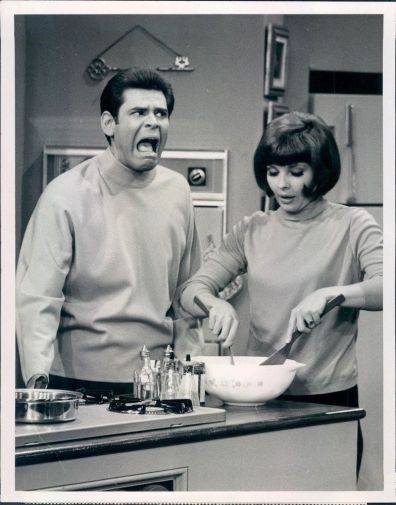
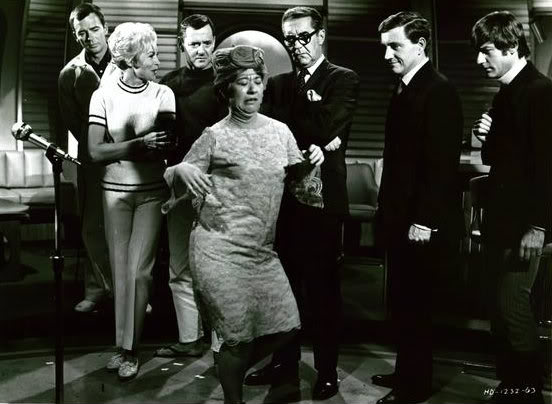
This photo made me laugh.  They could actually be stand-ins for Dick Van Dyke and Mary Tyler Moore. It might even be the same kitchen!

Filmed before a live audience at Desilu, the show was created to showcase Schell.  Ronnie had been a private on Gomer Pyle and this was to be his break-out show. Procter and Gamble sponsored the series which aired Tuesday nights. It should have done well during its slot, being up against NYPD and the Tuesday Night at the Movies.

The ratings were not great, and the network debated whether to cancel the show or bring it back for a second season.  The two deciding factors might have been that Baker had a lot of trouble memorizing his lines and Parrish was dealing with some health issues.  The network considered recasting both roles but ended up cancelling the series after 26 episodes.  Surprisingly, it was released on DVD.

Schell went back to Gomer Pyle, USMC where he was promoted to corporal.

radio1

The best episode is “No News Like Nude News.” The stars are invited to a Nude Ranch and go thinking they are on their way to a dude ranch.


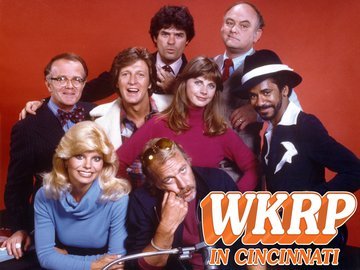
WKRP in Cincinnati (1978)

radio23

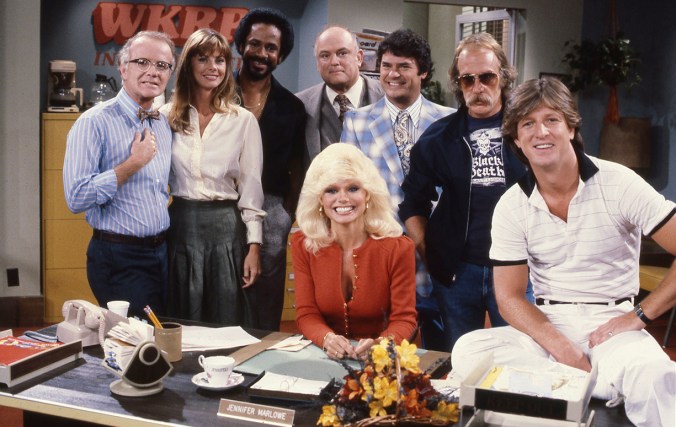
I consider WKRP the second-best radio sitcom. The premise for the show was that a new producer is brought in to help a struggling radio station in Cincinnati.  Changing the format from easy listening to rock brings new life to the station and a lot of chaos to the staff. Hugh Wilson created the format.  He can be seen as a police officer in the episode “Hold Up.”

Along with The Dick Van Dyke Show, The Mary Tyler Moore Show, Barney Miller, and The Office, this was one of the best ensemble casts in television. The characters included:

radio31

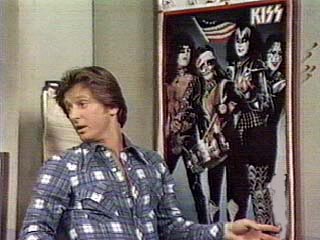
Andy Travis (Gary Sandy) is the producer who has a successful history of turning stations around.

Arthur Carlson (Gordon Jump) is the station manager whose mother owns the station. The Big Guy’s management style is a big part of why the station is not doing well.  Art is more interested in fishing than radio. Jump was a DJ in Dalton in his former life.

radio24

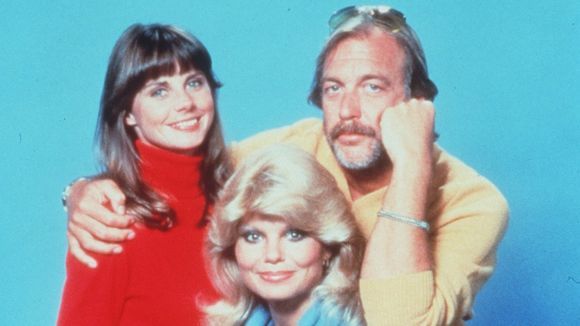
Jennifer Marlowe (Loni Anderson) is the smart receptionist who is the highest-paid staff member. Anderson refused to be cast as a dumb blonde.  Jennifer has a journalism degree and although she is only receptionist, she has the skills that keep Art Carlson out of the loop and everything running smoothly at the station. She is gorgeous and kind-hearted, but she refuses to type letters or make coffee.

Les Nessman (Richard Sanders) is the incompetent news reporter. He always wears bow ties and is best friends with Herb. Richard has a bandage on his head from a real-life injury in the pilot and he made that one of his trademarks.  He often shows up with bandages on various parts of his body and we later learn that he has a large dog.

Herb Tarlek (Frank Bonner) is a tasteless boor. He is married but is always coming on to Jennifer. Herb’s suits are even louder than he is.  In one episode, Venus says “Somewhere out there there’s a VW with no seats.” One of his suits actually was made from VW covers. Bonner grew up in Arkansas, and Herb always has a Razorback mug on his desk.

Bailey Quarters (Jan Smithers) originally took care of billing but is also a journalism major and shows she is a more competent on-air reporter than Les. She and Fever date off and on.

Venus Flytrap (Tim Reid) is the soulful, smooth-talking DJ.  Although he is on the air at night and Fever has the morning shift, they become best friends. His real name was Gordon Sims and he was a school teacher before his DJ career took off.

Dr. Johnny Fever (Howard Hesseman) is the burned-out DJ from LA.  He was fired for saying “booger” on the air at his last job.  He’s an insomniac and addicted to coffee.  His hippie lifestyle and cynicism do not mesh with Herb and Les. Originally Hesseman was asked to read for the part of Les Nessman but would only audition for Fever. David Cassidy turned down the role of Johnny Fever. The character of Fever was based on Atlanta’s Bobby Harper who was on the morning show on WQXL 790 AM.  The creator of the show, Hugh Wilson, had previously worked there.

In many of the scenes there were bulletin boards with bumper stickers plastered all over that had been sent in from radio DJs all over the country. As a tribute to John Lennon, his photo was displayed in the background after his assassination.

radio21

The show was videotaped because rock song rights were cheaper for taped shows than filmed shows. When the show went into syndication, almost all of the music had to be replaced.  When the DVD set was being created, the original music was put back in.  An agreement could not be reached until 2014.

Although it’s hard to believe, in 1980 Hugh Wilson collaborated with Hanna-Barbera to create an animated version of WKRP where all the characters are played by dogs.  The show never actually happened.

WKRP was on Monday nights against Welcome Back Kotter and Little House on the Prairie. After the first season, it was moved repeatedly. The show was cancelled after four seasons. It accumulated ten Emmy nominations including three for outstanding series. The show was much more successful in syndication.

radio12

The show was filmed in Los Angeles, but the opening and closing scenes as well as several episode scenes were filmed at the Enquirer Building in Cincinnati.  That building is currently a Hampton Inn/Homewood Suites at 615 Vine St. near Fountain Square.  The radio station said they were housed in the Osgood R. Flimm Building.
One of the most memorable parts of the show was the theme song:

“Baby, if you’ve ever wondered, wondered whatever became of me.  I’m living on the air in Cincinnati, Cincinnati WKRP. Got kind of tired of packin’ and unpackin’, town to town, up and down the dial. Maybe you and me were never meant to be, just maybe think of me once in a while. I’m at WKRP in Cincinnati.”

WKRP in Cincinnati

In 2015, a non-profit radio station in Raleigh, 101.9 was given the WKRP call letters. An independent television station, channel 25, in Cincinnati also received the WKRP designation in 1990.

The clever writing and memorable characters have gained this sitcom a great reputation in television history.

Hello Larry (1979)

radio6

McLean Stevenson was hoping to be the star of M*A*S*H.  Once he realized Alan Alda was firmly entrenched in that position, he opted out of his contract to star in his own show.

The result was Hello Larry about a man, Larry Alder, who is divorced and moves with his two teenage daughters to Portland to star in a call-in psychiatric radio show. Kim Richards played his daughter Ruthie and Krista Erickson played Diane. Lisa Whelchel auditioned for the role of Ruthie but lost out to Richards and ended up on Facts of Life which she was grateful for.

radio10

The other cast members included Joanna Gleason (Monty Hall’s daughter) as the radio producer, George Memmoli as Earl the engineer, and John Femia as Tommy Roscini. Larry also hung out with a familiar face – -Meadowlark Lemon, former Globetrotter, who owned a Portland sporting goods store.

The show was owned by the same company who created One Day at A Time and this was a mirror image of that show focusing on a single mom with two daughters.

radio8

The ratings were not good. The show was up against Charlie’s Angels and the Wednesday Night Movie. Several months into the season, to bolster ratings, the writers brought in the cast of Diff’rent Strokes which was a popular show that aired right before Hello Larry.  It was scripted that Larry and Phil Drummond had served together in Korea.  It did not help the ratings. The show went through a variety of scheduling changes all with the same result.  An issue that certainly didn’t help the show was the Iranian hostage crisis.  The show was often interrupted with special news breaks.

After 38 episodes, the show died a quiet death.  A TV Guide poll in 2002 listed Hello Larry as the 12th worse show of all time.  It was probably best remembered as the show that continually got made fun of by Johnny Carson for being so bad.

radio9

It’s hard to believe an actor would leave one of the most creative and popular shows of all time to move to one of the worst shows of all time.

Frasier (1993)

p183920_b_h9_ab

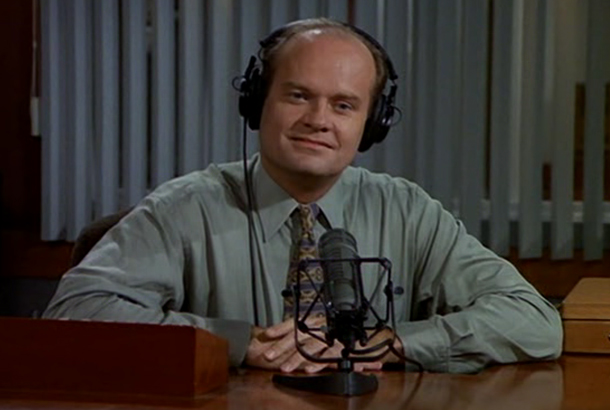
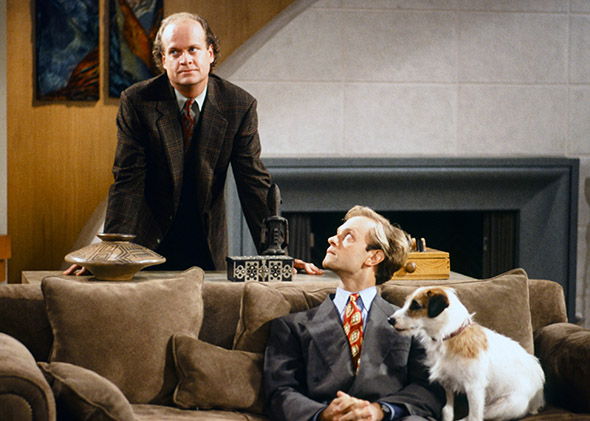
I think that Fraisier was the best radio show on television.  Frasier was on the air 12 years resulting in 263 episodes. The show averaged only 24 episodes a year. The hundredth episode was entirely filmed on the streets of Seattle. Leaving the cast of Cheers, Frasier Crane (Kelsey Grammer) moves back to Seattle to host a show as a radio psychiatrist.

radio32

After an injury, his father, a former policeman, moves in with Frasier. Fraiser provides advice on the airwaves while struggling in his personal relationships, especially with his cranky father and his pretentious brother. The producers did not want the show to resemble WKRP too much, so they came up with the concept of having Frasier live with his father, so family relationships became important.

radio43

John Mahoney plays Martin Crane, a grumpy, uncultured man who cannot understand his sons. Although Martin did not care about high-brow topics, John Mahoney taught Pierce a lot about wine and opera during the Frasier years.

radio35

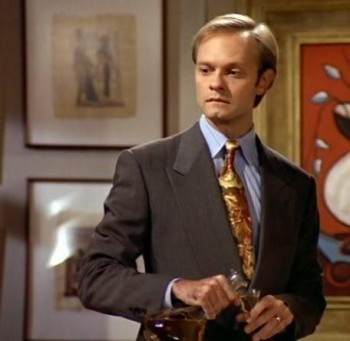
David Hyde Pierce was Frasier’s brother Niles.  The role of Niles was written just for Pierce.  The brothers were extremely competitive, although they could count on each other when it mattered. Frasier went to Harvard and Oxford while Niles went to Yale and Cambridge. Their mom was a scientist and the boys were named after lab rats she worked with. Both brothers had expensive tastes, intellectual interests, and high opinions of themselves. Niles was married to Maris, but we never see her. In later seasons, after getting a divorce, Niles marries Daphne. The brothers often meet at Café Nervosa.

radio33

On an episode of Cheers, Frasier explained that his father had died in an accident and he had no siblings.  When Sam (Ten Danson) comes to visit on Frasier, the error is explained by having Frasier tell Sam that he made the story up because he was mad at his family. All but two characters from Cheers starred on Frasier.  Coach had passed away and  Kirstie Alley (Rebecca) was a scientologist who did not accept psychology.

radio42

Jane Leeves plays Daphne Moon, who was hired to be Martin’s therapist and caretaker.

radio38

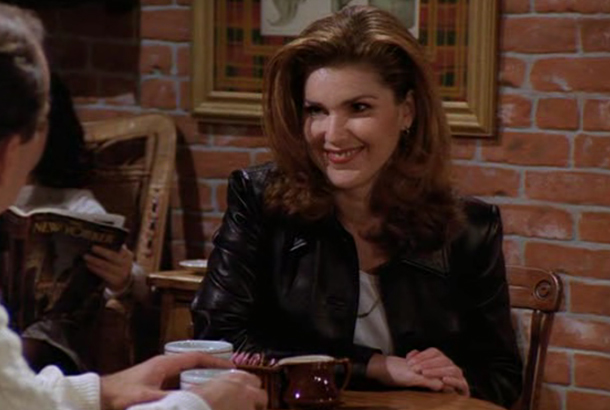
Peri Gilpin (Roz Doyle) is Frasier’s radio producer and becomes one of his best friends. The role of Roz had been narrowed down to Gilpin or Lisa Kudrow. Kudrow was funnier but lacked the forcefulness she needed in the workplace, so Gilpin got the job.

radio37

Another important character was Martin’s dog Eddie.  John Mahoney said Eddie got more fan mail than anyone else on the show. To get Eddie to lick Mahoney’s face, liver pate was placed strategically on his face.

bebe

Bebe Neuwirth was offered a regular role on the show as Frasier’s ex-wife, but she wanted to return to Broadway, so she guest-starred from time to time. She appeared in 12 shows.

Frasier

Frasier’s apartment was almost another character on the show.  He lived in an ultra-modern apartment. A Dale Chihuly sculpture is seen near the fireplace. Above the fireplace is another artwork by Laddie John Dill, an LA sculptor.  A Coco Chanel sofa was recovered at a cost of $15,000 to add realism. In contrast, Martin brings his old, tattered recliner which clashes with the rest of the apartment – a symbol of the way he and Frasier clash. On the first episode, a deliveryman played by Cleto Augusto brings the chair in. On the final episode, the same actor came and took the chair away.  Martin explains to Frasier that he spent many important life moments in the chair such as watching the moon landing and specific sports events.  When he came home from work, he often fell asleep in the chair, and his wife would kiss him and send him to bed.  Frasier’s mother had passed away a few years earlier. Frasier finally understands the significance of the chair. On the last episode, Martin is marrying again, and he moves out. Wendie Malick plays his second wife.

Guest stars played callers on the radio show.  Often, they phoned in their lines. Callers included David Duchovny, Phil Donahue, Marlo Thomas, Linda Hamilton, Olympia Dukakis, Daryl Hannah, Chris Reeve, and Estelle Parsons.

Grammer made life a bit anxious for his guest stars. He used an acting method called requisite disrespect where he did not rehearse and learned his lines right before each scene.

radio40

The theme song was “Tossed Salad and Scrambled Eggs” by Darryl Phinnessee and Bruce Miller. Miller wanted Mel Torme to sing the theme for the show, but the producers wanted Kelsey Grammer who ended up recording it.

Critics had great respect for the show. The series holds the record for most sitcom Emmys – 37.  It had the record for most Emmys of any genre till Game of Thrones won its 38th recently. The five best episodes include “The Ski Lodge,” “The Doctor is Out,” “Wheels of Fortune,” and “Ham Radio.”

Grammer and James Arness are currently tied for the character who was on television the longest – 20 years.  Arness played Marshall Dillon on Gunsmoke for 20 years while Grammer played Frasier on Cheers and Frasier for a total of 20 years. The Simpsons have actually passed both of them if animated characters count.

Not only was Fraiser a great radio sitcom, but it is one of the best sitcoms on my top 15 list.

News Radio (1995)

news1

News Radio explores the office politics and interpersonal relationships among the staff of WNYX, New York’s #2 news radio station.

news4

Dave Nelson (Dave Foley) is the boss who tries his best to manage a quirky staff. He was raised in Wisconsin and some of his interests include tap dancing, a cappella singing, knife-throwing, and ventriloquism. He is polite and always in control.  He talks to his mother frequently and keeps a photo of her on his desk. He loves coffee and classic sitcoms, especially Mr. Ed and Green Acres.

news5

Bill McNeal (Phil Hartman) is an egotistical co-anchor. He is arrogant and insubordinate.  There are many gaps in his knowledge, but he does show flashes of concern for others. Near the end of the show’s run, Hartman was killed; tragitically, Hartman was shot by his wife.

news3

Catherine Duke (Khandi Alexander) is the other co-anchor. She and McNeal previously had an affair and they are rivals. In the fourth season, she takes a job in London.

news10

Jimmy James (Stephen Root) is an eccentric owner. He is a billionaire and feels the need to micromanage the station. He is always searching for a wife and loves to air his rivalries with other entrepreneurs such as Ted Turner and Bill Gates. In the finale, he buys a radio station and newspaper in New Hampshire and takes most of the staff with him.

news8

Lisa Miller (Maura Tierney) is an ambitious producer who is Nelson’s on-and-off-again girlfriend. She’s an overachiever who can do complex math problems and has a detailed life plan. In season five, she marries Jimmy’s archenemy Johnny Johnson (Patrick Warburton).

news11

Matthew Brock (Andy Dick) is a hapless reporter who is clumsy and always tripping or falling down. He idolizes McNeal.  He has a dental degree, loves sci fi, and has a crush on Lisa.

rogan

Joe Garrelli (Joe Rogan) is a handyman and electrician.  He is infatuated with Catherine and believes conspiracy theories, especially about extraterrestrials. Ray Romano was originally hired for this job, but his verbal comedy did not mesh well with the rest of the cast.

news12

Beth (Vicki Lewis) is the quirky secretary.  She typically wears inappropriate clothing, chews gum all the time, and likes to complain about her low salary. She was named Beth based on the Kiss song.

lovitz

Max Lewis (Jon Lovitz) was McNeal’s replacement after Hartman’s death. He was inept, eccentric, insecure, unprofessional and a former colleague of Bill’s.

The show was on the brink of cancellation every season. It never placed higher than 26th and changed time slots 11 times. It was briefly cancelled in 1998, but the network reversed its decision and ordered 22 more episodes and then it was cancelled for good.

news2

The show was fast paced and witty.  Sarcasm ruled the dialogue. Physical humor and sight gags also had a place in the humor. The show differed from the casts in The Office or the Mary Tyler Moore Show because they were a dysfunctional family without the affection and empathy of those characters. The cast was banned from SAG awards for bad behavior at the first ceremony.

Shows featuring radio stations seem to be hit or miss.  Good Morning World and Hello Larry did not do well.  I think everyone can agree on WKRP in Cincinnati and Fraiser are well-written shows.  News Radio seems to fall somewhere in the middle.  Some people seem to love it while others thought it missed the mark.  I think the show is well written, but the characters are not endearing.  They don’t grow or change for the better.  We can grow to love a Herb Tarlek and a Ted Baxter, but there is nothing redeeming about the crew here.  I guess I would tune out.  There are too many good shows out there to watch a “maybe, maybe not” show.

Just When You Think It Can’t Get Any Weirder, It Does

Although I love The Big Bang Theory and Modern Family, there are a lot of shows on television today that make me shake my head.  It’s amazing what is airing when you scroll through the channels:  Vanilla Ice Goes Amish, I Cloned My Pet, Doomsday Preppers, and these are some of the best reality shows out there.  However, when I researched sitcoms from the classic era, I also found a lot of weird concepts there also.  Let’s take some time to look at a few of them.


unusual1

Boss Lady (1951)

Lynn Bari was Gwen Allen, owner and operator of Hillendale Homes Construction Co. which was owned by her father.  While this show would not seem unusual at all today, back in 1951 it was not common to see a woman the boss of a construction crew. This show began on the Dumont network and then switched to NBC for twelve episodes, running as a summer replacement from July to September 1952.


Where’s Raymond? (1953)

Believe it or not, this was a musical sitcom.  Ray Bolger (who had sang and danced as The Scarecrow in The Wizard of Oz) was a song and dance man named Ray Wallace living in Pelham, New York. He had a girlfriend named Susan (Marjie Millar) and a business partner Peter (Richard Erdman). Verna Felton from December Bride was his understudy’s mother-in-law. The show lasted 2 ½ years on ABC.


The People’s Choice (1955)

Ok, pay attention, because the basis of this show is confusing. Socrates (Sock) Miller played by Jackie Cooper is a Bureau of Fish and Wildlife Orinthologist studying to be a lawyer.  Honestly! He has car trouble one day and is picked up (and picked up) by the mayor’s daughter Mandy who thinks he should be on the city council. Sock decides to be a lawyer to support Mandy.   In the finale to year one, the two elope and conceal their marriage for the entire second season.  When the show came back for a third year, the mayor finds out about the marriage, Sock gets his law license, and Sock’s free-loading pal Rollo (Dick Wesson) moves in with the couple.  Now Sock is managing a real estate development. Just when you thought it could not get more confusing, Sock’s basset hound Cleo would do tricks and comment directly to the audience about situations occurring on the show. LSD had not even become a social problem yet, so it was not responsible for this show, so I’m not sure how this crazy mess stayed on the air for 104 episodes.


TSDDIAN EC004

Dick and the Duchess (1957)

Dick Starrett (Patrick O’Neal) is a claims adjuster in London.  There are some exciting scenarios to provide interest. He meets and marries Jane (Hazel Court) a duchess. She becomes his wife and assistant, although she still expects to live in the manner she has become accustomed to.  She humorously gets involved in his investigations. The network must not have thought she was that funny helping out because  CBS cancelled it after 25 episodes.


Mr. Ed (1961)

Let me say, I do not put Mr. Ed in the same category as Dick Van Dyke Show, That Girl, or Bachelor Father, but I don’t mind catching an episode or two now and then.  When looking at strange concepts for show, this one does have to go into the mix.

When the creator asked Young to appear in the show, he turned him down twice. A pilot was made without him. It did not sell, so producers Arthur Luben and Al Simon decided to enter it directly into syndication, and Young then agreed to take on the role. It was very successful, so CBS bought it.

Wilbur Post (Alan Young) is a married architect. Wilbur and his wife Winnie (Connie Hines) bought their house with a horse included. Their neighbors were played by Edna Skinner and Larry Keating. What no one else realized (including his wife), was that Wilbur was the only human who could understand Ed and talk with him.  Ed was quite the character; he was a hypochondriac; a voracious reader; a playboy, or play horse; loved Carl Bernstein and wanted to decorate his stable in Chinese modern.

The voice of Ed was a highly guarded secret until the show ended in 1967 when it was revealed to be Rocky Lane. Ed was played by Bamboo Harvester, a palomino. One interesting fact about this show is that it has been seen in 57 different countries.


My Mother the Car (1965)

This is another one of those shows you roll your eyes about.  Dave Crabtree (Jerry Van Dyke) lives in LA.  He wants to buy a new station wagon, and when he goes shopping, he realizes his mother’s voice is coming through the radio of a 1928 Porter.  Ann Sothern provides his mother’s voice. Of course, he buys the car which irritates his family, but they don’t know his secret. He also has to deal with a car connoisseur who wants to buy the car for his collection. Maybe it’s a Freudian slip, but I’m a bit offended that a mother is portrayed as an old jalopy as opposed to a new, sleek car, but I digress. This show was only on the air for a year and then the radio was turned off.


unusual11

The Second Hundred Years (1967)

Here is the premise of this one:  In 1900, 33-year-old Luke Carpenter (Monte Markham) is prospecting for gold in Alaska.  An avalanche occurs, and he is buried alive and frozen.

In 1967, Luke’s son Edwin, who is 67, is told that his father has been found alive.  Dad looks 33, but his identity and past has become a top-government secret.  He is released into the custody of Edwin (Arthur O’Connell) and grandson Ken (also Monte Markham). Luke has a hard time adjusting to life in the 1960s. I know you are surprised, but the show was cancelled after 30 episodes.


My World and Welcome to It (1969)

This show was based on James Thurber’s writings. The show was set in Connecticut where John Monroe (William Windom) was a cartoonist for Manhattanite Magazine. He was intimidated by his wife Ellen (Joan Hotchkiss). To escape his boring and nagging life, he escapes into a secret world where his cartoons come alive and he is a king. He drifted between real and fantasy lives. NBC cancelled the show after a year, but CBS picked it up and aired it from May-September of 1972. So, the presence of LSD does explain the writing on this one. What it doesn’t explain is that this show won two Emmys in 1970 : Outstanding Continued Performance by and Actor in a Leading Role in a Comedy Series and Outstanding Comedy Series. The competition for comedy included Love American Style, Room 222, The Bill Cosby Show, and The Courtship of Eddie’s Father.


The Roller Girls (1977)

Meet the Pittsburgh Pitts, an all-women roller derby team, owned and managed by Don Mitchell (Terry Kiser). The Pitts were pretty but useless when it came to roller derby. James Murtaugh played the team’s announcer Howie Devine. After four episodes, the network agreed this really was the pits and it was cancelled.


unusual14

Apple Pie (1978)

This show aired for one episode – I thought they used to call that a movie. (A couple sources say 2 episodes, perhaps a mini-series.) The show is set in Kansas City, Missouri. A hairdresser named Ginger Nell Hollyhock (Rue McLanahan) is lonely and decides to advertise in the local paper for a family. She ended up with a con artist, Fast Eddie (Dabney Coleman), a tap-dancer daughter, a son who wanted to fly just like birds do, and a grandfather figure (Jack  Guilford).


So, when you think you’ve seen it all before, you probably have. I would not be the least surprised to read that in the fall there will be a reality show that features a roller derby team, or a woman who advertised for a family in the personal ads, or an insurance adjustor married to royalty.

I do have to say that both Dick and the Duchess and My World and Welcome To It  seem to have some die-hard fans who appreciate the shows  I guess I should watch a few more episodes.

Listen up you sitcom developers; if you think you have a concept that’s a bit too far out there, it will probably be a big hit. After all, who would have guessed a show about an alien from Ork who traveled in an egg, and gave birth to a 79-year old man would score high ratings?

July is the Perfect Time for Berry Picking

berry1

Ken Berry was born in Moline, IL in 1933. After watching a group perform when he was 13, he decided he wanted to be a dancer. He loved Fred Astaire and Gene Kelly movies, especially Easter Parade, Royal Wedding, and On the Town. At 16, he traveled with the Horace Heidt Youth Opportunity Program, performing in small towns for 15 months.

berry12

He went into the army at Fort Bragg and was in the artillery. He was then moved to an entertainment division under Leonard Nimoy. During his second year, he won the All-Army Talent competition which allowed him to appear on Ed Sullivan in 1948. Nimoy encouraged him to move to Los Angeles where he made some connections for Berry. Both 20th Century Fox and Universal offered him jobs and he accepted the Universal contract.  In 1956, he opened for Abbott and Costello for their stage act. In 1957, Berry enrolled in Falcon Studios to study acting. He worked at the Cabaret Theater, making $11 per week. The same year he won Arthur Godfrey’s Talent Show.

berry6

In 1958, he received an opportunity to join the Billy Barnes Revue. While in the Billy Barnes Revue, Berry met Jackie Joseph, and they married in 1960. His work in the BBR led to several lucrative connections. Lucille Ball saw him and offered him a job with Desilu Studios for $50 per week. Carol Burnett also watched a performance and had him on her variety show. (In 1972, she would offer him the co-starring role with her in Once Upon a Mattress, a television movie.)

berry7

The first Desilu show he had a regular role on was the Ann Sothern Show. On the air from 1958-1961, Ann played Katy O’Connor who worked at a New York hotel. Originally, Mr. Macauley (Ernest Truex) was her boss, but he was berated by his controlling wife (Reta Shaw). Katy’s best friend from her previous show Private Secretary, which aired from 1953-1957, was Ann Tyrrell as Vi.  In this show, her name is Olive. The format wasn’t working, so Mr. Macauley the hotel owner, was transferred to Calcutta and James Devrey (Don Porter also from Private Secretary) took over.  Ratings improved, and the show was renewed for another season. During this season, Louis Nye was introduced as a funny dentist in the hotel who dates and marries Olive, and Berry played bellboy Woody Hamilton, replacing Jack Mullaney.  Most of the episodes revolve around the staff and guests of the hotel. As in Private Secretary, there is a lingering romance between Mr. Devrey and Katy throughout the run of the show. The ratings fell drastically in 1961 after the show was moved to Thursdays, and the network cancelled it.

In 1961, Berry obtained a job with Dr. Kildare, appearing in 25 episodes as Dr. John Kapish. Richard Chamberlin starred in the series about a doctor working in an urban hospital under his mentor Dr. Leonard Gillespie (Raymond Massey). In the third season, Dr. Kildare was promoted to resident and the series centered on his patients. The show aired until 1966, but Berry left the show in 1964. This was one of the shows that paved the way for Marcus Welby, MD and the medical dramas today including ER and Gray’s Anatomy.

berry13

He also appeared on several shows in the early 1960s: The Jim Backus Show, Hennesey, Ensign O’Toole, The Dick Van Dyke Show, Hazel, and No Time for Sergeants, among others.

berry3

In 1965, he was offered the lead in F-Troop. The show was set during the Civil War.  Berry played Will Parmenter.  At a critical moment during the Battle of Appomattox, Will gets credit for the defeat.  He is a private and was sent to get his commanding officer’s laundry. He was sneezing continuously, but the men thought he was saying “Charge,” so they did.  They won a decisive battle, and Will was promoted for his quick decision-making skills and bravery. He was then promoted to Fort Courage.

berry5

The cast had a crazy bunch of characters. The NCOs at the fort, Sergeant O’Rourke (Forrest Tucker) and Corporal Agarn (Larry Storch) are always scheming to raise money. The Hekawis tribe, with Chief Wild Eagle (Frank de Kova) worked on shady business deals with them. Although the officers manipulate Will, they are also protective of him. Melody Patterson plays Jane Thrift, Will’s girlfriend, who is always pressuring him to propose. The show relied on a lot of puns, slapstick, and running gags.

When F-Troop was cancelled two years later, Berry headlined the cast of Mayberry RFD as widower Sam Jones because Andy Griffith was leaving the show. Since Andy and Helen had married and moved away, Aunt Bee became Sam’s housekeeper. Sam and his son were introduced in Griffith’s final season when Sam is elected to the town council. Arlene Golonka plays Millie, Sam’s love interest. The show was rated as high as 4th and only as low as 15th, so it continued to pull in good ratings, but in 1971, the show was cancelled in the general “rural house cleaning” that the network performed getting rid of any shows such as Green Acres, Beverly Hillbillies, Petticoat Junction, etc.

During the late 1960s and 1970s, he was on 14 shows including The Danny Thomas Show, The Lucy Show, Love American Style, The Brady Bunch, and The Love Boat.

berry18

The network developed a show Ken Berry WOW, a variety show that lasted five episodes that Berry was not wowed with. In 1973, Sherwood Schwartz wrote a pilot for a Brady Bunch spinoff called Kelly’s Kids. The concept of the show was that Berry adopts three boys, one white, one African American, and one Asian. No network showed an interest in the show.

One of the most unusual jobs he had occurred in 1976.  An album called “Ken Berry RFD,” where he sang, backed by a full orchestra, was released. He and Joseph divorced that same year. Joseph later remarried and continued to have a long and full career.  She appeared on a variety of sitcoms including Designing Women, Full House, Newhart, Love American Style, Petticoat Junction, That Girl, Hogan’s Heroes, McHale’s Navy, F-Troop, and the Andy Griffith Show. She also had a productive movie career, including Gremlins, The Cheyenne Social Club, With Six You Get Eggroll, Who’s Minding the Mint, and Little Shop of Horrors.

Taking a break from television, Ken went on the road, performing in stock shows around the country.  He also played Caesar’s Palace between Andy Griffith and Jerry Van Dyke.

berry16

He returned to television to join the cast of Mama’s Family with Vickie Lawrence. The show derived from a skit on the Carol Burnett Show which led to a TV movie called Eunice. It featured the Harper family and their neighbors and friends. The matriarch is Thelma Harper (Lawrence) who speaks her mind freely. She is hot tempered and sarcastic, but she loves her family as she berates them. And they typically deserve a berating. They move back in with her and are happy to have her clean and cook for them as well.

For the first season and part of the second, the show was on NBC. Thelma lives with her spinster sister Fran (Rue McClanahan) who is a journalist. After Thelma’s daughter-in-law leaves her family, they move in with Thelma. Her son Vint began a relationship with Thelma’s next-door neighbor Naomi Oates (Dorothy Lyman). Her children from the Burnett sketch, Ellen (Betty White) and Eunice (Burnett), along with hubby Ed (Harvey Korman) are seen during this time.

berry17

The show was cancelled after two years and went into syndication.  The reruns were so popular, 100 new episodes were ordered. A new set had to be constructed and some cast adjustments were made as well. Lawrence, Berry and Lyman were the only original characters on this new version. Since White and McClanahan were now starring on The Golden Girls, and Burnette and Korman chose not to return, a new character was created. Mitchel (Allan Kayser) was Eunice’s son who was always getting into trouble. Another addition was Beverly Archer who played Iola Boylen, Thelma’s neighbor and best friend.

Once Mama’s Family was cancelled the second time, Berry traveled around the country, appearing in “The Music Man”, “Gene Kelly’s Salute to Broadway”, and “I Do I Do” with Loretta Swit. He also went back to television for brief appearances on several shows including CHiPs, Fantasy Island, Gimme a Break, Small Wonder, Golden Girls, The New Batman, and Maggie Winters.

berry20

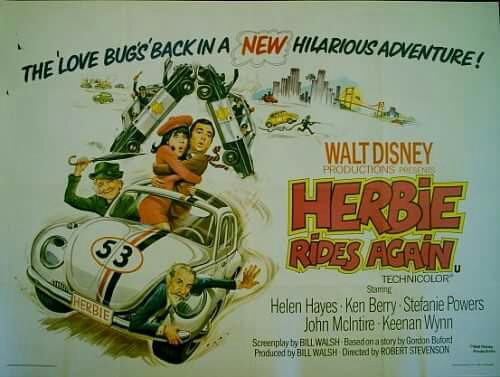
Berry also appeared in six movies including Two for Seesaw (1962), The Lively Set (1964), Hello Down There (1969), Herbie Rides Again (1974), Guardian of the Wilderness (1976), and The Cat from Outer Space (1978).

Guardian of the Wilderness was based on the life of Galen Clark who convinced Abraham Lincoln to make Yosemite Park the first public land grant. It covers a series of unusual adventures Clark had as he battled lumber companies to save wilderness land.  One of my favorite quintessential 1960s movies was Hello Down There.  Tony Randall and Janet Leigh star.  Randall is an architect who creates an underwater home.  To prove a family could live there, he cajoles his family to moving there for the summer.  His kids are in a band so they force him to take the entire band or no one.  Charlotte Rae is their housekeeper. Berry plays a rare role for him as the bad guy.

berry19

Early in his career, Ken appeared in a variety of commercials. From the mid-1970s to the mid-1980s, he was the spokesman for Kinney Shoes.

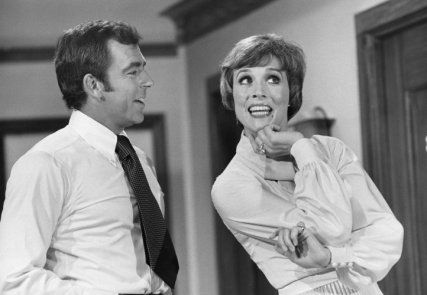
He appeared in two game shows, Hollywood Squares and Tattletales.  He also starred as himself on a variety of shows including Art Linkletter, Joey Bishop, Leslie Uggams, Jim Nabors, Julie Andrews, Sonny and Cher, Dean Martin, Laugh In, and Mike Douglas.

berry10

Berry retired in 1999. Berry loves cars and was an avid motorcyclist and camper.

Although Berry was never in a hugely successful series, he had a long and full career that any actor would be proud of.  Hopefully his well-deserved retirement has been fun and full of memories.

berry2

Fashions Fade, Style is Eternal – Yves Saint Laurent

Fashion trends tend to come and go, but series about the world of models and clothing designers come and go even quicker. Let’s look at a few of the series that centered around the fashion industry.

Love That Jill (1958).  While Love That Bob was about a photographer who did take models’ photos from time to time, Love That Jill was about the heads of two rival Manhattan model agencies (played by real life married couple Anne Jeffreys and Robert Sterling). The show only lasted three months. Jill Johnson runs a top modeling agency, putting her in direct competition with one headed by Jack Gibson. Jack is not above trying to steal her clients, but Jill, with the help of her secretary Richard (Jimmy Lydon), holds her own.  Jack also tries to steal her heart, and when they are not fighting about business, Jack and Jill find time for romancing each other. Some of the models on the show were Betty Lynn as Pearl, Polly Rose as Myrtle, Barbara Nichols as Ginger, Nancy Hadley as Melody, and Kay Elhardt as Peaches.


Diana (1973). Diana Rigg (previously Emma Peel on The Avengers) was a divorced woman seeking new life in America.  She was a fashion coordinator at Butley’s, a fashionable Fifth Avenue department store, where she was in charge of merchandising and advertising. Her brother has rented an apartment for her, but numerous other people seem to have keys to it as well which leads to some interesting situations. Some of the other characters included commercial model Holly Green (Carol Androsky), Butley’s president Norman Brodnik (David Sheiner), Brodnik’s wife Norma (Barbara Barrie), copywriter and office mate Howard Tolbrook (Richard B . Shull), and window dresser Marshall Tyler (Robert Moore). After four months, Diana switched jobs when her series was cancelled.


Needles and Pins (1973). This show was set in New York’s garment district. Nathan Davidson (Norman Fell) owned the Lorelei Fashion House which created women’s clothing. His brother and partner was Harry (Louis Nye) and their designer was Wendy (Deidre Lenihan) who came from Nebraska. Other characters included Sonia the bookkeeper (Sandra Deel), Charlie, a salesman (Bernie Kopell), Max a fabric cutter (Larry Gelman), Myron the patternmaker (Alex Henteloff), and Julius Singer (Milton Selzer) who was their competition in the industry. Apparently, the cast had a right to be on needles and pins because the show only lasted half a season.

fashion5


Veronica’s Closet (1997-2000).  Veronica is the best romance expert around. Unfortunately, her expertise only works for others. If the details about this show and its characters seem confusing to you, you are not alone.

Veronica Chase (Kirstie Alley) owns a lingerie company called Veronica’s Closet. After divorcing her husband of many years (after discovering that he has been cheating on her), she throws herself into her work. She is aided by her best friend, Olive (Kathy Najimy); Josh (Wallace Langham), her secretary whom everybody says is gay but he says he is not; and Leo (Daryl Mitchell) and Perry (Dan Cortese), two other employees.

Ok, get ready to pay attention. At the end of the first season, she took in a partner who died and the dead woman’s inept son took control of the company, wrecking it. In the next season, Alec Bilson, her previous partner’s ex-husband, bought the company from his stepson and decided to work with Veronica, or Ronnie as she is called. And while she didn’t like the arrangement, she liked him. In the third season, after Ronnie and Alec had a fight, he left abruptly and died in an accident, but before he did he married a girl named June who inherited his fortune which included Veronica’s Closet, and she drove Ronnie up the wall.

Apparently, the network felt there were too many fatal accidents and cut the show before another character was killed. While this show lasted three seasons, it actually was almost like three different series.


Just Shoot Me (1997-2003). Hot-tempered journalist Maya Gallo (Laura San Giancomo) got herself fired from yet another job when she made an anchorwoman cry on the air with some gag copy on the teleprompter. Unable to find a job anywhere else and facing eviction, she is forced to go work for Blush, her father’s (Jack Gallo played by George Segal) fashion magazine. Maya’s father was a workaholic while she was growing up and has been divorced four times.  Their time working together provides them the opportunity to heal their relationship, and Jack eventually turns over the company to his daughter. Personality conflicts quickly ensue with high-strung ex-model who can’t accept the fact that she has aged and her fans have forgotten her, Nina van Horn (Wendie Malick), philandering photographer Elliot DiMauro (Enrico Colantoni), and wise-guy secretary Dennis Finch (David Spade).

This show won its time slot most seasons which is amazing because the network moved it around quite often.  The first six episodes were shown in one month.  The next season it was given a great schedule on Thursday night between Friends and Seinfeld.  When Seinfeld ended its show, Just Shoot Me was moved to Tuesday. For the fifth season, it was moved back to Thursdays between Will & Grace and ER where it remained for two years, getting high ratings. However, for the seventh season, several characters left the show, and it once again aired on Tuesdays. The ratings never recovered and it was cancelled.


Ugly Betty (2006-2010). This show was based on a Colombian telenovela, “Yo soy Betty, la fea” published in 1999. A young and wise woman named Betty Suarez (America Ferrera), from Queens, goes on a journey to find her inner beauty. The only problem is that it’s hard for an unattractive woman to find her beauty surrounded by tall skinny models at a fashion magazine, but Betty doesn’t let this stop her or her positive attitude towards her work.

When publishing mogul Bradford Meade puts his son Daniel (Eric Mabius) in charge of his Mode magazine, he hires Betty to be Daniel’s new assistant — mostly because he knows that she may be the only woman in Manhattan with whom the younger man won’t sleep. Betty’s hard work and determination earn Daniel’s respect, as she helps him find his way through hurdles of the fashion industry. Tony Plana, Ana Ortiz, Becki Newton, Michael Urie, Mark Indelicato, Vanessa Williams, and Judith Light also play characters on the show.

This is the other fashion show that made it more than three years, and it was also moved around the schedule.  The first three years it had its highest ratings on Thursday nights. When ratings dropped after season 3, it was moved to Fridays.  Fans protested and the show moved to Wednesdays airing with Modern Family and Cougar Town, but it never recovered its previous high ratings and was cancelled. In the finale, Betty accepts a job in London, and Daniel leaves the magazine.


Lipstick Jungle (2008).  A look at the lives of Nico Reilly, the editor-in-chief of Bonfire magazine (Kim Raver), Wendy Healy, former president of Parador Pictures (Brooke Shields), and Victory Ford, a fashion designer (Lindsay Price) — three of “New York’s 50 Most Powerful Women,” according to The New York Post.  I’m not saying they are shallow, but apparently there was not much to look at because the show only lasted 20 episodes. Andrew McCarthy, Paul Blackthorne, and Robert Buckley also were part of the regular cast.

This was another series based on a novel, Lipstick Jungle by Candace Bushnell. Although the show debuted during the year a major writer’s strike was taking place, it never picked up any substantial ratings and was cancelled.


That Girl (1966-1971). While That Girl was not technically about on the fashion industry, Anne Marie is known for her incredible wardrobe. In a blog about fashion series, I felt it had to be included.

A young girl who moves to New York City to try to make it as an actress may not sound like revolutionary television, but this was 1966, and Marlo Thomas was an “unlikely pioneer in a flip coif and a Technicolor minidress.” She said this was the first show where a single, perky career gal learned to navigate the big city. She based the concept on her life about a girl who graduated from college, whose parents wanted her to get married while she wants to be an actress. Fans watched the show to see how Ann Marie would fare in the big city, but they also tuned in to see what she was wearing. Thomas personally chose her entire wardrobe for the show and wore many  current designers’ creations. One of the designers she chose was Marilyn Lewis.

Six years before the show debuted, Lewis and her husband Harry ran a restaurant chain called Hamburger Hamlet. She decided to launch a ready-to-wear line of clothing. She could not sew but wanted to design quality apparel. She named her collection Cardinali, and Saks Fifth Avenue and Bergdorf Goodman couldn’t get enough of her designs. Marlo Thomas, along with other celebrities such as Nancy Reagan, Betsy Bloomingdale, and Dyan Cannon also bought her outfits. A feature on Marilyn Lewis provided the following details about the designer in 2007:

As a girl growing up in Cleveland, Lewis invented the name Cardinali in homage to her absent father. She was told that he was living in Italy, and at 5 she rechristened herself Cardinali. In her first year of designing, Lewis created a 35-piece collection of suits, dresses and gowns. Her clothes, which Cameron Silver, who owns the Los Angeles vintage boutique Decades, will be showcasing in early June, are a mix of hard and soft: a tweed maxi skirt paired with a floral chiffon blouse, a wool jersey turtleneck halter gown with a plunging back. And Cardinali loved accouterment — a wool bouclé winter coat has a bag and hat to match; a floaty summer day dress comes with its own attached scarf. There is a metallic jumpsuit that Dyan Cannon wore on her first date with Cary Grant, and there is a demure silk gown with ruffles that Nancy Reagan ordered in red. Perhaps Lewis’s most famous designs were worn by Marlo Thomas in the TV show “That Girl.” The chiffon floral dress with its matching frilly umbrella that Thomas twirls during the opening credits says everything about being young and enthralled by Manhattan.

The Cardinali archive is currently stored in the Lewises’ condominium near Century City. Marilyn and Harry rent out their home in Beverly Hills and live in the 5,000-square-foot penthouse, with its breathtaking views of Los Angeles. The condo is decorated with Hamlet memorabilia, modern art and posters from Marilyn’s third career, as a movie producer. Her documentary, “Superstar: The Life and Times of Andy Warhol,” was critically acclaimed, and “The Passion of Ayn Rand,” which starred Helen Mirren, was on Showtime in 1998; Mirren won an Emmy for her performance. “As usual, when I became a producer, my husband thought I was crazy,” Lewis said in her apartment, as she presented each piece of Cardinali. “As usual, I never had doubt, but Harry always has the doubt for me. Luckily he trusts me. I could never have done any of this alone. Harry was always my producer.” She paused. “And I still can’t figure him out after all these years.”


With the fashion industry such an influence in our pop culture, it’s hard to believe that there have been only a few sitcoms about the design and modeling business. Although, I must admit that while I’m writing this, I realize that the only one of these shows I watched before I researched this blog was That Girl. Maybe the fashion business is too cut-throat to be funny, or maybe the fashion trends would date the show too much.  While That Girl was one of my favorite shows, I will also admit that one of the reasons I watch today is to watch all those adorable outfits Anne Marie wears.

fashion16

Not Everything is Black or White

As Black History Month comes to an end, I wanted to look at the early years of television featuring African American characters.  I don’t know if young people today realize how much culture has changed in the past fifty years.  While there are a lot of negative changes that have occurred in the movie and television industry, there have been a lot of positive changes as well.

It’s hard for young adults to realize today how different things are.  When I was growing up in the sixties, married couples on television had twin beds; you could not say “pregnant” on the air; black people and white people were not friends, and certainly did not date or marry; the “jobs wanted” ads in the newspaper were divided into jobs for men and jobs for women; and if a married woman wanted to join the armed forces, her husband or father had to sign a letter giving his approval.

Sometimes we get so caught up in how far we are from the journey’s end, we forget to appreciate how far we have traveled.  Looking at the current television schedule we see a variety of shows about capable women.  While certainly racism and gender discrimination exist, most people don’t think twice about whether a lead character is a man or a woman; is black, white, or Asian; or single or married.

Just a quick review of shows on the air reveal complex, intelligent characters who are African American.  We see this in Black-ish, This Is Us, Empire, Scandal, House of Lies, Last Man Standing, and Gray’s Anatomy, just to name a few.  This was far from the reality of early television.

We often think of that era as the golden age of television, but honestly, it was the white age of television.

In 1950, two shows debuted with main characters who were black:  Amos ‘N Andy and Beulah.  A radio transplant, Amos ‘N Andy dealt mostly with Kingfish’s schemes to gain wealth, often at the expense of his friends. Beulah also got its start on radio where she was a character in Fibber McGee and Molly.    She worked for a well-to-do middle class white couple with one son.  Both of these shows were demeaning and stereotypical.  In 1953, they were both yanked from the air due to NAACP protests.

Unfortunately, it would take almost 20 years before another show would feature a black character as a star.  In 1968, Julia debuted.  Julia, played by Diahann Carroll, was a black woman with a young son Corey (Marc Copage).  Her husband is killed in Vietnam and she moves to LA to start a new life in her nursing career.  Like Tom Corbett on The Courtship of Eddie’s Father, she is raising a son; like Doris Day she is a working mother; and like Ann Marie on That Girl, she has a fabulous wardrobe.  She is hired at Astrospace Industries, an industrial-health office where she works with Dr. Chegley (Lloyd Nolan).  Her life is normal.  She goes to work, takes care of her son, and goes on a few dates, but the concept of an African American, or a woman, starring in a show as the sole breadwinner, intelligent and fashionable, was not normal for the times.  The show was on for three seasons until 1971.

Julia was a controversial show at the time, but it scored high in the ratings and became a popular series.  I think it gets a lot of unfair criticism today.  The show gets complaints because during the time of the Watts riots, sit-ins, and so much racial unrest, it portrayed Julia living a fairly normal life.  I think people forget how groundbreaking it was to have a working woman or a black character star in a show.  I think the fact that she was able to live a “normal” life gives even more credit to not bowing to stereotypes of the late sixties. It’s like criticizing someone who is just learning to walk for not running and doing handstands.  They might be small steps, but they are steps going forward. I am one of those people who actually prefer not to see too much “real life” in sitcoms.  Honestly, I watch them to escape real life.

I also wanted to mention a few other shows that were featuring black characters in their cast during the time Julia was on the air: Hogan’s Heroes, The Mary Tyler Moore Show, and Barney Miller.

Hogan’s Heroes had a diverse cast, including Ivan Dixon as Sgt. James Kinchloe, striving to stay one step ahead of the Nazis.  The Mary Tyler Moore Show included a quirky news staff including weatherman Gordy Howard played by John Amos.  Barney Miller centered around a police department made up of personnel who each had their own dysfunctions.  One of those members was Lt. Ron Harris played by Ron Glass.  Each of these shows quietly featured black characters.  The races of any of the characters could easily have been switched during an episode and the character would not change.  It was just real people living real lives and some of them happened to be white and some black. After these creative and well-written shows, I prefer to ignore the Norman Lear era of shows.  They may have their merits, but I couldn’t stand All in the Family, Sanford and Son, Maude, or Good Times.  The Jeffersons was tolerable, but I would not choose to watch it either. In the mid-1980s, television began to get more diverse.

365

Don’t get me wrong.  Things are far from perfect in the world of television and movies, but we have made a lot of progress.  We have a lot of work to do, but just think how many choices Diahann Carroll would have today if she wanted to develop a television series. She could pick any career she wanted, including the military without anyone’s else’s approval; she could marry a white man and not sleep in twin beds; she could announce on the air she was pregnant—small steps but 5280 small steps turn into a mile. So, let’s devote one day to appreciate the hundreds of miles we have come before getting too caught up despairing about the hundred we still have to go.

Crazy Little Thing Called Love

Love is definitely in the air; whether you think it smells rancid or fragrant depends on your current relationship status.  Remember those days when everything hinged on what type of valentine your current crush gave you at the school party?  Love seemed to be the answer to all questions.  We’re going to look at some classic (and not so classic) television shows that promoted that kind of love.  Sorry, I can’t tell you if that pain you’re feeling is cupid’s arrow as it hit you or heartburn, but I can share some information with you as we learn about shows with “Love” in the title.

Love That Bob (1955). Bob Cummings played ladies’ man and photographer Bob Collins.  His widowed sister, Rosemary Decamp, and nephew (Dwayne Hickman) also lived with him. Before she moved in with the Bradys, Ann B. Davis was Schultzy, Charmaine Schultz, Bob’s assistant, who was in love with him.  Every show opened with Bob holding a camera and saying, “Hold it! I think you’re going to like this picture.” The beautiful Joi Lansing was another model who also was in love with Bob, but he was having too much fun playing the field.  When he never accepted Joi, we knew deep down in his heart, he realized that Schultzy was the one for him. While Bob couldn’t decide on only one woman, the networks couldn’t decide on only one channel for the show either.  It was on NBC Jan-May of 1955, moved to CBS for two seasons, moved back to NBC, and then finished up the last year and a half on ABC. I guess no one could remember where the show was supposed to end up after 1959, so it was cancelled. Bob was one of the first stars to play two characters in one show. Bob played himself and his grandfather Josh Collins. A decade later, Fred MacMurray would play Uncle Ferguson in addition to Steve Douglas in My Three Sons.

Love That Jill (1957). Rival managers of modeling agencies are played by real life couple Anne Jeffreys and Robert Sterling who had played the married ghosts on Topper.  I guess they spooked the network because they disappeared after three months.

loveandmarriagefeb13

Love and Marriage (1959). Now we know what Uncle Charlie really did before he moved in with My Three Sons.  He owned a music publishing company that was close to bankruptcy.  William Demerest plays a business owner who brings his daughter into the company as a partner.  She and her lawyer husband also move into his house.  She loves rock and roll; her father hates it, but it might save his company. The network shut down the agency after four months to promote family harmony.

The Many Loves of Dobie Gillis (1959). This show was based on a 1953 book and it was the first television series to feature teenagers as the main characters. I guess when Dwayne Hickman lived with Bob Collins, he picked up a lot of tips for the ladies, and as high schooler Dobie, he spent most of his time trying to find a girl to go out with and some money to pay for the date. Since his family owned a small grocery store, he was on his own for finances. Once he graduated, the show had to come up with new situations, so Dobie was in college for a couple of years as well as the army for a year. Dobie would go to the Rodin’s Thinker in the park and talk to us and himself about his love life. His best friend was beatnik and bongo player Maynard G. Krebs.  Bob Denver played this role before he went on to star in Gilligan’s Island.  He had never acted before this show; he had been a grade school teacher, and his sister, who worked for the casting department, included his name in the auditions. Super smart Zelda Gilroy was in love with Dobie.  We knew he would eventually end up with her, his own Schultzy.  She always wrinkled her nose at him and before he could stop himself he always did it back. In later years when they did two reunion movies, Dobie and Zelda were in fact married.  Sheila James, who played Zelda, became a California senator.

During the first season, Dobie thought he was in love with Thalia Meninger played by Tuesday Weld.  Thalia only liked Dobie when he had money which was not often. In real life they did not get along, and she left after the first season. Another character who disappeared after the first season was his brother Davey Gillis who was played by Hickman’s real brother, Darryl. Dobie also suffered through Milton Armitage played by Warren Beatty and then Chatsworth Osborne Jr. (Steve Franken) who were his arrogant, wealthy competition. Some of Dobie’s many girlfriends included Marlo Thomas (who became That Girl), Sally Kellerman (who was Hot Lips in the M*A*S*H movie), Ellen Burstyn (starred in many movies), Barbara Bain (who would be in Mission Impossible), and Yvonne Craig (before she was Bat Girl). Two interesting things I learned about this show was that DC Comics created a comic book series of 26 issues about the kids from 1960-1964. Also this show inspired the Scooby Doo Gang in 1969. Fred was based on Dobie, Velma on Zelda, Daphne on Thalia, and Shaggy on Maynard. Garry Marshall also reported that this was one of his main influences for his creation of the show Happy Days. After four years, I guess these kids were too innocent to handle all the crazy situations coming in the sixties and the show ended but has appeared in reruns often since it left the air.

Peter Loves Mary (1960). This couple, played by Peter Lind Hayes and Mary Healy, were married in real life. They play a show business couple who moved to Connecticut.  Luckily they have a housekeeper played by one of my all-time favorites Bea Benaderet who takes care of the house and children. Opposite the Green Acres viewpoint, Mary wants life in suburbia while Peter loves the city. The network didn’t want to weigh in on the argument so they took the show off the air after the first season.

Love On a Rooftop (1966). Judy Carne (pre Laugh-In days) and Peter Duel are a young married couple, living in San Francisco. He is an apprentice architect and she’s an art student, who gave up her dad’s money for love. Rich Little played their neighbor who designed restaurant menus, among other jobs. It was cancelled after one season.  Oddly, in the summer of 1971 it aired as a rerun show but never aired again.

To Rome with Love (1969). John Forsythe tries his hand in another sitcom.  In this one, he plays a widower who has accepted a job at an international school in Rome, and he heads for Europe with his three daughters.  His sister comes along the first season, mainly to try to talk them into going back home to Iowa.  For the second season, they gave her a one-way ticket home and brought Walter Brennan in as Forsythe’s father-in-law. The family lives in Mama Vitale’s boarding house.  After the second season, they all got air fare home and the show was done. Don Fedderson produced this show, and in the second season they had two cross-over episodes, one with the cast of Family Affair and one with Uncle Charlie, Robbie and Katie from My Three Sons.

Bridget Loves Bernie (1972). Bridget, played by Meredith Baxter, marries Bernie, played by David Birney.  The only problem is that she’s Catholic and he’s Jewish.  This would not even be noticed in today’s world, but in 1972 it caused quite a commotion. Her parents were wealthy and Irish.  His parents owned a deli and the couple lived above it. The ratings were very good–the fifth highest rated show, but they were cancelled after the first season anyway. It was the highest rated show to ever be cancelled, and the network finally caved into the pressure of public protests for having an inter-religious marriage. One fun fact is the Meredith Baxter and David Birney married in real life after this show was over.  However, that was before she came out of the closet, which created another mixed marriage . . .

loveneighborfeb13

Love Thy Neighbor (1973). This show was a summer replacement in the days of All in the Family.  Charlie Wilson, a shop steward at Turner Electronics, lives in LA. When new neighbors move in, not only are they black, but the new guy is hired as an efficiency expert at Turner.  The show explored how two couples of different races become friends.  The white couple was played by Ron Masak and Joyce Bulifant.  The black couple was played by Janet MacLachlan and Harrison Page.  The network didn’t love any of them because they sent them packing after 11 episodes.

Loves Me, Loves Me Not (1976). Jane, played by Susan Dey, fresh from the Partridge Family, is a teacher.  Dick (Kip Gilman) is a reporter.  They have a couple of dates with mixed results and aren’t sure if they like each other or not or should continue dating.  Dick’s boss and his wife are also characters on the show.  Apparently CBS decided it loved them not because they were cancelled after one month.

Love, Sidney (1981). If the network thought they had problems when Bridget loved Bernie, they really stirred up a hornet’s nest with this show.  Based on a movie, Sidney Shore, Tony Randall was the first person to play an openly gay character.  Sidney is an adman and lives with a young woman and her daughter, played by Swoosie Kurtz and Kalena Kiff. There were some heart-warming stories including two different episodes when both Sidney and Kurtz’s character had to make peace with less-than-perfect parents. Once again, the network gave into public dissatisfaction and cancelled the show midway through season 2.

Joanie Loves Chachi (1981). This show was a mid-season replacement.  Chachi (Scott Baio) left Milwaukee and Happy Days and moved with his parents (Ellen Travolta and Al Molinaro who had owned Arnolds’s malt shop) to Chicago.  He sang in a restaurant his family owned.  Because Joanie (Erin Moran) loved Chachi, she convinced her parents to let her go to Northwestern to be a nurse, but she spent more time singing with Chachi. Most of the shows involved one of them being jealous of the other and ending the fight with a song. In the first season this new show followed Happy Days and was a huge success. The second season it moved to Thursday and bombed in the ratings. The network sent both Joanie and Chachi back to Milwaukee after the second season where they continued on Happy Days until it went off the air in 1984.

Everybody Loves Raymond (1996). Ray Romano played sports columnist Ray Barrone.  He lived with his wife (Patricia Heaton) and kids, right across the street from his overbearing mother (Doris Roberts), cynical father (Peter Boyle), and jealous older brother (Brad Garrett). No one had any privacy on this street, but there were a lot of poignant episodes. We all knew everybody loved Raymond, but they also loved each other.  In 2004 after 9 seasons, the network decided not everybody loved Raymond, just most people, and they cancelled their sports subscription.

Image result for image of love

If you’re not crazy about love right now, apparently you’re in good company because the majority of these shows were cancelled within a year.  If you’re a hopeless romantic, you’re probably watching Everybody Loves Raymond on Nickelodeon. Happy Valentine’s Day, or not.

I’ll Take Paul Lynde for the Win

pl1

Today we are talking about the career of Paul Lynde.  Paul Lynde was an icon when I was growing up; he was probably best known at that time as the center Hollywood Square, the voice of Templeton the Rat in Charlotte’s Web, and Uncle Arthur on Bewitched.  His life encompasses both a unique and successful career as a comedian loved by many fans and the all-too-common saga of a star’s life ruined by drugs and alcohol. Many of the things you read about Paul Lynde concerning his behavior and cruel things he said to others are disheartening to a fan, but I learned that the characters I loved growing up (and continue to as an adult) are the characters, not the actors and actresses behind them.  With a few exceptions such as Fred MacMurray, Jimmy Stewart, or Cary Grant, most stars don’t live up to our illusions of them. Although truth be told, if someone studied our entire lives and wrote about them, there are probably parts of them we would not want the world to learn about either. I wanted to talk about Paul Lynde’s career, because although he was extremely well known during my youth, most young adults today probably have no idea who he is.

Paul was born in Mount Vernon, Ohio, one of six children.  His father was a local police officer and for a time, the family lived above the jail when his father was the sheriff of the jail.  Like many youngsters growing up in the 20s and 30s, he became interested in acting when he went to the movies  with his mother. The first movie he remembered was Ben Hur.  That interest propelled him to Northwestern University where he studied drama.  After school, he relocated to New York City where he worked as a stand-up comedian and then received a part in a Broadway show, “New Faces of 1952.” Alice Ghostley, who would be featured on Bewitched was also in the show. In 1963 he recorded a comedy album. From then on he was a popular guest, television star, and movie celebrity. His unique delivery of his sarcastic one-liners made him a popular entertainer.  There is not a lot of difference between the role of Uncle Arthur and his humor and delivery on Hollywood Squares.

He starred in several television series including Stanley with Buddy Hackett and Carol Burnett where he played a hotel owner in 1956-57 and The Pruitts of Southhampton with Phyllis Diller in 1967. From 1965-71, he was on Bewitched where he played Harold Harold a driving instructor the first season and then became a regular in the role of Uncle Arthur, Endora’s brother.  Surprisingly, the character of Arthur only appeared in ten episodes of the series. After Bewitched, he starred in The Paul Lynde Show where he played an attorney with two daughters and a liberal-minded son-in-law. Stiller and Meara were also on the show which was done to satisfy his contract with ABC in place of the ninth season of Bewitched. The show was up against The Carol Burnett Show and Adam-12 so it was cancelled, but he was nominated for a Best Actor Golden Globe award. His last starring role in television was in New Temperatures Rising where he played a penny-pinching doctor running a hospital owned by his mother.

Paul appeared on Hollywood Squares for 15 years (801 episodes).  In addition to that game show, he accumulated 80 credits playing himself on a variety of shows including Donny and Marie, Password, The 10,000 Dollar Pyramid, Dean Martin Roasts, The Carol Burnett Show, The Mike Douglas Show, and on several Paul Lynde Comedy Hour specials.

He appeared on a variety of television shows – 33 in all.  In addition to those he starred in, he was also in The Phil Silvers Show, The Patty Duke Show, The Jack Benny Show, The Munsters, Gidget, F-Troop, That Girl, I Dream of Jeannie, The Mothers-in-Law, The Flying Nun, and three episodes of Love American Style.  Had he lived a few years longer, I’m sure we would have seen him cruising the ocean on The Love Boat.

In addition to his television work, he also appeared in 18 movies between 1956 and 1975. He and Dick Van Dyke were the only Broadway performers from Bye Bye Birdie to be cast in the movie version.  He was also in Beach Blanket Bingo, and two of my favorites, Send Me No Flowers and The Glass Bottom Boat, both Doris Day movies.

Although he was gay, he did not discuss his sexual orientation, and the media respectfully did not report on it either.  In 1965, his partner and companion Bing Davidson died. They had been out drinking and Bing thought it would be funny to pretend to dangle from a hotel balcony but fell to his death.  Whether this exacerbated his alcohol and drug problems isn’t known, but Lynde’s health suffered from his addictions and he was arrested for public intoxication frequently. In 1980 he went through a successful rehabilitation, becoming sober and drug free.  Unfortunately, the damage that was done to his body was extensive, and he died from a heart attack in January of 1982 at age 55.

Some other interesting facts are that he was friends with Elizabeth Montgomery and her husband William Asher, he purchased Errol Flynn’s Hollywood Mansion, he was a dog lover, and he was one person who was able to appear on The Ed Sullivan Show while singing a song from Bye Bye Birdie about being on The Ed Sullivan Show. He was also a chef and considered opening a restaurant. To see some of his recipes, visit www.paullynde.info.

pl9

To truly appreciate Lynde’s comedic personality, here are a few lines from Bewitched and Hollywood Squares.

To Endora, his sister, on  Bewitched:  “Endora when I think of you as a blood relation, I long for a transfusion.”

On Bewitched, telling a story, “Then I spent the summer hunting lions with the British expedition. One morning I shot a lion in my pajamas. Now, what he was doing in my pajamas, I’ll never know.”

Answers on Hollywood Squares:

Peter Marshall: According to Ann Landers, what are two things you should never do in bed?

Paul Lynde: Point and laugh.


Peter Marshall: According to the IRS, out of every 10 Americans audited, how many end up paying more taxes?

Paul Lynde: 11.


Before a cow will give you any milk, she has to have something very important. What?

Paul Lynde: An engagement ring


Peter Marshall: Fred Astaire says, his mother has been trying to get him to do this since he was 35. But he hasn’t done it and says he won’t do it until he’s ready. Do what?

Paul Lynde: Move out of the house!

pl14

Perhaps the award that best sums up Lynde’s career was bestowed upon him in 1976 when he received the Entertainer of the Year Emmy for the funniest man of the year. If you don’t know much about Paul Lynde, check out some of the youtube videos from Hollywood Squares or watch a few of his episodes from Bewitched. Although not as well known today, his influence on present-day performers is wide spread and his career deserves to be remembered and celebrated.

Remembering William Christopher

I wanted to pay a tribute to William Christopher, who passed away December 31, 2016, exactly one year after Wayne Rogers, one of his co-workers on the show M*A*S*H.

wc2

Christopher was born in Evanston, Illinois October 20, 1932. Growing up in that area, he attended New Trier High School in Winnetka, the same high school as Rock Hudson.  His family’s genealogy apparently included Paul Revere. Ironically, his grandmother hoped he would go into the ministry like his grandfather who was the founder of the First Methodist Church in Chicago, and in some ways, he did. Christopher went to college at Wesleyan University in Middletown, Connecticut, graduating with a BA in Drama, focusing on Greek Literature. (In the last episode of M*A*S*H, Father Mulcahy wears a Wesleyan sweatshirt.) He participated in fencing, soccer, and the glee club in college.  Connecticut was also where he met his wife Barbara on a blind date.  They married in 1957 and later adopted twin boys, John and Ned.

wc19

Building on his theater experience which began with him playing a groundhog in the third grade, he moved to New York.  Eventually he made his Broadway debut in Beyond the Fringe where he worked with Peter Cook and Dudley Moore. Not long after, he moved to California to continue acting.

He began his work in television in 1965 appearing in 12 O’Clock High. For the next seven years, he worked regularly appearing in Hank in 1965, The Patty Duke Show in 1966, 2 appearances in The Andy Griffith Show in 1965 and 1966, Death Valley Days in 1966, four separate episodes of Hogan’s Heroes from 1965-68, Gomer Pyle where he was in 16 episodes from 1965-8, That Girl in two episodes as Chippy Dolan, The Virginian in 1971, Alias Smith and Jones in 1971, Insight in 1972, and 4 shows of Nichols from 1971-2.

Along with his television roles, he appeared on the big screen during this period. His first movie was Fortune Cookie in 1966 where he played an intern, The Perils of Pauline in 1967 as a doctor, The Private Navy of Sargent O’ Farrell in 1968 as Private Jake Schultz, The Shakiest Gun in the West in 1968 as a hotel manager, and With Six You Get Egg Roll in 1968. With Six You Get Egg Roll was Doris Day’s last movie before she moved into television and then retired. After playing so many military and religious roles, this one was out of character as he played a hippie Zip Cloud along with future M*A*S*H member Jamie Farr.wc6

In 1972 he got his big break, being cast as Father Mulcahy in the television version of M*A*S*H. George Morgan, who was cast in the pilot, was replaced and Christopher received the role. Morgan appeared in four series and three movies before the pilot, but only two other series after. M*A*S*H was on the air from 1972-1983, and Christopher was in 213 of the 251 episodes. Fans loved the goodness Father Mulcahy displayed, along with his humanness when the inhumanity of war tried his patience and frustrated him. Some of his best lines from the show included:

“This isn’t one of my sermons; I expect you to listen.”

“Klinger, how’d you like the last rites…and a few lefts!”

“I think the world of Colonel Potter. He’s a good Christian – yet hardly dull at all.”

“Remember what the good book says: Love thy neighbor, or I’ll punch your lights out!”

While he was part of the M*A*S*H cast, he appeared on other series including Columbo and Movin’ On in 1974, Lucas Tanner, Karen, and Good Times in 1975. Like so many of the stars we meet in this blog, he was on The Love Boat in four episodes from 1981-4. He appeared again on the big screen in the movie Hearts of the West in 1975 as a bank teller. He also made a TV movie, For the Love of It in 1980.

wc15

In 1983, the series After MASH debuted, and Christopher reprised his role of Father Mulcahy along with Harry Morgan as Dr. Sherman Potter, Jamie Farr as Klinger and Gary Burghoff as Radar. The show was not a great success and ended after 30 episodes.

wc5

Christopher never had another recurring role in a television show, but he continued to work in the business appearing in Murder She Wrote in 1985, CBS Summer Playhouse in 1987, The Smurfs 6 times from 1984-88, The New WKRP in Cincinnati in 1993, Lois and Clark: Adventures of Superman in 1997, Diagnosis Murder, Team Knight Rider, and Mad About You in 1998. His last television role was in 11 episodes of Days of Our Lives where he played a priest. In 1987 he made his second TV movie, The Little Troll Prince.

During the years of 1975-2011 he also appeared on several game shows, talk shows, and M*A*S*H-related specials and reunions. In 1994 he made his last movie, Heaven Sent.

wc9

He continued his love of theater touring the country with Jamie Farr in The Odd Couple in the mid-1990s. He also toured with the Church Basement Ladies in 2008-9.

Christopher was generous with his time, helping to raise money for the National Autistic Society (NAS).  The organization was near and dear to his heart because his son Ned suffers from autism. He and his wife wrote a book in 1985, Mixed Blessings, about their experience with their son.


William Christopher is revealed to be a very nice man liked by everyone who worked with him.  He was married to Barbara for the rest of his life, was a good family man, generous in working with the NAS, and had a full career.

After Christopher died, Alan Alda tweeted “His pals from #MASH miss Bill powerfully. His kind strength, his grace and gentle humor weren’t acted. They were Bill.”

wc1

Jamie Farr summed it up best in his tribute to his friend and co-worker:

We are all devastated by our beloved Bill’s passing. I have known him for over 50 years. During the 1960s we lived in the same neighborhood in Studio City. My Joy and I would see him and his wife Barbara going for walks as we were going for walks. Bill and I did the very last Doris Day movie together, “With Six You Get Egg Roll.” We were both cast in the tv series “M*A*SH” at almost the same time. He was a gentle soul and in my opinion probably the most underrated actor of all of us on the show. He was wonderful. During between set ups for camera angles Bill would read his Homeric book in Homeric Greek. He was a real egg head. He and his Barbara traveled the world and he would try to learn the language of the countries they were going to visit. He went to Egypt one year and tried his Arabic on me. He was better than I was. We used to imitate Bill on the set using his high pitched voice. One time he came down with hepatitis and when he returned to the series we had his actor’s chair painted yellow. Bill and I did a National Tour of the play “The Odd Couple” with Bill portraying Felix and me doing Oscar, Bill was at one time on the Board of the Devereaux Foundation for Autistic Children. It was a real honor to have had him and Barbara as friends and a great honor to have shared the tv screen with this gracious, talented and charming soul. May his memory be eternal. Rest in Peace Father Mulcahy.

1917 Was A Very Good Year

This week I was inspired by the blog “Once upon a screen . . .” to take a look at television pioneers who were born in 1917. (For some great articles on pop culture, movies, and television, check out her blog at aurorasginjoint.com.) Let’s get to know 17 of the stars who helped shape the direction of television during the golden age.

Herbert Anderson. Best known for his role as Henry Mitchell on Dennis the Menace, Anderson began his career making movies.  He transitioned to television in 1953, appearing on 61 shows over the years.  He appeared in episodes on such shows as Gunsmoke, Petticoat Junction, Batman, I Dream of Jeannie, Man from U.N.C.L.E., My Three Sons, Bewitched, and The Waltons.  One of my favorites is the first season of The Brady Bunch.  The kids are sick and both parents call a doctor.  The girls were used to a woman played by Marion Ross while the boys always had a man, Anderson.  After weighing factors to pick one of them, the family decides to keep both doctors. He died from a heart attack in 1994.

Carl Ballantine. Ballantine began his career as a magician and inspired many famous magicians since.  He began working in Las Vegas and on television as a magician.  Eventually he transferred to movie roles and after appearing in McHale’s Navy on the big screen, took on the same role of Lester Gruber on the television series. He went on to appear on 33 additional tv shows including That Girl, Laverne and Shirley, Trapper John MD, and Night Court. He passed away at his home in 2009.

bellamy1

Earl Bellamy. Earl Bellamy directed episodes for 101 different television shows.  He is best known for The Lone Ranger and The Tales of Wells Fargo.  He directed 82 episodes for Bachelor Father, one of my all-time favorite sitcoms.  In the 1960s he specialized in sitcoms including That Girl, The Brady Bunch, The Partridge Family, and My Three Sons while the 1970s saw him transition to dramas including Marcus Welby MD, The FBI, Medical Center, and Eight is Enough. In 2003 he passed away from a heart attack.

Ernest Borgnine.  Best known of his Oscar-winning role of Marty in 1955, Ernest enlisted in the Navy in 1935 until 1941.  In 1942 he re-enlisted and served until 1945.  After doing some factory work, he decided to go to school to study acting and began his career on Broadway.  He was also in the movie McHale’s Navy and went on to tackle the role in the television series.  He loved working with Tim Conway and in later years they did the voices for Mermaid Man and Barnacle Boy in SpongeBob SquarePants. He appeared in 47 different shows over the years, including the series Airwolf which he starred in. Borgnine appeared in the final episode of ER which he won an Emmy for. He was married five times, including a 32-day marriage to Ethel Merman.  His last marriage to Tova lasted 39 years. He died of kidney failure in 2012.

Raymond Burr. Best known as Perry Mason, Burr started his career on Broadway in the 1940s and then appeared in 50 films from 1946-1957. In 1956 he auditioned for the role of Hamilton Burger, the DA in Perry Mason.  He was told he could have the starring role if he lost about 60 pounds which he accomplished. He later starred in Ironside, another crime drama and appeared on a variety of other shows.  Burr had many interests including raising and cross-breeding orchids; collecting wine, art, stamps and sea shells; reading; and breeding dogs.  He was extremely generous, giving away much of his money over the years.  He passed away from cancer in 1993.

Phyllis Diller. Known for her wild hair and clothing, Diller was one of the pioneering stand-up female comedians.  She appeared in films in the 1940s, worked in radio in the 1950s, and began her stand-up career in 1955. Her first television appearance was in You Bet Your Life.  She appeared in 40 shows including Batman, CHIPs, Full House, and The Drew Carey Show.  She had her own show titled The Pruitts of Southampton, and in reruns The Phyllis Diller Show that ran from 1966-67.  She recorded comedy albums in the 1960s, wrote several books during her career, was an accomplished pianist, performing with symphony orchestras across the US and taught herself painting which she continued throughout the 1960s and 70s. Her husband Fang was not real, but she used him in her comedy routines.  She died of natural causes in 2012. My first memory of Diller was in the movie Boy Did I Dial a Wrong Number with Bob Hope which my parents took me to at the drive in.

Ross Elliott. A prolific actor on stage, film, and television, Elliott appeared in 184 different shows from sitcoms to westerns to medial dramas, all between 1951 and 1983. He passed away from cancer in 1999.

June Foray.  One of the greatest voice actors ever, Foray has been active in the industry since she had her own radio show.  She did off-air voices for many sitcoms including I Love Lucy, Father Knows Best, Jack Benny, Rawhide, Get Smart, Lost In Space, and Bewitched.  She also appeared in more than 76 animated series.  She is perhaps best known as Rocky in Rocky and Bullwinkle and as Cindy Lou Who in How the Grinch Stole Christmas and Karen and other voices in Frosty the Snowman. Foray is still alive today.

Zsa Zsa Gabor.  Unlike her sister Eva who became known as Lisa Douglas on Green Acres, Zsa Zsa seemed to make a career out of playing herself.  Of the 80 appearances she made in film and television, 20 of them were as herself. She was a true celebrity.  Crowned Miss Hungary in 1936, she came to the US in 1941 and began her career.  She was known for her extravagant lifestyle and many marriages: 9 with 7 divorces (including one to Conrad Hilton) and 1 annulment.

Sid Melton.  Known to most viewers today as handyman Alf Monroe on Green Acres, Melton began as a film star and went on to appear in 71 shows including Topper, Bachelor Father, Make Room for Daddy, That Girl, Petticoat Junction, I Dream of Jeannie, and Empty Nest. He died from pneumonia in 2011.

Alice Pearce. Although her career was cut short due to illness, I included Alice Pearce because her role as Gladys Kravitz in so memorable.  After spending her childhood in Europe, Pearce started on Broadway and after appearing in On the Town, she was brought to Hollywood to reprise her role in the movie version. She began specializing in comedy in the 1940s. In 1964 she turned down the role of Grandmama in The Addams Family and shortly after was offered the role of Gladys in Bewitched. She was already diagnosed with ovarian cancer when she began her role but didn’t tell anyone and was able to act for two seasons before she passed away from the disease. She received an Emmy for her work on Bewitched.

Gene Rayburn. One of the kings of game shows, Rayburn began his career as an actor, taking over for Dick Van Dyke in Bye Bye Birdie when Van Dyke began his television show. While he was on numerous game shows as a panelist or host over the years, Rayburn is best known for Match Game which first ran from 1962-69. It was revived again in 1973 and took several formats in the following years.  He died from heart failure in 1999.

Isabel Sanford. Best known as Louise Jefferson, she grew up in Harlem and performed in amateur nights at the Apollo Theatre. Her Broadway debut was in 1965.  After appearing as a maid in Guess Who’s Coming to Dinner, she was cast by Norman Lear in All in the Family which led to the series The Jeffersons.  When the show ended in 1985, she appeared in a variety of other shows until 2002.  She passed away from natural causes in 2004.

Sidney Sheldon.  A writer and producer, Sheldon created The Patty Duke Show, I Dream of Jeannie, and Hart to Hart, writing many of the scripts for all three series. After he turned 50, he began a career writing romantic suspense novels.  He died from pneumonia in 2007.

Robert Sterling. A clothing salesman before getting into acting, Sterling was best known for his role as George Kerby in Topper from 1953-55.  His wife, Anne Jeffreys played his wife in the show. From 1943-49 he was married to Ann Sothern. He appeared in 36 shows between 1951 and 1986. He passed away from natural causes in 2006.

Jesse White.  While White was a hard-working character actor, he is best known for his commercials as the Maytag repairman from 1967-88. After appearing in films for many years, he transitioned to television in the 1950s.  His daughter Carole Ita White also became an actress best known for Laverne and Shirley. White appeared in 113 shows, never receiving a regular series.

Jane Wyman. Wyman began working at Warner Brothers at age 16, claiming to be 19. Although she was a successful film star and began in television in 1955 with her own show, Jane Wyman Presents Fireside Theater, she is probably best known for her role on Falcon’s Crest from 1981-90 and her marriage to Ronald Reagan. She died in her sleep from natural causes in 2007.

These are just a handful of television mavericks that influenced television as we know it today.  I was amazed at the variety of different talents each of these stars displayed.  In comparing their television appearances, it’s surprising how many of them overlap and worked on the same shows.  What I found most surprising was that Ballantine, Diller, Melton, Sanford, Sterling, White and White’s daughter all appeared on Love American Style while Bellamy, Borgnine, Burr, Diller, Gabor, Rayburn, Sanford, White, and Wyman all guest starred on The Love Boat.  During my research, I ran across many shows that will become future blog topics.

Another fun fact about celebrating stars born in 1917 is that this week we are traveling to Pennsylvania to celebrate my grandmother’s 100th birthday who was also born in 1917.  Happy Birthday Mamie.