At The Summit of Coolness: The Rat Pack on Television

Photo: mentalfloss.com

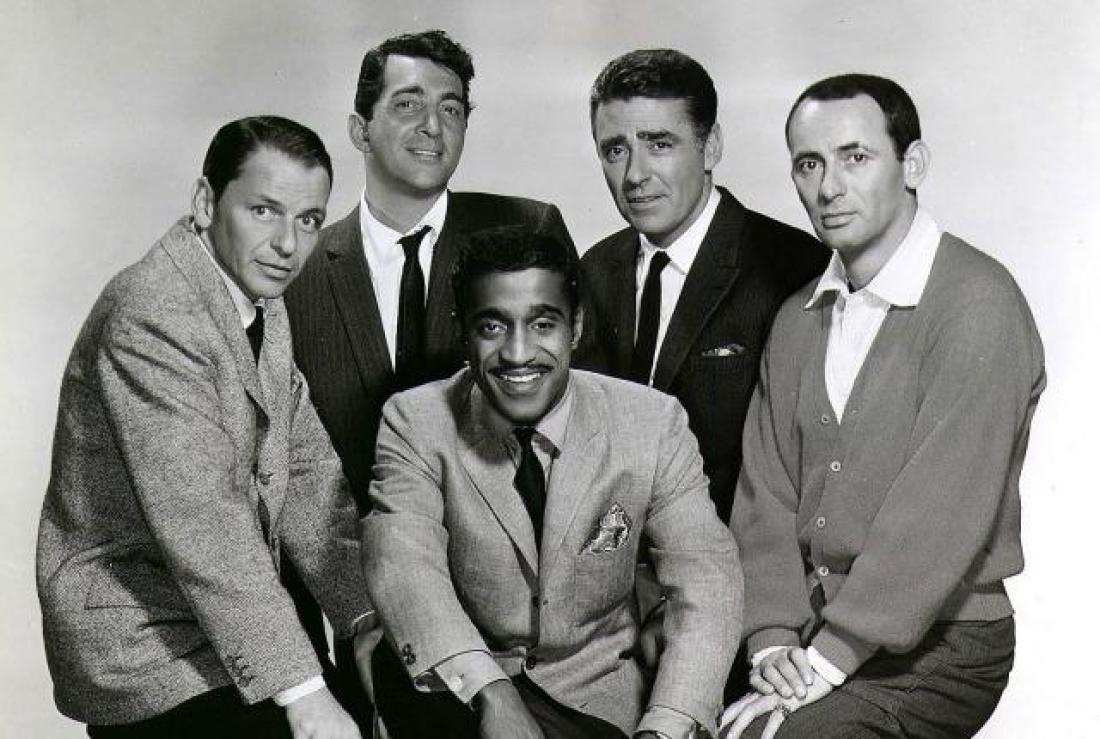
For some reason, the group including Frank Sinatra, Dean Martin, Joey Bishop, Peter Lawford, and Sammy Davis Jr. have been referred to the Rat Pack since the 1960s. The original rat pack was coined by Lauren Bacall about a group who gathered at her home whom she referred to as a pack of rats. The group we know as the Rat Pack preferred to call themselves the Clan or the Summit. Whatever they chose to call themselves, they had a hip, cool aura.

When one of the members of the group was scheduled to perform at Las Vegas, another one or two of the Clan would often show up as well. Because concert goers knew this, their shows tended to sell out. The Sands marquee promoted the possibility during one of Dean Martin’s shows when they put up “DEAN MARTIN – MAYBE FRANK – MAYBE SAMMY.”

I thought it would be fun to look at the Rat Pack on television and see how much influence this group had. Let’s start with Old Blue Eyes.

FRANK SINATRA

Frank began his film career in the 1940s. In 1953 he had one of his most famous roles in From Here to Eternity. I was surprised to learn that he began appearing on television in the mid-1950s as well. He showed up in The Colgate Comedy Hour in 1954, The Producer’s Showcase in 1955, and The Thin Man in 1958.

In the 1970s we find Frank showing up on Laugh-In for several appearances.

He also sang a few lullabies on Make Room for Granddaddy, Danny Thomas’ revival of his hit show Make Room for Daddy from the 1950s. I was amazed at the talent of actors who guest starred on the reboot considering the short time it was on the air, but that is a topic for a future blog. On this episode, he bumps into Danny. His wife Kathy is not happy Danny is bringing home a guest for dinner on “hamburger night” but then she learns it’s Frank. He sings “All the Way” and “Baa Baa Black Sheep” for Danny’s grandson, Michael.

Photo: imdb.com

Jumping ahead a decade, we find Frank’s last two television roles, one as himself and one as a New York cop.

Frank had met Tom Selleck in Hawaii on one of his trips. In 1987 Frank appeared as Michael Doheny, a retired police sergeant on Selleck’s show, Magnum PI. Frank and his entourage traveled to Hawaii (although he worked for scale) and took over a floor at The Colony Surf in Diamond Head. In this episode he returns to help find the men who kidnapped his granddaughter. There were plans for Sinatra to return in season eight as well but Selleck cut back on the number of episodes he was filming, and the show was never written.

Photo: kiwireport.com

In 1989 Sinatra showed up on Who’s the Boss as himself. Angela is invited to an exclusive party, but she gets waylaid by a work issue. Mona and Tony decide to take the tickets, but they can’t get in when they get there and then Angela shows up, which results in all three of them being thrown out of the gala. As Frank is showing up to sing, Tony gets to meet him and tell him he is his idol.

DEAN MARTIN

Not surprisingly Dean’s first appearance on television was on Make Room for Daddy in 1958. He portrayed himself. Danny calls on Dean to help him out with his daughter Terry who has been not very nice to a boy at school who likes her. Danny learns she is ignoring the boy because she has a crush on Dean. The plan works, and she and Donald get together.

Photo: youtube.com

During the same year, Dean shows up on The Phil Silvers Show. Bilko (Silvers) is sent to Yucca Flats to work on a nuclear test program. Ritzik is amazed by one of the scientist’s machines. They skip the base and head for Las Vegas, so Rupert can demonstrate his gambling skills. Dean Martin is an unnamed gambler they run into.

In 1964 Martin got on the western bandwagon, appearing in Rawhide. Martin is stalking Hispanic cattlemen. His wife wants him to drop the assignment and retire to her family’s plantation with her, but he refuses, and she seeks help from Gil Favor, the boss of a never-ending cattle drive.

We see Martin pop up on a Bob Hope special in 1968 and a Red Skelton show in 1970.
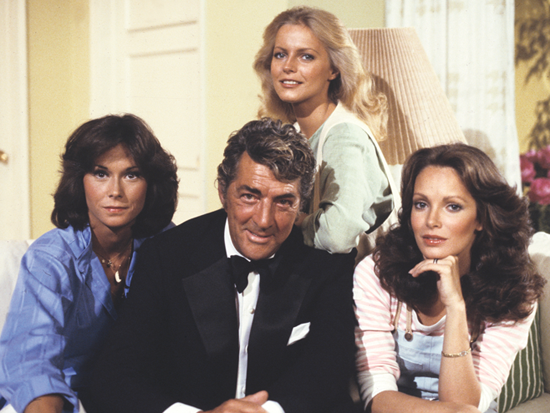
Photo: vegasmagazine.com

In 1978 Martin made an appearance on a show that surprised me: Charlie’s Angels. Martin plays the owner of the Tropicana Casino who hires the Angels to investigate several suspicious deaths that he thinks are part of a plot to make him think he’s going crazy. This was a two-part season opener and instead of singing, Martin got to display his magic skills. Naturally, he becomes romantically involved with one of the Angels, Sabrina played by Kate Jackson.

Fittingly, Dean’s last appearance was in the show Vega$ in 1979 as himself.

JOEY BISHOP

Bishop’s first role was not much of a stretch. He played a comedian on Richard Diamond in 1959. Bishop’s plays Joey Kirk and hires Diamond to determine who is following him and why, leading to a complicated murder plot.

He appeared in the DuPont Show of the Month in 1960 and The Dick Powell Theater in 1963.

Like most of the Rat Pack, Bishop made an appearance on Make Room for Daddy in 1961. As Joey Mason, he helps out Danny. Danny has flown from the east coast to the west coast and took two sleeping pills. However, there are four conventions in town and his assistant forgot to make him a reservation.

In 1965 he is Fred Jackson on an episode of Valentine’s Day starring Tony Franciosa and Jack Soo about a young eligible bachelor who lives with his valet, a poker-playing con artist who saved his life while they were in the Army.

Photo: tvtropes.com

From 1961-1965, Joey stars in The Joey Bishop Show as Joey Barnes. Barnes is the host of a talk show. He has to deal with his personal and professional life as a celebrity. A lot of guest stars show up playing themselves as guests on his show or friends of his. The show produced 125 episodes. I have recently been watching it on Antenna TV where it now is shown every morning.

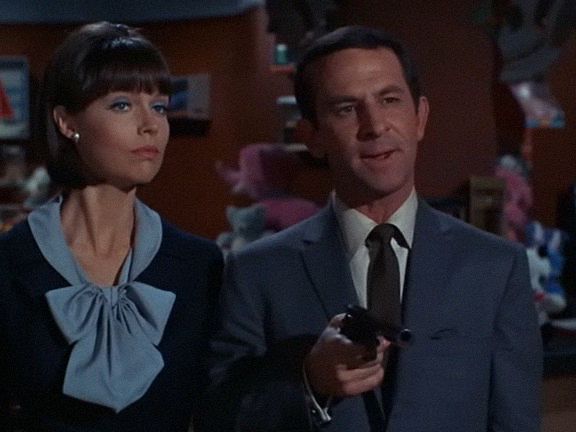
In 1967, Joey had a cameo on Get Smart. Max and 99 are sent on an assignment to rescue Don Carlos, the dictator of San Saludos. A general has imprisoned him and wants to marry his daughter. Max and 99 try to disguise themselves as flamenco dancers. When they are also thrown in jail, a guard, played by Bishop, attempts to bribe the firing squad.

In the 1970s we find Joey on Chico and the Man in 1976. He plays an inept burglar and when Ed doesn’t press charges, every lowlife crook appears at the business.

In 1981 Bishop appears as Dr. Burton on Trapper John MD.

Photo: basementrejects.com

In 1985 Bishop again takes on the role of a comedian on Hardcastle and McCormick. That same year he also played another comedian on Murder She Wrote.

PETER LAWFORD

Drama shows were very popular in the early days of television. Lawford appeared in quite a few of these shows from 1953-1965.

Photo: en.wikipedia.org

In 1954 he took on the role of Bill Hastings on Dear Phoebe. The show was on the air for two years, resulting in 32 episodes. Hastings works for a daily newspaper in a large city. He becomes the author of a lonely hearts column and advises his readers as “Phoebe” while trying to deal with his own issues in his personal life.

Photo: sitcomsonline.com

From 1957-1959, he was Nick Charles on the television version of The Thin Man. The show was very popular with 723 episodes filmed. Similar to the films, Nick marries Nora and lives in a luxurious Park Avenue apartment in New York. He was previously a private detective and many of his underworld friends get him involved in mysteries he has to solve.

Lawford appeared as himself on an episode of Jack Benny’s show in 1961.

He also played himself on The Patty Duke Show in 1965. Patty is selected to find a star to perform at the high school prom. Sammy Davis Jr. also guest stars on the episode.

Photo: imdb.com

Apparently, Sammy and Peter enjoyed working together because they guest starred on an episode of The Wild Wild West in 1966. Lawford is a wealthy ranch owner and Davis is a hired hand Jeremiah.

While Bishop showed up on Get Smart, Lawford chose the more realistic I Spy in 1967.

Like Sinatra, he also appeared on Laugh-In but must have enjoyed it more because he was on ten different episodes.

During the 1970s, Lawford shows up on a variety of television show genres. He would be on the western The Virginian in 1971, Born Free about Elsa the lion in 1974, The Love Boat and Fantasy Island, the bizarre comedy High Cliffe Manor, the crime drama Hawaii Five-0, the dramady Supertrain, and The Jeffersons.
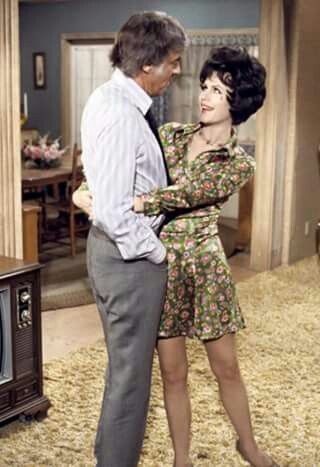
Photo: pinterest.com

In addition, he was featured on Bewitched in 1972. Lawford played Harrison Woolcott, a client of Darrin and Larry’s. Sam’s cousin Serena decides she wants to date him and try the mortal life for a while.

Photo: pinterest.com

He made several appearances during seasons four and five of The Doris Day Show. As Dr. Peter Lawrence, he begins a romance with Doris in 1972-1973.

SAMMY DAVIS JR

Sammy probably appeared in the most television shows. Like Peter, he began in drama shows and guest starred in several episodes of General Electric Theater.

He then appeared in The Lawman in 1961, Frontier Circus, Cain’s Hundred, 77 Sunset Strip, The Rifleman, and Hennessey in 1962.

In 1963 he was on Ben Casey.

Like the other Rat Pack actors, he was on Make Room for Daddy in 1963 and the revival Make Room for Granddaddy in 1970.

As mentioned before, he guest starred in The Patty Duke Show in 1965 and The Wild Wild West in 1966, both with Peter Lawford.
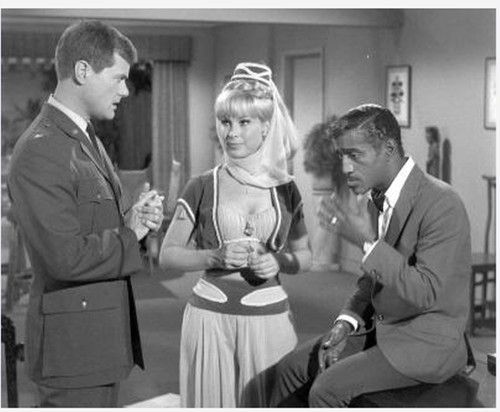
Photo: pinterest.com

In 1967, he showed up on I Dream of Jeannie as himself. Tony tries to get Sammy Davis Jr to sing for General Peterson’s party. When he is already booked, Jeannie tries to help by duplicating himself, so he can be in two places at one time.

Davis also took a role in The Beverly Hillbillies in 1969.

Photo: tvinsider.com

The same year he took on his first of three roles on Mod Squad. His first role was a black priest who becomes the target of a bad guy after the church suspends him. The hood is afraid he will reveal his confession now that he no longer is part of the church. The next episode he appeared on was in the role of Billy Lee Watson, a recovered drug addict. He runs a half-say house and is accused of rape of a man’s daughter who he has been trying to help. Her father accused Billy of the rape and after investigating, it turned out Billy was her actual father.  The last episode of Mod Squad he appeared on in 1970 had Davis portraying Willie Rush and actor and friend of Linc’s. He says someone is trying to kill him.

Photo: tumblr.com

The 1970s continued to be a productive time for Davis on television. He would go on to appear in The Name of the Game in 1970, The Courtship of Eddie’s Father in 1972, nine episodes of Laugh-In, and like his friend Dean Martin, an episode of Charlie’s Angels in 1977. He plays himself on Charlie’s Angels. When he hosts a charity event that includes a celebrity look alike contest, an attempt is made to kidnap him. The Angels take on the job of his bodyguards and Bosley becomes his chauffeur.

The 1980s were also busy times for him. He appeared as himself on several Norman Lear shows including Archie Bunker’s Place and The Jeffersons. He also could be seen on Fantasy Island, Pryor’s Place, Gimme a Break, The Cosby Show and Hunter in the 1980s.
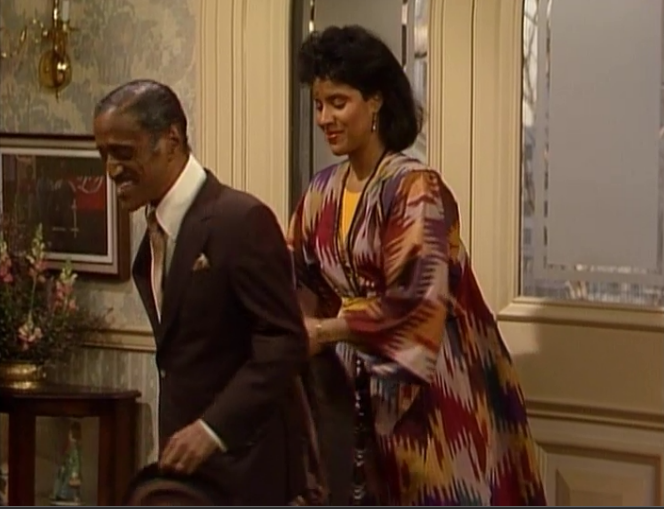
Photo: atlantablackstar.com

One thing that surprised me was his roles on One Life to Live and General Hospital. I have seen a few stars like Carol Burnett who chose to appear on a soap opera. Davis had a recurring role on General Hospital; he didn’t seem to me to be the type of actor who would be interested in a soap opera, but he did receive an Emmy nomination for his role on General Hospital. Sammy was also nominated for an Emmy for his work on The Cosby Show.

While Joey Bishop hosted some of the Emmy Award shows, I did not find any nominations for the other members of the Rat Pack.
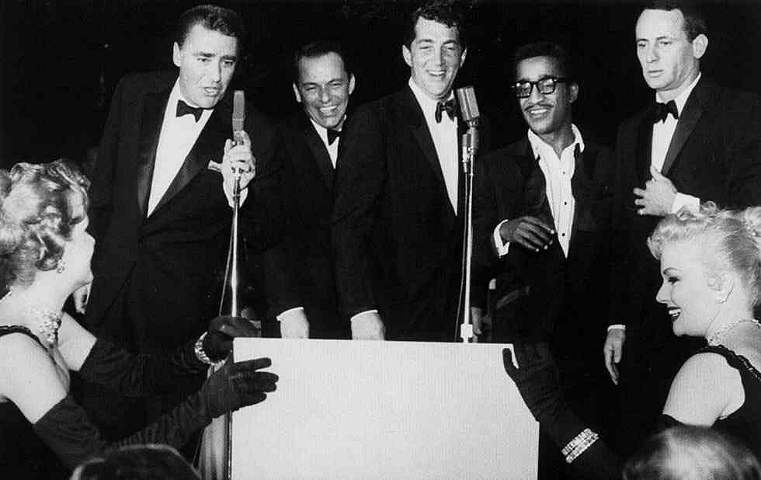
Photo: peoplequiz.com

Overall, I was surprised how extensive the television careers were for the Summit members. I think of them more in their performing or movie careers and did not expect them to see that they guest starred in so many shows and starred in some of their own television series. Check out some of these shows or make a batch of popcorn and watch the ensemble in the original Ocean’s Eleven.

Catch This Phrase: Memorable Expressions From Our Favorite Shows

We all have those family members who seem to find fun catch phrases which get repeated by friends. Then there are those relatives who say something that drives us crazy and overuse expressions. That is what we’re talking about today: catchphrases from our favorite television shows. I prepared a list of twenty phrases that caught on with viewers. What seems strange to me are expressions that come from a series or movie that were never actually said. For example, “Play it again Sam,” from Casablanca is a well-known phrase. However, that line was never said in the actual movie. You often hear someone say, “Beam me up Scotty,” but once again, it was never said in Star Trek. The closest line was only used once, and it was, “Beam us up, Mr. Scott.”

I’ll list these memorable phrases by shows alphabetically and tell you how often they were used: none, one, fun, or overdone. I also rate them: green light means I like it, yellow if it was getting close to being overkill, and red for those expressions that never should have been used at all. Here we go.

Photo: thefamouspeople.com

The A Team – Pity the fool

Mr. T often says this on commercials, public appearances,and as a guest on other shows, but he never said it on The A-Team. Mr. T explained how this phrase came about on the Conan show one night, “When you pity someone, you’re showing them mercy. I didn’t start this pity stuff, it was in the bible. You’ll find pity so many times in the Bible and fool so many times, so I put ‘em together. Pity the fool,” Mr. T said. He added, “Lotta guys in the Bible [were] asking for pity. And then a lot of them were saying, I did a foolish act. So, I put ‘em together.”

Not only has he trademarked the phrase, but he actually had a series developed around the phrase which was the title of the show. It aired in October of 2006 and was off the air by November 6, so I pity the fool who stuck money into it.

Rating: None, Green– I can’t really give it a light because it was never used but it was a good expression at the time.

Photo: throwbacks.com

Alf – I kill me

The Tanner family members weren’t often amused by Alf’s jokes. When no one responded or someone shook their head at him, he was often heard to say, “I kill me.”

The phrase was so popular, a poster and a t-shirt were sold featuring it.

Rating: Fun, Green – I also thought Alf was pretty funny, even when the Tanners were not as impressed.

Photo: pinterest.com

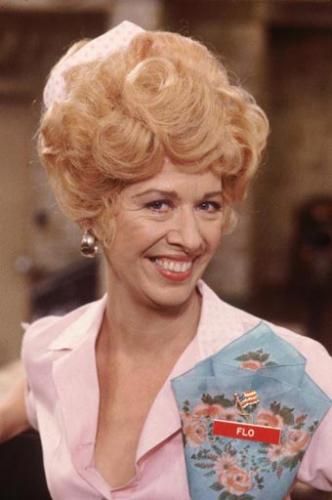
Alice – Kiss my grits

While Flo was a warm-hearted person who would do anything to help a friend, or Mel, she didn’t take any sass from anyone. Whenever someone did something to irritate her, she responded, “Kiss my grits.”

Rating: Overdone, Yellow– Only Flo could get away with using the phrase so often, but it did become a bit too much.

Photo: youtube.com

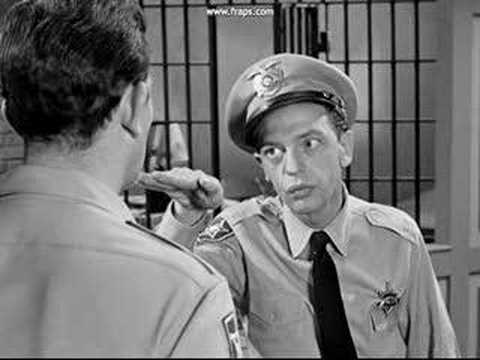
The Andy Griffith Show – Nip it in the bud

Barney liked being on top of situations and being in charge.When something happened whether it was questionable behavior by Opie or a dangerous criminal activity being plotted, he was heard to say, “Just nip it, nip it in the bud.”

Rating: Fun, Green –Barney Fife was just a great character.

Photo: nme.com

Big Bang Theory – Bazinga

Sheldon learned about sarcasm during season 2 of the show. Whenever he said something sarcastic or something that proved others wrong in a humorous way, he would utter, “Bazinga.” The first time he used it, it was not actually in the script, but he added it and it stuck.

Rating: Fun-ish, Green– I added the “ish” because it can be overdone some shows

Photo: imdb.com

The Brady Bunch – Marcia, Marcia, Marcia

Jan didn’t like being the middle child. While Cindy was the cute younger one and Marcia the pretty older one, Jan often felt left out. When she was upset Marcia was getting attention or doing something she wanted to do, she would pout, “Marcia, Marcia, Marcia.”

In the Season 3 episode, “Her Sister’s Shadow,” Jan said, “all I hear all day long at school is how great Marcia is at this or how wonderful Marcia did that. Marcia, Marcia, Marcia!”  Jan did not say the phrase much, but viewers sure did.

Rating: One, Green – I think every middle child understood what Jan meant. Apparently, viewers loved it, because it is an iconic quote for being only said one time. Actually, I always thought Jan was the cool one.

Photo: tvseriesfinales.com

Columbo – Just one more thing

When the bad guy thought he had gotten away with a crime, Columbo would often turn around and say, “Just one more thing,” and that “thing” was usually the evidence he needed to arrest someone.

Rating: Fun, Green – Even when we knew it was coming, it was fun to see how the villain of the week realizes he has been found out.

Photo: imgflip.com

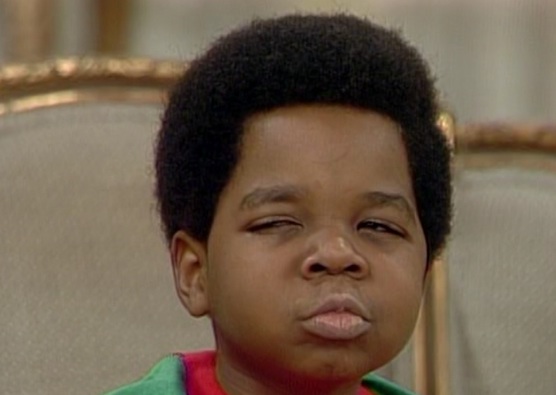
Diff’rent Strokes – What you talkin’ bout Willis?

Arnold was the “cute” kid in the Drummond family and often made others laugh. Whenever Willis said something Arnold didn’t want to do or thought should not happen, he would look at his brother and say, “What you talkin’ ‘bout Willis?”

Rating: Overdone, Red– Ok, I know I have a bias because this was one of those Norman Lear shows my readers know I don’t care for, but I do remember at the time, it was used a bit too often on the show. There is a fine line between defining a character and stereotyping a character.

Photo: tenor.com

Friends – How you doin’?

Joey was definitely the ladies’ man on Friends. He was always searching for his next social conquest. When he met a girl he wanted to get to know better, he often drawled, “How you doin?” It was a basic pick-up line, but he was so good looking, it almost always worked. While it became his catchphrase, it was not used for the first time until Season 4.

Rating: Fun, Yellow – It was a fun expression that is still used today but it was getting close to being overused.

Photo: bustle.com

Full House – Have mercy

Typically, it was Uncle Jesse who said, “Have mercy,” but occasionally another character would use it. He says Garry Marshall always told him he needed a catch phrase. He took on “Have mercy,” and it was probably one of the most-used phrases ever during the run of the show.

Rating: Fun, Green– I can still hear the exact tone of his voice whenever he used the line.

Photo: bondsuits.com

Get Smart – Missed it by that much

Maxwell Smart often messed up a spy mission, and 99 always saved the day. Often when the bad guys were put away and he was analyzing what had gone wrong, he would say, “Missed it by that much” which usually meant he was nowhere near to taking care of business.

Rating: Fun, Green– Everything on this show was fun and there were enough catch phrases that none of them took over.

Photo: tvparty.com

Good Times – Dy-no-mite!

The Evans were a close-knit family who lived in the projects. JJ was an artist and the class clown. His favorite expression was “Dy-no-mite!”

He revived his catch phrase in several Panasonic commercials in the mid-1970s.

Rating: Overdone, Yellow– Sorry, it’s my Norman Lear bias again, but I feel like not only did JJ Evans overuse this phrase, but you heard it from viewers everywhere you went. I agree that imitation is the sincerest from of flattery, so it worked, and people liked it, but I thought it was overdone.

Photo: people.com

Happy Days – Sit on it

I think every cast member used the phrase “Sit on it” at one point or another. It was said when someone said something or insinuated something a character didn’t like.

Rating: Overdone, Yellow– This was a fun phrase when it started but it was overused and overused by everyone on the show.

Photo: memorabletv.com

Hawaii Five-O – Book ‘em Danno

The original Hawaii Five-O would end each arrest with Steve saying “Book ‘em Danno.” They did not resurrect the phrase for the current Hawaii Five-0. However, if you were watching the November 30th episode in 2018, you saw the conclusion of an older cold case homicide and a comic book created the ending to the mystery and in the book, McGarrett did say, “Book 
’em Danno.”

Rating: Overdone, Green– It was over used although it did not occur on each episode, but I gave it green because it worked and fit the situation when it was used.

Photo: theherald.com.au

Hogan’s Heroes – I know nothing

Sargent Schultz began saying “I know nothing” when he didn’t want to answer questions Hogan asked him. He realized Hogan could always get him to talk by offering him food of some type. Later, the prisoners were not afraid of telling Schultz things they were doing or planning to foil the Nazis’ plans, and whenever he heard them talking about an upcoming mission, he also emphatically said, “I know nothing.”

Rating: Fun, Green– Schultz said it a lot but that was fitting for his character.

Photo: cbsnews.com

The Honeymooners – Bang, zoom, to the moon, Alice

This particular phrase is quoted a lot. Actually, Ralph Kramden had many similar expressions such as Bang, zoom” or “To the moon Alice,” but they all had similar wording and inferred that he was threatening her. The phrase would not go over well in a show today. However, Alice was never worried. She knew Ralph loved her and was all bark and no bite. Of course, one of the expressions he also used in a lot of shows was “Baby, you’re the greatest.”

Rating: One, Red – I only saw one episode that used the exact wording that has become a quote of the show. While I know it was innocent fun back then, I can’t say I was ever fond of the expression.

Photo: dga.org

I Love Lucy – Lucy, you got some ‘splaining to do

Lucy always had some type of scheme in the works to get something she wanted. Often, it was something her husband had forbidden her to do. When he found out what she was up to, he often said, “Lucy, you got some ‘splaining to do” in his Cuban accent. Like Ralph Kramden, he rarely said this exact phrase; instead, he would tell her to “splain what happened” or “try to splain why you are here” or something along those lines. Viewers picked up on the exact wording that gets repeated still.

Rating: One, Green – Desi used similar words but not this exact phrase. However, when he used it, it was always an appropriate use because Lucy had done something that did need to be explained.

Photo: wvxu.org

Laugh In – Sock it to me

Because so many people on the show say, “Sock it to me” started by Judy Carne, it has become a famous line. Of course, the celebrity who got the most attention saying it was Richard Nixon.

Rating: Fun, Yellow– It was still fun because it was used in different situations and with different celebrities but if the show had continued, it might have been overdone.

Photo: refelctionsonfilmandtelevision.blogspot.com

Lost in Space – Danger Will Robinson

Even kids who never heard of Lost in Space, quote “Danger Will Robinson” when they want to warn someone about an issue. The funny thing is it was only said one time on the show, but like The Brady Bunch, viewers have made it their own and it is now part of our lexicon.

Rating: One, Green– Although it was only said once, viewers have made it into a well-loved expression.

Photo: purpleclover.com

Welcome Back Kotter – Up your nose with a rubber hose

This was probably one of the most unusual catch phrases. The Sweathogs gave the image that they would not put up with nonsense and they made the rules. One of Vinnie Barbarino’s favorite insults was “Up your nose with a rubber hose.”

Rating: Fun, Green– I was not a huge fan of Welcome Back Kotter, but the phrase fit Barbarino, and he had enough other expressions, it was not overused.

I hope you had fun looking back at some of the expressions we grew up with in the 1960s, 1970s, and 1980s. It’s interesting to think about what current shows will produce catch phrases that kids will still be using in 2050.

Who Writes The Songs?: Good Question–Lots of People Including Frank De Vol, Jay Livingston, and Ray Evans.

At this time of year, we tend to watch a lot of football bowl games. Most of the attention centers on the coaches, the quarterbacks, and a handful of other star players like running backs, wide receivers, and occasionally kickers. While these positions influence the games, there is an entire team behind them which determines whether they get a win or a loss. This year I will be trying to look at some of the behind-the-scenes players in the television industry.

Today we look at three composers who often influenced shows, even though many viewers never heard of the song writers.

devol1

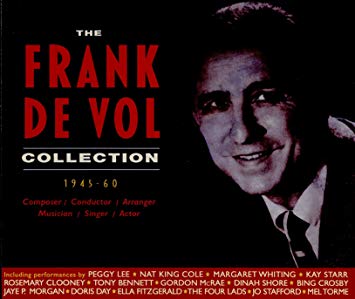
Frank Denny De Vol was born in West Virginia in 1911. His family moved to Canton, Ohio where he grew up. His mother owned a sewing shop, and his father was in charge of the pit orchestra at a local movie theater. He graduated from McKinley High School in 1929 and started at Miami of Ohio University but quit after six weeks. His parents were hoping he would pursue his law degree, but he was set on a career in music.

This wasn’t surprising because he had become a member of the musicians’ union at age 14. He worked for his father at the theater and played the saxophone and violin.

Once he left college, he joined Emerson Gill’s orchestra and traveled around Ohio. Later he became a musician with Horace Heidt’s band, and Horace let him try his hand at arranging. He would then travel with Alvino Rey’s band which led to a long-life friendship with the King Family.

During his career as a traveling musician he married his wife, Grayce McGinty in 1935. The couple’s 54-year-long marriage would produce two daughters.

During the 1940s, he would write arrangements for many of the country’s top performers including Tony Bennett, Nat King Cole, Vic Damone, Doris Day, Ella Fitzgerald, Dinah Shore, and Sarah Vaughn. His version of “Nature Boy” for Nat King Cole went to number 1 in 1948.

In 1943 he moved to California and started his own band. He appeared on the radio on KHJ and accompanied many stars including Jack Carson.


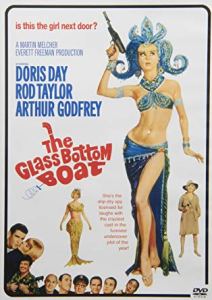
In the 1950s, he moved into movie composing and worked on more than 50 film scores including What Ever Happened to Baby Jane, The Glass Bottom Boat, The Dirty Dozen, and several Herbie movies. He received Academy Award nominations for his work on Pillow Talk (1959), Hush . . . Hush Sweet Charlotte (1964), Cat Ballou (1965), and Guess Who’s Coming to Dinner (1967).


During the 1950s, his orchestra also was frequently seen at the Hollywood Palladium as “Music of the Century.”

devol3


It seems natural that De Vol would ease into television work as well. He composed the jingle for Screen Gems’ “Dancing Sticks,” which appeared on all television series produced by Columbia Pictures.


devol26

Photo: pinterest.com

Frank became the musical director on Edgar Bergen’s game show Do You Trust Your Wife? His orchestra was featured on a variety of musical shows including The Lux Show Starring Rosemary Clooney.


devol21

Today De Vol might be best known for his work as a composer for television series. He wrote the music for My Three Sons, Family Affair, The Brady Bunch, and The Smith Family. My Three Sons theme song was a hit single in 1961 by Lawrence Welk, more musically complex than many sitcom themes of the time. He would continue his work for My Three Sons for all 380 episodes.


devol23

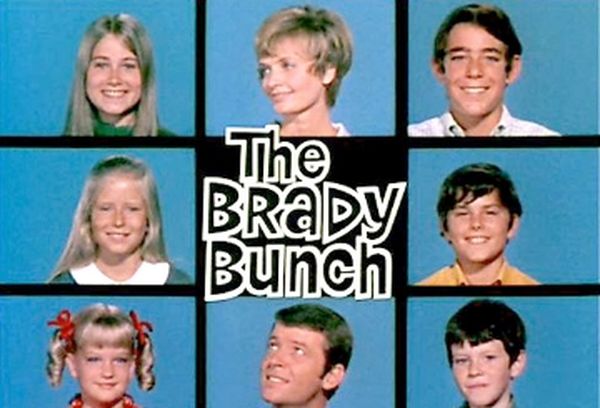
Sherwood Schwartz, the creator of The Brady Bunch, first turned to George Wyle to create the Brady theme. Wyle and Schwartz had composed the theme for Gilligan’s Island. With Wyle already committed to The Andy Williams Show, he approached De Vol. De Vol would provide music for 117 episodes of the original show, as well as music for The Brady Girls Get Married, The Brady Brides, The Bradys, and A Very Brady Sequel.

Frank was credited as composer for 37 movies and television series and listed as part of the music department for 87 total.


devol25

Photo: sitcomsonline.com

Not only was he musical composer for these shows, but you can see him acting in many of the shows he worked on as well. His first acting appearances were on Betty White’s Show, Life with Elizabeth where he played a variety of roles.


devol28

Photo: aveleyman.com

He then appeared on several television series including State Trooper, My Favorite Martian, The Farmer’s Daughter, Gidget, Please Don’t Eat the Daisies, Bonanza, Petticoat Junction, Get Smart, That Girl, and I Dream of Jeannie (37 different shows in all).

While composing on My Three Sons, he would actually portray a bandleader on the show and a father on The Brady Bunch.


devol2imagenesmy.coom

Photo: imagenesmy.com

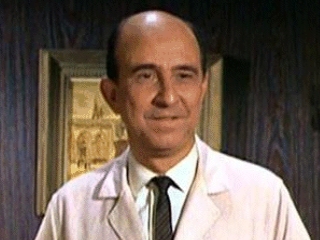
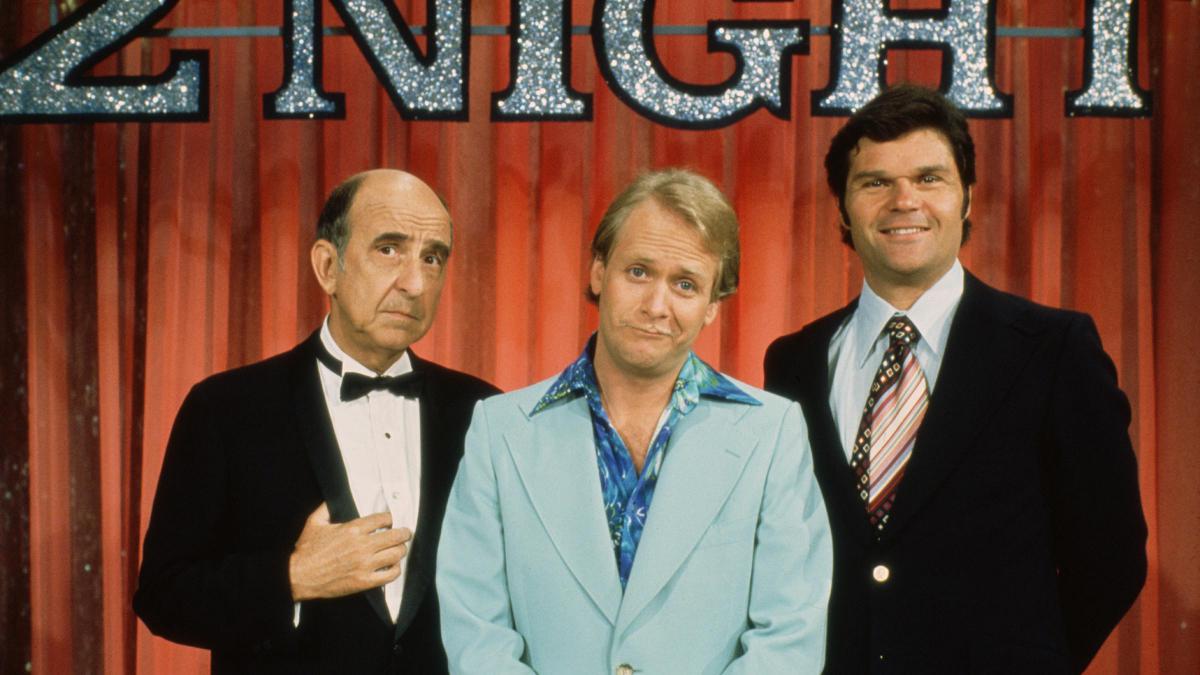
Many people will remember him as the dour-faced band leader Happy Kyne on Fernwood Tonight and America 2-Night, shows starring Martin Mull in the late 1970s.


One of my favorite roles of his was the head of the boys’ camp on the original Parent Trap.

devol27

Photo: tcm.com

His last acting role would be on Charles in Charge, the Scott Baio comedy from 1990.

When he was in his 80s, Frank was still active with the Big Band Academy of America. About this time, he married Helen O’Connell who had been a big band singer and actress. (His first wife passed away in 1989.)

Helen passed away in 1993, and Frank died from congestive heart failure in 1999.


devol24

Photo: pinterest.com

Like so many of these stars of the classic television era, he was a multi-talented guy. He could sing, he could play instruments, he could compose, he could arrange, and he could act. Sadly, when he does his job right, the music is so attuned to the shows that we almost don’t realize it’s there but try listening to a show with no background noise. Thank you Frank De Vol for not becoming an attorney.


We also take a look at a song-writing team of the golden age, Jay Livingston and Ray Evans.

living4


Livingston was born in McDonald, Pennsylvania in 1915. After studying piano with Harry Archer in Pittsburgh, he attended the University of Pennsylvania, majoring in journalism but also studying composition and orchestration.

Ray Evans was born in Salamanca, New York the same year. He also ended up at the University of Pennsylvania, receiving a degree in Economics.

Livingston organized a dance band at the University that played on campus as well as at local nightclubs and even cruise ships during their summer breaks.  One of those band mates was Ray Evans. Evans and Livingston became a partnership and they wrote some of the most iconic songs from film and television.


evans1

Photo: filmmusicsociety.org

After their graduation in 1937, the duo moved to New York City to work in Tin Pan Alley. They wrote for Broadway productions, including special material for Ole Olsen and Chic Johnson.


evans8

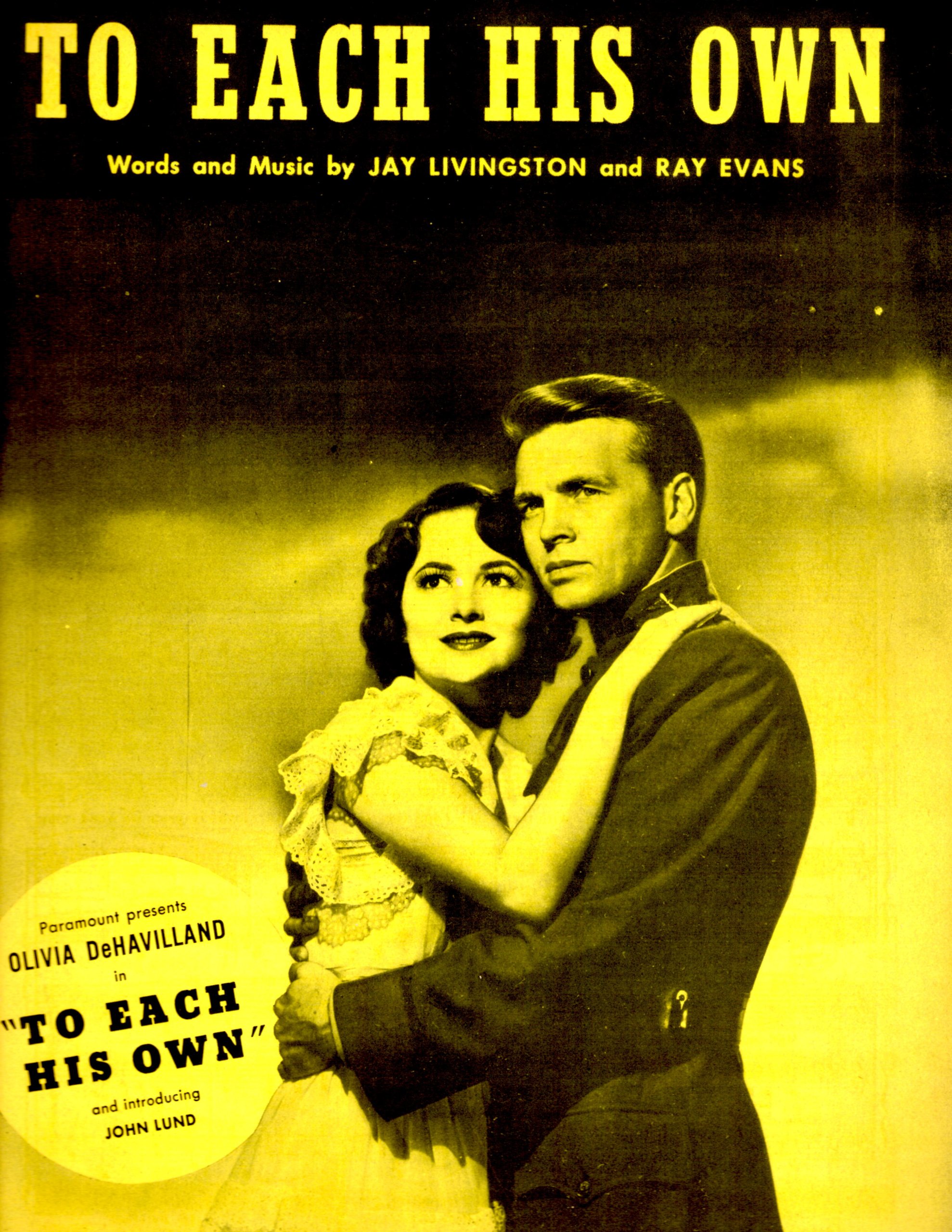
Livingston joined the Army when World War II began while Evans went to work for an aircraft company. When Jay came back home in 1945, he and Evans decided to try their luck in Hollywood. They received a contract from Paramount Pictures, and the team would stay with the company for a decade. Their first film was To Each His Own, starring Olivia DeHaviland, and they were nominated for an Academy Award.

During this time at Paramount, Livingston married Lynne Gordon. It must have been a happy marriage because they were married until 1991 when she passed away.

The exact same year, Evans married Wyn Ritchie. They were married until her death in 2003.

In 1947 the team began writing for Bob Hope for his personal appearances. Throughout the 1940s and 1950s, they would write many tunes that became jukebox favorites and popular songs. In Warren Craig’s book The Greatest Songwriters of Hollywood, he called them “the last of the great songwriters in Hollywood.”


evans2

Photo: pinterest.com

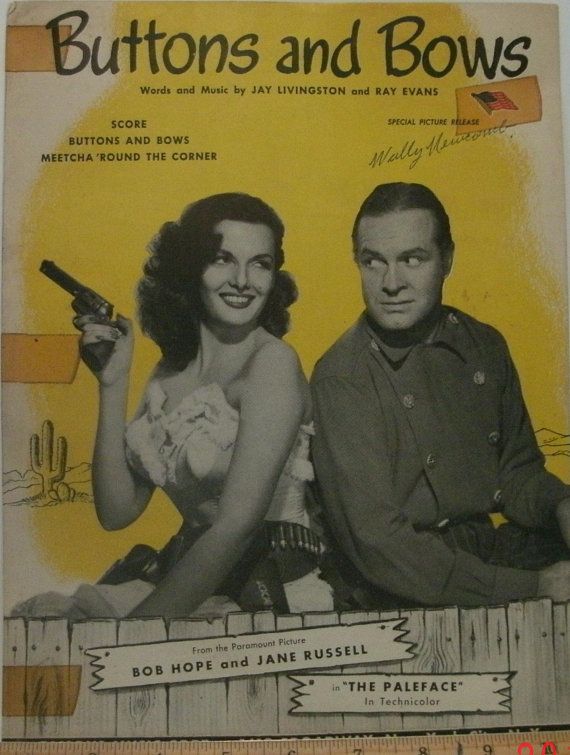
The year 1948 brought them their first Oscar win for “Buttons and Bows,” from Bob Hope’s western comedy, The Paleface. The jukebox version was recorded by Dinah Shore.


evans7

In 1950, they scored their second Academy Award for “Mona Lisa,” written for the movie Captain Carey, USA but made famous by Nat King Cole.


evans10

Photo: moviemovieblogblog.wordpress.com

Evans and Livingston would appear in Sunset Boulevard this same year at the New Year’s Eve party scene.


evans3

We can all smile and thing of Livingston and Evans each Christmas when we hear “Silver Bells.” The song, originally titled “Tinkle Bells” was written for The Lemon Drop Kid in 1951, also starring Bob Hope. Thankfully, they decided “tinkle” had other connotations and “Silver Bells” it became. (Some sources credits Jay’s wife Lynne with the name change.)

When their Paramount contract ended in 1955, they became free lancers and wrote both individual songs and complete scores for a variety of movies. They would receive ten additional Oscar nominations during their career.


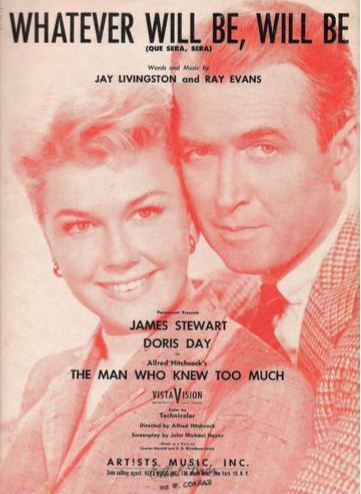
Doris Day had a huge hit in 1956 with “Que Sera, Sera” from The Man Who Knew Too Much with Jimmy Stewart and that hit would win them a third Oscar. The song would also become Doris’s theme song for her television show in 1968.

evans5


In 1957 they began writing the music for the Tammy movies that would be a staple of that era, beginning with Tammy and the Bachelor.

Jay and Ray would return to Broadway in 1958. They were nominated for a Tony for Oh, Captain! They also wrote songs for Let It Ride in 1961, a musical comedy adaptation of Three Men On a Horse, and Sugar Babies in 1979.


evans6

Photo: tidal.com

Though most of their work was in the film industry, the team is probably best known for their television compositions. In 1959, they were asked by Desi Arnaz to write a song for a Western show being developed. The show, thought likely to last a year, didn’t have money for a weekly salary, but he allowed them to keep the rights to the song. Luckily for them, that show, Bonanza, made them millions, and would be on television until 1973.

In 1960 they composed the theme song for The Bugs Bunny Show, “This is it.”


evans4

Photo: deezer.com

In 1961, Mister Ed debuted. Livingston and Evans not only wrote the well-known song, but Livingston is the one singing the line “I am Mister Ed.”

After Lynne’s passing, Jay would marry Shirley Mitchell in 1992.

Livingston and Evans were presented with a star on the Hollywood Boulevard Walk of Fame in 1995.

In 2001, at the age of 86, Jay Livingston died from pnuemonia. Ray Evans lived until 2007 when he passed away from heart failure.


evans9

Photo: rayevans.com

It’s fun to see a friendship and partnership span six decades and be so successful. Although they were born in the same year in the same area of the country and married the same year and their marriages would last decades until the death of a spouse, the two men were very different. In an interview with the Los Angeles Times in 1985, Evans said “I’m nuts about sports, play baseball and tennis every weekend. Jay couldn’t care less. He’s restrained and quiet. I’m more outward going. Jay is a marvelous musician. I have a tin ear. But our tastes are similar, and we both like good music and song.” The duo had 26 songs that sold more than a million records and their total record sales has exceeded 400 million dollars.

Michael Feinstein released an album in 2002 devoted to the team. He said, “they had a strong work ethic and they wrote a lot of plays that have wonderful and sophisticated songs that are quite different from movie songs.”

Like Frank De Vol, most viewers today have probably never heard of Jay Livingston and Ray Evans, although they recognize much of their work. It’s good to look behind the scenes of and dig deeper into the television industry to learn more about all the pioneers who made the era so great.


The Actor Who Always “Dressed” Up: Jamie Farr

farr3

Jamie Farr was born Jameel Joseph Farah on July 1, 1934 in Toledo, Ohio. His mother was a seamstress and his father a grocer. They attended the St. George Antiochian Orthodox Church.

Farr’s first acting success occurred at age 11, when he won two dollars in a local acting contest.

He graduated from Woodward High School with honors and was named most outstanding student. In addition to writing and acting in two variety shows, he was a member of the Drama Society, class president for three years, feature editor of the school newspaper, president of the radio class, manager of the football and basketball teams and a member of the varsity tennis team.

Before becoming a successful actor, he worked for a lithograph company, a post office clerk, an army surplus store clerk, an airline reservations clerk, and at a chinchilla ranch.

farrblackboard

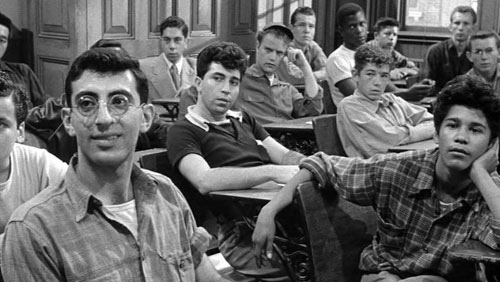
After graduation he attended the Pasadena Playhouse where a Metro-Goldwyn-Mayer talent scout discovered him, offering him a screen test for Blackboard Jungle. He won the role of the mentally challenged student, Santini. He was drafted by the United States Selective Service into the United States Army, undergoing his basic training with the 6th Infantry Division, Fort Ord, California, he served for two years, with service in Japan and Korea. The dog tags he wore on M*A*S*H were his own. (Alan Alda also served as a gunnery officer in Korea.)

In 1958, Warner Brothers cast him as the co-pilot of a TB-25 in the Andy Griffith military comedy No Time for Sergeants, which also brought the young TV comic Don Knotts to motion pictures. Farr appeared as Thaddaeus in the 1965 film The Greatest Story Ever Told, along with minor roles in Who’s Minding the Mint? and with future costar William Christopher in With Six You Get Eggroll. He would also appear in Cannonball Run and Cannonball Run II.


In the late 1960s, he became a regular on the Red Skelton Show. He appeared in a variety of shows in the 1960s including Hazel, My Three Sons, Donna Reed, The Dick Van Dyke Show, I Dream of Jeannie, My Favorite Martian, Get Smart, Gomer Pyle, The Flying Nun, and Family Affair. Farr received roles in several commercials as well, including an ad for Wonder Bread where he says, “If it isn’t fresh, I’m outta business.”


During this decade, he also married Joy Ann Richards. They are still married and have two children.

He continued his television acting career through the 1970s appearing on a variety of shows including Room 222, Love American Style, Toma, Emergency, Barnaby Jones, and The Love Boat.


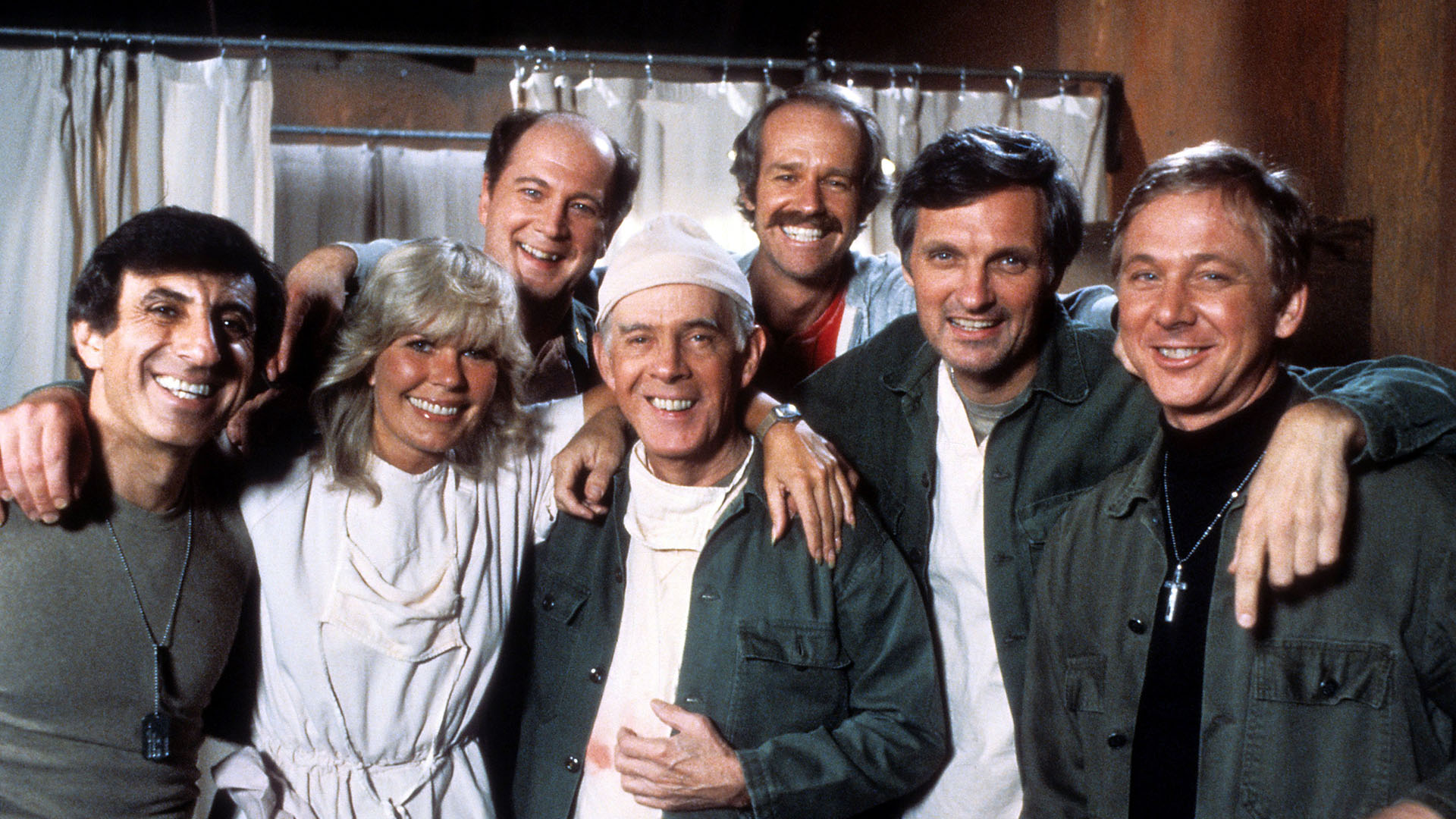
Image: Loretta Swit And Alan Alda William Christopher In 'M*A*S*H'

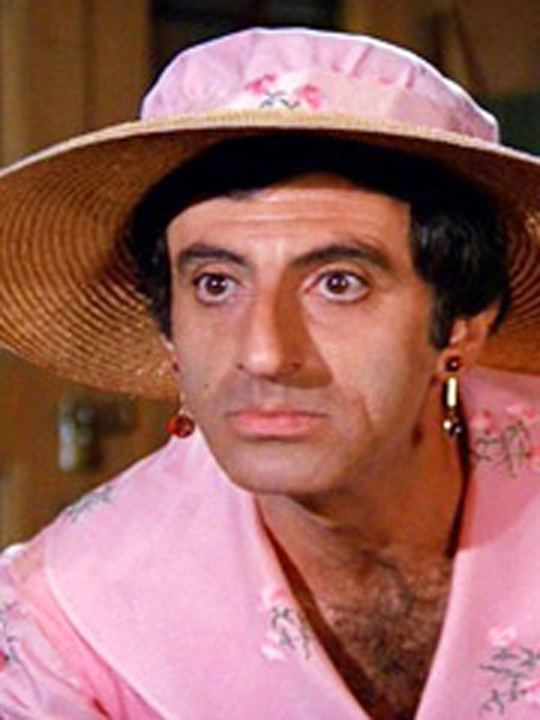
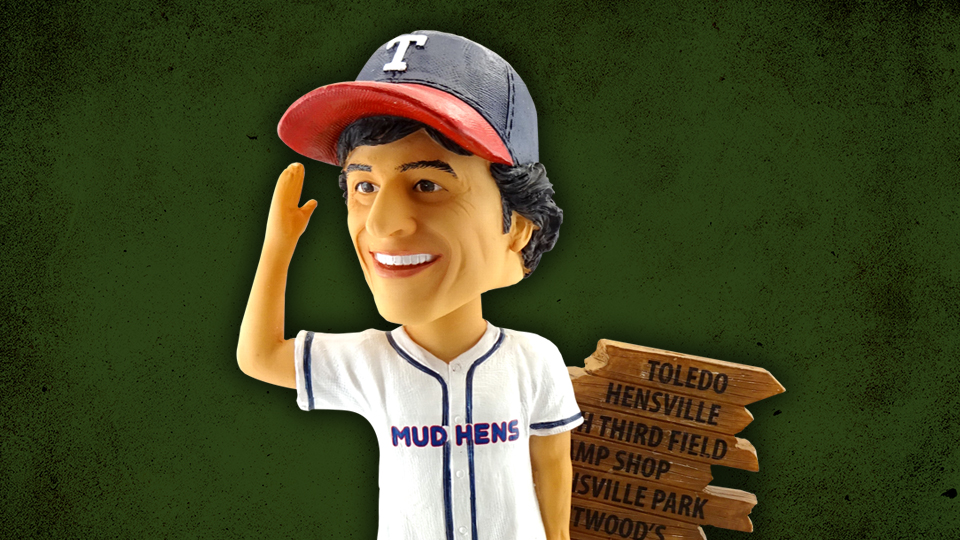
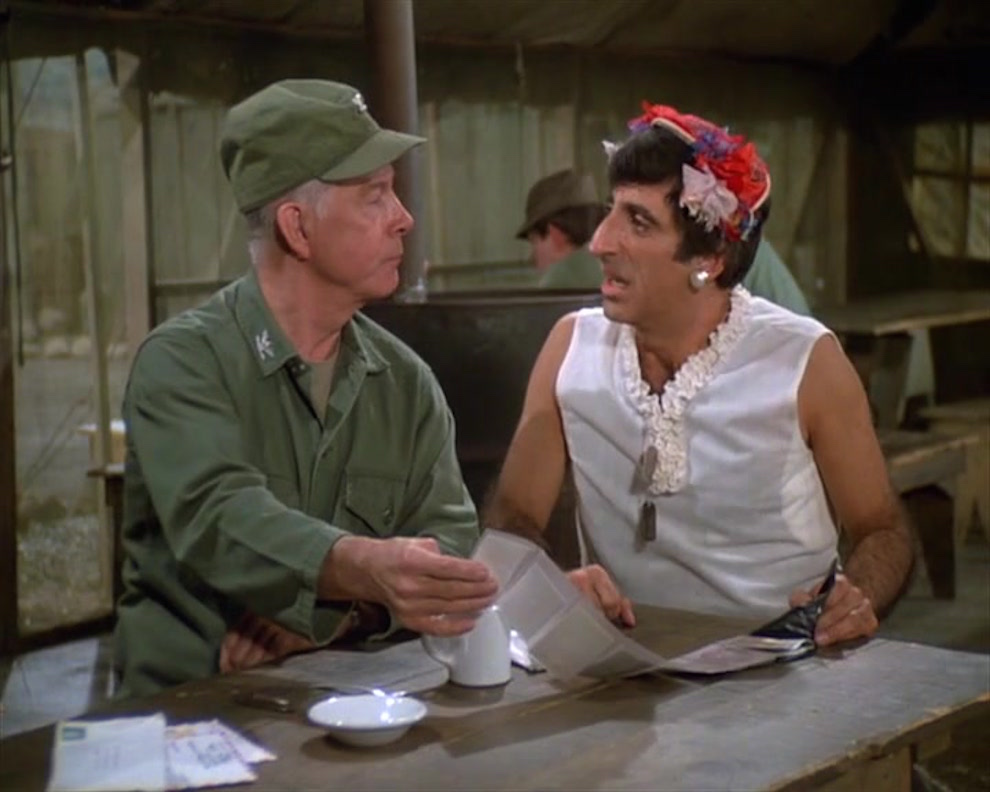
In October of 1972, he was hired to appear on one episode of M*A*S*H as Corporal Klinger. He wore women’s clothing, hoping to be discharged from the Army for a Section 8 discharge. He was asked back for the second season to appear in 12 episodes and became a regular cast member in the fourth season. When Radar left the show, and Klinger took over as Company Clerk, he stopped being fashionable and returned to uniforms. He said he did not want his kids to be made fun of because of his cross dressing. He was a resourceful and kind soldier. His character on the show was also from Toledo, and he often mentioned one of Farr’s favorite restaurants, Tony Packo’s Hot Dogs and talked about his love for the Toledo Mud Hens. (In 2017, he was inducted into the Mud Hens Hall of Fame.  A bobble head was given to the first 2000 fans to the game that night.) He continued with M*A*S*H until 1983 when it left the air.
farrbobble


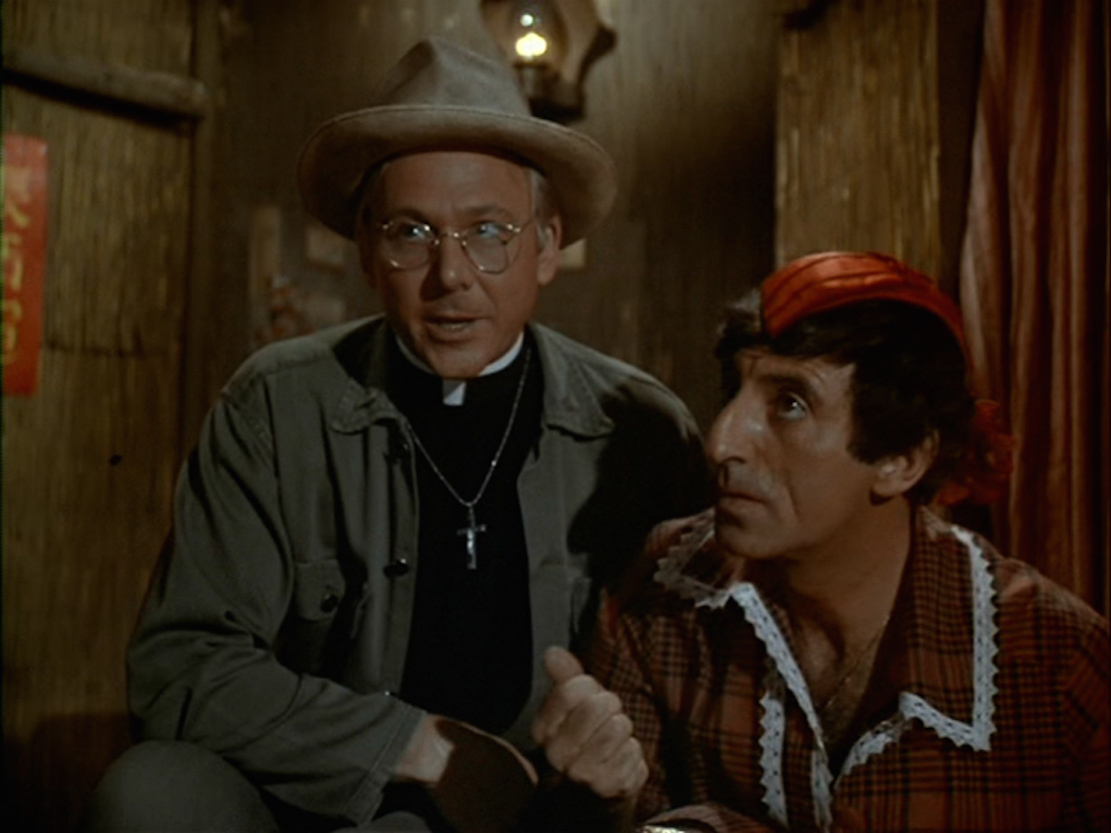
Along with Harry Morgan and William Christopher, he appeared in After M*A*S*H for two years. The show never got the fan base the original show had and was cancelled after 30 episodes.


farr harry morgan

The cast of both M*A*S*H and After M*A*S*H were very close. On the death of Harry Morgan, Farr commented, “Harry was very special to all of us cast members. Not only was he a wonderful performer that made such a difference … he was a dear friend to every cast member. He was absolutely a pixie, a gremlin as mischievous as all get out. You couldn’t be around Harry for very long without wanting to embrace him and I think our Lord will feel the same way.”


farr wm christopher

He also commented on William Christopher’s passing: “We are all devastated by our beloved Bill’s passing. I have known him for over 50 years. During the 1960s we lived in the same neighborhood in Studio City. My Joy and I would see him and his wife Barbara going for walks as we were going for walks. Bill and I did the very last Doris Day movie together, With Six You Get Egg Roll. We were both cast in the tv series M*A*S*H at almost the same time. He was a gentle soul and, in my opinion, probably the most under rated actor of all of us on the show. He was wonderful. During between set ups for camera angles Bill would read his Homeric book in Homeric Greek. He was a real egg head. He and his Barbara traveled the world and he would try to learn the language of the countries they were going to visit. He went to Egypt one year and tried his Arabic on me. He was better than I was. We used to imitate Bill on the set using his high-pitched voice. One time he came down with hepatitis, and when he returned to the series we had his actor’s chair painted yellow. Bill and I did a National Tour of the play “The Odd Couple” with Bill portraying Felix and me doing Oscar, Bill was at one time on the Board of the Devereaux Foundation for Autistic Children. It was a real honor to have had him and Barbara as friends and a great honor to have shared the tv screen with this gracious, talented and charming soul. May his memory be eternal. Rest in Peace Father Mulcahy.”


farr11

Like many celebrities who were typecast in a specific role, Farr realized there were advantages and disadvantages to his fame. He said that “the benefits from stardom as Klinger outweigh any setbacks. It’s a double-edged sword. What makes you famous is what interferes with getting other roles. But there are things that never would have happened without M*A*S*H. There certainly would be no Jamie Farr Kroger Golf Classic.”

SOC end09p 02.JPG

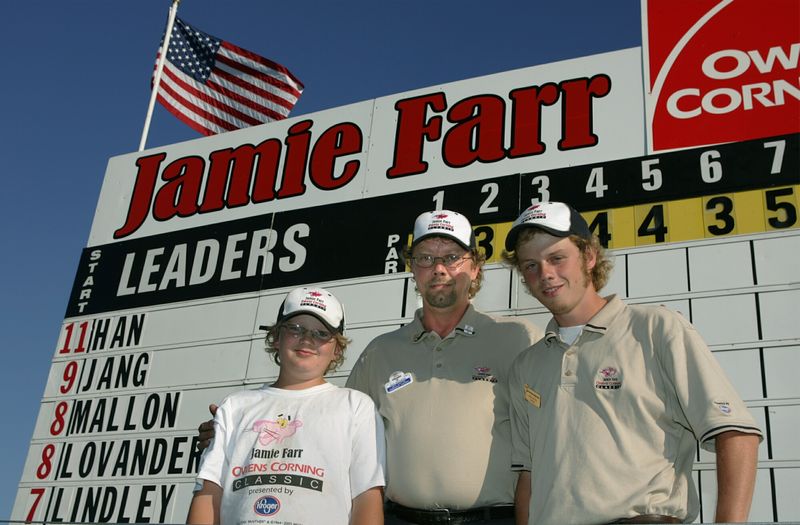
Farr has always been generous with his hometown. The golf classic he discussed above is now the Jamie Farr Owens Corning Classic. The tournament has raised more than $6 million dollars for local children’s charities.
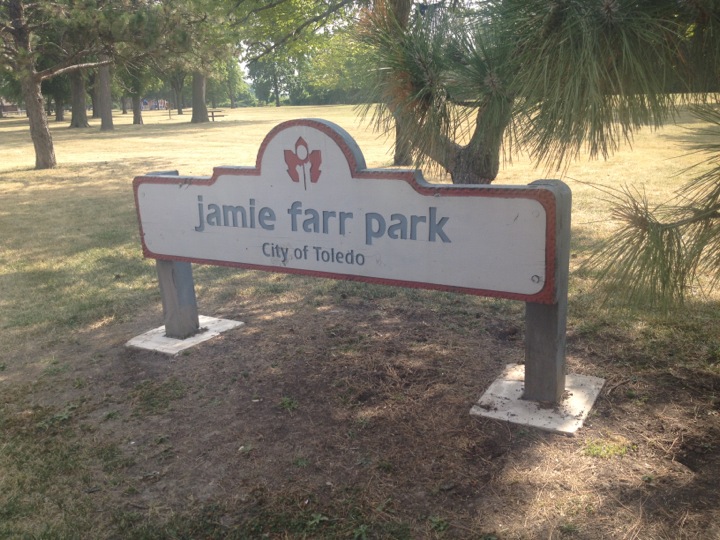
The city has shown its love for Farr as well. The park in Toledo where Farr used to hang out when he was younger was renamed “Jamie Farr Park” in his honor on July 5, 1998. About the park, he said, “I wanted to be an actor, a famous actor, and I wanted my hometown of Toledo, Ohio, to be proud of me.” Farr spoke to about four hundred admirers and was quoted in the New York Post: “Jamie Farr Park is certainly a highlight of my life and career.”

farrparksign

Farr also made a gift of his scripts to the University of Toledo. The scripts were from movies and television, including M*A*S*H, After M*A*S*H, The Blackboard Jungle, With Six You Get Eggroll, No Time for Sergeants, Who’s Minding the Mint, among others. He also donated call sheets with each script. Call sheets list the personnel and equipment needed for each day of productions, the scenes being filmed, shooting schedules, and the scenes to be filmed.

Farr has also appeared in plays during the second half of his career. In the 1990s, Farr  played the role of Nathan Detroit in a Broadway revival of “Guys and Dolls.” Farr is still active in regional theater and guest-stars occasionally on television.

farr1

In 1996–97 Farr went on a national tour with “The Odd Couple,” playing Oscar Madison, playing opposite his old friend William Christopher in the role of Felix Ungar.

Most recently he was in the national touring production of “Say Goodnight, Gracie,” a one-man show about longtime entertainer George Burns.

farrbook1


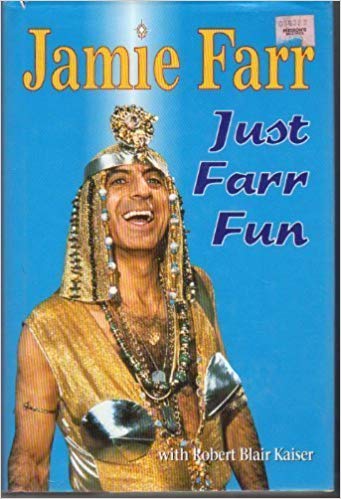
Farr has also tackled being an author. In 1994, he published his autobiography, Just Farr Fun. With his wife, he also wrote a children’s book, Hababy’s Christmas Eve, a Christmas book where the story is told from the view point of the animals.

farr4guideposts

Jamie Farr has had a successful and fun career. He has been a movie star, a television celebrity, an author, and a Broadway performer. He was not bitter about his role as Klinger but accepted the benefits that came with it and made the most of it. He has also been generous, raising money and publicizing Toledo. He truly sounds like a very nice man. It was fun to learn more about his life.

It Only Takes One Episode to Get Smart

In the mid-1960s, spy shows were all the rage.  James Bond drew large audiences to theaters:  Dr. No in 1962, From Russia with Love in 1963, Goldfinger in 1964, and Thunderball in 1965. Inspector Clouseau was big at the box office too appearing in The Pink Panther in 1963 and A Shot in the Dark in 1964. If you were checking out books at the library, you probably would have read Len Deighton’s The IPCRESS File (1962), The Spy Who Came in From the Cold (1963), or Harriet the Spy (1964). On the small screen, The Avengers was ahead of the curve, premiering in 1961, but in the mid-1960s, we would see some of the classic television shows debut: Mission Impossible began in 1966, The Man from UNCLE showed up in 1964 and in 1965, The Wild, Wild West and I Spy got network approval.

smart7

Another show came on the air in 1965 as well – on September 18, 1965, Get Smart was seen for the first time. Dan Melnick, a partner in Talent Associates thought a spy satire might be a good fit for their upcoming schedule. He recruited Buck Henry and Mel Brooks to write the show. The team took the show to ABC. ABC bought it but they wanted a few changes.  They wanted Tom Poston to take the role of Maxwell Smart. They wanted a dog on the show to add “heart.” Finally, they wanted Smart’s mother to be a major role and envisioned Smart coming home at the end of the episode to explain the case to his mother. Henry and Brooks said no to the mother, so ABC rejected the show and sold it back to Talent Associates.

Grant Tinker from NBC agreed to buy the show with the caveat that Don Adams star in place of Tom Poston.  And so, the creative talent of Brooks and Henry brought Maxwell Smart (Don Adams), Agent 99 (Barbara Feldon), and the Chief (Edward Platt) to life. The show would stay on the air for five seasons, producing 138 episodes.

The first four seasons were filmed at Sunset Bronson Studios.  In 1970, the show moved to CBS and the last season was filmed at CBS Studio Center.

Mel Brooks left the show after the first year, but Buck Henry stayed through 1967 as the story editor.

smartgun

Most of the administrative cast stayed with the show for its run. Leonard B. Stern was the executive producer for all the shows. Irving Szathmary was the music and theme composer, as well as conductor, for all five seasons. Gerald C. Gardner and Dee Caruso were the head writers for the series. Don Adams would get to direct 13 episodes and write 2 of them.

The show centered around the three main characters. Maxwell Smart is Agent 86.  He works for CONTROL, a US government counter-intelligence agency in Washington DC. Max is resourceful.  He is a adept marksman, has hand-to-hand combat skills and is extremely lucky. He uses several cover identities, but the one he uses most often is greeting card salesman. He insists in going by the book and this, along with his clumsy nature, cause problems for him.

smartsmart

He and his partner Agent 99 take on world threats. We never learn Agent 99’s real name, although we think we have in one episode.  In “99 Loses CONTROL”, she says her name is Susan Hilton but at the end of the episode, we learn she was lying. Agent 99 is smart and competent.  Her father was apparently a spy as well.  (In real life, Barbara Feldon was also smart; she won on The $64,000 Question with the category of Shakespeare.) If you look closely, you will often see Agent 99 slouching, sitting, or leaning on something to conceal the fact that she was a bit taller than Adams.

smart15

Their boss, Chief, whose real name is Thaddeus, is sarcastic and grouchy but also serious, sensible, and smart. He began his career as Agent Q and his cover name is often Harold Clark. Other CONTROL agents we meet during the series are Agents 8, 13, and 14, as well as Larrabee, the Chief’s highly inefficient and bumbling assistant.

smart10

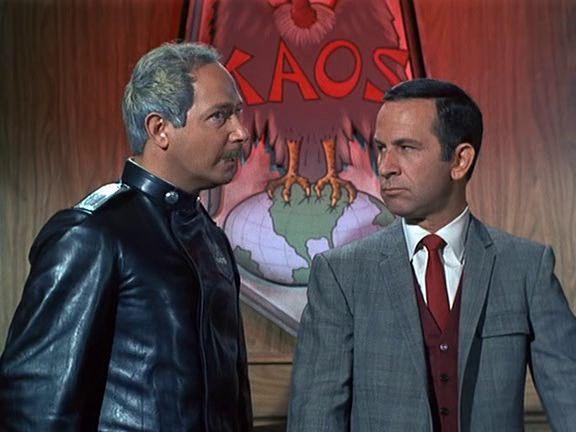
Their primary enemy is KAOS, an international organization of evil founded in Romania in 1904 (a Delaware corporation for tax purposes!). The two KAOS employees we see most often are Conrad Siegfried (Bernie Kopell), the VP for Public Relations and Terror and his assistant Shtarker (King Moody), whose personality can change from sadistic to childlike. While Siegfried and Smart are mortal enemies, they respect each other.  Sometimes they begin talking like old friends.  In one episode, they are discussing the flavor of cyanide pills each side has that month.  CONTROL is giving out raspberry, and Smart tries to give one to Siegfried.  Like CONTROL, KAOS has a bowling team to build rapport and fellowship among their employees.

smart13

Another KAOS agent is Hymie the Robot played by Dick Gautier. Dr. Ratton of KAOS built Hymie for evil, but Smart manages to turn the robot into a CONTROL agent. Hymie is faster and stronger than any human.  He also has the ability to swallow any poison and then identify it. He has emotions and a need to maintain neatness.  Unfortunately, he takes commands literally; if Smart says “Get ahold of yourself,” he literally wraps his arms around himself.

smart8

The opening sequence of the show is one of the most spoofed openings in television.  Smart walks through doors that continue to other doors. It was ranked as the number 2 opening out of the top ten by TV Guide viewers in 2010.

The show is still known for its catch phrases that became part of the American vocabulary including “Would you believe?”, “Sorry about that Chief,” “And loving it,” and “I asked you not to tell me that.”

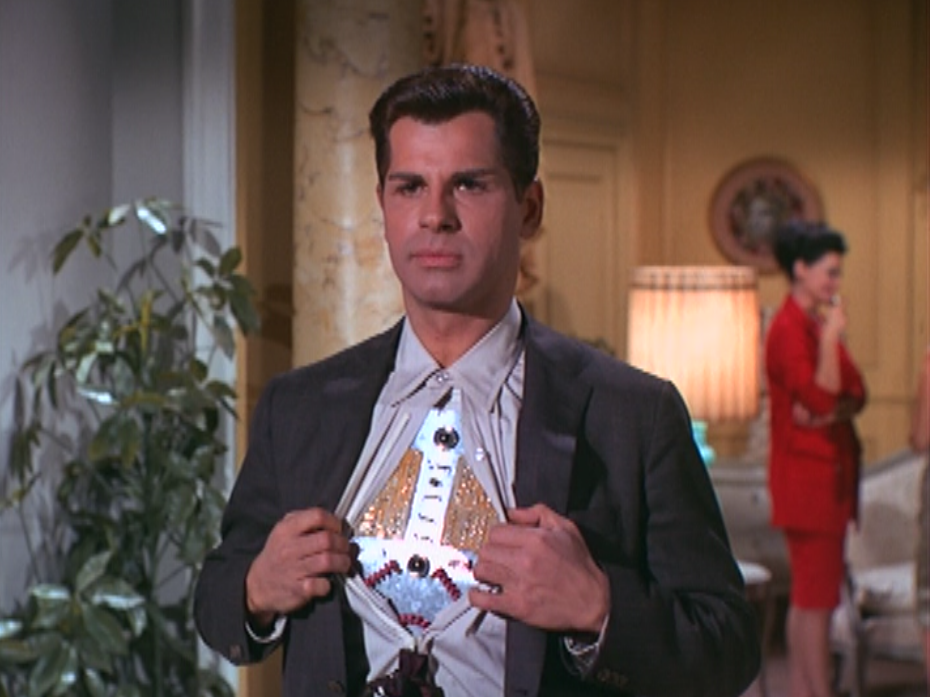
The series is identified with its James Bond-like gadgets.  Telephones could be concealed in neckties, combs, and watches, but most often it is in Smart’s shoe which he had to take off to answer. Agent 99 has a compact phone and a fingernail phone which forces her to look like she is nervously biting her nails to talk on it.

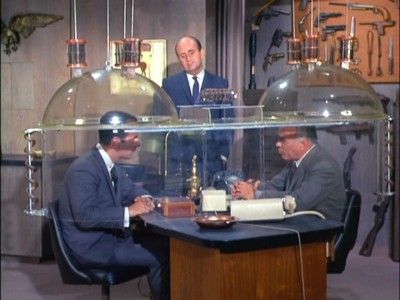
The show features a bullet-proof invisible wall in Smart’s apartment which lowers from the ceiling; he often forgets to put it back up and runs into it. Cameras can be in a bowl of soup.  A laser weapon was concealed in a suit jacket button, the blazer laser. The Cone of Silence are two glass domes that cover Smart and the Chief when they talk about a case.  Smart insists on using it because it’s  regulation; however, they can hardly hear each other, but anyone on the outside can hear their conversation clearly and often reports what the other person said.

smart3

Other weapons and aids for the spies included a parking meter telegraph, a perfume bottle radio transmitter, invisible icing, and a pencil listening device. Guns were hidden in a charm on a charm bracelet, in a pool cue, as a hairbrush, as a flashlight, and in a crutch. CONTROL even had gloves with fingerprints already on them – the fingerprints were KAOS agents so they would get the blame for a break-in.

Blowing up stuff is always good on a spy show and Get Smart had explosive rice; toothpaste that is really a fuse; an exploding wallet, ping pong ball and golf ball; and a horoscope book or lipstick case that contained knock-out gas.

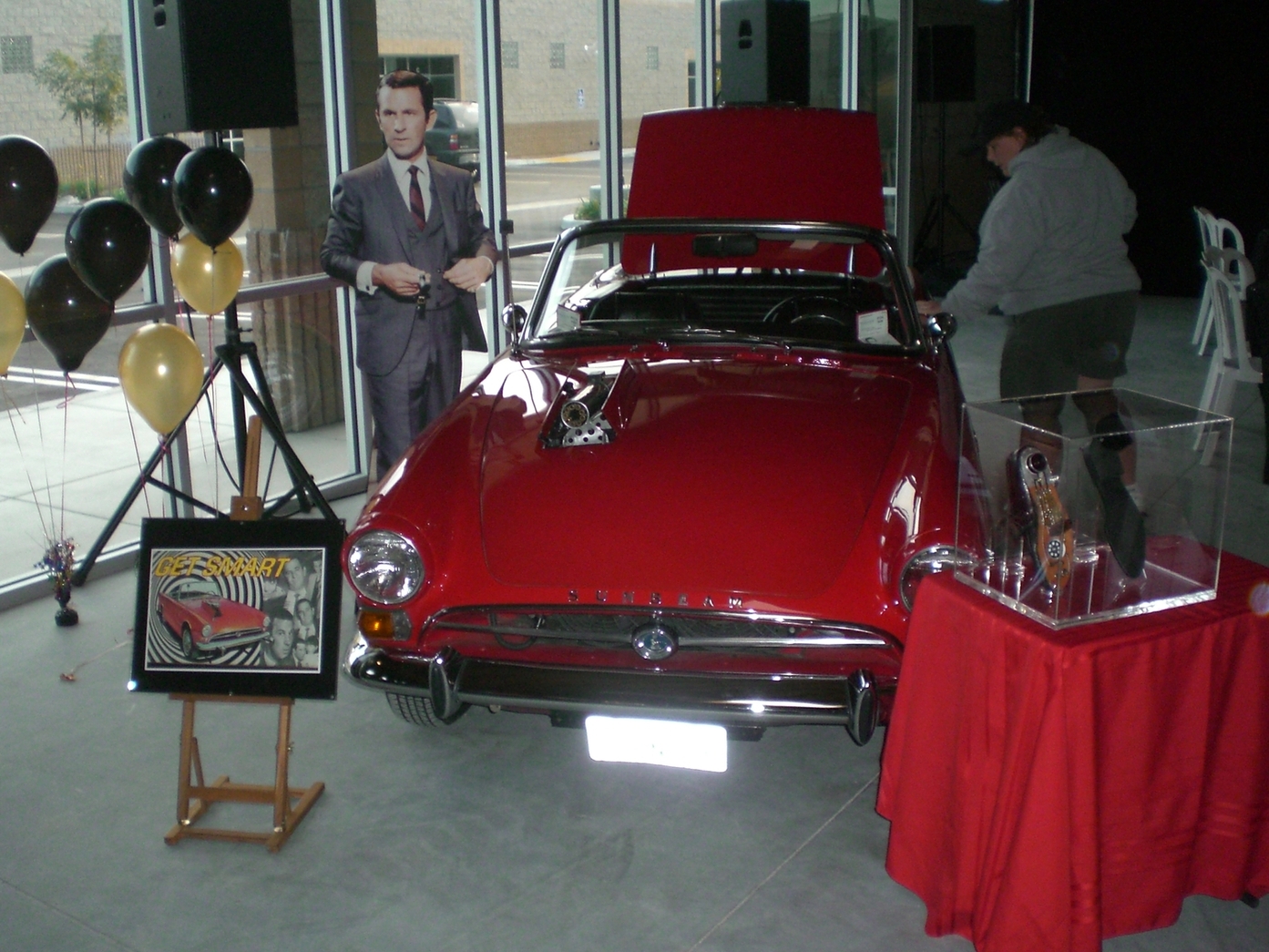
Smart had several cars but his most famous was a red 1965 Sunbeam Tiger.  The two-seat roadster had a machine gun built in, a smoke screen, a radar tracker, and an ejection seat.  When the series went off the air, Don Adams received the car and continued to drive it for ten years.

smart14

Get Smart probably had some of the most famous guest stars of any show.  Just a few of these celebrities include Steve Allen, Barbara Bain, Milton Berle, Ernest Borgnine, Carol Burnett, James Caan, Johnny Carson, Wally Cox, Robert Culp, Phyllis Diller, Jamie Farr, Jack Guilford, Bob Hope, Martin Landau, Julie Newmar, Pat Paulson, Tom Poston, Leonard Nimoy, Vincent Price, Don Rickles, and Fred Willard.

The show stayed true to its character through its entire run.  In Season 1, Hymie is introduced and the dog, Fang, disappears. In Season 2, we meet Siegfried. Smart and Agent 99 get engaged and marry in Season 4.  NBC demanded the change to boost ratings. In Season 5, they have twins.  Agent 99 continues working and is one of the first, if not the first, mother to be viewed as a working woman.  When the ratings did not increase, the show was cancelled. It went into syndication where it was very successful. Unfortunately, the DVD set was held up in legal battles and only came out weeks before Adams died.

Get Smart was one of the most clever and creative sitcoms ever airing on television.  It had `21 Emmy nominations including two for Feldon and won 7 of those awards.  Don Adams won best actor on a comedy three times and the show won best comedy twice.

smartemmy

William Johnston came out with 9 paperbacks based on the series in the late 1960s and Dell Comics issued 8 comic books in 1966 and 1967. For the March 5-11, 1966 TV Guide, Andy Warhol designed a pop art piece using Barbara Feldon. Numerous collectibles were created:  board games, lunch boxes, dolls, and model cars.

The show produced many spin-off projects. The Nude Bomb was a theatre release in 1980 with Feldon and Smart reprising their roles. Get Smart Again debuted in 1989 as an ABC TV movie.  After its release, a show appeared on FOX starring Feldon and Smart again called Get Smart in 1995.  In 2008 a movie was made starring Steve Carell and Anne Hathaway. Don Adams was known to later generations as the voice of Inspector Gadget.

carell

Of course, everyone has their favorite episodes, but after reviewing several polls and interviews with Nick at Nite and other 50th anniversary celebrations, I have come up with these top five.  Take a rainy fall day and give them a peek. However, if we are looking just at titles, I have to give a shout out to “Spy, Spy Birdie”, “Bronzefinger”, “Impossible Mission”, and “Tequila Mockingbird”.

  1. A Spy for a Spy
  2. The Not-So-Great Escape
  3. Ship of Spies
  4. The Amazing Harry Hoo
  5. The Little Black Book


smarttrench

Unfortunately, this is one of those shows that doesn’t get as much recognition and respect as it deserves.  Considering how much technology has developed in the last 50 years, the show is still up to date. The dialogue is witty; the characters are likable, even when they’re mortal enemies; and the show is just plain fun.


The Amazing, But Much Too Short, Career of Richard Deacon

Richard Deacon, 1960s

Richard Deacon was born in Philadelphia, Pennsylvania in 1921, but most of his adolescence was spent in Binghamton, New York. When he was only 11, he contracted polio. He took up dancing to build up his leg muscles.

Deacon’s first career choice was to become a doctor.  He was working as an orderly at the Binghamton Hospital when World War II began. He tried to join the Navy; they suggested he try the Army.  He did and joined the medical corps.

After the war, he studied medicine at Ithaca College but soon switched to acting. He studied drama for a couple of years and was the actor in residence at Bennington College.  After spending some time in New York, he headed to California to look for work.  After paying his dues as a bartender, he finally got a break and was offered a role in a film, Invaders From Mars.

When he first began his career, Helen Hayes advised him to become a character actor as opposed to a leading man.  It was great advice, and he was one of the most beloved and prolific actors during the golden age of television. During his career, he appeared in 66 movies on the big screen, guest starred on 92 different television shows, and starred in six series.

In the 1950s, he appeared in 48 television shows including Burns and Allen, The Life of Riley, Bachelor Father, and the Gale Storm Show.  He had regular roles in two sitcoms.

The Charles Farrell Show debuted in 1956. Farrell played himself as the manager of the Palm Springs Racquet Club, a resort he actually owned and operated. It was a summer replacement for I Love Lucy and only lasted 12 episodes. Richard played Sherman Hall.

deacon8

In 1957, he got another chance at being a regular in a sitcom, Date with the Angels starring Betty White. Deacon played Roger Finley.  This show lasted one year.

Richard continued his productive acting career, appearing in 43 shows in the 1960s.  He could be seen in a wide range of shows including Bonanza, The Rifleman, My Three Sons, Make Room for Daddy, Perry Mason, The Donna Reed Show, The Twilight Zone, Mr. Ed, I Dream of Jeannie, Get Smart, The Munsters, and The Addams Family. He was also appearing in a number of films during this decade. He appeared in four sitcoms on a regular basis during the ’60s.

Leave It to Beaver aired from 1957-1963. Deacon played Fred Rutherford, father of Clarence, or Lumpy, Rutherford, Wally’s friend. During the 6 seasons it was on the air, Fred was in 63 episodes.

Part way through the series, he was offered another regular role, that of Mel Cooley on The Dick Van Dyke Show.  From 1961-1966, he brightened the screen in 82 shows, putting up with his brother-in-law’s bullying and Buddy Sorrel’s belittling. Deacon had high praise for everyone connected with The Dick Van Dyke Show.

One day Morey Amsterdam was goofing around with Richard and said he didn’t think his hair had fallen out, he thought it had imploded and fallen into his brain, clouding his thinking.  Carl Reiner came running on the set and said to add that dialogue to the show.  From then on, there was an insult fest between Buddy Sorrell and Mel Cooley. When the writers were trying to come up with a comeback from Mel to Buddy, Reiner asked Deacon how he would respond to someone who continued to torment him.  Deacon replied, “Yeecchh!” and his trademark phrase was invented.

deacon9

Bud Molin, Dick Van Dyke Show film editor described Deacon as “the funniest human being on the face of the earth.” Carl Reiner said it was a joy to have him around and everyone on the show loved him.

Deacon, Leonard, Reiner, Paris

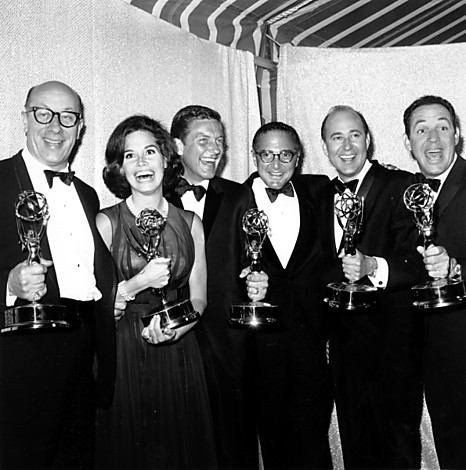
The Dick Van Dyke Show was one of the best shows ever written. It won the Outstanding Comedy Emmy in 1963, 1964, and 1966. After the cast of the Dick Van Dyke Show decided to end the show on its own terms, leaving the air with its quality reputation intact, Deacon was offered another sixties role.

Phyllis Diller had a fantastic cast on her show, The Pruitts of South Hampton, or The Phyllis Diller Show as it became known in syndication. This was about a formerly wealthy family who found out they owed $10,000,000 in back taxes.  They try to appear that they still have their wealth, while living in very reduced circumstances.  The cast included Louis Nye, John Astin, Reginald Gardiner, Paul Lynde, Gypsy Rose Lee, Billy De Wolfe, John McGiver, and Marty Ingels in addition to Diller and Deacon.  I don’t know how this show did not succeed, but it was taken off the air after only one year. Diller and Deacon continued to work together both on an episode of Love, American Style and in the production of Hello Dolly in the 1969-1970 season.

deacon14

Once the Diller show was canceled, Deacon was offered a role on The Mothers-In-Law starring Kaye Ballard and Eve Arden. Deacon took over the role of Roger Buell mid-way through the series. The concept was two families who didn’t necessarily get along were neighbors whose children  married so they had to find ways to get along and keep the peace.

deacon4

After the show was cancelled, he continued to stay busy with his acting career.  He also appeared in 17 episodes of Match Game and several Family Feud episodes.

deacon7

Deacon was a life-long bachelor.  He was a closeted gay man who had to keep his sexual orientation secret to keep his options open to work for companies like Disney. He was also a gourmet chef.  In the 1980s, he hosted a Canadian cooking show about microwave cooking, writing a book that sold almost two million copies. He spent a lot of his spare time working with SYNANON, an agency that helped teenage drug addicts.

On the night of August 8, 1984, he was suffered a heart attack in his Beverly Hills home. He was rushed to Cedars Sinai Hospital, where he died later that night. He was 63 years old.

deacon15 - Copy

Everything I read about Richard Deacon painted him as a gracious, friendly, very funny man who was caring and kind.  He had an amazing career, with 180 acting credits within a 30-year period.  The legacy he left was a rich and full acting life. Pretty good for a guy who chose to be a character actor and was humble enough to turn down two offers to star in his own show.

Do We Have Reservations? Yes We Do.

February has finally arrived.   Some of us are getting a bit tired of winter, so this is a popular month for travel to a warmer destination.  If you aren’t able to physically get away, stay home and watch the February Sweeps, the only time you’re guaranteed new episodes of your favorite show for a month straight.  This week I decided to look at sitcoms set in hotels or resorts.  I did not discuss Fantasy Island or The Love Boat because I thought we could talk about them another time.

resort

Based on the length of many of these shows, the hotel business is a tough one to be successful in. Let’s look at a bunch of shows that didn’t last too long.

buddyfeb6

Stanley was a show starring Buddy Hackett and his girlfriend played by Carol Burnett that aired in 1956. Stanley ran a newsstand in the lobby of a New York City hotel. The hotel owner was played by Paul Lynde.  The show was cancelled in March of 1957, supporting the philosophy that no news is good news.

happyfeb62

Happy starred George and Gracie’s son, Ronnie Burns. Ronnie was married to a woman played by Yvonne Lime and they were co-owners and managers of the Desert Palm, a ritzy resort. Included in the cast was their Uncle Charlie and the co-owner played by Doris Packer.  Happy was their son who commented on what was going on, sort of like Family Guy’s Stewie.  It was a summer entry in 1960, but 9 months later it gave birth to a cancellation which made the cast not Happy.  I don’t know why, but apparently viewers could accept a talking horse or a talking car, but not a talking baby.

Another show that began as a summer replacement was Holiday Lodge in 1961. Johnny Wayne and Frank Shuster, two comedians from Canada, played social directors at a New York state hotel. They tried to provide entertainment but always ran into trouble, including being taken off the air after a few episodes.

The Bill Dana Show was interestingly based on the character Jose Jiminez developed by Dana for the Steve Allen Show and later brought to the Danny Thomas Show.  In 1963 The Bill Dana Show portrayed Jiminez as a bellhop at the New York City Park Central Hotel and the show centered on him trying to get used to life outside Mexico. Often his dream sequences took him into bizarre situations.  The most interesting fact about this show might be that the house detective was played by Don Adams who went on to star in Get Smart. Jimeniz’s dream became a nightmare when the show was cancelled after 42 episodes.

hotlbaltimorefeb6

One of the most controversial shows to air on television in the 1970s was Hot L Baltimore debuting in the fall of 1975.  Many stations refused to air the show because it was lewd and racy.  Norman Lear, the producer behind All in the Family, Maude, and The Jeffersons developed the concept based on a play. The cast was made up of a desk clerk, his girlfriend, the manager, a hooker, an unemployed waitress, a dying man, a gay couple, and an eccentric woman. After four months, the waitress was not the only one unemployed because the show was done.

The Last Resort was developed by MTM in 1979, the company that created The Mary Tyler Moore Show, Rhoda, and Phyllis. The resort, set in the Catskills in upper New York, included a bunch of college students working their way through school. It featured a stereotyped crew including the brilliant premed student, a bookworm, a snob, an overweight clumsy guy, the pastry chef who left her wealthy husband to pursue her career, a Japanese chef, and a maitre’d who ran the place like a drill sergeant. It was cancelled after three episodes. Retooled, it came back in December only to be finished for good in March when the last resort of The Last Resort was no more.

Checking In must be in the running for the shortest show to appear on television. In 1980, Marla Gibbs, playing Florence the maid on The Jeffersons, got her own show, transferring to a hotel in New York City where she was the head housekeeper. She answered to a snobby manager played by Larry Linville who would later become Frank Burns on M*A*S*H. The rest of the cast included an assistant, a house detective, a maintenance supervisor, and a bellboy. After several weeks, the hotel was shut down and Florence went back to working for The Jeffersons.

goldenpalacefeb6

The Golden Girls was one of the most beloved shows in television, but I’m guessing few people remember The Golden Palace which debuted in 1992.  After Dorothy got married, the other three characters decide to invest in a hotel in Miami. Only two employees are left at the hotel:  a manager and a chef. After 24 shows, no one was left at the hotel.

In 1999 Payne, a remake of the British show Fawlty Towers hit the air.  Set in a California inn, Whispering Pines, the hotel was owned by Royal Payne and his wife Constance.  It went on the air in March.  At the end of April, the network ended its Payne by taking two aspirins and cancelling the show.

whoopifeb62

Compared to some of the shows, Whoopi! might have seemed successful, lasting an entire season.  Set in the Lamont Hotel in New York City, a one-hit wonder musician played by Whoopi Goldberg decides to put her money into a hotel and run it the way she sees fit.  She has an assistant from Iran, a brother who is a conservative Republican, and his girlfriend who is white but acts more African American than the black members of the hotel. Of course, these three characters give her much controversy to deal with.  The network, acting as referee, blew the whistle and cancelled the entire thing after one year.

In 2008 Do Not Disturb debuted.  If you missed it, don’t feel bad.  It debuted on Fox and featured The Inn, a hip Manhattan hotel.  The staff is not as competent as they appear to their guests. The manger is arrogant, the head of human resources is loud and tactless, the front desk clerk is an aging model who does not want to be a desk clerk or older, the reservations clerk is a famous musician wannbe, and the head of housekeeping has problems at home. The network, not wanting to disturb the viewing public, pulled the plug after three shows. Larry, played by Jesse Tyler Ferguson, would go on to star in Modern Family in 2009.

Before you begin to think shows about hotels are doomed, let’s check in with four successful shows that knew how to make a profit.

From 1996-2001 The Jamie Foxx Show on WB featured Jamie Foxx as a musician who moves to California to work at his aunt and uncle’s (played by Ellia English and Garett Morris) hotel, King’s Tower.  He has two co-workers played by Christopher B. Duncan and “Fancy” played by Garcelle Beauvais. He is interested in Fancy, but she doesn’t feel the same until the final two seasons when they become engaged. The show aired 100 episodes before the network finally got reservations.

Disney’s Suite Life of Zach and Cody set in the Tipton Hotel ran from 2005-2008. The twins lived in the hotel because their mother was the lounge singer.  Somewhat like Eloise at the Plaza, the boys got into mischief and interacted with other employees including the wealthy heiress London Tipton, the candy counter salesgirl Maddie Fitzpatrick, and the manger Marion Moseby.  In 2008 the show sailed off, literally, and became Suite Life on Deck running until 2011.

With 184 episodes, Newhart debuted in 1982. With its quirky cast of characters, it became a big hit. Set in Vermont, Dick Loudon (Bob Newhart) is a writer who buys the hotel and runs it with his wife Joanna (Mary Frann). Their handyman George Utley (Tom Poston) and their maid Stephanie Vanderkellen (Julia Duffy) make life both easier and more difficult at the inn. Later Dick becomes a local television celebrity working with Michael Harris (Peter Scolari) who marries Stephanie.  Larry, (William Sanderson) his brother Darryl (Tony Papenfuss) and his other brother Darryl (John Voldstad) are memorable characters.  Darryl and Darryl never speak until the final episode.  That finale has the best ending ever in a television series when Bob Newhart wakes up in bed, tells his wife he had a really weird dream, and we see the wife is Suzanne Pleshette, his wife Emily from The Bob Newhart Show in which he played a psychiatrist from 1972-78. This series delightfully captured the life in a small New England town until 1990.

While Newhart is hard to top, my favorite hotel sitcom is Petticoat Junction which featured the Bradley Girls from 1963-1970. Kate (Bea Benaderet) ran the hotel with her three daughters Billie Jo, (Jeannine Riley till 1965, Gunilla Hutton until 1966, and Meredith MacRae until 1970), Bobby Jo (Pat Woodell until 1965 and Lori Saunders through 1970, and Betty Jo (Linda Henning), along with her Uncle Joe (Edgar Buchanan). The Shady Rest is near Hooterville, so we get to know a variety of town folk including Sam Drucker who runs the general store; Floyd and Charley, who run the Cannonball train; and Steve Elliott, crop duster, who is Billie Jo’s boyfriend first but later marries Betty Jo; and we run into the Ziffels and the Douglases from the show Green Acres. It’s a charming and heart-warming show loaded with loveable but zany characters. It ran for 222 episodes, even surviving the death of Bea Benaderet, who was replaced by Janet Craig (June Lockhart), a woman doctor who moves into the hotel. The amazing Charles Lane shows up throughout the series as Homer Bedloe, a railroad employee whose sole mission is shutting down the Cannonball.

If you can’t physically travel this month, take some time and watch a season or two of Newhart or Petticoat Junction, and you can still get away and experience life in a small-town hotel.


1917 Was A Very Good Year

This week I was inspired by the blog “Once upon a screen . . .” to take a look at television pioneers who were born in 1917. (For some great articles on pop culture, movies, and television, check out her blog at aurorasginjoint.com.) Let’s get to know 17 of the stars who helped shape the direction of television during the golden age.

Herbert Anderson. Best known for his role as Henry Mitchell on Dennis the Menace, Anderson began his career making movies.  He transitioned to television in 1953, appearing on 61 shows over the years.  He appeared in episodes on such shows as Gunsmoke, Petticoat Junction, Batman, I Dream of Jeannie, Man from U.N.C.L.E., My Three Sons, Bewitched, and The Waltons.  One of my favorites is the first season of The Brady Bunch.  The kids are sick and both parents call a doctor.  The girls were used to a woman played by Marion Ross while the boys always had a man, Anderson.  After weighing factors to pick one of them, the family decides to keep both doctors. He died from a heart attack in 1994.

Carl Ballantine. Ballantine began his career as a magician and inspired many famous magicians since.  He began working in Las Vegas and on television as a magician.  Eventually he transferred to movie roles and after appearing in McHale’s Navy on the big screen, took on the same role of Lester Gruber on the television series. He went on to appear on 33 additional tv shows including That Girl, Laverne and Shirley, Trapper John MD, and Night Court. He passed away at his home in 2009.

bellamy1

Earl Bellamy. Earl Bellamy directed episodes for 101 different television shows.  He is best known for The Lone Ranger and The Tales of Wells Fargo.  He directed 82 episodes for Bachelor Father, one of my all-time favorite sitcoms.  In the 1960s he specialized in sitcoms including That Girl, The Brady Bunch, The Partridge Family, and My Three Sons while the 1970s saw him transition to dramas including Marcus Welby MD, The FBI, Medical Center, and Eight is Enough. In 2003 he passed away from a heart attack.

Ernest Borgnine.  Best known of his Oscar-winning role of Marty in 1955, Ernest enlisted in the Navy in 1935 until 1941.  In 1942 he re-enlisted and served until 1945.  After doing some factory work, he decided to go to school to study acting and began his career on Broadway.  He was also in the movie McHale’s Navy and went on to tackle the role in the television series.  He loved working with Tim Conway and in later years they did the voices for Mermaid Man and Barnacle Boy in SpongeBob SquarePants. He appeared in 47 different shows over the years, including the series Airwolf which he starred in. Borgnine appeared in the final episode of ER which he won an Emmy for. He was married five times, including a 32-day marriage to Ethel Merman.  His last marriage to Tova lasted 39 years. He died of kidney failure in 2012.

Raymond Burr. Best known as Perry Mason, Burr started his career on Broadway in the 1940s and then appeared in 50 films from 1946-1957. In 1956 he auditioned for the role of Hamilton Burger, the DA in Perry Mason.  He was told he could have the starring role if he lost about 60 pounds which he accomplished. He later starred in Ironside, another crime drama and appeared on a variety of other shows.  Burr had many interests including raising and cross-breeding orchids; collecting wine, art, stamps and sea shells; reading; and breeding dogs.  He was extremely generous, giving away much of his money over the years.  He passed away from cancer in 1993.

Phyllis Diller. Known for her wild hair and clothing, Diller was one of the pioneering stand-up female comedians.  She appeared in films in the 1940s, worked in radio in the 1950s, and began her stand-up career in 1955. Her first television appearance was in You Bet Your Life.  She appeared in 40 shows including Batman, CHIPs, Full House, and The Drew Carey Show.  She had her own show titled The Pruitts of Southampton, and in reruns The Phyllis Diller Show that ran from 1966-67.  She recorded comedy albums in the 1960s, wrote several books during her career, was an accomplished pianist, performing with symphony orchestras across the US and taught herself painting which she continued throughout the 1960s and 70s. Her husband Fang was not real, but she used him in her comedy routines.  She died of natural causes in 2012. My first memory of Diller was in the movie Boy Did I Dial a Wrong Number with Bob Hope which my parents took me to at the drive in.

Ross Elliott. A prolific actor on stage, film, and television, Elliott appeared in 184 different shows from sitcoms to westerns to medial dramas, all between 1951 and 1983. He passed away from cancer in 1999.

June Foray.  One of the greatest voice actors ever, Foray has been active in the industry since she had her own radio show.  She did off-air voices for many sitcoms including I Love Lucy, Father Knows Best, Jack Benny, Rawhide, Get Smart, Lost In Space, and Bewitched.  She also appeared in more than 76 animated series.  She is perhaps best known as Rocky in Rocky and Bullwinkle and as Cindy Lou Who in How the Grinch Stole Christmas and Karen and other voices in Frosty the Snowman. Foray is still alive today.

Zsa Zsa Gabor.  Unlike her sister Eva who became known as Lisa Douglas on Green Acres, Zsa Zsa seemed to make a career out of playing herself.  Of the 80 appearances she made in film and television, 20 of them were as herself. She was a true celebrity.  Crowned Miss Hungary in 1936, she came to the US in 1941 and began her career.  She was known for her extravagant lifestyle and many marriages: 9 with 7 divorces (including one to Conrad Hilton) and 1 annulment.

Sid Melton.  Known to most viewers today as handyman Alf Monroe on Green Acres, Melton began as a film star and went on to appear in 71 shows including Topper, Bachelor Father, Make Room for Daddy, That Girl, Petticoat Junction, I Dream of Jeannie, and Empty Nest. He died from pneumonia in 2011.

Alice Pearce. Although her career was cut short due to illness, I included Alice Pearce because her role as Gladys Kravitz in so memorable.  After spending her childhood in Europe, Pearce started on Broadway and after appearing in On the Town, she was brought to Hollywood to reprise her role in the movie version. She began specializing in comedy in the 1940s. In 1964 she turned down the role of Grandmama in The Addams Family and shortly after was offered the role of Gladys in Bewitched. She was already diagnosed with ovarian cancer when she began her role but didn’t tell anyone and was able to act for two seasons before she passed away from the disease. She received an Emmy for her work on Bewitched.

Gene Rayburn. One of the kings of game shows, Rayburn began his career as an actor, taking over for Dick Van Dyke in Bye Bye Birdie when Van Dyke began his television show. While he was on numerous game shows as a panelist or host over the years, Rayburn is best known for Match Game which first ran from 1962-69. It was revived again in 1973 and took several formats in the following years.  He died from heart failure in 1999.

Isabel Sanford. Best known as Louise Jefferson, she grew up in Harlem and performed in amateur nights at the Apollo Theatre. Her Broadway debut was in 1965.  After appearing as a maid in Guess Who’s Coming to Dinner, she was cast by Norman Lear in All in the Family which led to the series The Jeffersons.  When the show ended in 1985, she appeared in a variety of other shows until 2002.  She passed away from natural causes in 2004.

Sidney Sheldon.  A writer and producer, Sheldon created The Patty Duke Show, I Dream of Jeannie, and Hart to Hart, writing many of the scripts for all three series. After he turned 50, he began a career writing romantic suspense novels.  He died from pneumonia in 2007.

Robert Sterling. A clothing salesman before getting into acting, Sterling was best known for his role as George Kerby in Topper from 1953-55.  His wife, Anne Jeffreys played his wife in the show. From 1943-49 he was married to Ann Sothern. He appeared in 36 shows between 1951 and 1986. He passed away from natural causes in 2006.

Jesse White.  While White was a hard-working character actor, he is best known for his commercials as the Maytag repairman from 1967-88. After appearing in films for many years, he transitioned to television in the 1950s.  His daughter Carole Ita White also became an actress best known for Laverne and Shirley. White appeared in 113 shows, never receiving a regular series.

Jane Wyman. Wyman began working at Warner Brothers at age 16, claiming to be 19. Although she was a successful film star and began in television in 1955 with her own show, Jane Wyman Presents Fireside Theater, she is probably best known for her role on Falcon’s Crest from 1981-90 and her marriage to Ronald Reagan. She died in her sleep from natural causes in 2007.

These are just a handful of television mavericks that influenced television as we know it today.  I was amazed at the variety of different talents each of these stars displayed.  In comparing their television appearances, it’s surprising how many of them overlap and worked on the same shows.  What I found most surprising was that Ballantine, Diller, Melton, Sanford, Sterling, White and White’s daughter all appeared on Love American Style while Bellamy, Borgnine, Burr, Diller, Gabor, Rayburn, Sanford, White, and Wyman all guest starred on The Love Boat.  During my research, I ran across many shows that will become future blog topics.

Another fun fact about celebrating stars born in 1917 is that this week we are traveling to Pennsylvania to celebrate my grandmother’s 100th birthday who was also born in 1917.  Happy Birthday Mamie.

Decorate With Style

With the Christmas shopping season fully in swing, I thought it would be fun to look at ways to decorate with movie and television collectibles. If you are looking for a unique gift for someone on your list or trying to come up with ideas to share with others, think about personalizing home décor with items that showcase pop culture favorites.

Whether you want to sprinkle a few items in around your house or devote an entire room to a theme, there are a lot of fun ideas to display your passions.

If you are shopping for children, think about purchasing a movie poster from the first movie they ever went to.  Our oldest son’s first movie at 3 was supposed to be an animated Christmas feature, but they had a problem with the film and showed Home Alone instead.  I thought he would be bored (or scared), but he loved it, and we commemorated that memory with a framed movie poster for his room. Maybe your child is older but has a movie she watches over and over.

collection1

Our middle son collected old board games.  We still have a lot of those and play them a lot. You can find games about shows from the 1950s up through the present. Here are just a few of the ones I’ve seen out there:  The Lone Ranger, Happy Days, McHales’s Navy, The Partridge Family, The Patty Duke Show, The Big Bang Theory, Modern Family, The Honeymooners, The Office, and hundreds more.

If you have an avid sports fan to buy for, think about decorating with movies and tv shows about sports. How about the lobby cards for Remember the Titans, a basketball signed by Gene Hackman from Hoosiers, or a Happy Gilmore script signed by the entire cast.

Decorating with western items can also be a fun theme. Consider redoing your guest room with a western flare.  What would you put in it?  How about Clint Eastwood’s hat from The Good, The Bad, and The Ugly.  I’ve seen a Roy Rogers bedspread, a John Wayne figurine, a Lone Ranger poster for the wall, and on the night stand place a couple of Bonanza tin cups for morning coffee and a CD player with a collection of Old West radio episodes.

collection4

Maybe you have a family member who loves Christmas.  You can find a variety of Christmas photos from classic television shows.  Or buy a small fake Christmas tree and decorate it with Hallmark ornaments from pop culture.

collection5

Perhaps you have someone who loves fashion.  There are a variety of items you can search for in that category. Many movies had photos taken when they tested their costumes. You can also find clothing, accessories, and jewelry worn on television shows or movies to wear or frame. I have a thirtysomething jacket that was made for the crew and cast and it’s a fun item to hang on the wall.

Someone who likes old advertising can use a variety of collectibles scattered throughout the house.  You can find stars promoting everything from cold cream to coffee.  We have an ad of Ozzie and Harriet Nelson in our laundry room for a Hot Point washing machine.

Do you have a doll collector on your list ?  There are hundreds of dolls out there from television series. I’ve seen I Love Lucy, George Burns, Maxwell Smart from Get Smart, That Girl, and Laverne and Shirley. In movie collectibles, you can find Gone with the Wind dolls, Wizard of Oz figures, and even Rock Hudson and Doris Day from Pillow Talk.

Coffee bars are becoming common in new homes.  If you have someone who loves entertaining that way, you’re in luck.  You can find coffee mugs, serving bowls, and tea sets to display.

Last, but not least, if you know someone who has one show they are drawn to use that as your theme.   The iconic show is The Andy Griffith Show.  You can find blankets, villages, cups, signs, clocks, and even canned food and muffin packages. However, any show whether it be The Donna Reed Show from the 1950s or Last Man Standing currently on television will have a lot of items to choose from. If you are looking for single show themes, consider advertising items–My Three Sons had a wood block invitation made for the press; props –a typewriter used on Will and Grace; tv guides; music boxes; paper dolls and coloring books; lunch boxes; or even light switch plates.

If you can’t find exactly what you’re looking for, make your own.  For example, you could enlarge the sheet music from the theme song and frame it. Or make a shadow box with a few treasured items. You can even make pillows or magnets.

With a little imagination, you can come up with that perfect gift for everyone on your list.  The bonus?  You get to stay cozy and warm inside when the winds are blowing and the snow is falling and watch your favorite shows while you shop for everyone on your gift list.