I’m Dickens, He’s Fenster: Building Comedy Into Every Episode

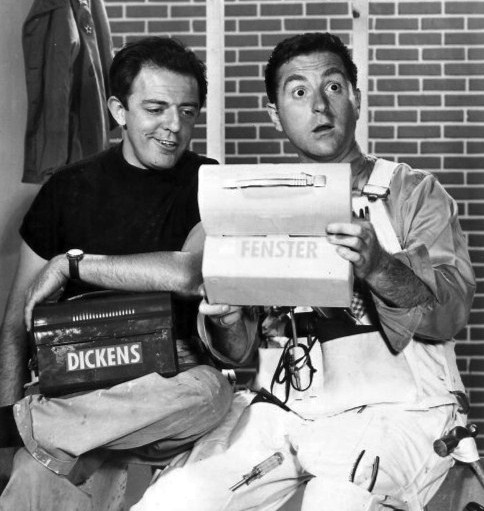
June’s blog theme is Funny Duos. Last week we learned about the Governor and J.J., a show created by Leonard Stern. Today it’s another show created and produced by Stern, I’m Dickens, He’s Fenster.
📷wikipedia.com

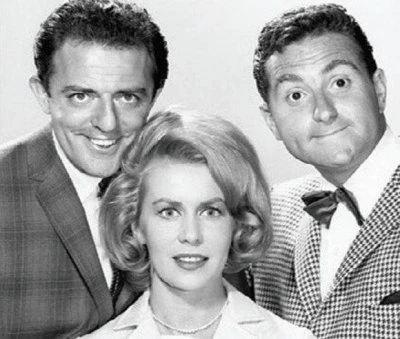
This show debuted on ABC in September 1962 and was canceled after one season. It starred John Astin and Marty Ingels.

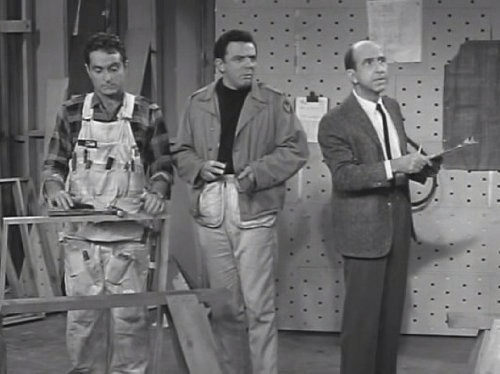
The plot is that two carpenters are best friends. Harry Dickens (Astin) is married to Kate (Emmaline Henry) while Arch Fenster (Ingels) is a swinging bachelor whose lifestyle is not okay with Kate. The two often clash with their boss, Mr. Bannister (one of my favorites, Frank DeVol). Rounding out the cast are coworkers Mel (Dave Ketchum), Bob (Henry Beckman), and Bentley (Noam Pitlik). We also meet a few of Fenster’s girls including Yvonne Craig, Ellen Burstyn, and Lee Meriwether.

Stern talked about casting for the show in his interview with the Television Academy. He had Ingels hired and then Stern and his wife saw Astin in a play at UCLA, and he was added to the cast. Stern said he needed a director who liked comedy and could bond with the actors well and was innovative because Stern didn’t like the three-camera shot. He hired Arthur Hiller who fit all three qualifications.

The show, unusual for the time, was filmed in front of a live audience. The comedy combined witty comments with slapstick comedy.
📷imdb.com

ABC placed it on Friday nights between The Flintstones, which was created for adult viewing, and 77 Sunset Strip. This should have provided a built-in audience, even though it was competing against Sing Along with Mitch and Route 66. At the end of the first season, it beat the competition in the ratings but was still canceled. One of the problems measuring viewership at this time was that a person watching was a person watching whether they were 6, 26, 56, or 106, so it was hard to tell which shows appealed to adults.

Astin discussed the reviews for this show during one of his interviews and said that “some of the critics said it’s the kind of humor that makes you laugh out loud in the living room, and that’s an accomplishment. How often do we really laugh out loud in the living room when we’re watching a television show? We’re lucky if we smile.”
📷televisionheaven.com

The idea for this show occurred when Stern had some work done at his home. On Christmas Eve 1961, the builders were in a hurry to finish work and get home to celebrate with their families. They were finishing a new fireplace with a built-in brick chimney. Unfortunately, one of the crew forgot to remove the ladder when they were finished in the chimney and they bricked up the hearth before realizing they had now lost their ladder. Stern thought the misadventures of a couple of construction workers might make a great sitcom.

In an interview with the Television Academy, Stern said he asked musician Irving Szathmary for a theme that evoked a Laurel and Hardy feeling. (Szathmary was also the composer behind the unforgettable Get Smart theme.) It must have worked because Stan Laurel said he thought this series was “one of the funniest and most highly imaginative comedies to have its thirty minutes of fame on television.”

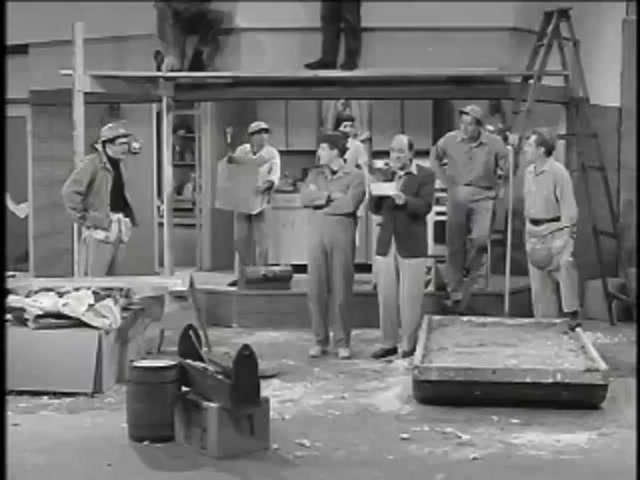
One of the running gags on the show was just like the cobbler’s children have no shoes, Dickens’ house was always in a state of upheaval with paint samples on the wall and cabinet doors not working properly; it was in constant renovation. We see this immediately in the pilot as Fenster stops by to pick up Dickens and sees Kate trying to work with the various kitchen issues under construction.
📷tvguide.com

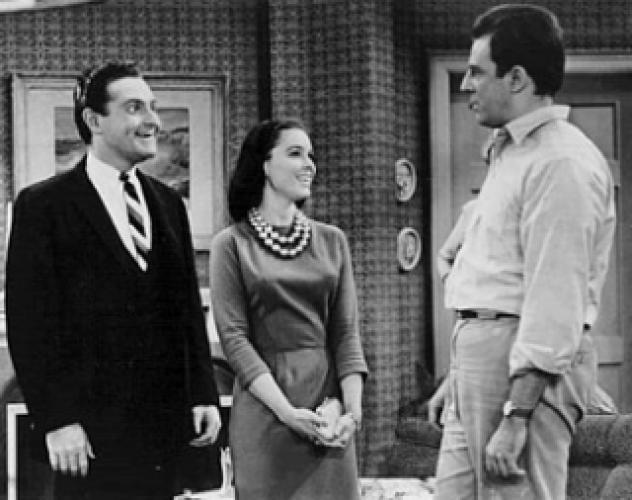
The pilot was a typical plot line for not only this show but most early sixties sitcoms. Dickens is up for a promotion to foreman and is afraid he won’t get the job. In the past, whenever Dickens is waiting for something special, he gets nervous and always ruins the opportunity. When the boss shows up at the project, he doesn’t seem to know Harry Dickens’ name, so the two friends decide to put it into his subconscious by whispering it here and there when they walk by him. That evening Fenster brings his girlfriend over. Harry doesn’t want to spend the evening with them, but once he meets the girlfriend, he falls all over himself being nice to her. Lorna mentions to Fenster that he should try for the foreman job himself.

The next morning, Fenster comes to get Dickens, and Harry is rude to him because he thinks he wants the foreman job. At the end of the day, Bannister calls Dickens into the office to give him the promotion and tells him that Fenster must be fired because he overheard a lot of bad things about him when the crew was talking. When Dickens talks to the other guys, they said that they never complained about Fenster, although they did repeat some of the funny things Dickens said about Fenster. Fenster tells Bannister that he just got fired by Dickens and then Dickens comes in to say it’s been a misunderstanding and Fenster should not be fired and would make a better foreman than Dickens. Bannister said he’ll let them know what decision has been made the next morning.
📷episodate.com

That night Fenster shows up with a different girlfriend who just happens to be Bannister’s daughter. There was a great mixture of slapstick and witty banter during the episode. Something did feel a bit off with the characters. I think the characters should have reversed roles; Aston seems more the playboy type, and Ingels seems more the married man for typical sixties sitcoms.

Astin would go on to star in The Addams Family while Henry would marry Dr. Bellows on I Dream of Jeannie. Unfortunately, with only 32 episodes, the show didn’t qualify for syndication. The first sixteen episodes are included on a DVD set released in 2012 if you want to check out the show. You can also find some of them online in different sites.
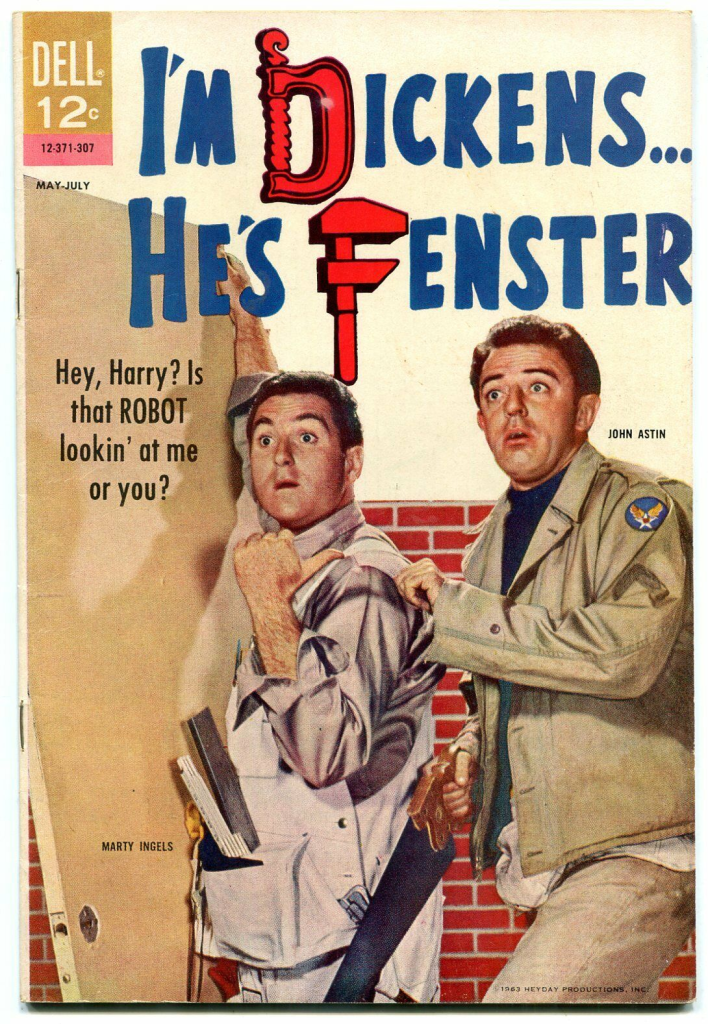
Like The Governor and J.J., this series also made it to Dell Comics; if you’re a collector of comic books about old television series, you can take a look.

I had heard a lot about this show but never watched it till now. It was different and funnier than I thought it would be.

Crazy Little Thing Called Love

Love is definitely in the air; whether you think it smells rancid or fragrant depends on your current relationship status.  Remember those days when everything hinged on what type of valentine your current crush gave you at the school party?  Love seemed to be the answer to all questions.  We’re going to look at some classic (and not so classic) television shows that promoted that kind of love.  Sorry, I can’t tell you if that pain you’re feeling is cupid’s arrow as it hit you or heartburn, but I can share some information with you as we learn about shows with “Love” in the title.

Love That Bob (1955). Bob Cummings played ladies’ man and photographer Bob Collins.  His widowed sister, Rosemary Decamp, and nephew (Dwayne Hickman) also lived with him. Before she moved in with the Bradys, Ann B. Davis was Schultzy, Charmaine Schultz, Bob’s assistant, who was in love with him.  Every show opened with Bob holding a camera and saying, “Hold it! I think you’re going to like this picture.” The beautiful Joi Lansing was another model who also was in love with Bob, but he was having too much fun playing the field.  When he never accepted Joi, we knew deep down in his heart, he realized that Schultzy was the one for him. While Bob couldn’t decide on only one woman, the networks couldn’t decide on only one channel for the show either.  It was on NBC Jan-May of 1955, moved to CBS for two seasons, moved back to NBC, and then finished up the last year and a half on ABC. I guess no one could remember where the show was supposed to end up after 1959, so it was cancelled. Bob was one of the first stars to play two characters in one show. Bob played himself and his grandfather Josh Collins. A decade later, Fred MacMurray would play Uncle Ferguson in addition to Steve Douglas in My Three Sons.

Love That Jill (1957). Rival managers of modeling agencies are played by real life couple Anne Jeffreys and Robert Sterling who had played the married ghosts on Topper.  I guess they spooked the network because they disappeared after three months.

loveandmarriagefeb13

Love and Marriage (1959). Now we know what Uncle Charlie really did before he moved in with My Three Sons.  He owned a music publishing company that was close to bankruptcy.  William Demerest plays a business owner who brings his daughter into the company as a partner.  She and her lawyer husband also move into his house.  She loves rock and roll; her father hates it, but it might save his company. The network shut down the agency after four months to promote family harmony.

The Many Loves of Dobie Gillis (1959). This show was based on a 1953 book and it was the first television series to feature teenagers as the main characters. I guess when Dwayne Hickman lived with Bob Collins, he picked up a lot of tips for the ladies, and as high schooler Dobie, he spent most of his time trying to find a girl to go out with and some money to pay for the date. Since his family owned a small grocery store, he was on his own for finances. Once he graduated, the show had to come up with new situations, so Dobie was in college for a couple of years as well as the army for a year. Dobie would go to the Rodin’s Thinker in the park and talk to us and himself about his love life. His best friend was beatnik and bongo player Maynard G. Krebs.  Bob Denver played this role before he went on to star in Gilligan’s Island.  He had never acted before this show; he had been a grade school teacher, and his sister, who worked for the casting department, included his name in the auditions. Super smart Zelda Gilroy was in love with Dobie.  We knew he would eventually end up with her, his own Schultzy.  She always wrinkled her nose at him and before he could stop himself he always did it back. In later years when they did two reunion movies, Dobie and Zelda were in fact married.  Sheila James, who played Zelda, became a California senator.

During the first season, Dobie thought he was in love with Thalia Meninger played by Tuesday Weld.  Thalia only liked Dobie when he had money which was not often. In real life they did not get along, and she left after the first season. Another character who disappeared after the first season was his brother Davey Gillis who was played by Hickman’s real brother, Darryl. Dobie also suffered through Milton Armitage played by Warren Beatty and then Chatsworth Osborne Jr. (Steve Franken) who were his arrogant, wealthy competition. Some of Dobie’s many girlfriends included Marlo Thomas (who became That Girl), Sally Kellerman (who was Hot Lips in the M*A*S*H movie), Ellen Burstyn (starred in many movies), Barbara Bain (who would be in Mission Impossible), and Yvonne Craig (before she was Bat Girl). Two interesting things I learned about this show was that DC Comics created a comic book series of 26 issues about the kids from 1960-1964. Also this show inspired the Scooby Doo Gang in 1969. Fred was based on Dobie, Velma on Zelda, Daphne on Thalia, and Shaggy on Maynard. Garry Marshall also reported that this was one of his main influences for his creation of the show Happy Days. After four years, I guess these kids were too innocent to handle all the crazy situations coming in the sixties and the show ended but has appeared in reruns often since it left the air.

Peter Loves Mary (1960). This couple, played by Peter Lind Hayes and Mary Healy, were married in real life. They play a show business couple who moved to Connecticut.  Luckily they have a housekeeper played by one of my all-time favorites Bea Benaderet who takes care of the house and children. Opposite the Green Acres viewpoint, Mary wants life in suburbia while Peter loves the city. The network didn’t want to weigh in on the argument so they took the show off the air after the first season.

Love On a Rooftop (1966). Judy Carne (pre Laugh-In days) and Peter Duel are a young married couple, living in San Francisco. He is an apprentice architect and she’s an art student, who gave up her dad’s money for love. Rich Little played their neighbor who designed restaurant menus, among other jobs. It was cancelled after one season.  Oddly, in the summer of 1971 it aired as a rerun show but never aired again.

To Rome with Love (1969). John Forsythe tries his hand in another sitcom.  In this one, he plays a widower who has accepted a job at an international school in Rome, and he heads for Europe with his three daughters.  His sister comes along the first season, mainly to try to talk them into going back home to Iowa.  For the second season, they gave her a one-way ticket home and brought Walter Brennan in as Forsythe’s father-in-law. The family lives in Mama Vitale’s boarding house.  After the second season, they all got air fare home and the show was done. Don Fedderson produced this show, and in the second season they had two cross-over episodes, one with the cast of Family Affair and one with Uncle Charlie, Robbie and Katie from My Three Sons.

Bridget Loves Bernie (1972). Bridget, played by Meredith Baxter, marries Bernie, played by David Birney.  The only problem is that she’s Catholic and he’s Jewish.  This would not even be noticed in today’s world, but in 1972 it caused quite a commotion. Her parents were wealthy and Irish.  His parents owned a deli and the couple lived above it. The ratings were very good–the fifth highest rated show, but they were cancelled after the first season anyway. It was the highest rated show to ever be cancelled, and the network finally caved into the pressure of public protests for having an inter-religious marriage. One fun fact is the Meredith Baxter and David Birney married in real life after this show was over.  However, that was before she came out of the closet, which created another mixed marriage . . .

loveneighborfeb13

Love Thy Neighbor (1973). This show was a summer replacement in the days of All in the Family.  Charlie Wilson, a shop steward at Turner Electronics, lives in LA. When new neighbors move in, not only are they black, but the new guy is hired as an efficiency expert at Turner.  The show explored how two couples of different races become friends.  The white couple was played by Ron Masak and Joyce Bulifant.  The black couple was played by Janet MacLachlan and Harrison Page.  The network didn’t love any of them because they sent them packing after 11 episodes.

Loves Me, Loves Me Not (1976). Jane, played by Susan Dey, fresh from the Partridge Family, is a teacher.  Dick (Kip Gilman) is a reporter.  They have a couple of dates with mixed results and aren’t sure if they like each other or not or should continue dating.  Dick’s boss and his wife are also characters on the show.  Apparently CBS decided it loved them not because they were cancelled after one month.

Love, Sidney (1981). If the network thought they had problems when Bridget loved Bernie, they really stirred up a hornet’s nest with this show.  Based on a movie, Sidney Shore, Tony Randall was the first person to play an openly gay character.  Sidney is an adman and lives with a young woman and her daughter, played by Swoosie Kurtz and Kalena Kiff. There were some heart-warming stories including two different episodes when both Sidney and Kurtz’s character had to make peace with less-than-perfect parents. Once again, the network gave into public dissatisfaction and cancelled the show midway through season 2.

Joanie Loves Chachi (1981). This show was a mid-season replacement.  Chachi (Scott Baio) left Milwaukee and Happy Days and moved with his parents (Ellen Travolta and Al Molinaro who had owned Arnolds’s malt shop) to Chicago.  He sang in a restaurant his family owned.  Because Joanie (Erin Moran) loved Chachi, she convinced her parents to let her go to Northwestern to be a nurse, but she spent more time singing with Chachi. Most of the shows involved one of them being jealous of the other and ending the fight with a song. In the first season this new show followed Happy Days and was a huge success. The second season it moved to Thursday and bombed in the ratings. The network sent both Joanie and Chachi back to Milwaukee after the second season where they continued on Happy Days until it went off the air in 1984.

Everybody Loves Raymond (1996). Ray Romano played sports columnist Ray Barrone.  He lived with his wife (Patricia Heaton) and kids, right across the street from his overbearing mother (Doris Roberts), cynical father (Peter Boyle), and jealous older brother (Brad Garrett). No one had any privacy on this street, but there were a lot of poignant episodes. We all knew everybody loved Raymond, but they also loved each other.  In 2004 after 9 seasons, the network decided not everybody loved Raymond, just most people, and they cancelled their sports subscription.

Image result for image of love

If you’re not crazy about love right now, apparently you’re in good company because the majority of these shows were cancelled within a year.  If you’re a hopeless romantic, you’re probably watching Everybody Loves Raymond on Nickelodeon. Happy Valentine’s Day, or not.