The Life of a Makeup Artist: All Made Up and Somewhere To Go

Welcome to our blog theme for the month, “Behind the Scenes.” We are going behind the camera to check out careers of those people working behind the camera to bring our favorite characters to life. Last week we learned a bit about costumer designers, and today we are heading to the makeup counter.

So, what do makeup artists do?  Obviously, they apply cosmetic products to enhance the appearance of the stars, but they do so much more. Artists also fit prosthetics and create the effects of blood, wounds, burns, and general aging; adjust colors and textures to work with high-definition cameras and bright lights; assure consistency for multiple-day filming; manage sweating; and sometimes choose and fit wigs for characters. Let’s look at a few of the best in the field to learn more about their life and careers.
📷vintagestardust.wordpress.com

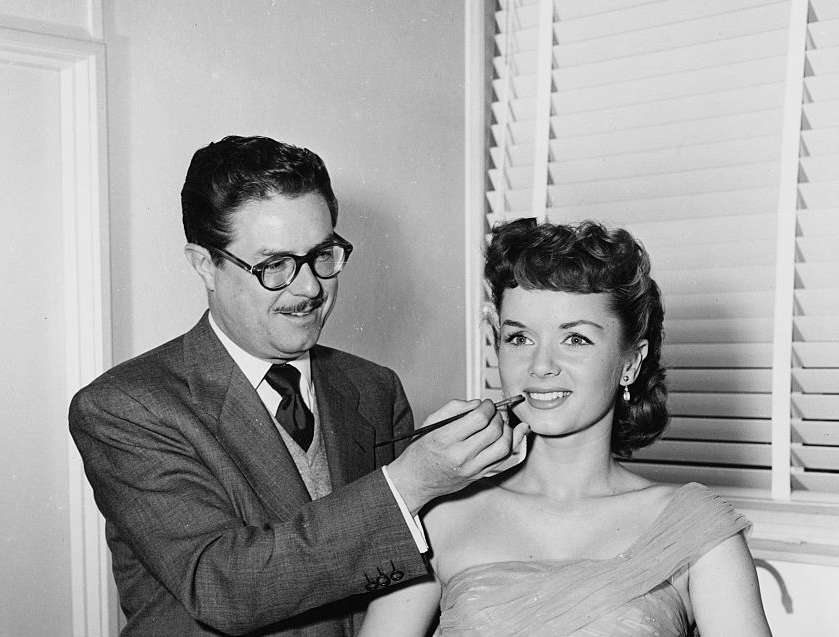
William Tuttle

William Tuttle was the first makeup artist to win an Academy Award. He created many innovative techniques and trained generations of makeup artists.

He was born in Florida in 1912. After dropping out of school early to support his mother and younger brother, he held a variety of jobs including forming his own band. In 1930, he moved to Los Angeles, enrolling in an art school and working as a page at Fox Studios. That younger brother, Thomas Tuttle, would also become a makeup artist working on The Dick Van Dyke Show, The Joey Bishop Show, Gomer Pyle USMC, and That Girl among others.

Tuttle was hired at Twentieth Century Pictures to work under Jack Dawn. In 1934, Dawn took a job at Metro-Goldwyn-Mayer and Tuttle moved with him. Tuttle was still working under Dawn but began taking on more responsibilities. He supervised the makeup in many popular movies including The Wizard of Oz and Father of the Bride. Eventually, he became the head of the makeup department.
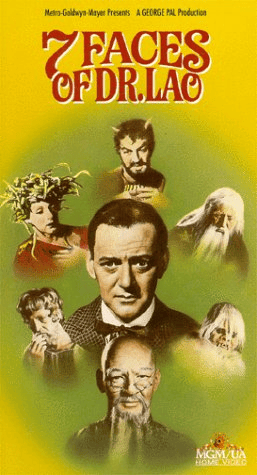
He received a special Oscar for his work on 7 Faces of Dr. Lao in 1965. In this film, Tuttle transformed Tony Randall into seven different characters including Dr. Lao; an aged, bearded Merlin the Magician; and a Medusa with a feminine appearance. Randall said “he shaved my head and eyebrows . . . gave me an unborn look. But professionally it was a masterstroke.” He went on to say that “all my preconceived notions on how I would play the characters vanished. As soon as Tuttle applied his makeup magic, I felt myself actually become these strange people.”

The Oscar category of makeup artist would not become an official category until 1982. That year Rick Baker won the first Oscar for makeup. He would go on to win another five and he credited Tuttle: “His work greatly influenced me.” He said as a young boy, he often tried to re-create the makeup techniques Tuttle used in The Twilight Zone.
📷reddit.com

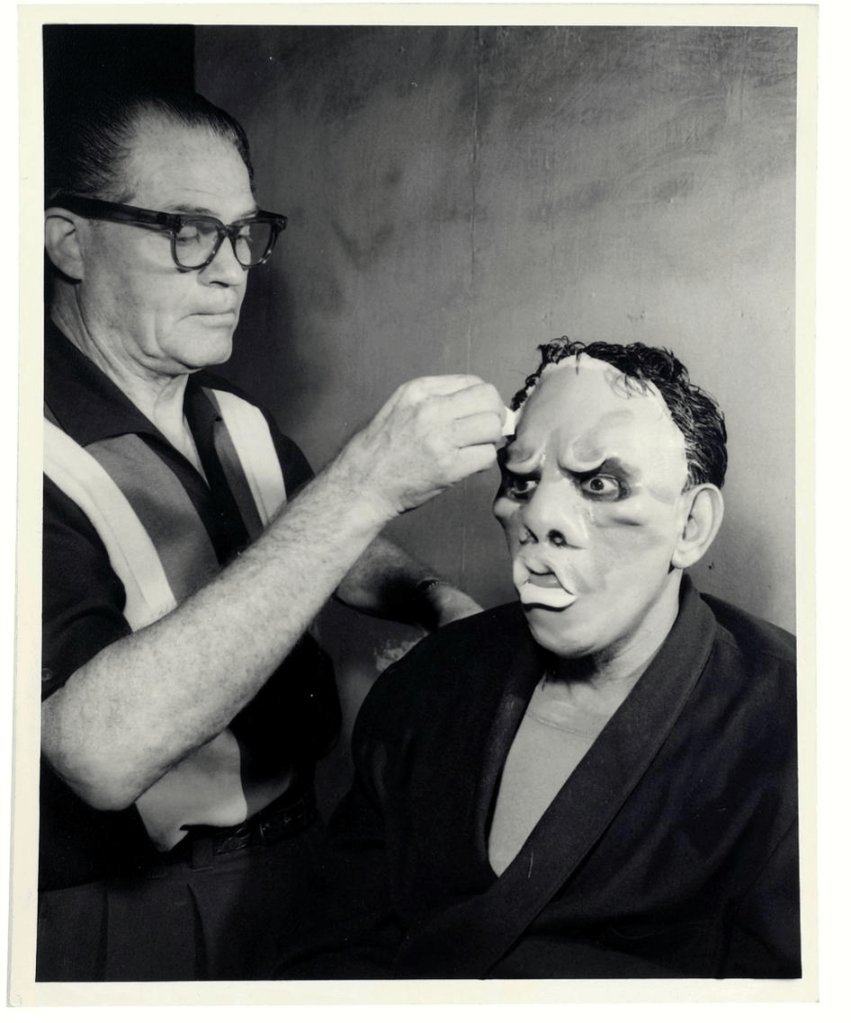
Tuttle was the artist behind one of my favorite Twilight Zone episodes, “Eye of the Beholder.” When the episode begins, doctors and nurses are working with a bandaged patient who just wants to look like everyone else. After some time, the bandages are slowly peeled away. We see the beautiful face of Donna Douglas. As she picks up the mirror to look at her new face, she screams, cries and covers her face. Then the camera pulls away and we see all the people Tuttle did makeup on – doctors and nurses with deformed faces and pig snouts.

With 393 credits, most of Tuttle’s work was in the movies, but he contributed to television as well. From 1960-62 he provided all the makeup for National Velvet. He also spent time on Mr. Novak, My Favorite Martian, The Man from U.N.C.L.E. as well as The Girl from U.N.C.L.E., The Phyllis Diller Show, and The Courtship of Eddie’s Father, among others.

Later in his career, Tuttle created his own line of makeup, Custom Color Cosmetics. Naimie Ojeil, owner of a beauty supply store in Hollywood said his brand was “the most popular makeup among Hollywood professionals for at least two decades.”

Tuttle would create molds of actors he worked on which allowed him to create their looks beforehand. He donated them to the University of Southern California where he taught from 1970-1995. Herbert Farmer, a USC archivist said Tuttle “was interested in passing on all he could to the students. He had a real following.”

Gene Hibbs

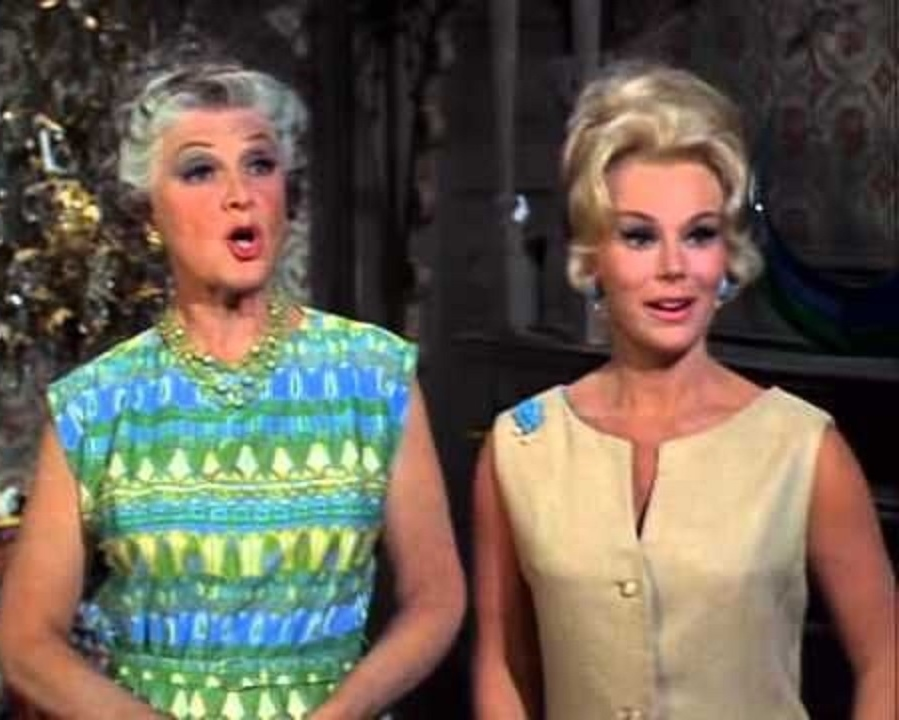
Gene Hibbs was born in Normal, Illinois in 1912.
📷imdb.com

I couldn’t find a lot of information about him. I did read several times that he was often hired because he had a unique talent for making older actresses look younger than they were with a technique he called “painting.”

His first television series was The Lone Ranger from 1954-1955. He worked on many television shows following that including with Ann Sothern on Private Secretary and The Ann Sothern Show, The Judy Garland Show, Here’s Lucy, and Green Acres.

He was working on Green Acres when Judy Garland passed away. She had stipulated in her will that Hibbs was supposed to do her makeup one last time. Her daughter Liza Minelli phoned Hibbs and he agreed to do that. When the network said no, Eva Gabor said she would not work unless he was allowed to leave for a few days. The producer pleaded with the network, but they held firm and said they would lose $30,000 of time and he could not leave the set.

Ben Lane
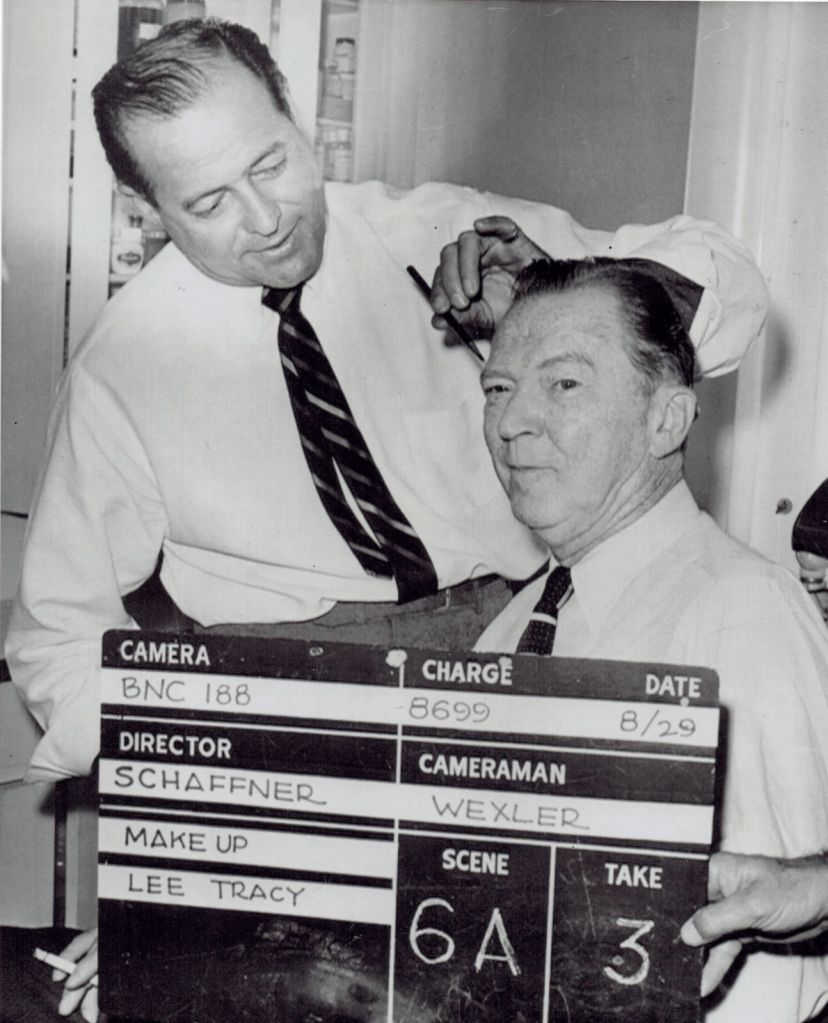
📷ebay.com Ben Lane on the set

Ben Lane was born in 1912 in Chicago, Illinois, the same year as both Gene Hibbs and William Tuttle. Lane was one of the founding members of the Motion Picture Guild, but many of his 236 credits were spent in television.

Lane’s first television series was in 1957 for Sergeant Preston of the Yukon. His career would continue with many popular shows. Get ready to take a long breath because this sample is far from a comprehensive listing of his work. Ready? He was part of the cast for The Lone Ranger, Dennis the Menace, The Farmer’s Daughter, Hazel, Gidget, The Monkees, Bewitched, The Flying Nun, I Dream of Jeannie, Bridget Loves Bernie, The Partridge Family, Police Woman, and Fantasy Island.

In addition to keeping busy with his career, he was involved in several charities: City of Hope and Shriner’s circus. He became a nationwide clown advisor. He also was a consultant for the Los Angeles Police Department, the US Department of Justice, and the FBI for disguises.

Bud Westmore
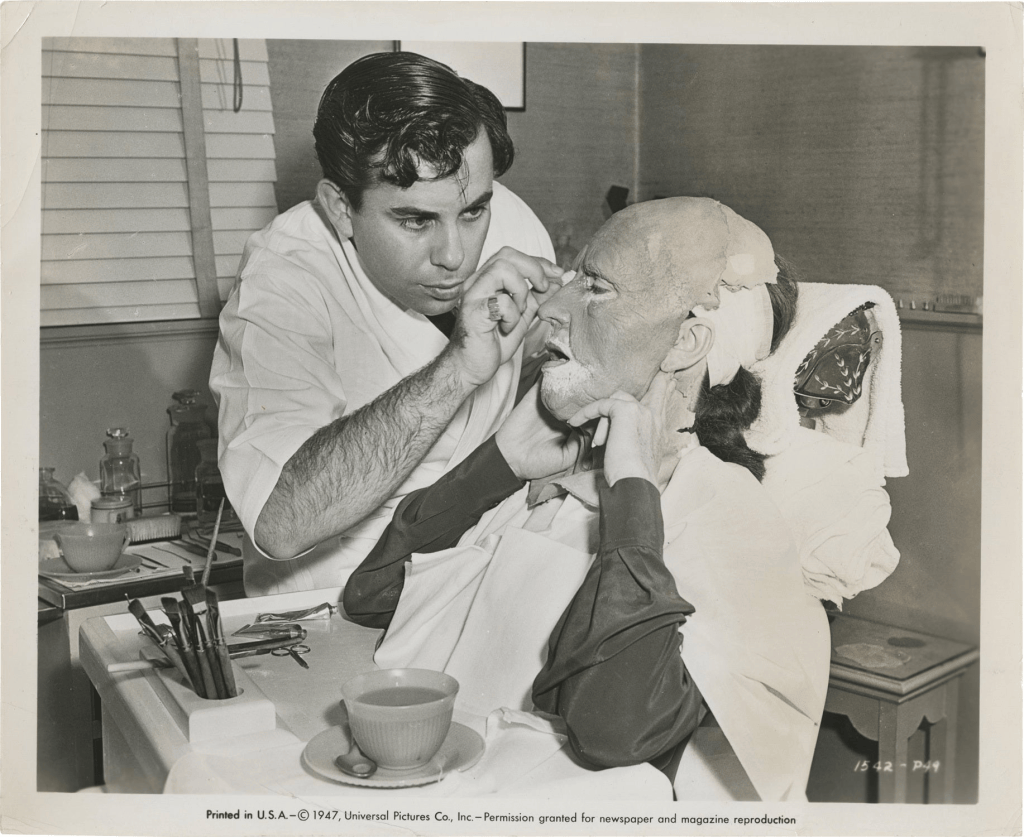
📷abebooks.com Westmore working on the film The Lost Moment

Born in 1918 in New Orleans, Westmore and his brothers—Ern, Frank, Monte, Perc, and Wally–were all makeup artists in the entertainment business. At one time, there was a Westmore heading up almost every studio makeup department.

After school, Bud was an apprentice under Perc at Warner Brothers to learn hair design and makeup before taking a job at Twentieth Century Fox. He left to serve three years with the Coast Guard. When he returned to Hollywood, he worked for the Eagle Lion before he was hired as the head of the Universal Studios makeup department in 1947. The largest building on the Universal studio back lot is named for Bud.

His marriages and divorces also kept him busy. He was married to actress Martha Raye for four months in 1937. A few years later he married Rosemary Lane, another actress, and they were together for fourteen years. His divorce to Lane was on March 31, 1955, and on April 1, 1955, he married Jeanne Shores, a former Miss California in 1952. They would remain together until his death from a heart attack in 1973.
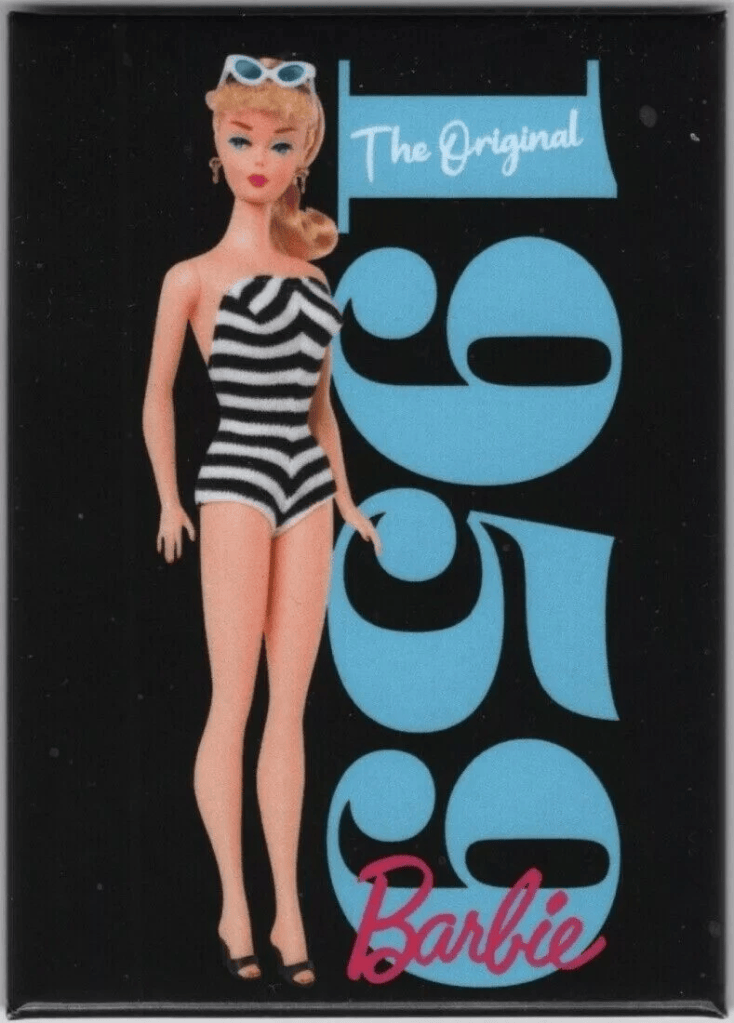
In 1957 Bud was asked to create makeup for a new doll that was coming on the market. In 1959 Barbie debuted. Bud had based her on a German doll Mattel found named Lili. He modified “the bee-stung lips, heavy eyelashes, and widow’s peak to give her an All-American Girl look” and he rooted her hair.

With more than 600 credits on both the big screen and the small screen, Bud’s first television project was Playhouse 90 in 1957. During the sixties he was involved in quite a few shows including The Jack Benny Program, McHale’s Navy, The Munsters, It Takes a Thief, Ironside, Marcus Welby MD, and The Virginian.

It was fun to learn a little bit about these make-up professionals and the shows they worked on to help create some of our favorite television land characters.

Love American Style: Love and the Celebrities

📷groovyhistory.com

This month we are starting a new blog series, Casting Celebrities. We’re going to take a look at four shows that featured a group of celebrities every week. We’ll learn more about Love, American Style; Fantasy Island; The Love Boat, and Supertrain. When we discuss Supertrain, we’ll also look at the small number of stars who appeared on all four shows.

Today we begin with Love, American Style. This show was an iconic 1970s show. Like Laugh In, the clothing, furnishings, and vocabulary do not make it timeless. But it was a lot of fun. This fast-paced anthology series featured two to four mini episodes each week, and between them were quick skits, often featuring a brass bed. Each smaller episode is titled “Love and the _______.”

📷gms.com The regular cast

A troupe of players was featured on each show for the in-between skits. These regulars included William Callaway, Buzz Cooper, Phyllis Davis, Mary Grover, James Hampton, Stuart Margolin, Lynn Marta, Barbara Minkus, and Tracy Reed. Margolin went on to a regular role in The Rockford Files; Tracy Reed was featured in McCloud and Knot’s Landing; Phyllis Davis was part of the cast of Vega$ and Magnum PI, and James Hampton will be familiar if you watched The Doris Day Show or F-Troop.

The show had a memorable and catchy theme song. Written by Arnold Margolin, the first year it was performed by The Cowsills. The snappy melody was set to the following words:

Love, Love, Love

Love, American Style,
Truer than the Red, White and Blue.
Love, American Style,
That’s me and you.

And on a star-spangled night my love,

My love come to me.
You can rest you head on my shoulder.
Out by the dawn’s early light, my love
I will defend your right to try.

Love, American Style,
That’s me and you.

📷imdb.com

During the second and subsequent years that Love, American Style was on the air, the theme song was performed by the Ron Hicklin Group. The Ron Hicklin Group could be heard in a variety of motion pictures and commercials, and they also appeared on recordings with stars such as Paul Revere and the Raiders and Cher. John and Tom Bahler, brothers who sang under The Charles Fox Singers were also part of this group. The band provided television theme song recordings including Batman, That Girl, Happy Days, and Laverne and Shirley. They also did the singing for The Partridge Family theme and songs performed on the show as well as the Brady Bunch Kids. Ron retired in the early 2000s, and Tom does a variety of things. He is also known for writing Bobby Sherman’s hit, “Julie Do You Love Me?”. John married Janet Lennon, one of the Lennon sisters who performed on The Lawrence Welk Show. He currently lives in Branson and conducts the “new” Lawrence Welk orchestra.

Paramount Television developed the show. The executive producer of the show was Arnold Margolin, Stuart’s brother. There were 53 different directors during the four-year run. The series received Emmy nominations for Outstanding Comedy Series in 1970 and 1971; Best Music Composition in 1971, 1972, and 1973, winning in 1973; and winning the Emmy in 1970 for Outstanding Original Music and Lyrics.

📷rewatchclassictv.com

Many people wrote for the show, but Garry Marshall and Jerry Belson received the most credits. One of the writers, Peggy Elliott, was interviewed by the Huffington Post in May of 2013, and she talked about her time writing for the show.

“But the show I loved writing the most, was Love, American Style. For every other show, I was writing for characters created out of someone else’s head. Sure, we could create the occasional guest-star role, and we had been told to make every role, no matter how small, a real person. ‘Think of the actor who’s playing that delivery boy,’ I can hear Billy Persky, the co-creator or That Girl, say: ‘This is a big break for him — it’s the biggest role he’s had so far. Give him something to work with.’

But with Love, American Style, every character was our very own; every situation came out of our heads. Each segment of the hour the show ran each week was a one-act play created entirely by us. Added to the attraction was the fact that we could say and do things that were taboo on every other TV show in the early ‘70s. Arnold Margolin, co-creator of the show with Jim Parker, told me recently that the creative side of the network wanted the show to be more daring, while the censors kept their red pencils ready. There was a full-time position on the show just to run interference.

We must have put both sides through the hoops with one episode we wrote: ‘Love and The Hand-Maiden.’ A young guy was dating a centerfold model. As their relationship developed, he discovered that she had no problem with shedding her clothes, but she always kept her hands covered — with artful poses in magazines, and with gloves in real life. He became obsessed with seeing her hands and came up with one ruse after another to get her to take off her gloves. We had a ball writing it, with one double-entendre after another.”

📷imdb.com

If you were a star of any kind in the early 1970s, you most likely were on Love, American Style.  The show produced 108 episodes, and those shows featured 1112 different actors. Some of the famous names showing up in the credits include Milton Berle, Sid Caesar, Phyllis Diller, Arte Johnson, Ozzie and Harriet Nelson, Regis Philbin, Burt Reynolds, Sonny and Cher, Flip Wilson, and Jo Anne Worley.

Brad Duke wrote a biography about Harrison Ford, and he said Ford had fond memories of appearing on Love, American Style. “He recalled that he had been given little time to prepare his wardrobe for the role of a philosophical hippie in the November 1969 episode, “Love and the Former Marriage.” He appeared on set with long hair and a beard thinking they were appropriate for the role. He was surprised when he was told he needed a haircut and trim and then was given a navy blue dress shirt and vinyl burgundy jeans with a large belt. They even had a scarf with a little ring to put around my neck. And I thought, someone has made a mistake here. So, rather than argue with the wardrobe people, I put on the clothes and went to find the producer. I walked on the set and he was pointed out.  I tapped his shoulder and when he turned around he had on the same clothes I did. He was a hippie producer I guess. At least the check went through, and I got paid.”

The best way to get a good understanding of what the show was like is to look at a couple of the episodes.

January 23, 1970: Love and the Big Night

📷facebook.com

Starring Ann Elder, Buddy Lester, Frank Maxwell, Julie Newmar, and Tony Randall, this episode is often listed as a favorite of viewers. Randall is a married businessman who escorts his voluptuous secretary (Newmar) to her apartment after a late night at the office. Eager to get home to his wife, Randall hurriedly tries to open a stubborn jar of mayonnaise and winds up covered with mayo. Newmar cleans his suit, but while it’s drying, it’s stolen. After a series of amusing mishaps, Randall finally gets back to his own apartment and creeps into bed with his wife–only to find out she’s not there.

February 25, 1972: Love and the Television Set

📷that’s entertainment.com

It starred Harold Gould, Marion Ross, Ron Howard, and Anson Williams. Reading this list of names might give you a hint about what happened to this episode after it aired. Garry Marshall had written a pilot about a 1950s family that did not sell.  He turned it into an episode for Love, American Style. George Lucas caught the episode and was impressed with Ron Howard and offered him a role in his new movie American Graffiti about 1950s teens. The movie was so popular that the network decided to put Marshall’s pilot in the fall line-up as Happy Days. Harold Gould’s role was given to Tom Bosley for the series. When Love, American Style went into syndication, this episode was retitled “Love and the Happy Days.”

October 22, 1970: Love and the Bashful Groom

📷listral.com

This is the episode I recall when I think of the series. When I watched it originally, I was staying overnight at my grandparents’ house and my grandmother was shocked at the “vulgarity.” It really seems quite tame today, but back then it probably was unexpected. She would approve of Tom Bahler marrying Janet Lennon though because I watched Lawrence Welk with her and my grandfather whenever I was at their house.

In this episode, Paul Petersen, Christopher Stone, Meredith MacRae, Jeff Donnell, and Dick Wilson are featured. Harold (Petersen) and Linda (MacRae) are getting married. He learns that she grew up in a nudist colony and is not comfortable being naked for his wedding.  After a soul-searching talk with his best friend, and realizing he loves Linda enough to be uncomfortable, he decides to go through with the ceremony.  He gets to the church a bit late and walks in, only to see that everyone else is dressed in their Sunday best. His bride informs him that they always dress up for weddings. One of the congregation members says something like “Let’s not make him uncomfortable,” and they all begin to undress.  Of course, you see nothing improper, no naked bodies, only clothes flying. This was probably not the best episode to “expose” my grandmother to as a first glimpse of the show.

The show lasted for four years and was cancelled in 1973. In 1985, a reboot was created, but it was on in the mornings and only lasted a few months.  The show was on at the same time as everyone’s favorite game show, The Price is Right. For the 1998 fall season, a pilot was created for prime time, but it was never ordered. While doing my research for this blog, I noticed that there was a Love, American Style project in production, so we may see it resurface again.  I’m not sure I would want to watch a contemporary version of the show though. It was such a product of its time, and I fear what a current version would be like after seeing the reboot of Match Game which has been airing the past few years.

Tom Bosley Scores a Home Run on Any Team

Since January was all about female sitcom actresses, this month we give the men their fair due.  We begin this series, “The Men of August,” with Tom Bosley.  Anyone who was a Happy Days fan knows why Bosley is part of this line-up.

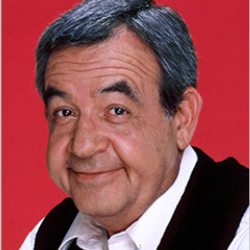
Image result for images of tom bosley
Photo: quotetab.com

Bosley was born in Chicago in 1927. His father was in real estate and his mother was a concert pianist. After graduating from high school, he served in the Navy during WWII. His father was in WWI and then served again in WWII, building army bases on the coast.

Following the war, he attended DePaul University in Chicago, declaring his major as Pre-Law. He had to take night classes because the day classes were full, and after getting tired of teachers not showing up, he switched to a radio school, hoping to be an announcer because he loved baseball, but acting eventually tugged at his heart.” In 1949 and 1950 he performed at the Woodstock Opera House in Woodstock, Illinois with Paul Newman. He was in the first live television show ever done in Chicago which was a production of Macbeth, about 1948 (on WBKB).

In the early fifties, he moved to New York and held a variety of jobs, including coat checker at Lindy’s restaurant, doorman at Tavern on the Green, and Wall Street bookkeeper. He continued to audition for his big break. During the fifties while he was looking for work, he shared rent with another Chicago actor trying to make it in the entertainment business: Harvey Korman.

Image result for images of tom bosley
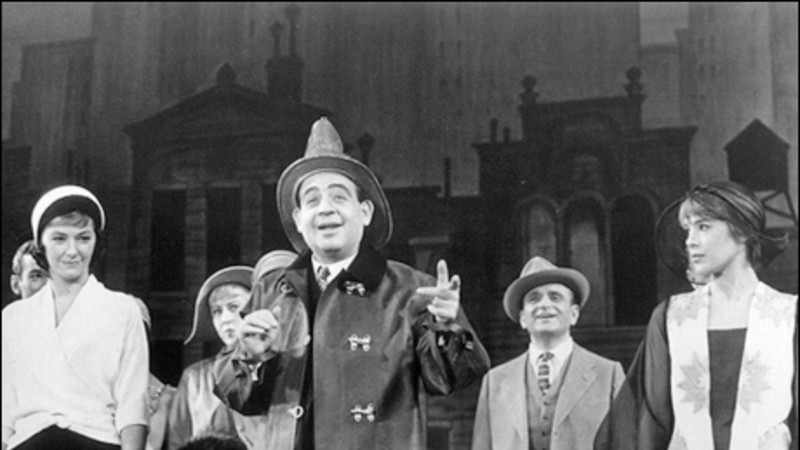
Bosley as Fiorello–Photo: markrobsinsonwrites.com

With one foot in Broadway and one in television, Bosley took on a variety of roles in his early career. In 1955 he appeared in a television production of “Alice in Wonderland” as the Knave of Hearts. In 1959, he won a lot of acclaim as New York mayor Fiorello H. La Guardia in the Broadway musical “Fiorello!” and won a Tony award. Bosley would later return to Broadway in the 1990s taking on the roles of Maurice in “Beauty and the Beast” and as Cap’n Andy in “Show Boat.”

In the 1960s he explored motion pictures and landed his first role as a suitor of Natalie Wood in Love with the Proper Stranger.

Although he continued to appear in the big screen, the little screen took up most of his time in the sixties and early seventies. In 1962 he played opposite Tony Randall and Boris Karloff in “Arsenic & Old Lace.” His face became a familiar one showing up in Car 54, Where Are You?, Bonanza, Get Smart, Route 66, Dr. Kildare, The Mod Squad, The Streets of San Francisco, Bewitched, McMillan and Wife, and Marcus Welby, among others.

It was also during this decade he married Jean Eliot. They were married until she passed away in 1978.

Image result for images of tom bosley
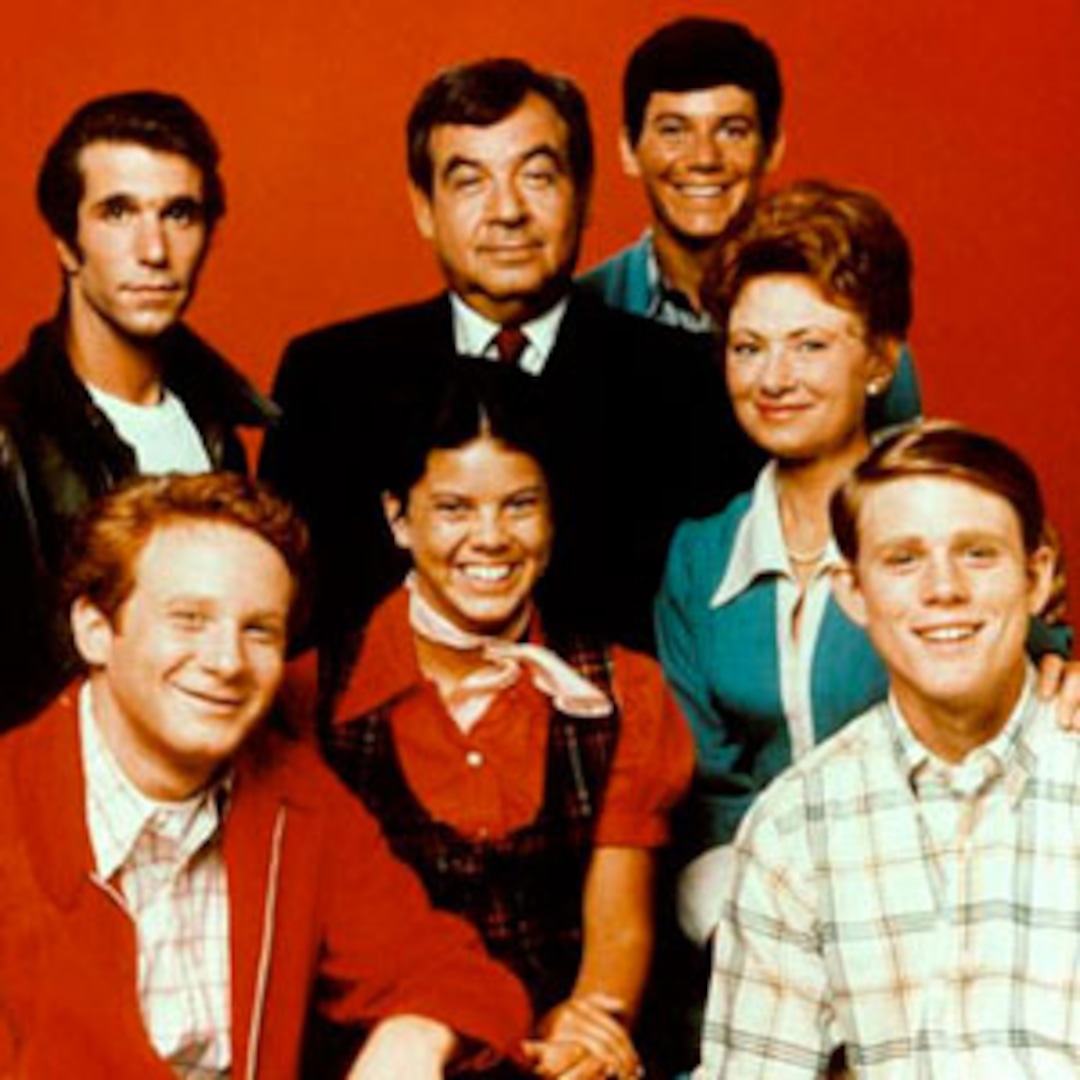
The Cast of Happy Days Photo: E!online.com

In 1974 he accepted the role that would make him a household name. “Love and the Television Set” was one of the four skits appearing on an episode of Love American Style, and I actually remember watching it. Garry Marshall developed it as a pilot, but the network wasn’t interested in turning the pilot into a show when it first came up. However, once George Lucas released American Graffiti in 1973, also starring Ron Howard, ABC took another look at the period show. The first two seasons, the show focused more on Richie Cunningham as he interacted with his friends and family. Jerry Paris (Jerry Helper on The Dick Van Dyke Show) directed 237 of the episodes. Happy Days was described as relentlessly ordinary. The plots revolved around the same types of problems most teens experienced in the fifties: dating, wanting to be popular, peer pressure, and similar issues.

Bosley originally turned down the role but reconsidered after reading the script more thoroughly; he was drawn to a scene between Howard and Richie that moved him. Bosley said he also was looking for some security. His wife was sick at the time, and they thought she might have epilepsy, which was later determined to be a brain tumor; he wanted an easier schedule in order to care for his wife and help raise his daughter.

Image result for images of tom bosley
With Henry Winkler Photo: brooklynvegan.com

He captured the sometimes cranky, but lovable, Howard Cunningham perfectly. He might not agree with his children, but he was always there for them, and he was apparently always there for his castmates who all remembered him as a kind, fatherly figure.

For a decade, Bosley developed the role of Howard into a much-loved sitcom father. Bosley said none of the characters were well defined in the early scripts. The cast developed their characters as relationships developed.  He described the actors as a baseball team that never made errors; they just clicked and had a wonderful rapport.

During the run of the show, his wife passed away from her tumor, and in 1980 he married actress Patricia Carr whom he stayed married to until his death.

Image result for images of tom bosley
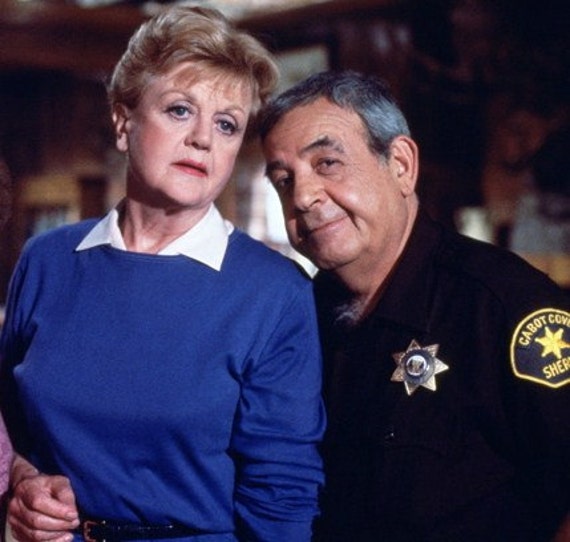
With Angela Lansbury Photo: etsy.com

When the show ended, Bosley was immediately offered another role. Although he appeared in a variety of shows in the early eighties, including five episodes of Love Boat, he moved from Milwaukee to Maine to help Jessica Fletcher solve mysteries on Murder, She Wrote. Bosley said the role of Jessica was written for Jean Stapleton, but then she did not want to do it so it was offered to Angela Lansbury. He and Angela had worked together in the past, so he did the pilot. It was supposed to be a one-time role, but they brought him back nineteen times without a contract.  As Sheriff Amos Tupper, he spent four years trying to figure out why so many murders took place in peaceful Cabot Cove. He then retired from the police force and moved to live with his sister. 

Image result for images of tom bosley father dowling
James Stephens, Tracy Nelson, Bosley, Mary Wickes Photo: pinterest.com

He actually did work with a sister in his next role on Father Dowling Mysteries. As Father Frank Dowling by day, he moonlighted, solving mysteries with his assistant Sister Stephanie Oskowski (played by Tracy Nelson, Rick Nelson’s daughter and granddaughter of Ozzie and Harriet).

Bosley described Father Dowling as being a lot like himself: calm, quiet, and caring. While murders occurred on the show, there was no violence. When they were casting the part for the housekeeper, they described the character as a Mary Wickes type, and Bosley told them to just get Mary Wickes, and he loved working with her.  He enjoyed that show more than any of the other shows he worked on. The cast was totally caught off guard when it was cancelled.  The network wanted to do a show with James Earl Jones and Richard Crenna.  They gave Crenna’s agent a short-time period to agree to the show and he agreed before the limit ended, so the network was forced to delete a show from the current schedule to make room for this new show and they chose Father Dowling; the James Earl Jones show, Pros and Cons, also about several private detectives, and was dropped after 12 episodes.

When the show ended in 1991, his career definitely did not. When asked if he was going to retire, he replied, “Don’t be silly—actors spend half of their careers in retirement.” He continued appearing in a variety of shows (39 in all) until his death in 2010 from a staph infection.

Photo: outsider.com

There are several actors I get confused by at times because of their similarities. One is Ray Walston from My Favorite Martian with Jonathan Harris from Lost in Space. The other is Tom Bosley with David Doyle from Charlie’s Angels.  At least I felt better about my mental error after doing research on Bosley.  Apparently, David Doyle was named “Bosley” on the show because people confused the two actors so often. 

I’m sure Tom Bosley would have made an excellent attorney or announcer, but I’m happy that he followed his acting passion, and I’m thankful for the five decades he was willing to entertain us with his special gift.

Jeepers, Creepers, It’s Mister Peepers

Mister Peepers was one of the first popular sitcoms.  It aired from July of 1952 until June of 1955. The show starred Wally Cox as Robinson J. Peepers. Peepers was a junior high school science teacher. A great cast surrounded him including history teacher Harvey Weskit (Tony Randall), Harvey’s wife Marge (Georgann Johnson), county nurse Nancy Remington (Patricia Benoit), English teacher Mrs. Gurney (Marion Lorne), and athletic coach Frank Whip (Jack Warden). (In the pilot, the coach was played by Walter Matthau.) Peepers developed a relationship with nurse Nancy, and her parents (Ernest Truex and Sylvia Field) also became part of the cast.

Photo: blogspot.com

The show featured some slapstick as well but it was not the primary form of humor. In one episode, the uncoordinated Mr. Peepers was playing basketball in the gym alone and somehow got stuck in the basket. In order to fulfill the evening obligations that he promised, he brings Mrs. Gurney’s flower club into the gym so he can lecture to them about potting soil while playing chess with a rival school’s champion as promised to Mr. Gurney.

Photo: wikiwant.com

Mr. Peepers is kind. In one episode, after injuring his finger, absent-minded Mrs. Gurney tries to help by bandaging it.  In addition to using half a roll of tape, Robinson informs Nancy that she bandaged the wrong finger.

Mister Peepers is a likable guy. He has some eccentric characteristics which make us like him even more. For example, he has an elaborate ritual to get his locker to open; on bring your pet to school day, he has to hide a cow; and sometimes he does things we all want to. On one episode, he comes upon a hopscotch board on the sidewalk and just like we would want to do, he plays it not realizing his girlfriend is watching him. However, Robinson has a bit of rebellion and sarcasm that keeps him from being too much of a goody-two-shoes.

Photo: tumblr.com

Tony Randall’s character Harvey was supposed to be a small role, but the producers liked him so much he became a regular. He is best friends with Robinson but they couldn’t be more different. Harvey is a lady’s man. However, Mr. Peepers only has eyes for Nancy even though it takes her a while to realize he is interested in her. The couple ties the not in 1954, producing a huge ratings boost.

In real life, Cox was experiencing the same situation when he married Marilyn Gennaro about the same time. When Benoit became pregnant in real life, she was also pregnant on the show.

When the Peepers found out they were having a baby, American Character Dolls Co wanted to make a “Peepers Baby Doll” in 1955. Polling indicated that viewers were hoping for a girl, so it went into production. Mister Peepers was cancelled before the doll debuted, but the company sold it anyway, although they did change the name.

Photo: blogspot.com

The show was aired live with an audience of 2500 at the New Century Theatre in New York. Preserved on 16mm kinescopes, there are currently 102 of the original 127 episodes in existence.  The kinescopes are being preserved by the UCLA Film and Television Archive and a DVD set has been produced.

The Ford Motor Company needed a summer replacement on Thursday nights so Mister Peepers debuted then. NBC decided it was too much pressure to do a live show, so it was cancelled. Fans were irate. After 2000 people called to complain and 15000 letters were received, the network had second thoughts, but their schedule was full.

MR. PEEPERS — Aired 09/15/1953 — Pictured: (l-r) Wally Cox as Robinson Peepers, Tony Randall as Harvey Weskitt (Photo by NBCU Photo Bank/NBCUniversal via Getty Images via Getty Images)

However, that fall, an opening occurred when Doc Corkle was cancelled after only three episodes. How bad does a show have to be to get axed after three episodes in 1952? I don’t know, but the summary of the show is that “Doc is a dentist plagued with money problems, teenage daughter problems, and a screwball stepsister Melinda.”

It says a lot about the quality of Mister Peepers that it was rated so highly and watched by so many fans because it was up against Private Secretary with Ann Sothern and The Jack Benny Show on Sunday nights. Tough competition.

See the source image
Photo: sitcomsonline.com

Critics liked the show and it was nominated for best situation comedy for the Emmys in 1953, 1954, and 1955. Wally Cox, Tony Randall, and Marion Lorne were all nominated as well. Each of the years the show was nominated it went up against Our Miss Brooks, Burns and Allen, and I Love Lucy which won in 1953 and 1954; Make Room for Daddy won in 1955. NBC made Wally Cox postcards which they handed out to tourists on the lot.

Wally Cox was an interesting guy. He was a brilliant man who studied acting with Stella Adler. His roommate was Marlon Brando whom he had been best friends with since grade school. His mother and grandmother were writers, and his dad was in advertising. Before he was able to earn a living in acting, he taught the lindy hop for $1.50 a lesson and made cuff links and tie clasps. While doing part-time jobs, he began doing standup at clubs like The Blue Angel and Village Vanguard.

Unfortunately, a lot of people will remember him only for his appearances on Hollywood Squares and as the voice of Underdog the cartoon hero. He was also famous for a Jockey Shorts commercial when he quipped, “Outside I might look like Wally Cox but inside I feel like Tyrone Power.” He passed away much too early, dying from a heart attack at 48.

Photo: latimes.com

Although Wally Cox was not Mister Peepers, their humor was similar. Cox wasn’t brash but he experienced life with a quiet subtle manner and was a genuinely funny guy. In discussing his time on the show, Cox said, “Mr. Peepers put me on the map and I love him.” I’m sure like many actors who were stereotyped early in their career, it was a bit of a love/hate relationship.  I’m sure you will love him too if you are able to watch some of the episodes.  Retro TV aired them in the past, but I don’t see the show on its current schedule. I also found the DVDs on amazon.com. Happy viewing!

Laughing and Crying with Charlotte Rae

This week we are winding up our series of favorite female actors with Charlotte Rae. If you remember last week we learned about June Lockhart. Charlotte was born a year after June and died a year before her, and their careers were very similar. Both were actresses for more than six decades, appeared in Broadway, movies, and television.

Rae was born in Milwaukee, WI in 1926. Her parents were Russian Jewish immigrants. Her mother Esther had been friends with Golda Meir since childhood. For her first ten years, the family lived above her father’s tire business. In 1936 they moved to a home in Shorewood. At age 16, she became an apprentice with the Port Players, a professional theater company that came to Milwaukee for the summer. After graduation, Charlotte did some radio work and did some performing with the Wauwatosa Children’s Theatre.

Charlotte Rae Obituary - Death Notice and Service Information
Photo: legacy.com

Although she never completed her degree, Rae attended Northwestern University. She and Cloris Leachman became friends there. She also met Agnes Nixon, Charlton Heston, Paul Lynde, and Claude Akins. In later years she would always recommend wanna-be actors get a degree first.

See the source image
Photo: thejewishnews.com

In 1948, she moved to New York City where she performed in theater and nightclubs. She worked at a variety of clubs including the Village Vanguard and the Blue Angel. During her early days, a radio star told her that her last name of “Lubotsky” would not work well, and she replaced it with her middle name of Rae.

In 1951 she received her first television job on Once Upon a Tune. She would appear on ten other drama theater shows during the fifties. In an interview with Milwaukee Talks in 2016 she said, “When I started out, I wanted to be a serious actor, I never thought I’d get into comedy.”

The same year, Rae married composer John Strauss. They had two sons, but in the mid seventies he came out as a bisexual. Rae was not interested in an open marriage, so the couple decided to divorce in 1976.

Songs I Taught My Mother

Charlotte also loved singing, and she released an album in 1955, Songs I Taught My Mother. Rae also loved being on the stage. In the seventies, Vanguard Records went out of business, and Rae was able to buy back the album for $5000.

She would have stage roles in “Three Wishes for Jamie” in 1952, “The Threepenny Opera” in 1954, “Li’l Abner” in 1956, and “Pickwick” in 1965 among others. Later in her career she would also appear in several off-Broadway shows.

See the source image
Photo: amazon.com

In 1958, she got a break with a guest spot on The Phil Silvers Show which led to her getting the part of Sylvia Schnauzer, the wife of Leo Schnauzer (Al Lewis) on Car 54 Where Are You when it debuted in 1961. Her husband John did the music for the show. Apart from that role, most of the other television work she did in the sixties was in drama series.

See the source image
Photo: pinterest.com

Rae also appeared in 14 big-screen movies. Can I take a shameless plug and say that one of my favorite Charlotte Rae roles is in Hello Down There? This movie from 1969 screams IT’S THE SIXTIES from the moment it starts until it ends, but it’s a great sit-back-and-just watch movie. If nothing else, it has an amazing cast including Tony Randall, Janet Leigh, Ken Berry, Jim Backus, Merv Griffin, and Richard Dreyfuss among others.

See the source image
Photo: muppet wiki fandom.com

The seventies were her busiest decade of work. She started with a recurring role on Sesame Street as Molly the Mail Lady. During the early seventies you could see her on The Partridge Family, McMillan and Wife, Love American Style, and The Paul Lynde Show. I always appreciated her character on The Partridge Family. When Danny is thinking about quitting school to get on with life, she plays his very smart and creative guidance counselor.

In 1974 Rae moved to Los Angeles. She did guest spots on All in the Family and Good Times, both Norman Lear shows. In 1975, she became a regular on Lear’s show, Hot l Baltimore. She played Mrs. Bellotti, whose son lived at the hotel. The show was a bit controversial and was cancelled after the first season.

During the remainder of the seventies, Rae kept busy working for a variety of genres. You could have seen her on The Flying Nun, Barney Miller, The Rich Little Show, All’s Fair, CPO Sharkey, Family, The Eddie Capra Mysteries, and on her friend Cloris Leachman’s show Phyllis.

In 1978 Norman Lear was working on Diff’rent Strokes about a single father who adopts two brothers whom he raises along with his daughter with help from his housekeeper. Lear signed Rae on as the housekeeper. Charlotte wanted to do the series, but as she related in a Television Academy interview, she was under contract at CBS when NBC made the offer. She had a few weeks left on her CBS option. The network offered her the role of a lady sheriff on a new western but it didn’t ring true to her, and she didn’t want to do it. While she was filming an Eddie Capra Mystery episode, she drove over to explain her predicament to Lear. He said that Bud Grant owed him a favor and he did indeed get her out of the contract.

One episode on the first season was “The Girls’ School” when Edna Garrett is asked to help out at Kim’s private school called East Lake. She does but at the end of the episode decides she’d rather be working in the Drummond home.

See the source image
Photo: imdb.com

In an interview with the Television Academy, Rae said she thought she was going to be fired from Diff’rent Strokes. She noticed her lines getting fewer and fewer and when she was called into talk with the producer, she thought that was it. However, they proposed a spinoff show for her based on “The Girls’ School” episode called The Facts of Life. They wanted Edna to become housemother for the boarding students at the school. It was a prestigious private school now called Eastland. The writers were focusing on issues affecting high school age girls including weight gain, dieting, depression, drug and alcohol use, dating, mental illness, and other subjects that kids that age deal with. Rae said the show was about growing up, family, love, and working out problems. “I had a lot of input with issues like suicide, divorce, death. I’m really very proud.”

Charlotte was a single mother and afraid to lose her Diff’rent Strokes income on a possibility that might not pan out. The producers wrote into her contract that if the show was cancelled, she could return to Diff’rent Strokes, so she agreed.

See the source image
Photo: redbook.com

The first season gained some fans, but ratings were so-so. For the second season, some cast changes were made and the show was moved from Fridays to Wednesdays. The show finished in the top thirty that year, and Rae became a household name. In 1982, Rae received an Emmy nomination. (She lost to Carol Kane from Taxi.) During the 1984 and 1985 seasons, Rae asked to be used less. She felt that the girls were older and would rely more on each other than a housemother for discussions about life issues.

When discussing the character of Edna, Rae explained “I want to bring in as much humanity as possible, as well as humor. I’ve tried to make her a human being with dimensions. The way they write her now is with a great deal of sensitivity and understanding. But I don’t want her to be Polly Perfect, because she must have human failings and make mistakes. She’s also a surrogate mother to the girls. I told them I wanted to be firm with the girls because I know it’s important. Parents must lay down ground rules for their children to help them grow up and to learn responsibility for their actions. They must learn to stand on their own two feet.”

See the source image
No doubt that this show took place in the 1980s
Photo: pinterest.com

Rae wanted to do more theater and she wanted to travel. When she decided to leave the series, Cloris Leachman replaced her in the role. The two-part finale of the eighth season had Edna Garrett marrying and moving to Africa with her husband to work for the Peace Corps. Her sister Beverly (Rae’s real sister’s name) comes for the wedding and then decides to stay with the girls at school. Cloris Leachman was signed on for two seasons. At the end of her time, she was willing to continue for another season, but cast members Nancy McKeon and Mindy Cohn were ready to end the show and take on new projects. It was not the end of the show, however. In 2001 a television reunion movie aired with much of the original cast. In 2007 the entire cast was invited to the TV Land Awards where they sang their old theme song.

See the source image
Murder She Wrote
Photo: backofthecerealbox.com

Charlotte took on several other roles after leaving the show. During the eighties and nineties, she appeared on The Love Boat, St. Elsewhere, Murder She Wrote, Sisters, and Alex Mack among others.

She was busy until she passed away, and continued to act throughout the 2000s, including an appearance on King of Queens, and a recurring role on ER. Her last acting credit on television was in 2014’s Girl Meets World.

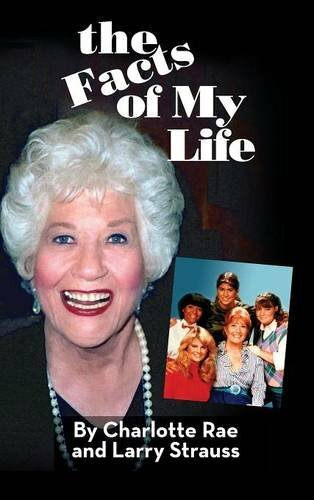
FACTS OF MY LIFE (HARDBACK) By Charlotte Rae & Larry Strauss - Hardcover **NEW**

In 2015, Rae wrote her memoirs with her son Larry. At many of her book signings, adults came to purchase the book and told her over and over that they had been latch-key kids and saw Edna as a second mother to them. A description from Amazon sums up the book:  “Charlotte Rae’s career spans more than seventy years, from the golden age of television to Shakespeare in the Park, the New York Cabaret scene of the late 1940s and 50s to her hit series, The Facts of Life and well beyond. Off stage and screen, Charlotte’s life has been one of joy and challenge, raising an autistic son, coming to terms with alcoholism, the heartache of a broken marriage, the revelation of a gay husband and the sudden challenge of facing middle-age with financial and emotional uncertainties–a crisis she ultimately turned into the determination that brought her stardom. The Facts of My Life is the first opportunity for Charlotte’s fans to explore the fascinating story of her extraordinary life: poignant and hilarious, a story of courage and triumph, one that speaks for a generation of women breaking barriers, taking on challenges, overcoming personal tragedy, and paving the way for others.”

Rae suffered from several health issues. In the early seventies, she joined Alcoholics Anonymous which was a critical part of the rest of her life. In 1982, she had a pacemaker implanted. It worked well for thirty years, but then stopped, requiring surgery for another smaller device. She also had open heart surgery to replace her mitral valve. Pancreatic cancer ran in her family, so she was screened often and when she was diagnosed with cancer, it was early so she had six months of chemotherapy and was then declared cancer free. In 2017, she was diagnosed with bone cancer. She died at her home in 2018. Todd Bridges from Diff’rent Strokes, tweeted, “You were loved by everyone on our show.”

See the source image
Photo: doyouremember.com

Charlotte said she never minded fans coming up to her because she realized that in being a television actor you were in people’s homes. “It was an intimate relationship.”

She said she wanted to be remembered as someone who took people out of themselves into a different world and allowed them to laugh or cry, and that would make her happy because we need as many laughs as we can get.

THE-FACTS-OF-LIFE-TV-SHOW-PHOTO-E-19-CHARLOTTE-RAE

Thank you, Charlotte for making us cry a little and laugh a lot.

Sirota’s Court: It Never Got a Fair Trial

We are in the middle of my “Don’t Judge Me” blogs. Today I am picking up my gavel to make a ruling on Sirota’s Court.

Photo: filmaffinity.com

This sitcom made its debut December of 1976. By April of 1977, it had disappeared from the airwaves. It was produced by Peter Engel Productions and Universal Television.

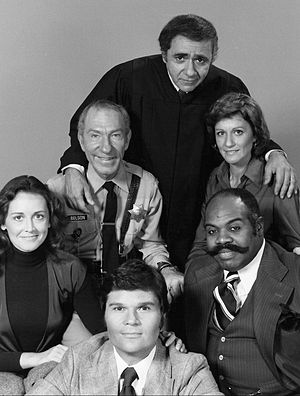
The show followed Judge Matthew Sirota (Michael Constantine) who sits on the bench for the night court. He works with, and has an off-again, on-again romantic relationship with, court clerk Maureen O’Conner (Cynthia Harris). The liberal public defender is Gail Goodman (Kathleen Miller) who battles with private attorney Sawyer Dabney (Ted Ross) and assistant district attorney Bud Nugent (Fred Willard). Bailiff John Belson (Owen Bush) has the judge’s back. Like the Mary Tyler Moore Show, the series devotes time to Judge Sirota’s professional and private lives.

Photo: ptwikipedia.com

If that concept sounds eerily familiar, it should. Seven years after Sirota’s Court left the air, Night Court appeared. Maybe Sirota’s Court was ahead of its time or could not survive the scheduled competition, but it’s hard not to see Night Court as an almost identical clone of this show. The newer judicial comedy featuring Harry Anderson would last nine seasons and produce 193 episodes.

In the original version, the Honorable Sirota incorporates a sense of humor and a boatload of common sense into his courtroom. Being in a large metropolitan city, Sirota is a surprisingly compassionate judge, considering the bizarre cases, the odd clients, and the eccentric court comrades he has to deal with. He often had to take on the role of referee between public defender Goodman who was trying to make the world a better place however she could, attorney Dabney who only cared about making a buck, and totally inept assistant district attorney Nugent.

The show employed a lot of different writers for only thirteen episodes. Twelve different writers were credited on the series. Some of the plots included Judge Sirota trying to prevent being named one of the ten worst judges in America, dealing with dentists who were using laughing gas on election night, or the night a full moon brings in an even more ridiculous roster of bizarre situations to rule on.

Photo: sitcomsonline.com

The show was on Wednesday nights. There was no way this series was going to obtain satisfactory ratings going up against All in the Family and Baretta. All in the Family was in the seventh year of its nine-year reign and still was in the top twenty. Baretta, which was in its third year, had a solid following and was in the top ten. In addition, the show took a lot of heat for one of its episodes, “Court Fear,” when the judge performed a same-sex wedding. It’s creator, Peter Engel, mentioned several times that the show “never got cancelled, it just sort of faded away.” Another factor may have been too many writers. Considering Jack Winter wrote 4 of the 13 episodes, that left 11 writers covering the other 9 shows. Perhaps there was not enough time to fully develop the characters with so many different perspectives.

Photo: tvtango.com

Considering there were only 13 episodes, it’s impressive that Sirota’s Court was nominated for an Emmy for Outstanding Art Direction or Scenic Design for a Comedy Series and for a Golden Globe for Constantine for Best Performance by an Actor in a Television Series, Musical or Comedy. Constantine was up against Tony Randall for The Tony Randall Show, Freddie Prinze for Chico and the Man, Alan Alda for MASH, and winner Henry Winkler for Happy Days.

Photo: pinterest.com

Unfortunately, I could not find DVDs for this show anywhere, even the rare and hard-to-find DVD sites. It would be interesting to compare it with Night Court and see how similar the two shows actually were. My ruling is that the show was competent to stand trial, but the powers that be were too quick to negotiate a settlement.

Bob Newhart: Laughing Through Life

This month I wanted to honor one of our most beloved television comedians: Bob Newhart. Next week we’ll spend some time learning more about The Bob Newhart Show.

Photo: spotify.com

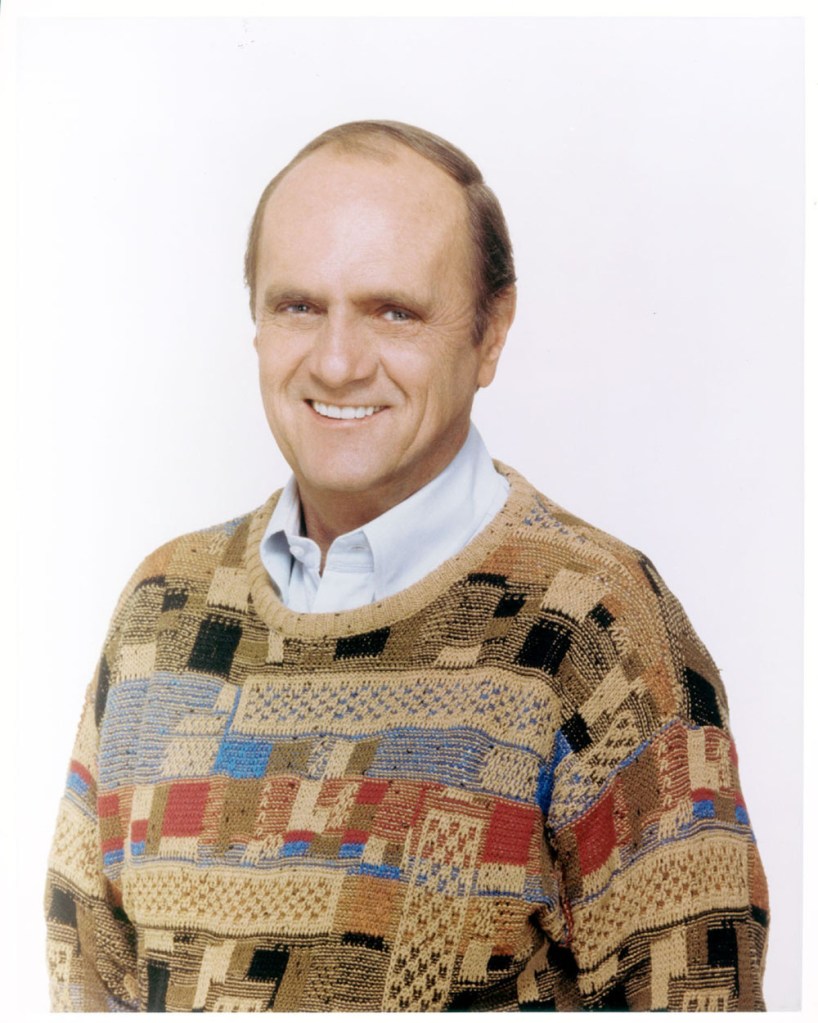
Newhart was born George Robert Newhart in 1929 in Oak Park, IL. He grew up in a typical midwestern family where his father was part owner of a plumbing and heating supply company, and his mom was a housewife. As a young boy, he always wanted to be called Bob. He had a Catholic education and went on to Loyola University of Chicago in 1947. Graduating in 1952 with a business degree, he was soon drafted into the US Army in the Korean war where he stayed until 1954. He considered getting a law degree and went back to Loyola. He decided not to pursue that; some sources site that he was asked to behave unethically during an internship which led him down a different career path.

He worked as an accountant and as an unemployment office clerk. In 1958 he was hired as a copywriter for Fred Niles who was a television producer in Chicago. It was while working here that Newhart and a colleague began entertaining each other by making telephone calls about absurd scenarios. They sent these to radio stations as audition tapes. A radio station disc jockey Dan Sorkin introduced Newhart to a Warner Brothers Records executive who signed him in 1959 based on those recordings. Bob then began creating stand-up routines which he performed at nightclubs.

Photo: discogs.com

He released an album in 1960 which changed his life. Titled, The Button-Down Mind of Bob Newhart, the comedy album made number one on the Billboard charts, and he won a Grammy for best new artist. A follow-up album, The Button-Down Mind Strikes Back was released soon thereafter. He would continue releasing comedy albums in 1961, 1962, 1964, 1965, 1967, 1971, and 1973.

During a 2005 interview for American Masters on public television, Bob stated that his favorite routine was Abe Lincoln vs Madison Avenue which was on his first album. A promoter for Abraham Lincoln has to deal with his reluctance to boost his image. A tv director named Bill Daily suggested the routine to him. Daily would be known later as Howard Borden on The Bob Newhart Show (as well as Roger Healey on I Dream of Jeannie).

The success of that first album led to a variety show titled The Bob Newhart Show. It only lasted a year, but it did receive both an Emmy nomination and a Peabody award. Apparently, he didn’t enjoy his time during the show so much. Halfway through the season he wanted to quit, but his agent explained that being under contract meant that was not possible. At a later date, he referred to his first show, saying “It won an Emmy, a Peabody Award, and a pink slip from NBC. All in the same year.”

He began making the rounds on television shows, appearing on The Dean Martin Show 24 times and The Ed Sullivan Show 8 times. He guest hosted The Tonight Show Starring Johnny Carson 87 times. When discussing his appearances on Johnny’s show, he stated “I remember once when I emceed The Tonight Show in New York, I arrived with my manager’s son. After a while, they asked, ‘When are the rest of your people coming?’ I had to say, ‘This is it.’”

Photo: huffingtonpost.com

In 1962 Newhart accepted his first movie role, Hell is for Heroes, starring Steve McQueen. He would continue to do movie roles throughout his career including the Christmas classic Elf, but the small screen would make him famous.

In 1963 Buddy Hackett introduced Bob to Virginia Quinn, whose father was character actor Bill Quinn. They wed in January of 1963 and 57 years later are still happily married.

Photo: zimbio.com

For the next decade, he continued to accept movie and television roles. In 1972, television history was made when The Bob Newhart Show debuted. Until 1978, Newhart played Bob Hartley, psychologist, and we got to know his unusual patients, quirky co-workers, and eccentric friends, including neighbor Howard Borden. Bob chose a psychologist based partly on his old telephone routines. As he said, “Much of my humor comes out of reaction to what other people are saying. A psychologist is a man who listens, who is sympathetic.”

Photo:epiguides.com

In 1982, Bob gave television another go for another eight years. Simply titled Newhart, the show featured Bob as Dick Loudon, an innkeeper and author from Vermont. He still had quirky co-workers and eccentric friends.

Photo: austenauthors.net

On cue a decade later in 1992, Bob showed up in a new show even more simply titled, Bob as Bob McKay a comic book writer and artist who had retired long ago and was trying to get back into the workplace. Unfortunately, after 33 episodes the show was canceled due to low ratings.

Photo: imdb.com

In 1997, Newhart starred in his last sitcom, George and Leo. As George Stoody, a bookstore owner, Newhart offers a temporary home to a full-time magician and part-time criminal who recently robbed a Mafia-owned casino. The series failed to catch on with viewers, and it was canceled after a season as well.

Photo: listosaur.com

Though he never took on another sitcom, Newhart has made appearances with recurring characters in several shows. In 2003, he showed up on ER as Ben Hollander. In 2005, he was Morty on Desperate Housewives. As Judson, he guest starred on The Librarians.

Photo: thewrap.com

Perhaps, younger audiences know him best as Arthur Jeffries or Professor Proton on The Big Bang Theory. He had been Sheldon’s boyhood hero who played the professor on television. Sheldon idolized the professor while the professor tolerated Sheldon.

Photo: upi.com

It’s hard to believe with all of his years being a successful television comedian, but Newhart won his first Emmy in 2013 for his role of Professor Proton. I can’t argue with the nominees for most of the 1970s during the airing of The Bob Newhart Show–names like Tony Randall, Jack Klugman, Alan Alda, and Hal Linden. Even with my bias of Norman Lear shows, I get nominating Carroll O’Connor every single one of those years. I understand the tough competition. What I don’t understand is the fact that he was never nominated during that eight-year period. When Jack Albertson wins, and Bob Newhart is not even nominated that is wrong. During the Newhart years, he was at least nominated three times. But I don’t understand it when John Ritter wins for Three’s Company or Richard Mulligan for Soap and no nomination for Bob Newhart. What especially appalls me is the fact that The Bob Newhart Show was only nominated one year; I can accept the fact that it got beat out by The Mary Tyler Moore Show. I cannot accept is that during this same time, Three’s Company, Mork and Mindy, and Welcome Back Kotter received nominations, and The Bob Newhart Show did not. Anyway, this blog is not about the television academy and its procedures, so let’s move on.

Photo: flickr.com

Even though he was never awarded with an Emmy for his time as Bob Hartley, TV Land placed a life-sized statue of Newhart in front of Navy Pier, complete with an empty couch. He was best friends with Suzanne Pleshette, his wife from the show, and spoke at her funeral. He remembered their time together, “Her laugh. Her laugh. We just laughed. We just had a great time. We all loved each other and respected each other and we got paid for it.” Bob also remains close friends with Marcia Wallace who played his receptionist Carol on the show.

Photo: sitcomsonline.com

While Bob has appeared as different characters throughout his career, he has also remained the same character. With his deadpan delivery and slight stammer, he perfected the straight-man role, surrounding himself with wacky castmates. He has often cited George Gobel and Bob and Ray as influences in his comedy career. When discussing his career choice, he explained “I like the humor to come out of character. When you’re going for a joke, you’re stuck out there if it doesn’t work. There’s nowhere to go. You’ve done the drum role and the cymbal clash and you’re out on the end of the plank.”

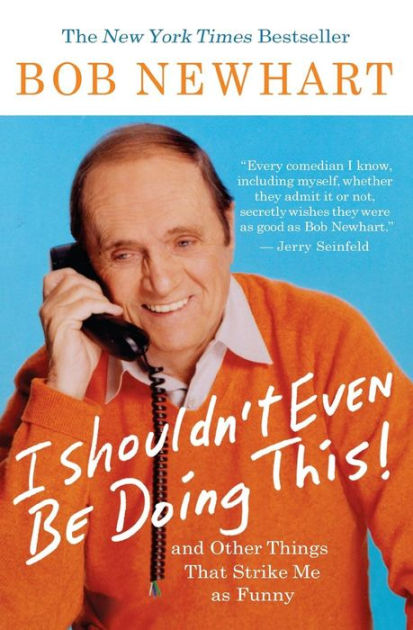
Photo: barnesandnoble.com

In 2006, he released a book I Shouldn’t Even Be Doing This. It’s a memoir with some of his classic comedy routines. Actor David Hyde Pierce reported that “the only difference between Bob Newhart on stage and Bob Newhart offstage is that there is no stage.”

Photo: parade.com

I am so appreciative of those stars who agree to entertain us for our entire life, such as Betty White, Carol Burnett, and Bob Newhart. They are classic comedians who can make us laugh no matter what. Bob’s view on comedy was that “laughter gives us distance. It allows us to step back from an event, deal with it and then move on.” What an amazing career and what an amazing man. With all its negatives and sometimes destructive tendencies, television can be a harmful place, but a comedian like Bob Newhart demonstrates what a positive and uplifting experience television can be when done right. Thanks for doing it right for sixty years.

The Smothers Brothers Comedy Hour: Fifty Years After Getting the Pink Slip

The late 1960s and early 1970s might have contained the most diverse television shows than any other era. In 1968, there were the rural comedies like Green Acres and The Beverly Hillbillies; there were the standard sitcoms, My Three Sons, Get Smart, That Girl, Bewitched; there were the remains of a few westerns including The High Chaparral, The Virginian, and Gunsmoke; there were crime and thrillers such as Hawaii Five-0 and Mission Impossible; there was the crime/western in The Wild, Wild West, there were gameshows on at night including Let’s Make a Deal, The Dating Game, and The Newlywed Game; there were sci-fi shows like Star Trek and The Land of the Giants; family shows like Lassie; and even Lawrence Welk.

In addition, there were a couple of shows that were a bit edgier and introduced more  provocative concepts and themes. The Mod Squad featured three teens who were helping solve crimes in lieu of jail time, and then there was the almost-impossible-to-describe Laugh In.

Photo: neatorama.com

Similar to Laugh In was The Smothers Brothers Comedy Hour which also debuted in 1967 featuring Tom and Dick Smothers. It had more of a variety format to it but it had the same topical and satirical humor.
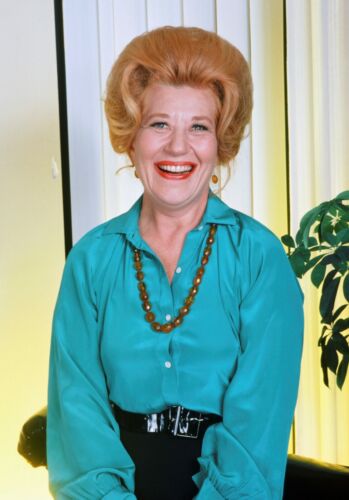
Photo: retrokimmer.com
The Who

In addition to poking fun at politics, the war, religion, and current issues, you could tune in to the Smothers Brothers for some of the best and sometimes controversial music in the industry. Performers such as Jefferson Airplane, Steppenwolf, Simon and Garfunkel, The Who, Cream, Pete Seeger, and The Doors appeared on the show.

Photo: metro.com
Jefferson Airplane

The show aired Sunday nights against Bonanza on NBC; ABC aired The Sunday Night Movie in its first season and Hee Haw in its second season.

The series had some of the best writers on television: Alan Blye, Hal Goldman, Al Gordon, Steve Martin, Lorenzo Music, Don Novello, Rob Reiner, David Steinberg, and Mason Williams. Reiner and Martin both commented on the show in an interview by Marc Freeman in the Hollywood Reporter 11-25-2017 (“The Smothers Brothers Comedy Hour at 50: The Rise and Fall of a Ground-Breaking Variety Show”).  

Reiner relayed that “you had two cute boy-next-doors wearing red suits, one with the stand-up bass and the other with his guitar. They looked like the sweetest, most innocent kids. You got drawn to them, and then they hit you with the uppercut you didn’t see coming.”

Photo: tvbanter.net

Martin elaborated “When you have the power wrapped up in innocence, it’s more palatable. They were like little boys, but you also had Dickie there to reprimand Tommy when he would make an outrageous statement. It’s like the naughty ventriloquist dummy who can get away with murder as long as the ventriloquist is there to say ‘You can’t say that.’ It’s the perfect setup for getting a message across.”

Photo: pinterest.com
Jack Benny

In addition to the musical acts, hundreds of celebrities appeared on the show between 1967 and 1969, including Jack Benny, Carol Burnett, George Burns, Bette Davis, Jimmy Durante, Barbara Eden, Nanette Fabray, Eva Gabor, Shirley Jones, Don Knotts, Bob Newhart, Tony Randall, Ed Sullivan, Danny Thomas and Jonathan Winters, along with so many others.
Part of the show was the brothers’ ongoing sibling rivalry about whom their parents liked best. They also began to add political satire and ribald humor. Pat Paulsen delivered mock editorials about current topics such as the draft and gun control, and in 1968 he had a mock presidential campaign.

Photo: rollingstone.com
Pat Paulsen for president

Church sermon sketches poked fun at religion. The show lampooned many of the values older Americans valued, often delivering anti-establishment and pro-drug humor. No one was given an exception, and the show lambasted the military, the police, the religious right, and the government.

Battles over content were ongoing with the network. The network pulled Pete Seeger’s performance of his anti-Vietnam War song, “Waist Deep in the Big Muddy.” They nixed Harry Belafonte’s song, “Don’t Stop the Carnival” because it had a video collage behind him of the 1968 Democratic National Convention riots.
Younger viewers were tuning in, and despite the conflicts, the show was picked up for a second season. The network insisted they receive a copy of the show at least ten days in advance for editing. In April of 1969, William Paley canceled the show without notice. Some sources contend it was canceled by CBS president Robert Wood. Some sources cite the issue with unacceptable deadlines and others mention Tom Smothers lobbying the FCC and members of Congress over corporate censorship that brought about the firing. The brothers filed a breach of contract suit against the network and after four years of litigation, a federal court ruled in their favor, awarding them $776,300.

Photo: blogspot.com

Here’s a typical joke from the show that was not as controversial.

Tom: You can tell who’s running the country by how much clothes people wear, see?

Dick: Do you mean that some people can afford more clothes on, and some people have . . . less on? Is that what you mean?

Tom: That’s right.

Dick: I don’t understand.

Tom: See, the ordinary people, you’d say that the ordinary people are the less-ons.

Dick: So, who’s running the country?

Tom: The morons.

The Smothers Brothers elicited humor that was as topical, influential, and critical as anyone had ever heard before on television. Fifty years later, both the network and the brothers realized everyone over-reacted. If the Smothers Brothers had tried to play by the rules a bit, they would not have lost their platform to continue to help change what they saw as a messed-up culture.

Photo: Wikipedia.com

The CBS executives felt the program created too much controversy. In their defense, politicians, especially Lyndon Johnson and Richard Nixon, exerted a lot of pressure on the network. Remember this was a time of three networks and ads are what produced the profits to fund shows. The network received a boatload of hate mail daily about the program and, when viewers begin talking boycotting advertisers, executives sit up a bit straighter and listen.

The Smothers Brothers Show, a less controversial series, debuted in 1975. They had two specials on NBC later and another CBS series in 1988 but never regained the influence they had in the sixties. However, the show did help pave the way for a future that permitted, and later embraced, shows with controversy beginning with All in the Family, continuing with Saturday Night Live, and recently seen on shows such hosted by Jon Stewart and Stephen Colbert. Although the comedy spouted on the show would seem quite tame by today’s standards, the show had an important part in the history of television and the rights of free speech.

Photo: wvxu.com

I have seen some DVDs out there from this show, but they are pricey. Recently I saw season two going for $190. I do see Laugh In on Decades quite often, so perhaps The Smothers Brothers might show up somewhere too, although I’m not sure this show would hold up as well as Laugh In, but the musical performances would be fun to see.

The Magic School Bus: Encouraging Us To “Take Chances, Make Mistakes, Get Messy”

Knowing the theme for this blog series is Valerie, if I asked you to think of “Valeries” from television history, it might take you a while to come up with our subject for today. We are learning about Valerie Frizzle, an eccentric teacher who takes her class on educational field trips on her magical school bus on The Magic School Bus.

Based on the books that are written by Joanna Cole and illustrated by Bruce Degen, the original television show ran from 1994-1997, producing 52 episodes. It was created by Joanna Cole, Bruce Degen, and Laskas Martin. (A reboot The Magic School Bus Rides Again began recently.)

Photo: io9.com

The premise of the show is that a class taught by Valerie Frizzle at Walkerville Elementary take field trips to learn about science. Mr. Ruhle is the principal, and he is not aware that the bus is anything other than a simple school bus. However, the “Friz’s” bus can change shape and form to explore anything: far into outer space, deep in the ocean, back to the days of dinosaurs, and even into the human body. The bus can transform itself into a plane, a jeep, or other form of transport. It can become a frog or another type of animal to get into a specific ecosystem.

The Friz has a pet lizard named Liz who accompanies the class on its trips. Liz eats insects, but when the bus shrinks, she is very frightened by bugs.

Photo: abcnews.com

Apparently Walkerville is in a small community, because there are only eight children in her third-grade class: Arnold, Carlos, Dorothy Ann, Keesha, Phoebe, Ralphie, Tim, and Wanda.

Photo: wikifandom.clom

The Bus

The bus itself is a 1970s Ward International R-183 manufactured by Ward International Trucks, Inc. The bus is painted the typical school bus yellow. The magic part comes in with the devices that are installed in the bus. There is the shrinker scope that can shrink and re-size the bus when Ms. Frizzle asks it to. There is also a portashrinker that doesn’t work if the bus is wet and if someone tries to use it then, the Dew Dinger alerts them. There is also a mesmerglober which can change the shape of the bus. A magic battery runs on solar power.

Photo: myabandonware.com

The bus seems pretty indestructible. In one episode it floated around in lava. The bus has eyes and a mouth and often shows emotions like fear, anger, and sadness.

Photo: buzzfeed.com

The Friz

Valerie Felicity Frizzle is a quite a character. She has fiery red hair that is usually seen in a bun. Static electricity makes her hair frizzy. So, what do we know about Ms. Frizzle? She was a Shakespearian actress at one point in her life. She also had a band called The Frizzlettes and toured with rock star Molly Cule. She then went back to school for education. She learned about “busanautics” from a mechanic she knows, R.U. Humerus.

Voiced by the funny Lily Tomlin, the Friz is always optimistic. She cares about her students and is passionate about science. She lives in a mansion that has a bridge on the property as well as a fountain with a statue of Liz. You can often spot the bus parked in her driveway. She keeps a framed photo of Mr. Seedplot, suggesting that they may be romantically involved. She loves to tell jokes. She is very protective of her students who love and respect her.

Miss Frizzle has an interesting wardrobe and most of her clothing is science themed.

Photo: twitter.com
Photo: pinterest.com

Some of her taglines are “To the bus!”; “Okay, bus, do your stuff!”; and “Take chances, make mistakes, get messy!”

During the four years the show was on the air, we got to know her students very well.

Photo: wikia.com

Arnold

Arnold was not a fan of field trips. Like The Friz, he is a redhead. Arnold wears glasses. He was the shyest kid in the class, but he was brave. He cares about the environment and is interested in rocks. His aunt, Arizona Joan, is a famous archaeologist. He also has an uncle who is a firefighter in a national park.

Arnold’s favorite color is orange and he is Jewish. Pollen and pepper both make him sneeze. He also loves cold weather because that means he can drink hot chocolate.

His most famous sayings are “I knew I should have stayed home today”; “We’re doomed” and “Carlos!”

In one of his interviews, illustrator Bruce Degen mentions that Arnold was based on his son.

Photo: wikia.com

Carlos

Carlos, a brunette, is the class clown. He tells a lot of jokes, some not so good which always gets the reactions, “Carlos!” from his classmates, especially Arnold. Carlos and Dorothy Ann often butt heads about learning because he is a hands-on learner while she is not.

Photo: wikia.com

Dorothy Ann

Dorothy Ann likes to learn by reading. Her favorite science area is astronomy and she has a telescope at home. She tends to argue with many of her friends and one of her favorite sentences starts, “According to my research . . .”

Photo: wikia.com

Keesha

Keesha can be a bit sarcastic. While Arnold and Dorothy Ann have different perspectives, Keesha and Ralphie are opposites. Keesha is a realist. Like Ms. Frizzle, she keeps her curly hair in a bun most of the time. Unlike most girls her age, she likes garter snakes.

Photo: wikia.com

Phoebe

Phoebe keeps her brown hair in a flip with a yellow hairband and bangs. She is kind-hearted, sweet, very bright, and patient. She’s left-handed and she cares a lot about animals. She often refers to her previous class, saying “At my old school . . .” When her father visits the school one day, he also refers to her old school.

Photo: wikia.com

Ralphie

Ralphie is a heavyset boy who often wears a baseball cap. He loves baseball, basketball, soccer, and hockey and is athletic. He daydreams a lot, learning through imagination. He is a fun-loving kid. He has a dog named Noodles. We learn he loves comic books and superheroes but dislikes anchovies and roller coasters. He worries about creatures like vampires which probably comes from overusing his imagination. His mother is a doctor and they seem to have a lot of fun together.

Photo: wikia.com

Tim

Tim is quiet and artistic; we often see him off drawing somewhere. Sometimes he tells jokes with Carlos. An interesting family fact is that his grandfather is a bee keeper and he delivers honey every winter.

Photo: wikia.com

Wanda

Wanda is a tomboy. She is the smallest member but may be the toughest. She dreams of being a pilot and loves it when the bus can fly. She hates cold weather. Her mother visits class now and then; she is a science journalist. It’s often mentioned that her mother keeps reptiles around the house; one time an alligator is found in the bathtub and a gila monster in the sandbox. Wanda is a gaming expert; she also likes to play the guitar.

We often hear her say, “What are we gonna do, what are we gonna do, what are we gonna do?”

Photo: wikia.com

Famous Guest Stars

For an animation show, this series featured an incredible number of famous guest stars. Tyne Daly was Ralph’s mother; Elliott Gould was Arnold’s father; Swoosie Kurtz was Dorothy Ann’s mom, and Eartha Kitt was Keesha’s mother. Ed Begley Jr. showed up as Logaway Larry; Carol Channing was Cornelia C. Contralto, Cindy Williams was Gerri Poveri; Dolly Parton was Katrina Murphy; Sherman Hemsley was Mr. Junkit; Rita Moreno was Dr. Carmina Skeledon; Dabney Coleman was Horace Scope; and Bebe Neuwirth was Flora Whiff. Tony Randall took the role of mechanic, R.U. Humerus while Wynonna Judd became rock star Molly Cule. Dom DeLuise was a baker; Ed Asner a general; Alex Trebek an announcer; and Tom Cruise played himself.

Photo: speed-new.com

Theme Song

The theme song is sung by Little Richard. The show begins with:

 (Bus honks, drives up, doors open)
 

Valerie Frizzle: Seatbelts, everyone!
 

Arnold: Please let this be a normal field trip.
 

Wanda: With the Frizz?
 

Kids except Arnold and Dorothy Ann: No way!
 

Arnold: Ohh!

Little Richard: Cruising on down main street. You’re relaxed and feeling good! (Yeah!)
 

Next thing that you know, you’re seeing…
 

Valerie Frizzle: (driving into ocean) Wa-ha-ha-hoo!
 

Little Richard: An octopus in the neighborhood?!

Surfing on a sound wave! Swinging through the stars!

Ralphie, Wanda and Carlos: Yee-ha!

Little Richard: Take a left at your intestine. Take your second right past Mars!

Kids: On The Magic School Bus!

Little Richard: Navigate a nostril!

(Ralphie sneezing)

(class gasping)

Kids and Little Richard: Climb on The Magic School Bus!

Little Richard: Spank a plankton, too!

Wanda: Take that!

Kids: On our Magic School Bus!

Little Richard: Raft a river of lava!

Kids: On The Magic School Bus!

Little Richard: Such a fine thing to do!

Kids: Whoa!

Little Richard: So, strap your bones right to the seat, come on in and don’t be shy….

Come on.

Just to make your day complete,

You might get baked into a pie!

Kids and Little Richard: On The Magic School Bus!
 

(Dorothy Ann, Keesha and Ralphie run up to Bus and enter before Bus shapeshifts)
 

Little Richard: Step inside, it’s a wilder ride!
 

Come on!
 

(Bus appears under big title that reads “The Magic School Bus…”)
 

Kids and Little Richard: Ride on The Magic School Bus!
 

(Bus disappears to reveal title of episode)
 

(Bus honking)

Photo: wordpress.com

I did not watch The Magic School Bus a lot. It went off the air about the time my older boys would have been the age to watch it. However, we read most of the books, and my kids learned a lot from them. Along with Arthur, this is probably one of my favorite cartoons for combining fun with learning.

The Millionaire and His Wife: Jim Backus and Natalie Schafer

backus9

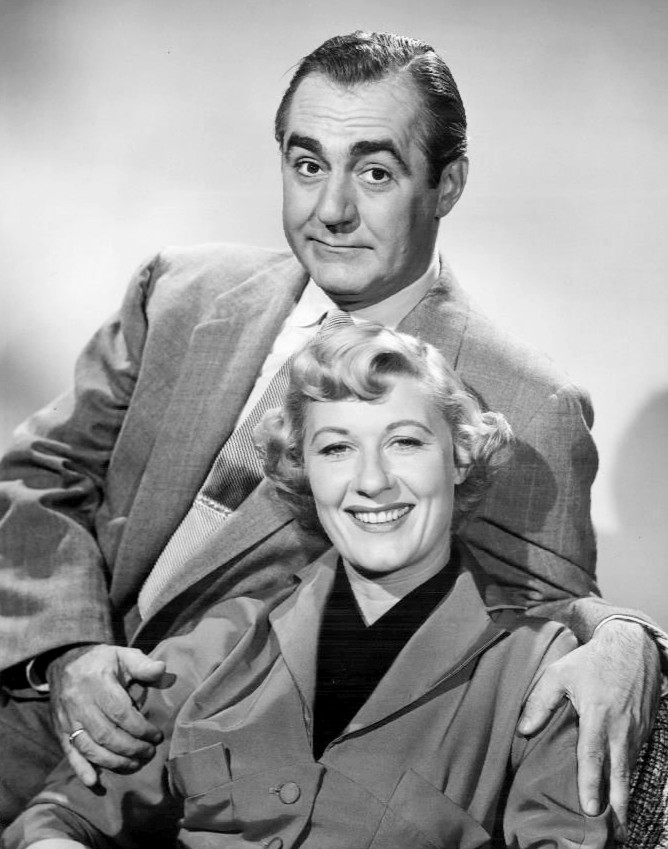
Today we continue our month-long series about the characters on Gilligan’s Island and the stars who portrayed them. We begin with the millionaire, Thurston Howell III, and his wife, Lovey. On the island, their money is worthless, but it doesn’t stop Mr. Howell from bribing other captives when it’s in his best interest.  He must have been a boy scout who learned the motto, “Be prepared,” because he and his wife took clothes on a three-hour tour to last a few years. In real life, Natalie Schafer was the millionaire. Both Backus and Schafer had very interesting careers.


Jim Backus

backus2

Jim Backus was born in Cleveland in February of 1913. He was one of those stars who seemed to excel in everything:  radio, Broadway, animation, big-screen movies, and television series. In an interesting aside, Margaret Hamilton who would go on to have a full career including the Wicked Witch of the West at the Wizard of Oz, was one of his grade school teachers. Jim grew up in a wealthy area, attending Shaw High School in East Cleveland. His father was a mechanical engineer. I could not find exact proof of this but several articles mention he was expelled from the Kentucky Military Institute for riding a horse in the mess hall. He later attended the American Academy of Dramatic Art.

In 1939 he married Betty Kean; they divorced in 1942. One of his famous quotes was “Many a man owes his success to his first wife and his second wife to his success.”

backus5

In the 1940s, Backus began appearing on radio as the “rich man,” which he often portrayed afterward on radio and television. He played the role of aviator Dexter Hayes on Society Girl on CBS Radio Network. He also appeared on the Mel Blanc Show as Hartley Benson, an arrogant character, and as Hubert Updike on The Alan Young Show. He also showed up regularly on The Jack Benny Program.

During his radio years, he married Henny Backus whom he was married to the rest of his life.

backus10

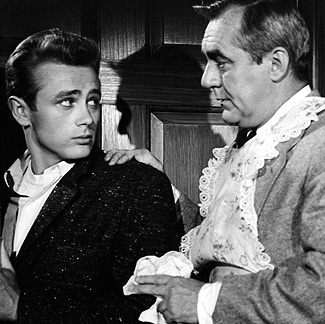
He began his big-screen cinema career in 1949 and would go on to appear in almost 100 movies, including Here Come the Nelsons, Pat and Mike, and Rebel Without a Cause (seen above). His most famous movie role was probably Tyler Fitzgerald in It’s a Mad Mad Mad Mad World. My favorite movie of his is Hello Down There with Tony Randall and Janet Leigh from 1969.

backus12

During the 1950s, he began auditioning for roles on television. He would go on to appear on 18 different series during that decade, including I Married Joan, on which he starred with Joan Davis. On the show, Backus played a respected judge and Davis was his scatterbrained wife. The show was very popular and lasted three seasons.
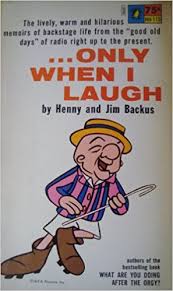
backus6

As if he wasn’t busy enough with acting in the 1950s, he also made a song recording with Phyllis Diller that hit the top 40 in 1958. It was called “Delicious,” and the two of them would take a sip of champagne throughout the song, saying “Delicious.” As the song continues, they get more drunk and a bit giddy, slurring their words and laughing hysterically.


His television career continued to be demanding in the 1960s. He appeared on 25 series, and four of them had regular starring sitcom roles. In 1960, The Jim Backus Show debuted. The program focuses on Backus in the role of Mike O’Toole, the editor/proprietor of a low rent wire service struggling to stay in business.

backus7


He had made movie shorts about Mr. Magoo in the 1950s and in 1960, he starred in 130 episodes of Mr. Magoo and would make 26 more episodes under the title The Famous Adventures of Mr. Magoo in 1964-1965. Mr. Magoo was an older nearsighted man who was very popular, appearing in ads and merchandise for years. The humor of the show was based on the difference between what Mr. Magoo thinks he sees and the reality of what was really there. Jim Backus liked to repeat a story about his famous character. He was in the movie, Don’t Bother to Knock, with Marilyn Monroe. She asked Jim to meet her in her dressing room later and his curiosity got the best of him, so he went, only to learn she wanted him to portray Mr. Magoo which he did.

backus11


This was also the decade he was offered the role of Thurston Howell III on Gilligan’s Island in 1964. That same year he was asked to play the role of Abner Kravitz on a new show, Bewitched but turned it down because he was committed to Gilligan’s Island. Gilligan’s Island would run from 1964-1967 and he would go on to appear in several Gilligan revivals including the far-fetched The Harlem Globetrotters on Gilligan’s Island.

backus3


During 1968-1969, Backus took the role of Mr. Dithers in a revival of Blondie.

During the 1960s, he also appeared on 77 Sunset Strip, The Beverly Hillbillies, Daniel Boone, The Wild, Wild West, and I Spy, among others.

backusb


Backus continued his television work into the 1970s where he appeared on 31 shows. He appeared in a variety of genres including I Dream of Jeannie, Young Dr. Kildare, Medical Center, The Brady Bunch, Gunsmoke, Ellery Queen, Charlie’s Angels, Fantasy Island, and The Love Boat.

backusa


Backus also continued his commercial work in the 1970s and 1980s. He was the spokesperson for La-Z-Boy furniture and General Electric. He and Natalie Schafer appeared in an ad for Redenbacher’s popcorn. They played their characters from Gilligan’s Island but apparently had been rescued and were in a luxurious home. In a sweet ending, it was the last television appearance for either of them.

When Jim Backus had a little bit of free time between acting jobs, he loved to golf. He also tried his hand at writing a few books and film scripts, including his autobiography which he wrote with his wife, Only When I Laugh in 1965.

book


In July of 1989, Backus died from pneumonia, after suffering from Parkinson’s disease for many years.

He had a long and varied career and seemed to have many friends in the business.


Natalie Schafer

schafer5

A millionaire in real life, Natalie Schafer seemed like a very fun woman, a bit of a character. She was born in November of 1900 in New Jersey and raised in Manhattan. She was quite secretive about her age, often claiming she was born in 1912.

She began her career in Broadway, appearing in 17 plays. She married actor Louis Calhern in 1934 and they divorced in 1942. She moved to Los Angeles in 1941 to become a film actress and received parts in 34 movies. Incidentally, she and her ex remained friends and appeared together in the movie Forever Darling in 1956.

schafer2


Like Backus, Schafer typically played wealthy and sophisticated roles. She did not have the versatility her tv husband had but continued to stay busy acting on television.  While Gilligan’s Island was her only long-term role, she appeared on 21 shows in the 1950s (including I Love Lucy, Loretta Young, Phil Silvers, and Topper); 8 in the 1960s (including The Beverly Hillbillies, 77 Sunset Strip, and Route 66); 15 in the 1970s (including Mayberry RFD, The Brady Bunch, and McMillan and Wife); and an additional 8 shows in the 1980s before she passed away (including Three’s Company, The Love Boat, Trapper John, and Simon and Simon).

schafer3


Schafer made most of her money from investments, particularly in real estate.

Several sources revealed that much of her fortune was bequeathed to either her Gilligan’s Island co-star Dawn Wells or to care for her dogs; however, at least $1.5 million was donated to the Lillian Booth Actors’ Home to renovate their outpatient wing. I never saw any answers from Wells about inheriting money, but on Vicki Lawrence’s talk show, she did say that Schafer spent her last years living with her. Like many wealthy people, she was quite thrifty.  She often admitted that she accepted the role of Mrs. Howell because she got a free trip to Hawaii to film the pilot and didn’t expect it to get picked up.


schafer1


Everyone seemed to like her on the set. Dawn Wells said she especially adored Schafer and Backus. Schafer was a hard worker and liked to keep fit. In a Chicago Tribune article from October 25, 1965, she relayed her secrets for staying in shape. For one thing, she did her own stunts on the show. She also said she swam nude every morning and evening, doing 100 strong kicks at the side of the pool. She also invented an ice cream diet for herself. She claimed to eat a quart a day, saying she had a bowl of vanilla ice cream with her coffee, two bowls of varying flavors for both lunch and dinner, and another single bowl for an afternoon snack. She claimed that she would lose three pounds in five days.

In 1990, Schafer passed away from liver cancer. After her death, she wanted people to realize her true age, and many of her closest friends were quite surprised to learn she was 12 years older than she claimed.

backus

While Thurston Howell III and his wife Lovey were two interesting characters, I don’t think they can compete with the characters who were Jim Backus and Natalie Schafer. I had a lot of fun learning about them.