Although I love The Big Bang Theory and Modern Family, there are a lot of shows on television today that make me shake my head. It’s amazing what is airing when you scroll through the channels: Vanilla Ice Goes Amish, I Cloned My Pet, Doomsday Preppers, and these are some of the best reality shows out there. However, when I researched sitcoms from the classic era, I also found a lot of weird concepts there also. Let’s take some time to look at a few of them.

Boss Lady (1951)
Lynn Bari was Gwen Allen, owner and operator of Hillendale Homes Construction Co. which was owned by her father. While this show would not seem unusual at all today, back in 1951 it was not common to see a woman the boss of a construction crew. This show began on the Dumont network and then switched to NBC for twelve episodes, running as a summer replacement from July to September 1952.


Where’s Raymond? (1953)
Believe it or not, this was a musical sitcom. Ray Bolger (who had sang and danced as The Scarecrow in The Wizard of Oz) was a song and dance man named Ray Wallace living in Pelham, New York. He had a girlfriend named Susan (Marjie Millar) and a business partner Peter (Richard Erdman). Verna Felton from December Bride was his understudy’s mother-in-law. The show lasted 2 ½ years on ABC.


The People’s Choice (1955)
Ok, pay attention, because the basis of this show is confusing. Socrates (Sock) Miller played by Jackie Cooper is a Bureau of Fish and Wildlife Orinthologist studying to be a lawyer. Honestly! He has car trouble one day and is picked up (and picked up) by the mayor’s daughter Mandy who thinks he should be on the city council. Sock decides to be a lawyer to support Mandy. In the finale to year one, the two elope and conceal their marriage for the entire second season. When the show came back for a third year, the mayor finds out about the marriage, Sock gets his law license, and Sock’s free-loading pal Rollo (Dick Wesson) moves in with the couple. Now Sock is managing a real estate development. Just when you thought it could not get more confusing, Sock’s basset hound Cleo would do tricks and comment directly to the audience about situations occurring on the show. LSD had not even become a social problem yet, so it was not responsible for this show, so I’m not sure how this crazy mess stayed on the air for 104 episodes.
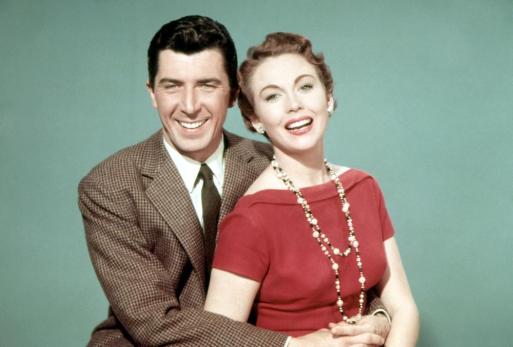
Dick and the Duchess (1957)
Dick Starrett (Patrick O’Neal) is a claims adjuster in London. There are some exciting scenarios to provide interest. He meets and marries Jane (Hazel Court) a duchess. She becomes his wife and assistant, although she still expects to live in the manner she has become accustomed to. She humorously gets involved in his investigations. The network must not have thought she was that funny helping out because CBS cancelled it after 25 episodes.


Mr. Ed (1961)
Let me say, I do not put Mr. Ed in the same category as Dick Van Dyke Show, That Girl, or Bachelor Father, but I don’t mind catching an episode or two now and then. When looking at strange concepts for show, this one does have to go into the mix.
When the creator asked Young to appear in the show, he turned him down twice. A pilot was made without him. It did not sell, so producers Arthur Luben and Al Simon decided to enter it directly into syndication, and Young then agreed to take on the role. It was very successful, so CBS bought it.
Wilbur Post (Alan Young) is a married architect. Wilbur and his wife Winnie (Connie Hines) bought their house with a horse included. Their neighbors were played by Edna Skinner and Larry Keating. What no one else realized (including his wife), was that Wilbur was the only human who could understand Ed and talk with him. Ed was quite the character; he was a hypochondriac; a voracious reader; a playboy, or play horse; loved Carl Bernstein and wanted to decorate his stable in Chinese modern.
The voice of Ed was a highly guarded secret until the show ended in 1967 when it was revealed to be Rocky Lane. Ed was played by Bamboo Harvester, a palomino. One interesting fact about this show is that it has been seen in 57 different countries.


My Mother the Car (1965)
This is another one of those shows you roll your eyes about. Dave Crabtree (Jerry Van Dyke) lives in LA. He wants to buy a new station wagon, and when he goes shopping, he realizes his mother’s voice is coming through the radio of a 1928 Porter. Ann Sothern provides his mother’s voice. Of course, he buys the car which irritates his family, but they don’t know his secret. He also has to deal with a car connoisseur who wants to buy the car for his collection. Maybe it’s a Freudian slip, but I’m a bit offended that a mother is portrayed as an old jalopy as opposed to a new, sleek car, but I digress. This show was only on the air for a year and then the radio was turned off.

The Second Hundred Years (1967)
Here is the premise of this one: In 1900, 33-year-old Luke Carpenter (Monte Markham) is prospecting for gold in Alaska. An avalanche occurs, and he is buried alive and frozen.
In 1967, Luke’s son Edwin, who is 67, is told that his father has been found alive. Dad looks 33, but his identity and past has become a top-government secret. He is released into the custody of Edwin (Arthur O’Connell) and grandson Ken (also Monte Markham). Luke has a hard time adjusting to life in the 1960s. I know you are surprised, but the show was cancelled after 30 episodes.


My World and Welcome to It (1969)
This show was based on James Thurber’s writings. The show was set in Connecticut where John Monroe (William Windom) was a cartoonist for Manhattanite Magazine. He was intimidated by his wife Ellen (Joan Hotchkiss). To escape his boring and nagging life, he escapes into a secret world where his cartoons come alive and he is a king. He drifted between real and fantasy lives. NBC cancelled the show after a year, but CBS picked it up and aired it from May-September of 1972. So, the presence of LSD does explain the writing on this one. What it doesn’t explain is that this show won two Emmys in 1970 : Outstanding Continued Performance by and Actor in a Leading Role in a Comedy Series and Outstanding Comedy Series. The competition for comedy included Love American Style, Room 222, The Bill Cosby Show, and The Courtship of Eddie’s Father.


The Roller Girls (1977)
Meet the Pittsburgh Pitts, an all-women roller derby team, owned and managed by Don Mitchell (Terry Kiser). The Pitts were pretty but useless when it came to roller derby. James Murtaugh played the team’s announcer Howie Devine. After four episodes, the network agreed this really was the pits and it was cancelled.
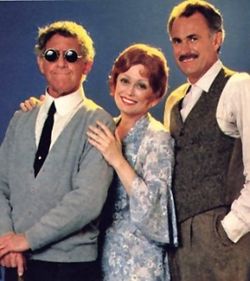
Apple Pie (1978)
This show aired for one episode – I thought they used to call that a movie. (A couple sources say 2 episodes, perhaps a mini-series.) The show is set in Kansas City, Missouri. A hairdresser named Ginger Nell Hollyhock (Rue McLanahan) is lonely and decides to advertise in the local paper for a family. She ended up with a con artist, Fast Eddie (Dabney Coleman), a tap-dancer daughter, a son who wanted to fly just like birds do, and a grandfather figure (Jack Guilford).
So, when you think you’ve seen it all before, you probably have. I would not be the least surprised to read that in the fall there will be a reality show that features a roller derby team, or a woman who advertised for a family in the personal ads, or an insurance adjustor married to royalty.
I do have to say that both Dick and the Duchess and My World and Welcome To It seem to have some die-hard fans who appreciate the shows I guess I should watch a few more episodes.
Listen up you sitcom developers; if you think you have a concept that’s a bit too far out there, it will probably be a big hit. After all, who would have guessed a show about an alien from Ork who traveled in an egg, and gave birth to a 79-year old man would score high ratings?


