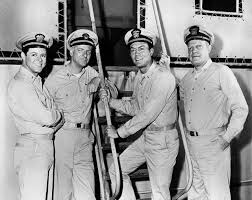
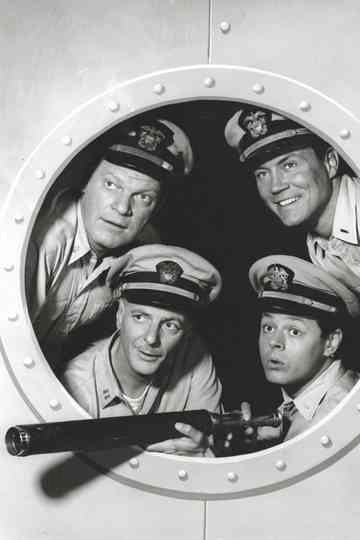
As we continue with our theme of Military Upended where we are taking a lot at several military sitcoms, today we delve into Mister Roberts.
📷collections.com
This series was based on a novel of the same name from 1946. The novel became a play in 1948 and a movie was released in 1955. A decade later, it hit the television air waves.
The show was set in World War II and follows the crew of the USS Reluctant AK-601 cargo ship, which the men called “The Bucket.” Like F-Troop that we discussed last week, it was a Warner Brothers show, produced by William T. Orr.
Lieutenant Roberts (Roger Smith) wasn’t happy on a cargo ship and wanted to be directly involved in the war. Ensign Pulver (Steve Harmon) tried to make things fun on the ship. Like McHale’s Navy, the entire crew was happy to stymie Captain Morton (Richard X. Slattery) in all of his efforts. Roberts wrote letters asking for reassignment to active duty, but they were all intercepted by Captain Morton and never sent.
Rounding out the cast was Doc (George Ives), Seamen Reber (Ray Reese), D’Angelo (Richard Sinatra), and Mannion (Ronald Starr).
📷moviephone.com
The theme song was composed by Frank Perkins. Perkins had more than 70 music credits; he composed all the music for Hawaiian Eye.
The show debuted on NBC on Friday nights. Its competition was The Smothers Brothers Show and The Farmer’s Daughter. The Smothers Brothers Show followed three very popular shows. The Wild Wild West (a top 40) began the night, with Hogan’s Heroes and Gomer Pyle USMC, both top ten shows, following. I’m guessing many viewers stayed with CBS all evening, and if they did not, perhaps after watching two military sitcoms, they were ready to watch something different the rest of the night.
It sounds like this show could not draw viewers and could never it the same quality that the movie provided, so it was cancelled after the first season. Jack Lemmon won the Oscar for his role in the big-screen version. In 1984 a made-for-television movie was aired based on the play. I guess they just wanted to make it successful somehow. Currently, it’s not available for streaming. If you do have fond memories of this one, let me know.
As we continue with our “Favorite Crime Solvers of the Past,” we turn to 77 Sunset Strip. Even if you never watched the show, you might be familiar with the theme song where they snapped and kept repeating “77 Sunset Strip.”
📷facebook.com
Created by Roy Huggins, the show debuted on ABC in 1958 and ran until spring of 1964. This was the third appearance by Detective Stuart Bailey. In 1946, Huggins’ novel, The Double Take, was published. In 1948, Bailey stepped into the big screen, starring in I Love Trouble played by Franchot Tone. A decade later he showed up on television played by Efrem Zimbalist Jr.
Bailey, a former WWII secret agent and foreign languages professor, works with former government agent Jeff Spencer (Roger Smith). Their office is at 77 Sunset Strip, Suites 101 and 102. Suite 103 is occupied by Suzanne Fabry (Jacqueline Beer), a French switchboard operator who handles phones for several clients including Bailey and Spencer. Occasionally she helps them solve a crime.
Other characters come and go from the offices including Roscoe (Louis Quinn), who gives out horse-racing tips when he’s not at the track; he often is an operative for the duo.
📷allposters.com
Gerald “Kookie” Kookson (Ed Byrnes) is a bit of a kook. He loves rock and roll, is witty, appreciates looking good, and works as a valet at the club next door. But he wants to be a private detective and makes full partner during the show. Kookie provides some comedy with his slang like “ginchiest” for coolest or “piling up Zs” for sleeping. During season 2, Byrnes asked for more money with his character expanding his role, but the answer was a firm no, so he left the show. Warner Brothers eventually settled with him, and he returned in May of that year.
Other occasional visitors include Lt. Roy Gilmore (Byron Keith) and the Frank Ortega Trio (played by themselves), a jazz band, who perform next door. They recorded for Warner Brothers who was also behind the television show.
The show had a fun, witty edge to it making it interesting to watch the interactions of the characters in addition to the crime solving. Bailey and Spencer were updated versions of forties’ noir detectives. Some of the shows had very different plots, something like the shows Moonlighting would feature a few decades later. “The Silent Caper” had no dialogue and, in another one, Bailey finds himself in a ghost town and he’s the only main character in the episode. During the last season in “The Target,” roles were played by crew members who were usually behind the camera including director William Conrad, associate producer James Lydon, and writer Tony Barrett.
Guest stars were plentiful and included Robert Conrad, Dyan Cannon, Cloris Leachman, Shirley MacLaine, Elizabeth Montgomery, Mary Tyler Moore, Roger Moore, William Shatner, Marlo Thomas, Robert Vaughn, and Adam West.
📷starstills.com
Mack David and Jerry Livingston wrote the famous theme which became a top 10 hit on the Billboard chart. The duo worked on several other Warner Brothers crime shows including Surfside Six, Bourbon Street Beat, and Hawaiian Eye, all based on the 77 Sunset Strip formula and exotic location.
By 1963, ratings were declining and the show revamped. If you read my blog often, you realize this is one of my pet peeves. If they want to change the casts, I understand that. However, in this one, like so often, Bailey is suddenly working alone and there is no mention made of any of the other characters, just as if they never existed. They did this on Happy Days, The Doris Day Show, and several other popular series.
In addition to booting the cast, Jack Webb was brought in as executive producer and William Conrad as director. And if the name William Conrad sounds familiar, yes, it is the same person as the man who starred on Cannon. During the fifties and sixties, Conrad racked up 32 directing credits.
Bailey is now a solo investigator. The title didn’t change, but the old office is no longer there nor the club nor the theme song. A new one written by Bob Thompson was used, and the show took on a darker, more serious nature. Bailey gets a secretary named Hannah who we rarely see.
📷ebay.com
The show was on Fridays for its entire run, just switching time slots now and then. By season two it was in the top ten. In seasons three through five, it got its biggest competition from Route 66, which it beat in the ratings. The final season, the show got moved to a later slot, going up against The Alfred Hitchcock Hour but, neither of them were in the top thirty.
Big surprise, viewers weren’t fans of the changes or the more serious tone of the show, and they drifted away. The show was cancelled in February. Efrem Zimbalist Jr. moved over to the FBI. Roy Huggins had a hugely successful career. He would write for and create more top shows including Run for Your Life, Maverick, Alias Smith and Jones, The Rockford Files, and The Fugitive. Viewers at least got the satisfaction of knowing that making such drastic changes to the show caused the end of that story. Stream a few of the early seasons on Philo, Roku, or Pluto TV and let me know what you think.