The Wackiest Ship in the Army: Couldn’t Find Its Viewers

We are half-way through our blog theme for July, which is Military Upended as we look at military sitcoms that all debuted in the mid-sixties.

Like our show from last week, Mister Roberts, this one debuted in 1965 and ran for one season. This hour-long NBC series was produced by Harry Ackerman and Herbert Hirschman. It was loosely based on a film from 1960. Our show last week, Mister Roberts, was also based on a movie that starred Jack Lemmon. Lemmon was in this movie as well with Ricky Nelson.
đź“·imdb.com

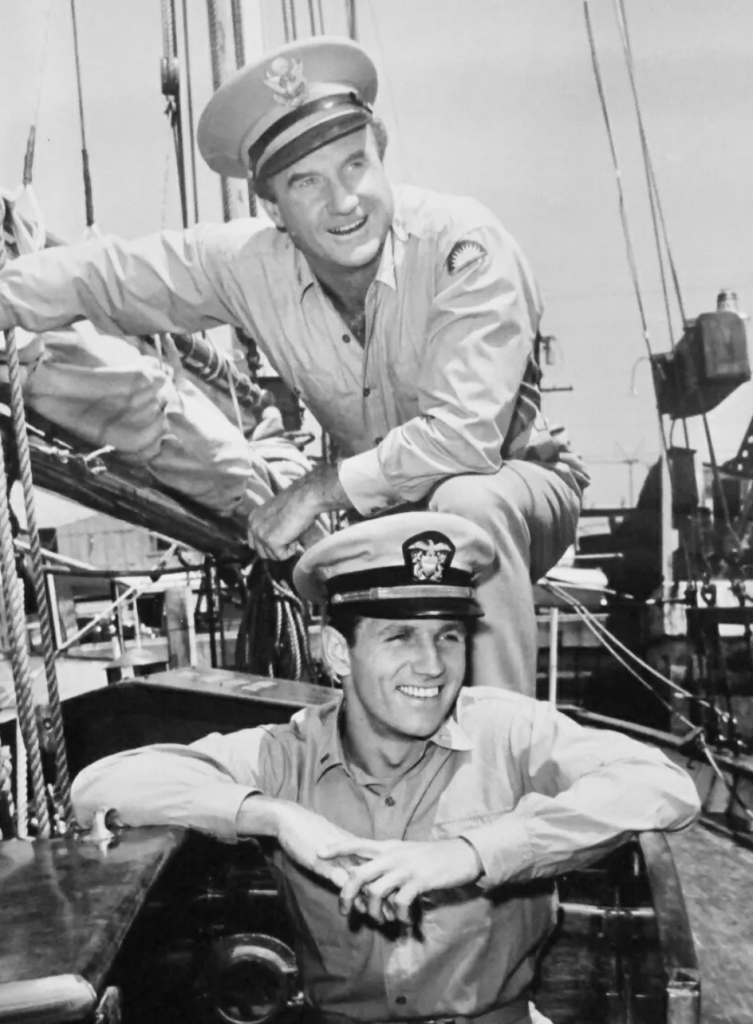
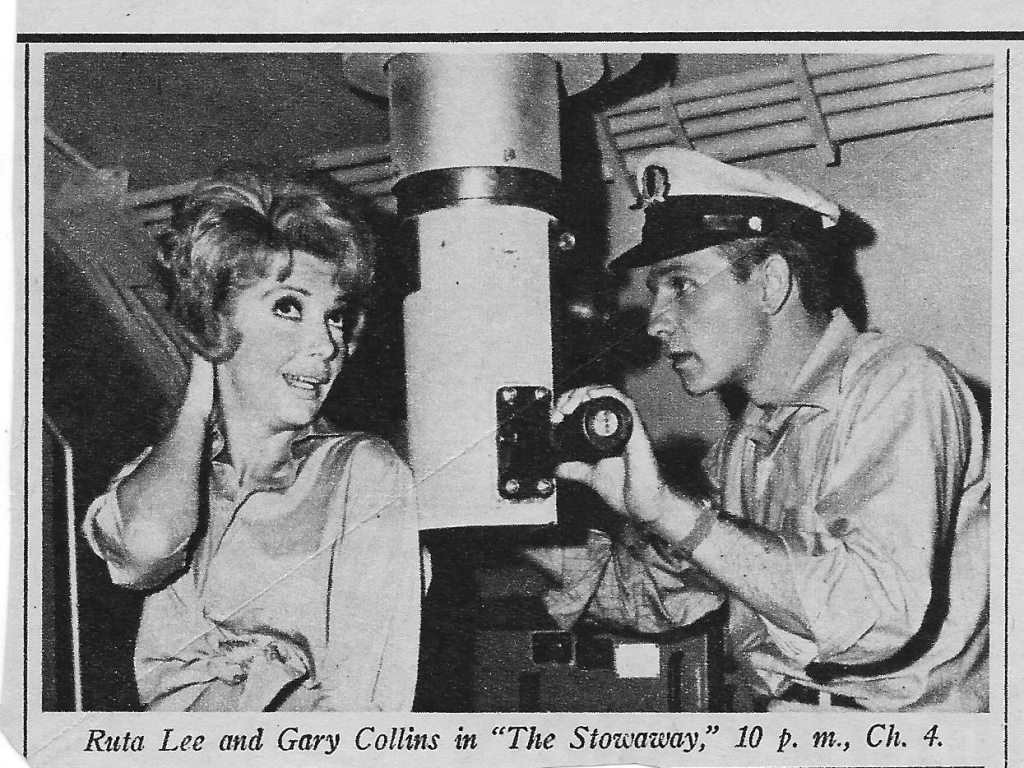
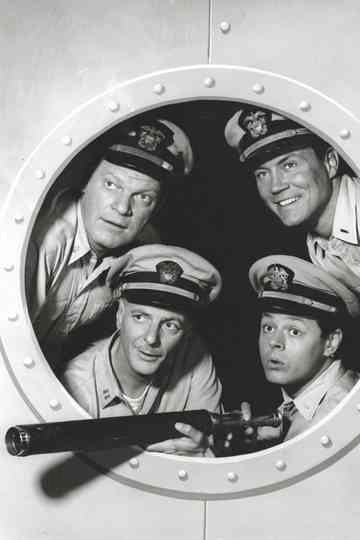
The show is set in World War II and focuses on the crew of the USS Kiwi in the Pacific theater. This old schooner, flying a Swiss flag, carries out covert missions behind Japanese lines. The commander is Major Simon Butcher (Jack Warden) and Lieutenant Richard Riddle (Gary Collins). Butcher controls land operations while Riddle commands at sea. The Kiwi was previously owned by New Zealand.

Also in the cast were Chief Petty Officer Willie Miler (Mike Kellin), Radioman Patrick Hollis (Mark Slade), Machinist Seymour Trivers (Fred Smoot), Gunner’s Mate Sherman Nagurski (Rudy Solari), and Pharmacist Charles Tyler, the cook, (Don Penny).

The Kiwi was based on the USS Echo, a 40-year-old schooner given to the US Navy by New Zealand to use during the War. The ship was returned in 1944. Its poor condition made it useful for spying. The wooden hull did not show up on radar, its sailing power didn’t register on sonar, and the shallow draft allowed it to travel in shallow waters.

The show was scheduled for Sunday nights. The tough part of the schedule was that it was up against Candid Camera and What’s My Line, very popular programs at the time. However, it was helped by following Bonanza, the number one show that year.

The composer of the theme song was the celebrated Nelson Riddle. With more than 100 credits he worked on films including High Society and Guys and Dolls; did variety shows for Dinah Shore, Frank Sinatra, Nat King Cole, Julie Andrews, and Rosemary Clooney; and lots of television series including The Untouchables, Route 66, Emergency, and Newhart.
đź“·imdb.com

Eddie Foy III talked about casting this show during his Television Academy interview. He said it was one of the best casts of any show he worked on. He said their producer brought the dramatic style the show needed to uphold the comedy. He said Danny Arnold was the talent behind this series and that Danny used to always say that writers aren’t funny and actors aren’t funny, but writers and actors who are successful think funny. Foy worked with him on That Girl and then continued as his casting director for years. Arnold gave everyone on the show freedom to do what they did best, so Foy did not have to run every casting decision by him.

The show was canceled after one season due to low ratings. I’m not sure if it was the quality of the show or if it was a victim of too many shows like this one. During the year this one debuted, we also had McHale’s Navy, F-Troop, Hogan’s Heroes, Gomer Pyle USMC, as well as tons of westerns, and extremely popular sitcoms like I Dream of Jeannie, Green Acres, Bewitched, That Girl, The Dick Van Dyke Show, The Andy Griffith Show, Get Smart, Batman, Petticoat Junction, and My Three Sons.

When you take into account that you had to watch shows live and there were only three choices at a time, it’s easy to understand how some good shows that might be recorded now received low ratings then. That said, this show never seemed to be sure what it was either. It was listed as a sitcom, but it was an hour-long show which was unusual. It wasn’t filmed before an audience, nor did it include a laugh track. And, it sometimes had episodes where people died, not so funny. If you wanted to see a funny military show, there were a lot of other options. There were also lots of good sitcoms and good dramas that all knew what their genre was. If you want to give it a try, it’s available on Philo.
Mister Roberts: The Third Time Was Not the Charm

As we continue with our theme of Military Upended where we are taking a lot at several military sitcoms, today we delve into Mister Roberts.

đź“·collections.com

This series was based on a novel of the same name from 1946. The novel became a play in 1948 and a movie was released in 1955. A decade later, it hit the television air waves.

The show was set in World War II and follows the crew of the USS Reluctant AK-601 cargo ship, which the men called “The Bucket.” Like F-Troop that we discussed last week, it was a Warner Brothers show, produced by William T. Orr.

Lieutenant Roberts (Roger Smith) wasn’t happy on a cargo ship and wanted to be directly involved in the war. Ensign Pulver (Steve Harmon) tried to make things fun on the ship. Like McHale’s Navy, the entire crew was happy to stymie Captain Morton (Richard X. Slattery) in all of his efforts. Roberts wrote letters asking for reassignment to active duty, but they were all intercepted by Captain Morton and never sent.

Rounding out the cast was Doc (George Ives), Seamen Reber (Ray Reese), D’Angelo (Richard Sinatra), and Mannion (Ronald Starr).

đź“·moviephone.com

The theme song was composed by Frank Perkins. Perkins had more than 70 music credits; he composed all the music for Hawaiian Eye.

The show debuted on NBC on Friday nights. Its competition was The Smothers Brothers Show and The Farmer’s Daughter. The Smothers Brothers Show followed three very popular shows. The Wild Wild West (a top 40) began the night, with Hogan’s Heroes and Gomer Pyle USMC, both top ten shows, following. I’m guessing many viewers stayed with CBS all evening, and if they did not, perhaps after watching two military sitcoms, they were ready to watch something different the rest of the night.

It sounds like this show could not draw viewers and could never it the same quality that the movie provided, so it was cancelled after the first season. Jack Lemmon won the Oscar for his role in the big-screen version. In 1984 a made-for-television movie was aired based on the play. I guess they just wanted to make it successful somehow. Currently, it’s not available for streaming. If you do have fond memories of this one, let me know.

Marcus Welby, MD: Every Family’s Doctor

The Cast Photo: tvtropes.com

This month we are “Examining Our Favorite Medical Series.” Beginning in 1969 and staying on the air for seven seasons, this show was a show that the entire family could agree to watch. In fact, on The Partridge Family, there is at least one episode where the Partridges are watching Marcus Welby, MD.

Marcus Welby (Robert Young) is a family doctor who truly likes and knows his patients. Sometimes he even made house calls. Dr. Steven Kiley (James Brolin) is his business partner and they both rely on Nurse/Office Manager Consuelo Lopez (Elena Verdugo).

Produced by David Victor and David J. O’Connell, the show aired on Thursday nights. Victor also produced episodes of Dr. Kildare as well as The Man from U.N.C.L.E., Owen Marshall, Counselor at Law, and Lucas Tanner, among others. O’Connell produced episodes from several series but he was kept busy in the Editorial Department for a slew of shows, including Tales of West Fargo, Bachelor Father, Leave It to Beaver, The Jack Benny Show, Wagon Train, McHale’s Navy, and The Munsters. (In the future, I will definitely look into a show about editors for a blog.)

Welby and Kiley were very different. Kiley rode a motorcycle to work while Welby drove a sedan. Welby was a widower; he started his career as a doctor in the US Navy during the war. He enjoyed sailing on the ocean. Welby often wanted to use more radical treatments than his younger partner who was more conservative in his patient care. A lot of ailments were tackled on the series including impotence, depression, brain damage, breast cancer, epilepsy, Alzheimer’s, rape, and abortion.

Photo: WorthPoint.com

The two doctors had a private practice with operating privileges at Lang Memorial Hospital. Both doctors had girlfriends, Myra (Anne Baxter) and Janet (Pamela Hensley). Welby’s daughter (Christine Belford) and grandson (Gavin Brendan) were often on the set as was Kathleen Faverty (Sharon Gless), an assistant program director.

In season two the show made it to number one for ABC. Both Young and Brolin won Emmys and the show won an Emmy for Outstanding Dramatic Series.

After seven seasons of medical storylines, the show’s viewership began to wane. Many of the medical series were running out of steam at that time. Once ratings continued on the decline, the show was canceled.

Photo: decider.com

However, eight years later, The Return of Marcus Welby, MD aired. Young and Verdugo continued their roles although Brolin was no longer available. It must have done well, because a second movie was filmed in 1988–Marcus Welby, MD – A Holiday Affair. This would be the last acting role Young would accept.

I have many fond memories of watching this show when I was young with my family. Marcus Welby reminded me of our family doctors; he was kind, gentle, smart, and had a great bedside manner. And he made house calls! Don’t get me wrong, there are still many doctors with his characteristics and they kind of make house calls now over the computer but it’s not the same. Thanks, Dr. Welby, for caring for all of us for seven years.

Dr. Kildare: The “Perfect” Doctor

Photo: collectors.com

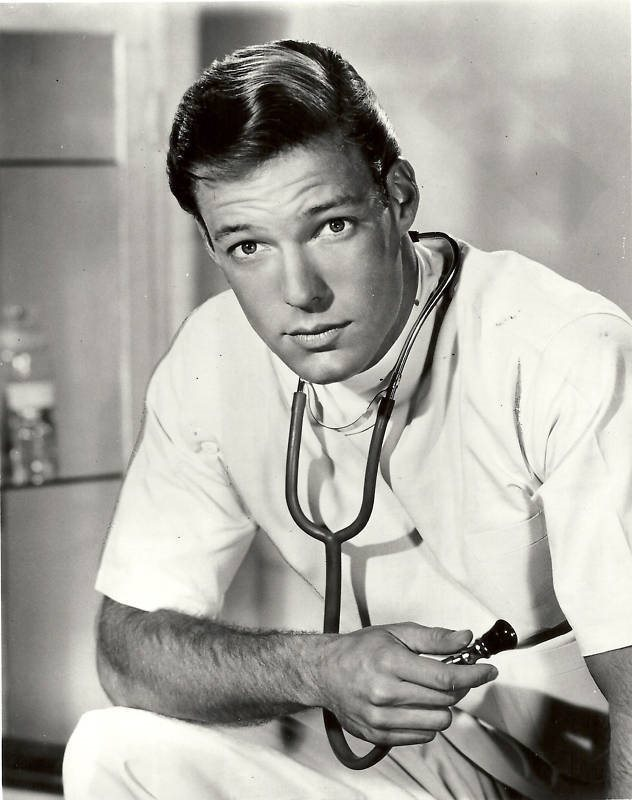
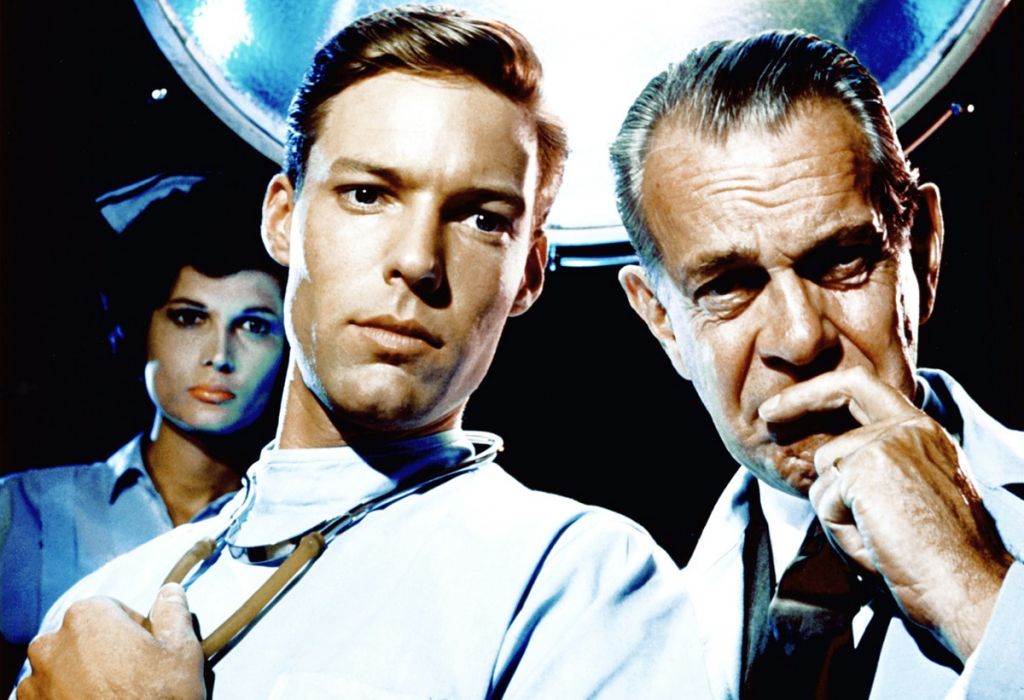
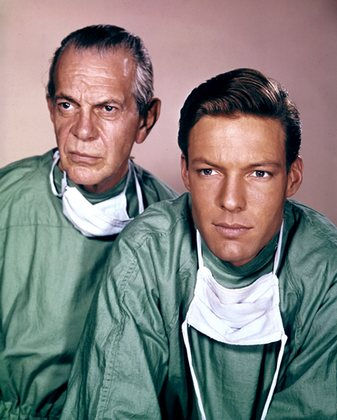
This month we are checking out a few favorites in a blog series: “Examining Our Favorite Medical Shows.” Last week we learned a bit about Ben Casey. Today we are looking at a similar show to Ben Casey, although in many ways it was very different: Dr. Kildare.  Dr. Kildare was also on the air from 1961-66. MGM produced this show created by Max Brand in the 1930s. The show had previously been a movie and a radio series. Unlike Ben Casey who seemed to argue with everyone, Dr. Kildare (Richard Chamberlain) was a respectful intern at Blair General Hospital. He wants to help his patients and listens to his mentor, Dr. Leonard Gillespie (Raymond Massey). In season three, Kildare became a resident, and the episodes focused more on the stories about the patients.

In 1960 a pilot was filmed with Joseph Cronin in the Kildare role and Lew Ayres as Gillespie which did not sell. The role of Kildare was offered to William Shatner and James Franciscus who both turned it down. In 1961, a new pilot was produced with Chamberlin and Massey. One of the reasons Massey accepted the role is because he was certain the show would only last one season, and he wanted to continue with his movie career. The popularity of the show put his film career on hold for five years.

Photo: medium.com

Other cast members who appeared on the show included Dr. John Kapish (Ken Berry), Nurse Fain (Jean Inness), Dr. Agurski (Eddie Ryder), Dr. Gerson (Jud Taylor), Dr. Lowry (Steve Bell) Nurse Conant (Jo Helton), and Nurse Lawton (Lee Kurty).

The guest stars on this show were amazing. I feel like this should be read in auctioneer mode but here goes: Eddie Albert, Jack Albertson, Fred Astaire, Ed Asner, Lauren Bacall, Ed Begley, Joan Blondell, Tom Bosley, Beau Bridges, Charles Bronson, James Caan, Robert Culp, Ossie Davis, Ruby Dee, Angie Dickinson, Olympia Dukakis, Barbara Eden, Linda Evans, Douglas Fairbanks Jr., Peter Falk, Beverly Garland, Ron Howard, Kim Hunter, Celeste Holm, Carolyn Jones, James Earl Jones, Brian Keith, Ted Knight, Harvey Korman, Cloris Leachman, Jack Lord, Walter Matthau, Gavin McLeod, Ricardo Montalban, Harry Morgan, Jack Nicholson, Leonard Nimoy, Carroll O’Connor, Suzanne Pleshette, Basil Rathbone, Robert Redford, Robert Reed, Cesar Romero, Gena Rowlands, William Shatner, Jean Stapleton, Gloria Swanson, Rip Torn, Sam Waterston, Dennis Weaver, and Robert Young. For a show that was only on five years, it was an impressive guest cast.

Photo: imdb.com

To add more realism to the show, writer E. Jack Neuman spent several months working with interns in a large hospital. Technical advice was provided by the American Medical Association.

The show was realistic in portraying all the drama that is truly found in a city hospital. The plots involved a lot of medical and social issues including smallpox, physician competency, drug addiction, malpractice, and euthanasia. Neuman definitely captured what life in a large, city hospital was like. Kildare makes about $60 a month, or $500 in today’s terms, works long hours, rotates through the various medical departments and has senior physicians overrule his diagnoses.

Just like Ben Casey, the first seasons produced stand-alone episodes and after the success of Peyton Place, storylines carried over from one show to another to entice the audience to tune in again the next week.

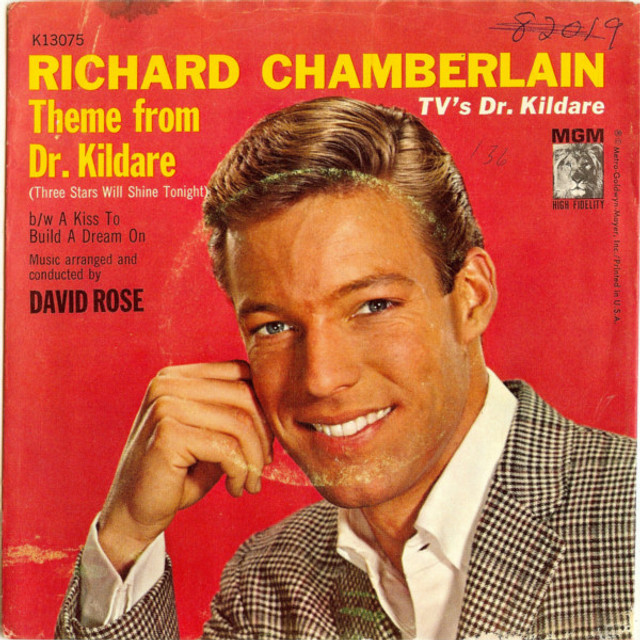
The theme music for the series was composed by Jerry Goldsmith. A CD set was released in 2009 which included the theme, the original music from the 1960 pilot, Richard Chamberlain’s recording of “Three Stars Will Shine Tonight,” and musical scores from the five seasons by Hurr Sukman, Richard Markowitz, Morton Stevens, Lalo Schifrin, John Green, and Burt Bacharach.

Airing on Thursday nights, the show was in the top ten during season one and the top twenty for seasons two and three. The show received about 12000 fan letters weekly, and, in addition, Chamberlain received letters personally asking for medical advice.

The network moved the show to Tuesday nights against Red Skelton and McHale’s Navy for season five and the viewers did not follow. The ratings declined, and the show was canceled.

This show really changed Chamberlain’s career. He had always been a small-role guy before this show, but he suddenly became a teen idol. He received more than 35,000 fan letters a month. Onscreen the idealistic Kildare and the wise, sometimes cantankerous, Gillespie don’t always agree but they had great chemistry on the set and apparently off the set as well. Unlike Ben Casey, the cast on this show did get along and Chamberlain mentioned that he always enjoyed working with Massey.

Richard said he grew up in a family where they all pretended to be perfect. So, he went through life trying to be perfect too. He said that philosophy did not work well for his life, but it did work well for Dr. Kildare.

Following the show he would take a turn on Broadway, in big-screen movies, and back on television where he specialized in mini-series like Shogun and The Thorn Birds, both in the 1980s.

One fact I found interesting was that the DVD release of the show included a never-aired pilot from a different medical show, The Eleventh Hour in 1962. The episode originally was written for Dr. Kildare. Drs. Kildare and Gillespie assist Dr. Bassett (Wendell Corey), a psychiatrist diagnosing one of his patients Ann (Vera Miles). Instead of airing on Dr. Kildare, Chamberlain and Massey were cut out of the film and it was submitted as a pilot for the show, with the title “Ann Costigan: a Duel on a Field of White.”

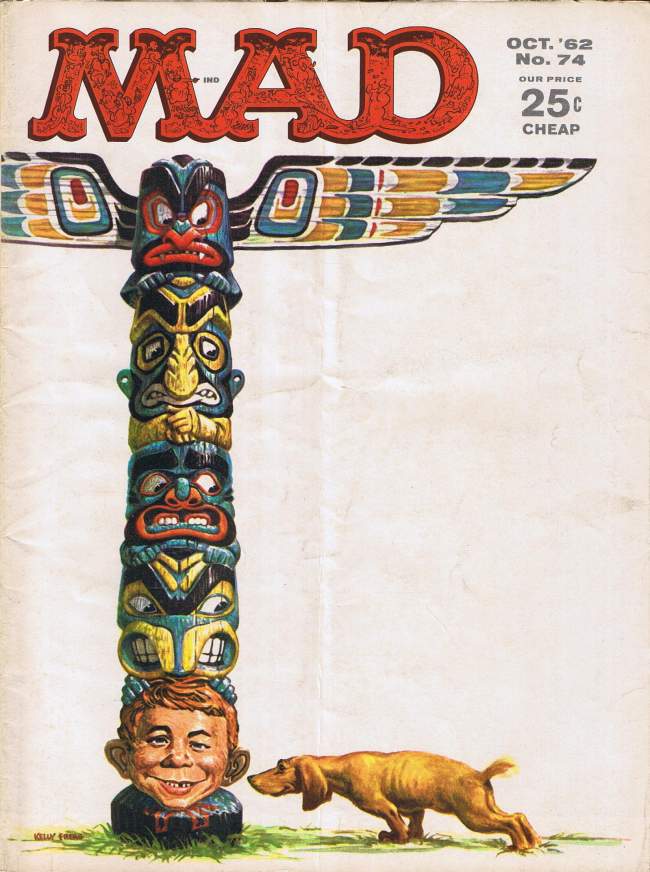
Even Mad Magazine got on the Kildare bandwagon. The 1962, #74 issue, featured “Dr. Killjoy,” a parody of the show.

Everyone seemed to like this show. Then again, what is not to like? You have a handsome doctor, exhilarating drama, a fun guest star every week, and realistic stories. The show would go on to inspire the talents behind a variety of medical series including Marcus Welby MD, ER, House, and Grey’s Anatomy.