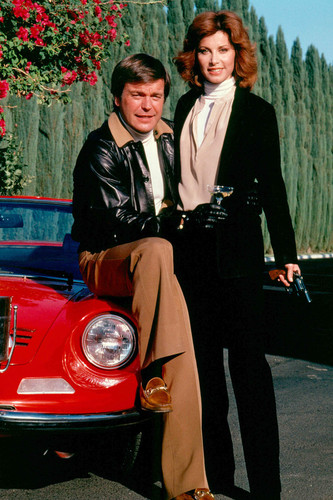
The Life of a Makeup Artist: All Made Up and Somewhere To Go

Welcome to our blog theme for the month, “Behind the Scenes.” We are going behind the camera to check out careers of those people working behind the camera to bring our favorite characters to life. Last week we learned a bit about costumer designers, and today we are heading to the makeup counter.

So, what do makeup artists do?  Obviously, they apply cosmetic products to enhance the appearance of the stars, but they do so much more. Artists also fit prosthetics and create the effects of blood, wounds, burns, and general aging; adjust colors and textures to work with high-definition cameras and bright lights; assure consistency for multiple-day filming; manage sweating; and sometimes choose and fit wigs for characters. Let’s look at a few of the best in the field to learn more about their life and careers.
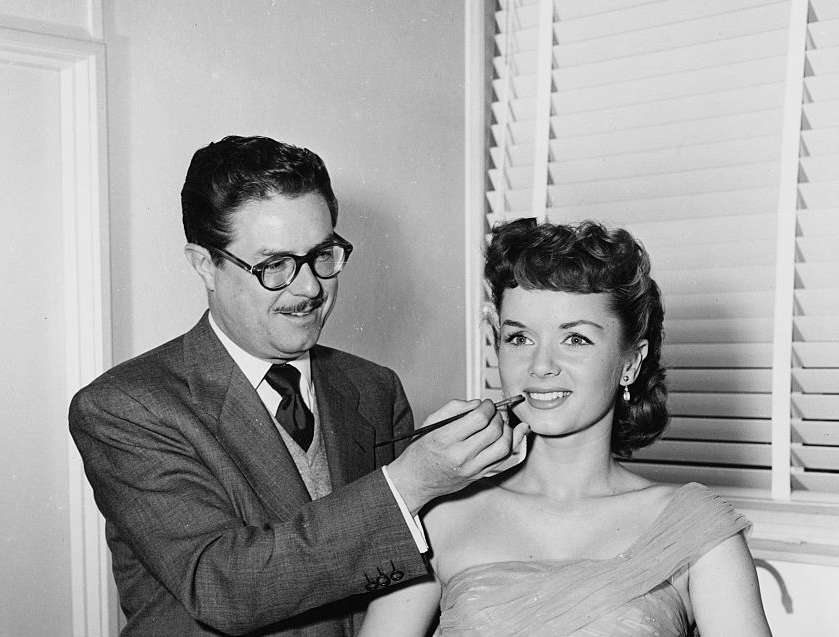
📷vintagestardust.wordpress.com

William Tuttle

William Tuttle was the first makeup artist to win an Academy Award. He created many innovative techniques and trained generations of makeup artists.

He was born in Florida in 1912. After dropping out of school early to support his mother and younger brother, he held a variety of jobs including forming his own band. In 1930, he moved to Los Angeles, enrolling in an art school and working as a page at Fox Studios. That younger brother, Thomas Tuttle, would also become a makeup artist working on The Dick Van Dyke Show, The Joey Bishop Show, Gomer Pyle USMC, and That Girl among others.

Tuttle was hired at Twentieth Century Pictures to work under Jack Dawn. In 1934, Dawn took a job at Metro-Goldwyn-Mayer and Tuttle moved with him. Tuttle was still working under Dawn but began taking on more responsibilities. He supervised the makeup in many popular movies including The Wizard of Oz and Father of the Bride. Eventually, he became the head of the makeup department.
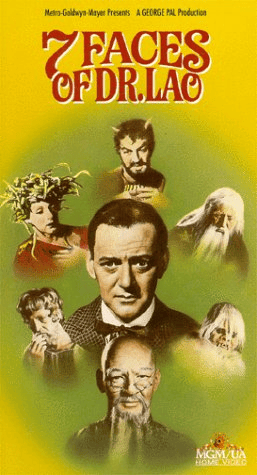
He received a special Oscar for his work on 7 Faces of Dr. Lao in 1965. In this film, Tuttle transformed Tony Randall into seven different characters including Dr. Lao; an aged, bearded Merlin the Magician; and a Medusa with a feminine appearance. Randall said “he shaved my head and eyebrows . . . gave me an unborn look. But professionally it was a masterstroke.” He went on to say that “all my preconceived notions on how I would play the characters vanished. As soon as Tuttle applied his makeup magic, I felt myself actually become these strange people.”

The Oscar category of makeup artist would not become an official category until 1982. That year Rick Baker won the first Oscar for makeup. He would go on to win another five and he credited Tuttle: “His work greatly influenced me.” He said as a young boy, he often tried to re-create the makeup techniques Tuttle used in The Twilight Zone.
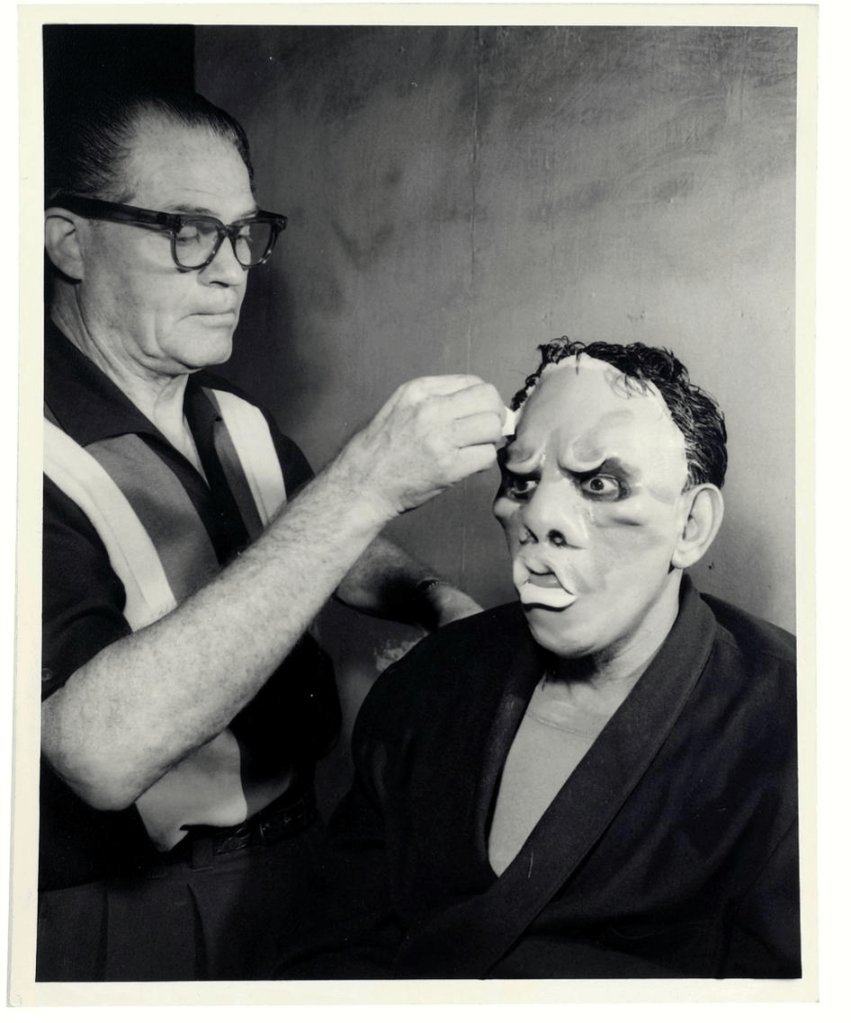
📷reddit.com

Tuttle was the artist behind one of my favorite Twilight Zone episodes, “Eye of the Beholder.” When the episode begins, doctors and nurses are working with a bandaged patient who just wants to look like everyone else. After some time, the bandages are slowly peeled away. We see the beautiful face of Donna Douglas. As she picks up the mirror to look at her new face, she screams, cries and covers her face. Then the camera pulls away and we see all the people Tuttle did makeup on – doctors and nurses with deformed faces and pig snouts.

With 393 credits, most of Tuttle’s work was in the movies, but he contributed to television as well. From 1960-62 he provided all the makeup for National Velvet. He also spent time on Mr. Novak, My Favorite Martian, The Man from U.N.C.L.E. as well as The Girl from U.N.C.L.E., The Phyllis Diller Show, and The Courtship of Eddie’s Father, among others.

Later in his career, Tuttle created his own line of makeup, Custom Color Cosmetics. Naimie Ojeil, owner of a beauty supply store in Hollywood said his brand was “the most popular makeup among Hollywood professionals for at least two decades.”

Tuttle would create molds of actors he worked on which allowed him to create their looks beforehand. He donated them to the University of Southern California where he taught from 1970-1995. Herbert Farmer, a USC archivist said Tuttle “was interested in passing on all he could to the students. He had a real following.”

Gene Hibbs

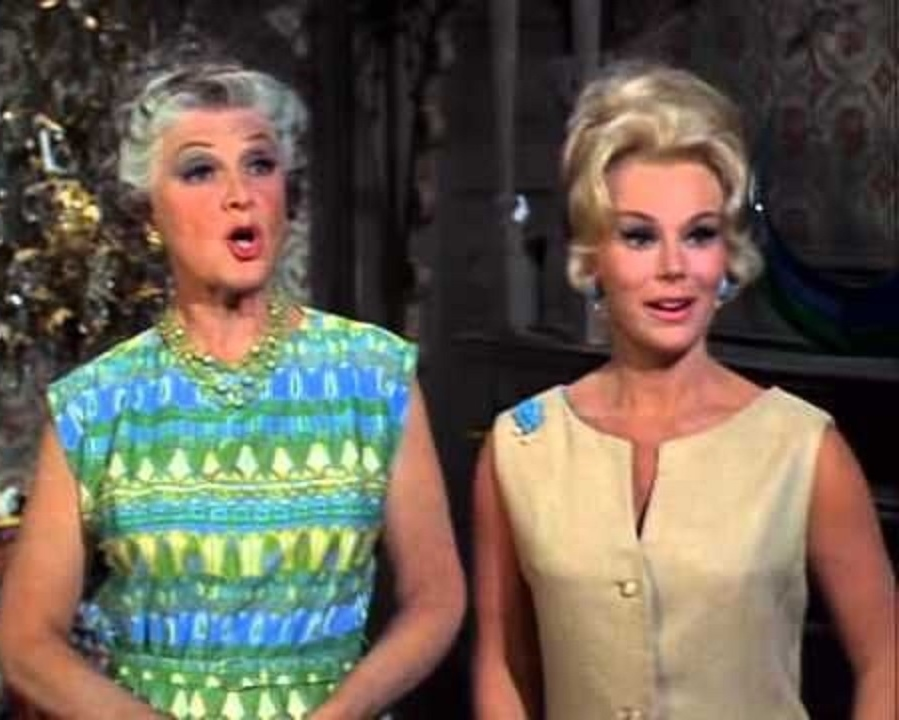
Gene Hibbs was born in Normal, Illinois in 1912.
📷imdb.com

I couldn’t find a lot of information about him. I did read several times that he was often hired because he had a unique talent for making older actresses look younger than they were with a technique he called “painting.”

His first television series was The Lone Ranger from 1954-1955. He worked on many television shows following that including with Ann Sothern on Private Secretary and The Ann Sothern Show, The Judy Garland Show, Here’s Lucy, and Green Acres.

He was working on Green Acres when Judy Garland passed away. She had stipulated in her will that Hibbs was supposed to do her makeup one last time. Her daughter Liza Minelli phoned Hibbs and he agreed to do that. When the network said no, Eva Gabor said she would not work unless he was allowed to leave for a few days. The producer pleaded with the network, but they held firm and said they would lose $30,000 of time and he could not leave the set.

Ben Lane
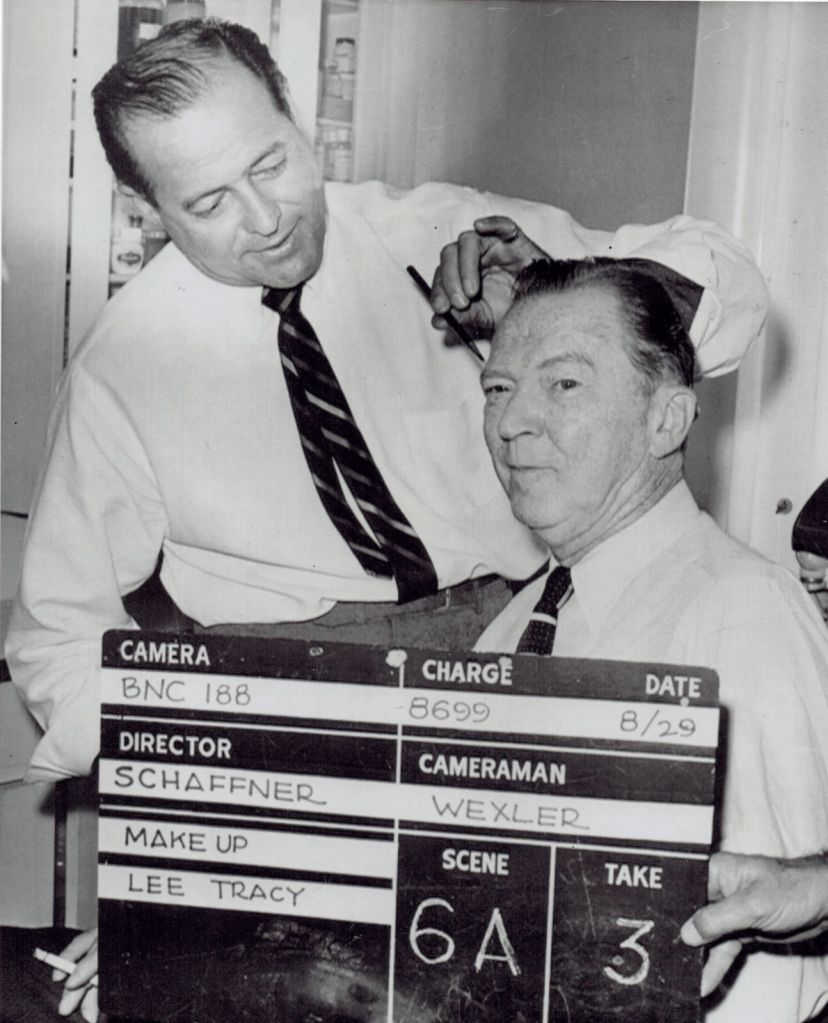
📷ebay.com Ben Lane on the set

Ben Lane was born in 1912 in Chicago, Illinois, the same year as both Gene Hibbs and William Tuttle. Lane was one of the founding members of the Motion Picture Guild, but many of his 236 credits were spent in television.

Lane’s first television series was in 1957 for Sergeant Preston of the Yukon. His career would continue with many popular shows. Get ready to take a long breath because this sample is far from a comprehensive listing of his work. Ready? He was part of the cast for The Lone Ranger, Dennis the Menace, The Farmer’s Daughter, Hazel, Gidget, The Monkees, Bewitched, The Flying Nun, I Dream of Jeannie, Bridget Loves Bernie, The Partridge Family, Police Woman, and Fantasy Island.

In addition to keeping busy with his career, he was involved in several charities: City of Hope and Shriner’s circus. He became a nationwide clown advisor. He also was a consultant for the Los Angeles Police Department, the US Department of Justice, and the FBI for disguises.

Bud Westmore
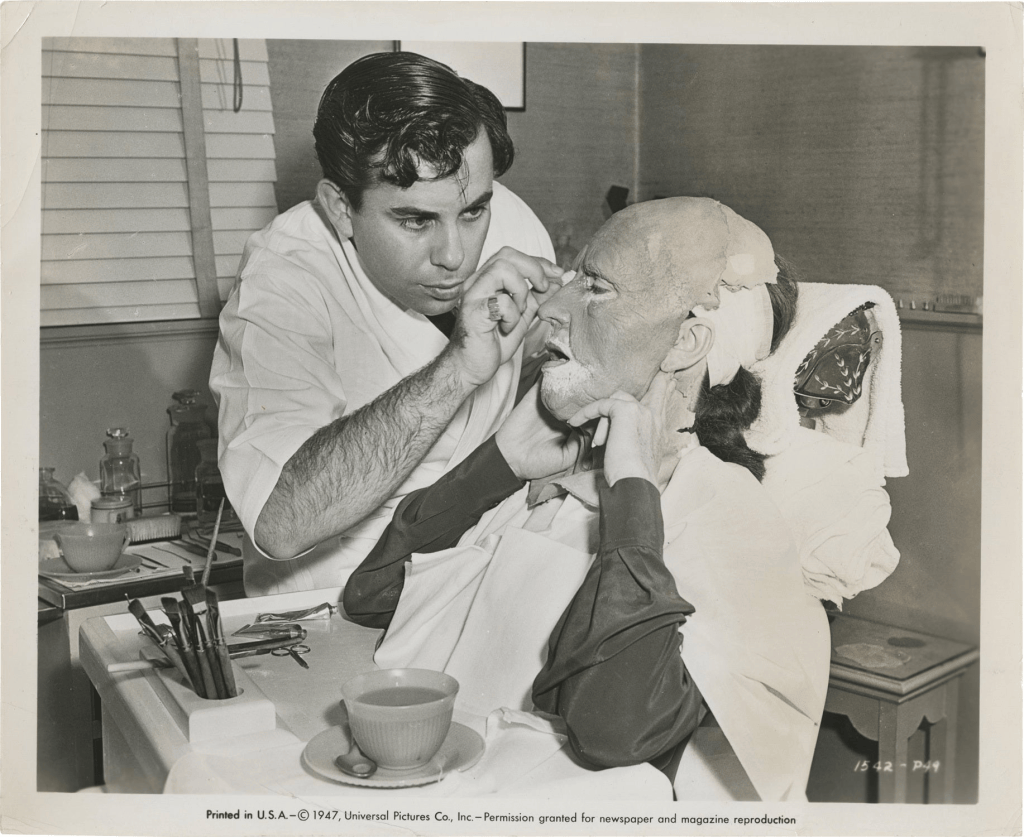
📷abebooks.com Westmore working on the film The Lost Moment

Born in 1918 in New Orleans, Westmore and his brothers—Ern, Frank, Monte, Perc, and Wally–were all makeup artists in the entertainment business. At one time, there was a Westmore heading up almost every studio makeup department.

After school, Bud was an apprentice under Perc at Warner Brothers to learn hair design and makeup before taking a job at Twentieth Century Fox. He left to serve three years with the Coast Guard. When he returned to Hollywood, he worked for the Eagle Lion before he was hired as the head of the Universal Studios makeup department in 1947. The largest building on the Universal studio back lot is named for Bud.

His marriages and divorces also kept him busy. He was married to actress Martha Raye for four months in 1937. A few years later he married Rosemary Lane, another actress, and they were together for fourteen years. His divorce to Lane was on March 31, 1955, and on April 1, 1955, he married Jeanne Shores, a former Miss California in 1952. They would remain together until his death from a heart attack in 1973.
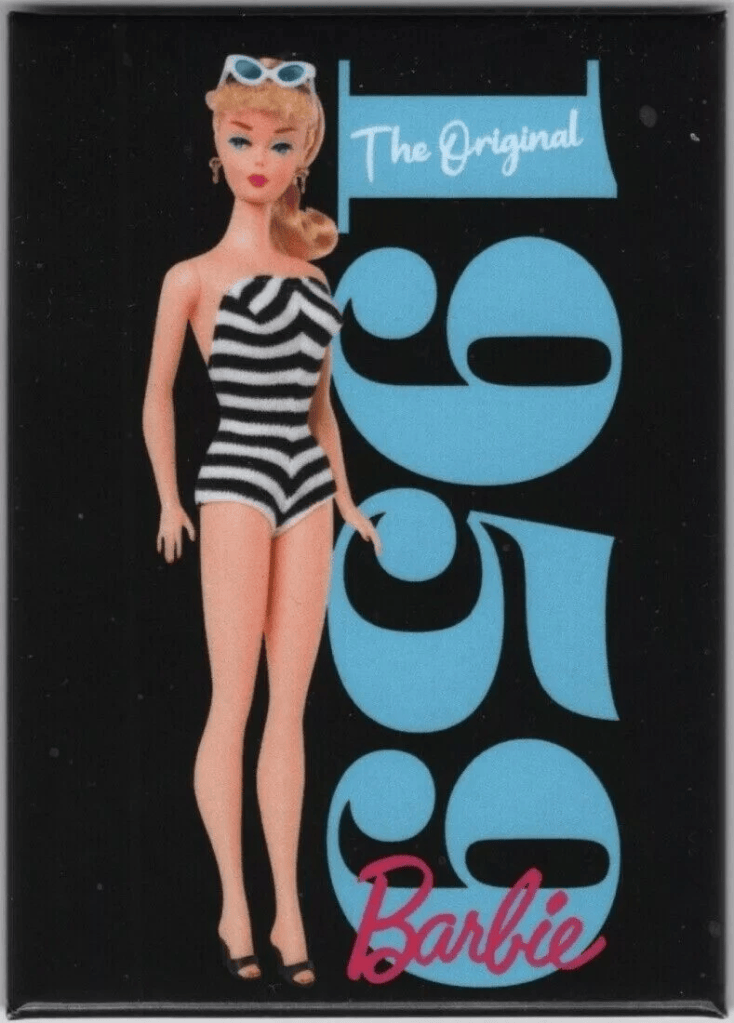
In 1957 Bud was asked to create makeup for a new doll that was coming on the market. In 1959 Barbie debuted. Bud had based her on a German doll Mattel found named Lili. He modified “the bee-stung lips, heavy eyelashes, and widow’s peak to give her an All-American Girl look” and he rooted her hair.

With more than 600 credits on both the big screen and the small screen, Bud’s first television project was Playhouse 90 in 1957. During the sixties he was involved in quite a few shows including The Jack Benny Program, McHale’s Navy, The Munsters, It Takes a Thief, Ironside, Marcus Welby MD, and The Virginian.

It was fun to learn a little bit about these make-up professionals and the shows they worked on to help create some of our favorite television land characters.

Julie Newmar: Batman’s Most Beautiful Villain

This month we are learning a bit about the Batman villains and their careers. No study of Batman’s favorite nemesis would be complete without Cat Woman, Julie Newmar. Julie shared the role of Cat Woman with Eartha Kitt who appeared the final television season and Lee Meriwether who was so catty in the Batman movie. What else did Julie Newmar do during her career? Let’s find out.

📷pinterest.com

Born Julia Chalene Newmeyer in 1933, Julie Newmar as she is known in the acting world, was a television and film actress, dancer, singer, and stage performer. But, as they say in the commercials, that’s not all. She also was known for writing, designing lingerie, and managing real estate investments.

Newmar was born in LA. Her father Don was head of the physical education department for the Los Angeles College. Her mother, of both Swedish and French descent, was a fashion designer under the name Chalene and later worked in real estate.

Julie began dancing early in life and performed as a prima ballerina with the Los Angeles Opera when she was only 15. With an IQ of 135, Newmar graduated from John Marshall High School at age 15. She continued dancing in films in the early fifties. At age 19, she was also working as a dancer/choreographer for Universal Studios. In 1954, she appeared in Seven Brides for Seven Brothers as Dorcas, one of the seven brides.

📷facebook.com

In 1955 she got her first Broadway appearance in “Silk Stockings.” She continued her movie and Broadway careers throughout her years in entertainment, appearing in 33 films in all.

Television is where Newmar gained most of her fame. Her first television appearance was on The Phil Silvers Show in 1957 and then Ominbus in 1959. But it was in the sixties that she became a household name. She started the decade in Adventure in Paradise in 1960, followed by a variety of shows including The Defenders, Route 66, and The Twilight Zone in the early sixties.

In 1964 she was offered the role of Rhoda on My Living Doll, where she played a robot. She was not enthralled with the choice of Bob Cummings as her costar and did not seem to enjoy her time on this show. She said that “They originally wanted Efrem Zimbalist Jr. It was not a flip part—it needed a straight actor who could play opposite this bizarre creature so the comedy would come off. That quality was lost when they hired Bob. The show could have been wonderful. I think it would have run for many seasons had they hired Efrem because he had the right qualities.”

📷classicfilmandtvcafe.com

After appearing in several comedies including The Beverly Hillbillies and F Troop, she received another recurring role as Cat Woman in Batman. She would appear in the series 13 times, 12 as Cat Woman, the only villain to make Batman question his morals, because we knew he was in love with her, and if she showed any sign of remorse, who knows where things might have gone. Her Cat Woman costume now lives at the Smithsonian Institution.

Newmar lived in Beekman Place in New York in the mid-sixties. One weekend her brother had come to visit her from Harvard. They were sitting around chatting when the phone rang. She was asked if she would like to play Cat Woman on the Batman series. She was a bit miffed because they said they were casting in California, and the role started on Monday. Her comment was “That’s how television is done: they never know what they are doing until yesterday.” When her brother heard Batman, he jumped up and said that was the favorite show at Harvard and they even skipped classes to watch it. He told her to take the role, so she did.

📷firstforwomen.com

After Batman, she finished out the sixties in The Monkees, Star Trek, Get Smart and It Takes a Thief. With 11 seventies offers, you can see her in shows such as Bewitched, Columbo, McMillan and Wife, Love American Style, The Bionic Woman, and The Love Boat. One of my favorite made-for-tv movies was The Feminist and the Fuzz. It had an exceptional cast, including Newmar who appeared in the movie along with Barbara Eden, David Hartman, Jo Anne Worley, Farrah Fawcett, Harry Morgan, Herb Edelman, Penny Marshall, and John McGiver. This ensemble was directed by Jerry Paris, who directed so many great shows from The Dick Van Dyke Show to Happy Days.

Her other starring role in the seventies was a marriage to J. Holt Smith, an attorney. After the wedding, Newmar moved to Forth Worth, Texas until 1984 when they divorced.

📷remindmagazine.com

The eighties was a more quiet decade for the actress but she did accept roles on CHiPs, Fantasy Island, and Hart to Hart. In 1992, she appeared in George Michael’s music video, “Too Funky,” She was still working in 2016 and 2017 in Batman animation features.

If you were a fan of Batman and Dark Shadows in the sixties, you were in luck when Newmar took on the role of Dr. Julia Hoffman (played in the original series by Grayson Hall) in Dark Shadows: Bloodline, the audio drama miniseries.

She was not just a pretty face, however. She received two US patents for pantyhose and one for a bra, under the name Nudemar. She also began investing in LA real estate and was credited with helping to improve the neighborhoods of La Brea Avenue and Fairfax Avenue. In one episode of My Living Doll, Rhoda is asked to play Chopin’s “Fantasie Impromptu” on the piano. Newmar played the piece herself. She had studied under concert pianist Dr. MacIntyre, and she said that scene is the only one she’s done with her playing the piano which had been her career choice before acting. One of Julie’s comments about herself was “Tell me I’m beautiful, it’s nothing. Tell me I’m intellectual—I know it. Tell me I’m funny, and it’s the greatest compliment in the world anyone could give me.”

📷closerweekly.com

Julie also enjoys art and gardening. She has a rose, a day lily, and an orchid named for her. Her gardens are often chosen as a spot for holding charity events.

Like Barbara Feldon from Get Smart, Julie Newmar is beautiful, bright, and funny. I hope she enjoyed her career. Obviously, she could have been a brain surgeon or any other profession of her choice. She seems like she would be a fun person to just hang out with and the conversation would never run out. Thank you, Julie Newmar for choosing the entertainment business over medical science for our sakes.

Hart to Hart: Mystery and Romance

We continue our crime-solving duos with Hart to Hart. The Harts are like the MacMillans in that they are also a glamorous and wealthy couple based in California. Unlike Mac who had a career with the San Francisco Police Department, Jonathan (Robert Wagner) was a self-made millionaire. He ran Hart Industries. His wife Jennifer (Stefanie Powers) was a freelance journalist. They were both amateur sleuths, and they found themselves in the middle of a mystery whenever they vacationed. They often traveled on their private jet. Rounding out the cast was Max (Lionel Stander), their butler, cook, chauffeur, and right-hand man, and their dog Freeway, a Lowchen breed. The show aired in 1979 on ABC and was cancelled in 1984, producing 111 episodes.

UK, EIRE, TURKEY, SOUTH AFRICA, HONG KONG, CROATIA ONLY No Merchandising. Editorial Use Only Mandatory Credit: Photo by Everett Collection / Rex USA ( 427513AT ) HART TO HART, Robert Wagner, Stefanie Powers, 1979-84 VARIOUS TV PROGRAMME STILLS

Sidney Sheldon had written a script called “Double Twist,” featuring a married couple who were spies. Aaron Spelling and Leonard Goldberg decided to update it as a television show. The original opening credits tell the story of the Harts narrated by Max. We never do learn Max’s last name. As he shares, “This is my boss—Jonathan Hart, a self-made millionaire. He’s quite a guy. This is Mrs. H—she’s gorgeous. What a terrific lady. By the way, my name is Max. I take care of them, which ain’t easy, ‘cause their hobby is murder.”

Spelling and Goldberg originally wanted Cary Grant for the part of Jonathan. Grant was 75 and decided he did not want to come out of retirement. Once Wagner was hired, the network wanted his wife Natalie Wood to play his wife on the show. She didn’t think that was a good idea. Suzanne Pleshette, Kate Jackson, and Lindsay Wagner were among the actresses considered for the role of Jennifer. Wagner had worked with Powers on an episode of his show, It Takes a Thief and suggested her for the role. Wagner also suggested Sugar Ray Robinson for Max’s part. However, the network thought it was a bad message to send having a black man work for a wealthy white couple. Stander had also worked with Wagner on It Takes a Thief.

Photo: moviestore.com

The script was given to Tom Mankiewicz to rewrite. Mankiewicz had written several Bond films. He made his directorial debut on this show as well.

The setting for the Hart estate was a house that June Allyson and Dick Powell had lived in with their children. It was named Amber Hills and situated in Mandeville Canyon in Los Angeles. As a twist, June guest starred on an episode during season five, “Always Elizabeth.”

Photo: sites.google.com

The theme for the show was composed by Mark Snow. He would compose music for a variety of show, including The X-Files.

Like Dallas and Dynasty, the show was recognized for its opulent furnishings and beautiful clothes. Nolan Miller who would outfit the Dynasty characters, also provided the clothing for his show.

Photo: pinterest.com

The show also featured a cast of guest stars. During the period it was on the air, some of the guest stars included David Doyle, Eva Gabor, Elaine Joyce, Bernie Kopell, Dorothy Lamour, Roddy McDowell, Juliet Mills, Diana Muldar, Anthony Newley, Julie Newmar, Jill St. John, and Jerry Stiller.

Photo: pinterest.com

They had a great chemistry. Powers said that this role was her most memorable. One of the things that kept their relationship fresh was that they often took on different roles for their cases. They might be a chemist and industrial magnate or a lady with her chauffeur.

Photo: sparklyprettybriiiight.com

Of course, they also had the money to take off for a spree whenever the mood struck them. It’s easier to keep romance in your life when you can hop off to some island for a fun week. They might show up in London, Paris, Athens, Hawaii, Mexico, or Asia. They were always kind to each other and interested in their hobbies, activities, and interests. Powers recalled that the couple didn’t have sex, they had intimacy.

So, how do the Harts stumble upon these murders? In Acapulco, they learn a senator has been assassinated due to bribery and corruption in the silver industry, so they investigate. In Hawaii, Jennifer overhears a woman plotting the murder of her husband. A Hart employee is murdered during a jungle exploration, so Jennifer and Jonathan travel to Peru to figure out why.

Photo: criminalelement.com

Wagner and Powers were also friends. Powers had gone to ballet when she was younger with Natalie Wood, Wagner’s wife. Powers was involved with William Holden. In a cruel twist of fate, both Wood and Holden died in 1981.

Photo: ebay.com

When the show was cancelled, the stars were shocked. The ratings had fallen but not drastically. Wagner said being axed without any warning was disappointing. He said, “I think we could have been written out with the taste, dignity, and style the audience responded to.” The viewers were also outraged and wrote the network thousands of letters.

A decade later in 1993, the network decided to create a series of Hart to Hart movies. Eight 90-minute movies were made between 1993 and 1996. Both Wagner and Powers returned. Stander appeared in the first five movies but passed away from cancer in 1994.

Photo: telegraph.co.eu

Like The Thin Man movies, it was just fun to watch the Harts. They were a glamorous, loving couple who were clever and witty. They also were “good” people, not a snobby bone in their bodies. We could live vicariously through them, their romance, and their mysteries.