I’m Dickens, He’s Fenster: Building Comedy Into Every Episode

June’s blog theme is Funny Duos. Last week we learned about the Governor and J.J., a show created by Leonard Stern. Today it’s another show created and produced by Stern, I’m Dickens, He’s Fenster.
📷wikipedia.com

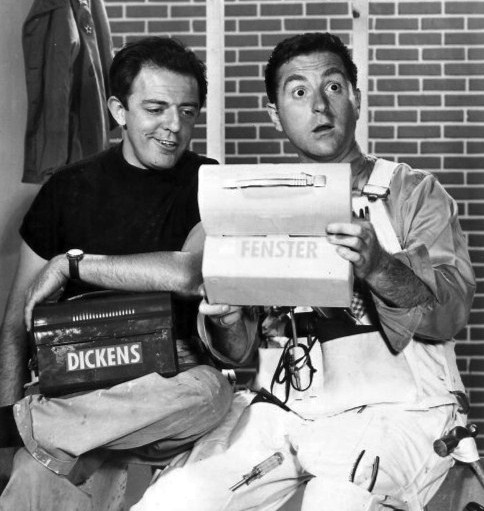
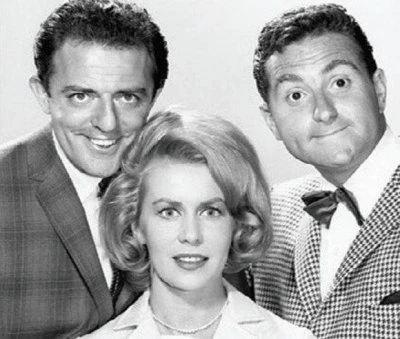
This show debuted on ABC in September 1962 and was canceled after one season. It starred John Astin and Marty Ingels.

The plot is that two carpenters are best friends. Harry Dickens (Astin) is married to Kate (Emmaline Henry) while Arch Fenster (Ingels) is a swinging bachelor whose lifestyle is not okay with Kate. The two often clash with their boss, Mr. Bannister (one of my favorites, Frank DeVol). Rounding out the cast are coworkers Mel (Dave Ketchum), Bob (Henry Beckman), and Bentley (Noam Pitlik). We also meet a few of Fenster’s girls including Yvonne Craig, Ellen Burstyn, and Lee Meriwether.

Stern talked about casting for the show in his interview with the Television Academy. He had Ingels hired and then Stern and his wife saw Astin in a play at UCLA, and he was added to the cast. Stern said he needed a director who liked comedy and could bond with the actors well and was innovative because Stern didn’t like the three-camera shot. He hired Arthur Hiller who fit all three qualifications.

The show, unusual for the time, was filmed in front of a live audience. The comedy combined witty comments with slapstick comedy.
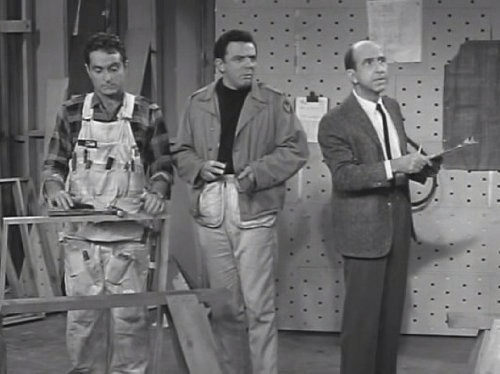
📷imdb.com

ABC placed it on Friday nights between The Flintstones, which was created for adult viewing, and 77 Sunset Strip. This should have provided a built-in audience, even though it was competing against Sing Along with Mitch and Route 66. At the end of the first season, it beat the competition in the ratings but was still canceled. One of the problems measuring viewership at this time was that a person watching was a person watching whether they were 6, 26, 56, or 106, so it was hard to tell which shows appealed to adults.

Astin discussed the reviews for this show during one of his interviews and said that “some of the critics said it’s the kind of humor that makes you laugh out loud in the living room, and that’s an accomplishment. How often do we really laugh out loud in the living room when we’re watching a television show? We’re lucky if we smile.”
📷televisionheaven.com

The idea for this show occurred when Stern had some work done at his home. On Christmas Eve 1961, the builders were in a hurry to finish work and get home to celebrate with their families. They were finishing a new fireplace with a built-in brick chimney. Unfortunately, one of the crew forgot to remove the ladder when they were finished in the chimney and they bricked up the hearth before realizing they had now lost their ladder. Stern thought the misadventures of a couple of construction workers might make a great sitcom.

In an interview with the Television Academy, Stern said he asked musician Irving Szathmary for a theme that evoked a Laurel and Hardy feeling. (Szathmary was also the composer behind the unforgettable Get Smart theme.) It must have worked because Stan Laurel said he thought this series was “one of the funniest and most highly imaginative comedies to have its thirty minutes of fame on television.”

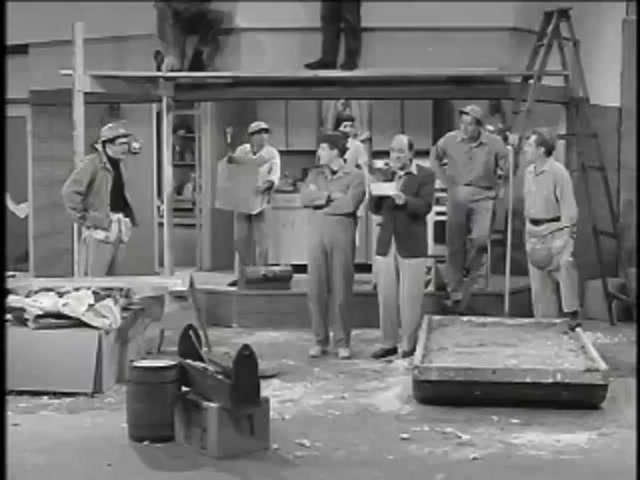
One of the running gags on the show was just like the cobbler’s children have no shoes, Dickens’ house was always in a state of upheaval with paint samples on the wall and cabinet doors not working properly; it was in constant renovation. We see this immediately in the pilot as Fenster stops by to pick up Dickens and sees Kate trying to work with the various kitchen issues under construction.
📷tvguide.com

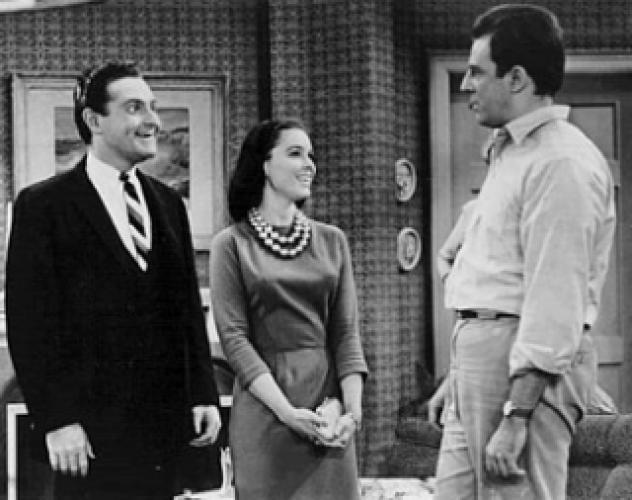
The pilot was a typical plot line for not only this show but most early sixties sitcoms. Dickens is up for a promotion to foreman and is afraid he won’t get the job. In the past, whenever Dickens is waiting for something special, he gets nervous and always ruins the opportunity. When the boss shows up at the project, he doesn’t seem to know Harry Dickens’ name, so the two friends decide to put it into his subconscious by whispering it here and there when they walk by him. That evening Fenster brings his girlfriend over. Harry doesn’t want to spend the evening with them, but once he meets the girlfriend, he falls all over himself being nice to her. Lorna mentions to Fenster that he should try for the foreman job himself.

The next morning, Fenster comes to get Dickens, and Harry is rude to him because he thinks he wants the foreman job. At the end of the day, Bannister calls Dickens into the office to give him the promotion and tells him that Fenster must be fired because he overheard a lot of bad things about him when the crew was talking. When Dickens talks to the other guys, they said that they never complained about Fenster, although they did repeat some of the funny things Dickens said about Fenster. Fenster tells Bannister that he just got fired by Dickens and then Dickens comes in to say it’s been a misunderstanding and Fenster should not be fired and would make a better foreman than Dickens. Bannister said he’ll let them know what decision has been made the next morning.
📷episodate.com

That night Fenster shows up with a different girlfriend who just happens to be Bannister’s daughter. There was a great mixture of slapstick and witty banter during the episode. Something did feel a bit off with the characters. I think the characters should have reversed roles; Aston seems more the playboy type, and Ingels seems more the married man for typical sixties sitcoms.

Astin would go on to star in The Addams Family while Henry would marry Dr. Bellows on I Dream of Jeannie. Unfortunately, with only 32 episodes, the show didn’t qualify for syndication. The first sixteen episodes are included on a DVD set released in 2012 if you want to check out the show. You can also find some of them online in different sites.
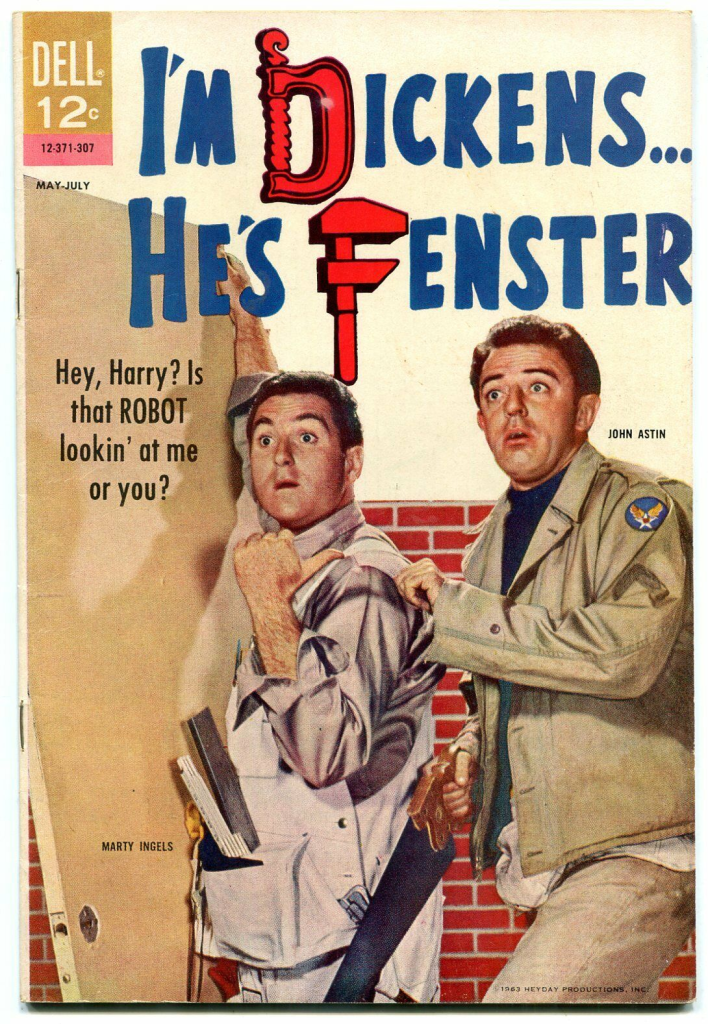
Like The Governor and J.J., this series also made it to Dell Comics; if you’re a collector of comic books about old television series, you can take a look.

I had heard a lot about this show but never watched it till now. It was different and funnier than I thought it would be.
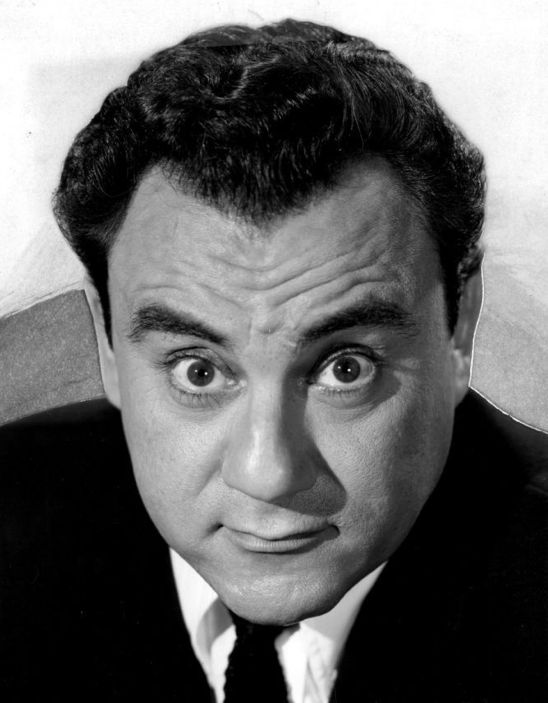
Bill Dana: Actor? Script Writer? Author? Talent Agent? Yep

This month we are exploring The Bill Dana Show for our blog series. Last week we talked a bit about the show itself, and for the rest of the weeks, we are looking at some of the other cast members’ careers. Today we begin with Bill Dana himself.

📷findagrave.com

Dana was born William Szathmary in Quincy, Massachusetts in 1924. He was the youngest of six children. His older brother Arthur was fluent in several languages and inspired Bill to learn different accents.

Dana served with the US Army during WWII as a machine gunner and was awarded the Bronze Star Medal.

After the war, Bill enrolled at Emerson College. After graduation, he was hired as a page at NBC’s Studio 6B, or 30 Rock.  He was also trying to break into comedy performing around New York. During the fifties he appeared on The Imogene Coca Show. He also did some writing and producing for The Spike Jones Show.

He met Don Adams and began writing routines for him in the fifties. He and Don would be part of each other’s lives for a bit. Don would be one of the cast members on The Bill Dana Show. Dana would appear on Adams’ show Get Smart, and Dana’s older brother Irving was the composer of the Get Smart theme song. Bill would also cowrite the script for the Get Smart film The Nude Bomb.

📷thenewyorktimes.com

In the late fifties, Steve Allen hired Dana as a writer. Bill created a character, Jose Jimenez, for the “Man in the Street” segments of Allen’s show. Soon Jose became his alter ego. He made appearances as Jose on The Red Skelton Show, The Spike Jones Show, The Danny Thomas Show, and The Ed Sullivan Show. He even had a comedy album featuring the character.

Dana told a story on Ed Sullivan’s show that some people truly thought he was Jose Jimenez. One lady who met him out and about asked if his birth name was Jose Jimenez and he told her, “No, it’s Bill Szathmary.” She said “Wow, no wonder you changed it to Jimenez.”

In 1961, Dana began a recurring role on The Danny Thomas Show. He played Jimenez as an elevator operator. People responded so well that Danny Thomas and Leonard Sheldon spun off the character, now a bellhop at a luxury New York hotel, and The Bill Dana Show was created. In addition to Adams, Jonathan Harrison was part of the cast and Maggie Peterson joined them in season two. The show was on the air for one and a half seasons.

As we discussed last week, some people saw Jimenez as a hard-working immigrant who noticed some of the crazy things Americans did, and others saw him as a stereotyped Latino caricature. The pre-show Jimenez fit the second description better and the show Jimenez leaned more toward the first portrayal. However, as the character developed, viewers were not flocking to the show. It was also up against Lassie which at the time was a huge family show on Sunday nights.

📷wikipedia.com

The last time Jimenez was on the screen as a character was a 1966 episode of Batman in a cameo on the famous wall. Later Dana apologized for his caricature of Jimenez and became a bit of an activist for Latino causes. The National Hispanic Media Coalition endorsed the Jose Jimenez character and invited Dana to sit on their advisory board.

Dana jumped back and forth from actor to writer for a couple of decades. He wrote the script for All in the Family’s episode “Sammy’s Visit” starring Sammy Davis Jr. He also wrote for Bridget Loves Bernie, Chico and the Man, Donny and Marie, The Smothers Brothers Comedy Hour, and Matlock.

His acting landed him in The Courtship of Eddie’s Father, Love American Style, The Snoop Sisters, Police Woman, McMillan and Wife, Ellery Queen, Switch, Vega$, Fantasy Island, The Facts of Life, and Empty Nest among a few others.

He had recurring roles on two additional shows during his career. He was on St. Elsewhere as Howie Mandel’s character’s father for three episodes. He also was Angelo on six episodes of The Golden Girls.

One of his last projects was founding the American Comedy Archives at Emerson College. He and Jenni Matz interviewed more than 60 comedians for this archive, including Phyllis Diller, Norman Lear, Carl Reiner, Betty White, and Jonathan Winters.

Dana was a man of many talents. He also ran a talent management company and an advertising agency. He wrote a book, The Laughter Prescription, with Dr. Laurence J. Peter.

Dana passed away in June of 2017 at his home in Nashville.

Certainly, Dana had a full career. I think starting off with the Jose debacle probably kept him from getting different roles early in his career. He also didn’t seem to know what he wanted to be when he grew up. Was he a comedy writer? A dramatic writer? A variety show writer? Was he an actor? A talent agent? An author? Not that you can’t be more than one thing in life, but in the span of three decades he never seemed to settle on one or two careers. Hopefully he had fun and enjoyed all the different hats he wore.

It Only Takes One Episode to Get Smart

In the mid-1960s, spy shows were all the rage.  James Bond drew large audiences to theaters:  Dr. No in 1962, From Russia with Love in 1963, Goldfinger in 1964, and Thunderball in 1965. Inspector Clouseau was big at the box office too appearing in The Pink Panther in 1963 and A Shot in the Dark in 1964. If you were checking out books at the library, you probably would have read Len Deighton’s The IPCRESS File (1962), The Spy Who Came in From the Cold (1963), or Harriet the Spy (1964). On the small screen, The Avengers was ahead of the curve, premiering in 1961, but in the mid-1960s, we would see some of the classic television shows debut: Mission Impossible began in 1966, The Man from UNCLE showed up in 1964 and in 1965, The Wild, Wild West and I Spy got network approval.

smart7

Another show came on the air in 1965 as well – on September 18, 1965, Get Smart was seen for the first time. Dan Melnick, a partner in Talent Associates thought a spy satire might be a good fit for their upcoming schedule. He recruited Buck Henry and Mel Brooks to write the show. The team took the show to ABC. ABC bought it but they wanted a few changes.  They wanted Tom Poston to take the role of Maxwell Smart. They wanted a dog on the show to add “heart.” Finally, they wanted Smart’s mother to be a major role and envisioned Smart coming home at the end of the episode to explain the case to his mother. Henry and Brooks said no to the mother, so ABC rejected the show and sold it back to Talent Associates.

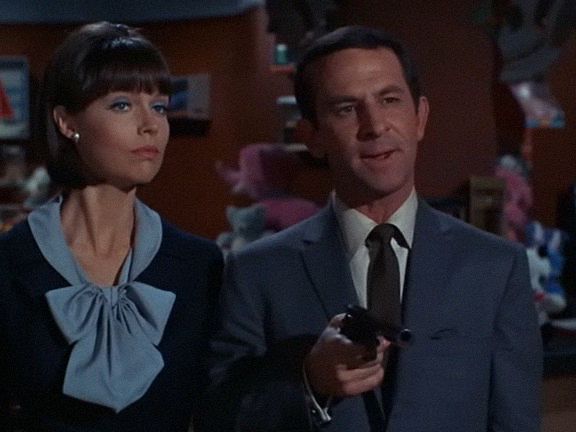
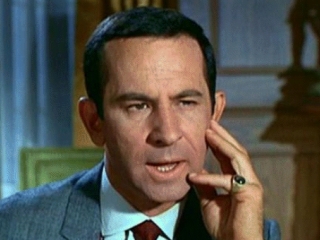
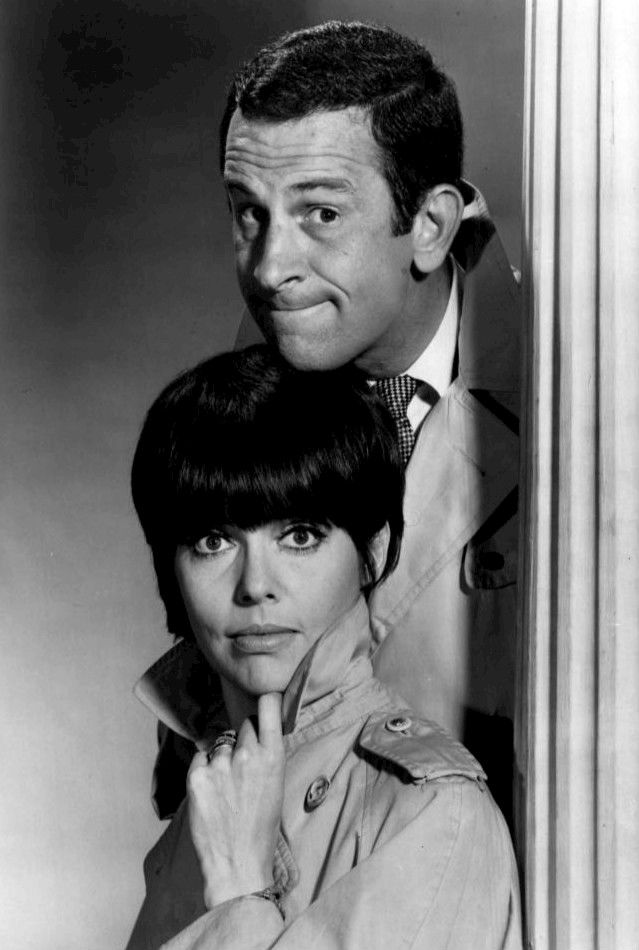
Grant Tinker from NBC agreed to buy the show with the caveat that Don Adams star in place of Tom Poston.  And so, the creative talent of Brooks and Henry brought Maxwell Smart (Don Adams), Agent 99 (Barbara Feldon), and the Chief (Edward Platt) to life. The show would stay on the air for five seasons, producing 138 episodes.

The first four seasons were filmed at Sunset Bronson Studios.  In 1970, the show moved to CBS and the last season was filmed at CBS Studio Center.

Mel Brooks left the show after the first year, but Buck Henry stayed through 1967 as the story editor.

smartgun

Most of the administrative cast stayed with the show for its run. Leonard B. Stern was the executive producer for all the shows. Irving Szathmary was the music and theme composer, as well as conductor, for all five seasons. Gerald C. Gardner and Dee Caruso were the head writers for the series. Don Adams would get to direct 13 episodes and write 2 of them.

The show centered around the three main characters. Maxwell Smart is Agent 86.  He works for CONTROL, a US government counter-intelligence agency in Washington DC. Max is resourceful.  He is a adept marksman, has hand-to-hand combat skills and is extremely lucky. He uses several cover identities, but the one he uses most often is greeting card salesman. He insists in going by the book and this, along with his clumsy nature, cause problems for him.

smartsmart

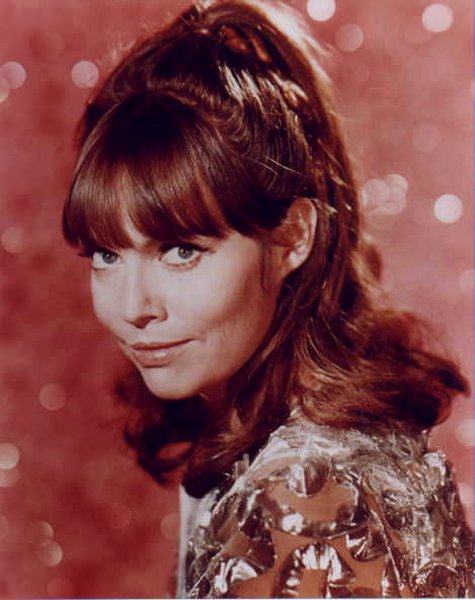
He and his partner Agent 99 take on world threats. We never learn Agent 99’s real name, although we think we have in one episode.  In “99 Loses CONTROL”, she says her name is Susan Hilton but at the end of the episode, we learn she was lying. Agent 99 is smart and competent.  Her father was apparently a spy as well.  (In real life, Barbara Feldon was also smart; she won on The $64,000 Question with the category of Shakespeare.) If you look closely, you will often see Agent 99 slouching, sitting, or leaning on something to conceal the fact that she was a bit taller than Adams.

smart15

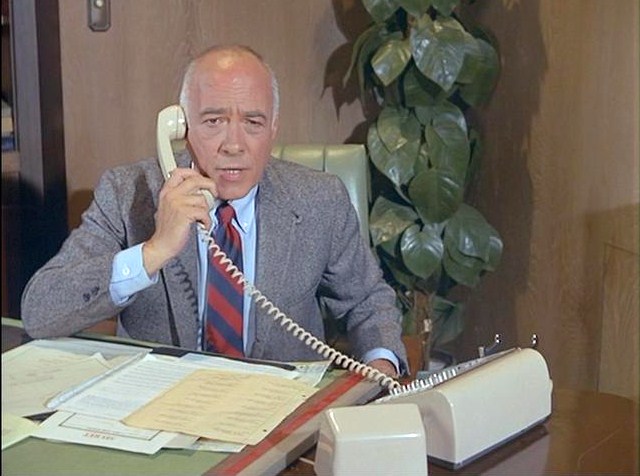
Their boss, Chief, whose real name is Thaddeus, is sarcastic and grouchy but also serious, sensible, and smart. He began his career as Agent Q and his cover name is often Harold Clark. Other CONTROL agents we meet during the series are Agents 8, 13, and 14, as well as Larrabee, the Chief’s highly inefficient and bumbling assistant.

smart10

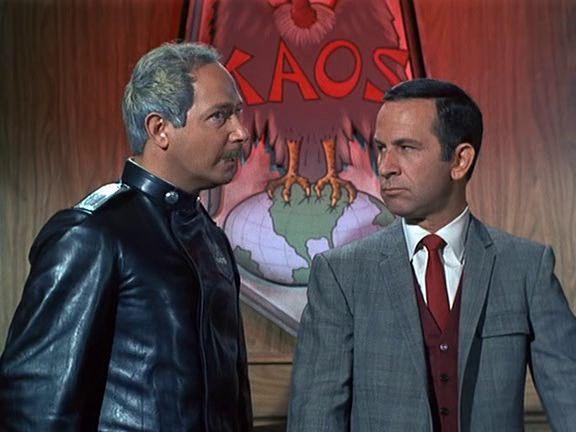
Their primary enemy is KAOS, an international organization of evil founded in Romania in 1904 (a Delaware corporation for tax purposes!). The two KAOS employees we see most often are Conrad Siegfried (Bernie Kopell), the VP for Public Relations and Terror and his assistant Shtarker (King Moody), whose personality can change from sadistic to childlike. While Siegfried and Smart are mortal enemies, they respect each other.  Sometimes they begin talking like old friends.  In one episode, they are discussing the flavor of cyanide pills each side has that month.  CONTROL is giving out raspberry, and Smart tries to give one to Siegfried.  Like CONTROL, KAOS has a bowling team to build rapport and fellowship among their employees.

smart13

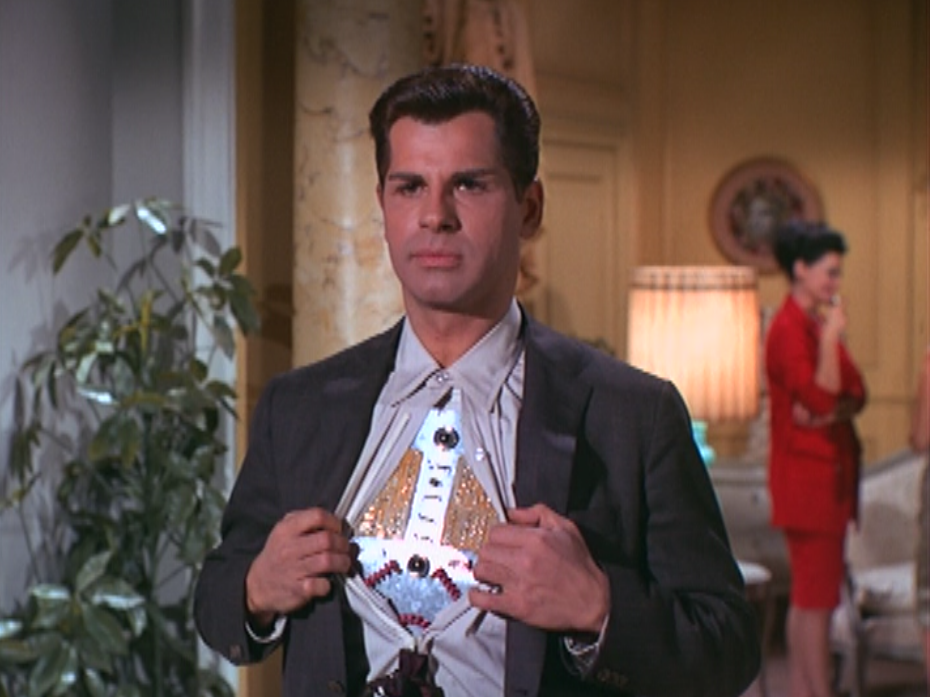
Another KAOS agent is Hymie the Robot played by Dick Gautier. Dr. Ratton of KAOS built Hymie for evil, but Smart manages to turn the robot into a CONTROL agent. Hymie is faster and stronger than any human.  He also has the ability to swallow any poison and then identify it. He has emotions and a need to maintain neatness.  Unfortunately, he takes commands literally; if Smart says “Get ahold of yourself,” he literally wraps his arms around himself.

smart8

The opening sequence of the show is one of the most spoofed openings in television.  Smart walks through doors that continue to other doors. It was ranked as the number 2 opening out of the top ten by TV Guide viewers in 2010.

The show is still known for its catch phrases that became part of the American vocabulary including “Would you believe?”, “Sorry about that Chief,” “And loving it,” and “I asked you not to tell me that.”

The series is identified with its James Bond-like gadgets.  Telephones could be concealed in neckties, combs, and watches, but most often it is in Smart’s shoe which he had to take off to answer. Agent 99 has a compact phone and a fingernail phone which forces her to look like she is nervously biting her nails to talk on it.

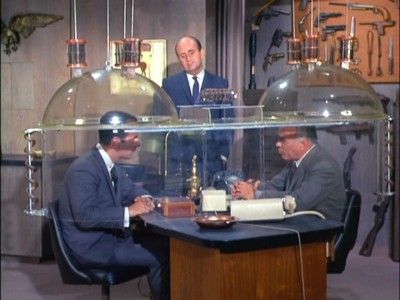
The show features a bullet-proof invisible wall in Smart’s apartment which lowers from the ceiling; he often forgets to put it back up and runs into it. Cameras can be in a bowl of soup.  A laser weapon was concealed in a suit jacket button, the blazer laser. The Cone of Silence are two glass domes that cover Smart and the Chief when they talk about a case.  Smart insists on using it because it’s  regulation; however, they can hardly hear each other, but anyone on the outside can hear their conversation clearly and often reports what the other person said.

smart3

Other weapons and aids for the spies included a parking meter telegraph, a perfume bottle radio transmitter, invisible icing, and a pencil listening device. Guns were hidden in a charm on a charm bracelet, in a pool cue, as a hairbrush, as a flashlight, and in a crutch. CONTROL even had gloves with fingerprints already on them – the fingerprints were KAOS agents so they would get the blame for a break-in.

Blowing up stuff is always good on a spy show and Get Smart had explosive rice; toothpaste that is really a fuse; an exploding wallet, ping pong ball and golf ball; and a horoscope book or lipstick case that contained knock-out gas.

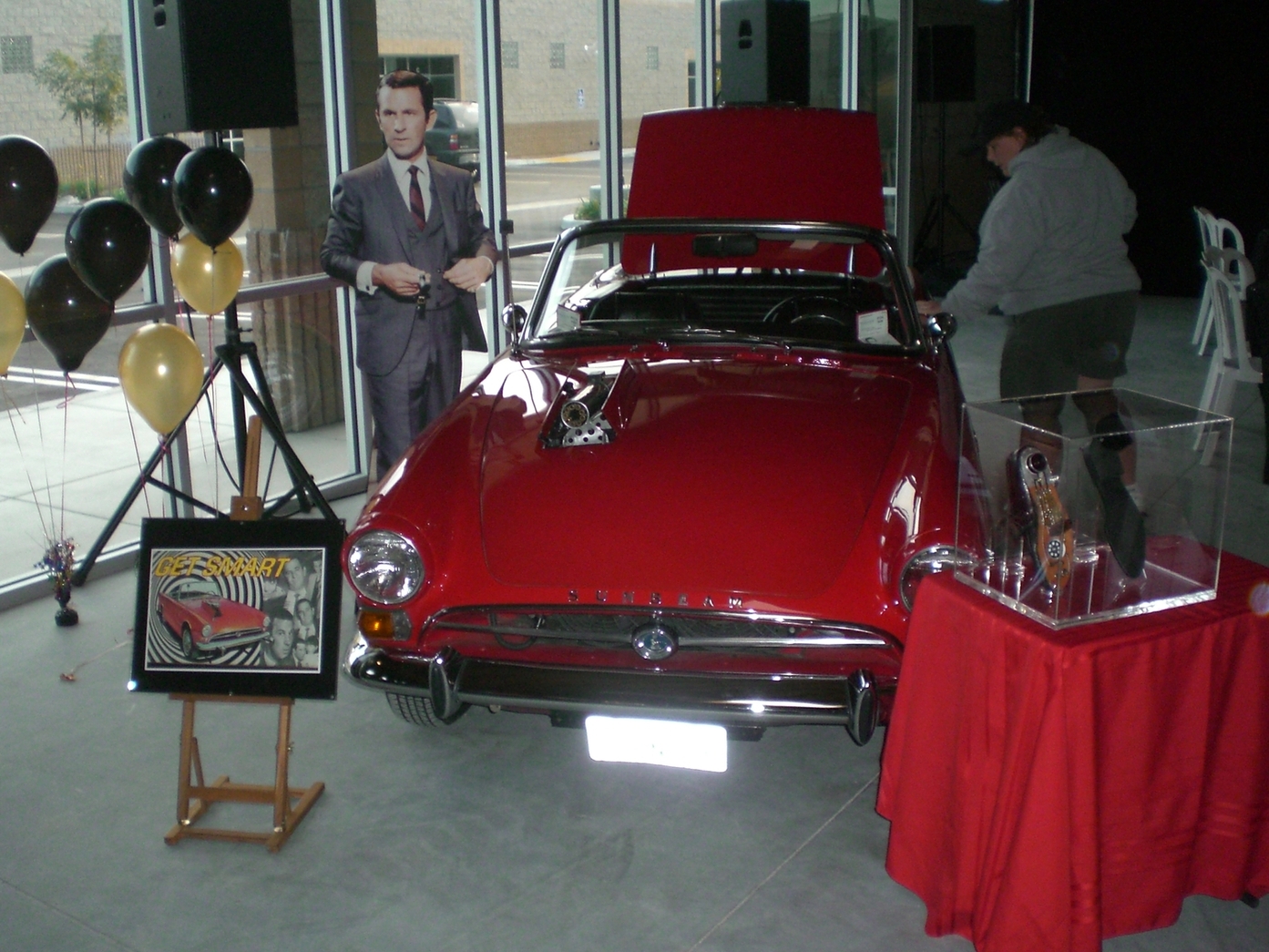
Smart had several cars but his most famous was a red 1965 Sunbeam Tiger.  The two-seat roadster had a machine gun built in, a smoke screen, a radar tracker, and an ejection seat.  When the series went off the air, Don Adams received the car and continued to drive it for ten years.

smart14

Get Smart probably had some of the most famous guest stars of any show.  Just a few of these celebrities include Steve Allen, Barbara Bain, Milton Berle, Ernest Borgnine, Carol Burnett, James Caan, Johnny Carson, Wally Cox, Robert Culp, Phyllis Diller, Jamie Farr, Jack Guilford, Bob Hope, Martin Landau, Julie Newmar, Pat Paulson, Tom Poston, Leonard Nimoy, Vincent Price, Don Rickles, and Fred Willard.

The show stayed true to its character through its entire run.  In Season 1, Hymie is introduced and the dog, Fang, disappears. In Season 2, we meet Siegfried. Smart and Agent 99 get engaged and marry in Season 4.  NBC demanded the change to boost ratings. In Season 5, they have twins.  Agent 99 continues working and is one of the first, if not the first, mother to be viewed as a working woman.  When the ratings did not increase, the show was cancelled. It went into syndication where it was very successful. Unfortunately, the DVD set was held up in legal battles and only came out weeks before Adams died.

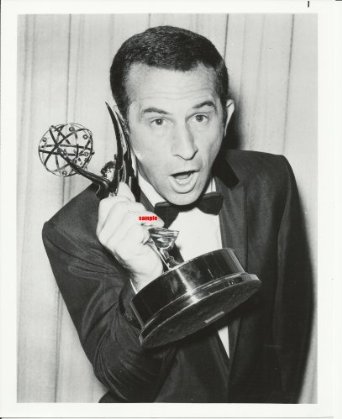
Get Smart was one of the most clever and creative sitcoms ever airing on television.  It had `21 Emmy nominations including two for Feldon and won 7 of those awards.  Don Adams won best actor on a comedy three times and the show won best comedy twice.

smartemmy

William Johnston came out with 9 paperbacks based on the series in the late 1960s and Dell Comics issued 8 comic books in 1966 and 1967. For the March 5-11, 1966 TV Guide, Andy Warhol designed a pop art piece using Barbara Feldon. Numerous collectibles were created:  board games, lunch boxes, dolls, and model cars.

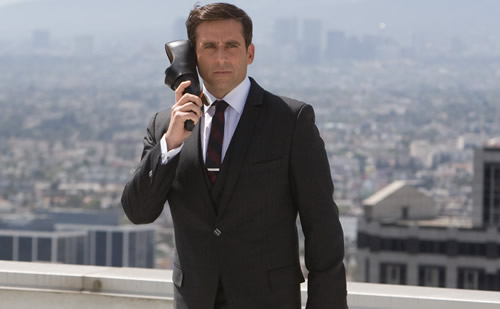
The show produced many spin-off projects. The Nude Bomb was a theatre release in 1980 with Feldon and Smart reprising their roles. Get Smart Again debuted in 1989 as an ABC TV movie.  After its release, a show appeared on FOX starring Feldon and Smart again called Get Smart in 1995.  In 2008 a movie was made starring Steve Carell and Anne Hathaway. Don Adams was known to later generations as the voice of Inspector Gadget.

carell

Of course, everyone has their favorite episodes, but after reviewing several polls and interviews with Nick at Nite and other 50th anniversary celebrations, I have come up with these top five.  Take a rainy fall day and give them a peek. However, if we are looking just at titles, I have to give a shout out to “Spy, Spy Birdie”, “Bronzefinger”, “Impossible Mission”, and “Tequila Mockingbird”.

  1. A Spy for a Spy
  2. The Not-So-Great Escape
  3. Ship of Spies
  4. The Amazing Harry Hoo
  5. The Little Black Book


smarttrench

Unfortunately, this is one of those shows that doesn’t get as much recognition and respect as it deserves.  Considering how much technology has developed in the last 50 years, the show is still up to date. The dialogue is witty; the characters are likable, even when they’re mortal enemies; and the show is just plain fun.