The Six Million Dollar Man: A $37,000,000 Man in 2026

We are right in the middle of our “Expensive Parts” blog theme, learning about The Bionic Woman, The Six Million Dollar Man, and the stars who played them. Up today is The Six Million Dollar Man.
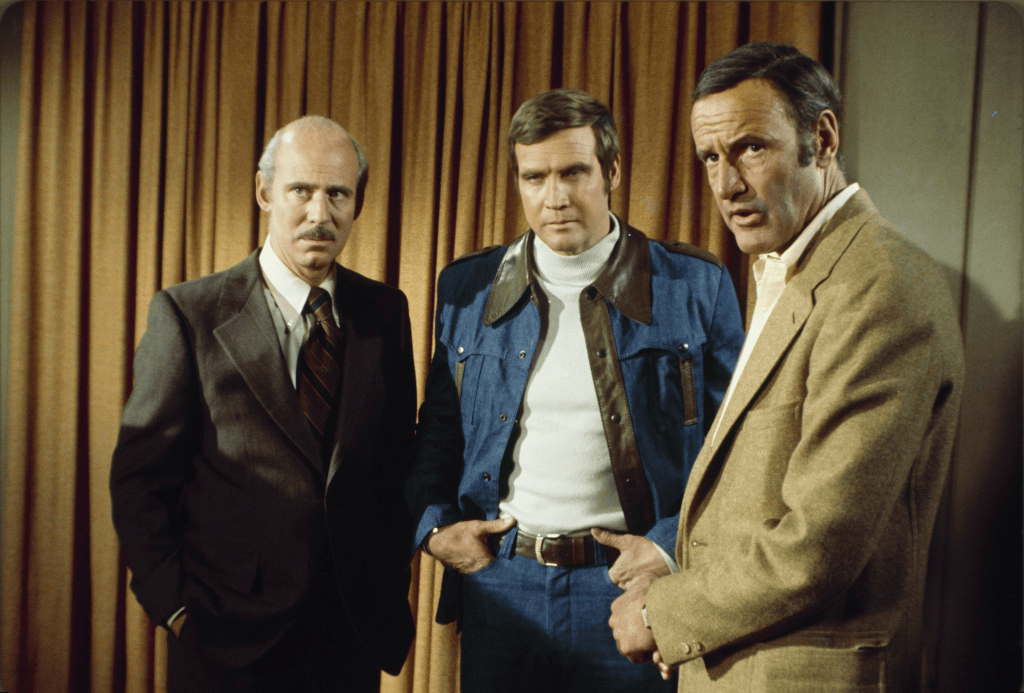
📷imdb.com

This science fiction show debuted in 1973. Steve Austin is a former astronaut played by Lee Majors. Majors always maintained that he did 90% of his stunts on the show. After an accident, he is rebuilt with superhuman strength, speed, and vision. Austin is transferred to OSI and takes on secret missions for the government. If the show was rebooted today, it would need to be titled “The Thirty-Seven Million Dollar Man.” The show was based on a book from 1972 called Cyborg written by Martin Caidin, an expert on aviation and aerospace technology.

Monte Markham was the first choice of both Caidin and the producers, but he was committed to another show so Majors got the part. Markham did appear on the show several times though.

Rounding out the cast were Oscar Goldman (Richard Anderson), director of OSI; Rudy Wells (Alan Oppenheimer/Martin E. Brooks), Austin’s doctor; and Peggy Callhan (Jennifer Darling), Goldman’s secretary.

Two weeks ago, we learned the backstory behind The Bionic Woman, a spinoff of this show. When the spinoff was created, Majors tried to get the part for his wife Farrah Fawcett, but she lost out to Lindsay Wagner. However, Fawcett appeared on the show as three different characters during the run of the series and in 1976 she became an Angel.

Oliver Nelson composed the theme music, but it was replaced with the narration about building Austin, “Gentlemen, we can rebuild him, we have the technology.” The accident in the beginning was a real crash by a pilot who survived the tragedy walking away.
Majors was an accomplished musician who learned to play the piano at age 6. He also worked on It Takes A Thief, Night Gallery, Columbo, and Ironside, among other shows.

The show’s executive producer was Harve Bennett (who had recently produced The Mod Squad). Producer Kenneth Johnson created very specific limits of what Austin could and could not do right away so the show never seemed unbelievable. He was fitted with a bionic eye, a bionic arm, and bionic legs. However, these set limits seemed to expand after season two. The two producers would go on to other science fiction successes. Bennett produced Star Trek films II and III, and Johnson created several shows including The Incredible Hulk and Alien Nation.

The first season scripts included a few episodes where Austin had to kill a villain. Once the network realized kids were tuning in as fans, the violence level of the show decreased.

Austin had new contract demands in 1977 and refused to tape any episodes until they were met. At one point the producers considered hiring a new actor for the role. Gil Gerard, Bruce Jenner, and Harrison Ford were all discussed as replacements. Eventually, the demands were met, but he was still out of a job the next year. A fun fact is that Ford was rejected quickly because the producers didn’t think he was a hero type. Indiana Jones anyone?
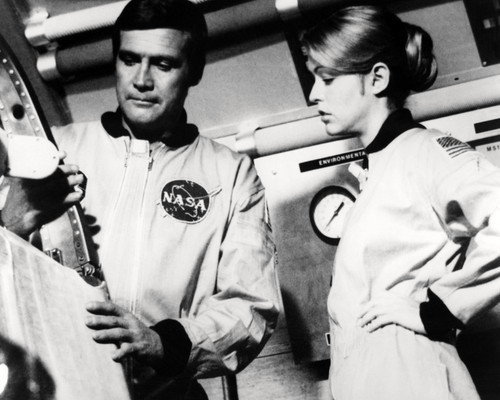
📷pinterest.com

Dorothy Fontana, a writer for the show, discussed the series in her Television Academy interview. She wrote about an air force nurse who became an astronaut. While in outer space, the woman’s partner suffers from appendicitis, she has to drive the spaceship home and Austin goes to help her. She said NASA was in an era where it wanted good publicity and she was given a lot of NASA footage to use for the show. This episode was one of the ones that featured Farrah Fawcett. Most of Fontana’s 50 writing credits were for science fiction scripts.

When the show began it was on ABC Friday nights before Kolchak. Midway through the year it was moved to Sunday nights and The Bionic Woman debuted on Wednesdays. The Six Million Dollar Man had no competition that year, but The Bionic Woman was up against Little House on the Prairie. Despite that, both shows were in the top ten. Schedules stayed the same for the next season. While The Six Million Dollar Man was still in the top ten, The Bionic Woman had slipped into the top twenty. ABC canceled the show which was then picked up by NBC who moved it to Saturday nights. Both shows had slipped out of the top thirty by that point, and they were both cancelled. However, the networks weren’t finished with the couple. They would return for three made-for-tv movies in the eighties.

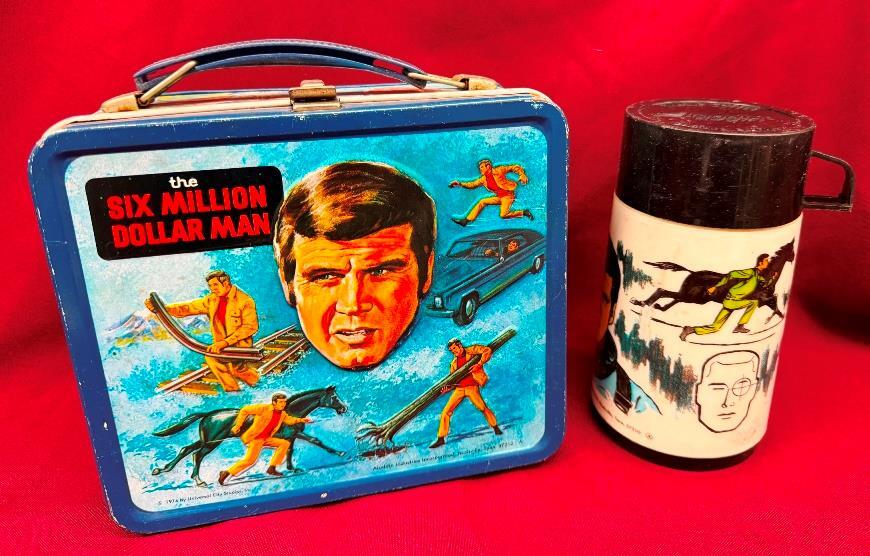
Six Million Dollar Man merchandise was everywhere. There were board games, comic books, and lunch boxes. One of the most successful tie-ins were Steve Austin and friends action figures. Extra bionic limbs could be swapped out on the figures for specific activities and there were vehicles and other accessories.
The Six Million Dollar Man was very different from any shows that had appeared before and it was popular for several seasons. I’m guessing that the kids who grew up with the show got older and busy and it didn’t have the same appeal to preteens and teens that it had in the past. The producers did create a pilot for “The Bionic Boy” in 1978 to appeal to younger viewers but the screenings didn’t produce a lot of positive comments, and it was shelved, probably for the best.

For the time, the special effects were amazing, but it doesn’t hold up today with all the changes that have come along with technology. I feel the same way about Wonder Woman which was also on the schedule with these two shows. I’m guessing the thing that is most memorable about the show is the sound effects that always were heard when Steve used his bionic parts and the slow motion of Austin in action.

If this was a favorite of yours, I’d love to hear if you still enjoy it or if it lost some of its watchability over the years.

Buck Rogers Is Not for This Century

I am calling this month’s blog series, “I Robot.”  We are taking a look at some popular shows that featured robots. I did not include Lost in Space in this group because I did devote a blog to the show that discussed that robot in some detail.

Cast of Buck Rogers Photo: pinterest.com

Today we start with a show that was a fan favorite in the 1980s, although full disclosure, I had never seen this show until I wrote this blog: Buck Rogers in the 25th Century.

Because Star Wars was so popular, Universal decided to develop a television show about space. Glen Larson was the primary face behind the creation. The original plan was to make a series of Buck Rogers made-for-tv movies for NBC. Larson was also behind the show Battlestar Galactica.

Universal changed plans and filmed a big-screen movie about Buck Rogers. It had good reviews, netting $21 million. After the success of the film, NBC asked for a weekly series. Buck Rogers was not a new concept; he was created in 1928 by Philip Francis Nowlan and had been featured in a variety of media including comic strips, books, and radio. The original movie was edited for television, and it became the first two episodes of the series.

The concept of the show was that Captain William “Buck” Rogers (Gil Gerard) was a NASA pilot commanding Ranger 3 which was launched into outer space in 1987. Because of a part malfunction, Buck is frozen for 504 years and his spacecraft is found in 2491. At this time, he learns the Earth was recovering from a nuclear war.

Photo: buckrogersguide.blogspot.com

Buck has to try to assimilate into the 25th-century culture. Because he was previously a pilot, he is placed in the Earth Defense department. Buck is often undercover. He works with Colonel Wilma Deering (Erin Gray), a starfighter pilot. Stargates were artificially created portals in space to help travel between stars. If you watch the episodes closely, you will notice a subtle shift in Wilma’s hair color. Gray was required to dye her hair blonde for the first season. As the season progresses, the color begins to fade and she was allowed to do that, so by the second season, she has brunette hair.

Another coworker is Twiki, a small robot (Felix Silla and voiced by Mel Blanc). Twiki provided much of the humor on the show. Also helping the trio was Dr. Theopolis (voiced by Eri Server), a small computer disk who understood Twiki and was part of the Computer Council. In the first season, the group received its orders from Dr. Elias Huer (Tim O’Connor).

It was a bit kitschy a la Batman. Several villains are involved in plots. In the first season, the “bad guy” was Princess Ardala (Pamela Hensley) who tried to conquer Earth. Most of the population resided in New Chicago and the rest of the planet was being explored again, and new cities were popping up like New Detroit, New Manhattan, New Phoenix, etc.

In the original story, Buck awakes after 500 years to learn that America was overrun by Mongol invaders and in ruins. Wilma and Dr. Huer are both part of that story, as are Killer Kane and Ardala Valmar.

The Villians Photo: moriareviews.com

For a show that did not produce very many episodes, a lot of celebrities were featured on the show including Gary Coleman, Jamie Lee Curtis, Peter Graves, Jack Palance, Markie Post, Dorothy Stratten, and Vera Miles. A few of the stars who played Batman’s foes show up on Buck Rogers including Cesar Romero, Frank Gorshin, Roddy McDowall, and Julie Newmar.

The opening theme music for the show was composed by Stu Phillips and arranged by Johnny Harris. Harris added a 45-second audio clip when Rogers is spinning and then begins with the main theme.

The show debuted in September of 1979. It was popular with viewers, but critics were not on board with the show. Gerard did not like the direction his character was taking. He was in favor of more series stories and felt like his character was just used to make continual jokes and not taken seriously. At times he even rewrote scripts to favor his character over other roles. There was a lot of tension on the set. Two of the writers and script editors left in the middle of the year. Gerard was reprimanded by the network, and he said he hoped that the series would not be picked up for a second season.

Photo: denofgeeks.com

James Van Hise said the show’s scripts “never took advantage of what they had at hand.” And he said Larson exploited a well-loved character in popular culture. John Javna in his book The Best of Science Fiction TV described the show as the worst science fiction show of all time. Bill Lengeman said the acting was wooden and specified that the episode “Space Rockers” was the worst episode of TV science fiction he had ever seen. Many critics were not happy with the way the women were treated in the second season. Ardala was dismissed, and Wilma lost her respectful position, almost becoming an inconsequential sidekick to Buck.

An actors’ strike delayed filming for season two. A new set of producers was brought in and the format was tweaked. Buck, Wilma, and Twiki were now on a spaceship called the Searcher with a mission to look for lost groups of humanity. Many of the previous characters were no longer part of the series, including Theopolis, Ardala, and Dr. Huer. The Starfighter on the series was created by Ralph McQuarrie and had been one of his designs for Battlestar Galactica.

Taking on more of a Star Trek aura, the new characters included Admiral Efram Asimov, a distant relative of Isaac Asimov (Jay Garner) who commands the Searcher; Hawk (Thom Christopher) an alien who represents the Bird people, now almost extinct; like Spock, he remained straight-faced while others are enjoying emotional moments; Dr. Goodfellow (Wilfrid Hyde-White) an elderly scientist; and Crichton (voiced by Jeff David) a robot built by Goodfellow who disdains humans.

The storylines became more serious and an underlying romance was hinted at between Buck and Wilma. Although the changes were what he asked for, Gerard later complained again about the show. Larson might have been second-guessing himself for casting Gerard. His first choice for the role was Kurt Russell. However, he was concentrating on his movie career and had no interest in coming back to television. Interestingly, Russell had been passed over for the role of Han Solo in Star Wars, losing to Harrison Ford. Ratings dropped in the second season. After only producing 21 episodes for season one, NBC canceled the show after 11 episodes in season two.

Despite the small number of shows produced, Universal released the show on DVD in 2004, but the first two episodes were replaced with the original big-screen movie. The series can also be streamed on NBC’s app.

New books and comic books were produced in the eighties. There were also several sets of action figures released by Mego. Milton Bradley debuted a Buck Rogers board game. You could also purchase jigsaw puzzles, model kits of space ships, die-cast toys, trading cards, and a lunch box.

Although the show garnered no Emmys for acting which is not surprising, it did receive five nominations. In season one, Bruce Broughton won for Outstanding Achievement in Music Composition for a Series. Other nominations included Outstanding Cinematography for a Series in season one, Outstanding Art Direction for a Series in season two, and Outstanding Costume Design for a Series in both seasons. The miniature sets for the landing bays and launch tubes were built with Styrofoam. Although they were inexpensive, combined with clever lighting, they appeared as complex architectural sets.

The show was beloved by its fan base. It’s hard to say why it had such a short life. There seem to be many reasons it didn’t last. With the success of Star Wars, everyone jumped on the outer space bandwagon, and the viewers could only watch so many of them. Gerard certainly did not help the ratings with his complaints and dissatisfaction with the show. Getting rid of Princess Ardala and reducing the role of Wilma to a minor character did not help retain female viewers. The show never seemed to be able to figure out what it was. Was it a Star Wars? Was it Batman? Was it Star Trek? It just seemed to not be very well planned or developed.

Twiki Photo: imdb.com

If you enjoy science fiction, it might be worth watching. After all, there are only 32 episodes, and if nothing else, you might want to watch to see if in the decades since it debuted, it still makes that list of worst science fiction shows. I’d be interested in hearing what you decide. As for this blog series on robots. I can happily relay that Twiki won the TV Land Awards in 2008 for Most Awesome Robot!