Today we start a new blog theme, “It Takes Two,” all about shows featuring partners. The first one on our schedule is Simon & Simon.
📷tvtropes.com
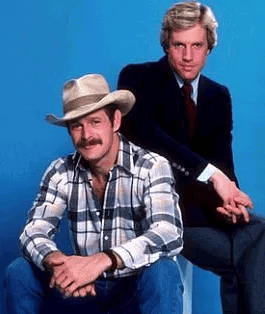
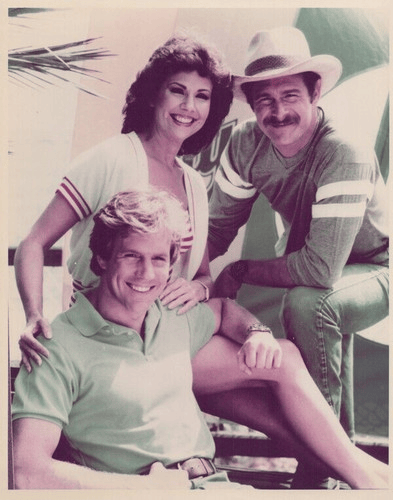
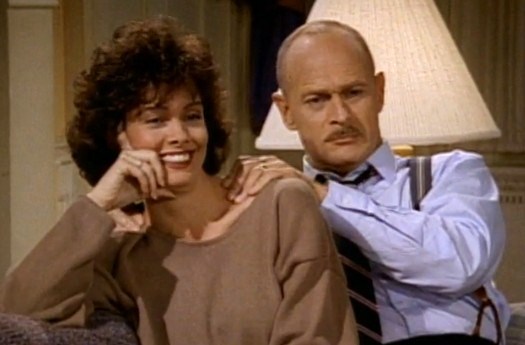
Simon & Simon was a long-running crime show that debuted in the fall of 1981 on CBS. Starring Gerald McRaney and Jameson Parker, it’s about two brothers who run a detective agency in San Diego.
The brothers have very different personalities and very different methods of solving crimes and conducting investigations which provides humor on the show. However, they are very loyal to each other.
Rick (McRaney), the older, single brother, is a Vietnam War veteran who typically shows up in Levis and cowboys boots, driving his truck. A.J. (Parker) is a married preppy college graduate, a practicing Catholic who drives Camaros and convertibles. Rick’s investigating style is much looser based on his street smarts while A.J. relies on intelligence and thinking things through. Rick lives on a boat . . . in his brother’s yard.
Rounding out the cast is their mother Cecilia (Mary Carver), A.J.’s ex-boss and biggest competitor Myron Fowler (Eddie Barth), Lt. Marcel Proust Brown, their friend (Tim Reid), and Lt. Abigail Marsh (Joan McMurtrey).
The pilot of the show was set in Florida and titled “Pirate’s Key,” but CBS moved the setting to San Diego. Created by Philip DeGuere, who was the executive producer for the show, he was attempting to portray a modern Buth Cassidy and the Sundance Kid.
📷losangelespubliclibrary.com
The show was on Tuesday nights. It had some tough competition up against Happy Days and Laverne and Shirley, both top twenty shows. When it didn’t garner decent ratings, CBS announced it would be cancelled, but DeGuere convinced them to move it to Thursdays after Magnum PI. It was successful and they drew a lot of new viewers, and the show was in the top ten until 1985 when it fell to the top thirty; its competition on Thursday nights at the end of its run was Cheers and Night Court. In an effort to boost ratings, the show moved to Saturday nights, but the ratings dropped even more. This wasn’t too surprising because now it was facing The Golden Girls and Empty Nest, well-established shows that were always in the top ten. CBS had approved 13 shows for the 1988 fall season but cancelled the show before the final two episodes aired.
The original theme, “Best of Friends,” was composed by Linda Creed and Barry De Vorzon. When the show switched to Thursdays, De Vorzon and Michael Towers created a new theme, an instrumental featuring slide guitar and saxophone. De Vorzon would later compose the music for S.W.A.T., another popular show in the 2010s.
It was not the end of the Simon Brothers who showed up in a made-for-tv movie in 1995. In this version, A.J. is divorced, working as an attorney in Seattle. Rick visits him while he is transporting an expensive yacht. When the yacht gets hijacked with their mother on board, the two brothers are back to crime solving.
moviestore.com
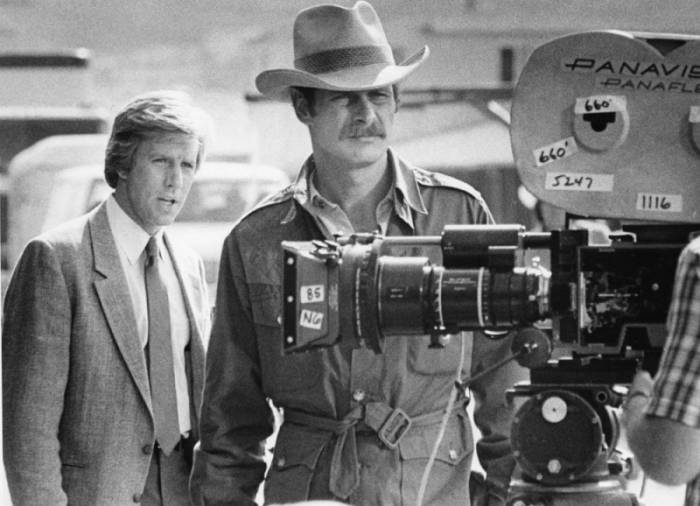
Sometimes we forget when we watch a half-hour or hour show how much time and creative planning goes into the filming of every little detail. During his Television Academy interview, Thomas Del Ruth talked about the photography he did on Simon & Simon. He worked on both the first pilot set in Florida and the second pilot set in San Diego. When he worked on the Florida set, they were trying to capture sunset there. The theme was blue and green for the show, so they had a jungle and next to it was a beach. They set up three hours early just to capture the sun at the exact moment it was on the horizon. It was supposed to convey to the viewers that this was sunset, and the next scene was set at night, so it was an important transition. He said the brothers were going to ride a jeep onto the beach and he needed to get all of that in the shot.
When they had two minutes to go, Corey Allen, the director, decided he wanted wildlife in the shot. Del Ruth said no, there wasn’t time, but Allen insisted, so he had a wrangler quickly bring a flamingo and they put filament around its neck so it would be stationary while the jeep drove by. Del Ruth said, of course, after waiting three hours, they took the shot, but the flamingo went crazy when the jeep got near and his neck went one way while his head went another. The filament kept him from running, but he went up in the air and when his feet came down, he kept digging a hole, kicking sand everywhere. The shot was ruined and they had to wait two days to come back and do it again, minus the flamingo. It’s hard to imagine all the work and planning that goes into every scene of every episode. Del Ruth later was photographer for The West Wing, and I’m sure he had some great stories about that series as well.
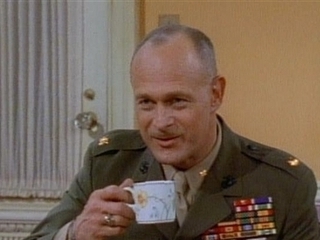
As we wind up our “I Salute You!” blog series, we end with a show that may not be remembered as well as many other military shows: Major Dad. Created by Richard Okie, Earl Pomerantz, and John Stephens, the show debuted in September of 1989 and ran until spring of 1993, producing 96 episodes. Stephens was a producer on Gunsmoke and Simon and Simon (which McRaney also starred in), among other shows. Okie also produced Simon and Simon, along with Quantum Leap and more recently, Elementary. Pomerantz had been involved with both The Cosby Show and The Larry Sanders Show. Although the show is not seen often now, it won best sitcom in 1990.
Photo: next-episode.net
In September of 1989, Bonnie Churchill wrote an article for the Christian Science Monitor, “McRaney is Major Dad.” They discussed how the show was developed. As McRaney recounted: “‘The eighth and last season of Simon and Simon we began to get the skeleton of an idea . . . It centers around a rather conservative peacetime officer who falls in love with a newspaper reporter, who is rather liberal. She’s a single parent raising three daughters. They get married, and then the real fun begins. When we were discussing which branch of the service he’d be in, I voted for the Marines.’ McRaney also had a vote as co-executive producer, so he won.”
Photo: nbc.com
The show was on Monday nights for most of its entire run. The first season it went up against MacGyver and for half the season it was on against Alf and My 2 Dads for the second half. Season two with the move to Camp Hollister found the show going against MacGyver on ABC and both Ferris Bueller and Blossom on NBC, landing in the top 30. The show was again competing against MacGyver and Blossom for season three where it was in the top 10. In season four, MacGyver was gone with American Detective taking its place and Blossom still on NBC. But at some time during the last season, the network moved the show to Friday nights which resulted in the ratings plummeting and the show was no longer in the top 30 and was cancelled.
Photo: sitcomsonline.com
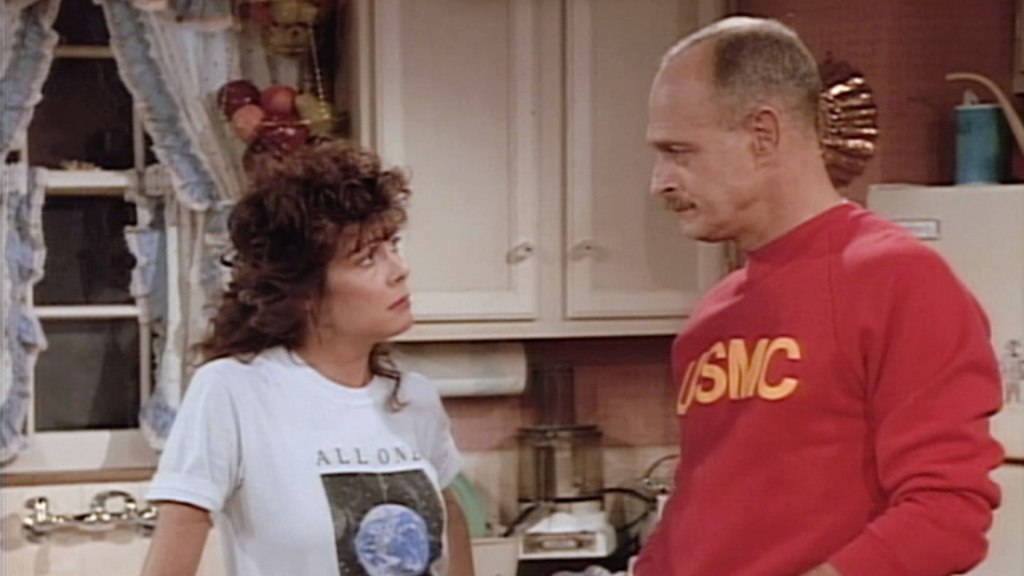
Major Dad starred Gerald McRaney and Shanna Reed as a newly married couple, John and Polly MacGillis. After left-leaning journalist Polly interviews conservative John, they fall in love. After a whirl-wind three-week romance, they decided to marry and the perennial bachelor’s life is turned upside down. Even though they are newly married, Polly has three daughters (Nicole Dubuc, Chelsea Hertford, and Marisa Ryan) from a previous marriage, so “Mac” must learn to live with a house of females. The girls are 6, 11, and 13. Mac has a hard-enough time learning to be a husband, let alone a father.
Photo: sharetv.com
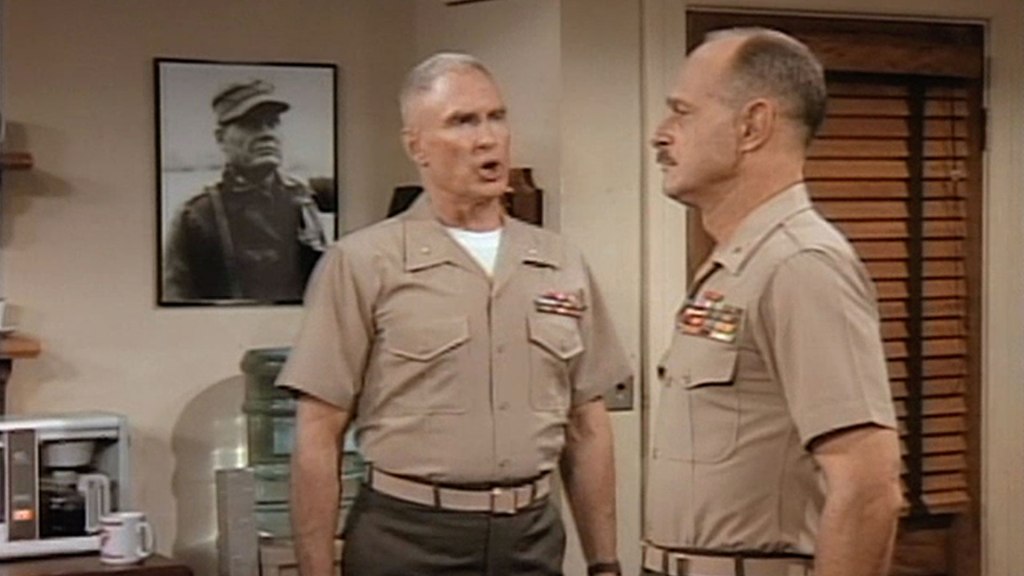
The show takes place in Camp Singleton which is similar to the real Camp Pendleton where Mac is the commander of the infantry training school’s acquisition division. Rounding out the cast were Lt Holowachuk (Matt Mulhern), Sgt James (Marlon Archey), and secretary Merilee (Whitney Kershaw). Many of the scripts for the first season had to be rewritten due to the US’s involvement in the Persian Gulf War.
For the second season, the family moves to Camp Hollister, which is similar to Quantico. Mac has been promoted to staff secretary under Brigadier General Marcus Craig (Jon Cypher). Lt Holowachuk comes along as aide-de-camp. Beverly Archer plays Gunnery Sergeant Alva Bricker, known as Gunny, the general’s secretary.
Photo: sitcomsonline.com Gunny
She adds a lot of humorous elements to the show as a no-nonsense, set-in-her-ways woman who seems to have many romantic interests.
Polly becomes the managing editor for the Bulldog, the camp newspaper. She also writes two columns, “At Ease” and “The Suggestion Box.” Originally for the second season, several of the characters were being sent to Saudia Arabia, but because the Persian Gulf War ended, it was decided to send everyone to Camp Hollister instead.
Photo: nbc.com
Some famous faces that popped up on this show included Ruth Buzzy, Peggy Cass, Brian Keith, Vicki Lawrence, and Jameson Parker.
Photo: themoviedatabase.com Work Life
Most reviews I read thought the show came into its own after the move to Camp Hollister. It got very positive ratings. Many people appreciated the fact that Marines were shown in a positive light. Before filming the show, McRaney was sent to Camp Pendleton to learn about life as a Marine. He was able to talk with people about their life stories, be outfitted with a uniform, and even got an authentic haircut.
Photo: retrotvmemories.com Home Life
The show provided a realistic insight into the issues that military families face. In addition, the show moved back and forth between home life and career life, so the characters are more balanced and not one-dimensional. Current issues like base closures were often written into the scripts, and in 1990, an episode commemorated the 215th anniversary of the Marines and Dan Quayle, who was the Vice President, made an appearance on the show.
Photo: Wikipedia.com
As far as I could find, the show is not available on DVD. I also could not find any networks currently carrying the show, although there are online sights where you can watch it. Perhaps with all the networks now carrying syndicated shows, this series will have a second chance to find new generations of fans.
This month we begin a new series—“Girls, Girls, Girls.” I am celebrating sitcoms that are based primarily on the relationships of women. We begin with a series that ran for seven years, resulting in 163 episodes. It revealed the joyful, disheartening, and disturbing details that occur in a long-term friendship. Today we learn more about Designing Women.
In September of 1986 a show debuted about not only friendship, but also about running a business, becoming independent, trusting in yourself, and living a truly southern lifestyle. We had watched shows about sisters before, about a workplace staff and how women rely on each other, but this show put it all in one place. Had this show been set in Chicago, Salt Lake City, or Boston, it would have been a totally different show.
Photo: pinterest.com
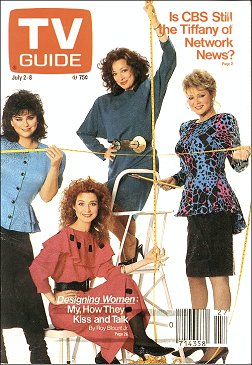
Julia Sugarbaker (Dixie Carter) owns a design firm and runs it from her house. Her shallow sister Suzanne (Delta Burke), who was a beauty queen and is still a diva, works there too, along with a divorced mother Mary Jo (Annie Potts), a naïve country girl Charlene (Jean Smart) and a black ex-con man named Anthony (Meshach Taylor) who not only delivers furniture for the business but delivers his unique viewpoint as a male among women. For the seven seasons the show was on the air we got to know each of the characters intimately. We saw them fall in and out of love, get married, get dumped, love each other, hate each other, and learn about themselves as they went through all these changes together.
While Julia
is the face of the company, Suzanne is a silent partner, Mary Jo is the head
designer, Charlene is the office manager, and Anthony takes on a variety of
duties that need to be tended to.
The famous exterior of the home/business was The Villa Marre, a Victorian mansion from 1981 that was located in the MacArthur Park Historic District in Little Rock, Arkansas. You can still drive by it today, and it’s listed in the National Registry of Historic Places.
Photo: pinterest.com
The Golden Girls (which we’ll look at in a couple of weeks), had premiered the year before Designing Women. You can definitely see a similarity in the two shows. Both were set in the south, the business was in Julia’s house while the older women friends lived in Blanche’s home. You can compare Dorothy to Julia and Charlene to Rose and, with a little stretching, Suzanne to Blanche. With a lot of stretching, Anthony and Mary Jo can be compared to Sophia; they’re more practical and always willing to offer advice, requested or not.
The sitcom was created by Linda Bloodworth-Thomason. She wrote about half of the episodes and was determined to include topics women were concerned about such as extra-marital relationships, body image, racial inequality, and terminal diseases. Although the show tackled many controversial issues, it was never preachy or judgmental. Linda’s husband Harry was an executive producer, so he also influenced the topics. The couple were friends with Bill and Hillary Clinton and voiced a decidedly more liberal viewpoint. This was especially tough on Dixie Carter who was a committed Republican.
Photo: sitcomsonline.com
Although the
show was beloved by fans, critics weren’t on board, at least at first. Below is
an excerpt from a New York Times article that ran September 29, 1986:
Like NBC’s “Golden Girls,” the new series “Designing Women,”tonight at 9:30, features four women with wisecracks to spare. Although they don’t live together in Florida, these women spend most of their time working together in a Victorian-type house in Atlanta. They are in the business of interior decorating.
The show was created by, and this evening’s premiere written by, Linda Bloodworth-Thomason, who also shares the executive-producer credit with her husband, Harry Thomason. The fictitious firm of Sugarbaker & Associates is headed by Julia Sugarbaker, a glamorous widow who is far from ready to become a blue-haired little old lady. Dixie Carter plays Julia as a graduate of the Beatrice Arthur-Elaine Stritch school of dripping sarcasm. Julia’s three partners are her man-hungry sister Suzanne (Delta Burke), whose alimony checks are filed alphabetically; the recently divorced Mary Jo (Annie Potts), who refused alimony, thinking capital punishment would be more appropriate, and dizzy but shrewd Charlene (Jean Smart), whose latest boyfriend is named Shadow and, for some unexplained reason, is walking around with a bullet hole in his pants.
This, then, is the basic mix, no less promising than any other in a season that continues to give white, middle-class parents to all sorts of minority children. Tonight, Suzanne discovers that her gynecologist is retiring. “Let him go,” advises Julia, “he’s paid his dues.” As it happens, Mary Jo’s former husband is a gynecologist. Suzanne visits his office and promptly returns with the news that they have fallen in love. Julia observes: “If sex were fast food, there’d be an arch over your bed.’” . . .
Ms. Bloodworth-Thomason is no Susan Harris, whose crackling humor keeps “The Golden Girls” popping steadily from week to week. On the other hand, “Designing Women” has a first-rate cast. . .
Now, it’s all a matter of figuring out where “Designing Women” goes from here. Mary Jo’s first husband, a major character this evening, isn’t even mentioned in next week’s episode, which revolves around not interior design but beauty pageants. And sure enough, Julia gets another scene in which she witheringly tells off another icky character. Already the show looks like four terrific actresses in search of a workable sitcom.
I was surprised to learn that none of the actresses auditioned for their roles. Bloodworth-Thomason had the four lead actresses in mind when she wrote the pilot. Smart was the only non-Southern native, having been raised in Seattle. Anthony was not intended to be a regular. He was supposed to have a one-time role but when asked to improvise with the lead characters, the producers were so impressed with the result that he was written into the show, becoming the first cast member to receive an Emmy nomination. All in all, the show would earn eighteen nominations.
Photo: amazon.com
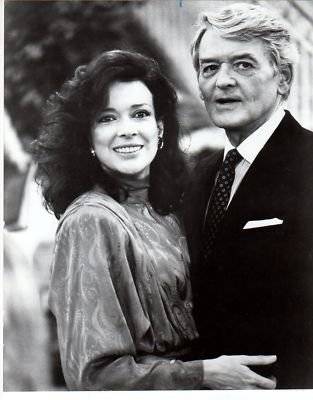
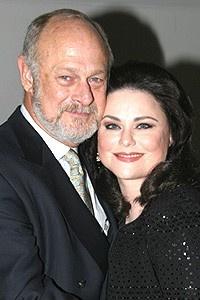
The cast members’ real marriages intertwined with the character’s relationships. Hal Holbrook played Reese on the show, Julia’s beau, and the two were married in real life. Gerald McRaney beat out John Ritter for the role of Suzanne’s ex-husband Dash.
Photo: broadway.com
Although they were exes on the show, they married in real life. Richard Gilliland won the role of Mary Jo’s boyfriend J.D., but he won the heart of Jean Smart whom he married in 1987.
Photo: zimbio.com
The show began its run on Monday nights on CBS, following Newhart, and it got decent ratings. For whatever reason, CBS began moving the show all over the place. The ratings went down when it was moved to Thursdays against Night Court and then Sundays up against the movie of the week on both ABC and NBC. CBS was planning on cancelling the show but a public letter-writing campaign saved it from its fate. After receiving 50,000 letters, the network returned it to the Monday night slot again. It was often in the top 20, and always in the top 30 through mid-1992. In late 1992, the network moved the show to Fridays where it again decreased its ratings. The network then cancelled the show in 1993.
It was hard to blame the network for its eventual cancellation though. The cast went through too many changes and the show lost its original charm and focus with so many replacements. In 1990, Delta Burke appeared on a Barbara Walters special and stated that the set was not a happy one. She accused the Thomasons of manipulating her. After that Burke began showing up late and sometimes not at all. The writers had to write two different scripts, one with her and one without her. Some people blamed it on McRaney’s influence, but whatever the reason, her co-stars took the brunt of her difficulties, having to learn two scripts while continuing to fulfill their contracts. They decided as a cast that they could not continue working with her, and she was let go. Julia Duffy, Jan Hooks, and Judith Ivey were all brought onto the show as possible characters, but they were not popular with the audience.
Photo: greginhollywood.com
Burke and Carter had been close friends up to this point and the situation destroyed their friendship, at least temporarily. Later they were able to somewhat repair the strained relationship.
I know it
sounds like déjà vu, but as I have to add in many blogs, there is a rumor of a
revival of the show for 2020. This past August, CBS confirmed that the show
will be debuting again next year.
Like most shows, Designing Women had its highs and lows. Once Burke became difficult to work with, the chemistry on the show was never recaptured. When it was good, it was very good.
Photo: fanpop.com
While Julia was a proper southern lady, once her fiery rage was aroused, she could put anyone in their place and she did it well over the years. During season two, the firm is hired by a gay man who is dying of AIDS and wants help designing his funeral. The staff become close to him and learn a lot about HIV. A wealthy client of the firm tells Julia that AIDS is “killing all the right people” which earns him one of her most scathing put-downs. While episodes like this one are heart-breaking, many episodes are just hilarious. In a very funny moment in season three, it is not Julia’s tongue that gets the laughs, it is another body part. As she is participating in a charity fashion show, her dress gets caught in her pantyhose, and she ends up mooning 1200 of Atlanta’s most prestigious citizens, including the mayor. Not many series can excel with such a range of topics, emotions, and comedy skills.
If you find
yourself with a free week-end or a night with no plans, take some time to watch
this award-winning show. Just stick to the first four seasons, so you don’t
have to watch its disappointing decline.