I’m Dickens, He’s Fenster: Building Comedy Into Every Episode

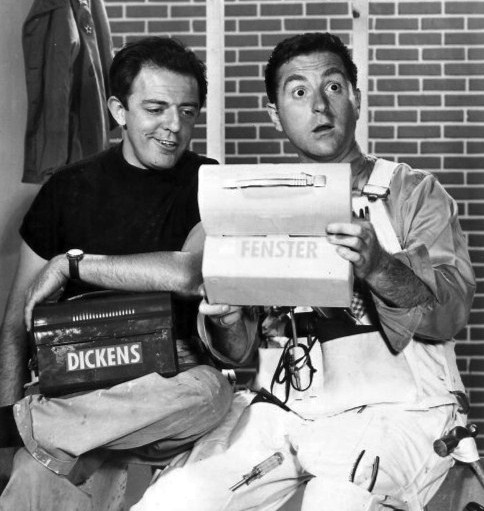
June’s blog theme is Funny Duos. Last week we learned about the Governor and J.J., a show created by Leonard Stern. Today it’s another show created and produced by Stern, I’m Dickens, He’s Fenster.
📷wikipedia.com

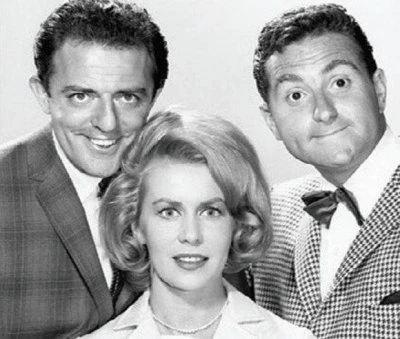
This show debuted on ABC in September 1962 and was canceled after one season. It starred John Astin and Marty Ingels.

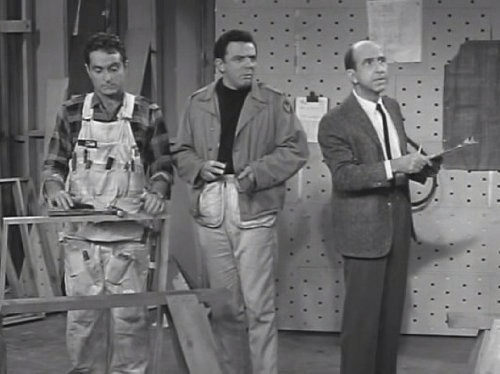
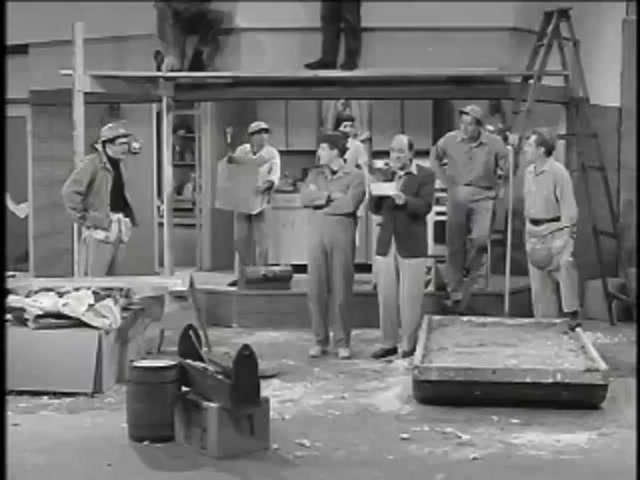
The plot is that two carpenters are best friends. Harry Dickens (Astin) is married to Kate (Emmaline Henry) while Arch Fenster (Ingels) is a swinging bachelor whose lifestyle is not okay with Kate. The two often clash with their boss, Mr. Bannister (one of my favorites, Frank DeVol). Rounding out the cast are coworkers Mel (Dave Ketchum), Bob (Henry Beckman), and Bentley (Noam Pitlik). We also meet a few of Fenster’s girls including Yvonne Craig, Ellen Burstyn, and Lee Meriwether.

Stern talked about casting for the show in his interview with the Television Academy. He had Ingels hired and then Stern and his wife saw Astin in a play at UCLA, and he was added to the cast. Stern said he needed a director who liked comedy and could bond with the actors well and was innovative because Stern didn’t like the three-camera shot. He hired Arthur Hiller who fit all three qualifications.

The show, unusual for the time, was filmed in front of a live audience. The comedy combined witty comments with slapstick comedy.
📷imdb.com

ABC placed it on Friday nights between The Flintstones, which was created for adult viewing, and 77 Sunset Strip. This should have provided a built-in audience, even though it was competing against Sing Along with Mitch and Route 66. At the end of the first season, it beat the competition in the ratings but was still canceled. One of the problems measuring viewership at this time was that a person watching was a person watching whether they were 6, 26, 56, or 106, so it was hard to tell which shows appealed to adults.

Astin discussed the reviews for this show during one of his interviews and said that “some of the critics said it’s the kind of humor that makes you laugh out loud in the living room, and that’s an accomplishment. How often do we really laugh out loud in the living room when we’re watching a television show? We’re lucky if we smile.”
📷televisionheaven.com

The idea for this show occurred when Stern had some work done at his home. On Christmas Eve 1961, the builders were in a hurry to finish work and get home to celebrate with their families. They were finishing a new fireplace with a built-in brick chimney. Unfortunately, one of the crew forgot to remove the ladder when they were finished in the chimney and they bricked up the hearth before realizing they had now lost their ladder. Stern thought the misadventures of a couple of construction workers might make a great sitcom.

In an interview with the Television Academy, Stern said he asked musician Irving Szathmary for a theme that evoked a Laurel and Hardy feeling. (Szathmary was also the composer behind the unforgettable Get Smart theme.) It must have worked because Stan Laurel said he thought this series was “one of the funniest and most highly imaginative comedies to have its thirty minutes of fame on television.”

One of the running gags on the show was just like the cobbler’s children have no shoes, Dickens’ house was always in a state of upheaval with paint samples on the wall and cabinet doors not working properly; it was in constant renovation. We see this immediately in the pilot as Fenster stops by to pick up Dickens and sees Kate trying to work with the various kitchen issues under construction.
📷tvguide.com

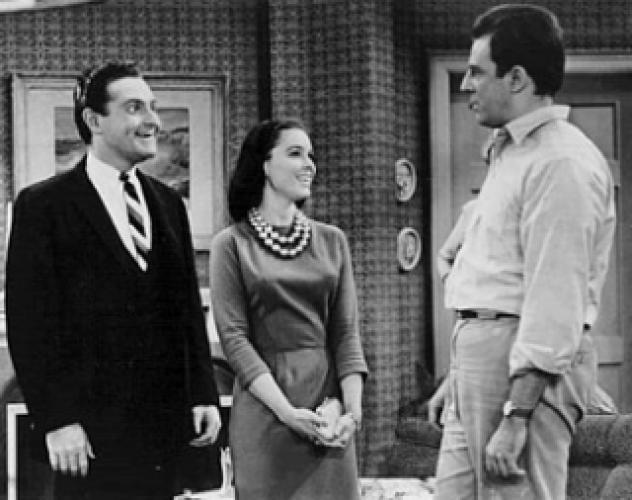
The pilot was a typical plot line for not only this show but most early sixties sitcoms. Dickens is up for a promotion to foreman and is afraid he won’t get the job. In the past, whenever Dickens is waiting for something special, he gets nervous and always ruins the opportunity. When the boss shows up at the project, he doesn’t seem to know Harry Dickens’ name, so the two friends decide to put it into his subconscious by whispering it here and there when they walk by him. That evening Fenster brings his girlfriend over. Harry doesn’t want to spend the evening with them, but once he meets the girlfriend, he falls all over himself being nice to her. Lorna mentions to Fenster that he should try for the foreman job himself.

The next morning, Fenster comes to get Dickens, and Harry is rude to him because he thinks he wants the foreman job. At the end of the day, Bannister calls Dickens into the office to give him the promotion and tells him that Fenster must be fired because he overheard a lot of bad things about him when the crew was talking. When Dickens talks to the other guys, they said that they never complained about Fenster, although they did repeat some of the funny things Dickens said about Fenster. Fenster tells Bannister that he just got fired by Dickens and then Dickens comes in to say it’s been a misunderstanding and Fenster should not be fired and would make a better foreman than Dickens. Bannister said he’ll let them know what decision has been made the next morning.
📷episodate.com

That night Fenster shows up with a different girlfriend who just happens to be Bannister’s daughter. There was a great mixture of slapstick and witty banter during the episode. Something did feel a bit off with the characters. I think the characters should have reversed roles; Aston seems more the playboy type, and Ingels seems more the married man for typical sixties sitcoms.

Astin would go on to star in The Addams Family while Henry would marry Dr. Bellows on I Dream of Jeannie. Unfortunately, with only 32 episodes, the show didn’t qualify for syndication. The first sixteen episodes are included on a DVD set released in 2012 if you want to check out the show. You can also find some of them online in different sites.
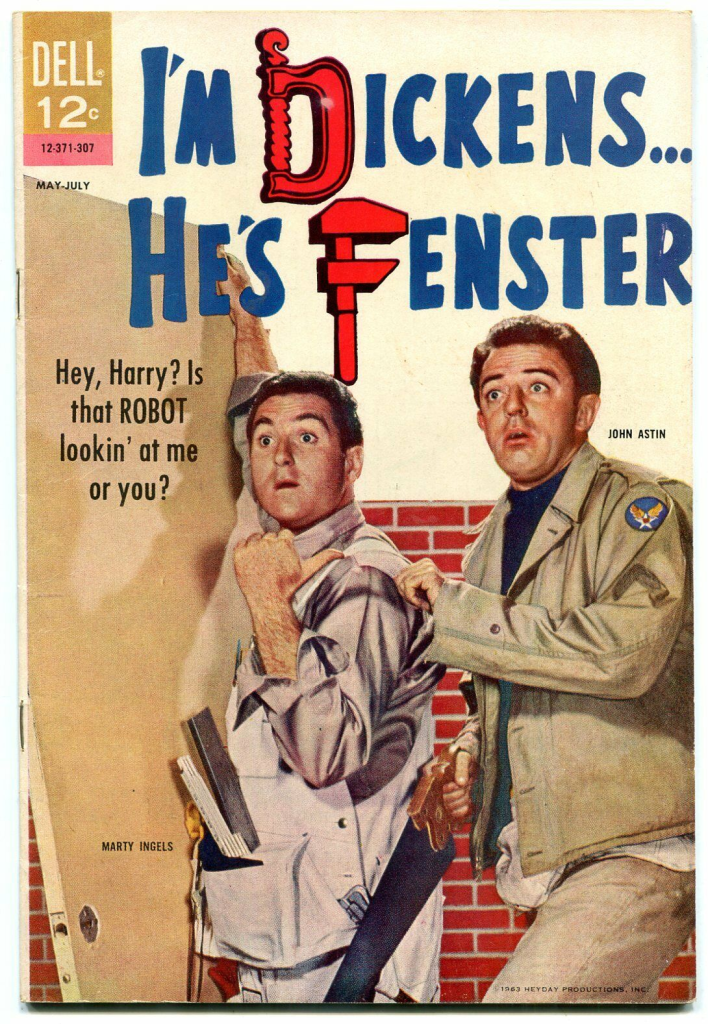
Like The Governor and J.J., this series also made it to Dell Comics; if you’re a collector of comic books about old television series, you can take a look.

I had heard a lot about this show but never watched it till now. It was different and funnier than I thought it would be.
Stars Who Jump From the Big Screen to the Small Screen Don’t Always Land on Their Feet

While it is not uncommon for stars to transition from television to movies–think about Robin Williams, Sally Field, Melissa McCarthy, and Tom Hanks–it is less likely to see stars move from the big screen to the small screen.  Jane Fonda has transitioned to television in Frankie and Grace and Fred MacMurray did it with My Three Sons.  For most stars, the move has not worked out very well. Let’s look at a few stars who tried to make the conversion.

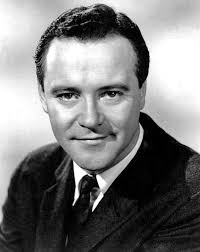
That Wonderful Guy – Jack Lemmon (1949)

Neil Hamilton (best known as Commissioner Gordon on Batman) plays Franklin Westbrook, a conceited drama critic who dislikes almost everything. Jack Lemmon plays Harold, a Midwesterner who thinks working for Westbrook will help him become worldly and give a boost to his acting career. His girlfriend is played by his real wife Cynthia Stone. The episodes revolved around his romantic and business adventures in New York City.  Perhaps Westbrook panned the show because it was cancelled after three episodes.

movielemmon1


Heaven for Betsy – Jack Lemmon (1952)

Three years later, Lemmon gave it another try. In this show, Lemmon plays Peter Bell, a toy store buyer. His wife Cynthia again played his wife Betsy. The series was based on a sketch “The Couple Next Door” that Lemmon and his wife played regularly on the Frances Langford/Don Ameche Show. Each episode lasted 15 minutes, and it told about the newlyweds’ struggles in New York City. Instead of three episodes, this series lasted three months.

movieslemmon2


Honestly Celeste – Celeste Holm (1954)

After playing Ado Annie in Oklahoma, Holm tried her hand at television. She plays Celeste Anders, a Minnesota college professor living in Manhattan, who is getting journalism experience working for the NY Express. Celeste wrote stories ranging from modern art to underprivileged families. She also dated the publisher’s son Bob Wallace, played by Scott McKay. After three months, she was sent back to school in Minnesota. What was most surprising about this failure was that Norman Lear (who would go on to create dozens of shows) and Larry Gelbart (who later created M*A*S*H) were both part of the writing staff.


Going My Way – Gene Kelly (1962)

Bridging television and movies, Gene Kelly redid Bing Crosby’s movie from 1944 for the small screen. Kelly is Father Chuck O’Malley, a progressive priest assigned to the slums of New York. Father Fitzgibbon played by Leo G. Carroll is a cantankerous, old priest. Dick York was his boyhood pal Tom Colwell who ran the community center. Mrs. Featherstone (Nydia Westman) played the rectory housekeeper. The list of guest stars on the show was very impressive, but after a year, the network told Kelly to keep going and cancelled the show.


The Bing Crosby Show – Bing Crosby (1964)

I guess Bing decided if Gene Kelly could enter television with his old movie, he might also give it a try. He plays Bing Collins a former singer. He is now an electrical engineer married to Ellie (Beverly Garland) with two daughters Janice (Carol Faylen), 15, and boy crazy and Joyce (Diane Sherry), 10, who had a high IQ. It lasted one season. Not surprisingly, this series also attracted a lot of big-name guest stars including Frankie Avalon, Jack Benny, Dennis Day, Joan Fontaine, and George Gobel. Apparently, Garland had a thing for engineers because she would marry aeronautical engineer Steve Douglas on My Three Sons.


Mickey – Mickey Rooney (1964)

Mickey plays Mickey Grady who leaves the Coast Guard to manage a posh hotel, Newport Arms in California, with his wife Nora (Emmaline Henry) and two young boys. His real son plays one of his sons on the show. Sammee Tong plays the hotel’s manager. The former supervisor has left a lot of problems for Mickey. The show was cancelled in January airing only 17 episodes.


One of the Boys – Mickey Rooney (1982)

After vowing never to work on television again, Rooney tried it again 18 years later. Now he plays 66-year-old Oliver Nugent, rescued from a nursing home by his grandson Adam Shields (Dana Carvey). Adam is a college student who takes him in. Adam’s roommate, Jonathan Burns (Nathan Lane) is not so happy about the situation. Oliver looks for a job and lands one singing in a restaurant. Also appearing in the cast was Scatman Crothers who sang with Oliver and had also left the nursing home.  A young Meg Ryan played Adam’s girlfriend Jane. The show debuted at 18th place in the ratings but by within a month it had dropped to 68th. Even with this cast, the show was cancelled after an unlucky 13 episodes.

movies10


Jimmy Stewart Show – Jimmy Stewart (1971)

Jimmy Stewart jumped to the small screen with great anticipation and excitement by viewers. He  played anthropology professor Jim Howard. Howard teaches at Josiah Kessel College, started by his grandfather.  His house is full with his wife, his son Peter, Peter’s wife Wendy, and his grandson Jake. He also has a young son Teddy, who happens to be the same age as his grandson. His friend Luther Quince often stops by to eat and give advice. Jim talks to the audience during the show and wishes them love, peace, and laughter at the end of each episode. Even beloved Jimmy Stewart was unable to save this show which was cancelled after one season.


The Doris Day Show – Doris Day (1968)

Doris Day was the most successful actor moving from film to television. However, I think the reason she managed to keep her show on the air for five seasons was because she changed the format so often that CBS did not realize it was the same show.  In 1968, Day is Doris Martin, a widow with two kids. She moves from the city to Mill Valley, CA to live on her father’s ranch.

The second season she commutes to San Francisco after accepting a job as an executive secretary to Michael Nicholson (MacLean Stevenson), the editor of Today’s Magazine. Rose Marie was Myrna Gibbons and Denver Pyle again played her father Buck Webb.

In 1970, Doris and the kids move to an apartment over an Italian restaurant run by Kaye Ballard and Bernie Kopell. Billy De Wolfe was her neighbor. Now Doris is writing feature stories for the magazine.

When the show returned the next fall, Doris was single and a reporter for a magazine. Her new boss was Cy Bennett (John Dehner) and she had a boyfriend Peter Lawford but later her boyfriend turned into Patrick O’Neal. There was no restaurant.

By 1973, the network caught up with all the changes and cancelled the show.


It was interesting that so many actors failed in television when they were such celebrated movie stars. The radio stars seemed to have better luck making the transition. Jack Benny and Burns and Allen had long-lasting and popular shows. It’s hard to imagine actors like Ryan Gosling, Amy Adams, Julia Roberts, or Ben Affleck bombing on a television series today.

I think for now I will continue to choose to watch Pillow Talk, Move Over Darling, Harvey, The Philadelphia Story, Some Like It Hot, Singing in the Rain, and Hope and Crosby’s Road movies and set aside the television DVDs these stars appeared in.