October is “What a Character,” blog series month, and we are taking a look at some of our favorite character actors. This blog features the wonderful Isabel Randolph.
Randolph was born in Chicago in 1889. After high school, Isabel began performing in regional theater throughout the Midwest until the mid-1930s. She married J.C. Ryan, a Chicago newspaperman, in 1917. Unfortunately, he passed away at a young age and she raised their two girls. She was the leading lady at the Princess Theater in Des Moines, Iowa. In a 2012 article, Ryan Ellett quoted Conrad Nagel as saying the Princess Theater “was recognized as one of the outstanding stock companies of the entire country, and is still referred to by some of the old timers as the best of them all.” Ralph Bellamy also spent time with the theater.
Photo: spicyonion.com
In the thirties, Randolph decided to try out radio. She was on the air on Fibber McGee and Molly from 1935-1943. She played a variety of roles but was best known for Mrs. Abigail Uppington, a society matron. During this time, she also was in several other soap opera-type shows. When the McGees moved their show to Hollywood, Isabel went to California with them where she took a chance at motion pictures.
Isabel specialized in the “grand dame” roles which continued into her film career. Of her 110 acting credits, 69 of them were for movies on the big screen, her first being in 1939 in The Women.
In 1953, she made the foray into television. Her first role was on The Dick Tracy Show in 1951, based on the popular comic strip.
In 1952, she got her second role, and her first recurring role in a sitcom, when she was offered the part of neighbor Mrs. Boone in Meet Millie. Meet Millie was about Millie Bronson (Elena Verdugo), a secretary who lives with her mother (Florence Halop) in Queens. Her boss is JR Boone (Roland Winters) and she sometimes dates his son Johnnie (Ross Ford). Family friend and poet Alfred Prinzmetal (Marvin Kaplan) often drops by. We don’t hear about this show very often but it was on for four years and produced 124 episodes.
Randolph did a variety of work in television throughout the rest of the fifties. She did a lot of theater programs, westerns, and also comedies including Burns and Allen, The Ann SothernShow, December Bride, and The Bob Cummings Show.
Photo: facebook.com
She had another recurring role during the last season of Our Miss Brooks when she played Ruth Nestor who ran a private boarding school. John Rich was the director on the show. He loved the cast and said especially Eve Arden was a joy to work with, very nice and very funny. He described the entire cast as “adorable.”
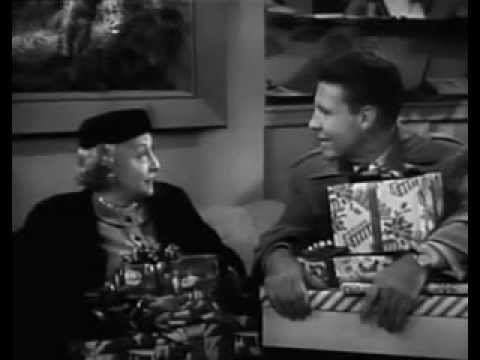
Although she didn’t have a recurring role on Ozzie and Harriet, she was on the show five times between 1956-61. My favorite of her roles on that show was “Busy Christmas” when she played Mrs. Brewster and was heading the Christmas caroling group.
During the sixties, Isabel kept busy. She appeared on Perry Mason three times, twice on The Andy Griffith Show, The Joey Bishop Show, Ben Jarrod, Arrest and Trial, and Many Happy Returns.
Tom Tully and Randolph as Clara Petrie with Photo: motionpictures.com
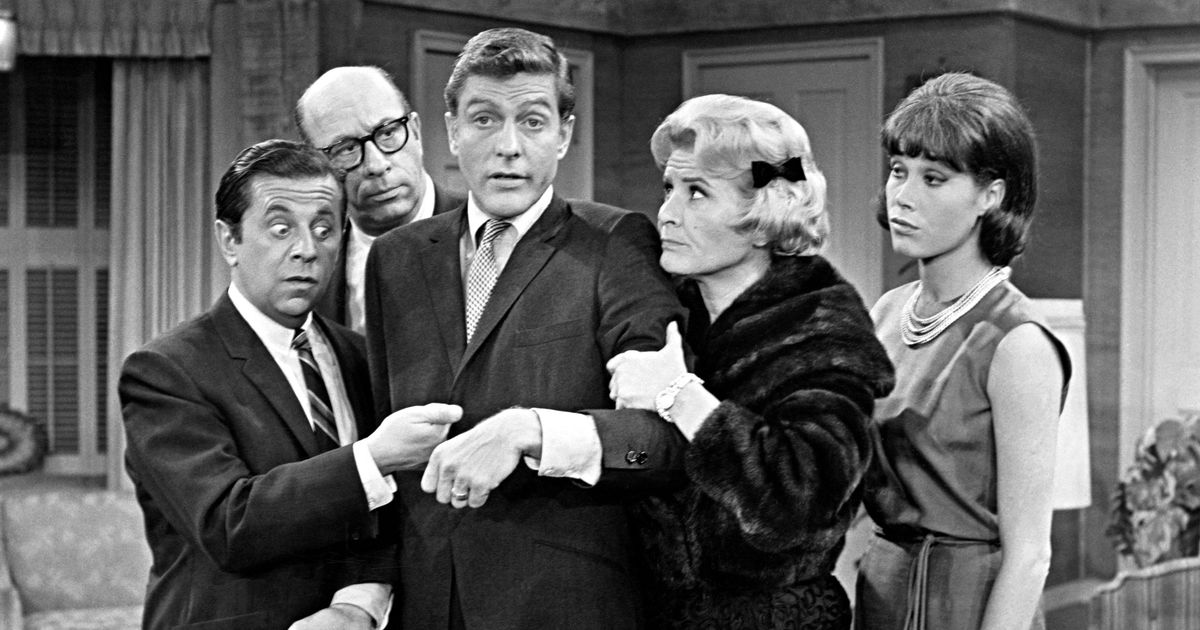
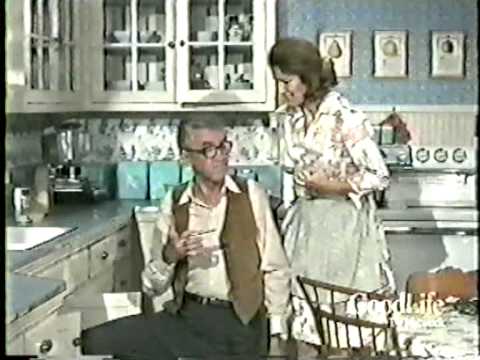
Her last recurring role was that of Mrs. Petrie on The Dick Van Dyke Show. In last week’s blog, we looked at one of the best Dick Van Dyke episodes, “Pink Pills and Purple Parents.” When Sally considers taking one of Buddy’s pain pills for her headache, Rob relates a time when Millie gave Laura some of her relaxation pills. Laura takes her first one when Rob’s parents arrive and as she becomes more nervous, she continues to take pills. Eventually, she is a bit loopy making strange comments, forgetting to put ice cream in the sundaes, and dancing to music before passing out. Rob’s parents are sure she has a drinking problem but later find out what happened. Randolph is a gem in this episode.
Randolph passed away in 1973 of undisclosed reasons.
Randolph with Ozzie Nelson–Photo: youtube.com
Sadly, like so many of our great character actors, there is not as much information about Isabel’s life. Character actors deserve to have more websites or books of their own. Isabel played the snobby rich woman in many of her roles, but I always think of her as an elegant, gracious mother type. Thank you, Isabel, for so many decades of entertainment and memorable characters. She was a character, indeed.
This blog series is “It’s My Show,” about actors who featured their names in the titles of shows. I’ve definitely saved the best for last: The Dick Van Dyke Show. During the past five plus years of writing my blog, I have realized that my favorite shows are those that feature amazing writing and concentrate on relationships. This show is no exception.
Photo: thiswastelevision.com
From 1961 till 1966, this show aired on CBS, resulting in 158 episodes. Created by Carl Reiner, it was produced by Calvada Productions. Calvada was named for Carl Reiner, Sheldon Leonard, Dick Van Dyke, and Danny Thomas. The show was filmed at Desilu Studios in front of a live audience. Bill Persky and Sam Denoff wrote 29 of the episodes.
The theme song was written by the great Earle Hagen. (For more on Hagen, you can see my blog from December 10, 2018; Hagen wrote many great theme songs including The Danny Thomas Show, Gomer Pyle, I Spy, The Mod Squad, and most memorably, The Andy Griffith Show.)
Photo: pinterest
The opening of the show had Rob walking into the living room. In one version, he trips over an ottoman, falling on the floor. In the another, he steps around the ottoman. You never knew which opening you would see, a fun element of the show.
I love that this show realized our professional lives are equally important to our personal and family life, and this show not only featured both, but often they meshed together just like all our lives do.
Not only was Rob Petrie’s (Dick Van Dyke) work life part of the show, but he was a television writer, which provided even more insights into what we were watching. Rob writes “The Alan Brady Show” with cowriters Sally (Rose Marie) and Buddy (Morey Amsterdam). Mel (Richard Deacon) is star Alan Brady’s (Carl Reiner) producer. Buddy and Mel have an ongoing feud, insulting each other on a daily basis. (In real life, Deacon and Amsterdam were good friends and often came up with new insults when they had drinks together after work.) Reiner originally planned on starring in the show and played Petrie in the pilot, but he was persuaded to give the role to another actor by Leonard.
Moore, Van Dyke and Mathews–Photo: wideopencountry.com
Rob’s home life consisted of wife Laura (Mary Tyler Moore), son Ritchie (Larry Mathews), and neighbors/best friends Jerry and Millie Helper (Jerry Paris and Ann Morgan Guilbert). Paris directed 84 of the show’s episodes and would go on to a career as a director later.
Moore, Paris, Guilbert, and Van Dyke Photo: motionpictures.com
In the pilot, titled “Head of the Family,” Barbara Britton played Laura, Gary Morgan played Ritchie, Morty Gunty played Buddy, and Sylvia Miles played Sally. Jack Wakefield played Alan Sturdy who was the star of the tv show.
The characters are very much like people we all know, except maybe a bit funnier. Rob loved his wife and son. He was a big fan of cowboy movies and Laurel and Hardy. He met Laura, a USO dancer, when he was in the Army as a Special Services Sergeant in Camp Crowder, Missouri. His brother Stacey appeared on the show a few times (played by real life brother Jerry Van Dyke). Richie is a typical kid who gets in trouble sometimes but is a good kid, just curious and looking to test his boundaries. Their neighbors Millie and Jerry have a son about Richie’s age, and they are their best friends; Jerry is also their dentist.
Moore, Van Dyke–Photo: pinterest.com
The only thing not realistic about his home life is that Rob and Laura have twin beds. Reiner asked the network to allow the couple to sleep in the same bed, but they would not approve it, so like most sitcom married couples, they had separate beds. About the only couples who were able to get around the challenge were the Stephens on Bewitched and Katie and Robbie on My Three Sons. The network also didn’t love that Moore wore capri pants but they did end up allowing her to do so.
Rob’s coworkers are also endearing characters. Buddy is energetic and sarcastic. He is married to Pickles and shares a lot of jokes about some of the scatterbrained things she does. We know he is in love with Sally, but they never take their relationship anywhere other than friendship. She is often making fun of herself for looking for a man, but we realize she is very lonely. Mel is an excellent producer who puts up with a lot from both Buddy and Alan.
Amsterdam, Deacon, Van Dyke, Marie, Moore–Photo: vulture.com
Van Dyke had to give up Bye, Bye Birdie to star in the show but definitely made the right choice. The role of Laura was a hard one to cast. Sixty actresses auditioned for the character. Moore almost chose not to go, and when she did, she lied about her age, making herself older than she was. Sally Rogers was based on Lucille Kallen who wrote for Your Show of Shows and Selma Diamond who wrote for Caesar’s Hour.
After the first season, CBS said they were cancelling the show. Procter & Gamble threatened to remove all its advertising and viewers complained loudly. The network didn’t need to worry about ratings in season two; the show was in the top ten by episode three and was popular for the rest of its time on air.
To color or not was a big question during the sixties. Reiner actually considered filming the show in color in the third season until he found out it would add $7000 per episode (the equivalent of about $59,000 today).
Deacon, Moore, Van Dyke, Leonard, Reiner, Paris Photo: taiwannews.com
I’m not the only one who thought this was an amazing show. The series was nominated for 25 Emmy awards and won 15 of them. Reiner won three times for writing, Van Dyke three times for acting, and Moore twice for leading actress in a comedy role.
Some of my favorite episodes are “Pink Pills and Purple Parents” (season 4) a flashback to when Laura meets Rob’s parents. She takes some anti-anxiety medicine Millie gives her. She gets a bit loopy and Rob’s mother thinks she has a drinking problem; “The Ghost of a Chantz” (season four) where Rob, Laura, Buddy, and Sally spend the night in what’s said to be a haunted cabin. Characters disappear one by one and finally we learn that Mel pranked them to test out a concept for a show called Sneaky Camera; “Coast to Coast Big Mouth” (season five) when Laura reveals on a TV game show that Alan is bald and wears a toupee. Laura bravely goes to the office to apologize; another one about Laura, “The Curious Thing About Women” (season one) when Rob writes a comedy skit about Laura’s bad habit of reading his mail. All her friends tease her after it airs, and she tries to deny it, but when a package comes to the house, she opens it and an inflatable raft opens up which she cannot put back; and finally, “That’s My Boy” (season 3) when Rob is convinced that the hospital switched their son with another boy born that day. He has to resolve this, and invites the other couple over to discuss the situation. When Rob opens the door, he sees an African American couple, and it gets one of the longest audience laughs than any other sitcom episode.
Moore, Reiner–Photo: nytimes.com
CBS may have wanted to end the show after season one, but they did not want to end it after season five. However, the cast made the decision to quit while they were still producing high-quality shows. I appreciate that they did this. One of the saddest things for me as a viewer is when a show goes on a year or two longer than it should and the quality diminishes greatly.
I just can’t think of anything about this show that needed improving. It had a great cast, great writers, likable characters, and a timeless quality. Sixty years after the show began, it is just as funny and easy to watch as it was then. Thank you, Carl Reiner and cast, for knowing how to make a memorable show and when to end it to keep it that way.
We are in the middle of the “It’s My Show” blog series, and today we are looking at a show that debuted in the mid-nineties. Although it feels like it was yesterday, we are looking back 25 years to The Drew Carey Show.
Photo: listal.com
Carey created the show from his stand-up comic and writing background, along with Bruce Helford who wrote for the television series, Roseanne.
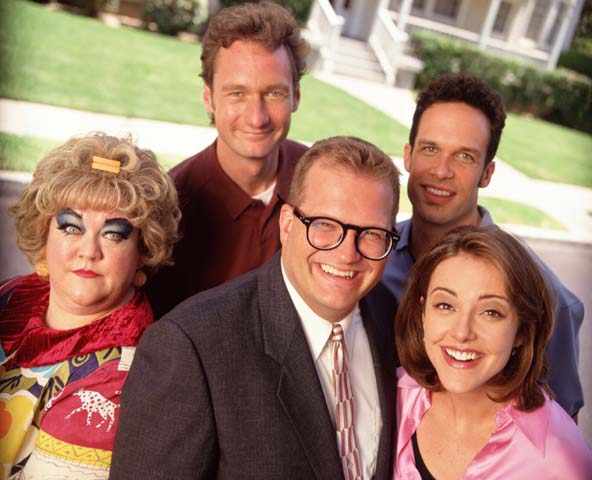
The show aired on ABC from September of 1995 until September of 2004. When Drew tried to explain his character, he described him as “what the actor would have been if he had not become an actor.” The show centers around Drew and his friends: unambitious Lewis (Ryan Stiles), not-so-bright Oswald (Diedrich Bader), and on-and-off again girlfriend Kate (Christa Miller).
Set in Cleveland, Drew works for the department store Winfred-Louder as Assistant Director of Personnel for the first seven seasons. His coworker, Mimi (Kathy Kinney), who always looks like the before photo in “how to apply your make-up correctly,” is also featured in the show. When the show begins, she and Drew strongly dislike each other, but they become closer over the run of the series. Drew also moonlights with his group of friends, making and selling Buzz Beer, a caffeinated alcoholic beverage, out of his garage. The beverage gains a following and is served around the city including at Drew’s hang-out, The Warsaw Tavern.
Photo: decider.com
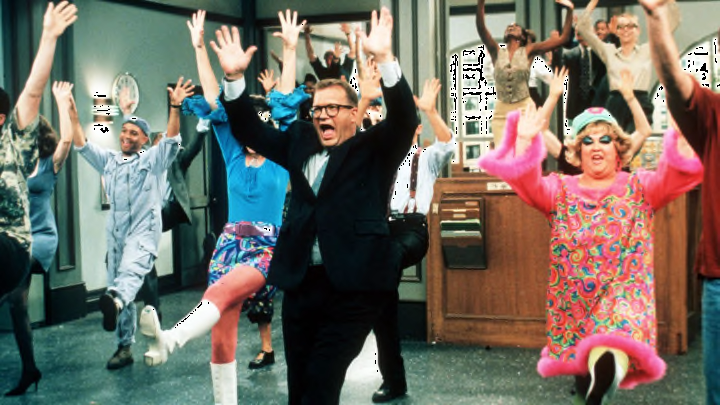
The theme song bounced around a bit. In season one, the song “Moon Over Parma” was used with a few lyric changes to reference Cleveland. The second season ushered in “Five O’ Clock World.” The fourth season replaced this theme with “Cleveland Rocks.” In the eighth season, the previous three themes were all used but in a different genre each week.
One unusual aspect of Drew’s show was his frequent “event” episodes. For example, one episode featured the theme “What’s Wrong with This Episode?” and invited viewers to find errors to win a prize. There were three live productions when they actually did the show twice, one for each coast. There was also a prolonged story when Drew is in a coma.
Photo: videodetective.com
The show received praise from critics and viewers. It spent its entire life on Wednesday nights. Seasons two through four it was in the top twenty but Season five started to decline and the ratings dropped drastically during the final two seasons.
I have to admit I never watched this show when it was on in prime time. When I look at the opposing shows, they weren’t anything I tended to watch either except for West Wing a couple years, so I’m not sure why I missed it in its first life.
It was on about the same time as Friends with a similar theme but Friends has had an incredible after life and Drew Carey’s show has not. A lot of people describe the show as “mean.” With the popularity of Whose Line Is It Anyway? which I do enjoy, you would think that would spark a rerun of the show.
Photo: jacksonupperco.com
The show seems similar to Seinfeld as well. It is about a guy and his close-knit group of friends. However, where Seinfeld was always described as being about “nothing,” Drew Carey’s show seems to be about “everyman.” I got the impression from some viewers that they were so much like everyman they were extremely boring.
Apparently, only season one is available to watch. There are several places including Amazon and Apple TV where you can purchase an episode. That is also the only season available on DVD, but I could not find out why. Apparently, it aired as a rerun on the CW for a bit but since that time it has never been in rerun syndication, and only two seasons were ever on Hulu; none of the show has been available on Netflix as far as I can find. One source did mention that there is so much copyrighted material in the shows that would need to be edited out, it would not be possible to do a DVD set.
Photo: thebiglead.com
Since I don’t have a lot of personal knowledge about this show, and most of the seasons are not available to view, I will leave the final word to a few of those fans who did write reviews of the show.
This show wasn’t as funny as I thought it would be, but it’s okay. No profanity, which is always a plus for me. But I could do without all the references to sex among the characters.
U know, before Drew Carey got his own show, I didn’t even know who he was. This show truly capitalizes his talents as a comedian and actor.
“The Drew Carey Show” is by far one of the funniest sitcoms on television in recent years. It also happens to be my third favorite show. Our bespectacled hero, Drew, works in a Winfried-Louder Department Store’s offices, run by a dorky Scot, Nigel Wick (Craig Ferguson). His arch-nemesis, Mimi Bobeck-Carey (Kathy Kinney) wears tons of make-up and tacky clothes, much in the same sense that Peggy Bundy on “Married with Children” was the queen of tacky. Of course, Drew has his girlfriend, Kate (Christa Miller) and his dopey buddies, Lewis Kiniski (Ryan Stiles, who upstages Carey) and Oswald Lee Harvey (Deidrich Bader).
This show is very funny. The plotlines are always interesting, and of course, Lewis and Oswald have to accomplish some stupid feat in the 1/2 hour (ie: they used $8000 to record an album using classic songs, with them–“Tequila” or Lewis saying “Wipeout!”) Of course, everyone gets into a big mess, Mimi insults Drew, Drew plots revenge, and everything is said and done in the half hour.
I love this show, and highly recommend it to everyone who has a good sense of humor. Drew Carey’s standup is excellent, and this show just adds another good credit to a very talented man!
I do remember the show. There were some funny interactions among the characters (e.g., Oswald and Lewis) and Craig Ferguson was a funny foil/boss of Drew’s. However, it’s not a show I’d be clamoring to see again. If I ever caught it while flipping through, I might watch a little of it before moving on. I’m 35 but I think only a handful of shows from the 80’s and 90’s would get frequent viewing from me now (e.g., “Cheers”, “Frasier”, “Married with Children” and “Seinfeld”).
This is one funny sitcom! Drew Carey and his co-stars (especially Kathy Kinney as Mimi Bobeck) each have an ingenious sense of comic timing! In addition, the show itself fairly accurately portrays the plight of the normal, everyday guy who’s trying to find both love and success in today’s world. Plus, the show sometimes has some highly loony episode storylines and crazy sight-gags that are normally only seen in movies! I would highly recommend this TV series to any serious comedy buff!
I do vaguely remember it, although I was never a big fan. My suspicion for why it has mostly disappeared is that while its audience was loyal, it was pretty narrow. In most shows, you can have a group of sad sacks or outcasts, but you also need someone relatable to ground the show. I don’t think the show had that. Drew Carey might have been the central character, but not a terribly strong one. Then that narrow audience grows up.
A great sitcom comedy show! The show is about Drew Carey and he works at a department store where he is the assistant personal director in Cleveland and he has been stuck at his job for ten more years. Other than fighting with co-worker Mimi, his hobbies include drinking beer and not being able to get dates. To make a few extra bucks he has a micro-brewery going in his garage with his buddies Lewis and Oswald. This show is so funny and I also like the intro to this show entitled “Cleveland Rocks” in the opening we see Drew and the others running out of the building and then tail-gating at a Cleveland Indians baseball game and then you see Drew and the crew dancing and at the end of the intro Drew yells “OHIO”! My favorite characters from this show were Lewis and Oswald. They have got to put this show out on DVD. Another great 90’s ABC sitcom!
Eh. Not the greatest show ever. The whole “Buzz Beer” thing is totally overrated, and so is Kate. Some of the shows, however, are very good (like when Drew goes to the Value Date class, or winds up working in the cafeteria, or getting sent to China). Some of the best episodes are from 1997-1998, I seem to remember that was when this show was in it’s prime. After Nicki left, it was all downhill from there.
Thumbs up or thumbs down? I’ll let you decide. I would love to hear your opinion of the show.
For this blog series, “It’s My Show,” we are looking at stars who had shows named for them. This blog takes a look at The Jimmy Stewart Show which aired in 1971.
Photo: reelgood.com
At the beginning of the golden age of television, several stars decided to plunge into the small screen, but most stars kept their distance, not trusting that television would ever go anywhere. Stars like Jack Benny, Burns and Allen, and Lucille Ball created successful shows that continued for years. Once Hollywood realized that television was here to stay, they were okay with their stars dipping their feet into the series life.
In the 1970s another round of stars decided to try their luck at their own show. Jimmy Stewart was one of those screen stars, and he had a huge fan base. Viewers were greatly anticipating watching his show.
Photo: tvmuseum.com
Hal Kanter was the creator, writer, and sometimes director for the series which showed viewers the frequently chaotic home and work life of Professor Jim Howard. Kantor developed the show Julia and would later create Chico and the Man. Howard teaches anthropology at the Josiah Kessel College in Easy Valley, California which happened to be founded by his grandfather. Also living in the house are his wife Martha (Julie Adams), his son Peter (Jonathan Daly), daughter-in-law Wendy (Ellen Geer, daughter of Will Geer) and grandson Jake (Kirby Furlong). Martha and Jim also have a younger son, Teddy (Dennis Larson) who is almost the same age as Jim’s grandson. Peter’s family is living there temporarily after their house burns down. In a twist I didn’t see coming, Jim was babysitting and fell asleep with a cigar which is what caused both the house to burn down and his son to be unhappy with him for the first few episodes.
Howard’s best friend, Luther Quince (John McGiver), a local bachelor and professor, often stops by for meals and to discuss life with Jim.
Photo: travalanche@wordpress.com
Rounding out the cast were a few recurring characters including Jo Bullard (Mary Wickes), president of the Women’s Action Group; Agatha Dwiggins (Jeff Donnell), a scatterbrained busybody, Dimitri Karpopolis (Richard Annis), college football hero; local businessman Fred Shimmel (Rickie Layne), chatty milkman Woodrow Yamada (Jack Soo), and students Janice Morton (Kate Jackson), Norman Lansworth (Lou Manor) and Ida Levin (Melissa Newman).
I read that except for Stewart, the casting for the family seemed to be off and never engendered any warmth for viewers. Jimmy wanted his real wife Gloria to play Martha, but after she was tested, the network said they wanted someone more experienced. More than fifty women were considered for the role, and twenty of them were brought in to read with Stewart.
However, John McGiver received a lot of praise for his character. Luther and Jim were quite different. Jim rode his bike to school while Luther drove a Rolls Royce.
The show really didn’t speak to viewers, and ratings, which weren’t great, got worse. The series was cancelled after 24 episodes. Stewart was not sad about the cancellation. Apparently, he was given the option to do the same type of work schedule Fred MacMurray had arranged for My Three Sons where he only filmed a small part of the year and everyone else filmed around him, but he declined. However, Stewart said he later regretted not trying that because he didn’t enjoy the long hours filming this show.
Photo: youtube.com
The show debuted in the fall of 1971 on Sunday nights. It was sandwiched between The Wonderful World of Disney and Bonanza, both big hits.
Like George Burns, James Stewart talked directly to the television audience during the opening and closing when he says “And, as always, my family and I wish you peace and love—and laughter.” During some episodes he makes an aside to the camera, and the rest of the cast thinks he’s just mumbling to himself.
This was one of the few shows during this time period that didn’t use a laugh track. Maybe that’s for the best because it doesn’t sound like there was much to laugh about in this show. It definitely shows its age today with Stewart making remarks about student protests, women’s lib, and industrial development. It obviously pandered to an older, conservative audience.
The show was filmed on a few sets and backlots. The building used for the university was known as “Hank’s School” because it first was used on a show from the sixties called Hank. It was also Boatwright University on The Waltons.
Photo: imdb.com
Sometimes there is a downside to blog writing about the past and our favorite stars. Jimmy Stewart has always been someone I admired and respected. A couple of his movies like The Philadelphia Story and Harvey are some of my of all-time favorites. When doing research, sometimes you learn things you wish you didn’t know.
Apparently, Stewart had gotten a reputation during the filming of The Man Who Shot Liberty Valence as a racist, but no one ever talked about it, and there didn’t seem to be any other controversy in his films. However, during the production of this show, he had actor Hal Williams fired. I read several accounts that all supported that view that Stewart told Kanter that he didn’t think it would be appropriate for a black person to be ordering him around on television. His words, often quoted were, “Blacks are bossing white people all over the country, and now we’re going to have the same damn thing on prime-time television? A black is going to be lecturing me with millions of people watching? No way. I get casting approval and Williams is out.” I never read how Kantor reacted or how it affected their relationship; however, after casting Diahann Carroll as the first black actor to star in a series, it must have been disheartening to hear this from Stewart.
I understand those were different times and many people were raised as racists. We could debate the causes of people being prejudiced for hours. However, this makes me very sad and I can’t look at Jimmy Stewart the way I did before. It doesn’t help to realize that there are still somehow a lot of Jimmy Stewarts out there sixty years later.
Photo: comforttv.com
As far as his show goes, I think it was just not where fans were at in that time period. Some of the other series on at the time included The Partridge Family, The Doris Day Show, Love American Style, Room 222, The Mary Tyler Moore Show, and All in the Family. By comparison, Jimmy’s show seems out of touch and old fashioned. Its competition was the F.B.I and Sunday Night at the Movies, both shows that started during The Wonderful World of Disney. If a show didn’t succeed following Disney and leading into Bonanza, it must have greatly disillusioned viewers. Jimmy was not alone as a star who couldn’t make the successful leap to television. Other stars who bombed with their shows include Jack Lemmon, Celeste Holm, Gene Kelly, Bing Crosby, Mickey Rooney, and Henry Fonda.
Although this show is available on DVD, my suggestion is to bypass it and read a good book instead.
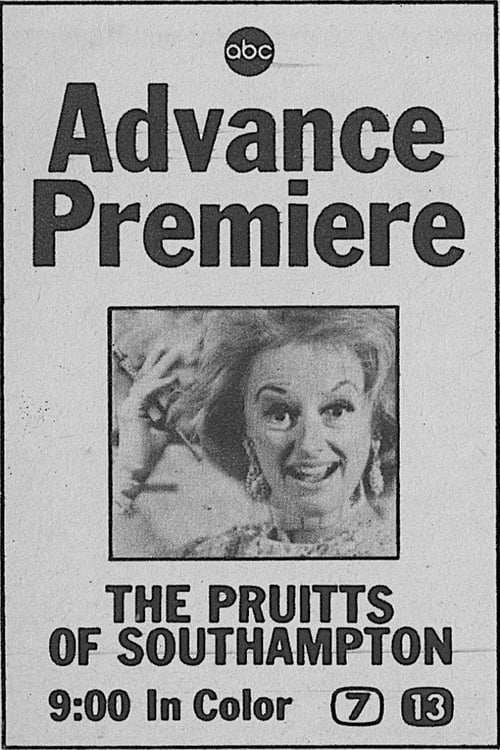
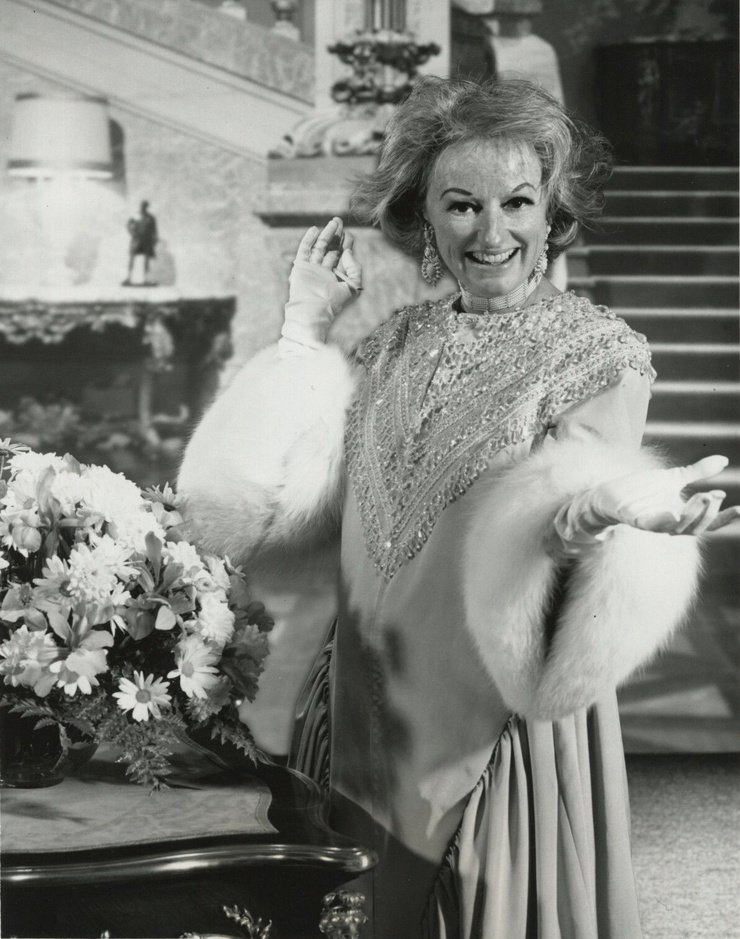
This month’s blog series is “It’s My Show.” Today we are beginning with a show I’ve discussed a few times over the years that had the perfect cast and concept, but it was cancelled after only one season: The Phyllis Diller Show which also went by The Pruitts of Southampton.
Photo: pinterest.com
The show was created by David Levy in 1967 and was loosely based on the book House Party by Patrick Dennis. Levy was also the creator/producer for The Addams Family which aired from 1964-1966. The shows also shared composer Vic Mizzy who wrote the themes for both series. Mizzy also wrote the catchy tune from Green Acres. The opening theme song had Phyllis Diller dancing, skipping, and singing through the mansion, and the lyrics were:
PD: Howcha do howcha do, howcha do my dear What a LOVELY surprise, nice to see you here.
RG: All the bills have been long overdue my dear.
PD: File them under I.O.U… Howcha do, howcha do, Well HELLO, it’s you! Like my beads, like my dress? Aren’t they marvy-poo? They belong to the internal revenue. And they got us eating stew.
CHORUS: The Pruitts of Southampton,
Live like the richest folk, But what the folk don’t know is that The Pruitts are flat broke!
PD: Howcha do, howcha do, howcha do, my dear
RG: We are out of champagne, and I’m stuck, my dear.
PD: Ask the butler to lend you a buck, my dear. Howcha do, howcha do, howcha do…
The Pruitts, an incredibly wealthy family, live in the Hamptons. After going through an IRS audit, the family realizes they owe so much in back taxes, $10,000,000 in fact, that they were now broke. The IRS agrees to let them continue living in their mansion because they think exposing such a wealthy family’s poverty would cause a lot of repercussions.
Photo: pinterest.com
Phyllis Diller starred as Phyllis Pruitt. Phyllis lives with her uncle Ned (Reginald Gardiner), her brother Harvey (Paul Lynde), her daughter Stephanie (Pam Freeman), brother-in-law (John Astin), and their butler (Grady Sutton). Midseason, the show was revamped and the family brings in boarders to raise money, including Norman Krump (Marty Ingels) and Vernon Bradley (Billy De Wolfe). They should have been able to raise a bit of money with 68 bedrooms in the house. Other characters included Regina Wentworth (Gypsy Rose Lee), their nosy neighbor and Baldwin (Richard Deacon), the IRS agent. The incredible Charles Lane plays Max.
In addition, there were a lot of guest stars during that single season including Ann B Davis, Bob Hope, Arte Johnson, John McGiver, Louie Nye, Hope Summers, and Mary Wickes.
The shots of the family home were filmed at the Vanderbilt mansion, Biltmore.
The show began on Tuesday nights. At the time, The Red Skelton Hour was one of the most popular shows on television and was tough competition. When the show was revamped, it moved to Friday nights where it was up against Friday Night at the Movies and T.H.E. Cat. If you don’t remember that show, don’t feel bad, you probably remembered very few of the new series that debuted that year.
Photo: nostalgiacentral.com
1967 was not a very profitable year for sitcoms specifically. Besides Phyllis Diller’s show, the season aired Run Buddy Run, Mr. Terrific, The Jean Arthur Show, Occasional Wife, and Pistols and Petticoats. That Girl was one of the few shows to return the following season.
Even though it was named as one of the worst sitcoms ever in several TV Guide listings, critics at the time praised the show. Phyllis Diller was nominated for a Golden Globe for Best Actress in 1967. Marlo Thomas won, but there was some great competition including Elizabeth Montgomery, Barbara Eden, and Barbara Stanwyck.
Photo: listal.com
One reviewer on imdb.com titled their review “The worst thing I have ever seen in my life” and followed up with a review that said, “Just kidding, this show is amazing and hilarious and that is why I gave it a 10/10.”
When Vic Mizzy discussed the show in a Televison Academy interview, he said the director was not any good, the scripts weren’t as funny as they could have been and sometimes Phyllis didn’t know her part. He thought those were the reasons the show failed. He thought it could have been unbelievabley funny.
One day Vic got a large check from England and it turns out the show was a hit there decades after it was aired in the United States.
I watched a couple of the episodes on youtube for this blog. Phyllis Diller was in rare form. Her hair is crazy like always and slapstick was part of her performance. The laugh track was annoying, but the show was funny at times. Pam Freeman was a breath of fresh air. In one of the episodes, Phyllis and her brother-in-law were trying to finance a pizza-making machine. They had to work around the fact that Baldwin from the IRS put a pay phone in the home to keep them from making so many long-distance calls. One of the funniest scenes was when Phyllis and her brother-in-law climb up one of the phone poles to tap into the line to talk to Baldwin pretending to be other people in order to get Baldwin to approve their financing. Phyllis had to come up with a variety of different voices during the calls. You could definitely hear a bit of Green Acres influence in the background music for this show. This was a show that only could have been produced in the sixties.
One of the best parts of watching the show was seeing the old commercials. I had forgotten the one about Joy dish soap when the dinner guests could see themselves in the plates. It just reminded me it was joyful to see these old shows in their entirety.
It was a fun show to learn about with an outstanding cast and should have been much more successful than it was. Whether the failure came from the director, the scripts, or some other behind-the-scenes issue, I’m not sure. It’s worth watching an episode or two just to see the wackiness that was associated with some sixties shows, but if I have to watch ten episodes of a show, I’ll take That Girl every time.
As we finish up our “Men of August” series, I think I’ve saved the best for last. Today we look at the career of a man who had more than 400 acting credits during six decades: William Schallert.
Photo: comforttvblogspot.com
Schallert was born in Los Angeles, California. His father, Edwin, was a drama critic for the Los Angeles Times and his mother, Elza, was a magazine writer and radio host. She interviewed some of the most famous people in the entertainment industry. Being in LA, he went to high school with Alan Hale Jr., Nanette Fabray, and Micky Rooney.
Schallert was also a composer, pianist, and singer. His first love had been music, and he studied composition with Arnold Schoenberg. Unfortunately, he realized that some of the other students were more adept at hearing the music in their heads than he could and that would inhibit his making a living from composing.
William decided to be an actor and registered at the University of Southern California. He left school temporarily to join the Army Air Corps as a fighter pilot during WWII. Following the war, he returned to school, graduating in 1946. That same year he was one of the cofounders of the Circle Theater. Sydney Chaplin was one of his friends at the theater, and in 1948, his brother Charlie directed Schallert in a production of W. Somerset’s Maugham’s “Rain.”
From 1947-1951, William appeared in 14 big-screen films, including Mighty Joe Young in 1949. He would go on to accept roles in seventy more films during this career, but for this blog, I’m going to concentrate on his television career, or we could be writing and reading for days.
Schallert married Leah Waggner in 1949. They were together for their entire lives, dying a year apart from each other. Waggner was also an actress and appeared with him in several episodes including The Patty Duke Show and The Dick Van Dyke Show.
With wife Leah Waggner on The Dick Van Dyke Show–Photo: facebook.com
During his career, he appeared in a lot of crime shows and westerns, but he could also do comedy as seen by his appearances on Burns and Allen, Father Knows Best, The Jack Benny Show, The Andy Griffith Show, The Dick Van Dyke Show, Bewitched, That Girl, The Partridge Family, and Love American Style. Some of these were his favorite appearances.
Photo: pinterest.com
On the Partridge Family, he was able to use some of his music skills as Red Woodloe, a folk singer. The episode of The Dick Van Dyke Show, “A Word a Day,” got a huge laugh for Schallert. It was similar to the episode when Rob is convinced that he and Laura got the wrong baby and Ritchie belongs to another family who he invites over and opens the door only to find Greg Morris, an African American. In this one, Ritchie begins using profanity and they assume it’s one of his new friends and invite the parents over to see what type of uncouth people they are and Rob opens the door to find William Schallert, a reverend.
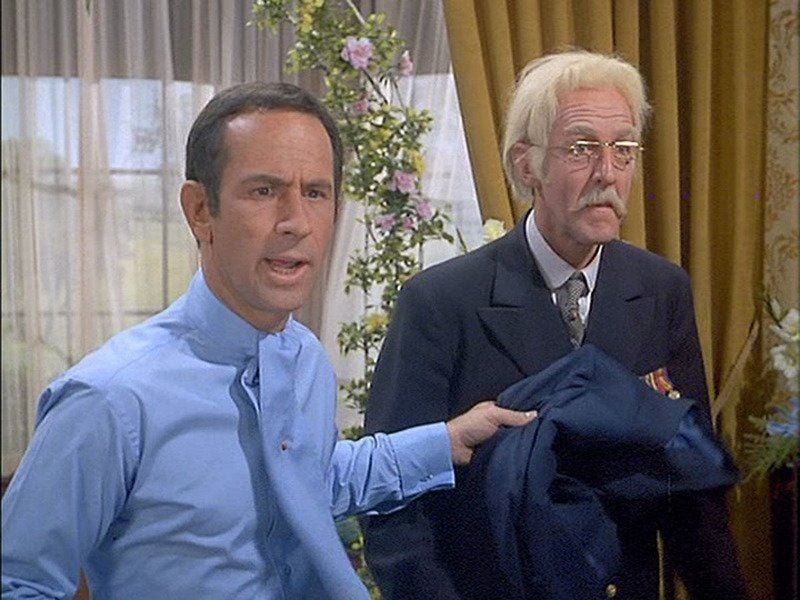
The admiral he played on Get Smart was one of his favorite all-time characters. William said, “The admiral was a charming character.”
Photo: greensburgdailynews.com
From 1979-1981, Schallert was the president of the Screen Actors Guild and was active in SAG issues and committees afterward.
During his six decades of acting, Schallert had recurring roles on eleven different series. The first was The Adventures of Jim Bowie in 1957. This show was set in the Louisiana Territory in 1830 and featured the people that Jim Bowie met there.
In 1958, William became part of the cast of Hey, Jeannie about Jeannie MacLennan, a Scottish woman, who has immigrated to New York and her adjustment to city life.
Photo: ebay.com
1959 found him on Phillip Marlowe as Lt Manny Harris. The same year he also began portraying Leander Pomfrit, a teacher on The Many Lives of Dobie Gillis. That role lasted three years.
It was in 1963 that he received the role that made him a household name. As Martin Lane, Patty’s father and Kathy’s uncle, on The Patty Duke Show. The show was on the air for three seasons, producing 104 episodes. Martin was the patient, wise father who knew when to give advice and when to step back and watch a small failure for a learning experience.
Photo: washingtonpost.com
He and Patty became very close in real life. In an interview with the Closer Weekly, Schallert discussed their relationship. “When I think of her, she’s family as far as I’m concerned. We had a very close relationship. Whenever I saw her it was always like greeting one of my kids. She just had a wonderful quality and I got to know her over the years and she was admirable in a lot of ways. She really did her best to raise her own kids and she certainly had very little help in her own life to do that, but she was very mature and she did a lot of growing up very fast. People take that kind of thing for granted far too easily, and she doesn’t get the credit she deserves for that.”
When the Patty Duke Show ended, Schallert began doing voiceover work in commercials and with his warm and friendly manner, it was a lucrative career for him for two decades, including the voice of Milton the Toaster for Pop Tart commercials. He said it was wonderful, “All you had to do was go in there and do it, you didn’t’ have to put makeup on, you didn’t have to learn anything. I also had a knack for timing.”
Although he had a successful voiceover career, his acting career was far from over. He would show up as a regular cast member on five more series before his career ended: The Nancy Walker Show, The Hardy Boys/Nancy Drew Hour, The Waltons, The New Gidget Show, and The Torkelsons. I especially loved his casting in Nancy Drew. When I read those books as a grade-school kid, he was exactly as I pictured Nancy’s dad Carson Drew in my mind.
Nancy Drew Hour–Photo: williamschallert.com
His last role was on Two Broke Girls in 2014. In that year, he announced he was suffering from peripheral neuropathy and had to wear leg braces some but also had to rely on a wheelchair most of the time. He passed away two years later from an undisclosed condition.
It sounds like Schallert had an amazing life. Growing up in Los Angeles and learning from his parents about theater and radio must have been a lot of fun. He said those connections led to a lot of opportunities like going to Shirley Temple’s birthday parties. Then he started a theater at a young age, worked in television from 1951-2014, appeared in more than eighty movies, had a successful voiceover career, raised four great kids and enjoyed a long-lasting marriage. What a legacy to leave behind.
This month we are looking at some of our favorite sitcom stars. With roles in more than eight popular sitcoms, Jerry Van Dyke has to be in the mix.
Photo: amazon.com
Jerry was born in Danville, Illinois in 1931. Van Dyke started his comedy stand-up career in high school performing for local nightclubs. In 1954 he joined the US Air Force Tops in Blue, performing at military bases around the world. During this time, he also played the banjo in his shows. After his military time was up, he married Carol Jean Johnson; they would divorce in 1974.
Photo: gr8terdays.com
Dick Van Dyke was his brother, and Jerry’s first television appearance was on his brother’s show where he fittingly played Rob Petrie’s brother Stacey.
In 1963 he made his movie debut with two movies: The Courtship of Eddie’s Father and Palm Springs Weekend. He was also made a member of The Judy Garland Show which was cancelled after its first season. I’m not sure if there were behind-the-scenes issues with this show or not, but it seems like it would have been more successful at that time. What I was able to read was that it went through a lot of personnel changes; had to compete with Bonanza; and that while viewers loved Judy, they did not love the format or Van Dyke.
McClintock–Photo: tidefans.com
Jerry made a few more television appearances in the early sixties on Perry Mason, The Cara Williams Show, The Andy Griffith Show, and McClintock.
In 1965, Jerry was offered the role of Dave Crabtree on My Mother the Car. The premise of the show is that Dave buys an antique car only to realize his dead mother talks to him through the radio, and no one else knows it’s happening. This show is often cited as the worst sitcom of all times, but it certainly has some strong competition. Somehow viewers suffered through 30 episodes before the show was put out of its misery. I’m not sure if it was a blessing or a curse, but Jerry turned down the role of Gilligan on Gilligan’s Island for this show. Luckily, this show didn’t seem to have too much negativity on his career, while Bob Denver was typecast to the point that he never really had much of a career once the show ended.
Photo: youtube.com
When the show ended, Jerry made appearances on That Girl and Vacation Playhouse before being offered another leading role. He was cast as Jerry Webster in Accidental Family. He aptly plays a nightclub comedian who was a widower with a small son Sandy. After buying a farm to raise Sandy, he hires Sue Kramer (Lois Nettleton) as governess and, of course, there is some romantic tension. This show only lasted for sixteen episodes before ending.
Photo: imdb.com
After showing up on Good Morning World and Gomer Pyle, USMC, Jerry was offered another lead role as Jerry Brownell, a physical education teacher, on Headmaster. This was an Andy Griffith vehicle where Andy played the principal at an elite California private school. After fourteen episodes, Jerry was back to guest appearances which he made on Love American Style, The New Dick Van Dyke Show, and The Mary Tyler Moore Show.
In 1977 he married again, this time to Shirley Ann Jones, and they were together until his death.
1979 brought him another regular role on 13 Queens Boulevard. The show was set in a New York apartment complex and explores the relationships of the residents. It just never clicked with fans and was given the boot after 9 shows.
Photo: people.com
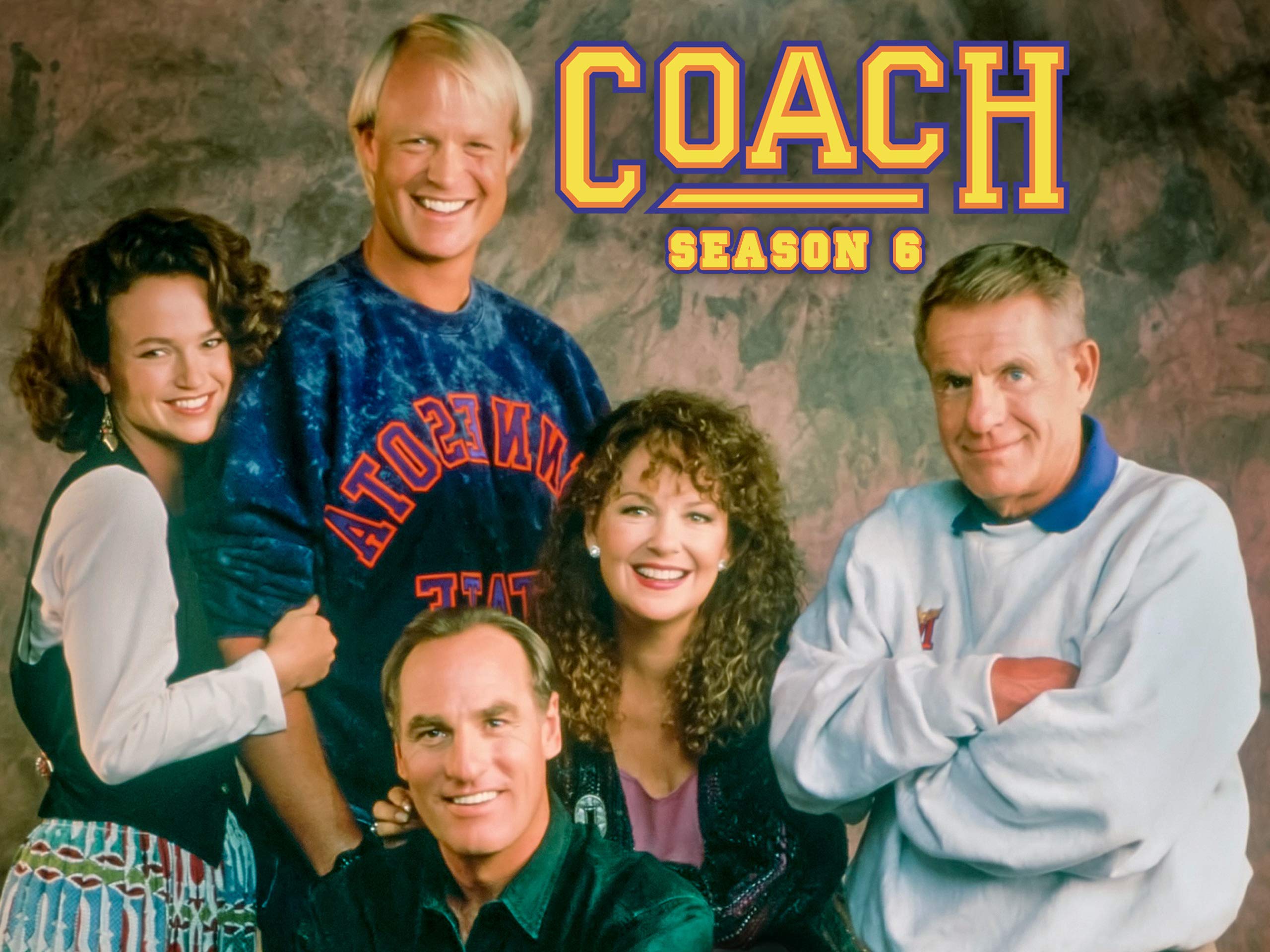
A decade later Jerry took on the role that he is best known for: Luther Van Dam on Coach. For eight years he was the assistant coach to Craig T. Nelson’s Hayden Fox–first as college coach and then for a time in the pros. Luther was the well-meaning but bumbling friend who often made life interesting for Hayden. However, he was a great coach. Van Dyke would receive four Emmy nominations for his character on the show from 1990-1993. His losses were to Alex Rocco on The Famous Teddy Z, Jonathan Winters on Davis Rules, Michael Jeter on Evening Shade, and Michael Richards on Seinfeld.
Photo: amazon.com
In the late nineties he had recurring roles on two shows that I do not remember anything about: Teen Angel and You Wish. Teen Angel was a weird concept where Marty DePolo eats a six-month old hamburger, dies, and then becomes his best friend’s guardian angel. Van Dyke played Grandpa Jerry. He played another grandpa on You Wish, which had an equally weird concept. Its premise is that a single mother finds a genie who was imprisoned in a magic carpet for 2000 years. Not surprisingly, they each had fewer than ten episodes before being canned.
Jerry Van Dyke was an avid poker player and fan, and from the late 1990s to the early 2000s, he hosted tournaments for ESPN. During that time, he also accepted guest roles on several television series and a few movies. However, his career was not over.
Photo: nytimes.com
He received two more recurring roles on popular sitcoms in the 2000s. From 2001-2005, he was Big Jimmy Hughes on Yes Dear and from 2010-2015, he was Tag Spence on The Middle.
He and his wife lived on a ranch in Hot Spring County in Arkansas where he seemed to be very happy. He passed away there from heart failure in 2018.
Most actors would have been very proud of a career mirroring Jerry Van Dyke’s, and I’m sure he was, but it would have been hard to be in your successful brother’s shadow so much of the time. Dick Van Dyke was five years older than Jerry and, with the success of The Dick Van Dyke Show, he had a career that was truly impressive. However, considering how few comedians make it in the business, Jerry had a stand-up career, a movie career, and a television career. His role of Luther Van Dam was a gem and gives us an example of what his career could have been if the luck of the dice had given him better roles.
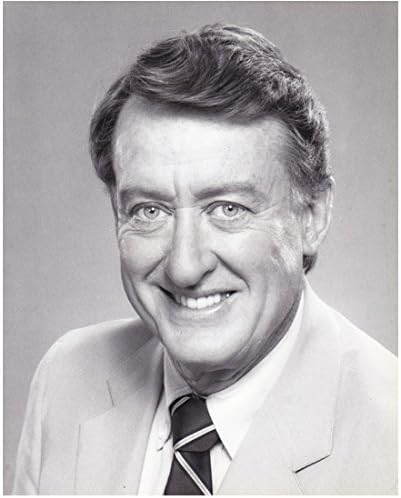
When I decided to do research for a blog series about some of my favorite sitcom actors, I knew Tom Poston had to be on the list. Poston seems to be someone who’s always a bit under the radar, and I’m not sure he ever received the accolades he deserved.
Photo: wikifandom.com
Poston was born in 1921 in Columbus, Ohio. His father was a liquor salesman and dairy chemist, an interesting combination. Poston started at Bethany College in West Virginia but joined the Air Force in 1941. He went to flight school and served as a pilot in the European Theater for WWII and was part of the Normandy invasion.
After returning home, he decided to move to New York City to study acting and graduated from the American Academy of Dramatic Arts.
Photo: pinterest.com
He was cast in his first television show, Tom Corbett, Space Cadet, in 1950. In 1955 Poston married actress Jean Sullivan. They would divorce in 1968, having one daughter.
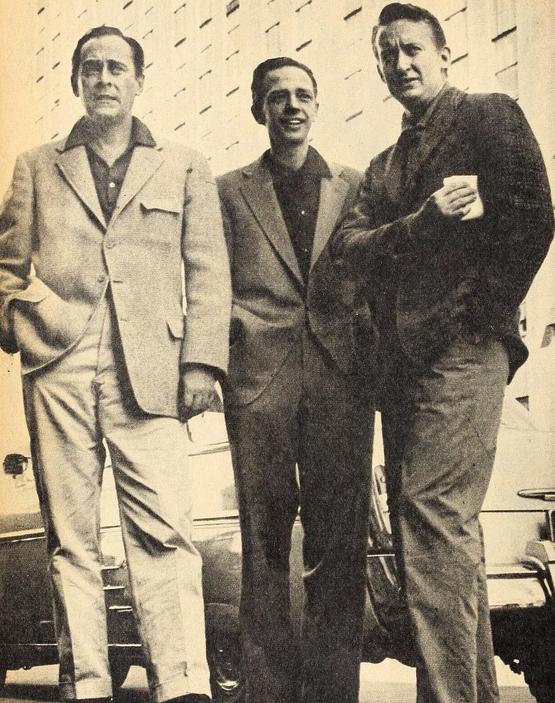
He continued receiving dramatic roles throughout the early fifties. In 1956 he joined the Steve Allen Show, along with his cast mates Don Knotts and Louie Nye. In 1959 he won the Best Supporting Actor Emmy for his work on the show. In 1960 The Steve Allen Show moved to Los Angeles and Poston decided to remain in New York, but Tom and Don Knotts stayed life-long friends. He appeared on Broadway often and began making the game show circuit and continued accepting drama roles on the small screen.
With Steve Allen cohorts Don Knotts and Louis Nye–Photo: tumbral.com
When Mel Brooks was putting together the pilot for Get Smart, ABC was planning on airing the show and they wanted Tom for the star. However, when ABC declined the show and when NBC picked it up, Don Adams got the lead; Poston did appear on the show as a KAOS bad guy.
Poston married for the second time in 1968 to Kay Hudson with whom he had two children. They divorced in 1975 but remarried in 1980 and remained husband and wife until her death from ALS in 1998.
The Peeper–Photo: pinterest.com
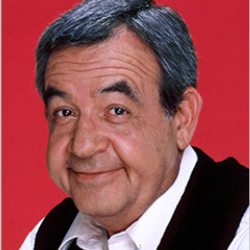
In 1975, he began recurring roles on two different sitcoms: On the Rocks and The Bob Newhart Show. On the Rocks was a show about the friendly rivalry between prisoners and their guards. On the Bob Newhart Show, Poston played “The Peeper,” Bob’s college buddy and big .prankster.
In 1977, Tom took on the role of Damon Jerome, photographer on We’ve Got Each Other. Beverly Archer played his assistant while her husband Stuart Hibbard (Oliver Clark) did the cooking and house cleaning. The show was cancelled after 13 episodes.
Photo: thetodayshow.com
He appeared on a variety of shows during the late seventies and from 1979-1981, he portrayed grouchy neighbor Franklin Delano Bickley on Mork and Mindy. Poston said the role he played on the show was written for him. He said Robin was hysterically funny all the time. He said Pam Dawber was a comic genius because she was able to keep the focus on both Mork and Mindy, because anyone else would have been lost in Robin’s antics.
Photo: dailyamerican.com
He moved from Colorado on that show to Vermont the next year when he became George Utley, handyman on Newhart. For eight seasons he worked at the Stratford Inn, becoming friends with Dick and Joanna. He was nominated for an Emmy in 1984, 1986, and 1987. (Pat Harrington won in 1984 for One Day at a Time and John Laroquette won for Night Court in 1986 and 1987.)
In an interview with the Television Academy, Poston discussed the last episode of Newhart. He said the cast members were kept in the dark about the ending. He said he was in the stands with the audience when that last scene with Suzanne Pleshette and Bob as Bob Hartley waking up from his “dream” was filmed. He said Bob’s wife Ginny had the idea, and Tom thought it was fabulous.
From 1990-1991, you could find him in Good Grief, playing Ringo Prowley, in a show set in a mortuary; when that show was cancelled, he was back with Bob Newhart on Bob as Jerry Fleisher.
That Seventies Show–Photo: tvmaze.com
During the 1990s, he would accept five recurring roles: Mr. Looney on Family Matters, Phineas Swenson on Murphy Brown, Dr. Art Hibke on Coach, Floyd Norton on Grace Under Fire, and Burt Sigardson on That Seventies Show. In between, he also managed to find time to guest star on more than thirty other shows including Home Improvement, Cosby, ER, The Drew Carey Show, and Will and Grace. He also accepted roles on the big screen in twelve movies during his career, the last two being The Princess Diaries 2: Royal Engagement and Christmas with the Kranks, both in 2004, as well as 15 Broadway productions.
Working together in 1959–Photo: pinterest.com
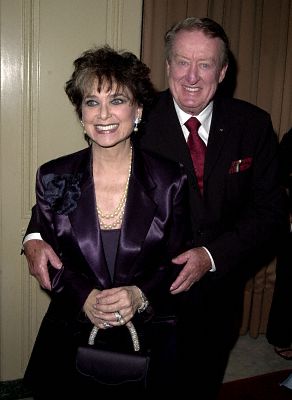
Tom tried married life once again in 2001 when he married actress Suzanne Pleshette. They were married until his death in 2007 from respiratory failure.
As husband and wife 2001–Photo: imdb.com
I was just amazed by Tom Poston’s career: a ton of television appearances–he probably had more recurring roles than almost any other actor during that time; a well-respected big screen career, a variety of Broadway roles and many gameshow stints. He was nominated for five Emmys, winning one. He always made the rest of the cast look better. I truly enjoyed getting to know a bit more about Tom Poston, one of our greatest sitcom stars.
We are in the midst of our “Men of August” series and today we to learn about another Wisconsin resident, Al Molinaro. Last week we delved into the career of Tom Bosley; Molinaro and Bosley were castmates on Happy Days but made their way there on very different paths.
Photo: itvhub.com
Al’s parents immigrated from Italy. His father had a true success story. He began his life in America at age 15 working as a water boy with a railroad crew heading west. He met and married his wife in Kenosha, Wisconsin where they settled down to raise their family of ten children. Al was born in 1919.
Al’s father, Raffaele, owned a restaurant/hotel and sponsored hundreds of Italians so they could make their way to the United States. Al’s brother Joseph became the district attorney for Kenosha County, and his brother George served thirty years in the Wisconsin State Assembly.
After high school, Al became a union leader at the Vincent-McCall Furniture Spring Factory. A year later, he later took a position with the City of Kenosha as assistant to the city manager. A friend of his had relocated to California to work in the aircraft industry and encouraged Al to give it a try.
Where Al watched movies in Kenosha dreaming of being an actor–Photo:cinematreasures.com
In 1940, Al left Wisconsin for a career in California. Although Al would never live in Kenosha again, it held a special place in his heart and later in his life, he said that “I love that town; I love it. If it wasn’t that I left it for show business, I’d still be there today.”
His first job in Los Angeles was with Reginald Denny’s Hobby Shop. He began working odd jobs in the television industry such as a live action animator at George Pal’s studios. He then worked for a bill collecting company until he had saved enough money to open his own collection agency. Although he moved on to another career, he held onto the collection agency until he retired. During this time, he also got involved in real estate. One of his properties was purchased for a huge retail mall which gave Molinaro the funds he needed to pursue an acting career.
During this time, he met his wife, Helen Martin, and they married in 1948, eventually divorcing in 1980.
On Bewitched–Photo: sitcomsonline.com
Al began receiving television roles in 1969. He first appearance was on Green Acres. Lisa opens a box of cereal only to find real gemstones in her box of Crickly Wickly. It turns out jewel thieves hid their stolen goods in the box in a Chicago factory. You know this will be a fun episode right from the beginning when the credits show up graffitied on a wall behind the crooks. Al was one of those crooks, and he would show up in two other Green Acres episodes. He also appeared on Bewitched, Get Smart, That Girl, and Love American Style.
Photo: DVDtalk.com
He took an improv class where he met Penny Marshall. In 1970, Penny introduced Al to her brother Garry which would change his acting journey. When The Odd Couple was casting for roles, Al wanted an audition for the role of Murray Greshler, the police officer who played poker with Oscar and Felix. Garry didn’t think he was right for the role, so he resisted, but Al was so persistent, he finally brought him in and ended up offering him the job.
After the show ended, Garry offered Al the role of Al Delvecchio, replacing Pat Morita who was leaving Happy Days as the owner of Arnold’s. Happy Days was set in Milwaukee, a city Al was very familiar with. While on the show, Molinaro suggested that Robin Williams be cast in a role John Byner declined which led to a new career for Williams.
Photo: nytimes.com
In 1981, Al married Betty Farrell. About this same time, he was one of the cast members who made the transition from Happy Days to the show’s spinoff, Joanie Loves Chachi.
After portraying a restaurant owner on the air for many years, Al became one in real life when he and Anson Williams (Potsie on Happy Days) opened a chain of diners called Big Al’s.
Molinaro continued to receive acting offers from Garry for some of his movies, but he felt he had to turn them down. He couldn’t reconcile his role with the language in movies that he felt was offensive. As he said, “I can’t work in movies with Garry because I’m so square that I won’t be in a movie that has four-letter words in it. . . . You gotta live with yourself.”
Photo: pinterest.com
Molinaro retired from acting in the early nineties but continued to appear in commercials for another decade. His commercial career included being the spokesperson for Cortaid Hydrocortisone Cream, Mr. Big Paper Products, and 42 spots for On-Cor Frozen Foods.
Al was diagnosed with Alzheimer’s in the mid-90s. He died from complications from an infected gallbladder in 2015.
Photo: pinterest.com
Considering Al was only an actor for 22 years or so, he created several of our favorite characters. He seemed to have a full life and stayed very humble. Happy Days would not be the same without Al, and he added a lot of humor to The Odd Couple’s weekly poker nights. A true success story; I’m glad he provided us with so many memorable moments without sacrificing his personal moral standards.
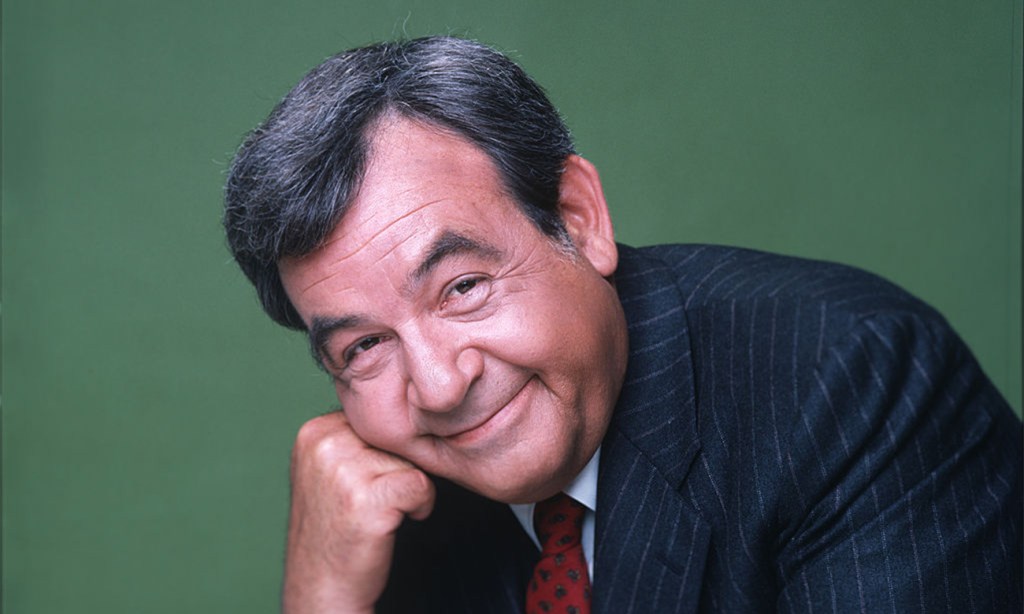
Since January was all about female sitcom actresses, this month we give the men their fair due. We begin this series, “The Men of August,” with Tom Bosley. Anyone who was a Happy Days fan knows why Bosley is part of this line-up.
Photo: quotetab.com
Bosley was born in Chicago in 1927. His father was in real estate and his mother was a concert pianist. After graduating from high school, he served in the Navy during WWII. His father was in WWI and then served again in WWII, building army bases on the coast.
Following the war, he attended DePaul University in Chicago, declaring his major as Pre-Law. He had to take night classes because the day classes were full, and after getting tired of teachers not showing up, he switched to a radio school, hoping to be an announcer because he loved baseball, but acting eventually tugged at his heart.” In 1949 and 1950 he performed at the Woodstock Opera House in Woodstock, Illinois with Paul Newman. He was in the first live television show ever done in Chicago which was a production of Macbeth, about 1948 (on WBKB).
In the early fifties, he moved to New York and held a variety of jobs, including coat checker at Lindy’s restaurant, doorman at Tavern on the Green, and Wall Street bookkeeper. He continued to audition for his big break. During the fifties while he was looking for work, he shared rent with another Chicago actor trying to make it in the entertainment business: Harvey Korman.
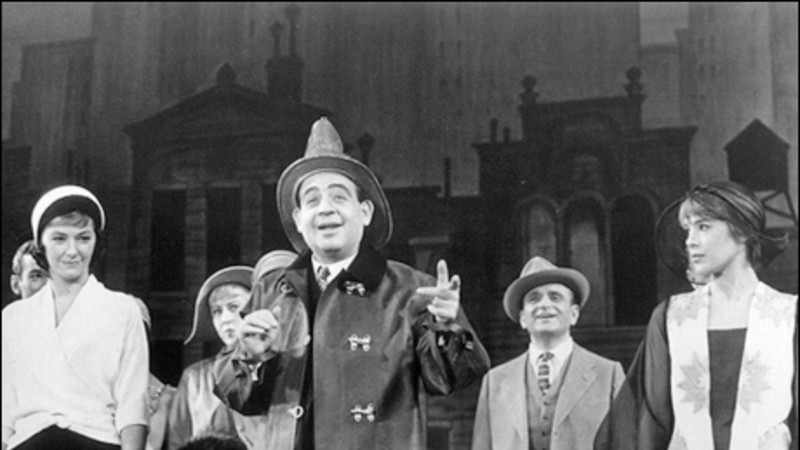
Bosley as Fiorello–Photo: markrobsinsonwrites.com
With one foot in Broadway and one in television, Bosley took on a variety of roles in his early career. In 1955 he appeared in a television production of “Alice in Wonderland” as the Knave of Hearts. In 1959, he won a lot of acclaim as New York mayor Fiorello H. La Guardia in the Broadway musical “Fiorello!” and won a Tony award. Bosley would later return to Broadway in the 1990s taking on the roles of Maurice in “Beauty and the Beast” and as Cap’n Andy in “Show Boat.”
In the 1960s he explored motion pictures and landed his first role as a suitor of Natalie Wood in Love with the Proper Stranger.
Although he continued to appear in the big screen, the little screen took up most of his time in the sixties and early seventies. In 1962 he played opposite Tony Randall and Boris Karloff in “Arsenic & Old Lace.” His face became a familiar one showing up in Car 54, Where Are You?, Bonanza, Get Smart, Route 66, Dr. Kildare, The Mod Squad, The Streets of San Francisco, Bewitched, McMillan and Wife, and Marcus Welby, among others.
It was also during this decade he married Jean Eliot. They were married until she passed away in 1978.
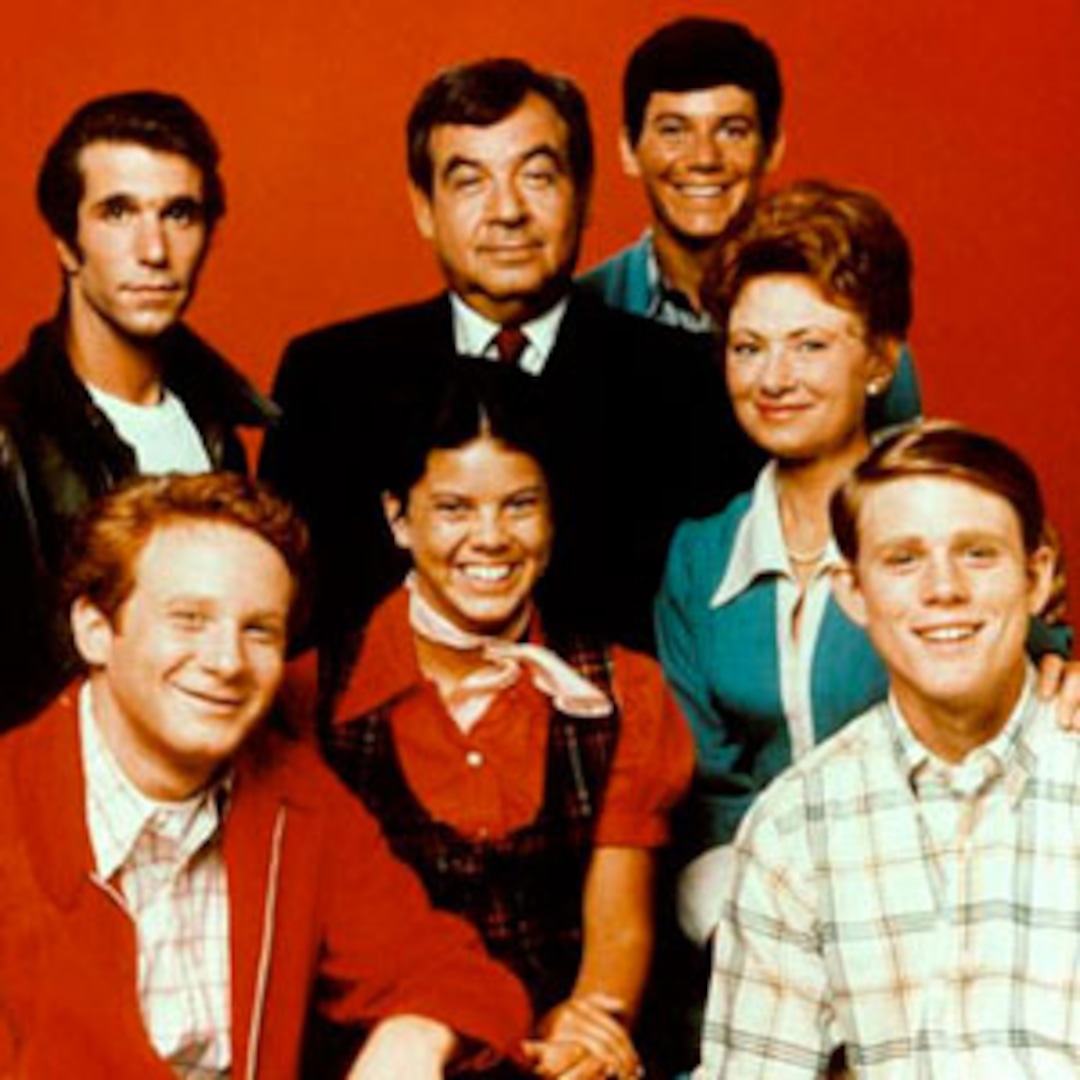
The Cast of Happy Days Photo: E!online.com
In 1974 he accepted the role that would make him a household name. “Love and the Television Set” was one of the four skits appearing on an episode of Love American Style, and I actually remember watching it. Garry Marshall developed it as a pilot, but the network wasn’t interested in turning the pilot into a show when it first came up. However, once George Lucas released American Graffiti in 1973, also starring Ron Howard, ABC took another look at the period show. The first two seasons, the show focused more on Richie Cunningham as he interacted with his friends and family. Jerry Paris (Jerry Helper on The Dick Van Dyke Show) directed 237 of the episodes. Happy Days was described as relentlessly ordinary. The plots revolved around the same types of problems most teens experienced in the fifties: dating, wanting to be popular, peer pressure, and similar issues.
Bosley originally turned down the role but reconsidered after reading the script more thoroughly; he was drawn to a scene between Howard and Richie that moved him. Bosley said he also was looking for some security. His wife was sick at the time, and they thought she might have epilepsy, which was later determined to be a brain tumor; he wanted an easier schedule in order to care for his wife and help raise his daughter.
With Henry Winkler Photo: brooklynvegan.com
He captured the sometimes cranky, but lovable, Howard Cunningham perfectly. He might not agree with his children, but he was always there for them, and he was apparently always there for his castmates who all remembered him as a kind, fatherly figure.
For a decade, Bosley developed the role of Howard into a much-loved sitcom father. Bosley said none of the characters were well defined in the early scripts. The cast developed their characters as relationships developed. He described the actors as a baseball team that never made errors; they just clicked and had a wonderful rapport.
During the run of the show, his wife passed away from her tumor, and in 1980 he married actress Patricia Carr whom he stayed married to until his death.
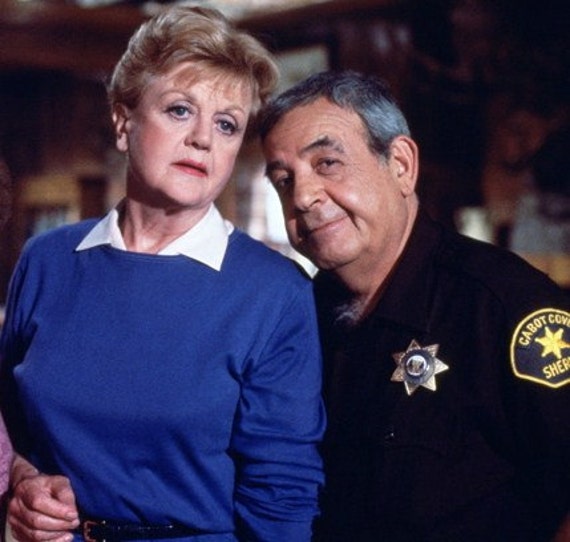
With Angela Lansbury Photo: etsy.com
When the show ended, Bosley was immediately offered another role. Although he appeared in a variety of shows in the early eighties, including five episodes of Love Boat, he moved from Milwaukee to Maine to help Jessica Fletcher solve mysteries on Murder, She Wrote. Bosley said the role of Jessica was written for Jean Stapleton, but then she did not want to do it so it was offered to Angela Lansbury. He and Angela had worked together in the past, so he did the pilot. It was supposed to be a one-time role, but they brought him back nineteen times without a contract. As Sheriff Amos Tupper, he spent four years trying to figure out why so many murders took place in peaceful Cabot Cove. He then retired from the police force and moved to live with his sister.
James Stephens, Tracy Nelson, Bosley, Mary Wickes Photo: pinterest.com
He actually did work with a sister in his next role on Father Dowling Mysteries. As Father Frank Dowling by day, he moonlighted, solving mysteries with his assistant Sister Stephanie Oskowski (played by Tracy Nelson, Rick Nelson’s daughter and granddaughter of Ozzie and Harriet).
Bosley described Father Dowling as being a lot like himself: calm, quiet, and caring. While murders occurred on the show, there was no violence. When they were casting the part for the housekeeper, they described the character as a Mary Wickes type, and Bosley told them to just get Mary Wickes, and he loved working with her. He enjoyed that show more than any of the other shows he worked on. The cast was totally caught off guard when it was cancelled. The network wanted to do a show with James Earl Jones and Richard Crenna. They gave Crenna’s agent a short-time period to agree to the show and he agreed before the limit ended, so the network was forced to delete a show from the current schedule to make room for this new show and they chose Father Dowling; the James Earl Jones show, Pros and Cons, also about several private detectives, and was dropped after 12 episodes.
When the show ended in 1991, his career definitely did not. When asked if he was going to retire, he replied, “Don’t be silly—actors spend half of their careers in retirement.” He continued appearing in a variety of shows (39 in all) until his death in 2010 from a staph infection.
Photo: outsider.com
There are several actors I get confused by at times because of their similarities. One is Ray Walston from My Favorite Martian with Jonathan Harris from Lost in Space. The other is Tom Bosley with David Doyle from Charlie’s Angels. At least I felt better about my mental error after doing research on Bosley. Apparently, David Doyle was named “Bosley” on the show because people confused the two actors so often.
I’m sure Tom Bosley would have made an excellent attorney or announcer, but I’m happy that he followed his acting passion, and I’m thankful for the five decades he was willing to entertain us with his special gift.





























 thewritelife61