This month we are learning to love Lucy. We have looked at the career of Lucille Ball, and today we are taking a peek back at the well-loved sitcom, I Love Lucy.

The show starred Lucille Ball, Desi Arnaz, Vivian Vance, and William Frawley. The series featured a young housewife, Lucy Ricardo, who lived with her husband Ricky, a nightclub bandleader. Their landlords, Fred and Ethel Mertz, were also their best friends. Lucy and Ethel get involved in a variety of schemes to get into show business. Lucy relies on Ethel and Fred who were in vaudeville earlier in their career. Eventually Lucy and Ricky have a son which coincided with the birth of their son Desi Jr. Lucy and Ethel try Desi’s patience often with their antics. When he gets upset, he starts speaking Spanish. Fred doesn’t have much time for the women’s plots either. After living through the Depression, he is considered cheap and doesn’t tolerate nonsense. In season six, the quartet move to Connecticut.
In 2012, ABC News and People did a joint survey, listing I Love Lucy as the Best TV Show of All Time.
The theme music was composed by Eliot Daniel with lyrics by Harold Adamson.
The show had three directors: Marc Daniels was director from 1951-53; William Asher, who would later produce Bewitched among other shows, was director from 1952-57, and James V. Kern directed 39 episodes from 1955-57.
Jess Oppenheimer was producer for the first 153 episodes; Desi Arnaz was executive producer for the first 124 episodes and producer for the final 26.
Oppenheimer was credited with writing for seasons 1-5, Madelyn Pugh Davis and Bob Carroll Jr. assisted him.

Lucille Ball had been starring in “My Favorite Husband” on the radio and in 1950, CBS wanted her to transition to television. Richard Denning had been her costar on the radio, but now she wanted to do a series with her real-life husband, Desi Arnaz. CBS did not think visitors would buy in to Lucy, the all-American girl, married to a Cuban musician. To prove them wrong, Lucy and Desi created a vaudeville act written by Carroll and Pugh that they performed with Arnaz’s orchestra in New York. The act was a big hit, so Harry Ackerman approved the couple doing the show.
The pilot was ordered in 1951. Oppenheimer, Pugh, and Carroll also made the move from radio to television. Philip Morris decided to sponsor the show. Ball wanted to continue her film career along with television show which was set to air biweekly. Philip Morris wanted the show to air weekly, and they wanted it filmed in New York. Because Lucy and Desi were expecting their first child, they wanted to stay in Hollywood. The couple agreed to reduce their pay by a $1000 a week in order to stay in California and cover the additional expenses of filming. They asked for 80% ownership in the films, with the remaining 20% going to Oppenheimer who shared 5% with Pugh and 5% with Carroll. Desilu (combining Desi and Lucy) became their production company.
The couple hired Carl Freund, who had worked on many big-screen movies, to film the show. He uniformly lit the set so all three cameras would pick up the same quality of the image. He also pioneered “flat lighting,” which lit everything with bright lights to get rid of shadows. The three-camera method became the standard sitcom technique.

A live audience produced a more authentic laugh than the canned laughter some shows used. Both Desi and Lucy’s mothers’ laughter can be detected in these early episodes.
When Lucy needed some rest after having her baby, the company could not finish their 39-episode commitment, so Oppenheimer and Desi decided to rebroadcast some of their favorite episodes instead. This out-of-the-box thinking proved to be so popular that it eventually led to the syndicated market.
When Lucy decided to transition her show from radio to television, Gale Gordon and Bea Benaderet were offered the roles of Fred and Ethel. However, both of them were already transitioning from radio to other televisions series. Gordon had already committed to Our Miss Brooks and Benaderet had agreed to star in The George Burns and Grace Allen Show.
The role of Ethel was then offered to Barbara Pepper, who was a good friend of Lucy’s. However, she was known to have a drinking problem; Wiliam Frawley also was a heavy drinker, so the production staff did not feel comfortable having two cast members with alcoholic issues, so the offer to Pepper was rescinded. Pepper would appear quite often in I Love Lucy and eventually she settled in Hooterville, married to Fred Ziffel.

Frawley never appeared drunk during filming or caused any problem on the show. I did think it was funny though that he had a clause in his contract that he did not have to film when and if the New York Yankees were in the World Series. They made it to the big show every year the series ran except for 1954.
Mary Wickes was then offered the role, but she was afraid working with Lucy would harm their friendship. Director Marc Daniels suggested Vivian Vance who was performing in “The Voice of the Turtle.” Oppenheimer and Arnaz went to watch her performance and hired her on the spot. Lucy was not thrilled with the idea of Vance. She thought she was prettier than her vision of what Ethel would look like. Vance was only two years older than Ball, but the producers agreed to dress her in frumpier clothing. Eventually Ball and Vance became good friends. Vance was the first actress to win an Emmy for Outstanding Supporting Actress. When I Love Lucy ended, Ball asked Vance to star in her new series, The Lucy Show.
Unfortunately, Vance and Frawley never warmed to each other the way she and Lucy did. They barely tolerated each other, although they were both always professional on the set.
Lucy and Desi had several miscarriages and when they were able to sustain a pregnancy which resulted in daughter Lucie, they filmed Lucy without ever mentioning that she was pregnant. The sponsors thought it would be in poor tasted to talk about pregnancy. However, in the second season, they were pregnant once again, and the pregnancy was written into the show. They had to use the word “expecting” when talking about the baby. The episode “Lucy Goes to the Hospital” in 1953 was watched by almost 72% of families with televisions, the highest rating for quite some time. It was surpassed by Elvis Presley’s first appearance on The Ed Sullivan Show.
The show was on for from 1951-1957 on CBS, resulting in 180 episodes.
I Love Lucy aired on Mondays for its first run. In 1967 the network began offering the show in syndication and it has never been off the air.
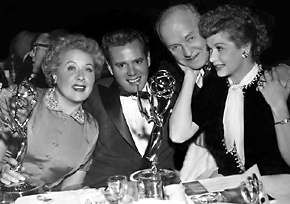
I Love Lucy was nominated for Best Comedy/Sitcom in 1952, 1953, 1954, and 1955, winning in 1953. Ball was nominated for Best Comedienne in 1953-1958, winning in 1953 and 1956. Vance was nominated for Best Supporting Actress in 1954, 1955, 1957 and 1958, winning in 1954. Frawley was also nominated for his role in 1954-1958. He never won but he lost to some great actors including Art Carney and Carl Reiner. Only Arnaz was denied a nomination for his comedy skills.
In 1957, Lucille Ball decided to end the show. She and Desi created a new show that wasn’t really new. It took the four main characters from I Love Lucy and moved them to Connecticut. Arnaz changed the format and length of the show, now an hour long, because he said he wanted to change it up before people got tired of the characters. He said this format kept the cast intact but also allowed for a celebrity guest star for Lucy to meet in every episode. In 1960 the show ended, the same year the couple’s real life marriage ended.
Unfortunately, the couple’s marriage dissolved in 1960, and in 1962, Lucy bought Desi’s shares of Desilu becoming the sole owner. She sold the company to Gulf+Western who owned Paramount Pictures.

We all remember the merchandising that accompanies shows in the sixties and seventies like dolls, board games, lunch boxes, etc, but I Love Lucy had more than its share of memorabilia. In 1952 a baby doll was released. Believe it or not, you could purchase an I Love Lucy bedroom set for $199 in the fifties, as well as I Love Lucy his and her pajamas.
The way it ended, I Love Lucy never had a proper finale. I wish I had the time to devote to how much this show changed the course of television, but a weekly blog just can’t contain as much history as there is to tell. I’m sure Lucy would be amazed if she knew that more than seventy years after the show began, we are still watching it and talking about it. Legacy doesn’t get any better than that.
 thewritelife61
The contract clause about the Yankees in the World Series sounds exactly like something I would do! That’s neat that those two took so much ownership over their content. I would assume that helps keep you bought in and in turn helps the end product.
LikeLike
You’ll have to bring up a sports clause in your next contract.
LikeLike