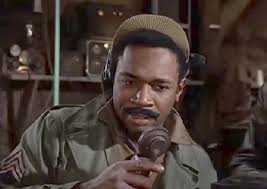
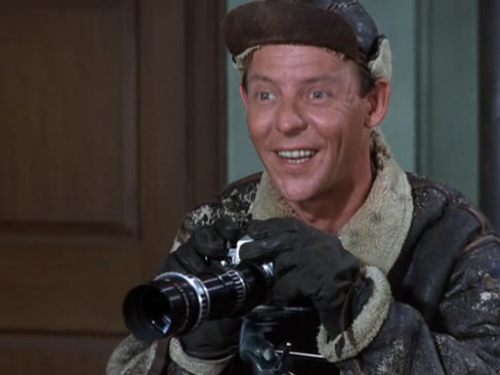
F-Troop: Braving Fort Courage

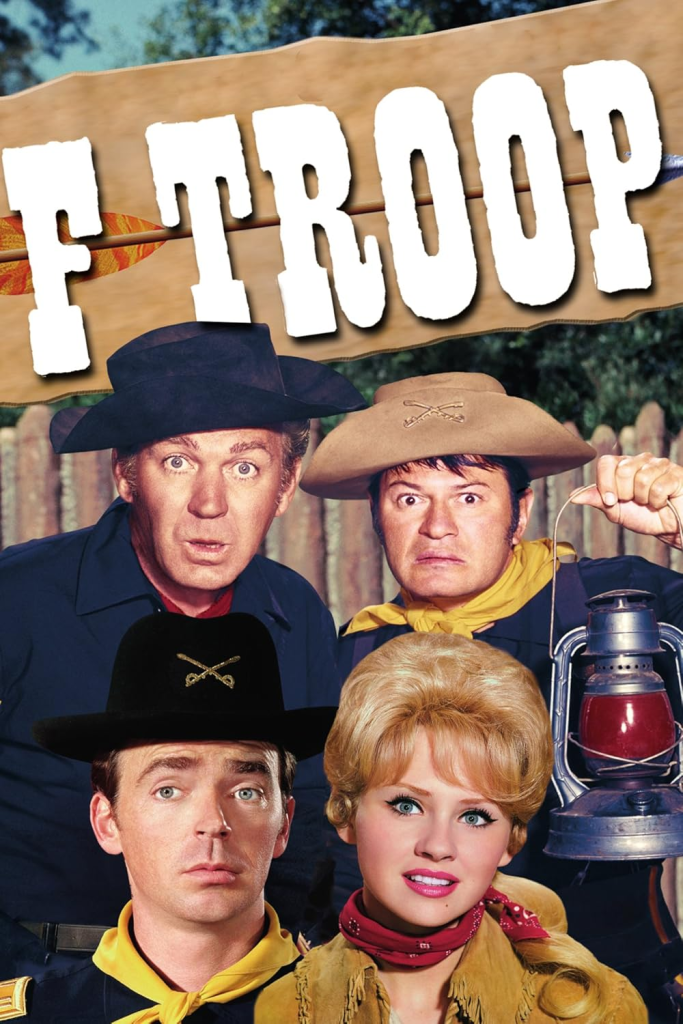
As we start our July blogs, the theme is Military Upended. We’re taking a look at military sitcoms and up first is F Troop. This was a western sitcom set in the 1860s. It debuted on CBS in September of 1965 and ran for two seasons.
📷imdb.com

If you and your siblings argue about whether this show was in color or black and white, you’re both right. The first season was in black and white, and the second season was produced in color.

The characters lived at Fort Courage, an army outpost. Captain Wilton Parmenter (Ken Berry) runs, or tries to run, the fort. One of the running gags is that Parmenter comes from a long line of military heroes that stopped with him. However, he served during the Civil War. After being told to pick up the general’s laundry near Appomattox, he begins sneezing. Union soldiers think it’s a command to charge which turns the tide of the battle. Then while Parmenter’s father is pinning the Medal of Honor on him for this feat, he pricks his chest, drawing blood for which they gave him a Purple Heart.

Parmenter is sent to Fort Courage where all the captains have failed. Two of the three commanders before him deserted, and one had a nervous breakdown there.

Parmenter is “aided” by Sergeant O’Rourke (Forrest Tucker) and Corporal Agarn (Larry Storch). However, these two are there just to make a quick buck however they can; they often work with Chief Wild Eagle (Frank de Kova) to find the next shady business deal. For example, the government thinks 30 men are at the fort; in reality, it’s 17 and the pay for the other 13 is put into a fund by the two men to fund their plans. However, the two men, while willing to take advantage of his gullibility, do like Parmenter and protect him. Parmenter is kind and well meaning.
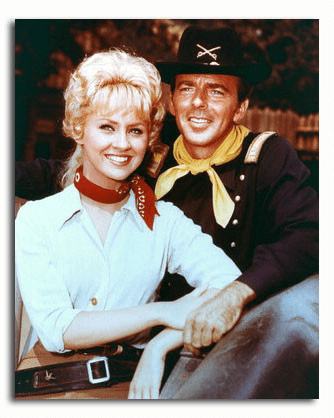
📷starstills.com

What Wil really needs protection from is marriage. The local store owner-postmistress Jane (Melody Patterson) has set her cap for him. She’s a beautiful tomboy who knows what she wants and usually gets it. She is also a telegrapher and is the best sharpshooter in the territory. She often rescues Wil with her good aim.

Patterson auditioned for this role at age 15, lying about her age. The show didn’t find about that till half-way through the first season. When the series started, she was 16 and Berry was 32. During the second season, when she turned 17, the producers allowed a more serious relationship between the two.

Rounding out the cast was Private Dobbs (James Hampton), a bugler who only knows two songs; Trooper Vanderbilt (Joe Brooks), the lookout who is almost blind; and Trooper Duffy (Bob Steele) the lone survivor of the Alamo who is too old to help much.

We also get to know several members of the Hekawis tribe headed by Chief Wild Eagle. They are 50/50 partners with O’Rourke and Agarn. They make souvenirs for sale and produce whiskey. They claim to be a peaceful nation because most of them are cowards like the men at the fort. The Chief has many wise sayings and often gives advice although when asked to explain some of them, he says he has no idea. His second in charge is Crazy Cat (Don Diamond).

📷imdb.com

Not surprisingly for the time, none of the tribal members are played by Native Americans. There is a lot of politically incorrect dialogue on the show. The Hekawe (pronounced “heck-ow-ee”) tell the story of how they got their name: Two indigenous people fell off a cliff and one asked “Where the heck are we?” which they chose for their name.

A lot of stereotypes exist not only about Native Americans but military heroes and the west in general. History is presented tongue in cheek with characters showing up who never would have been there and sly references to things that were happening in the sixties.

A number of guest stars somehow end up at Fort Courage. These include Jamie Farr, Bernard Fox, Zsa Zsa Gabor, Harvey Korman, Paul Lynde, Lee Meriwether, Julie Newmar, Vincent Price, and Don Rickles.

The popular theme music was composed by William Lava with lyrics by Irving Taylor. Lava had more than 500 television credits for composing. While he worked in animation a lot, he composed for Dr. Kildare, The Twilight Zone, Wagon Train, and 77 Sunset Strip. His collaborators included Henry Mancini and Sammy Kahn.

The series featured a lot of great writers including Stan Dreben who wrote for Green Acres, Seaman Jacobs and Howard Merrill from The Dick Van Dyke Show, and James B. Allardice who wrote for a lot of shows including My Three Sons and Hogan’s Heroes.
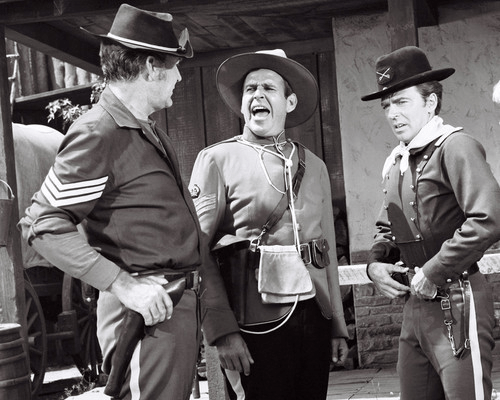
📷themoviestore.com

Storch was nominated for an Emmy Award for his role. His competition included Brian Keith for Family Affair, Bob Crane from Hogan’s Heroes, and Don Adams from Get Smart who won. I admit I was surprised to see his nomination given the classic television sitcoms that were on the air at the time.

ABC placed the show on Tuesday nights for season one which helped its ratings because there wasn’t a lot of competition. It was up against Red Skelton which was waning in its popularity, and it followed McHale’s Navy, and the same type of audience who enjoyed that show probably liked F-Troop as well.

After the second season, the show was ranked 40th out of 113 shows. According to Forrest Tucker, Warners Brothers was sold to Seven Arts, and they made the decision to cancel the show because they felt it used too much of the Warner Ranch for its setting and they weren’t thrilled about the added costs of producing this one in color.
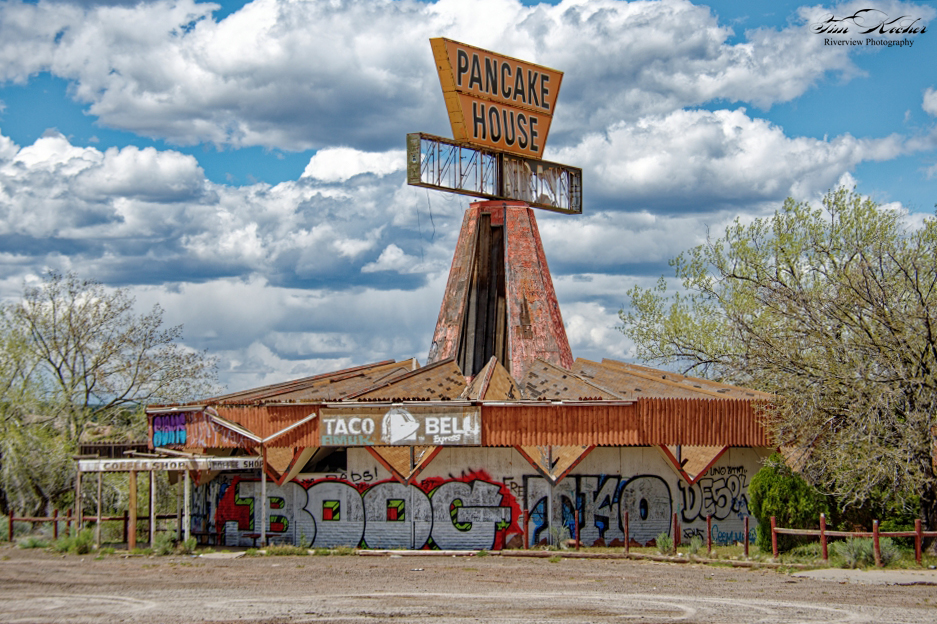
📷facebook.com

Fun fact, a replica of the fort was built in Houck, Arizona on Route 66. The Fort displayed F-Troop props, and they sold F-Troop merchandise. Among the amenities were a coffee shop, gas station, grocery store, pancake house, trading post, motel units, trailer park, and campground.

This show is a tougher one to evaluate now. Like so many shows from this era, Native Americans were not portrayed respectfully. However, truth be told, Natives were often portrayed as smarter than white men on this show. Like The Simpsons, everyone on this show was made fun of. It could be compared to The Phil Silvers Show or Hogan’s Heroes. It does have the military money-making schemes that Sergeant Bilko attempted but that was seen as a small part of a respectable military.

For me there was too much emphasis on slapstick humor apart from some of the uncomfortable dialogue. If you want to check it out and see what you think, which is what I always recommend, the series is available on DVD. It’s also on Prime and Roku.

The Donna Reed Show: It’s All About the Mom

Merry Christmas Eve.  In honor of It’s a Wonderful Life which will be playing quite often today, this week’s blog is about Donna Reed, who played Mary in the Jimmy Stewart holiday favorite.

In 1958, most of the television shows were game shows, variety shows, or westerns. Almost all the sitcoms on the air were based on a star; we had The Danny Thomas Show, The Ann Sothern Show, The Bob Cummings Show, and The Adventures of Ozzie and Harriet. It was also the year The Donna Reed Show began. The show would last eight seasons, resulting in 275 episodes.

reed14

Photo: dallas.wikia.com

The series was created by William Roberts. Donna and her husband Tony Owen developed and produced the show, under the name “Todon.” We had shows about single adults in The Bob Cummings Show and The Ann Sothern Show. We had families, including The Danny Thomas Show, Father Knows Best, and The Adventures of Ozzie and Harriet. Roberts wanted to concentrate on the demanding roles a stay-at-home mom had to juggle. Reed agreed with him. As she noted, “We started breaking rules right and left. We had a female lead, for one thing, a strong, healthy woman. We had a story line told from a woman’s point of view that wasn’t soap opera.”

reed2

Photo: imdb.com

The Donna Reed Show is often evoked by critics who say television scripts are not realistic but center around unreal family expectations, but that is not the goal Reed and her husband had. Donna described the show as “realistic pictures of small-town life—with an often-humorous twist. Our plots revolve around the most important thing in America—a loving family.” The shows featured typical family problems families faced in the late 1950s: having to fire a clumsy housekeeper, quality time with your spouse, dealing with disciplinary issues, or Donna being swamped with requests to volunteer for charity drives or community theater shows. However, there were times the show delved into more controversial issues such as women’s rights or freedom of the press.

reed3

Photo: metv.com

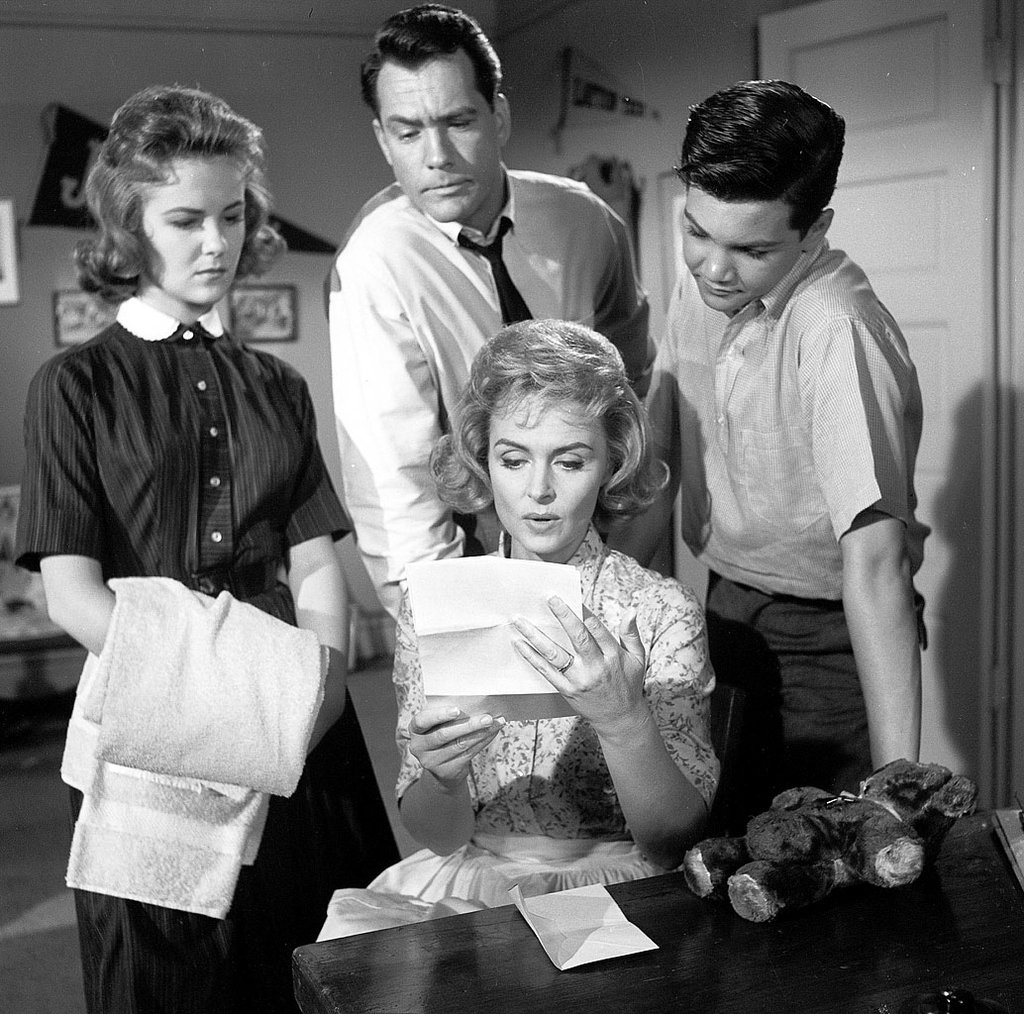
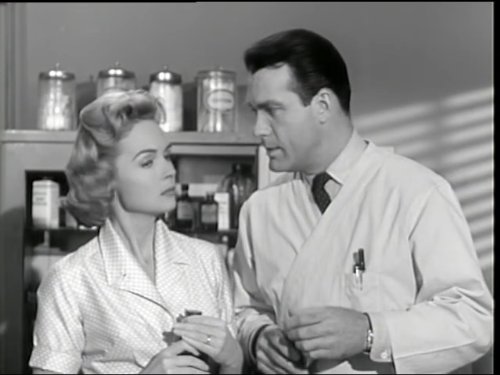
The Stone family includes Donna, Alex, Mary and Jeff. Donna (Donna Reed) is the iconic mother. She grew up on a farm (which Reed did). She became a nurse and occasionally helps Alex (Carl Betz), a pediatrician who has his office at the house. Mary (Shelly Fabares) is in her first year of high school. She studies ballet and plays the piano. During the series, she has several boyfriends. Mary left for college before the show ended, but Fabares made guest appearances. Jeff (Paul Petersen) is in grade school. He loves sports, likes to eat, and often teases his sister. In 1963 when Fabares leaves, Paul Petersen’s real sister, Patty was cast as a runaway orphan taken in by the Stone family. The Stones live in Hilldale, an All-American town.

reed9

Photo: pinterest.com

Several other characters appear often. Dave and Midge Kelsey (Bob Crane and Ann McCrea) are good friends of Donna and Alex’s.  Dave is also a doctor. Another of Alex’s colleagues who is a good friend is Dr. Boland (Jack Kelk), whom the kids call “Uncle Bo.” Smitty Smith (Darryl Richard) is Jeff’s best friend and Scotty (Jimmy Hawkins) is Mary’s boyfriend.

Photos: pinterest.com and metv.com

With Donna’s movie relationships, many guest stars appeared on the show during its run. Baseball players Don Drysdale, Leo Durocher, and Willie Mays played themselves. Musicians Harry James, Tony Martin, and Lesley Gore appeared. Buster Keaton was featured in two different shows. Esther Williams played a fashion designer. Other stars who showed up included Jack Albertson, John Astin, Dabney Coleman, Ellen Corby, Richard Deacon, Jamie Farr, Gale Gordon, Arte Johnson, Ted Knight, Harvey Korman, Cloris Leachman, Marion Ross, William Schallert, Hal Smith, Marlo Thomas, and William Windom.

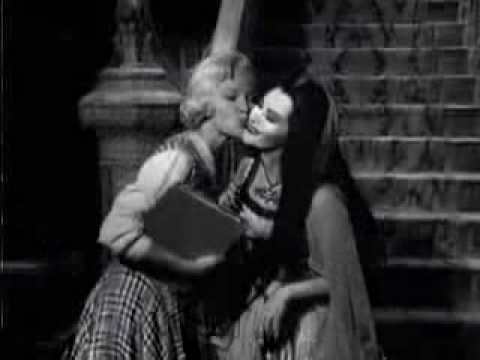
In the opening credits, Reed comes down the stairs and answers the telephone which she gives to Alex. She then hands the kids their lunches and books and sends them off to school. When Alex leaves on a call, she closes the door and smiles. In 1964 when The Munsters debuted, their opening credits were a parody of Donna’s show as Lily performs the same actions.

reed12

Photo: metv.com

The Donna Reed Show faced the Milton Berle show, Texaco Star Theater Wednesday nights and ratings were not great. It was renewed and moved to Thursdays the next year. I was surprised to learn that during the eight years the show was on the air it was only in the top 20 in season six and only in the top 30 in season four.

reed5

Photo: cinemacats.com (Look closely and you’ll notice this was                                                                 the living room for I Dream of Jeannie as well).

Although the show never received very high ratings, Donna Reed was nominated for an Emmy every year from 1959 to 1962. (Jane Wyatt won in 1959 and 1960, Barbara Stanwyck won in 1961, and Shirley Booth won in 1962.) Donna Reed won the Golden Globe in 1963.

reed8

Photo: metv.com

In 1962 Donna felt that the writers had run out of creative ideas and were recycling plots. Both Mary and Jeff were allowed to perform in this season. Fabares debuted a single, “Johnny Angel” in February which went to number one on the charts, selling more than a million copies. In October, Petersen sang “My Dad” which made it to number six. Donna decided that would be the last season, but when ABC made her a very lucrative offer for three more seasons, she and her husband agreed.

reed1

Photo: nytimes.com

When this contract ended in 1966, Donna was ready to retire. Reed was considering a television movie reunion but when Betz passed away in 1978, she decided it was no longer an option.

Campbell Soup was the first sponsor, and later sponsors included Johnson & Johnson and The Singer Company. Whenever a scene takes place in a supermarket, Campbell’s Soup, V-8 Juice, Franco-American Spaghetti and Johnson & Johnson Baby Powder are likely to be in the shot.

reed13

Photo: metv.com

Reruns of the show were seen on Nick at Nite from 1985-1994 and on TV Land from 2002 until 2004. MeTV began airing the show in September of 2011.

The cast was a close-knit one and continued their relationships after the show ended. Paul Petersen credited Donna as being the nurturing adult he needed in his life to get him through the years of being a child star. She helped him understand how the industry worked and helped him during some tough times during his life. Shelly Fabares also said Donna and Carl were amazing. Realizing how tough the industry can be for young kids, they protected Paul and herself and loved them as second parents. Donna never forgot to send Shelly a birthday gift.  In 1986, before she passed away from pancreatic cancer, her final words were to make sure Shelly’s birthday gift was wrapped and delivered.

reed15

Photo: lapostexaminer.com

Despite the bad raps the show often received from the women’s lib organizations, Donna Reed did help advance the way women were perceived in the media. She endowed her character with strong emotions, definite opinions on issues, and independence. In her personal life, Reed expressed her views on the medical industry and the political arenas.

reed7

Photo: geocaching.com

Paul Petersen summed up the value of the show in an interview he did in 2008. In his words, The Donna Reed Show, “depicts a better time and place. It has a sort of level of intelligence and professionalism that is sadly lacking in current entertainment products. The messages it sent out were positive and uplifting. The folks you saw were likable, the family was fun, the situations were familiar to people. It provided 22-and-a-half-minutes of moral instructions and advice on how to deal with the little dilemmas of life. Jeff and Mary and their friends had all the same problems that real kids in high school did. That’s what the show was really about, the importance of family. That’s where life’s lessons are transmitted, generation to generation. There’s a certain way in which these are transmitted, with love and affection.”

I couldn’t say it better.

My Heroes: Hogan and Company

In looking at war-themed television shows, M*A*S*H has to be number 1.  An episode could have you sobbing one minute and laughing hysterically the next minute. Hogan’s Heroes might not be at the same level, but it is a fun, well-written show with an interesting cast of characters. Debuting about two decades after the war ended, the show first aired in September 1965 and continued till April 1971, producing 168 episodes.

hogan1

The setting of the show is Luft Stalag 13, a prisoner of war camp where Allied prisoners are held north of the town of Hammelburg.

The POWs are using the camp as their base for Allied espionage tactics to sabotage the Nazis and to help other Allied POWs and defectors escape Germany. Colonel Robert E. Hogan, played by Bob Crane, is the mastermind of the crew. While Hogan and his boys help the Allied cause, the two men who aid the cause the most do it unwittingly. Colonel Wilhelm Klink (Werner Klemperer) and Sergeant of the Guard Schultz (John Banner) are easily tricked and proud of the fact that no prisoner has ever escaped Stalag 13. The incompetent Germans are more concerned with making sure they do not cause trouble with their superiors which could get them sent to the Russian front. The Germans in the camp are portrayed as inept and easily manipulated. In later episodes Sgt Schultz tends to look the other way, realizing that Hogan and his men are much more than mere prisoners.

hogan11

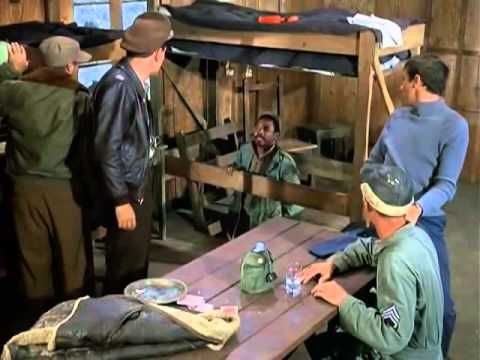
A series of tunnels allows Hogan and his men to come and go at will. A doghouse in the guard dog compound is one of their doors and they make friends with the dogs who never track them down. A bunk in the barracks is another trap door and the main entrance into the tunnels. A periscope disguised as a sink faucet allows them to view the compound. Hogan is also able to listen in to the telephone switchboard and to make phony calls when necessary. A planted microphone in Klink’s office allows the men to hear any conversation taking place there. A portion of the barbed wire fence is a frame that can be lifted to get in and out of camp. Sometimes the guys “borrow” cars from the Germans or have planes land near the fence for air drops.

hogan19

NBC actually turned down the show. From what I read, they didn’t think the pilot was bad; they seemed to think it was so good that the innovative story lines could not be sustained in a weekly show. The pilot was filmed in black and white, but after CBS put the show on the schedule, it decided to film the rest of the episodes in color.

hogan3

The show ranked in the top 20 for most of the seasons it was on television. However, the show engendered debate because it was a comedy about WWII. One critic wrote “Granted, this show is often funny and well-acted. But there’s simply no excuses for turning the grim reality of Nazi atrocities . . . for yet another brainless joke.”

The outdoor scenes were filmed on the 40 Acres Backlot in Culver City, California. The set was also used in a Mission Impossible show as a South American prison. In 1975 it was destroyed and became part of an industrial park.

The instrumental theme song was composed by Jerry Fielding. He wrote lyrics for it, so it could be featured on an album, “Hogan’s Heroes Sing the Best of World War II,” songs sung by cast members Ivan Dixon, Robert Clary, Richard Dawson, and Larry Hovis. It was also on Bob Crane’s album, “Bob Crane, His Drums and Orchestra Play the Funny Side of TV.”

Actors often played a variety of roles on the show. For example, William Christopher (who would later star in M*A*S*H) played a POW, a German soldier, and a British pilot. Arlene Martel appeared as a resistance fighter in one show and Olga and Gretchen in other episodes.

hogan7

The regular cast included the following:

Colonel Robert E. Hogan (Bob Crane). He is the senior ranking POW officer and the leader of the group. He commanded the 504th Bombardment Group. He was shot down during a raid on Hamburg. Many of his plans are quite complex. Being a ladies’ man, all the women fall for Hogan. Bob provided the drums for the theme song. He also played them in a couple of episodes.

hogan8


Staff Sergeant James Kinchloe (Ivan Dixon). Part of the US Army Air Force, “Kinch” is responsible for the radio, telephone, and other electronic communications for the POWs. He can also mimic German officers. He worked for the telephone company in Detroit before the war. He left the show after the fifth season. He was replaced by Kenneth Washington for the final episodes.

hogan10


Technical Sergeant Andrew Carter (Larry Hovis). United States Army Air Corps Technical Sergeant Andrew J. Carter is in charge of ordnance and bomb-making. Hovis was intended to be in the pilot only, but he was then offered a regular role moving from lieutenant to a sergeant. He worked in a drug store in Indiana and hoped to become a pharmacist after the war. He produces formulas, various chemicals, and explosive devices.

hogan6


Corporal Louis LeBeau (Robert Clary). Free French Air Force Corporal Louis LeBeau is a Master Chef who is passionate about his cooking and a notoriously patriotic Frenchman. Schultz and Klink nickname him “The Cockroach.” His cooking talent often get the Germans out of bad situations. Hogan uses LeBeau’s culinary skills to bargain for extra privileges. In real life, Clary was a French Jew who was in the Nazi concentration camps at Ottmuth and Buchenwald and had his serial number tattooed on his arm.

hogan5


Corporal Peter Newkirk (Richard Dawson). Royal Air Force Corporal Peter Newkirk is the group’s jack of all trades. When necessary he performs as a conman, magician, pick-pocket, card sharp, forger, bookie, tailor, lock picker, and safe cracker. He does numerous impersonations of German officers and a voice imitation of Adolf Hitler. Newkirk was convinced to dress as a woman for various plots.

hogan13


Colonel Wilhelm Klink (Werner Klemperer). Wilhelm Klink is an old-line Luftwaffe officer from aristocratic Prussian descent, but he is portrayed as inept, a bit dimwitted, cowardly, and often clueless. He has been stuck at the rank of colonel for twenty years with an efficiency rating a few points above “miserable.” Klink often gets splashed with water or snow.

hogan9


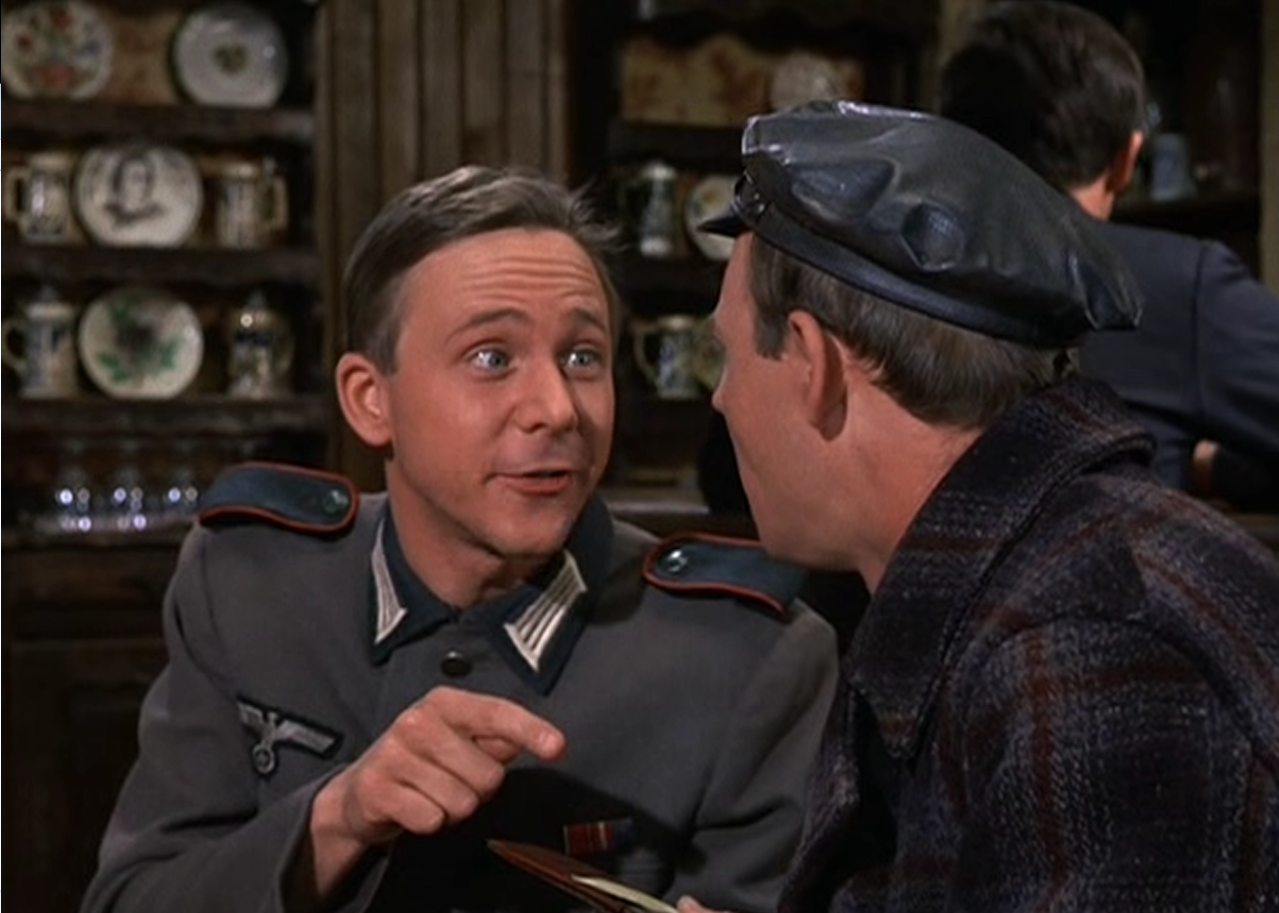
Sergeant Hans George Schultz (John Banner). Hans Schultz is Klink’s clumsy, but lovable, Sergeant of the Guard who is forever taking small bribes from the prisoners, with whom he is overly friendly. Sometimes the boys talk in front of him or tell him exactly what they are going to do. He always says, “I hear nothing, I see nothing, I know nothing!” Before the war, he owned the most successful toy company in Germany.

hogan2


General Albert Hans “Hansi” Burkhalter (Leon Askin). General Albert Burkhalter is Klink’s superior officer, a gruff man. Burkhalter frequently tires of Klink’s babbling and says, “Shut up, Klink!” He regularly threatens to send him to the Russian Front or have him shot.

hogan14


Some of the other regular roles included Sigrid Valdis as Hilda, Howard Caine as Major Hochstetter, and Cynthia Lynn as Helga.


There are some famous “goofs” in the filming of the show. (1) In one scene, a periodic table of elements is hanging on a wall. It shows all the 103 elements known to science in the 1960s; however, in the 1940s, fewer than 92 elements were known. (2) On numerous occasions Eva Braun, Hitler’s mistress, is mentioned either by Hogan’s men or the Germans. Braun’s association with Hitler was a closely guarded secret only known to Hitler’s inner circle, whose existence wasn’t revealed until after the war. (3) The center top ribbon on Colonel Hogan’s dress uniform is the Air Force Distinguished Service Medal, an award that was created by the Air Force after World War II.

The most surprising thing I learned about the cast members were their backgrounds. Werner Klemperer, Howard Caine, Leon Askin, and John Banner, who portrayed the Germans Klink, Hochstetter, Burkhalter, and Schultz, were all Jewish. All of them also served in the U.S. Armed Forces during World War II. Klemperer was born in Cologne, Germany, and Banner and Askin were both born in Vienna, Austria; the three of them immigrated to the United States after fleeing the Nazi regime. Banner had been held in a pre-war concentration camp, and his family was killed during the war. Robert Clary, John Banner, and Leon Askin were all survivors of the Holocaust. Werner Klemperer escaped Nazi Germany in 1933 with his parents. When asked about their willingness to play these roles, Klemperer said, “I am an actor. If I can play Richard III, I can play a Nazi.” Banner’s response was “Who can play Nazis better than us Jews?”

As mentioned earlier, Robert Clary was imprisoned for three years in Nazi camps. His comment when asked about his participation on the show was “Hogan’s Heroes was very different—we weren’t really dealing with Nazism.”

While it is surprising that this show was able to get produced so soon after WWII, the show received a lot of praise from critics. Hogan’s Heroes had 12 Emmy nominations, with two wins, both for Werner Klemperer for outstanding supporting actor in a comedy.

hogan4

The show has held up amazingly well since it aired 53 years ago. All seasons are available on DVD, and the show is currently seen on Me TV weeknights from 9-10 pm, CST. Tune in some night when you want to go to bed laughing–it’s a nice break from the news.

hogan12