Mel Tormé Jazzed Up a Few TV Scripts

76 Mel torme ideas | music, great american songbook, jazz
Photo: pinterest.com

We are in the midst of our blog series about unique television writers. If I mention the name Mel Tormé to you, you probably think exceptional musician, composer, and singer. You might specifically mention “The Christmas Song” which he composed the music and cowrote the lyrics for. (His cowriter was Bob Wells.)

If I say think writing, you might be able to recall that he wrote several musical biographies including Traps- The Drum Wonder: The Life of Buddy Rich, The Other Side of the Rainbow: Behind the Scenes on the Judy Garland Television Series, or My Singing Teachers. You might have even read his autobiography It Wasn’t All Velvet or Wynner, a novel he wrote in 1978.

However, I’m guessing most of you don’t realize that he also tried his hand at writing scripts for television.

Melvin Tormé was born in Chicago in 1925. He was a child prodigy and first performed professionally at age 4 with the Coon Sanders Orchestra, singing “You’re Driving Me Crazy,” at a local restaurant.

He played drums in the drum and bugle corps of his grade school, Shakespeare Elementary. From 1933-1941 he had roles in several radio programs including “The Romance of Helen Trent” and “Jack Armstrong, All American Boy.” He wrote his first song at age 13. At age 16, his song, “Lament to Love” was a hit for Harry James.
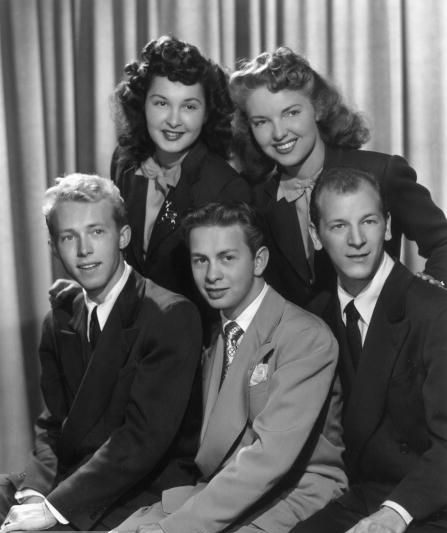
Mel Torme & The Mel-Tones at Singers.com - Vocal Harmony A Cappella Group
The Mel-Tones Photo: singers.com

Tormé graduated from Hyde Park High School. Shortly after, he was a singer and drummer with a band led by Chico Marx from 1942-1943. In 1944, he formed Mel Tormé and His Mel-Tones.

Tormé took his stint in the Army, and when he was discharged in 1946, he returned to the entertainment business. He was nicknamed “The Velvet Frog” by DJ Fred Robbins when he sang at the Copacabana. He always hated the nickname.

During the fifties, he had a radio program, “Mel Tormé Time,” and he recorded a variety of albums. He primarily performed jazz but he loved classical music as well, preferring Delius and Grainger. He wrote more than 250 songs. In the sixties, he strayed into pop music.

Mel had his first television appearance as an actor in 1960 on Dan Raven. He showed up on a few different series including The Lucy Show. In the 1980s, he made nine appearances on Night Court and found a new generation of fans.

Mel Torme & Harry Anderson, Night Court (1991) | Movie stars, Harry  anderson, Singer
On Night Court Photo: pinterest.com

During his career, he tried marriage four times, but the first three ended in divorce. In 1996 he suffered from a stroke that ended his musical career. Three years later, he passed away.

No doubt, he had a full and successful career. He had a multitude of skills he experimented with during his professional life. I would like to spend some time looking at part of his career that is not well known. He did help with the writing for a brief time when The Judy Garland Show was on the air. In the late sixties he continued writing for the small screen.

In 1967, Mel wrote his first television script. His first successful episode was for the 1967 show Run for Your Life. It’s not a well-remembered show, but it aired from 1965-1968. It was about a successful lawyer Paul Bryan (Ben Gazzara) who learns he is terminally ill with two years to live. He decides to accomplish everything on his bucket list, and each week he talks about the people he meets and the places he visits.

The Frozen Image
The Frozen Image Photo: run4.us

Mel not only wrote the script for “The Frozen Image,” but he starred in the episode as well. The premise is that a married Las Vegas singer (Diana Burke) who doesn’t want to get old, hires Paul as her manager.

He must have enjoyed it because the next year, he wrote a script for The Virginian called “The Handy Man.” The long-running show was on the air from 1962-1971 and was set in Wyoming in the late 1800s.

In this episode, a legal fight over a strip of land between the Shiloh and Bowden ranch turns nasty. The Bowdens think Shiloh has hired a gunfighter who turns out to be a handyman.

The Virginian" The Handy Man (TV Episode 1968) - IMDb
The Handyman Photo: imdb.com

In 1974, Tormé scripted another story, this time for Mannix. From 1967-1975, Mannix solved a variety of cases. Originally working for a company, he starts his own business with secretary/friend Peggy Fair, whose husband, a policeman, had been killed. They also work with a police department contact, Tobias. Mel’s story, “Portrait in Blues,” features a couple of musicians, one of whom is almost electrocuted while performing.

Mannix" Portrait in Blues (TV Episode 1974) - IMDb
Portrait in Blues Photo: imdb.com

The last television project Mel worked on as a writer was a made-for-television movie called The Christmas Songs in 1979. With cowriter Thomas V. Grasso, Mel penned the script and starred in the movie with Richard Basehart, Billy Davis, Jr., Jo Ann Greer, Les Brown and His Band of Renown, Rich Little, Marilyn McCoo, Maureen McGovern, Sons of the Pioneers, Roy Rogers, and George Shearing. I could not find much about this movie, so if anyone remembers watching it or knows anything more about it, please let me know.

With all the success that he had in the music industry, I was amazed to learn Mel wrote for television. I stumbled across it by accident when I was researching Mannix and decided to learn a little more about his writing career. I could not find any other information about his writing career. I did reach out to his son Steve March-Tormé . He said that he had not realized that his father wrote television scripts but said, “I’m not surprised. He tried his hand at a lot of areas of the business and was almost always very successful at them. Very bright guy.” Steve’s stepfather, Hal March, was another celebrated television writer and star. (For more about Steve March-Tormé , see his website, stevemarchtorme.com.)

It’s been a lot of fun to learn more about Mel Tormé’s television writing career. As someone who only knew him for his musical skills, it was fun to see another side of the performer. As someone who has always thought it would be fun to write for a sitcom, kudos to him for trying something new and succeeding. Hopefully, he is an inspiration to some of us who think we have to settle for the space we are in now to reach out and try something entirely different–and to remember that the success is in the trying.

Columbo: The Disheveled Detective

We are winding up the blog series, “One-Named Detectives,” and I think we saved the most interesting private eye for today: Columbo.

How Peter Falk made detective TV show 'Columbo' work - Click Americana
Photo: americana.com

Columbo was on the air from 1971-2003, the longest of the five detectives we looked at in this series (Cannon, Kojak, Mannix, Matlock, and Columbo), but oddly had the fewest episodes with 68 (Cannon had 120, Kojak had 117, Matlock with 181, and Mannix had the most with 194).

Richard Levinson and William Link created Columbo (they also were the force behind Mannix). Levinson and Link met in junior high and they were a writing team until 1987 when Levinson passed away. This show was a bit different; it actually had two pilot episodes in 1968 and 1971. It originally aired from 1971-1978 in The NBC Mystery Movie series. It alternated with McMillan and Wife, McCloud and Hec Ramsey.  ABC revived the show from 1989-2003, but it was not a weekly show then either. Falk didn’t want a weekly show, so the series was scheduled for one Wednesday a month. For season two, the series was moved to Sunday nights where it continued until 1978.

Columbo Hassan Salah
Falk with Hector Elizondo–Photo: columbophile.com

In the original concept for the show, Columbo was described as smooth-talking and cultured. The first choice for an actor to play the role was Bing Crosby who declined. When Falk showed up for his audition, he came in wrinkled clothing, aimlessly chattered, and seemed a bit scatter brained so the producers changed the character.

The show had some interesting directors. One of the directors on the show was Steven Spielberg who directed “Murder by the Book.” Falk himself directed the final episode of season one, “Blueprint for Murder.” Nicholas Colasanto who played Coach on Cheers directed two of the shows, “Etude in Black” and “Swan Song.” Patrick McGoohan directed five episodes (including three he guest starred in), as well as producing and writing two others. Falk’s friend actor Ben Gazzara directed “A Friend in Deed” and “Troubled Waters.”

On Columbo, we see the crime being committed long before we meet Lt Columbo (Peter Falk), so we know who committed the crime from the beginning. The fun of the episode is in watching Columbo investigate the crime and how he solves it. Columbo never introduces himself with his first name and no other character in the show uses it either. In season four, Colonel Rumford asks Columbo if he has a first name, and his response is “I do, but usually only my wife uses it.” Apparently, in one episode, a badge is scanned and lists his name as Frank, but William Link stated that Columbo was written without a first name.

Columbo | Columbo, Peter falk, Columbo peter falk
Photo: pinterest.com

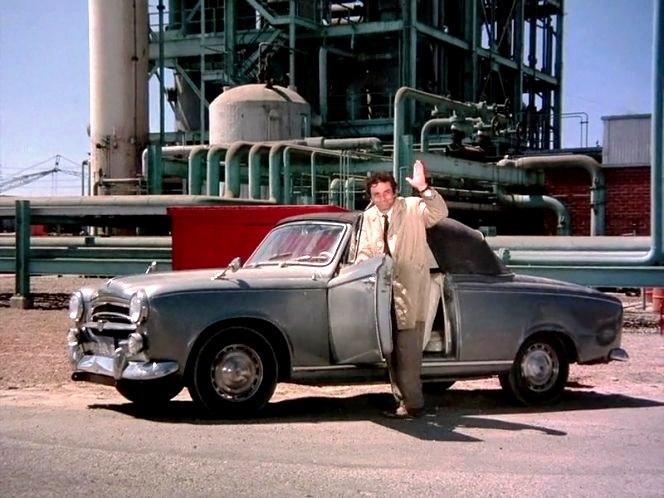
Columbo was a very disheveled detective who always showed up in a rumpled raincoat, smoking a cigar and appearing as if he was not quite all there. Falk used his own wardrobe for the character. The infamous raincoat was one he bought for $15 in 1967 when he got caught in a New York City rainstorm.

However, behind the façade of an inept policeman was a brilliant mind. He asked a lot of seemingly non-essential questions and paid attention to every detail. After interviewing a suspect, he always said, “Just one more thing.” Falk improvised during filming. He might ask for a pencil, search for something or throw in an unscripted line and did it to create a genuine confusion on the part of the other actor so it appeared more realistic.

This was definitely a one-man show, but there were a few characters who had recurring roles: Mike Lally played a bartender in 25 episodes, John Finnegan was Barney on 13 shows, and Bruce Kirby as Sgt George Kramer was seen nine times.

Car history: The Peugeot and the TYV show "Columbo."
Photo: recordonline.com

Columbo’s car is a 1959 Peugeot 403. Apparently, only 504 convertibles with two doors were made that year. When NBC cancelled the series, the car was sold. ABC had to locate a replacement when they picked the show up later. You can tell the difference because the license plate from NBC seasons was 044-APD and the plate from ABC shows was 448-DBZ.

Most of the suspects on the show were clever, wealthy people who think they have covered their tracks and have a solid alibi.

For only 68 episodes, there were a lot of famous guest stars on the show.  Some stars even portrayed two different criminals including Jack Cassidy, Robert Culp, George Hamilton, Patrick McGoohan, and William Shatner. Other guest stars showing up were Anne Baxter, Johnny Cash, Faye Dunaway, Jose Ferrer, Ruth Gordon, Lee Grant, Janet Leigh, Vera Miles, Ray Milland, Leonard Nimoy, Donald Pleasence, Dick Van Dyke, and Robert Vaughn.

Peter Falk Dick Van Dyke Color Poster Columbo Rare at Amazon's  Entertainment Collectibles Store
Falk with Dick Van Dyke–Photo: amazon.com

There was a variety of music written for each episode of the show. The Mystery Movie Theme was written by Henry Mancini and was used for the NBC shows. Both Quincy Jones and Mike Post also wrote versions of The Mystery Movie theme. One song uniquely belonging to Columbo was “This Old Man.” Falk can be heard humming or whistling it in various episodes after it was introduced in a 1973 show.

The show received thirteen Emmys during its run. Falk won the Emmy the first season and again in 1976. He was nominated in 1973, 1977 and 1978 but lost to Richard Thomas, James Garner and Ed Asner respectively. The series was nominated in 1972, 1973, 1976, 1977, and 1978 (winners were Elizabeth R Masterpiece Theater; The Waltons; Police Story; Upstairs, Downstairs; and The Rockford Files).

Columbo Wallpapers Wallpapers - All Superior Columbo Wallpapers Backgrounds  - WallpapersPlanet.net
Photo: wallpapersplanet.net

The show was very popular and was broadcast in 44 countries. There is a statue of Columbo in his coat in Budapest, Hungary on Falk Miksa Street. The story behind it is that according to then-mayor Antal Rogan, Falk is a relative of Falk Miksa who was a Hungarian writer and politician, but I could not verify if that was true or not.  What is true is that it was put up in 2014 at a cost of $63,000.

When he is questioning witnesses, Columbo often throws in random references to his wife and or something the couple liked to do, but we never see her in the series.  However, later a show was created, Mrs. Columbo starring Kate Mulgrew. Falk’s real-life wife Shera Danese was cast in six of the Columbo episodes, always appearing as a different character.

A group of novels was adapted from the Columbo tv series by MCA written by Alfred Lawrence, Henry Clements, and Lee Hays.

Columbo has been a popular show in syndication and can currently be seen on ME TV Sunday nights. The shows run from 70-98 minutes which probably makes syndication interesting. The entire set is available on DVD for about $50.

Unfortunately, Peter Falk was diagnosed with dementia in 2007, and by 2009 he could not recognize photos of himself and did not remember playing Columbo. He passed away in 2011.

Best 45+ Columbo Wallpaper on HipWallpaper | Columbo Wallpaper, Columbo TV  Wallpaper and Peter Falk Columbo Wallpaper
Columbo

It’s been fun looking at these five detectives for this series.  When I put this together, I chose five private eyes I thought would make good articles. What I didn’t realize, is that four of them were all from the same era.  In fact, in 1973, Columbo was on Sunday nights followed by Mannix and both were in the top twenty and on Wednesday nights Cannon was on followed by Kojak and both were in the top ten. The following year, Sunday nights featured Kojak before Mannix which was still in the top 20 and they were on at the same time as Columbo. Cannon eventually moved to Sunday night but also spent part of the year on Wednesdays where it was also in the top twenty. Matlock debuted in the late eighties, after the other shows except Columbo had all gone off the air.

Cannon, Kojak, Mannix, Matlock, and Columbo—five very different types of detectives who had one thing in common: good writing. Check them all out and I’d love to hear which one is your favorite.

The Dick Cavett Show: Television’s Classiest Talk Show Host

Dick Cavett made a career of being a talk show host. He began on ABC in March of 1968 and ended on TCM in 2007. In between, he showed up during the day, in prime time, late at night, on PBS, in syndication, and on CNBC. The Dick Cavett Show seems to refer to all the shows as a collected whole, so that’s how I will present it in my blog.

Image result for images of dick cavett
Photo: chicagotribune.com

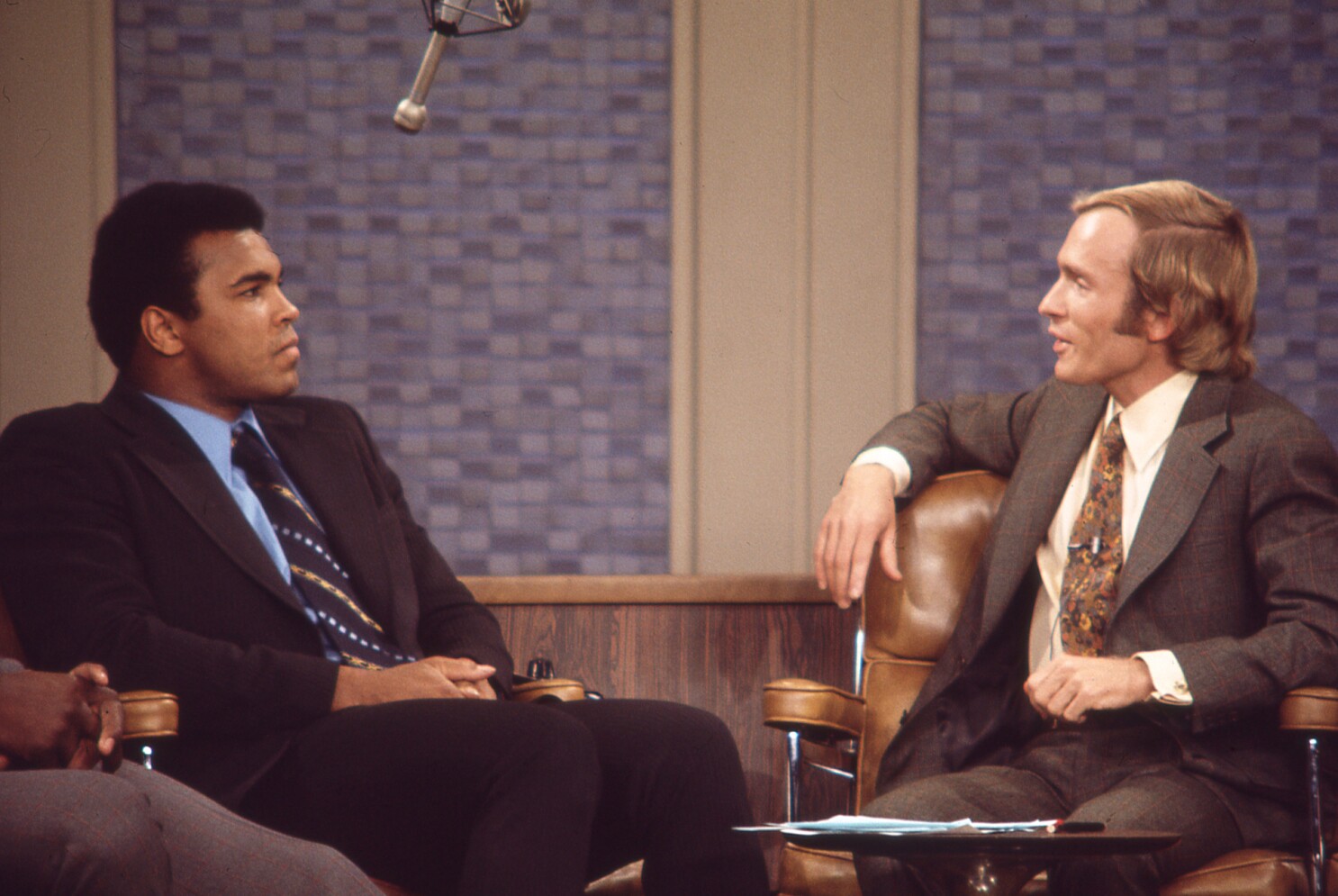
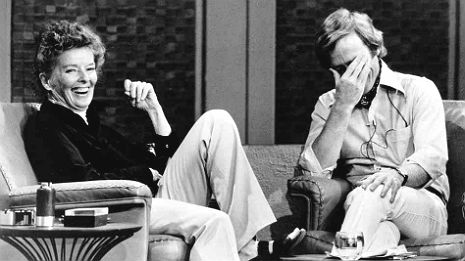
If you have ever seen Cavett in action, he has such a smooth, polite manner that sometimes you forget he may be asking an invasive question. Some of the most memorable shows were conversations with Christine Jorgenson (who walked off the show in 1968); Groucho Marx (1969); Jimi Hendrix (1969); The Woodstock Show (1969); Eric Clapton (1970); Alfred Lunt, Lynn Fontanne and Noel Coward (1970); Orson Welles (1970); Salvador Dali (1971); John Kerry debating on Vietnam (1971); Watergate and Beyond (1974); Angela Davis (1972); Jackie Robinson (1972); Marlon Brando (1973); Katharine Hepburn (1973); Carol Burnett (1974); and  Mohammad Ali (several shows). As you can see, in addition to entertainers, Cavett interviewed influential authors, politicians, athletes, and newsmakers.

Image result for images of dick cavett
Talking to the Great One: Ali Photo: latimes.com

Cavett often had several guests on each show, but sometimes he devoted the entire night to one person such as Laurence Olivier, Judy Garland, Bette Davis, Janis Joplin, Alfred Hitchcock, Fred Astaire, Gloria Swanson, Lucille Ball, Bob Hope, and David Bowie.

Politics were often covered by Cavett, and over the years, he interviewed many including political guests including Carl Bernstein and Bob Woodward, Walter Cronkite, John Ehrlichman, John Dean, Gerald Ford, Barry Goldwater, Henry Kissinger, and G. Gordon Liddy.

In various interviews of his own, Cavett mentioned different shows that were memorable or brought in a lot of mail. Early in the show’s history, Cavett was interviewing Peter Falk, Ben Gazzara, and John Cassavetes about a movie they were in. Cassavetes was so drunk and incoherent, Cavett walked off the stage.

Image result for images of dick cavett
Laughing with Katharine Hepburn Photo: dangerousminds.com

Georgia governor Lester Maddox appeared in a panel with Truman Capote and Jim Brown about segregation. Cavett made a reference to “bigots” who supported Maddox. When Maddox demanded an apology, Cavett apologized to Georgians who supported him without being a bigot. Maddox left the studio. However, later Maddox relented and made another appearance, and Cavett walked off the set as a joke.

One memorable episode was something no host wants to encounter. Publisher J. I. Rodale was on the show. Cavett was talking to another guest when Rodale seemed to be snoring, but everyone soon realized something was wrong. He actually died there on the set. The audience didn’t even realize it until Cavett called for a doctor. The program was taped but not aired.

Director Ingmar Bergman did few television interviews and no US interviews, but he made an exception for Dick Cavett.

Image result for images of dick cavett
With David Bowie Photo: nostalgiacentral.com

So, what types of things might you have learned from Cavett’s show? Well, Hitchcock explained how some of his most ingenious special effects worked.  Gale Sayers talked about the movie Brian’s Song (maybe he could have given me a hint how not to cry every single time I see the movie.).  BB King revealed what his name stands for. Jack Benny demonstrated how to play the violin. Melba Moore told what it was like to open at the Apollo Theater. James Garner explained how he accidentally broke co-star Doris Day’s ribs, and Jacques Cousteau discussed the mystery of manatees.

And finally, I had to find out who was Cavett’s favorite interview, and who were the ones that got away? The two he never got to interview but always wished he had was an easier answer to find: Cary Grant and Frank Sinatra.

Image result for images of dick cavett and groucho marx
Photo: WBUR

It was a lot harder to answer the first question.  If you read the other three blogs in this series, you know the other talk show hosts (Mike Douglas, Phil Donahue, and Tom Snyder) began careers in Ohio. I was hoping to find an Ohio link for Dick, and that’s when I found the answer to my question of his favorite interviewee.  Cavett landed in Cleveland at the end of his career, which seems fitting since he is ending this series.

He was talking about an upcoming show at The Nightclub in Cleveland and mentioned Jack Paar was his mentor. (Cavett wrote for The Tonight Show when Paar hosted it, and Paar began his career in Canton, Ohio; I know it’s one coincidence after another.) Jack told him he didn’t need humor, singing, or anything except a desire to have a conversation. Then Cavett said, “I watch clips from the shows when I’m invited to give a talk and they show them, and I’m always surprised by the number of little delightful moments I’ve forgotten. I watched a moment the other night when Groucho was on the show with [zoologist] Jim Fowler. And Fowler brought a sloth on the stage, and Groucho said, ‘That’s the lousiest-looking dog I’ve ever seen.’ I’d forgotten that. That was the same night Groucho proposed marriage to Truman Capote. . . .’I love to do Q&A with the audience, but there’s only one forbidden question, and it doesn’t have anything to do with sex or politics,’ he said. ‘The forbidden question is, Who has been your most interesting guest?’ . . . But then he went on to say that ‘If pushed to the wall, I have to admit that Groucho was the guest who meant the most to me.’ Cavett said that ‘In a letter from Miriam, Groucho’s daughter, she wrote, ‘My father thought the world of you.’ It gets me even now when I say that out loud.’”

Image result for images of dick cavett and groucho marx
The unique Groucho Marx Photo: pinterest.com

In 2005 several box sets were released of some of Cavett’s shows. They are collected by theme of the interviewee such as The Rock Icons, etc. The network Decades, which recently went off the air, broadcast these shows also. Before the network was disbanded, I was able to watch about ten of these episodes, and they were as good as I had hoped for.

I have really enjoyed reviewing these talk show hosts and their guest interviews this month.  It makes me want to invite a bunch of friends over, one at a time, for coffee and conversation.  Just be forewarned, if I invite you over, I may have a list of questions I’ll want to be asking you.