This month is all about National Days for States. Today we are celebrating National Nevada Day which is March 29, 2021. Our star who was born in Nevada is Abby Dalton. Abby was born Gladys Marlene Wasden in 1932 in Las Vegas.
Photo: wikipedia.com
Dalton began working as a teen model and also appeared on several record album covers. In 1957 she was cast in several unmemorable and hard-to-watch movies including Rock All Night, Teenage Doll, Carnival Rock, and The Saga of the Viking Women and Their Voyage to the Waters of the Great Sea Serpent.
Photo: ebay.com
Abby started her television acting career by being cast in a variety of westerns, including Have Gun Will Travel, Rawhide, Maverick and The Rifleman.
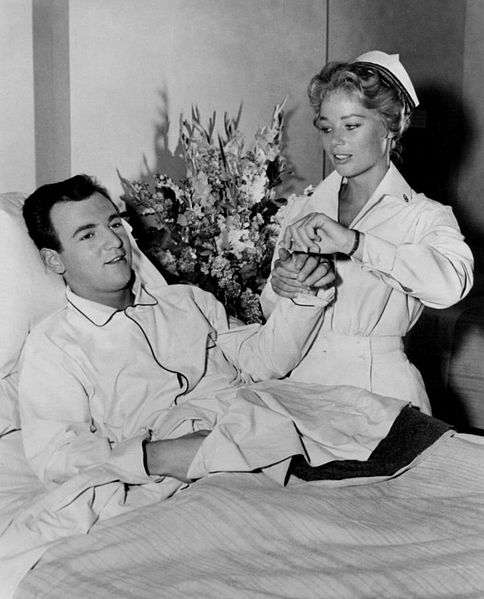
Dalton caring for Bobby Darin–Photo: wikimedia.com
In 1959, Abby received the role of Nurse Martha Hale on Hennesey. Jackie Cooper played US Navy physician Lt. Charles “Chick” Hennesey. The two medical professionals meet at a hospital where they work for the US Naval Stations in San Diego, CA. Both Dalton and Cooper received Emmy nominations for their roles on the series. The show continued on the air for three seasons before it was cancelled.
When the show ended, The Joey Bishop Show was beginning its second season. The series was going through an overhaul and season two debuted with Dalton married to Joey Bishop as Ellie Barnes.
Joey Bishop with Dalton–Photo: wikimedia.com
Dalton was married in real life to Jack Smith in 1960. When her character has a baby, her son on the show was played by her real-life son Matthew and her daughter Kathleen also appeared on the show. Unfortunately, her marriage ended in 1972. (Her first marriage to husband Joe Moudragon also ended in divorce in 1959.)
Ironically, the finale to Hennesey when she married Chick Hennesey was shown two days after The Joey Bishop Show’s show’s first airing of her character.
Dalton was cast in the pilot for Barney Miller as his wife, but the show was not picked up by any of the networks and later the role was given to Barbara Barrie.
Dalton and Bob Crane–Photo: ABC – Love American Style
Abby was also a favorite in Love American Style and The Love Boat. She did make some appearances on several shows during the seventies on Nanny and the Professor, Police Story, Apple’s Way and The Waltons.
In later years, Dalton was known as a game show panelist, appearing on Match Game, Super Password, and Hollywood Squares. In the eighties, you could see her on Hardcastle and McCormick, Murder She Wrote, and Hotel.
John Astin and George Furth with Dalton–Photo: ABC – Love American Style
During the 1980s Dalton accepted another permanent role as Julia Cumson on Falcon Crest. She is the daughter of Angela Channing (Jane Wyman) and a vintner. While she appeared as a decent woman, the season two finale clues us in that she was a murderess. Season three finds her navigating life in both a psychiatric ward and a prison. She escapes, planning on killing her mother. We believe her to have been killed at the end of the year, but in the fourth season, true to the soap opera formula, we realize she is alive, although maybe not well. She would make occasional appearances on seasons five and six but is not seen after that year.
Her daughter Kathleen Kinmont was married to her “son” on Falcon Crest, Lorenzo Lamas. Kinmont was also married to actor Jere Burns after her divorce to Lamas but that marriage also ended in divorce.
Dalton died in 2020 after suffering from a long illness.
Abby Dalton, 1982. (Photo by Getty Images)
Although Dalton’s career has to be labeled successful, I think with a break here or there, it could have been much more fulfilling. She seemed to be a good actress and could be very funny. Perhaps a sitcom rather than a tv drama might have catapulted her into a second wave of television acting roles. Despite, the fact that you feel like she never got that big break she deserved, she had permanent roles in three television series and entertained many people during her game show circuit era. Considering how many people never get a chance to star in a television show, she had a long career; thanks Abby Dalton for bringing us three decades of entertainment.
As we continue with our National State Day Celebrations, this week finds us in West Virginia. Who else can we pick but Don Knotts?
Photo: amazon.com
Born in 1924 in Morgantown, WV, Don Knotts was the youngest of four boys. Don had a rough youth. His parents were farmers and his mother was 40 when he was born. His father suffered from mental illness, and Don’s birth led to a nervous breakdown. His father died when he was 13 and his mother made her living running a boarding house after that. At an early age, Don began performing as a ventriloquist and comedian at church and school functions.
After graduation, Knotts began college but then enlisted in the army, serving during WWII from 1943-1946. He toured the Pacific Islands entertaining the GIs as a comedian. In 1948 he graduated from West Virginia University with a major in education, a member of the honor society.
Photo: pinterest.com
Before graduating, Knotts married Kathryn Metz. They would remain married until 1964 when they divorced. After college, the couple moved to New York to pursue a career in the entertainment industry.
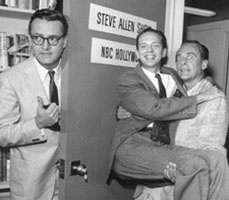
Steve Allen, Knotts, and Louis Nye–Photo: ebay.com
Believe it or not, his first role was in the soap opera Search for Tomorrow, and he would become part of the cast from 1953-1955. In 1956, he got his big break on the Steve Allen Show, playing a nervous man. He stayed with the show until 1959. The Tonight Show relocated to Hollywood with Jack Paar as host in 1959, and Don went with him. However, during his time on the show, he had a role in the play “No Time for Sergeants” and then in the film version with Andy Griffith.
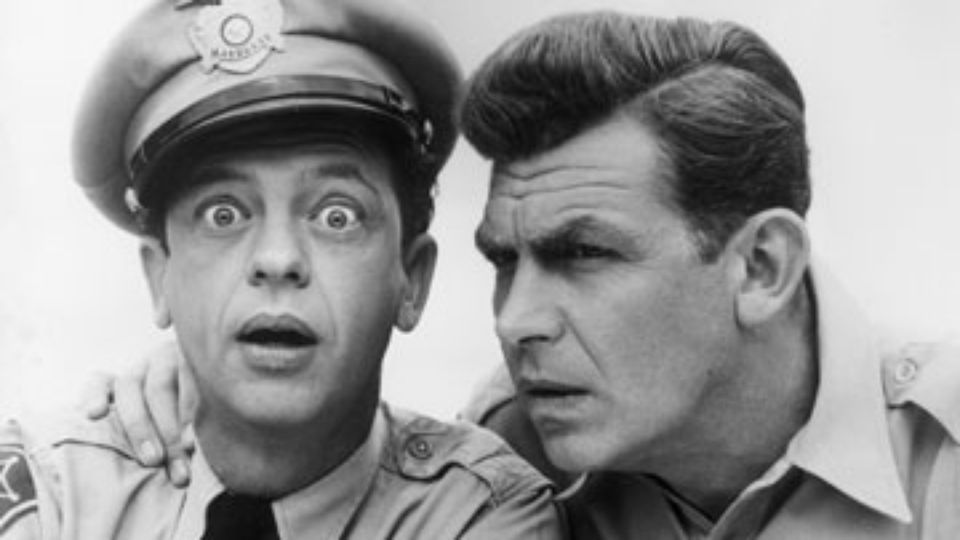
Andy Griffith and Knotts-Photo: tvseriesfinales.com
In 1960 Andy Griffith was putting together his own sitcom, The Andy Griffith Show, and he offered Knotts the role of Barney Fife, deputy. During his time as Barney, Knotts received five Emmy awards (three during his first five years).
Photo: bobshideout.com
The Museum of Broadcast Communications sums up Barney’s character perfectly:
“Self-important, romantic, and nearly always wrong, Barney dreamed of the day he could use the one bullet Andy had issued to him, though he did fire his gun on a few occasions. He always fired his pistol accidentally while still in his holster or in the ceiling of the court house, at which point he would sadly hand his pistol to Andy. This is why Barney kept his one very shiny bullet in his shirt pocket. In episode #196, Andy gave Barney more bullets so that he would have a loaded gun to go after a bad guy that Barney unintentionally helped escape. While Barney was forever frustrated that Mayberry was too small for the delusional ideas that he had of himself, viewers got the sense that he couldn’t have survived anywhere else. Don Knotts played the comic and pathetic sides of the character with equal aplomb.”
Mayberry Family: Knotts, Ron Howard, Griffith, Frances Bauvier– Photo: tvtropes.com
Originally, Don was supposed to be the straight man to Andy’s character, but Griffith quickly realized the reverse would make the show more successful. Andy always said he wanted to be done after five years. During that fifth year, Knotts began to search for his next job. He signed a five-film contract with Universal Studios. Then, Andy decided not to quit after season five, but since Knotts was already committed, he left the show in 1965.
Knotts with Betty Lynn–Photo: mesquitelocalnews.com
From everything I’ve read, it seems like the cast of TAGS got along very well. Although Frances Bavier seemed to take things more personally than others, the actors seemed to enjoy working together. Betty Lynn who played Barney’s girlfriend Thelma Lou described Knotts as “a very quiet man. Very sweet. Nothing like Barney Fife.” Mark Evanier, a television writer, called him “the most beloved person in all of show business.”
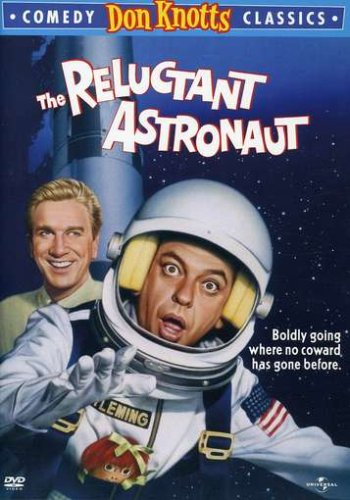
Knotts family-viewable films were very popular including It’s a Mad, Mad, Mad, Mad World; The Incredible Mr. Limpet; The Ghost and Mr. Chicken; The Reluctant Astronaut; The Shakiest Gun in the West; The Love God?; and How to Frame a Figg.
One of my favorite roles of Don’s was as the shoe salesman in the Doris Day-James Garner movie, Move Over Darling.
He also returned to Mayberry for several episodes. (Two of his Emmys came from these guest spots.)
Doris Day and Knotts– Photo: pinterest.com
Knotts also kept busy on other television shows including appearances on The Bill Cosby Show, Here’s Lucy, Fantasy Island, The Love Boat, Newhart, and That Seventies Show.
Also, during these years, Knotts tried marriage again wedding Loralee Czuchna in 1974. The couple called it quits in 1983.
He received his second starring role in 1979 as Mr. Furley on Three’s Company. Knotts replaced Stanley and Helen Roper (Norman Fell and Audra Lindley) who left for their own spin-off show.
Suzanne Somers and Knotts– Photo: history garage.com
He became the new landlord for the trio upstairs. He would stay with the show until it ended in 1984, racking up 115 episodes. I will admit that I did not enjoy the show, and I felt Knott’s performance was over the top and too stereotyped; I felt that way about the other characters also.
Don and Andy remained close friends throughout their lives. When Andy returned to television as Matlock, Knotts also received a role on the show as Les Calhoun, Matlock’s neighbor from 1988-1992.
Knotts and Griffith in later years– Photo: sitcomsonline.com
Don suffered from macular degeneration, and eventually it caused him to become virtually blind. In 2002 Don married a third time when Frances Yarborough became his wife.
Knotts died in 2006 from pulmonary and respiratory complications from pneumonia related to lung cancer.
Off screen, Knotts seemed to be a very funny guy. His daughter Karen said, “Here’s the thing about my dad. He had this funniness that was just completely, insanely natural.”
Photo: directexpose.com
He told his daughter his high school years were some of his happiest. His home town loved him too, and a statue honoring him was unveiled in 2006 in front of the Metropolitan Theatre. The statue was designed by local artist Jamie Lester, another West Virginia native.
Photo: guardianlv.com
Don Knotts had a spectacular career. As a young man, he got a job in a chicken factory and spent his days pulling feathers off dead chickens because he was told he had no future in the acting profession. It would have been hard for him to imagine at the time the legacy of performances he would leave—television shows and movies that generations of fans would watch. More than sixty years after Barney Fife put that bullet in his pocket for the first time, viewers continue to watch and love the Mayberry residents as they go about life in their small town. And the fact that the place where he first learned about life cared enough to fundraise and build a memorial to honor him says a lot. Thank you Don Knotts for showing us the importance of humor and following your dreams!
As we continue to celebrate National State Days, this week we are visiting Kansas. Our Sunflower star is Vivian Vance. Vivian was born in Cherryvale, Kansas in 1909. Her family moved to Independence when she was six. She knew she wanted to be an actress, but her mother’s strict religious beliefs prohibited her. She began sneaking out of her room at night to perform and eventually moved to Albuquerque, New Mexico where she changed her last name from Jones to Vance.Vivian married Joseph Shearer Danneck Jr. in 1928 at age 19 but they divorced in 1931.
Photo: showbizcheatsheet.com
In 1930 she was hired for her first job at the Albuquerque Little Theatre. After appearing in many other plays for the group, the local theater community paid her way to New York so she could study with Eva Le Gallienne.
In 1932, Vance began working on Broadway and was often a chorus member. In 1937 she replaced Kay Thompson in “Hooray for What!” and then began receiving supporting roles. In 1941, she joined Danny Kaye and Eve Arden in Cole Porter’s musical “Let’s Face It” for 500 performances. She would appear in 25 plays with her last being “Harvey” in 1977.
Photo: pinterest.com
In 1933 Vance tried marriage again, wedding George Koch, but that relationship also ended in divorce in 1940. Her third marriage to Philip Ober in 1941 would also last only 8 years.
Until 1950 she was offered some small roles in big screen in several films. In 1949, she appeared in her first television series, Philco TV Playhouse.
Photo: famouspeople.com
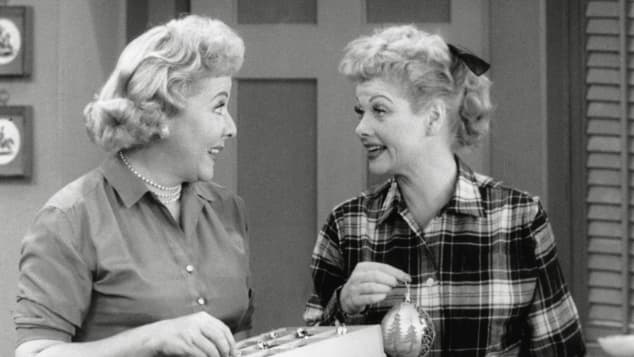
In 1951, Lucille Ball and Desi Arnaz decided to launch their sitcom I Love Lucy. Ball was hoping to cast Barbara Pepper or Bea Benarderet in the role of Ethel Mertz. Bea had already taken the role of Blanche Morton on The George Burns and Gracie Allen Show. CBS declined to hire Pepper because they said she had an addiction to alcohol. After many roles as “The Dame” in the movies, Pepper later played Doris Ziffel on Green Acres. It’s interesting that CBS allowed William Frawley to be hired for the show because he had a well-known alcohol problem at that time, but Desi gave him strict rules.
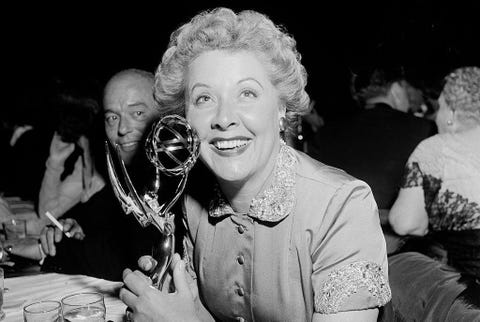
Director Marc Daniels had seen Vance perform in the “Voice of the Turtle” and suggested her for the role. She would play Ethel for 179 episodes. She was nominated for her work in 1954, 1956, and 1957, winning in 1954.
Photo: countryliving.com
Apparently, she was a very good actress because although she and William Frawley who played her husband Fred had great comedic timing, they could not stand each other. Vivian wasn’t happy that she had to wear frumpy clothing and that Frawley was supposed to be her husband because he was 22 years older than her. He overheard a derogatory comment she made about their age difference, and they never developed any type of cordial friendship after that. However, their coworkers claimed they were professionals and treated each other with respect on the set.
Vance with Frawley, Arnaz, and Ball–Photo: hollywoodmemorabilia.com
When the sitcom ended, Vance continued to play Ethel on The Lucille Ball-Desi Arnaz Show. She and Frawley were offered a spin-off series, but Vance passed because she didn’t want to continue working with Frawley. Vance was interested in another show however, and Desilu, Ball and Arnaz’s production company, put together a show called Guestward Ho! for her, but the network rejected the pilot. Desilu made some changes to the show and hired Joanne Dru for the lead. ABC picked it up but cancelled it after one season.
In 1961, Vance married John Dodds, an agent, editor and publisher. They moved to Stamford, Connecticut, and Vance always felt pulled between her marriage and career. In 1974 the couple moved to California. Vivian had no children from her four marriages but was godmother to Lovin’ Spoonful band member John Sebastian.
Candy Moore, Ball, Jimmy Garrett, Ralph Hart and Vance–Photo: hitstv.com
When Ball put together a new show, The Lucy Show in 1962, she invited Vance to costar on the show. The concept featured Ball as Lucy Carmichael, a widow, raising two children in Danfield New York. Vance played her best friend Vivian Bagley, a divorced mother of one son. After a few years, Vance wanted a bit more control and a bit of controversy developed between Lucy and Vivian. Vivian left the show, but they resolved their differences and she guest starred on the show and joined Lucy on reunion shows and on her third sitcom, Here’s Lucy which ran from 1968-1974.
Photo: pinterest.com
Vance had very few television roles after leaving Ball’s sitcom, although she did make appearances on Off to See the Wizard, Love American Style, Rhoda, and Sam.
She was best known during those years as the Maxine, the Maxwell Coffee lady starring in numerous commercials for the coffee company. She was paid $250,000 for her three-year contract.
Photo: pinterest.com
The last time Vivian and Lucy appeared together was Ball’s special Lucy Calls the President in 1977. Not long afterward, Vance suffered a stroke which left her partly paralyzed. She died in 1979 from bone cancer.
Both Ball and Arnaz commented on her death. Desi shared that “it’s bad enough to lose one of the great artists we had the honor and the pleasure to work with, but it’s even harder to reconcile the loss of one of your best friends.”
Ball commented on Vivian’s performance as Ethel: “I find that now I usually spend my time looking at Viv. Viv was sensational. And back then, there were things I had to do—I was in the projection room for some reason—and I just couldn’t concentrate on it. But now I can. And I enjoy every move that Viv made. She was something.” Both Vance and Frawley were inducted into the Television Academy Hall of Fame in March of 2012.
Photo: allvipp.com
Some actors have the ability to adapt to a variety of television roles and we’re grateful for them. Other stars create one that is so memorable it becomes completely entwined with part of our life. Thank you Vivian Vance for being Lucy’s best friend. While we love Lucy’s antics, you are the one the majority of us identified with and for seventy years you have been influencing comedy and making new fans.
We are celebrating National State days this month. This week we are celebrating Oregon. I’m sure a lot of stars grew up in Oregon, but my choice is David Ogden Stiers. Although Stiers was born in Illinois on Halloween in 1942, his family moved to Eugene, Oregon when he was in high school. Based on his life, I think Oregon has the better claim to him. After graduation, Stiers enrolled in the University of Oregon.
Photo: ebay.com
Early in his career, Stiers moved to San Francisco, performing with the California Shakespeare Theater, the San Francisco Actors Workshop, and the improv group, The Committee. I would like to learn more about The Committee whose members included Rob Reiner, Howard Hesseman, and Peter Bonerz.
In the 1960s, Stiers moved to New York to study at Juilliard for a couple of years and was able to appear in numerous Broadway productions. At Juilliard, Stiers was mentored by John Houseman.
Stiers was a prolific actor, appearing in 38 big screen movies, 39 made-for-tv movies, and more than 90 different television series.
Stiers with Mary Tyler Moore–Photo: amazon.com
In the 1970s, he showed up on Kojak, Charlie’s Angels, Phyllis, The Mary Tyler Moore Show, Rhoda, The Tony Randall Show, and Paper Chase.
Most of us got to know him as Major Charles Emerson Winchester III on M*A*S*H. He became part of the cast in 1977 and continued with the show until it ended in 1983. As Winchester, Stiers would receive two Emmy nominations in 1981 and 1982. Both years he got beat by a Taxi alumni, Danny DeVito in 81 and Christopher Lloyd in 82.
Stiers with Harry Morgan and William Christopher–Photo: thenewyorktimes.com
Winchester replaced Frank Burns whom Hawkeye and Hunnicutt made fun of for his inept medical skills. Charles was a brilliant surgeon but was an aristocrat from Boston and never let anyone forget it. However, as with all M*A*S*H characters, Winchester continues to evolve, and we learn more about his past and how that affected his personality.
Stiers with Morgan and Loretta Swit–Photo: enews.com
Stiers always described Harry Morgan as his acting mentor, but he loved the entire cast. Although Stiers could come off a bit like Winchester at first meeting, once he got to know you, his castmates said “the walls came down and you saw a sweet, tender man.” Kellye Nakahara (Nurse Kellye) shared that she used to jump into Stier’s arms every morning so he could twirl her around like a princess at a ball.” Loretta Swit said “he was very much his own person, but he loved and adored us as we did him.” Executive producer Burt Metcalfe reported that “I have always felt that one of the reasons for the show’s success was that the audience sensed that the characters loved another and they loved the characters. And that love goes down to the actors.” All his coworkers described Stiers as a prankster on the set.
His life after M*A*S*H included roles on a variety of shows, including Alf, Wings, Star Trek, Murder She Wrote, Dr. Quinn, Ally McBeal, The Outer Limits, Touched by An Angel, and Frasier.
He would also receive recurring roles in four additional series during his career. In Two Guys, A Girl and A Pizza Place, he played Mr. Bauer.
Stiers with Swoosie Kurtz, Paget Brewster, and Brian Van Holt Photo: pinterest.com
I never watched Love & Money, but Stiers played the wealthy Nicholas Conklin; the show is described as “The penthouse-residing Conklin family of scholars and the basement-dwelling McBride family of maintenance men find themselves unhappily linked when the heiress daughter and blue-collar son fall in love.”
I also never watched the Dead Zone, but Stiers played Reverend Purdy in the show where “Johnny had the perfect life until he was in a coma for six years When he awoke, he found his fiancé married to another man, his son doesn’t know him, and everything had changed including Johnny because he can now ‘see’ things.”
Stiers with Sasha Alexander–Photo: popcitylife.com
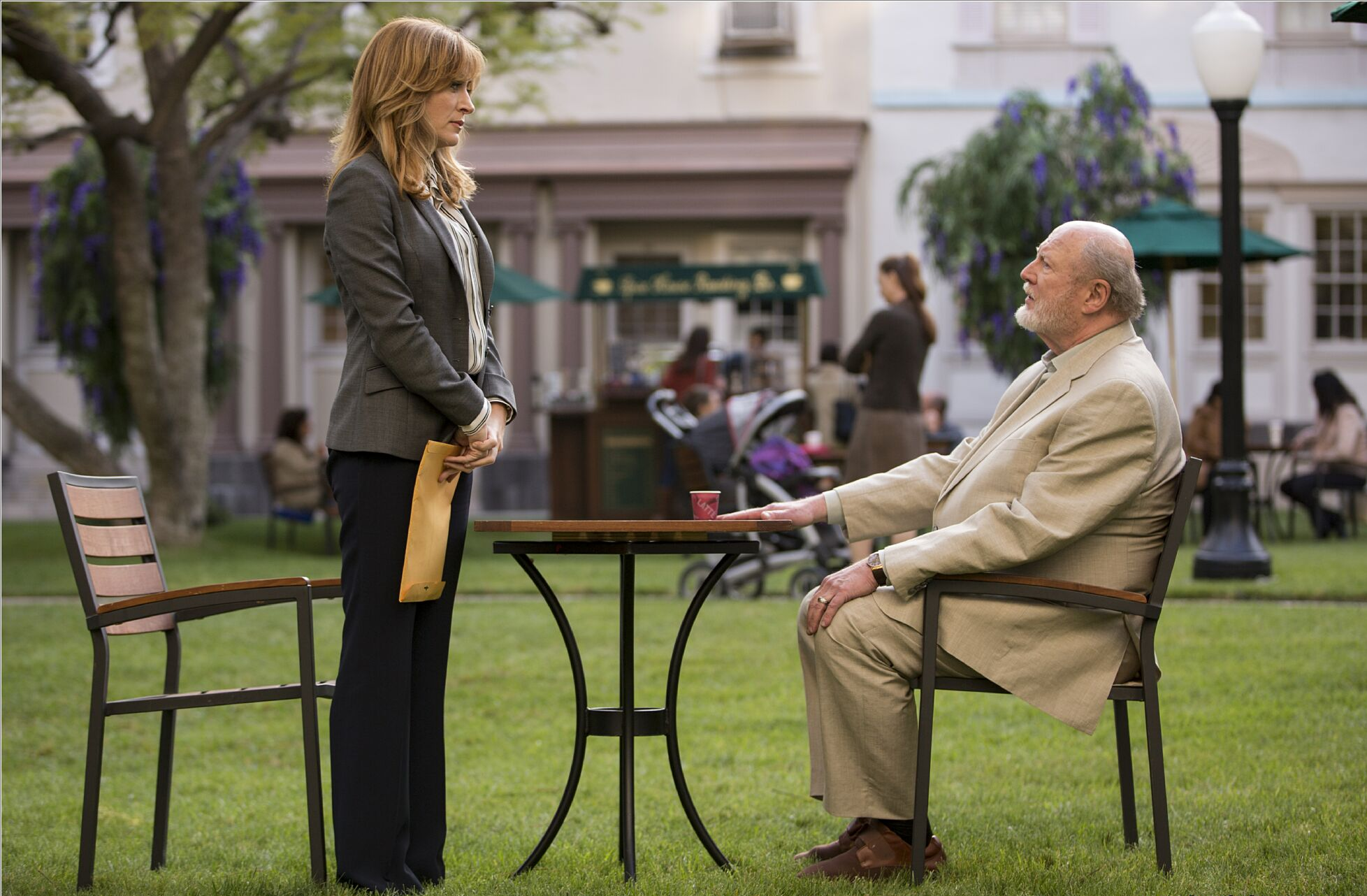
He also played Arthur Isles in Rizzoli & Isles, one of my favorite shows from the past few years.
You could also hear Stiers in a number of animation films including Beauty and the Beast, Pocahontas, and the Lilo and Stitch movies. He narrated many audiobooks as well.
Photo: OregonCoastDailyNews
One of the reasons Oregon can lay claim to Stiers is because he continued to live in Newport and spent his later years as a conductor for the Newport Symphony Orchestra. As a fan of classical music, Stiers was able to be a guest conductor in more than 70 orchestras around the world. Newport seems to be a quirky, but fun, place with a population of only about 10,000. It is definitely on my list of places to visit.
In 2018, Stiers passed away from bladder cancer. He generously bequeathed funding for a variety of cultural groups including the Newport Symphony, the Newport Public Library, and the Oregon Coast Council for the Arts.
Photo: amazon.com
I appreciate that Stiers loved and celebrated the arts. One of his thoughts about experiencing culture was: “The thing I love about the arts—music, theater, museums, galleries—is that everybody wins. You are touched and hopefully moved, and it is unique to each person. Even though you may have listened to the same performance, what you heard could be vastly different from what anyone else heard.” I’m happy that he was able to spend the last years of his life doing something he enjoyed so much after a life of giving to others through his acting performances—something we can all aspire to.
For those of you who are big fans of the “National Day of” calendars, you know that there are celebrations for National State Days. In my blog this month, we are learning about celebrities from those National State Days. We begin with National Minnesota Day and one of the stars born there is Marion Ross.
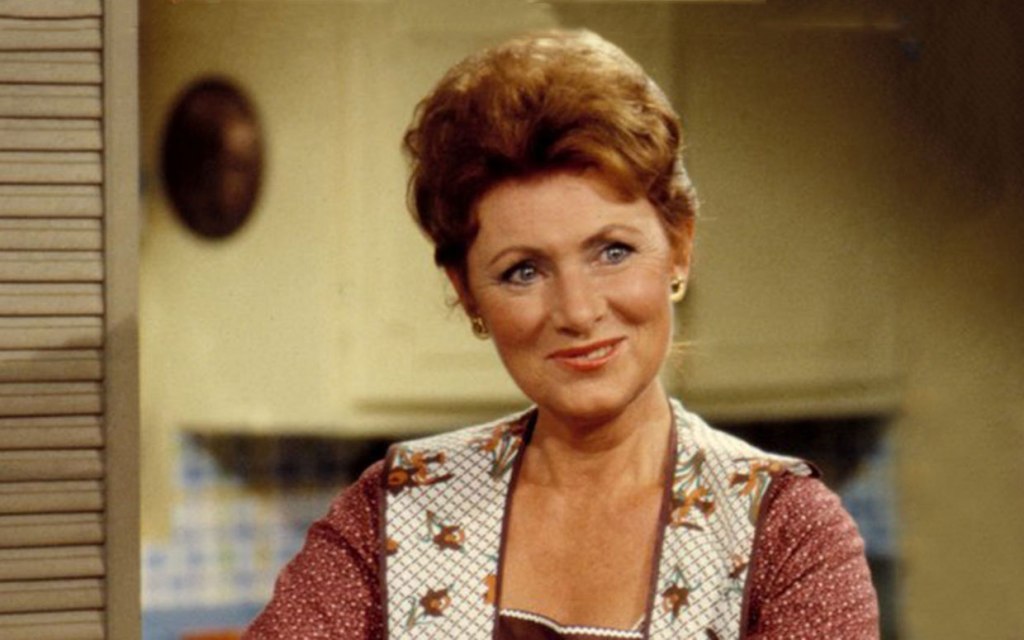
Marion was born in Watertown, MN in 1928. She moved from Waconia to Wilmar and then to Albert Lea. She must have always had stars in her eyes because at age 13 she changed the spelling of her name from Marian to Marion because she thought it would look better on a marquee. After her sophomore year in high school, she enrolled at the MacPhail Center for Music in Minneapolis. A year later, her family moved to California where she graduated from Point Loma High School.
Photo: ihearthollywood.com
Ross was named Most Outstanding Actress at San Diego State University; however, her major was archeology. After graduating in 1950, she did some summer theater in California and then began auditioning for films. The year she graduated, she eloped with Freeman Morse. They were married for 18 years.
Marion was successful in her movie career. Her first film was Forever Female with Ginger Rogers and William Holden in 1953. She would appear in 26 movies including The Glenn Miller Story and Sabrina. Ross recalled her time in Hollywood. She says it was a great time to be an actor. “All the stars ate in the studio’s dining room. Marlene Dietrich would come swooping into the room, and a hush would fall over the place. Those early days in Hollywood were just so thrilling, almost more than I could bear.”
Ironically, her first television role on Calvacade of America also took place in 1953. She would go on to have an amazing television career with more than 140 different roles on the small screen. While most of her appearances in the fifties were on the drama shows or westerns, she did show up on Life with Father as an Irish maid from 1953-55. She also was a teacher on The Donna Reed Show.
Photo: metv.com
Ross on Perry Mason
The sixties found her primarily on dramas such as Outer Limits, Dr. Kildare, and The Fugitive. However, she also received recurring roles on three series: The Gertrude Berg Show, Mr. Novak, and Paradise Bay. She was Mary Morgan on Paradise Bay, a soap opera set in California. Although the show was only on for a year, she appeared on 158 episodes before it ended.
Photo: metv.com
Her last role of that decade landed her on The Brady Bunch. When the kids get sick, Mike calls the boys’ male doctor and Carol calls the girls’ female doctor. Instead of choosing one, they decide to keep seeing their same patients.
The early seventies kept Ross busy on shows such as Hawaii Five-0, Love American Style, and Marcus Welby. In 1974 that Love American Style skit led to the show Happy Days where Marion reprised her role as Marion Cunningham. She continued her role as biological mother to Richie and Joanie (and poor Chuck occasionally) and as a surrogate mother to Fonzie for eleven years.
Photo: pinterest.com
In May of 2020, Ross did an interview on TVLine.com with Matt Webb Mitovich. He asked if she had a favorite episode from the show. She said there were two that were definitely favorites. One was when Marion gets mad at the family because they expect so much. She stood up for herself, told Howard he could have his food and took it out uncooked and put it in front of them, then storms out the door and went to work at Arnold’s. Her other favorite was the scene when she did the tango with Fonzie. She said Henry Winkler caught on right away but she had to work with a coach for a week to get it down right.
Photo: parademagazine.com
She also discussed the softball team Garry Marshall put together to keep everyone out of trouble in the off season. She said they played all over the US and continued, “And then at one point, we were invited to go to Europe. We went to Germany and played softball with the US infantry which was incredible. And then once our show was totally over, after we did our last show at Paramount, we all got on a plane at the crack of dawn and flew to Okinawa and played softball with the US infantry there.” She played rover but said she could hit. Her strategy was to hit the ball and then run with her arms raised up. Everyone was so afraid of hitting “the old lady” she would make it on first base.
Photo: yahoo.com
After the demise of Happy Days, Marion wasn’t content to sit back and enjoy life. She continued her television appearances and from 1984-2018 you could catch her on a variety of shows including Night Court, MacGyver,Grey’s Anatomy, and Hot in Cleveland. She had recurring roles on another six series. She played several different women named Emily on The Love Boat, as the iron-willed Jewish matriarch on Brooklyn Bridge, mean Grandmother Forman on That Seventies Show, Drew’s mother on TheDrew Carey Show, Marilyn Gilmore on The Gilmore Girls, and Ida Holden on Brothers and Sisters.
Marion was also able to get back on the stage. She took roles in “Arsenic and Old Lace”, “Steel Magnolias”, “Long Day’s Journey into Night”, “The Glass Menagerie”, “Pippin”, and “Barefoot in the Park.” She also toured the country in a one-woman show as poet Edna St. Vincent Millay in “A Lovely Light.”
Photo: albertleatribune.com
In 2008 the Albert Lea Civic Theater in Albert Lea, Minnesota changed the name of its venue to the Marion Ross Performing Arts Center. Marion retired in 2018. She could then concentrate on some of her hobbies which include gardening, reading, spending time with family, watching movies, listening to the radio, praying, and singing. Marion’s two children are also in the entertainment business, Jim as an actor and Ellen Kreamer as a writer/producer on many shows including Friends and one of my recent favorites, Trial & Error.
In 2018 Ross published her memoir, My Days, Happy & Otherwise. The book is described as “funny, poignant, and revealing.” It features Garry Marshall’s final interview, a foreword from Ron Howard, conversations with her own children, and her entire story.
Photo: parademagazine.com
With the Covid pandemic continuing, Ross is happy to be spending her time at her California home being in her garden and spending time with family. As she put it, “It is such a wonderful time to bond and connect with family even if we are not together. I also have been calling friends to see how they are and have a little chat.” Some good motherly advice for all of us.
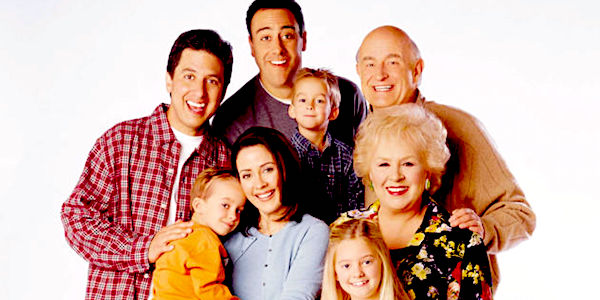
We are winding up this month’s blogs about some popular sitcoms. In 1986, the Barone family visited our living rooms. The show might be titled Everybody Loves Raymond, but the family was a package deal. Ray (Ray Romano), a sportswriter, (his column is “More Than a Game”) lives in a beautiful home with his funny and smart wife Debra (Patricia Heaton), and picture-perfect kids (played by real life siblings Madylin Sweeten, Sawyer Sweeten, and Sullivan Sweeten). However, once you probe a bit you find the same dysfunctional family all your neighbors and friends have.
Photo: cinemablend.com
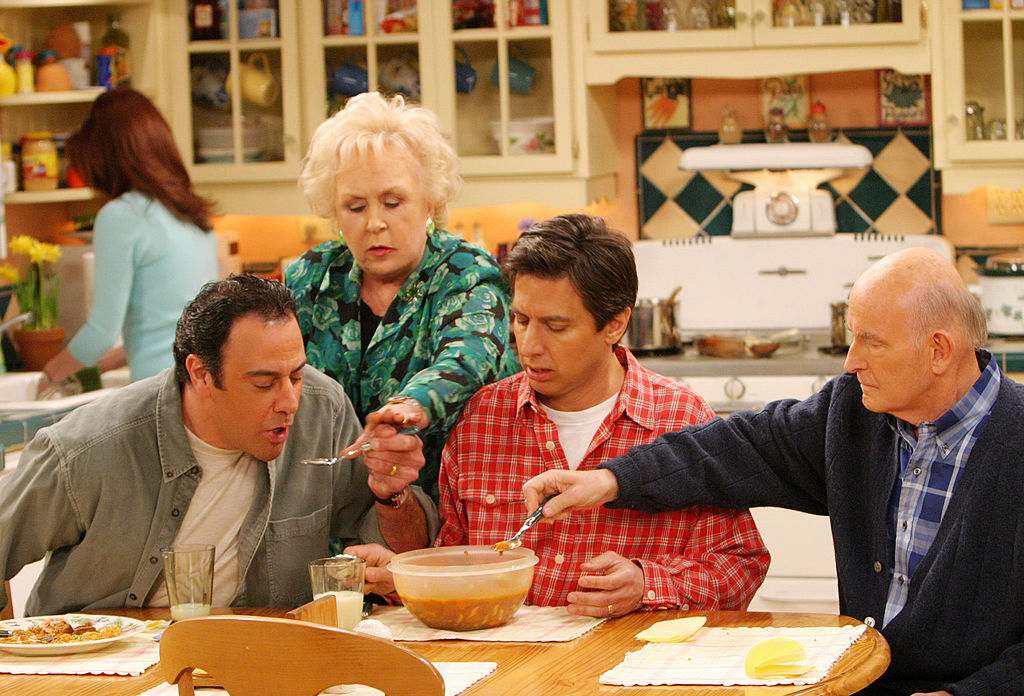
His parents Marie (Doris Roberts) and Frank (Peter Boyle) and his brother Robert (Brad Garrett), a policeman, live across the street and no one has anything that even looks like privacy. The exterior shots of the two Barone homes are located on Margaret Blvd in Merrick, New York and really are across the street from each other.
Romano told Larry King in 2005 that he was doing stand-up comedy for a dozen years when he appeared on Letterman. The next week, his company called to say they wanted to develop a show around his stories. He met with Philip Rosenthal who had been a writer for Coach.
Rosenthal Photo: vulture.com
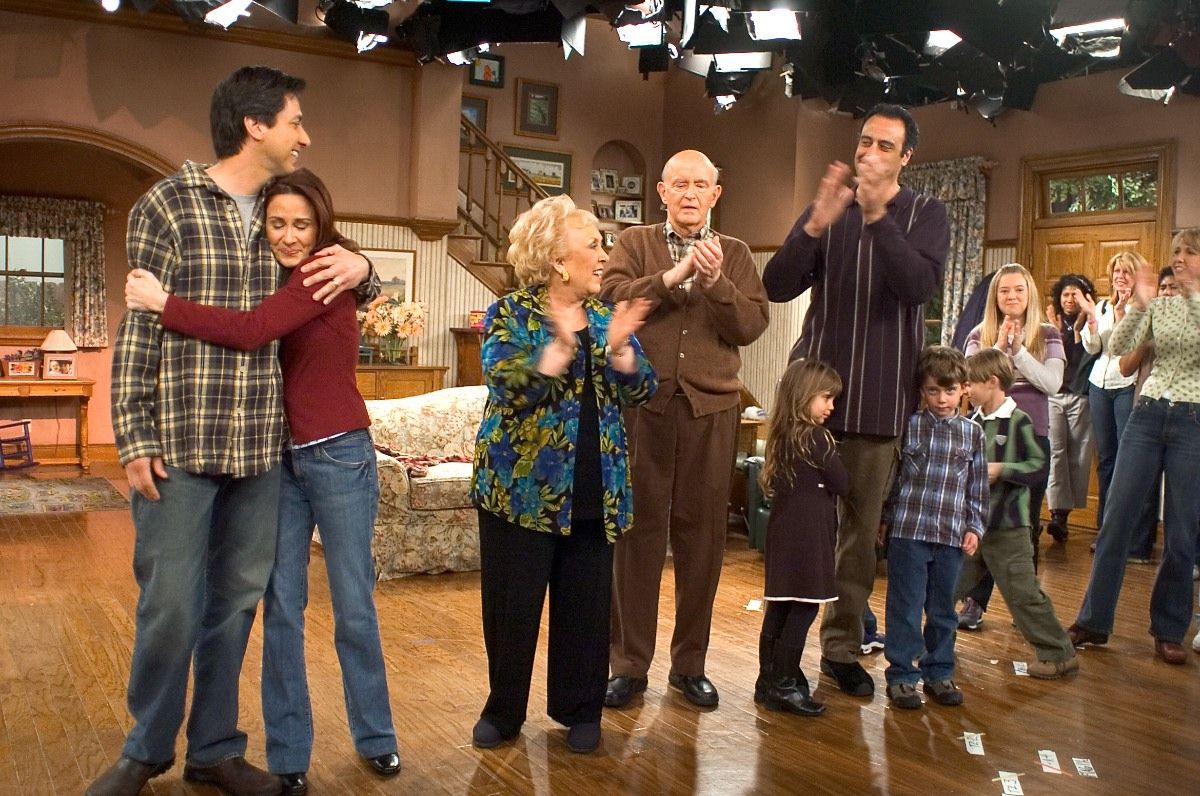
Philip Rosenthal then created this show which debuted in September of 1996 and stayed on the air until May of 2005, producing 210 episodes. (Romano and Roberts were the only two characters to appear on every one of the 210 shows.) The shows were filmed with a live audience for most of the nine years.
Real life intersects with television life in a variety of ways in this show. In addition to the Barone kids being real siblings, Ray’s daughter Alexandra appears on the show from time to time as Ally’s friend Molly. Ray’s brother in real life was also a police officer at the NYPD. Rosenthal’s wife Monica Horan later joins the show as Amy and marries Robert. Ray’s father Albert portrays Frank’s friend Albert. And, Heaton’s real-life husband David Hunt plays Bill Parker on several episodes.
Photo: amazon.com
Ray tries to keep peace between his wife and his mother but fails most of the time. Marie often criticizes Debra and the way she behaves as a wife and mother. He often leaves most of the children and household responsibilities to Debra. Marie obviously favors Ray, the younger of the boys, to Robert’s frustration. Ray and Robert are often seen arguing like ten-year-old boys. Frank is a bit of a gruff and rough man. Anyone is a potential target for his many insults, especially his wife. However, deep down he loves his family a lot, and we get to know him better as the show continues.
Boyle claimed that he got lost on the way to his audition, so when he showed up he was sarcastic and frustrated which helped him get the part. Garrett was the first actor given a role. Roberts was busy with a play so she came to the audition without any preparation and acted by her intutiion, obtaining the role over 100 other women. Heaton was a bit stressed, earning a living by babysitting and clipping coupons and the execs found her “real and focused.” The role came down to Heaton and Jane Sibbett but Ray preferred Heaton.
Photo: vox.com
The show has a timeless quality about it since it focused more on telling stories and reflecting on busy lives. Rosenthal said writing sessions started with everyone talking about their lives until they got an idea. Rosenthal admitted that “ninety percent of everything you hear on the show has been said to me or Ray Romano or one of the writers.” An episode was filmed every week. The actors did a read through and rehearsed on Monday, rehearsed with the tweaks made Tuesday, CBS running rehearsal Wednesday, camera blocking Thursdays, and filming Fridays.
The critics liked the show from the beginning. Los Angeles Daily News critic David Kronke said it “was the quintessentially honest sitcom. It’s neither too hokey nor too crass. It depicts families as dissolute yet inextricably bound together, just like they really are, and finds the humor in those real frictions that threaten, yet never manage, to burst family units apart. Its characterizations are among the most finely defined on TV. Debra, with her vaguely no-nonsense disgust of Raymond’s simpleton-ness, is unlike any sitcom mom ever. Doris Roberts’ Marie had a sinister streak long before Nancy Marchand’s Livia showed up on The Sopranos. Raymond is also one of the few contemporary sitcoms that has figured out how to implement and even exploit the four-camera, live-audience situation, which is no simple feat.”
Betsy Wallace gave the show 4 out of 5 stars, claiming “the cast is stellar and plotlines shed light on universal human insecurities, such as doubting that your spouse still finds you attractive as you grow older.” In 1997, Bruce Fetts said the series “may now be the best sitcom on the air.”
Photo: thecheatsheet.com
The show received 69 Emmy nominations, winning 15 of them. Roberts won four times, Garrett three, Heaton twice, Romano once. Boyle was the only nominee never to win.
After nine seasons, the fans were still on board, but the writers felt they had run out of ideas to keep a tenth season interesting, so the show ended. Knowing when it’s time to terminate a show and allow it to end gracefully is a wonderful gift for viewers.
Photo: throwbacks.com
With nine years of amazing shows you’re not going to be able to binge watch the entire series in a week-end, but it’s a great way to spend a season’s worth of cold, winter days. Thanks for nine years of memorable shows; we love you all.
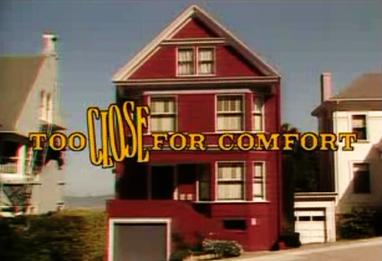
When I looked up the definition for “too close for comfort” it said “close enough to make a person feel nervous, worried or upset.” That is exactly how this show made me feel.
Photo: sitcomsonline.com
I realize that I was hard to please in the 1980s. Coming out of the 1970s with M*A*S*H,The Mary Tyler Moore Show, and The Bob Newhart Show, I did not enjoy All in the Family, The Jeffersons, Alice, Maude, or Diff’rentStrokes. I did watch Cheers, Family Ties, The Cosby Show, Who’s the Boss, and Moonlighting during that decade. Too Close for Comfort, along with Three’s Company, just didn’t strike me as funny.
When you invest in a show, you feel like these characters are part of your life. Ted Knight’s role of Ted Baxter on The Mary Tyler Moore Show was a flawed human being for sure, but I felt like we had spent a lot of time together, and I was able to see beyond the brash, obnoxious exterior to the vulnerable and kind being inside. It was if we had spent lots of hours over the kitchen table having coffee. Characters like Baxter teach us about the world and about ourselves. Ted Knight as Henry Rush was more like the neighbor whom I caught glimpses of out the kitchen window but there was no way to learn more about the character other than the surface appearances. The show was based more on plots than characters.
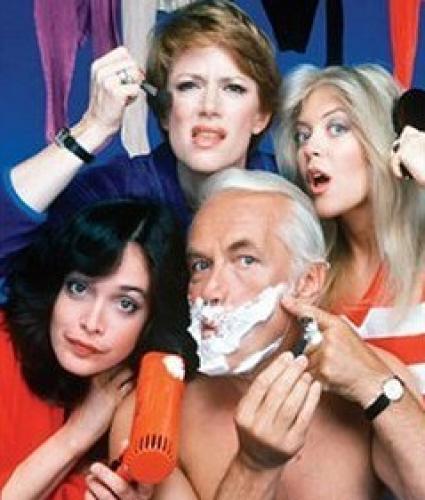
Too Close for Comfort was based on the British sitcom Keep It in the Family. It debuted in 1980. Henry Rush is a cartoonist who writes about the Cosmic Cow (a space crime fighter) and lives in San Francisco with his wife Muriel, a photographer (Nancy Dussault) and his two adult daughters Jackie (Deborah Van Valkenburgh) who works at a bank and Sara (Lydia Cornell) who is a college student.
Photo: wikipedia
The house was a two-family residence and the girls decide to rent from their parents. Henry is not sure it’s a good idea, but it’s the only apartment they can afford because he charges $300 rent for the bottom of the Victorian house. Monroe (Jim Bullock) is a friend of Sara’s who was cast only in one episode but ended up joining not only the cast but living with Henry and Muriel.
The show was on Tuesday nights. The show followed Three’s Company and its main competition was BJ and the Bear.
In season two, Muriel becomes pregnant and Henry’s niece April also comes to live with the Rushes.
Photo: pinterest.com
One of the signatures of Henry Rush was the variety of college sweatshirts he wore. Fans from around the country would send them to the network hoping to see them on the series. The first sweatshirt to make an appearance was the University of Michigan.
The third season found the show on Thursday nights and ratings declined significantly. The show was up against Cheers on NBC and Simon and Simon on CBS. April moves out and Muriel’s mother Iris (Audrey Meadows) moves in to help with the baby. The show was cancelled by the network. The fourth season went into syndication with new episodes.
Photo: sitcomsonline.com
A fifth season began, but the show changed so much it really was a new series. The title was changed to The Ted Knight Show, the family now lived in Marin County where Henry bought a newspaper, a new theme song was created, a new opening was shot, and both daughters left the show. However, Monroe moved with Henry and Muriel. The new episodes began airing in April of 1986; 22 episodes were taped and after the first 12 aired, Knight passed away from colon cancer. The final ten episodes were run, and then the series ended.
Photo: sitcomsonline.com
During the various seasons, the girls changed careers a lot. Jackie moved from the bank to a department store to a fashion designer. Sara held a bunch of part-time jobs while she was in college. She then became a bank teller, a weather woman at the local station KTSF, and an entrepreneur who sells Cosmic Cow Cookies.
In a Fox News interview, Cornell discusses how she received the role of Sara. She said she had to take a bus for the audition and showed up an hour late after being in the rain. The secretary told her auditions had closed but Arne Sultan said to let her audition as long as she came in. They gave her a script to read and a line said “She gives her dad a raspberry.” Sara picks up an imaginary raspberry and hands it to her dad. Sultan asked her what she was doing, and then explained a raspberry was a Bronx cheer. She felt very stupid and they were all laughing. The casting director and executives decided at that time she was perfect for the part and asked her to report to work the next day.
Photo: episodate.com
I know that there have been far worse shows than Too Close for Comfort, but I’m not content having the bar set there because there have also been far better shows. Rather than my usual recommendation of buying the DVDs for a weekend of binge watching, I’m going to tell you to buy a good book instead.
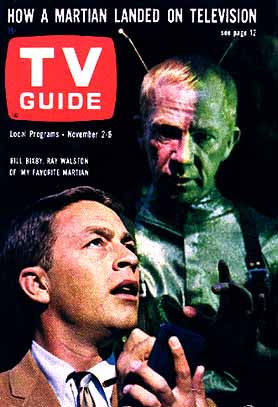
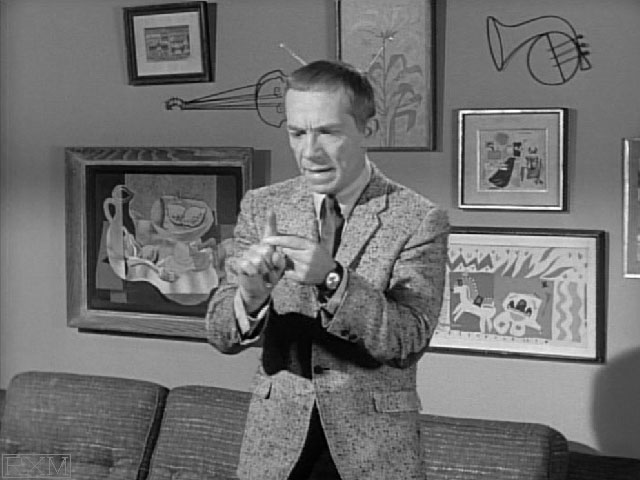
From Fall of 1963 to Spring of 1966, you could watch My Favorite Martian on television every week; I’m sure he was your favorite Martian too.
Photo: uncleodie’s.com
John L. Greene created the plot and developed the characters for the show produced by Jack Chertok. The plot was that a 450-year-old extraterrestrial anthropologist, who was not small and green, collides with an air force plane. A young reporter, Tim O’Hara (Bill Bixby) is returning home after an interview at Edwards Air Force Base and sees the crash. Tim takes the Martian (Ray Walston) home and refers to him as Uncle Martin, although his real name is Exigius 12 1/2. Tim agrees to protect his identity while he repairs his spaceship.
Photo: neatorama.com
Besides being an anthropologist, Uncle Martin is an inventor, which sometimes causes headaches for Tim. A time machine sends him and Martin to other times and brings Leonard da Vinci and Jesse James back to the present. A molecular separator allows Martin to take apart the molecules of one object and rearrange them into something else like a squirrel to a human. Another product lets Martin save memories in a pill form to relearn later.
In addition to his inventions, Martin has some unusual powers. He is telepathic and can read and influence minds; he can levitate objects with his index finger, communicate with animals, both freeze or speed up objects or people, and can raise two antennae to become invisible. Raising the antennae was done with a transistor under his collar.
Luckily Tim’s landlady, Lorelei Brown (Pamela Britton), is a bit scatterbrained. She and Uncle Martin have a bit of a romance but it never gets serious since Martin knows he must leave the planet.
Photo: youtube.com
The network didn’t like Chertok’s scripts, so they hired Sherwood Schwartz (later known as the creator behind Gilligan’s Island and The Brady Bunch) to doctor the plots.
The theme music was composed by George Greeley and performed by Paul Tanner, a former member of Glenn Miller’s band. Tanner used an electro-theremin which could later be heard on The Beach Boys’ hit “Good Vibrations.”
The first two seasons were filmed in black and white with the third being shot in color.
Photo: uncleodies.com
Season one found My Favorite Martian ranked tenth overall. This was a surprise to me because it was up against The World of Disney. By the end of the second season, it was down to 24th but was renewed for a third year. Ratings declined significantly in the third season; often mentioned was the redundant storylines. If kids were still watching Disney, adults might have split their viewership. In it second season, this show was on at the same time as Wagon Train and in its last season it was up against Voyage to the Bottom of the Sea.
For only being on the air three years, the show had a lot of after lives. Saturday morning cartoons were all over the place during this decade. One of the cartoons to debut in 1973 was My Favorite Martians featuring Martin; his nephew Andromeda, or Andy; Tim; Mrs. Brown; and her boyfriend Detective Brennan. The animation series relied on scripts that had been written for a potential fourth season but never used.
In 1999, the show also came to the big screen starring Christopher Lloyd as Martin and Jeff Daniels as Tim. Walston has an appearance as another Martian trapped on Earth, although a lot of the ET characteristics had changed from the original concepts.
Gold Key Comics developed a comic book series around the show and published nine issues between 1963 and 1966.
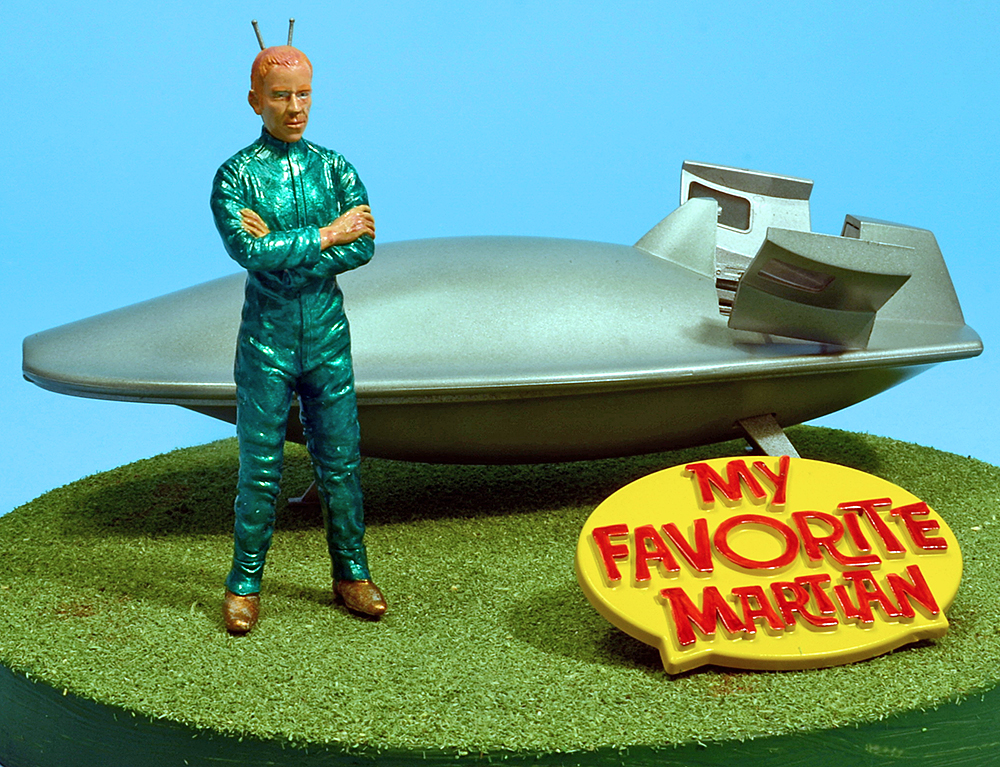
The series debuted during the time that merchandising was beginning to increase greatly. This show resulted in a board game, a magic set, a paint-by-numbers kit, a spaceship model kit, and a beanie hat.
One fun fact I learned was that the spaceship prop used in the series was bought by magician David Copperfield for $100,000 in 2018.
Although My Favorite Martian will not go down as one of the best sitcoms in the golden age of television, it was important as one of the first sci-fi television shows. Most fans cite their special effects as pretty impressive for the time.
Photo:
The first two seasons were filmed at Desilu and the great Sheldon Leonard directed the pilot. It would have been interesting to see the progression of the show if he had stayed on the payroll. He seemed to have an intuition for developing realistic and likable characters. Ray Walston later regretted taking the role of Uncle Martin. He said he did it for the money but felt it typecast him for many years. However, he did say that he enjoyed working with Bixby, and they became life-long friends.
Let’s end with one of their conversations that show how this series turned comedy upside down.
Tim: I thought you could give my article on ESP a special slant.
Martin causes Tim to stand at an angle through telepathy.
Photo: blogspot.com
If you want a special slant on early sci-fi, give this one a try, but save yourself some grief and leave season three in the box.
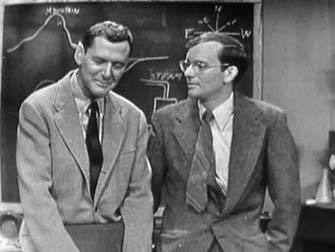
Mister Peepers was one of the first popular sitcoms. It aired from July of 1952 until June of 1955. The show starred Wally Cox as Robinson J. Peepers. Peepers was a junior high school science teacher. A great cast surrounded him including history teacher Harvey Weskit (Tony Randall), Harvey’s wife Marge (Georgann Johnson), county nurse Nancy Remington (Patricia Benoit), English teacher Mrs. Gurney (Marion Lorne), and athletic coach Frank Whip (Jack Warden). (In the pilot, the coach was played by Walter Matthau.) Peepers developed a relationship with nurse Nancy, and her parents (Ernest Truex and Sylvia Field) also became part of the cast.
Photo: blogspot.com
The show featured some slapstick as well but it was not the primary form of humor. In one episode, the uncoordinated Mr. Peepers was playing basketball in the gym alone and somehow got stuck in the basket. In order to fulfill the evening obligations that he promised, he brings Mrs. Gurney’s flower club into the gym so he can lecture to them about potting soil while playing chess with a rival school’s champion as promised to Mr. Gurney.
Photo: wikiwant.com
Mr. Peepers is kind. In one episode, after injuring his finger, absent-minded Mrs. Gurney tries to help by bandaging it. In addition to using half a roll of tape, Robinson informs Nancy that she bandaged the wrong finger.
Mister Peepers is a likable guy. He has some eccentric characteristics which make us like him even more. For example, he has an elaborate ritual to get his locker to open; on bring your pet to school day, he has to hide a cow; and sometimes he does things we all want to. On one episode, he comes upon a hopscotch board on the sidewalk and just like we would want to do, he plays it not realizing his girlfriend is watching him. However, Robinson has a bit of rebellion and sarcasm that keeps him from being too much of a goody-two-shoes.
Photo: tumblr.com
Tony Randall’s character Harvey was supposed to be a small role, but the producers liked him so much he became a regular. He is best friends with Robinson but they couldn’t be more different. Harvey is a lady’s man. However, Mr. Peepers only has eyes for Nancy even though it takes her a while to realize he is interested in her. The couple ties the not in 1954, producing a huge ratings boost.
In real life, Cox was experiencing the same situation when he married Marilyn Gennaro about the same time. When Benoit became pregnant in real life, she was also pregnant on the show.
When the Peepers found out they were having a baby, American Character Dolls Co wanted to make a “Peepers Baby Doll” in 1955. Polling indicated that viewers were hoping for a girl, so it went into production. Mister Peepers was cancelled before the doll debuted, but the company sold it anyway, although they did change the name.
Photo: blogspot.com
The show was aired live with an audience of 2500 at the New Century Theatre in New York. Preserved on 16mm kinescopes, there are currently 102 of the original 127 episodes in existence. The kinescopes are being preserved by the UCLA Film and Television Archive and a DVD set has been produced.
The Ford Motor Company needed a summer replacement on Thursday nights so Mister Peepers debuted then. NBC decided it was too much pressure to do a live show, so it was cancelled. Fans were irate. After 2000 people called to complain and 15000 letters were received, the network had second thoughts, but their schedule was full.
MR. PEEPERS — Aired 09/15/1953 — Pictured: (l-r) Wally Cox as Robinson Peepers, Tony Randall as Harvey Weskitt (Photo by NBCU Photo Bank/NBCUniversal via Getty Images via Getty Images)
However, that fall, an opening occurred when Doc Corkle was cancelled after only three episodes. How bad does a show have to be to get axed after three episodes in 1952? I don’t know, but the summary of the show is that “Doc is a dentist plagued with money problems, teenage daughter problems, and a screwball stepsister Melinda.”
It says a lot about the quality of Mister Peepers that it was rated so highly and watched by so many fans because it was up against Private Secretary with Ann Sothern and The Jack Benny Show on Sunday nights. Tough competition.
Photo: sitcomsonline.com
Critics liked the show and it was nominated for best situation comedy for the Emmys in 1953, 1954, and 1955. Wally Cox, Tony Randall, and Marion Lorne were all nominated as well. Each of the years the show was nominated it went up against Our Miss Brooks, Burns and Allen, and I Love Lucy which won in 1953 and 1954; Make Room for Daddy won in 1955. NBC made Wally Cox postcards which they handed out to tourists on the lot.
Wally Cox was an interesting guy. He was a brilliant man who studied acting with Stella Adler. His roommate was Marlon Brando whom he had been best friends with since grade school. His mother and grandmother were writers, and his dad was in advertising. Before he was able to earn a living in acting, he taught the lindy hop for $1.50 a lesson and made cuff links and tie clasps. While doing part-time jobs, he began doing standup at clubs like The Blue Angel and Village Vanguard.
Unfortunately, a lot of people will remember him only for his appearances on Hollywood Squares and as the voice of Underdog the cartoon hero. He was also famous for a Jockey Shorts commercial when he quipped, “Outside I might look like Wally Cox but inside I feel like Tyrone Power.” He passed away much too early, dying from a heart attack at 48.
Photo: latimes.com
Although Wally Cox was not Mister Peepers, their humor was similar. Cox wasn’t brash but he experienced life with a quiet subtle manner and was a genuinely funny guy. In discussing his time on the show, Cox said, “Mr. Peepers put me on the map and I love him.” I’m sure like many actors who were stereotyped early in their career, it was a bit of a love/hate relationship. I’m sure you will love him too if you are able to watch some of the episodes. Retro TV aired them in the past, but I don’t see the show on its current schedule. I also found the DVDs on amazon.com. Happy viewing!
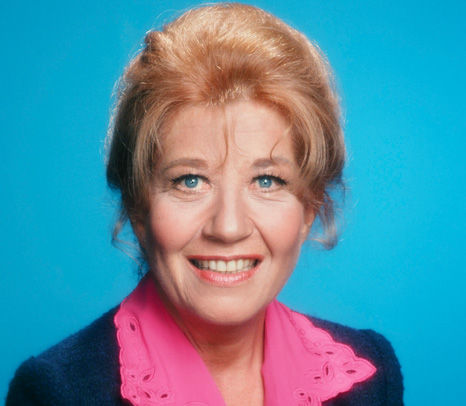
This week we are winding up our series of favorite female actors with Charlotte Rae. If you remember last week we learned about June Lockhart. Charlotte was born a year after June and died a year before her, and their careers were very similar. Both were actresses for more than six decades, appeared in Broadway, movies, and television.
Rae was born in Milwaukee, WI in 1926. Her parents were Russian Jewish immigrants. Her mother Esther had been friends with Golda Meir since childhood. For her first ten years, the family lived above her father’s tire business. In 1936 they moved to a home in Shorewood. At age 16, she became an apprentice with the Port Players, a professional theater company that came to Milwaukee for the summer. After graduation, Charlotte did some radio work and did some performing with the Wauwatosa Children’s Theatre.
Photo: legacy.com
Although she never completed her degree, Rae attended Northwestern University. She and Cloris Leachman became friends there. She also met Agnes Nixon, Charlton Heston, Paul Lynde, and Claude Akins. In later years she would always recommend wanna-be actors get a degree first.
Photo: thejewishnews.com
In 1948, she moved to New York City where she performed in theater and nightclubs. She worked at a variety of clubs including the Village Vanguard and the Blue Angel. During her early days, a radio star told her that her last name of “Lubotsky” would not work well, and she replaced it with her middle name of Rae.
In 1951 she received her first television job on Once Upon a Tune. She would appear on ten other drama theater shows during the fifties. In an interview with Milwaukee Talks in 2016 she said, “When I started out, I wanted to be a serious actor, I never thought I’d get into comedy.”
The same year, Rae married composer John Strauss. They had two sons, but in the mid seventies he came out as a bisexual. Rae was not interested in an open marriage, so the couple decided to divorce in 1976.
Charlotte also loved singing, and she released an album in 1955, Songs I Taught My Mother. Rae also loved being on the stage. In the seventies, Vanguard Records went out of business, and Rae was able to buy back the album for $5000.
She would have stage roles in “Three Wishes for Jamie” in 1952, “The Threepenny Opera” in 1954, “Li’l Abner” in 1956, and “Pickwick” in 1965 among others. Later in her career she would also appear in several off-Broadway shows.
Photo: amazon.com
In 1958, she got a break with a guest spot on The Phil Silvers Show which led to her getting the part of Sylvia Schnauzer, the wife of Leo Schnauzer (Al Lewis) on Car 54 Where Are You when it debuted in 1961. Her husband John did the music for the show. Apart from that role, most of the other television work she did in the sixties was in drama series.
Photo: pinterest.com
Rae also appeared in 14 big-screen movies. Can I take a shameless plug and say that one of my favorite Charlotte Rae roles is in Hello Down There? This movie from 1969 screams IT’S THE SIXTIES from the moment it starts until it ends, but it’s a great sit-back-and-just watch movie. If nothing else, it has an amazing cast including Tony Randall, Janet Leigh, Ken Berry, Jim Backus, Merv Griffin, and Richard Dreyfuss among others.
Photo: muppet wiki fandom.com
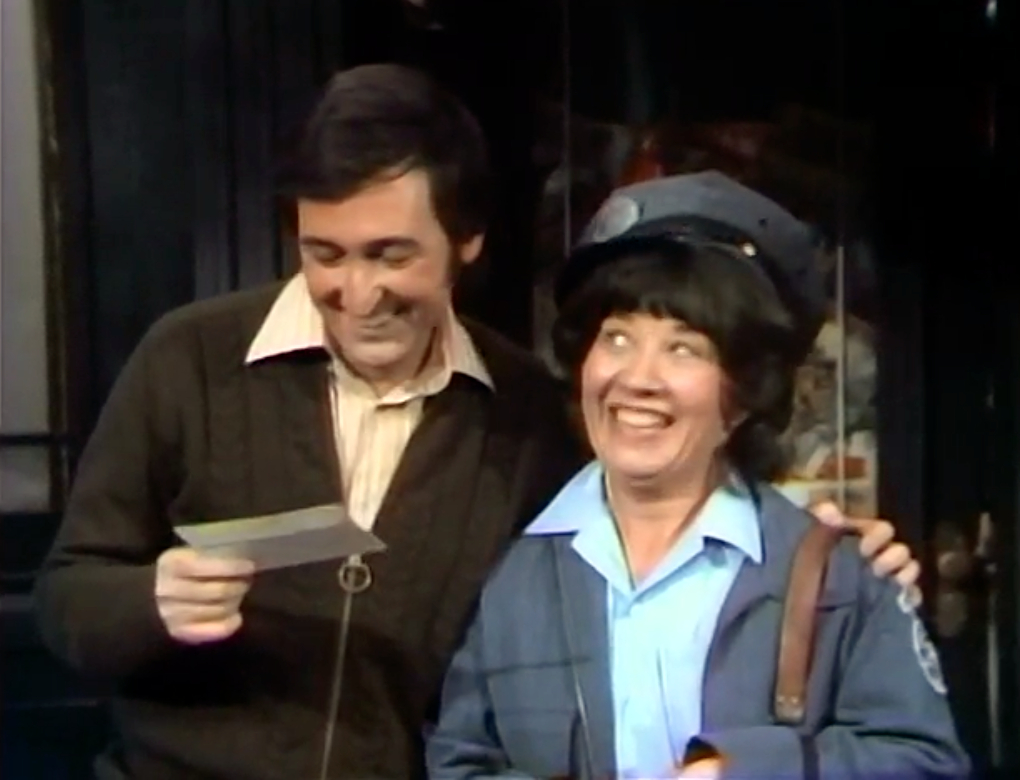
The seventies were her busiest decade of work. She started with a recurring role on Sesame Street as Molly the Mail Lady. During the early seventies you could see her on The Partridge Family, McMillan and Wife, Love American Style, and The Paul Lynde Show. I always appreciated her character on The Partridge Family. When Danny is thinking about quitting school to get on with life, she plays his very smart and creative guidance counselor.
In 1974 Rae moved to Los Angeles. She did guest spots on All in the Family and Good Times, both Norman Lear shows. In 1975, she became a regular on Lear’s show, Hot l Baltimore. She played Mrs. Bellotti, whose son lived at the hotel. The show was a bit controversial and was cancelled after the first season.
During the remainder of the seventies, Rae kept busy working for a variety of genres. You could have seen her on The Flying Nun, Barney Miller, The Rich Little Show, All’s Fair, CPO Sharkey, Family, The Eddie Capra Mysteries, and on her friend Cloris Leachman’s show Phyllis.
In 1978 Norman Lear was working on Diff’rent Strokes about a single father who adopts two brothers whom he raises along with his daughter with help from his housekeeper. Lear signed Rae on as the housekeeper. Charlotte wanted to do the series, but as she related in a Television Academy interview, she was under contract at CBS when NBC made the offer. She had a few weeks left on her CBS option. The network offered her the role of a lady sheriff on a new western but it didn’t ring true to her, and she didn’t want to do it. While she was filming an Eddie Capra Mystery episode, she drove over to explain her predicament to Lear. He said that Bud Grant owed him a favor and he did indeed get her out of the contract.
One episode on the first season was “The Girls’ School” when Edna Garrett is asked to help out at Kim’s private school called East Lake. She does but at the end of the episode decides she’d rather be working in the Drummond home.
Photo: imdb.com
In an interview with the Television Academy, Rae said she thought she was going to be fired from Diff’rent Strokes. She noticed her lines getting fewer and fewer and when she was called into talk with the producer, she thought that was it. However, they proposed a spinoff show for her based on “The Girls’ School” episode called The Facts of Life. They wanted Edna to become housemother for the boarding students at the school. It was a prestigious private school now called Eastland. The writers were focusing on issues affecting high school age girls including weight gain, dieting, depression, drug and alcohol use, dating, mental illness, and other subjects that kids that age deal with. Rae said the show was about growing up, family, love, and working out problems. “I had a lot of input with issues like suicide, divorce, death. I’m really very proud.”
Charlotte was a single mother and afraid to lose her Diff’rent Strokes income on a possibility that might not pan out. The producers wrote into her contract that if the show was cancelled, she could return to Diff’rent Strokes, so she agreed.
Photo: redbook.com
The first season gained some fans, but ratings were so-so. For the second season, some cast changes were made and the show was moved from Fridays to Wednesdays. The show finished in the top thirty that year, and Rae became a household name. In 1982, Rae received an Emmy nomination. (She lost to Carol Kane from Taxi.) During the 1984 and 1985 seasons, Rae asked to be used less. She felt that the girls were older and would rely more on each other than a housemother for discussions about life issues.
When discussing the character of Edna, Rae explained “I want to bring in as much humanity as possible, as well as humor. I’ve tried to make her a human being with dimensions. The way they write her now is with a great deal of sensitivity and understanding. But I don’t want her to be Polly Perfect, because she must have human failings and make mistakes. She’s also a surrogate mother to the girls. I told them I wanted to be firm with the girls because I know it’s important. Parents must lay down ground rules for their children to help them grow up and to learn responsibility for their actions. They must learn to stand on their own two feet.”
No doubt that this show took place in the 1980s Photo: pinterest.com
Rae wanted to do more theater and she wanted to travel. When she decided to leave the series, Cloris Leachman replaced her in the role. The two-part finale of the eighth season had Edna Garrett marrying and moving to Africa with her husband to work for the Peace Corps. Her sister Beverly (Rae’s real sister’s name) comes for the wedding and then decides to stay with the girls at school. Cloris Leachman was signed on for two seasons. At the end of her time, she was willing to continue for another season, but cast members Nancy McKeon and Mindy Cohn were ready to end the show and take on new projects. It was not the end of the show, however. In 2001 a television reunion movie aired with much of the original cast. In 2007 the entire cast was invited to the TV Land Awards where they sang their old theme song.
Murder She Wrote Photo: backofthecerealbox.com
Charlotte took on several other roles after leaving the show. During the eighties and nineties, she appeared on The Love Boat, St. Elsewhere, Murder She Wrote, Sisters, and Alex Mack among others.
She was busy until she passed away, and continued to act throughout the 2000s, including an appearance on King of Queens, and a recurring role on ER. Her last acting credit on television was in 2014’s Girl Meets World.
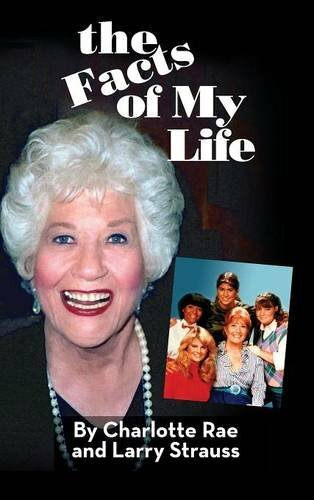
In 2015, Rae wrote her memoirs with her son Larry. At many of her book signings, adults came to purchase the book and told her over and over that they had been latch-key kids and saw Edna as a second mother to them. A description from Amazon sums up the book: “Charlotte Rae’s career spans more than seventy years, from the golden age of television to Shakespeare in the Park, the New York Cabaret scene of the late 1940s and 50s to her hit series, The Facts of Life and well beyond. Off stage and screen, Charlotte’s life has been one of joy and challenge, raising an autistic son, coming to terms with alcoholism, the heartache of a broken marriage, the revelation of a gay husband and the sudden challenge of facing middle-age with financial and emotional uncertainties–a crisis she ultimately turned into the determination that brought her stardom. The Facts of My Life is the first opportunity for Charlotte’s fans to explore the fascinating story of her extraordinary life: poignant and hilarious, a story of courage and triumph, one that speaks for a generation of women breaking barriers, taking on challenges, overcoming personal tragedy, and paving the way for others.”
Rae suffered from several health issues. In the early seventies, she joined Alcoholics Anonymous which was a critical part of the rest of her life. In 1982, she had a pacemaker implanted. It worked well for thirty years, but then stopped, requiring surgery for another smaller device. She also had open heart surgery to replace her mitral valve. Pancreatic cancer ran in her family, so she was screened often and when she was diagnosed with cancer, it was early so she had six months of chemotherapy and was then declared cancer free. In 2017, she was diagnosed with bone cancer. She died at her home in 2018. Todd Bridges from Diff’rent Strokes, tweeted, “You were loved by everyone on our show.”
Photo: doyouremember.com
Charlotte said she never minded fans coming up to her because she realized that in being a television actor you were in people’s homes. “It was an intimate relationship.”
She said she wanted to be remembered as someone who took people out of themselves into a different world and allowed them to laugh or cry, and that would make her happy because we need as many laughs as we can get.
Thank you, Charlotte for making us cry a little and laugh a lot.

















:no_upscale()/cdn.vox-cdn.com/uploads/chorus_asset/file/7168985/GettyImages-53015270.jpg)















 thewritelife61