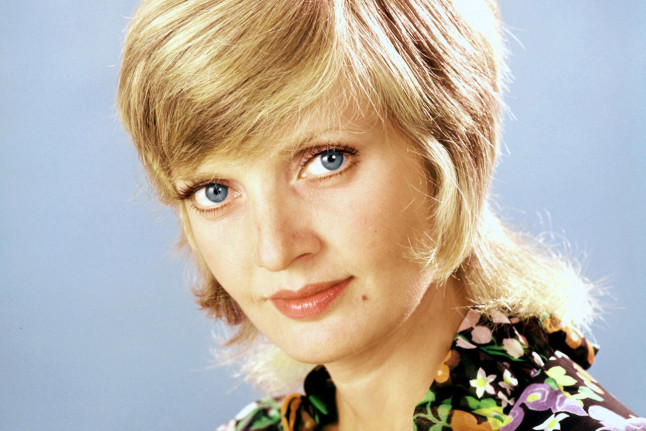
Taxi: The Hip Fleet of Sunshine Cab Co.

Cast Photo: clickamericana.com

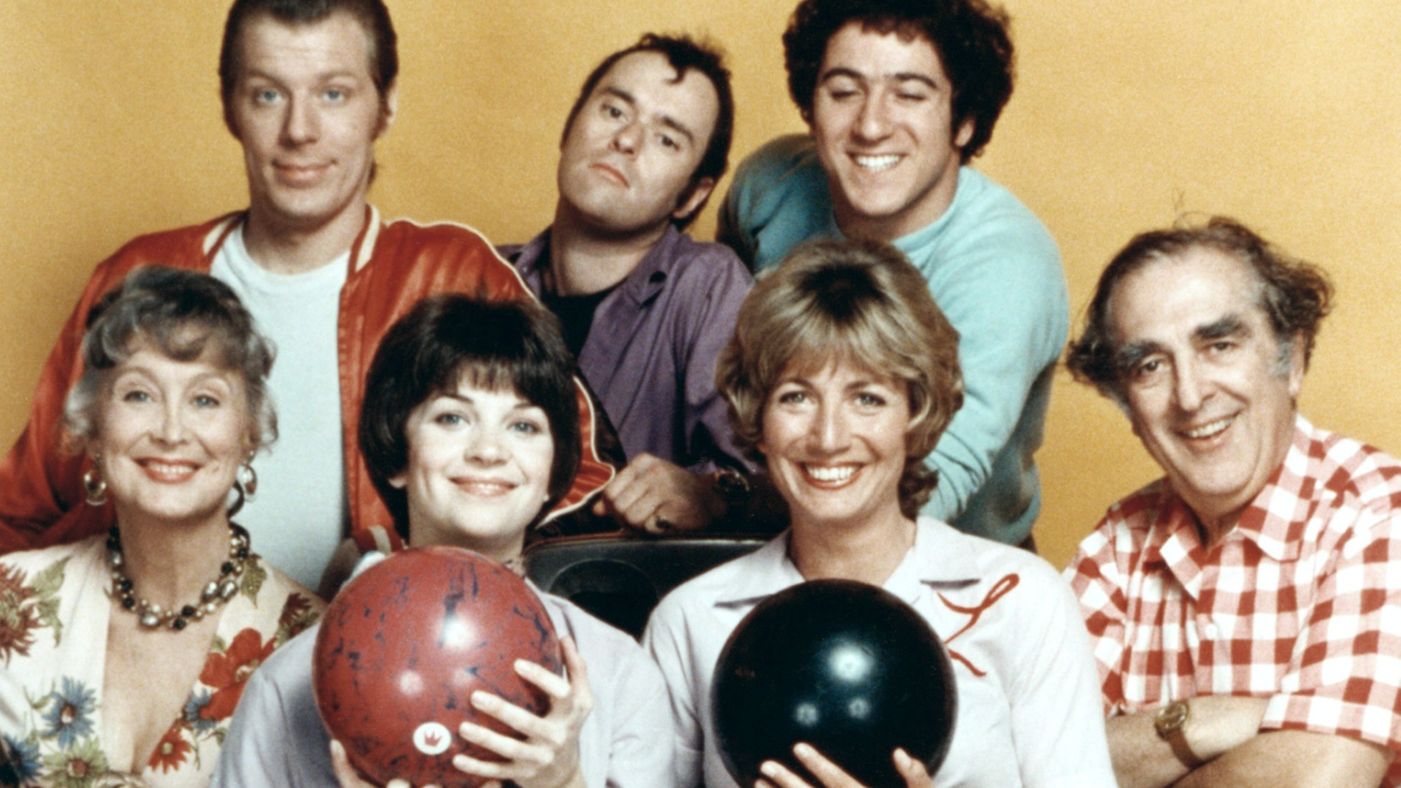
As we continue with our “Work It Out” blog series, today we are taking a long ride with Taxi. This show was created for ABC by James L. Brooks, Stan Daniels, David Davis, and Ed Weinberger and produced by John Charles Walters Co. The show was apparently inspired by an article in The New Yorker, “Night Shifting for the Hip Fleet” by Mark Jacobson in 1975. The article profiled several drivers who worked the night shift for a New York cab company. Taxi was in business from the Fall of 1978 to the Spring of 1982 on ABC and then drove over to NBC for a year.

The show is set primarily at the Sunshine Cab Company in Manhattan. Louie De Palma (Danny DeVito) is the dispatcher that everyone loves to hate. Brooks said that when they went to visit a company as the night drivers were just coming back from their shifts, they saw a dispatcher taking a bribe from a driver for a clean cab. That gave them the idea of Louis. DeVito described Louie as someone who “made life miserable for everyone. The manifestation of what was going on inside of him came out in a mean-spirited way to those around him. Deep down he just wanted people to love him.”

Photo: vodkaster.com

Drivers included Alex Reiger (Judd Hirsch) who considers cab driver his profession as opposed to a temporary get-by job. Elaine Nardo (Marilu Henner) is a single mother who also works at an art gallery. In the first episode when Elaine is hired, Reiger introduces the crew by saying, “You see that guy over there? Now he’s an actor. The guy on the phone? He’s a prize fighter. This lady here: She’s a beautician. The guy behind her? He’s a writer. Me? I’m a cab driver. I’m the only cab driver in this place.”

Tony Banta (Tony Danza) a boxer, and Bobby Wheeler (Jeff Conaway) a struggling actor are other coworkers. We also get to know the Reverend Jim Ignatowski (Christopher Lloyd), an aging hippie who gets a job driving and Latka Gravas (Andy Kaufman), an immigrant mechanic. Latka was a weird character, and I have to say that I did not enjoy him on the show. Andy Kaufman invented the character for a comedy act. During the show, he met and married Simka (Carol Kane).

The person who probably had the easiest audition was Danza. He said that when he went to read for the show, he had broken his third metacarpal on his right hand and had a black eye from knocking out a guy in the ring in Brooklyn. He had never acted before and didn’t really know what he was doing.

Although the show was a sitcom, there were a lot of important issues tackled during the run of the show including addiction, parenthood, obesity, animal abuse, homosexuality, racism, gambling, grief, divorce, and sexual harassment, among others.

Ruth Gordon Photo: ebay.com

This show had more than its share of important guest stars. Ruth Gordon and Eileen Brennan both were nominated for Emmys for their guest appearances, with Gordon winning hers. Other stars who showed up included Marcia Wallace, Penny Marshall, Dr. Joyce Brothers, Edwin Newman, George Wendt, Ted Danson, Tom Selleck, Tom Hanks, and Bubba Smith.

Brooks wrote for The Simpsons and The Mary Tyler Moore Show. Daniels also wrote for The Mary Tyler Moore Show and was best known for The Tonight Show. Davis was one of the writers behind The Bob Newhart Show and Weinberger would go on to write for The Cosby Show. It was no surprise that this show was known for its amazing writing, and the series was nominated for 31 Emmys during its five seasons, it won 18 of them, most impressively it won Outstanding Comedy in 1979, 1980, and 1981. Kane, Hirsch, DeVito, and Lloyd and all won Emmys for acting. James Burrows won two for directing.

Taxi had one of the most-recognized theme songs from the 1980s. “Angela” was written and performed by Bob James.

I did not hear much about conflict on the set, although several performers, including Hirsch, indicated they did not care much for Kaufman. Kaufman had it written in his contract that he only work two days a week, so for most of the filming a guy with a sign around his neck that said “Andy” worked with the cast, so I don’t think there was necessarily a lot of bonding with him anyway.

Conaway was fired after 69 episodes. It was apparently well-known that he had a major addiction problem, and when one of the producers discovered him passed out when he was supposed to be filming, they wrote him out of the episode and then wrote him out of the show.

The cast seemed very happy and like a family. Henner said that they could always express an opinion about their character and thoughts on a scene. Brooks said Burrows was able to bridge the two worlds of writers and actors. He spent time with actors all day and then went to the writers’ room to talk to them and was the liason between the two. Henner agreed and said that Burrows was brilliant at adding memorable moments to a scene. She said in one episode she was losing her mind a bit and someone says the champagne is flat and the producer had her bend over and blow bubbles in the glass. She said it was brilliant.
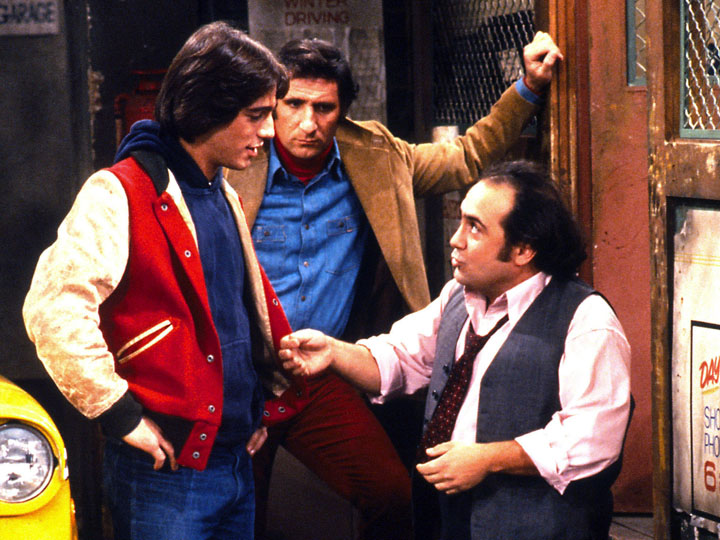
Photo: rottentomatoes.com

DeVito also mentioned a scene that was special for him. One night when Louie was all alone in the garage, he took out the mic and sang a song. Then he said, “I always wanted to do that.” It was a very heart-warming moment and made Louie more interesting and gave him more depth.

Burrows said that most of the cast was young and they all bonded so well. Sometimes they went roller skating, to dances, and they even had a softball team. Rhea Perlman was on the show off and on and during one of their lunch breaks, she and DeVito got married.

Henner talked about their weekly parties. She said everyone at Paramount wanted to hang out with them including the cast of Happy Days, Mork & Mindy, Laverne & Shirley, and Bosom Buddies. She said that John Travolta and Frances Ford Coppola stopped by. John Belushi hung out with DeVito a lot and was there for one of their get-togethers and he died the next day.

Photo: tvguide.com

Hirsch said the group wanted something to do after the show because they didn’t want to go home; they wanted to hang out together more than anything else.

Brooks probably summed up the show the most eloquently. He said that “there’s a lot of things that take a glow in retrospect. The great thing about Taxi was that there wasn’t a moment on the show they didn’t appreciate how lucky there were to have it. That was the show’s energy. I’ve never seen anything like it. . . People show up at the right time and everyone’s lucky enough to have each other at a certain point. It becomes a beautiful team sport.”

Isn’t that the best tribute anyone could give a show?  I’m glad they all had an appreciation for it, and I’m glad they included us in their family.
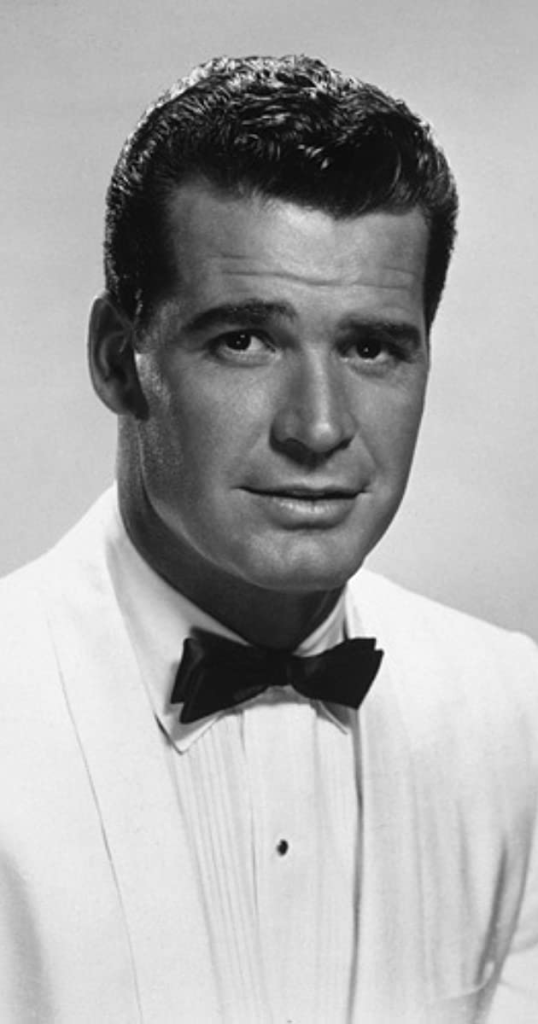
James Garner: Moving Forward

Photo: imdb.com

Today we are winding up our blog series about some of our favorite actors. We finish today with one of my favorites who had a dual big-screen and small-screen career, James Garner.

Garner was born in Norman, Oklahoma as James Scott Bumgarner in 1928. His mother died when he was 4, and his father ran a small store and the family lived above it. When James was 7 the store burned down and his father left the boys and gave them to relatives to raise. Later he moved to Los Angeles and became a carpet layer. James’ first stepmom was very abusive, and they finally had a fight when he hit her and she took off. His second stepmother was a total opposite of the first. He called her Mama Grace and said she was a real mother to him.

At 16 James dropped out of high school to join the Merchant Marines. He liked his shipmates but could never get over his chronic seasickness. In 1945 Garner moved to Los Angeles and enrolled in high school. He was a popular student and played both football and basketball, but he was a terrible student. He moved back to Norman the next year to try high school there again. He dropped out before graduating.

He then joined the California Army National Guard where he served his first seven months in Los Angeles. Then he went to Korea for 14 months as a rifleman in the 5th Regimental Combat Team. He was wounded twice and received two Purple Hearts. He also received his diploma from high school.

After he left the military, he had a variety of odd jobs including laying carpet with his father, pumping gas, installing telephones, chauffeur, dishwasher, janitor, lifeguard, grocery clerk, salesman, oil field worker, and modeling men’s clothing. His entry into the entertainment business is a bit different than most people’s. He was supposed to read lines to lead actors for Broadway production, “The Caine Mutiny Court Martial” in 1954. He was also given a minor, non-speaking role. As he was on the stage, he began to learn about the art of acting.

The Notebook Photo: GlamourUK.com

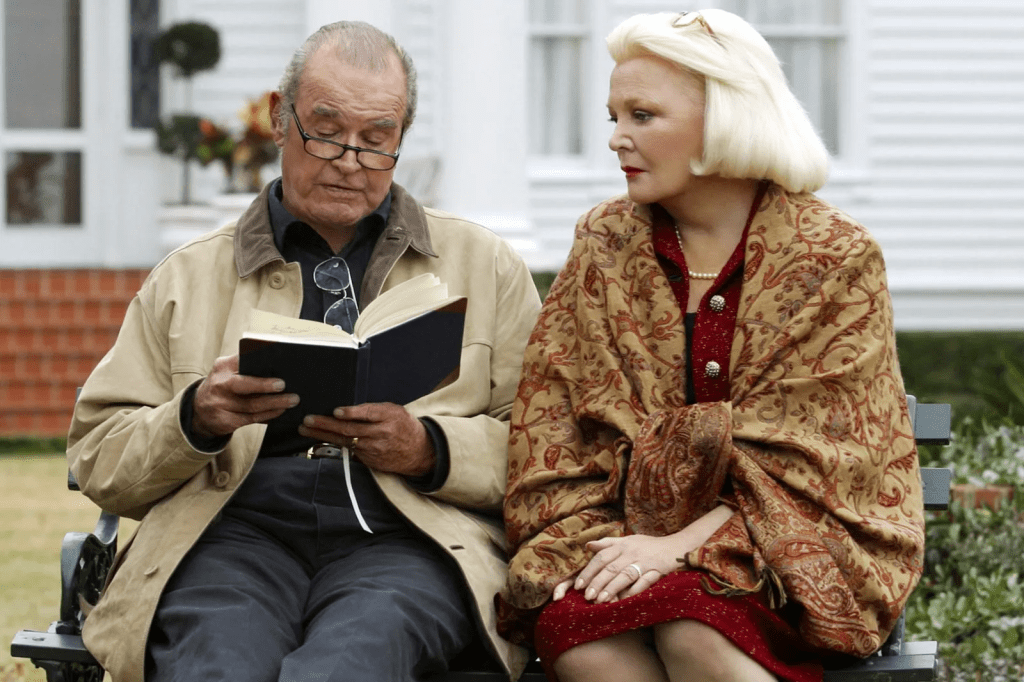
In 1955 he received a bit part on Cheyenne on television. He was also in Warner Brothers Presents. These small parts led to several offers to act in commercials and a larger offer from Warner Brothers to sign a contract for $200 a week. Garner began his big-screen career with Toward the Unknown in 1956. His film career included 46 additional movies with his last being The Notebook.

It was also 1956, when he married his wife Lois Fleishman Clarke; they would remain married until his death, and the couple had two daughters. They had a very short courtship. They met at the Beverly Hills Courthouse at a political rally for Adlai Stevenson and were a married couple two weeks later.

The couple bought a house in the Los Angeles neighborhood of Brentwood where their neighbors were Steve McQueen, O.J. Simpson, Arnold Schwarzenegger, Maria Shriver, and Mark Harmon. They were still living there when James passed away.

Maverick Photo: wikimediacommons.com

His successful movie career did not halt his television career. From 1957 to 1962, Garner starred as Bret Maverick on Maverick. Garner developed the type of role he would be known for as the calm, good-natured, likable, smart guy who gets out of trouble using his wit and street smarts. The show was not canceled by the network; unfortunately, Garner and the producers had a dispute over money, and he decided not to come back for the next season.

In August of 1963, Garner was one of several stars who accompanied Martin Luther King Jr. in his March on Washington. He later also recalled sitting in the third row while listening to King’s “I Have a Dream” speech.

In 1964 he made what he called his favorite film, The Americanization of Emily with Julie Andrews. He played the personal attendant of a Navy admiral and he said it contained the most impassioned speech of his career.

During the sixties and seventies, he continued making movies and showing up in a few places on television, shows like Rowan and Martin’s Laugh In, The Tonight Show, and several tv movies, one about Bret Maverick.

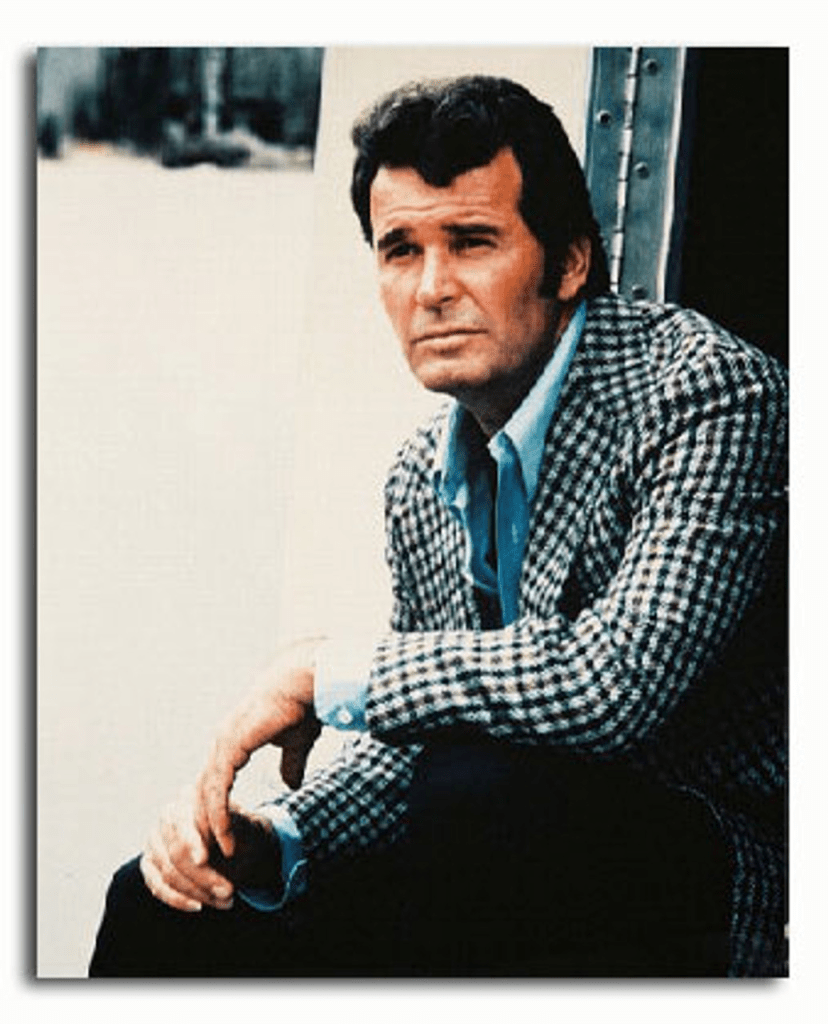
In 1974 he accepted his second role as star of a television series on The Rockford Files. He played Jim Rockford until 1980. Again, the network did not cancel the show which was still very popular but Garner had been having back pain and did not feel that he should continue the weekly series. He probably made the right choice because he was hospitalized with a bleeding ulcer during 1979; he would have quintuple heart bypass surgery in 1988; and both knees replaced in 2000.

Rockford Files Photo: starstills.com

In 1977 Garner began making commercials for Polaroid with Mariette Hartley. They were so convincing of being a married couple, that Hartley had a shirt made that said “I am not James Garner’s wife!” The couple filmed more than 300 commercials together.

After John Ritter passed away in 2003, Garner joined the cast of 8 Simple Rules as Cate’s father Joe and was on the show for the final three seasons.

Garner worked with several charities and foundations during his career. In 2003, he gave $500,000 to the James Garner Chair in the School of Drama for the University of Oklahoma to fund the first-endowed position at that school. He also volunteered with Save the Children.

In 2011, Garner wrote an autobiography called The Garner Files: A Memoir, cowritten with Jon Winokur.

Some of Garner’s hobbies included spending time with his family and political activism. However, his biggest passion was sports. He was a big fan of the Oakland Raiders and could often be seen on the sidelines with the team. He loved golfing. He was inducted into the Off Road Motorsports Hall of Fame in 1978. He owned the American International Racing team in the late sixties and he drove the pace cars for the Indianapolis 500 in 1975, 1977, and 1986.

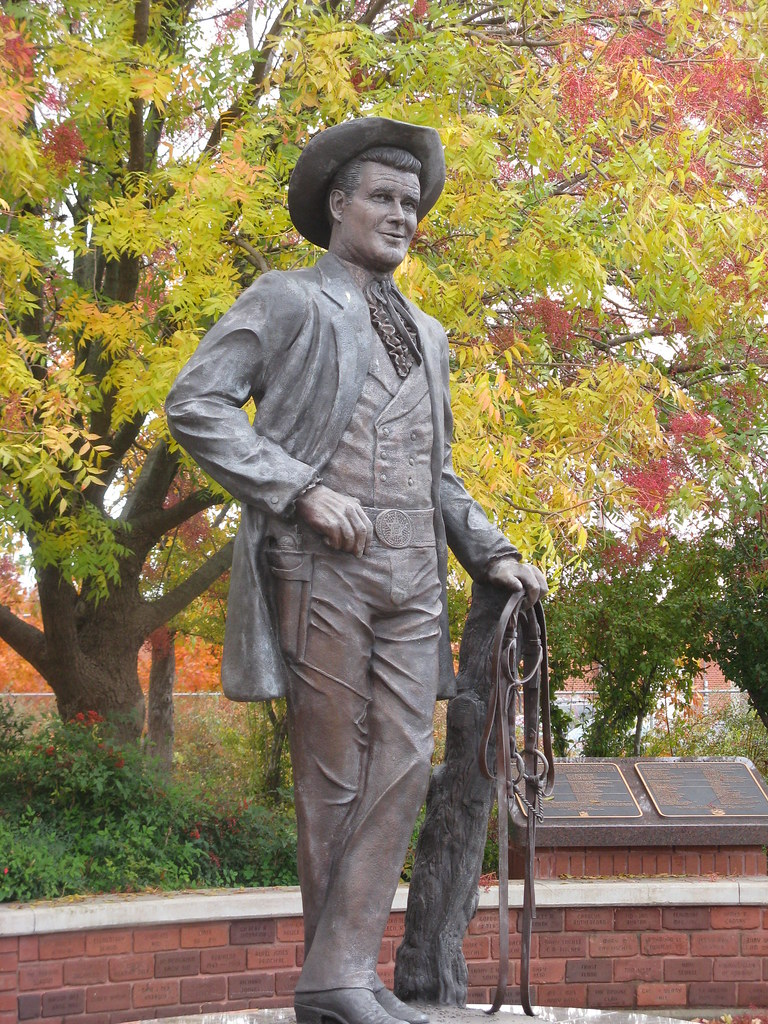
Photo: flickr.com

He was also honored by his hometown of Norman, Oklahoma. He has a street named after him there and in 2006, a ten-foot bronze statue as Bret Maverick was erected there.

He was also loved by his coworkers. In 1973, John Wayne named Garner the best American actor in an interview. He was also close friends with Tom Selleck, Sally Field, and Clint Eastwood. When he passed away in 2014 from a heart attack, Sally Field said “My heart just broke. There are few people on this planet I have adored as much as Jimmy Garner. I cherish every moment I spent with him and relive them over and over in my head. He was a diamond.” He was nominated for 15 Emmy awards during his television career, winning in 1977 as Outstanding Lead Actor in a Drama Series for The Rockford Files.

He didn’t do a lot of comedy but I think he was a funny guy. When he was asked if he would ever consider a nude scene, he said “No, I don’t do horror films.”

James always said he was not concerned with fame; he just wanted to make a good living at something he enjoyed. That comes across as something he truly believed in, not just talking the talk. He lived in the same house and was married to the same woman for most of his life. He did work he was proud of and was very successful in both film and television. He loved sports and his career allowed him to participate in more of those activities that he loved. He was also a generous man, giving to causes that he thought were important.

Move Over Darling Photo: moviescene.com

Although not the most important films in his portfolio, I always think of him acting with Doris Day in The Thrill of it All and Move Over Darling. I enjoyed learning about his life and respect him as a person. He never complained about the terrible childhood he had or used it to make excuses when he did make a poor choice; he said you have to just keep moving forward and he moved forward in an honorable way. Thanks for sharing your life with us  and letting us travel forward with you, James Garner.

Bill Cullen Wants to Tell the Truth

We have come to our final blog post about four interesting To Tell the Truth panelists. Today we are concentrating on Bill Cullen, who many of us associate with game shows during the era we grew up in.

Born William Cullen in 1920 in Pittsburgh, Pennsylvania, he was an only child. His father owned a Ford dealership there. Like many children in that era, he was diagnosed with polio which left him with physical issues to deal with for the rest of his life. The combination of the effects of polio and a motorcycle accident in 1939, that left him hospitalized for nine months, made it difficult for him to stand or walk for long periods of time.

He was originally a pre-med student but had to leave school because of financial problems. After a break to earn some money, he later returned to college to earn a degree in Fine Arts.

During this time, Cullen was married to Ruth Harrington; the two would divorce in 1948.

In 1939, Cullen worked at WWSW, a Pittsburgh radio station. He was a disc jockey and a play-by-play announcer with Joe Tucker for the Steelers and the Hornets (an earlier hockey team). In 1943 he was hired by KDKA. In 1944 he moved to New York where he got a job as an announcer at CBS.

While working on CBS, he tried his hand at joke writing, supplying Arthur Godfrey, Danny Kaye, and Jack Benny with his humor. He also obtained a writing job for the radio show Easy Aces.

Photo: whosdatedwho.com

During WWII Cullen became a pilot and served in the Civil Air Patrol as an instructor. He had become a pilot at age 13, and it remained one of his great passions his entire life.

In 1945 he was hired as the announcer for a radio quiz show called Give and Take. In 1952, he worked with Mark Goodson and Bill Todman on Winner Take All. This relationship would bring him a lot of work during his gameshow career, and he would host numerous game shows during the late forties and early fifties.

In 1948, Bill tried marriage again, wedding singer Carol Ames. They were married seven years before calling it quits.

Photo: Hudson Theater – Facebook

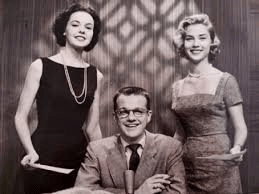
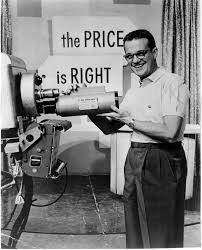
In 1952, Cullen made the move to television where he would become a household name. During the fifties, he hosted The Bill Cullen Show, Bank on the Stars, Place the Face, Name That Tune, and The Price is Right. Cullen beat out Dick Van Dyke as host of The Price is Right. Later it was determined the demands were too high for him when the show moved to prime time, and he was replaced by Bob Barker.

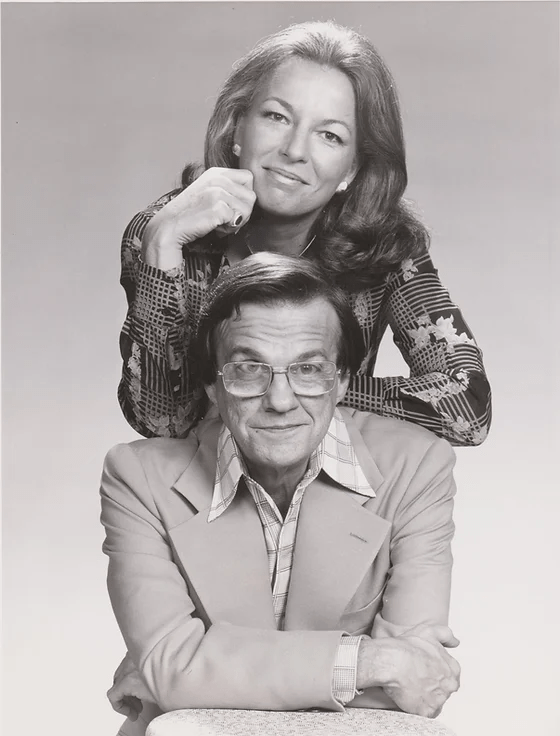
Not long after his divorce from Ames, Bill married dancer and model Ann Macomber. They would remain married until his death. She passed away in 2018.

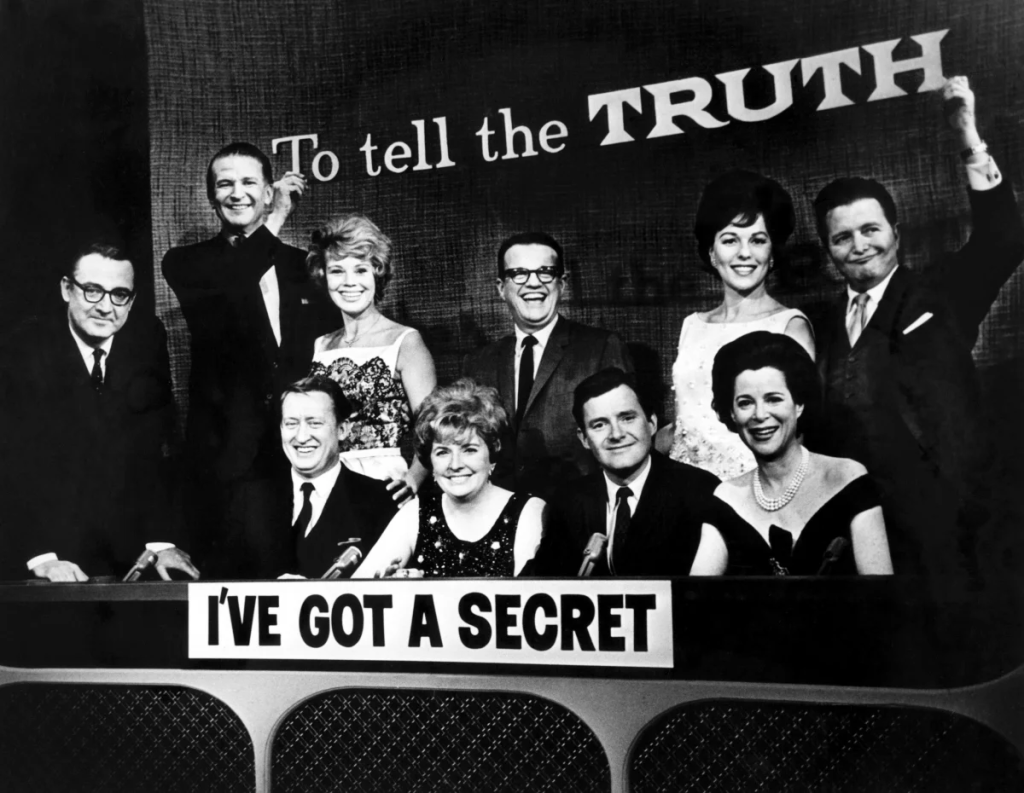
He also appeared as a panelist on I’ve Got a Secret from 1952-1967, on To Tell the Truth from 1969-1978, What’s My Line, The Cross Wits, Password, Match Game, and Tattletales.

Not one to sit around, he also hosted Eye Guess, Three on a Match, Blankety Blanks, The 25,000 Pyramid, Chain Reaction, Blockbusters, and The Joker’s Wild. After his stint with The Joker’s Wild, he retired.

After retirement, he was able to spend more time on his hobbies including photography, interior decorating, model airplanes, painting, magic tricks, raising fish, writing plays and poetry, learning the saxophone and guitar, and flying.

In 1969, Cullen got very ill and was diagnosed with pancreatitis that required surgery. The surgery and recuperation took quite a toll on him and left him 30 pounds lighter.

1962 TV Guide

In a TV Guide interview in 1984, Cullen said he was just lucky with game show offers. He said “This is how it happens every time. A known packager comes up with the idea for a new show. The network says do a run-through. They do. The network likes it, and they say, we’ll give you a pilot. Then the network says ‘Who are we going to get to host it?’ Then he says they have the discussion about hiring someone new or someone gets mentioned who didn’t work out on another show. They hire the staff and weeks before the pilot is scheduled, they say, ‘Let’s just go with Bill Cullen.’”

Cullen was nominated for an Emmy three times but only won for Three on a Match in 1973. It was said he hosted more than 25,000 episodes of television during his career. Cullen often filled in for other people including The Tonight Show when Johnny Carson took vacation, for To Tell the Truth when Garry Moore had throat cancer, and for Allen Ludden on Password when he was ill. During the 1960s, he was the first game show announcer to be working on all three networks at the same time. He was also the first game show host to appear on the cover of TV Guide in 1954, and he would go on to have six more covers.

With wife Ann Photo: billcullenarchives.com

It sounds like Cullen was more than satisfied with his career and had no desire to be a television star. With his limp and horn-rimmed glasses with thick lens, he said “I often ask myself, ‘How am I working? I’m certainly not the guy who appeals to women between the ages of 18 and 35.’” When asked if he had frustrations about his career, his response was, “If anything, the industry has treated me better than I deserve. If you don’t have high aspirations—and I don’t—it’s terrific. I like my niche. I’m never under great pressure, and I’ve made a lot of money over the years doing what I enjoy.”

If that isn’t a definition of success, then I’m not sure what is. I have to admit that I think being a panelist on a game show would be a pretty fun gig. I really enjoyed learning about the four panelists of the To Tell the Truth that I remembered watching on television when I was a youngster.

Peggy Cass Has To Tell the Truth

As we continue getting to know several of the panelists from To Tell The Truth, today we look at the career of Peggy Cass.

Photo: wikipedia.com

Mary Margaret Cass was born in 1924 in Boston. She attended Cambridge Latin School and after graduation became interested in acting. She joined the HB Studio in New York City, probably about the same time Orson Bean was there.

In New York, she was employed in various positions while waiting for her big break, including secretary, telephone operator, advertising solicitor, and model. She traveled to Australia with the USO for seven months.  Her first role was in a traveling production of “Born Yesterday” where she was an understudy to Jan Sterling.

Cass married Carl Fisher in 1948; they divorced in 1965.

As Agnes Gooch in glasses Photo: imdb.com

Peggy’s Broadway debut came for “Touch and Go” in 1949. One of her next shows was Agnes Gooch in “Auntie Mame” (based on a book written by Patrick Dennis) which she won a Tony for. She was cast in “A Thurber Carnival,” a 1960 Broadway revue of James Thurber’s works.

She also tried her hand at movies. Her first movie was 1951’s The Marrying Kind. In 1958 she reprised her role as Agnes in Auntie Mame, receiving an Oscar nomination, 1961 found her in Gidget Goes Hawaiian. She would be cast in three movies in 1969 and 1970.

Cass accepted her first television role in a show I’ve never heard of in 1950: Nash Airflyte Theater. In addition to playhouse dramas, she was on The Phil Silver Show in 1958 and 1959. In 1961 she was a regular on The Hathaways, a show we discussed a few months ago. Cass as Elinor raised three monkeys (The Marquis Chimps) along with her husband (Jack Weston); the monkeys were stars, and Elinor was also their agent. After 26 episodes, the show was canceled.

The Hathaways Photo: imdb.com

After the cancellation, she would take roles in thirteen other television shows including Love American Style, The Love Boat, and Hotel. In two of the shows, she had regular roles: The Doctors with 145 episodes, an afternoon soap opera; and Women in Prison. This is another show I have never heard of; it was set in my home state. The synopsis on imdb lists it as a “comedy taking place in Cell Block J of the Bass Women’s Prison in Wisconsin. Some of the inmates are Vicki, a yuppie housewife framed for shoplifting by her husband; Dawn, who murdered her husband; Bonnie, an English prostitute; Eve, the old lady who has been there for at least 10 years; and Pam, serving time for computer crimes. Meg is the guard and Blake is the assistant warden. Cass played Eve.

Cass was also in the pilot of Major Dad. She played Esther Nettleton a secretary working for Major MacGillis.

With Jack Paar and JFK Photo: collectors.com

Cass appeared on The Tonight Show with Jack Paar in 86 episodes as one of his regular cast members. She also appeared on The Mike Douglas Show ten times and on The Merv Griffith Show 26 times.

I guess the reason I recognize her as a game show celebrity is because she was on 21 different game shows. I remember her best from To Tell the Truth which is also not a surprise because if you count episodes of the various versions, she appeared in 481 episodes.

Cass remarried late in life in 1980. Her second husband was Eugene Feeney. He was a former Jesuit priest and educator. That same year she had an interesting experience we all think about but don’t think really happens much. She needed a left-knee operation and engaged the services of Dr. Norman Scott, doctor for the New York Knicks. After the operation, while Cass was in the recovery room, she realized they had operated on her right knee, and they had to take her back in for a second surgery.

Photo: famousfix.com

In 1999 Cass died from heart failure.

I have to admit Cass’s role as Agnes Gooch is one of my favorite supporting actress roles. I’m not sure what her hopes and dreams were. I wish she had been cast in a second sitcom; it might have changed the trajectory of her career drastically. It was fun to learn a bit more about the woman behind Agnes.

Orson Bean Likes to Tell the Truth

This month we are looking back at a few of the game show celebrities from To Tell the Truth. These are four individuals who were stars in their own right before they did the game show circuit. Although I know the game shows were typically at the end of their illustrious careers, for better or worse, it is how most of us know these interesting personalities.

Photo: globalnews.ca

We are beginning the month with Orson Bean. Bean expressed the sentiment I was discussing above by saying that the was a “neocelebrity,” someone who is famous for being famous for his appearances on prime-time game shows. While I agree with this conclusion, part of what I want us to learn today is why he is a memorable star even without the game show fame.

Bean was born in 1928 in Vermont as Dallas Frederick Burrows. Silent Cal Coolidge was a first cousin twice removed. His father was one of the founding members of the ACLU and chief of police on the Harvard campus. When Bean was sixteen, his mother committed suicide, and he left home.

On Broadway Photo: broadway.com

Bean attended the Rindge Technical School in Massachusetts, and after graduation, he joined the army and was sent to Japan. He spent some time at the HB Studio in New York, studying drama. After returning to the US, Bean began working as a stage musician before trying his hand at stand-up comedy in the early fifties.

Bean tells a fun story about how he came up with his stage name on The Tonight Show. When he was performing at a nightclub in Boston, the piano player would give him a different silly name to use every night. One night it was Orson Bean, and it went over great with the crowd.

In 1952 Bean started his radio career with an appearance on The Chamber Music Society of Lower Basin Street. When the show was renewed for 13 weeks, Bean was the full-time host.

In 1954 he was the house comedian at the Blue Angel Comedy Club in New York. Unfortunately, Bean was dating a girl who was a member of the Communist Party, and he was blacklisted as well. Ed Sullivan canceled his appearance on his show; he did later book him years later for five different episodes.

In 1956 Bean married Jacqueline de Sibour (stage name Rain Winslow). They had one child before divorcing in 1962.

In the fifties and sixties, Orson also was a regular on the Broadway stage. His first production was Will Success Spoil Rock Hunter with Walter Matthau and Jayne Mansfield. He continued on Broadway shows throughout the sixties, getting a Tony nomination for Best Featured Actor in a Musical for “Subways Are for Sleeping.”

The Twilight Zone Photo: wikimediacommons.com

It was also during this decade that Bean began appearing on television where he earned 84 acting credits. He started in the many drama and playhouse series that were on television in the fifties and sixties. He also had his fair share of sitcoms including The Phil Silvers Show, Love American Style, Will and Grace, Becker, Two and A Half Men, How I Met Your Mother, and Modern Family. His dramatic appearances included The Twilight Zone, Ellery Queen, The Fall Guy, Murder She Wrote, Diagnosis Murder, and Seventh Heaven. During his career he was a regular cast member on Doctor Quinn Medicine Woman, Normal Ohio, and Desperate Housewives.
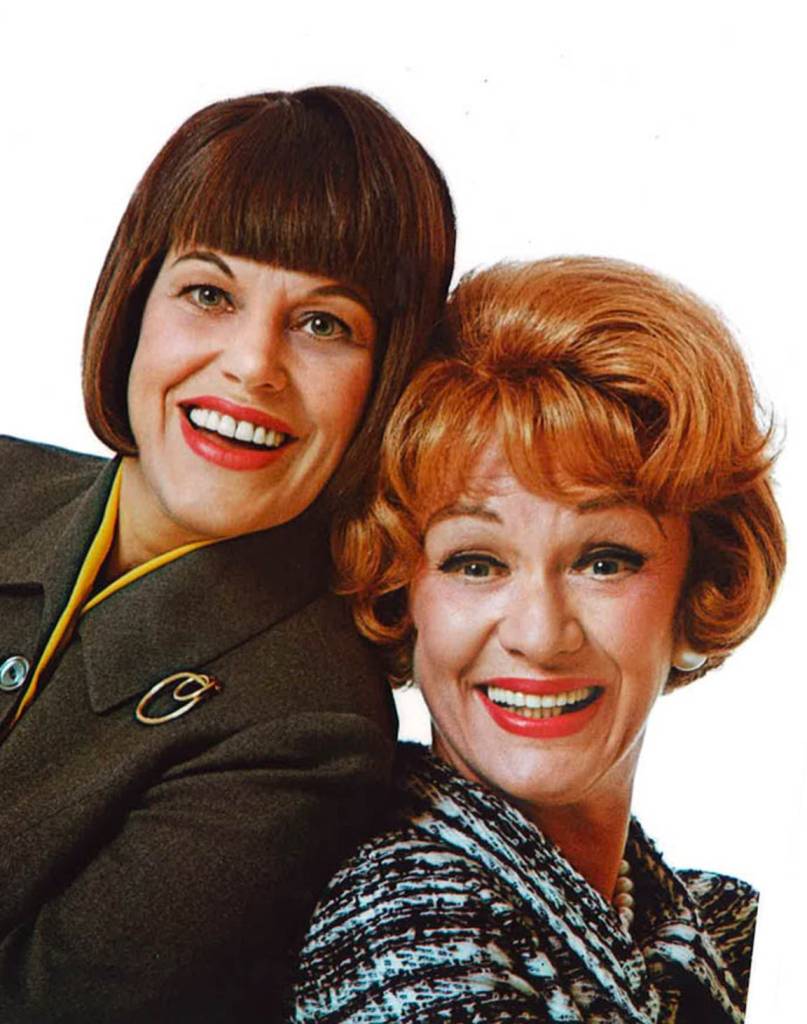
In 1965 he tried marriage again to fashion designer and actress Carolyn Maxwell. They had three children before they divorced in 1981.

The same year he married Maxwell, he entered into another new relationship. He was one of the founding members of The Sons of the Desert, an international organization that was started to share information about the lives of Stan Laurel and Oliver Hardy and to preserve their films.

In 1966 Bean founded the 15th Street School, a primary school in New York City. It was modeled on the Summerhill School in England.

He also showed up on the big screen for 23 movies, the two-best known being Innerspace in 1987 and Being John Malkovich in 1999.

In the 1970s, Bean moved his family to Australia to live in a commune with a hippie lifestyle. They later became bored and returned to the US where he resumed his career.

Orson was popular on the talk and variety shows. In addition to Ed Sullivan, he appeared on The Mike Douglas Show, The Dick Cavett Show, The David Frost Show, The Merv Griffin Show, and was on The Tonight Show more than 200 times.

With wife Alley Mills Photo: soaphub.com

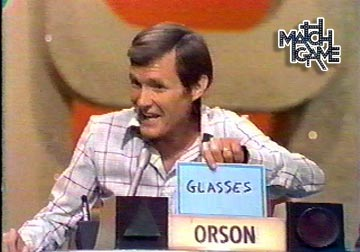
Bean was a competitor on many game shows including I’ve Got a Secret, What’s My Line, Super Password, Tattletales, $10,000 Pyramid, and Match Game. He was best known for being a regular on To Tell the Truth. In addition to being in 317 episodes of To Tell the Truth with Peggy Cass, the two were also regulars on two other game shows: Keep Talking and Call My Bluff.

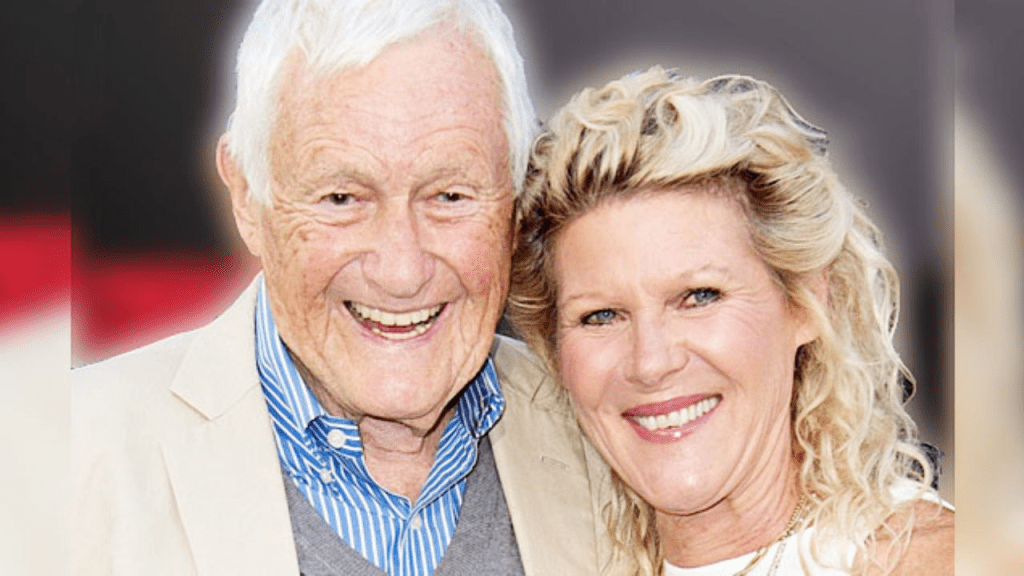
In 1993, Bean tried marriage again. He wed Alley Mills, best known as the mom on The Wonder Years. They were married until his death. The couple were members of the First Lutheran Church in LA and participated in the church’s annual production of “A Christmas Carol.”

On Match Game Photo:jackpendarvis.com

Bean had a terrible death. In February of 2020 when he was 91, he was crossing Venice Boulevard when he was struck by a car. He fell down and a driver of another vehicle, distracted by people trying to tell him to slow down, hit him again before realizing what they were trying to tell him and that hit caused Bean’s death.

Certainly, game shows were only a small part of this celebrity’s career. However, I admit before I wrote this blog, I only knew him for his To Tell the Truth appearances. Now I have a much better appreciation for his long and successful career. I’m glad we are getting a chance to know some panelists from that show this month in more detail.

December Bride “Springs Into Action”

Today we get to spend some time learning about one of the earliest sitcoms, December Bride, which aired on CBS from 1954-59. It began life as a radio show in 1952.

Cast of December Bride–Photo: tumbral.com

The show was created by Parke Levy who wrote the episodes as well and claimed to base Lily on his own mother-in-law. He owned 50% of the program; Desilu, producer, owned 25%; and CBS owned 25%. Harry Morgan said he liked Desi Arnaz very much. They cast rarely saw Lucy and saw Desi frequently but not in a negative way; he just might show up to see how things were going. (As an aside, I remember an interview with Bob Schiller, who wrote for this show along with many others, loved the name of “Parke Levy” and said it sounded like a Jewish housing development in New York.) Levy also wrote the film scripts for My Friend Irma and My Friend Irma Goes West.

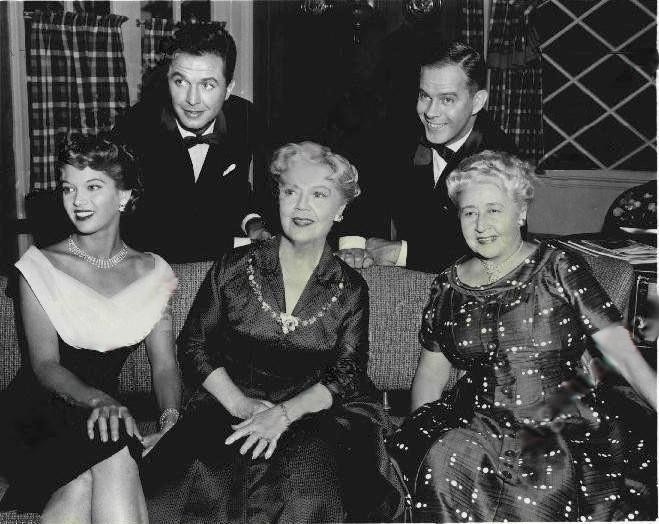
Spring Byington and Frances Rafferty–Photo: vintagetvandmore.com

One fun fact is that both Fred de Cordova and William Asher were directors for this sitcom. Both would go on to long careers; de Cordova would produce The Tonight Show and Burns and Allen, direct My Three Sons, and both produce and direct for The Jack Benny Show. Asher would go on to direct I Love Lucy and Alice and both produce and direct most of the Bewitched episodes.

Spring Byington–Photo: pinterest.com

Spring Byington starred as Lily Ruskin, a lively widow who was looking for the right man.

Dean Miller and Frances Rafferty–Photo: pinterest.com

She lives with her daughter Ruth Henshaw (Frances Rafferty) and son-in-law Matt (Dean Miller) who help her in the search, as does her best friend, Hilda Crocker (Verna Felton).

Lily stays busy writing an advice column for the LA Gazette, “Tips for Housewives.”

Verna Felton–Photo: upperjacksonco

Pete Porter (Harry Morgan) is her next-door neighbor who also shows up often. (Next week we will learn about his spin-off from this show, Pete ‘n Gladys.) Pete enjoyed watching Matt and Lily’s interactions which he viewed as positive, unlike his relationship with his mother-in-law which he viewed negatively.

A lot of guest stars showed up including Jack Albertson, Morey Amsterdam, Desi Arnaz, Edgar Bergen, Madge Blake, Barbara Eden, Zsa Zsa Gabor, Nancy Kulp, Fred MacMurray, Howard McNear, Isabel Randolph, and Mickey Rooney

Harry Morgan–Photo: wikimedia.com

The scripts seemed about what you would expect for this era. In one of the funniest shows, Lily fails to deliver plans for Matt and as a result, Desi Arnaz’s family room collapses. In another one, Lily arranges for Pete to take riding lessons because his fear of horses is standing in the way of him earning a huge commission selling insurance to a wealthy ranch owner.

The gold standard for this decade seems to be Ozzie and Harriet Nelson’s show and the writing doesn’t measure up to that but seems like a fun show to watch.

Maxwell House Coffee was their sponsor for the entire run of the show.

The show was on Monday nights after I Love Lucy and had top-ten ratings for the first four years. For season five, the network moved it to Thursdays, where it was up against Zorro and The Ed Wynn Show. Ratings declined significantly, and it was cancelled. Fans have noted that the last season’s scripts were not as well written and the show had probably run its course.

Harry Morgan discussed the show for the Academy of Television interviews. He said it was a nice show to work on; he described it as “fluffy and light” and “typical for the time.” He said he enjoyed doing the show, all the cast was wonderful, especially Spring who was an amazing actress, and he became good friends with Dean Miller and Frances Rafferty. He said that it was a well-done show and he had a lot of fun during those five years.

I watched the episode about Desi’s family room caving in. Morgan’s description was pretty accurate. The show might not present deep philosophical moments, but it was well written. One of the bright spots was Desi’s butler played by Richard Deacon. I can certainly think of worse ways to spend a few hours than watching several of these classic television episodes.

Good Luck with Your MOUTH: Remembering Kaye Ballard

As we take time to remember some of our favorite television stars who passed away this year, Kaye Ballard definitely comes to mind.

Photo: pdxretro.com

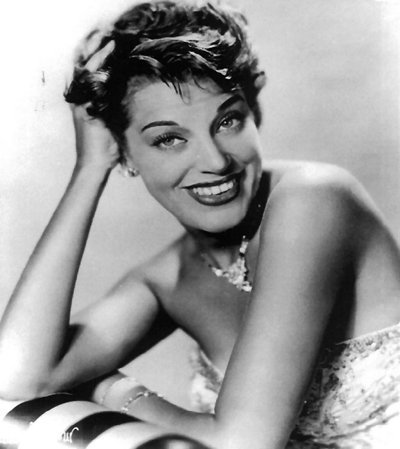
Apparently, no one was surprised to learn that Catherine Gloria Ballota planned on a career in entertainment. Born in Cleveland in 1925, she was performing by age 5 and was known as the class clown. At age 16 she performed in a Cleveland USO stage production of Stage Door Canteen and began perfecting impressions of stars for her comedy act.

At the young age of 18, she received a job touring with Spike Jones and His Orchestra as the featured vocalist and flute/tuba player. When that gig ended in 1945, she made her way to New York and appeared on Broadway in Three to Make Ready in 1946. While appearing in other musicals, she earned a reputation in the nightclub circuit as a comedian/singer. She traveled around the country with her act, popping up in clubs such as The Bon Soir in New York, The Hungry i in San Francisco, and Mr. Kelly’s in Chicago. One of her catch phrases was something her mother often said to her, “Good luck with your MOUTH.”

Photo: blogspot.com

During the 1950s and 1960s, she began appearing on variety and talk shows. You would tune in and find her with Ed Sullivan, Jack Paar, Steve Allen, Perry Como, Red Skelton, Carol Burnett, Merv Griffin, Mike Douglas and Johnny Carson. In fact, she appeared on The Tonight Show 150 times. She continued her Broadway career during these two decades as well. She made a name for herself playing Helen of Troy in The Golden Apple in 1954. This same year she recorded “Fly Me to the Moon,” a song Frank Sinatra would make famous. She also was part of the casts of Wonderful Town (1958), Carnival (1961), and Cole Porter Revisited (1965).

In 1957 Julie Andrews starred in a live telecast of Cinderella, the Rodgers and Hammerstein’s version of the fairy tale. Ballard, along with Alice Ghostley, played the wicked stepsisters. It was at this time that Hollywood brought Ballard to Los Angeles. She was one of the comic foils, playing the friend of Jane Powell’s character in The Girl Most Likely. Although she would appear in several movies during her career, television is where she was best known.

Photo: Fredericksburg.com
The Girl Most Likely with Jane Powell

In 1964 she played a teacher for models on The Patty Duke Show. In 1967 she was offered one of the leads, Kaye Buell, in The Mothers-in-Law. The other lead was played by Eve Arden as Eve Hubbard. When Kaye’s son married Eve’s daughter, it caused conflict between the neighboring families, especially with their kids living in the garage. The two families had very different lifestyles. Herb Hubbard was a wealthy attorney and his wife was a champion athlete and very organized. Roger Buell was a television writer and Kaye a stay-at-home mom who is a lazy housekeeper and very unorganized. Desi Arnaz produced the show which lasted two seasons.

Photo: mesquitelocalnews.com
With Eve Arden

The show followed The Wonderful World of Disney and preceded Bonanza but never received the ratings the network hoped for. Desi agreed to pay most of the stars $2000 per week with the intent of giving them a $250 raise the second year. Because the show was not as successful as everyone thought it would be, the network agreed to renew it on the condition that all expenses, including salaries, were frozen. With the exception of Roger Carmel, all the cast members agreed to freeze their salaries. He refused, so he was replaced with Richard Deacon. With the change in the cast, the ratings went down even further, and the show was not renewed for a third year.

Photo: thenewyorktimes.com

Kaye was asked if she thought the $250 raise was a joke, and Kaye said she and Eve didn’t care about the money. They wanted to keep doing the show. At the time, Arden was making $5000 a week. The show was originally written for Arden and Ann Southern but the networks felt they were too much alike, so Ballard was brought in. Kaye couldn’t get over actors receiving one or two million dollars an episode a couple decades later.

Photo: desertsun.com

A long-time friendship developed between Ballard and Arden during the filming of the show. Ballard fondly remembered her co-star, “Eve was a joy to work with, and we never had an unpleasant moment. . . She could read a script once and know it almost completely.”

Another long friendship was made when Kaye worked with Shelley Winters on a film in 1964. Kaye relayed that when Shelley was cast in The Poseidon Adventure, she “used my (Kaye’s) pool to practice swimming underwater because the studio wouldn’t let her rehearse until they started shooting. She was a great swimmer but ruined all my flashlights by swimming with them.”

Photo: sitcomsonline.com

The 1970s found Kaye very busy. From 1970-1972 she was a regular on The Doris Day Show, playing restaurant owner Angie Pallucci. The series took some liberties with format. The first two years had Doris moving back to her dad’s ranch to raise her kids after the death of her husband. The third season found Doris and her dad and kids living in an apartment above the Pallucci’s restaurant. In the fifth and final season, the kids, dad, and the Palluccis all disappeared and were never mentioned!

In 1971 she guest starred on her friend’s show, Here’s Lucy. In 1970 Ballard purchased Ball and Arnaz’s home after their divorce. She would live there the rest of her life. Her friend Lucy would often stop by and talked about Desi whom she never quite got over.

Photo: maxresdefault.com

Ballard won the trifecta in the seventies, appearing on Love American Style, Fantasy Island, and The Love Boat. She accepted a handful of random roles on television shows after The Doris Day Show ended. You might have seen her on Police Story or Trapper John MD.

The 1990-1991 season found Kaye trying her hand at a situation comedy one more time. The show was called What a Dummy. This show did stretch reality a bit. Ed and Polly Branningan inherit his uncle’s trunk of props which includes his dummy Buzz who has been in the trunk for 50 years. Buzz can think and talk and likes to give the family his unsolicited advice. Ballard was Mrs. Tavalony, their next-door neighbor. No surprise that it was cancelled after 24 episodes.

Photo: sharetv.com

In 1995, Ballard was rewarded with a Golden Palm Star on the Palm Springs Walk of Stars.

Kaye continued to take a few movies now and then, but most of her time was spent on the stage. In 2005, she went on the road in Nunsense. She also accepted roles in The Pirates of Penzance, High Spirits, Funny Girl, The Full Monty, and The Odd Couple.

In 2006, Kaye added author to her resume, publishing an autobiography, How I Lost 10 Pounds in 53 Years.

In 2015, Kaye announced her official retirement. She was interviewed by Nick Thomas that same year and talked about writing a second book. She explained to Thomas that she never married but did not have any regrets. “I was engaged four times, but couldn’t give my all to a marriage or wanted children unless I could give them my complete attention. But I’ve got to meet so many great people because of my career. Who could regret that?”

One of those great people was Mother Teresa whom she met in 1992. Kaye discussed that meeting: “I’m an Irish Catholic girl, so it was a thrill. I went to her private quarters where she was having breakfast –a piece of cheese, half an apple and some toast—and we drank Sanka together. She spoke in English, simply and quietly, and was just so modest and humble.”

Although she survived breast cancer, Kaye passed away at age 93 at her home from kidney cancer in January.

Kaye Ballard, ca. 1958
Photo: thehollywoodreporter.com

The girl from Cleveland with the MOUTH had a long, successful, and interesting career. In her own words, “I’m one of the lucky ones. People get Master’s Degrees and they say, ‘I don’t know what I wanted to do.’ I always knew what I wanted to do. Isn’t that nice?”

I have to agree; it was nice for her and even nicer for those of us she entertained.

A Tribute to Rose Marie

rosemarie2

Rose Marie had one of the longest-running careers in the entertainment industry – more than 90 years in the business. During her career, she was in vaudeville, on the radio, in the movies, performed in live concerts around the country, did some Broadway, and became most famous for her television performances.


rosemarie6

Born in 1923 as Rose Marie Mazetta, she won a contest at 3 and began performing as Baby Rose Marie. On her official site, she mentions she was born the same day the Broadway show Rose Marie opened. In 1927 at the age of 4 she was featured in a Vitaphone short that opened with Al Jolson’s Jazz Singer.


rosemarie21

By age 5, she had her own national radio show. She worked in vaudeville with Edgar Bergen and Milton Berle. She made several records, and the first one released was with Fletcher Henderson’s orchestra. By 1933 at age 10, she was starring in her first film, International House. During these years, she performed at the White House three times—for Presidents Coolidge, Hoover, and Franklin Roosevelt.


Rose Marie

It was during her vaudeville stint that the doorman informed her and her father that a gentleman wanted to see them in the back alley.  The “gentleman” was Al Capone who called her father Happy Hank and told them that “the guys” wanted to meet Rose Marie. She was taken to Capone’s house the next day where she performed for about 24 guys.  Al gave her a ring with three diamonds which she still had when she passed away. He said they would always take care of her.  He was true to his word. Even after he was incarcerated, Rose Marie was met and protected by the mob for her entire career.  Decades after the most notorious gangsters were gone, men showed up at her shows checking on her just to make sure she was doing okay, getting work,  and not in need of anything. Later she learned that her father, who was an actor by trade, was Capone’s arsonist, the one who burned down buildings of men who disappointed the gangster. There is an article about her meeting with Capone on The Mob Museum’s website. (The Mob Museum is located in Las Vegas.)

rosemarie20


As a teenager, Rose Marie transitioned to clubs, touring the United States. In order to make her sets longer, she began to add comedy to her singing acts.


In 1946 she met Bobby Guy who as with the Kay Kyser Orchestra. They were engaged within a week, and he remained the love of her life until he passed away in 1964. They had one child, Georgianna. Guy would become the lead trumpeter on The Tonight Show.


It was also in 1946 that Rose Marie opened the Flamingo with Jimmy Durante. Jimmy Durante mentored her earlier in her career and she loved him. He was always mentioned as one of her favorite people.  At that time, the only other hotels in Vegas were the Last Frontier and El Rancho. Bugsy Siegel owned the Flamingo, and Rose Marie received work in clubs from her mob connections. She also had a 40-year friendship with Frank Sinatra that was also probably tied to some of their mob connections.


In 1951, Rose Marie tried her hand at Broadway, appearing in Top Banana with Phil Silvers. She knew Silvers from appearing on his radio show with Alice Faye. She played their daughter and Sheldon Leonard (who would hire her for The Dick Van Dyke Show) played their son.

rosemarie5

In 1954, Top Banana was made into a film. Once again Phil Silvers was in it. Rose Marie recorded her musical numbers. The producer tried to manipulate her to have sex with him. She said no in front of several people, and in retaliation he cut all her numbers from the film. In 2017 before her death, she shared the incident on Twitter to help support the women who have been exposing the sexual assault in Hollywood. She appeared in ten movies after that, most of them in the 1980s and 1990s, but she quickly became disillusioned with the film industry.

rosemarie14


Tired of the Hollywood politics, Rose Marie embraced the new television culture. She appeared in Gunsmoke in 1957 and would continue to receive roles in the new medium through 2011. During her career, she appeared on 48 different shows.

In the 1950s, she had a recurring role in The Bob Cummings Show as Martha Randolph and she appeared in The Many Loves of Dobie Gillis. The first sitcom she had a permanent role in was My Sister Eileen; she played the sisters’ friend Bertha. The show ran for 24 shows during 1960 and 1961.


rosemarie17

In 1961, Sheldon Leonard cast Rose Marie in the role of Sally Rogers on The Dick Van Dyke Show. She recommended Morey Amsterdam for the role of Buddy Sorrel whom she had known since age 9. The show was originally to star the office cast with the home life coming in second; however, as things changed, Mary Tyler Moore became the costar with the home life dominating the scripts and Sally and Buddy were featured less. The show produced 158 episodes and is undoubtedly one of the best written sitcoms ever produced. She and Morey received the same salary despite her being a woman. That sounds only fair today, but at the time it was not the normal practice. She loved working on The Dick Van Dyke Show. When asked about her time on the show, Rose Marie said, “We loved each other, we helped each other . . . We were really very close.”


After The Dick Van Dyke Show ended, Rose Marie took roles on several shows including The Monkees and My Three Sons. In 1969, she received a role as Myrna Gibbons on The Doris Day Show, playing Doris’s friend and coworker.


She showed up in many series during the 1980s and 1990s including The Love Boat, Mr. Belvedere, Suddenly Susan, Wings, and was a cast member in Hardball, about a struggling baseball team.


In the 1990s, Rose Marie would take on the role of Frank Fontana’s mother on Murphy Brown. Later she would appear in S.W.AT. as Hilda providing doughnuts and coffee, as well as comic relief, on the show.

rosemarie28

In the late 1990s and early 2000s, Rose Marie transitioned to voice overs for such shows as Hey Arnold and Garfield.

Rose Marie also liked game shows and was a regular on Hollywood Squares through all the different versions.


From 1977-1981, she performed across the country with Helen O’Connell, Rosemary Clooney, and Margaret Whiting. They called the show 4 Girls 4. Rosemary’s nephew, George drove their bus for them.  At some point they made enough money to afford airfare, and George Clooney went on to create a little career for himself.


Rose Marie received the 2184th star on the Hollywood Walk of Fame in 2000. Her baby shoes, along with 40 other items, have become artifacts in the Smithsonian’s American History Museum.

Her hobbies included cooking Italian meals, knitting, and reading; she especially loved Stephen King novels.


rosemariebook

When she first appeared as Baby Rose Marie, someone handed her a bouquet of roses, but she needed to take her bow, so she handed them off and said, “Hold the Roses.” That became the title of her autobiography that was published in 2002.


rosemarielaugh

She was the subject of a documentary Wait For Your Laugh in 2017. Dick Van Dyke said that was her catchphrase, and whenever they were anywhere something funny happened, even a waiter dropping a tray full of food, she always repeated the phrase.


rosemarie10

She accomplished so much in her career you wonder how she could have had any regrets, but she was denied two accomplishments.  She received three Emmy nominations for her role as Sally Rogers but never won an Emmy.  She also wanted to direct and never had an opportunity to do so.


rosemarie3

Sadly, Rose Marie passed away in December. Happily, she left an amazing legacy of performances in a variety of mediums for us to remember her by. While she was so much more than a television star, Sally Rogers will always be one of my favorite characters. Thank you Rose Marie for so many fond memories.

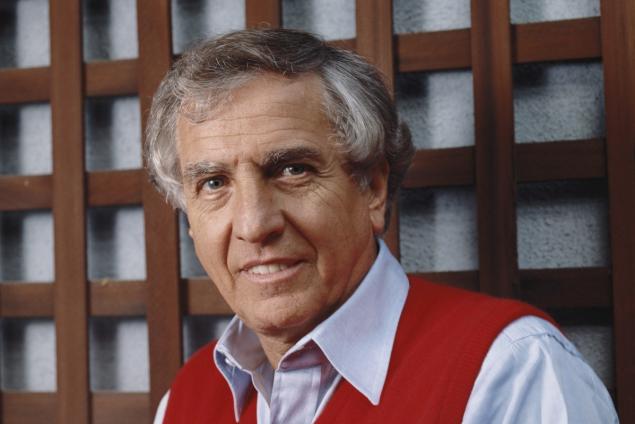
Garry Marshall: A Tribute To The Man Who Created So Many Happy Days For All Of Us

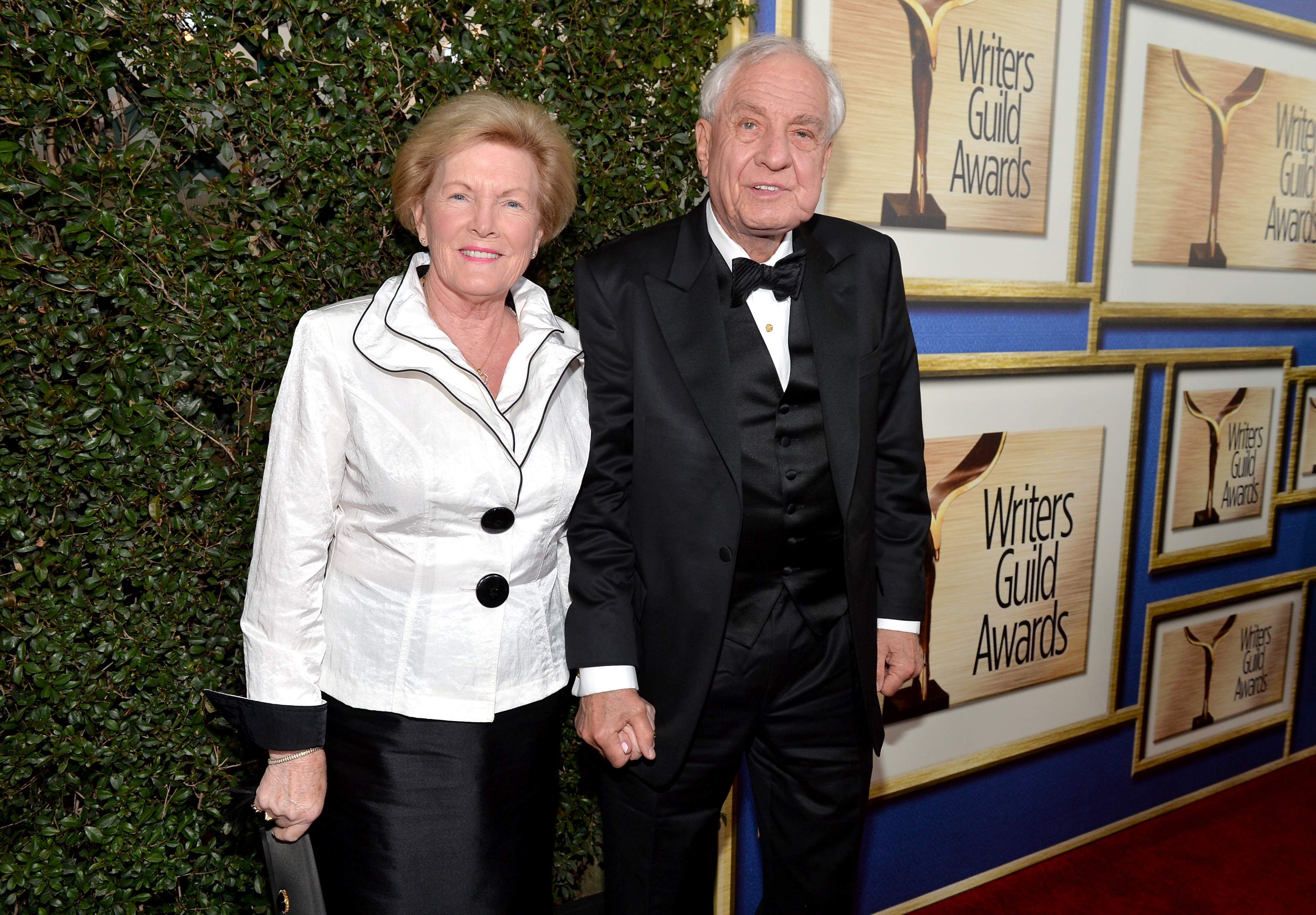
Today we get to honor one of my all-time favorites in the celebrity world – Garry Marshall.  By all accounts, whatever you read, he was hilarious, humble, and hard-working.  He was known as a family man, always putting them first. Let’s learn a little bit about his life.

garry1

His Early Life

Garry Kent Marshall was born in The Bronx, New York on November 13, 1934, the son of Anthony Wallace Marshall, a director and producer of industrial films, and Marjorie Irene, a  teacher who ran a tap dance school. His father changed his last name from Masciarelli to Marshall before Garry was born.

Marshall had a typical childhood which included “the usual bruised knees, runny nose, dead frogs and stolen bases.” But he said his formative years were primarily devoted to discovering girls, making people laugh, and learning to play drums. “When I was growing up, there were three drummers I admired: Gene Krupa, Max Roach, and this little girl drummer in my school who used to blow in my ear after practice.”

His brother is Ronny Marshall Hallin, a television producer; his sister is Penny Marshall, actress and director; and his brother-in-law for ten years was Rob Reiner, actor and director.

garry14

Garry decided to attend Northwestern University to major in journalism.  After graduation, he was drafted into the Army and sent to Korea as part of the Special Services.  He was able to write and produce shows which set him on a new career path once he returned to the United States. Discussing his service, he said, “The lowest musical experience of my life came when I was in the Army. I was a solo marching snare drummer and kept cadence for my battalion. One day while my battalion was marching, I was playing so badly that the Captain shot a hole through my drum with a .45 revolver.”

Garry moved to New York after the Army and met Fred Freeman.  The two of them began writing together.  To support himself while his writing career got underway, Garry supplemented his income playing drums and writing for the Daily News sports department.

His TV Production Career

Marshall began his career as a joke writer for comedians and became a writer for The Tonight Show with Jack Paar. He eventually secured a staff writing position on The Joey Bishop Show. There he met Jerry Belson in 1961, with whom he would go on to write two feature films, a Broadway play, and episodes for a variety of TV series including The Dick Van Dyke Show, The Lucy Show, and I Spy.

In 1963, he married Barbara; they would have three children.

garry16

Marshall and Belson’s first television series as creator-producers was Hey, Landlord, which lasted one season (1966–67).

Their next series was more successful. They adapted Neil Simon’s play The Odd Couple for television. Felix Unger and Oscar Madison are total opposites but best friends.  Garry’s sister Penny would play Myrna in the show.

T4DODCO EC002

Marshall continued to borrow from The Odd Couple throughout his career. Over and over again he employed the comic device of coupling two distinctly different characters: the hip and the square on Happy Days, the earthling and the Orkan on Mork and Mindy, the rich and the poor on Angie, and, later, the businessman and the prostitute in the movie Pretty Woman.

Most of his hit television series were created and executive produced by him. Rather than forming his own independent production company, which had become standard procedure for producers at the time, Marshall remained at Paramount to make a succession of hit situation comedies for ABC. By the end of the 1978-79 season, four of the five highest-rated shows of the year were Marshall’s.

garry13

In the Norman Lear era, when series like All in the Family tackled social issues, Marshall focused on younger viewers with lighter, more escapist fare, most of it set in the supposedly simpler past. In an interview reprinted in American Television Genres (1985), Marshall recalled that, after producing the adult-oriented Odd Couple, he had been anxious to make shows “that both kids and their parents could watch.”

His philosophy to get younger viewers: “You have to do something silly to get their attention. Then I like to knock them off their chairs with laughter. I go for the gut. I want them to laugh hard.  I don’t want them quietly staring at a bright, witty show.”

Happy Days debuted as a series in January of 1974, and by the 1976-77 season it was the most popular show on TV. Most people don’t realize this, but the show began as a skit on Love American Style, and I remember watching it when it aired the first time. The show was set in Milwaukee in the 1950s, focusing on a group of high school friends; the Cunningham family; and Fonzie, the cool guy in town.

garry5

Regarding Fonzie, Marshall said, “I knew that if I could get him over the garage, I could get him into the kitchen; he could become a member of the family.”

He worked with a variety of his family members throughout his career. His mother appeared in the Happy Days episode, Happy Days: Beauty Contest as “Mrs. Weiss,” the piano player.

Laverne and Shirley was a spin-off of Happy Days.  Two friends, Brewery workers, get involved in various kinds of trouble.  Marshall explained his idea for the show: “No one else on TV is doing early Lucy.  The other ladies on sitcoms are classy – they’re well off, smart, and they dress well. Laverne and Shirley are definitely not classy. They’re blue collar workers who went to work right after high school.  They’re decent people.”

garry6

Happy Days would produce two more shows in Joanie Loves Chachi that explored the life of Joannie Cunningham and Fonz’s nephew Chachi after high school as they tried to figure out their relationship and Mork and Mindy, a show starring Robin Williams and Pam Dawber about an alien living in Colorado.

His Acting Career

A la Hitchcock, Marshall turns up as an uncredited actor in the background, occasionally appearing in cameos on his own hit TV shows.

garrya

On Dick Van Dyke, he appeared as referee in a 1965 episode and a bartender in a 1966 episode. If you look closely, you will see him as a random man in three Odd Couple episodes. He showed up as a drummer in two Laverne and Shirley shows and on a Happy Days episode.

He had a small re-occurring part on Murphy Brown and provided the voice for two Simpsons shows (“Eight Misbehavin’” and “Homer the Father”).

In 2014, Marshall appeared in a guest star role in a Two and a Half Men.

He continued to show up in comedies until his death, the last one being Brooklyn Nine-Nine.

When he made the switch to movies, he continued to find small roles for himself. He plays a first baseman in  Runaway Bride, an audition director in Beaches, and a bum in Pretty Woman. It seems there was no part too small. He also played his real-life sister’s husband in Hocus Pocus in 1993.

His Directing Career

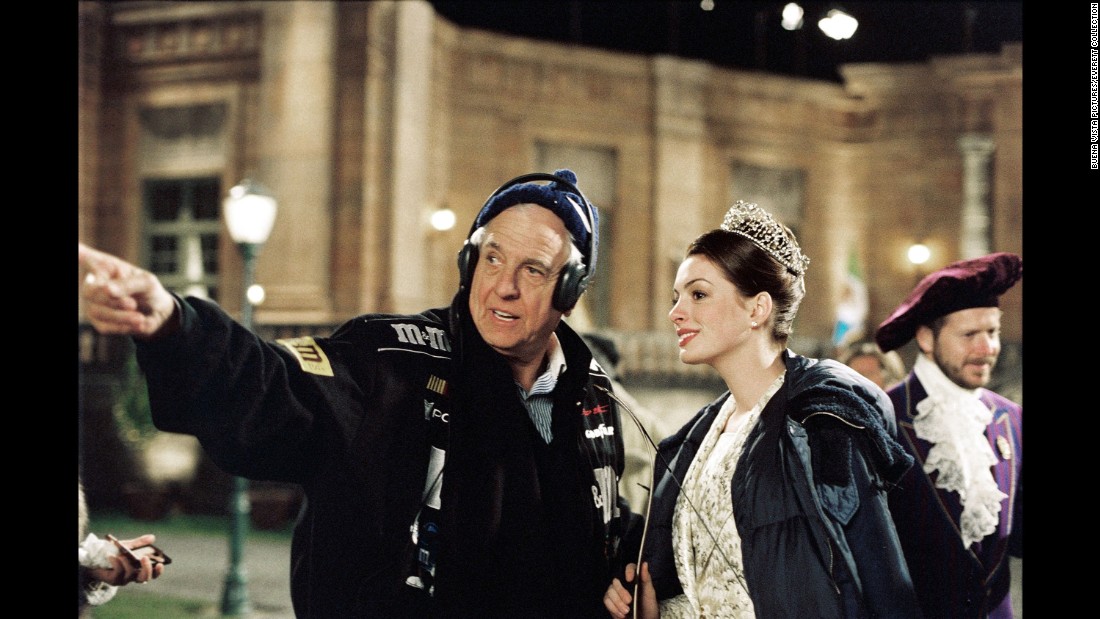
His career as a film director was just as impressive, yielding several gems and cult classics, from Pretty Woman to Runaway Bride to The Princess Diaries.

In the early 1980s, he met Héctor Elizondo while playing basketball and they became great friends. Marshall was known for his obsession with basketball: his contract often obligated studios to provide a basketball court on his film locations.

garry3

Elizondo appeared in every film that Marshall directed, beginning with his first feature film Young Doctors in Love. Elizondo once noted that he is written into all of Marshall’s contracts whether he wanted to do the film or not.

In the opening credits of Exit to Eden (their eighth film together), Elizondo is credited “As Usual … Hector Elizondo.” In 1984, Marshall had a film hit as the writer and director of The Flamingo Kid. He later produced Nothing in Common with Tom Hanks and Jackie Gleason and Overboard with Goldie Hawn and Kurt Russell.

In 1988, he directed the legendary weepie Beaches, starring Barbara Hershey and Bette Midler.

Although he was original choice to direct Sleepless in Seattle, Nora Ephron ended up with the job. His most famous movie as director also won him an Oscar nomination for Pretty Woman in 1990.

garry10

Pretty Woman star Richard Gere said of Marshall in Variety: “He was a mentor and a cheerleader and one of the funniest men who ever lived. He had a heart of the purest gold and a soul full of mischief.”

Some people might be surprised to find out that Garry was the director for The Princess Diaries and The Princess Diaries 2 starring Anne Hathaway and Julie Andrews.  Garry considers Julie Andrews one of his favorite actresses because “she could act, she can sing, she’s a lady who can curse with perfect diction.”

garry17

He seemed to be surrounded by family whether at home or work.  In his last movie, Mother’s Day, he re-united with Julia Roberts, Kate Hudson, and, of course, Hector Elizondo. His sister Penny provided narration; his son Scott helped direct; and his wife, Barbara, a nurse, played a nurse in the film. (“She has her own costume,” Marshall joked.) There were also a few grandchildren  included in certain scenes.

garry11

Awards

When he gave a speech upon accepting the Lifetime Achievement Prize given at the American Comedy Awards in 1990, Marshall said, “If television is the education of the American people, then I am recess.”

In addition, he received the Valentine Davies Award (1995), the Women in Film Lucy Award in recognition of excellence and innovation in creative works that have enhanced the perception of women through the medium of television, the Television Hall of Fame for his contributions to the field of television in 1997, the National Association of Broadcasters’ Broadcasting Hall of Fame in 2012, the Laurel Award for TV Writing Achievement in 2014, as well as a star on the Hollywood Walk of Fame.

garry12

Conclusion

On the morning of July 19, 2016, Marshall died at a hospital in Burbank, California at the age of 81 due to complications of pneumonia after suffering a stroke.

Robin Williams’s daughter Zelda wrote, “RIP Garry. You forever changed my father’s life, and thus, mine. Thank you for capturing so much joy on film, over and over.”

Henry Winkler tweeted, “Larger than life, funnier than most, wise and the definition of a friend.”

“How could one individual work parts of seven decades in the entertainment industry and make zero enemies?” Ron Howard asked, “Garry achieved that, and it was the result of his absolute integrity as a man and as an artist.”

Garry Marshall was an amazing and talented man.  He was a family man above all else.  He was an actor with 84 credits, a writer with 40 credits, a producer with 31 credits, and a director with 30 credits.  He was a drummer and a journalist.  His career covered more than six decades and his star was shining bright when he left show business.

He will be remembered for creating television shows that touched viewers and drew them into the world their characters inhabited.  We rooted for all of them and looked forward to spending time with them each week.  He created some of the most memorable characters on television. He also provided many lovable movies for our DVD collections with Pretty Woman at the top of the list.

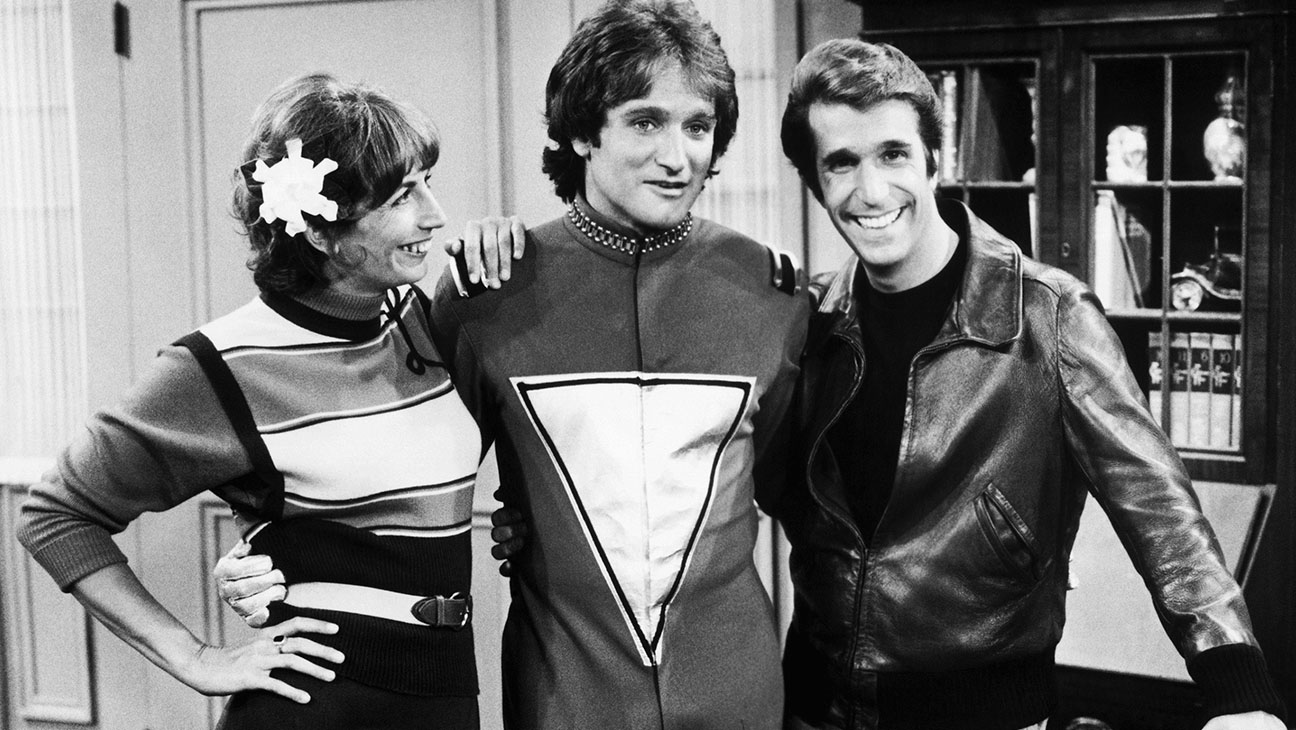
HAPPY DAYS, from left: Penny Marshall, Robin Williams, Henry Winkler, 1974-84.

He wrote My Happy Days in Hollywood in 2012.  This is one of my all-time favorite classic television era autobiographies.  He not only discusses his successes but admits to all his screw ups and mistakes as well.  It’s a refreshingly honest account by a down-to-earth and humble man.  It’s one of the best ways to get to know this fascinating guy and is a wonderful tribute to a man who quietly influenced generations of actors and actresses. Let’s end by hearing how his book was perceived by some of those people who knew him best.

book
“Garry Marshall is walking entertainment. He is smart, insightful, funny…and so is his book.” ―Henry Winkler

“Even though he speaks slowly with a distinctive New Yorkese Bronx accent, he has managed to quickly create, write, and produce a raft of beloved television series that speak ‘American’. I am happy that he gifted us with a witty memoir (about his Happy Days in Hollywood).” ―Carl Reiner

“Thanks to my brother I have a life.  I’m sorry I almost ruined his during Laverne & Shirley.” ―Penny Marshall

“I never thought my fairy godmother would look―or sound―like Garry. He is a gift of a human being, and this book is wicked sweet.” ―Anne Hathaway
 
“Garry Marshall is one of the most beloved and talented people I know…and maybe the most normal guy in the business. This wonderful biography will allow readers to discover for themselves the decent and kind man who writes and directs with such a huge heart—all grounded from humble beginnings in The Bronx. This is a must-read book.” —Julie Andrews
 
“Garry Marshall is quite simply one of my favorite people. He is loving, loyal, and hilarious! Having made movies with Garry when I was 20, 30, and 40…I guess you could say Garry and Barbara have raised me! In a time where people have lost touch with things to laugh about, this book is sure to be a cure.” —Julia Roberts

The Passing of a Pop-Culture Parent

flo

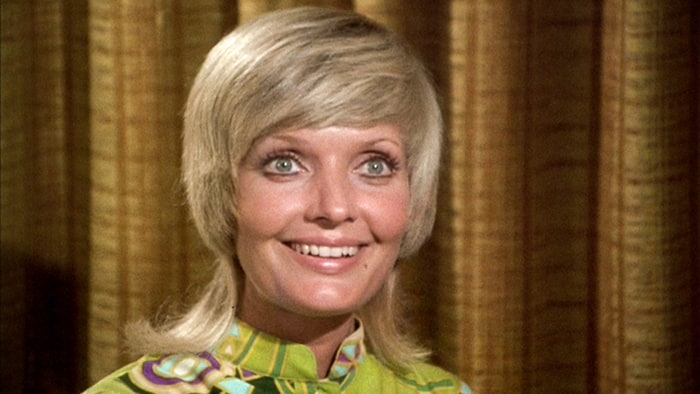
In memory of Florence Henderson, who passed on away on Thanksgiving, I just wanted to spend some time reviewing her career.  It’s hard not to call someone lucky and successful who became a multimillionaire (10-15 million depending on the source), is well known all over the world, and beloved by many fans. But, after researching her career, I wonder if she had been able to do it over, would she have chosen to take on the role of Carol Brady?

Florence’s life was a far cry from The Brady Bunch; the only similarity was having a huge number of people under one roof.  Her father didn’t marry until his late forties and he married a woman 25 years younger than him. He was a tobacco sharecropper and alcoholic and life was not like a sitcom. Florence, growing up in Indiana, was the tenth child to come along, and her father was close to 70 by the time she was born. Her mother and father divorced when she was a teen and then her mother moved to Cleveland, Ohio to work, and Florence did not see her until she was there for a musical performance. Her father passed away the same time she began a Broadway show. She had to choose between keeping the job and attending her father’s funeral, and she took the job and dealt with the guilt for many years.

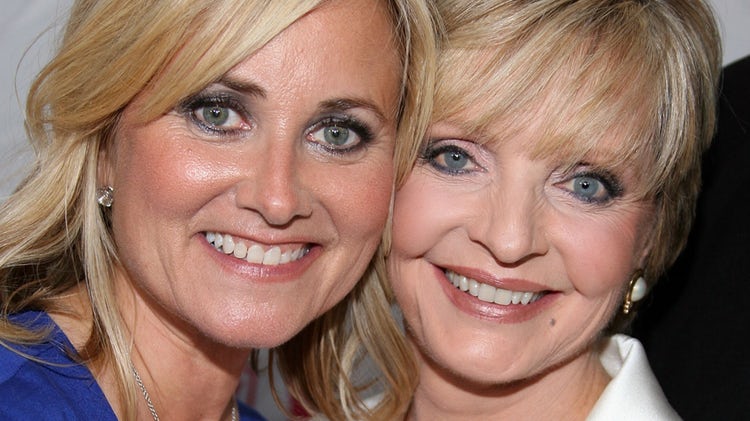
During her career she was in eleven Broadway shows. She had a very interesting career.  She was the first woman to fill in as host for the Tonight Show during the transition from Jack Paar to Johnny Carson. She then became a Today girl on the morning show, presenting the weather and light news in 1959. Although she appeared in various commercials, she is best known for promoting Wesson Oil which she did from 1974-1996. Her last appearance before her death was at a taping of Dancing with the Stars which she had competed in along with Maureen McCormick, her daughter Marcia, on The Brady Bunch. (Dancing with the Stars photo credited to ABC News)


After her iconic role as Carol Brady, she became the queen of one episodes.  She appeared in three episodes of her friend Angela Lansberry’s Murder She Wrote, three shows on Fantasy Island, four times on Dave’s World and ten episodes of The Love Boat, the most of any star. However, from 1975-2016, she worked on 31 shows where she appeared in one episode only. Some of these shows were classic sitcoms such as Alice, Roseanne, Ellen, King of Queens, and 30 Rock. Some were dramas including Medical Center, Hart to Hart, and Ally McBeal. Some were children’s or animated shows such as Scooby-Doo Mystery, Inc.; The Cleveland Show; Handy Manny; and Sofia the First.  However, the most by far were sitcoms that didn’t leave a lasting impression and many are probably quite forgettable.  During those years she appeared on Good Heavens, 3 Girls 3, Glitter, Free Spirit, Night Stand, Samantha Who, Happily Divorced, Trophy Wife, and Instant Mom.

florenceloveboat

Towards the end of her life, she seemed to find a comfortable place pursuing interesting and wide-ranging activities.  She and best friend Shirley Jones did a series of concerts together, she hosted a couple of shows on the Retirement Living network, and did a lot of interviews.

florence10nwitimes

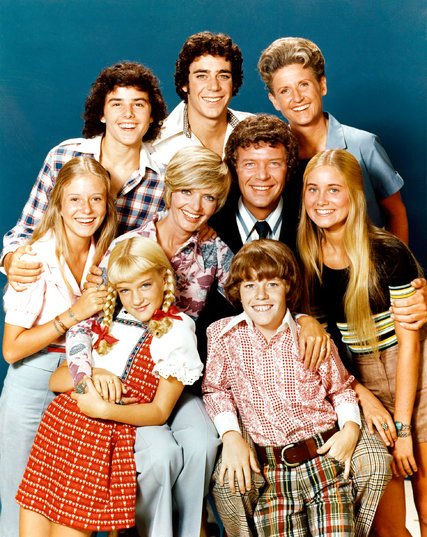
In 1968, she agreed to play the role of Carol Brady but had not heard anything about the show being picked up and was set to star in The Song of Norway being filmed in Norway.  She left for the musical still thinking The Brady Bunch was a no- go.  However, she later found out it was indeed debuting in 1969. They had to film the first six episodes without her and she did her taping later. Appearing as Carol Brady from 1969-1974 gave her the role of a lifetime.  The Brady Bunch has never been off the air since it debuted which says a lot about the show. Many generations of fans admired her and gave her thanks for being a mother figure to them. Some dreamed of being part of a family like the Bradys and obviously Florence could relate, with her background.

florence3

The role made her a national symbol and a lot of money, but you have to wonder what it cost her professionally. It was surprising that both Florence and Shirley Jones became America’s mothers on Friday nights after both being given their start by Rogers and Hammerstein earlier in their careers. They also both wrote “tell-all” books about their lives in show business in 2012 and 2013. Both of these women have been busy their entire lives because they were willing to change along with the times and continue to explore alternatives.

In an interview with Tavis Smiley in 2011, Florence reflected on being Carol Brady: “I’m okay with that.  I think you have to cherish your past because if you don’t cherish your past and love this moment, you have no future. I know a lot of actors hate it when they’re identified with a role. I know what I’ve done in my career . . . I received tremendous affection from people all over the world.”

In a joint interview conducted with Shirley Jones and Florence Henderson, Shirley recalled that her agent told her not to do The Partridge Family.  He said that if she was successful, she would be locked into the role forever.  She wanted a series so she could be home to raise her children, so she took it. She did admit that her agent was right. Even though she had done 20 movies before The Partridge Family, she was forever known as Shirley Partridge. However, she took said at least it was a show she could be proud of and an entire family could watch it together without anything shocking taking place.

florence9

After being The Fonz, Henry Winkler was so typecast that he went into directing and producing because he couldn’t get out of the Fonz’s shadow. I’m not sure why this happens to actors. I think it has something to do with the television being in our homes and we begin to relate to these characters as if they’re real people.  We don’t want anything to ruin the fantasy of the character and how genuine they have become to us. Actors in movies seem to be able to move from role to role without the same obstacles as television stars.

florence1

I guess if you have to be typecast in a role, the role of Carol Brady is not a bad one to identify with. In a recent interview, Florence talked about that fact and if she has to be Carol Brady forever, at least the show “represents what everyone wants in life, and that is a loving family, unconditional love, a place to make mistakes, to get angry, to be forgiven, and to forgive. (photo below credited to Closerweekly)

florence8closerweekly

Florence Henderson had four children and many grandchildren and became the type of mother and grandmother she portrayed on television rather than the role model she grew up with. That is certainly a success in any field. Not only did she have close relationships with her own family, but she stayed close to her “Brady family” for the past five decades. If that was not enough, she influenced generations of viewers who hopefully took something of Carol Brady and incorporated it into their idea of what a mother should be like.

florence11

I am in that generation who lived for Friday nights to watch The Brady Bunch and The Partridge Family, wanting to be part of their families, even if it was from a living room across the country.  Along with many viewers from that generation, I was sad to learn of Florence Henderson’s death and did feel like someone special from my life had passed away. Certainly my realization of the ideal mother was based partly on Carol Brady, Shirley Partridge, Donna Stone, Kate Bradley, and even Bentley Greg and Steve Douglas.  With each of their passing, it does feel like losing a family member.

florence6

Thank you Florence for your positive outlook, your energy, your wide range of interests, your honesty, and your willingness to take on parenting a whole generation of baby boomers. Rest in peace.