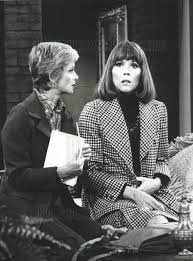
As we take a peek at some one-named sitcoms, today we travel back about fifty years to 1973 and visit Diana which debuted on NBC. Created by Leonard Stern, the show was filmed in front of a live audience. Stern was the creator behind several series including McMillan and Wife and He and She. In addition to this show, he wrote for several series including The Phil Silvers Show, Get Smart, and Holmes and Yo-Yo. He has a decent amount of producing credits including executive producer for Get Smart.
📷en.wikipedia.com
The premise is that divorced Diana Smythe (Diana Rigg) moves from London to New York City as a fashion coordinator for a department store. Her brother lets her live in his apartment while he’s out of town. Not only does Diana have to deal with learning about life in America, she has to take care of her brothers great dane Gulliver. Quickly, she realizes a lot of women have keys to her brother’s apartment and they show up regularly.
Rounding out the cast was neighbor Holly (Carole Androsky), copywriter Howard (Richard B. Shull), window decorator Marshall (Robert Moore), her bosses Norman and Norman Bronik (David Sheiner and Barbara Barrie), and friend Jeff (Richard Mulligan), a mystery novel writer.
Jerry Fielding composed the Diana theme. Fielding was a three-time Oscar nominee with 115 composing credits including McMillan and Wife, Mannix, Hogan’s Heroes, and Star Trek. He also was listed as part of the music department for lots of great series and movies.
📷wikimediacommons.com
Riggs took on the role due to the success of The Mary Tyler Moore Show and wanted to do something similar. I will say they tried a bit too hard to be similar. Their apartments are almost identical, and the work set was also set up with one coworker next to Diana and her boss’s office to the right. The show was placed on the Monday night schedule before Here’s Lucy. It was up against Gunsmoke and TheRookies. Gunsmoke had been on forever and was still in the top 20 while The Rookies was in the top 30. While a lot of shows debuted in 1973, the only real hit was Happy Days.
This show might have wanted to emulate The Mary Tyler Moore Show, but it lacked a few things including the amazing cast, the great writing, and the perfect timeslot. Fans never warmed up to this show and the ratings never took off, so the show was canceled before the end of the season.
📷facebook.com
It wasn’t a terrible show, but it wasn’t anything worth watching either. I thought the dialogue was not great and it tried way too hard. The jokes seem a bit tired. While the cast also wasn’t awful, they weren’t overly likable either. I think that there were valid reasons this one was canceled after only 15 episodes. At least she had The Avengers to remember which was a much better and beloved show. Diana summed up how this series fared when she related a story that when she arrived in American, the network had her picked up at the airport in a limousine and when she left America after a canceled show, they sent her to the airport in a shabby, yellow cab. I guess limousines and shabby cabs are part of all of our lives.
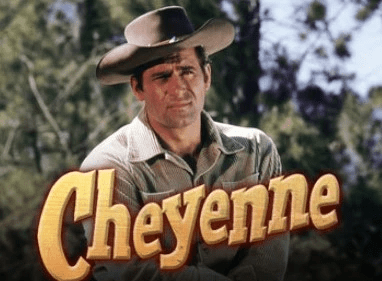
In June, we are advising “Go West Young Man” as we peek back at a few of our favorite westerns. First up is Cheyenne. Cheyenne debuted in 1955; it was the first hour-long Western. It would remain on the air for eight years, producing 108 episodes.
📷rewatchclassictv.com
Clint Walker starred as Cheyenne Bodie, a cowboy who explores the wild west after the Civil War. Early in the show, we learn that Bodie’s parents were killed by an unknown Native American tribe. A Cheyenne tribe found him and raised him till he was 12 when they sent him to live with a White family.
Because Cheyenne is traveling, guest stars change from week to week. The series was part of Warner Brothers Presents which alternated a weekly show with Cheyenne, Casablanca, and Kings Row.
For the first four seasons, the show was on Tuesday nights; then it moved to Mondays for the final four years. It was in the top thirty, and often the top twenty, for most of its television life, despite being up against The Phil Silvers Show; Richard Diamond, Private Detective; Dragnet; and the game shows To Tell the Truth and I’ve Got a Secret. Because Warner Brothers was used to making movies, the television show was produced with a movie feel to it.
In 1958, Walker went on strike. His contract stipulated that he had to give Warner Brothers 50% of his personal appearance fees, and he could only record music with the Warner Brothers label. He wanted 100% of his fees and to be able to record wherever he chose. I never learned what they settled on, but Walker returned to the show.
📷wikipedia.com
During his travels, Cheyenne often advocates for justice in the places he visits, sometimes working as a sheriff or deputy. Another theme of the show is the distrust of Native Americans. Cheyenne is sympathetic to their plight and is loyal to the Cheyenne tribe that raised him. Many of the plots were taken directly from Warner Brothers movies of the past and reworked a bit.
The theme song was composed by William Lava and Stanley Davis Jones. They both worked on The Mickey Mouse Club with Jones composing for the Spin and Marty shorts. Lava also provided music for Zorro, The Twilight Zone, and 77 Sunset Strip.
During Clint Walker’s interview with the Television Academy, he talked about his time on the show. He said he became aware of how many people liked the show when they sent him out to functions, and he started to realize how many fans he had in each town and then thinking of all the towns in the United States. He received a lot of fan mail from people who liked the values of the show. Some young men told him they no longer had fathers or uncles, and he was their role model.
📷imdb.com James Garner
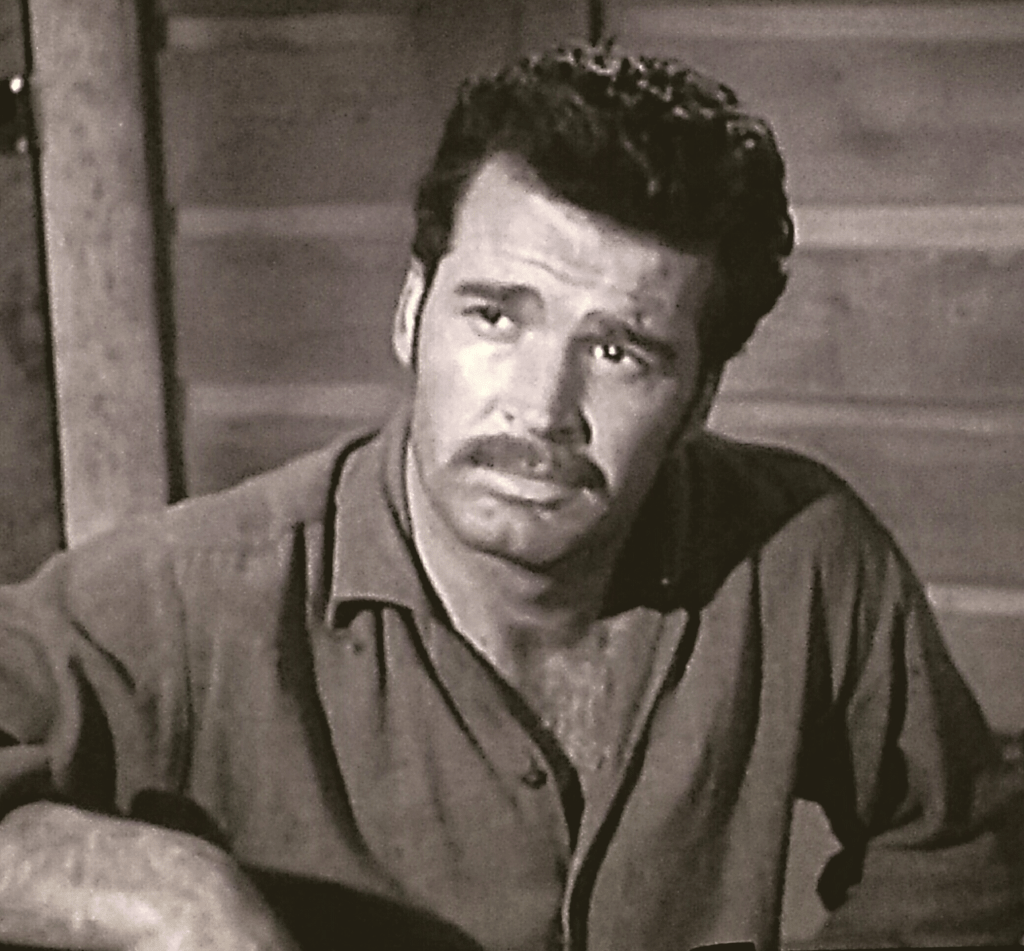
I also heard a fun story about casting during this show. Richard Bare explained during his interview that he was in a bar one night and a friend introduced him to an actor. The next day a meeting was called where Jack Warner informed them that he wanted some new faces introduced during the show. Bare remembered the young actor he met at the bar the night before but couldn’t remember his name. He called the bar and was told that the actor’s name was Jim Baumgartner, so he asked them to tell him to come to the studio when he showed up again. Finally, Baumgartner called Bare the day before they began shooting. He came in and did an audition. The crew was going on location the next day, so they had to decide immediately if he was part of the show. When Jack Warner saw the clips, he said to give that kid a seven-year contract, and that’s how James Garner started working in westerns.
There is no doubt Cheyenne was a popular show. It was interesting enough to keep viewers’ attention for an hour. The episodes seem to be well written. In an era when there were tons of westerns to watch, this one was in the top section of that list. The show still can be streamed on several places. If you want to live in the Old West for a bit, why not join Cheyenne and see what it was like.
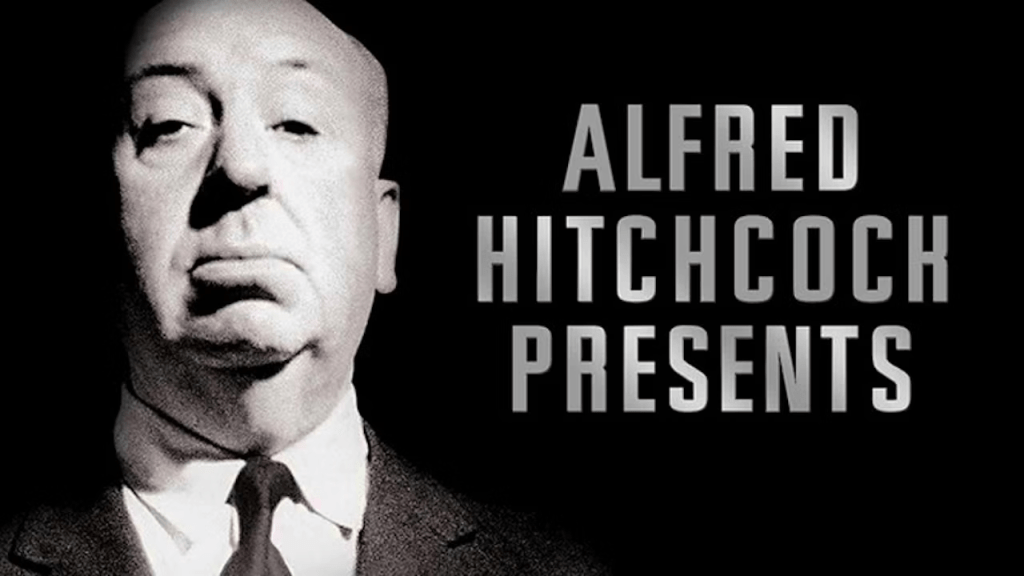
In October, we are tackling a blog series on Eerie Shows. It would be almost impossible to not include Alfred Hitchcock Presents which was on television for a decade.
The show premiered in 1955. Hitchcock had been directing films for more than three decades at that time. The series experienced several changes. It began as Alfred Hitchcock Presents on CBS but would switch both nights and networks during its run. In 1962 it became an hour-long show and was called The Alfred Hitchcock Hour.
Many fans recall the opening. There is a line-drawing of Hitchcock’s profile with the “Funeral March of a Marionette” playing in the background. Hitchcock appears at the edge of the screen and walks to the center where he fades into the caricature line drawing. Then he said, “Good evening.” The silhouette was one that Alfred drew. He began his entertainment career illustrating title cards for silent movies.
📷peacock.com
Hitchcock himself directed 17 of the episodes of the series. Two of those were nominated for Emmy awards: “The Case of Mr. Pelham” in 1955 with Tom Ewell and “Lamb to the Slaughter” in 1958 with Barbara Bel Geddes.
Hitchcock’s job during this series was to introduce the story and then to wrap it up at the end. Both the openings and closings were written by James B. Allardice. Allardice wrote for 38 different shows, many of them very popular series in the fifties and sixties. Norman Lloyd, who produced the show and appeared in five episodes, said Hitchcock respected Allardice so much that he never even changed a comma that he wrote.
The network demanded that if a character got away with murder during the show, then Hitchcock would let them know during the closing that he was eventually brought to justice; in the TV Guide, Hitch described this as “a necessary gesture to morality.” Lloyd gave an example of this in a Television Academy interview. In one episode, a woman kills her husband with a frozen lamb’s leg and gets away with it. At the end of the show, Alfred explains that she later remarried and tried the same trick again but when she took out the leg and hit her husband with it, it was not frozen enough, so he caught her in the act and turned her in.
📷genresnaps.com
The episodes were not your average thriller shows. They included drama, suspense, and humor. Audiences never knew just “who done it” till the end.
The show debuted on CBS on Sunday nights for five years, up against drama anthologies for two years and then competing with The Dinah Shore Show for three years. For the next two seasons it moved to NBC on Tuesday nights. It aired against The Many Loves of Dobie Gillis on CBS those years and against Wyatt Earp on ABC. For three months it went back to CBS on Thursdays before moving to Fridays on CBS the next season with The Price is Right and 77 Sunset Strip. The ninth year found it on CBS on Fridays with little competition and the final year it showed up on NBC’s schedule on Mondays against Ben Casey. I could never find the reason for cancelling the show. I’m assuming ratings began to decline but if anyone knows, I’d love to hear it.
NBC chose not to air a 1962 episode called “The Sorcerer’s Apprentice” because the sponsor felt the ending was too gruesome. In the episode, a magician’s helper is supposed to help in a trick where he “sawed” a woman in half, but he doesn’t realize he truly saws her in half.
📷thecompletehitchcock.com
As you might guess, with a new story every week, many celebrities appeared on the show including Charles Bronson, Bette Davis, Bruce Dern, Robert Duvall, Clint Eastwood, Peter Falk, Joan Fontaine, Peter Lorre, Walter Matthau, Steve McQueen, Vera Miles, Claude Rains, Robert Redford, Burt Reynolds, Thelma Ritter, George Segal, and Jessica Tandy.
In addition to the Hitchcock-directed episodes, the show received Emmy nominations for Best Series four times. In 1956 it was up for Best Action or Adventure Series, but it lost to Disneyland. The following year found the show in the Best Series – Half Hour or Less category, but it lost to The Phil Silvers Show. 1958 found it in the category of Best Dramatic Anthology Series. You would think that would be a no-brainer win for this show, but it lost to Playhouse 90. It had its fourth category nomination in 1959 as Best Dramatic Series – Less Than One Hour and lost to Alcoa Theatre. I guess the Emmy committee had a hard time determining categories for a few years.
In a different twist, NBC tried to air the show again in 1985. Hitchcock had passed away five years earlier from renal failure. A made-for-TV-movie combined new stories with colorized segments from the original show. It lasted a year before NBC canceled it. USA picked it up for three more seasons.
📷screentunes.com
The original show can still be seen on a few different networks including MeTV.
With Hitchcock’s popularity in 1955, it’s no wonder that this show was a successful series for a decade. The episodes were well written, and they had a wonderful cast of actors. Many people probably tuned in just to see Hitchcock, and his personality was larger than life, even if his behavior was a bit despicable at times. One of Alfred’s quotes about the show was that “television has brought murder back into the home – where it belongs.”
This month we are learning a bit about the Batman villains and their careers. No study of Batman’s favorite nemesis would be complete without Cat Woman, Julie Newmar. Julie shared the role of Cat Woman with Eartha Kitt who appeared the final television season and Lee Meriwether who was so catty in the Batman movie. What else did Julie Newmar do during her career? Let’s find out.
📷pinterest.com
Born Julia Chalene Newmeyer in 1933, Julie Newmar as she is known in the acting world, was a television and film actress, dancer, singer, and stage performer. But, as they say in the commercials, that’s not all. She also was known for writing, designing lingerie, and managing real estate investments.
Newmar was born in LA. Her father Don was head of the physical education department for the Los Angeles College. Her mother, of both Swedish and French descent, was a fashion designer under the name Chalene and later worked in real estate.
Julie began dancing early in life and performed as a prima ballerina with the Los Angeles Opera when she was only 15. With an IQ of 135, Newmar graduated from John Marshall High School at age 15. She continued dancing in films in the early fifties. At age 19, she was also working as a dancer/choreographer for Universal Studios. In 1954, she appeared in Seven Brides for Seven Brothers as Dorcas, one of the seven brides.
📷facebook.com
In 1955 she got her first Broadway appearance in “Silk Stockings.” She continued her movie and Broadway careers throughout her years in entertainment, appearing in 33 films in all.
Television is where Newmar gained most of her fame. Her first television appearance was on The Phil Silvers Show in 1957 and then Ominbus in 1959. But it was in the sixties that she became a household name. She started the decade in Adventure in Paradise in 1960, followed by a variety of shows including The Defenders, Route 66, and TheTwilight Zone in the early sixties.
In 1964 she was offered the role of Rhoda on My Living Doll, where she played a robot. She was not enthralled with the choice of Bob Cummings as her costar and did not seem to enjoy her time on this show. She said that “They originally wanted Efrem Zimbalist Jr. It was not a flip part—it needed a straight actor who could play opposite this bizarre creature so the comedy would come off. That quality was lost when they hired Bob. The show could have been wonderful. I think it would have run for many seasons had they hired Efrem because he had the right qualities.”
📷classicfilmandtvcafe.com
After appearing in several comedies including The Beverly Hillbillies and F Troop, she received another recurring role as Cat Woman in Batman. She would appear in the series 13 times, 12 as Cat Woman, the only villain to make Batman question his morals, because we knew he was in love with her, and if she showed any sign of remorse, who knows where things might have gone. Her Cat Woman costume now lives at the Smithsonian Institution.
Newmar lived in Beekman Place in New York in the mid-sixties. One weekend her brother had come to visit her from Harvard. They were sitting around chatting when the phone rang. She was asked if she would like to play Cat Woman on the Batman series. She was a bit miffed because they said they were casting in California, and the role started on Monday. Her comment was “That’s how television is done: they never know what they are doing until yesterday.” When her brother heard Batman, he jumped up and said that was the favorite show at Harvard and they even skipped classes to watch it. He told her to take the role, so she did.
📷firstforwomen.com
After Batman, she finished out the sixties in The Monkees, Star Trek, Get Smart and It Takes a Thief. With 11 seventies offers, you can see her in shows such as Bewitched, Columbo, McMillan and Wife, Love American Style, The Bionic Woman, and The Love Boat. One of my favorite made-for-tv movies was The Feminist and the Fuzz. It had an exceptional cast, including Newmar who appeared in the movie along with Barbara Eden, David Hartman, Jo Anne Worley, Farrah Fawcett, Harry Morgan, Herb Edelman, Penny Marshall, and John McGiver. This ensemble was directed by Jerry Paris, who directed so many great shows from The Dick Van Dyke Show to Happy Days.
Her other starring role in the seventies was a marriage to J. Holt Smith, an attorney. After the wedding, Newmar moved to Forth Worth, Texas until 1984 when they divorced.
📷remindmagazine.com
The eighties was a more quiet decade for the actress but she did accept roles on CHiPs, Fantasy Island, and Hart to Hart. In 1992, she appeared in George Michael’s music video, “Too Funky,” She was still working in 2016 and 2017 in Batman animation features.
If you were a fan of Batman and Dark Shadows in the sixties, you were in luck when Newmar took on the role of Dr. Julia Hoffman (played in the original series by Grayson Hall) in Dark Shadows: Bloodline, the audio drama miniseries.
She was not just a pretty face, however. She received two US patents for pantyhose and one for a bra, under the name Nudemar. She also began investing in LA real estate and was credited with helping to improve the neighborhoods of La Brea Avenue and Fairfax Avenue. In one episode of My Living Doll, Rhoda is asked to play Chopin’s “Fantasie Impromptu” on the piano. Newmar played the piece herself. She had studied under concert pianist Dr. MacIntyre, and she said that scene is the only one she’s done with her playing the piano which had been her career choice before acting. One of Julie’s comments about herself was “Tell me I’m beautiful, it’s nothing. Tell me I’m intellectual—I know it. Tell me I’m funny, and it’s the greatest compliment in the world anyone could give me.”
📷closerweekly.com
Julie also enjoys art and gardening. She has a rose, a day lily, and an orchid named for her. Her gardens are often chosen as a spot for holding charity events.
Like Barbara Feldon from Get Smart, Julie Newmar is beautiful, bright, and funny. I hope she enjoyed her career. Obviously, she could have been a brain surgeon or any other profession of her choice. She seems like she would be a fun person to just hang out with and the conversation would never run out. Thank you, Julie Newmar for choosing the entertainment business over medical science for our sakes.
This month’s blog series is “Time for Some Texas Tea,” stars of The Beverly Hillbillies. We begin our series with Elly May Clampett, played by Donna Douglas. Born Doris Ione Smith in Baton Rouge, Louisiana in 1932, Douglas’s upbringing could not have prepared her for her most famous role of Elly May Clampett any better, because she was a tomboy and loved animals. She had eight male cousins, and she wore their hand-me-downs, went fishing with them, and pitched on an all-boy softball team. In high school, she played softball and basketball, but did switch to cheerleading as she got older. Like many of her classmates during that era, she married shortly after high school. After she had a son, she and her husband Roland Bourgeois divorced three years after their wedding.
Photo: imdb.com
Donna won Miss Baton Rouge and Miss New Orleans. She then made the move to New York. She was offered a job as an illustration model for toothpaste ads. She began taking acting lessons while in the city.
In 1958, at age 27 she began her television career. That year she would appear on The Phil Silvers Show, but she was credited with the name Doris Bourgeois, her married name. In 1959 she would appear on The Steve Allen Show, Tightrope, US Marshal, and Bachelor Father.
Her movie career began the same year. She appeared in Career and would go on to show up in six movies before 1970 including Bells Are Ringing, Lover Come Back, and Frankie and Johnny which she starred in with Elvis Presley. Although they remained friends, and Elvis once visited the cast when they were in Memphis filming, I read a few different sources that relate that Donna fell in love with Elvis and was heartbroken he did not feel the same way. Her last big-screen appearance in 2013, Chronicles of Life Trials, was also her last acting credit of her professional life.
With the debut of the sixties, her career took off, and she received roles on twenty television shows in the first half of the decade. You can catch her in a variety of series including Route 66, The Sunset Strip, Hennessey, Pete and Gladys, Dr. Kildare, Jack Benny, Mister Ed, and The Joey Bishop Show.
With Alan Hale Jr. on Mister Ed Photo: reddit.com
She had a recurring role on Checkmate in 1961 as Barbara Simmons. The plot of the show was that two friends, Don Corey (Anthony George) and Jed Sills (Doug McClure) operate a high-priced detective agency called Checkmate, Inc. in San Francisco. A British criminologist, a former Oxford professor named Carl Hyatt (Sebastian Cabot) helps them.
Photo: etsy.com
In 1960 and 1962 she was in The Twilight Zone in two memorable appearances: I remember watching “Eye of the Beholder” when I was younger and the horror of watching it never left me. In the episode, Douglas is a patient in a hospital having plastic surgery to make her more beautiful. The tension is built as they get ready to unwrap her face. You hear the nurses and doctors talking, but no one’s face can be seen After reminding her that the surgery was not guaranteed to be successful, they finally remove the bandages. We suddenly see the beautiful Donna Douglas. A nurse hands her a mirror and Douglas screams hysterically. Then things move back in the shot and as we see the medical personnel around her, we see they look a bit hideous in our standards, and Donna is devastated that she has to remain so “ugly.”
Photo: kunr.com
In 1962, Paul Henning was developing a new show about a group of hillbillies who strike oil and move to Beverly Hills to buy a mansion and live the good life. They have a hard time adjusting to the California lifestyle and being millionaires. Douglas beat out hundreds of actresses to get the part of Elly May.
Donna said that she was never allowed to change her lines in the script and that now actors have that freedom, but back then producers were in charge instead of the actors.
Douglas received more fan mail than any other cast member on The Beverly Hillbillies, and she spent hours autographing photos and responding to her fans.
Apart from the spat between Nancy Kulp and Buddy Ebsen later in life, the cast of the show was very close. Douglas, Baer, and Ebsen attended Ryan’s memorial service. Irene Ryan put on a huge Christmas spread for the show’s cast and their families every year.
With Max Baer Photo: kroc-am.com
Douglas and Max Baer Jr. remained close friends for the rest of their lives Baer said “I spoke to her on a semi-regular basis. We weren’t the kind of people who would text, but we would call each other when there was something to share.” During the time of her death, one of Donna’s comments was, “Tell Maxie I thought I was going to get better.”
Max and Donna both visited Ebsen the week before he died, and Douglas gave a eulogy at his funeral. Later, when she discussed their relationship, she said he “was a wonderful man very much like my own father, a quiet, reserved, and caring person.”
After The Beverly Hillbillies was canceled, Donna took on a few roles in the seventies and could be seen on Night Gallery, Love American Style, Adam 12, and McMillan and Wife. During this decade she also tried marriage again with Robert Leeds, who had been the director for The Beverly Hillbillies. They married in 1971 and divorced in 1980. We only see Douglas once in the eighties on The Nanny, where she played herself.
Donna had two issues affecting her offers for television roles. After portraying Elly May Clampett for nine years, she was typecast in the role and her religious beliefs prevented her from appearing in anything in bad taste, immoral, or with nudity. She said she only wanted to do high-quality work and many of the scripts did not meet that criterion for her.
After her acting career, Douglas transitioned into gospel singing, real estate, and motivational speaking. She did not do much with her realty work, because she said while she told her clients all the things that were good about the homes, she also felt it necessary to tell them all the things that were bad about them which was not part of the corporate culture in LA at that time. She did perform frequently as a gospel singer and often gave talks for church youth groups, camps, and colleges. She recorded her first gospel album in 1982. Her gospel albums included “Back on the Mountain” and “Donna Douglas Sings Gospel I & II.” She also released several country records. This same year Donna enrolled at Rhema Bible Training Center in Broken Arrow, OK; she graduated in 1984 with a children’s ministry degree.
Douglas also penned a few books. She wrote Donna’s Critters and Kids: Children’s Stories with a Bible Touch and had an accompanying coloring book. In 2011 she wrote Miss Donna’s Mulberry Acres Farm. In 2013, she released a cookbook, Southern Favorites with a Taste of Hollywood. She included recipes from some of her acting friends including Max Baer, Pat Boone, Buddy Ebsen, Loretta Lynn, Gavin MacLeod, Dolly Parton, and Debbie Reynolds.
In a 2003 interview with “Confessions of a Pop Culture Addict,” she discussed her role of Elly May: “Elly May was like a slice out of my life. She is a wonderful little door opener for me because people love her, and they love the Hillbillies. Even to this day, it’s shown every day somewhere. But, as with any abilities, she may open a door for you, but you have to have substance or integrity to advance you through that door.” Donna also made the rounds for several fan conventions for the Beverly Hillbillies.
In 2011, Donna sued Mattel when they released an Elly May Barbie doll without her permission to use her likeness. It was settled behind closed doors, but you can still find the doll which came out in 2010 with a Samantha doll from Bewitched and a Jeannie doll from I Dream of Jeannie.
Donna also enjoyed gardening, responding to fan mail, and spending time with her friends and family. She moved back to Baton Rouge in 2005, and in 2015, she died from pancreatic cancer.
Some people might consider her career unlucky after the Beverly Hillbillies, because she was not able to attain the roles she really wanted to do. However, she was able to create new goals for herself, try out different careers in which she became successful.
Photo: tcm.com
As her life was moving from middle to older age, she was able to return home and spend the rest of the years in the place she loved and the place where her roots were. I think that is a successful and healthy life. She also chose to help raise money for charities and give back when she could have justified just enjoying her private life.
She is a great role model for all of us: strive for your dreams, adjust life when necessary, do your very best, give back to others, and remember where you came from. Pretty good advice and she walked the talk! Thank you for being you, Donna Douglas.
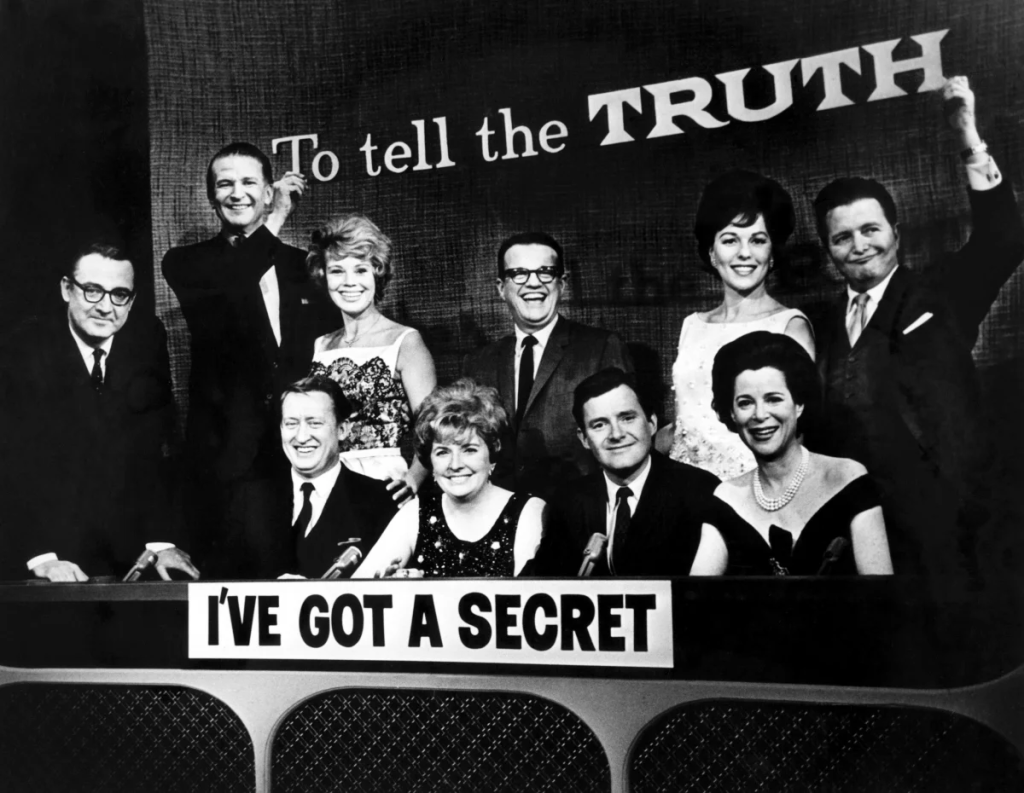
This month we are looking back at a few of the game show celebrities from To Tell the Truth. These are four individuals who were stars in their own right before they did the game show circuit. Although I know the game shows were typically at the end of their illustrious careers, for better or worse, it is how most of us know these interesting personalities.
Photo: globalnews.ca
We are beginning the month with Orson Bean. Bean expressed the sentiment I was discussing above by saying that the was a “neocelebrity,” someone who is famous for being famous for his appearances on prime-time game shows. While I agree with this conclusion, part of what I want us to learn today is why he is a memorable star even without the game show fame.
Bean was born in 1928 in Vermont as Dallas Frederick Burrows. Silent Cal Coolidge was a first cousin twice removed. His father was one of the founding members of the ACLU and chief of police on the Harvard campus. When Bean was sixteen, his mother committed suicide, and he left home.
On Broadway Photo: broadway.com
Bean attended the Rindge Technical School in Massachusetts, and after graduation, he joined the army and was sent to Japan. He spent some time at the HB Studio in New York, studying drama. After returning to the US, Bean began working as a stage musician before trying his hand at stand-up comedy in the early fifties.
Bean tells a fun story about how he came up with his stage name on TheTonight Show. When he was performing at a nightclub in Boston, the piano player would give him a different silly name to use every night. One night it was Orson Bean, and it went over great with the crowd.
In 1952 Bean started his radio career with an appearance on The Chamber Music Society of Lower Basin Street. When the show was renewed for 13 weeks, Bean was the full-time host.
In 1954 he was the house comedian at the Blue Angel Comedy Club in New York. Unfortunately, Bean was dating a girl who was a member of the Communist Party, and he was blacklisted as well. Ed Sullivan canceled his appearance on his show; he did later book him years later for five different episodes.
In 1956 Bean married Jacqueline de Sibour (stage name Rain Winslow). They had one child before divorcing in 1962.
In the fifties and sixties, Orson also was a regular on the Broadway stage. His first production was Will Success Spoil Rock Hunter with Walter Matthau and Jayne Mansfield. He continued on Broadway shows throughout the sixties, getting a Tony nomination for Best Featured Actor in a Musical for “Subways Are for Sleeping.”
The Twilight Zone Photo: wikimediacommons.com
It was also during this decade that Bean began appearing on television where he earned 84 acting credits. He started in the many drama and playhouse series that were on television in the fifties and sixties. He also had his fair share of sitcoms including The Phil Silvers Show, Love American Style, Will and Grace, Becker, Two and A Half Men, How I Met Your Mother, and Modern Family. His dramatic appearances included The Twilight Zone, Ellery Queen, The Fall Guy, Murder She Wrote, Diagnosis Murder, and SeventhHeaven. During his career he was a regular cast member on Doctor Quinn Medicine Woman, Normal Ohio, and Desperate Housewives.
In 1965 he tried marriage again to fashion designer and actress Carolyn Maxwell. They had three children before they divorced in 1981.
The same year he married Maxwell, he entered into another new relationship. He was one of the founding members of The Sons of the Desert, an international organization that was started to share information about the lives of Stan Laurel and Oliver Hardy and to preserve their films.
In 1966 Bean founded the 15th Street School, a primary school in New York City. It was modeled on the Summerhill School in England.
He also showed up on the big screen for 23 movies, the two-best known being Innerspace in 1987 and Being John Malkovich in 1999.
In the 1970s, Bean moved his family to Australia to live in a commune with a hippie lifestyle. They later became bored and returned to the US where he resumed his career.
Orson was popular on the talk and variety shows. In addition to Ed Sullivan, he appeared on The Mike Douglas Show, The Dick Cavett Show, The David Frost Show, The Merv Griffin Show, and was on The Tonight Show more than 200 times.
With wife Alley Mills Photo: soaphub.com
Bean was a competitor on many game shows including I’ve Got a Secret, What’s My Line, Super Password, Tattletales, $10,000 Pyramid, and Match Game. He was best known for being a regular on To Tell the Truth. In addition to being in 317 episodes of To Tell the Truth with Peggy Cass, the two were also regulars on two other game shows: Keep Talking and Call My Bluff.
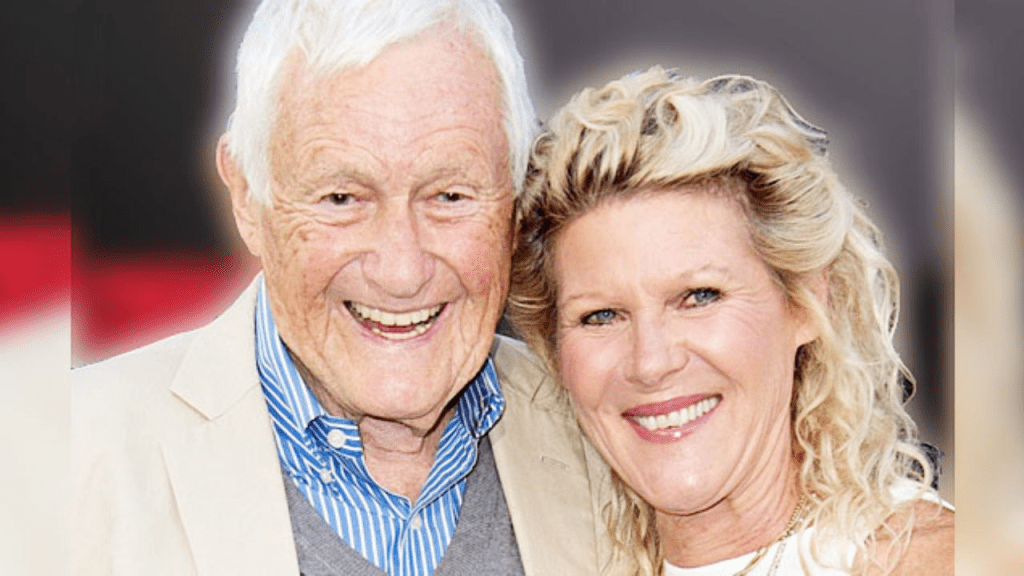
In 1993, Bean tried marriage again. He wed Alley Mills, best known as the mom on The Wonder Years. They were married until his death. The couple were members of the First Lutheran Church in LA and participated in the church’s annual production of “A Christmas Carol.”
On Match Game Photo:jackpendarvis.com
Bean had a terrible death. In February of 2020 when he was 91, he was crossing Venice Boulevard when he was struck by a car. He fell down and a driver of another vehicle, distracted by people trying to tell him to slow down, hit him again before realizing what they were trying to tell him and that hit caused Bean’s death.
Certainly, game shows were only a small part of this celebrity’s career. However, I admit before I wrote this blog, I only knew him for his To Tell the Truth appearances. Now I have a much better appreciation for his long and successful career. I’m glad we are getting a chance to know some panelists from that show this month in more detail.
September is What a Character month, and today we end our series with a look at the career of Herbie Faye. Faye was born in 1899 in New York City. He began working with Mildred Harris in vaudeville in 1928. Phil Silvers was one of the supporting cast members, and their friendship would prove fruitful for his future television career.
Photo: imdb.com
In the forties and fifties, Faye tried his luck on Broadway, appearing in a variety of shows including “Wine, Women, and Song” in 1942 and “Top Banana” in 1951.
He also began a career on the big screen in the fifties. His first film was the movie version of Top Banana in 1954. He would appear in 17 movies; in fact, his last acting credit was the movie Melvin and Howard in 1980. In between, he appeared in a variety of genres including Requiem for a Heavyweight starring Anthony Quinn, The Thrill of It All with Doris Day, and The Ghost and Mr. Chicken with Don Knotts.
In 1950, at the age of 51, Faye made his first television appearance. He appeared in two episodes of Cavalcade of Stars. You would have also seen him in Our Miss Brooks, The Goldbergs, and Hennessey in the fifties.
Photo: papermoonloveslucy.com
When Phil Silvers got his own show in 1955, he hired Faye to play Corporal Sam Fender which he did for 139 episodes between 1955 and 1959. This was a hilarious show and hasn’t lost its charm with time. In addition to the primary characters, there was a group of about a dozen secondary characters who appeared along with Faye. Eventually, the costs became too high, and the show was canceled.
Phil Silvers Show Photo: alchetron.com
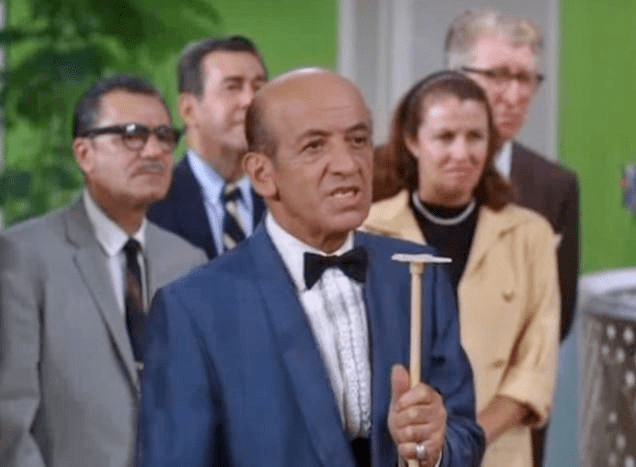
Faye was extremely busy in the sixties. He must have been good at his job because he was cast in more than one show on several of the series he worked for. He was four different characters on The Danny Thomas Show, six on The Dick Van Dyke Show, five on The Joey Bishop Show, two on My Favorite Martian, two on Bewitched, three on The Andy Griffith Show, four on The Gomer Pyle Show, two on I Dream of Jeanne, two on That Girl, four on Petticoat Junction, two on Mayberry RFD, two on Jack Benny as well as 27 other shows all in the sixties. On top of all those appearances, he was part of the cast for two additional television shows: The New Phil Silvers Show from 1963 to 1964 as Waluska and as Irv on Accidental Family in 1967.
In November of 2018, KJ Ricardo spotlighted Faye in her You Tube channel show about The Dick Van Dyke Show. Herbie was Willie, the deli owner who delivered lunch to the comic writers on the show. He appeared in six of the shows. In his first appearance, Rob is trying to leave the office because he thinks Mary is in labor but every time he tries to leave, the Danish cart is in the way. On the third and fourth episode, he starts critiquing the ideas the writers have and making
Willie Photo: televisonsnewfrontier.blogspot.com
comments on what works and what doesn’t. They are pretty funny.
He continued his busy career throughout the seventies when he made one-time appearances in eleven different shows including The Mary Tyler Moore Show, The Bob Newhart Show, Love American Style, Happy Days, and Barney Miller. He made multiple appearances on several other shows including Mod Squad (3), Here’s Lucy (4), The New Dick Van Dyke Show (4), The Odd Couple (6). He also had a recurring role on Doc where he played Ben Goldman from 1975-76.
Faye passed away in Las Vegas in 1980.
Herbie Faye was a very funny guy. He was just an average guy, but he had a way of focusing the viewers’ attention just on him for the brief time he appeared; he made the episodes he was in even better. I guess that is the ultimate definition of a great character actor.
We are winding down our blog series, “What A Character.” If you watched television between 1959 and 1989, you will definitely recognize this week’s character actor: Allan Melvin.
Photo: wikipedia.com
Melvin was born in 1923 in Kansas City, Missouri, but he always said he grew up in New York City where his parents moved to not long after his birth. After high school, he attended Columbia University, studying journalism before joining the US Navy in WWII.
He married Amalia Sestero in 1944 and they were together for his entire life and had two children. Amalia was also an actress and Melvin met her when he attended an actor’s group that she helped start.
Photo: people.com
After being discharged from the Navy, Allan worked in the sound effects department of NBC Radio. He also had a nightclub act. He was on Arthur Godfrey’s Talent Scouts radio show which he won. His first television role was that of Corporal Steve Henshaw on The Phil Silvers Show. Melvin’s wife remembered that time fondly: “I think the camaraderie of all those guys made it such a pleasant way to work. They were so relaxed.”
After the show ended, Melvin was often typecast as a military character or the abrasive, but happy-go-lucky guy. Even when he was not a recurring character, he often had multiple appearances on a series.
Allan and Amalia moved their family to California, hoping for more television roles in the early sixties.
Throughout the sixties, Melvin was kept busy with television work, appearing on The Danny Thomas Show, The Bill Dana Show, Perry Mason, Lost in Space, Love American Style, and The Andy Griffith Show. He had two recurring roles: Art Miller on The Joey Bishop Show and Sol Pomerantz on the Dick Van Dyke Show.
Photo: imayberry.com
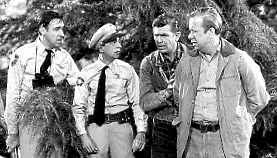
He was often cast as the tough guy on The Andy Griffith Show, with eight appearances in all. Melvin discussed his time on the show and said “I always enjoyed doing the show. We had a lot of fun doing it, and they were a great bunch.”
From 1965-1969 you could find him on Gomer Pyle USMC as Sergeant Charlie Hacker.
As early as 1963, Melvin was doing voice work on The Flintstones. His animation work would continue throughout his career and after about 1974, cartoon voices were his only gigs. One of his best-known roles is Magilla Gorilla.
I’m not sure why, but Melvin only appeared in one movie, although it was a good one. He was the desk sergeant at the end of the Doris Day-Brian Keith film, With Six You Get Eggroll. A couple of Andy Griffith writers wrote the screenplay, and Howard Morris, known as Ernest T Bass, directed the film.
In the 1970s he was cast in his two most memorable roles.
Photo: pinterest.com
He was Sam Franklin, Alice’s boyfriend on The Brady Bunch. Sam owned a butcher shop and was an avid bowler. In a later movie, we learned that he finally made an honest woman of Alice. Ann B Davis said “Allan Melvin, neat guy, very tall. He was just a nice, open, big guy, and it was fun to play with him.”
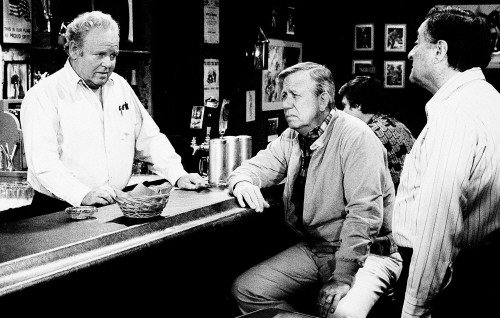
He was also neighbor and friend of Archie Bunker as Barney Hefner on All in the Family and Archie Bunker’s Place. Allan said it was a good experience and everyone’s input was welcome. Jason Wingreen, who played Harry the bartender on the show talked about Melvin in anther wordpress blog, classictvhistory (https://classictvhistory.wordpress.com/tag/allan-melvin/). When asked if he was the same in person as he was in character, Wingreen said, “He was more intelligent than that. Allan wrote little poems, little couplets of sorts, and they were very funny. Like limericks, but not quite limericks. Some of them were very intelligent and very, very funny. Never published. Allan and I became very close friends.”
With Carroll O’Connor on Archie’s Place Photo: record-eagle.coom
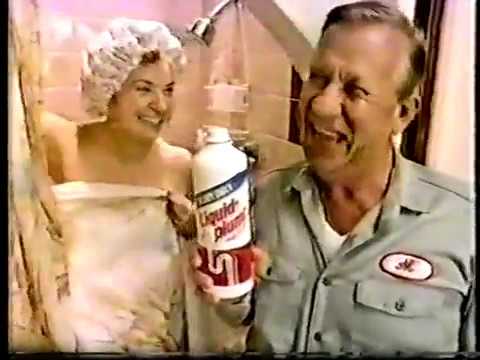
Melvin also did a lot of commercial work. You could see him pitching products from Sugar Frosted Flakes to Remington razors to Liquid Plumr. He was the plumber for Liquid Plumr for fifteen years.
In 2008, Melvin died from cancer.
Melvin certainly had a career to be proud of. One thing I never learned was when he decided that acting was the career he wanted. He became one of the most beloved and most-recognized character actors in the sixties and seventies–definitely a character worth celebrating.
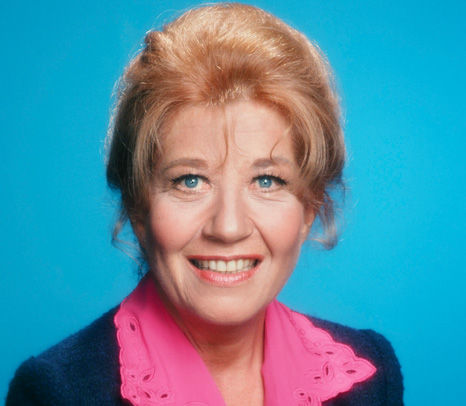
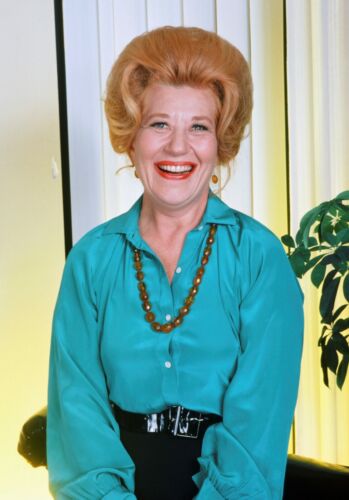
This week we are winding up our series of favorite female actors with Charlotte Rae. If you remember last week we learned about June Lockhart. Charlotte was born a year after June and died a year before her, and their careers were very similar. Both were actresses for more than six decades, appeared in Broadway, movies, and television.
Rae was born in Milwaukee, WI in 1926. Her parents were Russian Jewish immigrants. Her mother Esther had been friends with Golda Meir since childhood. For her first ten years, the family lived above her father’s tire business. In 1936 they moved to a home in Shorewood. At age 16, she became an apprentice with the Port Players, a professional theater company that came to Milwaukee for the summer. After graduation, Charlotte did some radio work and did some performing with the Wauwatosa Children’s Theatre.
Photo: legacy.com
Although she never completed her degree, Rae attended Northwestern University. She and Cloris Leachman became friends there. She also met Agnes Nixon, Charlton Heston, Paul Lynde, and Claude Akins. In later years she would always recommend wanna-be actors get a degree first.
Photo: thejewishnews.com
In 1948, she moved to New York City where she performed in theater and nightclubs. She worked at a variety of clubs including the Village Vanguard and the Blue Angel. During her early days, a radio star told her that her last name of “Lubotsky” would not work well, and she replaced it with her middle name of Rae.
In 1951 she received her first television job on Once Upon a Tune. She would appear on ten other drama theater shows during the fifties. In an interview with Milwaukee Talks in 2016 she said, “When I started out, I wanted to be a serious actor, I never thought I’d get into comedy.”
The same year, Rae married composer John Strauss. They had two sons, but in the mid seventies he came out as a bisexual. Rae was not interested in an open marriage, so the couple decided to divorce in 1976.
Charlotte also loved singing, and she released an album in 1955, Songs I Taught My Mother. Rae also loved being on the stage. In the seventies, Vanguard Records went out of business, and Rae was able to buy back the album for $5000.
She would have stage roles in “Three Wishes for Jamie” in 1952, “The Threepenny Opera” in 1954, “Li’l Abner” in 1956, and “Pickwick” in 1965 among others. Later in her career she would also appear in several off-Broadway shows.
Photo: amazon.com
In 1958, she got a break with a guest spot on The Phil Silvers Show which led to her getting the part of Sylvia Schnauzer, the wife of Leo Schnauzer (Al Lewis) on Car 54 Where Are You when it debuted in 1961. Her husband John did the music for the show. Apart from that role, most of the other television work she did in the sixties was in drama series.
Photo: pinterest.com
Rae also appeared in 14 big-screen movies. Can I take a shameless plug and say that one of my favorite Charlotte Rae roles is in Hello Down There? This movie from 1969 screams IT’S THE SIXTIES from the moment it starts until it ends, but it’s a great sit-back-and-just watch movie. If nothing else, it has an amazing cast including Tony Randall, Janet Leigh, Ken Berry, Jim Backus, Merv Griffin, and Richard Dreyfuss among others.
Photo: muppet wiki fandom.com
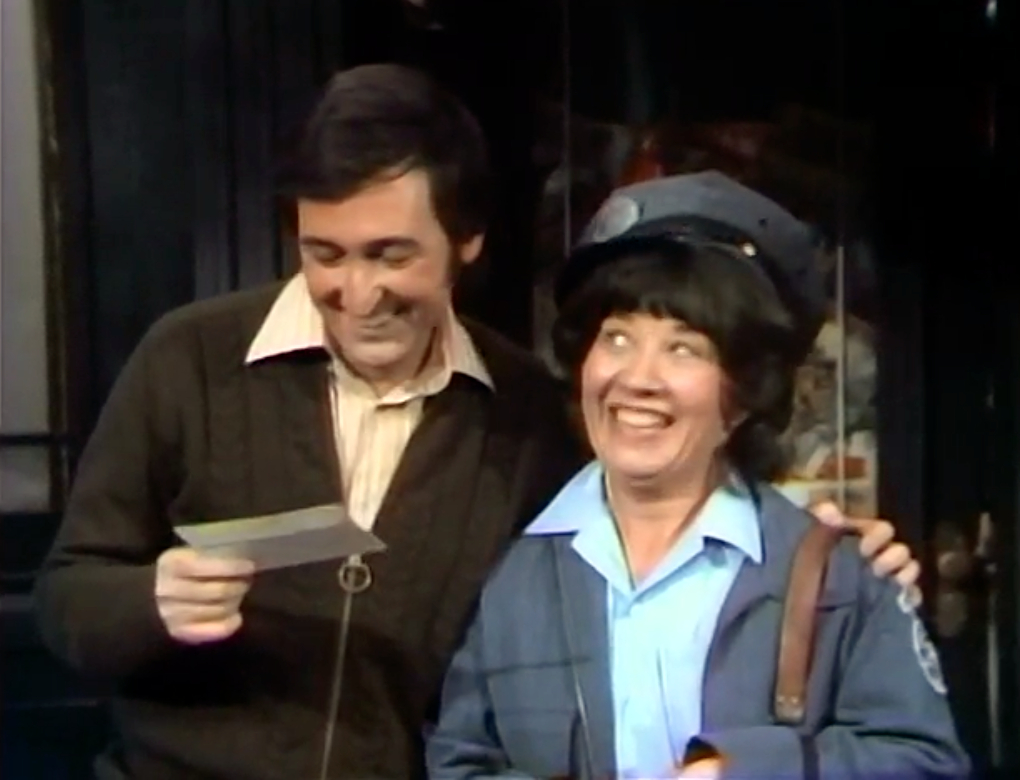
The seventies were her busiest decade of work. She started with a recurring role on Sesame Street as Molly the Mail Lady. During the early seventies you could see her on The Partridge Family, McMillan and Wife, Love American Style, and The Paul Lynde Show. I always appreciated her character on The Partridge Family. When Danny is thinking about quitting school to get on with life, she plays his very smart and creative guidance counselor.
In 1974 Rae moved to Los Angeles. She did guest spots on All in the Family and Good Times, both Norman Lear shows. In 1975, she became a regular on Lear’s show, Hot l Baltimore. She played Mrs. Bellotti, whose son lived at the hotel. The show was a bit controversial and was cancelled after the first season.
During the remainder of the seventies, Rae kept busy working for a variety of genres. You could have seen her on The Flying Nun, Barney Miller, The Rich Little Show, All’s Fair, CPO Sharkey, Family, The Eddie Capra Mysteries, and on her friend Cloris Leachman’s show Phyllis.
In 1978 Norman Lear was working on Diff’rent Strokes about a single father who adopts two brothers whom he raises along with his daughter with help from his housekeeper. Lear signed Rae on as the housekeeper. Charlotte wanted to do the series, but as she related in a Television Academy interview, she was under contract at CBS when NBC made the offer. She had a few weeks left on her CBS option. The network offered her the role of a lady sheriff on a new western but it didn’t ring true to her, and she didn’t want to do it. While she was filming an Eddie Capra Mystery episode, she drove over to explain her predicament to Lear. He said that Bud Grant owed him a favor and he did indeed get her out of the contract.
One episode on the first season was “The Girls’ School” when Edna Garrett is asked to help out at Kim’s private school called East Lake. She does but at the end of the episode decides she’d rather be working in the Drummond home.
Photo: imdb.com
In an interview with the Television Academy, Rae said she thought she was going to be fired from Diff’rent Strokes. She noticed her lines getting fewer and fewer and when she was called into talk with the producer, she thought that was it. However, they proposed a spinoff show for her based on “The Girls’ School” episode called The Facts of Life. They wanted Edna to become housemother for the boarding students at the school. It was a prestigious private school now called Eastland. The writers were focusing on issues affecting high school age girls including weight gain, dieting, depression, drug and alcohol use, dating, mental illness, and other subjects that kids that age deal with. Rae said the show was about growing up, family, love, and working out problems. “I had a lot of input with issues like suicide, divorce, death. I’m really very proud.”
Charlotte was a single mother and afraid to lose her Diff’rent Strokes income on a possibility that might not pan out. The producers wrote into her contract that if the show was cancelled, she could return to Diff’rent Strokes, so she agreed.
Photo: redbook.com
The first season gained some fans, but ratings were so-so. For the second season, some cast changes were made and the show was moved from Fridays to Wednesdays. The show finished in the top thirty that year, and Rae became a household name. In 1982, Rae received an Emmy nomination. (She lost to Carol Kane from Taxi.) During the 1984 and 1985 seasons, Rae asked to be used less. She felt that the girls were older and would rely more on each other than a housemother for discussions about life issues.
When discussing the character of Edna, Rae explained “I want to bring in as much humanity as possible, as well as humor. I’ve tried to make her a human being with dimensions. The way they write her now is with a great deal of sensitivity and understanding. But I don’t want her to be Polly Perfect, because she must have human failings and make mistakes. She’s also a surrogate mother to the girls. I told them I wanted to be firm with the girls because I know it’s important. Parents must lay down ground rules for their children to help them grow up and to learn responsibility for their actions. They must learn to stand on their own two feet.”
No doubt that this show took place in the 1980s Photo: pinterest.com
Rae wanted to do more theater and she wanted to travel. When she decided to leave the series, Cloris Leachman replaced her in the role. The two-part finale of the eighth season had Edna Garrett marrying and moving to Africa with her husband to work for the Peace Corps. Her sister Beverly (Rae’s real sister’s name) comes for the wedding and then decides to stay with the girls at school. Cloris Leachman was signed on for two seasons. At the end of her time, she was willing to continue for another season, but cast members Nancy McKeon and Mindy Cohn were ready to end the show and take on new projects. It was not the end of the show, however. In 2001 a television reunion movie aired with much of the original cast. In 2007 the entire cast was invited to the TV Land Awards where they sang their old theme song.
Murder She Wrote Photo: backofthecerealbox.com
Charlotte took on several other roles after leaving the show. During the eighties and nineties, she appeared on The Love Boat, St. Elsewhere, Murder She Wrote, Sisters, and Alex Mack among others.
She was busy until she passed away, and continued to act throughout the 2000s, including an appearance on King of Queens, and a recurring role on ER. Her last acting credit on television was in 2014’s Girl Meets World.
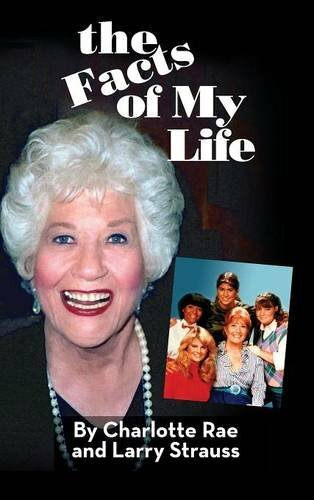
In 2015, Rae wrote her memoirs with her son Larry. At many of her book signings, adults came to purchase the book and told her over and over that they had been latch-key kids and saw Edna as a second mother to them. A description from Amazon sums up the book: “Charlotte Rae’s career spans more than seventy years, from the golden age of television to Shakespeare in the Park, the New York Cabaret scene of the late 1940s and 50s to her hit series, The Facts of Life and well beyond. Off stage and screen, Charlotte’s life has been one of joy and challenge, raising an autistic son, coming to terms with alcoholism, the heartache of a broken marriage, the revelation of a gay husband and the sudden challenge of facing middle-age with financial and emotional uncertainties–a crisis she ultimately turned into the determination that brought her stardom. The Facts of My Life is the first opportunity for Charlotte’s fans to explore the fascinating story of her extraordinary life: poignant and hilarious, a story of courage and triumph, one that speaks for a generation of women breaking barriers, taking on challenges, overcoming personal tragedy, and paving the way for others.”
Rae suffered from several health issues. In the early seventies, she joined Alcoholics Anonymous which was a critical part of the rest of her life. In 1982, she had a pacemaker implanted. It worked well for thirty years, but then stopped, requiring surgery for another smaller device. She also had open heart surgery to replace her mitral valve. Pancreatic cancer ran in her family, so she was screened often and when she was diagnosed with cancer, it was early so she had six months of chemotherapy and was then declared cancer free. In 2017, she was diagnosed with bone cancer. She died at her home in 2018. Todd Bridges from Diff’rent Strokes, tweeted, “You were loved by everyone on our show.”
Photo: doyouremember.com
Charlotte said she never minded fans coming up to her because she realized that in being a television actor you were in people’s homes. “It was an intimate relationship.”
She said she wanted to be remembered as someone who took people out of themselves into a different world and allowed them to laugh or cry, and that would make her happy because we need as many laughs as we can get.
Thank you, Charlotte for making us cry a little and laugh a lot.
Car 54, Where Are You? aired on NBC beginning September of 1961. I was surprised to learn that there are only 60 episodes in this series. The show revolves around officers Gunther Toody, Badge 1432 (Joe E. Ross) and Francis Muldoon, Badge 723 (Fred Gwynne). Their patrol car is Car 54, and they are with the 53rd precinct in New York. Toody and Muldoon are complete opposites which is why they get along so well. Toody is short, extremely talkative and not overly bright. He’s married to Lucille (Beatrice Pons), a bit of a loud, overbearing woman. Muldoon is tall, quiet and very smart. He’s a bachelor who lives with his mother (Ruth Masters) and two younger sisters.
Photo: imdb.com
Rounding out the large cast are officers Dave Anderson (Nipsey Russell), Omar Anderson (Ossie Davis), Kissel (Bruce Kirby), Nelson (Jim Gormley), Nicholson (Hank Garrett, O’Hara (Albert Henderson), Schnauser (Al Lewis), Steinmetz (Joe Warren), and Wallace (Frederick O’Neal), as well as Captain Block (Paul Reed), Sergeant Abrams ( Nathaniel Frey), Sylvia Schnauser (Charlotte Rae), and Claire Block (Patricia Bright).
A young Nipsey Russell Photo: yahoo.com
Nat Hiken (the creative force behind The Phil Silvers Show) created the series. He wrote many of the scripts and also directed several episodes, one of which he won an Emmy for. The show was nominated for three other Emmys. It was up for Outstanding Program Achievement in the Field of Humor in 1961 which went to The Bob Newhart Show (not that Bob Newhart show, this was a variety show hosted by Newhart) and for Outstanding Writing Achievement in Comedy in both 1961 and 1962 but got beat out both years by Carl Reiner for The Dick Van Dyke Show.
As recounted in Martin Grams, Jr.’s book Car 54, Where Are You?, after visiting a New York police precinct house and noticing what a communal feel it had, unlike any of the depictions of police on television, Hiken came up with the idea for a police-themed situation comedy. He continued to do research by spending weeks in a precinct squad room during late 1960, getting a feel for how the officers talked and interacted amongst each other, members of the community, and even repeat offenders, who were often treated more like family than threats. Hiken enlisted the support of Eupolis Productions and then pitched the idea to Proctor & Gamble, who agreed to finance a pilot.
Fred Gwynne and Al Lewis were coworkers before they were relatives Photo: shoutfactorytv.com
According to Kliph Nesteroff in the definitive account of Joe E. Ross’ tawdry life off-screen, “King of Slobs: The Life of Joe E. Ross,” Hiken originally wanted to cast Jack Weston in the role of Gunther Toody (televisionheaven.co.uk says it was Jack Warden) and Mickey Shaughnessy as Francis Muldoon, but contract negotiations broke down with both, so he turned to Ross and Fred Gwynne as suitable replacements, though in Ross’ case he later regretted it.
John Strauss who had collaborated with Hiken on the theme song for The Phil Silvers Show, teamed up with Hiken once again for this theme. Strauss was married to Charlotte Rae, who appeared on the show. Strass was the composer, and Hiken wrote the lyrics. The familiar theme song is:
There’s a hold-up in the Bronx,
Brooklyn’s broken out in fights;
There’s a traffic jam in Harlem
That’s backed up to Jackson Heights.
There’s a scout troop short a child,
Khrushchev’s due at Idlewild,
Car 54, where are you?
The show was originally titled “The Snow Whites.” (Maybe because the sponsor made Chlorox bleach.) The show was given a great time slot on Sunday nights between Walt Disney’s Wonderful World of Color and Bonanza. The producers thought the working title would confuse viewers since the show followed Disney. Since the theme song was already written, the last line of the song became the show’s title.
Critics were split on the show. While many people praised the series, some reviewers considered it disrespectful. The Chicago Sun Times deemed it “a preposterous (and sometimes cruel) depiction of the policeman.” The Dallas Times Herald stated, “The humor might be there, all right, but not much of it was showing.” The Alabama Journal complained, “It is insulting to the law enforcement and to the general public.” However, many policemen liked the show and found it funny.
The show was filmed at Biograph Studios in the Bronx and on location. The cars were painted bright red and white which photographed perfectly. There is some controversy about the patrol cars. Some articles listed them as Savoys, some as Dodges. According to Martin Grams’ blog from May 4, 2012, “On June 29, 1961, Arthur Hershkowitz signed the contract and during the first week of July, the following four automobiles were delivered to Eupolis Productions”: two 1961 Plymouth Belvederes, one Dodge Dart, and one Plymouth, all four-door sedans. Grams said “the cars were returned to the dealership and when the show was renewed for season two, the following cars were delivered”: two 1962 Plymouth Belvederes, three 1962 Plymouth Furys, one 1962 Dart 330, and a 1962 Chrysler New Yorker. One article I read said that the large circular object on the dashboard between the officers was an auxiliary fan used before air conditioning was available.
Despite the success of Car 54, which placed 20th in the ratings for 1961-62, Hiken soon began to feel overwhelmed with his responsibilities. Apparently, NBC wanted part ownership in the show in exchange for renewing it for season three, and Hiken would not agree to the deal. The show’s sponsor Proctor and Gamble tried to talk CBS into taking the show over, but there was no room on their schedule. Hiken was a bit burnt out with writing, directing, and overseeing the show and was exasperated with Ross who caused a lot of issues not remembering his lines, so Hiken ended the show and never worked on another series again.
Considering the short time that the show was on the air, there was a full slate of guest stars including Carl Ballantine, Tom Bosley, Wally Cox, Hugh Downs, Margaret Hamilton, Katherine Helmond, Hal Linden, Mitch Miller, Charles Nelson Reilly, Sugar Ray Robinson and Jean Stapleton.
The episodes are well written and similar to other sitcoms at the time.
Photo: shoutfactory.com
In one, Toody is feeling henpecked by Lucille, but musters the courage to become king of his castle after seeing a stirring performance of Shakespeare’s “The Taming of the Shrew.”
In another, Muldoon shares a childhood experience when the kids at school called him “Horse Face.” Toody, trying to console him, says “Don’t worry Francis, kids just repeat what other people say” and later added “After all, Francis, everybody liked Black Beauty.”
One script has Toody working an undercover detail in Brooklyn with a female cop posing as his wife and a small boy as his child. When his wife’s sister spots him, the rumors begin.
Even though there were only 60 episodes, the show went into syndication in 1964. It was one of the staples on Nick at Nite in the 1980s, aired on Comedy Central in the 1990s, and a few years ago it could be seen on both MeTV and Decades. The show came out on DVD in 2011 and 2012.
Like any show that was even somewhat successful, the show had a film made based on the series in 1994. The big screen version starred John C. McGinley as Muldoon, David Johansen as Toody, Rosie O’Donnell as Toody’s wife Lucille and Fran Drescher as Velma Velor. Not surprisingly, it was a dud. One reviewer said it “was one of the worst movies to ever come out of Hollywood.”
One fun fact I learned doing research for this blog was that this show was William Faulkner’s favorite tv show. He hated television but visited a friend’s house weekly to watch the show.
Photo: amazon.com
This show debuted during the decade when merchandising was a big part of every show. There were at least six comic books based on the show. There was a board game, puppets of Toody and Muldoon, and a car model.
The show was funny in its prime, but I’m not sure it holds up as well today as other shows from the sixties. However, two seasons of DVDs is not a large investment, so check out an episode on youtube and see what you think.


























 thewritelife61