Stagecoach West: Experiencing Life in Outpost

As we celebrate westerns this month in our blog series “Go West Young Man,” we are tuning in to Stagecoach West which traveled across the air waves from 1960-1961. The show debuted in October of 1960 with the final episode airing in June of 1961. For the summer, reruns of the show continued. The thirty-eight episodes were on Tuesday nights.

📷wikipedia.com

The show features two Civil War veterans, Luke Perry (Wayne Rogers) and Simon Kane (Robert Bray), who own a stagecoach line and share driving duties in the Wyoming territory. It was fun to see a young Rogers decades before he showed up in Korea bantering with Alan Alda. During their trips they run into murders, robberies, range wars, renegade soldiers, and passengers who have their own drama. Simon’s son Davey (Richard Eyer) often travels with the men.

They are based in Outpost, a small frontier town. We get to know several townspeople including Dan Murchison (John Litel) who runs the general store and bank; Zeke Bonner (James Burke) who rents rooms at The Halfway House; Hugh Strickland (Robert J. Stevenson), the Marshal in Timberline; and Doc Apperson (played by J. Pat O’Malley and Sydney Smith).

📷rottentomatoes.com

Vincent M. Fennelly was the producer and there were several directors, with Thomas Carr taking the helm most often. There was also a long list of writers, but D.D. Beauchamp and Mary Beauchamp penned many of the scripts. From what I could learn about the Beauchamps, they didn’t work together but wrote their own episodes. Mary was known for her work on Bat Masterson and Tales of West Fargo in addition to this show. D.D. (Daniel Deronda) is best remembered as a writer for Daniel Boone. His third wife was Mary Mitchell, so I am guessing that Mary Mitchell and Mary Beauchamp are the same person. Sounds like she and her husband were cremated, so there is no findagrave site for her.

The theme song was composed by Skip Martin and Terry Gilkyson. This was the only time I could find where this duo worked together. They had very different careers. Gilkyson was part of The Weavers and The Easy Riders. In 1960 he went to work for Walt Disney and was nominated for an Oscar for “The Bare Necessities” in Jungle Book. Martin worked with jazz and swing bands in the 1930s and 40s including Count Basie and Glenn Miller. With Les Brown, he was given credit for writing “I’ve Got My Love to Keep Me Warm.” In the 1950s he moved to Hollywood where he worked on Singin’ in the Rain and A Star is Born.

📷westernserieswiki.com

Richard Eyer in an interview said the show “kept me busy and was usually fun. It was a very positive experience. When they hired me, it was sort of a transitional point . . when we did the pilot I was 13 and quite young . . . we started production eight months [later] . . . I was into puberty and adolescence.”

Tuesday nights’ competition in 1960 was Thriller on NBC and The Tom Ewell Show and The Red Skelton Show on CBS. Thriller was an interesting show hosted by Boris Karloff. It began as an anthology focusing on crime but later transitioned to gothic horror stories. The Tom Ewell Show also began and ended in 1960. Ewell plays a real estate agent who lives with a lot of women, namely his wife, daughters, and mother-in-law. ABC aired The Rifleman and The Legend of Wyatt Earp before Stagecoach West.

The show never gained viewers, so it was cancelled in June. If you follow me, you know I don’t have the most positive feelings about Red Skelton and how he treated the people who worked for him, but it was a very popular show and some of the episodes were in color, so a lot of people were tuning into to watch him. I wonder if because two westerns were on earlier in the evening, people were ready to watch another genre. In addition to this night of programming, there were another 15 westerns on during the evenings on the other days of the week. The other factor that comes into play is that both The Rifleman and The Many Loves of Dobie Gillis on CBS were in the top thirty. I wonder how many viewers watched The Rifleman on ABC and then switched networks to Dobie Gillis on NBC and then never returned to ABC for the rest of the evening.

It would be a fun and easy binge watch if you want to tune in even to see the guest stars and learn some of the issues that were dealt with during this era of travel.

The Phil Silvers Show: You May Never Get Rich, but You’ll Receive a Wealth of Humor

This month, we begin a new series, “We Salute You” and we will look at shows about the military. Our first series is The Phil Silvers Show a/k/a You’ll Never Get Rich.

Photo: nostalgiacentral.com

The sitcom debuted on CBS in 1955. The pilot was never aired, but the show was part of the television schedule until 1959, producing 143 episodes.

Nat Hiken created the series which ended up being nominated for Best Comedy Series every year it was on and winning that category in 1956, 1957, and 1958. In addition, Silvers won an Emmy for his performance, and Hiken won an Emmy for Best Director.

Photo: findagrave.com
Nat Hiken in the bowtie with Phil Silvers

In 1955, television was transitioning from New York to California. However, Hiken insisted on filming the series in New York. The earlier seasons were filmed at Dumont and later seasons moved to CBS studios in Chelsea, Manhattan.

The show was filmed like a play in front of a live audience. The cast members had to memorize the entire script. When Mike Todd guest starred in season two, he insisted that the show be filmed more like a movie. Takes were filmed out of sequence and multiple takes were allowed because there was no audience. The crew realized that this process was faster, cheaper, and easier for the actors, so the change was put in place permanently. The show was screened for the military though, and servicemen made responses that were used to make the show more realistic.

Photo: thetimes.com

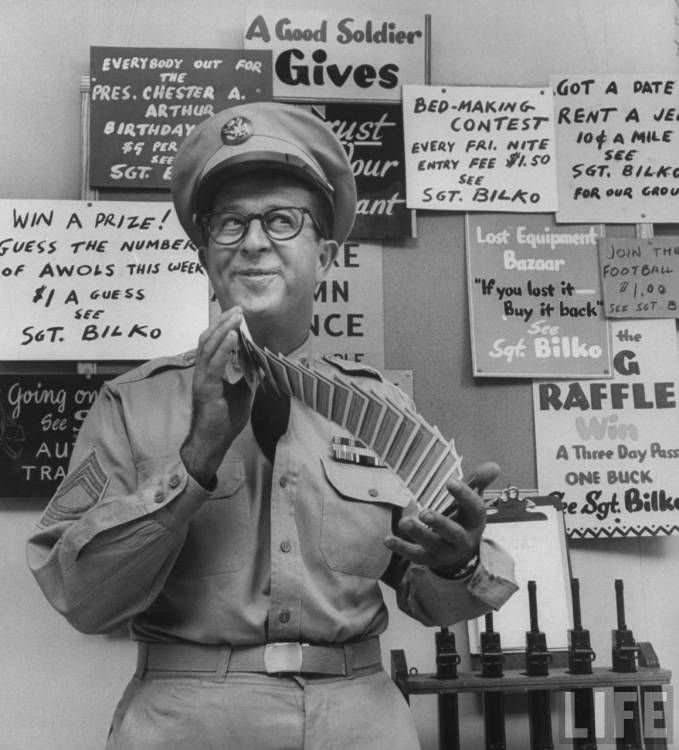
Sergeant Ernie Bilko (Phil Silvers) is a con man. He runs a motor pool at a small US Army Camp, Fort Baxter in Roseville, Kansas. Colonel Hall (Paul Ford), who doesn’t trust Bilko, tries to stay on top of his schemes. Bilko tries to make money any way he can and is not above using the landing craft for midnight cruises, “borrowing” tanks, setting up poker games, and conniving with a local service station for spare parts for Jeep tires for his get-rich quick scams. Bilko has pulled the wool over Col Hall’s wife’s (Hope Sansberry) eyes and flatters her every chance he gets. Silvers said Bilko was so successful because “inside everyone is a con man wiggling to sneak out.”

Photo: pinterest.com

Although his men knew he could not be truly trusted, they were usually loyal to him and while he occasionally used them in a scheme, he typically made sure they were taken care of. Some of the situations Bilko found himself in included starting a mink farm, entering his platoon in a singing contest, investing in an ailing race horse, stealing a French chef’s family recipe, buying swampland, thinking there was uranium beneath Hall’s living room, and getting a hot racing tip but not being able to get his bet in on time.

For the fourth season, the camp moved from Kansas to Camp Fremont in California. The move was explained that Bilko orchestrated the new location because he learned there was a gold deposit near the abandoned army post. The primary reason for the geographical change was so stars could guest on the show because the camp was now said to be close to Hollywood. Some of these celebrities included Dean Martin, Mickey Rooney, Bing Crosby, Dorothy McGuire, and Lucille Ball.

Photo: DVDtalk.com
Bing Crosby visits the base

In addition to the stars who were said to come from Hollywood, guest stars on the show included Charlotte Rae, Fred Gwynne, Dick Van Dyke, Paul Lynde, Tom Poston, Dina Merrill, Alan Alda, Bea Arthur, and Tina Louise.

Photo: tvtropes.com

I was surprised by the large cast that was featured on this show as opposed to Gomer Pyle, Hogan’s Heroes, or McHale’s Navy. Bilko’s comrades were Corporal Barbella (Harvey Lembeck) and Corporal Henshaw (Allan Melvin).

Photo: brittanica.com
Bilko with Barbella and Henshaw

The rest of the men included Corporal Sam Fender (Herbie Faye), Sergeant Grover (Jimmy Little), Privates Doberman (Maurice Gosfield), Zimmerman (Mickey Freeman), Kadowski (Karl Lukas), Gomez (Bernard Fein), Paparelli (Billy Sands), Mullen (Jack Healy), Fleischman (Maurice Brenner), Sugarman (Terry Carter) and Dillingham (Walter Cartier), as well as quartermaster Sergeant Pendelton (Ned Glass). Bilko even had a romantic interest in Sergeant Joan Hogan (Elisabeth Fraser).

Photo: losangelestimes.com

Because the series had so many secondary cast members, it became too expensive to maintain, and that was the primary reason it was canceled. I was surprised it did not affect the ratings because there were a lot of cast members to follow from week to week.

The show started out on Tuesday nights the first season. Its competition was The Legend of Wyatt Earp and Milton Berle.  The ratings at first were not good and Camel Cigarettes, the sponsor, considering withdrawing. The network moved the show so it didn’t need to compete with Berle’s second-half hour. The ratings skyrocketed. The second and third seasons, it continued on Tuesday nights but was up against Cheyenne both years and against The Big Surprise on the second season and The Eddie Fisher Show the third season. The Phil Silvers Show continued to be in the top 30 for season two but fell below those rankings in season three. Season four found the show on Friday nights up against Man with a Camera and M Squad.  I would have thought that season might have the weakest competition but the show never recovered its higher ratings. However, Friday nights many people were out, not home watching television.

Another downfall with such a large cast is the personality conflicts that might occur. Apparently, Phil Silvers did not get along with Maurice Gosfield. Gosfield had trouble remembering his lines which frustrated the other actors; however, he got the most fan mail which Silvers resented. In his memoir, Silvers discussed this issue and wrote that Gosfield “thought of himself as Cary Grant playing a short, plump man.”

Photo: pinterest.com
Gosfield as Doberman

Phil Silvers would play the same type of con man on many sitcoms later including The Beverly Hillbillies, Gilligan’s Island, The Lucy Show, and the movie It’s a Mad, Mad, Mad, Mad World.

Photo: pinterest.com

After its cancellation, CBS sold the show to NBC which was a great move on NBC’s part. The network made a ton of money on the show’s syndication because reruns were run for decades.

Photo: ebay.com

DC Comics published comic books based on the show as well. From 1957-1960 there were 16 issues of a Sergeant Bilko comic book and 11 issues of a Private Doberman comic book.

Photo: ebay.com

In 2009, the US Postal Service issued a set of stamps honoring early television programs. This show was commemorated with an image of Sergeant Bilko.

I remember the show being on the air a lot while I was growing up, but I rarely see it now. I am going to rely on a fellow blogger to sum up the show. In a recent blog on neatorama.com from February 14, 2019, the show was described as follows:

It is my opinion that THE PHIL SILVERS SHOW (aka YOU’LL NEVER GET RICH) remains the single most underrated sitcom in television history and that Phil Silvers remains the most underrated comedian in that medium. This is really saying something because the series has indeed received great acclaim over the years. Even so, Silvers is just not given his proper due for creating the Bilko character. But it is Phil Silvers, his facial expressions, his bugle-call barking of orders, his complete manipulation of everyone on the base, and his wild schemes to make money that never seem to get old no matter how much you watch the episodes on video. The show is a great testament to the talents of Phil Silvers. With its complex plotlines and quickfire dialogue it’s still a treat to watch Silvers’s monumental character. The most oft-said line in the series must be “but, Sarge! as Bilko launches into another diabolical and, ultimately, flawed scheme to make money and dodge work.”

Photo: philsilversshow.com

Bilko isn’t a bad guy; he’s just not trustworthy. As he himself likes to say, “All I ever wanted was an honest week’s pay for an honest day’s work.” Maybe in this politically correct world we live in, making fun of the military is a taboo. It’s too bad because all the critics loved this show. If you want to check it out for yourself, the series is on DVD, so it is available for a week-end of binge watching; you can purchase individual seasons or the complete series.