At The Summit of Coolness: The Rat Pack on Television

Photo: mentalfloss.com

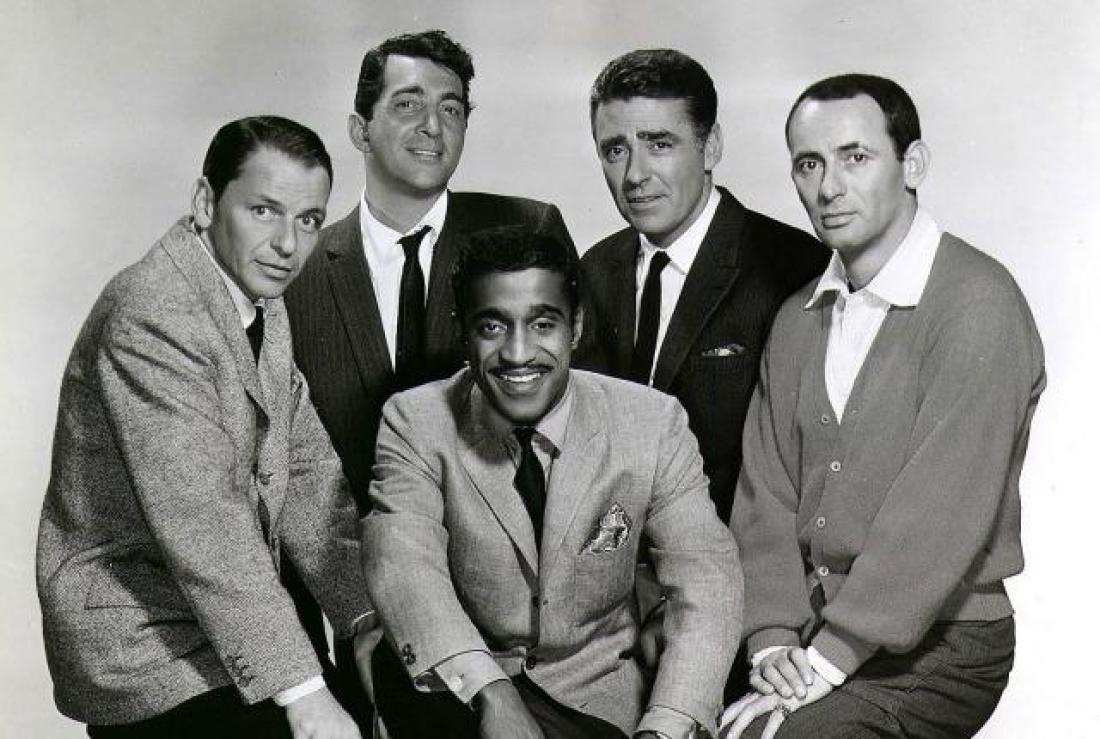
For some reason, the group including Frank Sinatra, Dean Martin, Joey Bishop, Peter Lawford, and Sammy Davis Jr. have been referred to the Rat Pack since the 1960s. The original rat pack was coined by Lauren Bacall about a group who gathered at her home whom she referred to as a pack of rats. The group we know as the Rat Pack preferred to call themselves the Clan or the Summit. Whatever they chose to call themselves, they had a hip, cool aura.

When one of the members of the group was scheduled to perform at Las Vegas, another one or two of the Clan would often show up as well. Because concert goers knew this, their shows tended to sell out. The Sands marquee promoted the possibility during one of Dean Martin’s shows when they put up “DEAN MARTIN – MAYBE FRANK – MAYBE SAMMY.”

I thought it would be fun to look at the Rat Pack on television and see how much influence this group had. Let’s start with Old Blue Eyes.

FRANK SINATRA

Frank began his film career in the 1940s. In 1953 he had one of his most famous roles in From Here to Eternity. I was surprised to learn that he began appearing on television in the mid-1950s as well. He showed up in The Colgate Comedy Hour in 1954, The Producer’s Showcase in 1955, and The Thin Man in 1958.

In the 1970s we find Frank showing up on Laugh-In for several appearances.

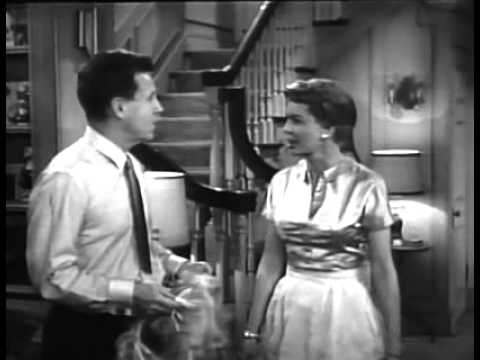
He also sang a few lullabies on Make Room for Granddaddy, Danny Thomas’ revival of his hit show Make Room for Daddy from the 1950s. I was amazed at the talent of actors who guest starred on the reboot considering the short time it was on the air, but that is a topic for a future blog. On this episode, he bumps into Danny. His wife Kathy is not happy Danny is bringing home a guest for dinner on “hamburger night” but then she learns it’s Frank. He sings “All the Way” and “Baa Baa Black Sheep” for Danny’s grandson, Michael.

Photo: imdb.com

Jumping ahead a decade, we find Frank’s last two television roles, one as himself and one as a New York cop.

Frank had met Tom Selleck in Hawaii on one of his trips. In 1987 Frank appeared as Michael Doheny, a retired police sergeant on Selleck’s show, Magnum PI. Frank and his entourage traveled to Hawaii (although he worked for scale) and took over a floor at The Colony Surf in Diamond Head. In this episode he returns to help find the men who kidnapped his granddaughter. There were plans for Sinatra to return in season eight as well but Selleck cut back on the number of episodes he was filming, and the show was never written.

Photo: kiwireport.com

In 1989 Sinatra showed up on Who’s the Boss as himself. Angela is invited to an exclusive party, but she gets waylaid by a work issue. Mona and Tony decide to take the tickets, but they can’t get in when they get there and then Angela shows up, which results in all three of them being thrown out of the gala. As Frank is showing up to sing, Tony gets to meet him and tell him he is his idol.

DEAN MARTIN

Not surprisingly Dean’s first appearance on television was on Make Room for Daddy in 1958. He portrayed himself. Danny calls on Dean to help him out with his daughter Terry who has been not very nice to a boy at school who likes her. Danny learns she is ignoring the boy because she has a crush on Dean. The plan works, and she and Donald get together.

Photo: youtube.com

During the same year, Dean shows up on The Phil Silvers Show. Bilko (Silvers) is sent to Yucca Flats to work on a nuclear test program. Ritzik is amazed by one of the scientist’s machines. They skip the base and head for Las Vegas, so Rupert can demonstrate his gambling skills. Dean Martin is an unnamed gambler they run into.

In 1964 Martin got on the western bandwagon, appearing in Rawhide. Martin is stalking Hispanic cattlemen. His wife wants him to drop the assignment and retire to her family’s plantation with her, but he refuses, and she seeks help from Gil Favor, the boss of a never-ending cattle drive.

We see Martin pop up on a Bob Hope special in 1968 and a Red Skelton show in 1970.
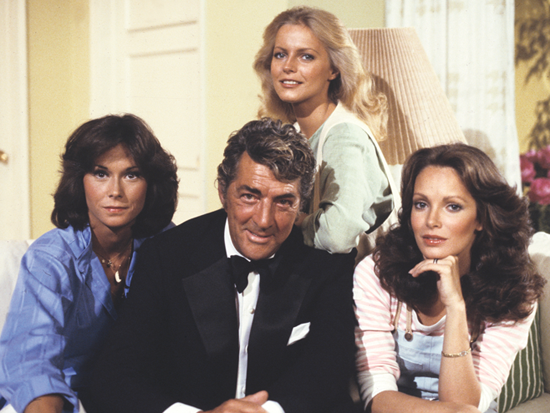
Photo: vegasmagazine.com

In 1978 Martin made an appearance on a show that surprised me: Charlie’s Angels. Martin plays the owner of the Tropicana Casino who hires the Angels to investigate several suspicious deaths that he thinks are part of a plot to make him think he’s going crazy. This was a two-part season opener and instead of singing, Martin got to display his magic skills. Naturally, he becomes romantically involved with one of the Angels, Sabrina played by Kate Jackson.

Fittingly, Dean’s last appearance was in the show Vega$ in 1979 as himself.

JOEY BISHOP

Bishop’s first role was not much of a stretch. He played a comedian on Richard Diamond in 1959. Bishop’s plays Joey Kirk and hires Diamond to determine who is following him and why, leading to a complicated murder plot.

He appeared in the DuPont Show of the Month in 1960 and The Dick Powell Theater in 1963.

Like most of the Rat Pack, Bishop made an appearance on Make Room for Daddy in 1961. As Joey Mason, he helps out Danny. Danny has flown from the east coast to the west coast and took two sleeping pills. However, there are four conventions in town and his assistant forgot to make him a reservation.

In 1965 he is Fred Jackson on an episode of Valentine’s Day starring Tony Franciosa and Jack Soo about a young eligible bachelor who lives with his valet, a poker-playing con artist who saved his life while they were in the Army.

Photo: tvtropes.com

From 1961-1965, Joey stars in The Joey Bishop Show as Joey Barnes. Barnes is the host of a talk show. He has to deal with his personal and professional life as a celebrity. A lot of guest stars show up playing themselves as guests on his show or friends of his. The show produced 125 episodes. I have recently been watching it on Antenna TV where it now is shown every morning.

In 1967, Joey had a cameo on Get Smart. Max and 99 are sent on an assignment to rescue Don Carlos, the dictator of San Saludos. A general has imprisoned him and wants to marry his daughter. Max and 99 try to disguise themselves as flamenco dancers. When they are also thrown in jail, a guard, played by Bishop, attempts to bribe the firing squad.

In the 1970s we find Joey on Chico and the Man in 1976. He plays an inept burglar and when Ed doesn’t press charges, every lowlife crook appears at the business.

In 1981 Bishop appears as Dr. Burton on Trapper John MD.

Photo: basementrejects.com

In 1985 Bishop again takes on the role of a comedian on Hardcastle and McCormick. That same year he also played another comedian on Murder She Wrote.

PETER LAWFORD

Drama shows were very popular in the early days of television. Lawford appeared in quite a few of these shows from 1953-1965.

Photo: en.wikipedia.org

In 1954 he took on the role of Bill Hastings on Dear Phoebe. The show was on the air for two years, resulting in 32 episodes. Hastings works for a daily newspaper in a large city. He becomes the author of a lonely hearts column and advises his readers as “Phoebe” while trying to deal with his own issues in his personal life.

Photo: sitcomsonline.com

From 1957-1959, he was Nick Charles on the television version of The Thin Man. The show was very popular with 723 episodes filmed. Similar to the films, Nick marries Nora and lives in a luxurious Park Avenue apartment in New York. He was previously a private detective and many of his underworld friends get him involved in mysteries he has to solve.

Lawford appeared as himself on an episode of Jack Benny’s show in 1961.

He also played himself on The Patty Duke Show in 1965. Patty is selected to find a star to perform at the high school prom. Sammy Davis Jr. also guest stars on the episode.

Photo: imdb.com

Apparently, Sammy and Peter enjoyed working together because they guest starred on an episode of The Wild Wild West in 1966. Lawford is a wealthy ranch owner and Davis is a hired hand Jeremiah.

While Bishop showed up on Get Smart, Lawford chose the more realistic I Spy in 1967.

Like Sinatra, he also appeared on Laugh-In but must have enjoyed it more because he was on ten different episodes.

During the 1970s, Lawford shows up on a variety of television show genres. He would be on the western The Virginian in 1971, Born Free about Elsa the lion in 1974, The Love Boat and Fantasy Island, the bizarre comedy High Cliffe Manor, the crime drama Hawaii Five-0, the dramady Supertrain, and The Jeffersons.
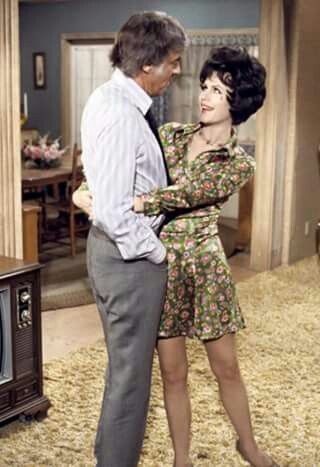
Photo: pinterest.com

In addition, he was featured on Bewitched in 1972. Lawford played Harrison Woolcott, a client of Darrin and Larry’s. Sam’s cousin Serena decides she wants to date him and try the mortal life for a while.

Photo: pinterest.com

He made several appearances during seasons four and five of The Doris Day Show. As Dr. Peter Lawrence, he begins a romance with Doris in 1972-1973.

SAMMY DAVIS JR

Sammy probably appeared in the most television shows. Like Peter, he began in drama shows and guest starred in several episodes of General Electric Theater.

He then appeared in The Lawman in 1961, Frontier Circus, Cain’s Hundred, 77 Sunset Strip, The Rifleman, and Hennessey in 1962.

In 1963 he was on Ben Casey.

Like the other Rat Pack actors, he was on Make Room for Daddy in 1963 and the revival Make Room for Granddaddy in 1970.

As mentioned before, he guest starred in The Patty Duke Show in 1965 and The Wild Wild West in 1966, both with Peter Lawford.
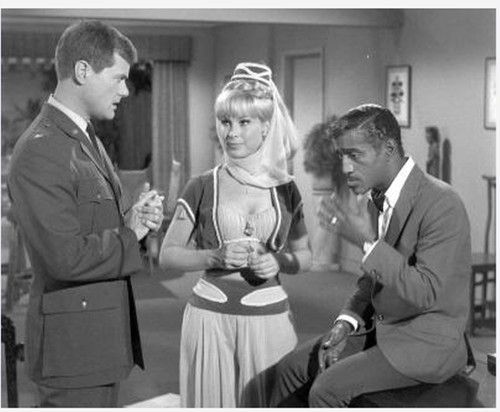
Photo: pinterest.com

In 1967, he showed up on I Dream of Jeannie as himself. Tony tries to get Sammy Davis Jr to sing for General Peterson’s party. When he is already booked, Jeannie tries to help by duplicating himself, so he can be in two places at one time.

Davis also took a role in The Beverly Hillbillies in 1969.

Photo: tvinsider.com

The same year he took on his first of three roles on Mod Squad. His first role was a black priest who becomes the target of a bad guy after the church suspends him. The hood is afraid he will reveal his confession now that he no longer is part of the church. The next episode he appeared on was in the role of Billy Lee Watson, a recovered drug addict. He runs a half-say house and is accused of rape of a man’s daughter who he has been trying to help. Her father accused Billy of the rape and after investigating, it turned out Billy was her actual father.  The last episode of Mod Squad he appeared on in 1970 had Davis portraying Willie Rush and actor and friend of Linc’s. He says someone is trying to kill him.

Photo: tumblr.com

The 1970s continued to be a productive time for Davis on television. He would go on to appear in The Name of the Game in 1970, The Courtship of Eddie’s Father in 1972, nine episodes of Laugh-In, and like his friend Dean Martin, an episode of Charlie’s Angels in 1977. He plays himself on Charlie’s Angels. When he hosts a charity event that includes a celebrity look alike contest, an attempt is made to kidnap him. The Angels take on the job of his bodyguards and Bosley becomes his chauffeur.

The 1980s were also busy times for him. He appeared as himself on several Norman Lear shows including Archie Bunker’s Place and The Jeffersons. He also could be seen on Fantasy Island, Pryor’s Place, Gimme a Break, The Cosby Show and Hunter in the 1980s.
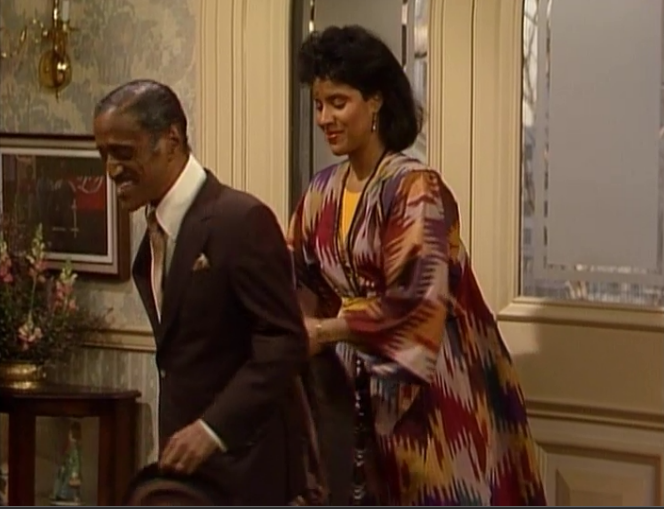
Photo: atlantablackstar.com

One thing that surprised me was his roles on One Life to Live and General Hospital. I have seen a few stars like Carol Burnett who chose to appear on a soap opera. Davis had a recurring role on General Hospital; he didn’t seem to me to be the type of actor who would be interested in a soap opera, but he did receive an Emmy nomination for his role on General Hospital. Sammy was also nominated for an Emmy for his work on The Cosby Show.

While Joey Bishop hosted some of the Emmy Award shows, I did not find any nominations for the other members of the Rat Pack.
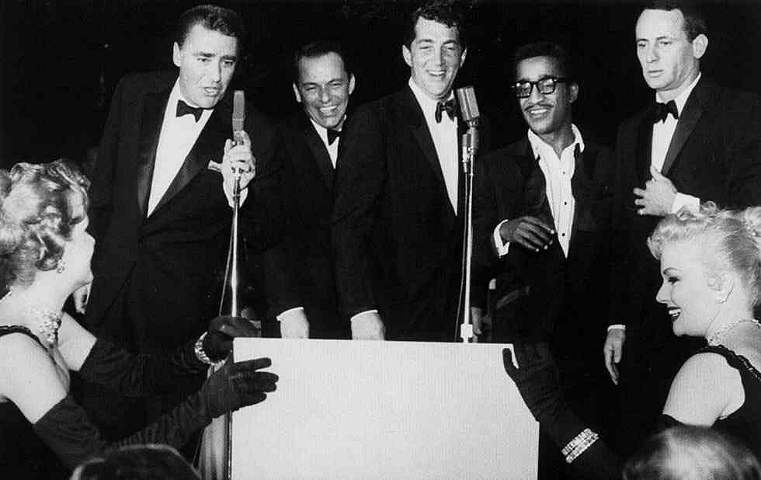
Photo: peoplequiz.com

Overall, I was surprised how extensive the television careers were for the Summit members. I think of them more in their performing or movie careers and did not expect them to see that they guest starred in so many shows and starred in some of their own television series. Check out some of these shows or make a batch of popcorn and watch the ensemble in the original Ocean’s Eleven.
The Skipper and His Little Buddy: Alan Hale Jr. and Bob Denver

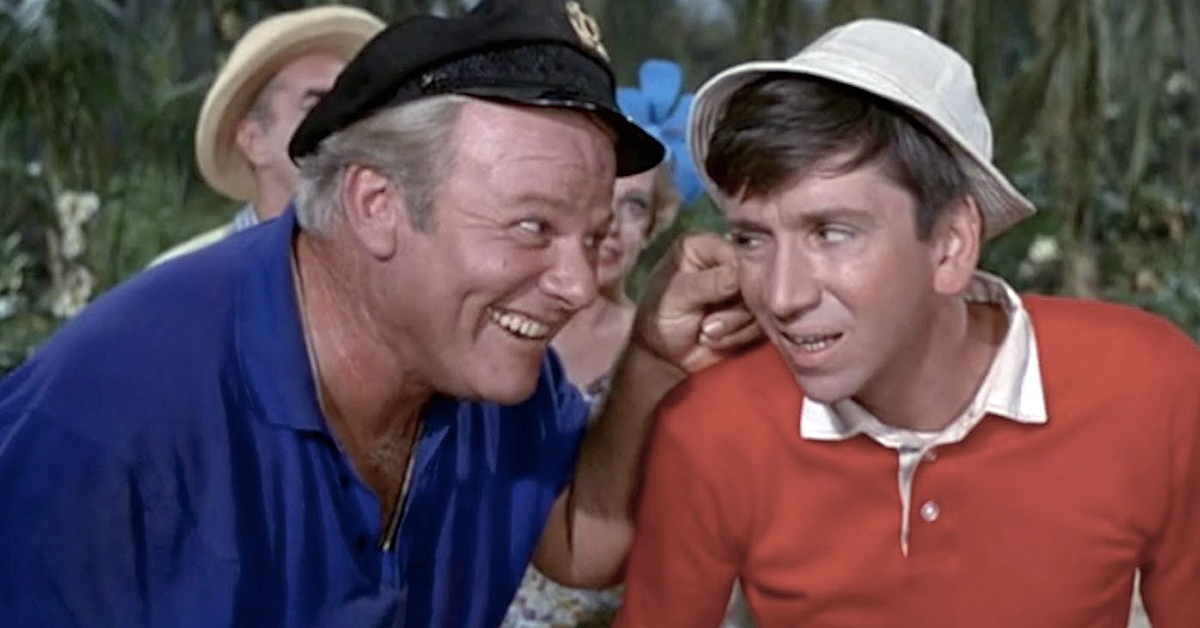
We continue our month-long exploration of the actors who appeared on Gilligan’s Island. Today we look at the two biggest stars: Alan Hale Jr. and Bob Denver.

Alan Hale Jr.

hale1

Alan Hale Jr. (Alan Hale Mackahan, Jr.) was born in 1921 in Los Angeles, California.  He looked exactly like his father, Alan Hale Sr. who was a well-known movie actor acting with legends like Douglas Fairbanks and Errol Flynn. His mother, Gretchen Hartman, was also a silent film star.

Hale’s first screen role was when he was 12 in Wild Boys of the Road.

hale3

He appeared in more movies and television series than any of the other Gilligan’s Island cast.  In all he would appear in 92 movies and 123 different tv shows.

In 1943 he married Bettina Reed Doerr. They would be married for twenty years and have four children. During World War II, Hale served in the US Coast Guard.

In the 1950s, he could be seen in many westerns as well as The Loretta Young Show and The Adventures of Ozzie and Harriet. He had regular roles on two sitcoms in that decade: Biff Baker USA and Casey Jones. Biff Baker is a businessman who becomes involved in espionage.  He and his wife travel around the world, working behind the scenes to solve problems. Although it was a serious show, there was some humor in the episodes also. As Casey Jones, Hale drove his train, The Cannonball Express, around the country.

hale4

The early 1960s was a prolific time for Alan Hale. The majority of his television credits came during this decade. You can see him in reruns of Jack Benny, The Lucy Show, Perry Mason, My Favorite Martian, and The Andy Griffith Show.

The year 1964 was a momentous one for Alan. He married Naomi and remained with her till his death. He also tackled the role he would become famous for.

hale5

Sherwood Schwartz said he was having trouble finding the right person to play Jonas Grumby. He auditioned a lot of people, including Carroll O’Connor. One night while having dinner at a local restaurant he saw Hale dressed in a Civil War costume and decided he might be the one. Although the Skipper often became frustrated with Gilligan, they had a father and son relationship. Hale and Denver managed to pull that off. They were close friends in their personal lives as well.

hale3

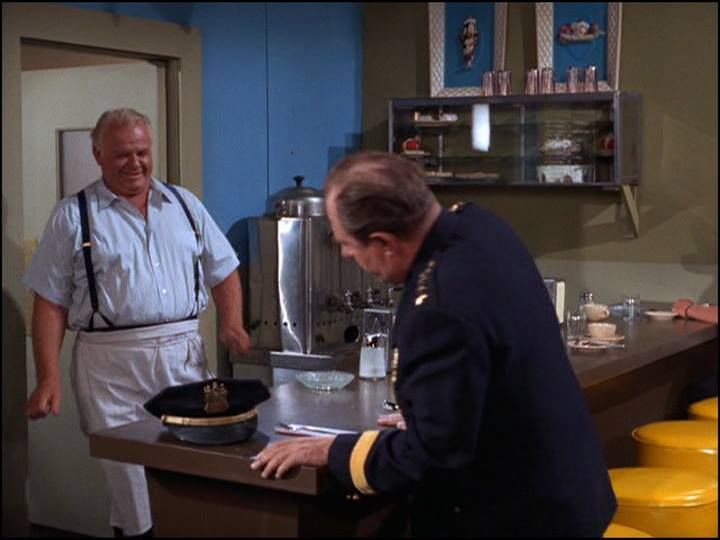
Unlike some of the cast who felt typecast after they left the show, Hale embraced the role he had played. He would later own and manage a popular restaurant in Los Angeles called “Alan Hale’s Lobster Barrel” and could be seen greeting guests as the Skipper. Both he and Jim Backus appeared on Bob Denver’s sitcom Good Guys in 1968.

hale4

After Gilligan, Hale’s career did not slow down. Until his death he would continue to appear in a variety of series including Batman, Green Acres, The Flying Nun, The Wild, Wild West, Here’s Lucy, Marcus Welby, The Doris Day Show, Gunsmoke, McMillan and Wife, Simon and Simon, Growing Pains, The Love Boat, and Magnum PI.

In addition to acting and his restaurant business, Alan enjoyed fishing, golfing, cooking, traveling, storytelling, spending time with his family, and philanthropy. In 1990, Hale died after suffering from thymus cancer at the young age of 68.

Alan Hale had a long and prosperous career.  From all accounts, he liked acting and enjoyed life. Perhaps we should leave the last word to his costars who knew him best.

hale2

Bob Denver said, “He was a big, lovable man who made everyone feel good. He had a great time with his life.”

Dawn Wells described him: “What a dear man . . . what a dear, dear man . . I never saw him disgruntled, having a temper tantrum or depressed. He was so jovial and so sweet and so strong. . . He was a nice man.”


Bob Denver

denver7

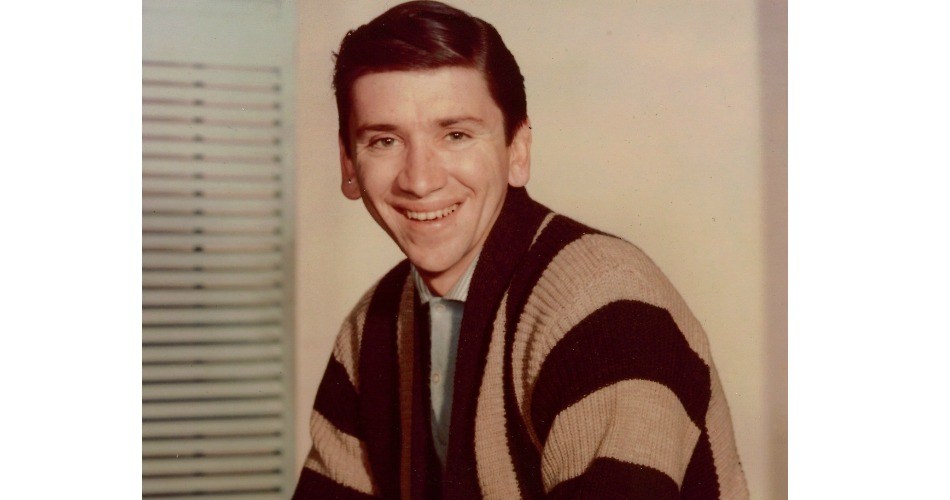
Bob Denver was born in New York in 1935. He went to college at Loyola University in Los Angeles, majoring in political science. He worked as a mailman and a teacher before deciding to go into acting full time.  His first appearance was on Silent Service in 1957.

While Alan Hale was in more shows and movies than any of the other crew members, Bob Denver was easily in the fewest.  While he appeared in seven movies, he was only in 21 television shows, and on six of them he had regular roles.

denver5

His sister suggested him for the part of Maynard G. Krebs on The Many Loves of Dobie Gillis. His role as Dobie Gillis’s best friend propelled him into stardom. Dobie Gillis was on the air for four years, producing 144 shows.

denver8

In the 1960s he would appear on Dr. Kildare, The Farmer’s Daughter, The Andy Griffith Show, Make Room for Daddy, and I Dream of Jeannie. In the mid-1960s, Bob was offered the role of Gilligan on a new show, Gilligan’s Island.  In 1966 he married Maggie Ryan. They would have two children during the six years before they divorced.

Schwartz wanted to cast Jerry Van Dyke in the role who turned it down to play Dave Crabtree in My Mother the Car. Denver was perfect in the role of the inept Gilligan who caused many mishaps on the island but was the center of affection of the rest of the castaways, especially the Skipper.

The same year Gilligan was cancelled, Denver remarried. Like many sitcoms, the relationship with Jean Webber lasted three years before the couple cancelled it.

denver2

Although Denver was given a lead role in three more sitcoms, most of his work after 1967 cashed in on his character of Gilligan. In 1968, he starred in Good Guys. He played the role of Rufus Butterworth who opens a diner with his best friend from childhood.  The show only lasted for 42 episodes. Like Gilligan’s Island, Sherwood Schwartz produced this show. In an interview in 1994 with Peter Anthony Holder on Montreal radio station CJAD 800 AM, Denver discussed Schwartz. “Oh yeah, sure. Sherwood, as a producer, he was one of the best writer producers. It’s amazing. That man was just amazing. We never knew there were any problems when we were shooting. He kept all the network craziness away from us. He was writing scripts literally four months in advance, so that special effects and props always got them in plenty of time. . . you just memorized your words and went down there and had a great time. It wasn’t until afterwards when I left that I realized that not everybody was in the same situation. So every time I had a chance to work with him I did.”

At this time, Bob was also involved with Broadway and dinner theater plays after 1970.

denver3

In 1972 Denver tried marriage a third time. He and Carole Abrahams made it three years and produced one child before divorcing. In 1973, he took the lead on Dusty’s Trail. As Dusty, he manages to get a wagon and stage separated from the rest of the wagon train heading west, and the lost group of travelers try to catch up with the rest of their party.  This one only lasted 26 shows.

In 1975, Denver appeared in his weirdest sitcom yet, Far Out Space Nuts. Lasting only 12 episodes, Denver played a maintenance man in a space company who is accidentally launched into space with a co-worker. Apparently, television producers decided Denver looked like someone who was always lost.

denver4

In 1979, Bob tried the marriage ride one more time. This time he would stay married to Dreama Perry until his death.  The couple would have a child, making a total of four children for him.

denver6

Like many of the other castaways, Denver published a book of memoirs.  It was called Gilligan, Maynard, & Me.

In 2005, Denver passed away from complications following throat cancer surgery, leaving Dawn Wells and Tina Louise as the only surviving actors from the show.

denver1

While Denver is obviously the most-recognized character from Gilligan’s Island, he also had the most difficult situation to work with in being typecast. He was never able to shake the traits that were part of Gilligan to explore other roles.  He mentioned he would have liked to be in Northern Exposure. I wonder if he would have been happier being a teacher or if he enjoyed his career.

hale7

Next week we will discover more about our last regular member of the show, Russell Johnson.

Love and the Funny Show

ABCFriday_1972

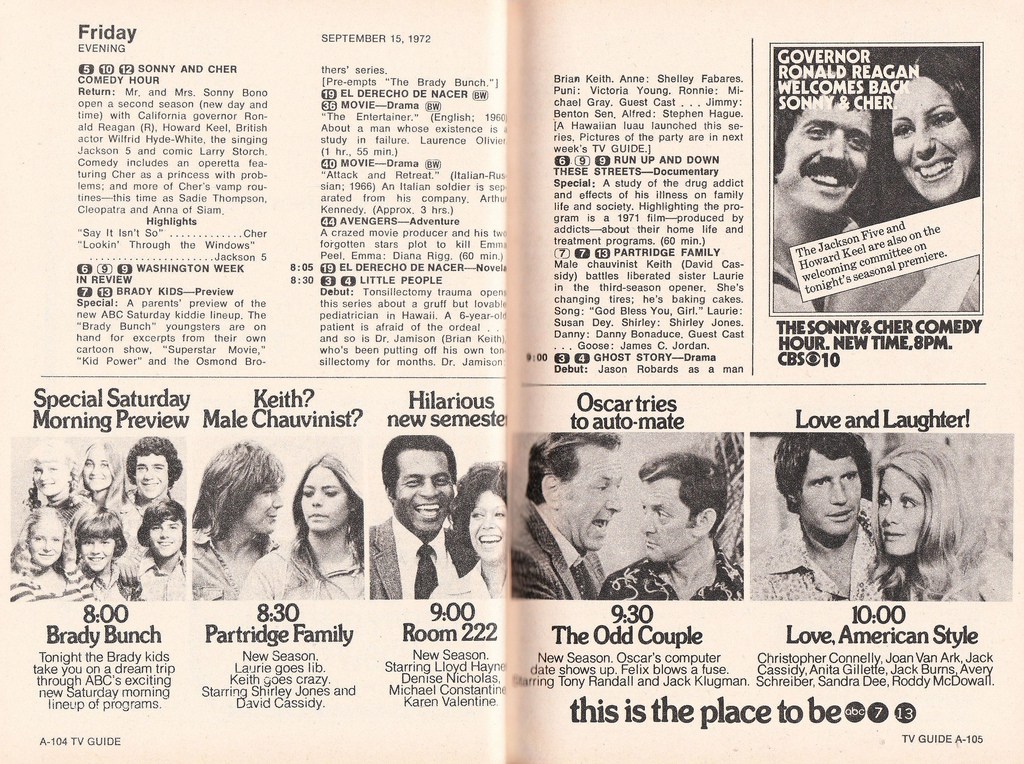
There was something magical about the Friday evening television schedule from 1971-1973.  Anyone who was born in the late 1950s or early 1960s can remember sitting down in front of the television at 7 pm (central time) for the Brady Bunch and staying put through The Partridge Family, Room 222, The Odd Couple, and Love, American Style.  Sitting through an entire evening of shows was almost unheard of back then, but we binge watched every Friday night. While the boys were divided between Marcia Brady and Laurie Partridge, every girl of that age had was in love with Keith Partridge.  Watching an episode of The Partridge Family today makes me feel 10 again. For the next five weeks, I’m taking a look at each of the shows that made this schedule so enjoyable.

las18

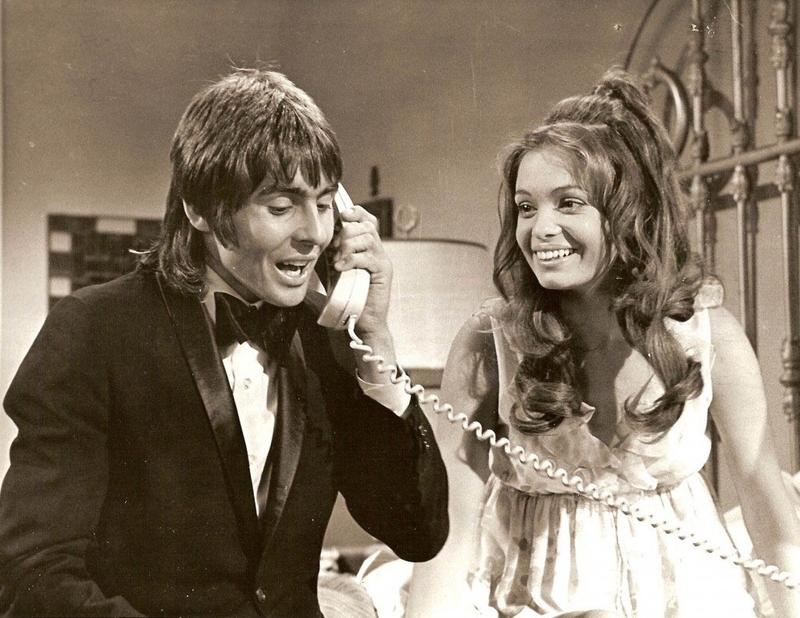
Today we begin with Love, American Style. This show was an iconic 1970s show. Like Laugh In, the clothing, furnishings, and vocabulary do not make it timeless. But it was a lot of fun. This fast-paced anthology show featured two to four mini episodes each week, and between them were quick skits, often featuring a brass bed. Each smaller episode is titled “Love and the _______.”

A troupe of players was featured on each show for the in-between skits. These regulars included William Callaway, Buzz Cooper, Phyllis Davis, Mary Grover, James Hampton, Stuart Margolin, Lynn Marta, Barbara Minkus, and Tracy Reed. Margolin went on to a regular role in The Rockford Files; Tracy Reed was featured in McCloud and Knot’s Landing; Phyllis Davis was part of the cast of Vega$ and Magnum PI, and James Hampton will be familiar if you watched The Doris Day Show or F-Troop. Both Reed and Davis were featured on Love Boat episodes which had a similar format to Love, American Style.

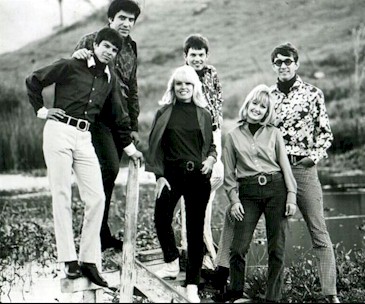
The show had a memorable and catchy theme song. Written by Arnold Margolin, the first year it was performed by The Cowsills.  You will see a lot of overlap between these five Friday night shows, and music is one of those cross-overs. The Partridge Family was based on the life of The Cowsills.

During the second and subsequent years that Love, American Style was on the air, the theme song was performed by the Ron Hicklin Group. The Ron Hicklin Group could be heard in a variety of motion pictures and commercials, and they also appeared on recordings with stars such as Paul Revere and the Raiders and Cher. John and Tom Bahler, brothers who sang under The Charles Fox Singers were also part of this group. The group provided television theme song recordings including Batman, That Girl, Happy Days, and Laverne and Shirley. They also did the singing for The Partridge Family theme and songs performed on the show as well as the Brady Bunch kids. Ron retired in the early 2000s, and Tom does a variety of things. He is also known for writing Bobby Sherman’s hit, “Julie Do You Love Me?”. John married Janet Lennon, one of the Lennon sisters who performed on The Lawrence Welk Show. He currently lives in Branson and conducts the “new” Lawrence Welk orchestra.

hicklin singers

The snappy melody was set to the following words:

Love, Love, Love

Love, American Style,
Truer than the Red, White and Blue.
Love, American Style,
That’s me and you.

And on a star-spangled night my love,

My love come to me.
You can rest you head on my shoulder.
Out by the dawn’s early light, my love
I will defend your right to try.

Love, American Style,
That’s me and you.

Paramount Television developed the show. The executive producer of the show was Arnold Margolin, Stuart’s brother. There were 53 different directors during the four-year run. The series received Emmy nominations for Outstanding Comedy Series in 1970 and 1971; Best Music Composition in 1971, 1972, and 1973, winning in 1973; and winning the Emmy in 1970 for Outstanding Original Music and Lyrics.

las8

Many people wrote for the show, but Garry Marshall and Jerry Belson received the most credits. One of the writers, Peggy Elliott, was interviewed by the Huffington Post in May of 2013, and she talked about her time writing for the show.

“But the show I loved writing the most, was Love, American Style. For every other show, I was writing for characters created out of someone else’s head. Sure, we could create the occasional guest-star role, and we had been told to make every role, no matter how small, a real person. ‘Think of the actor who’s playing that delivery boy,’ I can hear Billy Persky, the co-creator or That Girl, say: ‘This is a big break for him — it’s the biggest role he’s had so far. Give him something to work with.’

But with Love, American Style, every character was our very own; every situation came out of our heads. Each segment of the hour the show ran each week was a one-act play created entirely by us. Added to the attraction was the fact that we could say and do things that were taboo on every other TV show in the early ‘70s. Arnold Margolin, co-creator of the show with Jim Parker, told me recently that the creative side of the network wanted the show to be more daring, while the censors kept their red pencils ready. There was a full-time position on the show just to run interference.

We must have put both sides through the hoops with one episode we wrote: ‘Love and The Hand-Maiden.’ A young guy was dating a centerfold model. As their relationship developed, he discovered that she had no problem with shedding her clothes, but she always kept her hands covered — with artful poses in magazines, and with gloves in real life. He became obsessed with seeing her hands and came up with one ruse after another to get her to take off her gloves. We had a ball writing it, with one double-entendre after another.”

If you were a star of any kind in the early 1970s, you most likely were on Love, American Style.  The show produced 108 episodes, and those shows featured 1112 different actors. Some of the famous names showing up in the credits include Milton Berle, Sid Caesar, Phyllis Diller, Arte Johnson, Ozzie and Harriet Nelson, Regis Philbin, Burt Reynolds, Sonny and Cher, Flip Wilson, and Jo Anne Worley. Karen Valentine from Room 222, Ann B Davis and Robert Reed from The Brady Bunch, and both Jack Klugman and Tony Randall from The Odd Couple show up along the way.

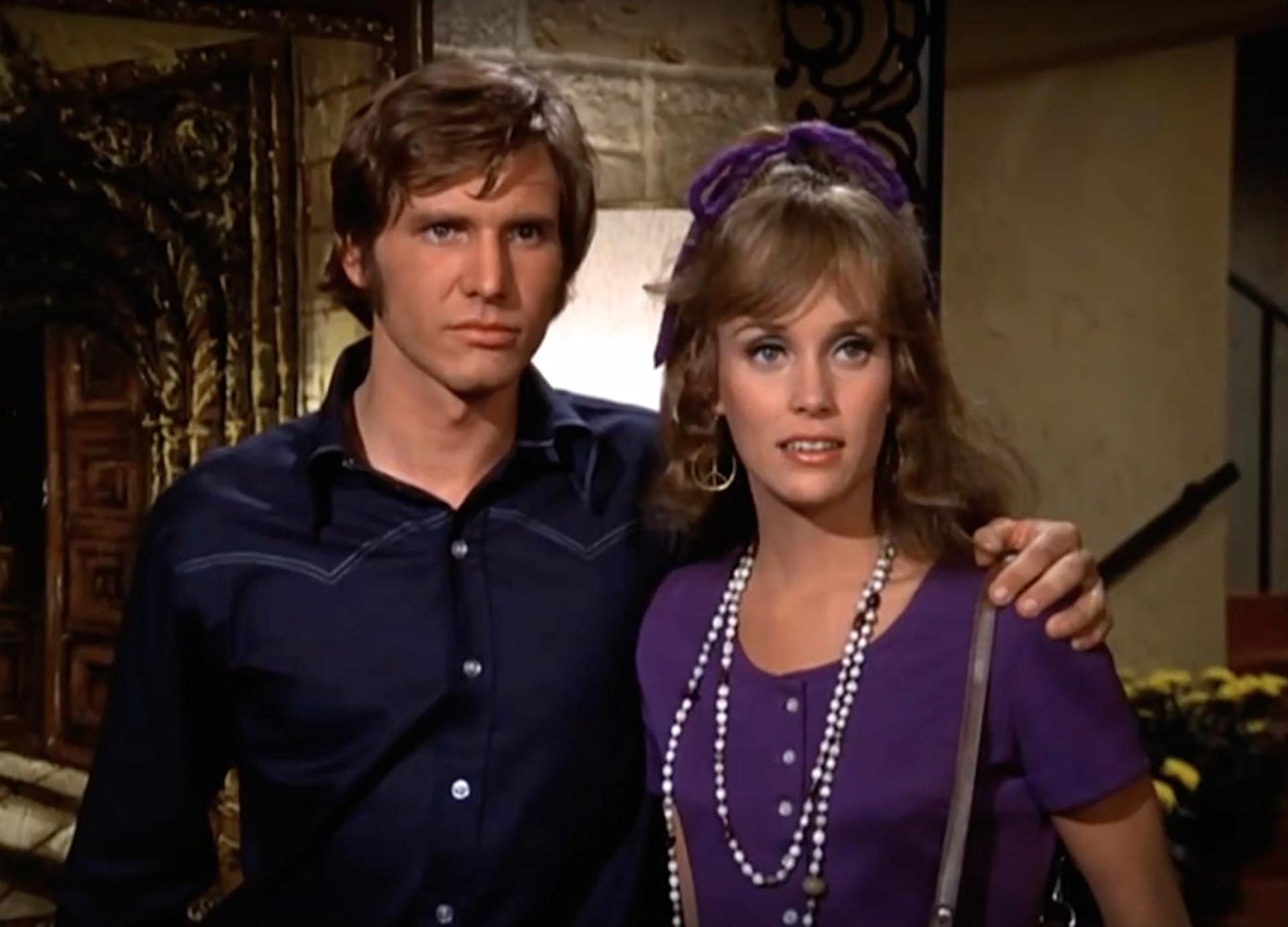
Brad Duke wrote a biography about Harrison Ford and he said Ford had fond memories of appearing on Love, American Style. “He recalled that he had been given little time to prepare his wardrobe for the role of a philosophical hippie in the November 1969 episode, “Love and the Former Marriage.” He appeared on set with long hair and a beard thinking they were appropriate for the role. He was surprised when he was told he needed a haircut and trim than given a navy blue dress shirt and vinyl burgundy jeans with a large belt. They even had a scarf with a little ring to put around my neck. And I thought, someone has made a mistake here. So, rather than argue with the wardrobe people, I put on the clothes and went to find the producer. I walked on the set and he was pointed out.  I tapped his shoulder and when he turned around he had on the same clothes I did. He was a hippie producer I guess. At least the check went through, and I got paid.”

harrison1love and the former marriage

The best way to get a good understanding of what the show was like is to look at a couple of the episodes.

January 23, 1970: Love and the Big Night

Starring Ann Elder, Buddy Lester, Frank Maxwell, Julie Newmar, and Tony Randall, this episode was often listed as a favorite. Randall is a married businessman who escorts his voluptuous secretary (Newmar) to her apartment after a late night at the office. Eager to get home to his wife, Randall hurriedly tries to open a stubborn jar of mayonnaise and winds up covered with mayo. Newmar cleans his suit, but while it’s drying, it’s stolen. After a series of amusing mishaps, Randall finally gets back to his own apartment and creeps into bed with his wife–only to find out she’s not there.

February 25, 1972: Love and the Television Set

It starred Harold Gould, Marion Ross, Ron Howard, and Anson Williams. Reading this list of names might give you a hint about what happened to this episode after it aired. Garry Marshall had written a pilot about a 1950s family that did not sell.  He turned it into an episode for Love, American Style. George Lucas caught the episode and was impressed with Ron Howard and offered him a role in his new movie American Graffiti about 1950s teens. The movie was so popular, that the network decided to put Marshall’s pilot in the fall line-up as Happy Days. Harold Gould’s role was given to Tom Bosley for the series. When Love, American Style went into syndication, this episode was retitled “Love and the Happy Days.”

October 22, 1970: Love and the Bashful Groom

This is the episode I recall when I think of the series. When I watched it originally, I was staying overnight at my grandparents’ house and my grandmother was shocked at the “vulgarity.” It really seems quite tame today, but back then it probably was unexpected. She would approve of Tom Bahler marrying Janet Lennon though because I watched Lawrence Welk with her and my grandfather whenever I was at their house.

In this episode, Paul Petersen, Christopher Stone, Meredith MacRae, Jeff Donnell, and Dick Wilson are featured. Harold (Petersen) and Linda (MacRae) are getting married. He learns that she grew up in a nudist colony and is not comfortable being naked for his wedding.  After a soul-searching talk with his best friend, and realizing he loves Linda enough to be uncomfortable, he decides to go through with the ceremony.  He gets to the church a bit late and walks in, only to see that everyone else is dressed in their Sunday best. His bride informs him that they always dress up for weddings. One of the congregation members says something like “Let’s not make him uncomfortable,” and they all begin to undress.  Of course, you see nothing improper, only clothes flying. This was probably not the best episode to “expose” my grandmother to as a first glimpse of the show.

The show lasted for four years and was cancelled in 1973. In 1985, a reboot was created, but it was on in the mornings and only lasted a few months.  The show was on at the same time as everyone’s favorite game show, The Price is Right. For the 1998 fall season, a pilot was created for prime time, but it was never ordered. While doing my research for this blog, I noticed that there was a Love, American Style project in production, so we may see it resurface again.  I’m not sure I would want to watch a 2019 or 2020 version of the show though. It was such a product of its time, and I fear what a current version would be like after seeing the reboot of Match Game which has been airing the past year or so.
Let’s all write to Antenna TV and Me TV to see if they will make the original 1971 television schedule happen, and we can watch these original shows again, reliving the excitement we experienced the first time around.

Next week we get to know The Odd Couple.


A Tribute to Rose Marie

rosemarie2

Rose Marie had one of the longest-running careers in the entertainment industry – more than 90 years in the business. During her career, she was in vaudeville, on the radio, in the movies, performed in live concerts around the country, did some Broadway, and became most famous for her television performances.


rosemarie6

Born in 1923 as Rose Marie Mazetta, she won a contest at 3 and began performing as Baby Rose Marie. On her official site, she mentions she was born the same day the Broadway show Rose Marie opened. In 1927 at the age of 4 she was featured in a Vitaphone short that opened with Al Jolson’s Jazz Singer.


rosemarie21

By age 5, she had her own national radio show. She worked in vaudeville with Edgar Bergen and Milton Berle. She made several records, and the first one released was with Fletcher Henderson’s orchestra. By 1933 at age 10, she was starring in her first film, International House. During these years, she performed at the White House three times—for Presidents Coolidge, Hoover, and Franklin Roosevelt.


Rose Marie

It was during her vaudeville stint that the doorman informed her and her father that a gentleman wanted to see them in the back alley.  The “gentleman” was Al Capone who called her father Happy Hank and told them that “the guys” wanted to meet Rose Marie. She was taken to Capone’s house the next day where she performed for about 24 guys.  Al gave her a ring with three diamonds which she still had when she passed away. He said they would always take care of her.  He was true to his word. Even after he was incarcerated, Rose Marie was met and protected by the mob for her entire career.  Decades after the most notorious gangsters were gone, men showed up at her shows checking on her just to make sure she was doing okay, getting work,  and not in need of anything. Later she learned that her father, who was an actor by trade, was Capone’s arsonist, the one who burned down buildings of men who disappointed the gangster. There is an article about her meeting with Capone on The Mob Museum’s website. (The Mob Museum is located in Las Vegas.)

rosemarie20


As a teenager, Rose Marie transitioned to clubs, touring the United States. In order to make her sets longer, she began to add comedy to her singing acts.


In 1946 she met Bobby Guy who as with the Kay Kyser Orchestra. They were engaged within a week, and he remained the love of her life until he passed away in 1964. They had one child, Georgianna. Guy would become the lead trumpeter on The Tonight Show.


It was also in 1946 that Rose Marie opened the Flamingo with Jimmy Durante. Jimmy Durante mentored her earlier in her career and she loved him. He was always mentioned as one of her favorite people.  At that time, the only other hotels in Vegas were the Last Frontier and El Rancho. Bugsy Siegel owned the Flamingo, and Rose Marie received work in clubs from her mob connections. She also had a 40-year friendship with Frank Sinatra that was also probably tied to some of their mob connections.


In 1951, Rose Marie tried her hand at Broadway, appearing in Top Banana with Phil Silvers. She knew Silvers from appearing on his radio show with Alice Faye. She played their daughter and Sheldon Leonard (who would hire her for The Dick Van Dyke Show) played their son.

rosemarie5

In 1954, Top Banana was made into a film. Once again Phil Silvers was in it. Rose Marie recorded her musical numbers. The producer tried to manipulate her to have sex with him. She said no in front of several people, and in retaliation he cut all her numbers from the film. In 2017 before her death, she shared the incident on Twitter to help support the women who have been exposing the sexual assault in Hollywood. She appeared in ten movies after that, most of them in the 1980s and 1990s, but she quickly became disillusioned with the film industry.

rosemarie14


Tired of the Hollywood politics, Rose Marie embraced the new television culture. She appeared in Gunsmoke in 1957 and would continue to receive roles in the new medium through 2011. During her career, she appeared on 48 different shows.

In the 1950s, she had a recurring role in The Bob Cummings Show as Martha Randolph and she appeared in The Many Loves of Dobie Gillis. The first sitcom she had a permanent role in was My Sister Eileen; she played the sisters’ friend Bertha. The show ran for 24 shows during 1960 and 1961.


rosemarie17

In 1961, Sheldon Leonard cast Rose Marie in the role of Sally Rogers on The Dick Van Dyke Show. She recommended Morey Amsterdam for the role of Buddy Sorrel whom she had known since age 9. The show was originally to star the office cast with the home life coming in second; however, as things changed, Mary Tyler Moore became the costar with the home life dominating the scripts and Sally and Buddy were featured less. The show produced 158 episodes and is undoubtedly one of the best written sitcoms ever produced. She and Morey received the same salary despite her being a woman. That sounds only fair today, but at the time it was not the normal practice. She loved working on The Dick Van Dyke Show. When asked about her time on the show, Rose Marie said, “We loved each other, we helped each other . . . We were really very close.”


After The Dick Van Dyke Show ended, Rose Marie took roles on several shows including The Monkees and My Three Sons. In 1969, she received a role as Myrna Gibbons on The Doris Day Show, playing Doris’s friend and coworker.


She showed up in many series during the 1980s and 1990s including The Love Boat, Mr. Belvedere, Suddenly Susan, Wings, and was a cast member in Hardball, about a struggling baseball team.


In the 1990s, Rose Marie would take on the role of Frank Fontana’s mother on Murphy Brown. Later she would appear in S.W.AT. as Hilda providing doughnuts and coffee, as well as comic relief, on the show.

rosemarie28

In the late 1990s and early 2000s, Rose Marie transitioned to voice overs for such shows as Hey Arnold and Garfield.

Rose Marie also liked game shows and was a regular on Hollywood Squares through all the different versions.


From 1977-1981, she performed across the country with Helen O’Connell, Rosemary Clooney, and Margaret Whiting. They called the show 4 Girls 4. Rosemary’s nephew, George drove their bus for them.  At some point they made enough money to afford airfare, and George Clooney went on to create a little career for himself.


Rose Marie received the 2184th star on the Hollywood Walk of Fame in 2000. Her baby shoes, along with 40 other items, have become artifacts in the Smithsonian’s American History Museum.

Her hobbies included cooking Italian meals, knitting, and reading; she especially loved Stephen King novels.


rosemariebook

When she first appeared as Baby Rose Marie, someone handed her a bouquet of roses, but she needed to take her bow, so she handed them off and said, “Hold the Roses.” That became the title of her autobiography that was published in 2002.


rosemarielaugh

She was the subject of a documentary Wait For Your Laugh in 2017. Dick Van Dyke said that was her catchphrase, and whenever they were anywhere something funny happened, even a waiter dropping a tray full of food, she always repeated the phrase.


rosemarie10

She accomplished so much in her career you wonder how she could have had any regrets, but she was denied two accomplishments.  She received three Emmy nominations for her role as Sally Rogers but never won an Emmy.  She also wanted to direct and never had an opportunity to do so.


rosemarie3

Sadly, Rose Marie passed away in December. Happily, she left an amazing legacy of performances in a variety of mediums for us to remember her by. While she was so much more than a television star, Sally Rogers will always be one of my favorite characters. Thank you Rose Marie for so many fond memories.

I Wish You a “Busy Christmas”

Merry Christmas!  I hope you are all enjoying a peaceful and happy day. We have a lot of holiday traditions in our family. When it comes to pop culture “must see” shows, we always watch Frosty, The Snowman; How the Grinch Stole Christmas; and a Charlie Brown Christmas, and the other specials are extras if we get them in.  Christmas movies are different for each generation.  I like White Christmas, while my oldest son never misses Elf.  But when it comes to television, one episode we all agree on is “Busy Christmas” from the Adventures of Ozzie and Harriet.  Our family makes an effort to watch this every year together. There is something charming about watching an episode that is more than 60 years old but still speaks to us in how we celebrate Christmas.  Ozzie, after vowing not to, involuntarily agrees to so many Christmas activities that he has no time to put up lights or buy a tree.

busy2

The show first aired in December 19, 1956 . It was the 12th episode of season 5. It was written by Jay Sommers, Don Nelson, Ozzie Nelson, and Alfred Nelson.  Alfred’s only writing credits were 4 Nelson episodes.  Ozzie, of course, helped write almost every episode.  Don Nelson, another brother, enjoyed a long writing career.  He helped Ozzie write the movie Here Come the Nelsons and he went on to write for a variety of shows including Bachelor Father, the Donna Reed Show, the Mothers-in-Law, the Doris Day Show, Bridget Loves Bernie, Herbie the Love Bug, Julia, The Ghost and Mrs. Muir, Nanny and the Professor, as well as a few episodes of Ozzie and Harriet’s later show, Ozzie’s Girls and 326 episodes of The Adventures of Ozzie and Harriet. Jay Sommers got credit for 146 of the Nelson episodes and went on to write for Dennis the Menace, wrote many Petticoat Junction shows, almost all the Green Acres scripts, and, surprisingly, Hello Larry which we looked at a few weeks ago.

Produced by Ozzie and Leo Pepin, the show’s set decoration was created by Jack Moore.  Moore had six Academy Award nominations and won for Little Women in 1949. The costume designer was George Sedilla, and the show was filmed at the General Service Studios, 1040 N. Las Palmas, Los Angeles.

In addition to the regular cast, Phil Arnold appears as a tailor and Isabelle Randolph is Mrs. Brewster.

This episode opens with Ozzie and Harriet looking at some of their Christmas cards.  Ozzie mentions he wished people took time to write in their cards.  He sees one that is a perfect example of what a card should say.  It has a very warm and sentimental message.  When Harriet agrees it is nice and asks who sent it, Ozzie replies, “Acme Cleaners.”


Modern Christmas cards were started by the Hall brothers whose company would become Hallmark.  They were post cards, but people did not have enough room to write what they wanted to tell people they didn’t see often. In the 1930s, Hallmark switched to a “book format” which is our card today.  The cards increased in popularity from the mid-1930s to the 1960s. Hallmark began commissioning famous artists to design cards including Salvador Dali, Grandma Moses, and Norman Rockwell. The Nelsons would have had to use regular postage stamps, because Christmas stamps did not debut until 1962. It’s funny that the switch to these cards was made so people could write more, but Ozzie’s complaint (and one you hear often today) is that people didn’t write anything personal.


busy12

Scene 2 cuts to Ozzie trying to maneuver through a mad rush of people shopping in a department store.  His arms are full of wrapped packages. He tries to ask a clerk for a Donkey Party game.  Giving up, he takes cover in a seating area and ends up sitting next to Mrs. Brewster.  We learn it is a week before Christmas. They are watching a busy crowd and listening over the speaker as Irving Muller is lost and they attempt to find his mother.  Eventually they find her, but now Irving is gone.  Ozzie reminisces about a Christmas when he and Harriet were first married.  They were looking at the tree when all the sudden they heard “Silent Night” and were caught up in the beauty of the song and the carolers on Christmas Eve.  Mrs. Brewster says that is perfect because they would like the Nelsons to join them for caroling this Christmas Eve.  Ozzie says he’ll talk to Harriet, and if she agrees, they will.  Mrs. Brewster smiles and says Harriet has already agreed to it if Ozzie was willing. Over the loudspeaker they hear little Ozzie Nelson is missing and then the message is corrected that Mrs. Nelson is looking for Mr. Nelson.

busy10


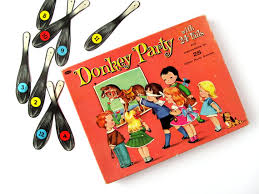
Donkey Party was a version of pin-the-tail-on-the donkey. It came with a poster and 24-30 tails. Some of the other classic toys from this year are Candy Land, Mr. Potato Head, a Slinky Dog, and a Lone Ranger guitar.

busydonkey

Following World War II, the nation displayed an era of peace, productivity, and prosperity and this could be seen in the nation’s department stores.  At Christmas the windows were magical places where beautiful scenes were created, often with moving parts.  Ozzie’s presents were wrapped because that was a service department stores provided, saving the customer time later. Here are some vintage options Ozzie might have been able to choose from.


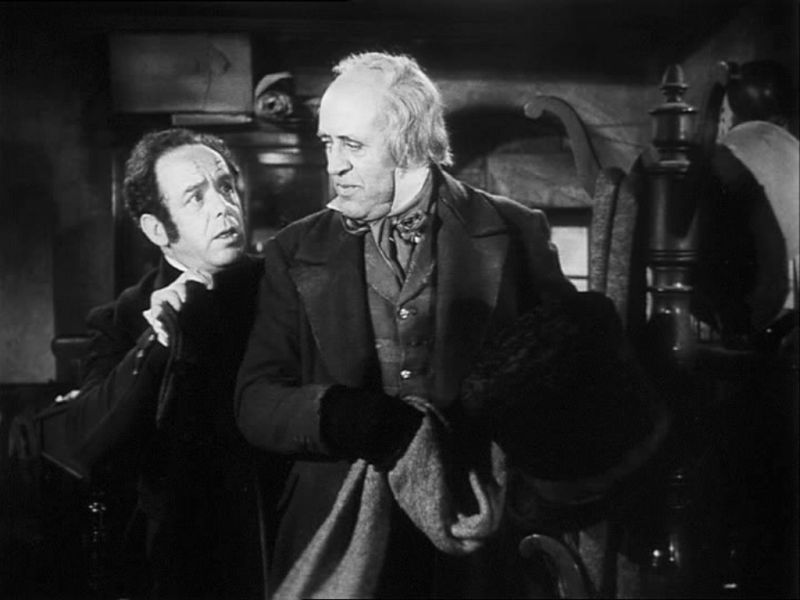
By Scene 3, a few days have passed. Ozzie is helping Harriet hang a wreath on the wall. When Harriet asks him about the tree and putting up lights, he says it’s too early to get the tree, and he decided not to put up lights this year.  He tells her he is not going to get overly busy again this year.  The doorbell rings and Doc Williams enters in.  Doc tells Ozzie that he has been appointed entertainment chairman of the Men’s Club for Christmas, and instead of the regular pageant, they have decided to do a shortened version of the Christmas Carol. Doc will be playing Bob Cratchet. Ozzie tells Harriet this is exactly what he was talking about.  They make one of the busiest men in town chairman and how unfair that is.  Doc looks confused and then starts to laugh.  He assumes Ozzie is auditioning for the role of Scrooge and he gives him the role. Doc asks when the lights are going up, and when Harriet says Ozzie isn’t putting them up this year, Ozzie says yes he is, he just hasn’t gotten around to it yet.


busyj

I have a beautifully illustrated book of  The Christmas Carol, and I try to find time to read it each year.  I also have a Scrooge in his striped night shirt, who is about 4 feet and I love him, although most of my family find him creepy.  My grandfather had a set of Dickens books and liked The Christmas Carol, and I find it inspiring that many generations have enjoyed and learned from this book.

Scene 4 finds Ozzie in his garage a day or so later trying to untangle lights. His friend Joe Randolph stops by and says the guy who always helped as Santa at the orphanage Christmas Eve party moved away.  Now they realized he used his own suit.  Ozzie offers his suit; however, Joe thinks his is also offering to be Santa.  Joe has to hurry off before Ozzie can explain.

busy11

Ozzie would be filling in for Santa because the real Big Guy was too busy Christmas Eve delivering gifts. NORAD began tracking his movements in 1955, so the Nelsons would have been able to follow his progress around the globe.

busy8

Scene 5 is December 23. Mrs. Brewster has dropped off a song, and Doc has dropped off his part. Ozzie climbs the ladder to hang lights and has Rick practice the part of Scrooge with him.  Rick, wearing a sheet like a ghost, leans out the window and plays Marley, ad-libbing the part till Ozzie tells him he must learn the part the way it’s written. David comes in the room and tells Rick to take off the sheet because it’s from David’s bed.  The boys get into a conversation and walk off, leaving Ozzie wondering what is going on.  Ozzie remembers he has to get the Santa suit out of the attic and goes to retrieve it. Mrs. Brewster stops by before he can get back on the ladder to bring more music and asks him to please learn the bass part, because she is short on basses. As he goes back up the ladder to put up the lights, he is called to dinner.


busy1

Scene 6 begins on Christmas Eve day.  Ozzie is walking around practicing his play part and singing his bass parts. He is just leaving the house to get a tree when the phone rings.  It’s Joe Randolph saying that there are so many children at the orphanage, they will have to do two parties instead of one.  Then Doc stops by and says he was called to the hospital for an emergency and Ozzie will have to go pick up the costumes. David offers to drive him.  They rush to pick up costumes from the tailor, then to the orphanage, and then to the play.  During the play, Ozzie knocks a picture off the wall, then drops a prop and, when he picks it up, his pants rip.

Everyone is back at home for Scene 7.  Ozzie is complaining that once again he was too busy.  He talks about how embarrassing the play was and how he hurt his knee hopping in and out of the car.  David says the audience thought what Ozzie did was part of the play and it was funny. Then David says he got a parking ticket.  That is the last straw for Ozzie, but when Harriet inspects it, she realizes it is an invitation to the Policeman’s Ball. At that moment, the carolers arrive to pick up the Nelson family. They are singing “Silent Night” and the family gets quiet and listens to the song, realizing how beautiful it is and what Christmas is all about.  Ozzie goes to get his coat which Harriet has put in the den.  Ricky comes into the hall with a Charlie Brown tree saying that was all they had left when he got to the lot.  As Ozzie opens the den door, a huge tree is revealed decorated with bulbs and tinsel with tons of presents under it. Harriet and Ricky said they did it while Dave and Ozzie were gone.

Tree decorations is one area that has changed drastically today.  Rarely do you see tinsel, garland, or snow flocking.  Back in the 1950s you might have seen bubble lights, or popcorn strands, and the rainbow colors of Shiny Brite ornaments.


They go outside for Scene 8 to join the carolers.  It begins to snow lightly. Doc mentions it’s too bad lights didn’t get put up, but then Ricky hits the light switch and he explains he and Harriet took care of those too. The group moves off singing “Deck the Halls.”

busy9

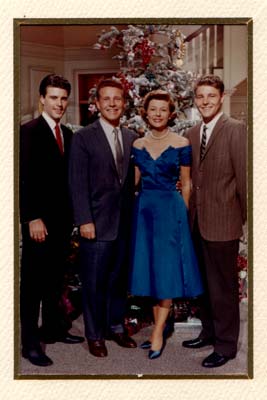
That’s the end of the 1956 episode, but in 1964, Ozzie replayed this show and added a Scene 10.  It is now 1964.  David is married to June Blair and they have a son Danny. Rick is married to Kris Harmon and they have a daughter Tracy. The entire Nelson family gathers around the tree.  Ricky plays his guitar, sitting in front of the fireplace and decorated tree and sings “The Christmas Song.”  While he sings, the camera pans around watching the rest of the family. It ends with everyone wishing the viewers a merry Christmas.


So much of our culture has changed today from 1956; however, thankfully many Christmas traditions remain.  We still send and get cards, although some of them are on the computer.  We still put up lights and a tree; we just tend to do it earlier, so we can enjoy it longer. We still do things for others like orphanage parties; we just don’t have actual orphanages much anymore. We also can get quiet, listening to “Silent Night” and be deeply touched by the season and what it means to us. This episode is a reminder of that for me every year, and I look forward to it.


This Man Was Busy, Busy, Busy

billya

Most television viewers today would not recognize the name Billy De Wolfe, but if you played his voice for them, they would immediately know it as Professor Hinkle from Frosty the Snowman.  I remember Billy primarily from That Girl as Ann Marie’s drama coach, Jules Benedict.  I was amazed to see he only appeared in three episodes because he was such a strong character, I would have thought he was in at least 20 shows. He became known as the prim, pompous, and sarcastic stock character.

Billy was born William Andrew Jones in Massachusetts in 1907. His father was a bookbinder, and they moved back to his parents’ home country of Wales shortly after his birth, returning to the United States when he was nine years old. His parents hoped he would become a Baptist minister, but his dreams were grounded in acting. He started his entertainment career as an usher.  He then became a dancer with the Jimmy O’Connor band.  This led to his appearing on the vaudeville circuit where a theater manger offered him the use of his name, Billy De Wolfe. He traveled to London to perform for five years and returned to America in 1939.

billy1

In 1942 he joined the US Navy where he became a Seaman 1st Class as a musician. Before he enlisted, he was offered a contract with Paramount, and he continued with them in 1944 when he left the Navy. His first movie Dixie was with Dorothy Lamour and Bing Crosby. He appeared in nine movies during the 1940s.


He loved old-fashioned musical comedies and had a chance to act with Doris Day and Gene Nelson in both Tea for Two and Lullaby of Broadway.  He and Doris would be friends for the rest of his life.  He gave her the nickname Clara Bixby because he said she looked more like a Clara than a Doris, and many of their friends referred to her as Clara.


He transitioned to theater and performed on the live stage in both Broadway and London.


billy16

He then decided to try television where he became very successful. Above he appears on the Dick Van Dyke Show. He appeared on six shows before obtaining his first role as a regular on a sitcom.  During the late 1960s and early 1970s he would be cast in five different sitcoms.


billy18

In 1966, he was part of the amazing cast of The Pruitts of South Hampton.  I have mentioned this show before in my blogs, and it is hard to believe that this incredible cast could not pull off a more successful show:  Phyllis Diller, Louis Nye, John Astin, Reginald Gardner, Paul Lynde, Gypsy Rose Lee, John McGiver, Richard Deacon, Marty Ingels, and De Wolfe. The series was based on a novel, House Party, by Patrick Dennis.  A wealthy family realizes it owes the IRS $10,000,000 in back taxes.  They want to keep the appearance that they still have plenty of money while living in a smaller home with one car and a butler.  One of the first shows to debut in color, it was cancelled after 30 episodes.


In 1966, De Wolfe also began the role of Jules Benedict on That Girl.  He played a sarcastic acting teacher who made it clear it was painful to work with these young actors who simply had no idea of how to act. But we also realized that he had a big heart that he did not want anyone to see. His last episode was in 1969.


In 1967, he took a role as radio station manager Roland Hutton Jr. on Good Morning, World.  Dave Lewis (Joby Baker) and Larry Clarke (Ronnie Schell) are small-time radio hosts Lewis and Clarke on the air from 6-10 am. Lewis is married and an introvert while Clarke is a swinging single. Also appearing on this show was a new comer, Goldie Hawn, who played the Lewises’ neighbor. The show only lasted a year. Several critics pointed out that De Wolfe was the funniest person on the show.


billy6

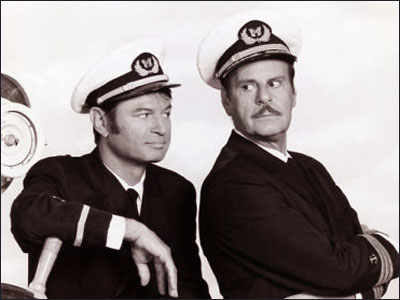
In 1969, De Wolfe was able to stay employed for another 13 episodes on the series The Queen and I. He starred with Larry Storch.  They worked on an aging ocean liner, The Amsterdam Queen, which the owners were planning on selling for scrap. Duffy (Storch) wants to save the ship through any means possible, but Nelson (De Wolfe) doesn’t like or trust him, although he fails to ever catch him doing anything wrong.


Doris Day began her sitcom in 1968. For the 1970 season, she and her kids moved to San Francisco to live over an Italian restaurant, owned by the Palluccis (Kaye Ballard and Bernie Kopell). She hired her friend Billy to play Willard Jarvis, the bad-tempered neighbor who really was a peach when you got to know him.

During his years on the Doris Day Show, he also appeared on the Debbie Reynolds Show and Love American Style. He was also a regular on the talk show circuits, appearing many times on Johnny Carson’s Tonight Show and the Mike Douglas Show.


billy4

Phoebe Murgatroyd was a famous commercial character. De Wolfe donned a hat and shawl (but kept his iconic mustache) to portray the romance expert who gave love life advice for this series of Ban Roll-On deodorant ads.


billy13

Who realized in 1969 that an animation special, based on the song, “Frosty the Snowman,” would go on to become a beloved classic and would play a role in generations of kids celebrating Christmas. For almost 50 years, viewers have cried at Professor Hinkle’s nasty act of locking Frosty in a greenhouse to melt. While I look forward to Charlie Brown and Rudolph The Red-Nosed Reindeer every holiday, Frosty is my must-see every December.

In the early 1970s, Billy was diagnosed with lung cancer. He passed away in 1974, his friend Doris helping him through this tough time.

billy2

Billy De Wolfe is another example of one of these great performers who could do it all.  He was a dancer. He appeared in many lucrative movies. He was successful on Broadway. When he decided to give television a try, he stayed employed with the medium until his death. And he left the legacy of Frosty the Snowman that has been a Christmas staple for almost 50 years. If you are searching for things to do this winter, add watching several episodes of Billy De Wolfe shows to your list and get to know this multi-talented man a bit better.


Not Everything is Black or White

As Black History Month comes to an end, I wanted to look at the early years of television featuring African American characters.  I don’t know if young people today realize how much culture has changed in the past fifty years.  While there are a lot of negative changes that have occurred in the movie and television industry, there have been a lot of positive changes as well.

It’s hard for young adults to realize today how different things are.  When I was growing up in the sixties, married couples on television had twin beds; you could not say “pregnant” on the air; black people and white people were not friends, and certainly did not date or marry; the “jobs wanted” ads in the newspaper were divided into jobs for men and jobs for women; and if a married woman wanted to join the armed forces, her husband or father had to sign a letter giving his approval.

Sometimes we get so caught up in how far we are from the journey’s end, we forget to appreciate how far we have traveled.  Looking at the current television schedule we see a variety of shows about capable women.  While certainly racism and gender discrimination exist, most people don’t think twice about whether a lead character is a man or a woman; is black, white, or Asian; or single or married.

Just a quick review of shows on the air reveal complex, intelligent characters who are African American.  We see this in Black-ish, This Is Us, Empire, Scandal, House of Lies, Last Man Standing, and Gray’s Anatomy, just to name a few.  This was far from the reality of early television.

We often think of that era as the golden age of television, but honestly, it was the white age of television.

In 1950, two shows debuted with main characters who were black:  Amos ‘N Andy and Beulah.  A radio transplant, Amos ‘N Andy dealt mostly with Kingfish’s schemes to gain wealth, often at the expense of his friends. Beulah also got its start on radio where she was a character in Fibber McGee and Molly.    She worked for a well-to-do middle class white couple with one son.  Both of these shows were demeaning and stereotypical.  In 1953, they were both yanked from the air due to NAACP protests.

Unfortunately, it would take almost 20 years before another show would feature a black character as a star.  In 1968, Julia debuted.  Julia, played by Diahann Carroll, was a black woman with a young son Corey (Marc Copage).  Her husband is killed in Vietnam and she moves to LA to start a new life in her nursing career.  Like Tom Corbett on The Courtship of Eddie’s Father, she is raising a son; like Doris Day she is a working mother; and like Ann Marie on That Girl, she has a fabulous wardrobe.  She is hired at Astrospace Industries, an industrial-health office where she works with Dr. Chegley (Lloyd Nolan).  Her life is normal.  She goes to work, takes care of her son, and goes on a few dates, but the concept of an African American, or a woman, starring in a show as the sole breadwinner, intelligent and fashionable, was not normal for the times.  The show was on for three seasons until 1971.

Julia was a controversial show at the time, but it scored high in the ratings and became a popular series.  I think it gets a lot of unfair criticism today.  The show gets complaints because during the time of the Watts riots, sit-ins, and so much racial unrest, it portrayed Julia living a fairly normal life.  I think people forget how groundbreaking it was to have a working woman or a black character star in a show.  I think the fact that she was able to live a “normal” life gives even more credit to not bowing to stereotypes of the late sixties. It’s like criticizing someone who is just learning to walk for not running and doing handstands.  They might be small steps, but they are steps going forward. I am one of those people who actually prefer not to see too much “real life” in sitcoms.  Honestly, I watch them to escape real life.

I also wanted to mention a few other shows that were featuring black characters in their cast during the time Julia was on the air: Hogan’s Heroes, The Mary Tyler Moore Show, and Barney Miller.

Hogan’s Heroes had a diverse cast, including Ivan Dixon as Sgt. James Kinchloe, striving to stay one step ahead of the Nazis.  The Mary Tyler Moore Show included a quirky news staff including weatherman Gordy Howard played by John Amos.  Barney Miller centered around a police department made up of personnel who each had their own dysfunctions.  One of those members was Lt. Ron Harris played by Ron Glass.  Each of these shows quietly featured black characters.  The races of any of the characters could easily have been switched during an episode and the character would not change.  It was just real people living real lives and some of them happened to be white and some black. After these creative and well-written shows, I prefer to ignore the Norman Lear era of shows.  They may have their merits, but I couldn’t stand All in the Family, Sanford and Son, Maude, or Good TimesThe Jeffersons was tolerable, but I would not choose to watch it either. In the mid-1980s, television began to get more diverse.

365

Don’t get me wrong.  Things are far from perfect in the world of television and movies, but we have made a lot of progress.  We have a lot of work to do, but just think how many choices Diahann Carroll would have today if she wanted to develop a television series. She could pick any career she wanted, including the military without anyone’s else’s approval; she could marry a white man and not sleep in twin beds; she could announce on the air she was pregnant—small steps but 5280 small steps turn into a mile. So, let’s devote one day to appreciate the hundreds of miles we have come before getting too caught up despairing about the hundred we still have to go.

An Actress With “Street” Smarts

Much of the entertainment news media has been focused on the death of Mary Tyler Moore this past week, and rightly so.  However, with the passing of two other television icons in Barbara Hale and Mike Connors, I decided to celebrate the life and career of Barbara Hale in this week’s blog.

bh14

Like William Christopher, whom we looked at a couple weeks ago, Barbara Hale seems to have had a successful and fulfilling career.  She comes across the decades as a very nice person and a hard-working actress. She was married for more than 46 years to the same man and they had three children.  A lot of her career was based on acting with her husband, her son, and her close friend Raymond Burr.

Born in April of 1922 in DeKalb, Illinois, she moved to nearby Rockford shortly after her birth.  She and her sister had a nice life, growing up in a middle class family.  Always interested in the arts, she attended The Chicago Academy of Fine Arts.  She continued to have an interest in art the rest of her life, often sketching while waiting for taping to resume. She worked as a model during part of her school years for a comic strip Ramblin’ Bill.  She was also featured as a Dr. Pepper girl in the Dr. Pepper calendars in the 1940s and 1950s.

bh5

Continuing her modeling career after graduation, it was through that avenue she was given a contract with RKO in 1943.  While at RKO she met her husband-to-be Bill Williams and they married in 1946.  Their wedding took place in the Old Stone Church in Rockton, Il and their reception was at the Wagon Wheel in Rockton, north of Rockford. During her RKO-tenure she also met Raymond Burr.

Her first movie was Gildersleeve’s Bad Day in 1943.  Her contract with RKO continued until 1949 at which point she signed a seven-year contract with Columbia.  During her career she appeared in 42 movies and 34 television movies, 31 of which were Perry Mason films. Some of her costars included Frank Sinatra, James Cagney, and Jimmy Stewart.

Between 1953 and 1956 she appeared in 14 drama/anthology series on television including Schlitz Playhouse, Studio 57, The Loretta Young Show, Damon Runyon Theater and Playhouse 90. She also appeared in many print ads during these years promoting products such as Lux Soap Flakes, Sunnybrook Margarine, and Chesterfield Cigarettes.

Debating whether or not she should retire and stay home to raise her three children (born in 1947, 1951, and 1953), she was offered the role of Della Street for the upcoming Perry Mason series.  She declined it at first, but when she realized her old friend Raymond Burr was starring in the show, she opted to take the part.  From 1957-1966, she appeared in 263 of the 271 shows. In the midst of the series’ run in 1960, she received a marker on the Hollywood Walk of Fame in 1960.  In 1959 she won the Emmy for best actress in a drama and was nominated again in 1961.

When the series ended, she appeared in only a handful of shows including Lassie, Adam-12, The Doris Day Show, Marcus Welby, and Walt Disney’s Wide World of Color. She was in her dear friend Raymond Burr’s show Ironside and acted with her son William Katt, the star of The Greatest American Hero, playing his mother on the show. She was also in the movie Big Wednesday in 1978 with her son, playing his mother. During this time, she also appeared in several commercials and was a spokesperson for Amana Radarange microwave ovens. In 1970 she was one of the celebrities appearing in the movie Airport.

In the mid-1980s, Raymond Burr was approached to make several Perry Mason television movies.  He agreed only if Barbara Hale was cast as Della Street again.  Hale’s son William Katt appeared in some of the movies as Paul Drake Jr. From 1986-1995 Hale and Burr made 31 Perry Mason movies. Sadly, her husband passed away from cancer in 1992 and Burr died in 1993. She was one of the friends to deliver a eulogy at Burr’s funeral.  He cultivated orchids and named one for Barbara Hale.

In her later years, Hale battled colon, ovarian, and bladder cancer.  With a remarkable attitude and her belief in God, she defeated the disease each time.  She died from natural causes this month at 94.

One of the most charming stories I read about Hale was one she told a few years ago when she had returned to Rockford, which she did often, to attend a theater renovation celebration.  She talked about after-football parties they had in high school.  The kids would drive to the Spring Creek Road subdivision.  Roads had been constructed for the housing development, but no homes had been built yet.   The kids would park their cars in a circle, turn their headlights on, tune their radios to the same channel, and get out and dance. It was a heart-warming story about a more innocent time.  After hearing so many sad stories about the issues actors often face in the industry, it was refreshing to hear about someone who was a nice person who appeared to have a normal and happy career with a great life balance of work and family.

A lot of her movies and the Perry Mason shows  are available on Amazon.  Take an upcoming week-end and watch a few seasons and keep track of how many cases Perry loses. Here is some dialogue to listen for while you watch.

Perry Mason: The Case of the Spurious Sister – 1959

Perry:  Della, how would you like to get a divorce?

Della: I thought you were supposed to be married first.

Perry Mason: The Case of the Surplus Suitor – 1963

Hamilton Burger: Well, Miss Street, having you here just as a witness for the prosecution is a rare experience for both of us.

Della: I’ll try not to be hostile, Mr. Burger

Hamilton Burger: Well, that’ll be a rare experience too.

Perry Mason: The Case of the Angry Mourner – 1957

Bell Adrian: Mr. Mason, were you surprised when you found I didn’t do it?

Perry:  Of course not, Mrs. Adrian. I knew all along. You just weren’t the type.

Paul Drake: And who is the type pray tell?

Della: Oh, that’s easy, Paul. Anyone who is not represented by Perry Mason.

Thank you Barbara Hale for providing us with so much drama over the years, but only on the television episodes!