Lee Majors: Still Acting

As we wind up my blog theme “Expensive Parts,” we finish by taking a look at the career of Lee Majors, who starred in The Six Million Dollar Man.
📷facebook.com

Known then as Harvey Yeary, Majors was born in Michigan in 1939. Sadly, both his parents died in separate car accidents before he reached two years of age. He was then adopted by his aunt and uncle who moved him to Kentucky.

Majors was a big sports guy, playing football and running with the track team. He received a scholarship to Indiana University. He transferred to Eastern Kentucky University to play football. Unfortunately, a back injury left him paralyzed for two weeks, putting an end to his football career. He then turned to acting but graduated with a degree in history and physical education with plans to be a football coach.

After graduation, he moved to Los Angeles to be the recreation director for North Hollywood Park. During his time there he met Dick Clayton who had been James Dean’s agent. Clayton convinced Lee to go to acting school, and after a year, Clayton felt he was ready to look for work in the entertainment business. He took on the name Lee Majors in honor of Johnny Majors who was a player and coach at the University of Tennessee. He said many people in Hollywood had trouble pronouncing his real last name, so he took on a new one.

During this time, he took his first stab at marriage. He and Kathy Robinson were wed in 1961 but divorced in 1964. His marriages were not as successful as his career.

In 1964 he received his first big-screen offer for Strait-Jacket. A year later he showed up on the small screen on Gunsmoke. He would continue to flip back and forth between the two genres his entire career.

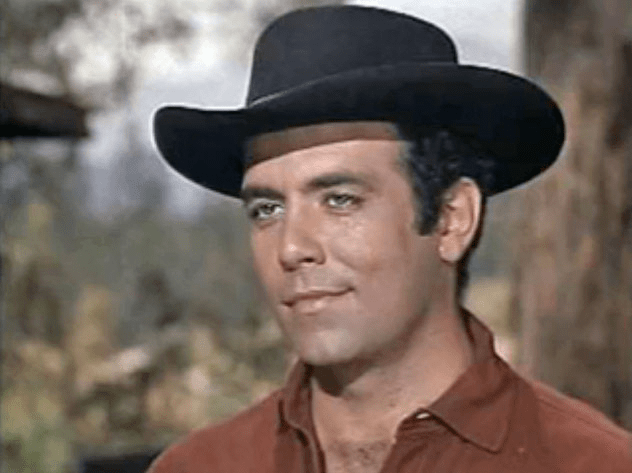
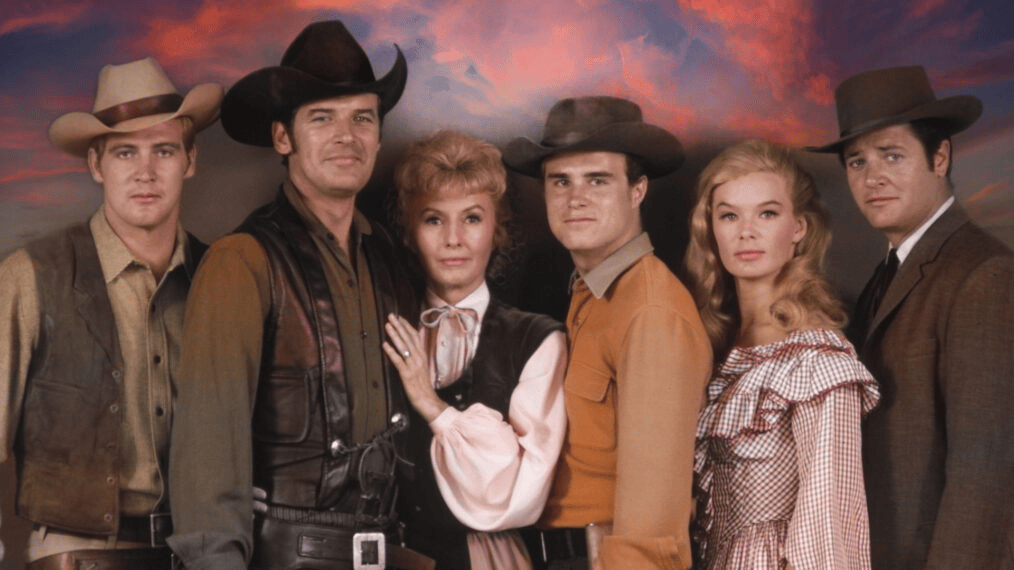
1965 was also the year he got his first recurring role. Chosen from more than 400 actors, including Burt Reynolds, he was given the role of Heath Barkley on The Big Valley. This was the decade of the westerns and Big Valley was a big hit. The show was on the air till 1969 at which time Majors signed with Universal Studios.
📷bigfanboy.com

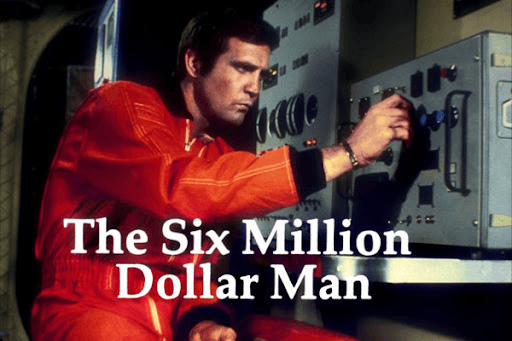
From 1971-1974, he was part of the cast of Owen Marshall Counselor at Law on ABC. In 1974, ABC decided to transfer a movie plot of The Six Million Dollar Man into a series and Majors got the job. The show was an immediate success. In 1977, Majors announced he wanted to renegotiate his contract with the show which had not ended. Some insiders said he wanted more money; Majors always claimed that he was asking that his production company, Fawcett Majors Productions, become an independent producer with Universal. The producers filed a lawsuit to report to work since his contract was still ongoing, but Majors refused and eventually the executives agreed to his demands. However, that might have put the nail in the coffin of the show. A spinoff, The Bionic Woman had slid in the ratings and was picked up by a different network and then The Six Million Dollar Man lost viewers as well, so both shows were cancelled the following year. However, the series continued in three made-for-tv movies during the eighties.

During the beginning of The Six Million Dollar Man, Majors married Farrah Fawcett; they divorced in 1979. He tried to get her the part of The Bionic Woman, but it went to Lindsay Wagner. Fawcett guest-starred on the show three times before getting her own series, Charlie’s Angels.
📷igw.com

Majors spent the rest of the seventies primarily doing movies. In 1981 he received another starring offer for The Fall Guy. Majors played Colt Seavers, a stuntman who worked part time as a bounty hunter. This series was on the air for five seasons before ending in 1986.

In 1988, marriage three happened when he wed Karen Velez, but after six years, they too divorced. In 2002, he walked down the aisle one last time, marrying Faith Noelle Cross, and they are still together.

He did have smaller recurring roles in the 1990s and 2000s but they were on little-known shows: Tour of Duty, Raven, Too Much Sun, Son of the Beach, The Game, and Ash versus Evil Dead. He had heart bypass surgery in 2003, but it didn’t keep him down long.

He was in three episodes of the well-known show, Weeds in 2008. He made appearances on several popular shows during this time including Will and Grace, Cold Case, According to Jim, Grey’s Anatomy, and Magnum PI. He still continues to work off and on as of 2026.  

It’s amazing that Majors has continued to work so long in the business. After five decades, he is still doing what he loves. He has said that he was “never into my looks. What’s important to me is my health and family.” He also was fine not being a leading man forever as he said, “A lot of guys think they can be leading men forever. And believe me, we all can’t be.”
📷remindmagazine.com

I was surprised to learn that despite the fact that so many kids looked up to Steve Austin, Majors did not love his time on the series. He said it “was so hard and so boring for me. Ironically that was the most popular. It was total work. You’re there 16-17 hours a day.” His favorite role? Heath Barkley. He considered Barbara Stanwyck his mentor. He said it “was the most fun at the time because it was my first and I love Westerns. All the action, horseback riding. I really loved it.” Linda Evans, his sister Audra on the show, also has mentioned how much she loved doing the show and how much she respected Stanwyck.

I’m not sure if he ever regretted choosing acting over football coaching because he mentions the importance of football coaches and the inspiration he received from his often. But he had a very successful career. He was never stereotyped in his roles moving from The Big Valley to Owen Marshall Counselor at Law to The Six Million Dollar Man and ending with The Fall Guy, all very different roles and highly rated shows. He also found the perfect partner for him and his children, a blended family from several of his marriages. And at 87, is still acting when he wants to.

In an interview with Terry Pace on http://www.leemajors.us/films/leeinterview.htm, Majors discussed his acting philosophy. He said, “Acting is a tough business, and the percentage of people who make it is very low — it’s about 1 percent. I’ve had disappointments and heartbreaks and setbacks and roles I didn’t get, but something always came along that either made me better or was an even better role.” That’s a great way to look at the ups and downs of the entertainment business. We should all learn from him.

Linda Evans’ Destiny was Working with John Forsythe

This month we are looking at some of our favorite “Supportive Women.” Today we are taking a closer look at the career of Linda Evans.

Photo: vintageeveryday.com

Born Linda Evenstad in 1942 in Hartford, Connecticut, she was the middle child of three sisters. Both her parents were professional dancers. When she was six months old, the family moved to North Hollywood. Linda graduated from Hollywood High School with Stefanie Powers, who we will be talking about next week. Like Morgan Fairchild, who we will be discussing in two weeks, Linda took drama classes to help her deal with shyness.

Linda was engaged to Patrick Curtis, but they never married. He later became a press agent and married Raquel Welch.

Linda’s first two roles were on two of my favorite sitcoms. In 1960, she guest starred on Bachelor Father where Bentley Greg (John Forsythe) raised his niece Kelly (Noreen Corcoran) with the help of his houseboy Peter (Sammee Tong). Her second appearance was on The Adventures of Ozzie and Harriet. During the sixties, she would appear on a variety of shows including Dr. Kildare, Wagon Train, and My Favorite Martian.

Photo: pinterest.com

Her first made-for-tv movie was 1962’s Buttons with Beaus, and her first big screen feature came a year later in Twilight of Honor; her second movie was Beach Blanket Bingo in 1965 where she played Sugar Kane.

It was in 1965 that Evans began dating film director John Derek. They would marry in 1968 and separate in 1973 when Linda learned he was dating the actress who became known as Bo Derek.

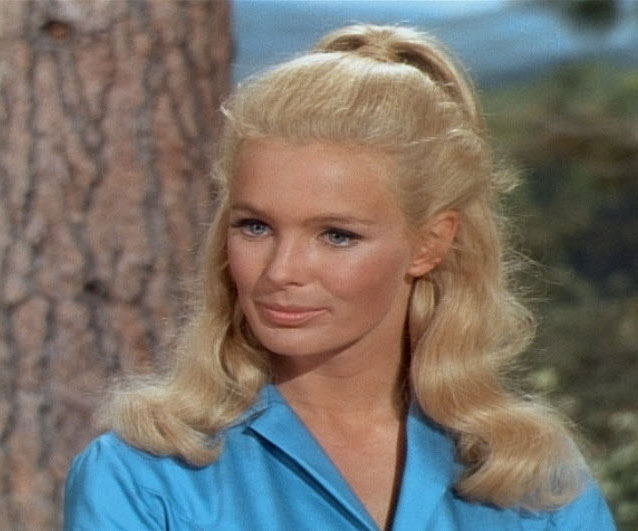
1965 was also the year she was offered her first role as a regular cast member of a series. She became Audra Barkley from 1965-1969 on The Big Valley. The western was very popular. Similar to Bonanza, in this show, Victoria Barkley managed to raise her family and keep the villains at bay.

She and Barbara Stanwyck, who played her mother Victoria on the show, became very close. Stanwyck continued to refer to her as Audra after the show ended. Linda says Barbara was a great mentor and friend to her.

In 1967 when Derek was filming Evel Knievel’s famous motorcycle jump over the fountains at Caesar’s Place in Las Vegas, he asked Linda to take over one of the cameras, and she shot the famous footage of Knievel’s devastating crash.

During the 1970s she kept busy with television appearances on dramas including McCloud, Banacek, Harry O, McMillan and Wife, and The Rockford Files.

With “mom” Barbara Stanwyck Photo: imdb.com

In 1975, she married Stan Herman, a real estate tycoon. They were married four years before splitting up. She never married again.

From 1976-1977 she again accepted a role as a regular on the show Hunter. The series only lasted fourteen episodes before being canceled. Not to be confused with the show from the 1980s, in this one, US government special agents James Hunter (Tony Franciscus) and Marty Shaw (Evans) take on missions around the world. He posed as a bookstore owner, and her cover was a model. I admit I have never seen this show, but it sounds like a seventies version of I Spy.

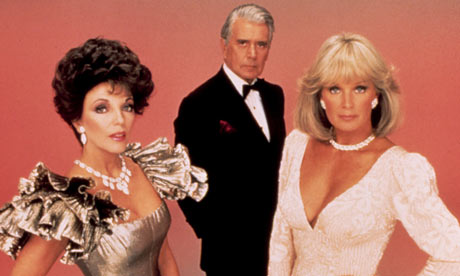
During the 1980s, her career was split between two primary shows: The Love Boat and Dynasty. Dynasty was on the air from 1981-1989. When Dallas became extremely popular, ABC commissioned Aaron Spelling to come up with a primetime soap opera of its own. Evans was back on the air working with John Forsythe again as Blake Carrington, her wealthy husband. The basic premise of the show was that it was an upper-class version of the Hatfields and the McCoys with the Carringtons and the Colbys feuding in the oil business in Denver, Colorado.

Dynasty with Forsythe and Collins Photo: imdb.com

Evans and Forsythe remained close friends for the rest of his life. She said he was “so magical. This show was so serious and he was funny personally. We’d be fighting and people would be strangling each other and he made me laugh all day long, I’ll be forever grateful to him for that.” The person Linda was often strangling was Joan Collins who played Alexis Carrington Colby, Blake’s first wife.

By 1984 the show had reached number one in the rankings. Linda was nominated for an Emmy for Outstanding Lead Actress in a Drama Series in 1983. She was beat out by Tyne Daly from Cagney and Lacey.

After the show was canceled, Evans stepped out of the limelight for the most part. She did film five made-for-tv movies during the 1990s and guest starred on Germany’s version of The Love Boat, Das Traumschiff, in 2020. In 2021, she was in a big-screen feature, Swan Song.

In 2011 Evans published a book, Recipes for Life: My Memories, a combination of candid memoir and inspirational cookbook. Despite her perfect figure, one of her weaknesses is pizza. On premierspeakers.com on April 10, 2018, she was quoted as saying “I love pizza so much, that if you wake me up in the middle of the night and ask me if I’d like to eat a slice, I’ll say YES. Kenny Rogers used to have it delivered to me while I was filming The Gambler.

Photo: dailyexpress.com

Linda seemed to enjoy her career. She is remembered for several well-known characters in Audra Barkley and Crystal Carrington. While she has given up acting for the most part, I would not be surprised to see her back on the big screen for another part or two if it’s the right offer.

Honey West: Quality Over Quantity

As we look back at some favorite crime dramas, this week we are traveling back sixty years. From 1965-1966, Honey West appeared in our living rooms. Only thirty episodes were produced, but the show was respected and worth remembering.

Photo: drunktv.com

The show was based on a novel series. Married couple, Gloria and Forrest “Skip” Fickling wrote the books. Skip had been a gunner in the US Army Air Force. According to Skip, they combined Marilyn Monroe and Mike Hammer for the character of Honey West. The novels were published from the late fifties to 1971, with eleven total.

West was one of the first female private eyes on tv. In an episode of Burke’s Law, Ann Francis showed up as Honey West which led to a spin-off. The series was developed by Gwen Bagni and Paul Dubov, writers on Burke’s Law. Aaron Spelling was listed as the producer.

Photo: drunktv.com

West has a partner Sam Bolt (John Ericson). Ericson never received another starring role in a series, but he was a successful actor, amassing 105 acting credits.

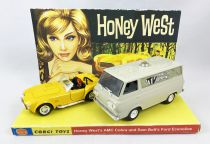
Honey is an interesting character. She has a hidden radio in her lipstick case, has a pet ocelot named Bruce, a colorful animal-print wardrobe, and a Cobra convertible. She shares an apartment with her Aunt Meg (Irene Hervey) who shows up in about half of the episodes.

West owns her own investigation firm which she inherited from her father. Her base of operations was behind a fake wall in her living room. She’s very smart and experienced in electronic surveillance. Bolt creates many of the gadgets she uses. They go undercover in a specially equipped van which had a sign “H.W. Bolt & Co., TV Service.” She and Sam could be the inspiration behind Maddie and David from Moonlighting.

Like James Bond, or Max Smart, she uses a number of high-tech instruments: an exploding compact, a garter belt gas mask, tear gas earrings. You don’t have to worry about Honey’s safety. Sam is an ex-Marine, and Honey attained a black belt in judo.

Photo: filmscoremonthly.com

Several of the episodes were written by Richard Levinson and William Link who would go on to write for Columbo and Murder, She Wrote.

The show was canceled after the first year for two primary reasons, one understandable and one which makes me shake my head. I understand that the network determined that it would be cheaper to import The Avengers and show it in the time slot. The second reason is a bit harder to understand: the show was in competition with Gomer Pyle USMC and could not hold its own in the ratings war. I say this with great respect to Jim Nabors whom I love and while Gomer Pyle was an ok show, it’s hard for me to picture it as a show that would draw more viewers than a crime drama.

Francis did receive Golden Globe and Best Actress Emmy nominations that year. She was beat out by Barbara Stanwyck for The Big Valley. The show was described as “sexy, sophisticated and delightfully funny.” According to most of the reviews of the DVDs, it holds up very well after sixty years and is still fun to watch.

Photo: lulu-berlu.com

They had some clever details in the show. There is often at least one instance when the last word of a sentence leads into a funny new scene. The actors often discuss television shows, wondering about their ratings. Honey pulls down an imaginary shade, so viewers won’t watch her sleep. It also had a jazzy theme written by Joseph Mullendore. He had created a lot of the music for Burke’s Law and would go on to provide music for other series, including Land of the Giants and Daniel Boone.

There were several drawbacks mentioned, most notably the lack of color. Not only was color becoming the norm by this time, but Honey West was a show that would have been enhanced by color. It was also criticized for being a 30-minute show. There was not enough time to truly develop both the plot and the characters’ relationships in such a short time.

Photo: pinterest.com

This show reminds me a bit of Barbara Eden’s show How to Marry a Millionaire and Bachelor Father, starring John Forsythe, in that both debuted in 1957; two series that I thought had clever writing, fun characters, witty dialogue, and elegant interiors. On one hand, it is sad it wasn’t given more of a chance to get established with viewers. On the other hand, it sounds like it has thirty mostly great episodes to watch. Maybe an early cancellation allowed the best shows to be saved. I think about I Dream of Jeannie which was released the same year as Honey West. The shows from the first year are fun to watch. Jeanne is witty, clever, mischievous, and smarter than she lets on. During the following years, the episodes were average at best and often sub-par. If I only had the first year’s episodes to watch, I would not feel like I was missing anything.

For less than $20, you can buy the entire DVD season of Honey West. And if it makes you want to go out and get a pet ocelot, who am I to judge?

Gavin MacLeod: Murray Slaughter Takes Up Sailing

Photo: metv.com

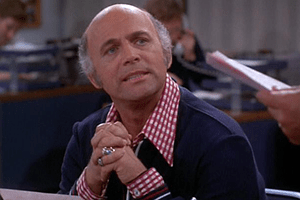
As we wind up our up close and personal blog series, we are focusing on Gavin MacLeod. I have mentioned Gavin MacLeod’s name a lot in my blogs, but I have never devoted an entire to blog to him, so today is the day. Gavin had an impressive career; he starred in three sitcoms but those three garnered him almost 500 episodes. In addition, he took on more than a hundred guest roles on both the small and big screen.

MacLeod was born Allan George See in 1931 in New York. His mother worked for Reader’s Digest, and his father was an electrician. In 1952, MacLeod graduated from Ithaca College with a bachelor’s degree in fine arts, studying acting.

On Perry Mason Photo: imdb.com

He served in the US Air Force where he wrote, produced, and directed plays. After his service, he moved to New York City. While tackling acting auditions, he worked at Radio City Music Hall. While working as an usher there, he met Joan Rootvik, a Rockette. They married in 1955 and had four children. About this time, he took on the name Gavin MacLeod. MacLeod was a tribute to his acting coach at Ithaca, Beatrice MacLeod.

His movie career began with three movies in 1958. He would make 20 more before 2005, including Operation Petticoat and The Gene Krupa Story.

His television appearances began in 1957 on The Walter Winchell File. He would make another lucky 13 performances during the fifties including The Thin Man and Whirlybirds.

On Hogan’s Heroes Photo: pinterest.com

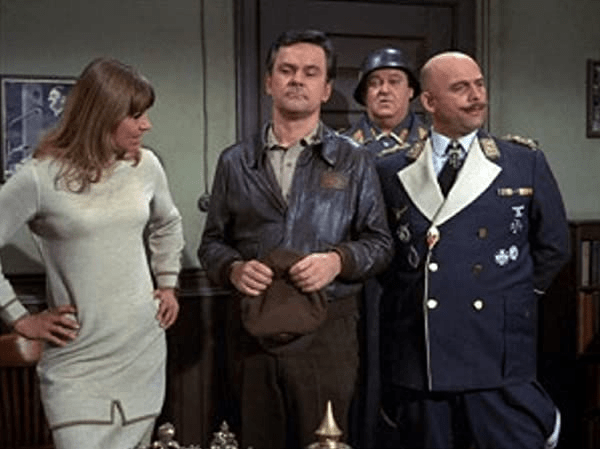
The sixties kept him busy. He took on comedy in The Dick Van Dyke Show, The Munsters, Gomer Pyle USMC, The Andy Griffith Show, My Favorite Martian, The Flying Nun, and several different characters on Hogan’s Heroes. Westerns called him for Rawhide, The Iron Horse, Death Valley Days, and The Big Valley. He landed dramas including The Man from UNCLE, Perry Mason, Ironside, Hawaii Five-0, and Ben Casey.

From 1962-1964 he starred as Happy in McHale’s Navy. The show continued until 1966, but Gavin left the show halfway through. He was dealing with alcoholism, and he received an offer to make the movie The Sand Pebbles with Steve McQueen. However, he remained close friends with Ernest Borgnine, the star of the show, until his death in 2012. (He quit drinking in 1974.)

Murray and Mary Photo: showbizcheatsheet.com

During the 1970s, he appeared on Love American Style, Charlie’s Angels, and Wonder Woman, but the character we loved best during that decade was Murray Slaughter on The Mary Tyler Moore Show. From 1970-1977, Murray sat next to Mary, helping her through the ups and downs of life. Gavin was originally auditioning for the role of Lou Grant, but ended up reading for Murray. He and Ted Baxter were enemies on the show, but he and Ted Knight were dear friends in real life. They had lived near each other before being cast in the show.

During the run of the show, Gavin and his first wife divorced, and he married his second wife Patti Steele. That marriage also ended in divorce in 1982. Patti became part of a Bible Study group after their divorce and became a Christian. Gavin reached out to her, also became a Christian, and they remarried in 1985.

Photo: travelweekly.com

Upon the ending of Mary’s show, he was immediately hired as Captain Stubing on The Love Boat. This time he was in charge of his coworkers. One of his best friends was Bernie Kopell who played Dr. Adam Bricker on the show. Gavin was on the seas for a decade. His best friend Telly Savalas (the lollipop-loving Kojak star) popped up on The Love Boat; the two were very close until Telly’s death in 1994.

When the show ended in 1987, he got a well-deserved break, but he still managed to find time to tour with Michael Learned in “Love Letters.”

Celebrating on Murder She Wrote Photo: imdb.com

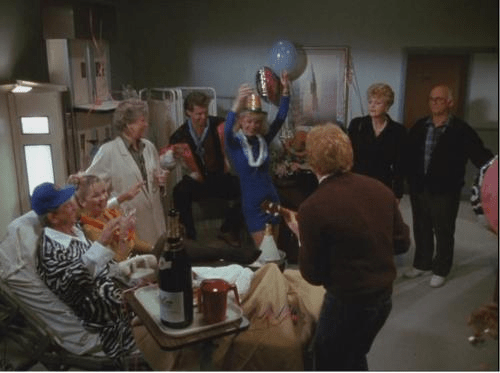
He landed a variety of television show appearances in the 1990s and 2000s, including Murder She Wrote, King of Queens, JAG, and That 70s Show. His final appearance was in 2014 on The Comeback Kids; then he decided to retire. He also did several musicals after The Love Boat including “Gypsy,” “Annie Get Your Gun,” and “Gigi.”

MacLeod and his wife hosted a show on marriage on Trinity Broadcasting Network for 17 years. He also served as the honorary mayor of Pacific Palisades from 2006-2011 when Sugar Ray Leonard took over.

The Love Boat was a big part of his life. Instead of being bitter about being typecast, he embraced the role. He celebrated his 80th birthday in 2011 aboard the Golden Princess with his family, celebrating with a 3D replica cake of The Pacific Princess, his boat on the show.

Photo: princesscruises.com

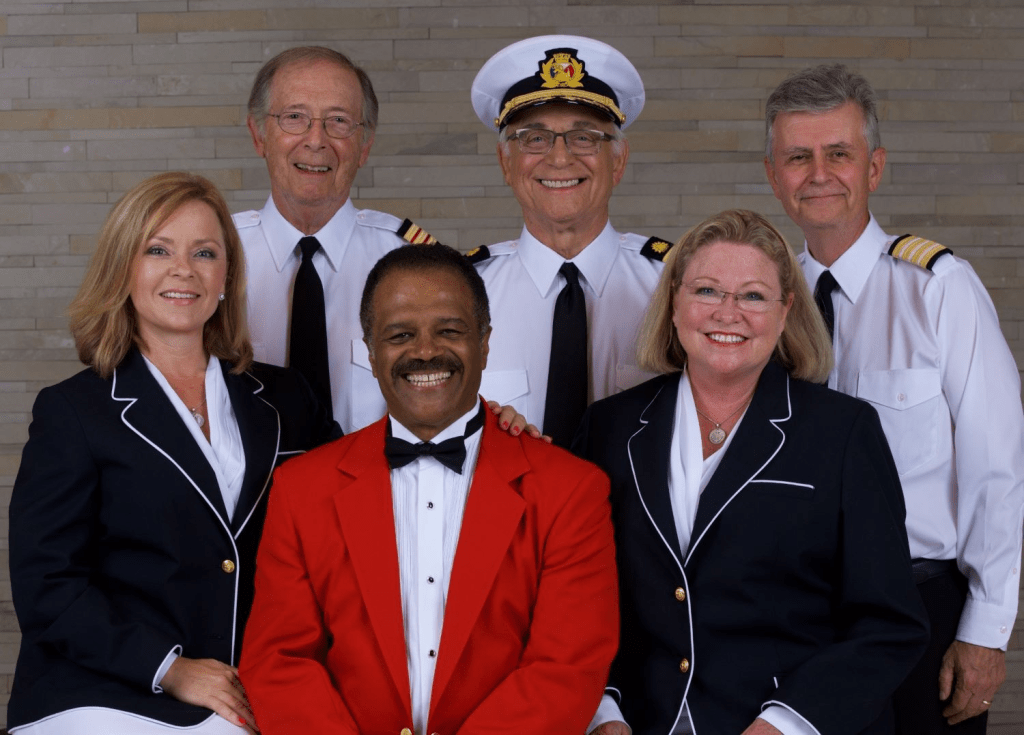
In 2013, MacLeod joined his former coworkers on The Talk for a cast reunion. Several members of the cast including Gavin took part in The Rose Bowl Parade in 2015.

The cast apparently was very close. Ted Lange who played bartender Isaac Washington mentioned the crew in an interview in 2017 with “The Wiseguyz Show,” saying “Oh yeah, sure, Gavin was wonderful. Gavin lives down here in Palm Springs and we’re still tight, all of us, Gavin and Bernie and Jill; we still see each other. Fred [who played Gopher] lives in a different state, we’re still close, we’re still good friends.”

In his spare time, Gavin enjoyed traveling, playing tennis, dancing, golfing, sailing, reading the Bible, and watching movies. Gavin passed away in May of 2021 at his home.

Photo: twitter.com

During the past decade, he released a memoir, This is Your Captain Speaking: My Fantastic Voyage Through Hollywood, Faith & Life. He explained his goal for writing this book: “My life has taken one incredible turn after another,” writes MacLeod. “I’ve gotten to do what I wanted to do. I’ve been a captain! I’ve been given this incredible gift of life and now I want to use it to give back. That’s why I’m sharing my story here, the fun parts and even some not-so-fun parts, in the hopes that maybe someone will take a nice walk down memory lane with me – and maybe I’ll even give someone a little bit of hope.”

Good memories and a little bit of hope is all we can ask for; thanks, Gavin, for giving that to us.

Pernell Roberts: A Man of Many Talents

We are up close and personal this month with some of our favorite male television stars, and Pernell Roberts is definitely on that short list. Pernell Roberts was well known to television viewers in the early sixties and the early eighties. Some fans might not even realize the two characters he was best known for, Adam Cartwright on Bonanza and Dr. John McIntyre on Trapper John, MD were played by the same man.

The Family of Bonanza Photo: toledoblade.com

Pernell Elven Roberts Jr. was born an only child in 1928. He was named for his father who was a Dr. Pepper salesman. During high school, Roberts played the horn, acted in several school and church plays, played basketball, and sang in the local USO shows. He enrolled at Georgia Tech but then enlisted in the US Marine Corps. He played both the tuba and horn in the Marine Corps Band while sometimes tackling the sousaphone and percussion parts. After his time in the Marines, he enrolled at the University of Maryland where he enjoyed participating in classical theater. He left college to continue his acting career.

In 1949, he had his professional stage debut in “The Man Who Came to Dinner” with Moss Hart and Kitty Carlisle. He then took on several roles in Philadelphia.

In 1951, Roberts married Vera Mowry; she was a professor of theatre history at Washington State University. They divorced in 1959. They had one son who was killed in a motorcycle accident in 1989.

In 1952, Roberts made the big move to New York City appearing in off-Broadway shows. Several of his costars were Joanne Woodward and Robert Culp. He performed several Shakespeare roles.

In 1956, Roberts made his television debut in Kraft Theatre. In 1957, he signed with Columbia Pictures. His first big-screen role was as Burl Ives’ son in Desire Under the Elms. His second role was with Glenn Ford and Shirley MacLaine in The Sheepman.

Roberts continued to accept television roles with ten appearances in 1958 and six in 1959.

Photo: simple.wikipedia.org

From 1959-1965 he would portray Adam Cartwright, Ben’s oldest son on Bonanza. Each of the brothers had a different mother, and Adam was the only Cartwright to attend college, studying architectural engineering. After acting in classical theater for so much of his early career, the transition to a weekly series was a difficult one for Roberts. He thought it a bit ridiculous that the independent sons had to get their father’s permission for everything they did. He wanted to act in a show with greater social relevance. So, although the show would continue until 1973, he left in 1965 after appearing in 202 episodes. The storyline was that Adam was traveling in Europe or living on the east coast. Bonanza producer David Dortort said Roberts was “rebellious, outspoken . . . and aloof, but could make any scene he was in better.”

The Odd Couple Photo: sitcomsonline.com

During this time on the show, Roberts married again in 1962; he wed Judith Roberts and they would divorce in 1971.

After leaving Bonanza, Roberts returned to theater, playing a variety of roles. He toured with many musicals including “The King and I”, “Kiss Me Kate”, “Camelot”, and “The Music Man.”

Pernell also became involved in the civil rights movement, joining Dick Gregory, Joan Baez, and Harry Belafonte in the sixties demonstrations including the March on Selma.

On Mission Impossible Photo: ebay.com

From 1972-1996, Roberts was married to Kara Knack. They also divorced.

Throughout the late sixties and seventies, Pernell continued appearing in television series and made-for-tv movies. You’ll see him in westerns such as Gunsmoke, The Big Valley, and The Virginian; spy genres including Wild Wild West, Mission Impossible, and The Girl from U.N.C.L.E.; crime shows including Hawaii Five-0, Mannix, Police Story, Ironside, Cannon, and The Rockford Files; and several medical series—Marcus Welby, West Side Medical, and Quincy. He even showed up on The Twilight Zone and The Odd Couple.

Photo: televisionacademy.com

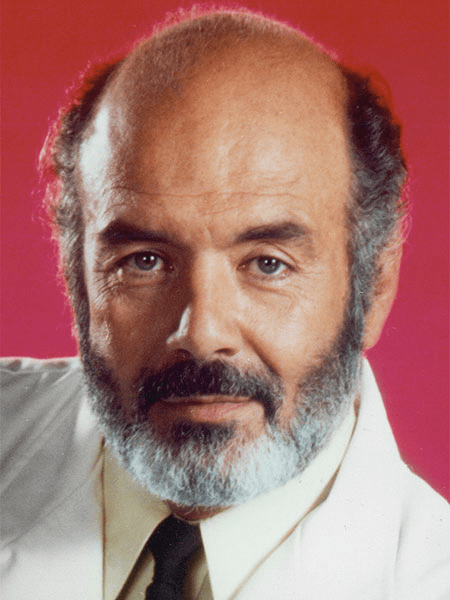
Perhaps he enjoyed those medical shows because he returned to television to star in his own series in 1979, playing Trapper John, MD. The plot was featured Trapper John from M*A*S*H later in his career at San Francisco Memorial Hospital where he was Chief of Surgery. He worked with a young surgeon who had also served in a MASH unit, Alonzo “Gonzo” Gates (Gregory Harrison). The series lasted seven seasons.

In 1979, he told TV Guide that he chose to return to a weekly show because he had “seen his father age and realized it was a vulnerable time to be without financial security.” Roberts felt the role allowed him to use his dramatic range of acting skills and to address important social issues.

In the 1990s, Roberts took on very few television appearances; his last television performance was in Diagnosis: Murder in 1997.

Roberts would attempt marriage one last time in 1999 when he wed Eleanor Criswell. When Pernell passed away in 2010 from pancreatic cancer after being diagnosed in 2007, they were still together.

Photo: Facebook.com

Pernell also enjoyed golfing, swimming, playing tennis, running, reading, cooking, and singing. He appeared on two record albums during his career. The cast of Bonanza recorded an album in 1959 and he released a folk music album in 1962, titled “Come All Ye Fair and Tender Ladies.”

He certainly had a long and varied career: music, movies, Broadway, and television. He also used his fame to help causes he believed in. I don’t think he is remembered as well as he should be. Maybe it’s because he left Bonanza too early to be included on a lot of the memorabilia that came out of that show or because there was such a gap between his two series that he starred in. Whatever the reason, I hope this blog has helped recall some of our memories of the three decades he spent entertaining us.

Big Valley: Home of the Barkleys

We are in the midst of our western series, and today we turn our attention to a show that was on ABC for four years, from 1965-1969: The Big Valley. Created by A. I. Bezzerides and Louis F. Edelman and produced by Levy-Gardner-Laven (a trio of Jules V. Levy, Arthur Gardner, and Arnold Laven).

Photo: amazon.com

The series is set on the Barkley Ranch in the 1870s, home of the Barkleys, one of the wealthiest families in the area. The ranch is based on the 30-acre Hill Ranch which existed from 1855-1931. Lawson Hill was murdered in 1861 ad then his wife Euphemia ran it. They also had three sons and one daughter. Today the ranch is covered by Camanche Reservoir waters. The exterior shot of the house used in the show was also Tara in Gone with the Wind.

Photo: pinterest.com

On Big Valley, Victoria Barkley (Barbara Stanwyck) runs the ranch with the help of her sons Jarrod (Richard Long), Heath (Lee Majors), and Nick (Peter Breck) and daughter Audra (Linda Evans).

Barbara Stanwyck in The Big Valley by Silver Screen | Barbara stanwyck,  Actresses, Silver screen
Barbara Stanwyck Photo: pinterest.com

Heath was her husband’s illegitimate son, but she considered him her own child. He never met his father who had never been told of his existence; Heath learned it from his mother on her deathbed.

Three Great Stories in the Barkley Library - The Big Valley Writing Desk
The boys of Big Valley Photo: tapatalk.com

Jarrod was an attorney and was refined and well educated. He was briefly married but his wife was killed shortly after by a bullet meant for him. Nick was the younger, hot-tempered son who helped his mother run the ranch. He was a soldier in the Union Army during the Civil War. He had a great sense of humor and was very loyal to his family.
15 Things You Don't Know About Linda Evans - INSP TV | TV Shows and Movies
Linda Evans Photo: insp.com

Audra was rather bold for the times. She was a tomboy but had a soft heart and tended to children at the local orphanage.

There was another younger Barkley, Eugene (Charles Briles), who was a medical student at Berkeley. He was seen off and on through season one, then drafted into the army and never really mentioned again.

Considering that the show was only on the air four years, a lot of stars appeared. A small sample includes Jack Albertson, Lew Ayres, Anne Baxter, Milton Berle, Charles Bronson, John Carradine, Yvonne Craig, Yvonne DeCarlo, Richard Dreyfuss, Robert Goulet, Julie Harris, Ron Howard, Cloris Leachman, Gavin MacLeod, Leslie Nielsen, Regis Philbin, Lou Rawls, Pernell Roberts, Wayne Rogers, Katharine Ross, William Shatner, and Adam West.

The Big Valley" Joshua Watson (TV Episode 1969) - IMDb
Lou Rawls guest star Photo: imdb.com

The Big Valley was a western but with a few twists and never predictable. It was the first time a woman would have the lead in a western.  The Barkleys may have been wealthy, but they were raised right. They were hardworking and fought for the underdog, making sure justice prevailed. However, it was not a cliché; no one could be trusted and nothing was exactly as it looked. Characters who appeared angelic ended up being truly evil.

Photo: hulu.com

Unfortunately for the show, it was coming in at the end of the western’s popularity and was never in the top 30 during its time on the air. The other new shows that began when it did included Get Smart, I Dream of Jeannie, Hogan’s Heroes, Lost in Space, F Troop, and The Wild Wild West.

However, it received good reviews, and in 1966, Stanwyck was nominated and won the Emmy for drama series. She would also be nominated in 1967 and 1968, losing to Barbara Bain from Mission Impossible both years.

The theme was composed by George Duning. In 1966, a soundtrack from the show was released in mono and stereo versions. During his career Duning would work on more than 300 movie and television scores.

Like many television shows in the fifties and sixties, Dell Comics published six comic books based on the show. For some reason, I did not see much in the way of merchandising for this show compared to other westerns or shows from the sixties.

A warmhearted retrospective with 'Big Valley' cowgirl Linda Evans | Medium
Photo: pinterest.com

The cast got along well. Evans and Stanwyck were exceptionally close and rehearsed at Barbara’s house every Saturday. When Arthur Gardner was interviewed on the Television Academy, he said that Stanwyck mentored the younger cast members. He said “he could not praise her enough” for the work she did.

52 The Big Valley ideas | tv westerns, barbara stanwyck, linda evans
Photo: pinterest.com

It’s too bad the show didn’t begin earlier in the decade; it might have been able to stay on the air a bit longer. It was a unique concept with a powerful woman as the star. You can currently see it on Me TV on Saturdays as well as a few other networks.       

While John Forsythe Chose “To Rome with Love,” The Network Let the Show Roam Without Much Love

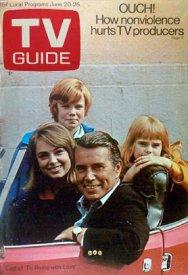
We continue our series with a salute to fathers looking at one of my favorite actors, John Forsythe in a little-remembered show, To Rome with Love.

Photo: en.wikipedia.org

The show debuted on CBS in September of 1969 and aired until spring of 1971. In 1967 Forsythe had starred in The John Forsythe Show and in the successful sitcom, Bachelor Father, seven years before that.

Photo: pinterest.com
The John Forsythe Show

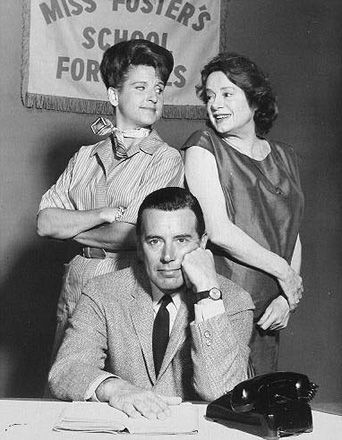
After the acclaim of Bachelor Father, The John Forsythe Show was a big disappointment. The premise of the show was that Forsythe as retired US Air Force Major John Foster inherits a private girls’ school in San Francisco. A buddy of his and former sergeant helps him run the school and they have conflicts with the principal Miss Culver. Forsythe once commented on it, saying “I choose to froget about that one. It was a disaster from the start. I hope the world forgets it too, especially the name.”

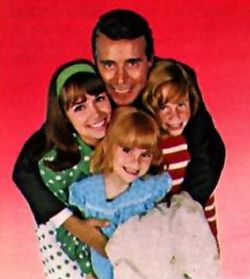
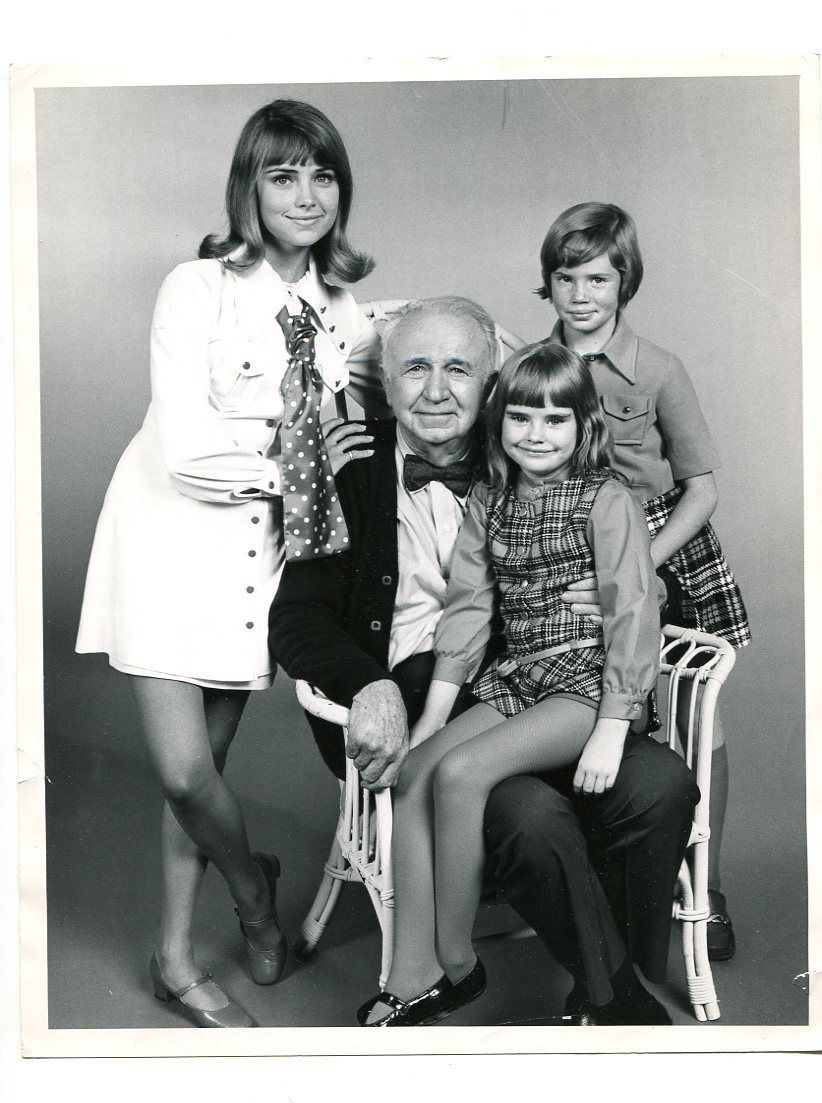
To Rome with Love also had a school setting. Forsythe played Michael Endicott, a widow with three daughters. He accepts a teaching position at an American school in Rome and relocates his family there from Iowa. His sister Harriet (Kay Medford) comes with the family for season one to help out. Endicott’s father-in-law, Andy Pruitt (Walter Brennan), comes to Rome to visit and ends up moving there during the second season.

Photo: nndb.com

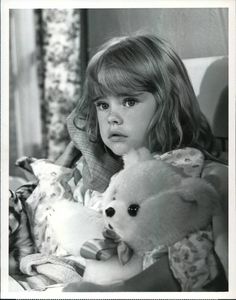
The oldest daughter is Alison (Joyce Menges), the middle is tomboy Penny (Susan Neher) and the youngest is Mary Jane, nicknamed Pokey (Melanie Fullterton). None of the girls continued in television past 1974. Menges had been a former tv and magazine model.  She appeared in two films, one before (1967) and one after (1972) the show. Fullerton made an appearance on High Chaparral before this show and appeared in two movies (1972 and 1974). Neher had the most productive acting career. She was cast on Accidental Family before appearing on To Rome with Love. After the show, she would guest star on Young Lawyers, Getting Together, Love American Style, The Partridge Family, with her last appearance was on Paul Sand in Friends and Lovers in 1974.

Photo: allstarpic.famousfix.com
Photo: famousfix.com


Photo: famousfix.com
Photo: pinterest.com

Rounding out the cast was Vito Scotti who played Mr. Mancini and Peggy Mondo who was Mama Vitale in Rome.

Photo: tvmaze.com

Photo: tvmaze.com

The show was on Sunday nights at 7:30 for the first year. It was up against Land of the Giants and The Wonderful World of Disney. The second year it switched to Tuesdays at 9:30 for the first half of the year on against movies of the week and then was moved to Wednesdays at 8:30 for the rest of the season. On Wednesdays it was up against The Smith Family and the Men from Shiloh. They were one-hour shows and To Rome with Love was on during the second half of both shows. The show never received the ratings the network had hoped for.

Photo: metv.com

Jack Gould reviewed the show before its debut. His comment was “the personable John Forsythe is the main asset of the series, but it is doubtful if he alone can overcome the handicap of imposing Hollywood nonsense on a city rich in drama and laughter and yet to be explored with understanding by TV. For the viewer, one solution is to turn off the sound and settle for incidental scenic background.” Donald Freeman from the San Diego Union called the show “all stereotyped and unfailingly pleasant.” Terrence O’Flaherty of the San Francisco Chronicle described it as a “giant pizza which appears to be filled with every situation comedy cliché in TV history and every Italian character actor south of San Luis Obispo. Dwight Newton of the San Francisco Examiner said it was “another little innocuous comedy drama series.” Apparently, viewers agreed with their opinions.

The combination of bad reviews and going up against Disney before moving to two different nights almost guaranteed its failure.

Photo: incredibleinman.com

Don Fedderson and Edmond Hartman produced the show. They were also the creative forces behind My Three Sons and Family Affair. An interesting concept was the cross-over episode. In season two, Anissa Jones and Johnnie Whitaker from Family Affair appear on the show on episode 4, “Roman Affair.” Episode 6 featured William Demarest, Don Grady, and Tina Cole from My Three Sons in “Rome is Where You Find It.”

After the show ended, Forsythe commented that his “fate is to be surrounded by ladies at home and at work which is not at all painful. I have a wife and two daughters at home. But on the television, I’ve always been unmarried. We might have started the single-parent trend with ‘Bachelor Father.’ Now the air is filed with widows and widowers raising children alone. There’s a reason for it. One unqualified parent dealing with children is more amusing because of the difficulty it presents.”

This sounded a bit exaggerated to me, so I went back to take a closer look at the shows that were on during the 1960s, and he was right. I always think of the typical sitcom as a nuclear family like the Donna Reed Show or Leave It To Beaver, but during this decade many shows were about adults. Think of Get Smart, The Joey Bishop Show, That Girl, The Odd Couple, The Mary Tyler Moore Show, or The Flying Nun. When shows were about families, the norm was almost to have a single parent. In addition to Bachelor Father, My Three Sons, and Family Affair, we had The Farmer’s Daughter, The Ghost and Mrs. Muir, The Doris Day Show, The Andy Griffith Show, Petticoat Junction, Gidget, and Julia. It wasn’t confined to sitcoms either; consider The Rifleman, Bonanza, and The Big Valley. The genre would continue into future decades as well. Some of the most popular shows featured single parents: The Partridge Family, The Courtship of Eddie’s Father, Nanny and the Professor, Diff’rent Strokes, One Day at a Time, Eight is Enough, and Alice.

Photo: dailymail.co.uk

Fortunately for viewers, Forsythe did not throw in the towel and retire into obscurity. Forsythe would go on to star as Blake Carrington on Dynasty.

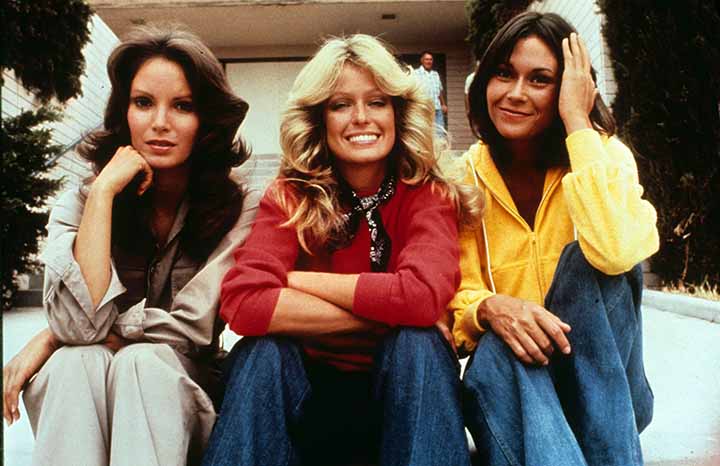
DNX6N3 Jan. 1, 1976 – F3353.”Charlie’s Angels”.FARRAH FAWCETT, KATE JACKSON, & JACLYN SMITH. 1976(Credit Image: © Globe Photos/ZUMAPRESS.com)

The show he is best remembered for is Charlie’s Angels, continuing his tradition of being surrounded by beautiful women on television.

Just a Couple of Characters, Part 3: Henry Jones and Olan Soule

My series, “Just a Couple of Characters” continues with Part 3 today. This month, we learn more about actors we recognize but may not know much about. This week Henry Jones and Olan Soule are on the hot seat.

Henry Jones

Photo: en.wikipedia.org

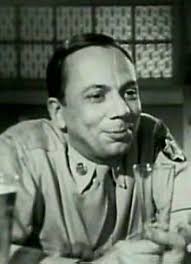
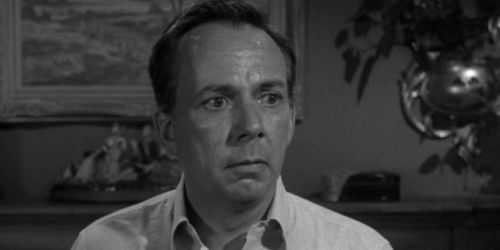
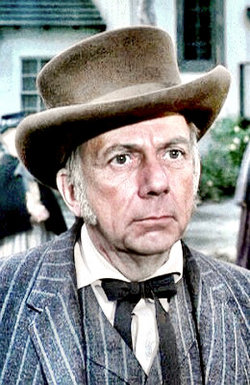
Born in New Jersey in 1912 and raised in Pennsylvania, his grandfather was a first-generation Prussian immigrant who became a Representative. Henry went to St. Joseph’s College, a Jesuit school. He landed his first Broadway show in 1938, playing Reynaldo and a grave digger in “ Hamlet. ” Like many of the actors in the late 30s and early 40s, Henry joined the Army for World War II. He was a private. During his service, he was cast as a singing soldier, Mr.  Brown, in Irving Berlin’s “This is the Army.”

When he came back to the US, he married Yvonne Sarah Bernhardt Buerger in 1942. Sadly she passed away at age 22. This information was supplied by a blog reader, and I appreciate receiving the updated information because several sources refer to his divorce which is not the case. Yvonne’s father was a renowned surgeon. One of his patients had been Sarah Bernhardt which is where Yvonne go her middle name from.

Jones continued his stage roles and began a movie career. He had bit parts in 35 films, including The Bad Seed, Will Success Spoil Rock Hunter?, Vertigo, and Butch Cassidy and the Sundance Kid. He won a Supporting Actor Tony in 1958 for his performance of Louis Howe in “Sunrise at Campobello.”

Photo: fanpix.famousfix.com

In 1948 he married Judith Johnson. They had two children (one is actress Jocelyn Jones) but divorced in 1961.

Bridging the gap of television and film, he starred in seventeen tv movies as well.

Although his movie career kept him somewhat busy, it was nothing compared to his television work. Jones was credited with 205 acting appearances, meaning he had roles in 153 different television series. Jones was able to tackle a wide range of roles, being believable as a judge, a janitor, a murderer, or a minister. Jones had no illusions about becoming a romantic lead. He once said that “casting directors didn’t know what to do with me. I was never tall enough or good looking enough to play juvenile leads.”

Photo: findagrave.com

His first television appearance was in drama series, Hands of Mystery, in 1949. His work in the 1950s was primarily in theater shows about dramas. He also appeared in the George Burns and Gracie Allen Show and Father Knows Best.

Photo: michaelstvtray.com

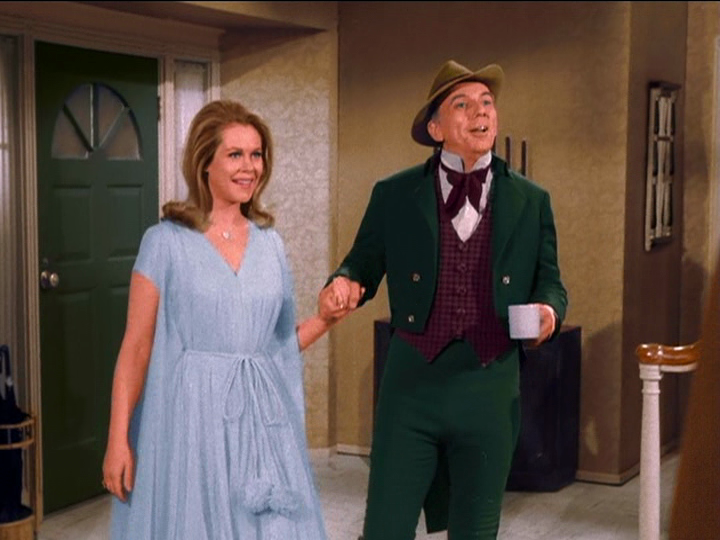
He continued his drama roles into the 1960s. He also appeared in 3 episodes of The Real McCoys and westerns including Wagon Train, The Big Valley, and Daniel Boone. He showed up on mysteries such as the Man from U.N.C.L.E. and The Name of the Game. He also found work on unique shows including Lost in Space, Route 66, and the Alfred Hitchcock Show. Hitchcock liked his work and used him five times. He also appeared in several comedies, Bewitched and That Girl. He starred in Channing in 1963-64.  Jones played Fred Baker, a dean who mentors Professor Joe Howe who teaches English at Channing College while he writes his memoir about the Korean War.

During the 1970s, he continued to work on a variety of genre shows. We see him on westerns, The Virginian, Gunsmoke, and Bonanza. We see him in thrillers like The Mod Squad; McMillan and Wife; Owen Marshall, Counselor at Law; and The Six Million Dollar Man, on which he had a recurring role as Dr. Jeffrey, a scientist who built robots. However, comedies continued to be his mainstay, and he appeared in many of them including Nanny and the Professor, the Mary Tyler Moore Show, The Paul Lynde Show, The Doris Day Show, the Partridge Family, and Barney Miller.

commons.wikimedia.org

In addition to all his guest spots, he was cast in three shows during this decade. In The Girl with Something Extra, he played Owen Metcalf in 1973. The role he was best remembered for was Judge Johnathan Dexter on Phyllis. He was Phyllis’s father-in-law from 1975-1977. As Josh Alden, he appeared on Mrs. Columbo for thirteen episodes.

Photo: totallykate.com

Recurring roles comprised most of his television appearances in the 1980s. He continued to accept guest roles on such shows as Quincy ME, Cagney and Lacey, Magnum PI, Murder She Wrote, The Love Boat, and Mr. Belvedere. He would make regular appearances on Gun Shy, Code Name: Foxfire, Falcon Crest, and I Married Dora.

Jones continued to appear in shows in the 1990s, including Coach and Empty Nest. In 1999, he passed away after suffering from complications from an injury from a fall.

Olan Soule

Photo: pinterest.com

Olan Soule’s timeline was similar to Jones. He was born in Illinois in 1909, growing up in Iowa, and he passed away in 1994. While Jones’ grandfather arrived in America, Soule’s ancestors included three Mayflower passengers. He began his acting career on the radio.

In 1929 he married Norma Miller. They would be married until her death in 1992 and they had two children.

For eleven years, he was part of the cast of the soap, “Bachelor’s Children.” His roles changed when he transitioned to television. On radio, he could play any role, but his 135-pound frame prohibited him from getting many roles he played on radio. He told the Los Angeles Times during an interview that “People can’t get over my skinny build when they meet me in person after hearing me play heroes and lovers on radio.”

Photo: tralfaz.blogspot.com

However, he certainly was not lacking in roles. Soule is credited with more than 7000 radio episodes and commercials, 60 films, and 200 television series.

The 1950s found him appearing in many sitcoms, including George Burns and Gracie Allen, I Married Joan, I Love Lucy, December Bride, the Ann Sothern Show, and Dennis the Menace.

Photo: complete-hitchcock.com

He would appear regularly in Dragnet from 1952-59 and in Captain Midnight from 1954-56.

Photo: riflemanconnors.com

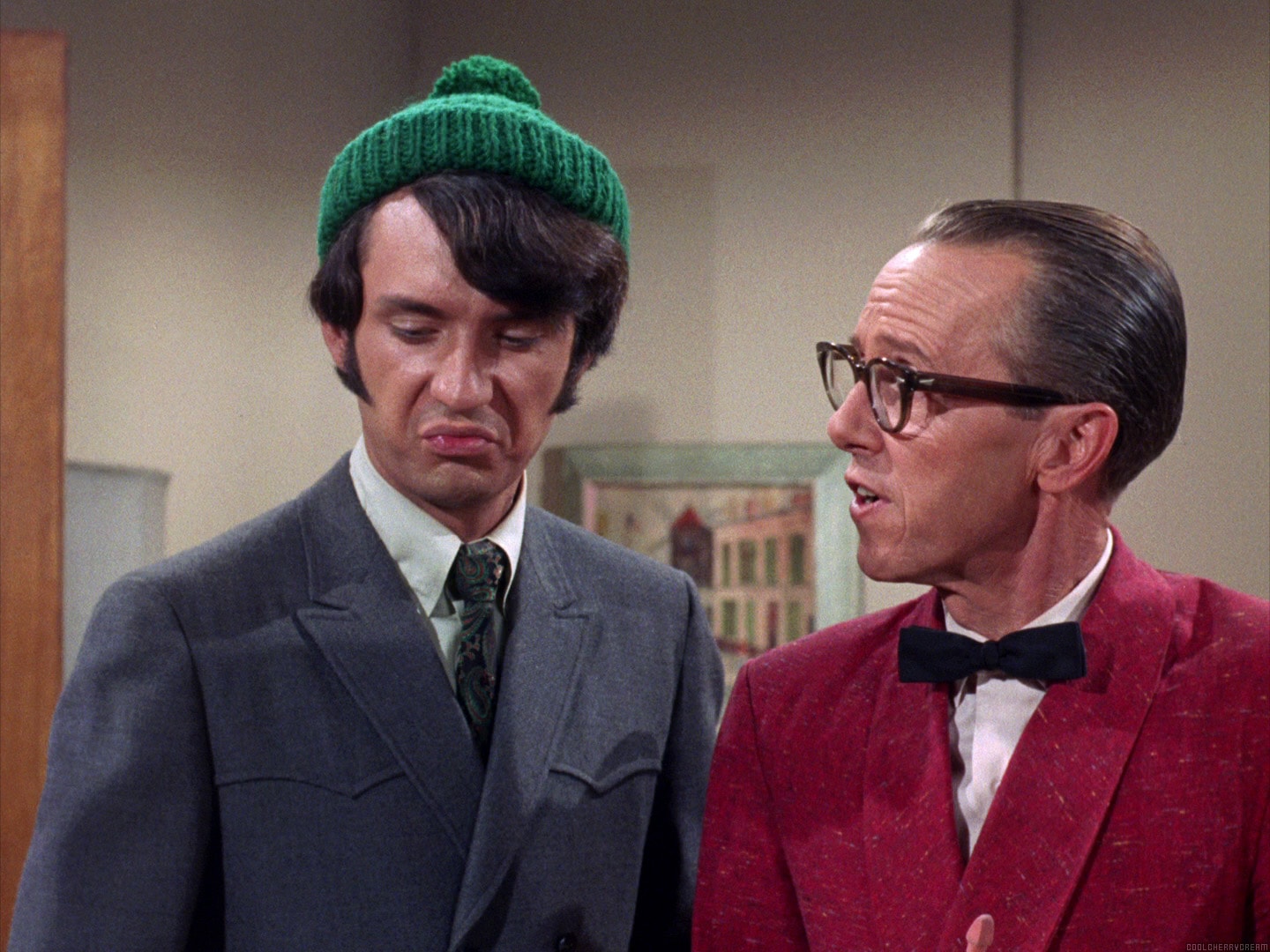
He got even busier in the 1960s, working nonstop. The only show he had a recurring role on was The Andy Griffith Show where he played choir director and hotel clerk John Masters. Other comedies he appeared on included The Jack Benny Show, Pete and Gladys, Bachelor Father, Make Room for Daddy, Mister Ed, My Favorite Martian, The Addams Family, The Monkees, Petticoat Junction, and That Girl. He also took on roles in suspense shows including One Step Beyond, the Alfred Hitchcock Show, and the Twilight Zone. He also specialized in westerns, including Maverick, Stage Coach West, Have Gun Will Travel, The Rifleman, Bonanza, Gunsmoke, and The Big Valley.

Photo: pinterest.com

He started the 1970s continuing to show up on series such as Family Affair, My Three Sons, McMillan and Wife, Cannon, Police Woman, and a recurring role on the comedy Arnie.

Photo: monkees.coolcherrycream.com

In the mid-1970s he began appearing on Battlestar Galactica and Project UFO. Most of his career in the decade was spent providing voiceovers for animated shows, primarily Batman.

The Towering Inferno Director: John Guillermin US Premiere: 10 December 1974 Copyright 1974 Twentieth Century Fox Film Corporation and Warner Bros. Inc.

In 1994, Soule died from lung cancer at age 84.

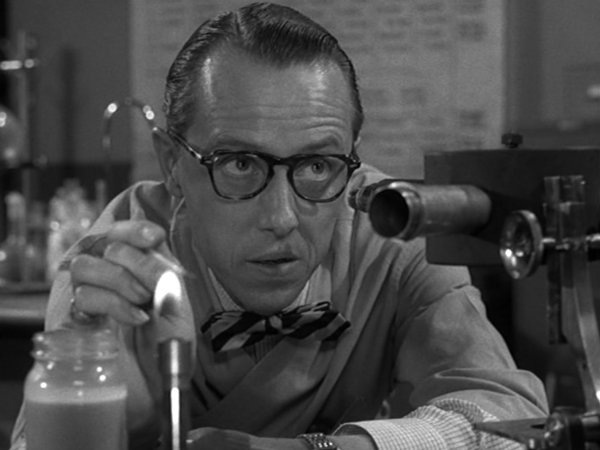
Both Soule and Jones were prolific actors who had long and successful careers. Neither one of them were the leading men type of actors, but they could tackle a wide range of roles. Soule once said, “Because of my build and glasses, I’ve mostly played lab technicians, newscasters, and railroad clerks.” Not a bad life for someone who loves acting. If you watch Antenna or Me Tv, chances are you will see these two characters pop up quite often.

Danger Will Robinson: Lost in Space Revisited

Airing in 1965, Lost in Space follows the travels of a family whose ship is off course, traveling through outer space. The show was on the air for three seasons, producing 84 episodes.

Photo: nytimes.com

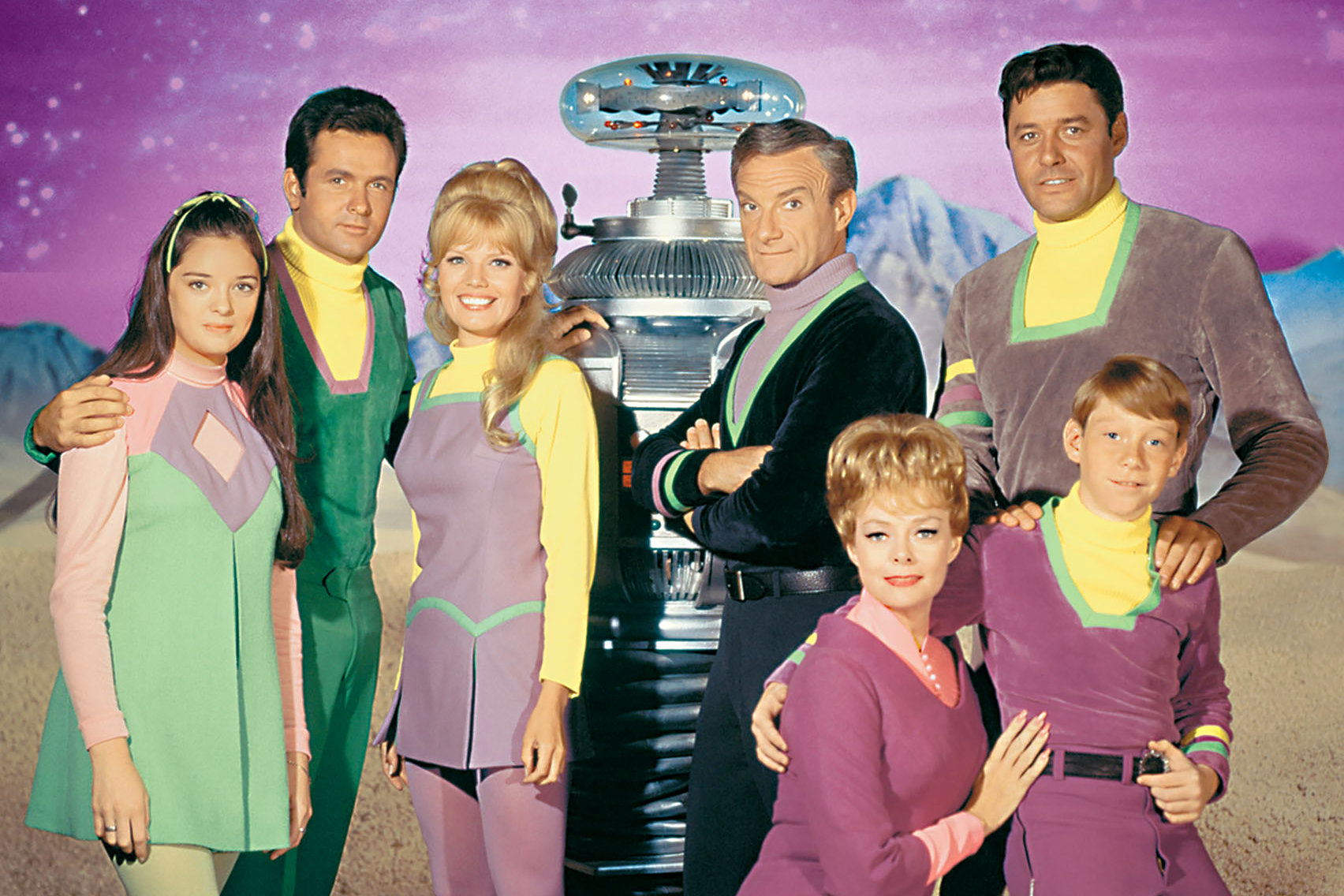
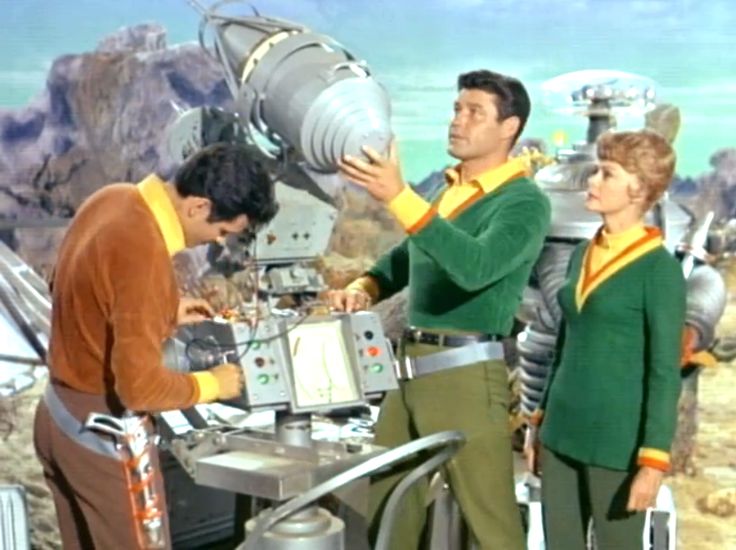
The premise of the show was that in 1997, earth becomes overpopulated. Professor John Robinson (Guy Williams); his wife Maureen (June Lockheart); and their kids, Judy (Marta Kristen), Penny (Angela Cartwright), and Will (Billy Mumy) are selected to go to the third planet in the Alpha Centauri star system to establish a new colony. Major Don West (Mark Goddard) is also accompanying them. Doctor Zachary Smith (Jonathan Harris) an enemy government agent is sent to sabotage the mission. He becomes trapped on the ship after he reprograms the robot (voiced by Dick Tufeld), altering the course for the spaceship, the Jupiter 2. The group is now lost and trying to find their way back home. During the course of the show, Smith becomes less sinister. It was no secret that the show was a science fiction version of Swiss Family Robinson.

The pilot, created by Irwin Allen, was titled “No Place to Hide.” A ship called the Gemini 12 was supposed to take a family on a 98-year journey to a new planet. When an asteroid knocks the shop off course, the family must try to find their way back. CBS bought the series, choosing Lost in Space over another new show, Star Trek. Dr. Smith and the Robinsons’ robot were added to the cast and the ship was renamed Jupiter 2.

Photo: fandom.com

Dr. Robinson was an astrophysicist who specialized in planetary geology. Williams who played the part was a well-known actor who had starred in the show Zorro. He thought his lead role would be a dramatic part, but the show became increasingly campy like Batman, and Williams’ role was more of a supporting character than a star. He was bitter about the turn of events and when the show was cancelled, he moved to Argentina where Zorro was popular and never acted again.

Photo: en.wikipedia.org

Maureen Robinson was also a doctor; she was a biochemist who also performed housewife duties such as preparing meals and tending the garden. Her chores were not too taxing though because the “auto-matic laundry” took seconds to clean, iron, fold, and package clothing in plastic bags. The dishwasher also did a load in seconds. In addition to the hydroponic garden maintained by Maureen, the crew had protein pills available that would substitute for food during emergencies. One fun fact I learned about Lockhart was that she had the largest parking spot on the 20th Century Fox lot because she often drove a 1923 Seagrave fire truck.

West was the pilot of the Jupiter 2 and the only crew member who could land the ship.

Photo: digitalvortex.info

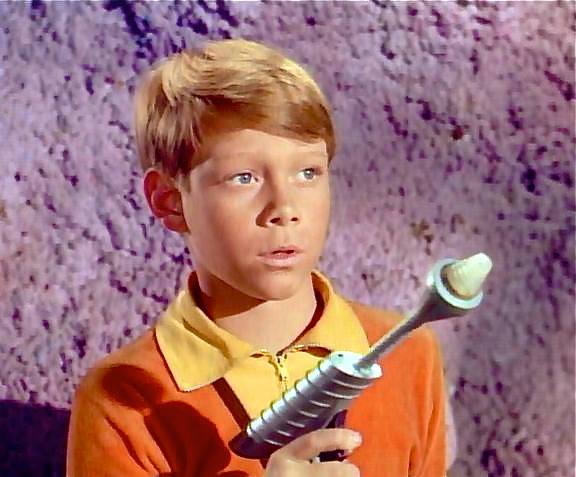
Judy is the oldest child. Being the oldest, she was allowed a more glamorous wardrobe and hairstyle. There was always the undercurrent that she and West would get together. Penny is eleven and loves animals and classical music. She finds a pet similar to a chimpanzee which she named “Bloop.” Will is nine and the youngest member of the family, but he is a genius when it comes to electronics and computer technology.

Photo: pinterest.ca
Photo: tvdatabase.wiki.com

Dr. Smith is an expert in cybernetics. Carroll O’Connor, Jack Elam, and Victor Buono were all considered for the part of Dr. Smith. Smith was only supposed to be a guest star but became the best-loved character in the show. Harris rewrote many of his lines that he considered boring. He redefined his character as an attention-getting egoist with a flamboyant style and arrogant dialogue.

Photo: nytimes.com

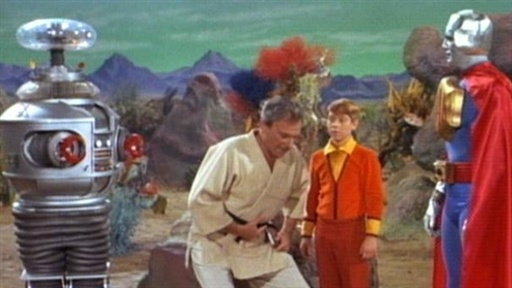
The Robot is an M-3, Model B9, General Utility Non-Theorizing Environmental Robot which had no name. It did have superhuman strength and weaponry that was futuristic in nature. It can display human characteristics such as laughter, sadness, and mockery.

Photo: denofgeek.com

The robot was designed by Robert Kinoshita. It cost $75,000 to produce and weighed more than 200 pounds. Kinoshita also designed Robby the Robot for the Forbidden Planet in 1956. The Lost in Space robot was a Burroughs B-205. It had a flashing light and large reel-to-reel tape drives. It could be seen in a variety of movies and television shows, including Voyage to the Bottom of the Sea (1964), Batman (1966), The Land of the Giants (1968), and Austin Powers: The Spy Who Shagged Me (1999).

A number of stars chose to appear on the show including Werner Klemperer, Kurt Russell, Wally Cox, Lyle Waggoner, Arte Johnson, Hans Conried, and Daniel J. Travanti.

The pilot and many shows from season one used Bernard Herrmann’s score from The Day the Earth Stood Still, a 1951 film. John Williams wrote the opening and closing themes for the show. Season three used a faster tempo version and the opening featured live action shots of the cast. The theme music is unforgettable, and although I haven’t seen the show since its original airing until recently, I immediately remembered the entire score.

Photo: friends-club.info

In season one, the ship crashes on an alien world, later identified as Priplanus. The crew spends most of the season on the planet, surviving many adventures. Most of the episodes emphasize the daily life of the Robinsons adjusting to their new conditions. The show was on Wednesday nights against The Adventures of Ozzie and Harriet and The Patty Duke Show on ABC and The Virginian on NBC.

Photo: pinterest.ca

In season two, the ship is repaired and launched into space. Priplanus is destroyed after a series of earthquakes. Eventually, the spaceship lands on another planet and is delayed there. The show became campier during this time because it was scheduled against Batman for a second year. Costumes were brighter and the show was filmed in color. Most of the plots featured outlandish villains. More emphasis was placed on Will, Dr. Smith, and the robot and serious science fiction was sacrificed. Like season one, each episode ended with a cliff hanger.

Photo: pinterest.com

Season three shows the Jupiter 2 travelling through space visiting a new setting on each episode. A space pod allows transportation between the ship and the planets they explore. Humor was still a mainstay of the show and the crew encountered space hippies, pirates, intergalactic zoos, and ice princesses. The cliff hanger disappeared, and the robot would show highlights from the upcoming episode before the closing credits. The show continued its slot on Wednesdays and was still on opposite The Virginian on NBC but also The Avengers on ABC

Photo: mightymega.com

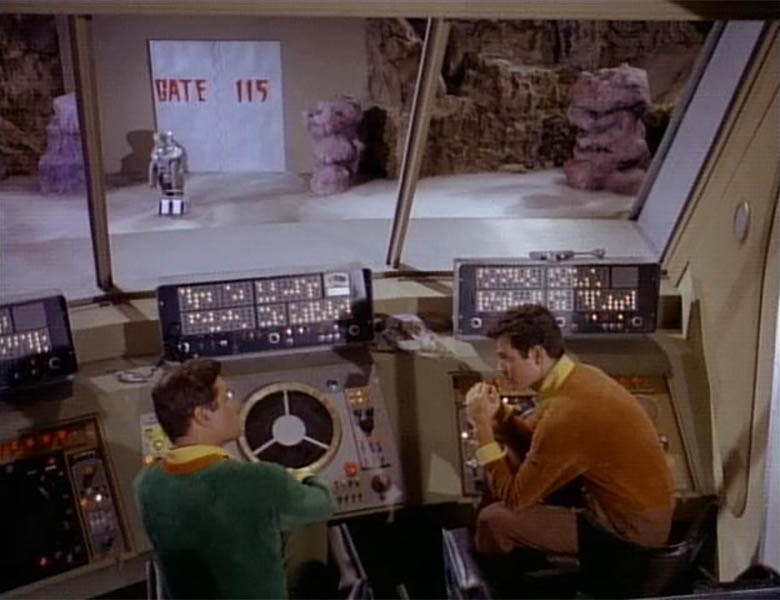
The show was probably best known for its technology and futuristic props. The Jupiter 2 was a two-deck spacecraft, nuclear powered. It used “deutronium” for fuel. The crew slept in Murphy beds. A laboratory was also designed as part of the spaceship. The characters could travel between two levels by an electronic glide tube elevator or a ladder. The ship could be entered or exited through an airlock on the upper deck or landing struts on the lower deck.

Photo: pinterest.com

The crew traveled on the Chariot. It had six bucket seats for passengers, a radio transceiver, a public address system, a rack holding laser rifles, and interior spotlights.

The crew members could use a jet pack, the Bell Rocket Belt. The robot ran air and soil tests. He could detect threats with his scanner and produce a smoke screen for protection. He could understand speech and speak to the crew. He claimed he could read minds by translating thought waves back into words.

Photo: view.yahoo.com

One of the things Lost In Space is best remembered for is the catchphrase, “Danger Will Robinson.” What is funny is that it was only used one time in the series. Smith also had several lines he is remembered for: “Oh, the pain, the pain” and “Never fear, Smith is here” are two of them. He also was famous for his alliterative phrases such as “Bubble-headed booby,” “Cackling Cacophony,” “Tin-Plated Traitor,” “Blithering Blatherskyte,” and “Traitorous Transistorized Toad” which he used to insult the robot.

Photo: en.wikipedia.org

Lost in Space ranked in the top 35 shows all three seasons it was on the air (32nd, 35th, and 33rd respectively). It was ranked number three in the top five favorite new shows of 1965-66, along with The Big Valley, Get Smart, I Dream of Jeannie, and F-Troop. The show was nominated for an Emmy for Cinematography Special Photographic Effects in 1966 and for Achievement in Visual Arts & Make-up in 1968 but did not win either award.

Despite its good ratings, CBS Chairman William Paley hated the show and didn’t understand why it was popular. He instructed his executives to cancel it the minute its ratings dipped. Unfortunately, it was never able to air a finale.

Photo: metv.com

In the 1970s, Mumy wrote a script for a reunion movie. He arranged for the casting and had approval from 20th Century Fox and CBS. However, Allen who was worried that Mumy might be entitled to a copyright claim on the original, refused to even review the script. Without his okay, the reunion was never able to be filmed.

Lost in Space was successful in reruns and syndication. All three seasons are available on DVD. Like many science-fiction shows and movies from the 1960s, it was eerily predictive of technology and glaringly wrong at the same time. The show is campy, but I don’t mind that. Along with The Monkees and Batman, it seems to fit the times it was produced in.

Photo: lrmonline.com

Perhaps it’s not that bad that Mumy was not able to film the reunion. The show was made into a movie in 1998 which received poor reviews. Legendary Television has brought a reboot of the show to Netflix in 2018.  It is currently getting ready for its second season. It has not received the greatest reviews either. Lost in Space can be seen on Antenna TV on Saturday nights, so you might want to catch an episode or two this winter. Sometimes the real thing just can’t be duplicated.

Photo: pinterest.com

In Memory of Adam West

west1

Adam West was born William West Anderson on September 19, 1928 in Walla Walla, Washington.  He just passed away this summer on June 9. His father farmed and his mother gave up her career as an opera singer and concert pianist.  Like all kids, he had a collection of comic books including Batman. When his parents divorced, he moved to Seattle with his mother. He attended Whitman College in Washington and graduated with a BS in literature. He was drafted into the Army and became an announcer on the American Forces Network television.

After his service career, he became a milkman until he moved to Hawaii to pursue a career in television. In 1959, he took on his stage name of Adam West and moved to Hollywood with his wife and children. He quickly became an actor and appeared in 33 television shows, including 77 Sunset Strip, Maverick, Hawaiian Eye, Tales of West Fargo, Perry Mason, Gunsmoke, Petticoat Junction, and Bewitched.

west4

In 1966, William Dozier, producer for a new show about Batman decided to cast West over Lyle Waggoner after seeing him as a James Bond-type character in a Nestle Quik commercial. DC Comics described Batman as 6’2” and that was West’s height.

west2

When the series ended, he and Burt Ward found themselves typecast as Batman and Robin.  He did a series of appearances about the Batman character while pursuing a movie career. He ended his career with 49 movies to his credit.

He appeared in 78 television shows after Batman ended including The Big Valley, Emergency, Alice, Police Woman, Laverne and Shirley, The Love Boat, Hart to Hart, Murphy Brown, Diagnosis Murder, News Radio, Drew Carey, King of Queens, and 30 Rock.

After 1990, he apparently embraced his Batman character and appeared on numerous television shows as himself or Batman. When asked about this, he said, “I think it evolved. I learned a long time ago that because people love Batman, I should too. I learned that I shouldn’t resent it even though it prevented me from getting other roles. I really had to become fond of Batman in order to deal with it. I embraced it.”

In 1957, he and his first wife Billie divorced.  He married  dancer Frisbie Dawson in 1957 and divorced in 1962. In 1970, he married Marcelle, and they were together until his death.  He had two children with each of his wives and two stepchildren.

In 1994, he wrote an autobiography Back to the Batcave. In 2012, he received a star on the Hollywood Walk of Fame on Hollywood Boulevard.

west8

West loved outdoor activities and had a lot of hobbies including fishing, sailing, hiking, skiing, golfing, riding motorcycles, swimming, surfing, dancing, traveling, as well as spending time with his family, listening to classic rock, reading, and watching movies.

West died after a short battle with leukemia at age 88. The next week, LA shined the bat signal on city hall to honor him.
While West certainly had a full and varied career despite his typecasting from Batman, I would like to spend some time looking at the series that gave him his fame. Typically, I am not really into super heroes, but I loved this show when I was younger and still get a kick out of watching the campy comedy. I can still hear the narrator saying, “Same bat time, same bat channel.” The show was canceled not only because of low ratings but also because the special effects and lighting had tremendous costs.  When ABC dropped it, they tried to find another network to take it over.  They had no offers, so they dismantled the set. Two weeks later, NBC offered to pick up the show, but decided it was too expensive to start from scratch.

batman4

In the 1960s, Ed Graham Productions received the rights to the comic strip Batman and intended to produce an adventure show similar to Superman or The Lone Ranger. ABC was thinking about a prime time show so DC Comics bought back the rights and sold them to 20th Century Fox. 20th Century gave it to William Dozier to produce.  Dozier had never read comic books and felt that the show should take a campy, pop-art approach. The show was originally an hour-long series, but with only half-hour time slots available, it was changed to a bi-weekly half-hour show.

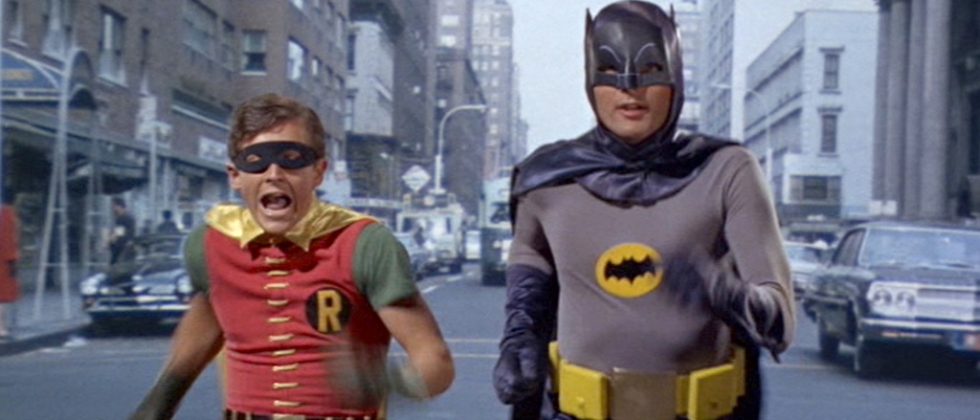
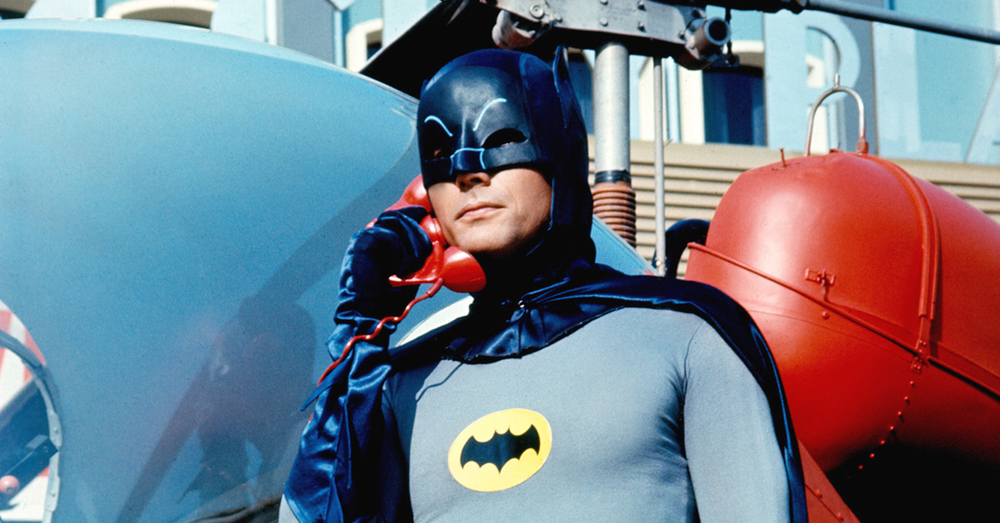
The concept of the show was that millionaire Bruce Wayne and his ward Dick Grayson lead a double life in Gotham City.  When they move a shelf in their library and slide down the bat pole to the bat cave, they become Batman and Robin.  Only their butler Alfred is aware of their real identity. Police Commissioner Gordon calls them on the batphone, often referring to them as the dynamic duo. They usually hop in their bat mobile and speed to city hall to learn what villain is up to no good in their city.

west5

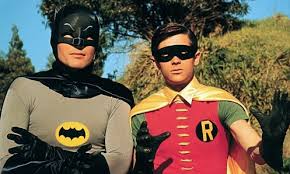
Adam West took the role of Batman/Bruce Wayne and Burt Ward was Robin/Dick Grayson. Other cast members included Alan Napier as Alfred the Butler, Neil Hamilton as Commissioner Gordon, Stafford Repp as Chief O’Hara, Madge Blake as Aunt Harriet, and Yvonne Craig as Batgirl.

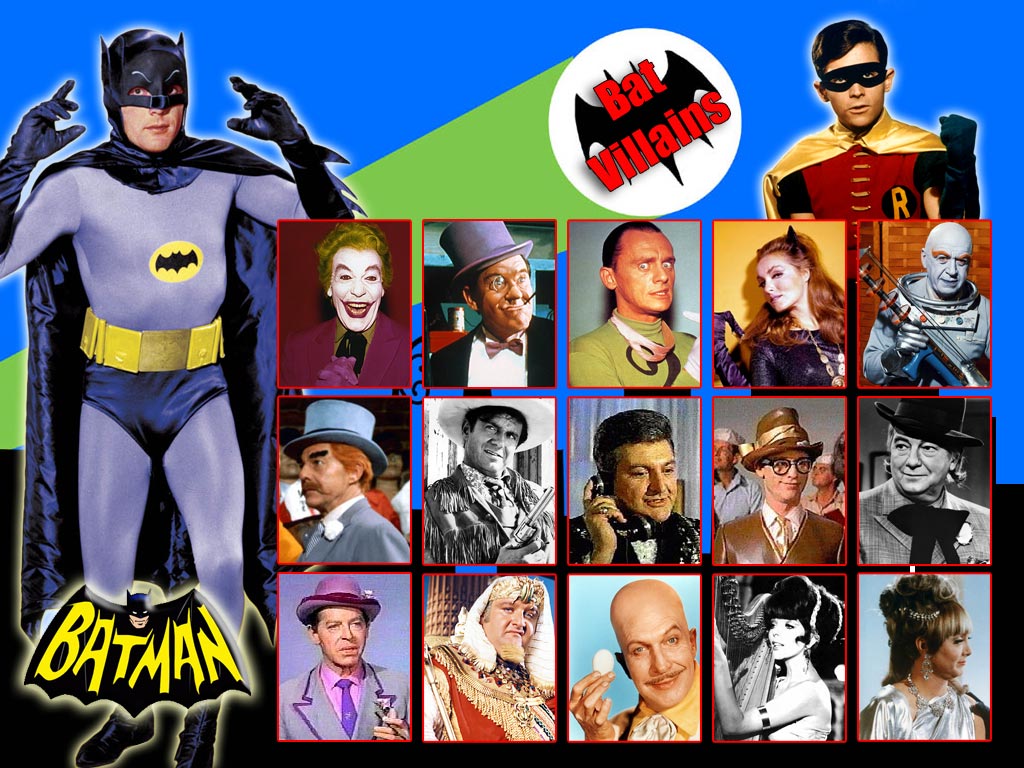
My favorite villians included Julie Newmar and Eartha Kitt as Cat Woman, in love with Batman but not willing to give up her criminal life; Burgess Meredith as Penguin always carrying an umbrella; Frank Gorshin as The Riddler leaving riddles for clues; Vincent Price as Egghead a bald-headed genius who loves eggs; Cesar Romero as the Joker who leaves jokes for clues; and Victor Buono as King Tut when evil and Professor William McElroy as his non-evil personality.

The show aired twice a week on back-to-back nights. The first episode would set up the situation and end with the dynamic duo in some dangerous situation. Batman and Robin would get their assignment from the Commissioner and then, using a series of clues, try to figure out who the villain is and then how to defeat them. At some point, there was always a fistfight with the villain’s entourage at which time the villain typically escaped. During the fight, words would pop up on the screen like POW, BAM, ZONK, BOOM. Then the crime fighters would go to look for them at which point the dangerous and perhaps deadly situation occurred and the next episode would summarize what happened on the previous episode before defeating the bad guys for good. They often used inventions like shark repellant bat spray to aid them in their search.

batman5

In Season 3, Bat Girl was added to the cast. The ratings were starting to fall so Dozier wanted to bring in a girl character to attract female viewers. Her real identity was Barbara Gordon, the Commissioner’s daughter.  The Commissioner never seemed to realize she was familiar to him. Because of low ratings, the show also became a once a week series in the third season.  Eartha Kitt took over the Catwoman role since Newmar was filming a movie at the time. Madge Blake’s health was failing, and her role was limited to two appearances during the last season.
The show was cancelled before the next season but it has continued to be popular in reruns. In 1966, an album was released “Batman: The Exclusive Original Soundtrack Album.” It included music by Nelson Riddle, dialogue excerpts from several of the characters in the show, as well as the Batman theme song, Batusi A Go Go, and several other tunes.

A lot of collectibles were produced during the run of the show including trading cards, Batmobile kits, coloring books, lunch boxes, board games, and View-Master reels. In 2013, Mattel designed an action figure line based on the tv characters, and several Hot Wheels/Matchbox cars have been produced. The Batmobile from the show was auctioned in 2013, selling for $4.2 million.  The huge profits from the car as well as the line of action figures prove the continuing interest in and success of this show now 50 years old.

Here are some fun facts I found about the series:

A total of 352 “Holy” words were used by Robin from “Holy Agility” to “Holy Zorro”.

Cesar Romero’s Joker laugh was created almost by accident. Shortly after being cast, Romero met with producers to discuss his role on his series. While waiting to meet with them, Romero happened to see conceptual art of Joker’s costuming. Romero felt the pictures almost looked absurd, and as a result spontaneously broke out into a playfully loud and almost manic laughter. A producer overhearing it responded by telling Romero “That’s it, that’s your Joker’s laugh!”

Burgess Meredith had not smoked in 20 years when he was cast as the Penguin. He came up with the Penguin’s distinctive squawking sound because the cigarettes were irritating his throat. Like his trademark “quack”, the Penguin’s waddling was largely a result of improvisation by Burgess Meredith, as he found it difficult to stand and walk straight while wearing the rubber padded fat suit that was part of his costuming.

Before going on the air, this show received the worst audience test scores in the history of ABC. It only went on the air because so much money had already been invested in it.

This was one of the “in” shows to appear on if you were a big name in Hollywood during the 1960s, and many top names guested on the show, including many who didn’t do much TV otherwise. Those performers who weren’t cast as guest villains could frequently be seen popping their heads out of windows to exchange a few words with Batman and Robin when the latter would be climbing up a building wall. Frank Sinatra, Natalie Wood, and Cary Grant were all fans of the show, and wanted to be on it, but the producers were never able to come up with the right roles for any of them. During the run of the series, this show crossed over with The Green Hornet (1966).
The “Giant Lighted Lucite Map of Gotham City” is a reverse image of St. Louis, right down to Forest Park, Fairground Park, Tower Grove Park, Lafayette Park, and Horseshoe Lake on the Illinois side, as well as the other river and road networks.

Each main villain had their own theme music.

In the first season, Burt Ward (Robin) was paid $350 per week.

Yvonne Craig has stated that she briefly did have a stunt double, but did most of her stunts herself. She actually operated the Batgirl Cycle herself as well. She was an accomplished biker at the time, and actually owned a bike.

Adam West (Bruce Wayne / Batman), Burt Ward (Dick Grayson / Robin) and  Neil Hamilton (Commissioner Gordon) are the only actors to appear in all 120 episodes of the series.

Suzanne Pleshette was one of the original choices to play Catwoman before Julie Newmar landed the role.

The show aired from January 12, 1966 to March 14, 1968 on ABC for 120 episodes. It was one of few TV series to be seen on 2 different nights a week: 7:30 Wednesdays and Thursdays. It remained there for a season and a half (Jan. 1966-Aug. 1967) until it was moved back once a week (Thursdays 7:30) for its final season. The episodes were generally two-parters: Wednesday’s episode was a cliffhanger, resolved in Thursday’s episode. The 1966-1967 season had 2 3-parter episodes (“The Zodiac Crimes/The Joker’s Hard Times/The Penguin Declines”[ep. #2.37-9, 1/11-12 & 18/1967] and “Penguin is a Girl’s Best Friend/Penguin Sets a Trend/Penguin’s Disastrous End”[ep. #2.42-4, 1/26/, 2/1 & 2/1967]) which left cliffhangers that would be solved the following week. When the series was reduced to (mostly) one part episodes during season three, the cliffhanger death traps and threats were still used, but greatly scaled back and occurring at the middle commercial break.

The three primary cast members of The Addams Family each made appearances on Batman. Carolyn Jones played the villainess Marsha, Queen of Diamonds, and John Astin played the Riddler during the second season. Additionally, Ted Cassidy had a window cameo, appearing in his part as Lurch from The Addams Family. Interestingly, Cassidy’s cameo took place in a story involving the Penguin, with whom Jones’ character Marsha teamed up in one of the three-part stories.

In episode 7, Alfred refers to Robin as Mr. Ward, and not Mr. Grayson.

While Superheroes and the movies and television shows they appear in seem to cycle up and down throughout the decades, the popularity of the Batman television show has never wavered.  The fact that Mattel would create action figures based on the original stars almost 50 years after the show debuted says a lot about the fans and the place the show holds in their hearts.

Thank you Adam West for creating such a memorable and well-loved character.  Rest in peace.

batman2