We are continuing to our series, “Behind the Scenes.” Today we are learning a bit about the career of a set designer. When we think of our favorite sitcoms from the past, many of us remember their houses as places we visited and know well. Think about The Brady Bunch and their seventies kitchen or Frasier’s apartment full of elegant things and then Martin’s old chair right in the middle of it.
📷Facebook.com The Brady Kitchen
Set designers have similar jobs as costumers except that they are dressing and accessorizing the places where the characters live, work, and do life. They research specific time periods to get historical details right; they create detailed sketches, 3D models, and blueprints for home design and furniture placement; and they work hard to ensure that every home looks like the character who inhabits it. In addition, they oversee construction, painting and installation of sets, and manage the budget. They study architectural styles, the science of color, and develop an awareness of how rooms and homes flow both for movement of actors and allowing equipment like cameras to be set up.
I thought it was hard to find information about costumers and makeup artists, but set designers are no easier to learn about. Let’s meet a few of them.
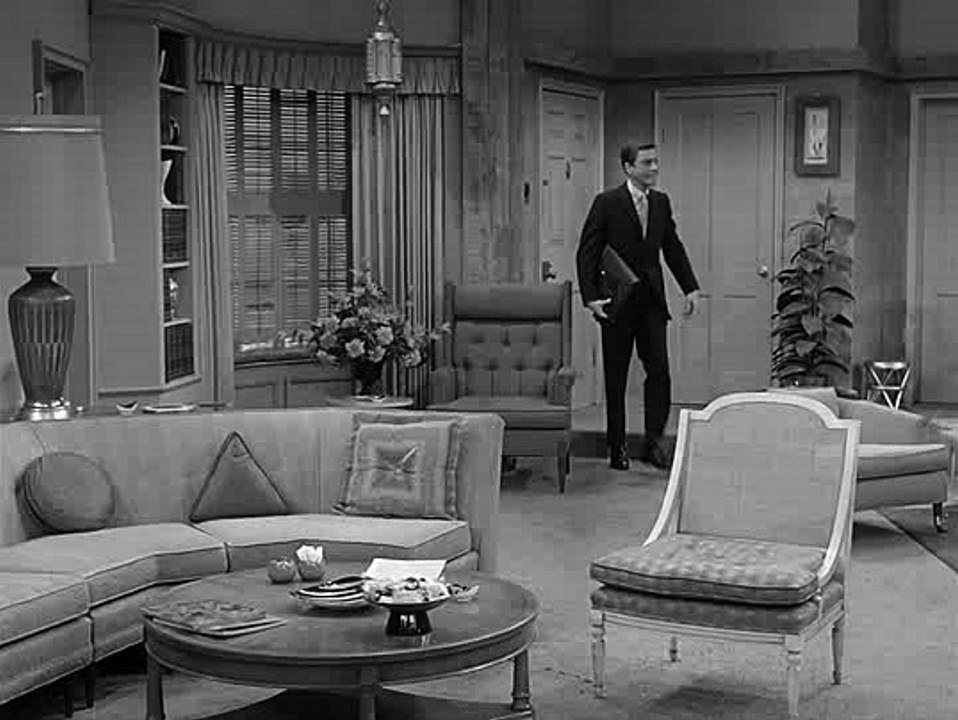
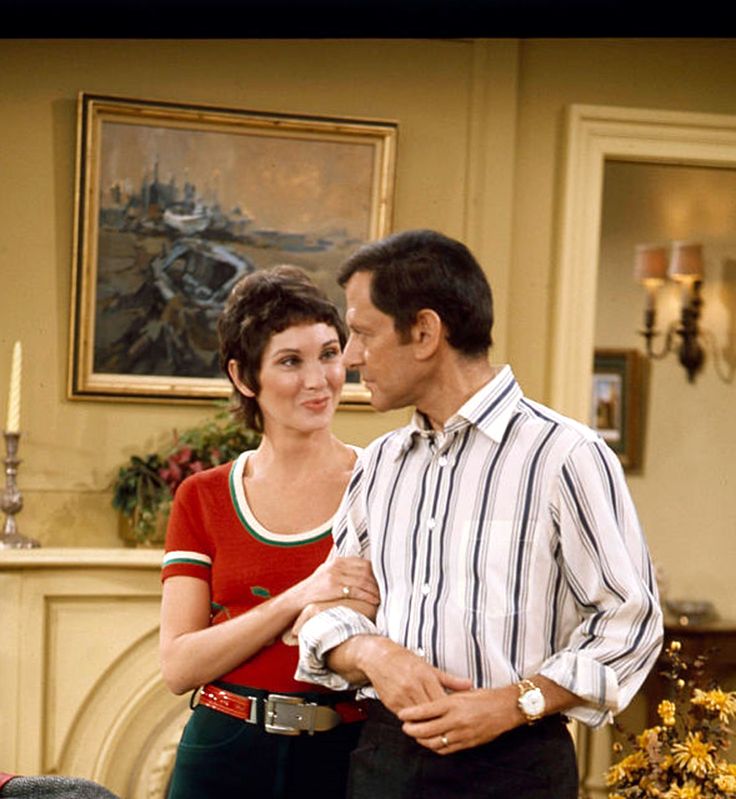
📷artdepartmental.com Rob and Laura Petrie’s living room
Ken Swartz was born in Oregon in 1913. He began his career in the 1940s working as a set decorator and he remained in film for a couple of decades, but television is where he made his mark. He took his film experience to the small screen working on many popular shows including The Dick Van Dyke Show, The Andy Griffith Show, The Danny Thomas Show, The Joey Bishop Show, and I Spy in the sixties. In the seventies he worked on The Rookies. I have talked about Sheldon Leonard many times over the years and what a professional he was and his high-quality standards. Swartz’s shows in the sixties were all Leonard shows, so he must have been very good at his job to keep getting hired show after show.
Swartz died in Los Angeles in 1973, putting an end to his career at age 60. The cause of his death was never disclosed. While his career was much shorter than we would have liked, he designed many iconic homes for some of our favorite characters like Rob and Laura Petrie’s suburban home; Aunt Bee, Andy, and Opie’s southern house; and the beauty and grandeur of the I Spy sets.
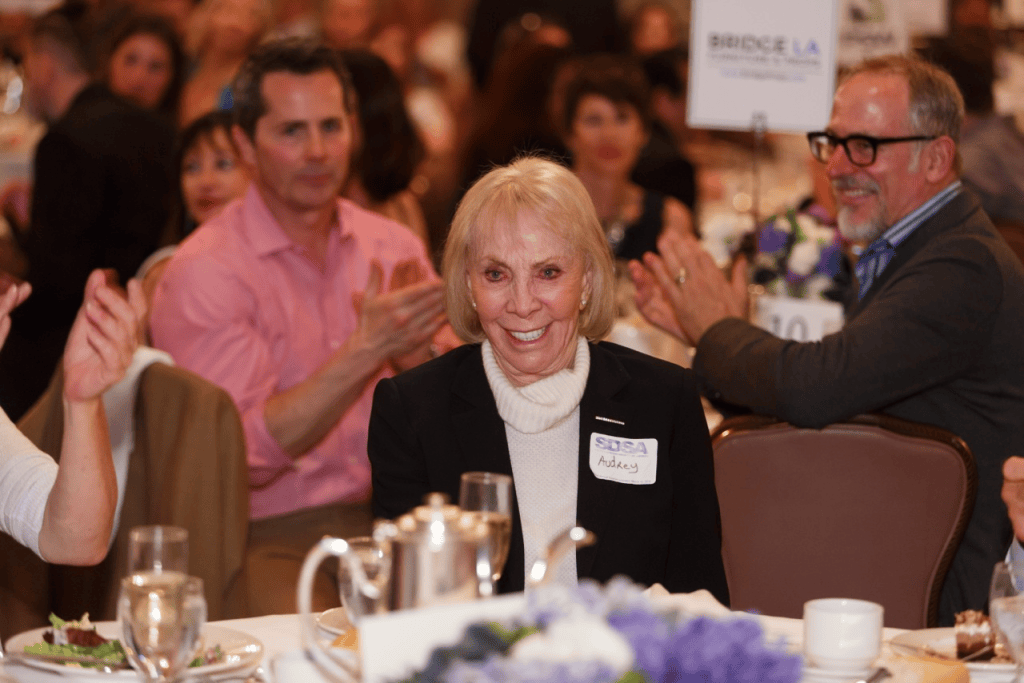
Audrey Blasdel-Goddard was born in California in 1930. After receiving a Master’s degree from UC Berkeley in 1954, she worked as a social worker for three years. During that time, she transitioned to work as a script supervisor for eight years before deciding she wanted to become a set decorator. From 1965-1988, she designed movie and television sets.
📷setdecoratorssocietyofamerica.com
Blasdel-Goddard became a producer at Columbia TV from 1976-1982; however, from 1975 until 1991, she also worked at Columbia heading the TV Property Department. She was the first woman to head a major studio property department. Later in 1991 she moved to Sony Pictures for the final seventeen years of her career at which time she retired.
Audrey had an amazingly successful career in television and film, but it was not easy for her to get established. She spent two years working on the television show Sky King learning to be a set decorator. While working as a script supervisor during the day, she attended art school and interior design classes at night.
When she felt qualified, she applied for acceptance into the Union and was told by a business agent, Ed LeRoy, “We haven’t taken a woman into this union, except seamstresses, since it was called the IA.” When she shared her experiences with Universal Property Head John McCarthy and art director Frank Arrigo, they hired her for decorating jobs on shows like The Munsters. After the required thirty days on the job, she submitted her application and dues for membership. After four months of waiting, the Union called the studio and told them to fire her because they hadn’t received an application or payment. Luckily, she kept her receipt from her money order, and after producing it, her paperwork was suddenly “found.” A year and a half after starting her job as a set decorator, she finally got into the Union.
When Audrey worked at Sony, she was asked to run a prop house, so she built the inventory from scratch. She was also a partner in the Hollywood Central prop house.
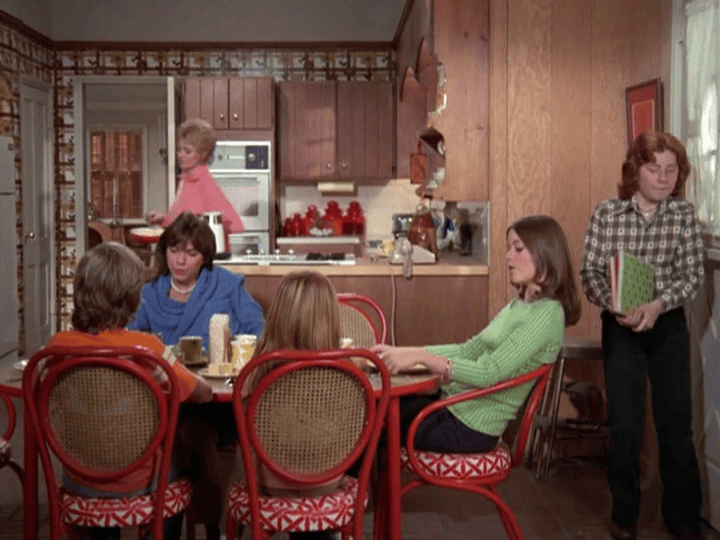
📷davidcassidy.com Partridge Family Kitchen
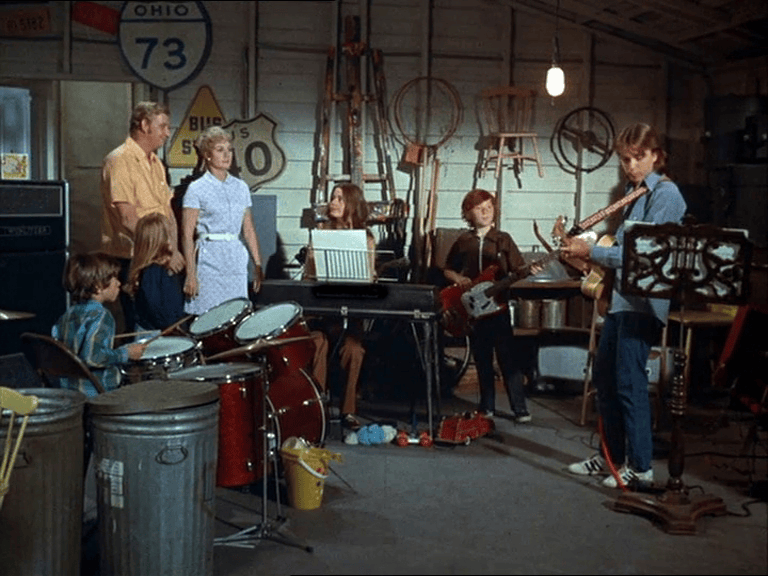
📷davidcassicy.com Partridge Family Garage
In addition to The Munsters, her television work includes Pistols ‘n Petticoats, The Partridge Family, Police Woman, Fantasy Island, Hart to Hart, Crazy Like a Fox, TJ Hooker, and Designing Women.
Blasdel-Goddard is now enjoying retirement, spending lots of time with her family, attending book clubs, doing charity work, and traveling.
I appreciated learning more about these hard-working professionals who help create the shows and characters we fall in love with during our lives. Special thanks to Audrey Blasdel-Goddard for persevering in a hard-to-overcome men’s world in set designing and property supervision. Any of their lives would make an exciting movie. Fun Fact: If you are reading this and thinking about some of your favorite television homes, check out Mark Bennett’s book, TV Sets: Fantasy Blueprints of Classic TV Homes.
Welcome to our blog theme for the month, “Behind the Scenes.” We are going behind the camera to check out careers of those people working behind the camera to bring our favorite characters to life. Last week we learned a bit about costumer designers, and today we are heading to the makeup counter.
So, what do makeup artists do? Obviously, they apply cosmetic products to enhance the appearance of the stars, but they do so much more. Artists also fit prosthetics and create the effects of blood, wounds, burns, and general aging; adjust colors and textures to work with high-definition cameras and bright lights; assure consistency for multiple-day filming; manage sweating; and sometimes choose and fit wigs for characters. Let’s look at a few of the best in the field to learn more about their life and careers.
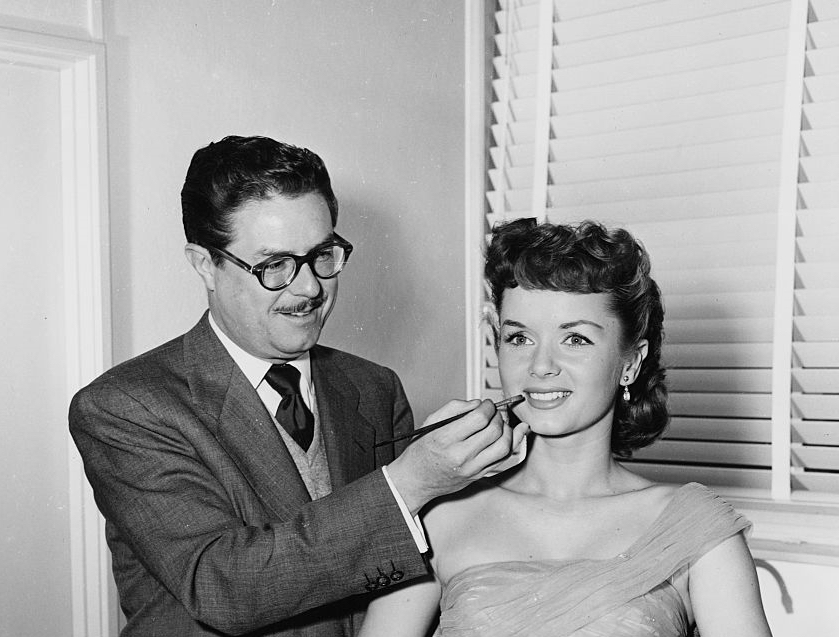
📷vintagestardust.wordpress.com
William Tuttle
William Tuttle was the first makeup artist to win an Academy Award. He created many innovative techniques and trained generations of makeup artists.
He was born in Florida in 1912. After dropping out of school early to support his mother and younger brother, he held a variety of jobs including forming his own band. In 1930, he moved to Los Angeles, enrolling in an art school and working as a page at Fox Studios. That younger brother, Thomas Tuttle, would also become a makeup artist working on The Dick Van Dyke Show, The Joey Bishop Show, Gomer Pyle USMC, and That Girl among others.
Tuttle was hired at Twentieth Century Pictures to work under Jack Dawn. In 1934, Dawn took a job at Metro-Goldwyn-Mayer and Tuttle moved with him. Tuttle was still working under Dawn but began taking on more responsibilities. He supervised the makeup in many popular movies including The Wizard of Oz and Father of the Bride. Eventually, he became the head of the makeup department.
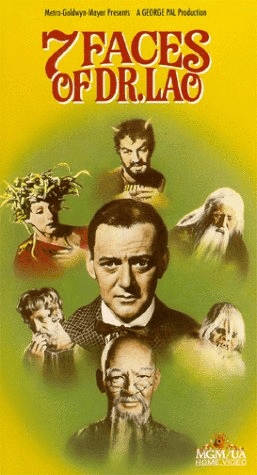
He received a special Oscar for his work on 7 Faces of Dr. Lao in 1965. In this film, Tuttle transformed Tony Randall into seven different characters including Dr. Lao; an aged, bearded Merlin the Magician; and a Medusa with a feminine appearance. Randall said “he shaved my head and eyebrows . . . gave me an unborn look. But professionally it was a masterstroke.” He went on to say that “all my preconceived notions on how I would play the characters vanished. As soon as Tuttle applied his makeup magic, I felt myself actually become these strange people.”
The Oscar category of makeup artist would not become an official category until 1982. That year Rick Baker won the first Oscar for makeup. He would go on to win another five and he credited Tuttle: “His work greatly influenced me.” He said as a young boy, he often tried to re-create the makeup techniques Tuttle used in The Twilight Zone.
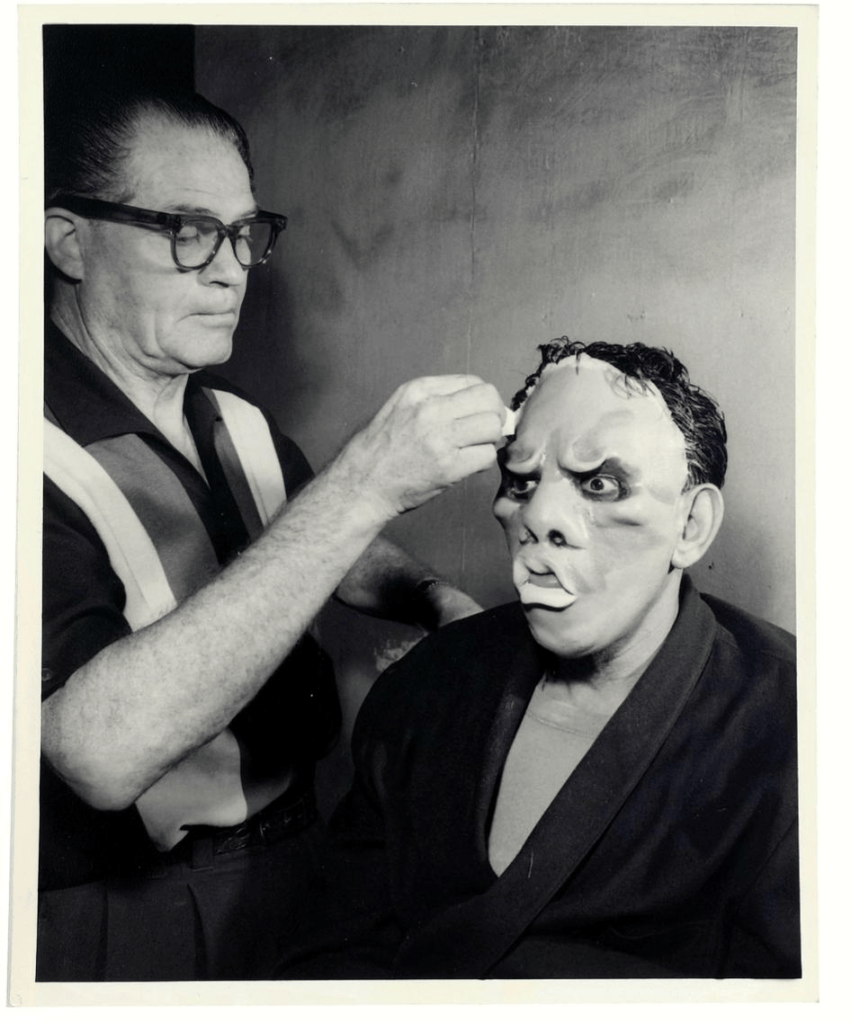
📷reddit.com
Tuttle was the artist behind one of my favorite Twilight Zone episodes, “Eye of the Beholder.” When the episode begins, doctors and nurses are working with a bandaged patient who just wants to look like everyone else. After some time, the bandages are slowly peeled away. We see the beautiful face of Donna Douglas. As she picks up the mirror to look at her new face, she screams, cries and covers her face. Then the camera pulls away and we see all the people Tuttle did makeup on – doctors and nurses with deformed faces and pig snouts.
With 393 credits, most of Tuttle’s work was in the movies, but he contributed to television as well. From 1960-62 he provided all the makeup for National Velvet. He also spent time on Mr. Novak, My Favorite Martian, The Man from U.N.C.L.E. as well as The Girl from U.N.C.L.E.,The Phyllis Diller Show, and The Courtship of Eddie’s Father, among others.
Later in his career, Tuttle created his own line of makeup, Custom Color Cosmetics. Naimie Ojeil, owner of a beauty supply store in Hollywood said his brand was “the most popular makeup among Hollywood professionals for at least two decades.”
Tuttle would create molds of actors he worked on which allowed him to create their looks beforehand. He donated them to the University of Southern California where he taught from 1970-1995. Herbert Farmer, a USC archivist said Tuttle “was interested in passing on all he could to the students. He had a real following.”
Gene Hibbs
Gene Hibbs was born in Normal, Illinois in 1912.
📷imdb.com
I couldn’t find a lot of information about him. I did read several times that he was often hired because he had a unique talent for making older actresses look younger than they were with a technique he called “painting.”
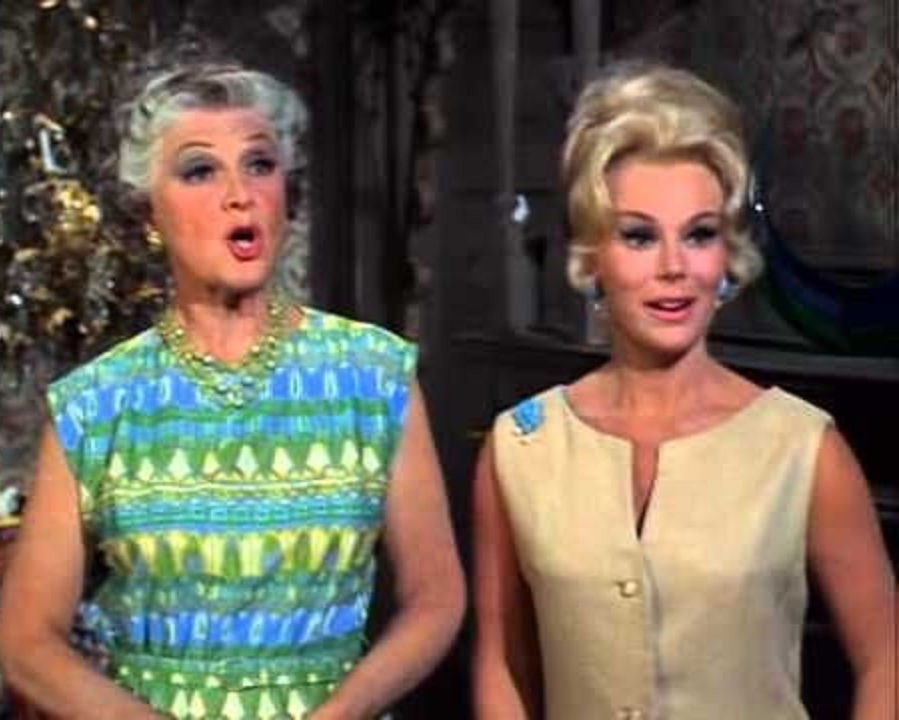
His first television series was The Lone Ranger from 1954-1955. He worked on many television shows following that including with Ann Sothern on Private Secretary and The Ann Sothern Show, The Judy Garland Show, Here’s Lucy, and Green Acres.
He was working on Green Acres when Judy Garland passed away. She had stipulated in her will that Hibbs was supposed to do her makeup one last time. Her daughter Liza Minelli phoned Hibbs and he agreed to do that. When the network said no, Eva Gabor said she would not work unless he was allowed to leave for a few days. The producer pleaded with the network, but they held firm and said they would lose $30,000 of time and he could not leave the set.
Ben Lane
📷ebay.com Ben Lane on the set
Ben Lane was born in 1912 in Chicago, Illinois, the same year as both Gene Hibbs and William Tuttle. Lane was one of the founding members of the Motion Picture Guild, but many of his 236 credits were spent in television.
Lane’s first television series was in 1957 for Sergeant Preston of the Yukon. His career would continue with many popular shows. Get ready to take a long breath because this sample is far from a comprehensive listing of his work. Ready? He was part of the cast for The Lone Ranger, Dennis the Menace, The Farmer’s Daughter, Hazel, Gidget, The Monkees, Bewitched, The Flying Nun, I Dream of Jeannie, Bridget Loves Bernie, The Partridge Family, Police Woman, and Fantasy Island.
In addition to keeping busy with his career, he was involved in several charities: City of Hope and Shriner’s circus. He became a nationwide clown advisor. He also was a consultant for the Los Angeles Police Department, the US Department of Justice, and the FBI for disguises.
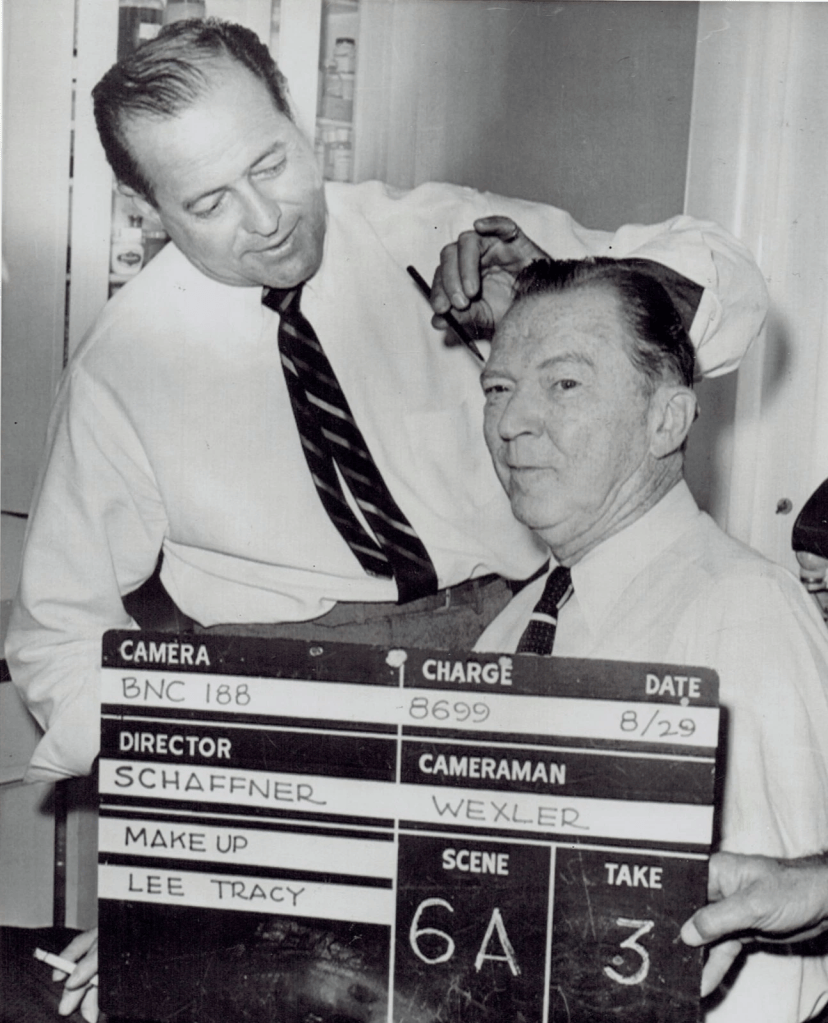
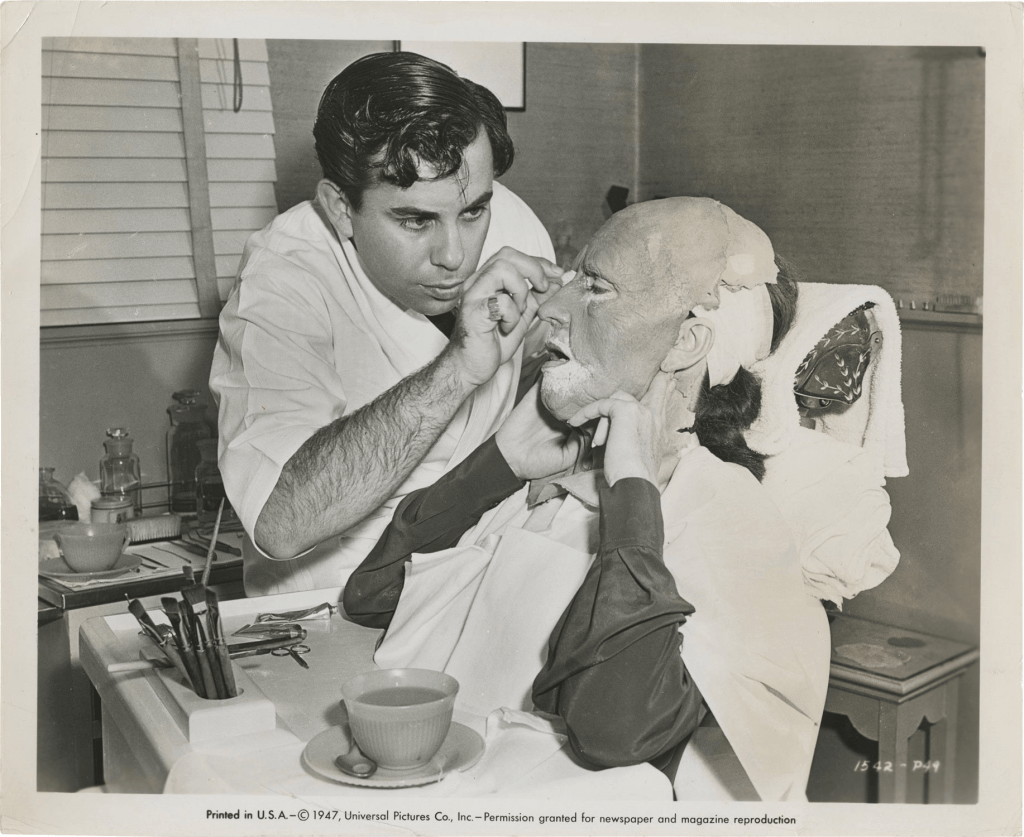
Bud Westmore
📷abebooks.com Westmore working on the film The Lost Moment
Born in 1918 in New Orleans, Westmore and his brothers—Ern, Frank, Monte, Perc, and Wally–were all makeup artists in the entertainment business. At one time, there was a Westmore heading up almost every studio makeup department.
After school, Bud was an apprentice under Perc at Warner Brothers to learn hair design and makeup before taking a job at Twentieth Century Fox. He left to serve three years with the Coast Guard. When he returned to Hollywood, he worked for the Eagle Lion before he was hired as the head of the Universal Studios makeup department in 1947. The largest building on the Universal studio back lot is named for Bud.
His marriages and divorces also kept him busy. He was married to actress Martha Raye for four months in 1937. A few years later he married Rosemary Lane, another actress, and they were together for fourteen years. His divorce to Lane was on March 31, 1955, and on April 1, 1955, he married Jeanne Shores, a former Miss California in 1952. They would remain together until his death from a heart attack in 1973.
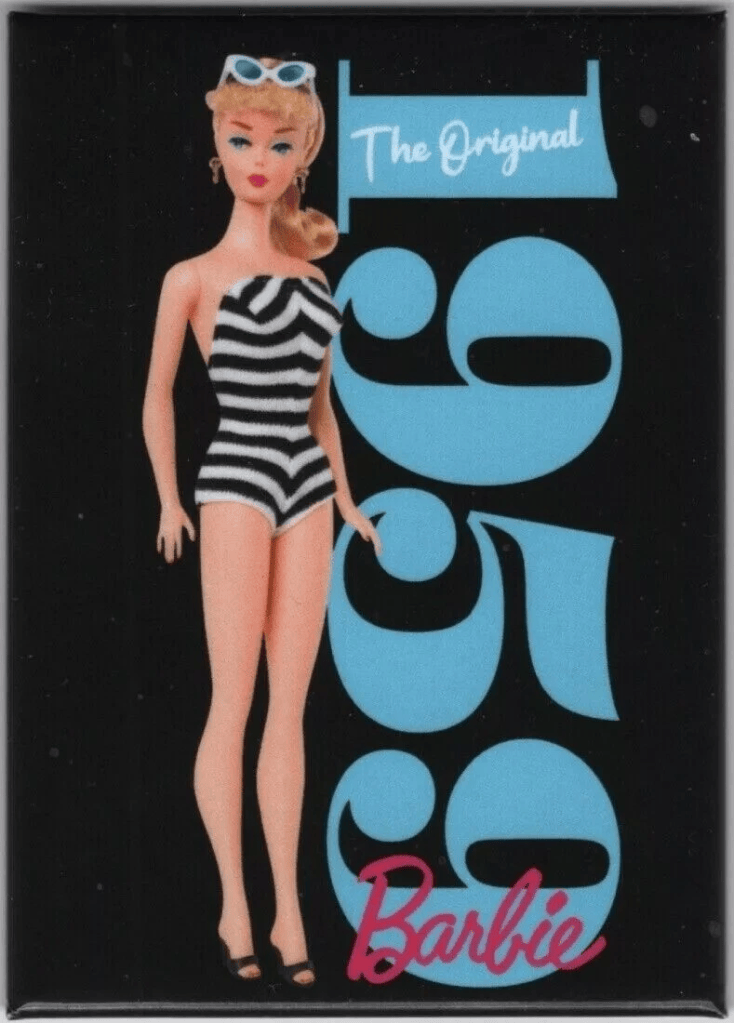
In 1957 Bud was asked to create makeup for a new doll that was coming on the market. In 1959 Barbie debuted. Bud had based her on a German doll Mattel found named Lili. He modified “the bee-stung lips, heavy eyelashes, and widow’s peak to give her an All-American Girl look” and he rooted her hair.
With more than 600 credits on both the big screen and the small screen, Bud’s first television project was Playhouse 90 in 1957. During the sixties he was involved in quite a few shows including The Jack Benny Program, McHale’s Navy, The Munsters, It Takes a Thief, Ironside, Marcus Welby MD, and The Virginian.
It was fun to learn a little bit about these make-up professionals and the shows they worked on to help create some of our favorite television land characters.
This month we are exploring The Bill Dana Show for our blog series. Last week we talked a bit about the show itself, and for the rest of the weeks, we are looking at some of the other cast members’ careers. Today we begin with Bill Dana himself.
📷findagrave.com
Dana was born William Szathmary in Quincy, Massachusetts in 1924. He was the youngest of six children. His older brother Arthur was fluent in several languages and inspired Bill to learn different accents.
Dana served with the US Army during WWII as a machine gunner and was awarded the Bronze Star Medal.
After the war, Bill enrolled at Emerson College. After graduation, he was hired as a page at NBC’s Studio 6B, or 30 Rock. He was also trying to break into comedy performing around New York. During the fifties he appeared on The Imogene Coca Show. He also did some writing and producing for The Spike Jones Show.
He met Don Adams and began writing routines for him in the fifties. He and Don would be part of each other’s lives for a bit. Don would be one of the cast members on The Bill Dana Show. Dana would appear on Adams’ show Get Smart, and Dana’s older brother Irving was the composer of the Get Smart theme song. Bill would also cowrite the script for the Get Smart film The Nude Bomb.
📷thenewyorktimes.com
In the late fifties, Steve Allen hired Dana as a writer. Bill created a character, Jose Jimenez, for the “Man in the Street” segments of Allen’s show. Soon Jose became his alter ego. He made appearances as Jose on The Red Skelton Show, The Spike Jones Show, The Danny Thomas Show, and The Ed Sullivan Show. He even had a comedy album featuring the character.
Dana told a story on Ed Sullivan’s show that some people truly thought he was Jose Jimenez. One lady who met him out and about asked if his birth name was Jose Jimenez and he told her, “No, it’s Bill Szathmary.” She said “Wow, no wonder you changed it to Jimenez.”
In 1961, Dana began a recurring role on The Danny Thomas Show. He played Jimenez as an elevator operator. People responded so well that Danny Thomas and Leonard Sheldon spun off the character, now a bellhop at a luxury New York hotel, and The Bill Dana Show was created. In addition to Adams, Jonathan Harrison was part of the cast and Maggie Peterson joined them in season two. The show was on the air for one and a half seasons.
As we discussed last week, some people saw Jimenez as a hard-working immigrant who noticed some of the crazy things Americans did, and others saw him as a stereotyped Latino caricature. The pre-show Jimenez fit the second description better and the show Jimenez leaned more toward the first portrayal. However, as the character developed, viewers were not flocking to the show. It was also up against Lassie which at the time was a huge family show on Sunday nights.
📷wikipedia.com
The last time Jimenez was on the screen as a character was a 1966 episode of Batman in a cameo on the famous wall. Later Dana apologized for his caricature of Jimenez and became a bit of an activist for Latino causes. The National Hispanic Media Coalition endorsed the Jose Jimenez character and invited Dana to sit on their advisory board.
Dana jumped back and forth from actor to writer for a couple of decades. He wrote the script for All in the Family’s episode “Sammy’s Visit” starring Sammy Davis Jr. He also wrote for Bridget Loves Bernie, Chico and the Man, Donny and Marie, The Smothers Brothers Comedy Hour, and Matlock.
His acting landed him in The Courtship of Eddie’s Father, Love American Style, The SnoopSisters, Police Woman, McMillan and Wife, Ellery Queen, Switch, Vega$, Fantasy Island, The Facts of Life, and Empty Nest among a few others.
He had recurring roles on two additional shows during his career. He was on St. Elsewhere as Howie Mandel’s character’s father for three episodes. He also was Angelo on six episodes of The Golden Girls.
One of his last projects was founding the American Comedy Archives at Emerson College. He and Jenni Matz interviewed more than 60 comedians for this archive, including Phyllis Diller, Norman Lear, Carl Reiner, Betty White, and Jonathan Winters.
Dana was a man of many talents. He also ran a talent management company and an advertising agency. He wrote a book, The Laughter Prescription, with Dr. Laurence J. Peter.
Dana passed away in June of 2017 at his home in Nashville.
Certainly, Dana had a full career. I think starting off with the Jose debacle probably kept him from getting different roles early in his career. He also didn’t seem to know what he wanted to be when he grew up. Was he a comedy writer? A dramatic writer? A variety show writer? Was he an actor? A talent agent? An author? Not that you can’t be more than one thing in life, but in the span of three decades he never seemed to settle on one or two careers. Hopefully he had fun and enjoyed all the different hats he wore.
We are learning about some of our favorite female character actresses. Today we are learning more about the life of Virginia Sale.
📷champaigncounty history museum.com
Virginia was born in 1899 in Illinois. Her father Frank was a dentist, and her mother Lillie Belle was a poet and truant officer for the Urbana Illinois School District. After graduation, she attended the University of Illinois for two years and then transferred to the American Academy of Dramatic Arts in New York where she graduated in the early twenties. Her brother Charles was a vaudeville comic, and he persuaded her to go to Hollywood to pursue a film career.
She began her career in Hollywood as an extra. In 1931, she did an interview for the Kansas City Star where she said “I had known an assistant director [named Ned] when I lived in New York. He introduced me to King Vidor, then casting for The Crowd. He gave me quite a good bit in the picture, although it lasted only five days. When asked how much salary I wanted, Ned told me to say $350 a week. ‘Well, I think you ought to work for us for $25 a day’ the casting director said. ‘That’s an awful comedown I protested,’ trembling in my boots. ‘All right then, let’s compromise on $35 a day,’ he said. I was awfully glad to get it.” That would be almost $600 a day currently.
📷x.com
During her first two years in Hollywood, Virginia lived at the Hollywood Studio Club. She appeared in 54 films between 1930 and 1935.
The Hollywood Studio Club was created as a safe place for starlets to live. Mary Pickford, along with several other women, was trying to raise money to construct a new building to house actresses. Will Hays gave $20,000 and soon after the studios contributed. Julia Morgan was hired as the architect. She designed an Italian Renaissance Revival style building that opened in 1926. The first floor had a spacious lobby, a library, writing rooms, a dining room, and a stage. The upper stories were single, double, and triple rooms. Men were only allowed to be on the first floor. You had to be between 18-35 years old, be seeking work as an actress, and could stay a maximum of three years. A hundred women lived there, paying $10-15 a week for room and board.
📷mayberrywikifandom.com
Barbara Hale, Donna Reed, Dorothy Malone, Ann B. Davis, Barbara Eden, Sharon Tate, and Sally Struthers were just a few of the women who lived there. The most famous resident was Marilyn Monroe. After the culture shift in the sixties and seventies, the residents decreased until the Club could no longer financially exist. In 1975 the doors were closed, and the contents were auctioned off.
In Hollywood Sale was often cast as an older woman, even though she was still in her twenties. She entered the movie entertainment business just as silent films were ending. Her first role was in Legionnaires in Paris in 1927. During her film work, she met actor and studio executive Sam Wren, and they married in 1935. In 1936 they had twins named Virginia and Christopher.
In the thirties, Virginia developed a one-woman show based on her life growing up in Illinois which she called “American Sketches.” She performed the piece more than 6000 times throughout the thirties, forties, and fifties, even touring Europe during WWII. This sounds like it would have been a fun show to see. Some of the different pieces of the performance included: “Traveling on the Illinois Central” where she portrays a mother trying to keep her son under control after a visit with relatives; “Life of the Party” where she is a giggling, talkative woman who annoys a young man she is trying to impress; “Mealtime in Indiana” where she impersonates a housewife trying to get ready for the Ladies Guild while preparing supper for her family; “Three O’Clock in the Morning” as a weary hostess trying to get her guests to go home, and “I Remember Abraham Lincoln” where she is Grandma Willoughby reminiscing about her encounters with Lincoln.
📷rottentomatoes.com
She also received some radio work, including a serial, For Those We Love, playing Martha the maid every Sunday for eight years.
Her film career continued to develop during those decades and she appeared in Topper, When Tomorrow Comes, They Died with Their Boots On, and Night and Day.
Sam served in WWII as part of the Air Corps. When he returned home, he had a six-year position as executive secretary for the Actor’s Equity. He was an executive at both Warner Brothers and Columbia studios.
📷imdb.com Topper
In 1949 as television was developing, she and Sam created a sitcom, Wren’s Nest which featured the life of the Wrens starring Virginia, Sam, and the twins. The show aired three times a week. Virginia took over writing duties on the show. Many of her scripts were based on real events that happened to the family. The series contained 47 episodes.
During the fifties, Sale took a break from the big screen, focusing on television shows and commercials. She appeared in several series in the fifties, but she hit her stride during the sixties. If you watch a lot of television from that decade, you can catch her in a variety of shows including The Many Lives of Dobie Gillis, Ben Casey, The BeverlyHillbillies, Wild Wild West, The Andy Griffith Show, Green Acres, and I Spy. She had a recurring role on Petticoat Junction where she played several characters. Her final television role was in Police Woman in 1975.
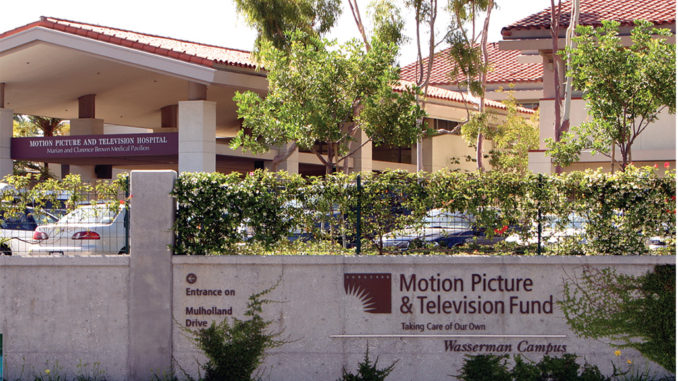
Sam passed away in 1962, and Virginia lived another thirty years, dying in 1992 from heart failure. Both Sam and Virginia are buried in Arlington National Cemetery. She spent her final years at the Motion Picture and Television Country Hospital in Woodland Hills, California.
📷
Sale could thank Mary Pickford for her home once again. Pickford was part of the Motion Picture Relief Fund which she founded with Joseph Schenck and Reverend Neal Dodd. When several former Hollywood stars died destitute in the thirties, 48 acres were purchased in the San Fernando Valley to build a Motion Picture Country House. In 1948, the Motion Picture Hospital was dedicated on the grounds. Later television actors were invited to live there as well. By that time, the site included a retirement community with individual cottages, administrative offices, and a hospital. Fees are based on the ability to pay. Actors, artists, backlot men, cameramen, directors, extras, producers and security guards are all eligible to live there. To live there, residents must be at least 70 and have worked in the entertainment industry for at least 20 years.
It was fun to learn not only about Virginia Sales but also the places she lived at the beginning and the end of her career.
This week we are finishing up our “Supportive Women” blog series. If you watched a lot of television in the sixties and seventies, you will remember today’s blog star very well: Morgan Fairchild.
Photo: dallasfandom.com
Morgan Fairchild was born Patsy Ann McClenny in 1950 in Dallas, Texas. In grade school, she was too shy to read her book report in class, so her mother, an English teacher, signed her up for drama lessons. At age ten, she began performing in dinner theater and stock productions in Dallas which led to several local commercials.
In 1967 she married Jack Calmes; they would divorce in 1973.
In 1967, a young Morgan was hired as a double for Faye Dunaway in Bonnie and Clyde. At age 20 she was cast in her first movie where we could see her face, A Bullet for a Pretty Boy. She would receive roles for another 35 big-screen features during her career.
However, most of her work was on the small screen. Her first role was Jennifer Pace on Search for Tomorrow. She stayed with that show for four years but she would come back to soap operas on and off throughout her acting time and could be seen on The Bold and The Beautiful, Days of Our Lives, General Hospital, and most recently as Sydney Chase in The City in 1996. Most of her roles were the stereotype of an elegant and wealthy woman who will do whatever it takes to get what she wants.
In between work on soap operas, Morgan showed up on many of the most popular shows as a guest star or regular cast member. In 1976 she was on Kojak. After her time on Search for Tomorrow, during the 1970s she appeared on other dramas including Police Woman, Barnaby Jones, and Dallas and on sitcoms like The Bob Newhart Show, Happy Days, and Morkand Mindy.
Flamingo Road Photo: nbcwikifandom.com
During the 1980s she did make a few guest appearances on The Love Boat, Simon and Simon, Magnum PI, and Hotel. Morgan received an Emmy nomination for her appearance on Murphy Brown in 1989. However, it was during this decade that Fairchild was a regular cast member on three different shows: Flamingo Road, Paper Dolls, and Falcon Crest (attorney Jordan Roberts), all night-time soap operas.
Flamingo Road was based on a novel written in 1949. It features the small town of Truro, Florida. The wealthy citizens live on Flamingo Road in their mansions, while the lower classes do what they have to do to make that street their address. Morgan played a woman with one of the longest names on television: Constance Weldon Semple Carlyle. After two years, the show was done.
Photo: IthinkthereforeIreview.com
Paper Dolls was about the modeling world. Fairchild played Racine, an agent, and the show is about the jobs that her models take on including a perfume company that uses her models exclusively. The series only lasted for thirteen episodes.
Morgan played Jordan Roberts, an attorney, on Falcon Crest. This long-running drama from 1981-90 featured the Gioberti family who operates the Falcon Crest Winery in California.
In the nineties, she appeared on a variety of shows including Roseanne, Empty Nest, Murder She Wrote, Diagnosis Murder, Cybill, and Home Improvement.
Her career continued during the 2000s where you could see her on Dharmaand Greg and Hot in Cleveland, as well as five appearances on Friends as Chandler Bing’s mother Nora. She also had another series, Fashion House, in 2006 as Sophia Blakely. The concept of the show was another fashion-themed one where a ruthless executive played by Bo Derek defends her company against a hostile takeover.
Friends Photo:netflixlife.com
With so many movie channels, we forget today that for a few decades we could not watch movies on television. The networks came up with a solution: made-for-tv movies, and Morgan was a queen of the genre with thirty movies and six miniseries.
Morgan has continued to stay busy. She has two finished productions listed on imdb that have not been released yet.
Fairchild has used her platform as a celebrity to advocate for AIDS research, the pro-choice movement, and many environmental issues. She collects movie memorabilia, especially Marilyn Monroe items, and antique clothing. She seems to have had a long-lasting career. It would have been fun to see her star in a sitcom instead of just playing ruthless women who just care about fame and money.
Continuing the “What a Character” series, today we look at the career of Nita Talbot. Born in 1930 in New York as Anita Sokol, Talbot had an almost fifty-year-long career. She began appearing in films in 1949 with It’s a Great Feeling (and would go on to make another 30), but it was in television that she had her greatest success. It’s a Great Feeling starred Doris Day and Jack Carson in a parody of what goes on behind the scenes of the making of a Hollywood movie.
Photo: pinterest.com
She was married to Don Gordon from 1954-1958 and to Thomas Geas from 1961 until sometime in the 1970s. I could not narrow it down to any specific year. Both of her husbands were also actors. Her sister Gloria was the wife of Carl Betz who co-starred as Alex Stone on The Donna Reed Show.
Photo: pinterest.com Joe and Mabel
Talbot began her television career in 1950 on Repertory Theater. Appearing in 32 different shows throughout the fifties, many of her appearances were in dramas, primarily shows with different plays weekly. Talbot had a recurring role on Man Against Crime starring Ralph Bellamy, appearing in 9 of the 123 episodes. Later in the decade she was cast in Joe and Mabel in 1956. Nita played the role of Mabel, a manicurist who was dating cab driver Joe. The show only lasted four episodes. At the end of the decade, she would have a recurring role on The Thin Man as Beatrice/Blondie Dane a con artist.
Photo: pinterest.com Gomer Pyle
Nita would take on roles in 29 different shows in the sixties. This decade was her “western” season. She did appear in Gomer Pyle and The Monkees, but most of her roles were in westerns, including Gunsmoke, Maverick, The Man from Blackhawk, Rawhide, The Virginian, Daniel Boone, and Bonanza.
Photo: pinterest.com
During this ten-year period, she would be cast in three shows, one drama, and two comedies. In 1960, she could be seen in Bourbon Street Beat about a New Orleans detective agency where she played Lusti Weather. She co-starred in one sitcom this decade with Jim Backus in The Jim Backus Show. Backus plays Mike O’Toole, who struggles to keep his news service business afloat. Talbot played the role of Dora, one of O’Toole’s reporters. The show only lasted for one season.
At the end of the decade, Talbot was offered the role that she would become best known for. Although she only appeared in seven episodes of Hogan’s Heroes, she earned an Emmy nomination for Best Supporting Actress in a Comedy Series in 1967-68 season for her role of Marya, a Russian spy.
Photo: pinterest.com Hogan’s Heroes
One of her taglines was “Hogahn darlink.” While Hogan could charm most women, he never was certain when he could or couldn’t trust Marya, but he was often coerced to join forces with her against the Germans.
She continued her thriving television career during the seventies with another 26 shows; four of those would be permanent or recurring roles; however, none of them lasted very long.
In 1971, she was offered the role of Maggie Prescott in Funny Face starring Sandy Duncan. Duncan played a college student who worked part time as an actress and Talbot was her agent. When CBS picked up the pilot, they made several changes which resulted in Talbot’s role being dropped.
Photo: blogspot.com Here We Go Again
1973 found her as part of the cast of Here We Go Again. The show portrayed life after divorce for two couples. It should have been renamed, There We Went because the show only lasted for 13 episodes before being canceled.
Photo: rebeatmag.com The Monkees
In 1977 she joined the cast of Soap, playing Sheila Fine, who has an affair with Burt Campbell’s son Peter.
In 1979, Supertrain debuted. It was supposedly the most expensive show ever made. It was a “Love Boat” on the rails. The supertrain traveled across the country and every week passengers found love and solved life problems on their journeys. The show was derailed after nine episodes.
In between these roles, she tended to appear primarily in crime shows in the 1970s such as Mannix, McCloud, Columbo, Police Story, The Rockford Files, Charlie’sAngels, and Police Woman.
Photo: pinterest.com The Partridge Family
Her roles diminished a bit in the eighties with 13 appearances and 9 in the 1990s. She would be cast in one additional sitcom in 1988, Starting from Scratch. This show starred Bill Daily and Connie Stevens as a divorced couple. Stevens leaves her second husband to come back to her ex-spouse and two sons. Talbot played Rose. The show seemed to get good ratings and currently people are rating them 4.5-4.8 out of 5.0, so I’m not sure why it was canceled after a year.
Photo: pinterest.com
Talbot retired in the late 1990s and is hopefully enjoying a less-busy life. She had a long and successful career and certainly was a character!
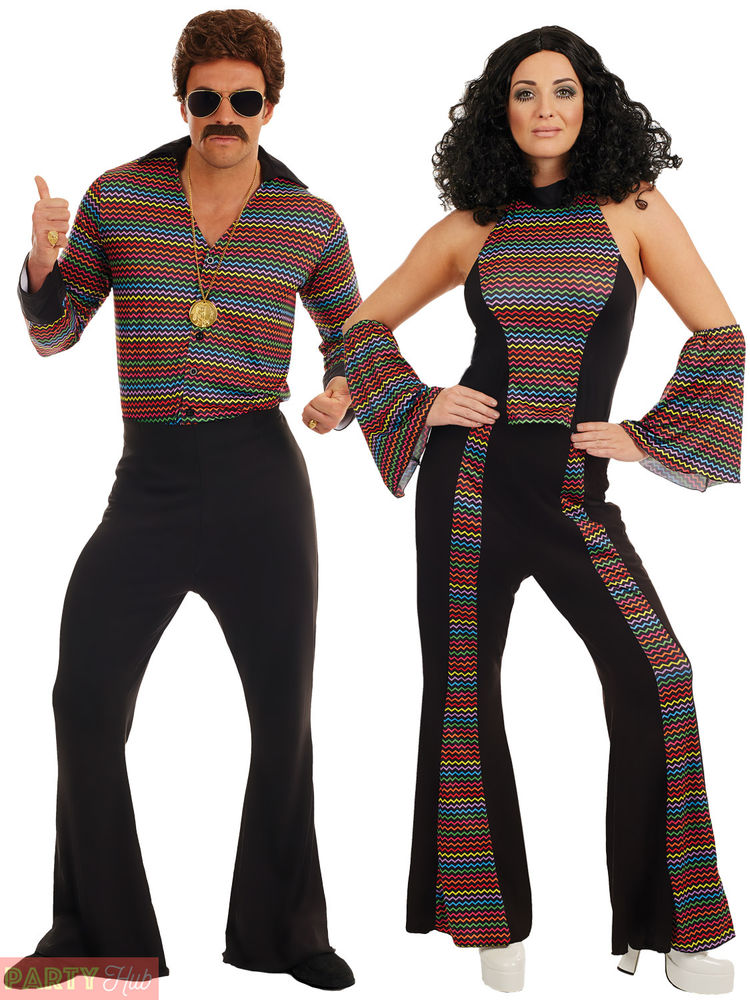
Continuing our series about “Valerie,” today we look at a slice of American life from the 1970s. It’s hard to emphasize how much the movie Saturday Night Fever changed American culture. In the movie, a high school graduate played by John Travolta, escapes his hard life by dancing at the local disco. The hippie culture of the late 1960s and early ‘70s was shoved aside by the bold and brash disco era. It was hard to go anywhere without the background soundtrack of the movie being heard. Extravagant clothing and three-piece suits were back in style, along with platform shoes and blingy jewelry.
Photo: ebay.com Saturday Night Fever, the movie that started it all
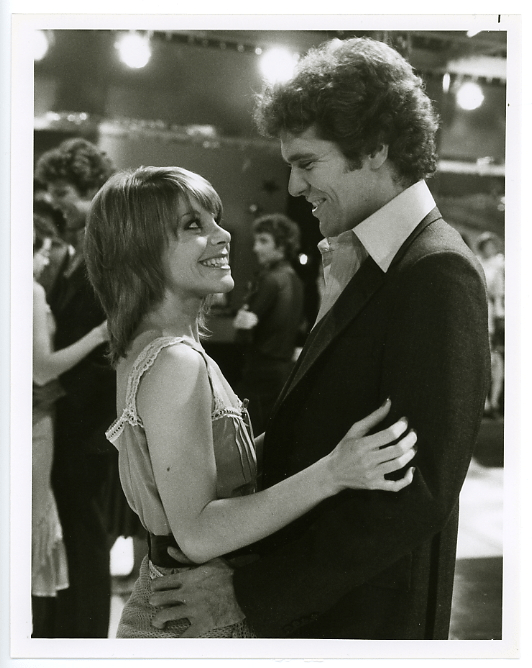
A year after the movie debuted, a new show called Joe and Valerie appeared in April of 1978. Joe (Paul Regina) works at his father’s plumbing store. He meets Valerie (Char Fontane) at the disco and they get romantically involved. However, Joe’s roommates, Paulie (David Elliott), a hearse driver, and Frankie (Bill Beyers/Lloyd Alan), a spa worker and chauvinist, have their opinions on the romance as does Valerie’s divorced mother Stella (Arlene Golonka). Rounding out the cast were Robert Costanzo as Joe’s father Vincent and Rita/Thelma (Donna Ponterotto), Valerie’s best friend.
Photo: moviepictures.org
The series was produced by Bob Hope’s production company, Hope Enterprises, and his daughter Linda served as executive producer. Bill Persky, who had been one of the forces behind That Girl, directed the first episode.
The writers for the show included Howard Albrecht, Hal Dresner, Bernie Kahn, and Sol Weinstein. Kahn and Dresner also served as producer for an episode each. Art direction was credited to Bruce Ryan and shop coordinator to Edwin McCormick.
Photo:ebay.com The chic couple: Makes a person wonder doesn’t it
The series was divided into two parts; in 1978 the episodes show Joe and Valerie meeting, falling in love and planning their future. Jumping to January 1979, the episodes center around the couple beginning their married life. Four half-hour episodes aired in April and May of 1978. Four half-hour episodes were set to air in January, but only three did; the final episode never was played on the air.
Episode 1, “The Meeting” aired April 24, 1978. Joe and Valerie meet at the disco and fall in love when Joe bets his roommates that he can take Valerie away from her dancing partner.
Episode 2, “The Perfect Night” aired May 1, 1978. Valerie arranges dates for Frank and Paulie. She sets up Frank with her best friend Thelma and the date is a disaster. The woman she set Paulie up with ended up getting married the night before, so Valerie is frantically looking for a substitute. Albrecht and Weinstein were credited as writers.
Episode 3, “Valerie’s Wild Oat” aired May 3, 1978. Joe and Valerie’s romance hits a potential roadblock when Valerie finds out that her new boss at the store is her ex-boyfriend Ernie (Marcus Smythe).
Photo: backdrops.com.au The Village People, a big part in the disco fad
Episode 4, “The Commitment” aired May 10, 1978. When Valerie’s mother is unexpectedly called away for the weekend, Joe and Valerie face the prospect of spending their first night together. Joe loves Valerie too much to stay but worries how his roommates will react if he doesn’t.
Episode 5, “The Engagement” aired January 5, 1979. Joe and Valerie break the news to their parents that they are going to live together and looking for a place to live through a rental service which adds to the confusion.
Photo: blogspot.com Disco fashion
Episode 6, “The Wedding Guest” aired January 12, 1979. Joe and Valerie learn that a gangster’s funeral has been scheduled at the same time as their wedding at the church.
Episode 7, “The Wedding” aired January 19, 1979. The newly married couple look back at the events that occurred around their wedding. Some of the problems included Vince wanting Valerie to wear his wife’s old-fashioned wedding dress, Frank and Paulie fighting over who is best man, and Valerie’s mother threatening to stay away from the wedding if her ex-husband comes.
The final episode, “Paulie’s First Love,” was never aired.
This was a bad year for series’ debuts. A number of shows flopped during this year including Hizzoner, Sweepstakes, and Supertrain, none of them making it to more than nine episodes.
Photo: celebritybio.com Char Fontane
Char Fontane (also listed as Fontaine occasionally) was born in California in 1952. She passed away from breast cancer in 2007. Before being cast in Joe and Valerie, she appeared on a variety of tv series in the 1970s and a couple after: LoveAmerican Style (1972), The FBI (1973), Barnaby Jones (1979), Supertrain (1979), Sweepstakes (1979), The Love Boat (1979), and Nero Wolfe (1981). In the mid-1980s she took a role in a made-for-tv movie, The Night the Bridge Fell Down and two movie roles: Too Much (1987) and The Punisher (1989). She was not credited with any roles after the 1989 movie.
Photo: weebly.com Char Fontane in The Night the Bridge Fell Down
Paul Regina was born in Brooklyn in 1956 and passed away from liver cancer in 2006.
Photo: snipview.com
Before his role on Joe and Valerie, he had parts in The Hardy Boys/Nancy Drew Hour and Police Woman both in 1978. After the show ended, his career stayed fairly busy. Throughout the 1980s and 1990s, he could be seen on many popular television shows including Benson, Gimme a Break, TJ Hooker, Hunter, and EmptyNest. He would be cast in three series: Zorro and Son in 1983, Brothers from 1984-89, and The Untouchables in 1993-94. He also had a recurring role as a lawyer on LA Law between 1988-1992.
Photo: waytoofamous.com
Post 2000 before his death he was in Law and Order several times as well as two movies, The Blue Lizard and Eddie Monroe.
David Elliott had a successful career going when he received the role of Paulie. He began with several roles on tv including a mini-series, Pearl, that Char Fontane was also in. From 1972-1977, he had a role in The Doctors in 272 episodes. Before beginning Joe and Valerie, he had a role on Angie in 1979.
OLYMPUS DIGITAL CAMERA Photo: imdb.com
After the show ended, he continued showing up in television series including TJHooker, St. Elsewhere, Simon and Simon, and Murder She Wrote. He ended his credited acting career with seven movies in the 1990s.
He is an interesting guy. After dropping out of high school, he drove a cab in New York. He was a professional boxer, ran a PI business in Hollywood, received his pilot’s license, sat on the board of a major labor union, and traveled extensively through every continent except Africa and Antarctica. Recently he earned a certificate in both long and short fiction from the UCLA Writer’s program and has written a novel, The Star Shield, about a body guard trying to rescue a kidnapped movie star. Currently he is working on a collection of short stories.
The role of Frankie was played by two different actors, Bill Beyers in 1978 and Lloyd Alan in 1979.
Photo: headhuntersholo.com Bill Beyers
Bill Beyers was born in New York in 1955 and died in 1992 in Los Angeles. His first role was that of Frankie on Joe and Valerie. Following the end of that show he was cast in several series including Barnaby Jones, Quincy ME, The Incredible Hulk, CHiPs, Too Close for Comfort, and Murder She Wrote. He had a recurring role on Capitol, appearing in 24 episodes from 1982-1987.
Photo: ztams.com
Lloyd Alan was in 1952. He might have had the shortest career of the cast. Before being cast in Joe and Valerie, he was in an episode of Eight is Enough. After he appeared in The Love Boat, Knight Rider, and Baywatch. His last credited acting job was 1998. I was unable to locate a photo of Lloyd Alan.
The actors with the longest careers were Robert Costanzo who played Joe’s father Vince; Arlene Golonka who was Stella, Valerie’s mother; and Donna Ponterotto who played Rita/Thelma, Valerie’s best friend.
Donna Ponterotto had a successful career following the cancellation of Joe and Valerie. She came to the show having appeared on The Police Story, Happy Days, and Rhoda.
Photo: imdb.com
Following the show, she appeared on Trapper John MD, Laverne and Shirley, TheLove Boat, Who’s the Boss, Murder She Wrote, Night Court, Murphy Brown, ER, Mad About You, Third Rock from the Sun, and NYPD Blue among others. Her last film was Sharkskin in 2015.
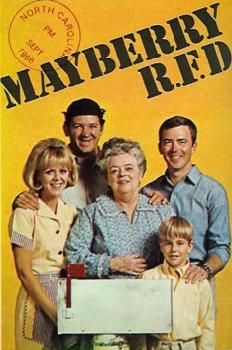
Arlene Golonka grew up in Chicago where she was born in 1936. She began taking acting classes when she was quite young. At age 19, she headed for New York and began a career on Broadway. In the 1960s she relocated to Los Angeles. She continued to appear in movies and appeared in dozens of television programs during the next three decades. While she is probably best known as Millie on Mayberry R.F.D., she has appeared in many respected series.
Photo: blogspot.com
Golonka came into Joe and Valerie with a strong resume. She had made appearances in shows such as The Naked City, Car 54 Where Are You, The Flying Nun, Big Valley, Get Smart, I Spy, That Girl, M*A*S*H, All in the Family, Barnaby Jones, Alice, The Rockford Files, and Love American Style. She made five appearances on The Doctors with David Elliott.
Photo: pinterest.com
After Joe and Valerie, she continued to receive many roles including on FantasyIsland, The Love Boat, Simon and Simon, Benson, and Murder She Wrote. Her last appearance was on The King of Queens in 2005, and she is now retired.
Robert Costanzo was born in New York in 1942. He also came into the show with a very strong string of shows, having been in Rhoda, The Bob Newhart Show, and Lou Grant. He also was in several profitable movies including Dog Day Afternoon, The Goodbye Girl, and Saturday Night Fever.
Photo: pinterest.com
Following the end of Joe and Valerie, he would continue his successful career. Costanzo has been cast in recurring roles in ten shows: Last Resort, Checking In, The White Shadow, Hill Street Blues, LA Law, 1st Ten, Glory Days, NYPD Blue, Charlie and Grace, and Champions. He has continued to take roles on other series including Barney Miller, Alice, Who’s the Boss, Family Ties, St. Elsewhere, The Golden Girls, Friends, and Murder She Wrote.
His movie career has also been very successful, and he is remembered for his roles in Used Cars, Total Recall, Die Hard 2, and Air Bud.
Currently Costanzo is still acting and has several movies debuting in the next couple of years.
Photo: sitcomsonline.com
I have to admit I do not remember Joe and Valerie, and obviously I did not watch it, but I don’t think I missed much. It’s fun to learn about some of the more obscure shows that had a brief flicker in television history. There are many more shows that lasted for less than 20 episodes than there are the classics we remember today. If nothing else, the show captures a unique time in American history.
My series, “Just a Couple of Characters” continues with Part 3 today. This month, we learn more about actors we recognize but may not know much about. This week Henry Jones and Olan Soule are on the hot seat.
Henry Jones
Photo: en.wikipedia.org
Born in New Jersey in 1912 and raised in Pennsylvania, his grandfather was a first-generation Prussian immigrant who became a Representative. Henry went to St. Joseph’s College, a Jesuit school. He landed his first Broadway show in 1938, playing Reynaldo and a grave digger in “ Hamlet. ” Like many of the actors in the late 30s and early 40s, Henry joined the Army for World War II. He was a private. During his service, he was cast as a singing soldier, Mr. Brown, in Irving Berlin’s “This is the Army.”
When he came back to the US, he married Yvonne Sarah Bernhardt Buerger in 1942. Sadly she passed away at age 22. This information was supplied by a blog reader, and I appreciate receiving the updated information because several sources refer to his divorce which is not the case. Yvonne’s father was a renowned surgeon. One of his patients had been Sarah Bernhardt which is where Yvonne go her middle name from.
Jones continued his stage roles and began a movie career. He had bit parts in 35 films, including The Bad Seed, Will Success Spoil Rock Hunter?, Vertigo, and Butch Cassidy and the Sundance Kid. He won a Supporting Actor Tony in 1958 for his performance of Louis Howe in “Sunrise at Campobello.”
Photo: fanpix.famousfix.com
In 1948 he
married Judith Johnson. They had two children (one is actress Jocelyn Jones) but
divorced in 1961.
Bridging the
gap of television and film, he starred in seventeen tv movies as well.
Although his movie career kept him somewhat busy, it was nothing compared to his television work. Jones was credited with 205 acting appearances, meaning he had roles in 153 different television series. Jones was able to tackle a wide range of roles, being believable as a judge, a janitor, a murderer, or a minister. Jones had no illusions about becoming a romantic lead. He once said that “casting directors didn’t know what to do with me. I was never tall enough or good looking enough to play juvenile leads.”
Photo: findagrave.com
His first television appearance was in drama series, Hands of Mystery, in 1949. His work in the 1950s was primarily in theater shows about dramas. He also appeared in the George Burns and Gracie Allen Show and Father Knows Best.
Photo: michaelstvtray.com
He continued his drama roles into the 1960s. He also appeared in 3 episodes of The Real McCoys and westerns including Wagon Train, The Big Valley, and Daniel Boone. He showed up on mysteries such as the Man from U.N.C.L.E. and The Name of the Game. He also found work on unique shows including Lost in Space, Route 66, and the Alfred Hitchcock Show. Hitchcock liked his work and used him five times. He also appeared in several comedies, Bewitched and That Girl. He starred in Channing in 1963-64. Jones played Fred Baker, a dean who mentors Professor Joe Howe who teaches English at Channing College while he writes his memoir about the Korean War.
During the 1970s, he continued to work on a variety of genre shows. We see him on westerns, The Virginian, Gunsmoke, and Bonanza. We see him in thrillers like The Mod Squad; McMillan and Wife; Owen Marshall, Counselor at Law; and The Six Million Dollar Man, on which he had a recurring role as Dr. Jeffrey, a scientist who built robots. However, comedies continued to be his mainstay, and he appeared in many of them including Nanny and the Professor, the Mary Tyler Moore Show, The Paul Lynde Show, The Doris Day Show, the Partridge Family, and Barney Miller.
commons.wikimedia.org
In addition to all his guest spots, he was cast in three shows during this decade. In The Girl with Something Extra, he played Owen Metcalf in 1973. The role he was best remembered for was Judge Johnathan Dexter on Phyllis. He was Phyllis’s father-in-law from 1975-1977. As Josh Alden, he appeared on Mrs. Columbo for thirteen episodes.
Photo: totallykate.com
Recurring roles comprised most of his television appearances in the 1980s. He continued to accept guest roles on such shows as Quincy ME, Cagney and Lacey, Magnum PI, Murder She Wrote, The Love Boat, and Mr. Belvedere. He would make regular appearances on Gun Shy, Code Name: Foxfire, Falcon Crest, and I Married Dora.
Jones continued to appear in shows in the 1990s, including Coach and Empty Nest. In 1999, he passed away after suffering from complications from an injury from a fall.
Olan Soule
Photo: pinterest.com
Olan Soule’s timeline
was similar to Jones. He was born in Illinois in 1909, growing up in Iowa, and
he passed away in 1994. While Jones’ grandfather arrived in America, Soule’s ancestors
included three Mayflower passengers. He began his acting career on the radio.
In 1929 he
married Norma Miller. They would be married until her death in 1992 and they
had two children.
For eleven years, he was part of the cast of the soap, “Bachelor’s Children.” His roles changed when he transitioned to television. On radio, he could play any role, but his 135-pound frame prohibited him from getting many roles he played on radio. He told the Los Angeles Times during an interview that “People can’t get over my skinny build when they meet me in person after hearing me play heroes and lovers on radio.”
Photo: tralfaz.blogspot.com
However, he
certainly was not lacking in roles. Soule is credited with more than 7000 radio
episodes and commercials, 60 films, and 200 television series.
The 1950s found him appearing in many sitcoms, including George Burns and Gracie Allen, I Married Joan, I Love Lucy, December Bride, the Ann Sothern Show, and Dennis the Menace.
Photo: complete-hitchcock.com
He would appear regularly in Dragnet from 1952-59 and in Captain Midnight from 1954-56.
Photo: riflemanconnors.com
He got even busier in the 1960s, working nonstop. The only show he had a recurring role on was The Andy Griffith Show where he played choir director and hotel clerk John Masters. Other comedies he appeared on included The Jack Benny Show, Pete and Gladys, Bachelor Father, Make Room for Daddy, Mister Ed, My Favorite Martian, The Addams Family, The Monkees, Petticoat Junction, and That Girl. He also took on roles in suspense shows including One Step Beyond, the Alfred Hitchcock Show, and the Twilight Zone. He also specialized in westerns, including Maverick, Stage Coach West, Have Gun Will Travel, The Rifleman, Bonanza, Gunsmoke, and The Big Valley.
Photo: pinterest.com
He started the 1970s continuing to show up on series such as Family Affair, My Three Sons, McMillan and Wife, Cannon, Police Woman, and a recurring role on the comedy Arnie.
Photo: monkees.coolcherrycream.com
In the mid-1970s he began appearing on Battlestar Galactica and Project UFO. Most of his career in the decade was spent providing voiceovers for animated shows, primarily Batman.
The Towering Inferno
Director: John Guillermin
US Premiere: 10 December 1974
Copyright 1974 Twentieth Century Fox Film Corporation and Warner Bros. Inc.
In 1994,
Soule died from lung cancer at age 84.
Both Soule and Jones were prolific actors who had long and successful careers. Neither one of them were the leading men type of actors, but they could tackle a wide range of roles. Soule once said, “Because of my build and glasses, I’ve mostly played lab technicians, newscasters, and railroad clerks.” Not a bad life for someone who loves acting. If you watch Antenna or Me Tv, chances are you will see these two characters pop up quite often.
Elinor Donahue always displays a warmth and comes across as a genuinely nice person. Her first sitcom became her most famous role. She played Betty in the iconic Father Knows Best. Although none of her later sitcoms reached the same popularity, she has had a long and full career.
She was born in April of 1937 in Tacoma, Washington. She began tap dancing at 16 months old. As a toddler, she did some acting and received a contract with Universal at the ripe old age of 5. From 1955-1961 she was married to Robert Smith. She was married her second husband, Harry Ackerman, from 1962-1991. Ackerman was a producer for shows including Leave It to Beaver, Gidget, and Bewitched. She married her third husband Louis Genevrino in 1992.
Donahue appeared in 18 movies between 1942 and 1952 including Tea for Two with Doris Day and My Blue Heaven. She made the transition to television in 1952 appearing in 8 shows in the 1950s. One of the shows I remember her in although I only saw it in reruns was one of my favorite shows, The George Burns and Gracie Allen Show. She was typically cast as the girl-next-door type. Her most famous role came in 1954 when she was cast in a new sitcom, Father Knows Best.
Father Knows Best – 1954-1960
This was one of the typical family shows of the 1950s. The Andersons lived in Springfield with three children: Betty, called Princess (Elinor Donahue), James Jr., or Bud (Billy Gray) and Kathy, usually called Kitten (Lauren Chapin). The show debuted in the fall of 1954 on CBS. The show was cancelled in 1955 and the public was furious. Letters came pouring in, so it was reinstated. NBC took over the next year until 1958 when it went back to CBS. In 1960, Robert Young decided he was done. These were warm and inviting parents, providing guidance and object lessons galore. Critics panned it later because it was not reality. We have reality shows today, and please, give me fiction. We did learn life lessons on the show – following through on promises, working for what you want, being yourself, and taking responsibility for your mistakes.
Shortly after Father Knows Best left the airwaves, Donahue accepted the role of Elly Walker in The Andy Griffith Show.
Most of us are very familiar with TheAndy Griffith Show and many of the characters who inhabit Mayberry: Widower Andy Taylor (Andy Griffith) and his son Opie (Ron Howard) live with Andy’s Aunt Bee (Frances Bavier) who takes care of them; Barney (Don Knotts) is the inept deputy but also Andy’s best friend; Helen Crump (Anita Corsaut), the school teacher and Andy’s girlfriend later in the series; Thelma Lou (Betty Lynn), Barney’s girl; Otis Campbell (Hal Smith), town drunk but nice guy; Gomer Pyle (Jim Nabors), who runs the gas station; and his cousin Goober Pyle (George Lindsey). Andy had several romances early in the show. He dated the county nurse Mary Simpson (played by several actresses), spent a limited amount of time with Daphne (Jean Carson) who had a crush on him; and in the first two seasons, he was sweet on Ellie Walker (Donahue), who ran the local drug store. Ellie cared about Andy, but she always stood up for herself and women’s rights. Andy and Ellie never had the chemistry they were hoping for but they respected each other and like each other. Elinor raved about the cast and her opportunity to be on the show. She said Andy was in charge and expected quality but was fair and a nice man. She described Ron Howard as the best child actor she ever worked with. She liked Frances Bavier and got along well with her. She had a huge respect for Don Knott’s comedic ability. She is still friends with Betty Lynn.
She appeared on a variety of shows in the mid-1960s including 77 Sunset Strip, Dr. Kildare, The Virginian, Dennis the Menace, Star Trek, and The Flying Nun. She tried her luck with one other sitcom in the 1960s.
Many Happy Returns – 1964-1965
This sitcom was also about a widower. Walter Burnley (John McGiver) ran the Complaint Department at a LA department store. The show also featured his daughter (Donahue) and a coworker Lynn Hall (Elena Verdugo). His boss (Jerome Cowan) did not want him to take in any returns, so he had to resolve complaints without making his boss mad. Apparently Burnley couldn’t solve the complaints that came in from viewers because the show was cancelled after 24 episodes.
Father Knows Best came out with two television movies in 1977: The Father Knows Best Reunion and Father Knows Best – Home for Christmas, and Elinor was in both. While still showing up in random shows during the 1970s such as The Rookies, Police Woman, and Diff’rent Strokes, Donahue found time to appear in two 70s shows on a regular basis.
The Odd Couple – 1972-1975
Neil Simon’s The Odd Couple came to Friday nights in 1970. Felix Unger (Tony Randall) and Oscar Madison (Jack Klugman), two divorced men who are complete opposites but best friends, try to live together without killing each other. The show had a great supporting cast including Donohue as Miriam Welby from 1972-1974, Felix’s girlfriend.
Mulligan’s Stew – 1977
This show from 1977 starred Elinor Donahue as Jane Mulligan. She and her husband Michael (Lawrence Pressman) are trying to raise three kids on his teacher’s salary when they suddenly add four orphaned nieces and nephews to their family. One of the kids was played by Suzanne Crough, Tracy from ThePartridge Family, one of the few shows she was in. The series only lasted for seven episodes.
The 1980s found Donahue still working regularly. She was in Barnaby Jones, Mork & Mindy, One Day ata Time, Fantasy Island, The Love Boat, Newhart, and Golden Girls. One sitcom in the 1980s captured her attention about Beans Baxter.
The New Adventures of Beans Baxter – 1987
Here is the plot for this one: Beans Baxter’s (Jonathan Ward) father who he thought was a mailman disappears one day. Teenage Bean discovers that his dad worked for a secret government agency. He is then drawn into becoming a spy for the government. The show features his adventures as he tries to find the enemy agents who are holding his father hostage while his mother played by Donahue is completely oblivious that anything strange is happening. Viewers also didn’t realize anything was happening because the show was cancelled after 17 episodes.
Entering her 60s, Elinor joined the cast of three sitcoms in the 1990s. She also made several movies including Pretty Woman in 1990 and The Princess Diaries 2 in 2004.
Get a Life – 1990-1992
Shows don’t get much weirder than this one. Comedian Chris Elliot plays a 30-year-old paperboy Chris Peterson who lives with wacky parents (Donahue and Bob Elliott, Chris’s real father). Some of the strange things that happen during the 36 episodes include eating a space alien, beheadings, and a robot paperboy. In this bizarre series, Chris actually dies in a third of the episodes. During the run of the show, he died from old age, tonsillitis, a stab wound, a gunshot wound, was strangled, got run over by a car, choked on his cereal, was crushed by a giant boulder, and actually exploded.
Eek!stravaganza – 1992-1993
Donahue plays “The Mom” in this animated show about Eek, a purple cat who always finds himself in dangerous situations. The series was on the air for five seasons.
Dr. Quinn, Medicine Woman – 1993-1997
During the six years the show was on the air, Donahue reprised her role as Rebecca Quinn ten times. The show followed the ups and downs experienced by a female doctor practicing in a wild western town.
Interestingly, Donahue appeared in three different soap operas toward the end of her career: SantaBarbara, Days of Our Lives, and The Young and the Restless. Elinor also appeared on a variety of documentaries and award shows. She was in the Match Game/Hollywood Squares Hour. In 1998, she wrote her memoirs titled, In the Kitchen with Elinor Donahue. The book included about 150 of her favorite recipes. Elinor’s career has been long and she appeared in many shows and movies over the years. She hasn’t appeared in a movie or television show since 2010, although she did do some theater. In September of 2015, she appeared in one of my favorite plays, “Harvey” in North Carolina.
Donahue’s career reminds me of many of the actors we have gotten to know in this blog including William Christopher, Betty White, Ken Berry, and Shelly Fabares. These actors and actresses all appear to be very nice, talented people who have careers they should be proud of. In a day when bad decisions and selfish actions are splattered across our television screens and newspapers, perhaps one of the best compliments we can give someone is that they had a long and fulfilling career and didn’t step all over other people to achieve it.
When a rainy day shows up this summer, take a moment to watch some of Elinor’s sitcom episodes. Thank you Elinor Donahue for the entertainment and memories you gave us.
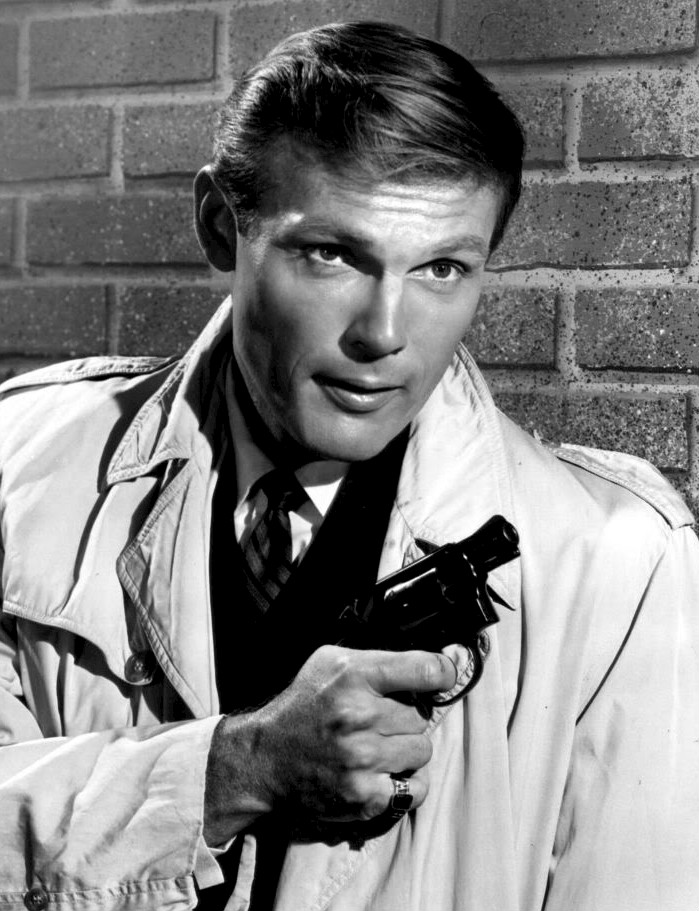
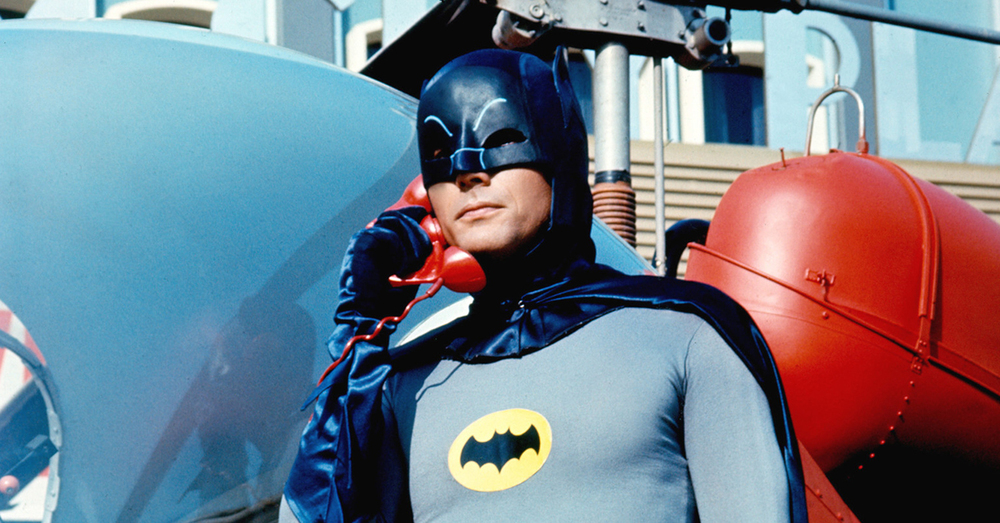
Adam West was born William West Anderson on September 19, 1928 in Walla Walla, Washington. He just passed away this summer on June 9. His father farmed and his mother gave up her career as an opera singer and concert pianist. Like all kids, he had a collection of comic books including Batman. When his parents divorced, he moved to Seattle with his mother. He attended Whitman College in Washington and graduated with a BS in literature. He was drafted into the Army and became an announcer on the American Forces Network television.
After his service career, he became a milkman until he moved to Hawaii to pursue a career in television. In 1959, he took on his stage name of Adam West and moved to Hollywood with his wife and children. He quickly became an actor and appeared in 33 television shows, including 77 Sunset Strip, Maverick, Hawaiian Eye, Tales of West Fargo, Perry Mason, Gunsmoke, Petticoat Junction, and Bewitched.
In 1966, William Dozier, producer for a new show about Batman decided to cast West over Lyle Waggoner after seeing him as a James Bond-type character in a Nestle Quik commercial. DC Comics described Batman as 6’2” and that was West’s height.
When the series ended, he and Burt Ward found themselves typecast as Batman and Robin. He did a series of appearances about the Batman character while pursuing a movie career. He ended his career with 49 movies to his credit.
He appeared in 78 television shows after Batman ended including The Big Valley, Emergency, Alice, Police Woman, Laverne and Shirley, The Love Boat, Hart to Hart, Murphy Brown, Diagnosis Murder, News Radio, Drew Carey, King of Queens, and 30 Rock.
After 1990, he apparently embraced his Batman character and appeared on numerous television shows as himself or Batman. When asked about this, he said, “I think it evolved. I learned a long time ago that because people love Batman, I should too. I learned that I shouldn’t resent it even though it prevented me from getting other roles. I really had to become fond of Batman in order to deal with it. I embraced it.”
In 1957, he and his first wife Billie divorced. He married dancer Frisbie Dawson in 1957 and divorced in 1962. In 1970, he married Marcelle, and they were together until his death. He had two children with each of his wives and two stepchildren.
In 1994, he wrote an autobiography Back to the Batcave. In 2012, he received a star on the Hollywood Walk of Fame on Hollywood Boulevard.
West loved outdoor activities and had a lot of hobbies including fishing, sailing, hiking, skiing, golfing, riding motorcycles, swimming, surfing, dancing, traveling, as well as spending time with his family, listening to classic rock, reading, and watching movies.
West died after a short battle with leukemia at age 88. The next week, LA shined the bat signal on city hall to honor him.
While West certainly had a full and varied career despite his typecasting from Batman, I would like to spend some time looking at the series that gave him his fame. Typically, I am not really into super heroes, but I loved this show when I was younger and still get a kick out of watching the campy comedy. I can still hear the narrator saying, “Same bat time, same bat channel.” The show was canceled not only because of low ratings but also because the special effects and lighting had tremendous costs. When ABC dropped it, they tried to find another network to take it over. They had no offers, so they dismantled the set. Two weeks later, NBC offered to pick up the show, but decided it was too expensive to start from scratch.
In the 1960s, Ed Graham Productions received the rights to the comic strip Batman and intended to produce an adventure show similar to Superman or The Lone Ranger. ABC was thinking about a prime time show so DC Comics bought back the rights and sold them to 20th Century Fox. 20th Century gave it to William Dozier to produce. Dozier had never read comic books and felt that the show should take a campy, pop-art approach. The show was originally an hour-long series, but with only half-hour time slots available, it was changed to a bi-weekly half-hour show.
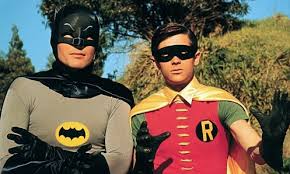
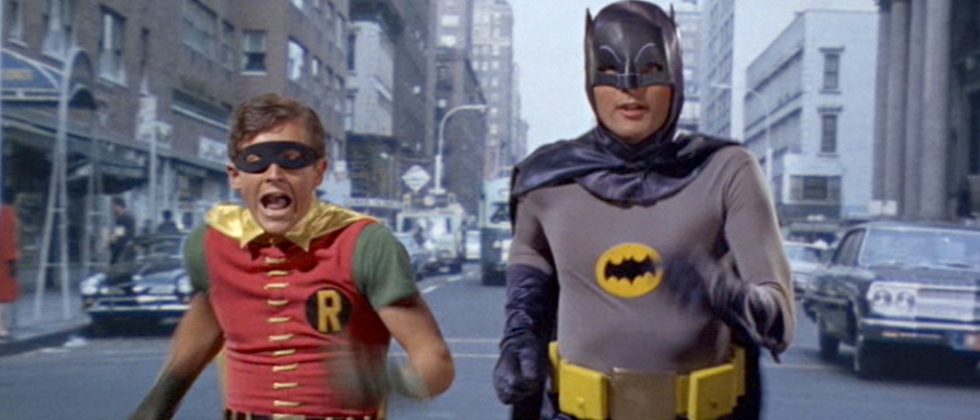
The concept of the show was that millionaire Bruce Wayne and his ward Dick Grayson lead a double life in Gotham City. When they move a shelf in their library and slide down the bat pole to the bat cave, they become Batman and Robin. Only their butler Alfred is aware of their real identity. Police Commissioner Gordon calls them on the batphone, often referring to them as the dynamic duo. They usually hop in their bat mobile and speed to city hall to learn what villain is up to no good in their city.
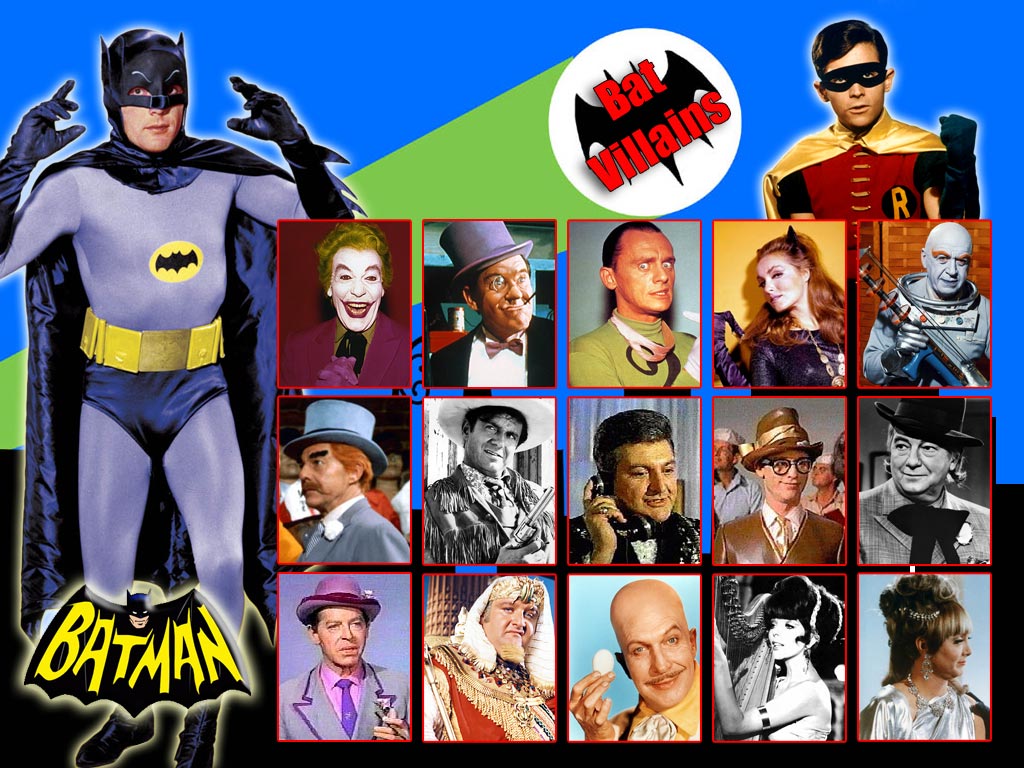
Adam West took the role of Batman/Bruce Wayne and Burt Ward was Robin/Dick Grayson. Other cast members included Alan Napier as Alfred the Butler, Neil Hamilton as Commissioner Gordon, Stafford Repp as Chief O’Hara, Madge Blake as Aunt Harriet, and Yvonne Craig as Batgirl.
My favorite villians included Julie Newmar and Eartha Kitt as Cat Woman, in love with Batman but not willing to give up her criminal life; Burgess Meredith as Penguin always carrying an umbrella; Frank Gorshin as The Riddler leaving riddles for clues; Vincent Price as Egghead a bald-headed genius who loves eggs; Cesar Romero as the Joker who leaves jokes for clues; and Victor Buono as King Tut when evil and Professor William McElroy as his non-evil personality.
The show aired twice a week on back-to-back nights. The first episode would set up the situation and end with the dynamic duo in some dangerous situation. Batman and Robin would get their assignment from the Commissioner and then, using a series of clues, try to figure out who the villain is and then how to defeat them. At some point, there was always a fistfight with the villain’s entourage at which time the villain typically escaped. During the fight, words would pop up on the screen like POW, BAM, ZONK, BOOM. Then the crime fighters would go to look for them at which point the dangerous and perhaps deadly situation occurred and the next episode would summarize what happened on the previous episode before defeating the bad guys for good. They often used inventions like shark repellant bat spray to aid them in their search.
In Season 3, Bat Girl was added to the cast. The ratings were starting to fall so Dozier wanted to bring in a girl character to attract female viewers. Her real identity was Barbara Gordon, the Commissioner’s daughter. The Commissioner never seemed to realize she was familiar to him. Because of low ratings, the show also became a once a week series in the third season. Eartha Kitt took over the Catwoman role since Newmar was filming a movie at the time. Madge Blake’s health was failing, and her role was limited to two appearances during the last season.
The show was cancelled before the next season but it has continued to be popular in reruns. In 1966, an album was released “Batman: The Exclusive Original Soundtrack Album.” It included music by Nelson Riddle, dialogue excerpts from several of the characters in the show, as well as the Batman theme song, Batusi A Go Go, and several other tunes.
A lot of collectibles were produced during the run of the show including trading cards, Batmobile kits, coloring books, lunch boxes, board games, and View-Master reels. In 2013, Mattel designed an action figure line based on the tv characters, and several Hot Wheels/Matchbox cars have been produced. The Batmobile from the show was auctioned in 2013, selling for $4.2 million. The huge profits from the car as well as the line of action figures prove the continuing interest in and success of this show now 50 years old.
Here are some fun facts I found about the series:
A total of 352 “Holy” words were used by Robin from “Holy Agility” to “Holy Zorro”.
Cesar Romero’s Joker laugh was created almost by accident. Shortly after being cast, Romero met with producers to discuss his role on his series. While waiting to meet with them, Romero happened to see conceptual art of Joker’s costuming. Romero felt the pictures almost looked absurd, and as a result spontaneously broke out into a playfully loud and almost manic laughter. A producer overhearing it responded by telling Romero “That’s it, that’s your Joker’s laugh!”
Burgess Meredith had not smoked in 20 years when he was cast as the Penguin. He came up with the Penguin’s distinctive squawking sound because the cigarettes were irritating his throat. Like his trademark “quack”, the Penguin’s waddling was largely a result of improvisation by Burgess Meredith, as he found it difficult to stand and walk straight while wearing the rubber padded fat suit that was part of his costuming.
Before going on the air, this show received the worst audience test scores in the history of ABC. It only went on the air because so much money had already been invested in it.
This was one of the “in” shows to appear on if you were a big name in Hollywood during the 1960s, and many top names guested on the show, including many who didn’t do much TV otherwise. Those performers who weren’t cast as guest villains could frequently be seen popping their heads out of windows to exchange a few words with Batman and Robin when the latter would be climbing up a building wall. Frank Sinatra, Natalie Wood, and Cary Grant were all fans of the show, and wanted to be on it, but the producers were never able to come up with the right roles for any of them. During the run of the series, this show crossed over with The Green Hornet (1966).
The “Giant Lighted Lucite Map of Gotham City” is a reverse image of St. Louis, right down to Forest Park, Fairground Park, Tower Grove Park, Lafayette Park, and Horseshoe Lake on the Illinois side, as well as the other river and road networks.
Each main villain had their own theme music.
In the first season, Burt Ward (Robin) was paid $350 per week.
Yvonne Craig has stated that she briefly did have a stunt double, but did most of her stunts herself. She actually operated the Batgirl Cycle herself as well. She was an accomplished biker at the time, and actually owned a bike.
Adam West (Bruce Wayne / Batman), Burt Ward (Dick Grayson / Robin) and Neil Hamilton (Commissioner Gordon) are the only actors to appear in all 120 episodes of the series.
Suzanne Pleshette was one of the original choices to play Catwoman before Julie Newmar landed the role.
The show aired from January 12, 1966 to March 14, 1968 on ABC for 120 episodes. It was one of few TV series to be seen on 2 different nights a week: 7:30 Wednesdays and Thursdays. It remained there for a season and a half (Jan. 1966-Aug. 1967) until it was moved back once a week (Thursdays 7:30) for its final season. The episodes were generally two-parters: Wednesday’s episode was a cliffhanger, resolved in Thursday’s episode. The 1966-1967 season had 2 3-parter episodes (“The Zodiac Crimes/The Joker’s Hard Times/The Penguin Declines”[ep. #2.37-9, 1/11-12 & 18/1967] and “Penguin is a Girl’s Best Friend/Penguin Sets a Trend/Penguin’s Disastrous End”[ep. #2.42-4, 1/26/, 2/1 & 2/1967]) which left cliffhangers that would be solved the following week. When the series was reduced to (mostly) one part episodes during season three, the cliffhanger death traps and threats were still used, but greatly scaled back and occurring at the middle commercial break.
The three primary cast members of The Addams Family each made appearances on Batman. Carolyn Jones played the villainess Marsha, Queen of Diamonds, and John Astin played the Riddler during the second season. Additionally, Ted Cassidy had a window cameo, appearing in his part as Lurch from The Addams Family. Interestingly, Cassidy’s cameo took place in a story involving the Penguin, with whom Jones’ character Marsha teamed up in one of the three-part stories.
In episode 7, Alfred refers to Robin as Mr. Ward, and not Mr. Grayson.
While Superheroes and the movies and television shows they appear in seem to cycle up and down throughout the decades, the popularity of the Batman television show has never wavered. The fact that Mattel would create action figures based on the original stars almost 50 years after the show debuted says a lot about the fans and the place the show holds in their hearts.
Thank you Adam West for creating such a memorable and well-loved character. Rest in peace.