Love American Style: Love and the Celebrities

📷groovyhistory.com

This month we are starting a new blog series, Casting Celebrities. We’re going to take a look at four shows that featured a group of celebrities every week. We’ll learn more about Love, American Style; Fantasy Island; The Love Boat, and Supertrain. When we discuss Supertrain, we’ll also look at the small number of stars who appeared on all four shows.

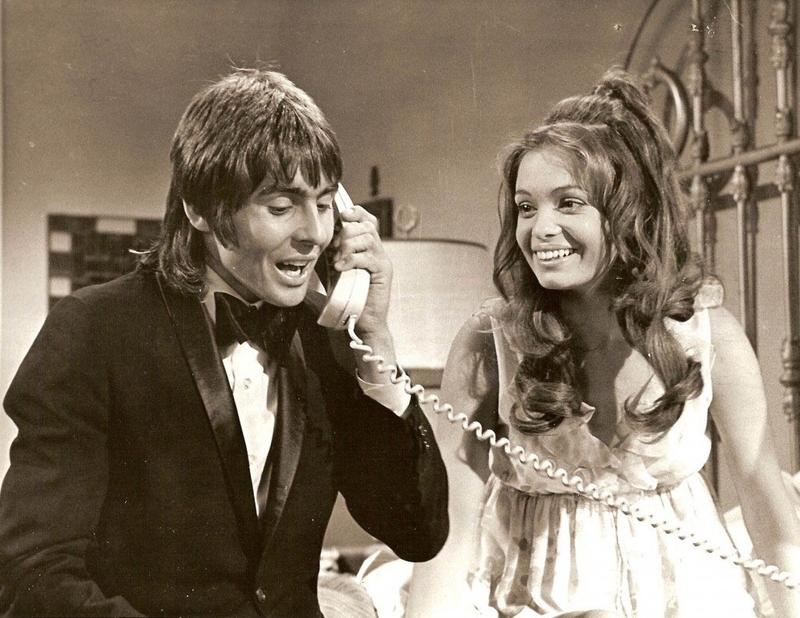
Today we begin with Love, American Style. This show was an iconic 1970s show. Like Laugh In, the clothing, furnishings, and vocabulary do not make it timeless. But it was a lot of fun. This fast-paced anthology series featured two to four mini episodes each week, and between them were quick skits, often featuring a brass bed. Each smaller episode is titled “Love and the _______.”

📷gms.com The regular cast

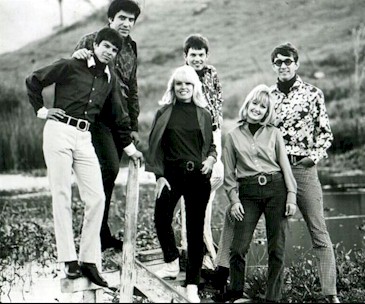
A troupe of players was featured on each show for the in-between skits. These regulars included William Callaway, Buzz Cooper, Phyllis Davis, Mary Grover, James Hampton, Stuart Margolin, Lynn Marta, Barbara Minkus, and Tracy Reed. Margolin went on to a regular role in The Rockford Files; Tracy Reed was featured in McCloud and Knot’s Landing; Phyllis Davis was part of the cast of Vega$ and Magnum PI, and James Hampton will be familiar if you watched The Doris Day Show or F-Troop.

The show had a memorable and catchy theme song. Written by Arnold Margolin, the first year it was performed by The Cowsills. The snappy melody was set to the following words:

Love, Love, Love

Love, American Style,
Truer than the Red, White and Blue.
Love, American Style,
That’s me and you.

And on a star-spangled night my love,

My love come to me.
You can rest you head on my shoulder.
Out by the dawn’s early light, my love
I will defend your right to try.

Love, American Style,
That’s me and you.

📷imdb.com

During the second and subsequent years that Love, American Style was on the air, the theme song was performed by the Ron Hicklin Group. The Ron Hicklin Group could be heard in a variety of motion pictures and commercials, and they also appeared on recordings with stars such as Paul Revere and the Raiders and Cher. John and Tom Bahler, brothers who sang under The Charles Fox Singers were also part of this group. The band provided television theme song recordings including Batman, That Girl, Happy Days, and Laverne and Shirley. They also did the singing for The Partridge Family theme and songs performed on the show as well as the Brady Bunch Kids. Ron retired in the early 2000s, and Tom does a variety of things. He is also known for writing Bobby Sherman’s hit, “Julie Do You Love Me?”. John married Janet Lennon, one of the Lennon sisters who performed on The Lawrence Welk Show. He currently lives in Branson and conducts the “new” Lawrence Welk orchestra.

Paramount Television developed the show. The executive producer of the show was Arnold Margolin, Stuart’s brother. There were 53 different directors during the four-year run. The series received Emmy nominations for Outstanding Comedy Series in 1970 and 1971; Best Music Composition in 1971, 1972, and 1973, winning in 1973; and winning the Emmy in 1970 for Outstanding Original Music and Lyrics.

📷rewatchclassictv.com

Many people wrote for the show, but Garry Marshall and Jerry Belson received the most credits. One of the writers, Peggy Elliott, was interviewed by the Huffington Post in May of 2013, and she talked about her time writing for the show.

“But the show I loved writing the most, was Love, American Style. For every other show, I was writing for characters created out of someone else’s head. Sure, we could create the occasional guest-star role, and we had been told to make every role, no matter how small, a real person. ‘Think of the actor who’s playing that delivery boy,’ I can hear Billy Persky, the co-creator or That Girl, say: ‘This is a big break for him — it’s the biggest role he’s had so far. Give him something to work with.’

But with Love, American Style, every character was our very own; every situation came out of our heads. Each segment of the hour the show ran each week was a one-act play created entirely by us. Added to the attraction was the fact that we could say and do things that were taboo on every other TV show in the early ‘70s. Arnold Margolin, co-creator of the show with Jim Parker, told me recently that the creative side of the network wanted the show to be more daring, while the censors kept their red pencils ready. There was a full-time position on the show just to run interference.

We must have put both sides through the hoops with one episode we wrote: ‘Love and The Hand-Maiden.’ A young guy was dating a centerfold model. As their relationship developed, he discovered that she had no problem with shedding her clothes, but she always kept her hands covered — with artful poses in magazines, and with gloves in real life. He became obsessed with seeing her hands and came up with one ruse after another to get her to take off her gloves. We had a ball writing it, with one double-entendre after another.”

📷imdb.com

If you were a star of any kind in the early 1970s, you most likely were on Love, American Style.  The show produced 108 episodes, and those shows featured 1112 different actors. Some of the famous names showing up in the credits include Milton Berle, Sid Caesar, Phyllis Diller, Arte Johnson, Ozzie and Harriet Nelson, Regis Philbin, Burt Reynolds, Sonny and Cher, Flip Wilson, and Jo Anne Worley.

Brad Duke wrote a biography about Harrison Ford, and he said Ford had fond memories of appearing on Love, American Style. “He recalled that he had been given little time to prepare his wardrobe for the role of a philosophical hippie in the November 1969 episode, “Love and the Former Marriage.” He appeared on set with long hair and a beard thinking they were appropriate for the role. He was surprised when he was told he needed a haircut and trim and then was given a navy blue dress shirt and vinyl burgundy jeans with a large belt. They even had a scarf with a little ring to put around my neck. And I thought, someone has made a mistake here. So, rather than argue with the wardrobe people, I put on the clothes and went to find the producer. I walked on the set and he was pointed out.  I tapped his shoulder and when he turned around he had on the same clothes I did. He was a hippie producer I guess. At least the check went through, and I got paid.”

The best way to get a good understanding of what the show was like is to look at a couple of the episodes.

January 23, 1970: Love and the Big Night

📷facebook.com

Starring Ann Elder, Buddy Lester, Frank Maxwell, Julie Newmar, and Tony Randall, this episode is often listed as a favorite of viewers. Randall is a married businessman who escorts his voluptuous secretary (Newmar) to her apartment after a late night at the office. Eager to get home to his wife, Randall hurriedly tries to open a stubborn jar of mayonnaise and winds up covered with mayo. Newmar cleans his suit, but while it’s drying, it’s stolen. After a series of amusing mishaps, Randall finally gets back to his own apartment and creeps into bed with his wife–only to find out she’s not there.

February 25, 1972: Love and the Television Set

📷that’s entertainment.com

It starred Harold Gould, Marion Ross, Ron Howard, and Anson Williams. Reading this list of names might give you a hint about what happened to this episode after it aired. Garry Marshall had written a pilot about a 1950s family that did not sell.  He turned it into an episode for Love, American Style. George Lucas caught the episode and was impressed with Ron Howard and offered him a role in his new movie American Graffiti about 1950s teens. The movie was so popular that the network decided to put Marshall’s pilot in the fall line-up as Happy Days. Harold Gould’s role was given to Tom Bosley for the series. When Love, American Style went into syndication, this episode was retitled “Love and the Happy Days.”

October 22, 1970: Love and the Bashful Groom

📷listral.com

This is the episode I recall when I think of the series. When I watched it originally, I was staying overnight at my grandparents’ house and my grandmother was shocked at the “vulgarity.” It really seems quite tame today, but back then it probably was unexpected. She would approve of Tom Bahler marrying Janet Lennon though because I watched Lawrence Welk with her and my grandfather whenever I was at their house.

In this episode, Paul Petersen, Christopher Stone, Meredith MacRae, Jeff Donnell, and Dick Wilson are featured. Harold (Petersen) and Linda (MacRae) are getting married. He learns that she grew up in a nudist colony and is not comfortable being naked for his wedding.  After a soul-searching talk with his best friend, and realizing he loves Linda enough to be uncomfortable, he decides to go through with the ceremony.  He gets to the church a bit late and walks in, only to see that everyone else is dressed in their Sunday best. His bride informs him that they always dress up for weddings. One of the congregation members says something like “Let’s not make him uncomfortable,” and they all begin to undress.  Of course, you see nothing improper, no naked bodies, only clothes flying. This was probably not the best episode to “expose” my grandmother to as a first glimpse of the show.

The show lasted for four years and was cancelled in 1973. In 1985, a reboot was created, but it was on in the mornings and only lasted a few months.  The show was on at the same time as everyone’s favorite game show, The Price is Right. For the 1998 fall season, a pilot was created for prime time, but it was never ordered. While doing my research for this blog, I noticed that there was a Love, American Style project in production, so we may see it resurface again.  I’m not sure I would want to watch a contemporary version of the show though. It was such a product of its time, and I fear what a current version would be like after seeing the reboot of Match Game which has been airing the past few years.

We Never Really Left Leave It to Beaver

This month we are learning about America’s favorite families. Today we are spending some time with the Cleaver family. In the past we have talked quite a bit about The Brady Bunch, and in some ways, Leave It to Beaver is like that show. The Brady Bunch portrayed the 1970s and although they have been on the air since that first episode debuted, the show never cracked the top twenty. The Cleavers taught us about the 1950s. That show also never got into the top thirty during its six-season run but has been on the air most of the past 65 years.

📷thetodayshow.com

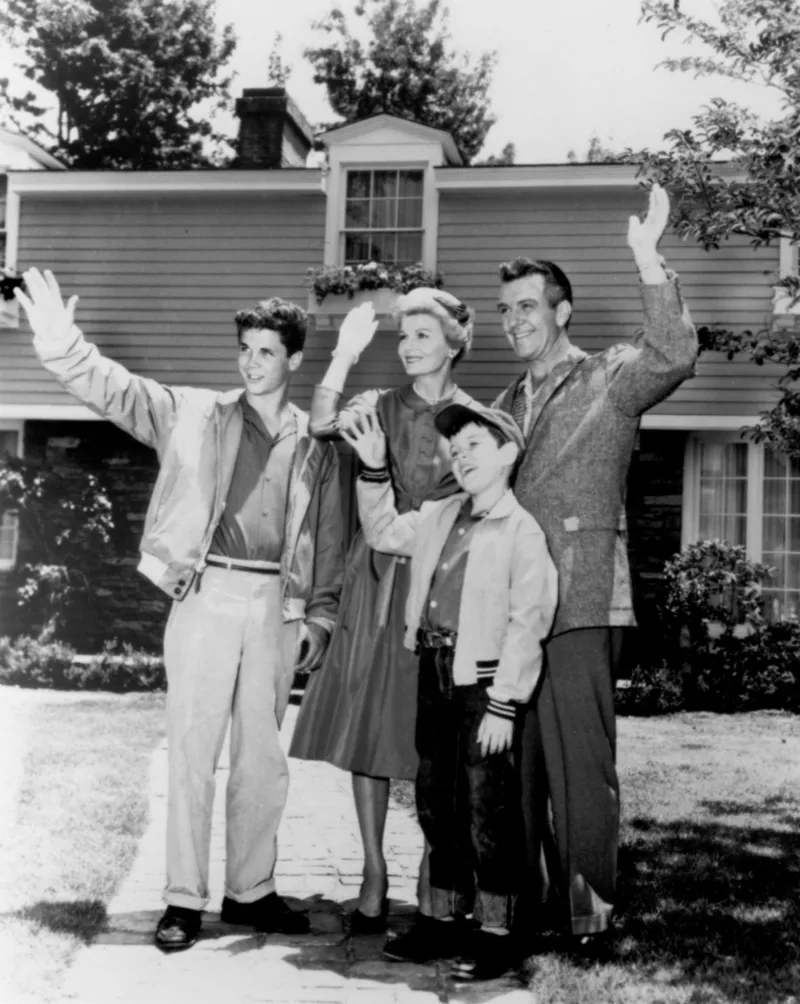
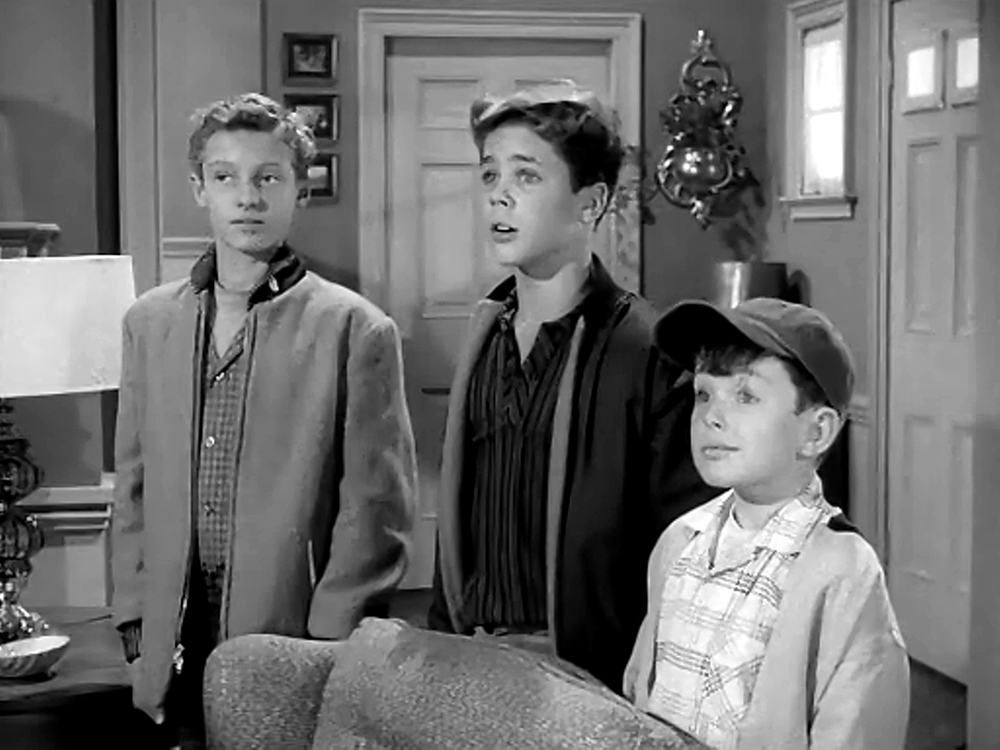
The show was originally written to feature Theodore or Beaver played by Jerry Mathers. Beaver gets into a lot of mischief, but he is a good kid and always means well. He has an older brother Wally, played by Tony Dow. His parents are Ward (Hugh Beaumont) and June (Barbara Billingsley). I thought it was interesting that all four of the stars appeared in every single episode of the show, 234 of them.

We also got to know some of the boys’ best friends as well. Beaver hangs out with Larry Mondello (Rusty Stevens) and Gilbert Bates (Stephen Talbot). He also spends time with Gus an old fireman played by Burt Mustin who seemed old even then. Wally is often with Clarence “Lumpy” Rutherford (Frank Bank) whose father is friends with Ward and Eddie Haskell (Ken Osmond). Eddie is overly polite to Ward and June who are never fooled by his manners; he often picks on Beaver.

Mathers said that when he went to the audition, he went in his Cub Scout uniform because he didn’t want to be late for the den meeting. He was so honest and innocent about wanting to get to his Scout meeting that the producers hired him.

📷imdb.com With Eddy Haskell

Tony Dow never planned on getting a part. He had been in one commercial but no television series. He was an athlete and a diving champion and great swimmer. He had been working out at the Hollywood athletic club and a lifeguard there asked Dow’s mom if Tony could go with him to the audition. Dow ended up getting the part. Mathers later corroborated the story in his blog, saying that the actor who was in the pilot grew five inches the following year and was as tall as Beaumont, so they decided to hire another kid for the role. They wanted someone who looked like an athlete, so they chose Dow.

Beaumont took some inspiration from his studies to be a wise and caring father. He held a Master of Theology degree from USC and was an ordained minister. In addition to acting, Beaumont wrote one entire episode, contributed to several others, and directed 23 episodes.

While Beaumont contributed to the scripts, the show was primarily created by Joe Connelly and Bob Mosher, and many of the plots were based on their children.

📷metacritic.com

CBS put Leave It to Beaver on the air Wednesday nights in 1957. I can see where the ratings might suffer because the show was on during the last half of both Wagon Train and Disneyland, so a lot of viewers were watching another show at the time.

The network decided to drop the show at the end of the year, but ABC picked it up and extended its run for five more years. The new network aired it Thursday nights up against repeats of I Love Lucy and a show I know nothing about called Jefferson Drum. The description is that a widowed father starts a newspaper in a western town. The next season the show appeared on Friday nights with another move the following year to Saturday nights. In its fifth season it stayed on Saturday nights but switched times and the sixth season found it on Thursday nights against Perry Mason and Dr. Kildare. At that point, Jerry Mathers wanted to have a normal high school life, and the show ended.

The theme of the show is probably one of the best-known television themes. It was “The Toy Parade” composed by David Kahn, Melvyn Leonard, and Mort Greene.

📷dvnet.com Still the Beaver

In 1983, “Still the Beaver” aired to catch us up on the Cleaver family. Beaumont had passed away, but the rest of the cast showed up for the reunion. It led to a reboot that ran for four years from 1985-89 called The New Leave It to Beaver. Beaver and Lumpy run Ward’s business. Beaver lives in their family home. June is still living there, taking care of Beaver’s two boys. Eddie Haskell is still in Mayfield with his son Freddie. Wally is now a lawyer living in town, married and expecting his first child.

Ward and June took a lot of heat for being stereotypical parents in the show. While there was definitely some unrealistic behavior, fans continued to flock to the show for decades and now, almost 70 years after the first airing, it is still on the air and gaining new generations of viewers. June gets made fun of for wearing pearls and high heels, but when she was asked about that, she admitted that she wore the pearls because she had an indentation on her neck that she thought did not look good on film and the pearls covered it up. She said she wore heels because she had to be taller than the boys.

📷latimes.com

Mathers is the only remaining primary cast member; the rest of the crew has passed away. He has admitted that the family on television was also close off the air. Mathers became good friends with Ken Osmond. When Dow passed away, Matters wrote, “It is with the utmost sadness I learned this morning of my costar and lifelong friend Tony Dow’s passing. He was not only my brother on tv but in many ways in life as well. Tony leaves an empty place in my heart that won’t be filled. He was always the kindest, most generous, gentle, loving, sincere, and humble man, that it was my honor and privilege to know. Of Beaumont, he said, “we had a good chemistry and . . . I was very glad that he was picked for the role and we had a wonderful friendship for his entire life until he passed away from a heart attack. Hugh and my dad had become friends and he occasionally came to our house to play cards with my father and his friends.” He also had fond words for Billingsley, that she was “a good friend and an even better mentor. . . I was lucky enough to work with her for six years and have a life-long relationship with her. She was a very kind woman and a generous philanthropist who supported many charities.”

Like some of the Brady kids, Mathers thought once he left the show, he left show business behind him. He attended Notre Dame High School in Sherman Oaks, California and had a typical teenage life. He enlisted in the US Air Force Reserves, attaining the rank of sergeant. He also was in a band called Beaver and the Trappers. After graduation, he worked as a loan officer at a bank and got involved in real estate. At the end of the 1970s, he decided to star with Dow in a stage production of “Boeing, Boeing” in Kansas City and afterward, the two of them toured in “So Long, Stanley” for 18 months. In 1981, Mathers began working as a DJ and, not long after, the reunion movie and reboot of the tv show was offered to him.

📷heraldweekly.com

I will admit that I have never been a huge fan of Leave It to Beaver. I never thought of it as a bad show, but I was just interested in other shows more. It is pretty incredible that it has been on the air for so many decades and still finds new viewers. I think I gravitate more to The Brady Bunch because it reflects the decade that I grew up in. It must be very strange for a person to live a role for six years, walk away at age 15 or so and then come back to it two decades later. From everything I read, both Mathers and Dow came away from their acting careers unscathed from so much of what you read other child actors had to endure. Along with Ron Howard, they seem to have been able to have a fairly normal life off the set. I think it’s great that Hugh Beaumont became friends with Mather’s father. They seem to have experienced the same great relationships with their tv parents that Patty Duke, Shelley Fabares, and Paul Petersen did. It’s always nice to hear that a show about a favorite American family in pop culture is also a great family away from the set.

The Donna Reed Show: It’s All About the Mom

Merry Christmas Eve.  In honor of It’s a Wonderful Life which will be playing quite often today, this week’s blog is about Donna Reed, who played Mary in the Jimmy Stewart holiday favorite.

In 1958, most of the television shows were game shows, variety shows, or westerns. Almost all the sitcoms on the air were based on a star; we had The Danny Thomas Show, The Ann Sothern Show, The Bob Cummings Show, and The Adventures of Ozzie and Harriet. It was also the year The Donna Reed Show began. The show would last eight seasons, resulting in 275 episodes.

reed14

Photo: dallas.wikia.com

The series was created by William Roberts. Donna and her husband Tony Owen developed and produced the show, under the name “Todon.” We had shows about single adults in The Bob Cummings Show and The Ann Sothern Show. We had families, including The Danny Thomas Show, Father Knows Best, and The Adventures of Ozzie and Harriet. Roberts wanted to concentrate on the demanding roles a stay-at-home mom had to juggle. Reed agreed with him. As she noted, “We started breaking rules right and left. We had a female lead, for one thing, a strong, healthy woman. We had a story line told from a woman’s point of view that wasn’t soap opera.”

reed2

Photo: imdb.com

The Donna Reed Show is often evoked by critics who say television scripts are not realistic but center around unreal family expectations, but that is not the goal Reed and her husband had. Donna described the show as “realistic pictures of small-town life—with an often-humorous twist. Our plots revolve around the most important thing in America—a loving family.” The shows featured typical family problems families faced in the late 1950s: having to fire a clumsy housekeeper, quality time with your spouse, dealing with disciplinary issues, or Donna being swamped with requests to volunteer for charity drives or community theater shows. However, there were times the show delved into more controversial issues such as women’s rights or freedom of the press.

reed3

Photo: metv.com

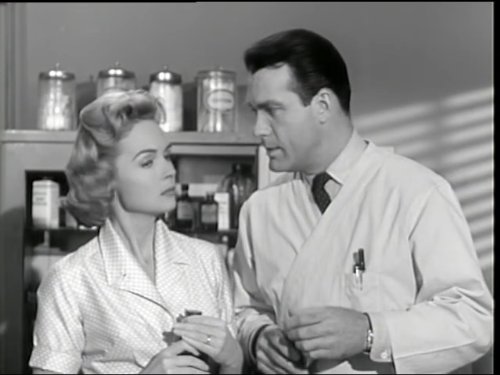
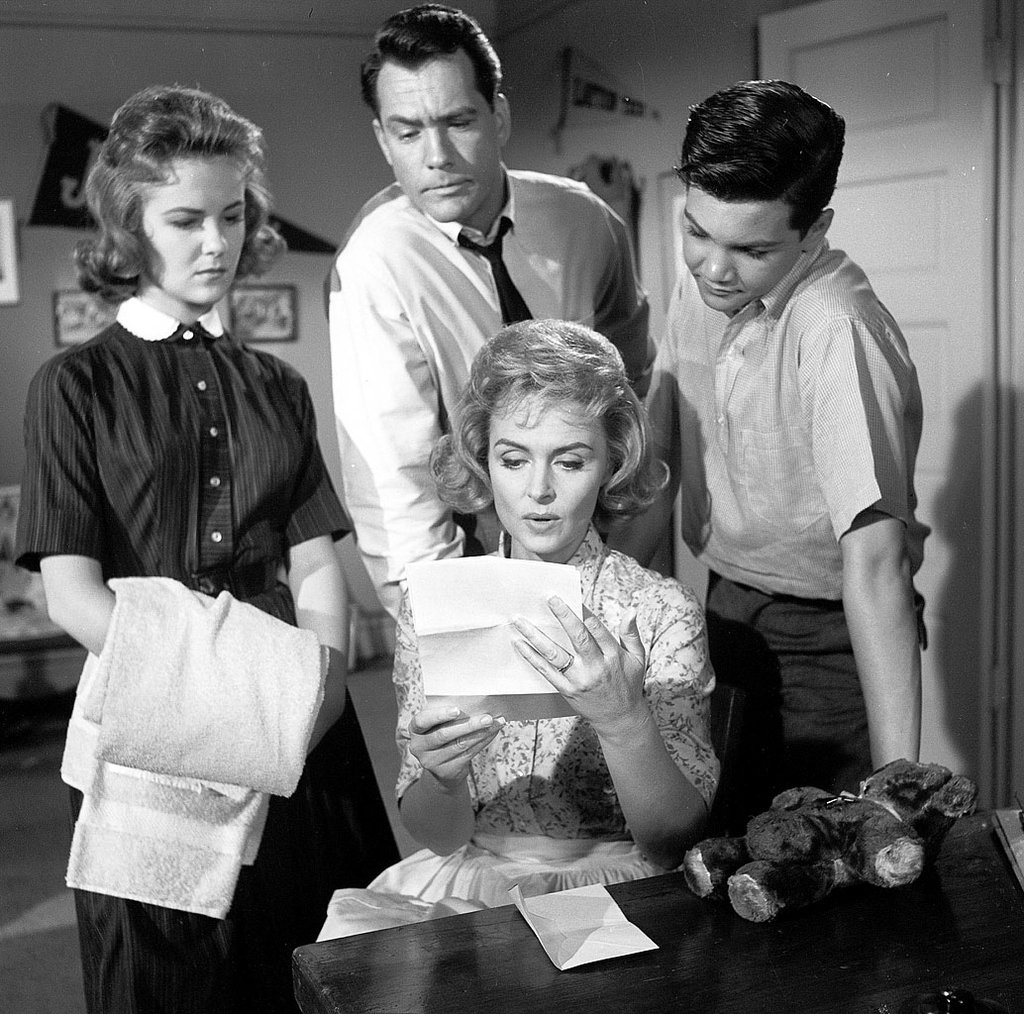
The Stone family includes Donna, Alex, Mary and Jeff. Donna (Donna Reed) is the iconic mother. She grew up on a farm (which Reed did). She became a nurse and occasionally helps Alex (Carl Betz), a pediatrician who has his office at the house. Mary (Shelly Fabares) is in her first year of high school. She studies ballet and plays the piano. During the series, she has several boyfriends. Mary left for college before the show ended, but Fabares made guest appearances. Jeff (Paul Petersen) is in grade school. He loves sports, likes to eat, and often teases his sister. In 1963 when Fabares leaves, Paul Petersen’s real sister, Patty was cast as a runaway orphan taken in by the Stone family. The Stones live in Hilldale, an All-American town.

reed9

Photo: pinterest.com

Several other characters appear often. Dave and Midge Kelsey (Bob Crane and Ann McCrea) are good friends of Donna and Alex’s.  Dave is also a doctor. Another of Alex’s colleagues who is a good friend is Dr. Boland (Jack Kelk), whom the kids call “Uncle Bo.” Smitty Smith (Darryl Richard) is Jeff’s best friend and Scotty (Jimmy Hawkins) is Mary’s boyfriend.

Photos: pinterest.com and metv.com

With Donna’s movie relationships, many guest stars appeared on the show during its run. Baseball players Don Drysdale, Leo Durocher, and Willie Mays played themselves. Musicians Harry James, Tony Martin, and Lesley Gore appeared. Buster Keaton was featured in two different shows. Esther Williams played a fashion designer. Other stars who showed up included Jack Albertson, John Astin, Dabney Coleman, Ellen Corby, Richard Deacon, Jamie Farr, Gale Gordon, Arte Johnson, Ted Knight, Harvey Korman, Cloris Leachman, Marion Ross, William Schallert, Hal Smith, Marlo Thomas, and William Windom.

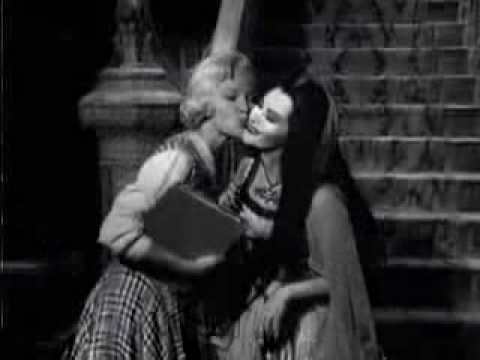
In the opening credits, Reed comes down the stairs and answers the telephone which she gives to Alex. She then hands the kids their lunches and books and sends them off to school. When Alex leaves on a call, she closes the door and smiles. In 1964 when The Munsters debuted, their opening credits were a parody of Donna’s show as Lily performs the same actions.

reed12

Photo: metv.com

The Donna Reed Show faced the Milton Berle show, Texaco Star Theater Wednesday nights and ratings were not great. It was renewed and moved to Thursdays the next year. I was surprised to learn that during the eight years the show was on the air it was only in the top 20 in season six and only in the top 30 in season four.

reed5

Photo: cinemacats.com (Look closely and you’ll notice this was                                                                 the living room for I Dream of Jeannie as well).

Although the show never received very high ratings, Donna Reed was nominated for an Emmy every year from 1959 to 1962. (Jane Wyatt won in 1959 and 1960, Barbara Stanwyck won in 1961, and Shirley Booth won in 1962.) Donna Reed won the Golden Globe in 1963.

reed8

Photo: metv.com

In 1962 Donna felt that the writers had run out of creative ideas and were recycling plots. Both Mary and Jeff were allowed to perform in this season. Fabares debuted a single, “Johnny Angel” in February which went to number one on the charts, selling more than a million copies. In October, Petersen sang “My Dad” which made it to number six. Donna decided that would be the last season, but when ABC made her a very lucrative offer for three more seasons, she and her husband agreed.

reed1

Photo: nytimes.com

When this contract ended in 1966, Donna was ready to retire. Reed was considering a television movie reunion but when Betz passed away in 1978, she decided it was no longer an option.

Campbell Soup was the first sponsor, and later sponsors included Johnson & Johnson and The Singer Company. Whenever a scene takes place in a supermarket, Campbell’s Soup, V-8 Juice, Franco-American Spaghetti and Johnson & Johnson Baby Powder are likely to be in the shot.

reed13

Photo: metv.com

Reruns of the show were seen on Nick at Nite from 1985-1994 and on TV Land from 2002 until 2004. MeTV began airing the show in September of 2011.

The cast was a close-knit one and continued their relationships after the show ended. Paul Petersen credited Donna as being the nurturing adult he needed in his life to get him through the years of being a child star. She helped him understand how the industry worked and helped him during some tough times during his life. Shelly Fabares also said Donna and Carl were amazing. Realizing how tough the industry can be for young kids, they protected Paul and herself and loved them as second parents. Donna never forgot to send Shelly a birthday gift.  In 1986, before she passed away from pancreatic cancer, her final words were to make sure Shelly’s birthday gift was wrapped and delivered.

reed15

Photo: lapostexaminer.com

Despite the bad raps the show often received from the women’s lib organizations, Donna Reed did help advance the way women were perceived in the media. She endowed her character with strong emotions, definite opinions on issues, and independence. In her personal life, Reed expressed her views on the medical industry and the political arenas.

reed7

Photo: geocaching.com

Paul Petersen summed up the value of the show in an interview he did in 2008. In his words, The Donna Reed Show, “depicts a better time and place. It has a sort of level of intelligence and professionalism that is sadly lacking in current entertainment products. The messages it sent out were positive and uplifting. The folks you saw were likable, the family was fun, the situations were familiar to people. It provided 22-and-a-half-minutes of moral instructions and advice on how to deal with the little dilemmas of life. Jeff and Mary and their friends had all the same problems that real kids in high school did. That’s what the show was really about, the importance of family. That’s where life’s lessons are transmitted, generation to generation. There’s a certain way in which these are transmitted, with love and affection.”

I couldn’t say it better.

Love and the Funny Show

ABCFriday_1972

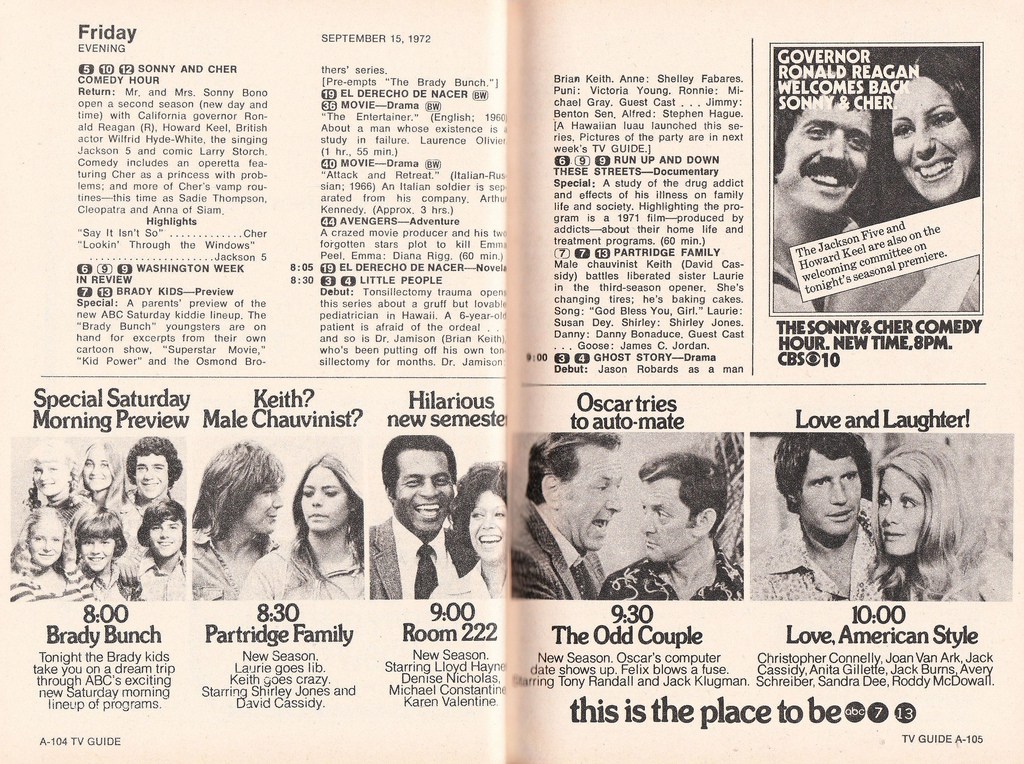
There was something magical about the Friday evening television schedule from 1971-1973.  Anyone who was born in the late 1950s or early 1960s can remember sitting down in front of the television at 7 pm (central time) for the Brady Bunch and staying put through The Partridge Family, Room 222, The Odd Couple, and Love, American Style.  Sitting through an entire evening of shows was almost unheard of back then, but we binge watched every Friday night. While the boys were divided between Marcia Brady and Laurie Partridge, every girl of that age had was in love with Keith Partridge.  Watching an episode of The Partridge Family today makes me feel 10 again. For the next five weeks, I’m taking a look at each of the shows that made this schedule so enjoyable.

las18

Today we begin with Love, American Style. This show was an iconic 1970s show. Like Laugh In, the clothing, furnishings, and vocabulary do not make it timeless. But it was a lot of fun. This fast-paced anthology show featured two to four mini episodes each week, and between them were quick skits, often featuring a brass bed. Each smaller episode is titled “Love and the _______.”

A troupe of players was featured on each show for the in-between skits. These regulars included William Callaway, Buzz Cooper, Phyllis Davis, Mary Grover, James Hampton, Stuart Margolin, Lynn Marta, Barbara Minkus, and Tracy Reed. Margolin went on to a regular role in The Rockford Files; Tracy Reed was featured in McCloud and Knot’s Landing; Phyllis Davis was part of the cast of Vega$ and Magnum PI, and James Hampton will be familiar if you watched The Doris Day Show or F-Troop. Both Reed and Davis were featured on Love Boat episodes which had a similar format to Love, American Style.

The show had a memorable and catchy theme song. Written by Arnold Margolin, the first year it was performed by The Cowsills.  You will see a lot of overlap between these five Friday night shows, and music is one of those cross-overs. The Partridge Family was based on the life of The Cowsills.

During the second and subsequent years that Love, American Style was on the air, the theme song was performed by the Ron Hicklin Group. The Ron Hicklin Group could be heard in a variety of motion pictures and commercials, and they also appeared on recordings with stars such as Paul Revere and the Raiders and Cher. John and Tom Bahler, brothers who sang under The Charles Fox Singers were also part of this group. The group provided television theme song recordings including Batman, That Girl, Happy Days, and Laverne and Shirley. They also did the singing for The Partridge Family theme and songs performed on the show as well as the Brady Bunch kids. Ron retired in the early 2000s, and Tom does a variety of things. He is also known for writing Bobby Sherman’s hit, “Julie Do You Love Me?”. John married Janet Lennon, one of the Lennon sisters who performed on The Lawrence Welk Show. He currently lives in Branson and conducts the “new” Lawrence Welk orchestra.

hicklin singers

The snappy melody was set to the following words:

Love, Love, Love

Love, American Style,
Truer than the Red, White and Blue.
Love, American Style,
That’s me and you.

And on a star-spangled night my love,

My love come to me.
You can rest you head on my shoulder.
Out by the dawn’s early light, my love
I will defend your right to try.

Love, American Style,
That’s me and you.

Paramount Television developed the show. The executive producer of the show was Arnold Margolin, Stuart’s brother. There were 53 different directors during the four-year run. The series received Emmy nominations for Outstanding Comedy Series in 1970 and 1971; Best Music Composition in 1971, 1972, and 1973, winning in 1973; and winning the Emmy in 1970 for Outstanding Original Music and Lyrics.

las8

Many people wrote for the show, but Garry Marshall and Jerry Belson received the most credits. One of the writers, Peggy Elliott, was interviewed by the Huffington Post in May of 2013, and she talked about her time writing for the show.

“But the show I loved writing the most, was Love, American Style. For every other show, I was writing for characters created out of someone else’s head. Sure, we could create the occasional guest-star role, and we had been told to make every role, no matter how small, a real person. ‘Think of the actor who’s playing that delivery boy,’ I can hear Billy Persky, the co-creator or That Girl, say: ‘This is a big break for him — it’s the biggest role he’s had so far. Give him something to work with.’

But with Love, American Style, every character was our very own; every situation came out of our heads. Each segment of the hour the show ran each week was a one-act play created entirely by us. Added to the attraction was the fact that we could say and do things that were taboo on every other TV show in the early ‘70s. Arnold Margolin, co-creator of the show with Jim Parker, told me recently that the creative side of the network wanted the show to be more daring, while the censors kept their red pencils ready. There was a full-time position on the show just to run interference.

We must have put both sides through the hoops with one episode we wrote: ‘Love and The Hand-Maiden.’ A young guy was dating a centerfold model. As their relationship developed, he discovered that she had no problem with shedding her clothes, but she always kept her hands covered — with artful poses in magazines, and with gloves in real life. He became obsessed with seeing her hands and came up with one ruse after another to get her to take off her gloves. We had a ball writing it, with one double-entendre after another.”

If you were a star of any kind in the early 1970s, you most likely were on Love, American Style.  The show produced 108 episodes, and those shows featured 1112 different actors. Some of the famous names showing up in the credits include Milton Berle, Sid Caesar, Phyllis Diller, Arte Johnson, Ozzie and Harriet Nelson, Regis Philbin, Burt Reynolds, Sonny and Cher, Flip Wilson, and Jo Anne Worley. Karen Valentine from Room 222, Ann B Davis and Robert Reed from The Brady Bunch, and both Jack Klugman and Tony Randall from The Odd Couple show up along the way.

Brad Duke wrote a biography about Harrison Ford and he said Ford had fond memories of appearing on Love, American Style. “He recalled that he had been given little time to prepare his wardrobe for the role of a philosophical hippie in the November 1969 episode, “Love and the Former Marriage.” He appeared on set with long hair and a beard thinking they were appropriate for the role. He was surprised when he was told he needed a haircut and trim than given a navy blue dress shirt and vinyl burgundy jeans with a large belt. They even had a scarf with a little ring to put around my neck. And I thought, someone has made a mistake here. So, rather than argue with the wardrobe people, I put on the clothes and went to find the producer. I walked on the set and he was pointed out.  I tapped his shoulder and when he turned around he had on the same clothes I did. He was a hippie producer I guess. At least the check went through, and I got paid.”

harrison1love and the former marriage

The best way to get a good understanding of what the show was like is to look at a couple of the episodes.

January 23, 1970: Love and the Big Night

Starring Ann Elder, Buddy Lester, Frank Maxwell, Julie Newmar, and Tony Randall, this episode was often listed as a favorite. Randall is a married businessman who escorts his voluptuous secretary (Newmar) to her apartment after a late night at the office. Eager to get home to his wife, Randall hurriedly tries to open a stubborn jar of mayonnaise and winds up covered with mayo. Newmar cleans his suit, but while it’s drying, it’s stolen. After a series of amusing mishaps, Randall finally gets back to his own apartment and creeps into bed with his wife–only to find out she’s not there.

February 25, 1972: Love and the Television Set

It starred Harold Gould, Marion Ross, Ron Howard, and Anson Williams. Reading this list of names might give you a hint about what happened to this episode after it aired. Garry Marshall had written a pilot about a 1950s family that did not sell.  He turned it into an episode for Love, American Style. George Lucas caught the episode and was impressed with Ron Howard and offered him a role in his new movie American Graffiti about 1950s teens. The movie was so popular, that the network decided to put Marshall’s pilot in the fall line-up as Happy Days. Harold Gould’s role was given to Tom Bosley for the series. When Love, American Style went into syndication, this episode was retitled “Love and the Happy Days.”

October 22, 1970: Love and the Bashful Groom

This is the episode I recall when I think of the series. When I watched it originally, I was staying overnight at my grandparents’ house and my grandmother was shocked at the “vulgarity.” It really seems quite tame today, but back then it probably was unexpected. She would approve of Tom Bahler marrying Janet Lennon though because I watched Lawrence Welk with her and my grandfather whenever I was at their house.

In this episode, Paul Petersen, Christopher Stone, Meredith MacRae, Jeff Donnell, and Dick Wilson are featured. Harold (Petersen) and Linda (MacRae) are getting married. He learns that she grew up in a nudist colony and is not comfortable being naked for his wedding.  After a soul-searching talk with his best friend, and realizing he loves Linda enough to be uncomfortable, he decides to go through with the ceremony.  He gets to the church a bit late and walks in, only to see that everyone else is dressed in their Sunday best. His bride informs him that they always dress up for weddings. One of the congregation members says something like “Let’s not make him uncomfortable,” and they all begin to undress.  Of course, you see nothing improper, only clothes flying. This was probably not the best episode to “expose” my grandmother to as a first glimpse of the show.

The show lasted for four years and was cancelled in 1973. In 1985, a reboot was created, but it was on in the mornings and only lasted a few months.  The show was on at the same time as everyone’s favorite game show, The Price is Right. For the 1998 fall season, a pilot was created for prime time, but it was never ordered. While doing my research for this blog, I noticed that there was a Love, American Style project in production, so we may see it resurface again.  I’m not sure I would want to watch a 2019 or 2020 version of the show though. It was such a product of its time, and I fear what a current version would be like after seeing the reboot of Match Game which has been airing the past year or so.

Let’s all write to Antenna TV and Me TV to see if they will make the original 1971 television schedule happen, and we can watch these original shows again, reliving the excitement we experienced the first time around.

Next week we get to know The Odd Couple.


Shelly Fabares: A Life Spent in the Entertainment Industry

fabares2

Michele Ann Marie (Shelly) Fabares was born in 1944 in California.  She began acting at 3 and at age 10 she appeared in her first television show. Her aunt was the actress Nanette Fabray who also began acting as a child, and then went on to musical theater.

During the 1950s, Shelly appeared in several television shows including Annie Oakley, The Loretta Young Show, and the Twilight Zone, in addition to 8 others. She was part of the cast of Annette in 1958, playing Moselle Corey.  The star of the show was Annette Funicello.  She is an orphan who grew up in the country and now lives with her wealthy aunt and uncle, not fitting into the snobby community. The show was cancelled after 19 episodes. Annette was a life-long friend of Shelly’s. They met in seventh grade, and Shelly was at her bedside when she passed away from multiple sclerosis in 2013.

Later that year she was offered the part of Mary Stone on The Donna Reed Show. The show was on the air seven years. Shelly left the show in 1963 to pursue a film career but stayed close to the cast, especially Donna Reed who was a second mother to her. Paul Petersen and Fabares both described how amazing Donna Reed and Carl Betz were during their time on the show.  Realizing how tough the industry can be for young kids, they protected them and loved them as second parents. Both Shelly and Petersen pursued their music interests on the Donna Reed Show. In 1962, she recorded “Johnny Angel” which went to number 1 on the Billboard 100.

Shelly appeared in 13 films in the 1950s and 1960s, including three with Elvis Presley—Girl Happy in 1965, Spinout in 1966, and Clambake in 1967. She also appeared on television on The Ghost and Mrs. Muir, Daniel Boone, Lancer, and Bracken’s World. Shelly married Lou Adler in 1964.
fabares12

Her acting career continued to skyrocket in the 1970s.  She appeared as Joy Piccolo in Brian’s Song in 1971. She appeared in 26 television shows, three of them regular series. The Brian Keith Show was on the air from 1972-74. Keith was Dr. Sean Jamison and Shelly played his daughter, Dr. Ann Jamison.  The two of them ran a free pediatric clinic in Hawaii financed by a wealthy patron. Sticking with the medical theme, she joined the cast of The Practice in 1976-77 working with Danny Thomas. She played Jenny Bedford, the daughter of Dr. Jules Bedford. At the end of the decade she tried another sitcom, Highcliff Manor, which only lasted 6 episodes. I don’t remember this sitcom, but it seems an odd one: the manor, owned by Fabares’ character, Helen Blacke, was home to the Blacke Foundation, a research institute staffed by an eclectic group of eccentric characters. It sounds a bit like Scorpion, maybe just a couple decades’ too early.

She continued working on television in the 1980s, appearing on Fantasy Island, Mork and Mindy, Matt Houston, The Love Boat, Newhart, and Murder She Wrote.  She joined the cast of One Day at a Time, playing Francine Webster between 1978-1984. She also made the movie Hot Pursuit in 1987. The description of the movie is that young Danny is following his rich girlfriend’s family to the Caribbean. But suddenly he simply must take a chemistry test and cannot go with them. After they have left, he gets a leave from his professor and takes a plane to find them. But he is not quite sure where they are, and meets smugglers, crazy captains, and murderers. Fabares’ marriage to Lou Adler legally ended in 1980, although they had been separated since 1966. In 1984, she married M*A*S*H star Mike Farrell.

fabares8

Entering her 5th decade of acting, she made her last film, Love or Money in 1990. She continued her television work appearing in A Whole New Ballgame and the Justice League.  She also had a regular gig providing the voice for Martha Kent in Superman from 1996-99. In addition to the Donna Reed Show, the show that Fabares is best known for was Coach which ran throughout most of the 90s, from 1989-1997. As Christine Armstrong, she is the girlfriend, and later, wife of Coach Hayden Fox, played by Craig T. Nelson.  The show revolves around the football team that Fox coaches.  He lives for sports while Christine is not the least interested.  This causes a bit of friction and miscommunication in their relationship.

Fabares had a long and full career.  While her career kept her busy, she had to deal with several major life situations:

DONNA REED;SHELLEY FABARES

Donna Reed, her second mother, passed away in 1986 from pancreatic cancer.  Shelly adored Donna, and Donna’s final words were to make sure Shelly’s birthday gift was wrapped and delivered.

At the same time Reed was dying, Fabares’ mother was suffering from Alzheimers.

In 2000, Shelly needed a liver transplant because she had autoimmune hepatitis.

She had to deal with the death of her life-long friend Annette Funicello in 2013.

Few actors can begin acting as a child, transition into teen parts, transition into movie roles, and then continue acting as an adult in sitcom series, but she did that beautifully. Hopefully she and hubby Mike Farrell continue to enjoy a long and well-deserved retirement.

fabares1