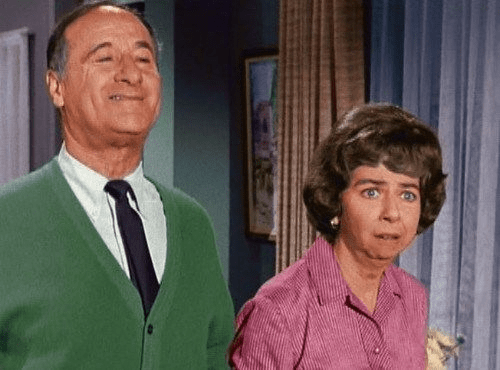
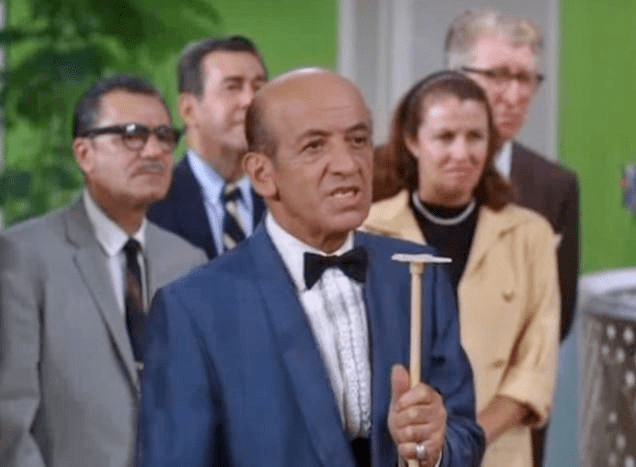
As we learn about a few Bewitching characters this month, I had to include the Kravitzes, Abner and Gladys, a/k/a George Tobias and Alice Pearce. Today let’s take a closer look at the career of George Tobias.
📷pinterest.com The Kravitzes
Tobias was born in New York in 1901. He was the son of Russian-Jewish immigrants, and his parents were active in the Yiddish theatre. After his older brother joined them, they tried to discourage George from following in their footsteps. In a St. Louis Post Dispatch interview in 1940, Tobias said “They made up their minds very definitely that I was not going to spend my life nearly starving as they did. They wanted me to be a doctor or lawyer, but I knew from a very early age that I would follow the same career as my mother, father and brother . . . so whenever I got an acting job in between other jobs, I had to keep it from my family.”
At age 15, Tobias was in local productions, making his Broadway debut at age 23. In 1939, Warner Brothers offered him a contract, and he appeared in 65 big-screen productions during his career, including parts in This is the Army and Marjorie Morningstar. Tobias appeared in four Oscar Best Picture nominees: Ninotchka (1939), Sergeant York (1941), Yankee Doodle Dandy (1942), and Mildred Pierce (1945).
Tobias’s television career began in 1954 in Our Miss Brooks. He would go on to earn 34 additional television credits before he retired in 1977.
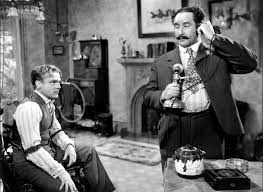
📷imdb.com With James Cagney in The Strawberry Blonde
His first cast role was in Hudson’s Bay playing Pierre Falcon in 1959. This show centered on Hudson’s Bay Company and its fur trade shortly after North America’s colonization. Trappers, explorers, Native Americans, and both the French and British navigate the territory, seeking fortune, fame, and adventure.
In 1960, he showed up as Penrose on season one of Adventures in Paradise in a show about the adventures of the Tiki III and crew as they sailed from island to island through the South Pacific, carrying cargo and the odd passenger from one drama to another.
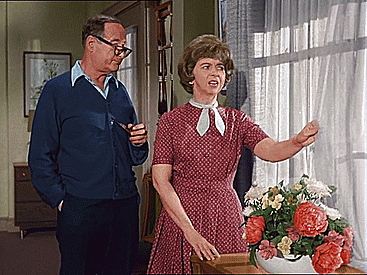
From 1964-1971, Tobias was part of the Bewitched cast as Abner Kravitz. He put up with his wife Gladys despite thinking she was high strung, delusional, and just plain kookie.
In 1966, Doris Day’s movie The Glass Bottom Boat was released. Pearce and George Tobias were cast as next-door neighbors in the film. Although they weren’t named Gladys and Abner, the Fenimores were a carbon copy of the Kravitzes.
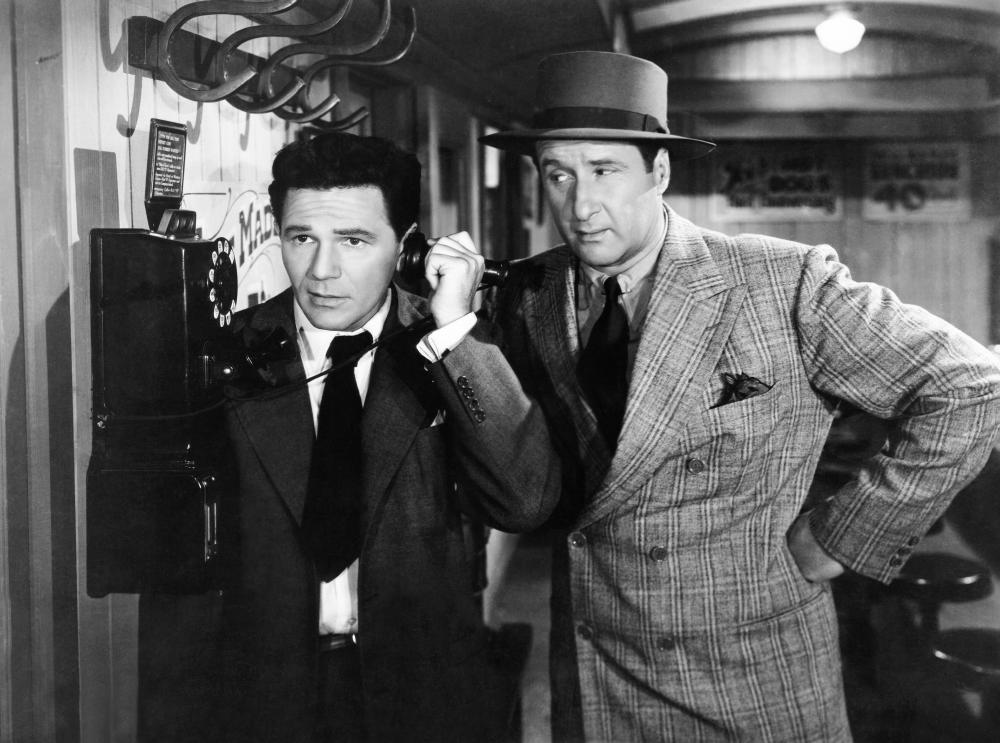
📷tvinsider.com 1946 Nobody Lives Forever
George’s last regular role was in The Waltons during seasons one and two when he played junkman Vernon Rutley.
While Tobias took on a few more roles before retiring, 1977 was his last year of acting, appearing on Tabitha when he reprised his role of Abner Kravitz. Tabitha was Darrin and Samantha’s daughter, now an adult.
Tobias passed away in 1980 from bladder cancer. He never married or had children, although he had a 40-year on-and-off relationship with actress Milicent Patrick. Patrick had an active career in entertainment from 1941-1961; she was also a commercial artist, fashion designer, and children’s book illustrator.
Even though Tobias was no longer living, he had one more adventure to journey through. The hearse with his body was stolen on its way to the mortuary. The car was in a fender-bender, and while the two drivers exchanged information, a carjacker made off with the hearse. The car and body were found shortly afterward.
📷pinterest.com
In his book, Bewitched Forever, Herbie J. Pilato discusses how rugged and tough Tobias was in real life. He said he was “quite the equestrian. He owned and trained many horses, loved to play polo, and was a volunteer mounted policeman.” David White, who played Larry Tate, told Pilato that George “was a sheriff out in Peach Blossom, California, where he lived. He had a badge and everything.”
I always like Abner and Gladys Kravitz. I’m happy Tobias stuck to his guns and continued with his acting career, despite his parents’ worries. It sounds like he had a happy and successful life.
We are winding up our blog series “What a Character” with Sandra Gould. I have to be honest, I had an unfair bias against Sandra Gould. I didn’t know a lot about her career, I just knew that she replaced Alice Pearce as Gladys Kravitz, and it was a bad replacement. It wasn’t Sandra’s fault—I blame the show’s producers.
📷pinterest.com
Some actors truly are irreplaceable. Eartha Kitt, while a great Cat Woman, just wasn’t Julie Newmar. Imagine trying to replace Henry Winkler as the Fonz halfway into the show. Can you picture tuning into MASH and finding Hawkeye was now played by someone other than Alan Alda? Pearce was perfect in that role and, despite her being nosy and annoying, she was likable and that is hard to do. Gould’s Gladys was loud and brash, and I felt like I heard fingernails on a chalkboard whenever she was in a scene.
As long as I’m oversharing, I never cared for Dick Sargent either. While he was able to replace Dick York in some ways, York was just Darrin. Okay, I’m done and ready to talk about the good aspects of Sandra Gould and her long career.
Gould was born in Brooklyn in 1916. She entered the entertainment business early becoming a kid dancer in the Cat Skills by age 13.
📷threads.com
Gould found a lot of success on radio, appearing on “My Friend Irma” and “Duffy’s Tavern.” Her first radio job came along when she was only 9 on “The Danny Thomas Show.” Gould was with Jack Benny for almost fifteen years.
In 1938 she married Larry Berns, a broadcasting executive. They were married until his death in 1965. Berns joined CBS in 1942 writing and producing radio and TV series including Our Miss Brooks. He later worked on McHale’s Navy and Broadside.
Sandra’s first role was in the big screen T-Men in 1947. Most of her roles were inept or gabby women, typically a telephone operator, nurse, receptionist, landlady, or saleswoman. Gould once mentioned that she played an operator more than any other actress. I did notice 10-15% of her roles mentioned switchboard operators.
📷facebook.com
While she continued to appear in movies, most of her acting credits came on television. She appeared in Oboler Comedy Theater in 1949. In the early days of television, many of the series were drama or comedy reenactments of movies or plays. Sometimes, new stories were written for these episodes. Gould continued with these roles into the mid-fifties.
From 1952-55 she appeared as Mildred on I Married Joan. This series starred Joan Davis and Jim Backus. He was a judge, and she was another “Lucy Ricardo” always getting into mischief or causing hardships for her husband.
📷tumblr.com
Gould was kept very busy with offers during the end of the fifties and throughout the sixties. She could be seen doing comedy on Our Miss Brooks, I Love Lucy, The Jack Benny Program, My Three Sons, The Brady Bunch, and I Dream of Jeannie among others. She also tried western life on Wagon Train. Her drama performances included Hawaiian Eye and I Spy. She even dipped her toe into animation on The Flintstones.
At the end of the sixties, she was given the Glady Kravitz role. Pearce and Gould split the character’s appearances: Pearce had 27 episodes with Gould having 29.
Gould had stepped away from acting for a time. She published two books for girls: Always Say Maybe and Sexpots and Pans. They both seem quite dated today in their advice to girls to get the right type of husband. At the time she accepted the role of Gladys she said she had gone through a very rough year. Her husband died. Then her writing partner Peter Barry died. Then Alice Pearce, who was a good friend of hers. She had no desire to take over the role, but George Tobias who played Abner and was also a friend, called her to come in for an audition.
📷imdb.com
I could not find any information about she and Barry collaborating. One article specifically mentioned that they wrote scripts for Honey West, Tammy, and The John Forsythe Show, but I don’t see either of their names as writers for these shows. Barry is listed as a writer for 23 shows in the late fifties and early sixties, and he was a radio scriptwriter. Perhaps they had written some scripts that were never filmed.
I guess I am in the minority on the Bewitched issue because most sites I visited described her role similarly, usually something like Hollywood Spotlight’s description: “her over-the-top performance and shrill voice were popular with viewers, and she succeeded ultimately in making the character her own.” She also reprised her role as Gladys in the sitcom Tabitha in 1977 which was about Darrin and Samantha’s daughter as an adult.
Some time during her stint on Bewitched, she got married again to Hollingsworth Morse, and they were together until his death in 1988. Hollingsworth was a director and assistant director on almost 90 programs and movies including McHale’s Navy, Dukes of Hazzard, and Mork and Mindy.
The seventies and eighties found her primarily in drama roles, although she could be spotted in a handful of sitcoms. You can catch her on Columbo, Marcus Welby MD, Ironside, Crazy Like a Fox, and MacGyver. During the nineties, she took on roles that were described as “old lady” on Friends and on her last appearance which was Boy Meets World in 1999.
📷bewitched wiki.com
Not long after filming this episode, Gould passed away from a stroke following heart surgery.
Gould had a long and successful career and certainly made the nosy, gabby character her own. I’m glad the job on Bewitched helped her get through a very sad and difficult time in her life. However, I still am claiming she was not right for Gladys who should have been written off the show and just replaced with a new neighbor. But I respect Gould and the characters she made her own on the big and little screens.
This month we are learning to love Lucy. We have looked at the career of Lucille Ball, and today we are taking a peek back at the well-loved sitcom, I Love Lucy.
📷pinpage.com
The show starred Lucille Ball, Desi Arnaz, Vivian Vance, and William Frawley. The series featured a young housewife, Lucy Ricardo, who lived with her husband Ricky, a nightclub bandleader. Their landlords, Fred and Ethel Mertz, were also their best friends. Lucy and Ethel get involved in a variety of schemes to get into show business. Lucy relies on Ethel and Fred who were in vaudeville earlier in their career. Eventually Lucy and Ricky have a son which coincided with the birth of their son Desi Jr. Lucy and Ethel try Desi’s patience often with their antics. When he gets upset, he starts speaking Spanish. Fred doesn’t have much time for the women’s plots either. After living through the Depression, he is considered cheap and doesn’t tolerate nonsense. In season six, the quartet move to Connecticut.
In 2012, ABC News and People did a joint survey, listing I Love Lucy as the Best TV Show of All Time.
The theme music was composed by Eliot Daniel with lyrics by Harold Adamson.
The show had three directors: Marc Daniels was director from 1951-53; William Asher, who would later produce Bewitched among other shows, was director from 1952-57, and James V. Kern directed 39 episodes from 1955-57.
Jess Oppenheimer was producer for the first 153 episodes; Desi Arnaz was executive producer for the first 124 episodes and producer for the final 26.
Oppenheimer was credited with writing for seasons 1-5, Madelyn Pugh Davis and Bob Carroll Jr. assisted him.
📷📷wikipedia.com Best Friends
Lucille Ball had been starring in “My Favorite Husband” on the radio and in 1950, CBS wanted her to transition to television. Richard Denning had been her costar on the radio, but now she wanted to do a series with her real-life husband, Desi Arnaz. CBS did not think visitors would buy in to Lucy, the all-American girl, married to a Cuban musician. To prove them wrong, Lucy and Desi created a vaudeville act written by Carroll and Pugh that they performed with Arnaz’s orchestra in New York. The act was a big hit, so Harry Ackerman approved the couple doing the show.
The pilot was ordered in 1951. Oppenheimer, Pugh, and Carroll also made the move from radio to television. Philip Morris decided to sponsor the show. Ball wanted to continue her film career along with television show which was set to air biweekly. Philip Morris wanted the show to air weekly, and they wanted it filmed in New York. Because Lucy and Desi were expecting their first child, they wanted to stay in Hollywood. The couple agreed to reduce their pay by a $1000 a week in order to stay in California and cover the additional expenses of filming. They asked for 80% ownership in the films, with the remaining 20% going to Oppenheimer who shared 5% with Pugh and 5% with Carroll. Desilu (combining Desi and Lucy) became their production company.
The couple hired Carl Freund, who had worked on many big-screen movies, to film the show. He uniformly lit the set so all three cameras would pick up the same quality of the image. He also pioneered “flat lighting,” which lit everything with bright lights to get rid of shadows. The three-camera method became the standard sitcom technique.
📷rottentomatoes.com
A live audience produced a more authentic laugh than the canned laughter some shows used. Both Desi and Lucy’s mothers’ laughter can be detected in these early episodes.
When Lucy needed some rest after having her baby, the company could not finish their 39-episode commitment, so Oppenheimer and Desi decided to rebroadcast some of their favorite episodes instead. This out-of-the-box thinking proved to be so popular that it eventually led to the syndicated market.
When Lucy decided to transition her show from radio to television, Gale Gordon and Bea Benaderet were offered the roles of Fred and Ethel. However, both of them were already transitioning from radio to other televisions series. Gordon had already committed to Our Miss Brooks and Benaderet had agreed to star in The George Burns and Grace Allen Show.
The role of Ethel was then offered to Barbara Pepper, who was a good friend of Lucy’s. However, she was known to have a drinking problem; Wiliam Frawley also was a heavy drinker, so the production staff did not feel comfortable having two cast members with alcoholic issues, so the offer to Pepper was rescinded. Pepper would appear quite often in I Love Lucy and eventually she settled in Hooterville, married to Fred Ziffel.
📷pinterest.com
Frawley never appeared drunk during filming or caused any problem on the show. I did think it was funny though that he had a clause in his contract that he did not have to film when and if the New York Yankees were in the World Series. They made it to the big show every year the series ran except for 1954.
Mary Wickes was then offered the role, but she was afraid working with Lucy would harm their friendship. Director Marc Daniels suggested Vivian Vance who was performing in “The Voice of the Turtle.” Oppenheimer and Arnaz went to watch her performance and hired her on the spot. Lucy was not thrilled with the idea of Vance. She thought she was prettier than her vision of what Ethel would look like. Vance was only two years older than Ball, but the producers agreed to dress her in frumpier clothing. Eventually Ball and Vance became good friends. Vance was the first actress to win an Emmy for Outstanding Supporting Actress. When I Love Lucy ended, Ball asked Vance to star in her new series, The Lucy Show.
Unfortunately, Vance and Frawley never warmed to each other the way she and Lucy did. They barely tolerated each other, although they were both always professional on the set.
Lucy and Desi had several miscarriages and when they were able to sustain a pregnancy which resulted in daughter Lucie, they filmed Lucy without ever mentioning that she was pregnant. The sponsors thought it would be in poor tasted to talk about pregnancy. However, in the second season, they were pregnant once again, and the pregnancy was written into the show. They had to use the word “expecting” when talking about the baby. The episode “Lucy Goes to the Hospital” in 1953 was watched by almost 72% of families with televisions, the highest rating for quite some time. It was surpassed by Elvis Presley’s first appearance on The Ed Sullivan Show.
The show was on for from 1951-1957 on CBS, resulting in 180 episodes.
I Love Lucy aired on Mondays for its first run. In 1967 the network began offering the show in syndication and it has never been off the air.
📷pinterest.com
I Love Lucy was nominated for Best Comedy/Sitcom in 1952, 1953, 1954, and 1955, winning in 1953. Ball was nominated for Best Comedienne in 1953-1958, winning in 1953 and 1956. Vance was nominated for Best Supporting Actress in 1954, 1955, 1957 and 1958, winning in 1954. Frawley was also nominated for his role in 1954-1958. He never won but he lost to some great actors including Art Carney and Carl Reiner. Only Arnaz was denied a nomination for his comedy skills.
In 1957, Lucille Ball decided to end the show. She and Desi created a new show that wasn’t really new. It took the four main characters from I Love Lucy and moved them to Connecticut. Arnaz changed the format and length of the show, now an hour long, because he said he wanted to change it up before people got tired of the characters. He said this format kept the cast intact but also allowed for a celebrity guest star for Lucy to meet in every episode. In 1960 the show ended, the same year the couple’s real life marriage ended.
Unfortunately, the couple’s marriage dissolved in 1960, and in 1962, Lucy bought Desi’s shares of Desilu becoming the sole owner. She sold the company to Gulf+Western who owned Paramount Pictures.
We all remember the merchandising that accompanies shows in the sixties and seventies like dolls, board games, lunch boxes, etc, but I Love Lucy had more than its share of memorabilia. In 1952 a baby doll was released. Believe it or not, you could purchase an I Love Lucy bedroom set for $199 in the fifties, as well as I Love Lucy his and her pajamas.
The way it ended, I Love Lucy never had a proper finale. I wish I had the time to devote to how much this show changed the course of television, but a weekly blog just can’t contain as much history as there is to tell. I’m sure Lucy would be amazed if she knew that more than seventy years after the show began, we are still watching it and talking about it. Legacy doesn’t get any better than that.
This month we are looking at some of our favorite character actors. As we wrap up the series, we are ending on a high note with the amazing Burt Mustin. Like Charles Lane, Mustin had a prolific career in Hollywood and television. However, unlike Lane, Mustin was offered his first acting job at age 67 after he had retired.
📷Widener University Archives
Mustin was born in Pittsburgh in 1884. His father was a stockbroker. After high school, Mustin enrolled in the Pennsylvania Military College (now Widener University) with a degree in civil engineering. During his college career he played trombone in the band and played goalie for his hockey team.
After graduation, Mustin toured Europe, planning to work at his father’s brokerage firm. However, a financial panic destroyed the company.
One of Burt’s university classmates was Charles Spinney. According to Burt, Spinney displayed lots of photographs of young ladies from his hometown of Memphis, Tennessee. One day, he was showing them to Burt when he spotted the photo of what he referred to as “the prettiest girl in the room.” Mustin traveled to Memphis to meet her and in 1915 he married Frances Robina Woods. The couple had no children and remained together for their entire lives, with Frances passing away in 1969.
📷imdb.com
After working as an engineer for a few years, Mustin decided to try to sell automobiles. In an interview, Mustin admitted, “I was the worst engineer the school turned out.” He began selling Oakland Sensible Sixes and later Franklins, Lincolns, and Mercurys. WWII put an end to car sales for a few years, so Mustin began working for the Better Business Bureau and then the Chamber of Commerce. He stayed in Pittsburgh until he retired.
He did a bit of amateur acting and continued his passion for music. He was part of the oldest Gilbert and Sullivan troupe in the country, the Pittsburgh Savoyards; the Pittsburgh Opera; and an officer in the Society for the Preservation and Encouragement of Barbershop Quartet Singing in America.
He was a founding member of the Pittsburgh Lions Club in 1921 and a life member in the Fellows Club of Pittsburgh. Mustin served as an announcer for the first weekly variety show on radio station KDKA.
📷that’sentertainment.com
After retiring, Mustin and his wife moved to Tucson, Arizona for her health where he continued acting. William Wyler saw him in a stage production of “Detective Story” and told Mustin to let him know if he ever wanted to pursue a film career. When Wyler was casting for Detective Story in 1951, Mustin reached out to him. The couple later moved to Los Angeles. Mustin would appear in 67 films overall.
In 1968 Mustin was cast in Speedway with Elvis and Nancy Sinatra. In one scene the stars have a lover’s quarrel in a coffee shop. When they make up, Elvis sings a song for his girl. Mustin is in the background cleaning the café and working at the counter. The producers felt the scene needed something else. That something else ended up being Mustin singing and dancing with a mop. No one on the set realized that Burt could sing before that adlibbed scene.
1951 was also the year that Mustin appeared on television in The Adventures of Kit Carson. He would find a new career in television for the next two decades, appearing in more than 130 series (which would equal more than 400 actual episodes).
📷imdb.com
During the fifties, he would be attracted to many westerns and dramas; however, he found his way onto a few comedies including The Great Gildersleeve, December Bride, and Our Miss Brooks.
If I listed half of the 1960s shows he appeared on, you would still be reading this blog next Monday when my new one is dropped. Take my word for it that he was on almost every popular sixties’ sitcom, including 14 episodes as Gus the fireman on Leave it to Beaver. Other sixties hits you can find him on include The Many Loves of Dobie Gillis, The Dick Van Dyke Show, The Joey Bishop Show, The Jack Benny Show, The Beverly Hillbillies, Get Smart, TheAndy Griffith Show, The Lucy Show, Bewitched, Gomer Pyle USMC, PetticoatJunction, and My Three Sons, not to mention many dramas and westerns including Bonanza and Gunsmoke. He was no less busy in the seventies where we could catch him in Marcus Welby, The Mary Tyler Moore Show, The Brady Bunch, Love American Style, Adam-12, All in the Family, and Phyllis.
📷imdb.com
Johnny Carson loved having Mustin on The Tonight Show, where he was a fan favorite. He shared a lot of fun stories on the show. One of them was about him being at the first World Series for baseball in 1903 when the Pittsburgh Pirates played the Boston Red Sox. Unfortunately for Burt, Boston came back to win the series, but as a bonus he did get to see Honus Wagner play on the diamond.
Mustin passed away eight years after his wife at the age of 92. He left a gift to the college he was loyal to his entire life, enabling Widener University to renovate their theater. It is now named the Burton H. Mustin Theatre and Lecture Hall.
It’s hard to wrap your head around what a busy film and television career Mustin had. He was an actor for the last 25 years of his life, and with 67 movies and more than 400 episodes, that means that he accumulated about 20 credits per year which is almost two a month from age 67 to 92. Talk about an amazing career. Mustin proved that it’s never too late to find your next passion. Thanks for so many great memories Burt Mustin.
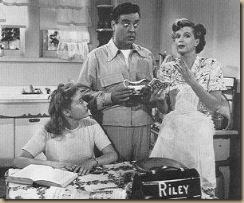
This month we are talking about classic television shows. Because it was early in the history of television, many of these shows began on the radio. Our series today was no different. It had a lot of lives. Like Ozzie and Harriet Nelson or Our Miss Brooks, it went from radio to television to film. However, in addition to those different genres, this show probably has the record for the first reboot. Today we learn all about The Life of Riley.
📷wikipedia.com
The Life of Riley began on the radio. Throughout the forties, you could tune in to hear Chester Riley, voiced by William Bendix, getting into a lot of different trouble while his long-suffering wife Peg (Paula Winslow), tried to help him. He had two kids, Babs (Barbara Eller) and Junior (Tommy Cook, Bobby Ellis, Scotty Beckett). His best friend Jim Gillis was often in the middle of the screw-ups with him. Another recurring character favorite was Riley’s friend Digby O’Dell, local undertaker, played by John Brown.
The family lived in California, and Riley was a blue-collar worker; he was a riveter at the Cunningham Aircraft plant. Riley is stubborn and opinionated, and knows his way is the right way. His family and neighbors think otherwise.
The original radio concept was created to star Groucho Marx, but the sponsor could not see Marx in a sitcom role. Gummo Marx who had become an agent, worked with the original sponsors, The American Meat Institute, to develop the show. Later the show was sponsored by Proctor and Gamble and then by Pabst Blue Ribbon Beer.
In 1949 in a weird twist, there was a film version coming out as well as an ABC Blue Network television sitcom. Bendix had signed on for the film, so that prevented him from playing Riley on television. The film did well, earning $1.6 million.
📷iamachildoftelevision.com The Jackie Gleason Riley
Jackie Gleason took on that role with Rosemary DeCamp as Peg. Gloria Winters was Babs, Larru Reese was Junior, Sid Tomack was Gillis, and Brown continued to play O’Dell. It only was on the air from October 1949 to March 1950. I’m not sure why it disappeared from the schedule so quickly. Producer Irving Brecher and Pabst Brewing Co. could not agree on extending the series to a 39-episode season. Apparently, the ratings were not high enough for the sponsor to want to continue with the series. It competition was a Feature Theater on Dumont and Suspense on CBS. Suspense also began in 1949 and began as a radio show. It was an anthology series that often featured literature adapted for television. It was on the air until 1954, although the radio show was on the air from 1942-1962. However, it won the first Emmy Award for Best Film Made For and Shown on Television. Six shows were nominated, but the only other show remembered today was The Lone Ranger.
📷imdb.com
In 1953, a reboot was made for NBC. William Bendix was back as Riley and this series continued on the air for six seasons. In this second, better-known series, Marjorie Reynolds was Peg, Lugene Sanders was Babs, and Wesley Morgan was Junior. Gillis was played by Tom D’Andrea and his wife Honeybee was played by Gloria Blondell. Digger O’Dell was not mentioned. John Brown had been named on the Hollywood Blacklist during the McCarthy debacle years, so he was prevented from taking the role. Many people use Riley’s catch phrase, even if they are not sure where it was originally from: “What a revoltin’ development this is.” Riley made $59 a week, and money was often one of his concerns.
Four of the six seasons found the show in the top 30, and 217 episodes were produced. Oddly, season five was filmed and broadcast in color, while season six was back to black and white. The show was on Friday nights for its entire run. The first three seasons it faced its biggest competition against Topper for two years and Our Miss Brooks for season three.
Dell Comics featured the show in one of its comic books in 1958. It was included in the Four Color series. It has held its value with most editions going for about $200-$300 online.
While I have watched a fair number of episodes of The Life of Riley, I have to admit it was never one of my favorites. Shows from this era are very hit or miss with me. I do like all the versions of Our Miss Brooks, and I love Burns and Allen and Jack Benny, but I got quickly got tired of the circumstances Riley continually found himself in and his mispronunciation of words and his lack of knowledge which he never realized. I am also in the small, small minority of people who felt the same way about I Love Lucy. I can watch one or two episodes here and there but not on a regular basis, although the scripts and acting on I Love Lucy carried it much further than Life of Riley.
However, Life of Riley was popular in the fifties and is still well-known today, so it found its audience of fans. If you want to try it out, there are limited opportunities. Interestingly, there is a DVD of the Gleason episodes and there are several recordings available of the radio show. However, for the Bendix television series, I could only find one option and half the shows are Our Miss Brooks so it is not even an entire season, just two episodes. I could not find any networks currently streaming the show either.
September is What a Character month, and today we end our series with a look at the career of Herbie Faye. Faye was born in 1899 in New York City. He began working with Mildred Harris in vaudeville in 1928. Phil Silvers was one of the supporting cast members, and their friendship would prove fruitful for his future television career.
Photo: imdb.com
In the forties and fifties, Faye tried his luck on Broadway, appearing in a variety of shows including “Wine, Women, and Song” in 1942 and “Top Banana” in 1951.
He also began a career on the big screen in the fifties. His first film was the movie version of Top Banana in 1954. He would appear in 17 movies; in fact, his last acting credit was the movie Melvin and Howard in 1980. In between, he appeared in a variety of genres including Requiem for a Heavyweight starring Anthony Quinn, The Thrill of It All with Doris Day, and The Ghost and Mr. Chicken with Don Knotts.
In 1950, at the age of 51, Faye made his first television appearance. He appeared in two episodes of Cavalcade of Stars. You would have also seen him in Our Miss Brooks, The Goldbergs, and Hennessey in the fifties.
Photo: papermoonloveslucy.com
When Phil Silvers got his own show in 1955, he hired Faye to play Corporal Sam Fender which he did for 139 episodes between 1955 and 1959. This was a hilarious show and hasn’t lost its charm with time. In addition to the primary characters, there was a group of about a dozen secondary characters who appeared along with Faye. Eventually, the costs became too high, and the show was canceled.
Phil Silvers Show Photo: alchetron.com
Faye was extremely busy in the sixties. He must have been good at his job because he was cast in more than one show on several of the series he worked for. He was four different characters on The Danny Thomas Show, six on The Dick Van Dyke Show, five on The Joey Bishop Show, two on My Favorite Martian, two on Bewitched, three on The Andy Griffith Show, four on The Gomer Pyle Show, two on I Dream of Jeanne, two on That Girl, four on Petticoat Junction, two on Mayberry RFD, two on Jack Benny as well as 27 other shows all in the sixties. On top of all those appearances, he was part of the cast for two additional television shows: The New Phil Silvers Show from 1963 to 1964 as Waluska and as Irv on Accidental Family in 1967.
In November of 2018, KJ Ricardo spotlighted Faye in her You Tube channel show about The Dick Van Dyke Show. Herbie was Willie, the deli owner who delivered lunch to the comic writers on the show. He appeared in six of the shows. In his first appearance, Rob is trying to leave the office because he thinks Mary is in labor but every time he tries to leave, the Danish cart is in the way. On the third and fourth episode, he starts critiquing the ideas the writers have and making
Willie Photo: televisonsnewfrontier.blogspot.com
comments on what works and what doesn’t. They are pretty funny.
He continued his busy career throughout the seventies when he made one-time appearances in eleven different shows including The Mary Tyler Moore Show, The Bob Newhart Show, Love American Style, Happy Days, and Barney Miller. He made multiple appearances on several other shows including Mod Squad (3), Here’s Lucy (4), The New Dick Van Dyke Show (4), The Odd Couple (6). He also had a recurring role on Doc where he played Ben Goldman from 1975-76.
Faye passed away in Las Vegas in 1980.
Herbie Faye was a very funny guy. He was just an average guy, but he had a way of focusing the viewers’ attention just on him for the brief time he appeared; he made the episodes he was in even better. I guess that is the ultimate definition of a great character actor.
I thought it might be fun to look at some unique aspects of writing for sitcoms in this blog series. This month we’ll take a look at a variety of writing subjects.
To begin this series, I wanted to learn a bit about a classic sitcom writer, and Jay Sommers came to mind immediately. He wrote more than 400 scripts.
Sommers was born in 1917 in New York City. Before veering into comedy, he attended the City College of New York and studied the not-so-funny topic of chemistry. Apparently, he had good chemistry with his girlfriend’s father who thought he was pretty funny. The dad was an executive with Bristol Myers and the company sponsored many radio shows.
Photo: rusc.com
In 1940 his relationship with his then girlfriend’s dad led to Sommers receiving an offer to write for Milton Berle’s radio show. Jay did not keep the girl, but he kept the career. He would go on to write for a variety of radio shows including The Alan Young Show, Eddie Cantor, Spike Jones, Lum and Abner, and Red Skelton.
In 1950 he became the producer, director, and writer for a show called Granby’s Green Acres. It only ran for two months, but it would inspire him to create Green Acres for television a decade later. The show was based on a book by S.J. Perelman titled Acres and Pains. The premise of the show was that a wealthy banker wants to become a farmer, so he and his wife move to the country. The banker was played by Gale Gordon and his wife was Bea Benardaret.
Gordon and Benardaret Photo: wikiwand.com
Sommers’ first job as a writer on television was for The Peter Lind Hayes Show in 1950; the episode starred Gloria Swanson. In 1951 he wrote for the Colgate Comedy Hour, along with an episode of the Buster Keaton Show.
1953 brought him recognition for an episode of Our Miss Brooks (“Clay City Chaperone”). He became busier in 1954 writing for My Friend Irma, The Red Skelton Hour, and The Great Gildersleeve.
In the late fifties, he contributed to Blondie, Bachelor Father, and The Donna Reed Show.
Sommers really came into his own as a writer in the sixties. Along with a few screenplays, he wrote for The Adventures of Ozzie and Harriet, The Jim Backus Show, Dennis the Menace, The Beverly Hillbillies, and Grindl.
Sommers enjoyed the most lucrative part of his career from 1964 to 1970, working on Petticoat Junction and Green Acres. Paul Henning had created The Beverly Hillbillies and Petticoat Junction for CBS. In 1965, the network asked Henning to come up with a new sitcom and said he did not have to film a pilot or give a pitch; they trusted him to develop whatever he wanted. Sommers suggested a television version of his old radio show, Granby’s Green Acres. With Gale Gordon and Bea Benardaret already committed to other shows, the hunt began for two new stars for Green Acres.
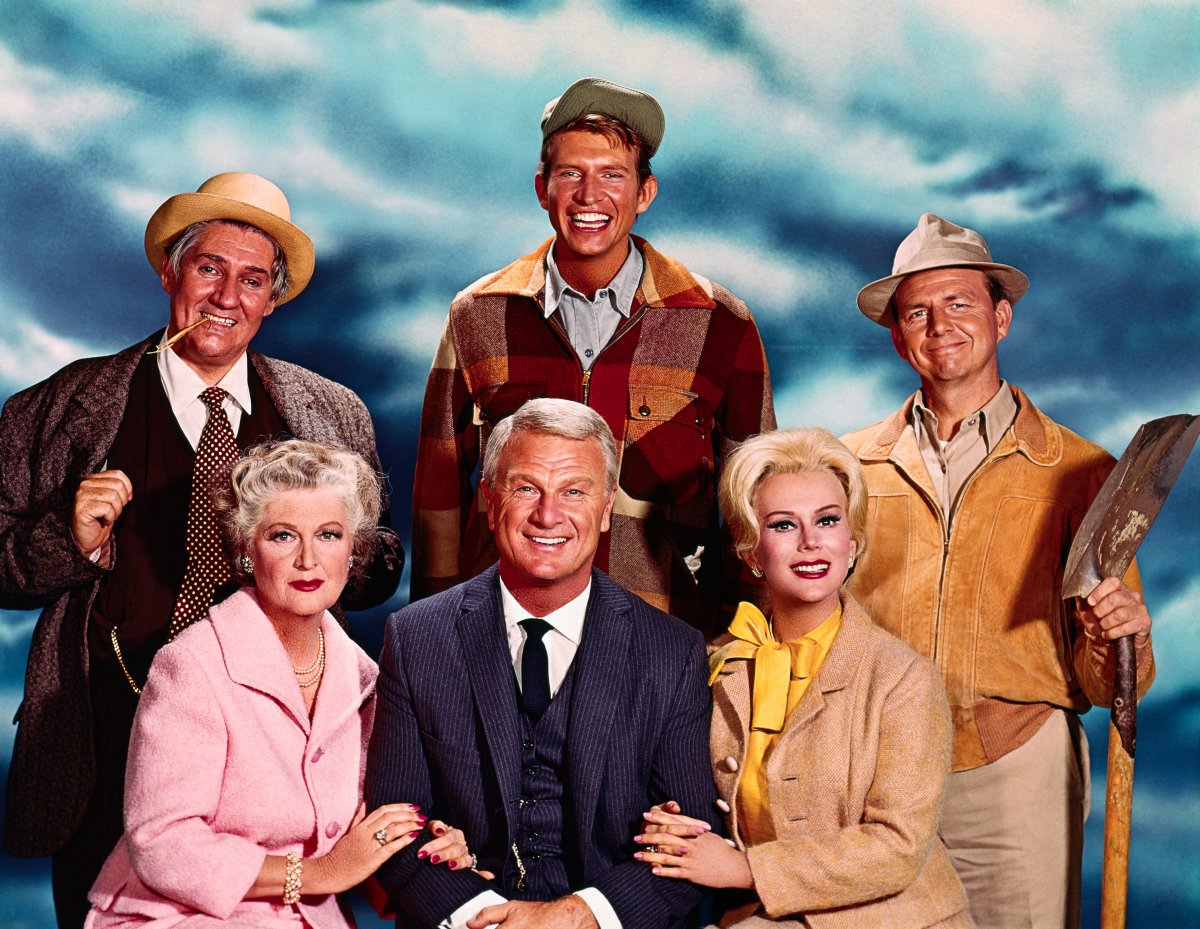
Photo: globalnews.com Cast of Green Acres
In the television show starring Eva Gabor and Eddie Albert, the banker is replaced by an attorney. Oliver Wendell Douglas and his wife Lisa leave glamorous Manhattan and move to a run-down farm in Hooterville. Lisa considers their handyman Eb their son and they bond with all the neighbors including Fred and Doris Ziffel and their pet pig Arnold, general store owner and postmaster Sam Drucker, and the folks from Petticoat Junction.
During an interview with the Television Academy, Paul Henning said his contribution was casting, and he let Jay do most of the writing and producing. The show resulted in 170 episodes and was canceled in 1971 when CBS decided to do a “rural purge” and get rid of any shows that fit that theme.
In another Television Academy interview with Richard L. Bare, who directed Green Acres, he said that he was the only director, Jay was the only producer, and that Jay and Dick Chevillat did all the writing. He said that the only other person on staff was a secretary. And, he said things worked out great. He said today there are way too many people on the set and it gets confusing.
More Hooterville favorites Photo: sitcomsonline.com
Jay continued writing in the seventies, but he did not write a lot. His shows that decade included Hot L Baltimore, Good Times, Ball Four, Alice, and Hello Larry.
Jay passed away in 1985 in Los Angeles from a heart ailment. It was very hard to find much personal information about Jay and no photos. I do know that at some point he married Barbara and they had several children. So sad that we don’t know a lot about some of the people who contributed so much to the golden age of television.
Jay Sommers left us much too early. He came out of a chemistry background, proving you don’t have to teach someone to be funny. He wrote for some of my favorite shows including The Adventures of Ozzie and Harriet, The Donna Reed Show, and Bachelor Father.
Photo: findagrave.com
Sommers worked on three of the most iconic television sitcoms in the 1960s: The Beverly Hillbillies, Petticoat Junction, and Green Acres. If you have been with me for a while, you know I never really cared for The Beverly Hillbillies. I really enjoy Petticoat Junction and I think it’s well written, but I think Green Acres was one of the best-written sitcoms on television. It’s not easy to write about quirky characters without them seeming unbelievable, but Jay did it. He created characters we fell in love with and truly liked. He produced and wrote brilliant scripts week after week for more than five years. They were clever, witty, and sophisticated without being over the top. His grave marker sums it up, “WRITER.” Thank you, Jay Sommers for introducing us to the good folks in Hooterville.
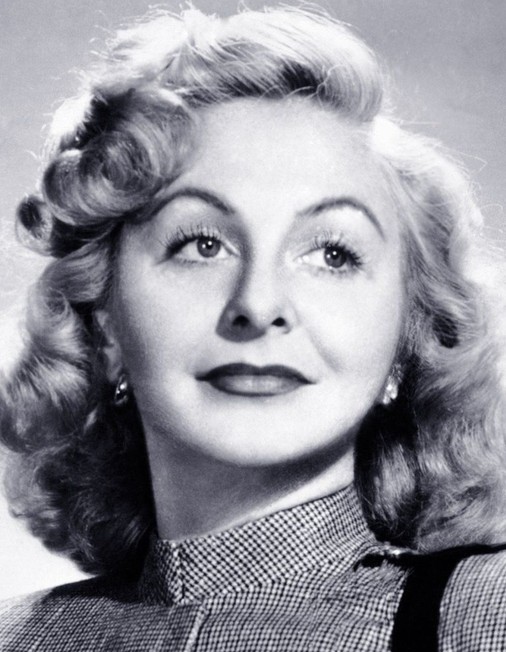
In October we are having fun with the “What a Character” series. Although this actress spent less than two decades on television, she had a memorable career. Today let’s learn more about Mary Jane Croft.
Photo: rottentomatoes.com
Mary Jane Croft was born in 1916 in Muncie, Indiana. She described herself as a “stage-struck 17-year-old just out of high school,” when she began working at the Muncie Civic Theatre. Moving on to the Guild Theatre Company in Cincinnati led her to radio station work at WLW.
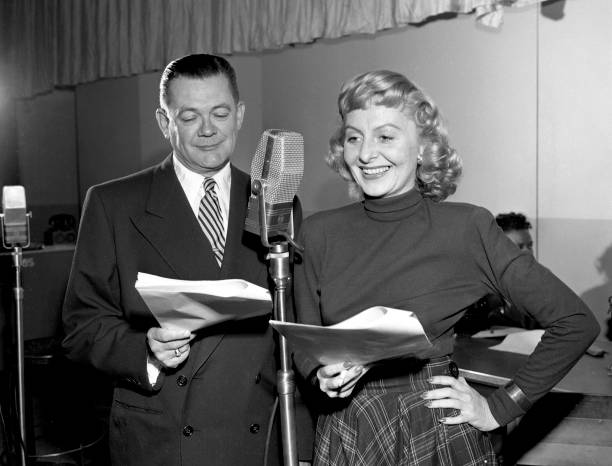
In the thirties, she received a lot of experience and she described her work there: “from 1935-1939, I played parts with every kind of voice and accent: children, babies, old women, society belles, main street floozies—everything.” She appeared in Life with Luigi, Blondie, The Adventures of Sam Spade, The Mel Blanc Show, and Our Miss Brooks, among other shows. She was a frequent guest star on My Favorite Husband, Lucille Ball’s radio show which would become very important to her television career.
Croft had married Jack Zoller, another actor earlier in her life. The marriage did not last long but produced a son, Eric. After her divorce, she moved to Hollywood in 1939.
On the radio Photo: closerweekly.com
While Croft appeared in three big-screen films, most of her professional career was spent on television. Her first role was in Eve Arden’s show, Our Miss Brooks from 1953-1955 once it moved from radio to television. She portrayed Daisy Enright whom she had also voiced on the radio show. Daisy and Connie Brooks competed for the head English teacher position and for the attention of Mr. Boynton. During that time, she also was cast in The Lineup, The Life of Riley, I Married Joan, and Dragnet.
From 1954-1957, she was on I Love Lucy seven times. She and Lucy continued both their professional and personal relationships. In the final season of Lucy’s show, she played Betty Ramsey, a neighbor of the Ricardos and Mertzs when they moved to Connecticut.
In the mid-fifties, she showed up on A Date with Angels, The Eve Arden Show, and The Court of Last Resort.
In 1959, she married Elliott Lewis and they were married until he died in 1990. She met Lewis while appearing on Lucy’s show; he was the producer. Sadly, her son Eric was killed in action in Vietnam.
Photo: ebay.com
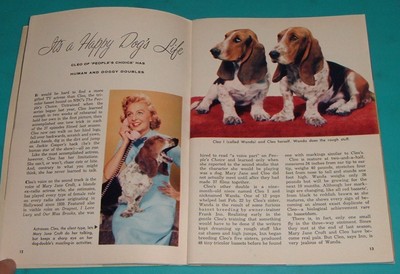
From 1955-1958 she was the voice of Cleo on The People’s Choice for 99 episodes. This is another one of those quirky shows from the fifties. The premise is that Socrates Miller, known as “Sock,” joins the city council and clashes with the mayor, John Peoples. Sock then dates and marries John’s daughter Mandy. Sock has a basset hound named Cleo, and Cleo shares her thoughts with the audience about what is going on.
Croft with Lyle Talbot and the Randolphs on Ozzie and Harriet–Photo: pinterest.com
From 1955-1966 she appeared as Clara Randolph on the Ozzie and Harriet Show for a total of 75 episodes. Joe and Clara Randolph were the Nelsons’ neighbors and good friends.
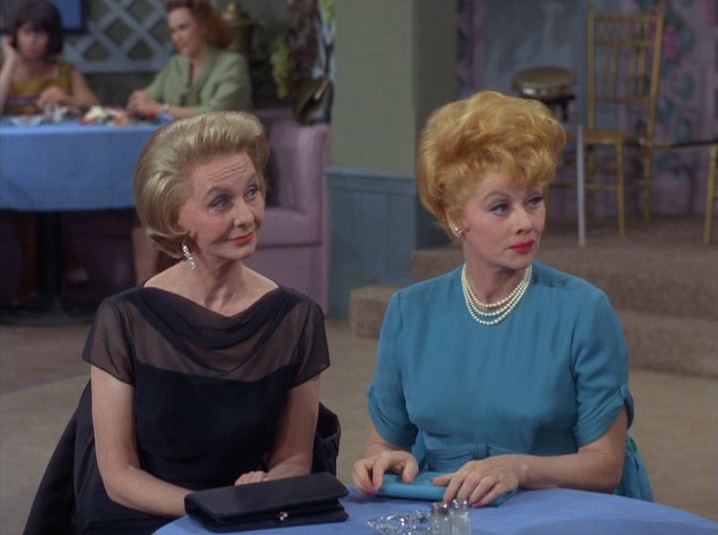
Although Croft did accept roles on Vacation Playhouse in 1966 and The Mothers-in-Law (another Arden show) in 1969, her career from 1962-1974 was with Lucille Ball. She was on The Lucy Show from 1962-1968 as Mary Jane Lewis when Lucy’s original sidekick Vivian Vance left the show. She continued that same role into Here’s Lucy from 1969-1974 for an additional 34 episodes.
Her last acting credit was a TV Movie with Lucille Ball titled Lucy Calls the President.
Croft with Lucille Ball–Photo: closerweekly.com
Croft died of natural causes in 1999.
Ball and Croft–Photo: closerweekly.com
Geoffrey Mark who wrote The Lucy Book: A Complete Guide to Her Five Decades on Television, got to spend time with Croft. He said she was “nothing like the characters she played,” in an exclusive interview with Closer Weekly. “She was intelligent, thoughtful in her speech and prettier than you would think. I found her to be very honest in that there was no nonsense about what she said. If she said it, she meant it. She was aware that she had become this icon mostly because of her association with Lucille Ball, but also because of other things that she did.”
When he asked her how she was able to assume so many character voices, she said that she thought about what the backstory of the character might be and invented a voice that would serve that character. It was something she learned when she worked in radio.
Photo: tumblr.com
Although Croft only appeared on 26 different shows, she had a busy and lucrative career. She is remembered for three major roles: Daisy Enright on Our Miss Brooks, Clara Randolph on Ozzie and Harriet, and Mary Jane Lewis on The Lucy Show and Here’s Lucy. And even if her television career was not long, she was in the entertainment business for her entire life after graduation. She created many memorable radio voices as well. With her numerous roles, she truly was quite a character.
October is “What a Character,” blog series month, and we are taking a look at some of our favorite character actors. This blog features the wonderful Isabel Randolph.
Randolph was born in Chicago in 1889. After high school, Isabel began performing in regional theater throughout the Midwest until the mid-1930s. She married J.C. Ryan, a Chicago newspaperman, in 1917. Unfortunately, he passed away at a young age and she raised their two girls. She was the leading lady at the Princess Theater in Des Moines, Iowa. In a 2012 article, Ryan Ellett quoted Conrad Nagel as saying the Princess Theater “was recognized as one of the outstanding stock companies of the entire country, and is still referred to by some of the old timers as the best of them all.” Ralph Bellamy also spent time with the theater.
Photo: spicyonion.com
In the thirties, Randolph decided to try out radio. She was on the air on Fibber McGee and Molly from 1935-1943. She played a variety of roles but was best known for Mrs. Abigail Uppington, a society matron. During this time, she also was in several other soap opera-type shows. When the McGees moved their show to Hollywood, Isabel went to California with them where she took a chance at motion pictures.
Isabel specialized in the “grand dame” roles which continued into her film career. Of her 110 acting credits, 69 of them were for movies on the big screen, her first being in 1939 in The Women.
In 1953, she made the foray into television. Her first role was on The Dick Tracy Show in 1951, based on the popular comic strip.
In 1952, she got her second role, and her first recurring role in a sitcom, when she was offered the part of neighbor Mrs. Boone in Meet Millie. Meet Millie was about Millie Bronson (Elena Verdugo), a secretary who lives with her mother (Florence Halop) in Queens. Her boss is JR Boone (Roland Winters) and she sometimes dates his son Johnnie (Ross Ford). Family friend and poet Alfred Prinzmetal (Marvin Kaplan) often drops by. We don’t hear about this show very often but it was on for four years and produced 124 episodes.
Randolph did a variety of work in television throughout the rest of the fifties. She did a lot of theater programs, westerns, and also comedies including Burns and Allen, The Ann SothernShow, December Bride, and The Bob Cummings Show.
Photo: facebook.com
She had another recurring role during the last season of Our Miss Brooks when she played Ruth Nestor who ran a private boarding school. John Rich was the director on the show. He loved the cast and said especially Eve Arden was a joy to work with, very nice and very funny. He described the entire cast as “adorable.”
Although she didn’t have a recurring role on Ozzie and Harriet, she was on the show five times between 1956-61. My favorite of her roles on that show was “Busy Christmas” when she played Mrs. Brewster and was heading the Christmas caroling group.
During the sixties, Isabel kept busy. She appeared on Perry Mason three times, twice on The Andy Griffith Show, The Joey Bishop Show, Ben Jarrod, Arrest and Trial, and Many Happy Returns.
Tom Tully and Randolph as Clara Petrie with Photo: motionpictures.com
Her last recurring role was that of Mrs. Petrie on The Dick Van Dyke Show. In last week’s blog, we looked at one of the best Dick Van Dyke episodes, “Pink Pills and Purple Parents.” When Sally considers taking one of Buddy’s pain pills for her headache, Rob relates a time when Millie gave Laura some of her relaxation pills. Laura takes her first one when Rob’s parents arrive and as she becomes more nervous, she continues to take pills. Eventually, she is a bit loopy making strange comments, forgetting to put ice cream in the sundaes, and dancing to music before passing out. Rob’s parents are sure she has a drinking problem but later find out what happened. Randolph is a gem in this episode.
Randolph passed away in 1973 of undisclosed reasons.
Randolph with Ozzie Nelson–Photo: youtube.com
Sadly, like so many of our great character actors, there is not as much information about Isabel’s life. Character actors deserve to have more websites or books of their own. Isabel played the snobby rich woman in many of her roles, but I always think of her as an elegant, gracious mother type. Thank you, Isabel, for so many decades of entertainment and memorable characters. She was a character, indeed.
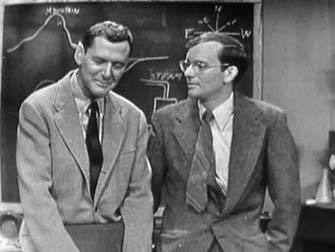
Mister Peepers was one of the first popular sitcoms. It aired from July of 1952 until June of 1955. The show starred Wally Cox as Robinson J. Peepers. Peepers was a junior high school science teacher. A great cast surrounded him including history teacher Harvey Weskit (Tony Randall), Harvey’s wife Marge (Georgann Johnson), county nurse Nancy Remington (Patricia Benoit), English teacher Mrs. Gurney (Marion Lorne), and athletic coach Frank Whip (Jack Warden). (In the pilot, the coach was played by Walter Matthau.) Peepers developed a relationship with nurse Nancy, and her parents (Ernest Truex and Sylvia Field) also became part of the cast.
Photo: blogspot.com
The show featured some slapstick as well but it was not the primary form of humor. In one episode, the uncoordinated Mr. Peepers was playing basketball in the gym alone and somehow got stuck in the basket. In order to fulfill the evening obligations that he promised, he brings Mrs. Gurney’s flower club into the gym so he can lecture to them about potting soil while playing chess with a rival school’s champion as promised to Mr. Gurney.
Photo: wikiwant.com
Mr. Peepers is kind. In one episode, after injuring his finger, absent-minded Mrs. Gurney tries to help by bandaging it. In addition to using half a roll of tape, Robinson informs Nancy that she bandaged the wrong finger.
Mister Peepers is a likable guy. He has some eccentric characteristics which make us like him even more. For example, he has an elaborate ritual to get his locker to open; on bring your pet to school day, he has to hide a cow; and sometimes he does things we all want to. On one episode, he comes upon a hopscotch board on the sidewalk and just like we would want to do, he plays it not realizing his girlfriend is watching him. However, Robinson has a bit of rebellion and sarcasm that keeps him from being too much of a goody-two-shoes.
Photo: tumblr.com
Tony Randall’s character Harvey was supposed to be a small role, but the producers liked him so much he became a regular. He is best friends with Robinson but they couldn’t be more different. Harvey is a lady’s man. However, Mr. Peepers only has eyes for Nancy even though it takes her a while to realize he is interested in her. The couple ties the not in 1954, producing a huge ratings boost.
In real life, Cox was experiencing the same situation when he married Marilyn Gennaro about the same time. When Benoit became pregnant in real life, she was also pregnant on the show.
When the Peepers found out they were having a baby, American Character Dolls Co wanted to make a “Peepers Baby Doll” in 1955. Polling indicated that viewers were hoping for a girl, so it went into production. Mister Peepers was cancelled before the doll debuted, but the company sold it anyway, although they did change the name.
Photo: blogspot.com
The show was aired live with an audience of 2500 at the New Century Theatre in New York. Preserved on 16mm kinescopes, there are currently 102 of the original 127 episodes in existence. The kinescopes are being preserved by the UCLA Film and Television Archive and a DVD set has been produced.
The Ford Motor Company needed a summer replacement on Thursday nights so Mister Peepers debuted then. NBC decided it was too much pressure to do a live show, so it was cancelled. Fans were irate. After 2000 people called to complain and 15000 letters were received, the network had second thoughts, but their schedule was full.
MR. PEEPERS — Aired 09/15/1953 — Pictured: (l-r) Wally Cox as Robinson Peepers, Tony Randall as Harvey Weskitt (Photo by NBCU Photo Bank/NBCUniversal via Getty Images via Getty Images)
However, that fall, an opening occurred when Doc Corkle was cancelled after only three episodes. How bad does a show have to be to get axed after three episodes in 1952? I don’t know, but the summary of the show is that “Doc is a dentist plagued with money problems, teenage daughter problems, and a screwball stepsister Melinda.”
It says a lot about the quality of Mister Peepers that it was rated so highly and watched by so many fans because it was up against Private Secretary with Ann Sothern and The Jack Benny Show on Sunday nights. Tough competition.
Photo: sitcomsonline.com
Critics liked the show and it was nominated for best situation comedy for the Emmys in 1953, 1954, and 1955. Wally Cox, Tony Randall, and Marion Lorne were all nominated as well. Each of the years the show was nominated it went up against Our Miss Brooks, Burns and Allen, and I Love Lucy which won in 1953 and 1954; Make Room for Daddy won in 1955. NBC made Wally Cox postcards which they handed out to tourists on the lot.
Wally Cox was an interesting guy. He was a brilliant man who studied acting with Stella Adler. His roommate was Marlon Brando whom he had been best friends with since grade school. His mother and grandmother were writers, and his dad was in advertising. Before he was able to earn a living in acting, he taught the lindy hop for $1.50 a lesson and made cuff links and tie clasps. While doing part-time jobs, he began doing standup at clubs like The Blue Angel and Village Vanguard.
Unfortunately, a lot of people will remember him only for his appearances on Hollywood Squares and as the voice of Underdog the cartoon hero. He was also famous for a Jockey Shorts commercial when he quipped, “Outside I might look like Wally Cox but inside I feel like Tyrone Power.” He passed away much too early, dying from a heart attack at 48.
Photo: latimes.com
Although Wally Cox was not Mister Peepers, their humor was similar. Cox wasn’t brash but he experienced life with a quiet subtle manner and was a genuinely funny guy. In discussing his time on the show, Cox said, “Mr. Peepers put me on the map and I love him.” I’m sure like many actors who were stereotyped early in their career, it was a bit of a love/hate relationship. I’m sure you will love him too if you are able to watch some of the episodes. Retro TV aired them in the past, but I don’t see the show on its current schedule. I also found the DVDs on amazon.com. Happy viewing!





















 thewritelife61