Don Adams: Always Smart

This month our blog series is titled “All About The Bill Dana Show.” The first week in March we learned about the show and now we have been spending time with some of the cast. We end our series with Don Adams.

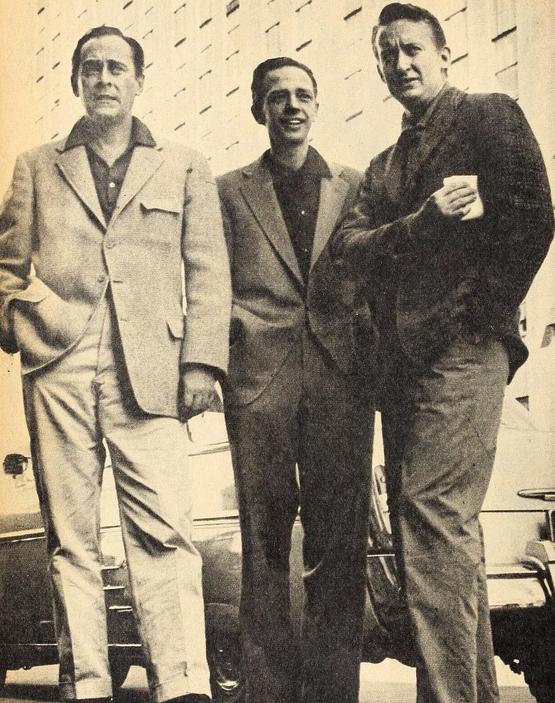
Adams was born Donald James Yarmy in Manhattan in 1923. Don was a blend of cultures, Hungarian Jewish on his dad’s side and Irish-American on his mom’s. Don was raised Catholic while his brother Dick was raised Jewish. I could not find out what their sister decided to do. She later became a writer under the name Gloria Burton and wrote a script for Get Smart. His brother was also an actor. Dick has about 50 acting credits and appeared in many of the most popular sitcoms during the sixties and seventies, including three appearances on Get Smart.

Adams dropped out of high school and went to work as a theater usher. In 1941 he joined the US Marine Corp. At one point he was injured during a Japanese assault on Tulagi. He was the only survivor from his platoon. While recovering, he came down with blackwater fever, a side effect from malaria and was evacuated to New Zealand. He was not expected to recover, but when he did, he was sent back to the US as a Marine drill instructor.

After his discharge, he moved to Florida to work as a comedian. He refused to do material he considered “blue” and was fired.

In 1947 he married Adelaide Efantis, and her stage name was Adelaide Adams. Don decided to take the name Adams as well for his stage name. He worked as a commercial artist and cashier to support their family.

In 1954, Don was the winner of Arthur Godfrey’s Talent Scouts with a comedy act written by Bill Dana. He began making appearances on The Steve Allen Show, where Dana was a writer. In 1961 he became a regular on the Perry Como Show.

About this time, Don and Adelaide divorced, and Adams married Dorothy Bracken, another actress. They split up in 1977 when he married Judy Luciano, also an actress but that marriage also ended in divorce. (I could only find one credit for his last two wives; Bracken was on Get Smart, while Luciano appeared on The Love Boat.)

While discussing his marriages, Don said “I’m no longer independently wealthy. I guess it’s the result of too many wives, too many kids and too much alimony. I’ve been paying alimony since I was 14 and child support since 15. That’s a joke, but not by much. . . I like getting married, but I don’t like being married.”

In 1963 Adams was offered the role of Byron Glick, hotel detective on The Bill Dana Show. As we’ve discussed this month, the show was on the air for a season and a half. While working on the show, Don was also the voice of cartoon Tennessee Tuxedo which he continued doing until 1973.

During those years he also made an appearance on The Danny Thomas Show and on Pat Paulsen’s Comedy Hour.

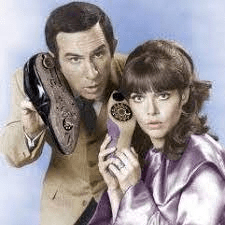
In 1965 he was offered the role of Maxwell Smart in a new spy satire, Get Smart.

The sixties saw westerns being overtaken by spy shows such as The Man From U.N.C.L.E., I Spy, The Pink Panther, and The Avengers. Mel Brooks and Buck Henry decided to try their hand at writing a campy sitcom and Get Smart was born.

The role of Smart was created for Tom Poston, but ABC turned it down, and NBC said yes. They had Adams under contract, so he got the part. Rounding out the cast was Edward Platt as the Chief and Barbara Feldon as Agent 99.

Smart and 99 had great chemistry and married in a later season. Feldon and Adams remained life-long friends.

One of the most memorable parts of the show was all the catch phrases Adams created on the show including “Sorry about that Chief,” “Would you believe,” and “Missed it by that much.”

In addition to acting, Adams worked as a producer and director on the show. He was nominated for an Emmy from 1966-1969. He won three of those, losing to William Windom for the little-remembered one-season show, My World and Welcome to It. Lloyd Haynes from Room 222 and Bill Cosby for The Bill Cosby Show were also nominated that year.

The show moved to CBS for the final season, but the ratings never recovered, and the show was canceled after that year.

Like so many of our successful actors with unusual characters, Adams suffered from typecasting after the show ended. He did become part of two additional sitcom casts during his career.

In 1971 he was on The Partners. According to imdb.com, the plot is that “Lennie Crooke and George Robinson are inept detectives teamed up to solve crimes. Captain Andrews is their exasperated boss, Sgt. Higgenbottom is a smarmy co-worker, and Freddy confesses to most of the neighborhood crimes.” Adams played Crooke, but the show only produced 20 episodes.

In 1985, Adams tried a sitcom again on Check it Out. This one was about a grocery store and its employees. Adams played Howard Bannister. The show lasted three seasons, ending in 1988. The show was not very popular in the US but was a hit in Canada.

In between those two shows, Adams appeared in a handful of series including Fantasy Island, The Fall Guy, The Love Boat, Empty Nest, and Nick Freno: Licensed Teacher. He made most of his salary appearing in nightclubs. He also had his Smart character resurrected in several big screen films and television series.

Because of the typecasting, he returned to animation and found a lot of success, especially with Inspector Gadget which he voiced from 1983-1999.

He also tried his hand at a game show. Called Don Adams’ Screen Test, it had an interesting concept. The show was filmed in two 15-minute parts; Adams would randomly select an audience member to recreate a scene from a Hollywood movie such as From Here to Eternity with Adams as director. It ended after 26 episodes.

In his spare time, it sounds like he visited the racetracks, betting on horses. He also spent a night a week at the Playboy Mansion playing cards with Caan and Rickles. He loved history and studied Abraham Lincoln and Adolf Hitler in depth. He also wrote poetry and painted.

Don passed away in 2005 from a lung infection and lymphoma. The eulogists at his funeral included James Caan, Bill Dana, Barbara Feldon, and Don Rickles.

It’s hard to know what to make of Adams’ career. Obviously, he was hard working, an excellent Marine, and a man of many interests. He was fired for not performing blue material but then put horse racing and gambling above the needs of his family, according to several of his friends. He created the amazing role of Maxwell Smart, one of the best characters in television history, but that feat kept him from achieving other great roles in the following decades due to typecasting. It sounds like Check It Out was very popular in Canada, so maybe if he had been given a few chances to create characters different from Smart in a couple other sitcoms, it would have helped.

I feel bad for those actors who are so successful in the characters they help create that they are barred from future jobs, but then again, those characters are some of the best actors in television: George Reeves as Superman, Ray Walston as My Favorite Martian, Henry Winkler from Happy Days, Frank Cady from Green Acres, and Jack Klugman from The Odd Couple. I guess you trade being warmly remembered for fewer quality roles.

Apart from Get Smart, I knew little about Adams before writing this blog, so it was fun to get to know him a bit.
Dick Van Patten: He Was Enough

We are discussing some of our favorite actors who were typically supporting actors. In the case of today’s subject, he did star in a television show, but he was so great in other assisting roles, we are including him here as well. Today we get to know Dick Van Patten.

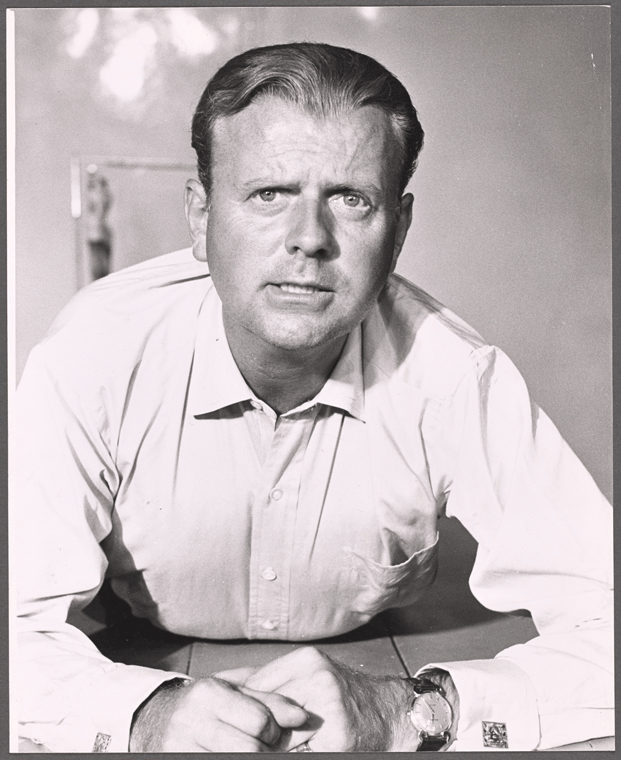
📷nypldigitalcollections.com Off Broadway

Van Patten was born in 1928 in Queens, New York. His father was an interior decorator, and his mother worked in advertising. Joyce Van Patten is his sister. Van Patten began working as a model and actor while he was still a child. He was only four when he joined John Robert Powers, a modeling agency, where made $5 an hour.

His first Broadway appearance was in “Tapestry in Gray” when he was seven, and he appeared in many plays by the time he graduated from the Professional Children’s School in New York City.

At that time, he moved to Hollywood. In 1949 he accepted the role of Nels Hansen on the early sitcom, Mama, about a Norwegian family living in San Francisco. The show was on the air until 1957, for a total of 327 episodes.

In 1954 Van Patten married Patricia Poole. She was a professional dancer, part of the June Taylor Dancers on The Jackie Gleason Show. Their son Vincent was on Apple’s Way in the mid-seventies, with 65 credits to his name. He is married to Eileen Davidson, who is Ashley Abbot in The Young and the Restless.

📷wikipedia.com On the set with friend Dick Van Dyke

Van Patten’s sister Joyce also began her career as a child. With 160 acting credits, she also has been very busy for decades, starring in The Good Guys. She was married to Martin Balsam from 1957-1962, another prolific actor. Van Patten’s niece Talia, who has also amassed more than 100 acting credits, was married to George Clooney and then John Slattery, star of several shows including Mad Men. So, this is a well-known family in entertainment.

In the fifties and sixties, most of Van Patten’s roles on television were in dramas and a few westerns. In the seventies, he took on his first comedy roles, appearing on I Dream of Jeannie, The Governor and JJ, Arnie, That Girl, Sanford and Son, The Doris Day Show, The Paul Lynde Show, Love American Style, The New Dick Van Dyke Show, Maude, Phyllis, Happy Days, and One Day at a Time, among others. He also accepted a few drama roles on shows such as Cannon, Adam-12, The Streets of San Francisco, Medical Center, and Barnaby Jones. After appearing on The New Dick Van Dyke Show in 1971, Van Patten and Van Dyke became life-long friends.

He appeared in 36 movies, his first being Violent Midnight in 1963. Spaceballs, Robin Hood: Men in Tights, and High Anxiety, all with Mel Brooks, were probably his best-known films. In 2014, Van Patten said working with Brooks was “great. It’s like a game. It’s not like work. He keeps you laughing the full day on the set. He’s just a funny man.” Van Patten also accepted 28 made-for-tv movie roles.

In 1977, he took on the role that would make him a household name: that of Tom Bradford on Eight is Enough. He played a newspaper publisher with eight kids. His wife dies early in the series, and Tom remarries.

Van Patten auditioned for the role of Tom Bradford but was not given the part. When the producers watched the first day of shooting, they scrapped the entire production. Fred Silverman then hired Van Patten.

📷showbizcheatsheet.com Cast of Eight is Enough

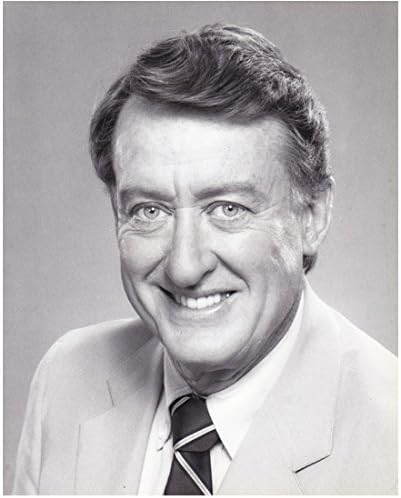
It’s interesting to wonder what his career would have been like if he had declined Eight is Enough and accepted the role he was offered of Dr. Adam Brinker on The Love Boat. Since he had already agreed to appear on Eight is Enough, the role went to Bernie Kopell.

In an interview with the St. Petersburg Times in 1989, Van Patten discussed his character on Eight is Enough: “Tom Bradford is a lot like the real me. He’s a man who always put his career second to his family. As long as everything was OK at home, he was OK too.”

Sadly, the cast did not learn of the cancellation of Eight is Enough from the network. Van Patten said “nobody called me to tell me it was canceled. I read it in the paper.”

Van Patten never received a starring role again, but he did keep very busy in the eighties and nineties appearing in many popular shows, including Love Boat, Murder She Wrote, The Facts of Life, Growing Pains, and Diagnosis: Murder.

He was in a handful of shows in the 2000s with Hot in Cleveland in 2011 being his last appearance on television.

He published a book in 2009 titled Eighty is Not Enough!, his memoir. He had also written Launching Your Child in Show Biz: A Compete Step-By-Step Guide and Totally Terrific TV Trivia. In 2001, he was honorary mayor of Sherman Oaks, California.

Van Patten was an animal advocate, and he created Natural Balance Pet Foods and the National Guide Dog Month to raise awareness and money for nonprofit guide dog schools.

Van Patten also participated in a variety of hobbies. Like Tom Bradford, he loved spending time with this family. He also owned thoroughbreds and attended horse racing events. He enjoyed playing poker, golf, swimming and reading. Most Sundays he headed to the tennis courts to meet Alan Alda, Mel Brooks, and Gene Wilder.

📷latimes.com

In 2006, Van Patten suffered a diabetic stroke. He made a full recovery and lived another nine years, passing away in 2015 from diabetes complications. He was still married to Patricia.

His son Tommy on Eight is Enough, Willie Aames, said Van Patten “was truly a gem who will be missed.” His second wife, Abby, on the show played by Betty Buckley, recalled that “every day on the set he was a happy, jovial person, always generous and ready to play, tease, and always keep us laughing. He was the consummate professional, a wonderful actor, master of comedy, and a kind and generous human being.”

📷imdb.com

Van Patten had an extremely successful career. For more than seven decades he was part of the entertainment community. In addition to his stage productions, films, and television work, he appeared in more than 600 radio show episodes and was in Weird Al Yankovic’s music video “Smells Like Nirvana.” He said that he had “fun doing this and going through my life. I’ve had a great life. It was exciting. I worked with the most interesting people, and I traveled all over the country.”

His reflection on his work is great advice for all of us. Van Patten said that he wanted to express the “single idea that has governed my entire life, that every moment of life is precious, that every step we take is an adventure, that every day on earth is a gift from God.” Thanks, Dick Van Patten, for leaving us with this inspiration and for taking your gifts and presenting them to us in the form of many wonderful memories.

“Mad About You” . . . And Them

Photo: today.com

For our blog series this month, we are looking at some of our favorite duos from the eighties and nineties in “Duos to Love.” Today we will meet Paul and Jamie Buchman and their daughter Mabel. Yep, it’s Mad About You. It’s not about you, it’s about them, but I am mad about you too—very thankful you are on this journey with me learning about the golden, and sometimes tarnished, age of television.

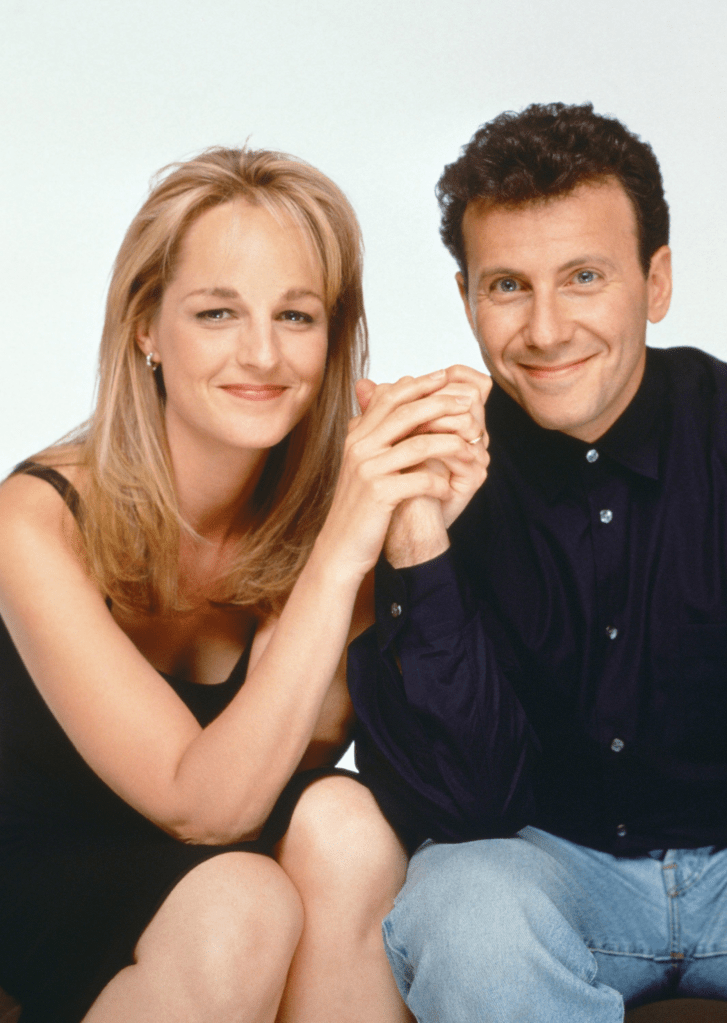
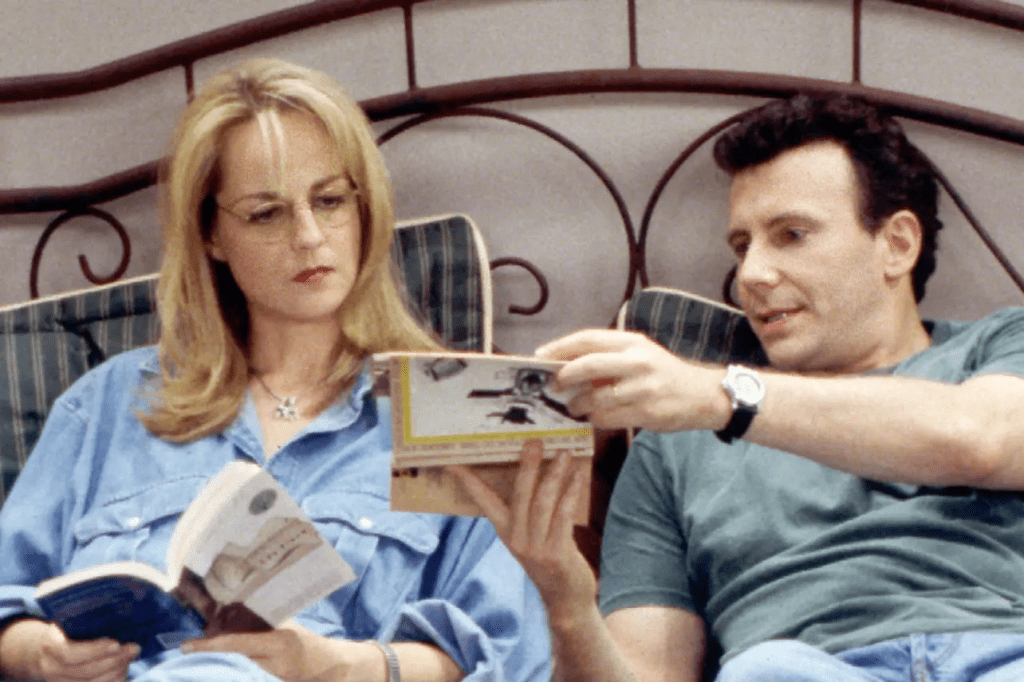
In 1992, NBC aired Mad About You. The series was about newlyweds Paul (Paul Reiser) and Jamie (Helen Hunt) Buchman, He was a documentary filmmaker and she worked in public relations. They lived in Greenwich Village for seven years until they were canceled. Both Teri Hatcher and Valerie Bertinelli were considered for the role of Jamie. It’s hard to imagine anyone but Helen in the role. I think the critics agreed; Hunt was nominated for six Emmy Awards for Best Actress in a Comedy Series. In 1993, she lost to Roseanne Arnold for Roseanne; in 1994 and 1995, she lost to Candice Bergen for Murphy Brown; in 1996 and 1997 and 1998 she won. Overall, the show won thirty-four nominations, with twelve wins.

Photo: decider.com

For seasons one through six, the two top stars received $250,000 per episode but in season seven they got a nice raise, landing $1,000,000 per episode.

Before Mabel (Alyssa and Justin Baric) came along, their “baby” was Murray their dog. Paul met Jamie while he was on a walk with Murray. They meet at a newsstand when they are both looking for The New York Times. In real life, the two stars met because Hunt was sharing a house with a good friend of Paul’s wife, Paula. After reading Reiser’s pilot, Hunt changed her mind about concentrating on her film career and wanted the role.

When Reiser pitched the idea to NBC he said it was about the life of a couple in their private moments. He compared it to a couple going to a party but this show was more about what happens when they leave the party and it’s just the two of them in the car talking on the way home. Reiser also compared it to the successful thirtysomething but “shorter and funnier.”

Carol Burnett Photo: deadline.com

The rest of the cast included Lisa Semple (Anne Ramsay), Jamie’s older sister; Fran Devanow (Lelia Kenzle), Jamie’s best friend; Ira Buchman (John Pankow), Paul’s cousin and friend; Sylvia Buchman (Cynthia Harris), Paul’s mother-in-law who is not in the running for Best Mother-in-Law according to Jamie; Burt Buchman (Louis Zorich), Paul’s father; and Dr. Mark Devanow (Richard Kind), Fran’s ex-husband who is a bit eccentric but not too odd because he wins her back as his wife during the show’s run.

There were a lot of recurring characters on this show. Several showed up more often than others: Debbie Buchman (Robin Bartlett), Paul’s sister; Dr. Joan Golfinos (Suzie Plakson), Debbie’s life partner; Nat Ostertag (Hank Azaria), the Buchmans’ dog walker; Mr. Wicker (Jerry Adler), the apartment building superintendent; Dr. Sheila Kleinman (Mo Gaffney), the Buchmans’ therapist; Maggie Conway (Judy Geeson), their neighbor; Jay Selby (Tommy Hinkley), Paul’s college friend; and Sid (George O. Petrie), Paul’s colleague.

Lisa Kudrow Photo: biography.com

However, there were also a few very famous recurring characters. Mel Brooks showed up as Paul’s uncle Phil in four shows. Cyndi Lauper was Ira’s on/off again girlfriend Marianne in five episodes. Jamie’s mom was in 15 shows but played by three different women: Carol Burnett (10), Penny Fuller (4) and Nancy Dussault (1). Another interesting recurring character was Lisa Kudrow. She was Ursula Buffay, the waitress at their favorite restaurant, Riff’s. She appeared 24 times and when Friends was created, her twin sister Phoebe was written into the show. In one episode after not seeing Ursula much, Paul asks her where she has been and she says “I’ve been hanging out with friends.”

You can imagine how huge the guest star list is for this series. Get ready for auctioneer speed and I will list some of them; just know I am leaving out a lot of famous and fun people. Here goes: We have Ed Asner, Kevin Bacon, Christie Brinkley, Garth Brooks, Sid Caesar, Tim Conway, Ellen DeGeneres, Jamie Farr, Barbara Feldon, Al Gore, Seth Green, Billy Joel, Nathan Lane, Jerry Lewis, Yoko Ono, Regis Philbin, Carl Reiner, Jerry Seinfeld, and Bruce Willis.

Paul Reiser also composed the theme song, “Final Frontier,” with Don Was. Both Andrew Gold and Anita Baker versions of the song were used during the eight-year run. Reiser also played the piano for the theme recording.

Mabel grows up. Photo: parade.com

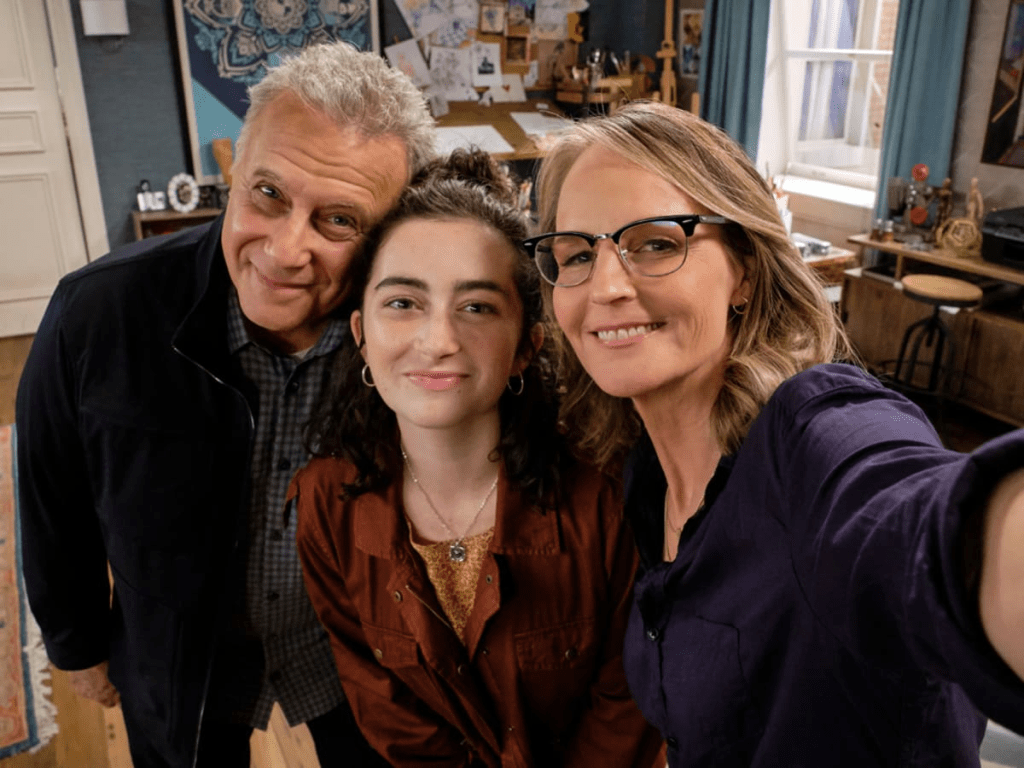
In 2019, a twelve-episode revival series debuted. Both Reiser and Hunt returned for the sequel. The Buchmans are now empty nesters after dropping Mabel off at college. Other veterans returning included Ramsay, Pankow, Kind, Harris, Adler, Gaffney, and Carol Burnett. Abby Quinn was Mabel.

This was a popular show that was always discussed around the water cooler. It’s first year on NBC it aired Wednesday nights against In the Heat of the Night and Coach; Coach was in the top twenty. The next season it was moved to Thursdays nights and oddly was still up against In the Heat of the Night but was also on against The Simpsons. Season three found it with little competition and it was ranked eleventh place for the year. As networks do, now that it had a dedicated audience, it was moved to Tuesday nights where it dropped out of the top forty. The show remained in the Tuesday slot, still up against Roseanne but its audience returned and it crept into the top twenty again. It remained in the same spot for its final two years, one year competing with JAG and the next year against Home Improvement which was a top-ten show. I know this was a lot of detail, but I think it helps to think about how much the schedule moving can potentially hurt a show. Fans get used to a certain night and sometimes clear their schedule for that evening and when shows continue to move around, it is frustrating for everyone. Now, we can just DVR shows and it’s not such a big deal.

Photo: tvseriesfinale.com

This was a well-written show, and the producers and writers spent a lot of time on character development. It had some quirky moments and did some fun plot twists that kept it fun and fresh. Of course, both Hunt and Reiser were amazing actors and went on to great success in the movies. I did not see much about how the 2019 reboot was received by viewers. Considering the competition that the show faced as the network moved it around, it did very well for its seven years. The critics loved it and it was certainly recognized by the Emmy committee every year. I am hoping it will come to Antenna or ME TV soon and we can again spend some time with the Buchmans.

Barbara Feldon Did Not Have to Get Smart: She Was Born That Way

This month’s blog is taking a look at some Supportive Women. First up is Barbara Feldon, costar with Don Adams in Get Smart.

Photo: getsmartwikifandom.com

Feldon was born Barbara Anne Hall in 1933 in Pennsylvania, near Pittsburgh. During an interview with Emerson College, Barbara talked about the ecstasy of performing in a little band in first grade. When things stopped, she got to play her triangle, and the thought that everyone was watching her, and her mother’s pride in seeing her made her want to perform more. In sixth grade she went into the gym to watch her friend doing her ballet lessons. The teacher invited Barbara to join them and played Tchaikovsky’s Nutcracker music; that combination of music and movement took her away to another place. She was hooked at that point, and she knew that she wanted to dance.

She trained at the Pittsburgh Playhouse and then graduated from Carnegie Mellon University with a BA in drama in 1955. They didn’t have a dance program, and her mother thought Bennington, where she wanted to go for dance, was too expensive and too liberal. While she enjoyed acting, it never had the enchantment for her that dance did.

Feldon made her way to New York and studied at the HB Studio. She briefly had a career as a showgirl at the Copacabana. She said “that was my first professional job in New York and it was probably the highlight of my whole career. We got to dance with Jimmy Durante. Oh, my God, it was a thrill.” They replaced the girls every three months so, then she went on to appear in The Ziegfield Follies. She landed one job that never made it to Broadway. A friend of hers who was a model talked her into exploring a modeling career.

Photo: punkglobe.com

She worked as a model and was in a Revlon commercial about a hair pomade for men, Top Brass. Feldon said commercials were excellent training to get experience in acting. You do the same scene over and over, maybe more than forty times, but you have to keep that spontaneity. “You must remember to stress each word properly and come in on a split-second when that camera rolls.”

Like several actresses that we have discussed in this blog, before Feldon got her first big break, she appeared on a game show. In this instance, she was on The $64,000 Question in 1955, and she won the grand prize of $64,000 in the category of Shakespeare.

She didn’t use her winnings to buy a mansion or live the typical party life. She opened an art gallery with a man who was a photographer and ad man who was no longer interested in advertising named Lucien Verdoux Feldon. Barbara would be the subject of a Warhol pop art painting in 1965.

In 1958 Barbara married Lucien Feldon. They divorced nine years later. She had a longer relationship with one of the Get Smart producers, Burt Nodella and when that ended, she moved back to New York City.

After her commercial debut, she received offers for several television roles in the early sixties including The Man From U.N.C.L.E. and Flipper. She was also offered a chance to appear on East Side/West Side with George C. Scott. Colleen Dewhurst was her mentor and Scott’s wife. He asked her to play his girlfriend in the next episode. Talent Associates which produced the show was working with Mel Brooks and Buck Henry on a potential spy spoof called Get Smart. Her second television role was as a spy. So, when Talent Associates was casting for a spy on Get Smart, she was an obvious choice.

Photo: facebook.com

She turned down the role at first because she didn’t want to move from New York to California, but she did love the script. They agreed to offer her a two-year contract instead of a five-year contract, and she accepted. Her first review was in TV Guide which compared her to the dog and concluded that the dog came off better. She was devastated and humiliated. In later years, the reviewer rated her performance much better.

From 1965 till 1970, Feldon was known as Agent 99 working with Maxwell Smart for CONTROL. In both 1968 and 1969, she was nominated for an Emmy for Outstanding Lead Actress in a Comedy Series. Lucille Ball won for The Lucy Show in 1968 and Hope Lange won for The Ghost and Mrs. Muir in 1969.

Women at the time looked at Feldon as an example of a powerful woman; Feldon commented that young women said “she was a role model for them because she was smart and always got the right answer.” If you look closely in the early seasons, you will typically see Feldon sitting and Adams standing because she was taller than he was. Once she even had to bury her feet in the sand. While Adams was the blundering, awkward Smart, it was Agent 99 who was really the “smart” one, getting him out of trouble during their spy missions.

Feldon said that she is not a comedienne; she is an actress who can play comedy. She said that she is the worst person to tell a joke to because she doesn’t always get it. She never enjoyed drama much because the actual acting on camera was wonderful but the long, boring hours waiting were very tedious, and if you have a tearful scene, you have to be able to keep the momentum.
During the run of Get Smart, Feldon also appeared on Rowan & Martin’s Laugh In and The Dean Martin Show.

Photo: imdb.com

After the show ended, she would appear on 20 additional television series including Cheers and Mad About You. She made fifteen made-for-tv movies, one of which was a 1989 movie, Get Smart, Again. She also could be found in six big-screen films including The Last Request, her last acting role, in 2006.

During my research, I read an article where pop culture historian Geoffre Mark commented on one of her movies, Fitzwilly, which I admit I have never seen. He said that it was a gem of a movie and that “Dick Van Dyke is brilliant in it and Barbara plays his love interest and she’s brilliant in it. She was playing a version of herself: a beautiful, sensual, highly intelligent woman with a strong moral compass and a loving heart. That’s what the character is and that’s who Barbara is.” According to imdb.com, the plot of the 1967 movie is that a butler and the staff of an eccentric aged philanthropist whose family wealth is exhausted engage in larceny and crimes to maintain her lifestyle and provide funds for her charitable activities.
Feldon was offered a cameo in the Get Smart movie with Anne Hathaway and Steve Carrell in 2008, but she declined. She said that “times have changed too much. The psychology of the writers and the audience has changed radically. Get Smart belongs in the 1960s, or it’s not going to be Get Smart.”

Despite her comment of Get Smart staying in the sixties, in 1995 Feldon took on the role of Agent 99 again in a brief reboot of Get Smart. Feldon discussed that series with The (Westchester County NY) Journal News reporter Karen Croke in 2017. She said that she and Adams never became friends after the original Get Smart. She said he was a lovely man and very funny, but they had their jobs to do and did their acting and then parted ways for the day. After they worked together on this series, they became very close friends in a way they could not have in their original show. She said once Don Adams died, Max also died and she can’t do any work as 99 without Max now. That might be the real reason she turned down the cameo in the Carrell-Hathaway film.

Photo: imdb.com

Barbara said it’s hard to make friendships on a set because it’s more like a factory and when you’re not acting, you might be resting or talking to your agent. The only person she said she was able to maintain a good relationship with after acting with him, was Alan Alda.

Apparently, she still enjoyed games shows and she appeared regularly in several of them including Hollywood Squares and The $20,000 Pyramid.

Feldon lost interest in acting, but she did numerous television and radio commercials and documentaries. In 1977, Barbara hosted a news show called Special Edition. In the 1990s she had a one-woman show she took around the country. She has also taken up writing and had two of her pieces published in Metropolitan Magazine. She wrote a book about living as a single person in 2003 called Living Alone and Loving It. She also enjoys writing poetry. In talking about her book, Barbara said, “I had been in relationships my whole life. I’d been married, then had lived with someone for several years. After those, I just assumed I would find another relationship. But it didn’t happen. As time went on with some good guidance, I learned how to live alone really happily. I’ve met a number of people—men and women—who feel living by themselves is a second-rate life. I thought that was sad, and since I had this technique of living alone, I decided to write a book. And I’m really glad I did.”

Photo: pixels.com

Feldon said that she has nothing but gratitude for Get Smart. She said acting is not a kind career and you only have a few years to be able to find your place, and she is grateful for being in the right place at the right time. I think after learning about Barbara Feldon, she manages to put herself in the right place at the right time often.

Now, her life sounds almost perfect. She lives where she wants to, is open to meeting a lot of people, attends concerts, advocates for the arts, and travels and writes whenever she wants to. During her life, she has managed to learn from so many experiences and during her life journey she definitely “got smart.”

Sid Caesar: The Ultimate Comedian

This month’s blogs are dedicated to Your Show of Shows and the stars who made the show such a success. Last week we learned about the career of Imogene Coca, and today it’s Sid Caesar’s turn.

Sid Caesar - Wikipedia
Photo: wikipedia.com

Sid Caesar was born in Yonkers, New York, the youngest of three boys. His parents ran a 24-hour luncheonette. Sid grew up waiting on tables which allowed him to study the accents and mannerisms of a wide range of people and ethnicities. His brother David loved comedy sketches, and the brothers worked on comedy routines together.

At the young age of 14, Caesar traveled to the Catskill Mountains, playing saxophone with the Swingtime Six. Occasionally he performed sketches with his collected accents.

After graduating from high school in 1939, Caesar struck out on his own, pursuing a career in music. He landed in Manhattan where he worked as an usher and a doorman at the Capitol Theater. He played sax at the Vacationland Hotel, a resort also in the Catskills. He was able to audit clarinet and saxophone classes at Julliard.

After a few months, he decided to enlist in the US Coast Guard. He was stationed in Brooklyn, and he played in military revues and shows.

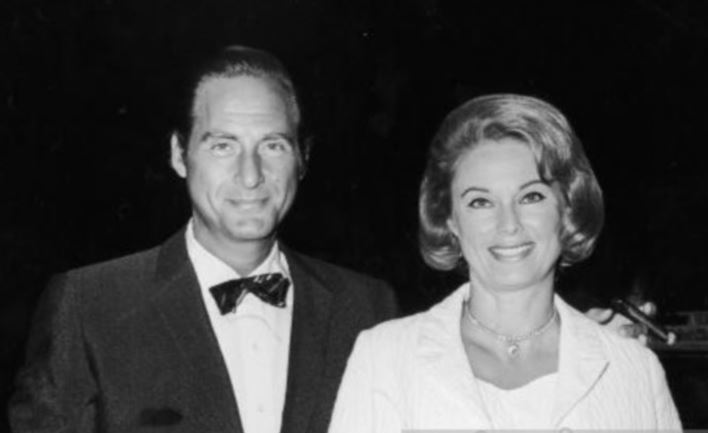
In 1942 Caesar met Florence Levy at the Avon Lodge in the Catskills. They were married the following year and had three children. In November of 2009, Greg Crosby wrote about an interview with the Caesars in the Tolucan Times. He quoted Florence, “I thought he would be just a nice boyfriend for the summer. He was cute looking and tall, over six feet . . . I was in my last year at Hunter College; we were still dating when Sid went into the service, the Coast Guard. Luckily, he was stationed in New York, so we were able to continue seeing each other, even though my parents weren’t too happy about it. They never thought he would amount to anything, that he’d never have a real career or make any money. But we were married one year after we met, in July of 1943.” They would remain married until her death in 2010.

After joining the musicians’ union, Sid played with several well-known bands, including Benny Goodman.

Sid Caesar Wiki, Wife, Career, Net worth and Death children, House,
With wife Florence Levy
Photo: hollywoodmagazine.com

While in the Coast Guard, he was able to collaborate with Vernon Duke, the composer of “Autumn in New York,” “April in Paris,” and “Taking a Chance on Love.” He and Duke put together a show called “Tars and Spars.” Max Liebman, future director of Your Show of Shows, was also part of the show, although not part of the military. Liebman asked Sid to do a few stand-up bits between songs and when the show toured nationally, Sid continued these routines.

Caesar left the service in 1945. He and his wife moved to Hollywood. In 1946, Sid was able to reprise his role in the film version Tars and Spars with Columbia Pictures.

Eventually, he returned to New York and accepted the offer of opening act for Joe E. Lewis at the Copacabana. He also received a contract with the William Morris Agency. He was able to perform in a Broadway show, “Make Mine Manhattan.”

In the fall of 1948, Sid made an appearance on Milton Berle’s popular show, Texaco Star Theater. The following year, he and Liebman met with Pat Weaver, VP of television at NBC. The meeting resulted in the Admiral Broadway Revue with Imogene Coca. It was very successful but Admiral could not keep up with the demand for new television sets so it pulled the sponsorship and the show was canceled after 26 weeks.

Sid Caesar's “Your Show of Shows,” the Best TV Has Ever Offered – Once upon  a screen…
Photo: onceuponascreen.com

In 1950, Weaver, Liebman, and Company created Your Show of Shows. It started life as a second half of the Saturday Night Review but became its own 90-minute program in 1951. In 1954, a 160 episodes later, it ended so Coca and Caesar could both have their own shows.

Sid’s show was called Caesar’s Hour, a one-hour show with Howard Morris and Carl Reiner from Your Show of Shows as well as Bea Arthur and Nanette Fabray. The show was not a success. In 1958, Sid tried again with Sid Caesar Invites You.

In the sixties, Caesar took stage roles, as well as big and small-screen parts. He had several specials on television, starred on Broadway in “Little Me,” which got him a Tony award nomination. He also was part of the ensemble of It’s a Mad, Mad, Mad, Mad World, a huge success that earned six Academy award nominations.

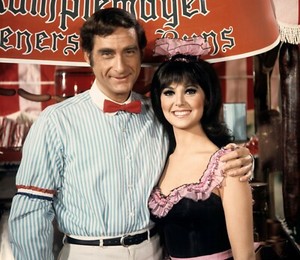
Sid appeared in a few television shows during his career but only a handful. A couple of those include That Girl, Love American Style, Laugh In, Vega$, and The Love Boat.

THAT GIRL - TV SHOW PHOTO #E-13 - MARLO THOMAS + SID CAESAR | eBay
That Girl Photo: ebay.com

Caesar didn’t write his own material. He often performed long sketches, 10-15 minutes. He relied on body language, accents, and facial expressions. Larry Gelbart called him a “pure TV comedian.” Fabray said he always stayed in character, “he was so totally in the scene he never lost it.” He was able to pantomime many different types of characters: a tire, a gumball machine, a lion, a punching bag, a telephone, an infant, a piano, even a bottle of seltzer. Neil Simon said that “Sid would make it [a sketch] ten times funnier than what we wrote.”

Many of his favorite comic sketches were parodies of films including gangster, western, and spy movies. Gerald Nachman wrote Seriously Funny: The Rebel Comedians of the 1950s and 1960s. He said, “the Caesar shows were the crème de la crème of fifties television, studded with satire and their sketches sharper, edgier, more sophisticated than the other variety shows.” Historian Susan Murphy agreed, describing Sid as “best known as one of the most intelligent and provocative innovators of television comedy.”

Unfortunately, like many comedians, Caesar had some demons of his own. His stardom ended quickly. He had no interest in the movies. He was using pills and alcohol to help relieve the pressures of headlining and producing a weekly show. In 1977, Caesar blacked out during a stage performance of “The Last of the Red-Hot Lovers” in Canada and gave up alcohol immediately. He discussed his substance abuse to alcohol and sleeping pills in his two autobiographies, Where Have I Been? And Caesar’s Hours. He said at his worst, he “had been downing eight Tuinals and a quart of Scotch a day.”

Later in his career, Sid came back to the movies. He was in Silent Movie and History of the World, Part I with Mel Brooks; Airport 1975, and Grease and Grease 2, playing Coach Calhoun.

Grease (1978) starring John Travolta, Olivia Newton-John, Stockard  Channing, Jeff Conaway, Barry Pearl, Michael Tucci, Kelly Ward, Didi Conn,  Jamie Donnelly, Di… | John travolta, Grease john travolta, John lennon  beatles
From Grease with John Travolta Photo: pinterest.com

In 1983, Caesar hosted Saturday Night Live and received a standing ovation. In 1996, The Writers Guild of America, West gathered Sid and his writers from Your Show of Shows and Caesar’s Hour for a two-hour panel discussion which was broadcast on PBS.

Sid passed away in 2014 after an illness. He left behind an amazing career and a legacy of actors and comedians he inspired. I’ll let his friends have the last word since they knew him so well. Carl Reiner commented at the time that “he was the ultimate, he was the very best sketch artist and comedian that ever existed.” Mel Brooks agreed and said “Sid Caesar was a giant, maybe the best comedian who ever practiced the trade. And I was privileged to be one of his writers and one of his friends.”

We were all privileged to watch a master at work. Thank you for the many memorable moments and teaching us what funny honestly looks like.

When Things Were Rotten: No “Happily Ever After” for this Tale

This month’s series is “Living in the Past: Timeless Comedies.” For our first blog, we travel back to the 12th century to Sherwood Forest to a time When Things Were Rotten. After viewing one episode of this show, you knew it could only have been created by the comic legend Mel Brooks. In this case, he had the help of John Boni and Norman Stiles.

Photo: nostalgiacentral.com

Debuting in 1975 on ABC, Brooks considered what life would have been truly like if the legend was just hype, and Robin and his Merry Men were just a bunch of buffoons. The series has many of the traits found in Brooks’ Blazing Saddles or Monty Python episodes.

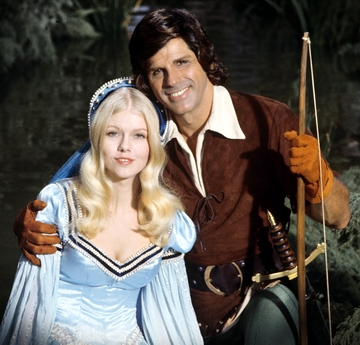
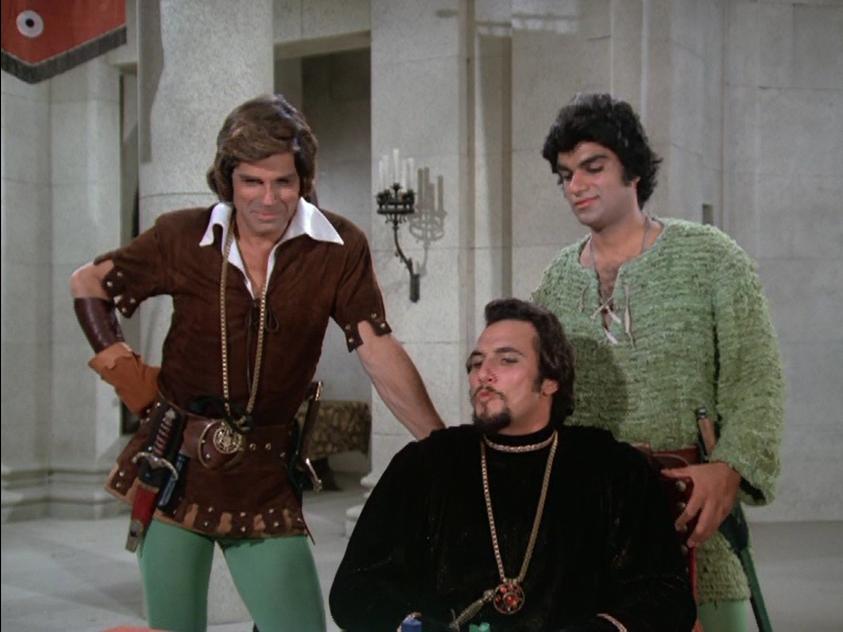
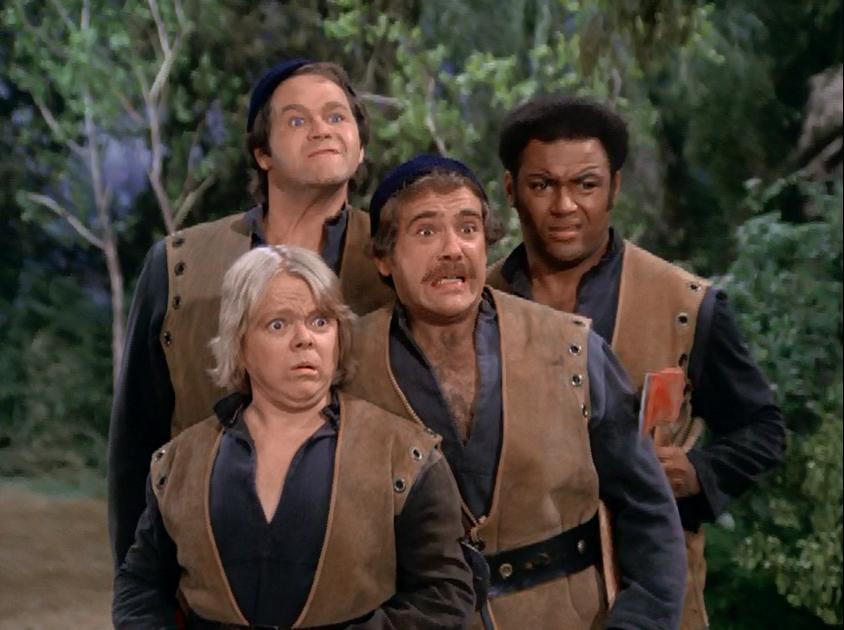
Reading the list of brilliant cast members, this show seems like one that should have been a huge hit, but in reality, it only lasted for thirteen episodes. Based on its brief airing, perhaps Robert Klein was wise to turn down the role of Robin. Dick Gautier, who worked with Brooks on Get Smart, agreed to take on the role of the heroic leader. Henry Polic II played the Sheriff of Nottingham who always got taken in by the gang. Ron Rifkin is Prince John. Misty Rowe, known best for her Hee-Haw performances, is Maid Marian. The Merry Men were indeed merry, being made up of Bernie Kopell, Dick Van Patten, Richard Dimitri (who had a dual role as identical twin brothers), and David Sabin.

Photo: sitcomsonline.com

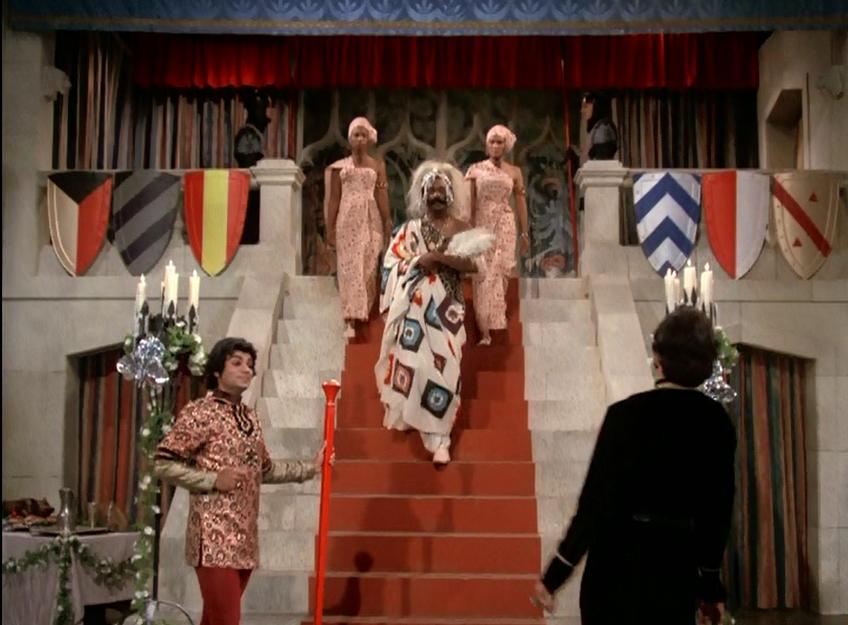
Of course, in this parody, slapstick is involved in every episode. The sight gags were always described as hilarious, and every script was full of great one-liners. It was definitely not everyone’s cup of tea. For example, at times the sheriff was said to be barking mad and he would literally bark. In one episode, the “barking” sheriff asks Bertram to hang up some banners and a cutaway scene shows a husband, wife and two children on a wall saying, “Hi, we’re the Banners.” Another example is Richard the-Lion-Hearted coming ashore after the Crusades to be met by an umpire, yelling “Safe,” at which point the sheriff shouts, “Kill the umpire.” The humor came fast and furious at a rapid-fire pace. Brooks described the construction of the show by saying: “We took great liberties, and the writing was very crazy and funny.”

Photo: imdb.com

Unlike some parodies, the production of the show was high quality with lavish costumes and sets. Every episode featured a well-known guest star. Dudley Moore appeared as a piano-playing sheik named Achmed Muhammad Ben Gazzara. Other stars included Carl Ballantine, John Byner, Sid Caesar, Paul Williams, and Mel Brooks himself. Brooks said his favorite episode was “The French Disconnection” starring Caesar as a French ambassador.

Photo: imdb.com

The theme song was written by Lee Adams and Charles Strouse who had done the well-known theme for All in the Family as well as many composing for many popular musicals. The lyrics were:

“Once upon a time when things were rotten,
Not just food, but also kings were rotten.
Everybody kicked the peasants,
Things were bad and that ain’t good,
Then came Robin Hood (Ba-bahh!)

“Soon a band of merry men he’d gotten,
They wore outfits made of plain green cotton,
Helping victims was their business.
Boy oh boy was business good —
Good for Robin Hood!

“They laughed, they loved, they fought, they drank,
They jumped a lot of fences.
They robbed the rich, gave to the poor —
Except what they kept for expenses!

“So when other legends are forgotten
We’ll remember back when things were rotten.
Yay for Robin Hood!”

When Things Were Rotten was definitely a product of its time. Like Laugh-In or even Sesame Street, viewers had no time to reflect on a comment. Things moved at a frenetic pace. One of the New York Times critics, John O’Connor, timed the gags and noted there was a new one every fifteen seconds.

Photo: imdb.com

The critics gave the series great reviews and mentioned its inventiveness and quick humor. The ratings never backed up the praise however. Brooks had a different perspective. In an interview with Frank DeCaro in the New York Times (7-19-2013), Brooks discussed the show’s ending. “The show was canceled, Mr. Brooks said, not because it failed to find an audience — ‘The ratings weren’t bad,’ he insisted — but because, as a one-camera show, shot like a film, it just cost too much to produce. ‘I was very happy with When Things Were Rotten,’ he said. “We were on our way to doing 36 episodes, and then someone at Paramount called and said, ‘Mel, could you do it as a three-camera show?’ I said, ‘You mean like “I Love Lucy”? Are you crazy?’” When the network pulled the plug, Mr. Brooks remembers, friends offered their condolences. ‘Everybody said, ‘I’m sorry it didn’t work.’ I said: ‘It did work. It was just too expensive.’”

Photo:

The same reason many viewers might still appreciate the show today is also one of the factors of its demise. The show depended on fans knowing a lot of pop culture knowledge. People who love cultural history would have a blast watching the show, but the younger generations whom don’t have that database in the brain might feel disconnected.

Photo: imdb.com

Of course, the television schedule always has a lot of sway about whether a show is a hit or a flop. This show was on Wednesday nights. Its competition was Tony Orlando and Dawn and Little House on the Prairie. While Tony Orlando and Dawn was on its last legs and would not return in 1976, Little House on the Prairie was very popular. This was the second season for the show which had a huge audience; the show would continue until 1983.

Photo: nytimes.com
Comedy legend Mel Brooks

The show might have ended, but Brooks could not let the concept go. In 1993, his film, Robin Hood: Men in Tights would continue the concept. In this version, Cary Elwes as Robin leads his men, but if you look closely, you might think The Abbot (Dick Van Patten) resembles Friar Tuck in When Things Were Rotten.

Photo: imdb.com

One interesting technological advancement is that a show like this typically would never have been released on DVD because of its short run. Now, however, manufactured-on-demand makes the show available on Amazon. It’s the perfect length for a week-end marathon. You might realize that When Things Were Rotten, they were also pretty good and funny.

Jeopardy: What is My Favorite Game Show?


Three games shows have been around for a majority of my life: The Price is Right, Wheel of Fortune, and Jeopardy. As a fan, I think most viewers fall in one of the three camps. I am definitely in the Jeopardy camp.

The Back Story of Jeopardy

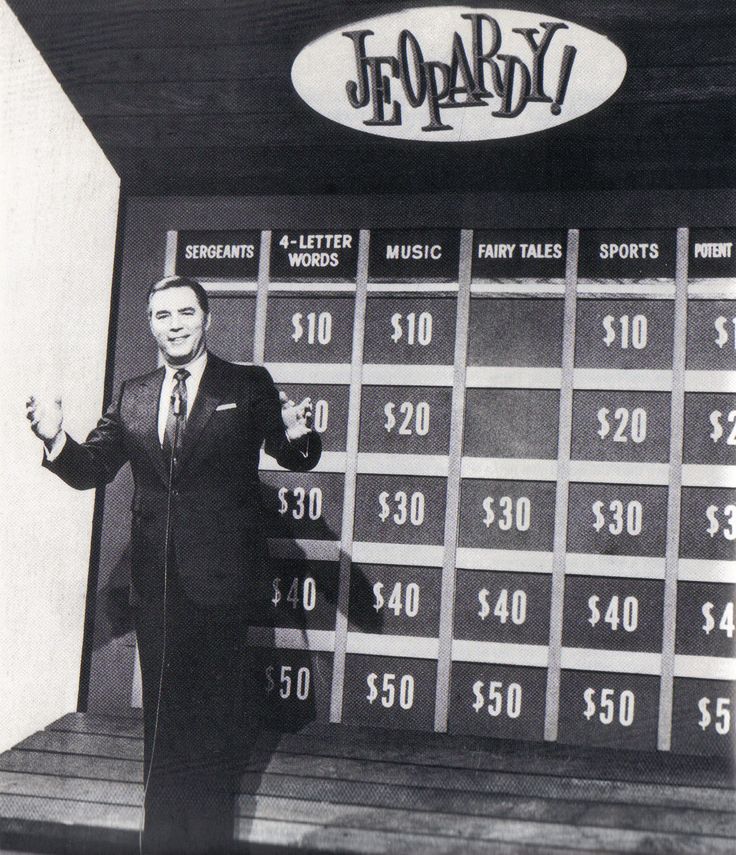
The original Jeopardy was created by Merv Griffin in 1964. On the site, mervgriffinabc.blogspot, a story is included where Merv explains how Jeopoardy was created: “My wife Julann just came up with the idea one day . . . She noted that there had not been a successful “question and answer” game on the air since the quiz show scandals. Why not do a switch and give the answers to the contestants and let them come up with the question? . . . I loved the idea, went straight to NBC with the idea, and they bought it without even looking at a pilot show.”

jeop22stl

Photo: stl.com

It was hosted by Art Fleming and ran until 1975. While Jeopardy’s format of giving contestants the answers and requiring them to provide the answer is unique, it was not the first tv game show to do that.  Television Quiz, airing in 1941-1942, also used this structure.

jeopcpinterest

Photo: pinterest.com

A nighttime syndicated show was on in the evenings from 1974-1975. Don Pardo was the announcer for both the original and the nighttime show. John Harlan was hired as the announcer for a show titled The All-New Jeopardy which aired in October 1978 and ended in March 1979.

In September of 1984, the current version hosted by Alex Trebek (whose real name is George), began and continues today. Johnny Gilbert has partnered with Alex as announcer during the show’s run. The current version has produced more than 7000 episodes, just in case you wanted to watch them before you audition. Five shows are taped a day for 46 days. That would be a fun job to have with lots of time to recharge every year.

jeopfjohnnygilbert.tv

Photo: johnnygilbert.tv

When I was in college in the mid-1980s, I remember listening to a radio show on Sunday nights from St. Louis that Art Fleming hosted and, as I remember it, it was very similar to Jeopardy.

Jeopardy has won a record-setting 34 Emmys. It also won the Peabody Award in 2011 for “decades of consistently encouraging, celebrating and rewarding knowledge of this, that and the other.” It has won several other awards including the Writers Guild of America Award in 2014.

The Rules of the Game

While there have been a few changes to the Jeopardy format over the years, the game has remained basically the same. Three contestants answer questions. Whoever buzzes in first is allowed to answer. Until 1985 contestants could answer as soon as the clue was revealed. In September of 1985, it was required that the contestant not hit the buzzer until the clue is read. The Jeopardy round has a clue where the contestant can bet an amount of their money, or up to $1000 if they have less than that amount. In the Double Jeopardy round, there are two clues available and players can bet up to $2000 or the amount of money they have.

A contestant chooses from categories of clues. Each of the clues vertically increases in monetary value. The second round, Double Jeopardy, features six new categories of clues. Clue values are doubled from the Jeopardy round.

jeop1

The Final Jeopardy round features a single clue. Contestants write their wagers using a light pen to write on an electronic display on their lectern. The contestants have 30 seconds to write their responses, while the show’s iconic “Think!” music plays in the background. In the event that either the display or the pen malfunctions, contestants can use an index card and a marker to manually write their response and wager.

The contestant with the highest score at the end of the round is that day’s winner. If all three contestants finish with $0, no one returns as champion for the next show. The second and third place winners receive a small amount of money.  The top scorer(s) in each game retains the value of the winnings in cash and return to play in the next day’s show. If there is a tie, both players can come back the next day.

Seven times a show has ended with no winner. Three new contestants then show up the next day.

The Clue Crew

jeopemaximumfun.org

Photo: maximumfun.org

In 2001, the Clue Crew was formed. They travel around the world to tape clues. More than 5000 people applied for the three positions. The current crew is comprised of Sarah Whitcomb, Joe Cannon, and Kelly Miyahara. The team has been to more than 280 cities, including all 50 states and 44 other countries.

The Writers

Nine writers and five researchers create the categories and clues for Jeopardy.

You’ve Probably Hummed the Theme Even if You Don’t Watch the Show

Since the debut of Jeopardy in 1964, several different songs and arrangements have served as the theme music for the show, most of which were composed by Griffin. The main theme for the original Jeopardy series was “Take Ten” composed by Griffin’s wife Julann. The best-known theme song on Jeopardy is “Think!” originally composed by Griffin under the title “A Time for Tony”, as a lullaby for his son. “Think!” has always been used for the 30-second period in Final Jeopardy when the contestants write down their responses, and since the syndicated version debuted in 1984, a rendition of that tune has been used as the main theme song.

jeop2youtube

Photo: youtube.com

Even Game Shows Have Spin-offs

In addition to the daily show, three other versions of Jeopardy have been created: Rock & Roll Jeopardy which was on VH1, Jep! which was on the Game Show Network, and Sports Jeopardy! hosted by Dan Patrick.

More Than Fifteen Minutes of Fame

Ken Jennings holds the record for the longest appearance on Jeopardy, June 2 – November 30, 2004. He won $2,520,700.  Many people have studied Jennings’ streak and determined that due to filming fatigue, no one is likely to break his record.

The highest earner is Brad Rutter who won $4,355,102 between his first appearances and his tournaments. Roger Craig has the all-time record for a single day of winning. In 2010, he won $77,000.

AP TV-JEOPARDY TOURNAMENT A ENT FILE USA CA

Photo: usatoday.com

Julia Collins who was on in 2014 holds the record for female both for number of games and total winnings. She won $429,100.

Another famous contestant is buzz kill Arthur Chu. He was the first contestant to consistently skip around the board trying to find the daily doubles. Since Chu’s appearance, many contestants have jumped around the board instead of trying to run the categories from top to bottom. Often the categories can be understood better if contestants pick them in order. Personally, I admit that I did hold a grudge against Chu for many years for “ruining” Jeopardy.

Watson, I Presume

jeopwatsonyoutube

Photo: youtube.com

The IBM Challenge aired February 14–16, 2011, and featured IBM’s Watson computer facing off against Ken Jennings and Brad Rutter in a two-game match played over three shows. Watson won both the first game and the overall match to win the grand prize of $1 million, which IBM divided between two charities (World Vision International and World Community Grid). Jennings, who won $300,000 for second place, and Rutter, who won the $200,000 third-place prize, both pledged to donate half of their winnings to charity.

Tournaments

During the most recent version of Jeopardy, various tournaments have been held annually. Currently, there is a Tournament of Champions featuring the top fifteen winners from the past year, The Teen Tournament, The College Championship, Celebrity Jeopardy, and the Teachers Tournament.

jeop8berkeleyside

Photo: berkeleyside.com

Portrayals and Parodies

Jeopardy has been part of several television shows and movies over the years. In 1988, a show titled “Mama on Jeopardy” featured Thelma Harper (Mama’s Family) competing on the show when Iola was rejected. She doesn’t know many answers but starts to make a comeback and is able to move into Final Jeopardy. She ends up in second place but wins a trip to Hawaii for herself and her ungrateful family.

In 1990, an episode titled “What Is . . . Cliff Clavin?” aired on Cheers. Cliff appears on Jeopardy and wins $22,000, way more money than his competitors have. However, for Final Jeopardy, Cliff bets everything. The answer is “Archibald Leach, Bernard Schwartz, and Lucille LeSueur” and the correct question is “What are the real names of Cary Grant, Tony Curtis, and Joan Crawford,” but Cliff’s answer is “Who are three people who have never been in my kitchen” and he ends up with no money.

jeop23metv

Photo: metv.com

In 1992 on the Golden Girls in “Questions and Answers,” Dorothy auditions but is rejected because they don’t think she’s likable enough for the viewers to root for her. She has a dream that night where she does appear, competing against Rose and neighbor Charlie.

jeop21imdb

Photo: imdb.com

Perhaps the most famous show to host Jeopardy was Saturday Night Live with their version.

Happy New Year

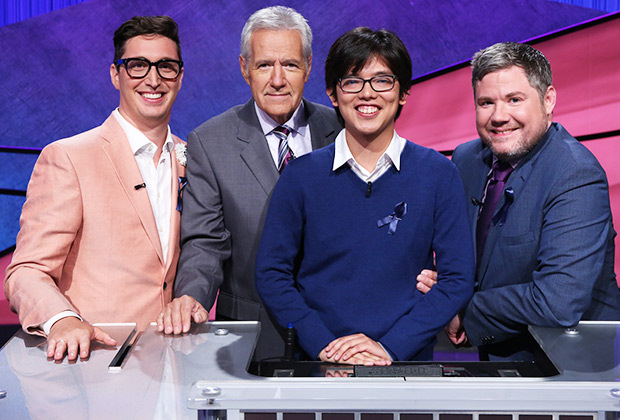
In honor of its 35th anniversary, Jeopardy is holding a special All-Star tournament this year. Six teams will compete in February during a two-week period. Some of our favorite contestants will be part of the celebration. Captains were chosen and they each drafted their own team. Captains include Buzzy Cohen, Colby Burnett, Julia Collins, Austin Rogers, Ken Jennings, and Brad Rutter. This should be a fun couple of weeks.

I admit these three were my favorite contestants during a tournament. This was a fun couple days. One of my favorite moments was during the introduction of the contestants when they portrayed See No Evil, Hear No Evil,  Speak No Evil. (Buzzy Cohen, Alex Trebek, Alan Lin, Austin Rogers)

 jeopbtvline.coom

Photo: tvline.com

Will You Marry Me?

One of the contestants in 2018 was Michael Pascuzzi. When it came time for Alex to talk with the contestants after the first commercial break, he announced he had no information on his card about Pascuzzi. So, Alex told him to say whatever he wanted. He then proposed to his girlfriend, Maria Shafer, who was in the audience. She must also be a fan, because not only did she say yes, she answered “What is yes.”


To Be-ard or Not to Be-ard

bearddailymail.co.us

Photo: dailymail.co.uk

Of course one of the most asked questions at the beginning of each fall season is will Alex have the mustache or not. This year, Alex took it a step further. He began the year with a full beard in addition to the mustache and let viewers decide whether it was a keeper or gotta go. Spoiler alert: You will only see the beard for a few shows.


jeop3dailymotion

Photo: dailymotion.com

So, You Want to Be on the Show

Auditioning for the current version of the show begins with a written exam, comprising fifty questions in total. This exam is administered online periodically, as well as being offered at regional contestant search events. If you have considered auditioning for Jeopardy, here is what you should know. I took these paragraphs directly from the Jeopardy site:

“First, you must take and pass the online test. If you pass the test and meet the minimum eligibility requirements, you will be placed into a random selection process for an invitation to an audition. Assuming you perform well at the audition, you will be placed into the contestant pool and could be invited to compete up to 18 months from your audition date. Making it to an audition is not a guarantee of being invited to compete on the show.

There is no fee to take any of the tests, but any costs you incur in connection with the test are your responsibility. Likewise, if you are invited to participate in an in-person audition, all costs (including, but not limited to, accommodations, meals, transportation and parking) must come at your own expense.

If you pass the test and do well at your audition, you will be placed in a pool of potential contestants for 18 months after your audition date. But attending an audition and being put in the pool does not guarantee that you will be invited to appear on the show. If you are selected to compete on the show, our contestant coordinators will contact you with full details. Prospective contestants are notified about a month in advance of their tape date.”

What is My Favorite Jeopardy Story?

Some of the most entertaining parts of Jeopardy are when Alex talks to the contestants. I remember one woman who was in Yellowstone and while the rest of the family was taking a class about what to do if bears show up, her mom was alone at the campsite with several bears. One lady said she and her mom learned Swedish because they loved Abba songs. One guy said he met his wife because she came over and introduced herself. Later he found out, she did that because she thought he was very smart and talking about philosophy because she heard him discussing Plato. He had to inform her they were discussing play-doh, nothing enlightening. One poor girl said her parents got pregnant late in life and could not decide on a name. Her mom asked her bridge club for suggestions. She ended up taking the first letter from each of their names and calling her daughter “Pidge.”

brooksyoutube

Photo: youtube.com

One of my favorite facts about Jeopardy was discovered on a Seinfeld episode of Comedians in Cars Getting Coffee, but it has also been discussed on the show.  Mel Brooks and Carl Reiner get together every night for dinner to watch Jeopardy. Watching an episode with them is definitely on my bucket list.

There are a lot of shows that made me sad when they left the air, but when Jeopardy is cancelled, I will go into a major withdrawal. Like so many Jeopardy fans, it’s a multi-generational interest. my son Brice and daughter-in-law Melanie and I share many texts about watching Jeopardy shows and how we feel about categories or contestants. For my entire life I’ve counted on people dying, paying taxes, and watching Jeopardy. I can give up the first two, but the last one is gonna be a challenge!