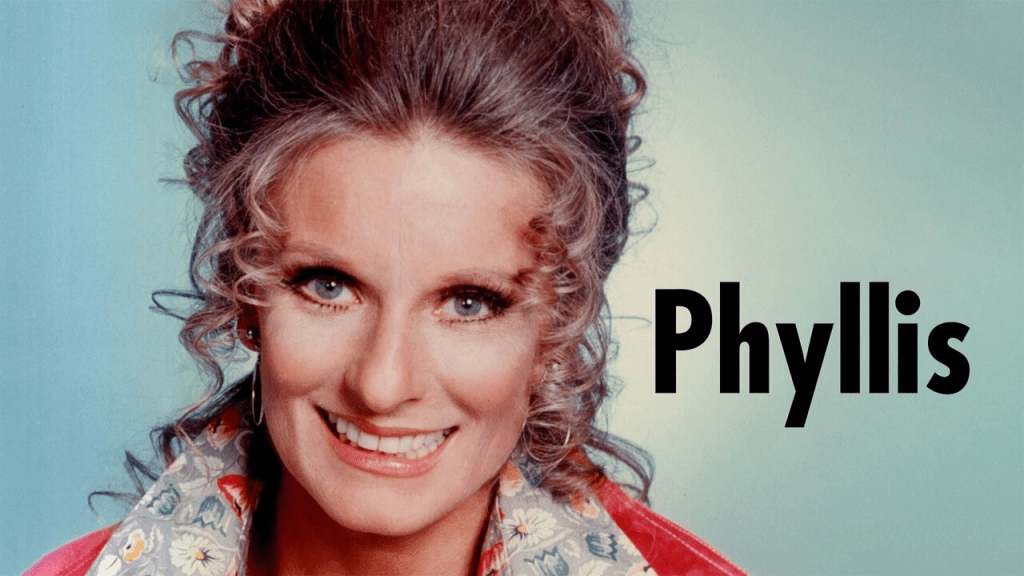
This month we are looking back at one-named sitcoms, and we can’t forget Phyllis. A spinoff from The Mary Tyler Moore Show, it aired in the fall of 1975 and ran for two seasons. James Brooks, The MTM producer, was involved slightly as a consultant but Ed Weinberger and Stan Daniels were in charge.
📷TVInsider.com
In this series, Phyllis Lindstrom (Cloris Leachman) and her daughter Bess (Lisa Gerritsen) leave Minneapolis and move to San Francisco after Phyllis’ husband passes away. Her in-laws still live out west in the area where she and Lars lived as newlyweds. Even though Lars was a doctor, his death left his family broke. Life is interesting with three generations under one roof. Lars’ father Judge Jonathan Dexter (Henry Jones), Lars’ mother Audrey (Jane Rose), and Phyllis and her daughter navigate life with their grief, new surroundings, and complicated life situations.
Phyllis applies for an assistant in a photography studio. Her first boss is Julie (Barbara Colby). After Colby was murdered, Liz Torres took on the role and Valerie Harper’s (who played Rhoda on the MTM show) ex-husband Richard Schall plays Leo, a photographer at the studio who doesn’t make life easy for anyone. Phyllis is not only used to being pampered and not working, she also never was shy about sharing her opinions with anyone around her.
The network scheduled the show on Monday nights after Rhoda and before All in the Family, so it became an instant top ten hit. Leachman was nominated for lead actress in a comedy but lost the Emmy to Mary Tyler Moore. In addition to Moore, Leachman’s competition included her previous coworker Valerie Harper for Rhoda, Lee Grant for Fay, and Bea Arthur for Maude.
Once again, as we’ve seen a few times this month, when ratings began to slip a bit, the network turned the show upside down. For season two, the photography studio was sold, and Phyllis was without a job again. She then goes to work for the San Francisco City Supervisor and is put into the middle of political chaos. Rhoda was also having some trouble with ratings and was rehabbed. Their competition was Little House on the Prairie which continued to rake in lots of viewers.
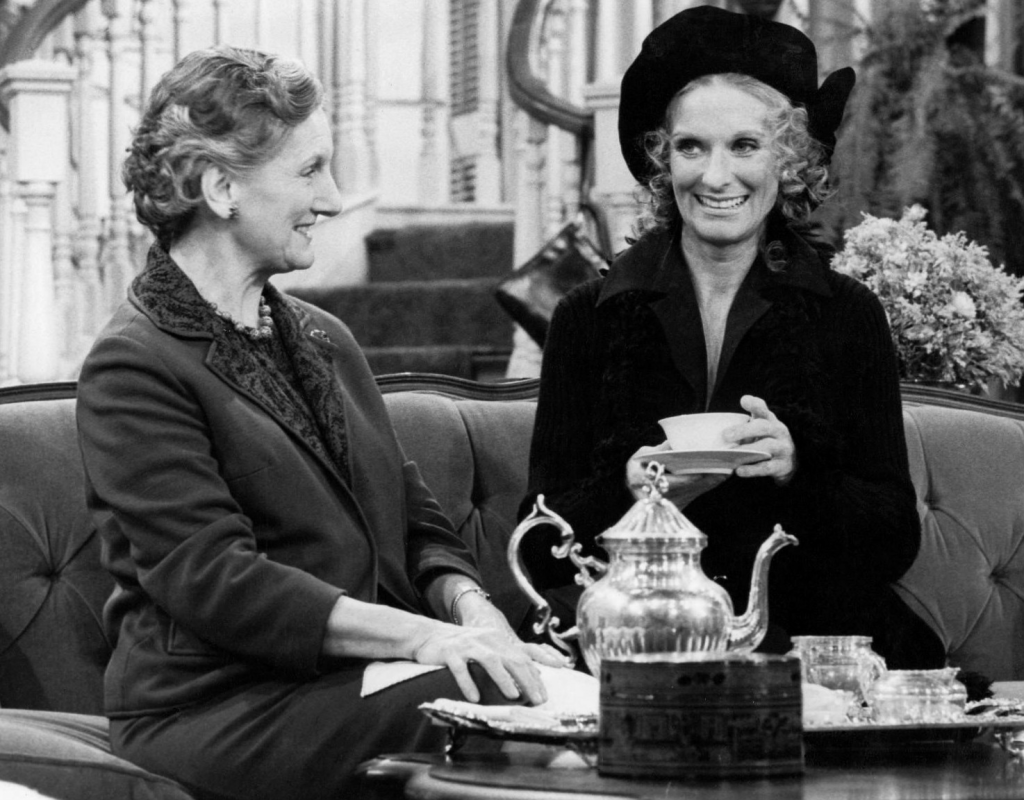
By 1976, Rhoda had regained many of its viewers, but Phyllis was continuing to decline. It was dropped for the next season. At one point, Mother Dexter (Judith Lowry), the judge’s mother, has a boyfriend Arthur Lanson played by Burt Mustin who later becomes her husband. Henry Jones and Burt Mustin’s scenes are probably the highlights of the shows.
📷tvseriesfinale.com
Alan Burns discussed casting the role of Phyllis on The Mary Tyler Moore Show. He said Leachman’s instincts were terrific, and she made the role amazing. James Brook said that Marlin Brando called Leachman the best actor he ever saw come out of The Actor’s Studio. Obviously, the character of Phyllis was a successful and popular one. I think that The Mary Tyler Moore Show was so well loved for the ensemble cast. Pulling Phyllis out of that “family,” and placing her across the country probably wasn’t the formula for a successful spinoff. They would have been better off to give her a brand new show of her own which could feature her highly rated acting ability.
As we wind up our What in the World? blog series this month, we end with Bracken’s World. Just like the other shows we covered, this one began in the sixties, 1969, and just like the others, it was on for less than two seasons.
Dorothy Kingsley created the series for NBC. This was her only foray into television; she was a screenplay writer for most of her career. Kingsley wanted to concentrate on the “little people” who work at the studio, rather than the executives. In one blog I read that props from Twentieth Century Fox where the show was filmed were often carted around in the background for authenticity. It would be fun to go back and make a list of the props that were shown around the set; specifically mentioned were props from Planet of the Apes and Land of the Giants.
Watch.plex.tv.com captures the essence of the show in its description “In the glitzy realm of Century Studios, powerful executive John Bracken shapes Hollywood’s fate, navigating ambition, romance, and betrayal through the eyes of his astute secretary Sylvia, who holds the key to both secrets and success.”
Century Studios was a movie studio. John Bracken owned the company, and he was never seen during the first season. Similarly to the way Charlie interacted with Charlie’s Angels, we only heard Bracken on the telephone, voiced by Warren Stevens. Sylvia Caldwell (Eleanor Parker) was his secretary. There were some impressive cast members in this show including stunt man Dennis Cole, Jeanne Cooper, Madlyn Rhue, Linda Harrison, Elizabeth Allen, Karen Jensen, and Laraine Stephens. Most of them played starlets waiting for their big break. Peter Haskell as producer Kevin Grant seemed to be responsible for a lot of the success of the show. Tom Selleck had a recurring role of Roger Haines during the first season. The characters dealt with the problems of the movie industry—drugs, sex, alcohol, and amoral executives.
Being a Hollywood studio, there were also a lot of great guest stars including Anne Baxter, Shelley Fabares, Sally Field, Lee Grant, Carolyn Jones, Ricardo Montalban, Edward G. Robinson, Martin Sheen, Richard Thomas, Forrest Tucker and Raquel Welch.
The series was on Friday nights in the hole filled when Star Trek was canceled. It was referred to as the “Friday night death slot.” The show’s competition was Love American Style and CBS Friday Night at the Movies, which started an hour before Bracken’s World did. I’m not sure when this death slot switched because at that same time, I recall loving Friday nights in the early seventies featuring The Brady Bunch, The Partridge Family, Room 222, The Odd Couple, and Love American Style.
The show’s ratings were not good, so for the second season, things were changed a bit. Parker left part way through season one because she didn’t like the scripts. We now got to see John Bracken in person, but he sounded like Leslie Nielsen who played him instead of John Warren. Dennis Cole was also shown out the door.
Jeanne Cooper had a very different view of the show than Parker. Cooper played one of the starlet’s mom who was also her agent. She said that it allowed viewers to go behind the scenes of a movie studio to get a realistic depiction of what happened when the cameras were off. She said that the cast can take much more time filming movies to discuss the script, but that is not the way television works, and Parker never understood the difference between the two mediums. Cooper felt the writing was much more sophisticated than shows had produced before and that it led the way for shows like LA Law and Boston Legal.
According to Cooper, there were two reasons for the demise of the show. One was that she said Bracken should never have been exposed. He should have stayed a voice who ran a studio like a Louis B. Mayer type. She also said the show was very expensive to produce. Often shows were ordered six at a time back then which gave the crew some wiggle room to have a few expensive shows and then cut back when it got viewers locked in to average out the cost. NBC would only buy two or three at a time. Finally, Stan Rubin, the executive producer, said NBC had to agree to a minimum of four-episode commitments at a time and they refused, so the show was canceled.
The show did seem to be a bit ahead of its time. Perhaps if it had debuted a few years later, it would have found more viewers.
We are winding up the blog series, “One-Named Detectives,” and I think we saved the most interesting private eye for today: Columbo.
Photo: americana.com
Columbo was on the air from 1971-2003, the longest of the five detectives we looked at in this series (Cannon, Kojak, Mannix, Matlock, and Columbo), but oddly had the fewest episodes with 68 (Cannon had 120, Kojak had 117, Matlock with 181, and Mannix had the most with 194).
Richard Levinson and William Link created Columbo (they also were the force behind Mannix). Levinson and Link met in junior high and they were a writing team until 1987 when Levinson passed away. This show was a bit different; it actually had two pilot episodes in 1968 and 1971. It originally aired from 1971-1978 in The NBC Mystery Movie series. It alternated with McMillan and Wife, McCloud and Hec Ramsey. ABC revived the show from 1989-2003, but it was not a weekly show then either. Falk didn’t want a weekly show, so the series was scheduled for one Wednesday a month. For season two, the series was moved to Sunday nights where it continued until 1978.
Falk with Hector Elizondo–Photo: columbophile.com
In the original concept for the show, Columbo was described as smooth-talking and cultured. The first choice for an actor to play the role was Bing Crosby who declined. When Falk showed up for his audition, he came in wrinkled clothing, aimlessly chattered, and seemed a bit scatter brained so the producers changed the character.
The show had some interesting directors. One of the directors on the show was Steven Spielberg who directed “Murder by the Book.” Falk himself directed the final episode of season one, “Blueprint for Murder.” Nicholas Colasanto who played Coach on Cheers directed two of the shows, “Etude in Black” and “Swan Song.” Patrick McGoohan directed five episodes (including three he guest starred in), as well as producing and writing two others. Falk’s friend actor Ben Gazzara directed “A Friend in Deed” and “Troubled Waters.”
On Columbo, we see the crime being committed long before we meet Lt Columbo (Peter Falk), so we know who committed the crime from the beginning. The fun of the episode is in watching Columbo investigate the crime and how he solves it. Columbo never introduces himself with his first name and no other character in the show uses it either. In season four, Colonel Rumford asks Columbo if he has a first name, and his response is “I do, but usually only my wife uses it.” Apparently, in one episode, a badge is scanned and lists his name as Frank, but William Link stated that Columbo was written without a first name.
Photo: pinterest.com
Columbo was a very disheveled detective who always showed up in a rumpled raincoat, smoking a cigar and appearing as if he was not quite all there. Falk used his own wardrobe for the character. The infamous raincoat was one he bought for $15 in 1967 when he got caught in a New York City rainstorm.
However, behind the façade of an inept policeman was a brilliant mind. He asked a lot of seemingly non-essential questions and paid attention to every detail. After interviewing a suspect, he always said, “Just one more thing.” Falk improvised during filming. He might ask for a pencil, search for something or throw in an unscripted line and did it to create a genuine confusion on the part of the other actor so it appeared more realistic.
This was definitely a one-man show, but there were a few characters who had recurring roles: Mike Lally played a bartender in 25 episodes, John Finnegan was Barney on 13 shows, and Bruce Kirby as Sgt George Kramer was seen nine times.
Photo: recordonline.com
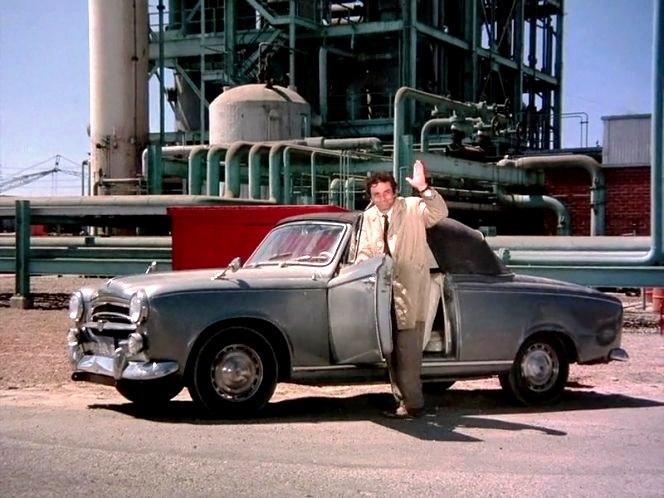
Columbo’s car is a 1959 Peugeot 403. Apparently, only 504 convertibles with two doors were made that year. When NBC cancelled the series, the car was sold. ABC had to locate a replacement when they picked the show up later. You can tell the difference because the license plate from NBC seasons was 044-APD and the plate from ABC shows was 448-DBZ.
Most of the suspects on the show were clever, wealthy people who think they have covered their tracks and have a solid alibi.
For only 68 episodes, there were a lot of famous guest stars on the show. Some stars even portrayed two different criminals including Jack Cassidy, Robert Culp, George Hamilton, Patrick McGoohan, and William Shatner. Other guest stars showing up were Anne Baxter, Johnny Cash, Faye Dunaway, Jose Ferrer, Ruth Gordon, Lee Grant, Janet Leigh, Vera Miles, Ray Milland, Leonard Nimoy, Donald Pleasence, Dick Van Dyke, and Robert Vaughn.
Falk with Dick Van Dyke–Photo: amazon.com
There was a variety of music written for each episode of the show. The Mystery Movie Theme was written by Henry Mancini and was used for the NBC shows. Both Quincy Jones and Mike Post also wrote versions of The Mystery Movie theme. One song uniquely belonging to Columbo was “This Old Man.” Falk can be heard humming or whistling it in various episodes after it was introduced in a 1973 show.
The show received thirteen Emmys during its run. Falk won the Emmy the first season and again in 1976. He was nominated in 1973, 1977 and 1978 but lost to Richard Thomas, James Garner and Ed Asner respectively. The series was nominated in 1972, 1973, 1976, 1977, and 1978 (winners were Elizabeth R Masterpiece Theater; The Waltons; Police Story; Upstairs, Downstairs; and The Rockford Files).
Photo: wallpapersplanet.net
The show was very popular and was broadcast in 44 countries. There is a statue of Columbo in his coat in Budapest, Hungary on Falk Miksa Street. The story behind it is that according to then-mayor Antal Rogan, Falk is a relative of Falk Miksa who was a Hungarian writer and politician, but I could not verify if that was true or not. What is true is that it was put up in 2014 at a cost of $63,000.
When he is questioning witnesses, Columbo often throws in random references to his wife and or something the couple liked to do, but we never see her in the series. However, later a show was created, Mrs. Columbo starring Kate Mulgrew. Falk’s real-life wife Shera Danese was cast in six of the Columbo episodes, always appearing as a different character.
A group of novels was adapted from the Columbo tv series by MCA written by Alfred Lawrence, Henry Clements, and Lee Hays.
Columbo has been a popular show in syndication and can currently be seen on ME TV Sunday nights. The shows run from 70-98 minutes which probably makes syndication interesting. The entire set is available on DVD for about $50.
Unfortunately, Peter Falk was diagnosed with dementia in 2007, and by 2009 he could not recognize photos of himself and did not remember playing Columbo. He passed away in 2011.
Columbo
It’s been fun looking at these five detectives for this series. When I put this together, I chose five private eyes I thought would make good articles. What I didn’t realize, is that four of them were all from the same era. In fact, in 1973, Columbo was on Sunday nights followed by Mannix and both were in the top twenty and on Wednesday nights Cannon was on followed by Kojak and both were in the top ten. The following year, Sunday nights featured Kojak before Mannix which was still in the top 20 and they were on at the same time as Columbo. Cannon eventually moved to Sunday night but also spent part of the year on Wednesdays where it was also in the top twenty. Matlock debuted in the late eighties, after the other shows except Columbo had all gone off the air.
Cannon, Kojak, Mannix, Matlock, and Columbo—five very different types of detectives who had one thing in common: good writing. Check them all out and I’d love to hear which one is your favorite.




 thewritelife61