This month we are looking at adult PBS shows that inspire us. Today we check out a show that has intimidated and inspired thousands of us: The French Chef hosted by Julia Child. I think Julia’s life was a fascinating one. I spend a lot of my time reading biographies and Julia’s biography Dearie by Bob Spitz is one of my all-time favorites.

For those of you who are not as familiar with her life, Julia was born in 1912 to a wealthy family in Pasadena, CA. She had a younger brother and sister. She was very athletic and went to Smith College in Massachusetts, graduating with a major in history. After graduation, she moved to New York City to work as a copywriter for an advertising company. She joined the OSS, the precursor to the CIA in 1942. She became a research assistant in the Secret Intelligence division. She later was posted to Sri Lanka where she met Paul Cushing Child who would become her husband in 1946. After the war, he joined the US Foreign Service, and the couple moved to Paris. Paul introduced Julia to a more sophisticated cuisine. While trying to find something to keep her busy in Paris, she enrolled in the Cordon Bleu cooking school and later studied with well-known chefs. When she met Simone Beck and Louisette Bertholle, the trio decided to write a French cookbook for Americans. Paul and Julia eventually settled in Cambridge, Massachusetts but also had a home in Provence.
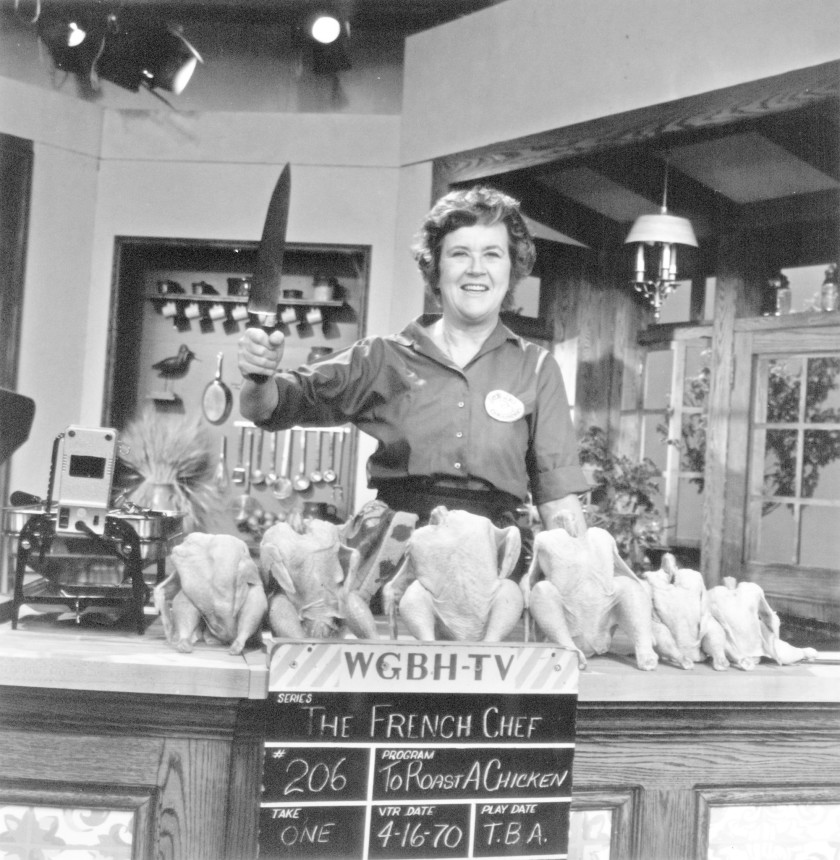
In 1963 Julia gave a presentation about omelette-making on WGBH, the Boston PBS station from the book she wrote with her friends, Mastering the Art of French Cooking. After a last-minute cancellation by a guest on one of the on-air shows, Julia agreed to fill in. When Paul and Julia watched the show on their black and white television in Cambridge, Julia was horrified. She said she looked like Mrs. Steam Engine careening across the screen, panting heavily. “There I was in black and white, a large woman sloshing eggs too quickly here, too slowly there.”
It was so popular, that it became a weekly television show airing for a decade from 1963-1973. It was one of the first cooking shows on television. There was not a lot of money for shows on public television. Volunteers came in to wash dishes, and Julia’s creations were often auctioned after the show to raise money.
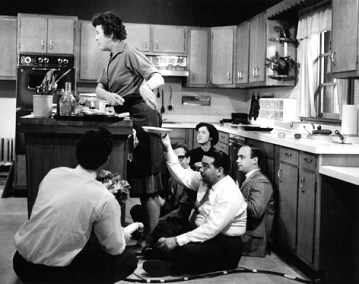
NET, which would become PBS, continued the show in reruns until 1989. Some episodes have also been run on other networks including the Cooking Channel and Create; they are also available on PBS’s streaming service.
In 1964, Julia received a Peabody Award because they said her program did “more than show us how good cooking is achieved; by her delightful demonstrations she has brought the pleasures of good living into many American homes.” In 1966, Time magazine said that “So good is she that men who have not the slightest intention of going to the kitchen for anything but ice cubes watch her for pure enjoyment.” 1966 was also the year she won an Emmy.
At the time Julia and company wrote their book, French cuisine was considered expensive and difficult; it was typically reserved for ordering in restaurants, not making at home. The show was done live, so mishaps were not uncommon. During the second episode, she was so busy “chatting” that the onion soup burned. Instead of acknowledging it, she just discussed the “wonderful smell.” She would often burn butter, drop food, spill sauces, and have other little incidents that all of us experience in the kitchen weekly. Never one to be embarrassed much, Julia just accepted them and turned them into teachable moments. When she dropped a potato pancake on the stove, she just said “Oh, that didn’t go very well. But you can always pick it up. If you are alone in the kitchen, who is going to see?”

I thought it was interesting that Julia’s show beginning in 1971 was the first television show to include captions for deaf viewers. And speaking of firsts, Child was the first woman inducted into the Culinary Institutes of America’s Hall of Fame. She also received the Presidential Medal of Freedom from President George W. Bush in 2003.
If you watched this show there are things that you fondly remember including her love of good wine, her unique voice, her loyalty to butter and abhorrence of margarine, needing a very clean towel in the kitchen, and her closing each show with “This is Julia Child, Bon Appetit!” Of course, even if you did not watch this show, you will likely be familiar with these same points because whenever Julia is spoofed by comedians, these elements are part of the sketch.
Viewers loved her show. Apparently, grocery stores reported that after her episodes aired, they often ran out of ingredients she used in her dishes that week. Julia produced two books to accompany the show: The French Chef Cookbook and From Julia Child’s Kitchen.
In the eighties and nineties, Julia continued to host television programs, and the later shows invited celebrity chefs into her kitchen to cook. Her lessons were always memorable. Some viewers recall her tickling lobsters, showing the cuts of meat on her own body, and using exotic tools. While making crème brulee, she employed an interesting tool, saying “Every woman needs a blowtorch.”
PBS has a website devoted to Julia. Her kitchen, which was designed by Paul, now has a home at the Smithsonian Museum of American History.

Julia did not see cooking as a boring duty but as “an immense pleasure and a true creative outlet.” She further said that “we should enjoy food and have fun. It is one of the simplest and nicest pleasures in life.” Who can argue with that? If ever there was a television series to inspire us, The French Chef was it. I do remember my mom watching this show occasionally, but I have to admit our weekly dinners never reflected any of the recipes. Perhaps having five kids running through the kitchen did not lend itself well to cooking quiche and using a blowtorch. Julia’s best advice for everyone: “Learn how to cook—try new recipes, learn from your mistakes, be fearless, and above all, have fun.” Thank you so much Julia Child for teaching us to cook, to try new things, to learn from our mistakes, and especially, to have fun while doing it.


 thewritelife61