Jo Anne Worley: What a Character

📷imdb.com

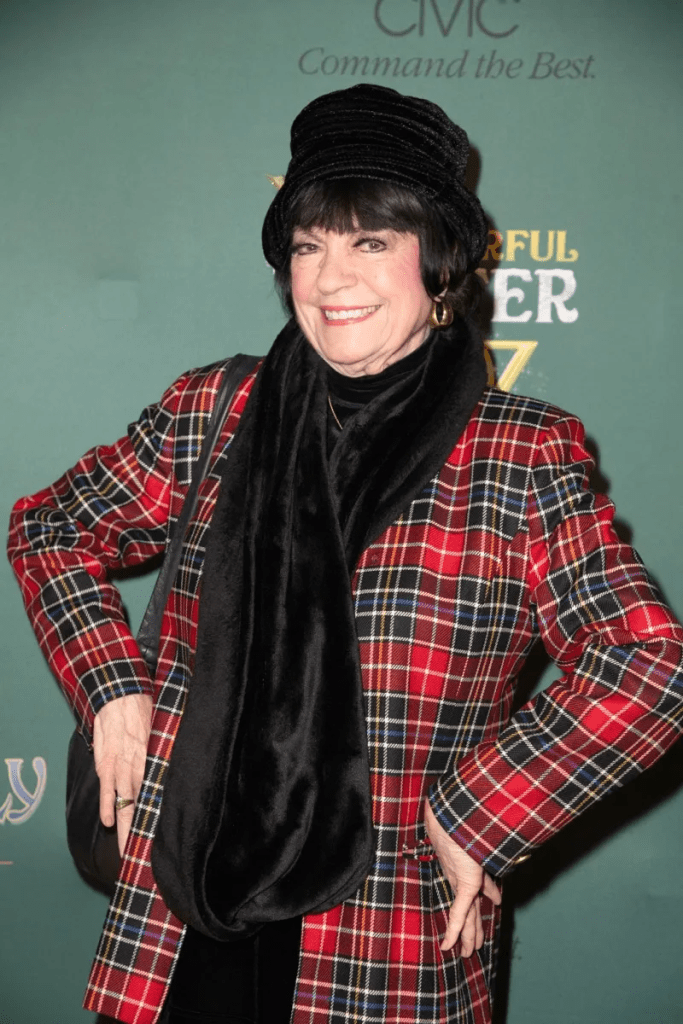
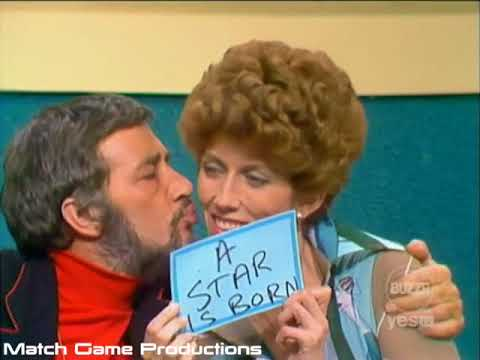
We are winding up a blog series about Supportive Women. One of the women I wanted to include was Jo Anne Worley. I didn’t know much about her apart from her appearances on Rowan & Martin’s Laugh-In and being in my favorite made-for-television movie, The Feminist and the Fuzz.

Jo Anne was born in 1937 in Lowell, Indiana. Her loud voice was not an acting tool. She always felt she was loud. She said, “I have a big mouth, and I’m sorry to say I’ve always had one. When I was young, in church, I never sang with everybody else. I only mouthed the hymns, so I wouldn’t drown anyone else out. I have my quiet moments. But I don’t have many.” She was named school comedienne at her high school.

In one interview with a Lowell reporter, she said “I’ll never forget the place I’d work every summer while in high school. It was called Robert’s Hotel, Gas and Café, and it was at the intersection of US 41 and Highway 2. They had an old juke box in the café where I worked, and I’d sing and joke around whenever the business was slow, which seemed like most of the time.”

After graduation, Worley moved to Blauvelt, New York to work with the Pickwick Players. She was later offered a scholarship to Midwestern State University in Wichita Falls, Texas. After two years at the school, she moved to Los Angeles City College and enrolled at the Pasadena Playhouse. Her first musical role was in “Wonderful Town.”

📷hellodolly.com

In 1961 she was in the off-Broadway musical show “Billy Barnes Revue” with Charles Nelson Reilly and Larry Hovis (who was Carter on Hogan’s Heroes). The original show in 1959 featured Bert Convy, Joyce Jameson, Patti Regan, Ken Berry, Ann Guilbert, Jackie Joseph, and Len Weinrib.

Jo Anne was in two episodes of The Many Loves of Dobie Gillis in 1961-2. During the rest of the sixties, she was offered several big-screen roles.

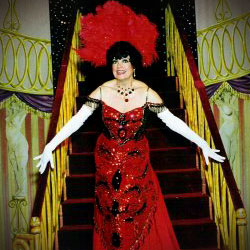
In 1964 she was given a role in “Hello, Dolly.” A year later she developed her own comedy and singing act in Greenwich Village where she was discovered there by Merv Griffin.

📷palmspringslife.com Laugh-In

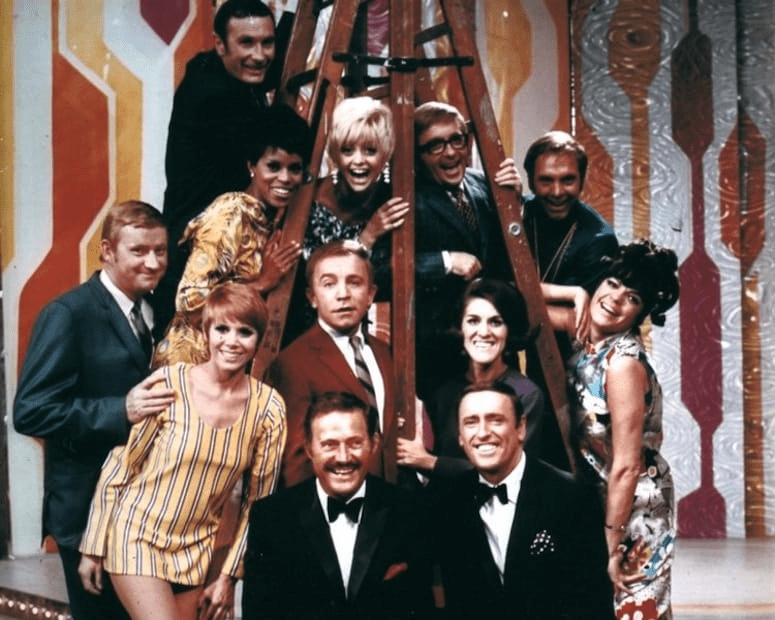
Griffin encouraged her to appear on his show which she did forty times. Like Marcia Wallace, who we learned about last week, her appearance on Merv Griffin was seen by someone who recommended her for a new show. In this case, George Schlatter cast her in Rowan & Martin’s Laugh-In.

Worley left the show in 1970. She made guest appearances on The Tonight Show Starring Johnny Carson. She also appeared on several game shows, including Super Password, Hollywood Squares, and many versions of Pyramid.

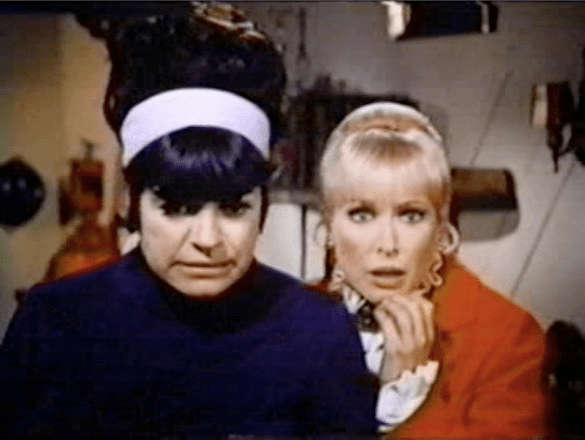
In 1971 she made the television movie I discussed above, The Feminist and the Fuzz. It starred David Hartman, Barbara Eden, Farrah Fawcett, Worley, Julie Newmar, and Henry Morgan. I would love to see it again.

For most of her career, Worley would be providing voices for animation. However, she appeared in a handful of shows during the seventies and eighties, including Adam 12, Love American Style, Hawaii Five-0, CHiPs, Murder She Wrote, The Love Boat, Mad About You, Curb Your Enthusiasm, and The Middle.

📷modcinema.com Feminist and the Fuzz

In 1975, Worley married Roger Perry. They would stay together for 25 years, divorcing in 2000. Perry has 95 acting credits and appeared in many popular shows in the seventies, eighties, and nineties. He was also in The Feminist and The Fuzz. After divorcing Worley, he would marry actress Joyce Bulifant.

During the seventies and eighties, Worley did a lot of regional theater in Milwaukee and several cities in California.

In the 1990s she got involved with Disney and provided her voice for Beauty and the Beast and A Goofy Movie. She also was on several Disney series including Kim Possible and the Wizards of Waverly Place.

📷bestlife.com

She was in a limited run of a musical production of “The Wizard of Oz,” playing the wicked witch of the west in 1999. In 2007, she appeared on Broadway as Mrs. Tottendale in “The Drowsy Chaperone,” and she reprised the role in 2015 at The Cape Playhouse. She was also cast in “Wicked” as Madame Morrible in 2008.

Jo Anne Worley once said, “my goal in life is to be the kind of person my dog thinks I am.” That seems to be good advice for all of us. It was fun getting to know a little more about this funny woman. We love her as much as her dog did.

Marcia Wallace: What a Character

📷matchgamewikifandom.com

When trying to decide who to include in our Supportive Women blog series this month, Marcia Wallace was a no-brainer. Carol was one of my favorite characters on television on The Bob Newhart Show, and I love the fact that her role carried over into an episode of Murphy Brown.

Marcia Wallace was born in 1942 in Iowa. Her father owned a general store where she and her siblings often worked. After performing in a school play, one of her teachers encouraged her to pursue an acting career. After graduation, Marcia enrolled in Parsons College in Fairfield, Iowa where she received a full scholarship. She majored in English and Theater.

Upon her college graduation, Marcia decided to move to New York. The country gal had $148 in her savings. When she arrived in the Big Apple, she took on a variety of part-time jobs including typing scripts and substitute teaching. She joined a summer stock company and did a few commercials. She worked in a Greenwich Village nightclub for a year before creating an improv group, The Fourth Wall, with several friends. While she kept the friends, she lost 100 pounds.

Eventually, Wallace was offered a job with The Merv Griffin Show. When Merv decided to move to LA, he asked Wallace to move with them. She was able to obtain a few roles in series after moving to California. During the sixties and early seventies, she was on Bewitched, The Brady Bunch, Columbo, and Love American Style.

📷tvinsider.com

After Bill Paley had seen her on Merv Griffin, Grant Tinker (producer) called her to offer her a role on a new sitcom, The Bob Newhart Show. The role of Carol was written specifically for her.

Marcia loved her time on the sitcom. She said Bob was the Fred Astaire of comedy, making it look so easy. She also praised Bob for being a treasure. Because of the way the scripts were written, the show doesn’t date itself. It was about human relationships and people struggling to make them work and make life better.

When The Bob Newhart Show went off the air six years later, Marcia jumped on the game show circuit. Shecould be seen on Password Plus; Super Password; Hollywood Squares; Crosswits; Hot Potato; The $25,000 Pyramid; Win, Lose, or Draw; Tattletales; To Tell the Truth; Family Feud; Card Sharks; and my favorite, Match Game.

📷youtube.com

Like so many actresses and actors who perform their role so well, Marcia was typecast after the show ended. In an interview, she said that “I have heard ‘You’re too recognizable for this part.’ I remember once, I desperately wanted to be on the series Nine to Five and they just weren’t going to see me because of that. Every once in a while, something would break my heart.”

Wallace also made appearances on The Love Boat and Fantasy Island in the seventies. During the eighties she would show up on CHiPs, Magnum PI, Taxi, Murder She Wrote, Night Court, and ALF, among other shows.

One of my favorite appearances of Wallace’s occurred in the mid-nineties on Murphy Brown. If you were a fan of that show, you know Murphy could not keep a secretary. There was even a support group that started of her former secretaries. However, when Carol Kester came to work for her, she was overjoyed. Carol was the role Wallace played on The Bob Newhart Show. Unfortunately for Murphy, at one point during the show, Bob Newhart shows up and convinces Carol to return to work for him and Jerry and Murphy lost her perfect assistant.

Most of Wallace’s work after 2000 was for voice work with one exception. In 2009, she had a recurring role on The Young and the Restless as Annie Wilkes for 14 episodes.

In 1985 Marcia was diagnosed with breast cancer. She survived it and became an activist and lecturer on the topic. In 2007, she won the Gilda Radner Courage Award for her work in this area.

In 1986 Marcia married Dennis Hawley in a Buddhist ceremony. Dennis renovated and managed hotels. The couple adopted a little boy, but Dennis passed away three years later.

📷imdb.com

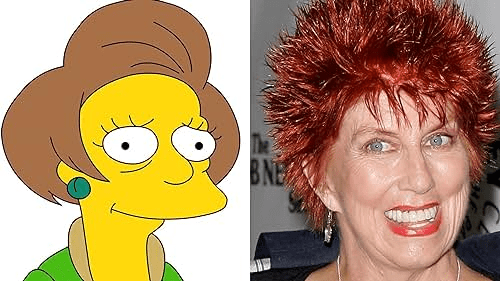
In 1989, a new type of show debuted called The Simpsons. Marcia was asked to provide the voice of Edna Krabappel, school teacher. She probably did not realize she would be associated with that role for another 24 years. Her role as Edna did not end until her passing.

In addition to her television work, Wallace performed on stage. She produced and starred in “An Almost Perfect Person,” a female version of “The Odd Couple,” “Same Time, Next Year” and many others.

In 2004, Wallace published an autobiography, Don’t Look Back, We’re Not Going That Way. She honestly discussed her breast cancer, the loss of her husband, her nervous breakdown, being a single mother, and the ups and downs of her career.

Marcia died from pneumonia and sepsis in 2013. Her coworkers commented on her passing. Yeardley Smith, who voices Lisa on The Simpsons, said “Heaven is now a much funnier place because of you, Marcia.” Bob Newhart said that “Marcia’s death came as quite a shock, she left us too early. She was a talented actress and dear friend.”

📷onceuponascreen.com

I’m so sad that Marcia was typecast and unable to get the roles that she wanted. The networks were very shortsighted during those decades. They didn’t give television fans enough credit for being resilient enough to love the character of Carol while being able to love another character played by Wallace. You saw the same things happen to Adam West, Alan Alda, and Henry Winkler. If that perspective had continued, we never would have had Mary Richards on The Mary Tyler Moore Show or Jay Pritchett from Modern Family. If someone could be a hit as Al Bundy and then go on to star in another show, anyone can get beyond being stereotyped. Marcia Wallace proved that anyone could survive life’s disappointments with determination and a sense of humor, and perhaps that was her greatest role for us.

Barbara Feldon Did Not Have to Get Smart: She Was Born That Way

This month’s blog is taking a look at some Supportive Women. First up is Barbara Feldon, costar with Don Adams in Get Smart.

Photo: getsmartwikifandom.com

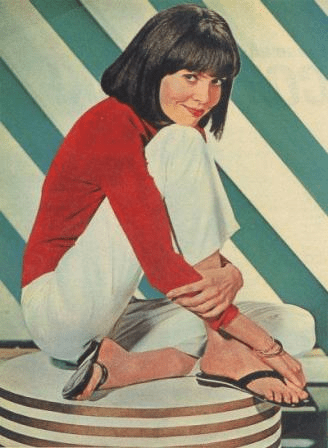
Feldon was born Barbara Anne Hall in 1933 in Pennsylvania, near Pittsburgh. During an interview with Emerson College, Barbara talked about the ecstasy of performing in a little band in first grade. When things stopped, she got to play her triangle, and the thought that everyone was watching her, and her mother’s pride in seeing her made her want to perform more. In sixth grade she went into the gym to watch her friend doing her ballet lessons. The teacher invited Barbara to join them and played Tchaikovsky’s Nutcracker music; that combination of music and movement took her away to another place. She was hooked at that point, and she knew that she wanted to dance.

She trained at the Pittsburgh Playhouse and then graduated from Carnegie Mellon University with a BA in drama in 1955. They didn’t have a dance program, and her mother thought Bennington, where she wanted to go for dance, was too expensive and too liberal. While she enjoyed acting, it never had the enchantment for her that dance did.

Feldon made her way to New York and studied at the HB Studio. She briefly had a career as a showgirl at the Copacabana. She said “that was my first professional job in New York and it was probably the highlight of my whole career. We got to dance with Jimmy Durante. Oh, my God, it was a thrill.” They replaced the girls every three months so, then she went on to appear in The Ziegfield Follies. She landed one job that never made it to Broadway. A friend of hers who was a model talked her into exploring a modeling career.

Photo: punkglobe.com

She worked as a model and was in a Revlon commercial about a hair pomade for men, Top Brass. Feldon said commercials were excellent training to get experience in acting. You do the same scene over and over, maybe more than forty times, but you have to keep that spontaneity. “You must remember to stress each word properly and come in on a split-second when that camera rolls.”

Like several actresses that we have discussed in this blog, before Feldon got her first big break, she appeared on a game show. In this instance, she was on The $64,000 Question in 1955, and she won the grand prize of $64,000 in the category of Shakespeare.

She didn’t use her winnings to buy a mansion or live the typical party life. She opened an art gallery with a man who was a photographer and ad man who was no longer interested in advertising named Lucien Verdoux Feldon. Barbara would be the subject of a Warhol pop art painting in 1965.

In 1958 Barbara married Lucien Feldon. They divorced nine years later. She had a longer relationship with one of the Get Smart producers, Burt Nodella and when that ended, she moved back to New York City.

After her commercial debut, she received offers for several television roles in the early sixties including The Man From U.N.C.L.E. and Flipper. She was also offered a chance to appear on East Side/West Side with George C. Scott. Colleen Dewhurst was her mentor and Scott’s wife. He asked her to play his girlfriend in the next episode. Talent Associates which produced the show was working with Mel Brooks and Buck Henry on a potential spy spoof called Get Smart. Her second television role was as a spy. So, when Talent Associates was casting for a spy on Get Smart, she was an obvious choice.

Photo: facebook.com

She turned down the role at first because she didn’t want to move from New York to California, but she did love the script. They agreed to offer her a two-year contract instead of a five-year contract, and she accepted. Her first review was in TV Guide which compared her to the dog and concluded that the dog came off better. She was devastated and humiliated. In later years, the reviewer rated her performance much better.

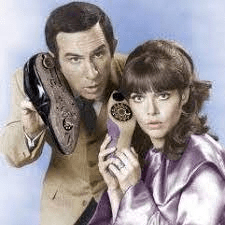
From 1965 till 1970, Feldon was known as Agent 99 working with Maxwell Smart for CONTROL. In both 1968 and 1969, she was nominated for an Emmy for Outstanding Lead Actress in a Comedy Series. Lucille Ball won for The Lucy Show in 1968 and Hope Lange won for The Ghost and Mrs. Muir in 1969.

Women at the time looked at Feldon as an example of a powerful woman; Feldon commented that young women said “she was a role model for them because she was smart and always got the right answer.” If you look closely in the early seasons, you will typically see Feldon sitting and Adams standing because she was taller than he was. Once she even had to bury her feet in the sand. While Adams was the blundering, awkward Smart, it was Agent 99 who was really the “smart” one, getting him out of trouble during their spy missions.

Feldon said that she is not a comedienne; she is an actress who can play comedy. She said that she is the worst person to tell a joke to because she doesn’t always get it. She never enjoyed drama much because the actual acting on camera was wonderful but the long, boring hours waiting were very tedious, and if you have a tearful scene, you have to be able to keep the momentum.

During the run of Get Smart, Feldon also appeared on Rowan & Martin’s Laugh In and The Dean Martin Show.

Photo: imdb.com

After the show ended, she would appear on 20 additional television series including Cheers and Mad About You. She made fifteen made-for-tv movies, one of which was a 1989 movie, Get Smart, Again. She also could be found in six big-screen films including The Last Request, her last acting role, in 2006.

During my research, I read an article where pop culture historian Geoffre Mark commented on one of her movies, Fitzwilly, which I admit I have never seen. He said that it was a gem of a movie and that “Dick Van Dyke is brilliant in it and Barbara plays his love interest and she’s brilliant in it. She was playing a version of herself: a beautiful, sensual, highly intelligent woman with a strong moral compass and a loving heart. That’s what the character is and that’s who Barbara is.” According to imdb.com, the plot of the 1967 movie is that a butler and the staff of an eccentric aged philanthropist whose family wealth is exhausted engage in larceny and crimes to maintain her lifestyle and provide funds for her charitable activities.

Feldon was offered a cameo in the Get Smart movie with Anne Hathaway and Steve Carrell in 2008, but she declined. She said that “times have changed too much. The psychology of the writers and the audience has changed radically. Get Smart belongs in the 1960s, or it’s not going to be Get Smart.”

Despite her comment of Get Smart staying in the sixties, in 1995 Feldon took on the role of Agent 99 again in a brief reboot of Get Smart. Feldon discussed that series with The (Westchester County NY) Journal News reporter Karen Croke in 2017. She said that she and Adams never became friends after the original Get Smart. She said he was a lovely man and very funny, but they had their jobs to do and did their acting and then parted ways for the day. After they worked together on this series, they became very close friends in a way they could not have in their original show. She said once Don Adams died, Max also died and she can’t do any work as 99 without Max now. That might be the real reason she turned down the cameo in the Carrell-Hathaway film.

Photo: imdb.com

Barbara said it’s hard to make friendships on a set because it’s more like a factory and when you’re not acting, you might be resting or talking to your agent. The only person she said she was able to maintain a good relationship with after acting with him, was Alan Alda.

Apparently, she still enjoyed games shows and she appeared regularly in several of them including Hollywood Squares and The $20,000 Pyramid.

Feldon lost interest in acting, but she did numerous television and radio commercials and documentaries. In 1977, Barbara hosted a news show called Special Edition. In the 1990s she had a one-woman show she took around the country. She has also taken up writing and had two of her pieces published in Metropolitan Magazine. She wrote a book about living as a single person in 2003 called Living Alone and Loving It. She also enjoys writing poetry. In talking about her book, Barbara said, “I had been in relationships my whole life. I’d been married, then had lived with someone for several years. After those, I just assumed I would find another relationship. But it didn’t happen. As time went on with some good guidance, I learned how to live alone really happily. I’ve met a number of people—men and women—who feel living by themselves is a second-rate life. I thought that was sad, and since I had this technique of living alone, I decided to write a book. And I’m really glad I did.”

Photo: pixels.com

Feldon said that she has nothing but gratitude for Get Smart. She said acting is not a kind career and you only have a few years to be able to find your place, and she is grateful for being in the right place at the right time. I think after learning about Barbara Feldon, she manages to put herself in the right place at the right time often.

Now, her life sounds almost perfect. She lives where she wants to, is open to meeting a lot of people, attends concerts, advocates for the arts, and travels and writes whenever she wants to. During her life, she has managed to learn from so many experiences and during her life journey she definitely “got smart.”

Celebrating Nevada Day with Abby Dalton

This month is all about National Days for States. Today we are celebrating National Nevada Day which is March 29, 2021. Our star who was born in Nevada is Abby Dalton. Abby was born Gladys Marlene Wasden in 1932 in Las Vegas.

Photo: wikipedia.com

Dalton began working as a teen model and also appeared on several record album covers. In 1957 she was cast in several unmemorable and hard-to-watch movies including Rock All Night, Teenage Doll, Carnival Rock, and The Saga of the Viking Women and Their Voyage to the Waters of the Great Sea Serpent.

Photo: ebay.com

Abby started her television acting career by being cast in a variety of westerns, including Have Gun Will Travel, Rawhide, Maverick and The Rifleman.

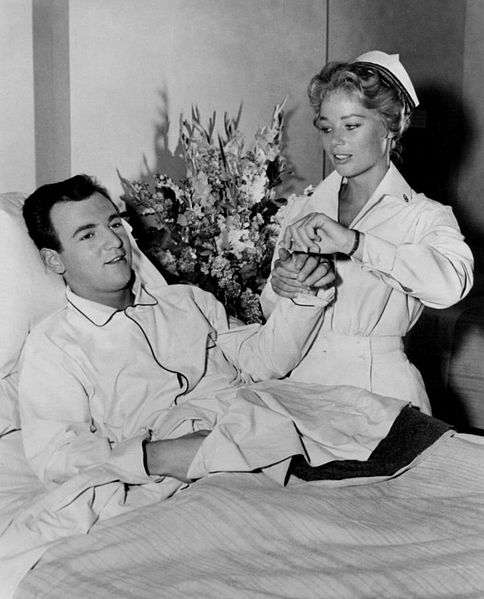
Dalton caring for Bobby Darin–Photo: wikimedia.com

In 1959, Abby received the role of Nurse Martha Hale on Hennesey. Jackie Cooper played US Navy physician Lt. Charles “Chick” Hennesey. The two medical professionals meet at a hospital where they work for the US Naval Stations in San Diego, CA. Both Dalton and Cooper received Emmy nominations for their roles on the series. The show continued on the air for three seasons before it was cancelled.

When the show ended, The Joey Bishop Show was beginning its second season. The series was going through an overhaul and season two debuted with Dalton married to Joey Bishop as Ellie Barnes.

Joey Bishop with Dalton–Photo: wikimedia.com

Dalton was married in real life to Jack Smith in 1960. When her character has a baby, her son on the show was played by her real-life son Matthew and her daughter Kathleen also appeared on the show. Unfortunately, her marriage ended in 1972. (Her first marriage to husband Joe Moudragon also ended in divorce in 1959.)

Ironically, the finale to Hennesey when she married Chick Hennesey was shown two days after The Joey Bishop Show’s show’s first airing of her character.

Dalton was cast in the pilot for Barney Miller as his wife, but the show was not picked up by any of the networks and later the role was given to Barbara Barrie.

This image has an empty alt attribute; its file name is listal-with-bob-crane.jpg
Dalton and Bob Crane–Photo: ABC – Love American Style

Abby was also a favorite in Love American Style and The Love Boat. She did make some appearances on several shows during the seventies on Nanny and the Professor, Police Story, Apple’s Way and The Waltons.

In later years, Dalton was known as a game show panelist, appearing on Match Game, Super Password, and Hollywood Squares. In the eighties, you could see her on Hardcastle and McCormick, Murder She Wrote, and Hotel.

This image has an empty alt attribute; its file name is etour-1.jpg
John Astin and George Furth with Dalton–Photo: ABC – Love American Style

During the 1980s Dalton accepted another permanent role as Julia Cumson on Falcon Crest. She is the daughter of Angela Channing (Jane Wyman) and a vintner. While she appeared as a decent woman, the season two finale clues us in that she was a murderess. Season three finds her navigating life in both a psychiatric ward and a prison. She escapes, planning on killing her mother. We believe her to have been killed at the end of the year, but in the fourth season, true to the soap opera formula, we realize she is alive, although maybe not well. She would make occasional appearances on seasons five and six but is not seen after that year.

Her daughter Kathleen Kinmont was married to her “son” on Falcon Crest, Lorenzo Lamas. Kinmont was also married to actor Jere Burns after her divorce to Lamas but that marriage also ended in divorce.

Dalton died in 2020 after suffering from a long illness.

Abby Dalton, 1982. (Photo by Getty Images)

Although Dalton’s career has to be labeled successful, I think with a break here or there, it could have been much more fulfilling. She seemed to be a good actress and could be very funny. Perhaps a sitcom rather than a tv drama might have catapulted her into a second wave of television acting roles. Despite, the fact that you feel like she never got that big break she deserved, she had permanent roles in three television series and entertained many people during her game show circuit era. Considering how many people never get a chance to star in a television show, she had a long career; thanks Abby Dalton for bringing us three decades of entertainment.

Jeepers, Creepers, It’s Mister Peepers

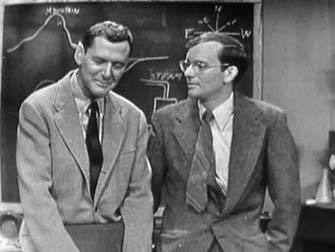
Mister Peepers was one of the first popular sitcoms.  It aired from July of 1952 until June of 1955. The show starred Wally Cox as Robinson J. Peepers. Peepers was a junior high school science teacher. A great cast surrounded him including history teacher Harvey Weskit (Tony Randall), Harvey’s wife Marge (Georgann Johnson), county nurse Nancy Remington (Patricia Benoit), English teacher Mrs. Gurney (Marion Lorne), and athletic coach Frank Whip (Jack Warden). (In the pilot, the coach was played by Walter Matthau.) Peepers developed a relationship with nurse Nancy, and her parents (Ernest Truex and Sylvia Field) also became part of the cast.

Photo: blogspot.com

The show featured some slapstick as well but it was not the primary form of humor. In one episode, the uncoordinated Mr. Peepers was playing basketball in the gym alone and somehow got stuck in the basket. In order to fulfill the evening obligations that he promised, he brings Mrs. Gurney’s flower club into the gym so he can lecture to them about potting soil while playing chess with a rival school’s champion as promised to Mr. Gurney.

Photo: wikiwant.com

Mr. Peepers is kind. In one episode, after injuring his finger, absent-minded Mrs. Gurney tries to help by bandaging it.  In addition to using half a roll of tape, Robinson informs Nancy that she bandaged the wrong finger.

Mister Peepers is a likable guy. He has some eccentric characteristics which make us like him even more. For example, he has an elaborate ritual to get his locker to open; on bring your pet to school day, he has to hide a cow; and sometimes he does things we all want to. On one episode, he comes upon a hopscotch board on the sidewalk and just like we would want to do, he plays it not realizing his girlfriend is watching him. However, Robinson has a bit of rebellion and sarcasm that keeps him from being too much of a goody-two-shoes.

Photo: tumblr.com

Tony Randall’s character Harvey was supposed to be a small role, but the producers liked him so much he became a regular. He is best friends with Robinson but they couldn’t be more different. Harvey is a lady’s man. However, Mr. Peepers only has eyes for Nancy even though it takes her a while to realize he is interested in her. The couple ties the not in 1954, producing a huge ratings boost.

In real life, Cox was experiencing the same situation when he married Marilyn Gennaro about the same time. When Benoit became pregnant in real life, she was also pregnant on the show.

When the Peepers found out they were having a baby, American Character Dolls Co wanted to make a “Peepers Baby Doll” in 1955. Polling indicated that viewers were hoping for a girl, so it went into production. Mister Peepers was cancelled before the doll debuted, but the company sold it anyway, although they did change the name.

Photo: blogspot.com

The show was aired live with an audience of 2500 at the New Century Theatre in New York. Preserved on 16mm kinescopes, there are currently 102 of the original 127 episodes in existence.  The kinescopes are being preserved by the UCLA Film and Television Archive and a DVD set has been produced.

The Ford Motor Company needed a summer replacement on Thursday nights so Mister Peepers debuted then. NBC decided it was too much pressure to do a live show, so it was cancelled. Fans were irate. After 2000 people called to complain and 15000 letters were received, the network had second thoughts, but their schedule was full.

MR. PEEPERS — Aired 09/15/1953 — Pictured: (l-r) Wally Cox as Robinson Peepers, Tony Randall as Harvey Weskitt (Photo by NBCU Photo Bank/NBCUniversal via Getty Images via Getty Images)

However, that fall, an opening occurred when Doc Corkle was cancelled after only three episodes. How bad does a show have to be to get axed after three episodes in 1952? I don’t know, but the summary of the show is that “Doc is a dentist plagued with money problems, teenage daughter problems, and a screwball stepsister Melinda.”

It says a lot about the quality of Mister Peepers that it was rated so highly and watched by so many fans because it was up against Private Secretary with Ann Sothern and The Jack Benny Show on Sunday nights. Tough competition.

See the source image
Photo: sitcomsonline.com

Critics liked the show and it was nominated for best situation comedy for the Emmys in 1953, 1954, and 1955. Wally Cox, Tony Randall, and Marion Lorne were all nominated as well. Each of the years the show was nominated it went up against Our Miss Brooks, Burns and Allen, and I Love Lucy which won in 1953 and 1954; Make Room for Daddy won in 1955. NBC made Wally Cox postcards which they handed out to tourists on the lot.

Wally Cox was an interesting guy. He was a brilliant man who studied acting with Stella Adler. His roommate was Marlon Brando whom he had been best friends with since grade school. His mother and grandmother were writers, and his dad was in advertising. Before he was able to earn a living in acting, he taught the lindy hop for $1.50 a lesson and made cuff links and tie clasps. While doing part-time jobs, he began doing standup at clubs like The Blue Angel and Village Vanguard.

Unfortunately, a lot of people will remember him only for his appearances on Hollywood Squares and as the voice of Underdog the cartoon hero. He was also famous for a Jockey Shorts commercial when he quipped, “Outside I might look like Wally Cox but inside I feel like Tyrone Power.” He passed away much too early, dying from a heart attack at 48.

Photo: latimes.com

Although Wally Cox was not Mister Peepers, their humor was similar. Cox wasn’t brash but he experienced life with a quiet subtle manner and was a genuinely funny guy. In discussing his time on the show, Cox said, “Mr. Peepers put me on the map and I love him.” I’m sure like many actors who were stereotyped early in their career, it was a bit of a love/hate relationship.  I’m sure you will love him too if you are able to watch some of the episodes.  Retro TV aired them in the past, but I don’t see the show on its current schedule. I also found the DVDs on amazon.com. Happy viewing!

Mr. Johnson Teaches Us About the “Art” of Television Acting

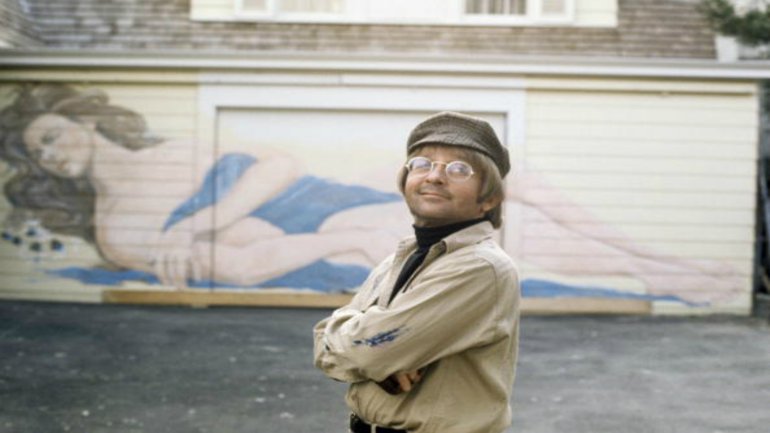
As we continue honoring revered television actors who passed away in 2019, Arte Johnson certainly is at the top of the list. Although he accepted roles in movies, most of his work was on the small screen.

Photo: blogspot.com

Arte was born in Benton Harbor, Michigan in 1929. Acting was not Arte’s first profession. He graduated with a radio journalism major from Illinois and decided to pursue a career in the advertising world. He left Chicago when he could find no ad agency jobs and moved to New York where he began at Viking Press. He loved books and collected them throughout his life.

Unlike the stories of people who hone their craft in hundreds of auditions in the Big Apple, Arte impulsively stepped into an audition line for Gentlemen Prefer Blondes and got the part. His real name was Arthur and he decided on Art E. Johnson for his stage name, but “Arte” was mistakenly printed on the playbill, and he decided he liked that better.

Although acting began easily for him, after he moved to LA, his career hit a rough spot and he did take a job as a men’s clothing salesman for a while at Carroll & Co. in Beverly Hills.

Photo: cvta.biz
It’s Always Jan

Arte began on television in the 1950s. In the mid-50s, he had a recurring role on It’s Always Jan starring Janis Paige and Merry Anders. A widowed nightclub singer, Janis Stewart, shares a small apartment with an aspiring actress, a secretary, and her daughter. Arte plays a deli employee, showing up in 4 of the 26 episodes.

He was cast as in his first ongoing role later that year. He played Bascomb Bleacher, Jr. on Sally. His father, a department store owner, was played by Gale Gordon. This show about a girl who worked in a department store who became a wealthy matron’s companion also lasted 26 episodes.

Photo: sharetv.com
Cousin Edgar on Bewitched

During the 1960s, Arte would appear in 32 different series, including The Twilight Zone, The Andy Griffith Show, McHale’s Navy, Bewitched, Lost in Space, The Donna Reed Show, and I Dream of Jeannie. Once again, he was cast as a regular on a show, Don’t Call Me Charlie. If you’re not familiar with the show, you are not alone. The show starred Josh Peine as a rural veterinarian who is drafted into the Army. He leaves Iowa and heads for Paris. Like Gomer Pyle he retains his simple view of life and his “Sargent Carter” is Colonel Barker. Johnson played the part of Col. Lefkowitz.

Photo: inquisitor.com
The Cast of Laugh In

In 1968, Arte was offered a job that would change his life. Along with a handful of other cast members, he appeared on the new edgy Laugh-In. This is a hard show to describe if you never watched it. (It does appear on the Decades channel quite often.) The show was comprised of fast-moving comedy bits featuring guest stars, skits, regulars performing specific characters, gags, and punchlines in rapid format. It was quite different from anything else that had ever appeared in television. Arte was on the show from 1967-1971.

Photo: pinterest.com
“Wolfgang”

He was a master of accents and is best known for the characters he created on this show. “Wolfgang” was a cigarette-smoking German soldier hiding out who refused to believe WWII had ended. One of Arte’s taglines was “Verrrrry Interrrrresting.” He would also be seen in a yellow raincoat riding a tricycle that he would fall off from.

Photo: blogspot.com
Tyrone and Gladys

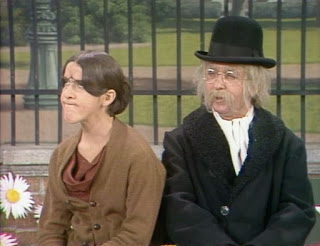
Another favorite was “Tyrone” who was an old man wearing a trench coat, always trying to seduce Ruth Buzzy’s “Gladys” on a park bench. She would hit him with her purse, and he often fell off the bench. Oddly, in a far-reaching concept, years later these two characters formed the nexus of a Saturday morning cartoon show, Baggy Pants and the Nitwits.

Photo: fox8.com
On The Partridge Family

During the 1970s, Johnson continued his television appearances with 17 different series, including two roles on The Partridge Family and several on Love American Style. He also could be seen on Match Game and Hollywood Squares.

Photo: sitcomsonline.com

His prolific career continued through the 1980s where he was seen on 25 different shows, including Murder She Wrote and The Love Boat. At the end of the ’80s, he began voicing characters for animation shows, but in the 1990s he accepted roles on 14 shows, including Night Court.

At the end of his career, his love of books provided him an opportunity to begin recording the narration for more than 80 audiobooks, including Dave Barry Is Not Making This Up in 2005.

Photo: vulture.com

Married to his wife Gisela since 1968, he survived a battle with non-Hodgkin lymphoma in 1997. In 2006 he retired from acting. He passed away mid-year in 2019 after suffering from bladder and prostate cancer. Ruth Buzzy, his comrade on Laugh-In, shared this message upon his death: “Thank you for a wonderful half-century of friendship. I could not have shared the spotlight with a nicer guy. Rest in peace. And yes, Arte Johnson, I believe in the hereafter.”

I like to think Arte is working on some skits, waiting for Ruth Buzzy, and some day when we get to heaven, we’ll be able to watch Gladys and Tyrone team up for us again.

ALF: Amusing, Ludicrous, and Funny

April does begin with April Fool’s Day, so this month we take a look at a few shows I call oddly wonderful. Some of them may be odd, some wonderful and some oddly wonderful. You get to decide. These are shows that were very different but popular hits.

In 1963, My Favorite Martian came to earth to live with a news reporter, Tim O’Hara. In 1978, Mork landed on earth from Ork and lived with Mindy. In 1986, ALF, aka Gordon Shumway, crashed into the Tanners’ garage and moved in with the family. In all three series, the extraterrestrial tries to adapt to earthly ways and causes a lot of complications for the people he lives with.

Photo: slate.com

ALF aired in September of 1986 on NBC. Producer Bernie Brillstein was asked to catch Paul Fusco’s show with his puppet character. Brillstein had managed Jim Henson, so he knew something about this type of comedy. He thought ALF was hilarious and could be the center of a new sitcom. The company was Alien Productions; Fusco became a co-producer and Tom Patchett helped create the series, wrote the scripts, and directed the episodes. ALF produced 99 episodes (in syndication, it was 102 since there were three one-hour episodes during its time on the air).

ALF was one of the first sitcoms to use Dolby surround sound. The show was one of the most expensive sitcoms to produce because of the technical elements surrounding the puppet and the long tapings that developed. To try to help out with the expenses, ALF was licensed for a variety of toys, foods, and other types of merchandise. One fun fact is that every episode was the name of a song. Some of the shows were named, “Hungry Like the Wolf”, “Stayin’ Alive”, and “Gotta Be Me.”

Photo: semestertimes.com

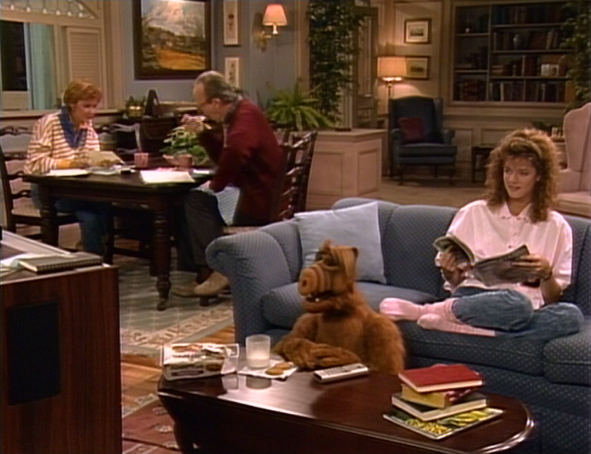
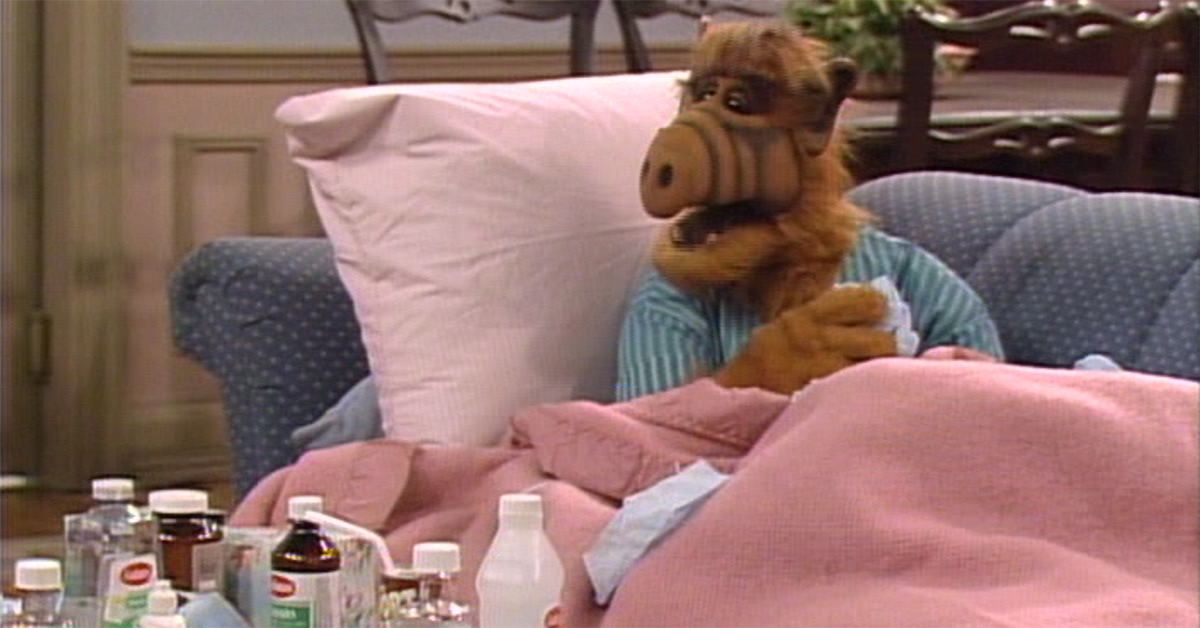
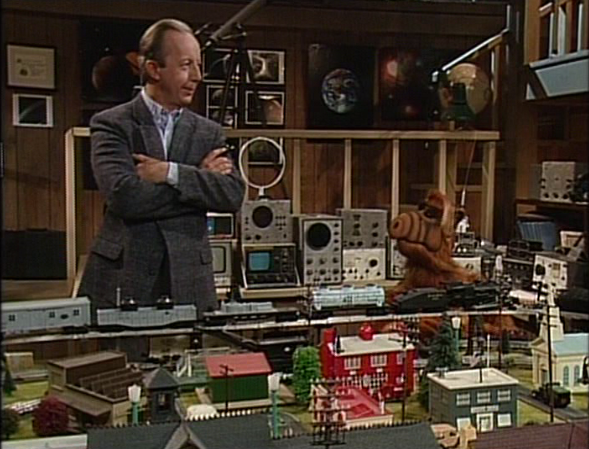
ALF (alien life form) was a sarcastic, sometimes overbearing, character from Melmac. The Tanners take him in to protect him after he crashes into their garage. Willie Tanner (Max Wright) is married to Kate (Anne Schedeen) and they had two children, Lynn (Andrea Elson) and Brian (Benji Gregory). The plan is for ALF to repair his spaceship and then leave. Later ALF learns that his planet was destroyed by nuclear war. Eventually he becomes part of the family as he develops affection for them and vice versa.

Of course, ALF causes no end of trouble for the Tanners. In one episode, Brian is building a model of the solar system as we know it. ALF reveals to him that there are two planets past Pluto which Brian includes and then gets in trouble for.

Photo: noiselesschatter.com

Like Mork, as ALF becomes closer to the family, he is exposed to several of their friends and family. He is friends with Willie’s brother Neal (Jim Bullock), gets to know a psychologist Larry (Bill Daily), has a love-hate relationship with Kate’s mom, Dorothy (Anne Meara), and builds a relationship with a blind woman, Jody (Andrea Covell), who never realizes that ALF is not human.

ALF meant well and often was trying to help someone else when he caused many of his problems.

When Anne Schedeen became pregnant in real life, a baby was written into the show named Eric. ALF temporarily lives in the laundry room but eventually he and Willie convert the attic into a small apartment.

Photo: popdust.com

ALF often talks about eating cats. On Melmac, cats are raised for food. However, he bonds with the Tanners’ cat Lucky and, when Lucky dies, he becomes very sad. He has one heart that is located in his right ear, and he has eight stomachs. ALF claims he came from a large family, his best friend growing up was Malhar Naik, his girlfriend was Rhonda, he attended high school for 122 years, and was captain of his bouillabaisseball team. The sport was played on ice but used fish parts as bats and balls, requiring nose plugs on warm days. Melmac apparently had blue grass, a green sky, and a purple sun.

Photo: metv.com

Despite the funny scripts and fond remembrances viewers had, it was a difficult show to work on. The human actors had trouble playing second fiddle to a puppet, and there were a lot of complications trying to film with ALF. The set was on high tension alert all the time. When the final scene was filmed, Max Wright, who had the hardest time adjusting to working with ALF, walked off the set and left without saying good-bye to anyone. Schedeen said “There was no joy on that set . . . it was a technical nightmare—extremely slow, hot and tedious.” A thirty-minute show could take 20-25 hours to shoot. Schedeen said she was fond of her screen children, but some adults on the show had difficult personalities. Later in life, Wright said he found out the show brought a lot of enjoyment to people and felt better about his time portraying Willie.

One of the issues was that the set was built on a four-foot platform with trap doors all over so ALF could appear anywhere. He was operated from underneath the set and the doors and holes could be treacherous. To avoid wear and tear on the real puppet, a stand-in was used to rehearse named RALF (rehearsal alien life form).

Photo: noiselesschatter.com

Luckily, none of all the problems behind the scenes leaked out to the public. The show was popular in season one. In season two, it reached number five. It continued to hold its own in season three, with tenth place. However, season four saw a sharp decline and the show came in at 39th. In March of 1990, NBC moved the show from Monday to Saturday, but the ratings continued to decline.

The show had one of the most interesting endings in sitcom history. The production team hoped by having a cliffhanger at the end of season four, they could convince the network to bring it back for a fifth season, but it did not work that way. The Tanners take ALF to a field where an aircraft is going to reclaim him. Suddenly he’s circled by a group of military automatons. No one knew if he would be taken to Area 51 or escape. Viewers were left wondering what happened to ALF. NBC executive Brandon Tartikoff later admitted to Fusco they had cancelled the show prematurely.

Photo: horrorgeeklife.com

Six years later, ABC aired a movie, Project: ALF. None of the original cast was in the film. The movie was not well received.

Photo: hobbydb.com

However, the movie was not the end of ALF. The character has had more lives than all the cats he ever ate combined. Marvel Comics developed a series of books in 1987 which ran for four years with 50 issues. An animated cartoon that aired Saturday mornings which was a prequel to the show also ran for a couple of years.

One of the most unexpected outcomes of the show and, in my opinion, one of the funniest, was ALF’s talk show which aired on TV Land. ALF was a talk show host with none other than Ed McMahon as his sidekick. It was on for only seven episodes but featured guests like Drew Carey and Merv Griffin.

Photo: nathanrabin.com

Believe it or not, it didn’t end there. In 1987 while the show was still on the air, ALF appeared on an episode of Matlock. He was in an episode of Blossom when he denies her entrance to heaven in a dream. He was the only extra terrestrial to appear on The Love Boat: The Next Wave. He was a regular on Hollywood Squares. In addition to a bunch of other shows, he appeared on Good Morning America in 2011, on The Simpsons several times, twice on Family Guy, once in Young Sheldon, and a stuffed animal ALF was in a Big Bang Theory show. The guys buy a box at a garage sale after following someone they think could be Adam West. One of the items in the box is the ALF doll.

Photo: bigbangtheorywiki.wikinfofoundry.com

In addition to shows, ALF appeared in a variety of commercials including telephones, Delta Airlines, Super Bowl XLV, and Radio Shack.

If all that is not enough, in August of 2018, Variety reported that there was a possible ALF reboot coming from Warner Brothers. One of the rumored ideas is that ALF would emerge from Area 51 into a world that has drastically changed, somewhat like Austin Powers, I guess.

Photo: noiselesschatter.com

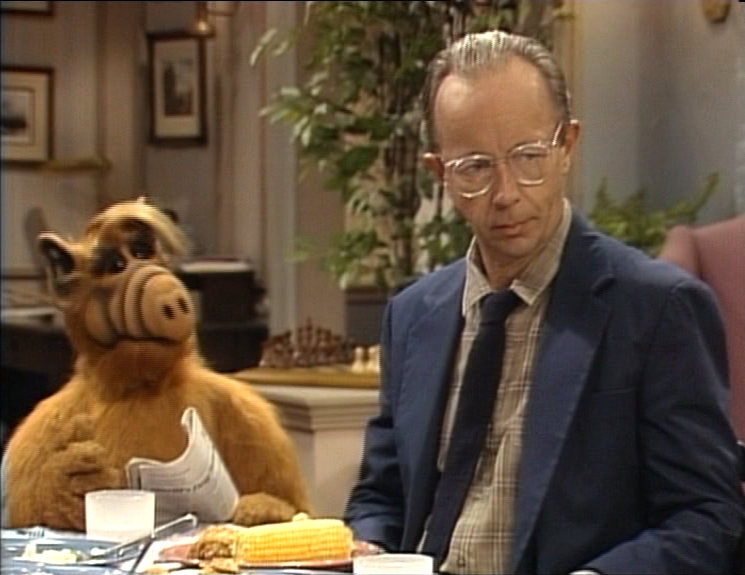
I’m not sure that it would be a good idea to bring ALF back. The original is a classic and extremely funny if you aren’t aware of all the background tension. I think we’ll let the show speak for itself. Here is a typical example of the conversations that Willie and ALF had around the breakfast table.

Willie: You can’t vote, ALF, you’re not a citizen.

ALF: I’ll apply for a green card.

Willie: That’s only if you want a job.

ALF: Pass. (After a pause) I know, I’ll marry Lynn, become a citizen, and then drop her like a hot potato.

Willie: ALF . . .

ALF: Sure, it will be hard on her at first. She’ll cry, drink a little too much, join up with a bongo player named Waquine.

Willie: ALF

ALF: You’d like Waquine, he doesn’t like beets.

Willie: Neither you nor Waquine may marry my daughter and you may not vote.

ALF: Fine, I won’t have a voice in government. Waquine will get deported, and they’ll make him eat beets.

Willie: How many cups of coffee have you had today?

ALF: Forty. Why?

July is the Perfect Time for Berry Picking

berry1

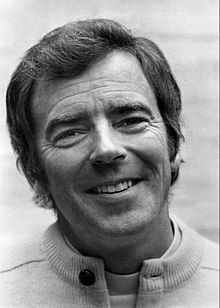
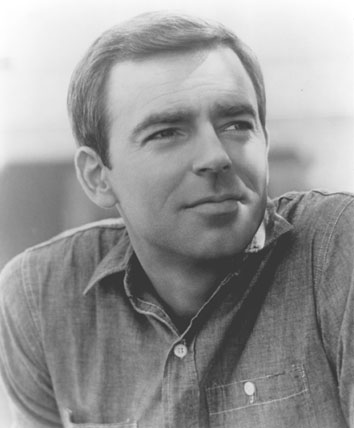
Ken Berry was born in Moline, IL in 1933. After watching a group perform when he was 13, he decided he wanted to be a dancer. He loved Fred Astaire and Gene Kelly movies, especially Easter Parade, Royal Wedding, and On the Town. At 16, he traveled with the Horace Heidt Youth Opportunity Program, performing in small towns for 15 months.
berry12

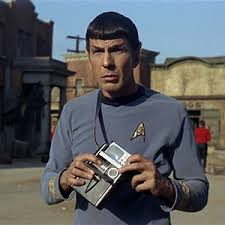
He went into the army at Fort Bragg and was in the artillery. He was then moved to an entertainment division under Leonard Nimoy. During his second year, he won the All-Army Talent competition which allowed him to appear on Ed Sullivan in 1948. Nimoy encouraged him to move to Los Angeles where he made some connections for Berry. Both 20th Century Fox and Universal offered him jobs and he accepted the Universal contract.  In 1956, he opened for Abbott and Costello for their stage act. In 1957, Berry enrolled in Falcon Studios to study acting. He worked at the Cabaret Theater, making $11 per week. The same year he won Arthur Godfrey’s Talent Show.
berry6

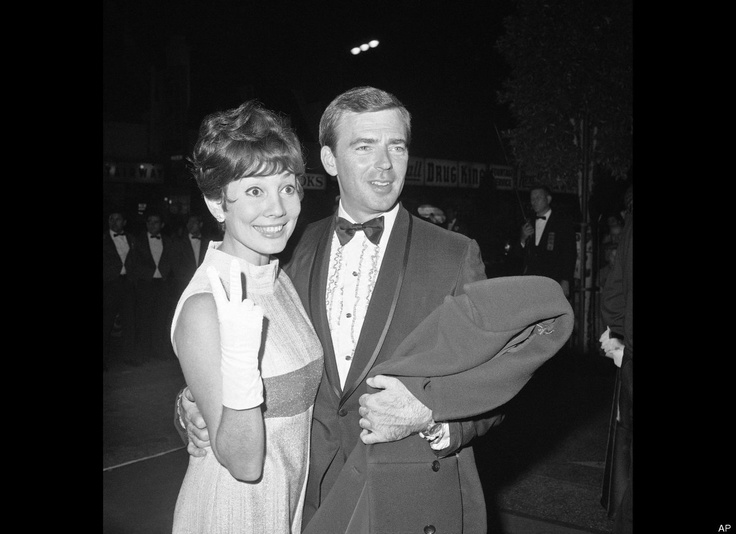
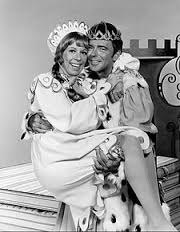
In 1958, he received an opportunity to join the Billy Barnes Revue. While in the Billy Barnes Revue, Berry met Jackie Joseph, and they married in 1960. His work in the BBR led to several lucrative connections. Lucille Ball saw him and offered him a job with Desilu Studios for $50 per week. Carol Burnett also watched a performance and had him on her variety show. (In 1972, she would offer him the co-starring role with her in Once Upon a Mattress, a television movie.)
berry7

The first Desilu show he had a regular role on was the Ann Sothern Show. On the air from 1958-1961, Ann played Katy O’Connor who worked at a New York hotel. Originally, Mr. Macauley (Ernest Truex) was her boss, but he was berated by his controlling wife (Reta Shaw). Katy’s best friend from her previous show Private Secretary, which aired from 1953-1957, was Ann Tyrrell as Vi.  In this show, her name is Olive. The format wasn’t working, so Mr. Macauley the hotel owner, was transferred to Calcutta and James Devrey (Don Porter also from Private Secretary) took over.  Ratings improved, and the show was renewed for another season. During this season, Louis Nye was introduced as a funny dentist in the hotel who dates and marries Olive, and Berry played bellboy Woody Hamilton, replacing Jack Mullaney.  Most of the episodes revolve around the staff and guests of the hotel. As in Private Secretary, there is a lingering romance between Mr. Devrey and Katy throughout the run of the show. The ratings fell drastically in 1961 after the show was moved to Thursdays, and the network cancelled it.

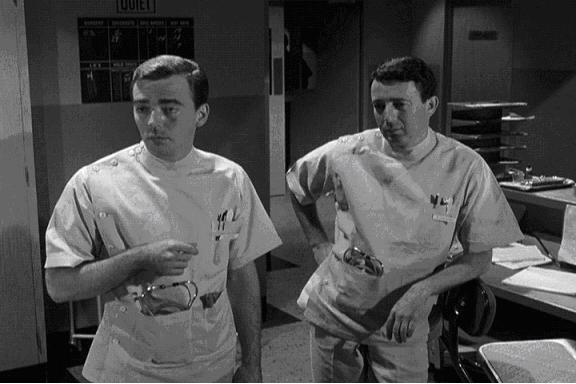
In 1961, Berry obtained a job with Dr. Kildare, appearing in 25 episodes as Dr. John Kapish. Richard Chamberlin starred in the series about a doctor working in an urban hospital under his mentor Dr. Leonard Gillespie (Raymond Massey). In the third season, Dr. Kildare was promoted to resident and the series centered on his patients. The show aired until 1966, but Berry left the show in 1964. This was one of the shows that paved the way for Marcus Welby, MD and the medical dramas today including ER and Gray’s Anatomy.
berry13

He also appeared on several shows in the early 1960s: The Jim Backus Show, Hennesey, Ensign O’Toole, The Dick Van Dyke Show, Hazel, and No Time for Sergeants, among others.
berry3

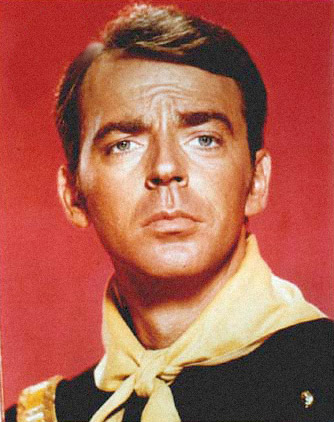
In 1965, he was offered the lead in F-Troop. The show was set during the Civil War.  Berry played Will Parmenter.  At a critical moment during the Battle of Appomattox, Will gets credit for the defeat.  He is a private and was sent to get his commanding officer’s laundry. He was sneezing continuously, but the men thought he was saying “Charge,” so they did.  They won a decisive battle, and Will was promoted for his quick decision-making skills and bravery. He was then promoted to Fort Courage.
berry5

The cast had a crazy bunch of characters. The NCOs at the fort, Sergeant O’Rourke (Forrest Tucker) and Corporal Agarn (Larry Storch) are always scheming to raise money. The Hekawis tribe, with Chief Wild Eagle (Frank de Kova) worked on shady business deals with them. Although the officers manipulate Will, they are also protective of him. Melody Patterson plays Jane Thrift, Will’s girlfriend, who is always pressuring him to propose. The show relied on a lot of puns, slapstick, and running gags.

When F-Troop was cancelled two years later, Berry headlined the cast of Mayberry RFD as widower Sam Jones because Andy Griffith was leaving the show. Since Andy and Helen had married and moved away, Aunt Bee became Sam’s housekeeper. Sam and his son were introduced in Griffith’s final season when Sam is elected to the town council. Arlene Golonka plays Millie, Sam’s love interest. The show was rated as high as 4th and only as low as 15th, so it continued to pull in good ratings, but in 1971, the show was cancelled in the general “rural house cleaning” that the network performed getting rid of any shows such as Green Acres, Beverly Hillbillies, Petticoat Junction, etc.

During the late 1960s and 1970s, he was on 14 shows including The Danny Thomas Show, The Lucy Show, Love American Style, The Brady Bunch, and The Love Boat.
berry18

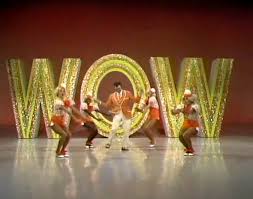
The network developed a show Ken Berry WOW, a variety show that lasted five episodes that Berry was not wowed with. In 1973, Sherwood Schwartz wrote a pilot for a Brady Bunch spinoff called Kelly’s Kids. The concept of the show was that Berry adopts three boys, one white, one African American, and one Asian. No network showed an interest in the show.

One of the most unusual jobs he had occurred in 1976.  An album called “Ken Berry RFD,” where he sang, backed by a full orchestra, was released. He and Joseph divorced that same year. Joseph later remarried and continued to have a long and full career.  She appeared on a variety of sitcoms including Designing Women, Full House, Newhart, Love American Style, Petticoat Junction, That Girl, Hogan’s Heroes, McHale’s Navy, F-Troop, and the Andy Griffith Show. She also had a productive movie career, including Gremlins, The Cheyenne Social Club, With Six You Get Eggroll, Who’s Minding the Mint, and Little Shop of Horrors.

Taking a break from television, Ken went on the road, performing in stock shows around the country.  He also played Caesar’s Palace between Andy Griffith and Jerry Van Dyke.
berry16

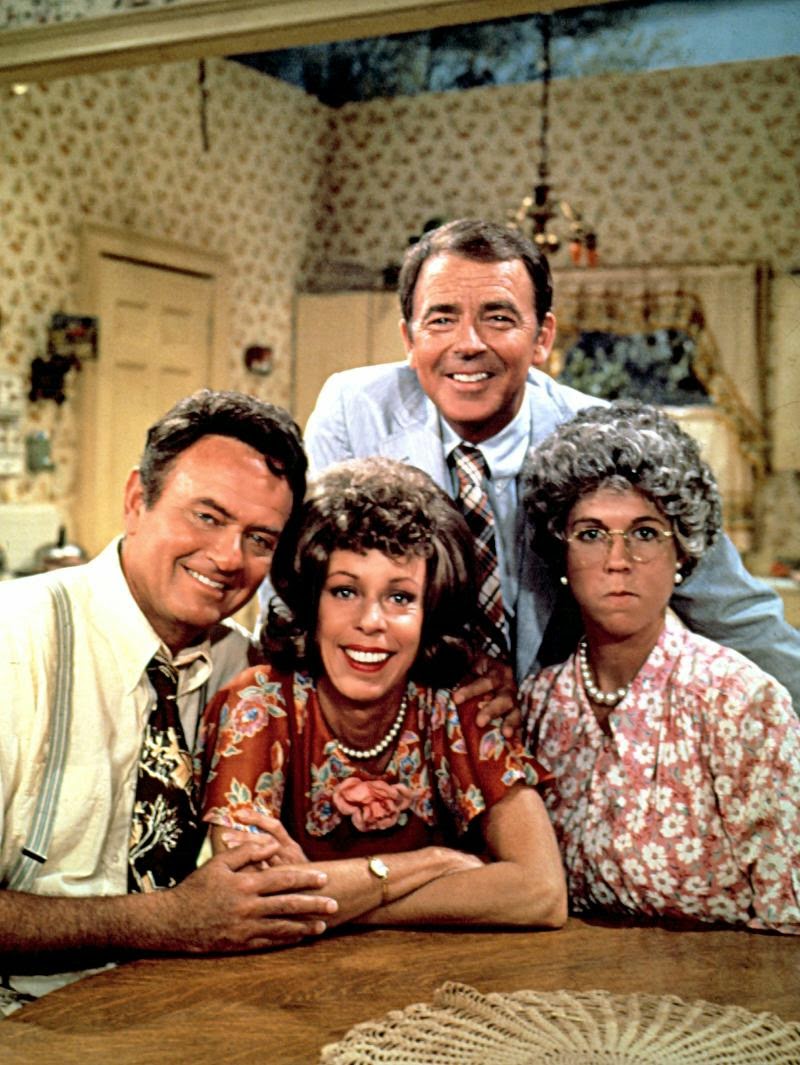
He returned to television to join the cast of Mama’s Family with Vickie Lawrence. The show derived from a skit on the Carol Burnett Show which led to a TV movie called Eunice. It featured the Harper family and their neighbors and friends. The matriarch is Thelma Harper (Lawrence) who speaks her mind freely. She is hot tempered and sarcastic, but she loves her family as she berates them. And they typically deserve a berating. They move back in with her and are happy to have her clean and cook for them as well.

For the first season and part of the second, the show was on NBC. Thelma lives with her spinster sister Fran (Rue McClanahan) who is a journalist. After Thelma’s daughter-in-law leaves her family, they move in with Thelma. Her son Vint began a relationship with Thelma’s next-door neighbor Naomi Oates (Dorothy Lyman). Her children from the Burnett sketch, Ellen (Betty White) and Eunice (Burnett), along with hubby Ed (Harvey Korman) are seen during this time.
berry17

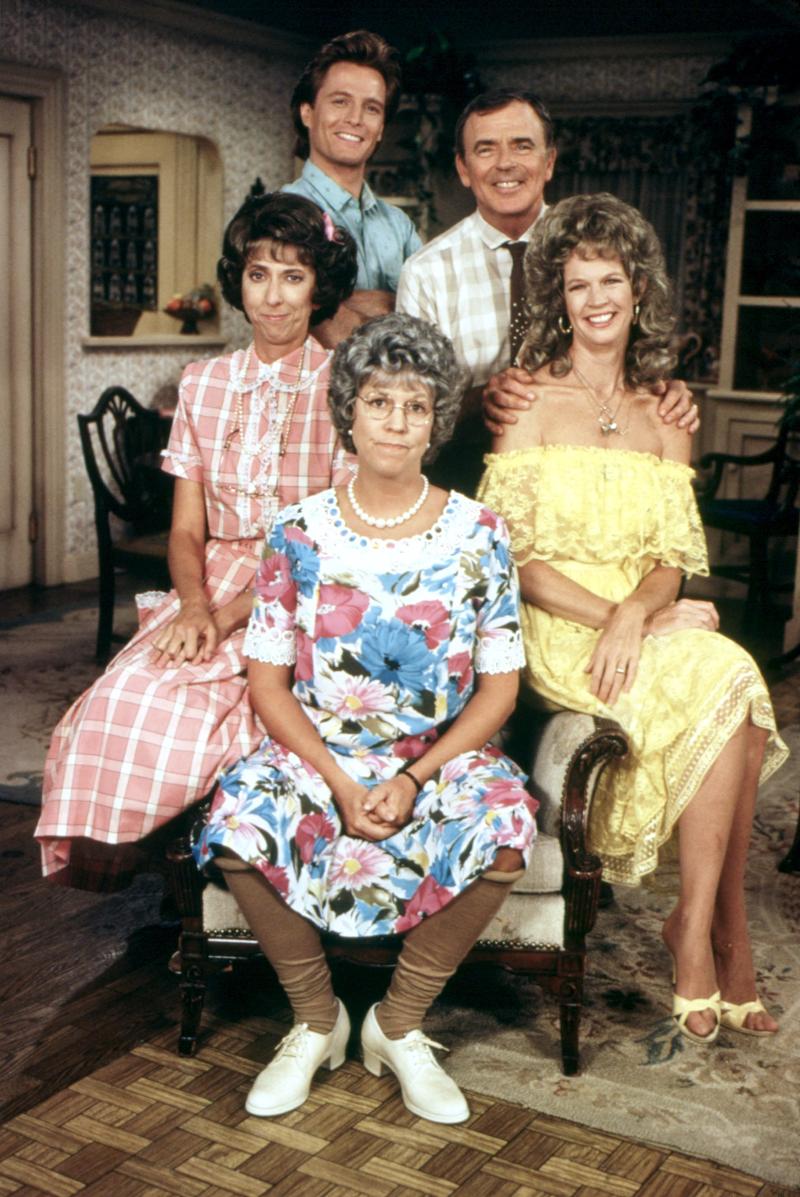
The show was cancelled after two years and went into syndication.  The reruns were so popular, 100 new episodes were ordered. A new set had to be constructed and some cast adjustments were made as well. Lawrence, Berry and Lyman were the only original characters on this new version. Since White and McClanahan were now starring on The Golden Girls, and Burnette and Korman chose not to return, a new character was created. Mitchel (Allan Kayser) was Eunice’s son who was always getting into trouble. Another addition was Beverly Archer who played Iola Boylen, Thelma’s neighbor and best friend.

Once Mama’s Family was cancelled the second time, Berry traveled around the country, appearing in “The Music Man”, “Gene Kelly’s Salute to Broadway”, and “I Do I Do” with Loretta Swit. He also went back to television for brief appearances on several shows including CHiPs, Fantasy Island, Gimme a Break, Small Wonder, Golden Girls, The New Batman, and Maggie Winters.
berry20

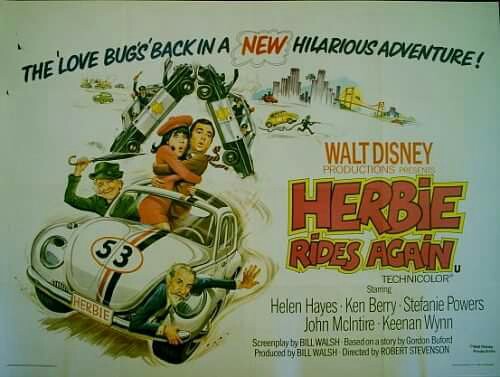
Berry also appeared in six movies including Two for Seesaw (1962), The Lively Set (1964), Hello Down There (1969), Herbie Rides Again (1974), Guardian of the Wilderness (1976), and The Cat from Outer Space (1978).

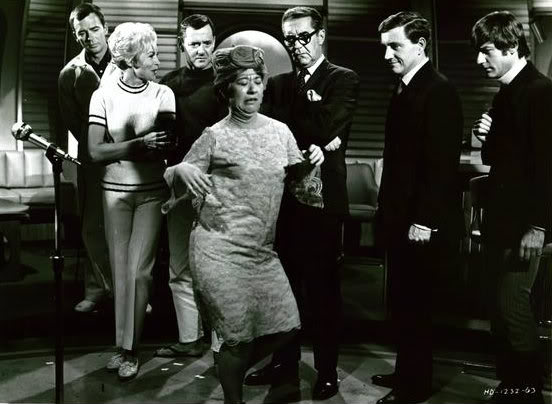
Guardian of the Wilderness was based on the life of Galen Clark who convinced Abraham Lincoln to make Yosemite Park the first public land grant. It covers a series of unusual adventures Clark had as he battled lumber companies to save wilderness land.  One of my favorite quintessential 1960s movies was Hello Down There.  Tony Randall and Janet Leigh star.  Randall is an architect who creates an underwater home.  To prove a family could live there, he cajoles his family to moving there for the summer.  His kids are in a band so they force him to take the entire band or no one.  Charlotte Rae is their housekeeper. Berry plays a rare role for him as the bad guy.
berry19

Early in his career, Ken appeared in a variety of commercials. From the mid-1970s to the mid-1980s, he was the spokesman for Kinney Shoes.

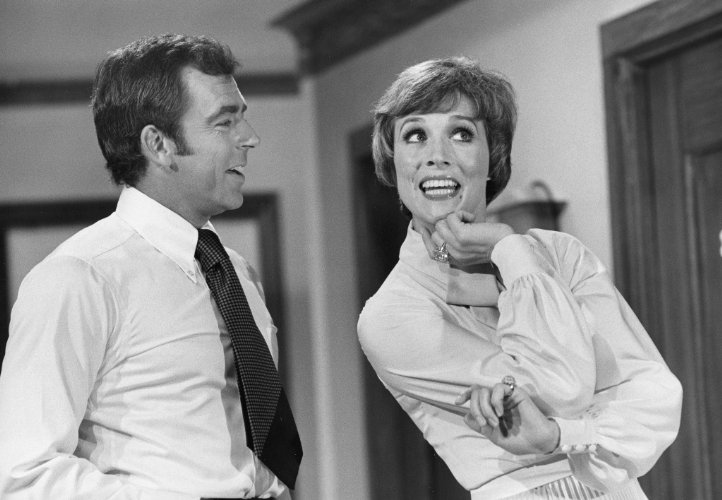
He appeared in two game shows, Hollywood Squares and Tattletales.  He also starred as himself on a variety of shows including Art Linkletter, Joey Bishop, Leslie Uggams, Jim Nabors, Julie Andrews, Sonny and Cher, Dean Martin, Laugh In, and Mike Douglas.
berry10

Berry retired in 1999. Berry loves cars and was an avid motorcyclist and camper.

Although Berry was never in a hugely successful series, he had a long and full career that any actor would be proud of.  Hopefully his well-deserved retirement has been fun and full of memories.
berry2

I’ll Take Paul Lynde for the Win

pl1

Today we are talking about the career of Paul Lynde.  Paul Lynde was an icon when I was growing up; he was probably best known at that time as the center Hollywood Square, the voice of Templeton the Rat in Charlotte’s Web, and Uncle Arthur on Bewitched.  His life encompasses both a unique and successful career as a comedian loved by many fans and the all-too-common saga of a star’s life ruined by drugs and alcohol. Many of the things you read about Paul Lynde concerning his behavior and cruel things he said to others are disheartening to a fan, but I learned that the characters I loved growing up (and continue to as an adult) are the characters, not the actors and actresses behind them.  With a few exceptions such as Fred MacMurray, Jimmy Stewart, or Cary Grant, most stars don’t live up to our illusions of them. Although truth be told, if someone studied our entire lives and wrote about them, there are probably parts of them we would not want the world to learn about either. I wanted to talk about Paul Lynde’s career, because although he was extremely well known during my youth, most young adults today probably have no idea who he is.

Paul was born in Mount Vernon, Ohio, one of six children.  His father was a local police officer and for a time, the family lived above the jail when his father was the sheriff of the jail.  Like many youngsters growing up in the 20s and 30s, he became interested in acting when he went to the movies  with his mother. The first movie he remembered was Ben Hur.  That interest propelled him to Northwestern University where he studied drama.  After school, he relocated to New York City where he worked as a stand-up comedian and then received a part in a Broadway show, “New Faces of 1952.” Alice Ghostley, who would be featured on Bewitched was also in the show. In 1963 he recorded a comedy album. From then on he was a popular guest, television star, and movie celebrity. His unique delivery of his sarcastic one-liners made him a popular entertainer.  There is not a lot of difference between the role of Uncle Arthur and his humor and delivery on Hollywood Squares.

He starred in several television series including Stanley with Buddy Hackett and Carol Burnett where he played a hotel owner in 1956-57 and The Pruitts of Southhampton with Phyllis Diller in 1967. From 1965-71, he was on Bewitched where he played Harold Harold a driving instructor the first season and then became a regular in the role of Uncle Arthur, Endora’s brother.  Surprisingly, the character of Arthur only appeared in ten episodes of the series. After Bewitched, he starred in The Paul Lynde Show where he played an attorney with two daughters and a liberal-minded son-in-law. Stiller and Meara were also on the show which was done to satisfy his contract with ABC in place of the ninth season of Bewitched. The show was up against The Carol Burnett Show and Adam-12 so it was cancelled, but he was nominated for a Best Actor Golden Globe award. His last starring role in television was in New Temperatures Rising where he played a penny-pinching doctor running a hospital owned by his mother.
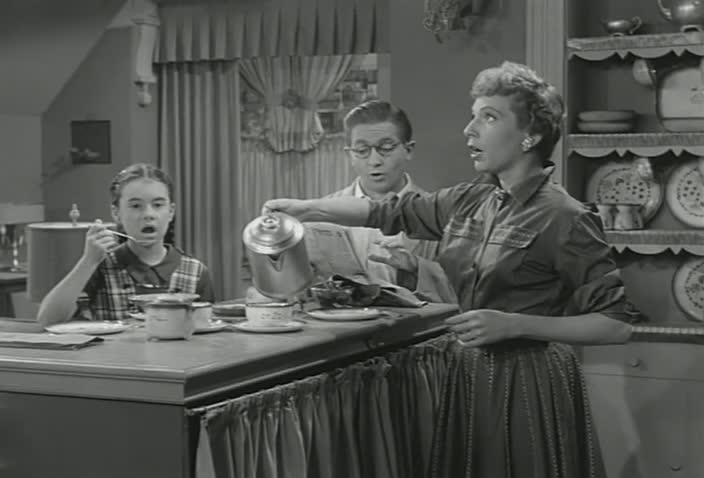
Paul appeared on Hollywood Squares for 15 years (801 episodes).  In addition to that game show, he accumulated 80 credits playing himself on a variety of shows including Donny and Marie, Password, The 10,000 Dollar Pyramid, Dean Martin Roasts, The Carol Burnett Show, The Mike Douglas Show, and on several Paul Lynde Comedy Hour specials.

He appeared on a variety of television shows – 33 in all.  In addition to those he starred in, he was also in The Phil Silvers Show, The Patty Duke Show, The Jack Benny Show, The Munsters, Gidget, F-Troop, That Girl, I Dream of Jeannie, The Mothers-in-Law, The Flying Nun, and three episodes of Love American Style.  Had he lived a few years longer, I’m sure we would have seen him cruising the ocean on The Love Boat.

In addition to his television work, he also appeared in 18 movies between 1956 and 1975. He and Dick Van Dyke were the only Broadway performers from Bye Bye Birdie to be cast in the movie version.  He was also in Beach Blanket Bingo, and two of my favorites, Send Me No Flowers and The Glass Bottom Boat, both Doris Day movies.
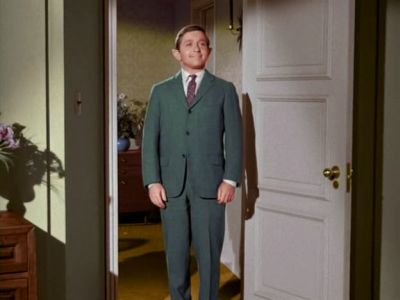
Although he was gay, he did not discuss his sexual orientation, and the media respectfully did not report on it either.  In 1965, his partner and companion Bing Davidson died. They had been out drinking and Bing thought it would be funny to pretend to dangle from a hotel balcony but fell to his death.  Whether this exacerbated his alcohol and drug problems isn’t known, but Lynde’s health suffered from his addictions and he was arrested for public intoxication frequently. In 1980 he went through a successful rehabilitation, becoming sober and drug free.  Unfortunately, the damage that was done to his body was extensive, and he died from a heart attack in January of 1982 at age 55.

Some other interesting facts are that he was friends with Elizabeth Montgomery and her husband William Asher, he purchased Errol Flynn’s Hollywood Mansion, he was a dog lover, and he was one person who was able to appear on The Ed Sullivan Show while singing a song from Bye Bye Birdie about being on The Ed Sullivan Show. He was also a chef and considered opening a restaurant. To see some of his recipes, visit www.paullynde.info.

pl9

To truly appreciate Lynde’s comedic personality, here are a few lines from Bewitched and Hollywood Squares.

To Endora, his sister, on  Bewitched:  “Endora when I think of you as a blood relation, I long for a transfusion.”

On Bewitched, telling a story, “Then I spent the summer hunting lions with the British expedition. One morning I shot a lion in my pajamas. Now, what he was doing in my pajamas, I’ll never know.”

Answers on Hollywood Squares:

Peter Marshall: According to Ann Landers, what are two things you should never do in bed?

Paul Lynde: Point and laugh.
 

Peter Marshall: According to the IRS, out of every 10 Americans audited, how many end up paying more taxes?

Paul Lynde: 11.


Before a cow will give you any milk, she has to have something very important. What?

Paul Lynde: An engagement ring


Peter Marshall: Fred Astaire says, his mother has been trying to get him to do this since he was 35. But he hasn’t done it and says he won’t do it until he’s ready. Do what?

Paul Lynde: Move out of the house!

pl14

Perhaps the award that best sums up Lynde’s career was bestowed upon him in 1976 when he received the Entertainer of the Year Emmy for the funniest man of the year. If you don’t know much about Paul Lynde, check out some of the youtube videos from Hollywood Squares or watch a few of his episodes from Bewitched. Although not as well known today, his influence on present-day performers is wide spread and his career deserves to be remembered and celebrated.