As we wind up our Riding the Range blog series, we end with another show set in the 1880s: The Rifleman.
📷boomermagazine.com
The series was set in the New Mexico Territory and starred Chuck Connors as Lucas McCain and Johnny Crawford as his son Mark. The show was on ABC from 1958 through April 1963. Lucas McCain was one of the first single parents on television.
The show was created by Arnold Laven and developed by Sam Peckinpah. Peckinpah would go on to direct many famous westerns. The pilot episode was written by Peckinpah and Dennis Hopper starred in it. It was aired on Dick Powell’s Zane Grey Theatre. Some famous people worked behind the scenes. Connors would write several of the episodes and Robert Culp, who would become the co-star of I Spy, wrote a two-part episode. Ida Lupino directed “The Assault” in 1961.
McCain was a Union soldier in the American Civil War. His wife died from smallpox when their son was six, and McCain and Mark move from Oklahoma to New Mexico where Lucas buys a ranch outside North Fork. McCain is not a perfect father; he is often stubborn and opinionated. Sometimes he seems overprotective of his son. He tries to teach Mark life lessons. In one episode, he tells him “A man doesn’t run from a fight, Mark, but that doesn’t mean you go looking to run to one.”
📷remmetsweeney.com
Chuck Connors was offered the role of McCain but turned it down because he thought the salary was too low. Several other actors were tested but no one had the same chemistry with the young boy that Connors did, so they made him another offer with a higher salary.
There are some North Fork folk who show up on many of the shows including bartender Marshal Micha Torrance (Paul Fix), Frank (Bill Quinn), hotel owner Lou (Patricia Blair), blacksmith Nels (Joe Higgins), banker John (Harlan Warde), general store owners Milly (Joan Taylor) and Hattie (Hope Summers), and hotel clerk Eddie (John Harmon). Bill Quinn was Bob Newhart’s father-in-law. Patricia Blair left in 1963 to star in Daniel Boone. Hope Summers moved to Mayberry after the show ended and became Aunt Bee’s best friend. Joan Taylor only did a few shows after The Rifleman, but she came into the show with quite a few television appearances. Higgins, Warde, and Harmon were prolific actors who had very successful careers.
📷amazon.com
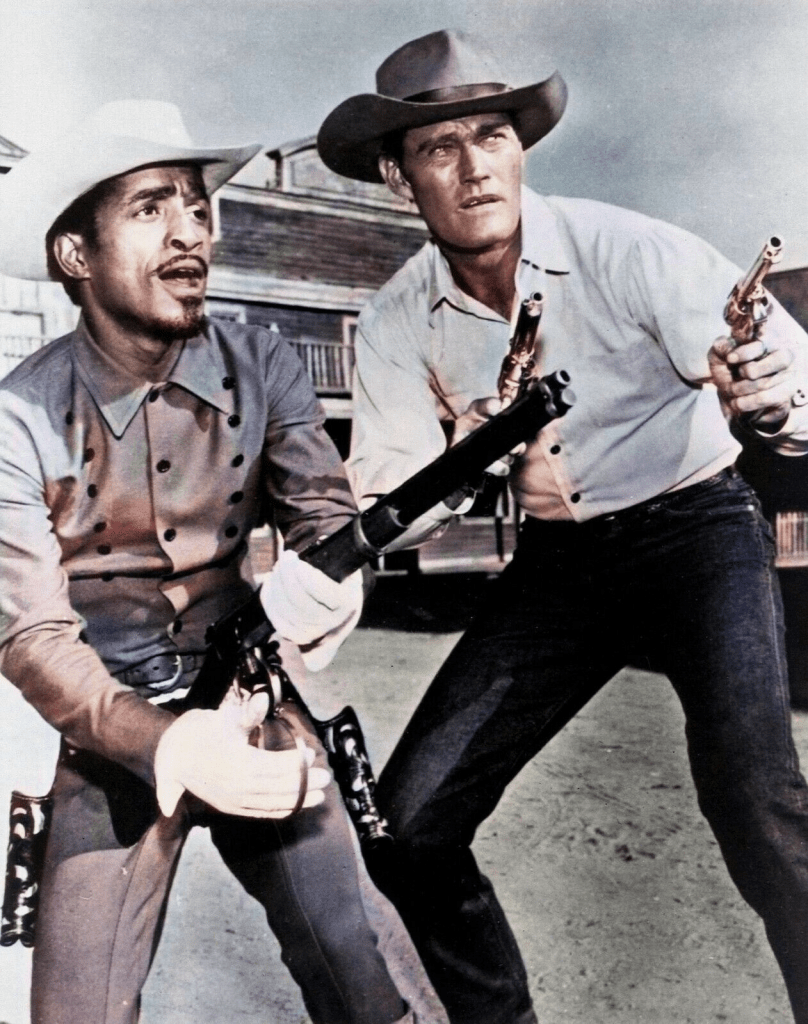
Quite a few well-known stars make their appearance during the run of the show. Some of them include Harry Carey Jr., John Carradine, Lon Chaney Jr., Ellen Corby, Robert Culp, Sammy Davis Jr., Jack Elam, Dabbs Greer, Buddy Hackett, Michael Landon, Agnes Moorehead, Denver Pyle, Pernell Roberts, Robert Vaughn, and Adam West.
There were so many westerns on the air during the fifties and sixties that most of them needed a hook to set them apart. McCain was called The Rifleman because he used a modified Winchester Model 1892 rifle with a large ring lever. The lever design allowed him to cock the rifle by spinning it in his hand and it was rigged to rapid fire which we saw demonstrated in the opening of every show. I guess no one was bothered by the fact that McCain used a rifle that would not be invented until ten years later than the time the show was set in.
The show was on Tuesday nights for the first three seasons. For season four, it moved to Mondays. After the fifth season, the show was canceled due to low ratings. However, Connors and Crawford remained life-long friends. Connors admired Crawford’s work on the set and said he always respected the cast and crew.
📷ebay.com
Crawford began his career as a Mouseketeer, one of the original 24. After the show ended, he became a pop singer with five hits. “Cindy’s Birthday” was his most famous and it was No. 8 on the Billboard 100 in 1962. Crawford came into the show with thirty acting credits, and he would go on to have thirty more after the show ended, but he never starred in another series.
Fun fact, The Rifleman was one of the few American shows that was allowed to be shown on Russian television. Apparently Breshnev loved the show. Later he met Chuck Connors when he came to the US. The actor made several trips to Russia.
I have seen this show on MeTV, and it is okay. I’m guessing that the reason it was on five seasons, and the reason it was canceled after five seasons, is because it was another western. Almost every western seemed to be successful in the fifties and sixties, but five years seems to be about the length of most of them with the exception of Gunsmoke, Bonanza and a handful of others. I have to admit that I am not drawn to McCain as a character, although I didn’t dislike him either. If you like westerns and have not seen it, it might be worth checking out.
This month we are Riding the Range, exploring some of the westerns from the fifties and sixties. One of those shows that was on the air from 1957-1962 was Tales of Wells Fargo.
The show was produced by Revue Productions and set in the 1870s and 1880s. Gene Reynolds was one of the creators of the show, along with Frank Gruber and James Brooks. Reynolds would go on to great success as a director, producer and writer, and my favorite of his was M*A*S*H. Although this show was set in the same time as Daniel Boone, it was better at getting history correct. The show featured special agent Jim Hardie (Dale Robertson) with his horse Jubilee. It was loosely based on the life of real detective Fred J. Dodge. Sometimes Hardie ran into characters from history including Jesse James and Belle Starr.
📷pinterest.com Fred J. Dodge
Fred Dodge was born in California in 1854. He went to work as an undercover agent for Wells Fargo, working in California, Nevada, and Arizona. In 1979 he was in Tombstone and recommended hiring Wyatt Earp as guard for the stage line. He became great friends with Earp. Later Dodge became constable of Tombstone while working undercover. In 1890 he left his undercover work and became a known employee of Wells Fargo in Texas. He purchased a 2,000-acre ranch near Boerne, Texas and when he retired in 1917, he lived there with his family. Dodge was described as an intelligent and successful investigator. He wrote 27 journals during his career, noting his activities and travels in them. Some of these were used for Tales of West Fargo.
I had always assumed this show was about stagecoach travel, but it was not, although stage coaches played a part. In the mid-1800s, the Wells Fargo stage line was the primary connection between the East and West coasts. Wells Fargo did not operate a stage coach line, but they did use that form of transportation for money, gold and other valuables to be delivered. Trains are involved in many of the plots. One of the trains used in the show would eventually travel to Hooterville and be renamed the Cannonball.
📷imdb.com
The first five seasons were black and white half-hour shows, while the final season switched to a color, hour-long show. During the last season, Hardie settles on a ranch near San Francisco and several recurring characters (Jack Ging, William Demarest, Virginia Christine, Lory Patrick, and Mary Jayne Saunders) were added to the series. Earle Lyon replaced Nat Holt as producer in 1960.
The theme song was written by Stanley Wilson and Mort Greene. Wilson was a prolific composer, amassing 147 credits for composing and 278 for music department credit on television and in movies. Mort Greene was best known as a writer for The Red Skelton Show and for his musical role for Leave it to Beaver.
The number of well-known actors who appeared on the show was surprising. Here are just a few of the huge number: Claude Akins, Eddie Albert, Hugh Beaumont, Dan Blocker, Charles Bronson, Edgar Buchanan, Harry Carey Jr., Chuck Connors, Buddy Ebsen, Beverly Garland, George Kennedy, Tina Louise, Steve McQueen, Jack Nicholson, Leonard Nimoy, Denver Pyle, Jason Robards, Vito Scotti, Dawn Wells, and Adam West.
📷mysteryfile.com
It was an NBC show. The pilot premiered on Schlitz Playhouse of Stars. Its biggest competition was Father Knows Best in seasons two and three. It was very popular with the viewers. The show was in the top ten during seasons one through four. For the sixth season, with an entire new cast, new theme song, and color, it was almost like a new show. NBC moved it to Saturday nights against Perry Mason and ratings declined drastically, costs went up significantly, and it was canceled.
Robertson thought the key to the popularity of the show was because it was not geared specifically to adults or kids. It was a family show. When Robertson first read the script, it was terrible, but he owed Nat Holt a favor, so he accepted the role, assuming that it would never make it. Robertson received a 50% ownership in the show, so he said of course it made him want the show to be better and he convinced them to replace most of the original script. He said that he enjoyed his time on the show a lot and that the crew was close and professional. They never went over schedule or over budget during the entire run.
📷thehollywoodreporter.com
The first two seasons were released on DVD in 2011 if you want to check them out. It sounds like this was a solid show. The network supported them, the cast was close, the production team was on top of things, and they all enjoyed their time with the show. That is a rare thing to hear in the television business. They took a gamble in the last season, and it didn’t work out, but perhaps it was for the best. It sounds like the actual show ended the season before because the last season things changed so much it was a completely new production. I would like to read more about Fred Dodge. His life sounds fascinating.
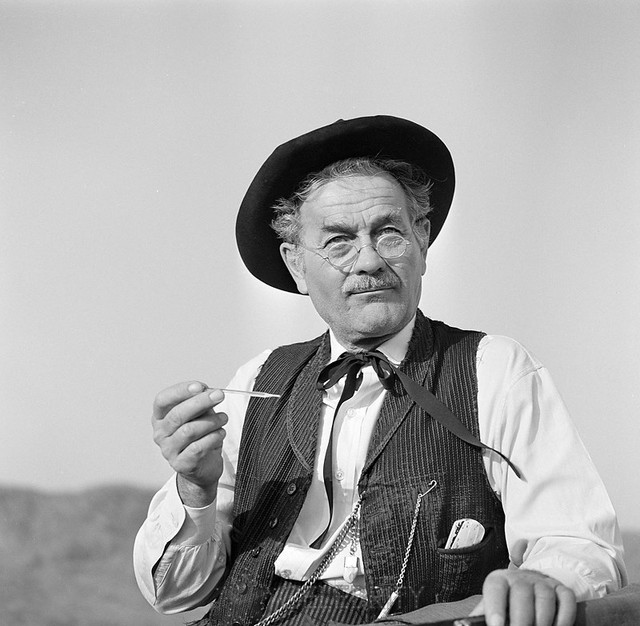
This month we are getting up close and personal with some of our favorite television stars. Today we are getting to know one of the most prolific actors to appear on classic television: Denver Pyle. Denver amassed acting credits for 263 different television series and movies during a fifty-year career.
Photo: Facebook.com
Denver was born Denver Dell Pyle in 1920 in Colorado, but not in Denver, in Bethune. His father was a farmer. His brother Willis became an animator who worked at the Walt Disney Animation Studios and UPA. Also, an interesting note is that Ernie Pyle, the famous journalist and war correspondent, was his cousin.
Photo: reddit.com
After his high school graduation, Pyle enrolled at Colorado State University but dropped out to pursue a show business career. He was a drummer for a band and then bounced around in different jobs including working in the oil fields, working shrimp boats in Texas, and as an NBC page. When WWII began, he joined the Merchant Marine. He was injured in the battle of Guadalcanal and received a medical discharge. Following his stint in the war, Pyle worked as a riveter at a Los Angeles aircraft plant. While there, he was spotted by a talent scout in an amateur theater production. Pyle decided he wanted a career in the entertainment business and trained under Maria Ouspenskaya and Michael Chekhov.
His first movie roles occurred in 1947 in The Guilt of Janet Ames and Devil Ship. He would continue polishing his film career for the next fifty years, with his last big-screen feature being Maverick in 1994.
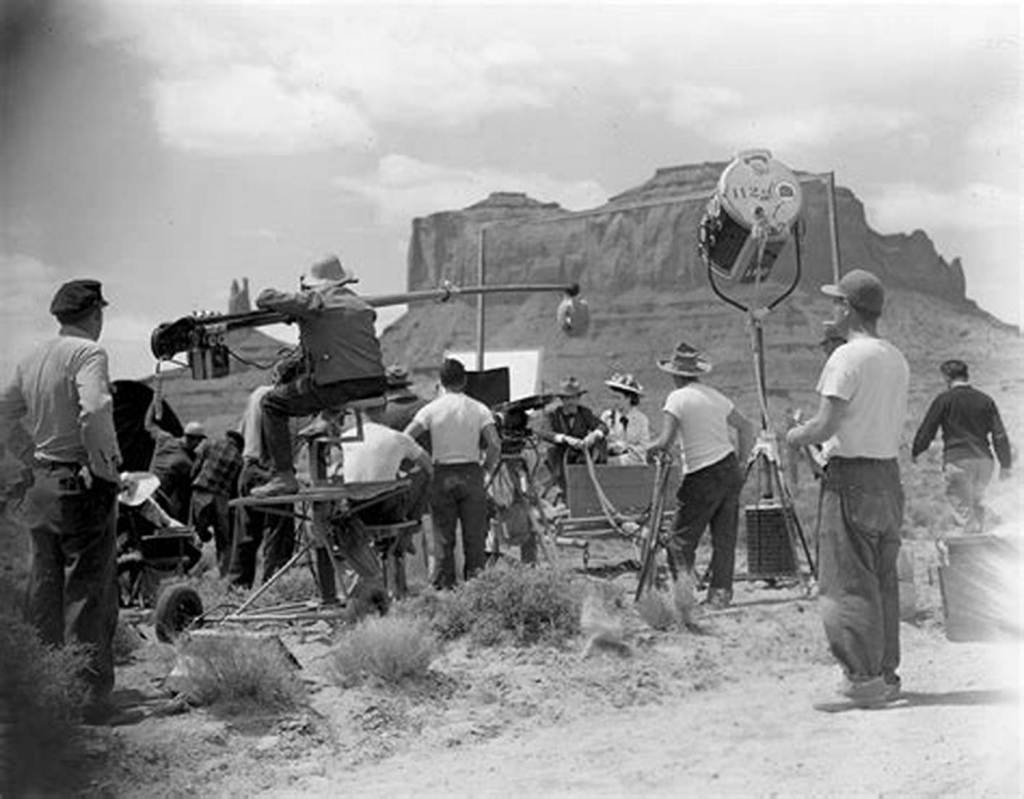
When he was filming The Alamo with John Wayne in 1960, Wayne realized Pyle had an eye for photography. He made arrangements with the PR office to hire Pyle as the official set photographer for the film.
Photo: ladylavinia’s1932blog.wordpress.com
He received his first television role in 1951 in The Cisco Kid. He gravitated toward westerns and in the fifties would appear in many of them including Roy Rogers, Gunsmoke, The Range Rider, Hopalong Cassidy, Annie Oakley, The Gene Autry Show, The Adventures of Kit Carson, The Lone Ranger, The Adventures of Jim Bowie, and The Tales of West Fargo.
In 1955, Pyle married Marilee Carpenter. They had two children and divorced in 1970.
The sixties still provided many roles in westerns (The Life and Legend of Wyatt Earp, Have Gun Will Travel, Bonanza, The Rifleman, Gunsmoke, and Death Valley Days among others), but he also began appearing on dramas and sitcoms: to name a few, Route 66, The Dick Van Dyke Show, Dr. Kildare, The Twilight Zone, Perry Mason, and Gomer Pyle USMC.
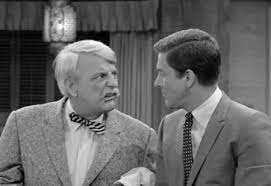
On Dick Van Dyke Photo: sitcomsonline.com
In many of these shows, he returned nine or ten times to guest star in episodes. During the run of Perry Mason, Pyle would play a victim, a defendant, and a murderer on the show.
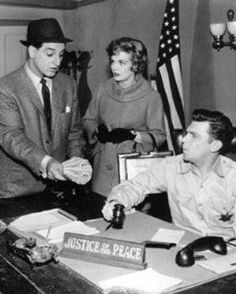
He received the first recurring roles of his career during this era on sitcoms. On Tammy, he played Grandpa Tarleton in 1965-66, and from 1963-66, he portrayed Briscoe Darling on The Andy Griffith Show. He only appeared in Mayberry six times but left a lasting impression on fans.
After playing Briscoe, Pyle invested in oil, buying oil wells thought to be near the end of their production. In the eighties, technology allowed the wells to produce more oil; Pyle made much more from oil than he did acting. However, he continued his career because he said, “I look at it this way, acting provides the cash flow I need for oil speculation, and besides that, I like acting. It’s fun.”
Doris Day Show Photo: thrillingdaysofyesteryear.com
His career did not slow down too much throughout the seventies and eighties. In the seventies, you could watch him in The Waltons, Streets of San Francisco, Cannon, and Barnaby Jones. The eighties featured him in The Love Boat, Murder She Wrote, Dallas, and LA Law.
During this time, he also received three other regular cast roles. From 1968-1970, he played Doris Day’s father in The Doris Day Show. From 1977-78. He was Mad Jack in The Life and Times of Grizzly Adams, and in 1979-85, he took on Uncle Jesse in The Dukes of Hazard. In fact, his last acting credit was for a made-for-tv movie where he once again portrayed Jesse in The Dukes of Hazzard Reunion! in 1997.
Dukes of Hazzard Photo: twitter.com
In 1991, Pyle married a second time. He wed Tippie Johnston and they remained married until his death. The couple did a lot of fundraising for charity including Special Olympics and Denver Pyle’s Children’s Charities. In addition, Pyle sponsored Uncle Jesse’s Fishing Tournament in Texas. For the ten years, he ran it, it raised more than $160,000 to support children’s needs.
In 1997, Pyle died on Christmas from lung cancer.
If you watch reruns from any decade of classic television, you will be very familiar with Denver Pyle. Although he was part of the cast in five very popular shows, it would have been fun to see him get the starring role in a show. It’s amazing to realize how many shows he was a part of. Considering he was in the television business for forty years and for almost fifteen of those years, he was busy being part of the cast of a weekly show, that left 25 years to amass 250 other series that he found time to appear on; that is almost one a month for 25 years—very impressive.
Like most of the westerns we are studying this month, The Lone Ranger first aired as a radio series. In 1933, the masked hero and his best friend Tonto, traveled throughout the Old West, capturing outlaws and putting them behind bars.
Fran Striker began reworking some old scripts about westerns in 1932. Those stories became The Lone Ranger. George Trendle brought Striker in to work on the radio scripts in 1933 when the show debuted. Striker continued to pen books about the hero with his first being The Lone Ranger in 1936 and his last The Lone Ranger on Red Butte Trail in 1961, 25 in all.
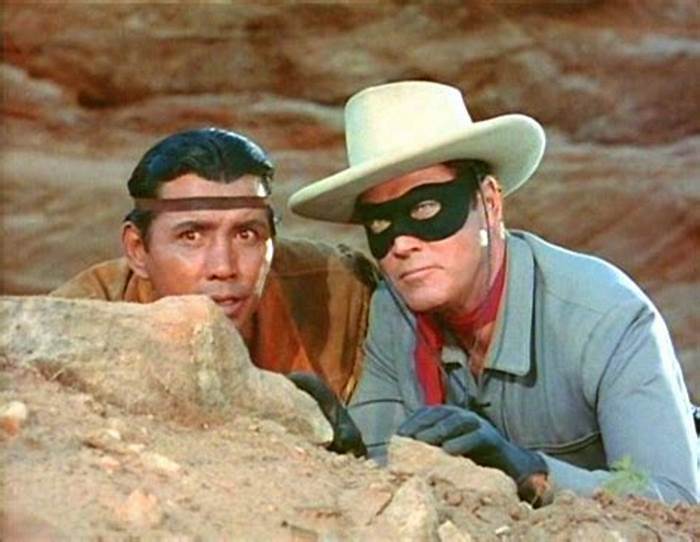
The television show began in 1949 and ran for eight years. Clayton Moore portrayed the ranger and Jay Silverheels portrayed Tonto. Silverheels was a full-blooded Mohawk Indian from the Six Nations Indian Reservation in Ontario, Canada. In season three, Moore was temporarily replaced by John Hart, but he returned for the final two years. The other recurring character we see during the series is the ranger’s nephew Dan Reid played by Chuck Courtney. This was ABC’s first big television hit.
Photo: pinterest.com
The show began and ended the same way. As the show opened, the Lone Ranger’s horse would rear up on his back and the ranger shouted “Hi-Yo Silver.” At the end of the show, someone would as “Who was that masked man?” Another repeated phrase from the series was “Kemo sabe.” Tonto called the Ranger this which translates to “faithful friend.”
The backstory of the ranger is that a patrol of six Texas Rangers was massacred and only the Lone Ranger survived. He now wears a mask to protect his real identity and he and Tonto, who nursed him back to health, travel around bringing justice to the territories. The ranger owns a silver mine which is why he named his horse Silver and why he carries silver bullets.
Photo: pinterest.com
MGM film veteran producer Jack Chertok was brought in to produce the show. He would later produce Ann Sothern’s show Private Secretary and My Favorite Martian.
This show was produced and filmed differently than most shows in the classic age. Seventy-eight episodes were broadcast for consecutive weeks. Then they were all shown for a second time. After 156 weeks, they decided to film another 52 shows but there was a controversy and Moore left the show and was replaced by John Hart. Again the 52 filmed shows were consecutively shown and then rerun. For the next season, the original creator George Trendle sold the rights to Jack Wrather in 1954. Wrather hired Moore again and produced another 52 shows which were shown and then rerun. For the final year, only 39 episodes were produced with Sherman Harris taking over as producer. The final season was the only one shot in color. Because there were only new episodes in five of the eight years, only 221 shows were produced.
At this point, film stars were still avoiding television, seeing it as a temporary competition with films. Therefore, most of the guest stars we see on the show were actors who went on to have successful television careers. Some of those include Michael Ansara, James Arness, Frances Bavier, Hugh Beaumont, Dwayne Hickman, Stacy Keach Jr., Marjorie Lord, Martin Milner, Denver Pyle, and Marion Ross.
Photo: imdb Marion Ross guest starred
This was one of the first series to be nominated for an Emmy; unfortunately, it lost to the first version of The Life of Riley starring Jackie Gleason. The nomination came in 1950 at the second Emmy ceremony. The early years had very limited categories for awards.
General Mills was the original sponsor for the show. They also sponsored the radio show from 1941-1961.
Photo: michiganradio.com
The theme music was the classical piece, the William Tell overture. Rossini composed the piece in 1829.
Like Adam West and Batman, Clayton Moore really embodied the character of the Lone Ranger. After the show ended, he would make up to 200 appearances a year as the crime fighter. In 1979, Jack Wrather, who owned the rights to the character, sued him, but Moore won a countersuit allowing him to continue appearing as the masked hero.
The Lone Ranger was never permanently retired. Two animated series were released in 1966 and 1980. Also, both Silverheels and Moore starred in two big-screen features: The Lone Ranger (1956) and The Lone Ranger and the Lost City of Gold (1958).
In addition, Moore slipped into his costume again for a film in 1958 to promote the Lone Ranger Peace Patrol to convince kids to buy US Savings Bonds. A 2013 movie reboot came out with Armie Hammer in the starring role.
The Lone Ranger has had an iconic place in history for 87 years now. Almost every generation recognizes the hero, and his black mask is at the Smithsonian Museum. It’s pretty incredible for a show that really had five years’ worth of episodes made and has been off the air for 64 of those years. Although this era did not often portray African Americans or Native Americans very well, this show was about friendship, and I read very little about negative portrayals of anyone on the television series. You can easily find the episodes on DVD, Youtube, or a variety of network channels.
Photo: amazon.com
When my son who is now 29 was about 9, he was enthralled by westerns and watched The Lone Ranger and Daniel Boone. Internet and email were newer forms of technology, but he was able to reach out to Fess Parker and Clayton Moore. Both were very kind. Moore sent him his autographed book with a written note. He still enjoyed discussing his time as the crime fighter. A classic man from a classic show.
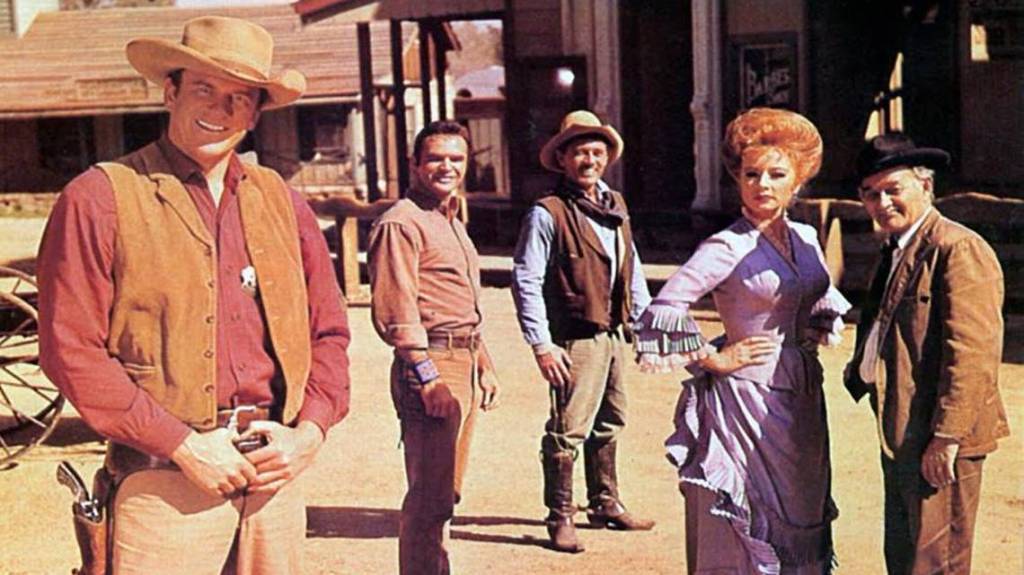
From 1952-1961, you could tune into Gunsmoke on your local radio to hear the adventures of the folks in Dodge City, Kansas created by Norman Macdonnell and John Meston. The primary characters were Marshal Matt Dillon (William Conrad), Doc Charles Adams (Howard McNear), Miss Kitty Russell (Georgia Ellis) and Chester Wesley Proudfoot (Parley Baer). Three years after its debut, the series shifted to television as well, running on CBS from 1955-1975, producing an incredible 635 episodes. For television, Macdonnell took over the reins as producer with Meston the head writer.
James Arness was offered the role of Dillon on television. The network wanted John Wayne who turned it down. He did, however, introduce the first episode. Both Raymond Burr and Denver Pyle were also considered for the role. Matt Dillon spent his youth in foster care, knew the Bible well, and at some point was mentored by a caring lawman. He also talks about his time in the Army in some episodes.
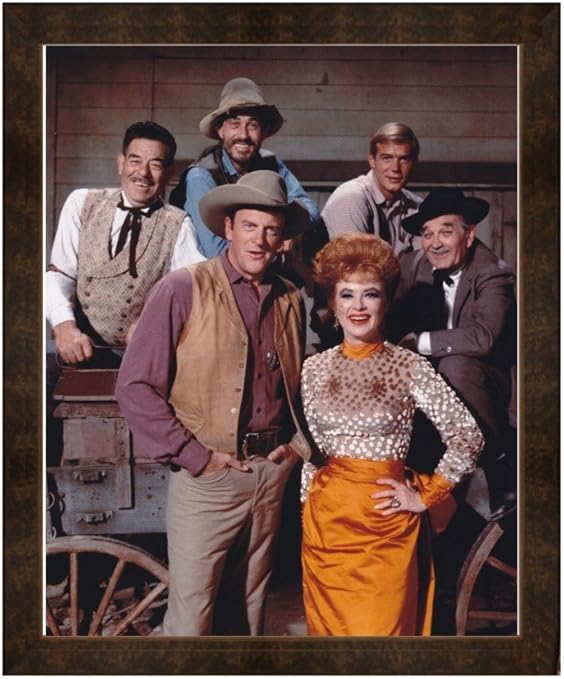
Photo: allposters.com
The role of Chester, with a new last name of Goode now, was played by Dennis Weaver. Chester was not only a loyal employee to Marshal Dillon, but he brewed a mean pot of coffee. He had a noticeable limp which apparently resulted from an injury in the Civil War. Weaver later said if he realized how hard it would be to film that long with a fake limp, he would have not used it. Other sidekicks to the Marshal included Ken Curtis as Festus Haggen, Burt Reynolds as Quint Asper (1962-65), Roger Ewing as Thad Greenwood (1966-68), and Buck Taylor as Newly O’Brien (1967-75).
Photo: pinterest.com
Doc was now Galen Adams and played by Milburn Stone. Doc was an interesting guy. He apparently was educated in Philadelphia and spent some time as a ship doctor on gambling boats on the Mississippi River where he met Mark Twain. His young wife died from typhus two months after their marriage. He finally settled in Dodge City after wandering a bit.
Photo: ebay.com
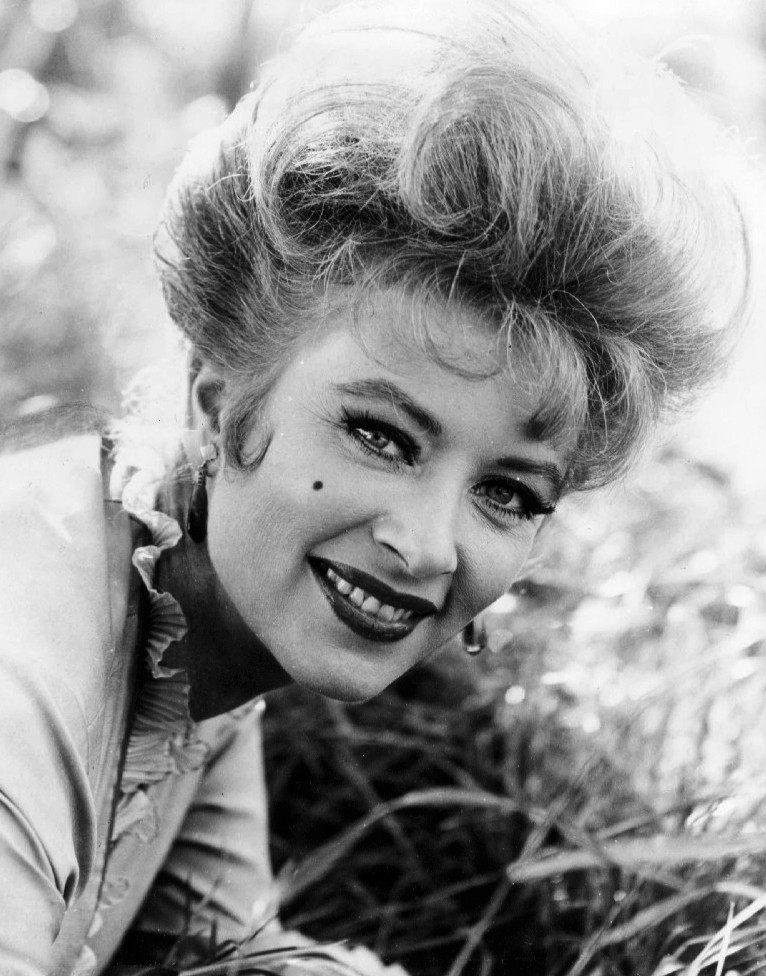
Miss Kitty was portrayed by Amanda Blake. Perhaps the closest bond she had with Dillon was that she also grew up in foster care in New Orleans. She was in more than 500 of the television episodes. In addition to her role as “entertaining men” in Dodge City, she is half owner of the Long Branch Saloon. Kitty and Matt obviously are attracted to each other and are very close. Kitty was a successful business owner and had a cold demeanor about professional matters but had a soft heart in other matters. Blake was ready to leave the show in 1974, and her storyline was that she finally returned to New Orleans.
Photo: wikipedia.com
During its twenty-year stint, the show had some notable guest stars. Just a few celebrities who graced the set include Jack Albertson, Ed Asner, James Backus, Beau Bridges, Charles Bronson, Bette Davis, Angie Dickinson, Richard Dreyfuss, Buddy Ebsen, Barbara Eden, Jodie Foster, Mariette Hartley, Ron Howard, June Lockhart, Jack Lord, Rose Marie, Howard McNear, Harry Morgan, Leonard Nimoy, Carroll O’Connor, Denver Pyle, Wayne Rogers, William Shatner, Cicely Tyson, and Adam West.
While the show portrayed the hard life in the West, it was also a warm and humorous celebration of a group of people making a new life together.
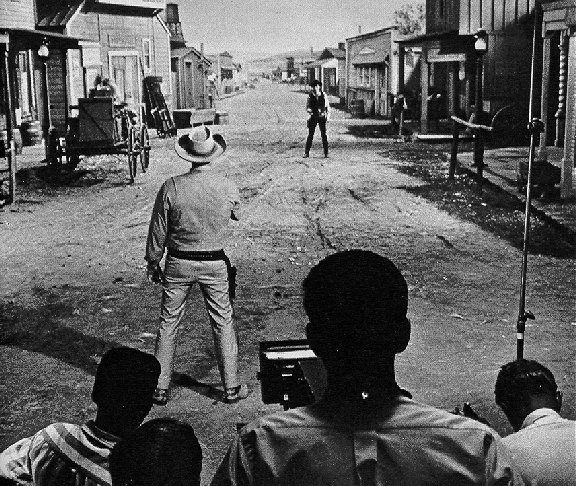
The opening of the show is a gunfight between Matt and a “bad guy.” It was shot on the same Main Street set used in High Noon, the Grace Kelly/Gary Cooper classic. The scene was dropped in the 1970s when a nonviolence emphasis was placed on television shows and the opening was Matt riding his horse.
Photo: marksmannet.com
The show began its life on Saturday nights at 10 pm ET. In 1961 when the radio show left the air, the television show switched from half an hour to an hour. For season 13, it moved to Monday nights at 7:30 for four years, and then at 8 pm for four years. By season two it was a top ten hit, rising to number one where it remained until 1971.
The first seven seasons were sponsored by L&M cigarettes and Remington shavers.
The well-known theme from the show and radio was “Old Trails” composed by Rex Koury. Lyrics were later recorded by Tex Ritter in 1955 but not used in either radio or tv. Although I could not confirm it, I read several mentions that Koury was so busy, he actually penned the song while using the bathroom. William Lava composed original theme music for television; other composers who contributed music during the twenty years were Elmer Bernstein, Jerry Goldsmith, Bernard Herrmann, Jerome Moross, and Franz Waxman.
Photo: amazon.com
Surprisingly, the show was only nominated for fifteen Emmys during its reign. Of those, there were only three wins: one for best dramatic show in 1957, one for Dennis Weaver as supporting actor in 1958, and one for Milburn Stone in 1967.
After surviving the rural purge Paley conducted, the cast thought they were not in jeopardy and were all stunned by the cancellation in 1975. CBS had not prepared them that they were debating ending the show. They assumed the show was continuing till it had 700 episodes and many of the stars read about the cancellation in the trade magazines.
The show has appeared in syndication in three different versions. One package is half-hour episodes from 1955-1961, one package contains hour-long black and white episodes from 1961-1966, and the final package contains one-hour color episodes from 1966-1975. Me TV currently airs the one-hour color shows.
Photo: wichitaeagle.com
Arness would appear in five made-for-television movies after the show went off the air. In 1987, Gunsmoke: Return to Dodge featured Blake as Miss Kitty and Taylor as O’Brien. Stone had passed away in 1980, so his role was not part of the new film. Gunsmoke: The Last Apache premiered in 1990 without Blake who had died in 1989. In 1992-1994, Gunsmoke: To the Last Man, Gunsmoke: The Long Ride, and Gunsmoke: One Man’s Justice would appear before the series rode off into the sunset for good.
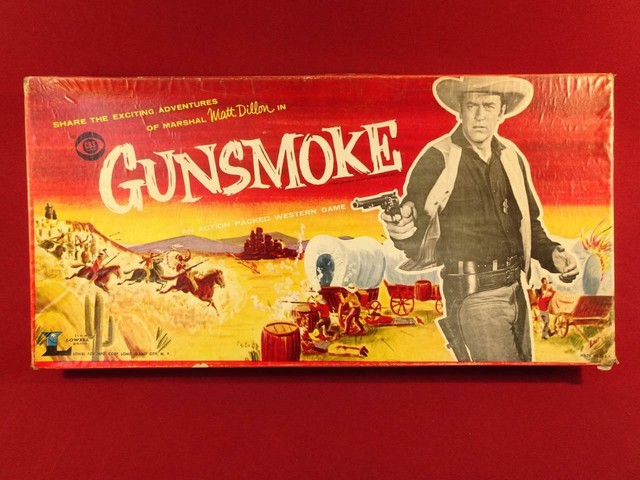
After being on television so long, it’s not surprising that there were a lot of merchandising opportunities for the show. In addition to typical items like lunch boxes, there was Gunsmoke cottage cheese. A Matt Dillon figurine was available with his Horse Buck.
There were also board games, puzzles and a variety of books including numerous paperbacks and comic books from Dell and Gold Key.
Fans had an affinity for the show. During its time on the air more than thirty westerns came and went, but Gunsmoke continued, in the top ten for most of its two decades. Few series have their own museum, but you can visit Boot Hill Museum in Dodge City to learn all about the show. Furniture from the series is included, as well as signed photos from the cast and other memorabilia including one of Miss Kitty’s dresses.
When you hear someone say “Get outta Dodge,” you can fondly remember Gunsmoke which is where this phrase began. Perhaps being cancelled was a blessing in disguise. After two decades, maybe it was time to get outta Dodge, maintaining the high standards and high ratings that made the show such a long-running success.
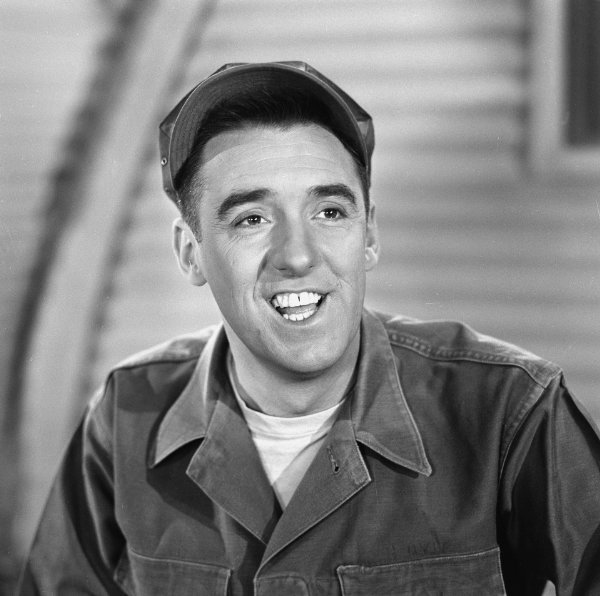
Continuing my “We Salute You!” blog series, today we look at one of the most-loved television characters, Gomer Pyle.
Photo: pinterest.com Danny Thomas in Mayberry
In the late 1950s Make Room for Daddy was one of the most popular sitcoms. On one episode in February of 1960, Danny found himself in Mayberry, picked up for going through a stop sign. Although Sheriff Taylor came off a bit of a country bumpkin, viewers enjoyed the episode and the following fall, The Andy Griffith Show (TAGS) aired on CBS. When the series debuted, Andy was portrayed more of a wise sage and the folks of Mayberry were a quirky but lovable bunch. The show was in the top ten every year it was on the air. In fact, it seemed to get better as it went, making #3 in 1966-1967 and #1 in 1967-68. Andy left the show the following year, and it turned into Mayberry RFD which continued for three more seasons. The first two it was also in the top 10 and the third year it slipped a bit into the top 15. Although it was one of the most successful shows on CBS’s schedule, it was eliminated with a lot of other popular shows in the famous rural purging in the early seventies.
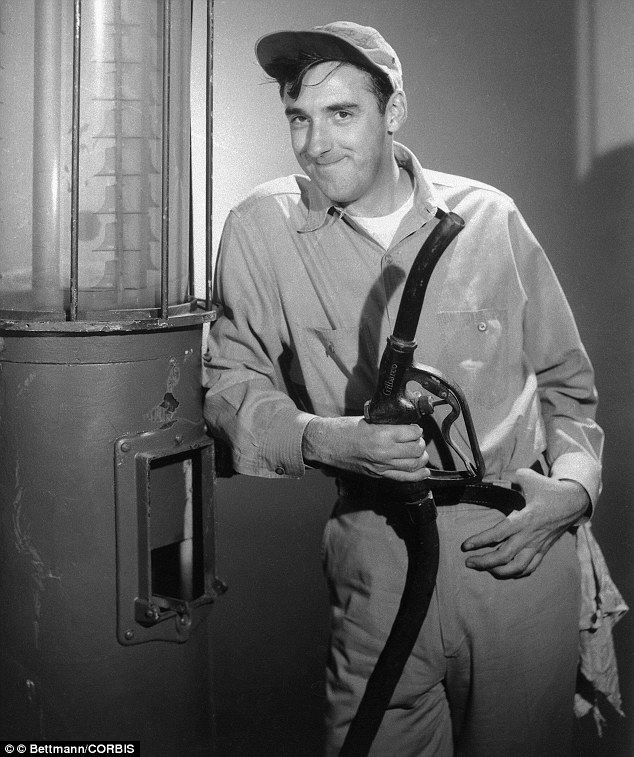
One night, Andy Griffith saw Jim Nabors performing at The Horn in Santa Monica and decided he would be a perfect fit for Mayberry. He offered him a job, and Gomer Pyle began working at Wally’s gas station.
Two writers, Everett Greenbaum and Jim Fritzell were said to have created the character. Greenbaum had dealt with an incompetent gas station attendant. He stopped by a station with motor trouble. The man could not think of any way to fix it except to keep adding gas to the tank, so Greenbaum thought a character based on him should be part of an episode on TAGS. He derived the name from Gomer Cool, a writer and Denver Pyle, the actor. Everett and Greenbaum (along with many TAGS writers) would continue to write for TAGS as well as Pyle episodes.
Gomer was one of the most popular characters on the show. Surprisingly he was only in 23 episodes in the two years he was with the show. Traveling around the country, you would be able to hear people repeating his “gawwwleee,” “surprise, surprise, surprise,” or “shazzam” which all became part of our language at the time.
Photo: dailymailreporter.com Gomer at Wally’s Gas Station
Because Gomer Pyle was so popular, Andy, Aaron Ruben, and Sheldon Leonard decided to give him his own show and Gomer Pyle USMC was created. In this show, Gomer who is naïve, kind-hearted and morally upright has to deal with life in the marine corps and his gruff Sergeant Carter (Frank Sutton). Although Carter gets driven to distraction by Pyle and his “do-gooding,” we all realize he has a soft spot for Pyle and his main concern is protecting him.
Photo: pinterest.com Carter and Pyle
The show was on the air from 1964-69 and had a solid supporting cast. Like TAGS, Gomer Pyle USMC was in the top ten for its entire run.
Photo: mayberrywikia.com With Ted Bessell
The show was on Friday nights, except for season three when it moved to Wednesdays. I was a bit surprised it stayed in the top ten, because it had some competition at times. Season one it was opposite Jack Benny and Twelve O’Clock High. Season two it went up against Honey West on one network and a variety of music shows on the other. Season three it was at the same time as Peyton Place and season four it was on opposite Star Trek.
Although the show depicted military life on base, war was never discussed. The series began at Camp Wilson in North Carolina and was moved to the fictional Camp Henderson in California. The actual show was filmed at Camp Pendleton and, along with TAGS, at Desilu’s Cahuenga studio and the RKO Forty Acres backlot. Unlike TAGS, Pyle used a single-camera setup because much of the shooting was outside.
Photo: pinterest.com Don Rickles, Guest Star
The US Marine Corps worked with Leonard, giving the show unlimited access to their equipment because they felt the series was good for their image. The opening scene of the show was that of marching recruits from the Marine Corps Recruit Depot in San Diego. Nabors commented that it was very difficult for him to see that footage because so many of those service men were killed in Vietnam. In real life, Frank Sutton could not pass the Marine Corps physical for WWII but was able to serve in the US Army, taking part in 14 assault landings including Luzon and Bataan.
Photo: wikipedia.com
I had heard of universities bestowing honorary degrees to actors even if they did not attend the school, but I did not realize the military could do something similar. During the show, Gomer’s highest rank was Private First Class. In 2001, the US Marine Corps gave Nabors an honorary promotion to Lance Corporal, and in 2007 he was raised to Corporal.
Obviously, there were a lot of military vehicles used in the filming of the show. Chrysler Corporation provided them. Jeeps were also prominent in the show, but Jeep did not become part of Chrysler until 1987. As an aside, the vehicles for TAGS were provided by Ford.
Photo: sitcomsonline.com Gomer and his friend Duke Slater
Pyle’s loyalty and good-natured attitude made him a favorite of both his platoon members and many of the women whom he came in contact with. One of Pyle’s friends was Duke Slater played by Ronnie Schell. Schell was written off after the third season when he left to star in Good Morning World. When that sitcom did not get renewed, he returned to Pyle. Some of the other platoon members included Roy Stuart as Corporal Boyle, Forrest Compton as Colonel Edward Gray, Ted Bessell as Frankie, and William Christopher as Lester.
Gomer gets to meet a lot of people when he goes to town. He especially loves movies and one of his favorite all-time pictures was Godzilla.
Photo: pinterest.com Sergeant Carter and his girlfriend Bunny
As mentioned, Sergeant Carter eventually becomes a father figure to Gomer. Carter’s girlfriend Bunny (Barbara Stuart) also tried to help Gomer (I could not find anything to indicate that Roy and Barbara Stuart are related). Gomer often causes trouble between Carter and Bunny by trying to “help” Carter. In season three, Gomer also got a girlfriend in Lou-Ann Poovie (Elizabeth MacRae). She is a singer in a local nightclub, but eventually Gomer talks her into returning to Turtle Creek, NC to marry her old beau Monroe. She leaves but returns, informing Gomer she wants him for her boyfriend, and she gets a new job as a clerk at a record store.
Photo: sitcomsonline.com Gomer and Lou-Ann
Several TAGS alumni made appearances on the show. Allan Melvin was part of the cast as Staff Sergeant Hacker for four years, Carter’s rival on the show. Denver Pyle who was Briscoe Darling on TAGS showed up on Gomer Pyle as a farmer. Andy, Aunt Bee, Goober and Opie all were seen at the base at one time or another, including when Opie ran away from home.
With a show on the air so long, many well-known guest stars showed up at Camp Henderson as well, including Carol Burnett, Ted Knight, Rob Reiner, Don Rickles, and Jerry Van Dyke.
Photo: directexpose.com
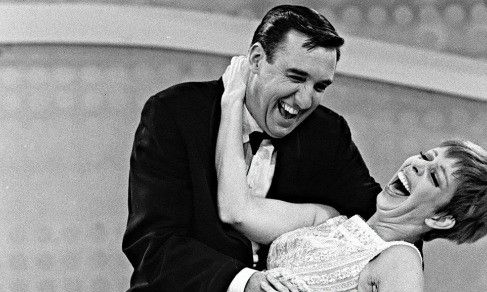
After the fifth season, Nabors expressed an interest to do a variety show, so Gomer Pyle was not renewed. He brought Ronnie Schell and Frank Sutton along for his new show which was on the air for two seasons. Carol Burnett called Nabors her good luck charm. He was one of her best friends and he was always on her season opener each year.
Photo: pinterest.com Best Friends
In an interview with Jim for American Profile, writer Paulette Cohn (Jim Nabors Lives Happily in Hawaii, January 13, 2008) quoted Carol Burnett’s perspective of Nabors vs Pyle: “ ‘The one thing Jim has in common with Gomer is his kindness,’ says actress and comedienne Carol Burnett, Nabors’ long-time friend, who named him godfather to her daughter Jody. ‘He loves people and is very gregarious. But he is also very smart. Not that Gomer wasn’t, but Jim isn’t naïve. He keeps his eye on things.’ ”
Considering how popular Gomer Pyle USMC has been in reruns, I was surprised to learn it wasn’t until 2006 that CBS Home Entertainment released the show on DVD. By 2008, all the seasons were available.
Photo: blogspot.com
Let’s end with a few quotes that captures the essence of the show’s characters.
Carter: I don’t get it Pyle, how come you can knock that Phillips flat, yet you can’t handle that little Lombardi guy?
Gomer: Well sir, you see the big feller needed a lesson, the little feller didn’t.
Photo: abcnews.com
Although Gomer Pyle USMC might not be everyone’s cup of tea, it was a well-done and popular show. I think its success, like TAGS and many of the other shows considered classics, comes from the fact that it’s a character-driven show. We start to consider the characters our friends and enjoy spending time with them. The show can currently be seen on MeTV nightly at 9 pm EST.
While it is not uncommon for stars to transition from television to movies–think about Robin Williams, Sally Field, Melissa McCarthy, and Tom Hanks–it is less likely to see stars move from the big screen to the small screen. Jane Fonda has transitioned to television in Frankie and Grace and Fred MacMurray did it with My Three Sons. For most stars, the move has not worked out very well. Let’s look at a few stars who tried to make the conversion.
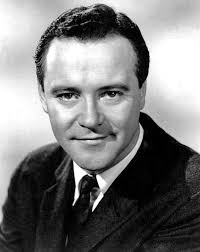
That Wonderful Guy – Jack Lemmon (1949)
Neil Hamilton (best known as Commissioner Gordon on Batman) plays Franklin Westbrook, a conceited drama critic who dislikes almost everything. Jack Lemmon plays Harold, a Midwesterner who thinks working for Westbrook will help him become worldly and give a boost to his acting career. His girlfriend is played by his real wife Cynthia Stone. The episodes revolved around his romantic and business adventures in New York City. Perhaps Westbrook panned the show because it was cancelled after three episodes.
Heaven for Betsy – Jack Lemmon (1952)
Three years later, Lemmon gave it another try. In this show, Lemmon plays Peter Bell, a toy store buyer. His wife Cynthia again played his wife Betsy. The series was based on a sketch “The Couple Next Door” that Lemmon and his wife played regularly on the Frances Langford/Don Ameche Show. Each episode lasted 15 minutes, and it told about the newlyweds’ struggles in New York City. Instead of three episodes, this series lasted three months.
Honestly Celeste – Celeste Holm (1954)
After playing Ado Annie in Oklahoma, Holm tried her hand at television. She plays Celeste Anders, a Minnesota college professor living in Manhattan, who is getting journalism experience working for the NY Express. Celeste wrote stories ranging from modern art to underprivileged families. She also dated the publisher’s son Bob Wallace, played by Scott McKay. After three months, she was sent back to school in Minnesota. What was most surprising about this failure was that Norman Lear (who would go on to create dozens of shows) and Larry Gelbart (who later created M*A*S*H) were both part of the writing staff.
Going My Way – Gene Kelly (1962)
Bridging television and movies, Gene Kelly redid Bing Crosby’s movie from 1944 for the small screen. Kelly is Father Chuck O’Malley, a progressive priest assigned to the slums of New York. Father Fitzgibbon played by Leo G. Carroll is a cantankerous, old priest. Dick York was his boyhood pal Tom Colwell who ran the community center. Mrs. Featherstone (Nydia Westman) played the rectory housekeeper. The list of guest stars on the show was very impressive, but after a year, the network told Kelly to keep going and cancelled the show.
The Bing Crosby Show – Bing Crosby (1964)
I guess Bing decided if Gene Kelly could enter television with his old movie, he might also give it a try. He plays Bing Collins a former singer. He is now an electrical engineer married to Ellie (Beverly Garland) with two daughters Janice (Carol Faylen), 15, and boy crazy and Joyce (Diane Sherry), 10, who had a high IQ. It lasted one season. Not surprisingly, this series also attracted a lot of big-name guest stars including Frankie Avalon, Jack Benny, Dennis Day, Joan Fontaine, and George Gobel. Apparently, Garland had a thing for engineers because she would marry aeronautical engineer Steve Douglas on My Three Sons.
Mickey – Mickey Rooney (1964)
Mickey plays Mickey Grady who leaves the Coast Guard to manage a posh hotel, Newport Arms in California, with his wife Nora (Emmaline Henry) and two young boys. His real son plays one of his sons on the show. Sammee Tong plays the hotel’s manager. The former supervisor has left a lot of problems for Mickey. The show was cancelled in January airing only 17 episodes.
One of the Boys – Mickey Rooney (1982)
After vowing never to work on television again, Rooney tried it again 18 years later. Now he plays 66-year-old Oliver Nugent, rescued from a nursing home by his grandson Adam Shields (Dana Carvey). Adam is a college student who takes him in. Adam’s roommate, Jonathan Burns (Nathan Lane) is not so happy about the situation. Oliver looks for a job and lands one singing in a restaurant. Also appearing in the cast was Scatman Crothers who sang with Oliver and had also left the nursing home. A young Meg Ryan played Adam’s girlfriend Jane. The show debuted at 18th place in the ratings but by within a month it had dropped to 68th. Even with this cast, the show was cancelled after an unlucky 13 episodes.
Jimmy Stewart Show – Jimmy Stewart (1971)
Jimmy Stewart jumped to the small screen with great anticipation and excitement by viewers. He played anthropology professor Jim Howard. Howard teaches at Josiah Kessel College, started by his grandfather. His house is full with his wife, his son Peter, Peter’s wife Wendy, and his grandson Jake. He also has a young son Teddy, who happens to be the same age as his grandson. His friend Luther Quince often stops by to eat and give advice. Jim talks to the audience during the show and wishes them love, peace, and laughter at the end of each episode. Even beloved Jimmy Stewart was unable to save this show which was cancelled after one season.
THE JIMMY STEWART SHOW, (back row, l to r): Ellen Geer, Jonathan Daly, (front):Julie Adams, Jimmy Stewart, Dennis Larson, Kirby Furlong, 1971-72
The Doris Day Show – Doris Day (1968)
Doris Day was the most successful actor moving from film to television. However, I think the reason she managed to keep her show on the air for five seasons was because she changed the format so often that CBS did not realize it was the same show. In 1968, Day is Doris Martin, a widow with two kids. She moves from the city to Mill Valley, CA to live on her father’s ranch.
The second season she commutes to San Francisco after accepting a job as an executive secretary to Michael Nicholson (MacLean Stevenson), the editor of Today’s Magazine. Rose Marie was Myrna Gibbons and Denver Pyle again played her father Buck Webb.
In 1970, Doris and the kids move to an apartment over an Italian restaurant run by Kaye Ballard and Bernie Kopell. Billy De Wolfe was her neighbor. Now Doris is writing feature stories for the magazine.
When the show returned the next fall, Doris was single and a reporter for a magazine. Her new boss was Cy Bennett (John Dehner) and she had a boyfriend Peter Lawford but later her boyfriend turned into Patrick O’Neal. There was no restaurant.
By 1973, the network caught up with all the changes and cancelled the show.
It was interesting that so many actors failed in television when they were such celebrated movie stars. The radio stars seemed to have better luck making the transition. Jack Benny and Burns and Allen had long-lasting and popular shows. It’s hard to imagine actors like Ryan Gosling, Amy Adams, Julia Roberts, or Ben Affleck bombing on a television series today.
I think for now I will continue to choose to watch Pillow Talk, Move Over Darling, Harvey, ThePhiladelphia Story, Some Like It Hot,Singing in the Rain, and Hope and Crosby’s Road movies and set aside the television DVDs these stars appeared in.



















 thewritelife61