Leon Ames: What a Character!

We are part way through our October blog series, “What a Character.” Today we look at someone we all remember from the golden days of television: Leon Ames. 
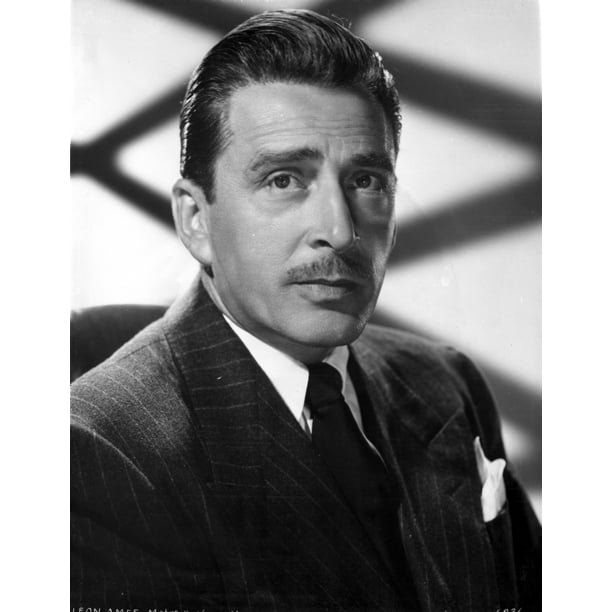
Leon Ames Photo Print (8 x 10) - Walmart.com - Walmart.com
Photo: walmart.com

Ames was born Harry Wycoff in Portland, Indiana and was raised on a farm. He said he changed his name because it was often misspelled which I can understand because some sources say “Wykoff,” and some say “Waycoff” in addition to “Wycoff.” Ames was his mother’s maiden name.

After graduation, he enrolled in Indiana University at Bloomington. He then served in the field artillery for WWI and later transferred to the flying corps.

After his discharge, at some point, he began working as the stage manager for the Charles K. Champlin Theatre Company. He had always wanted to be an actor and soon began acting with the group, eventually gettng the lead in a Los Angeles production of “Tomorrow and Tomorrow.” For three years he was with the Stuart Walker Stock Company in Cincinnati, Ohio. Broadway would be a big part of his early career as he debuted in 1933 in “It Pays to Sin” and went on to perform in another eleven shows.

In 1937, Ames decided to make the move to Hollywood. At that time, he met Christine Gossett, and the couple married in 1938. Leon and Christine appeared in several films together including Eighth Wife and Suez, but after having two children, Christine retired from acting to raise the children. The couple was together for the rest of Ames’ life.

Ames accumulated 158 acting credits; 125 of those were on the big screen. His debut came in 1931 in Quick Millions and his last role was as the grandfather in Peggy Sue Got Married in 1986.

Even though 5/6 of his career was spent in films, I am including him in our television character series because the 1/6 of his career in television made quite an impact. From 1951 until 1979, he would appear in 29 different shows, and five of those would be as a regular cast member.

Life With Father | Nostalgia Central
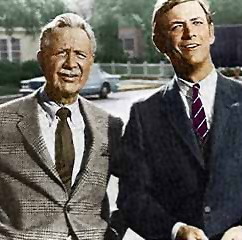
Life with Father cast–Photo: nostalgiacentral.com

Not surprisingly, given his depth of film work, he began his television career in a variety of drama shows such as Screen Directors Playhouse and Studio One. In 1953 he was cast as Clarence Day in Life with Father, adapted from the film. Unfortunately, the show only lasted for a limited number of episodes. I’m not sure how this show fit into the television schedule because it was on for three seasons; a few sources listed 8 episodes, imdb.com lists 10 episodes, and tvseriesfinale.com mentions 27 episodes; even then, it would mean 9/year which doesn’t seem to make a lot of sense. Fun fact, this was the first show in Hollywood to be filmed in color.

After the cancellation of Life with Father, he continued to guest in dramas, but was once again offered a recurring role in a comedy on Father of the Bride in 1950, another television show that was adapted from the big screen.

Pin on Mayberry
Ames with Aneta Corsaut on The Andy Griffith Show–Photo: pinterest.com

In the sixties, he gravitated toward sitcoms, showing up in The Lucy Show, Please Don’t Eat the Daisies, The Beverly Hillbillies, and The Andy Griffith Show.
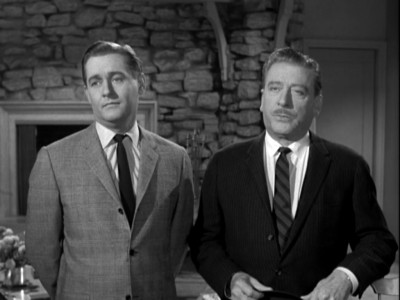
DVD Talk
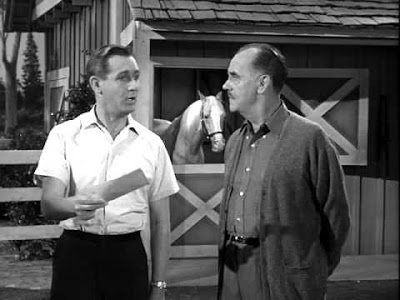
With Alan Young on Mister Ed–Photo: pinterest.com

It was during this time, that Leon probably became best known to television fans.  From 1963-1965, he portrayed Gordon Kirkwood on Mister Ed. During the early seasons of the show Roger (Larry Keating) and Kay Addison (Edna Skinner) lived next to Wilbur Post (Alan Young) who owns Mister Ed. They become good friends with Wilber and his wife Carol (Connie Hines). Keating died in 1963 and Ames and his wife Winnie (Florence MacMichael) buy the Addison home. We also learn that Kirkwood was Wilbur’s former commanding officer when they were in the US Air Force.

In a frightening experience, in February of 1964, an intruder entered the Ames household and held Leon and Christine hostage, demanding $50,000. Ames phoned his business manager and asked him to go to the bank and then bring the money to the house. Once he got the money, the intruder left Ames tied up in the house and forced Christine to drive him in their car. Before leaving, he forced both the business manager and a guest at the home into the car trunk. Luckily, before Ames’ manager brought the money to the house, he had called police who eventually caught up with the car, surrounded it, and freed the hostages.

His next regular role was that of Dr. Roy Osborne on My Three Sons.  I enjoyed his performances on this show.  At first, Robbie thinks he is too old-fashioned to be Katie’s Ob/Gyn because he delivered her, but Robbie soon learns his caring ways and wealth of experience is invaluable.
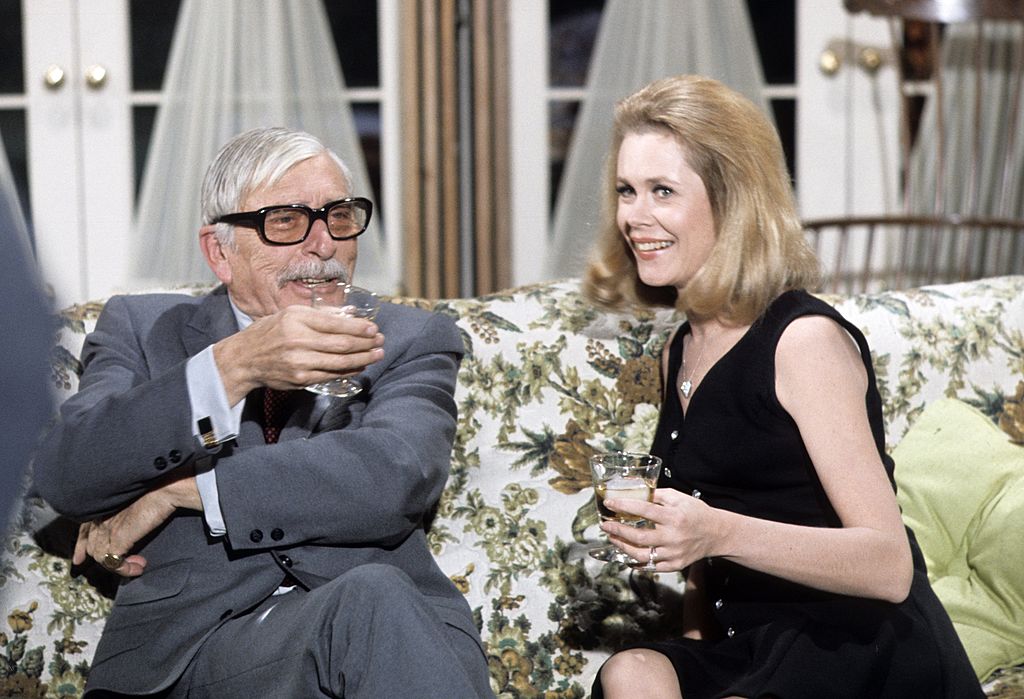
Leon Ames — Life and Death of the Notable 'Mister Ed' Actor
Ames and Elizabeth Montgomery on Bewitched–Photo: amomama.com

The remainder of his television career was spent in a variety of genres including Bewitched, The Virginian. Apple’s Way, and Emergency, among others.

Ames was one of the founders of the Screen Actors Guild in 1933 and became president of SAG in 1957. In 1980, Ames was the recipient of the Screen Actors Guild Life Achievement Award.

In addition to his acting duties, in the sixties, Ames opened several Ford dealerships in California.

Leon died in October of 1993 after having a stroke.
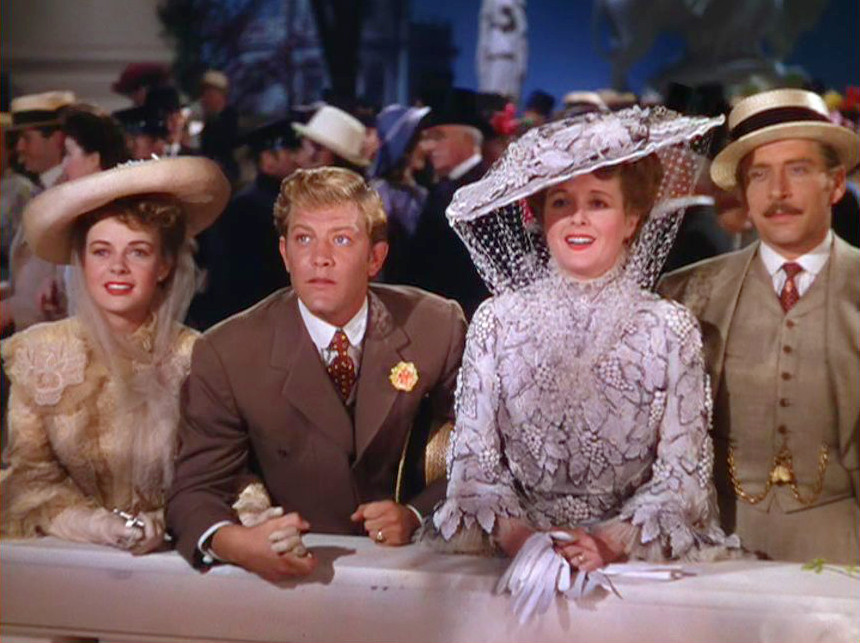
DREAMS ARE WHAT LE CINEMA IS FOR...: MEET ME IN ST. LOUIS 1944
Meet Me in St. Louis Photo: pinterest

One of my favorite roles of Ames was as the father in Meet Me in St. Louis. He had that perfect gruffness for a paternalistic role but made it obvious that there was a giant teddy bear just below the surface. What a character he was.
Mister Ed:

In the 1960s we had some crazy sitcom situations: a wife who was a witch, a genie who was found in a bottle, a dead mother who inhabited a car, and the Munsters who tried to adjust to a normal human world.  One show that was not that incredible was Mister Ed. If someone said they were writing a show about a talking horse, it should sound a bit far-fetched, but when you watched the show, it all seemed quite plausible. Let’s take a look at what made Mister Ed a fairly well-written and enjoyable series.

mred8


Mister Ed was developed by Arthur Lubin, a producer and director. Lubin had worked on the Francis the talking mule movies. He wanted to make a similar show for television. He was unable to gain the rights to Francis, but then he heard about children’s author Walter R. Brooks. Brooks had a series of short stories about a talking horse. His stories were published by Bantam, but since he passed away in 1958, he was never able to see the television show his work inspired.

mred1


The pilot was financed by George Burns and filmed at his McCadden Studio. It was titled “Wilbur Pope and Mister Ed.” Scott McKay played Wilbur Pope, Sandra White played his wife, and Mr. Ed was played by a chestnut gelding that was temperamental and difficult to work with.


mred5

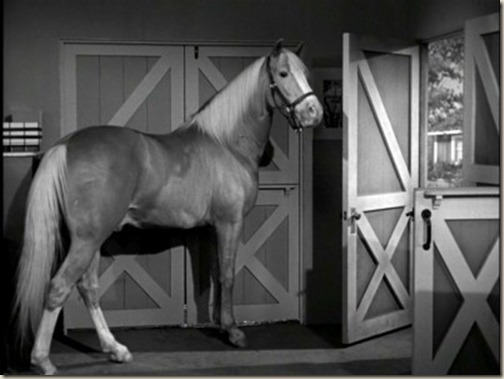
Lubin was not able to sell the show to one of the major networks, so he financed it as a syndication sitcom. The cast was switched up a bit. Bamboo Harvester, a golden Palamino, was brought in as Ed and his voice was kept secret at the time but was Rocky Lane, an older Western star.

Allan Young came on board as the now named Wilbur Post, and Connie Hines played his wife Carol. Young was actually a blonde but in the black and white version, his hair blended into the horse’s, so Connie Hines’ hairdresser would dye Young’s hair brunette. Originally Lubin discussed naming it The Alan Young Show, but Alan did not want to do that in case it bombed. He did, however, buy into the show, which resulted in his earning a lot of money later.

Ed’s singing voice was provided by Sheldon Allman. However, the line “I am Mister Ed” at the end of the theme song was done by the song’s composer, Jay Livingston.

Jay Livingston and Ray Evans wrote the theme song. An instrumental version was used for the first seven episodes, and then lyrics were added. The lyrics are:

A horse is a horse, of course, of course.

And no one can talk to a horse, of course.

That is, of course, unless the horse is the famous Mister Ed.

Go right to the source and ask the horse.

He’ll give you the answer that you’ll endorse.

He’s always on a steady course.

Talk to Mister Ed.

People yakkity-yak a streak and waste your time of day,

But Mister Ed will never speak unless he has something to say.

A horse is a horse, of course, of course.

And this one’ll talk ’til his voice is hoarse.

You never heard of a talking horse?

Well listen to this: I am Mister Ed.


ed7


The first 26 episodes were so popular, CBS picked it up. It aired on CBS from October 1961 until February 1966. During the sixth season, CBS moved the show from the prime time schedule and broadcast it on later on Sunday afternoon. There are 143 episodes in all, and they were all filmed in black and white.


lark

Photo: Hooniverse.com

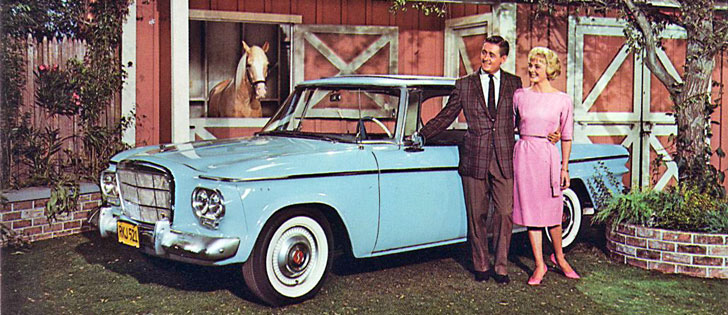
Lubin got Studebaker Packard Corporation to sponsor the show in syndication which it continued to sponsor once CBS picked it up. The Posts own a 1962 Lark convertible. Studebaker’s sales plummeted in the early 1960s, and production stopped in 1963. From then on, Ford provided the cars seen on the show.

Ed also had a double named Pumpkin, a quarterhorse, which was his stunt double. Later Pumpkin was featured in a pudding commercial and went on to appear in another Filmways Presentation show, Green Acres.

The Posts live in Los Angeles. Wilbur was an architect.

mred7

Photo: youtube.com

The Posts’ neighbors and friends were Roger and Kay Addison played by Larry Keating and Edna Skinner.  Keating died in the middle of the series, and Edna continued on the show. Later Wilbur’s former commanding officer, Col. Gordon Kirkwood (Leon Ames) and his wife Winnie (Florence MacMichael) moved into the Addisons’ home.

guest2

Both the Addisons and the Kirkwoods think Wilbur is a bit nuts. They often hear him talking to himself and, to cover for Ed, he gets involved in a lot of awkward situations. Wilbur is also a bit accident prone.

Wilbur’s wife resented the time Wilbur liked to spend with his horse instead of her. Her father, Mr. Higgins (Jack Albertson), thought she should leave Wilbur and considered him a “kook.”

mred9

Mr. Ed only talks to Wilbur. The only reason given for Ed refusing to talk to anyone else is that he thought Wilbur was the only person worth talking to. It worked because Ed was not treated as an unbelievable horse who could talk. He appeared as an equal character. Ed was also quite intelligent. He could read and play chess. He was able to use the phone to get information.  Bamboo Harvester really could answer the phone; he just could not have a conversation. He was also able to open the barn door. Ed would also pout at times when he didn’t get his way and threatened to run away a lot.

mred6

Photo: itschess.blogspot

In an online article, “The World of Mr. Ed-What You Didn’t Know About the Talking Horse,” written by Ed Gross on April 24, 2018, he quoted Ben Starr who wrote 42 of the episodes. He explained that the reason the show worked was because he and producer Lou Derman “really knew how to do that show because we figured out how to make it work for kids and grownups. You had to take care of the grownups, and that was our secret.”

Mister Ed featured a lot of famous guest stars including Mae West, Clint Eastwood, George Burns, Zsa Zsa Gabor, Leo Durocher, Jon Provost, Sebastian Cabot, Donna Douglas, Irene Ryan, Alan Hale Jr., Neil Hamilton, William Bendix, Sharon Tate, and Jack LaLanne.


ed2

Bamboo Harvester was trained by Les Hilton.  At a time when trainers could be considered somewhat cruel, Hilton was always respectful of his animals and never used force or abuse on them. Hilton had to be on the set whenever the horse was. To make Ed appear to be talking, Hilton originally used a nylon thread to open his mouth. Bamboo Harvester was quite smart though and learned to talk on cue whenever Hilton touched his hoof. A story made the rounds that Ed was made to talk by applying peanut butter to the horse’s mouth, but later Young admitted he made that up because it was more interesting than the real story.


ed5

Bamboo Harvester appeared to be a professional. He usually only needed one take to complete his action. Hilton had to teach him to play a variety of sports including riding a skateboard. However, when he got tired of working for the day, he just walked off the set. He received twenty pounds of hay and a gallon of sweet tea daily.

Apparently Young and the horse became close. Young had a great respect for his co-star and after the show ended, he would make trips to see Bamboo Harvester in his retirement.

ed4


I could not find a definite date of death for the horse. There are a lot of conflicting stories about it. Young claimed that the horse was in a stable in California where he lived on Hilton’s property. One version is that one day when Hilton was out of town, Bamboo Harvester was given a tranquilizer because he was having trouble getting up and he died hours later. Another story I read was that the horse was euthanized in 1970 in Oklahoma. He was reported to be suffering from arthritis and kidney problems.

One story I did confirm is that a horse did die in February of 1979 in Oklahoma, but it was not Bamboo Harvester, but a horse that posed for still pictures for the show which led to false reports of his being Mr Ed when he died.

Apparently, a reboot was planned for the Fox network in 2004, starring Sherman Hemsley as the voice of Mr. Ed, David Alan Basche as Wilbur, and Sherilyn Fenn as Carol. I could not find any information whether a pilot was ever filmed or not.

Another movie version was discussed in 2012 when Waterman Entertainment announced they were developing a new feature film based on the television show. Once again, I could not find any further information on the movie.


Mister Ed was popular during its run. A lot of collectible products were created in the 1960s including comic books and board games.

Mister Ed was not a show on my “must-watch” list, and I don’t watch a lot of the reruns. However, when I do catch one, I never feel like I wasted my time. The show worked and felt believable. Currently, it is not on either Me TV or Antenna TV, but it is available on DVD.

Just When You Think It Can’t Get Any Weirder, It Does

Although I love The Big Bang Theory and Modern Family, there are a lot of shows on television today that make me shake my head.  It’s amazing what is airing when you scroll through the channels:  Vanilla Ice Goes Amish, I Cloned My Pet, Doomsday Preppers, and these are some of the best reality shows out there.  However, when I researched sitcoms from the classic era, I also found a lot of weird concepts there also.  Let’s take some time to look at a few of them.


unusual1

Boss Lady (1951)

Lynn Bari was Gwen Allen, owner and operator of Hillendale Homes Construction Co. which was owned by her father.  While this show would not seem unusual at all today, back in 1951 it was not common to see a woman the boss of a construction crew. This show began on the Dumont network and then switched to NBC for twelve episodes, running as a summer replacement from July to September 1952.


Where’s Raymond? (1953)

Believe it or not, this was a musical sitcom.  Ray Bolger (who had sang and danced as The Scarecrow in The Wizard of Oz) was a song and dance man named Ray Wallace living in Pelham, New York. He had a girlfriend named Susan (Marjie Millar) and a business partner Peter (Richard Erdman). Verna Felton from December Bride was his understudy’s mother-in-law. The show lasted 2 ½ years on ABC.


The People’s Choice (1955)

Ok, pay attention, because the basis of this show is confusing. Socrates (Sock) Miller played by Jackie Cooper is a Bureau of Fish and Wildlife Orinthologist studying to be a lawyer.  Honestly! He has car trouble one day and is picked up (and picked up) by the mayor’s daughter Mandy who thinks he should be on the city council. Sock decides to be a lawyer to support Mandy.   In the finale to year one, the two elope and conceal their marriage for the entire second season.  When the show came back for a third year, the mayor finds out about the marriage, Sock gets his law license, and Sock’s free-loading pal Rollo (Dick Wesson) moves in with the couple.  Now Sock is managing a real estate development. Just when you thought it could not get more confusing, Sock’s basset hound Cleo would do tricks and comment directly to the audience about situations occurring on the show. LSD had not even become a social problem yet, so it was not responsible for this show, so I’m not sure how this crazy mess stayed on the air for 104 episodes.


TSDDIAN EC004

Dick and the Duchess (1957)

Dick Starrett (Patrick O’Neal) is a claims adjuster in London.  There are some exciting scenarios to provide interest. He meets and marries Jane (Hazel Court) a duchess. She becomes his wife and assistant, although she still expects to live in the manner she has become accustomed to.  She humorously gets involved in his investigations. The network must not have thought she was that funny helping out because  CBS cancelled it after 25 episodes.


Mr. Ed (1961)

Let me say, I do not put Mr. Ed in the same category as Dick Van Dyke Show, That Girl, or Bachelor Father, but I don’t mind catching an episode or two now and then.  When looking at strange concepts for show, this one does have to go into the mix.

When the creator asked Young to appear in the show, he turned him down twice. A pilot was made without him. It did not sell, so producers Arthur Luben and Al Simon decided to enter it directly into syndication, and Young then agreed to take on the role. It was very successful, so CBS bought it.

Wilbur Post (Alan Young) is a married architect. Wilbur and his wife Winnie (Connie Hines) bought their house with a horse included. Their neighbors were played by Edna Skinner and Larry Keating. What no one else realized (including his wife), was that Wilbur was the only human who could understand Ed and talk with him.  Ed was quite the character; he was a hypochondriac; a voracious reader; a playboy, or play horse; loved Carl Bernstein and wanted to decorate his stable in Chinese modern.

The voice of Ed was a highly guarded secret until the show ended in 1967 when it was revealed to be Rocky Lane. Ed was played by Bamboo Harvester, a palomino. One interesting fact about this show is that it has been seen in 57 different countries.


My Mother the Car (1965)

This is another one of those shows you roll your eyes about.  Dave Crabtree (Jerry Van Dyke) lives in LA.  He wants to buy a new station wagon, and when he goes shopping, he realizes his mother’s voice is coming through the radio of a 1928 Porter.  Ann Sothern provides his mother’s voice. Of course, he buys the car which irritates his family, but they don’t know his secret. He also has to deal with a car connoisseur who wants to buy the car for his collection. Maybe it’s a Freudian slip, but I’m a bit offended that a mother is portrayed as an old jalopy as opposed to a new, sleek car, but I digress. This show was only on the air for a year and then the radio was turned off.


unusual11

The Second Hundred Years (1967)

Here is the premise of this one:  In 1900, 33-year-old Luke Carpenter (Monte Markham) is prospecting for gold in Alaska.  An avalanche occurs, and he is buried alive and frozen.

In 1967, Luke’s son Edwin, who is 67, is told that his father has been found alive.  Dad looks 33, but his identity and past has become a top-government secret.  He is released into the custody of Edwin (Arthur O’Connell) and grandson Ken (also Monte Markham). Luke has a hard time adjusting to life in the 1960s. I know you are surprised, but the show was cancelled after 30 episodes.


My World and Welcome to It (1969)

This show was based on James Thurber’s writings. The show was set in Connecticut where John Monroe (William Windom) was a cartoonist for Manhattanite Magazine. He was intimidated by his wife Ellen (Joan Hotchkiss). To escape his boring and nagging life, he escapes into a secret world where his cartoons come alive and he is a king. He drifted between real and fantasy lives. NBC cancelled the show after a year, but CBS picked it up and aired it from May-September of 1972. So, the presence of LSD does explain the writing on this one. What it doesn’t explain is that this show won two Emmys in 1970 : Outstanding Continued Performance by and Actor in a Leading Role in a Comedy Series and Outstanding Comedy Series. The competition for comedy included Love American Style, Room 222, The Bill Cosby Show, and The Courtship of Eddie’s Father.


The Roller Girls (1977)

Meet the Pittsburgh Pitts, an all-women roller derby team, owned and managed by Don Mitchell (Terry Kiser). The Pitts were pretty but useless when it came to roller derby. James Murtaugh played the team’s announcer Howie Devine. After four episodes, the network agreed this really was the pits and it was cancelled.


unusual14

Apple Pie (1978)

This show aired for one episode – I thought they used to call that a movie. (A couple sources say 2 episodes, perhaps a mini-series.) The show is set in Kansas City, Missouri. A hairdresser named Ginger Nell Hollyhock (Rue McLanahan) is lonely and decides to advertise in the local paper for a family. She ended up with a con artist, Fast Eddie (Dabney Coleman), a tap-dancer daughter, a son who wanted to fly just like birds do, and a grandfather figure (Jack  Guilford).


So, when you think you’ve seen it all before, you probably have. I would not be the least surprised to read that in the fall there will be a reality show that features a roller derby team, or a woman who advertised for a family in the personal ads, or an insurance adjustor married to royalty.

I do have to say that both Dick and the Duchess and My World and Welcome To It  seem to have some die-hard fans who appreciate the shows  I guess I should watch a few more episodes.

Listen up you sitcom developers; if you think you have a concept that’s a bit too far out there, it will probably be a big hit. After all, who would have guessed a show about an alien from Ork who traveled in an egg, and gave birth to a 79-year old man would score high ratings?