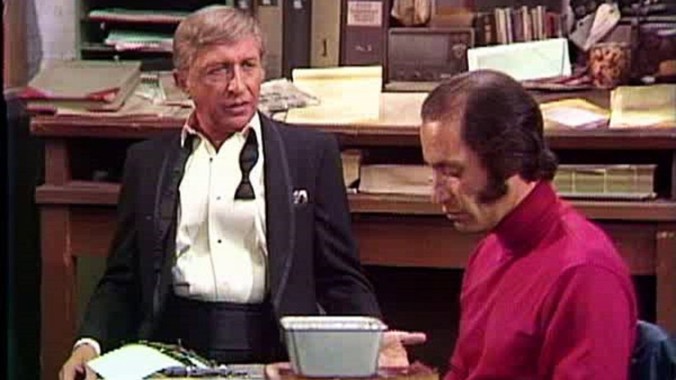
Sheldon Leonard: A True TV Pioneer

leonard4

The Depression changed the course of Sheldon Leonard’s life. He was born in Manhattan to Jewish parents. He went to Syracuse University on an athletic scholarship. While there, he was president of the dramatics club. His degree was in finance, and he landed a job at a prestigious brokerage firm. Then the Depression hit, and he was out of a job. He had to fall back on the only other skill he could think of which was acting.

In 1931 he married Frances Bober whom he was married until his death. They would have two children.

Acting was not quick money either though. It took five years until he landed his first major Broadway role in Hotel Alimony in 1934. It did not have a long run, but his next two shows were more successful: Having a Wonderful Time in 1937 and Kiss the Boys Goodbye in 1938.
leonard7

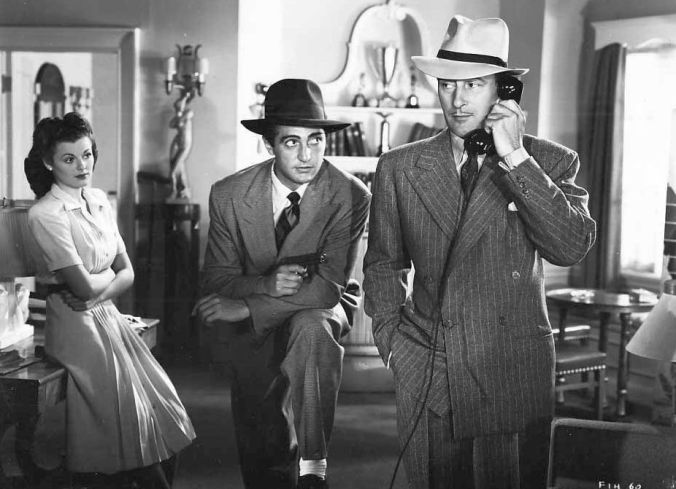
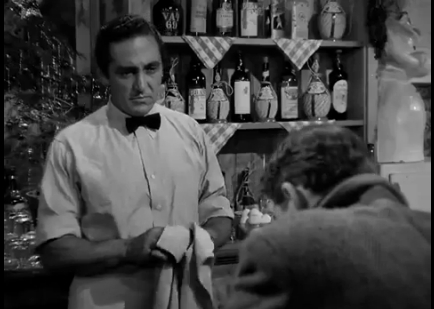
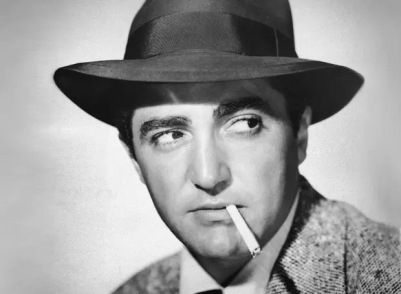
He then entered film work. He had several very small roles in a couple of movies and a couple of shorts, but in 1939 he was cast in Another Thin Man, the popular movie series with William Powell and Myrna Loy. That began his career as a heavy, often being cast as a gangster. He would appear in To Have and Have Not with Bogie and Bacall in 1944. In 1946 he was cast as the bartender in It’s a Wonderful Life with Jimmy Stewart and Donna Reed. Because it has become a Christmas staple, it has brought Sheldon a lot of recognition. Sheldon would appear in 74 movies during his career, 69 of them by 1952.
leonard2

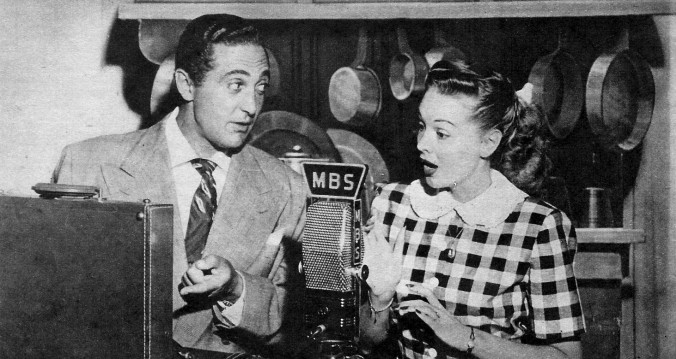
During this time, he also gave radio a try. He was working on both sides of the mic. He sold scripts to several shows including Broadway is My Beat. He also portrayed his stereotyped gangster role on many shows including as Grogan on The Phil Harris, Alice Faye Show. You could hear him on Jack Benny, Burns and Allen, Bob Hope, Duffy’s Tavern, the Halls of Ivy, and The Judy Canova Show, among others.
sheldon6

Photo: radiospirits.com

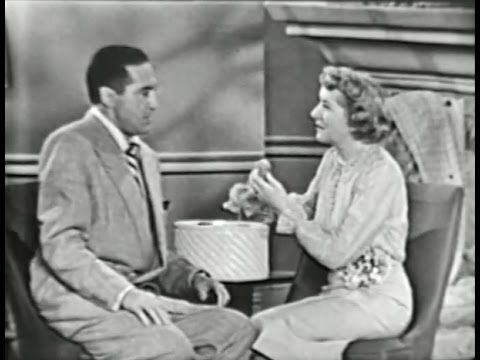
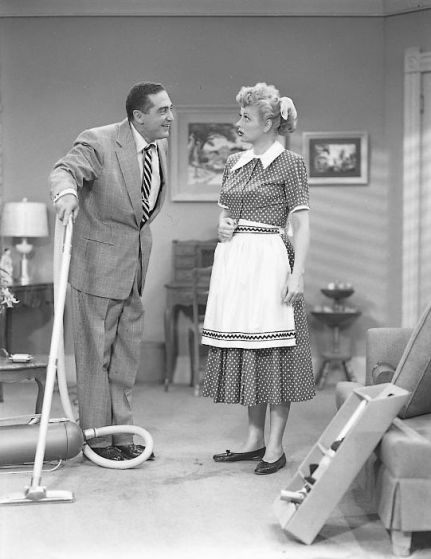
It was only a matter of time before Sheldon took his talents to television. He appeared in four episodes of Your Jeweler’s Showcase in 1952. In addition, he was listed as producer and director for several of these episodes. He appeared in I Love Lucy in 1953 as vacuum salesman Harry Martin and several I Married Joan episodes in 1952-53. One of my favorites was his role as Johnny Velvet on Burns and Allen when he kidnaps Gracie but takes her back because she drives him crazy. In 1954 he co-starred in The Duke which lasted 13 episodes.  This show featured an artistic boxer who leaves the ring to open a nightclub. Sheldon also directed the pilot as well as some early episodes of Lassie and The Real McCoys.
leonard14

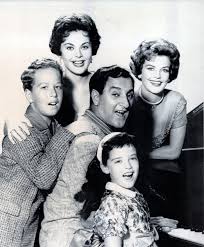
However, the show that made him a household name was his director/producer role on Make Room for Daddy, Danny Thomas’s hit sitcom. The show was in the top ten, and Sheldon even found time to appear on the show 19 times. The show continued from 1953-1964. Leonard had found his sweet spot. During his career, he would direct and produce shows such as The Dick Van Dyke Show, The Andy Griffith Show, Gomer Pyle USMC, and I Spy.
sheldon4

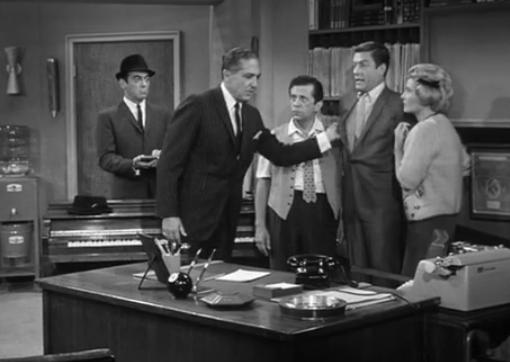
Sheldon convinced Carl Reiner to step back from acting as Rob Petrie and produce The Dick Van Dyke Show. That conversation resulted in Dick Van Dyke accepting the role, leading to 158 episodes. If you watch carefully, you will notice Sheldon appearing twice on the show in minor roles. The show was nominated for 25 Emmys and won 15.
leonard12

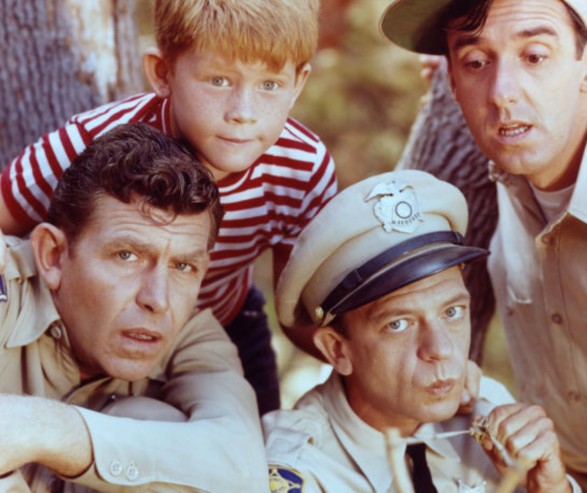
Sheldon also is credited with creating the spinoff. One of Danny Thomas’s episodes was set in North Carolina where he gets picked up for speeding in a rural town and has a run-in with Sheriff Andy Taylor. This episode turned into the long-running The Andy Griffith Show which was on the air from 1960-1968 netting 249 episodes. The show won 6 of the 9 Emmys it was nominated for.
sheldon3

The spinoff was so successful he did it again, moving Jim Nabors as Gomer Pyle from the gas station attendant on The Andy Griffith Show to his own show, Gomer Pyle USMC. That show was on the air for five years (150 episodes), and Sheldon would also make an appearance there as Norman Miles.

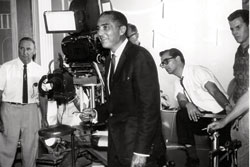
Thomas and Leonard as L&T Productions were also behind the The Joey Bishop Show and The Bill Dana Show. Thomas and Leonard’s shows were notable for emphasizing characters and relationships over slapstick or situation comedy. You cared about the characters even when they were a little kooky like Gomer Pyle or Barney Fife. They were committed to high-quality scripts. Many of the writers they employed went on to successful shows of their own including Danny Arnold for Barney Miller; Garry Marshall and Jerry Belson for The Odd Couple, Happy Days, and Laverne and Shirley, Mork and Mindy; and Bill Persky and Sam Denoff for That Girl and Kate and Allie. L&T Productions ended in 1965.
leonard9dga.org

Photo: dga.com

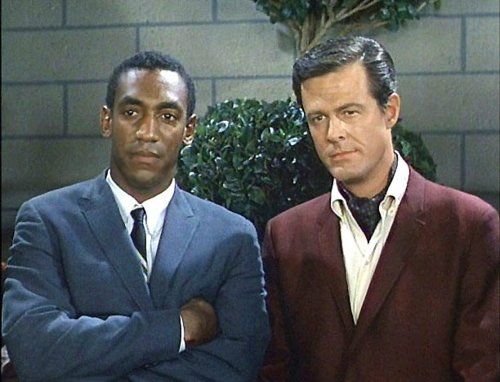
In the mid-1960s Sheldon produced I Spy. He cast Bill Cosby and Robert Culp as secret agents.  This was the first series to star a black actor in a lead role. In a March 7, 2016 Modern Times article, David Fantle and Tom Johnson discussed Sheldon Leonard and I Spy. Leonard said he knew what he was doing. “Race was very much an issue at that time,” he said. “I was intellectually conscious of it, but emotionally unaware of it. When I say emotionally unaware, I mean I was free to think of Cosby as the man to fill the slot I needed. Intellectually I knew the problems I’d have to face to get him on the air.” I Spy was a humorous suspense show and was known for its exotic locations, filming in countries such as Hong Kong, England, Morocco, France, and Greece among others. The critics rewarded Leonard. The show was nominated for Outstanding Dramatic Series Emmy every year of its three-year run and earned Leonard an Emmy nomination for directing in 1965.
sheldon7

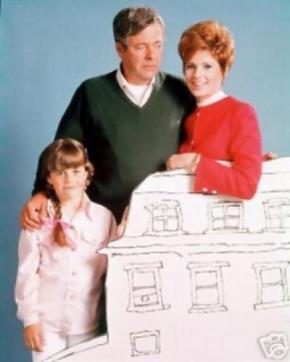
Sheldon was also the producer behind Accidental Family and Good Morning World, both shows debuting in 1967 and ending in 1968 and My World and Welcome to It in 1969. Accidental Family was about a widower who is a stand-up comedian. He buys a California farm which is managed by Sue Kramer who is also his son’s governess and his love interest. Good Morning World was about morning disc jockeys in LA. One is happily married, and one is a ladies’ man. Goldie Hawn was the next-door neighbor and Billy De Wolfe was their boss. On My World and Welcome To It, John Monroe is a married man with a daughter. He frequently daydreams and fantasizes about life. This show was unusual in that it included some animation along with the live action.
sheldon9

In the Fantle and Johnson article referenced above, Leonard also talked about his favorite sitcom. He said his favorite might be the one that needed the most attention. “My favorite show was cancelled after the first year. My World and Welcome to It, based on the writings of James Thurber and starring William Windom. It won every award, and they cancelled . . . It was satire and above their (the network bosses’) heads. That show and I Spy are my favorites.”

In the early 1970s Sheldon would produce From a Bird’s Eye View and Shirley’s World. From a Bird’s Eye View was a sitcom about two stewardesses, Millie from England and Maggie from America. Millie was always getting into mischief and Maggie bailed her out. Shirley’s World starred Shirley MacLaine as a photographer who travels the world for her London-based magazine. The locales were similar to I Spy.
leonard3bigeddie

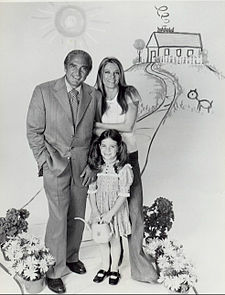
In 1975 Sheldon starred in a new sitcom, Big Eddy which only lasted for ten episodes. He was Eddie Smith was the owner of the Big E Sports Arena in New York. He was an ex-gambler fighting the impulse to get back into it. He has a bunch of eccentric people in his life including his ex-stripper wife Honey and their granddaughter Ginger.

In the 1980s, Sheldon would continue to show up on various television shows, appearing in Sanford and Son, The Cosby Show, Matlock, Murder She Wrote, and Cheers.

Along with author Mickey Spillane, Leonard was one of the first two people to become a Miller Lite spokesman. In his New York accent, he tells the audience, “I was at first reluctant to try Miller Lite, but then I was persuaded to do so by my friend, Large Louis.”

Sheldon Leonard passed away at the age of 89 in 1997. His wife Frances passed away in 1999.
leonard1

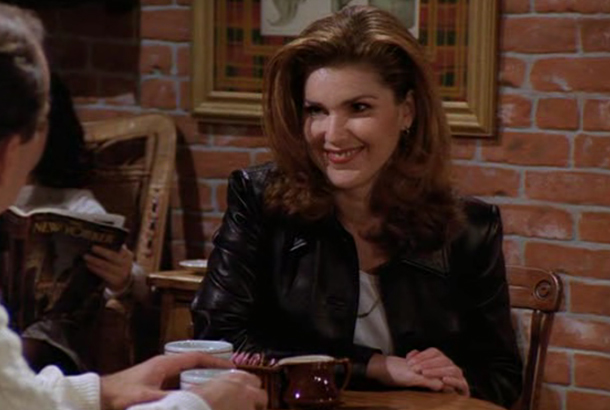
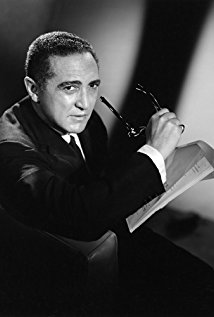
Sheldon Leonard is undoubtedly one of the greatest television producers. Most of his shows were consistently in the top ten. They are classic shows still on the air today.  Sheldon required scripts that brought characters to life. He created spinoffs when he believed in the characters. He was not afraid to take risks. Besides casting Bill Cosby, he cast Lois Nettleton as divorced Sue Kramer on Accidental Family. This was in the mid-1960s and yet when Mary Tyler Moore’s show aired in 1970, the network refused to allow her to be a divorced character.

In the Mercurie Blogspot from November 10, 2013, Carl Reiner discussed Leonard: “Sheldon has mentored more people in our business than anyone else I know. He knew how to teach what he knew, and what he knew was situation comedy with the three-camera technique. Sheldon was a producing genius who understood comedy. He had four or five shows going, but he would walk in and give his intelligence and his time to every script that was being read for the week. And we always came away with a better script because we would discuss and argue and come to a better situation.”
sheldon5

Garry Marshall was also quoted in this same article: “Sheldon was a sort of man’s man, yet he had all the creative sensitivity of the artist. No matter what story you were working on, he could help you fix it. He would never put down your idea. If I had to describe Sheldon in one word, it would be gentleman. He was a Renaissance man with a New York accent—and possibly a gun!”
The Herb Garden Germination

Photo: americanprofile.com

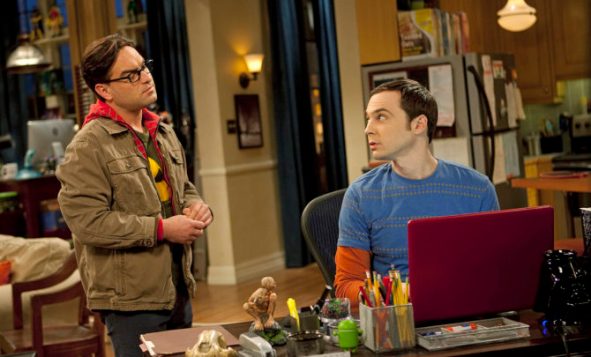
As a salute to Leonard, the writers of The Big Bang Theory, named their main characters Sheldon and Leonard in honor of Sheldon Leonard.
sheldon1

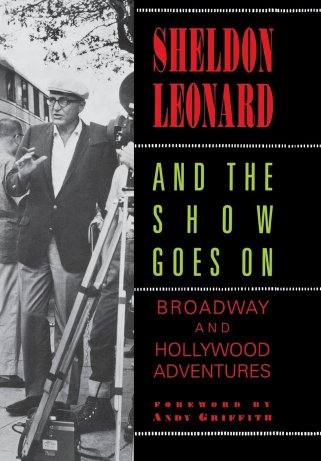
Sheldon himself seems to explain his success best. After working on his memoir in 1995, And the Show Goes On: Broadway and Holiday Adventures, he said “I was driven by an urge to survive and being very self-indulgent. I never did anything for very long that I didn’t like or enjoy. I would survive only on my own terms. I had to enjoy what I was doing, and I would have done what I did even if nobody paid me. That’s the secret of success in any business: do it well and enjoy doing it.”
leonard11

He did it all well, and we all enjoyed it.

Rain, Rain, Go Away

The old cliché is that April showers bring May flowers. So,  today we get a glimpse of April Showers.  I’m just grateful that I did not have to research shows about snowstorms, since Wisconsin received one to two feet of snow two weeks ago, and we’re still waiting for our first April shower. Let’s look at some of the best sitcom episodes about rain.

I am not a fan of Married . . . With Children, but when looking at sitcom episodes about rain, “Who’ll Stop the Rain” needs to be on the list. The title was taken from the Creedence Clearwater Revival song. During a weekend of rain, Al tries several times to fix the house’s leaky roof. He keeps falling off, and his family can’t decide if his worst trait is stupidity or being cheap. While Al continues to climb the ladder, and his family continues to debate his mental status, in a subplot, Steve lands a job at a pet store. He brings home a guinea pig for a pet. Unfortunately, the guinea bites Marcy and she finds out that the bite is full of venom.


One of my favorite rain episodes is a My Three Sons show titled “The Sky is Falling.” This episode is from the seventh season. Robbie and Katie are married and now have three sons. Rob is under some pressure to provide for his family. A friend of Robbie’s, Steve Franken, convinces him he can make a ton of money selling real estate, so Robbie considers quitting school. During a torrential rain, the storm reveals several flaws in a house he’s selling. Robbie must decide if he will cover up the problems or be honest with the potential buyers and lose the sale.

shower8

Another great rain show is the Barney Miller episode “Rain,” an episode from Season 2. Written by Tony Sheehan, the episode features Stanley Brock, Phil Leeds, and Sidney Miller. The team must continue their work even though the precinct roof is threatening to collapse due to a downpour. As the show opens, everyone is unhappy with the weather. There is a deluge of rain out the window, and you can hear the drop of water hitting a pan. Harris and Chano are sent to a nightclub to break up a fight.

shower3

The maintenance man reports that there are 6 inches of water on the roof.   Fish opens an umbrella when a large leak occurs. Everyone who looks out the window gets depressed and complains about their life.

shower1

Harris and Chano bring in a comedian, Jackie Ace. When the audience didn’t like his jokes, he started insulting them. It turned into a free for all, and the owner wants him to pay for damages. He is booked on disorderly conduct. His act is Bicentennial impersonations such as Benedict Arnold turning to Ethan Hale and saying, “Just hang in there kid.” Barney asks Fish if they found a crime for the comedian, and Fish says only his monologue. Jack Soo who plays Yemana with deadpan delivery and a wry sense of humor, uses the rain coming from the ceiling to make coffee.

shower2

Every time we see the room there are more containers collecting water. Eventually the maintenance man reports they now have 5 feet of water on the roof, and it is coming from the buildings surrounding the precinct. Even the file drawers fill up with water. The emergency department for the city says there is no way the roof can collapse. When no nightclub guests press charges, the officers let Jackie Ace go. Eventually part of the roof collapses and Barney, who is typically mild mannered and calm, loses his temper. He has finally had it, and he decides to call the City and give them a piece of his mind, but now the phone line is washed out. At the end of the show when the rain has finally stopped, Barney apologizes to the crew for getting so mad, but they tell him not to worry about it. He just said what they all were feeling.

My favorite rain episode, hands down, is “The Rains Came” from Green Acres. This quirky episode is from the first season. It begins in the Pixley Courtroom. As everyone enters, Mr. Haney introduces Oliver and Lisa to his attorney, Diller Fangworth, played by J. Pat O’Malley. Fangworth doesn’t believe Oliver is really a lawyer because he’s never seen him hanging out with the other lawyers at the saloon across the street. Mr. Haney reprimands Oliver for not settling the lawsuit and gives him another chance to pay. He does take time to compliment Lisa on her sophisticated outfit in the middle of the speech. Fangworth removes his coat and plays with his suspenders. Haney tells Oliver the judge’s favorite actor is Spencer Tracy, and as Fangworth begins questioning the witnesses, he is obviously using his impersonation of Spencer from Inherit the Wind. At one point, the judge tells him he’s seen enough of his Tracy mimicking in the past and to put his coat back on.

tracy

When the judge asks who is representing Oliver, and Oliver says he is an attorney, the judge asks why he’s never seen him across the street at the saloon. We learn that Haney is suing Oliver for $350 for services rendered. Oliver says he did agree to pay $350 but services were not rendered. They begin to recall what led up to the lawsuit.
shower4

Eb is the first witness. He takes the stand, and the judge makes him remove his hat. Eb bought the hat just to go with the suit, so he is not happy. Plus, he worries his hair is now a mess while he testifies. Eb recalls that on the 86th day of the drought, Lisa was talking to Rudolph the sunflower outside their back door. Oliver finds Lisa talking to the plant and thinks the heat has gotten the better of her. When she waters the flower, Oliver reminds here they have acres of plants dying from lack of water. She says she is not wasting water because there is a story from her old country that if you water a sunflower right outside your door, you can ask him for one favor and he must grant it. She is going to ask him for rain. Oliver tells her she is being ridiculous and sends her inside. Then he stops and stares at the sunflower and, making sure no one sees him, he waters it.
The second witness was Hank Kimble. He’s eating lunch when they call him up which leads to some confusion. He takes the oath but feels compelled to say while he doesn’t lie, he did in fact lie to his mother once. The judge stops him and tells him just to answer the questions. Kimble admits Oliver asked him how they could get it to rain, and Kimble said they could seed a cloud; unfortunately, there were no clouds to seed.

Everyone retires to the saloon across the street for lunch. When they reconvene, it’s Mr. Haney’s turn to take the stand. He explains that he and Oliver discussed the drought, and Haney offered to make it rain for $100 with his rain machine. When Oliver says there is no such thing, Haney reveals Chief Thundercloud, played by Robert Strauss. The chief begins playing a drum, but Oliver cuts him off and refuses to pay $100. Haney pulls out jars of water specimens from different areas around the country where the chief has brought rain.

shower7

A couple days later, Haney comes back to give Oliver a second chance. The Chief says he has to work harder now because it’s dryer, so the cost is $350. Oliver agrees to a double or nothing payment. If the Chief brings rain, Oliver will pay, but if not, they get nothing. The Chief does his dance, but after a couple minutes he stops because he is tired and asks Oliver for a glass of water.  Oliver sends then both away. Haney tells the Chief he no longer wants his services. The Chief is walking around Hooterville and meets Lisa at the house; he tells her he needs a job. She tells him to do whatever handyman chores he sees need done and they will pay him. She relays this to Oliver who realizes who he is. He goes outside and finds the Chief washing his car. Oliver tells him to stop wasting water on the car. Suddenly, a rain storm begins.

Mr. Haney is sure it was from the Chief’s dancing, Lisa thinks it is the sunflower, and Oliver says it’s because the Chief washed his car, and everyone knows as soon as you wash the car, it rains.

The judge (played by Howard Smith), tired of the entire bunch, dismisses the case. Everyone returns home.

At home, Oliver finds Lisa talking to Rudolph again. She said she asked Rudolph to bring rain when Oliver was arguing with the Chief about washing the car. Oliver tells her that is silly, so she asks Rudolph to make it rain. Instantly, Oliver has rain coming down on him and looks amazed till he looks up and sees Eb squirting him with a hose.

The characters make this episode funny. Their expressions and mannerisms from Fangworth’s Tracy impersonation to Eb worrying about his hair to Kimble feeling the need to admit he once lied to his mother add dimension to the quirkiness the characters always exhibit. I liked the fact that the judge was not portrayed as a country hick; he is an intelligent and no-nonsense guy who just wants to get his job done right. I also thought it was great that while Oliver knows its crazy that watering a sunflower could produce rain, he still takes time to water Rudolph. It’s a well-written script featuring the true traits of the Hooterville citizens at their best.

Enjoy these rainy days of spring when you can stay indoors and watch old tv episodes.


Do You Hear What I See?

As viewers transitioned from radio to television, there was a lot of conflict as advertisers volleyed between the two mediums. Many critics predicted an early death for radio which never came about.  Radio found its new niche, relying more on news and music. Now, you can actually watch radio on television shows like Mike & Mike on ESPN.

Television has also featured several shows about radio stations over the years.  Today we tune in to five of those.

Good Morning World (1967)

radio3

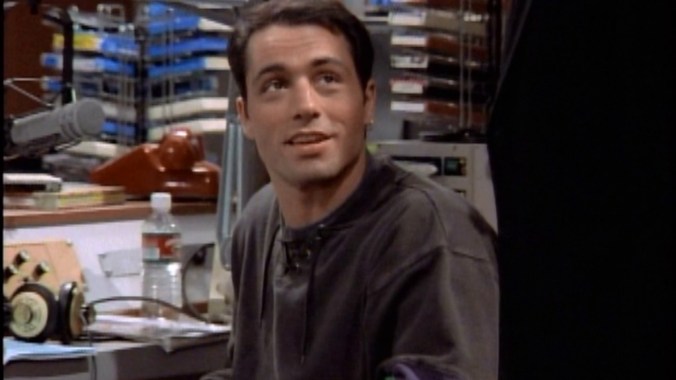
David Lewis (Joby Baker) and Larry Clarke (Ronnie Schell) are early morning DJs in LA with the Lewis and Clarke Show. Dave is happily married, while Larry considers himself a ladies’ man. Billy De Wolfe garnered a lot of attention as the best part of the show  portraying station manager Roland Hutton, a stuffy and humorless boss. Rounding out the cast are Dave’s wife Linda played by Julie Parrish and the debut of Goldie Hawn as their next-door-neighbor.

American actors Goldie Hawn (as Sandy Kramer) and Charlie Brill (as Milton Pervis) appear in an episode of the television show 'Good Morning Wold' called 'Knits To You, Sir,' June 20, 1967.

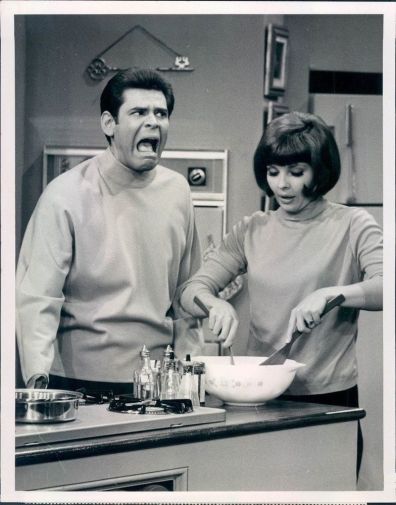
The show was created by an unbelievable group: Carl Reiner, Sheldon Leonard, Bill Persky, and Sam Denoff. They all were part of the creative force of the Dick Van Dyke Show.  Persky and Denoff were also the producers for That Girl. They based this show on their work as writers at WNEW-New York in the 1950s.

radio2

This photo made me laugh.  They could actually be stand-ins for Dick Van Dyke and Mary Tyler Moore. It might even be the same kitchen!

Filmed before a live audience at Desilu, the show was created to showcase Schell.  Ronnie had been a private on Gomer Pyle and this was to be his break-out show. Procter and Gamble sponsored the series which aired Tuesday nights. It should have done well during its slot, being up against NYPD and the Tuesday Night at the Movies.

The ratings were not great, and the network debated whether to cancel the show or bring it back for a second season.  The two deciding factors might have been that Baker had a lot of trouble memorizing his lines and Parrish was dealing with some health issues.  The network considered recasting both roles but ended up cancelling the series after 26 episodes.  Surprisingly, it was released on DVD.

Schell went back to Gomer Pyle, USMC where he was promoted to corporal.

radio1

The best episode is “No News Like Nude News.” The stars are invited to a Nude Ranch and go thinking they are on their way to a dude ranch.


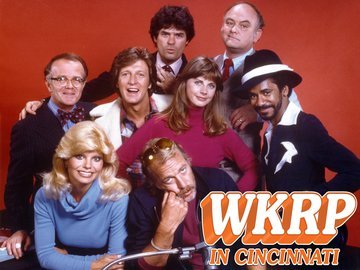
WKRP in Cincinnati (1978)

radio23

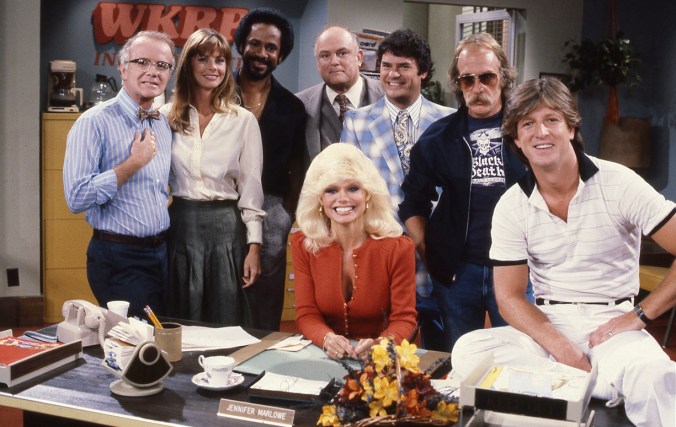
I consider WKRP the second-best radio sitcom. The premise for the show was that a new producer is brought in to help a struggling radio station in Cincinnati.  Changing the format from easy listening to rock brings new life to the station and a lot of chaos to the staff. Hugh Wilson created the format.  He can be seen as a police officer in the episode “Hold Up.”

Along with The Dick Van Dyke Show, The Mary Tyler Moore Show, Barney Miller, and The Office, this was one of the best ensemble casts in television. The characters included:

radio31

Andy Travis (Gary Sandy) is the producer who has a successful history of turning stations around.

Arthur Carlson (Gordon Jump) is the station manager whose mother owns the station. The Big Guy’s management style is a big part of why the station is not doing well.  Art is more interested in fishing than radio. Jump was a DJ in Dalton in his former life.

radio24

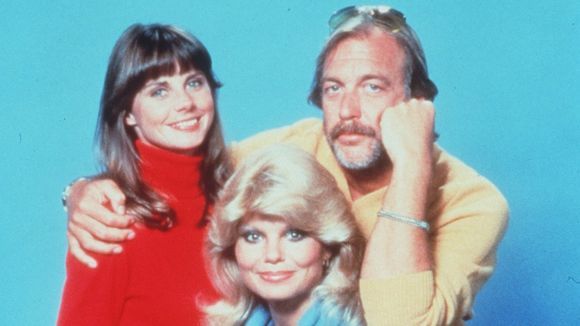
Jennifer Marlowe (Loni Anderson) is the smart receptionist who is the highest-paid staff member. Anderson refused to be cast as a dumb blonde.  Jennifer has a journalism degree and although she is only receptionist, she has the skills that keep Art Carlson out of the loop and everything running smoothly at the station. She is gorgeous and kind-hearted, but she refuses to type letters or make coffee.

Les Nessman (Richard Sanders) is the incompetent news reporter. He always wears bow ties and is best friends with Herb. Richard has a bandage on his head from a real-life injury in the pilot and he made that one of his trademarks.  He often shows up with bandages on various parts of his body and we later learn that he has a large dog.

Herb Tarlek (Frank Bonner) is a tasteless boor. He is married but is always coming on to Jennifer. Herb’s suits are even louder than he is.  In one episode, Venus says “Somewhere out there there’s a VW with no seats.” One of his suits actually was made from VW covers. Bonner grew up in Arkansas, and Herb always has a Razorback mug on his desk.

Bailey Quarters (Jan Smithers) originally took care of billing but is also a journalism major and shows she is a more competent on-air reporter than Les. She and Fever date off and on.

Venus Flytrap (Tim Reid) is the soulful, smooth-talking DJ.  Although he is on the air at night and Fever has the morning shift, they become best friends. His real name was Gordon Sims and he was a school teacher before his DJ career took off.

Dr. Johnny Fever (Howard Hesseman) is the burned-out DJ from LA.  He was fired for saying “booger” on the air at his last job.  He’s an insomniac and addicted to coffee.  His hippie lifestyle and cynicism do not mesh with Herb and Les. Originally Hesseman was asked to read for the part of Les Nessman but would only audition for Fever. David Cassidy turned down the role of Johnny Fever. The character of Fever was based on Atlanta’s Bobby Harper who was on the morning show on WQXL 790 AM.  The creator of the show, Hugh Wilson, had previously worked there.

In many of the scenes there were bulletin boards with bumper stickers plastered all over that had been sent in from radio DJs all over the country. As a tribute to John Lennon, his photo was displayed in the background after his assassination.

radio21

The show was videotaped because rock song rights were cheaper for taped shows than filmed shows. When the show went into syndication, almost all of the music had to be replaced.  When the DVD set was being created, the original music was put back in.  An agreement could not be reached until 2014.

Although it’s hard to believe, in 1980 Hugh Wilson collaborated with Hanna-Barbera to create an animated version of WKRP where all the characters are played by dogs.  The show never actually happened.

WKRP was on Monday nights against Welcome Back Kotter and Little House on the Prairie. After the first season, it was moved repeatedly. The show was cancelled after four seasons. It accumulated ten Emmy nominations including three for outstanding series. The show was much more successful in syndication.

radio12

The show was filmed in Los Angeles, but the opening and closing scenes as well as several episode scenes were filmed at the Enquirer Building in Cincinnati.  That building is currently a Hampton Inn/Homewood Suites at 615 Vine St. near Fountain Square.  The radio station said they were housed in the Osgood R. Flimm Building.

One of the most memorable parts of the show was the theme song:

“Baby, if you’ve ever wondered, wondered whatever became of me.  I’m living on the air in Cincinnati, Cincinnati WKRP. Got kind of tired of packin’ and unpackin’, town to town, up and down the dial. Maybe you and me were never meant to be, just maybe think of me once in a while. I’m at WKRP in Cincinnati.”

WKRP in Cincinnati

In 2015, a non-profit radio station in Raleigh, 101.9 was given the WKRP call letters. An independent television station, channel 25, in Cincinnati also received the WKRP designation in 1990.

The clever writing and memorable characters have gained this sitcom a great reputation in television history.

Hello Larry (1979)

radio6

McLean Stevenson was hoping to be the star of M*A*S*H.  Once he realized Alan Alda was firmly entrenched in that position, he opted out of his contract to star in his own show.

The result was Hello Larry about a man, Larry Alder, who is divorced and moves with his two teenage daughters to Portland to star in a call-in psychiatric radio show. Kim Richards played his daughter Ruthie and Krista Erickson played Diane. Lisa Whelchel auditioned for the role of Ruthie but lost out to Richards and ended up on Facts of Life which she was grateful for.

radio10

The other cast members included Joanna Gleason (Monty Hall’s daughter) as the radio producer, George Memmoli as Earl the engineer, and John Femia as Tommy Roscini. Larry also hung out with a familiar face – -Meadowlark Lemon, former Globetrotter, who owned a Portland sporting goods store.

The show was owned by the same company who created One Day at A Time and this was a mirror image of that show focusing on a single mom with two daughters.

radio8

The ratings were not good. The show was up against Charlie’s Angels and the Wednesday Night Movie. Several months into the season, to bolster ratings, the writers brought in the cast of Diff’rent Strokes which was a popular show that aired right before Hello Larry.  It was scripted that Larry and Phil Drummond had served together in Korea.  It did not help the ratings. The show went through a variety of scheduling changes all with the same result.  An issue that certainly didn’t help the show was the Iranian hostage crisis.  The show was often interrupted with special news breaks.

After 38 episodes, the show died a quiet death.  A TV Guide poll in 2002 listed Hello Larry as the 12th worse show of all time.  It was probably best remembered as the show that continually got made fun of by Johnny Carson for being so bad.

radio9

It’s hard to believe an actor would leave one of the most creative and popular shows of all time to move to one of the worst shows of all time.

Frasier (1993)

p183920_b_h9_ab

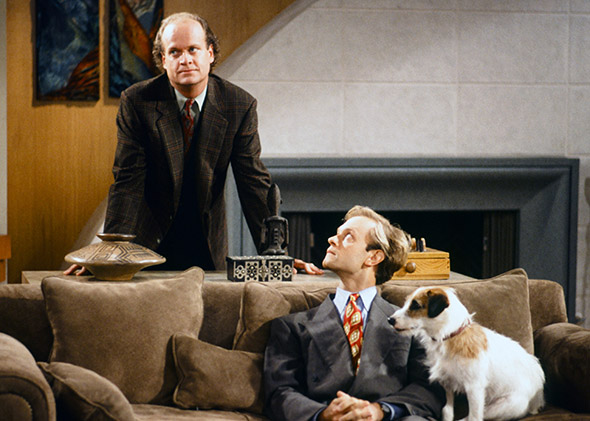
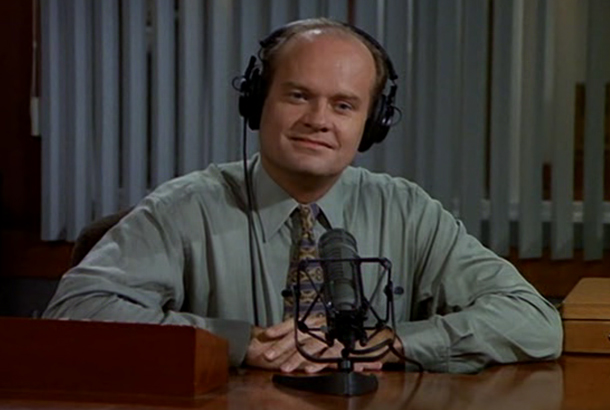
I think that Fraisier was the best radio show on television.  Frasier was on the air 12 years resulting in 263 episodes. The show averaged only 24 episodes a year. The hundredth episode was entirely filmed on the streets of Seattle. Leaving the cast of Cheers, Frasier Crane (Kelsey Grammer) moves back to Seattle to host a show as a radio psychiatrist.

radio32

After an injury, his father, a former policeman, moves in with Frasier. Fraiser provides advice on the airwaves while struggling in his personal relationships, especially with his cranky father and his pretentious brother. The producers did not want the show to resemble WKRP too much, so they came up with the concept of having Frasier live with his father, so family relationships became important.

radio43

John Mahoney plays Martin Crane, a grumpy, uncultured man who cannot understand his sons. Although Martin did not care about high-brow topics, John Mahoney taught Pierce a lot about wine and opera during the Frasier years.

radio35

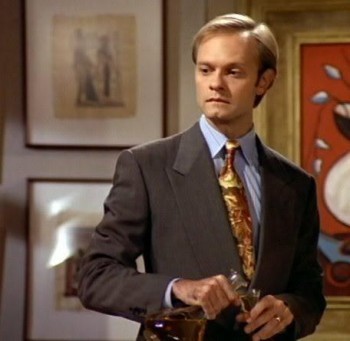
David Hyde Pierce was Frasier’s brother Niles.  The role of Niles was written just for Pierce.  The brothers were extremely competitive, although they could count on each other when it mattered. Frasier went to Harvard and Oxford while Niles went to Yale and Cambridge. Their mom was a scientist and the boys were named after lab rats she worked with. Both brothers had expensive tastes, intellectual interests, and high opinions of themselves. Niles was married to Maris, but we never see her. In later seasons, after getting a divorce, Niles marries Daphne. The brothers often meet at Café Nervosa.

radio33

On an episode of Cheers, Frasier explained that his father had died in an accident and he had no siblings.  When Sam (Ten Danson) comes to visit on Frasier, the error is explained by having Frasier tell Sam that he made the story up because he was mad at his family. All but two characters from Cheers starred on Frasier.  Coach had passed away and  Kirstie Alley (Rebecca) was a scientologist who did not accept psychology.

radio42

Jane Leeves plays Daphne Moon, who was hired to be Martin’s therapist and caretaker.

radio38

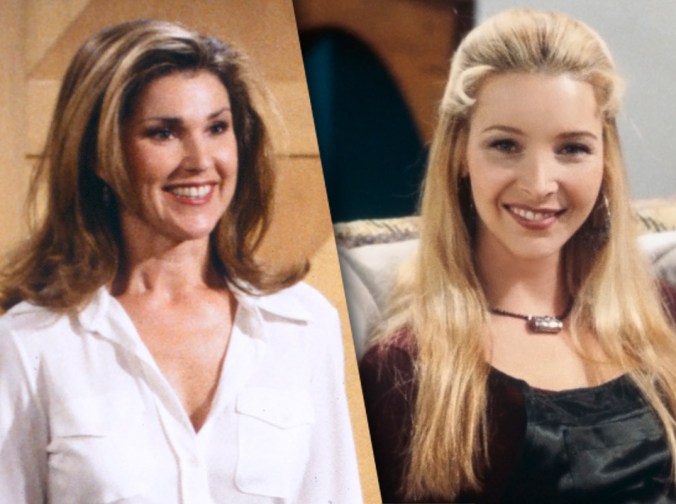
Peri Gilpin (Roz Doyle) is Frasier’s radio producer and becomes one of his best friends. The role of Roz had been narrowed down to Gilpin or Lisa Kudrow. Kudrow was funnier but lacked the forcefulness she needed in the workplace, so Gilpin got the job.

radio37

Another important character was Martin’s dog Eddie.  John Mahoney said Eddie got more fan mail than anyone else on the show. To get Eddie to lick Mahoney’s face, liver pate was placed strategically on his face.

bebe

Bebe Neuwirth was offered a regular role on the show as Frasier’s ex-wife, but she wanted to return to Broadway, so she guest-starred from time to time. She appeared in 12 shows.

Frasier

Frasier’s apartment was almost another character on the show.  He lived in an ultra-modern apartment. A Dale Chihuly sculpture is seen near the fireplace. Above the fireplace is another artwork by Laddie John Dill, an LA sculptor.  A Coco Chanel sofa was recovered at a cost of $15,000 to add realism. In contrast, Martin brings his old, tattered recliner which clashes with the rest of the apartment – a symbol of the way he and Frasier clash. On the first episode, a deliveryman played by Cleto Augusto brings the chair in. On the final episode, the same actor came and took the chair away.  Martin explains to Frasier that he spent many important life moments in the chair such as watching the moon landing and specific sports events.  When he came home from work, he often fell asleep in the chair, and his wife would kiss him and send him to bed.  Frasier’s mother had passed away a few years earlier. Frasier finally understands the significance of the chair. On the last episode, Martin is marrying again, and he moves out. Wendie Malick plays his second wife.

Guest stars played callers on the radio show.  Often, they phoned in their lines. Callers included David Duchovny, Phil Donahue, Marlo Thomas, Linda Hamilton, Olympia Dukakis, Daryl Hannah, Chris Reeve, and Estelle Parsons.

Grammer made life a bit anxious for his guest stars. He used an acting method called requisite disrespect where he did not rehearse and learned his lines right before each scene.

radio40

The theme song was “Tossed Salad and Scrambled Eggs” by Darryl Phinnessee and Bruce Miller. Miller wanted Mel Torme to sing the theme for the show, but the producers wanted Kelsey Grammer who ended up recording it.

Critics had great respect for the show. The series holds the record for most sitcom Emmys – 37.  It had the record for most Emmys of any genre till Game of Thrones won its 38th recently. The five best episodes include “The Ski Lodge,” “The Doctor is Out,” “Wheels of Fortune,” and “Ham Radio.”

Grammer and James Arness are currently tied for the character who was on television the longest – 20 years.  Arness played Marshall Dillon on Gunsmoke for 20 years while Grammer played Frasier on Cheers and Frasier for a total of 20 years. The Simpsons have actually passed both of them if animated characters count.

Not only was Fraiser a great radio sitcom, but it is one of the best sitcoms on my top 15 list.

News Radio (1995)

news1

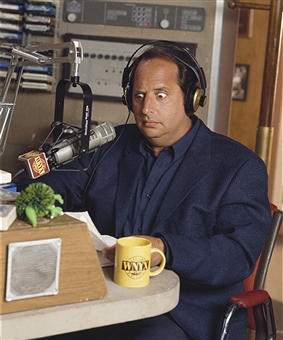
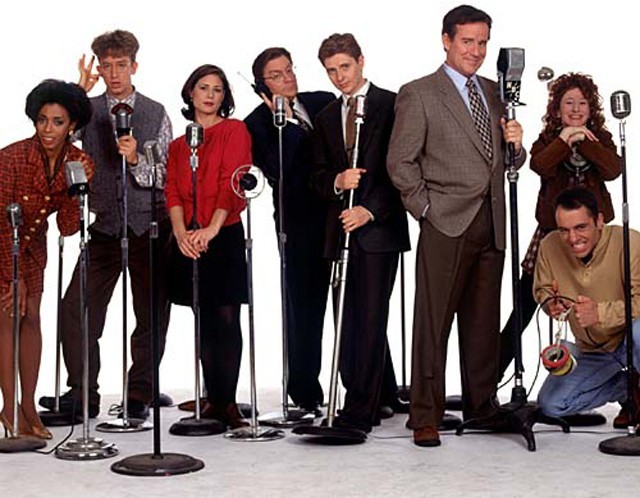
News Radio explores the office politics and interpersonal relationships among the staff of WNYX, New York’s #2 news radio station.

news4

Dave Nelson (Dave Foley) is the boss who tries his best to manage a quirky staff. He was raised in Wisconsin and some of his interests include tap dancing, a cappella singing, knife-throwing, and ventriloquism. He is polite and always in control.  He talks to his mother frequently and keeps a photo of her on his desk. He loves coffee and classic sitcoms, especially Mr. Ed and Green Acres.

news5

Bill McNeal (Phil Hartman) is an egotistical co-anchor. He is arrogant and insubordinate.  There are many gaps in his knowledge, but he does show flashes of concern for others. Near the end of the show’s run, Hartman was killed; tragitically, Hartman was shot by his wife.

news3

Catherine Duke (Khandi Alexander) is the other co-anchor. She and McNeal previously had an affair and they are rivals. In the fourth season, she takes a job in London.

news10

Jimmy James (Stephen Root) is an eccentric owner. He is a billionaire and feels the need to micromanage the station. He is always searching for a wife and loves to air his rivalries with other entrepreneurs such as Ted Turner and Bill Gates. In the finale, he buys a radio station and newspaper in New Hampshire and takes most of the staff with him.

news8

Lisa Miller (Maura Tierney) is an ambitious producer who is Nelson’s on-and-off-again girlfriend. She’s an overachiever who can do complex math problems and has a detailed life plan. In season five, she marries Jimmy’s archenemy Johnny Johnson (Patrick Warburton).

news11

Matthew Brock (Andy Dick) is a hapless reporter who is clumsy and always tripping or falling down. He idolizes McNeal.  He has a dental degree, loves sci fi, and has a crush on Lisa.

rogan

Joe Garrelli (Joe Rogan) is a handyman and electrician.  He is infatuated with Catherine and believes conspiracy theories, especially about extraterrestrials. Ray Romano was originally hired for this job, but his verbal comedy did not mesh well with the rest of the cast.

news12

Beth (Vicki Lewis) is the quirky secretary.  She typically wears inappropriate clothing, chews gum all the time, and likes to complain about her low salary. She was named Beth based on the Kiss song.

lovitz

Max Lewis (Jon Lovitz) was McNeal’s replacement after Hartman’s death. He was inept, eccentric, insecure, unprofessional and a former colleague of Bill’s.

The show was on the brink of cancellation every season. It never placed higher than 26th and changed time slots 11 times. It was briefly cancelled in 1998, but the network reversed its decision and ordered 22 more episodes and then it was cancelled for good.

news2

The show was fast paced and witty.  Sarcasm ruled the dialogue. Physical humor and sight gags also had a place in the humor. The show differed from the casts in The Office or the Mary Tyler Moore Show because they were a dysfunctional family without the affection and empathy of those characters. The cast was banned from SAG awards for bad behavior at the first ceremony.

Shows featuring radio stations seem to be hit or miss.  Good Morning World and Hello Larry did not do well.  I think everyone can agree on WKRP in Cincinnati and Fraiser are well-written shows.  News Radio seems to fall somewhere in the middle.  Some people seem to love it while others thought it missed the mark.  I think the show is well written, but the characters are not endearing.  They don’t grow or change for the better.  We can grow to love a Herb Tarlek and a Ted Baxter, but there is nothing redeeming about the crew here.  I guess I would tune out.  There are too many good shows out there to watch a “maybe, maybe not” show.

The Friendship and Careers of Fred Gwynne and Al Lewis

Fred Gwynne was born in New York in July of 1926 and died in Maryland in 1993.  Al Lewis was born in New York in April of 1923 and passed away in New York in February of 2006. At first glance, they don’t seem to have a lot in common, but a closer look reveals why they enjoyed a long friendship.

Fred Gwynne

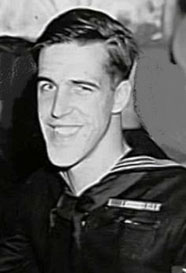
Fred Gwynne grew up in New York and had a very wealthy and advantaged upbringing.  He was a radioman in the Navy during World War II.  When the war was over, Gwynne entered Harvard, studying drawing and dramatics. He became a member of their Hasty Pudding Club, being involved with many theatrical productions. Gwynne graduated in 1951 and went on to work for a Shakespeare repertory company. He was a talented man with a variety of interests and earned his living from several careers.  He was a copywriter, a musician, a book illustrator, and a commercial artist.

gwynne2

In 1952, he made his Broadway debut, acting with Helen Hayes in “Mrs. McThing.” The play ran for 320 performances.  In 1953, he performed in his second Broadway play, “The Frogs of Spring” which had a much shorter run.  In 1954, he had a small role in On the Waterfront with Marlon Brando.

He also began appearing on television in the 1950s, and most of his roles were on dramas such as Kraft Theater or DuPont Show of the Week.

The one exception was The Phil Silvers Show where he appeared in 1955 and 1956. The producer of this show, Nat Hiken, went on to create a similar show called Car 54 Where Are You? about New York policemen.  He cast Gwynne as one of the leads, Francis Muldoon. The show ran for two seasons and when it was cancelled, Gwynne went back to his theatrical dramas.

In 1964, the creators of Leave It to Beaver, decided on a different concept for a show called The Munsters.  Fred was cast as the lead role.  While this show also ran two years, the part of Herman Munster was much harder to overcome than Francis Muldoon had been.  Gwynne struggled to find new roles, and when he was unsuccessful, he went back to Broadway.  He did make one pilot during these years for a show called Guess What I Did Today, but no network picked it up. His favorite Broadway performance was Big Daddy in 1974 when he starred in “Cat On a Hot Tin Roof.”

gwynne7bigdaddy

During the 1980s, his cinema career picked up and he ended up with 15 movies to his credit from 1979-1992. Included in this list are The Cotton Club, The Secret of My Success, Fatal Attraction, Ironweed, Pet Sematary, and My Cousin Vinny.

His book writing and illustrating also continued.  His first book, The Best in Show, was published in 1958.  The King Who Rained came out in 1970, and Simon and Schuster published A Chocolate Moose for Dinner in 1976 and A Little Pigeon Toad in 1988.

Throughout most of his career, Gwynne lived a quiet life far from Hollywood. He was married to his first wife Roxy from 1952-1980 and his second wife from 1981 until his death from pancreatic cancer in 1993.

Al Lewis

Al Lewis claimed he was born in 1910 and was a circus performer in the 1920s.  He also said he went to Columbia and graduated with a PhD in child psychology.  After he passed away, his son confirmed that he was born in 1923, and Columbia had no record of him attending school with his given name or his stage name.  His son thought he made himself older to get the role of Grandpa in The Munsters because in real life Yvonne DeCarlo was a year older than he was.

Some of his other jobs included a salesman,  hot dog vendor for the Brooklyn Dodgers, waiter, pool room owner, and store detective.  He was a good basketball player in high school and apparently worked as a basketball scout at some time in his early life. A friend convinced him to join an actor’s workshop in 1949 and that led to a career in vaudeville. In the 1950s and 1960s, he appeared in a variety of TV shows including US Steel Hour, Route 66, Lost in Space, and Gomer Pyle.  He too was cast in the Phil Silvers Show which later resulted in his role of Patrolman Leo Schnauzer in Car 54 Where Are You?

lewis8

In 1964, he too was offered a role in The Munsters. In 1966 when the show went off the air, he continued making television appearances and starred in cinema movies.  During the 1970s and 1980s, he appeared on Night Gallery, Green Acres, Love American Style, Here’s Lucy, Taxi, and Best of the West.  His career featured 22 films including They Shoot Horses Don’t They, Boatniks, Used Cars, Married to the Mob, and a remake of Car 54 Where Are You?

lewis5shoothorses

Like Gwynne, he was married twice:  to Marge from 1956-1977 and to Karen from 1984 until his death from heart complications in 2006. Lewis also published several children’s books during his acting career.

Midway through his career he opened an Italian restaurant, Grandpa’s Bella Gente, which Gwynne designed the logo for. He also got into radio and was featured on Howard Stern’s Show often.

lewis6

It is surprising that both of these stars were in two sitcoms which both lasted only two years. Let’s take a look at the shows that made them household names.

Car 54 Where Are You?

gwynnelewis4

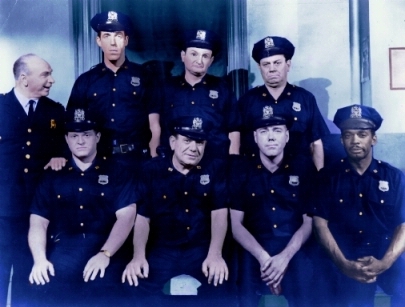
This sitcom, set in the 53rd precinct in Brooklyn was an early Barney Miller. Gwynne played Francis Muldoon.  His partner, Gunther Toody, was his exact opposite.  While Muldoon was a bachelor, an intellectual, calm and quiet, Toody was married, naïve, excitable, and talkative. In one show, when the precinct is debating splitting up the two men, Muldoon says “I guess most of the men are smarter than Gunther and less trouble than Gunther, but  . . . well, I’m so used to Gunther.  When he chatters away, the days just fly by.  I’d just be lost without Gunther.” Gunther concurs, “You mean ride around with someone next to me that’s not Muldoon? Francis is a quiet man. He doesn’t say a word. He just sits there all day thinking. It’s very comforting for a man like me to know there’s someone next to him doing the thinking for both of us.” Of course, they split them up only to partner them up again because no one else could take the silence or constant chatter.

Al Lewis played Officer Leo Schnauzer, appearing in every episode.

Policemen were split on their view of the show.  Some took offense and felt they were portrayed in a negative light, while others enjoyed it and identified with some of the comedic elements. It was filmed in The Bronx at Biograph Studio.  There was a large sign out front identifying it as the 53rd precinct till a woman came in pleading to save her from her abusive husband and the sign was quickly taken down.

Originally titled Snow Whites, the show aired at 8:30 eastern time Sunday nights between The Wide World of Disney and Bonanza.  The only clue I could find for the original name was that the show was sponsored by Proctor and Gamble who made several detergents for clothing. It was filmed in black and white, but the police cars were red and white so they would show up better on black and white film. The show also starred Beatrice Pons, Charlotte Rae, Nipsey Russell, Alice Ghostley, and Larry Storch.

Perhaps what the show is best remembered for was its catchy theme song.  Anyone who viewed an episode or two can probably remember the fun lyrics:

There’s a hold up in the Bronx, Brooklyn’s broken out in fights.

There’s a traffic jam in Harlem that’s backed up to Jackson Heights.

There’s a scout troop short a child; Kruschev’s due at Idlewild . . .

Car 54, where are you?


The Munsters

gwynnelewis1

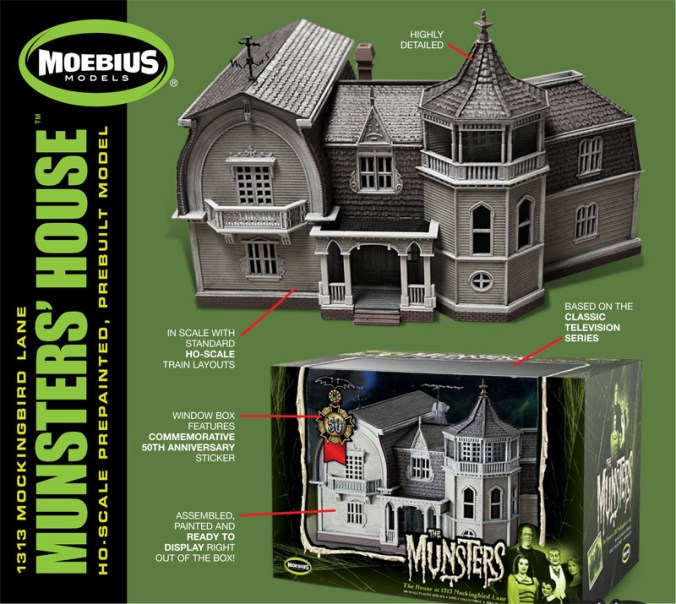
In 1964, the creators of Leave It to Beaver decided to feature another “wholesome” family who just happens to live at 1313 Mockingbird Lane in Mockingbird Heights. The family consists of Grandpa who is always experimenting in his lab; Herman who is the funeral director at Gateman, Goodbury, and Graves; his wife Lilly, a vampire; their son Eddie who is a werewolf; and their beautiful black-sheep Marilyn.  Marilyn was beautiful but they viewed her as odd looking and she seemed to get a lot of dates but when she brings them home, they never ask her out again. The family also owns two pets – Spot, a prehistoric animal Grandpa rescued and Igor, a bat.  They lived a somewhat normal life but drank bat milk and cooked in a cauldron. On the hour, a cuckoo clock chimed and a raven, voiced by Mel Blanc, appeared and said “Nevermore.”

gwynne4

All the actors had to endure a two-hour make-up session, but Gwynne had the worst time because he had to wear 40-50 pounds of padding.  One day he lost 10 pounds filming under the lights.  They gave him gallons of lemonade between takes and later rigged a way to blow cool air on him underneath the material.

The entire family could have been played by different actors.  John Carradine was offered the role of Herman. The pilot featured Joan Marshall as the wife and instead of Lilly, her name was Phoebe. Marilyn was played by Beverly Owens for 13 episodes and then Pat Priest took over for the rest of the show’s run. Eddie was first offered to Bill Mumy, Will Robinson from Lost in Space, and Grandpa to Bert Lahr from The Wizard of Oz.

After the show was cancelled, the Munster mobile often traveled to memorabilia shows.  There was also a Dragula built with purple silk upholstery and chrome pipes for the exhaust. Although the show was only on the air for two years, there were a lot of collectibles such as board games, lunch boxes, paper dolls, and coloring books.

gwynnelewis6

In 2001, the McKee family of Waxahachie, Texas was such a huge fan of the show that the family built their 5000+ square foot house to exactly resemble the Munsters’ home including the crooked weather vane and grand staircase that lifted up to feed Spot.

Both Gwynne and Lewis were born in New York.  They both appeared on the show Brenner early in their careers. Both were tapped from their roles in The Phil Silvers Show to play roles on Car 54 Where Are You? They both went on to star in The Munsters.  Neither of them ever had another series.  They both chose to live on the east coast. They both wrote children’s books.  They were each married twice and married to their second spouse for the rest of their lives. They both had a lot of success in the movies as well as television. They were both men with fascinating careers before they ever entered acting.  I learned a lot about these interesting friends.  Happy Birthday to Fred Gwynne would have been 91.

Not Everything is Black or White

As Black History Month comes to an end, I wanted to look at the early years of television featuring African American characters.  I don’t know if young people today realize how much culture has changed in the past fifty years.  While there are a lot of negative changes that have occurred in the movie and television industry, there have been a lot of positive changes as well.

It’s hard for young adults to realize today how different things are.  When I was growing up in the sixties, married couples on television had twin beds; you could not say “pregnant” on the air; black people and white people were not friends, and certainly did not date or marry; the “jobs wanted” ads in the newspaper were divided into jobs for men and jobs for women; and if a married woman wanted to join the armed forces, her husband or father had to sign a letter giving his approval.

Sometimes we get so caught up in how far we are from the journey’s end, we forget to appreciate how far we have traveled.  Looking at the current television schedule we see a variety of shows about capable women.  While certainly racism and gender discrimination exist, most people don’t think twice about whether a lead character is a man or a woman; is black, white, or Asian; or single or married.

Just a quick review of shows on the air reveal complex, intelligent characters who are African American.  We see this in Black-ish, This Is Us, Empire, Scandal, House of Lies, Last Man Standing, and Gray’s Anatomy, just to name a few.  This was far from the reality of early television.

We often think of that era as the golden age of television, but honestly, it was the white age of television.

In 1950, two shows debuted with main characters who were black:  Amos ‘N Andy and Beulah.  A radio transplant, Amos ‘N Andy dealt mostly with Kingfish’s schemes to gain wealth, often at the expense of his friends. Beulah also got its start on radio where she was a character in Fibber McGee and Molly.    She worked for a well-to-do middle class white couple with one son.  Both of these shows were demeaning and stereotypical.  In 1953, they were both yanked from the air due to NAACP protests.

Unfortunately, it would take almost 20 years before another show would feature a black character as a star.  In 1968, Julia debuted.  Julia, played by Diahann Carroll, was a black woman with a young son Corey (Marc Copage).  Her husband is killed in Vietnam and she moves to LA to start a new life in her nursing career.  Like Tom Corbett on The Courtship of Eddie’s Father, she is raising a son; like Doris Day she is a working mother; and like Ann Marie on That Girl, she has a fabulous wardrobe.  She is hired at Astrospace Industries, an industrial-health office where she works with Dr. Chegley (Lloyd Nolan).  Her life is normal.  She goes to work, takes care of her son, and goes on a few dates, but the concept of an African American, or a woman, starring in a show as the sole breadwinner, intelligent and fashionable, was not normal for the times.  The show was on for three seasons until 1971.

Julia was a controversial show at the time, but it scored high in the ratings and became a popular series.  I think it gets a lot of unfair criticism today.  The show gets complaints because during the time of the Watts riots, sit-ins, and so much racial unrest, it portrayed Julia living a fairly normal life.  I think people forget how groundbreaking it was to have a working woman or a black character star in a show.  I think the fact that she was able to live a “normal” life gives even more credit to not bowing to stereotypes of the late sixties. It’s like criticizing someone who is just learning to walk for not running and doing handstands.  They might be small steps, but they are steps going forward. I am one of those people who actually prefer not to see too much “real life” in sitcoms.  Honestly, I watch them to escape real life.

I also wanted to mention a few other shows that were featuring black characters in their cast during the time Julia was on the air: Hogan’s Heroes, The Mary Tyler Moore Show, and Barney Miller.

Hogan’s Heroes had a diverse cast, including Ivan Dixon as Sgt. James Kinchloe, striving to stay one step ahead of the Nazis.  The Mary Tyler Moore Show included a quirky news staff including weatherman Gordy Howard played by John Amos.  Barney Miller centered around a police department made up of personnel who each had their own dysfunctions.  One of those members was Lt. Ron Harris played by Ron Glass.  Each of these shows quietly featured black characters.  The races of any of the characters could easily have been switched during an episode and the character would not change.  It was just real people living real lives and some of them happened to be white and some black. After these creative and well-written shows, I prefer to ignore the Norman Lear era of shows.  They may have their merits, but I couldn’t stand All in the Family, Sanford and Son, Maude, or Good TimesThe Jeffersons was tolerable, but I would not choose to watch it either. In the mid-1980s, television began to get more diverse.

365

Don’t get me wrong.  Things are far from perfect in the world of television and movies, but we have made a lot of progress.  We have a lot of work to do, but just think how many choices Diahann Carroll would have today if she wanted to develop a television series. She could pick any career she wanted, including the military without anyone’s else’s approval; she could marry a white man and not sleep in twin beds; she could announce on the air she was pregnant—small steps but 5280 small steps turn into a mile. So, let’s devote one day to appreciate the hundreds of miles we have come before getting too caught up despairing about the hundred we still have to go.