Go Green, Green Acres That Is

In the 1950s, a lot of the top shows were set in residential or suburban areas:  Father Knows Best, Ozzie and Harriet, the Donna Reed Show, and December Bride to name a few.  In the early 1960s, the rural sitcom became the hottest genre.  In 1963 The Beverly Hillbillies was #1, Petticoat Junction was #4, and The Andy Griffith Show was #5. Filmways offered Paul Henning the chance to produce a new rural show with no pilot necessary.  Filmways was created in 1952, and the company was behind many successful shows including The Debbie Reynolds Show, The Pruitts of Southampton, Mr. Ed, The Addams Family, and Cagney and Lacey.

Paul Henning approached Jay Sommers to create the new rural comedy. Sommers based the series on a radio show he had written in 1950 —  Granby’s Green Acres.  Granby was based on a book, Acres and Pains by S.J. Perelman. The radio show only lasted for 13 episodes and starred Gale Gordon and Bea Benaderet. Granby was a former banker who moved to the country to run a farm.  He also had a daughter, and the general store owner was a major character, Will Kimble, played in the first episode by Howard McNear. A couple of titles proposed were Country Cousins and The Eddie Albert Show, but the final decision was Green Acres.

green4

Green Acres ran on CBS from 1965-1971 with solid ratings. It produced 170 episodes, all filmed in color.  Richard Bare directed most of the shows. At the end of each episode, Eva Gabor would say “This has been a Filmways presentation dahling.”

While the Beverly Hillbillies took a family out of the mountains and put them in Beverly Hills, Green Acres went with the opposite scenario.

The premise of the show was that Oliver Douglas  who had been a busy attorney in New York City decides he wants to move to the country to run his own farm. His wife Lisa  does not agree. He buys a farm unseen in Hooterville. We are never told where Hooterville is, and I think everyone has their own idea of which state it might be in. The house and farm are more run-down and dilapidated than Lisa ever imagined in her worst nightmare.  The citizens of Hooterville are a quirky set of characters.

green7

The debut show was done as a documentary narrated by John Daly, a former newscaster and the host then of What’s My Line.  Eddie Albert and Eva Gabor appeared on What’s My Line later in the fall as a thank you to Daly. As you can see below, Oliver’s mother is horrified by his choice.

green18

The theme song is memorable and tells the backstory of the Douglases:

Oliver: Green Acres is the place to be – Farm living is the life for me –Land spreading out so far and wide – Keep Manhattan, just give me the countryside.

Lisa: No, New York is where I’d rather stay – I get allergic smelling hay – I just adore a penthouse view – Darling, I love you but give me Park Avenue

Oliver: The chores

Lisa: The stores

Oliver: Fresh air

Lisa: Times Square

Oliver: You are my wife

Lisa: Goodbye city life

Both: Green Acres, we are there

Snippets of country and New York city were shown while the stars sing, and ends with both of them in the same pose as “American Gothic” by Grant Wood.

green1

Like the Andy Griffith Show, the series worked because of the interaction between these Hooterville citizens who become believable for us. Let’s meet the cast of characters.

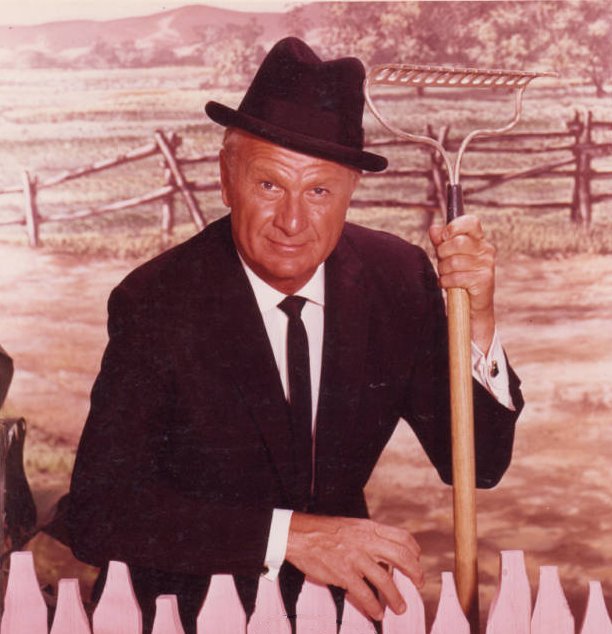
Oliver Wendell Douglas (Eddie Albert) – Oliver is intelligent, hard-working, and practical to a fault.  He has to deal with a kooky wife, a disapproving mother (played by Eleanor Audley who was only 5 months older than Albert), and the quirky neighbors that surrounded him. However, Oliver has a respect for the wisdom these people have about farming and rural life.  Despite the fact that he seems to be the only sane person in the valley, it’s obvious he truly has an affection for the folks he lives with.
albert

Lisa Douglas (Eva Gabor) – Lisa grew up in a wealthy Hungarian family. Her misuse of the English language is one of her endearing qualities. She has a hard time adjusting to farm life.  In one episode she is using a stapler to fix Oliver’s socks.  While Oliver is telling her how woman for centuries have sewn socks, Fred Ziffel, the most experienced farmer in Hooterville enters the room and tells her he notices she is mending socks; his wife does it the same way. Despite the fact that Lisa did not want to leave the city, she adapts to living in the country quickly and develops an understanding with the neighbors Oliver never attains.
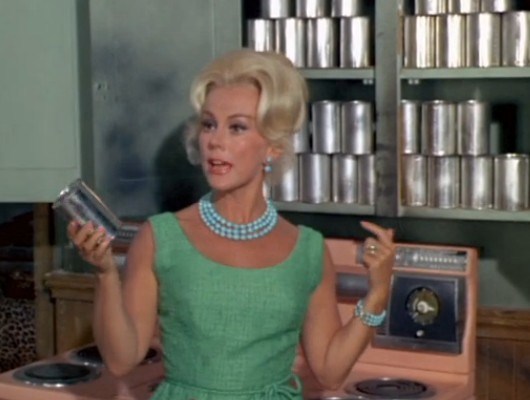
green31

Eb Dawson (Tom Lester) – Eb is the farmhand who lives with the Douglases.  He comes off as naïve, but we understand Eb is much smarter than he lets on.  He is always trying to get less work for more money.  He calls them Mom and Dad which Lisa loves but drives Oliver crazy.

green17

Mr. Eustace Haney (Pat Buttram)- Mr. Haney is the unethical and dishonest salesman who originally sold Oliver the farm, which belonged to his family. He is always showing up to sell them something they need at outrageous prices. [Pat Buttram was Gene Autrey’s sidekick in the movies and tv; Smiley Burnette, Charley, who runs the Cannonball, the local train on Green Acres and Petticoat Junction, was Autrey’s sidekick in radio and movies and  Buttram replaced him when he moved on.]

green5

Sam Drucker (Frank Cady) – Sam was a busy guy; he ran the general store, he was the newspaper editor, was the only printer in town, he was part of the volunteer fire department, he was the justice of the peace, and he’s the postman. Apart from Oliver, he was the smartest and most sane person in the valley, and he and Oliver often commiserated about the crazy life going on around them.

Hank Kimball (Alvy Moore) – Mr. Kimball was the county agricultural agent who was supposed to help Oliver adjust to farming. He often loses his train of thought and rarely follows through on the news or information he is supposed to relay.

moore

The Monroe Brothers – Alf (Sid Melton) and Ralph (Mary Grace Canfield) are a brother and sister team that Alf portrays as brother and brother in order get work. Their projects are never finished on time, and rarely finished the right way.
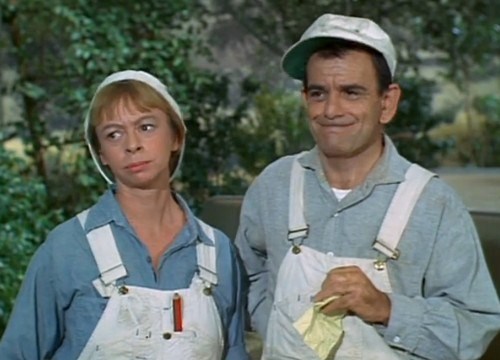
green8


Fred and Doris Ziffel (Hank Patterson and Barbara Pepper/Fran Ryan) – the Ziffels were successful farmers.  They had no children, but they had a pet pig that they considered a son.


Arnold Ziffel – Arnold Ziffel was their pet pig and one of the most intelligent people in Hooterville. He understands English, attends the local grade school, lives inside in his own bedroom, can sign his name, and is a bit addicted to television watching, especially westerns. A new pig was used each season because they grew so fast. The Union demanded the pigs be payed $250 a day and were trained by Frank Inn. In 1967 Arnold won a Patsy award.

green20

Some of the other animals featured on the show included Eleanor the Cow; Bertram the rooster; Alice the hen; and Mr. Haney’s dog, Cynthia, a basset hound who had a huge crush on Arnold.

Green Acres had its fair share of guest stars including Parley Baer, Robert Cummings, June Foray, Alan Hale Jr., Elaine Joyce, Gordon Jump, Bernie Kopell, Al Lewis, Rich Little, Al Molinaro, Pat Morita, Jerry Van Dyke, and Jesse White.

The show was 25% surrealism, 25% satire, and 50% just plain fun.

Some of the running gags on the show were the fact that people, except Oliver, could see the credits running, and Lisa often commented on them. A lot of the jokes were at Oliver’s expense.  He was the only one in town who could not understand Arnold’s grunts. Also, whenever Oliver got passionate about something, he went into a monologue, usually patriotic, and everyone but him could hear fifes playing.

green3

Lisa’s hotcakes were good for many projects, just not eating. The Douglases had a feud with the phone company because they were supposed to move their phone inside.  Whenever they had to use the phone, Oliver had to climb up a phone pole to talk. Oliver had a Hoyt-Clagwell tractor which was usually breaking down, catching on fire, or falling apart.

green29

We also had the stark extremes of sophisticated New York living and rural life.  Lisa continued to dress in beautiful gowns and furs.  They slept in a huge, expensive bed, with an elaborate chandelier over their heads, but their closet had no back so neighbors walked in on and off. The fire department marching band often practices at Sam Drucker’s store but for all five years whenever they practice, they only know one song, There’ll Be a Hot Time in the Old Town Tonight.

Although Lisa continues to threaten to move back to New York City, aided and abetted by Oliver’s mother, we know she loves him and will never leave without him.  Despite their arguments, Lisa and Oliver are frequently seen kissing and hints are given about them retiring to their room together. In real life, Albert and Gabor were dear friends and they are both buried in Westwood Village Memorial Park Cemetery in Los Angeles. Tom Lester, Eb, credited Albert with helping him as an actor and being a surrogate father to him; the two remained close friends until Albert passed away.
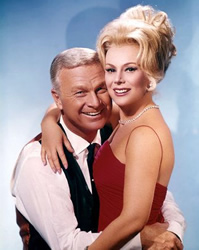
green10

There are many cross-overs with Petticoat Junction and the Beverly Hillbillies. Sam Drucker was featured in both Green Acres and Petticoat Junction. Some of the characters visited each other on various episodes. It is funny that Bea Benaderet starred in Petticoat Junction as well as the radio show Granby’s Green Acres which means Green Acres was based on her radio show and was a spin-off of her television show. In 1968, a Beverly Hillbillies Thanksgiving Show united cast members from all three shows.

green9

green6

With 170 episodes, it’s hard to come up with the best five, but after looking at various polls and tv guide reviews, I will do my best to represent the majority’s votes:

“Music to Milk By” – Eb wants to win a radio contest and he has to listen day and night which cuts into his chores, especially when the cow swallows the radio.
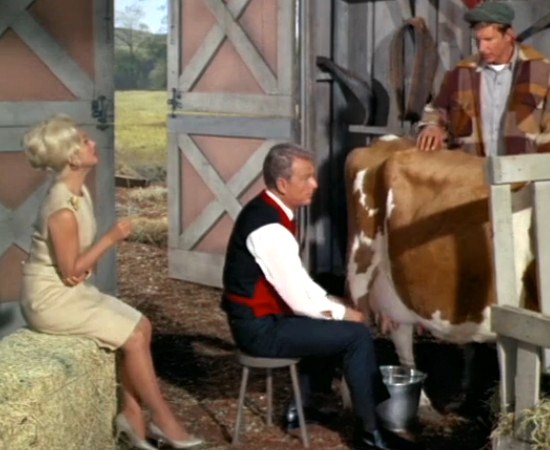
radio

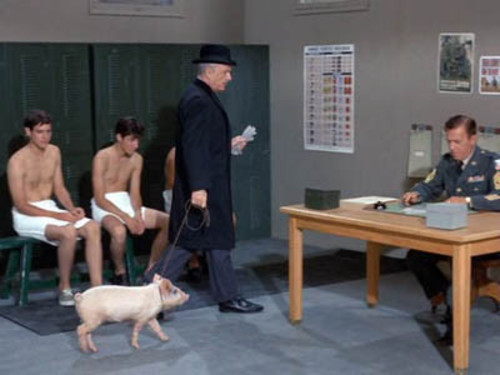
“I Didn’t Raise My Pig to be a Soldier” – Arnold Ziffel gets a draft notice. Oliver acts as his attorney before the draft board. They are assuming Oliver is making fun of them with the pig and the real Arnold is elsewhere. After a lot of explanations and some time in jail, Oliver convinces them Arnold is really a pig.  The end of the show has Oliver back before the draft board because Ralph Monroe, a woman, who they think is a man, has been drafted.
draft

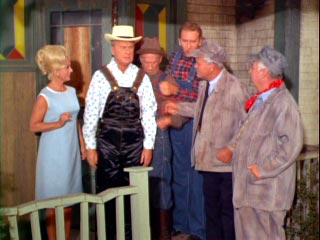
“The Hooterville Image” – The town agrees Oliver needs to do chores in overalls. He has been farming in a vest and dress shirt. They finally convince him to become more accepted by switching his attire until they see the overalls Lisa’s dress designer came up with.
green28

“The Computer Age” – Ralph Monroe joins a computer dating service. Oliver and Lisa disagree on whether that is a good idea. Oliver thinks it is. He also thinks computers are the best way to run a farm. To prove her point, Lisa uses the service to see if she and Oliver would have been paired up.

computer

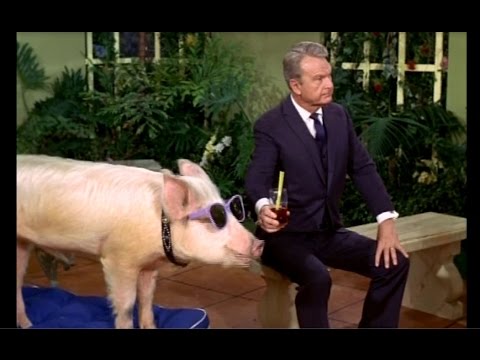
“A Star Named Arnold is Born, Parts 1 and 2” – Arnold appears in a play at the local theater. Lisa arranges for an old friend to give him a chance in show business. In the second part, Lisa and Oliver chaperone his trip to Hollywood to star in a motion picture.
arnold

Oddly enough the top four were all from season 2, and “A Star Named Arnold Is Born” is from season 3.
green16

In Spring of 1971, Green Acres was still pulling in good ratings.  However, the Rural Purge of 1971 got rid of all shows that had country leanings whether they were audience favorites or not.


In full disclosure, I loved Petticoat Junction growing up, and I could not stand the Beverly Hillbillies.  I thought Green Acres was okay but if I missed it that was okay too.  As I’ve gotten older, I still love Petticoat Junction, and I still don’t care for the Beverly Hillbillies, but I have developed a much greater appreciation for Green Acres.  If a show was capable of having a sense of humor, this one did.   It never took itself seriously.  Eddie Albert was willing to be the straight guy to the rest of the ensemble. The character interaction worked, and no dialogue came off as too zany.  The citizens might not have always agreed or understood each other’s lifestyles, but they had affection and respect for each other. Lisa’s reading the credits and different characters addressing the audience brought us in on the jokes and made us part of the Green Acres family. Now when I watch the show, I laugh out loud – a lot! I don’t laugh at the characters, I laugh with them. For being a rural sitcom, this show has some sophisticated humor.  If you have not watched the show in a while, you owe it to yourself, as well as the cast and crew who created it, to get to know the folks in Hooterville.


It Only Takes One Episode to Get Smart

In the mid-1960s, spy shows were all the rage.  James Bond drew large audiences to theaters:  Dr. No in 1962, From Russia with Love in 1963, Goldfinger in 1964, and Thunderball in 1965. Inspector Clouseau was big at the box office too appearing in The Pink Panther in 1963 and A Shot in the Dark in 1964. If you were checking out books at the library, you probably would have read Len Deighton’s The IPCRESS File (1962), The Spy Who Came in From the Cold (1963), or Harriet the Spy (1964). On the small screen, The Avengers was ahead of the curve, premiering in 1961, but in the mid-1960s, we would see some of the classic television shows debut: Mission Impossible began in 1966, The Man from UNCLE showed up in 1964 and in 1965, The Wild, Wild West and I Spy got network approval.

smart7

Another show came on the air in 1965 as well – on September 18, 1965, Get Smart was seen for the first time. Dan Melnick, a partner in Talent Associates thought a spy satire might be a good fit for their upcoming schedule. He recruited Buck Henry and Mel Brooks to write the show. The team took the show to ABC. ABC bought it but they wanted a few changes.  They wanted Tom Poston to take the role of Maxwell Smart. They wanted a dog on the show to add “heart.” Finally, they wanted Smart’s mother to be a major role and envisioned Smart coming home at the end of the episode to explain the case to his mother. Henry and Brooks said no to the mother, so ABC rejected the show and sold it back to Talent Associates.

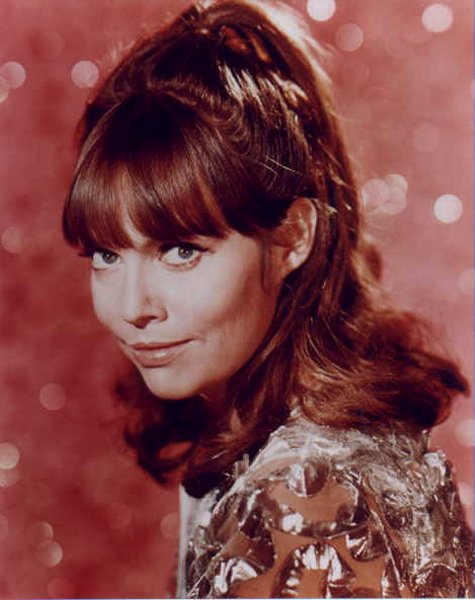
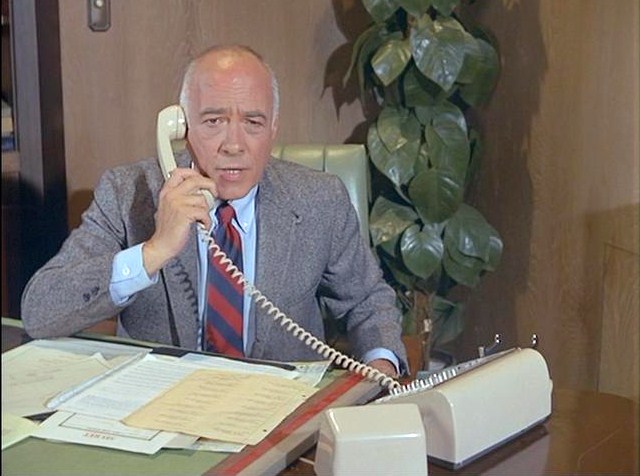
Grant Tinker from NBC agreed to buy the show with the caveat that Don Adams star in place of Tom Poston.  And so, the creative talent of Brooks and Henry brought Maxwell Smart (Don Adams), Agent 99 (Barbara Feldon), and the Chief (Edward Platt) to life. The show would stay on the air for five seasons, producing 138 episodes.

The first four seasons were filmed at Sunset Bronson Studios.  In 1970, the show moved to CBS and the last season was filmed at CBS Studio Center.

Mel Brooks left the show after the first year, but Buck Henry stayed through 1967 as the story editor.

smartgun

Most of the administrative cast stayed with the show for its run. Leonard B. Stern was the executive producer for all the shows. Irving Szathmary was the music and theme composer, as well as conductor, for all five seasons. Gerald C. Gardner and Dee Caruso were the head writers for the series. Don Adams would get to direct 13 episodes and write 2 of them.

The show centered around the three main characters. Maxwell Smart is Agent 86.  He works for CONTROL, a US government counter-intelligence agency in Washington DC. Max is resourceful.  He is a adept marksman, has hand-to-hand combat skills and is extremely lucky. He uses several cover identities, but the one he uses most often is greeting card salesman. He insists in going by the book and this, along with his clumsy nature, cause problems for him.

smartsmart

He and his partner Agent 99 take on world threats. We never learn Agent 99’s real name, although we think we have in one episode.  In “99 Loses CONTROL”, she says her name is Susan Hilton but at the end of the episode, we learn she was lying. Agent 99 is smart and competent.  Her father was apparently a spy as well.  (In real life, Barbara Feldon was also smart; she won on The $64,000 Question with the category of Shakespeare.) If you look closely, you will often see Agent 99 slouching, sitting, or leaning on something to conceal the fact that she was a bit taller than Adams.

smart15

Their boss, Chief, whose real name is Thaddeus, is sarcastic and grouchy but also serious, sensible, and smart. He began his career as Agent Q and his cover name is often Harold Clark. Other CONTROL agents we meet during the series are Agents 8, 13, and 14, as well as Larrabee, the Chief’s highly inefficient and bumbling assistant.

smart10

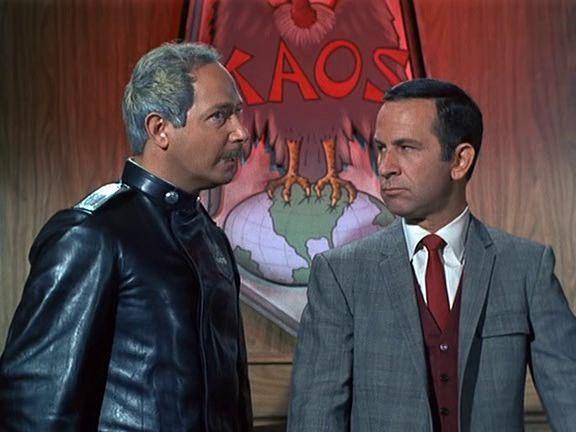
Their primary enemy is KAOS, an international organization of evil founded in Romania in 1904 (a Delaware corporation for tax purposes!). The two KAOS employees we see most often are Conrad Siegfried (Bernie Kopell), the VP for Public Relations and Terror and his assistant Shtarker (King Moody), whose personality can change from sadistic to childlike. While Siegfried and Smart are mortal enemies, they respect each other.  Sometimes they begin talking like old friends.  In one episode, they are discussing the flavor of cyanide pills each side has that month.  CONTROL is giving out raspberry, and Smart tries to give one to Siegfried.  Like CONTROL, KAOS has a bowling team to build rapport and fellowship among their employees.

smart13

Another KAOS agent is Hymie the Robot played by Dick Gautier. Dr. Ratton of KAOS built Hymie for evil, but Smart manages to turn the robot into a CONTROL agent. Hymie is faster and stronger than any human.  He also has the ability to swallow any poison and then identify it. He has emotions and a need to maintain neatness.  Unfortunately, he takes commands literally; if Smart says “Get ahold of yourself,” he literally wraps his arms around himself.

smart8

The opening sequence of the show is one of the most spoofed openings in television.  Smart walks through doors that continue to other doors. It was ranked as the number 2 opening out of the top ten by TV Guide viewers in 2010.

The show is still known for its catch phrases that became part of the American vocabulary including “Would you believe?”, “Sorry about that Chief,” “And loving it,” and “I asked you not to tell me that.”

The series is identified with its James Bond-like gadgets.  Telephones could be concealed in neckties, combs, and watches, but most often it is in Smart’s shoe which he had to take off to answer. Agent 99 has a compact phone and a fingernail phone which forces her to look like she is nervously biting her nails to talk on it.

The show features a bullet-proof invisible wall in Smart’s apartment which lowers from the ceiling; he often forgets to put it back up and runs into it. Cameras can be in a bowl of soup.  A laser weapon was concealed in a suit jacket button, the blazer laser. The Cone of Silence are two glass domes that cover Smart and the Chief when they talk about a case.  Smart insists on using it because it’s  regulation; however, they can hardly hear each other, but anyone on the outside can hear their conversation clearly and often reports what the other person said.

smart3

Other weapons and aids for the spies included a parking meter telegraph, a perfume bottle radio transmitter, invisible icing, and a pencil listening device. Guns were hidden in a charm on a charm bracelet, in a pool cue, as a hairbrush, as a flashlight, and in a crutch. CONTROL even had gloves with fingerprints already on them – the fingerprints were KAOS agents so they would get the blame for a break-in.

Blowing up stuff is always good on a spy show and Get Smart had explosive rice; toothpaste that is really a fuse; an exploding wallet, ping pong ball and golf ball; and a horoscope book or lipstick case that contained knock-out gas.

Smart had several cars but his most famous was a red 1965 Sunbeam Tiger.  The two-seat roadster had a machine gun built in, a smoke screen, a radar tracker, and an ejection seat.  When the series went off the air, Don Adams received the car and continued to drive it for ten years.

smart14

Get Smart probably had some of the most famous guest stars of any show.  Just a few of these celebrities include Steve Allen, Barbara Bain, Milton Berle, Ernest Borgnine, Carol Burnett, James Caan, Johnny Carson, Wally Cox, Robert Culp, Phyllis Diller, Jamie Farr, Jack Guilford, Bob Hope, Martin Landau, Julie Newmar, Pat Paulson, Tom Poston, Leonard Nimoy, Vincent Price, Don Rickles, and Fred Willard.

The show stayed true to its character through its entire run.  In Season 1, Hymie is introduced and the dog, Fang, disappears. In Season 2, we meet Siegfried. Smart and Agent 99 get engaged and marry in Season 4.  NBC demanded the change to boost ratings. In Season 5, they have twins.  Agent 99 continues working and is one of the first, if not the first, mother to be viewed as a working woman.  When the ratings did not increase, the show was cancelled. It went into syndication where it was very successful. Unfortunately, the DVD set was held up in legal battles and only came out weeks before Adams died.

Get Smart was one of the most clever and creative sitcoms ever airing on television.  It had `21 Emmy nominations including two for Feldon and won 7 of those awards.  Don Adams won best actor on a comedy three times and the show won best comedy twice.

smartemmy

William Johnston came out with 9 paperbacks based on the series in the late 1960s and Dell Comics issued 8 comic books in 1966 and 1967. For the March 5-11, 1966 TV Guide, Andy Warhol designed a pop art piece using Barbara Feldon. Numerous collectibles were created:  board games, lunch boxes, dolls, and model cars.

The show produced many spin-off projects. The Nude Bomb was a theatre release in 1980 with Feldon and Smart reprising their roles. Get Smart Again debuted in 1989 as an ABC TV movie.  After its release, a show appeared on FOX starring Feldon and Smart again called Get Smart in 1995.  In 2008 a movie was made starring Steve Carell and Anne Hathaway. Don Adams was known to later generations as the voice of Inspector Gadget.

carell

Of course, everyone has their favorite episodes, but after reviewing several polls and interviews with Nick at Nite and other 50th anniversary celebrations, I have come up with these top five.  Take a rainy fall day and give them a peek. However, if we are looking just at titles, I have to give a shout out to “Spy, Spy Birdie”, “Bronzefinger”, “Impossible Mission”, and “Tequila Mockingbird”.

  1. A Spy for a Spy
  2. The Not-So-Great Escape
  3. Ship of Spies
  4. The Amazing Harry Hoo
  5. The Little Black Book


smarttrench

Unfortunately, this is one of those shows that doesn’t get as much recognition and respect as it deserves.  Considering how much technology has developed in the last 50 years, the show is still up to date. The dialogue is witty; the characters are likable, even when they’re mortal enemies; and the show is just plain fun.


Developing A Negative Perspective

We can all name a ton of shows featuring lawyers, doctors, and teachers.  Once you begin looking at other careers, it’s not easy to find more than one or two successful shows about each profession. Let’s look at a few series about photographers and see what develops.


Love That Bob – 1955-1959

Bob Collins (Bob Cummings) is a bachelor and a professional photographer. He lives with his sister Margaret McDonald (Rosemary DeCamp), a widow, and his nephew Chuck (Dwayne Hickman). Bob spends his time trying to get dates with his models while his sister spends her time trying to get him to settle down. Although he was not aware of it yet, we all knew the real love of his life was his assistant Schultzy (Ann B. Davis) who was obviously in love with him.

Not only did Bob get around, but his show followed suit. This show debuted on NBC for a half season and then moved to CBS for two years. Then it went back to NBC for two years and finally finished its life on ABC.

The opening of every show was Bob and his camera; he said “Hold It.  I think you’re going to like this picture.” Though Bob tried hard to be a playboy, he was so insecure we liked him in spite of himself and because of Schultzy.

Among the beautiful bevy of models on the show, we also got to know his best pal Harvey Helm (King Donovan) and his next-door neighbor Pamela Livingston (Nancy Kulp), an avid bird watcher.

The writers had a great perspective for the series because the show lasted five seasons for a total of 157 episodes.

The Box Brothers – 1956-1957

The Box brothers lived in San Francisco. They badly needed money and were offered a chance to buy a photography studio.  They developed more trouble than photographs. The brothers were total opposites. Mild-mannered Gilmore (Bob Sweeney) dated quiet Marilee Dorf (Nancy Hadley) while strong-willed Harvey (Gale Gordon) dated the self-assured Dr. Margaret Kleeb (Ann Morriss).

The show was one of the first series to feature a character who was heard off camera but never seen. Andy worked in the darkroom, so we never saw him in person.  The show also featured Howard McNear soon to run a barber shop in Mayberry and Barbara Billingsley who would dress in pearls and parent the Beaver.

After 26 episodes, the network had a flash of inspiration to cancel the whole thing.

Shirley’s World – 1971-1972

Shirley Logan (Shirley MacLaine) is a mod, young photographer who works for World Illustrated magazine based in London for editor Dennis Croft (John Gregson). She travels the world taking pictures, and the shows were filmed in England, Scotland, Japan, and Hong Kong, among other spots. She usually becomes involved in the lives of the subjects she is sent to photograph.

The show was a collaboration between British ITC and Sheldon Leonard.  It was expensive to film due to the traveling costs for shooting around the world and MacLaine’s salary which was reported as $47,500 per episode. This salary would be the equivalent of about $275,000 per episode today.

After 17 episodes, the network either ran out of money or changed its focus to cheaper production methods because this series was cancelled.

All’s Fair — 1976-1977

In 1976, Norman Lear created this sitcom about 49-year-old Richard Barrington (Richard Crenna) involved with 23-year old Charlotte Drake (Bernadette Peters).  He was a political columnist and she was a photographer, and they both lived in Washington DC.  That was about all they had in common.  He was conservative, lived in a luxurious townhouse, and was a gourmet cook.  She was liberal, lived cheaply, and was a vegetarian.  Most of the series centered around their generation gap and their political differences.

Jack Dodson, no longer living in Mayberry, played Senator Joplin, Barrington’s friend and Michael Keaton played President Carter’s aide.

The dialogue was fast-paced. One reviewer described it as “the best new comedy of the year” and the New York Times said, “casting is first rate and the finger-snapping pace of the show leaves just about everything looking easy and undemanding.”

Peters was nominated for a Golden Globe.  The only other well-known show to debut in 1976 was Alice.  I’m not sure if the writing quality was uneven or if the jokes just got tired and predictable, but after 24 episodes, the network decided it had been overexposed and moved on.

We’ve Got Each Other – 1977-1978

Mary Tyler Moore’s company produced this sitcom.  Stuart Hibbard (Oliver Clark) was a copywriter who worked from home and took care of the house and cooked the meals.  His wife Judy (Beverly Archer) commuted to Los Angeles for her career as a famous photographer’s assistant. Tom Poston played Damon Jerome the photographer.  He was great with a camera but a terrible businessman, so he relied on Judy for everything.

Stuart had to deal with their nutty neighbor Ken Redford (Martin Kove), and Judy had to put up with a self-centered model DeeDee Baldwin (Joan Van Ark). Damon’s secretary Donna (Red Woods) tried to keep peace between the women at work.

Thirteen was an unlucky number for this show which was cancelled after that many episodes. I guess Damon was a underexposed photographer whose contract was not renewed.

Whitney – 2011

We started with star Bob Cummings in this blog and we end with Whitney Cummings, no relation.  Whitney created and starred in this show about a photographer and her friends, a group of 20 somethings, who live in Chicago. Her boyfriend Alex Miller is played by Chris D’Elia.

Beverly D’Angelo from the Vacation movies played her mom in the original pilot, but was replaced by Jane Kaczmarek with all the scenes re-shot. The show did not garner great reviews.  The debut was watched by 6.8 million viewers in September, but by December only 4 million of them were still watching.

After 38 episodes, the network thought too large a time lapse had happened and ended the show.  Cummings also was the co-creator of 2 Broke Girls the same year.  That show had better luck, lasting five years, being cancelled this past May.

Obviously shows about photographers did not do too well over the television decades.  But if anyone can handle it, it’s these characters – after all they deal with negatives all day long.

Garry Marshall: A Tribute To The Man Who Created So Many Happy Days For All Of Us

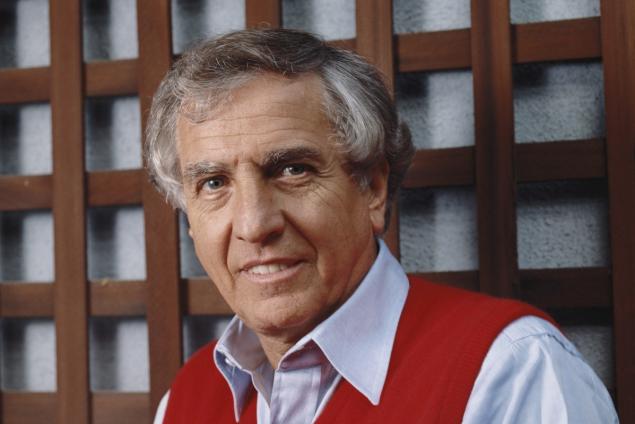
Today we get to honor one of my all-time favorites in the celebrity world – Garry Marshall.  By all accounts, whatever you read, he was hilarious, humble, and hard-working.  He was known as a family man, always putting them first. Let’s learn a little bit about his life.

garry1

His Early Life

Garry Kent Marshall was born in The Bronx, New York on November 13, 1934, the son of Anthony Wallace Marshall, a director and producer of industrial films, and Marjorie Irene, a  teacher who ran a tap dance school. His father changed his last name from Masciarelli to Marshall before Garry was born.

Marshall had a typical childhood which included “the usual bruised knees, runny nose, dead frogs and stolen bases.” But he said his formative years were primarily devoted to discovering girls, making people laugh, and learning to play drums. “When I was growing up, there were three drummers I admired: Gene Krupa, Max Roach, and this little girl drummer in my school who used to blow in my ear after practice.”

His brother is Ronny Marshall Hallin, a television producer; his sister is Penny Marshall, actress and director; and his brother-in-law for ten years was Rob Reiner, actor and director.

garry14

Garry decided to attend Northwestern University to major in journalism.  After graduation, he was drafted into the Army and sent to Korea as part of the Special Services.  He was able to write and produce shows which set him on a new career path once he returned to the United States. Discussing his service, he said, “The lowest musical experience of my life came when I was in the Army. I was a solo marching snare drummer and kept cadence for my battalion. One day while my battalion was marching, I was playing so badly that the Captain shot a hole through my drum with a .45 revolver.”

Garry moved to New York after the Army and met Fred Freeman.  The two of them began writing together.  To support himself while his writing career got underway, Garry supplemented his income playing drums and writing for the Daily News sports department.

His TV Production Career

Marshall began his career as a joke writer for comedians and became a writer for The Tonight Show with Jack Paar. He eventually secured a staff writing position on The Joey Bishop Show. There he met Jerry Belson in 1961, with whom he would go on to write two feature films, a Broadway play, and episodes for a variety of TV series including The Dick Van Dyke Show, The Lucy Show, and I Spy.

In 1963, he married Barbara; they would have three children.

garry16

Marshall and Belson’s first television series as creator-producers was Hey, Landlord, which lasted one season (1966–67).

Their next series was more successful. They adapted Neil Simon’s play The Odd Couple for television. Felix Unger and Oscar Madison are total opposites but best friends.  Garry’s sister Penny would play Myrna in the show.

T4DODCO EC002

Marshall continued to borrow from The Odd Couple throughout his career. Over and over again he employed the comic device of coupling two distinctly different characters: the hip and the square on Happy Days, the earthling and the Orkan on Mork and Mindy, the rich and the poor on Angie, and, later, the businessman and the prostitute in the movie Pretty Woman.

Most of his hit television series were created and executive produced by him. Rather than forming his own independent production company, which had become standard procedure for producers at the time, Marshall remained at Paramount to make a succession of hit situation comedies for ABC. By the end of the 1978-79 season, four of the five highest-rated shows of the year were Marshall’s.

garry13

In the Norman Lear era, when series like All in the Family tackled social issues, Marshall focused on younger viewers with lighter, more escapist fare, most of it set in the supposedly simpler past. In an interview reprinted in American Television Genres (1985), Marshall recalled that, after producing the adult-oriented Odd Couple, he had been anxious to make shows “that both kids and their parents could watch.”

His philosophy to get younger viewers: “You have to do something silly to get their attention. Then I like to knock them off their chairs with laughter. I go for the gut. I want them to laugh hard.  I don’t want them quietly staring at a bright, witty show.”

Happy Days debuted as a series in January of 1974, and by the 1976-77 season it was the most popular show on TV. Most people don’t realize this, but the show began as a skit on Love American Style, and I remember watching it when it aired the first time. The show was set in Milwaukee in the 1950s, focusing on a group of high school friends; the Cunningham family; and Fonzie, the cool guy in town.

garry5

Regarding Fonzie, Marshall said, “I knew that if I could get him over the garage, I could get him into the kitchen; he could become a member of the family.”

He worked with a variety of his family members throughout his career. His mother appeared in the Happy Days episode, Happy Days: Beauty Contest as “Mrs. Weiss,” the piano player.

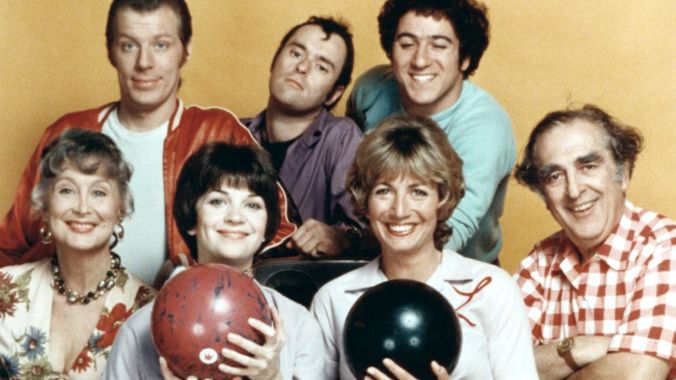
Laverne and Shirley was a spin-off of Happy Days.  Two friends, Brewery workers, get involved in various kinds of trouble.  Marshall explained his idea for the show: “No one else on TV is doing early Lucy.  The other ladies on sitcoms are classy – they’re well off, smart, and they dress well. Laverne and Shirley are definitely not classy. They’re blue collar workers who went to work right after high school.  They’re decent people.”

garry6

Happy Days would produce two more shows in Joanie Loves Chachi that explored the life of Joannie Cunningham and Fonz’s nephew Chachi after high school as they tried to figure out their relationship and Mork and Mindy, a show starring Robin Williams and Pam Dawber about an alien living in Colorado.

His Acting Career

A la Hitchcock, Marshall turns up as an uncredited actor in the background, occasionally appearing in cameos on his own hit TV shows.

garrya

On Dick Van Dyke, he appeared as referee in a 1965 episode and a bartender in a 1966 episode. If you look closely, you will see him as a random man in three Odd Couple episodes. He showed up as a drummer in two Laverne and Shirley shows and on a Happy Days episode.

He had a small re-occurring part on Murphy Brown and provided the voice for two Simpsons shows (“Eight Misbehavin’” and “Homer the Father”).

In 2014, Marshall appeared in a guest star role in a Two and a Half Men.

He continued to show up in comedies until his death, the last one being Brooklyn Nine-Nine.

When he made the switch to movies, he continued to find small roles for himself. He plays a first baseman in  Runaway Bride, an audition director in Beaches, and a bum in Pretty Woman. It seems there was no part too small. He also played his real-life sister’s husband in Hocus Pocus in 1993.

His Directing Career

His career as a film director was just as impressive, yielding several gems and cult classics, from Pretty Woman to Runaway Bride to The Princess Diaries.

In the early 1980s, he met Héctor Elizondo while playing basketball and they became great friends. Marshall was known for his obsession with basketball: his contract often obligated studios to provide a basketball court on his film locations.

garry3

Elizondo appeared in every film that Marshall directed, beginning with his first feature film Young Doctors in Love. Elizondo once noted that he is written into all of Marshall’s contracts whether he wanted to do the film or not.

In the opening credits of Exit to Eden (their eighth film together), Elizondo is credited “As Usual … Hector Elizondo.” In 1984, Marshall had a film hit as the writer and director of The Flamingo Kid. He later produced Nothing in Common with Tom Hanks and Jackie Gleason and Overboard with Goldie Hawn and Kurt Russell.

In 1988, he directed the legendary weepie Beaches, starring Barbara Hershey and Bette Midler.

Although he was original choice to direct Sleepless in Seattle, Nora Ephron ended up with the job. His most famous movie as director also won him an Oscar nomination for Pretty Woman in 1990.

garry10

Pretty Woman star Richard Gere said of Marshall in Variety: “He was a mentor and a cheerleader and one of the funniest men who ever lived. He had a heart of the purest gold and a soul full of mischief.”

Some people might be surprised to find out that Garry was the director for The Princess Diaries and The Princess Diaries 2 starring Anne Hathaway and Julie Andrews.  Garry considers Julie Andrews one of his favorite actresses because “she could act, she can sing, she’s a lady who can curse with perfect diction.”

garry17

He seemed to be surrounded by family whether at home or work.  In his last movie, Mother’s Day, he re-united with Julia Roberts, Kate Hudson, and, of course, Hector Elizondo. His sister Penny provided narration; his son Scott helped direct; and his wife, Barbara, a nurse, played a nurse in the film. (“She has her own costume,” Marshall joked.) There were also a few grandchildren  included in certain scenes.

garry11

Awards

When he gave a speech upon accepting the Lifetime Achievement Prize given at the American Comedy Awards in 1990, Marshall said, “If television is the education of the American people, then I am recess.”

In addition, he received the Valentine Davies Award (1995), the Women in Film Lucy Award in recognition of excellence and innovation in creative works that have enhanced the perception of women through the medium of television, the Television Hall of Fame for his contributions to the field of television in 1997, the National Association of Broadcasters’ Broadcasting Hall of Fame in 2012, the Laurel Award for TV Writing Achievement in 2014, as well as a star on the Hollywood Walk of Fame.

garry12

Conclusion

On the morning of July 19, 2016, Marshall died at a hospital in Burbank, California at the age of 81 due to complications of pneumonia after suffering a stroke.

Robin Williams’s daughter Zelda wrote, “RIP Garry. You forever changed my father’s life, and thus, mine. Thank you for capturing so much joy on film, over and over.”

Henry Winkler tweeted, “Larger than life, funnier than most, wise and the definition of a friend.”

“How could one individual work parts of seven decades in the entertainment industry and make zero enemies?” Ron Howard asked, “Garry achieved that, and it was the result of his absolute integrity as a man and as an artist.”

Garry Marshall was an amazing and talented man.  He was a family man above all else.  He was an actor with 84 credits, a writer with 40 credits, a producer with 31 credits, and a director with 30 credits.  He was a drummer and a journalist.  His career covered more than six decades and his star was shining bright when he left show business.

He will be remembered for creating television shows that touched viewers and drew them into the world their characters inhabited.  We rooted for all of them and looked forward to spending time with them each week.  He created some of the most memorable characters on television. He also provided many lovable movies for our DVD collections with Pretty Woman at the top of the list.

HAPPY DAYS, from left: Penny Marshall, Robin Williams, Henry Winkler, 1974-84.

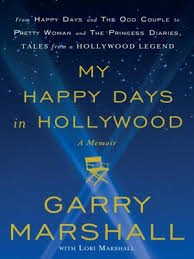
He wrote My Happy Days in Hollywood in 2012.  This is one of my all-time favorite classic television era autobiographies.  He not only discusses his successes but admits to all his screw ups and mistakes as well.  It’s a refreshingly honest account by a down-to-earth and humble man.  It’s one of the best ways to get to know this fascinating guy and is a wonderful tribute to a man who quietly influenced generations of actors and actresses. Let’s end by hearing how his book was perceived by some of those people who knew him best.

book
“Garry Marshall is walking entertainment. He is smart, insightful, funny…and so is his book.” ―Henry Winkler

“Even though he speaks slowly with a distinctive New Yorkese Bronx accent, he has managed to quickly create, write, and produce a raft of beloved television series that speak ‘American’. I am happy that he gifted us with a witty memoir (about his Happy Days in Hollywood).” ―Carl Reiner

“Thanks to my brother I have a life.  I’m sorry I almost ruined his during Laverne & Shirley.” ―Penny Marshall

“I never thought my fairy godmother would look―or sound―like Garry. He is a gift of a human being, and this book is wicked sweet.” ―Anne Hathaway
 
“Garry Marshall is one of the most beloved and talented people I know…and maybe the most normal guy in the business. This wonderful biography will allow readers to discover for themselves the decent and kind man who writes and directs with such a huge heart—all grounded from humble beginnings in The Bronx. This is a must-read book.” —Julie Andrews
 
“Garry Marshall is quite simply one of my favorite people. He is loving, loyal, and hilarious! Having made movies with Garry when I was 20, 30, and 40…I guess you could say Garry and Barbara have raised me! In a time where people have lost touch with things to laugh about, this book is sure to be a cure.” —Julia Roberts

Stars Who Jump From the Big Screen to the Small Screen Don’t Always Land on Their Feet

While it is not uncommon for stars to transition from television to movies–think about Robin Williams, Sally Field, Melissa McCarthy, and Tom Hanks–it is less likely to see stars move from the big screen to the small screen.  Jane Fonda has transitioned to television in Frankie and Grace and Fred MacMurray did it with My Three Sons.  For most stars, the move has not worked out very well. Let’s look at a few stars who tried to make the conversion.

That Wonderful Guy – Jack Lemmon (1949)

Neil Hamilton (best known as Commissioner Gordon on Batman) plays Franklin Westbrook, a conceited drama critic who dislikes almost everything. Jack Lemmon plays Harold, a Midwesterner who thinks working for Westbrook will help him become worldly and give a boost to his acting career. His girlfriend is played by his real wife Cynthia Stone. The episodes revolved around his romantic and business adventures in New York City.  Perhaps Westbrook panned the show because it was cancelled after three episodes.

movielemmon1


Heaven for Betsy – Jack Lemmon (1952)

Three years later, Lemmon gave it another try. In this show, Lemmon plays Peter Bell, a toy store buyer. His wife Cynthia again played his wife Betsy. The series was based on a sketch “The Couple Next Door” that Lemmon and his wife played regularly on the Frances Langford/Don Ameche Show. Each episode lasted 15 minutes, and it told about the newlyweds’ struggles in New York City. Instead of three episodes, this series lasted three months.

movieslemmon2


Honestly Celeste – Celeste Holm (1954)

After playing Ado Annie in Oklahoma, Holm tried her hand at television. She plays Celeste Anders, a Minnesota college professor living in Manhattan, who is getting journalism experience working for the NY Express. Celeste wrote stories ranging from modern art to underprivileged families. She also dated the publisher’s son Bob Wallace, played by Scott McKay. After three months, she was sent back to school in Minnesota. What was most surprising about this failure was that Norman Lear (who would go on to create dozens of shows) and Larry Gelbart (who later created M*A*S*H) were both part of the writing staff.


Going My Way – Gene Kelly (1962)

Bridging television and movies, Gene Kelly redid Bing Crosby’s movie from 1944 for the small screen. Kelly is Father Chuck O’Malley, a progressive priest assigned to the slums of New York. Father Fitzgibbon played by Leo G. Carroll is a cantankerous, old priest. Dick York was his boyhood pal Tom Colwell who ran the community center. Mrs. Featherstone (Nydia Westman) played the rectory housekeeper. The list of guest stars on the show was very impressive, but after a year, the network told Kelly to keep going and cancelled the show.


The Bing Crosby Show – Bing Crosby (1964)

I guess Bing decided if Gene Kelly could enter television with his old movie, he might also give it a try. He plays Bing Collins a former singer. He is now an electrical engineer married to Ellie (Beverly Garland) with two daughters Janice (Carol Faylen), 15, and boy crazy and Joyce (Diane Sherry), 10, who had a high IQ. It lasted one season. Not surprisingly, this series also attracted a lot of big-name guest stars including Frankie Avalon, Jack Benny, Dennis Day, Joan Fontaine, and George Gobel. Apparently, Garland had a thing for engineers because she would marry aeronautical engineer Steve Douglas on My Three Sons.


Mickey – Mickey Rooney (1964)

Mickey plays Mickey Grady who leaves the Coast Guard to manage a posh hotel, Newport Arms in California, with his wife Nora (Emmaline Henry) and two young boys. His real son plays one of his sons on the show. Sammee Tong plays the hotel’s manager. The former supervisor has left a lot of problems for Mickey. The show was cancelled in January airing only 17 episodes.


One of the Boys – Mickey Rooney (1982)

After vowing never to work on television again, Rooney tried it again 18 years later. Now he plays 66-year-old Oliver Nugent, rescued from a nursing home by his grandson Adam Shields (Dana Carvey). Adam is a college student who takes him in. Adam’s roommate, Jonathan Burns (Nathan Lane) is not so happy about the situation. Oliver looks for a job and lands one singing in a restaurant. Also appearing in the cast was Scatman Crothers who sang with Oliver and had also left the nursing home.  A young Meg Ryan played Adam’s girlfriend Jane. The show debuted at 18th place in the ratings but by within a month it had dropped to 68th. Even with this cast, the show was cancelled after an unlucky 13 episodes.

movies10


Jimmy Stewart Show – Jimmy Stewart (1971)

Jimmy Stewart jumped to the small screen with great anticipation and excitement by viewers. He  played anthropology professor Jim Howard. Howard teaches at Josiah Kessel College, started by his grandfather.  His house is full with his wife, his son Peter, Peter’s wife Wendy, and his grandson Jake. He also has a young son Teddy, who happens to be the same age as his grandson. His friend Luther Quince often stops by to eat and give advice. Jim talks to the audience during the show and wishes them love, peace, and laughter at the end of each episode. Even beloved Jimmy Stewart was unable to save this show which was cancelled after one season.


The Doris Day Show – Doris Day (1968)

Doris Day was the most successful actor moving from film to television. However, I think the reason she managed to keep her show on the air for five seasons was because she changed the format so often that CBS did not realize it was the same show.  In 1968, Day is Doris Martin, a widow with two kids. She moves from the city to Mill Valley, CA to live on her father’s ranch.

The second season she commutes to San Francisco after accepting a job as an executive secretary to Michael Nicholson (MacLean Stevenson), the editor of Today’s Magazine. Rose Marie was Myrna Gibbons and Denver Pyle again played her father Buck Webb.

In 1970, Doris and the kids move to an apartment over an Italian restaurant run by Kaye Ballard and Bernie Kopell. Billy De Wolfe was her neighbor. Now Doris is writing feature stories for the magazine.

When the show returned the next fall, Doris was single and a reporter for a magazine. Her new boss was Cy Bennett (John Dehner) and she had a boyfriend Peter Lawford but later her boyfriend turned into Patrick O’Neal. There was no restaurant.

By 1973, the network caught up with all the changes and cancelled the show.


It was interesting that so many actors failed in television when they were such celebrated movie stars. The radio stars seemed to have better luck making the transition. Jack Benny and Burns and Allen had long-lasting and popular shows. It’s hard to imagine actors like Ryan Gosling, Amy Adams, Julia Roberts, or Ben Affleck bombing on a television series today.

I think for now I will continue to choose to watch Pillow Talk, Move Over Darling, Harvey, The Philadelphia Story, Some Like It Hot, Singing in the Rain, and Hope and Crosby’s Road movies and set aside the television DVDs these stars appeared in.

The Amazing, But Much Too Short, Career of Richard Deacon

Richard Deacon, 1960s

Richard Deacon was born in Philadelphia, Pennsylvania in 1921, but most of his adolescence was spent in Binghamton, New York. When he was only 11, he contracted polio. He took up dancing to build up his leg muscles.

Deacon’s first career choice was to become a doctor.  He was working as an orderly at the Binghamton Hospital when World War II began. He tried to join the Navy; they suggested he try the Army.  He did and joined the medical corps.

After the war, he studied medicine at Ithaca College but soon switched to acting. He studied drama for a couple of years and was the actor in residence at Bennington College.  After spending some time in New York, he headed to California to look for work.  After paying his dues as a bartender, he finally got a break and was offered a role in a film, Invaders From Mars.

When he first began his career, Helen Hayes advised him to become a character actor as opposed to a leading man.  It was great advice, and he was one of the most beloved and prolific actors during the golden age of television. During his career, he appeared in 66 movies on the big screen, guest starred on 92 different television shows, and starred in six series.

In the 1950s, he appeared in 48 television shows including Burns and Allen, The Life of Riley, Bachelor Father, and the Gale Storm Show.  He had regular roles in two sitcoms.

The Charles Farrell Show debuted in 1956. Farrell played himself as the manager of the Palm Springs Racquet Club, a resort he actually owned and operated. It was a summer replacement for I Love Lucy and only lasted 12 episodes. Richard played Sherman Hall.

deacon8

In 1957, he got another chance at being a regular in a sitcom, Date with the Angels starring Betty White. Deacon played Roger Finley.  This show lasted one year.

Richard continued his productive acting career, appearing in 43 shows in the 1960s.  He could be seen in a wide range of shows including Bonanza, The Rifleman, My Three Sons, Make Room for Daddy, Perry Mason, The Donna Reed Show, The Twilight Zone, Mr. Ed, I Dream of Jeannie, Get Smart, The Munsters, and The Addams Family. He was also appearing in a number of films during this decade. He appeared in four sitcoms on a regular basis during the ’60s.

Leave It to Beaver aired from 1957-1963. Deacon played Fred Rutherford, father of Clarence, or Lumpy, Rutherford, Wally’s friend. During the 6 seasons it was on the air, Fred was in 63 episodes.

Part way through the series, he was offered another regular role, that of Mel Cooley on The Dick Van Dyke Show.  From 1961-1966, he brightened the screen in 82 shows, putting up with his brother-in-law’s bullying and Buddy Sorrel’s belittling. Deacon had high praise for everyone connected with The Dick Van Dyke Show.

One day Morey Amsterdam was goofing around with Richard and said he didn’t think his hair had fallen out, he thought it had imploded and fallen into his brain, clouding his thinking.  Carl Reiner came running on the set and said to add that dialogue to the show.  From then on, there was an insult fest between Buddy Sorrell and Mel Cooley. When the writers were trying to come up with a comeback from Mel to Buddy, Reiner asked Deacon how he would respond to someone who continued to torment him.  Deacon replied, “Yeecchh!” and his trademark phrase was invented.

deacon9

Bud Molin, Dick Van Dyke Show film editor described Deacon as “the funniest human being on the face of the earth.” Carl Reiner said it was a joy to have him around and everyone on the show loved him.

Deacon, Leonard, Reiner, Paris

The Dick Van Dyke Show was one of the best shows ever written. It won the Outstanding Comedy Emmy in 1963, 1964, and 1966. After the cast of the Dick Van Dyke Show decided to end the show on its own terms, leaving the air with its quality reputation intact, Deacon was offered another sixties role.

Phyllis Diller had a fantastic cast on her show, The Pruitts of South Hampton, or The Phyllis Diller Show as it became known in syndication. This was about a formerly wealthy family who found out they owed $10,000,000 in back taxes.  They try to appear that they still have their wealth, while living in very reduced circumstances.  The cast included Louis Nye, John Astin, Reginald Gardiner, Paul Lynde, Gypsy Rose Lee, Billy De Wolfe, John McGiver, and Marty Ingels in addition to Diller and Deacon.  I don’t know how this show did not succeed, but it was taken off the air after only one year. Diller and Deacon continued to work together both on an episode of Love, American Style and in the production of Hello Dolly in the 1969-1970 season.

deacon14

Once the Diller show was canceled, Deacon was offered a role on The Mothers-In-Law starring Kaye Ballard and Eve Arden. Deacon took over the role of Roger Buell mid-way through the series. The concept was two families who didn’t necessarily get along were neighbors whose children  married so they had to find ways to get along and keep the peace.

deacon4

After the show was cancelled, he continued to stay busy with his acting career.  He also appeared in 17 episodes of Match Game and several Family Feud episodes.

deacon7

Deacon was a life-long bachelor.  He was a closeted gay man who had to keep his sexual orientation secret to keep his options open to work for companies like Disney. He was also a gourmet chef.  In the 1980s, he hosted a Canadian cooking show about microwave cooking, writing a book that sold almost two million copies. He spent a lot of his spare time working with SYNANON, an agency that helped teenage drug addicts.

On the night of August 8, 1984, he was suffered a heart attack in his Beverly Hills home. He was rushed to Cedars Sinai Hospital, where he died later that night. He was 63 years old.

deacon15 - Copy

Everything I read about Richard Deacon painted him as a gracious, friendly, very funny man who was caring and kind.  He had an amazing career, with 180 acting credits within a 30-year period.  The legacy he left was a rich and full acting life. Pretty good for a guy who chose to be a character actor and was humble enough to turn down two offers to star in his own show.

Just When You Think It Can’t Get Any Weirder, It Does

Although I love The Big Bang Theory and Modern Family, there are a lot of shows on television today that make me shake my head.  It’s amazing what is airing when you scroll through the channels:  Vanilla Ice Goes Amish, I Cloned My Pet, Doomsday Preppers, and these are some of the best reality shows out there.  However, when I researched sitcoms from the classic era, I also found a lot of weird concepts there also.  Let’s take some time to look at a few of them.


unusual1

Boss Lady (1951)

Lynn Bari was Gwen Allen, owner and operator of Hillendale Homes Construction Co. which was owned by her father.  While this show would not seem unusual at all today, back in 1951 it was not common to see a woman the boss of a construction crew. This show began on the Dumont network and then switched to NBC for twelve episodes, running as a summer replacement from July to September 1952.


Where’s Raymond? (1953)

Believe it or not, this was a musical sitcom.  Ray Bolger (who had sang and danced as The Scarecrow in The Wizard of Oz) was a song and dance man named Ray Wallace living in Pelham, New York. He had a girlfriend named Susan (Marjie Millar) and a business partner Peter (Richard Erdman). Verna Felton from December Bride was his understudy’s mother-in-law. The show lasted 2 ½ years on ABC.


The People’s Choice (1955)

Ok, pay attention, because the basis of this show is confusing. Socrates (Sock) Miller played by Jackie Cooper is a Bureau of Fish and Wildlife Orinthologist studying to be a lawyer.  Honestly! He has car trouble one day and is picked up (and picked up) by the mayor’s daughter Mandy who thinks he should be on the city council. Sock decides to be a lawyer to support Mandy.   In the finale to year one, the two elope and conceal their marriage for the entire second season.  When the show came back for a third year, the mayor finds out about the marriage, Sock gets his law license, and Sock’s free-loading pal Rollo (Dick Wesson) moves in with the couple.  Now Sock is managing a real estate development. Just when you thought it could not get more confusing, Sock’s basset hound Cleo would do tricks and comment directly to the audience about situations occurring on the show. LSD had not even become a social problem yet, so it was not responsible for this show, so I’m not sure how this crazy mess stayed on the air for 104 episodes.


TSDDIAN EC004

Dick and the Duchess (1957)

Dick Starrett (Patrick O’Neal) is a claims adjuster in London.  There are some exciting scenarios to provide interest. He meets and marries Jane (Hazel Court) a duchess. She becomes his wife and assistant, although she still expects to live in the manner she has become accustomed to.  She humorously gets involved in his investigations. The network must not have thought she was that funny helping out because  CBS cancelled it after 25 episodes.


Mr. Ed (1961)

Let me say, I do not put Mr. Ed in the same category as Dick Van Dyke Show, That Girl, or Bachelor Father, but I don’t mind catching an episode or two now and then.  When looking at strange concepts for show, this one does have to go into the mix.

When the creator asked Young to appear in the show, he turned him down twice. A pilot was made without him. It did not sell, so producers Arthur Luben and Al Simon decided to enter it directly into syndication, and Young then agreed to take on the role. It was very successful, so CBS bought it.

Wilbur Post (Alan Young) is a married architect. Wilbur and his wife Winnie (Connie Hines) bought their house with a horse included. Their neighbors were played by Edna Skinner and Larry Keating. What no one else realized (including his wife), was that Wilbur was the only human who could understand Ed and talk with him.  Ed was quite the character; he was a hypochondriac; a voracious reader; a playboy, or play horse; loved Carl Bernstein and wanted to decorate his stable in Chinese modern.

The voice of Ed was a highly guarded secret until the show ended in 1967 when it was revealed to be Rocky Lane. Ed was played by Bamboo Harvester, a palomino. One interesting fact about this show is that it has been seen in 57 different countries.


My Mother the Car (1965)

This is another one of those shows you roll your eyes about.  Dave Crabtree (Jerry Van Dyke) lives in LA.  He wants to buy a new station wagon, and when he goes shopping, he realizes his mother’s voice is coming through the radio of a 1928 Porter.  Ann Sothern provides his mother’s voice. Of course, he buys the car which irritates his family, but they don’t know his secret. He also has to deal with a car connoisseur who wants to buy the car for his collection. Maybe it’s a Freudian slip, but I’m a bit offended that a mother is portrayed as an old jalopy as opposed to a new, sleek car, but I digress. This show was only on the air for a year and then the radio was turned off.


unusual11

The Second Hundred Years (1967)

Here is the premise of this one:  In 1900, 33-year-old Luke Carpenter (Monte Markham) is prospecting for gold in Alaska.  An avalanche occurs, and he is buried alive and frozen.

In 1967, Luke’s son Edwin, who is 67, is told that his father has been found alive.  Dad looks 33, but his identity and past has become a top-government secret.  He is released into the custody of Edwin (Arthur O’Connell) and grandson Ken (also Monte Markham). Luke has a hard time adjusting to life in the 1960s. I know you are surprised, but the show was cancelled after 30 episodes.


My World and Welcome to It (1969)

This show was based on James Thurber’s writings. The show was set in Connecticut where John Monroe (William Windom) was a cartoonist for Manhattanite Magazine. He was intimidated by his wife Ellen (Joan Hotchkiss). To escape his boring and nagging life, he escapes into a secret world where his cartoons come alive and he is a king. He drifted between real and fantasy lives. NBC cancelled the show after a year, but CBS picked it up and aired it from May-September of 1972. So, the presence of LSD does explain the writing on this one. What it doesn’t explain is that this show won two Emmys in 1970 : Outstanding Continued Performance by and Actor in a Leading Role in a Comedy Series and Outstanding Comedy Series. The competition for comedy included Love American Style, Room 222, The Bill Cosby Show, and The Courtship of Eddie’s Father.


The Roller Girls (1977)

Meet the Pittsburgh Pitts, an all-women roller derby team, owned and managed by Don Mitchell (Terry Kiser). The Pitts were pretty but useless when it came to roller derby. James Murtaugh played the team’s announcer Howie Devine. After four episodes, the network agreed this really was the pits and it was cancelled.


unusual14

Apple Pie (1978)

This show aired for one episode – I thought they used to call that a movie. (A couple sources say 2 episodes, perhaps a mini-series.) The show is set in Kansas City, Missouri. A hairdresser named Ginger Nell Hollyhock (Rue McLanahan) is lonely and decides to advertise in the local paper for a family. She ended up with a con artist, Fast Eddie (Dabney Coleman), a tap-dancer daughter, a son who wanted to fly just like birds do, and a grandfather figure (Jack  Guilford).


So, when you think you’ve seen it all before, you probably have. I would not be the least surprised to read that in the fall there will be a reality show that features a roller derby team, or a woman who advertised for a family in the personal ads, or an insurance adjustor married to royalty.

I do have to say that both Dick and the Duchess and My World and Welcome To It  seem to have some die-hard fans who appreciate the shows  I guess I should watch a few more episodes.

Listen up you sitcom developers; if you think you have a concept that’s a bit too far out there, it will probably be a big hit. After all, who would have guessed a show about an alien from Ork who traveled in an egg, and gave birth to a 79-year old man would score high ratings?

We Are Previewing the Preview of Fall 2017 New Shows

Traditions have always been important to me.  Apart from holiday rites and rituals that make celebrating more meaningful, I have other seasonal customs. I always wear lilac perfume the first day of spring, I have a snowman I bought at 20 that comes out the first snowfall of each year, and I like to celebrate my birthday on the actual date.

When I think about the traditions that were part of my childhood, two things come to mind immediately.  There were two days I looked forward to every year.  One was the day the Sears Wish Book came in the mail.  We would pour through the catalog, planning our Christmas list for Santa and looking at all the unusual decorations they featured.

The other day was the day the TV Guide September Preview came out.  With the same anticipation we had in paging through the Christmas catalog, we would read about all the new shows debuting on the three major networks.  I picked out my favorites and marked down when each one would begin.

I know I could still go to the store and buy the TV Guide that previews the fall shows, but it is not the same. There are no longer three networks; there are hundreds, and even though many of them don’t feature new fall shows, it is still hard to find a spot where you can preview everything that is being produced.

Looking at some of those years and the shows that began each fall, I picked three seasons that featured some long-lasting, classic shows.

1960 – While I did not preview any of these shows since I was not born yet, I included this season because it featured The Andy Griffith Show, My Three Sons, and Pete and Gladys.  Who knew back then that almost 60 years later, an entire town would be devoted to The Andy Griffith Show, drawing thousands of visitors yearly. Talk about long-lasting!  My Three Sons is one of my favorite shows.  It continued on the air until 1972, so I literally grew up with the Douglas boys. I only got to know Pete and Gladys through reruns, but it was one of those shows that sparked my interest in older sitcoms.


1965 – I was only 4 when these shows debuted, but I have spent most of my life watching them.  September of 1965 introduced us to Get Smart, F-Troop, Gidget, Green Acres, Hogan’s Heroes, I Dream of Jeannie, Please Don’t Eat the Daisies, and The Smothers Brothers – eight shows that continue to be watched by viewers.  I Dream of Jeannie went to reruns as soon as the show was cancelled, and has never not been on television since 1965 – pretty amazing.  Turn on ME TV or Antenna TV and you can still watch most of these series.


1970 – The late 60s and early 70s featured the shows I lived for.  I read about the stars in Tiger Beat and other magazines.  We had slumber parties around the Friday night line-up of shows.  In 1970, we saw the beginning of The Mary Tyler Moore Show, The Odd Couple, The Partridge Family, and Nanny and the Professor.  We still discuss the significance of Mary Tyler Moore and the way the show featured single women.  The Odd Couple just saw the remake of the second or third series since the original debuted. When I watch an episode of The Partridge Family, I am ten again and have not a care in the world, except that I can’t find a way to meet Keith who I know is just waiting for me. I have not watched Nanny and the Professor since my youth but I do remember watching every week then.

So here we are 47 years later, and I have to search the internet just to find a full listing of new shows coming out.  It’s not the same as sitting down with the glossy issue, knowing I can do the crossword puzzle later.  We have hundreds of networks, not three.  Yet some things remain the same.

In reviewing the new shows, I still only came up with 7 that looked interesting to me.  I don’t see the This Is Us of 2017. What I did see were a lot of legal and medical dramas.  I wonder why can’t the networks figure out that one or two well-written shows about the medical and legal fields are great, but 32 of them glaze our eyes over.

I loved the fresh approach of Trial and Error last year, and I will continue watching that show, but I’ll pass on the Trial and Error-Wannabees I see coming out this year.  Again, creativity and originality are more important than another rollout of a successful show already on the air. I also get tired of shows that call themselves sitcoms like Two Broke Girls, but have no humor, just a lot of crude language and not much originality.  Would you eat at their restaurant?

So, with all that being said, here are the shows that are piquing my interest this fall. I copied the series descriptions directly from the preview site on Entertainment Weekly: http://ew.com/tv/2017/04/21/fall-tv-pilots-2017/.

IMG_1518

  1. The Trustee

In this fun, female buddy cop dramedy, a driven but stubborn detective finds unlikely help from her precinct’s trustee, a larger than life ex-con finishing out her prison sentence doing menial tasks for the police department. Though these two have completely opposing views on crime and punishment, a highly entertaining and successful partnership is born.

Team: Jay Scherick and David Ronn will write and executive-produce with Elizabeth Banks and Michael Engler.

Cast: Meaghan Rath, Micheal Cudlitz, Laverne Cox, Gail Bean, Lance Gross, L. Scott Caldwell, Trevor Lerner, Berto Colon, Tim Kang, David Warshofsky.

I may be placing more hope in this show that I should, but I am still in mourning over Rizzoli and Isles ending, so I am looking for a replacement.


fall11

  1. Household Name

This multi-camera comedy follows a family who has an opportunity to buy the house of their dreams but under extremely abnormal circumstances: They must live with the previous owner, an eccentric, larger-than-life actress (Carol Burnett).

Team: Michael Saltzman will write and executive-produce with Amy Poehler, Brooke Posch, Carol Burnett, Dave Becky, and Michael Pelmont.

Cast: Carol Burnett, Timothy Omundson, Matt Oberg, Mary Holland, Zoe Anne Pessin, Maverick Thompson.

How can you not be excited about a show starring Carol Burnett.  I admit, I will give this one several chances and the benefit of the doubt just to watch her.


IMG_1519

  1. The Mayor

After an outspoken, idealistic rapper runs for office as a publicity stunt and actually gets elected, he surprises everyone (including himself) when he has a natural knack for the job and slowly transforms City Hall.

Team: Jeremy Bronson will write and executive-produce with Daveed Diggs, Jamie Tarses, and James Griffiths.

Cast: Brandon Michael Hall, Lea Michele, Bernard David Jones, Marcel Spears, Yvette Nicole Brown, David Spade.

This show is going to be great or a total flop.  Let’s check it out and see which way it goes.


  1. Splitting Up Together

Based upon the original Danish series created by Mette Heeno, Splitting Up Together is the story of a couple whose relationship is reignited by their divorce.

Team: Emily Kapnek will write and executive-produce with Ellen DeGeneres, Jeff Kleeman, Mette Heeno, Mie Andreasen, and Hella Joof.

Cast: Jenna Fischer, Oliver Hudson, Lindsay Price, Olivia Keville, Bobby Lee, Diane Farr, Van Crosby, Sander Combs, Geoff Pierson, Lucas Near-Verbrugghe, Kelsey Asbille.

I am putting faith in Ellen DeGeneres that this one will be a hit.  I am also looking forward to Jenna Fischer and Oliver Hudson pairing up.


wyle

  1. Perfect Citizen

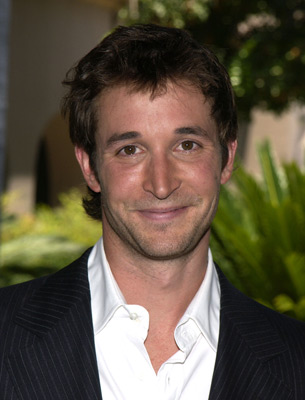
After his involvement as a whistleblower in an international scandal, the former General Counsel for the NSA (Noah Wyle) embarks on a new career at a storied law firm in Boston, facing the reality that while half the country thinks he’s our greatest patriot, the other half thinks he’s a traitor.

Team: Craig Turk will write and executive-produce with Ridley Scott, David Zucker, and Paris Barclay.

Cast: Noah Wyle, Shanley Caswell, Kristin Chenoweth, Stephanie Szostak, Adrienne Warren, Lenny Platt, Brian Stokes Mitchell.

I am a big Noah Wyle fan and never watched The Librarians although I had good intentions, so I am going to watch this one.  The plot intrigues me.
 

  1. Life Sentence

When a young woman diagnosed with terminal cancer finds out that she’s not dying after all, she has to learn to live with the choices she made when she decided to “live like she was dying.”
Team: Erin Cardillo and Richard Keith will write and executive-produce with Bill Lawrence, Oliver Goldstick, Jeff Ingold and Lee Toland Krieger.
Cast: Lucy Hale, Dylan Walsh, Jayson Blair, Gillian Vigman, Brooke Lyons, Elliot Knight, Carlos PenaVega.

This plot also has me creating story lines in my mind.  It could be an interesting concept or another Two Broke Girls.  Let’s hope for the first option.


  1. Will & Grace (straight-to-series)

A 12-episode revival of the long-running Emmy-winning comedy, which will reunite Debra Messing, Eric McCormack, Sean Hayes, and Megan Mullally.

Team: Original series creators Max Mutchnick and David Kohan will act as showrunners and executive producers, while prolific director James Burrows, who directed every episode of the show during its initial eight-year run, is on board to direct and executive-produce.

Cast: Debra Messing, Eric McCormack, Sean Hayes, Megan Mullally.
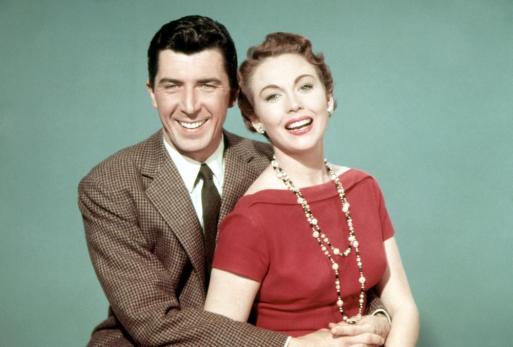
Based on the writing from the original and the cast chemistry between these four stars, I can’t imagine not liking this show.  I’m not sure if the 12 episodes is a first taping or if that is all we will get. 

Let me know what shows you plan on checking out this fall.  In January, I’ll let you know how I think the shows panned out and which ones may or may not be back next fall. Happy fall preview week!

One of the Most Under-Rated Comedians of Our Time – Nancy Kulp

kulp5

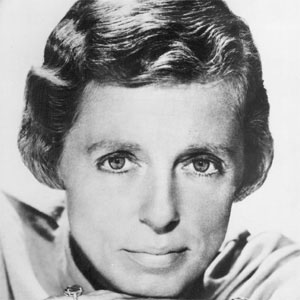
Today we look at the career of Nancy Kulp.  Nancy Jane Kulp was born this day in 1921; she would have been 96. If you are part of the younger generation, your response is probably “Nancy Who?”  If you are one of us that watched television growing up in the 1960s and 1970s, your response is probably, “Oh, Jane Hathaway.”

Nancy Kulp is one of the most under-rated comedians we have seen in film and television.  She is one of those performers like Don Knotts, Dick Van Dyke, or Jerry Lewis who is so natural in her characterizations and has perfected a stereotype role that we assume that there is not so much acting going on – they are just expressing their true personality.

Nancy was born in Harrisburg, Pennsylvania where she grew up.  Like me, she left Pennsylvania in her early teens, but she moved to Florida instead of Wisconsin. She was an only child.  After high school, she attended Florida State University, which at the time was known as Florida State College for Women. She received a BA in journalism in 1943.

Kulp joined the US Naval Reserve (or WAVES) in 1944, becoming a lieutenant, junior grade. She received several awards in the Navy including the American Campaign Medal.  I learned that this medal was issued by Roosevelt to recognize military members who had performed their service in the American Theater of Operations during World War II.

After the war, she went on to earn masters in both English and French at the University of Miami. After graduation, she began writing profiles of celebrities for the Miami Beach Tropics, a local newspaper.

In 1951, she married Charles Dacus, and they moved to Hollywood.   (They divorced in 1961 and I could not find out anything else about him.)

Three weeks after arriving in Hollywood to work in the publicity department, George Cukor convinced her to try out as an actress.  Her first movie role was in The Model and the Marriage Broker in 1951. She would appear in 32 movies, including Shane (1953), A Star is Born (1954), Anything Goes (1956), and two of my all-time favorite movies, Sabrina (1954) and The Parent Trap (1961). Although most of her movies were comedies, she was cast in four westerns, a science fiction movie, a mystery, and several adventures and dramas. She was also the voice of Frou Frou in The Aristocats.

In 1954, she began her television career.  Although she only starred in one series, she was in many well-respected shows. She was Bob Cumming’s neighbor on Love That Bob and that character, Pamela Livingston, a prim birdwatcher, was to define most of her later characters. On I Love Lucy, she played a maid who taught Lucy and Ethel to curtsy before they met the Queen. She also appeared on Topper, Our Miss Brooks, The Adventures of Ozzie and Harriet, December Bride, Perry Mason, Mr Ed, Pete and Gladys, Jack Benny, My Three Sons, 77 Sunset Strip, and Sanford and Son, 58 different shows in all.

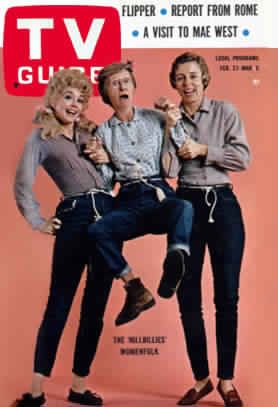
In 1962, she accepted the role of Jane Nancy Hathaway (a play on her real first two names), Milton Drysdale’s efficient secretary. The concept of the show was that a backwoods family, the Clampetts from Tennessee, struck oil, became millionaires, and moved to Beverly Hills.  They never were accepted into the higher society and continued to live in the style they had back home.  Granny made vittles, and they called their pool the cement pond.  Mr. Drysdale was the banker who took care of their money.  Miss Hathaway was devoted to her boss, but if he went too far with a scheme, she would call him out by saying, “Chief!” She had a crush on Jethro Bodine, Jed Clampett’s nephew who lived with them.

The show would continue until 1971 when the network decided to get rid of all the rural comedies, whether they were still garnering high ratings or not. The show was in the top 20 for 8 of its 9 seasons. Kulp was nominated for Outstanding Actress in a Supporting Role in 1967 but lost to Frances Bavier for her role as Aunt Bee on The Andy Griffith Show.

After her role as Jane Hathaway ended, she turned to Broadway.  Her best-known work was in Mornings at Seven from 1980-1981.

kulp23

In 1984, she ran for Congress in the Pennsylvania 9th district.  She was running as a Democrat against incumbent Bud Shuster in a decidedly Republican district. She did take 33% of the vote; however, she never had a chance.  Buddy Ebsen and Nancy had not gotten along during their years on The Beverly Hillbillies.  When he heard she was running for Congress, he contacted Shuster’s campaign and offered to do radio spots claiming Kulp was too liberal and voters should not elect her.  While she admitted they had not been friends, she was surprised he would choose to do something so mean for spite.

She began working at Juniata College in Huntingdon, PA as an artist-in-residence and later taught acting.

In the late 1980s, Nancy moved to Palm Springs.  She became involved with a variety of charities including The Humane Society of the Desert, The Desert Theater League, and United Cerebal Palsy. She was also on the board of SAG.

Nicknamed Slim, Nancy was an devoted football fan all her life. She was the first guest on The Arsenio Hall Show and sat with the house band. She also appeared on the Frank Sinatra Show, the Jack Paar Show, The Mike Douglas Show, and several game shows including Password All-Stars, Hollywood Squares, Match Game 73, and Match Game PM.

In 1989, in an interview with Boze Hadleigh, she admitted she was a lesbian.  When he asked her about that, she said she would answer him but only if she could frame the question.  She said to ask her if she believed opposites attract, and her answer was that “she believed birds of a feather flocked together.”  Perhaps this was an apt reply given that her first recurring role of Pam Livingston, as well as Jane Hathaway, was an avid bird watcher. I read one anecdote that Kulp was afraid of anyone learning her sexual preference, especially Irene Ryan, who played Granny on the Beverly Hillbillies.  Kulp respected Ryan, and they shared a dressing room.  Apparently, Ryan left for the day but came back to the dressing room unexpectedly, walking in on a scene she did not expect; however, she never told anyone and she and Kulp became close friends.

kulp10

At one point, Nancy described herself as a brain symbol, as opposed to a sex symbol.

kulp7

It was hard to learn much about Nancy Kulp; she apparently kept a private life, not surprising given that she was working in an industry where her sexual identity could have damaged her career, especially her work for Disney Studios.

I enjoyed Petticoat Junction and Green Acres, but I never was a fan of The Beverly Hillbillies.  However, I am a fan of Nancy Kulp.  She had a long and fulfilling career, appearing in many respected films and television series. She was a naturally gifted comedian who perfected the proper spinster. It’s too bad she was never given a chance to star in her own series. I also admire her commitment to charities and her interest in pursuing politics.

kulp9

Happy Birthday Nancy Kulp!

From Gidget to Mary Todd Lincoln: The Highly Respected Career of Sally Field

When you mention the name of Sally Field, different generations of women remember her for different roles.  That is because she has continued to find quality movies and television shows to add to her resume. Beginning her career in 1965, 52 years later she is still appearing in respected films.  The woman who started out as Gidget, a typical teenager has become Mary Todd Lincoln. Let’s take a look at her long and admired work.

fieldA

Sally Margaret Field was born in 1946 in California.  Her mother was actress Margaret Field. Margaret is a descendent of a passenger on the Mayflower and William Bradford, governor.  Her parents divorced in 1950 and her mother then married stuntman Jock Mahoney. Sally graduated from Birmingham High School in Van Nuys where she was a cheerleader. Her classmates included Michael Milken and Cindy Williams.

Her first acting job was the role of Frances Elizabeth Lawrence, or Gidget, as she was nick-named in the 1965 series. Field was perfectly matched as the all-American girl Gidget; she lived with her widowed father, a college professor (Don Porter). Her older sister Anne was married, and she and her husband John felt compelled to watch over Gidget. Gidget spent most of her time surfing and hanging out with her best friend Larue played by Lynette Winter. The show was based on the book and Sandra Dee movies which were very popular, but the series was cancelled after only 32 episodes due to low ratings.

In 1967, she accepted the role of Sister Bertrille on The Flying Nun. The show featured a nun who was assigned to a convent in Puerto Rico. Her coronets and small size allowed the trade winds there to lift her up, and she was able to fly. This series was also based on novel, The Fifteenth Pelican by Tere Rios.

She also appeared in her first movie in 1967 – opposite of Kirk Douglas in The Way West.

Sally has been married twice, first to Steven Craig from 1968 to 1975.  The couple had two sons, Peter and Eli. Following that marriage, Sally was involved in a long relationship with Burt Reynolds.  In his book which came out in 2015 he said that she was the love of his life and definitely the one that got away.  Sally then married Alan Greisman from 1984-1993 and they had one son, Samuel.


field10

Field appeared in several television series in the 1970s and finally received a role as The Girl with Something Extra in 1973.  For 22 episodes, she starred with John Davidson as her husband who realizes on his wedding night that his wife has ESP. Hopefully she was able to alert him that the show would be cancelled before the end of the season so he could start looking for a new job.


After this tv series flopped, Field became a serious movie actress.  She appeared in many critically acclaimed movies during her career, including Smokey and the Bandit (1977), Norma Rae (1979), Smokey and the Bandit II (1980), Places in the Heart (1984), Steel Magnolias (1989), Mrs. Doubtfire (1993), Forest Gump (1994), Legally Blonde 2 (2003), and, most recently, Lincoln (2012).

field15

In the late 1990s, Field added to her resume, directing several shows including the tv film The Christmas Tree in 1996, one episode of From the Earth to the Moon in 1998, and the feature film Beautiful in 2000.


field11

In 2000, Field returned to television with a recurring role on ER between 2000 and 2006. She played Abby Lockhart’s mother, Maggie, who has bipolar disorder. She won an Emmy for the role in 2001. She starred in The Court in 2002 which only lasted for six episodes.

In 2005, Sally was diagnosed with osteoporosis. She created the Rally with Sally for Bone Health campaign which encouraged early diagnosis of the condition using bone-density scans.


field12

Her last television role was matriarch Nora Walker in Brothers & Sisters which was on the air from 2006 until 2011. Originally the role of Nora was played by Betty Buckley. The producers decided the character would take a different direction and offered the part to Field. She also won an Emmy for Lead Actress in a Drama Series for this show in 2007.
In 2014 Sally received a star on the Hollywood Walk of Fame, located front of the Hollywood Wax Museum.

fieldnytg

2017 found Field in a Broadway production of The Glass Menagerie. She was nominated for a Tony award for best actress in a play for the performance.

field13

In addition to her Emmys listed above, Sally won an Emmy for outstanding lead actress in a miniseries or movie for Sybil in 1977. She won Academy Awards for best actress in Norma Rae and Places in the Heart. Her acting performances have been nominated for awards 57 times.

Sally Field is a well-respected and award-winning actress who has continued to find projects as she ages which is not always easy for women in film. At 70, Field appears much younger and energetic than other women her age.  She has continued to fight for causes she is passionate about. Her acting portfolio has definitely been a career to be proud of.