Walter Cronkite was the Best, And “that’s the way it is.”

This month we are learning about our favorite news anchors from the past in What’s News? Today we are learning about the man everyone respected: Walter Cronkite.
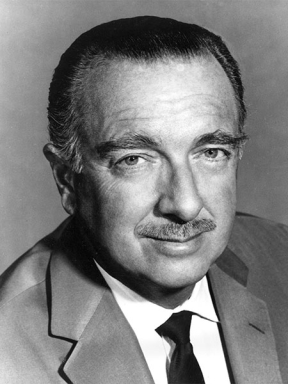
📷televisionacademy.com

Cronkite was born in 1916 in St. Joseph, Missouri, an only child. His father was a dentist there. During the sixties and seventies, he was described as “the most trusted man in America.” Let’s learn why.

He lived in Kansas City, Missouri until he was ten. The family moved to Houston, Texas when his father took a position at the University of Texas Dental School. No surprise he was a boy scout, always prepared, and worked on the newspaper in high school. He went to the University of Texas, Austin beginning in 1933 and majored in political science. He remembered reading adventures of reporters in American Boy magazine and said they inspired him to be a journalist.

📷warfarehistory.com

Walter left college during his junior year in 1935, perhaps because of the Depression. He took on a number of newspaper reporting jobs, and became an announcer for WKY in Oklahoma City, Oklahoma. In 1936 he met Mary Maxwell, whom he married. After their marriage, he became a sports broadcaster with the name Walter Wilcox. He also joined United Press International in 1937.

Edward R. Murrow had gained a bit of fame covering WWII, and he invited Cronkite to join the Murrow Boys, war correspondents. Cronkite became one of the top reporters during the war, covering action in North Africa and Europe. He was one of eight journalists selected by the US Army Air Forces to join bombing raids over Germany. After the war, he covered the Nuremberg trials and worked for the United Press from Moscow until 1948.

📷Biograhy.com

In 1950, Cronkite joined CBS News in its television division, recruited by Murrow once again. He went to WTOP in Washington, DC, serving as the anchor of Up to the Minute after What’s My Line from 1951-62. 

In addition, from 1953-1957 Cronkite hosted You Are There, an enactment of historical vents on CBS. He also popped up on The Morning Show in 1954. He interviewed guests and chatted with Charlemagne, a lion puppet.

1960 found him covering the summer Olympics in Rome. By 1962, he was anchorman of CBS nightly newscast for a feature called “Walter Cronkite with the News” and by 1963 he became the anchor of the first thirty-minute nightly news program.

📷facebook.com

Cronkite reported on the arrival of The Beatles to the US on the CBS Morning News, but another event took precedence that day and the story aired on December 10. That story was John F. Kennedy’s assassination in 1963. Walter had been standing near the wire machine when the news about Kennedy broke, so he rushed to the studio, so CBS would be the first network to air the news. Cronkite continued to read breaking-news bulletins through the afternoon. Eventually he read “President Kennedy died at 1 p.m. Central Standard Time.” He then paused, put on his glasses, swallowed to maintain his composure and with emotion in his voice told the nation that VP Johnson would be taking the oath of office shortly. In 2006, Cronkite was doing an interview with Nick Clooney when he admitted, “I choked up, I really had a little trouble . . . my eyes got a little wet . . . Fortunately, I grabbed hold before I was actually crying.”

His reporting began to gain more viewers than the former number one Huntley-Brinkley Report. By 1968 Cronkite traveled to Vietnam after the Tet Offensive with Ernest Leiser, executive producer. He would report on location during that time. The night Cronkite mentioned on air that we were never going to win the war, Lyndon B. Johnson was said to have replied, “If I’ve lost Cronkite, I’ve lost Middle America.” Cronkite also covered the Democratic National Convention. Johnson didn’t run again, and in 1973 Cronkite reported about Johnson’s death. In 1972 he covered Richard Nixon’s visit to China.

📷posterazzi.com

Cronkite was known for his coverage of space travel. He reported on almost every manned spaceflight for two decades (1961-81). He was willing to put in the time to learn everything he could about astronauts and the work of NASA. When watching Apollo 11 take off, his excitement overcame him as he yelled, “Go, Baby, Go.”

One of Cronkite’s trademarks was ending the news with “And that’s the way it is” with the date. In 1980, during the Iran hostage crisis, he began to add the number of days they had been held hostage to the end of his news.

In February of 1980, Cronkite decided to retire; his last day was March 6, 1981, and he was succeeded by Dan Rather. His farewell statement was: “This is my last broadcast as the anchorman of The CBS Evening News; for me, it’s a moment for which I long have planned, but which, nevertheless, comes with some sadness. For almost two decades, after all, we’ve been meeting like this in the evenings, and I’ll miss that. But those who have made anything of this departure, I’m afraid have made too much. This is but a transition, a passing of the baton. A great broadcaster and gentleman, Doug Edwards, preceded me in this job, and another, Dan Rather, will follow.”

A few years later, Arizona State University named their journalism school after him. He interacted with the faculty and students and annually traveled there to present the Walter Cronkite Award for Excellence in Journalism.
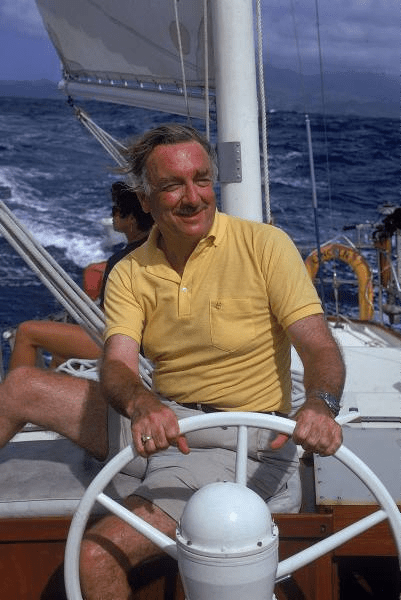
📷messingaboutinsailboats.com

Cronkite also became a pop culture icon. He made an appearance in 1974 on The Mary Tyler Moore Show. He also appeared as himself on Murphy Brown. From 1981-2002, he hosted the Kennedy Center Honors.

In his free time, Cronkite liked to sail.  He received the rank of commodore in the United States Coast Guard Auxiliary. Earlier in his career, he aspired to be a race car driver. He also loved music and had taken up drumming.

Cronkite passed away at his home in July of 2009 from cerebrovascular disease. Many journalists paid respect to him at the funeral including Tom Brokaw, Connie Chung, Katie Couric, Charles Gibson, Matt Lauer, Dan Rather, Andy Rooney, Morely Safer, Diane Sawyer, Meredith Vieira, and Barbara Walters.

Walter Cronkite had a career he could be proud of. He took his work seriously and was always prepared, taking the time to learn everything he could. Being the most-trusted man in America was no small feat, especially given the topics he broadcast about: politicians, the space race, and the Vietnam war. I can’t think of a news icon who has replaced his reputation. Wish we had a few Walter Cronkites today.

Dan Rather: Didn’t “Love” Tennis in 1987

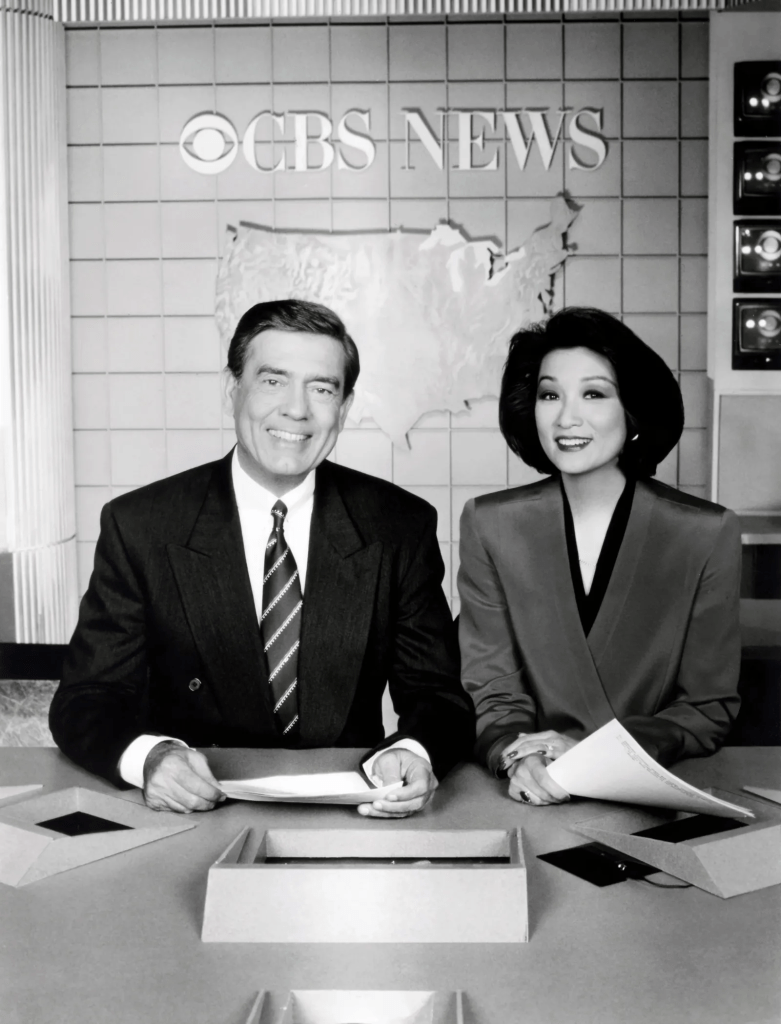
This month we are learning about some of our favorite newscasters from the past. It’s hard to compare today’s news atmosphere with 24/7 coverage of everything, but the three network newscasts held a different importance in the fifties, sixties, and seventies. Nightly newscasters were highly respected and listened to. Dan Rather is one of the news correspondents who straddled these two eras. He would cover President Kennedy’s assassination, Watergate, the fall of the Berlin Wall, the Gulf War, 9/11, and the Iraq War.

📷facebook.com A young Dan Rather

He was born in 1931 in Texas where his father was an oil pipe lineman. The family moved to Houston where he attended grade school, middle school, and high school, graduating in 1950. As a youngster, Dan was bedridden with rheumatic fever. During that time, he was fascinated by radio broadcasts by Edward R. Murrow and Eric Sevareid.

He enrolled at Sam Houston State Teachers College, graduating in 1953 with a degree in journalism. During those years, he was the editor of the school newspaper and worked at KSM-FM radio as a play-by-play announcer for high school and university football games.

He briefly attended South Texas College of Law before enlisting in the Marine Corps. When the Marines found out about his rheumatic fever, he was honorably discharged.

In 1957 Rather married Jean Goebel and they had two children. Their daughter became an activist and environmentalist, and their son was ADA in the District Attorney’s office in Manhattan.

📷nationalportraitgallery

Rather began his career in his home state. In September 1961, Rather was reporting during Hurricane Carla, and he saved thousands of lives, initiating an evacuation of 350,000 residents, becoming a household name overnight. He created the first radar weather report by overlaying a transparent map over a radar image of the hurricane.

His reporting on the assassination of Kennedy in Dallas got him promoted to White House correspondent at CBS News.

Later he would serve as a foreign correspondent in both London and Vietnam before returning to the White House. He was at the White House during Nixon’s presidency, covering his trip to China, the Watergate scandal, and Nixon’s resignation. During this time, Peter Jennings was at ABC, and Tom Brokaw was at NBC.

He joined the 60 Minutes cast in 1975.

After Walter Cronkite’s retirement, Rather became the anchor for the CBS Evening News from 1981-2005. For most of those years, he signed off with “That’s part of our world tonight.” Rather was often criticized for being outspoken and brash on things he didn’t agree with. In 1987, he was upset that his broadcast that night was being cut short for a tennis match; he walked off the set early, causing CBS to transmit a blank signal for six minutes.

In 1994, Sam Houston State University renamed its mass communications building after Rather.

Rather had a 2004 report on 60 Minutes II about President Bush’s military record with the Texas Air National Guard. His report was based on documents that were questioned for their authenticity. Rather admitted that the authenticity could not be proven. Rather later stated that “If I knew then what I know now, I would not have gone ahead with the story as it was aired, and I certainly would not have used the documents in question.”

📷vanityfair.com

When his contract ended the next year, he was let go. At his final CBS news broadcast, Rather ended his report with the following: “We’ve shared a lot in the 24 years we’ve been meeting here each evening, and before I say ‘Good night’ this night, I need to say thank you. Thank you to thousands of wonderful professionals at CBS News, past and present, with whom it’s been my honor to work over these years. And a deeply felt thanks to all of you, who have let us into your homes night after night; it has been a privilege, and one never taken lightly.”

He then hosted Dan Rather Reports, an investigative news program on AXS TV (known then as HDNet) from 2006-2013. During this time, he released an autobiography, Rather Outspoken: My Life in the News.

After 2013, Rather produced several series and documentaries. He also was a frequent guest on news shows, including The Rachel Maddow Show and The Last Word with Lawrence O’Donnell. He also wrote for “The Huffington Post” and “Mashable.”

📷tvtropes.com

In 2016, he joined SiriusXM Radio with “Dan Rather’s America.”

Dan Rather had an interesting career. He received high praise and loud criticism. He was quickly promoted and quickly fired. He covered many of the top stories from 1960 – 2015. He conducted interviews with some of the world’s leaders including Fidel Castro and Nelson Mandela. He was part of network news, documentaries, independent stations, and Sirius Radio. However, no matter what was happening around him, he stuck to his principles and covered the news the way he thought was best for the American public. You have to admire that.

Meet the Press: The First News Show

We are in the midst of our “It’s the First” blog series, and today we are talking about a show that debuted in 1947 to bring us the news: Meet the Press (although the show actually began on radio in 1945). Although we hear a lot about Gunsmoke and The Simpsons being on air for so many years, rarely do people talk about the fact that Meet the Press was one of the first television shows and is still going strong. Of course, it looks a bit different than it did when it first began.

The show, which will be celebrating its 75th anniversary next year, features interviews with national leaders about politics, economics, foreign policy and other critical global topics. Noted journalists and experts provide analysis, discussion, and reviews of the past week’s events. The show began during the second official television season. It was the first live network news show, and was the first live news show that a sitting president appeared on; in this case it was Gerald Ford.

The program has had twelve different hosts during its history beginning with Martha Rountree. The first guest was James Farley who had served as postmaster general, Democratic National Committee chairman, and campaign manager for Franklin D. Roosevelt.

See the source image
Martha Rountree and Gov. Thomas Dewey Photo: flowersforsocrates.com

Meet the Press is on the air in most markets on Sunday morning on NBC. It is also on Sirius/XM and syndicated on Westwood One, and is often replayed on C-Span.

For the first forty-five years of its airing, it was a 30-minute program but was extended to an hour in 1992. General Foods was the sponsor for the first television seasons. Rountree, the only female, hosted until 1953 when Ned Brooks took over for 12 years. Lawrence Spivak, who had hosted the radio version was the moderator until 1975. Bill Monroe stepped up to the plate next, hosting until 1984. The next seven years had a revolving door of hosts including Roger Mudd and Marvin Kalb, cohosts; Chris Wallace; and Garrick Utley.

See the source image
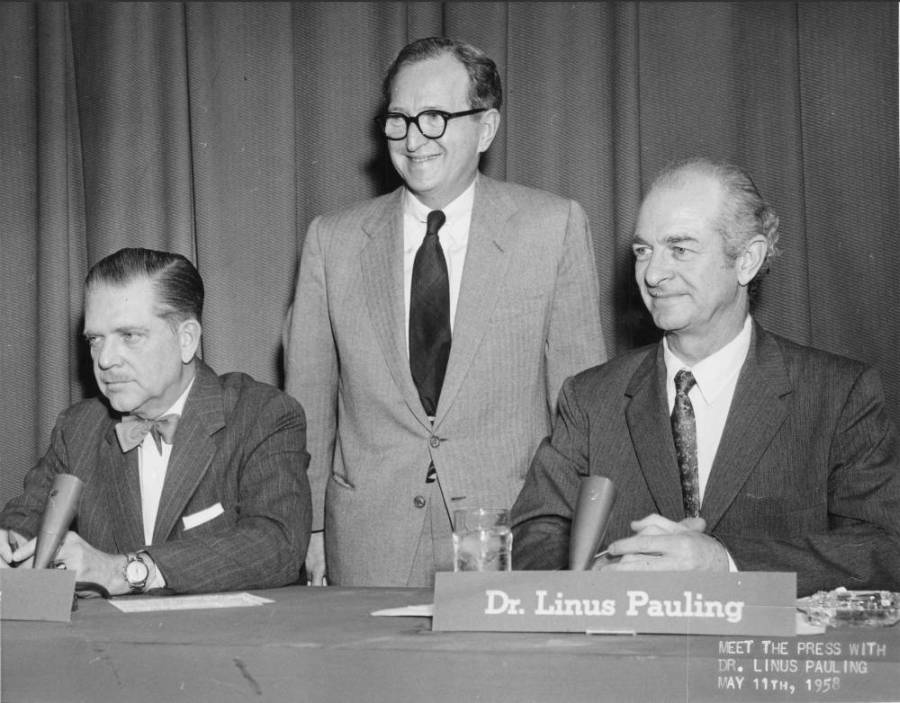
Ned Brooks, Lawrence Spivak and Dr. Linus Pauling Photo: oregonstateuniversity.com

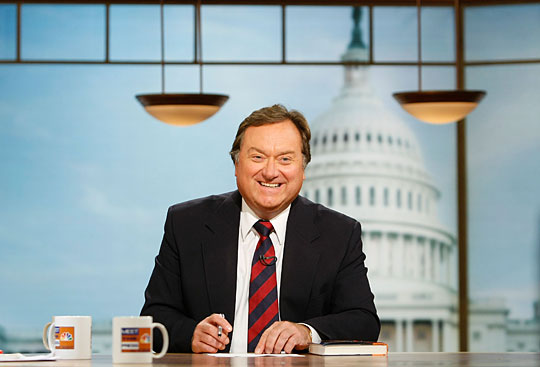
Tim Russert, network bureau chief in Washington DC took over in 1991 and remained with the show until his death in 2008. After his death, Tom Brokaw had a special edition of the show dedicated to Russert, leaving his chair empty on the set.

See the source image
Ned Brooks with Joe McCarthy Photo: eyesofageneration.com

NBC news anchor Brian Williams hosted the next regularly scheduled show following Russert’s death and Brokaw became interim host through the 2008 general elections. Following the elections, Brokaw continued the first half hour with David Gregory taking over the second half hour. Gregory became the sole host in December of 2008.

In an attempt to gain viewers, a new set and theme song were introduced in 2010. Ratings continued to decline, and in 2013 the show, which had typically been the number one Sunday news program, dropped to third place.

See the source image
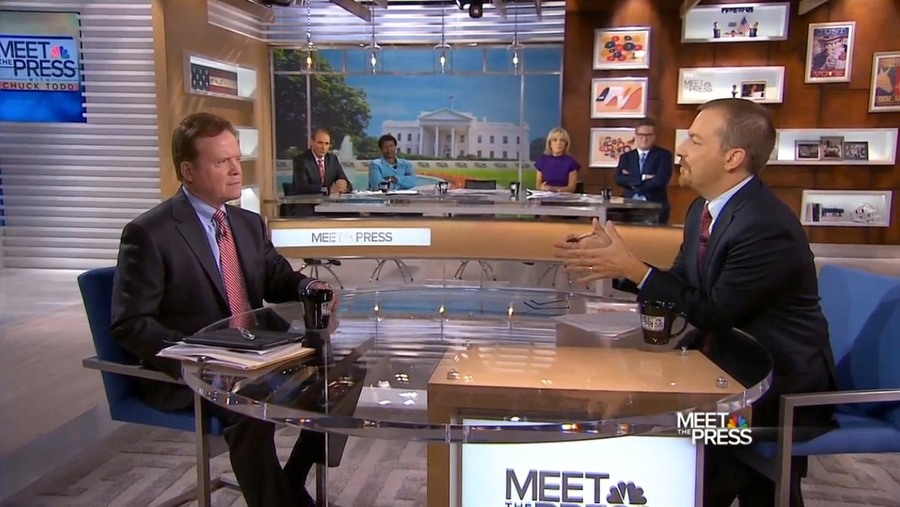
Photo: newscaststudio.com

In 2014, Chuck Todd, NBC’s chief White House correspondent took over the reins of the show. The show never regained its former numbers, but its Facebook ratings have skyrocketed.

Some of the most-watched episodes included Elizabeth Bentley, a courier with a Community spy ring, in 1948; Fidel Castro in 1959; and Martin Luther King Jr. in 1963.

See the source image
Fidel Castro on Meet the Press Photo: pinterest.com

Every US president since JFK has appeared on the show, although most after their presidencies.

Todd, who is still running the show, shared some of his thoughts about why Meet the Press has been so influential. About the Sunday time slot, he said that “I think that the reason it has survived is because the idea of using Sunday as a day of reflection is sort of ingrained in the news business, too,” Todd said. “We continue to believe that Sunday mornings are when we’re going to sit down and try to figure out what the heck’s going on in the country.”

See the source image
Tim Russert Photo: npr.org

Todd also discussed Russert’s relevance on the show when he said, “Every moderator leaves an imprint. Tim has two giant imprints. He took Meet the Press to an hour. And he made the round table a vital and regular part of the show. Tim also made it seem less like an insider show. He realized it was at its best when explaining Washington to America but also bringing America to Washington.”

It’s hard to fault the show too much for its decline in ratings. When you consider, how many news choices there currently are, I think it is amazing that any news show has been able to remain on the air for almost 75 years.

See the source image
Chuck Todd Photo: youtube.com

The combination of Trump as president and the Covid pandemic has helped the show’s ratings a bit. In March of 2020 Dr. Anthony Fauci appeared on the show. According to Nielsen data, 4.657 million views tuned in making the show the most-watched one on that day. An additional 952,000 people watched rebroadcasts on NBC and MSNBC, the highest-rated show since January 2009.

See the source image
Dr. Anthony Fauci Photo: mediaite.com

It will be interesting to learn what celebrations are planned for 2022. If you have not checked in to see what Meet the Press is all about, take a listen this month.