Burgess Meredith: America’s Favorite Villain

Bam! Pow! It’s Batman Villain Month. We will be looking at the career of an actor who played a Batman baddie every week this month. We are beginning with my favorite, The Penguin, played by Burgess Meredith.

📷pinterest.com

Oliver Burgess Meredith was born in Cleveland, Ohio in 1907. His father was a physician, and his mother was born into a family of Methodist revivalists. Burgess followed his Methodist faith for his entire life. After high school, he enrolled at Amherst College, until 1932 when he became a reporter for the Stamford Advocate. He worked in a variety of jobs while getting started in acting including retail, an editor, a merchant marine, and a runner on Wall Street.

He joined Eva Le Gallienne’s Civic Repertory Theatre in New York City. His Broadway debut was in this company’s “Romeo and Juliet” in 1930. His film debut came in 1935 in Winterset. Later in his career, he would return to Broadway as a director. He shared a Tony Award with James Thurber for their collaboration on “A Thurber Carnival” in 1960, and he earned a Tony nomination for his staging of “Ulysses in Nighttown” in 1974. In the late seventies, he directed Fionnula Flanagan’s one-woman play, “James Joyce’s Women” which toured for several years.

Meredith had more success in acting than marriage. Helen Derby Merrien Burgess was his wife from 1932-1935. His marriage to actress Margaret Perry only lasted two years, ending in 1938.

In 1942, Burgess enlisted in the US Army Air Forces for WWII, reaching the rank of captain. He was discharged in 1945. Meredith married another actress, Paulette Goddard, and they were together from 1944-1949. However, in 1951 he married Kaja Sundsten and they were together until his death.
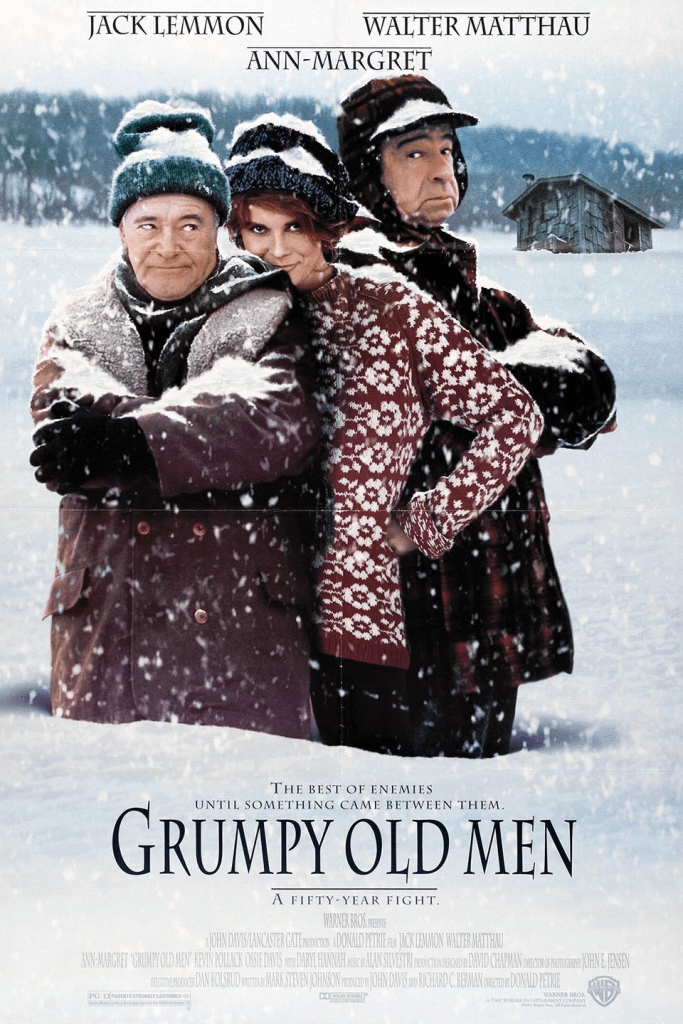
Meredith would appear in 80 movies during his career, as well as a number of made-for-television movies. He might be best known in the past few decades for Grumpy Old Men and Grumpier Old Men in the 1990s.

However, it was television where he found the most acclaim. His first appearances came in 1949 on the Ford Theater Hour and The Silver Theater. Throughout the fifties he continued receiving offers for theatric roles on these types of programs. During the early sixties, he was everywhere. You could catch his appearances on dramas such as The Naked City, Ben Casey, The Twilight Zone, The Bold Ones, Room 222, Ironside, and Mannix. He rode onto many western sets including Wagon Train, Rawhide, The Wild, Wild West, Bonanza, Daniel Boone, and The Virginian. He found his way onto several comedies such as Please Don’t Eat the Daisies and The Monkees.

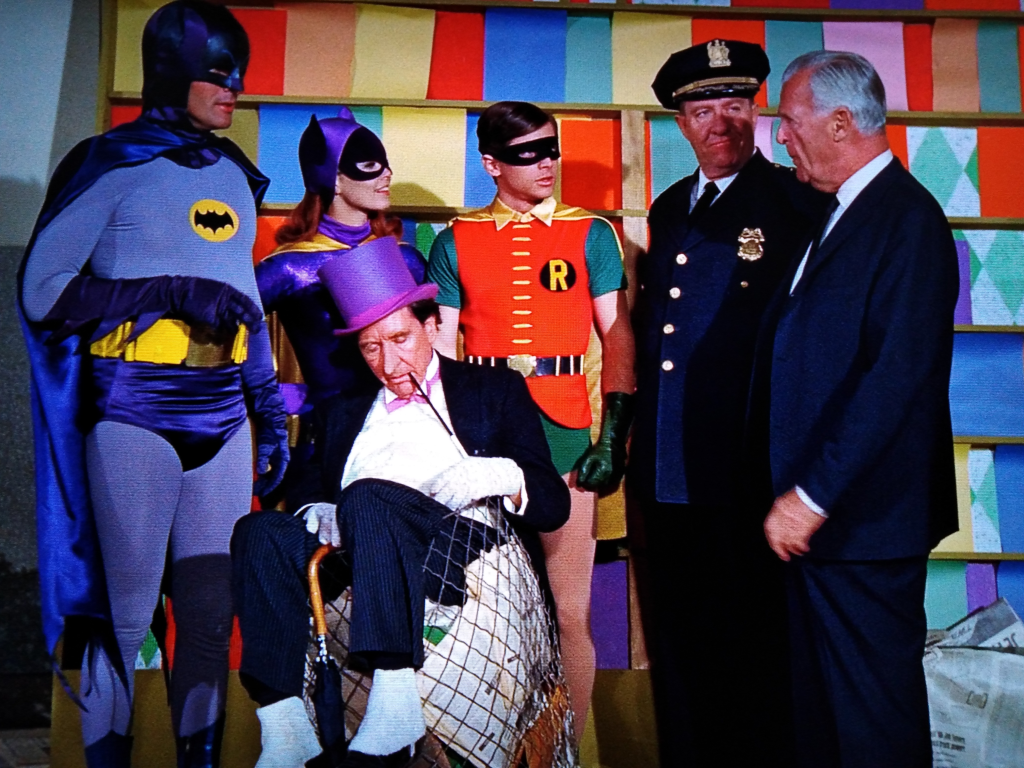
Given the astounding number of drama shows that he chose roles on, it is a bit surprising that one of his best-known roles was the campy, humorous 1960s series Batman. From 1966-1968, he made 21 appearances as the Penguin. When he appeared on The Monkees, it was also as the Penguin. Originally the producers wanted Spencer Tracy for the role of Penguin. Tracy said he would not accept the offer unless his character was allowed to kill Batman. So, Meredith got the role. The cast loved him, and the producers made sure there was always a Penguin script waiting so whenever Burgess was free, it could be filmed.

📷dcdatabase.com

He was perfect for the role with his raspy voice and that iconic Penguin laugh. The laugh came about because Burgess had given up smoking but had to smoke for his role on Batman. When he coughed, he covered it up with his trademark laugh. When asked why he did Batman, he replied that he did it “for two reasons, one of which was the salary. The other was that, after the first few episodes, Batman became the in-thing to do. Everybody would either play a villain or appear as himself in that cameo showcase where a celebrity would poke his head through the window of a building that Batman and Robin were climbing. Actually, we didn’t get as much money from the show as you might think, although we were paid decent money for the feature film version. The main impetus to continue appearing on Batman—beyond the desire to get some TV work—was that it was fashionable.”

Later in his career, Burgess continued appearing on the big screen and provided voice-over work and a bit of animation. Unfortunately, he was named as an unfriendly witness by the House Un-American Activities Commission which ended his studio work for several decades. Burgess also did commercial work and was known for his roles for Skippy Peanut Butter and United Air Lines.
📷imdb.com

Meredith was a life-long Democrat and was generous to the Democratic party. He was an environmentalist and tried to end pollution. He was also fascinated by intelligent animals, especially dolphins. One night he said he felt a dolphin needed help while staying at a friend’s beach house. He ran out to the beach and found a dolphin caught in a net under a dock and was able to save its life. He was nominated for two Academy Awards, both for Supporting Actor in Rocky and The Day of the Locust. A 21-acre park in Pomona, New York was named for him; he provided the funding to incorporate the village.

In 1997, Meredith died from complications of Alzheimer’s. His former Batman costar, Adam West, spoke at his memorial service.

While almost all of the bad guys on Batman were memorable, the Penguin and Cat Woman were by far my favorites. We will look at the career of Julie Newmar next week.
Mary Kay and Johnny and Company: The First Sitcoms

We are in the midst of our “They Were the First” blog series. In past weeks we’ve learned about the first crime drama and the first news show. Today we take a peek at some of the first sitcoms on the air.

She Was the First Lucy, but Where Is the Love?
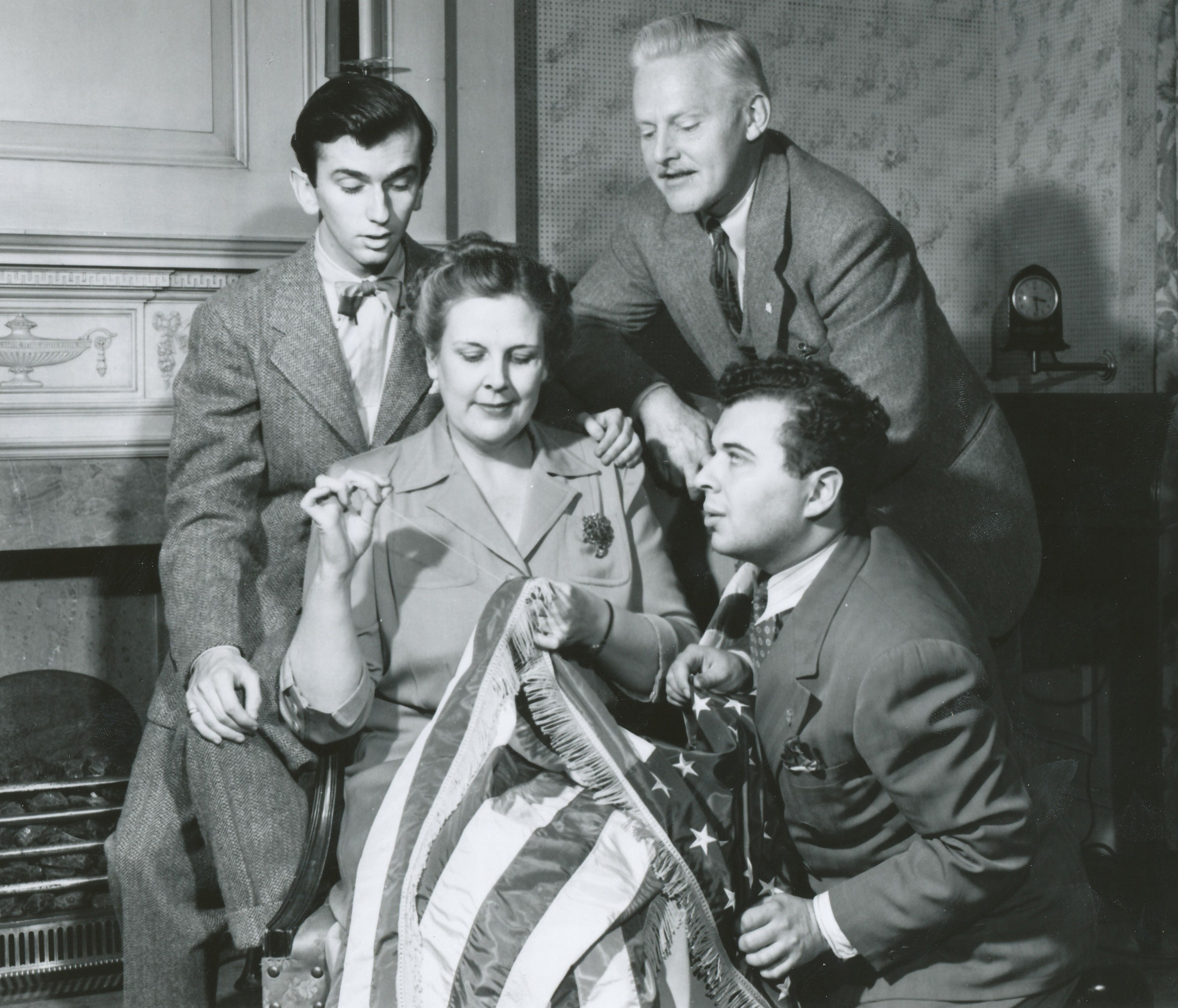
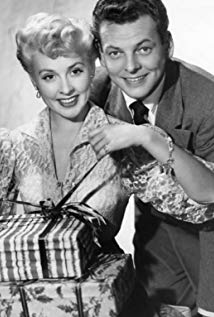
Mary Kay and John Stearns Photo: gr8erdays.com

The very first sitcom I could find evidence for was Mary Kay and Johnny which debuted in 1947. This show was only on three or four seasons, but it produced 301 episodes so it was on more often than once a week. The description on imdb.com is that it’s about the “adventures and misadventures of the strait-laced bank employee Johnny Sterns and his zany wife Mary Kay.”

Real-life spouses Mary Kay Stearns and John Stearns played the married couple that the show centered on. Nydia Westman played Mary Kay’s mother and Howard Fischer played Howie. When the Stearns had a baby named Christopher, he also became their son on the show.

The show was shot live in New York and sponsored by Anacin. During the first season, Anacin tested the market to see how many people might be watching the show because TV ratings had not been collected at that time. They offered a free mirror to the first 200 viewers who submitted comments about the show; to their surprise, more than 9,000 viewers sent letters.

Believe it or not, this was the first married couple to share a bed. At some point, networks rethought this decision, because it would be a battle for years during the fifties and sixties.

So, what were some of the other earliest sitcoms? Here are a few of the other sitcoms that were on during the early years of the golden age.

the laytons | THAT'S ENTERTAINMENT!
Photo: jacksonupperco.com

The Laytons. This short-lived show was on the air from August to October of 1948 on the Dumont network. However, it was notable in that it was the first show to feature an African American in a recurring role. I could only find detailed information for one episode which starred Vera Tatum as Ruth Layton, Amanda Randolph as Martha, and Elizabeth Brew as Ginny Layton. From what I could determine it moved to Dumont after running locally for a month.

Growing Paynes (1948-1949) | New york broadway, Elaines, Theatre poster
Elaine Stritch Photo: pinterest.com

The Growing Paynes. From 1948-49, this show followed the “trials and tribulations” of an insurance salesman and his screwball wife.  I’m not sure why all the wives were screwballs in the forties. The show had a cast overhaul after the first couple of months. John Harvey and Judy Parish were replaced by Ed Holmes and Elaine Stritch. The sponsor was Wanamakers Department Store. This show is historically important because it was the first sitcom to work the sponsor’s business into the script. Despite the change in casting, the show was cancelled after ten months.

Golden Age of Radio: Program #123 | WMKY
Photo: wmky.com

The Aldrich Family. This well-known family made the leap from radio to television in 1949. The show centered around the Aldrich son Henry and his family who lived on Elm Street in Centerville.  Imdb.com lists 18 episodes but five seasons so it was on sporadically apparently like The Jack Benny Show when it began on the small screen. I’m not sure how this show survived five seasons. While Jameson House played Sam Aldrich, during the 18 episodes, there were three different women playing his wife Mary and five different actors who showed up as his son Henry.

The Life of Riley. This show also began life as a radio show. There were two versions of the show and the second version was the better known one.  In this earlier version from 1949, Riley is played by Jackie Gleason and his wife Peg is Rosemary DeCamp. Their son Riley Jr. was played by Lanny Rees and Gloria Winters took on the role of their daughter Bab. The other cast member was Jim Gillis, Riley’s friend, played by Sid Tomack. The show primarily focuses on Riley’s home life though we hear about life at the aircraft plant he works in as a riveter. His catchphrase was “What a revoltin’ development this is.”

The Life of Riley: A matter of perspective | CharlesPaolino's Blog
Photo: charlespaolino.com

The show only lasted for 26 episodes; at that time, a full season was 39. Their sponsor was Pabst Blue Ribbon Beer and part way through the year the company decided it would rather put more money into the Pabst Blue Ribbon Bouts, a boxing show.

This show also made history. It was the first sitcom to win an Emmy, beating out The Silver Theater and The Lone Ranger.

William Bendix could not accept this role because, oddly enough, he was filming a movie, The Life of Riley. He would perfect the role in the second television version which debuted in 1953.

Amazon.com: I Remember Mama TV Show (aka.- Mama Television Series ) : Peggy  Wood, Dick Van Patten, Judson Laire, Rosemary Rice, Robin Morgan, Don  Richardson: Movies & TV
Photo: amazon.com

Mama. This show ran from 1949-1957, producing 178 episodes. Peggy Wood starred as Mama Hansen and Judson Laire played her husband Papa Hansen. A young Dick Van Patten appeared as their son Nels, Rosemary Rice was daughter Katrin, and Robin Morgan was daughter Dagmar.

The show chronicled the lives of a family who recently immigrated to San Francisco shortly after 1910. The movie starring Irene Dunne was also very popular. Many viewers fondly recalled the series as a heart-warming and tender show. Like, most of these early shows, it was shot live so there are no reruns available for this much-loved show.

It, too, made history, being the first show listed as a comedy drama which was not the new thing that we thought it was in the 1970s.

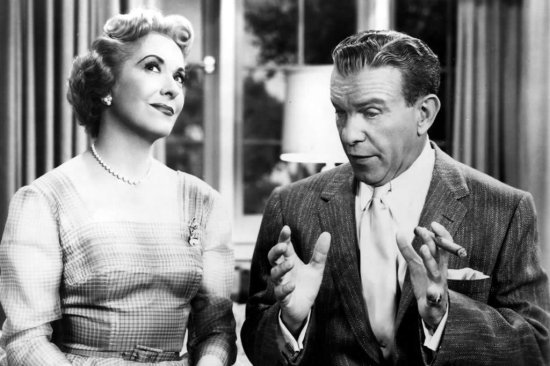
Beginning in 1950, the sitcom genre would become the king of the television schedule. That was the year one of my all-time favorite shows, The George Burns and Gracie Allen Show aired and the two popular, but disgraceful shows, Beulah and Amos ‘n Andy hit the air.

The George Burns and Gracie Allen Show | TIME
George Burns and Gracie Allen Photo: timemagazine.com

It was interesting to go back to learn about the first sitcoms which are not well-known or available for viewing. It’s television history we don’t want to lose. These were the pioneers of classic television, and it’s amazing how each series made history of its own that often would not be repeated for several decades.