As we continue with our “Favorite Crime Solvers of the Past,” we turn to 77 Sunset Strip. Even if you never watched the show, you might be familiar with the theme song where they snapped and kept repeating “77 Sunset Strip.”
📷facebook.com
Created by Roy Huggins, the show debuted on ABC in 1958 and ran until spring of 1964. This was the third appearance by Detective Stuart Bailey. In 1946, Huggins’ novel, The Double Take, was published. In 1948, Bailey stepped into the big screen, starring in I Love Trouble played by Franchot Tone. A decade later he showed up on television played by Efrem Zimbalist Jr.
Bailey, a former WWII secret agent and foreign languages professor, works with former government agent Jeff Spencer (Roger Smith). Their office is at 77 Sunset Strip, Suites 101 and 102. Suite 103 is occupied by Suzanne Fabry (Jacqueline Beer), a French switchboard operator who handles phones for several clients including Bailey and Spencer. Occasionally she helps them solve a crime.
Other characters come and go from the offices including Roscoe (Louis Quinn), who gives out horse-racing tips when he’s not at the track; he often is an operative for the duo.
📷allposters.com
Gerald “Kookie” Kookson (Ed Byrnes) is a bit of a kook. He loves rock and roll, is witty, appreciates looking good, and works as a valet at the club next door. But he wants to be a private detective and makes full partner during the show. Kookie provides some comedy with his slang like “ginchiest” for coolest or “piling up Zs” for sleeping. During season 2, Byrnes asked for more money with his character expanding his role, but the answer was a firm no, so he left the show. Warner Brothers eventually settled with him, and he returned in May of that year.
Other occasional visitors include Lt. Roy Gilmore (Byron Keith) and the Frank Ortega Trio (played by themselves), a jazz band, who perform next door. They recorded for Warner Brothers who was also behind the television show.
The show had a fun, witty edge to it making it interesting to watch the interactions of the characters in addition to the crime solving. Bailey and Spencer were updated versions of forties’ noir detectives. Some of the shows had very different plots, something like the shows Moonlighting would feature a few decades later. “The Silent Caper” had no dialogue and, in another one, Bailey finds himself in a ghost town and he’s the only main character in the episode. During the last season in “The Target,” roles were played by crew members who were usually behind the camera including director William Conrad, associate producer James Lydon, and writer Tony Barrett.
Guest stars were plentiful and included Robert Conrad, Dyan Cannon, Cloris Leachman, Shirley MacLaine, Elizabeth Montgomery, Mary Tyler Moore, Roger Moore, William Shatner, Marlo Thomas, Robert Vaughn, and Adam West.
📷starstills.com
Mack David and Jerry Livingston wrote the famous theme which became a top 10 hit on the Billboard chart. The duo worked on several other Warner Brothers crime shows including Surfside Six, Bourbon Street Beat, and Hawaiian Eye, all based on the 77 Sunset Strip formula and exotic location.
By 1963, ratings were declining and the show revamped. If you read my blog often, you realize this is one of my pet peeves. If they want to change the casts, I understand that. However, in this one, like so often, Bailey is suddenly working alone and there is no mention made of any of the other characters, just as if they never existed. They did this on Happy Days, The Doris Day Show, and several other popular series.
In addition to booting the cast, Jack Webb was brought in as executive producer and William Conrad as director. And if the name William Conrad sounds familiar, yes, it is the same person as the man who starred on Cannon. During the fifties and sixties, Conrad racked up 32 directing credits.
Bailey is now a solo investigator. The title didn’t change, but the old office is no longer there nor the club nor the theme song. A new one written by Bob Thompson was used, and the show took on a darker, more serious nature. Bailey gets a secretary named Hannah who we rarely see.
📷ebay.com
The show was on Fridays for its entire run, just switching time slots now and then. By season two it was in the top ten. In seasons three through five, it got its biggest competition from Route 66, which it beat in the ratings. The final season, the show got moved to a later slot, going up against The Alfred Hitchcock Hour but, neither of them were in the top thirty.
Big surprise, viewers weren’t fans of the changes or the more serious tone of the show, and they drifted away. The show was cancelled in February. Efrem Zimbalist Jr. moved over to the FBI. Roy Huggins had a hugely successful career. He would write for and create more top shows including Run for Your Life, Maverick, Alias Smith and Jones, The Rockford Files, and The Fugitive. Viewers at least got the satisfaction of knowing that making such drastic changes to the show caused the end of that story. Stream a few of the early seasons on Philo, Roku, or Pluto TV and let me know what you think.
This month we are starting a new blog series, Casting Celebrities. We’re going to take a look at four shows that featured a group of celebrities every week. We’ll learn more about Love, American Style; Fantasy Island; The Love Boat, and Supertrain. When we discuss Supertrain, we’ll also look at the small number of stars who appeared on all four shows.
Today we begin with Love, American Style. This show was an iconic 1970s show. Like Laugh In, the clothing, furnishings, and vocabulary do not make it timeless. But it was a lot of fun. This fast-paced anthology series featured two to four mini episodes each week, and between them were quick skits, often featuring a brass bed. Each smaller episode is titled “Love and the _______.”
📷gms.com The regular cast
A troupe of players was featured on each show for the in-between skits. These regulars included William Callaway, Buzz Cooper, Phyllis Davis, Mary Grover, James Hampton, Stuart Margolin, Lynn Marta, Barbara Minkus, and Tracy Reed. Margolin went on to a regular role in TheRockford Files; Tracy Reed was featured in McCloud and Knot’s Landing; Phyllis Davis was part of the cast of Vega$ and Magnum PI, and James Hampton will be familiar if you watched The Doris Day Show or F-Troop.
The show had a memorable and catchy theme song. Written by Arnold Margolin, the first year it was performed by The Cowsills. The snappy melody was set to the following words:
Love, Love, Love
Love, American Style, Truer than the Red, White and Blue. Love, American Style, That’s me and you.
And on a star-spangled night my love,
My love come to me. You can rest you head on my shoulder. Out by the dawn’s early light, my love I will defend your right to try.
Love, American Style, That’s me and you.
📷imdb.com
During the second and subsequent years that Love, American Style was on the air, the theme song was performed by the Ron Hicklin Group. The Ron Hicklin Group could be heard in a variety of motion pictures and commercials, and they also appeared on recordings with stars such as Paul Revere and the Raiders and Cher. John and Tom Bahler, brothers who sang under The Charles Fox Singers were also part of this group. The band provided television theme song recordings including Batman, That Girl, Happy Days, and Laverne and Shirley. They also did the singing for The Partridge Family theme and songs performed on the show as well as the Brady Bunch Kids. Ron retired in the early 2000s, and Tom does a variety of things. He is also known for writing Bobby Sherman’s hit, “Julie Do You Love Me?”. John married Janet Lennon, one of the Lennon sisters who performed on The Lawrence Welk Show. He currently lives in Branson and conducts the “new” Lawrence Welk orchestra.
Paramount Television developed the show. The executive producer of the show was Arnold Margolin, Stuart’s brother. There were 53 different directors during the four-year run. The series received Emmy nominations for Outstanding Comedy Series in 1970 and 1971; Best Music Composition in 1971, 1972, and 1973, winning in 1973; and winning the Emmy in 1970 for Outstanding Original Music and Lyrics.
📷rewatchclassictv.com
Many people wrote for the show, but Garry Marshall and Jerry Belson received the most credits. One of the writers, Peggy Elliott, was interviewed by the Huffington Post in May of 2013, and she talked about her time writing for the show.
“But the show I loved writing the most, was Love, American Style. For every other show, I was writing for characters created out of someone else’s head. Sure, we could create the occasional guest-star role, and we had been told to make every role, no matter how small, a real person. ‘Think of the actor who’s playing that delivery boy,’ I can hear Billy Persky, the co-creator or That Girl, say: ‘This is a big break for him — it’s the biggest role he’s had so far. Give him something to work with.’
But with Love, American Style, every character was our very own; every situation came out of our heads. Each segment of the hour the show ran each week was a one-act play created entirely by us. Added to the attraction was the fact that we could say and do things that were taboo on every other TV show in the early ‘70s. Arnold Margolin, co-creator of the show with Jim Parker, told me recently that the creative side of the network wanted the show to be more daring, while the censors kept their red pencils ready. There was a full-time position on the show just to run interference.
We must have put both sides through the hoops with one episode we wrote: ‘Love and The Hand-Maiden.’ A young guy was dating a centerfold model. As their relationship developed, he discovered that she had no problem with shedding her clothes, but she always kept her hands covered — with artful poses in magazines, and with gloves in real life. He became obsessed with seeing her hands and came up with one ruse after another to get her to take off her gloves. We had a ball writing it, with one double-entendre after another.”
📷imdb.com
If you were a star of any kind in the early 1970s, you most likely were on Love, American Style. The show produced 108 episodes, and those shows featured 1112 different actors. Some of the famous names showing up in the credits include Milton Berle, Sid Caesar, Phyllis Diller, Arte Johnson, Ozzie and Harriet Nelson, Regis Philbin, Burt Reynolds, Sonny and Cher, Flip Wilson, and Jo Anne Worley.
Brad Duke wrote a biography about Harrison Ford, and he said Ford had fond memories of appearing on Love, American Style. “He recalled that he had been given little time to prepare his wardrobe for the role of a philosophical hippie in the November 1969 episode, “Love and the Former Marriage.” He appeared on set with long hair and a beard thinking they were appropriate for the role. He was surprised when he was told he needed a haircut and trim and then was given a navy blue dress shirt and vinyl burgundy jeans with a large belt. They even had a scarf with a little ring to put around my neck. And I thought, someone has made a mistake here. So, rather than argue with the wardrobe people, I put on the clothes and went to find the producer. I walked on the set and he was pointed out. I tapped his shoulder and when he turned around he had on the same clothes I did. He was a hippie producer I guess. At least the check went through, and I got paid.”
The best way to get a good understanding of what the show was like is to look at a couple of the episodes.
January 23, 1970: Love and the Big Night
📷facebook.com
Starring Ann Elder, Buddy Lester, Frank Maxwell, Julie Newmar, and Tony Randall, this episode is often listed as a favorite of viewers. Randall is a married businessman who escorts his voluptuous secretary (Newmar) to her apartment after a late night at the office. Eager to get home to his wife, Randall hurriedly tries to open a stubborn jar of mayonnaise and winds up covered with mayo. Newmar cleans his suit, but while it’s drying, it’s stolen. After a series of amusing mishaps, Randall finally gets back to his own apartment and creeps into bed with his wife–only to find out she’s not there.
February 25, 1972: Love and the Television Set
📷that’s entertainment.com
It starred Harold Gould, Marion Ross, Ron Howard, and Anson Williams. Reading this list of names might give you a hint about what happened to this episode after it aired. Garry Marshall had written a pilot about a 1950s family that did not sell. He turned it into an episode for Love, American Style. George Lucas caught the episode and was impressed with Ron Howard and offered him a role in his new movie American Graffiti about 1950s teens. The movie was so popular that the network decided to put Marshall’s pilot in the fall line-up as Happy Days. Harold Gould’s role was given to Tom Bosley for the series. When Love, American Style went into syndication, this episode was retitled “Love and the Happy Days.”
October 22, 1970: Love and the Bashful Groom
📷listral.com
This is the episode I recall when I think of the series. When I watched it originally, I was staying overnight at my grandparents’ house and my grandmother was shocked at the “vulgarity.” It really seems quite tame today, but back then it probably was unexpected. She would approve of Tom Bahler marrying Janet Lennon though because I watched Lawrence Welk with her and my grandfather whenever I was at their house.
In this episode, Paul Petersen, Christopher Stone, Meredith MacRae, Jeff Donnell, and Dick Wilson are featured. Harold (Petersen) and Linda (MacRae) are getting married. He learns that she grew up in a nudist colony and is not comfortable being naked for his wedding. After a soul-searching talk with his best friend, and realizing he loves Linda enough to be uncomfortable, he decides to go through with the ceremony. He gets to the church a bit late and walks in, only to see that everyone else is dressed in their Sunday best. His bride informs him that they always dress up for weddings. One of the congregation members says something like “Let’s not make him uncomfortable,” and they all begin to undress. Of course, you see nothing improper, no naked bodies, only clothes flying. This was probably not the best episode to “expose” my grandmother to as a first glimpse of the show.
The show lasted for four years and was cancelled in 1973. In 1985, a reboot was created, but it was on in the mornings and only lasted a few months. The show was on at the same time as everyone’s favorite game show, The Price is Right. For the 1998 fall season, a pilot was created for prime time, but it was never ordered. While doing my research for this blog, I noticed that there was a Love, American Style project in production, so we may see it resurface again. I’m not sure I would want to watch a contemporary version of the show though. It was such a product of its time, and I fear what a current version would be like after seeing the reboot of Match Game which has been airing the past few years.
This month our blog series is Supportive Men. These actors were not the stars of the series, but they contributed a lot of fun to the show. First up is David White who we know best as Larry Tate from Bewitched.
White was born near Denver, Colorado, in 1916. His family moved around a bit. He lived in Pennsylvania and Missouri and graduated from Los Angeles City College. He worked at the Pasadena Playhouse before enlisting in the Marine Corps during WWII. After his four years in the military, he began acting again with the Cleveland Play House.
📷pinterest.com On The Phil Silvers Show
In 1949, White found himself living in New York where he made his Broadway debut in “Leaf and Bough.” The theater critics were not kind in their reviews, and the show closed after three performances. The following year, he tried the stage again in “The Birdcage” with Maureen Stapleton. He was then given a role in “The Anniversary Waltz,” co-starring Macdonald Carey and Kitty Carlisle which ran for 611 nights. He paid his dues, working in a variety of jobs while trying to establish his acting career. His resume included a farm laborer, a truck driver, a doorman at the Roxy Theater, and working at the J.H. Taylor Management Co.
In the 1950s, David began his long television career. His first appearance was in The Philco Playhouse production of “Rich Boy” with Grace Kelly. While most of his roles were in dramatic shows and westerns, he did a few comedies including Father Knows Best, My Favorite Martian, The Farmer’s Daughter, and My Three Sons. Most of his roles were as corrupt businessmen or arrogant politicians.
📷dvdizzy.com In The Apartment
In 1952, David married actress Mary Welch. Welch appeared in several successful plays on Broadway. She was a member of Lee Strasberg’s Actor’s Studio before opening her own school called The Welch Workshop. White and Welch worked together in only one production, at a regional theater, in “Tea and Sympathy.” In 1958 she died of complications from their second pregnancy. They had a son Jonathan and sadly, he died in 1988 in the bombing of the Pan Am Flight 103 over Lockerbie, Scotland. (This was a tragic incident when Libyan terrorists planted a bomb on a plane flying from London to New York. It exploded 35 minutes into the trip and killed all 259 people on board and 11 people in the neighborhood where it landed.)
After his wife died, White and his son moved to Hollywood where White launched a big-screen career. His film debut was in 1957 with Tony Curtis, Barbara Nichols and Burt Lancaster in The Sweet Smell of Success. He only had 16 movies in his credits, but they included The Apartment, Sunrise at Campbello, and Brewster’s Millons.
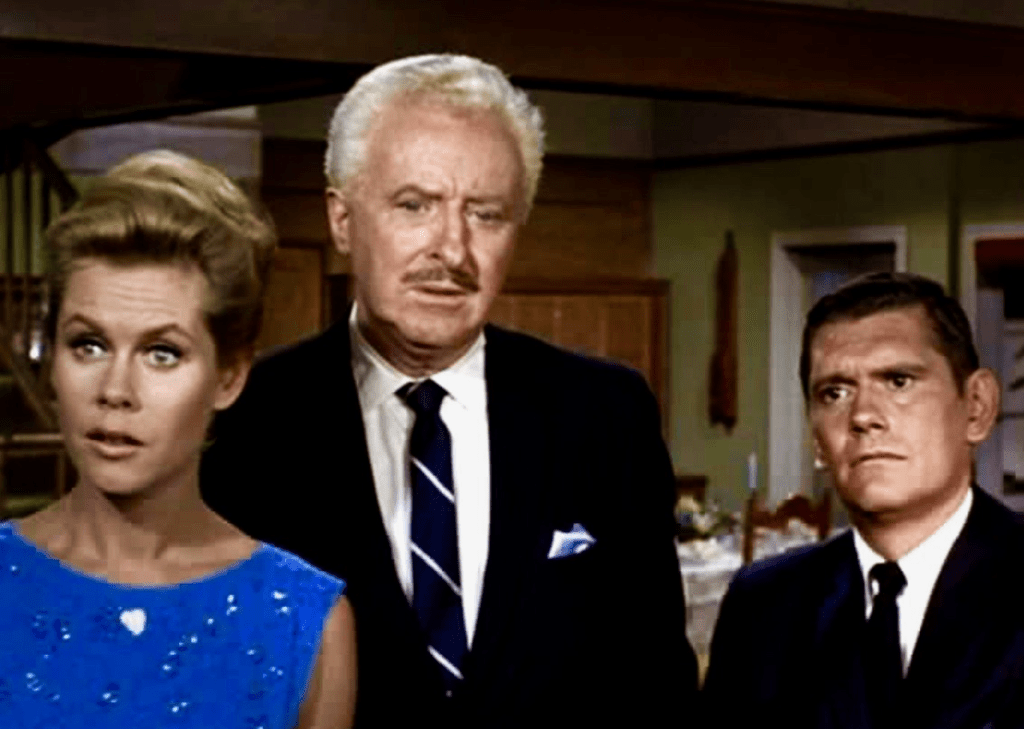
📷closerweekly.com On Bewitched
From 1964-1972, he perfected the comedic role of Larry Tate on Bewitched. As president of McMann & Tate, he was constantly firing Darrin for one reason or another, usually related to some circumstance caused by Samantha’s family. White also directed one episode of the series, “Sam’s Double Mother Trouble.”
During an interview with Herbie J. Pilato (author of Bewitched Forever), White said he “got the part because I was an honest man, and that’s how Larry and I were different. I’m not two-faced, and he was. I had more integrity than Larry ever had. I was smarter and had a deeper sense of values. I had to diminish who I was to play Larry, whom I viewed as a very insecure person who only had a certain brilliance in certain areas. He was smart enough to hire people who possessed the skills he did not—like Darrin. I wasn’t born to play Larry. I had to create him. He was a make-believe character of his own truth slated in a comedy series. When playing humor and farce you take that truth and stretch it as far as it will go. But not any farther. When I was playing Larry, though he was a funny character, I never tried to be funny. To me, acting has to do with fulfilling the needs of the character you’re playing, not the actor who’s playing him. Although the one thing the actor and the character have in common is that both have needs. A real heavy is a man who doesn’t have any moral structure whatsoever; one who ends up cheating or even killing someone. Larry was selfish, but he was never that extreme. If anything, he was still a little kid who never matured.”
📷x.com Bewitched
In that same interview, White said his favorite Bewitched episodes were “Moment of Truth” (Season 3, Episode 2 when Samantha has to tell Darrin Tabitha is also a witch and they try to keep the secret from the Tates), “Bewitched, Bothered and Infuriated” (Season 3, Episode 31 when Clara tells them about a future newspaper article that says Larry broke his leg on their trip, so Darrin and Samantha try to protect him while causing a lot of annoyance to Larry and Louise), and “Toys in Babeland” (Season 4, Episode 2 when Endora brings one of Tabitha’s toys to babysit her while she runs a quick errand which leads Tabitha to bring a lot of toys to life).
After the show ended, White continued both his television and film careers. He also continued in the theater, primarily with Theatre West and the Mark Taper Forum in Los Angeles.
📷imdb.com My Three Sons
During the seventies and eighties, he showed up in a variety of popular shows including Adam-12, Cagney and Lacey,Cannon, Columbo, Dallas, Dynasty, Love American Style, Mission Impossible, Qunicy M.E., Room 222,The Odd Couple, The LoveBoat, The Mary Tyler Moore Show, and The Rockford Files.
After his son’s death, White became a bit of a recluse. He had just begun working again when he passed away from a heart attack in 1990 at the age of 74. Certainly, David White had a successful career, amidst his personal heartbreaks, appearing on the stage, in films, and on television. It would have been wonderful if he had another chance to be part of the cast of another hit show, maybe a dramatic role. However, if you only costar in one show, the role of Larry Tate and the memories we have of him on Bewitched is a great one to have.
Today we are winding up our blog series about some of our favorite actors. We finish today with one of my favorites who had a dual big-screen and small-screen career, James Garner.
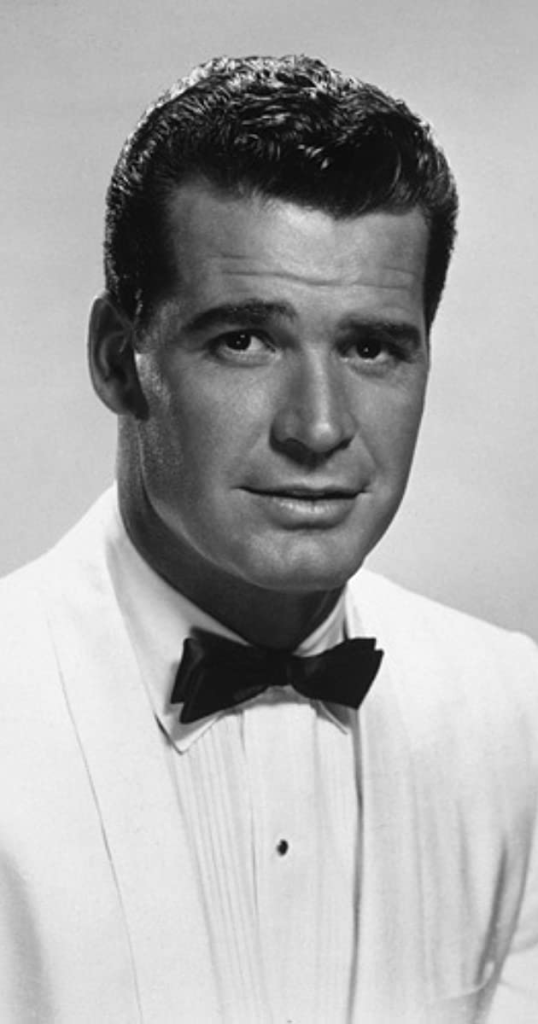
Garner was born in Norman, Oklahoma as James Scott Bumgarner in 1928. His mother died when he was 4, and his father ran a small store and the family lived above it. When James was 7 the store burned down and his father left the boys and gave them to relatives to raise. Later he moved to Los Angeles and became a carpet layer. James’ first stepmom was very abusive, and they finally had a fight when he hit her and she took off. His second stepmother was a total opposite of the first. He called her Mama Grace and said she was a real mother to him.
At 16 James dropped out of high school to join the Merchant Marines. He liked his shipmates but could never get over his chronic seasickness. In 1945 Garner moved to Los Angeles and enrolled in high school. He was a popular student and played both football and basketball, but he was a terrible student. He moved back to Norman the next year to try high school there again. He dropped out before graduating.
He then joined the California Army National Guard where he served his first seven months in Los Angeles. Then he went to Korea for 14 months as a rifleman in the 5th Regimental Combat Team. He was wounded twice and received two Purple Hearts. He also received his diploma from high school.
After he left the military, he had a variety of odd jobs including laying carpet with his father, pumping gas, installing telephones, chauffeur, dishwasher, janitor, lifeguard, grocery clerk, salesman, oil field worker, and modeling men’s clothing. His entry into the entertainment business is a bit different than most people’s. He was supposed to read lines to lead actors for Broadway production, “The Caine Mutiny Court Martial” in 1954. He was also given a minor, non-speaking role. As he was on the stage, he began to learn about the art of acting.
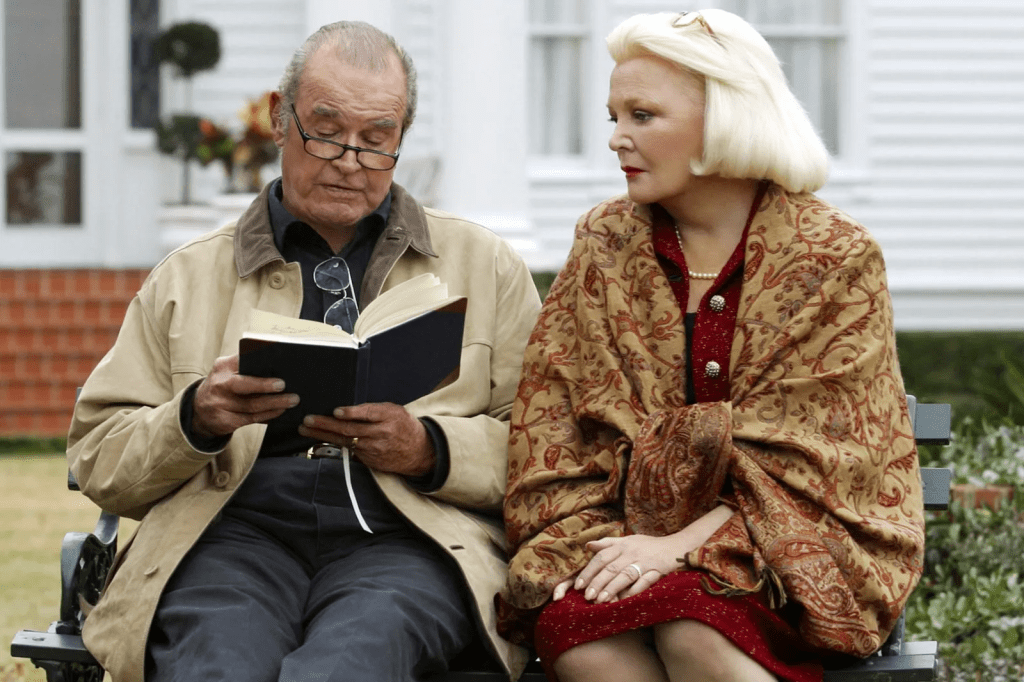
The Notebook Photo: GlamourUK.com
In 1955 he received a bit part on Cheyenne on television. He was also in Warner Brothers Presents. These small parts led to several offers to act in commercials and a larger offer from Warner Brothers to sign a contract for $200 a week. Garner began his big-screen career with Toward the Unknown in 1956. His film career included 46 additional movies with his last being The Notebook.
It was also 1956, when he married his wife Lois Fleishman Clarke; they would remain married until his death, and the couple had two daughters. They had a very short courtship. They met at the Beverly Hills Courthouse at a political rally for Adlai Stevenson and were a married couple two weeks later.
The couple bought a house in the Los Angeles neighborhood of Brentwood where their neighbors were Steve McQueen, O.J. Simpson, Arnold Schwarzenegger, Maria Shriver, and Mark Harmon. They were still living there when James passed away.
Maverick Photo: wikimediacommons.com
His successful movie career did not halt his television career. From 1957 to 1962, Garner starred as Bret Maverick on Maverick. Garner developed the type of role he would be known for as the calm, good-natured, likable, smart guy who gets out of trouble using his wit and street smarts. The show was not canceled by the network; unfortunately, Garner and the producers had a dispute over money, and he decided not to come back for the next season.
In August of 1963, Garner was one of several stars who accompanied Martin Luther King Jr. in his March on Washington. He later also recalled sitting in the third row while listening to King’s “I Have a Dream” speech.
In 1964 he made what he called his favorite film, The Americanization of Emily with Julie Andrews. He played the personal attendant of a Navy admiral and he said it contained the most impassioned speech of his career.
During the sixties and seventies, he continued making movies and showing up in a few places on television, shows like Rowan and Martin’s Laugh In, The Tonight Show, and several tv movies, one about Bret Maverick.
In 1974 he accepted his second role as star of a television series on The Rockford Files. He played Jim Rockford until 1980. Again, the network did not cancel the show which was still very popular but Garner had been having back pain and did not feel that he should continue the weekly series. He probably made the right choice because he was hospitalized with a bleeding ulcer during 1979; he would have quintuple heart bypass surgery in 1988; and both knees replaced in 2000.
Rockford Files Photo: starstills.com
In 1977 Garner began making commercials for Polaroid with Mariette Hartley. They were so convincing of being a married couple, that Hartley had a shirt made that said “I am not James Garner’s wife!” The couple filmed more than 300 commercials together.
After John Ritter passed away in 2003, Garner joined the cast of 8 Simple Rules as Cate’s father Joe and was on the show for the final three seasons.
Garner worked with several charities and foundations during his career. In 2003, he gave $500,000 to the James Garner Chair in the School of Drama for the University of Oklahoma to fund the first-endowed position at that school. He also volunteered with Save the Children.
In 2011, Garner wrote an autobiography called The Garner Files: A Memoir, cowritten with Jon Winokur.
Some of Garner’s hobbies included spending time with his family and political activism. However, his biggest passion was sports. He was a big fan of the Oakland Raiders and could often be seen on the sidelines with the team. He loved golfing. He was inducted into the Off Road Motorsports Hall of Fame in 1978. He owned the American International Racing team in the late sixties and he drove the pace cars for the Indianapolis 500 in 1975, 1977, and 1986.
Photo: flickr.com
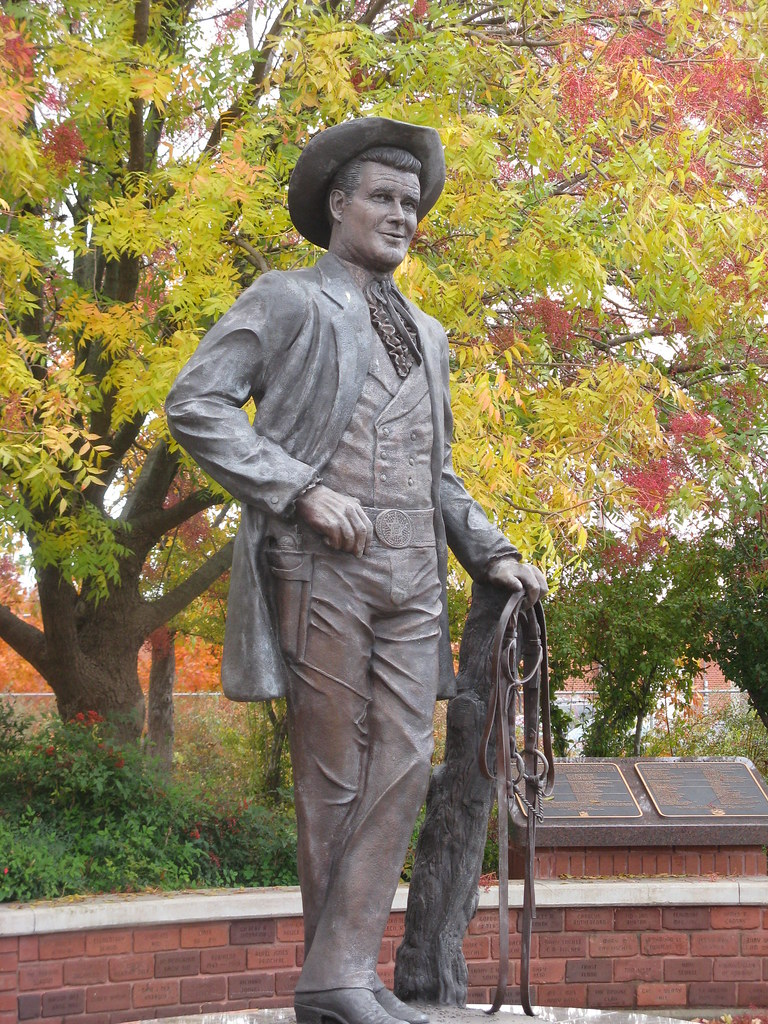
He was also honored by his hometown of Norman, Oklahoma. He has a street named after him there and in 2006, a ten-foot bronze statue as Bret Maverick was erected there.
He was also loved by his coworkers. In 1973, John Wayne named Garner the best American actor in an interview. He was also close friends with Tom Selleck, Sally Field, and Clint Eastwood. When he passed away in 2014 from a heart attack, Sally Field said “My heart just broke. There are few people on this planet I have adored as much as Jimmy Garner. I cherish every moment I spent with him and relive them over and over in my head. He was a diamond.” He was nominated for 15 Emmy awards during his television career, winning in 1977 as Outstanding Lead Actor in a Drama Series for The Rockford Files.
He didn’t do a lot of comedy but I think he was a funny guy. When he was asked if he would ever consider a nude scene, he said “No, I don’t do horror films.”
James always said he was not concerned with fame; he just wanted to make a good living at something he enjoyed. That comes across as something he truly believed in, not just talking the talk. He lived in the same house and was married to the same woman for most of his life. He did work he was proud of and was very successful in both film and television. He loved sports and his career allowed him to participate in more of those activities that he loved. He was also a generous man, giving to causes that he thought were important.
Move Over Darling Photo: moviescene.com
Although not the most important films in his portfolio, I always think of him acting with Doris Day in The Thrill of it All and Move Over Darling. I enjoyed learning about his life and respect him as a person. He never complained about the terrible childhood he had or used it to make excuses when he did make a poor choice; he said you have to just keep moving forward and he moved forward in an honorable way. Thanks for sharing your life with us and letting us travel forward with you, James Garner.
Since this month is a Potpourri Month, I thought it might be fun to look at the career of stuntmen on television. I’m calling this one “Propourri” because you have to be well trained to do these types of stunts.
Left to right: stuntmen Bob Miles, Bob Herron, Whitey Hughes, actor Michael Dunn, stuntman John Hudkins, Bill Shannon, and actor Quintin Sondergaard. Photo: famousfix.com
A stuntman or stuntwoman is a person who performs dangerous action sequences in a movie or television show. They have usually had extensive training to do these perilous moves safely. Sometimes they are hired as a team with a stunt crew, rigging coordinator, and special effects coordinator.
Stuntmen like Evel Knievel are daredevils who perform for a live audience. If someone fills in for a specific actor all the time, they are stunt doubles. So, what type of stunts do these professionals perform? Sometimes it’s car crashes, explosions, fights, or falls.
The first stuntmen to entertain audiences were performers who traveled around, often in circuses. Later these types of performers worked with Buffalo Bill and in shows that celebrated the Old West.
Today we are going to concentrate on television performers. Currently, stunt professionals must be certified to obtain the insurance producers need to obtain.
The Academy of Television Arts and Sciences now awards Emmys for stunt coordinators but there is no Oscar for this work.
Life-threatening injuries are not uncommon in this work and sadly, deaths do still occur. While most of my research found stuntmen killed in movies, I only found one relating to television. In 1985, Reid Rondell was killed in a helicopter explosion filming Airwolf.
I thought it would be fun to look at the careers of a few stuntmen from the golden age of television. Most of these men made their money in films, but all three of them had successful careers working on television shows as well.
Whitey Hughes
Photo: findagrave.com
Whitey Hughes was born in 1920 in Arkoma, Oklahoma. He grew up on a farm, so in addition to working with plows and horse teams, he learned to break horses with his father. When he was sixteen, the family moved to Los Angeles. After graduating from high school, Whitey became a Screen Actors Guild member in 1947.
Whitey began his movie career in 1946. During the fifties, he worked on a lot of western films. Hughes said that in the early part of his career, he often had to be a double for the leading lady. (We’ll come back to this subject later in the blog.) He did stunt work for a variety of actresses including Anne Baxter, Rita Hayworth, Barbara Hershey, Virginia Mayo, Stephanie Powers, and Lana Turner.
Photo: westernclippings.com
Speaking of women, one of the roles, Whitey loved best was being the husband of Dotti; they were married for seventy years.
During the fifties, Whitey worked on a lot of westerns including Cheyenne. In the sixties, you would see him on Rawhide or as Kurt Russell’s double on The Magical World of Disney. If you want to see him in action, the best show to watch would be The Wild Wild West; his crew did some amazing things on that show and Whitey coordinated the stunt work for 1965-1968.
The eighties found him in Fantasy Island, Wonder Woman, and BJ and the Bear while in the nineties he was part of Little House on the Prairie and The Fall Guy. His last work was in a movie in 1998. In 2009, Whitey died in his sleep. It is good he died peacefully; I can’t imagine the toll that this type of work took on his body for fifty years.
Hal Needham
Photo: themoviedatabase.com
Hal Needham was born in 1931 in Memphis, Tennessee. He served as a paratrooper in the US Army during the Korean War. After the war, he worked as an arborist doing tree-topping services. He was also the billboard model for Viceroy Cigarettes while he was trying to establish his career in Hollywood.
Hal’s first big job was the stunt double for Richard Boone on Have Gun, Will Travel. From 1957-63 he was in 225 episodes. During the sixties, he would show up in many television series including Laramie, Wagon Train, Laredo, The Wild, Wild West, Star Trek, Gunsmoke, Big Valley, and Mannix.
Hal was the highest-paid stuntman in the world. That seems fitting because during his career he broke 56 bones, broke his back twice, punctured a lung, and lost a few teeth.
Needham was responsible for wrecking hundreds of cars, fell from many buildings, was dragged by horses, perfected boat stunts and was the first human to test the car airbag.
He revolutionized the work of stuntmen and worked to get his craft recognized and appreciated. He mentored up-and-coming professionals.
With Burt Reynolds Photo: youtube.com
His career transitioned from a stuntman to a stunt coordinator to a second unit director to a director. In all, he would work on 4500 television episodes and in 310 films, according to imdb.com. He made his directing debut on a movie he wrote called Smokey and the Bandit with Burt Reynolds and would go on to direct Hooper and The Cannonball Run for Reynolds among other series and films.
In 1977 Gabriel Toys debuted the Hal Needham Western Movie Stunt Set with a cardboard saloon movie set, lights, props, a movie camera, and an action figure that could break through a balcony railing, break a table and crash through the window. They have become highly collectible.
Photo: pinterest.com
Needham owned a NASCAR race team. He also set a Guinness World Record as the financier and owner of the Budweiser Rocket Car which is now on display at the Smithsonian’s National Air and Space Museum.
He also managed to win both an Emmy and an Oscar. Reynolds and Needham were close friends; Needham lived in Reynold’s guest house for 12 years and their relationship was used as the basis for the plot in Once Upon a Time in Hollywood.
Bob Herron
Bob Herron was born in 1924 in California. When his parents divorced, he moved to Hawaii with his father. The swimming and high diving he did there was a boost to his stunt career. His mother married Ace Hudkins who was a supplier of horses to the movie industry. Herron helped his stepfather in this business before enlisting in the Navy.
Photo: imdb.com
In 1950 he began doing stunt work. His first job was on Rocky Mountain with Errol Flynn and he was shot off horses. This would be a piece of cake compared to his role in Oklahoma Crude where he fell 55 feet from the top of an oil derrick into a stack of boxes.
In the sixties, he began his stunt work on television. He was in Gunsmoke, I Spy, I Dream of Jeannie, The Man from UNCLE, The Girl from UNCLE, Star Trek, Mission Impossible, Get Smart, and Bonanza. He doubled for Ross Martin in The Wild, Wild West. During the seventies, he appeared on Petrocelli, Little House on the Prairie, Marcus Welby, The Mary Tyler MooreShow, The Rockford Files, Kojak, and Charlie’s Angels among other shows. He was still going in the eighties doing his stunts on Hart to Hart, Magnum PI, Remington Steele, the Dukes of Hazzard, Matt Houston, Airwolf, The A-Team, and MacGyver. Despite being almost seventy, he continued in the nineties on shows like Father Dowling’s Murder Mysteries, The Wonder Years, and Murder She Wrote.
I did smile a bit to see shows like I Dream of Jeannie and The Mary Tyler Moore Show on this list. The Jeannie episode is one where she brings her great-grandfather to Cocoa Beach to show Tony how to desalinate water and the Mary episode is one where Sue Anne falls in love with someone who doesn’t return the feelings. I guess it proves you never know where a stunt person will show up.
I don’t know how he managed to survive sixty years performing dangerous stunts but he must have been in amazing physical shape.
I did promise to come back to men having to double for women in the forties and fifties. Thankfully, that is no longer the case, and women’s numbers are increasing among the 3400 stunt performers in SAG.
Former gymnast Shauna Duggins did the hard fighting work in Jennifer Garner’s show Alias. Because pay is determined by union contracts, stuntwomen do not suffer from the pay discrimination that sometimes shows up in the industry. Stunt performers are paid a minimum of $1005 for one day of work and they can negotiate higher pay based on their experience.
Shauna Duggins and Jennifer Garner Photo: broadwayworld.com
Duggins was at the University of California Davis when she first thought about being a stuntwoman. She learned more about martial arts and spent hours working out in gyms after graduation. In 2000 she auditioned for stunt work in The X Files as Krista Allen’s double and got the job. Then she was in Charlie’s Angels for Kelly Lynch and Cameron Diaz.
It was after that movie that she got the role on Alias where she worked for five years. To protect these women, SAG has a 24/7 hotline for performers to phone if they feel they have been the victim of sexual abuse.
In 2018 Duggins won an Emmy after twenty years in the business. Her advice to young women who decide to make this their career: “train as much as you can in various skills. Go to different gyms with stunt performers, train with all of them and just learn from each other.”
I’m glad we took some time to learn about the tough and dangerous job these performers do. It was so interesting to learn a little bit about some of these industry stars.
Today in our Supportive Women blog series, today we are delving into the career of Stefanie Powers.
Photo: themoviestore.com
Stefania Zofya Paul was born in 1942 in Hollywood, California, Her parents divorced when she was little, and she rarely saw her father again. At age fifteen, she began dancing for Jerome Robbins. During her career she has appeared on the stage many times, the first time in 1964 in “Under The Yum-Yum Tree.” She also appeared on the British stage in several productions including “The King and I.”
She graduated from Hollywood High, although she was given her first contract at age 16 with Columbia Pictures. She made 15 films in those early years with some of the great stars including James Caan, Bing Crosby, Sammy Davis, Ava Gardner, Maureen O’Hara, Roger Moore, Lana Turner, and John Wayne.
Her first role was in the made-for-tv movie Now is Tomorrow in 1958. Out of her 118 acting credits, 25 would be big-screen movies with 37 made-for-tv movies. The other half of her appearances were on television series.
The Girl From U.N.C.L.E. Photo: pinterest.com
In the 1960s she showed up in many shows including the sitcoms The Ann Sothern Show and Please Don’t Eat the Daisies and dramas including Bonanza and Route 66.
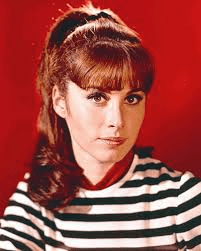
In the middle of the decade, she was cast in her first starring television role as April Dancer on The Girl From U.N.C.L.E. Although it would only last one season, she became well known for her spy missions on the series.
In 1966 Stefanie married Gary Lockwood, another actor; with 95 credits, he also had a long and successful career. They divorced in 1972. Shortly after her divorce, she met William Holden and they were together until his death in 1981; Powers described them as soul mates.
Powers was kept busy in the seventies, making appearances on a variety of shows including Love American Style; The FBI; Owen Marshall, Counselor at Law; The Mod Squad; Barnaby Jones; McCloud; Marcus Welby, MD; Medical Center; Cannon; The Rockford Files; and McMillan and Wife.
Although she made a few random appearances on small screen series, her last three major roles were as a regular cast member on three shows: The Feather and Father Gang, Hart to Hart, and TheDoctors.
The Feather and the Father Gang is not a show I remember at all. She starred with Harold Gould as a con man and she was his daughter, a lawyer, who helped him solve crimes.
Hart to Hart Photo: thetelegraph.com
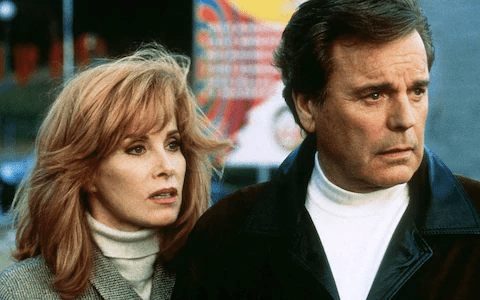
Jennifer Hart is the role that Powers was best known for. She starred with Robert Wagner as her husband Jonathan on Hart to Hart. They are a wealthy married couple similar to Nick and Nora Charles on The Thin Man who continued to get mixed up in murders wherever they go. The show was on the air for five years from 1979 to 1984. Stefanie received two Emmy nominations for her role of Jennifer Hart. In 1981 she was beat out by Barbara Babcock for Hill Street Blues and in 1982 she was beat out by Michael Learned for Nurse.
Wagner lobbied for Powers to be cast as his wife because she had worked with him in an earlier show of his in 1968, To Catch a Thief.
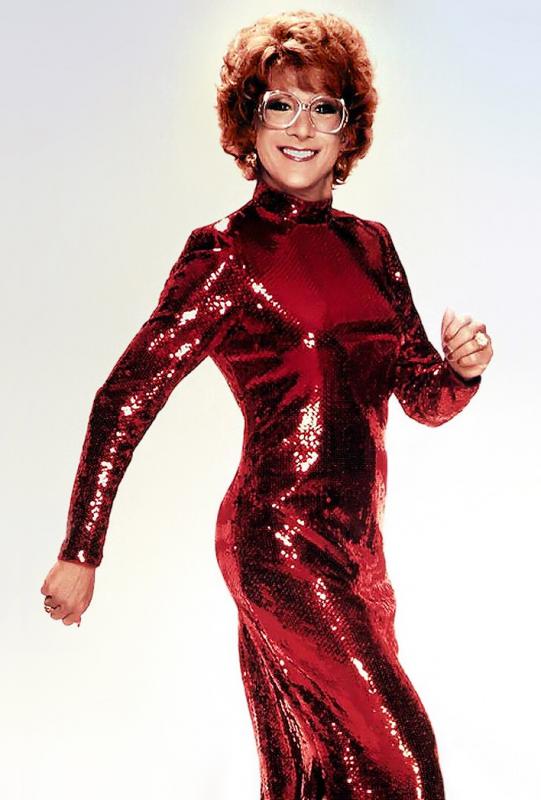
Several other actresses who were being considered for the role were Lindsay Wagner and Suzanne Pleshette. Fun fact, if you watch Tootsie with Dustin Hoffman, you will see him wearing a red, sequenced dress that was worn by Powers as Jennifer two years earlier in the episode “Color Jennifer Dead” in 1980.
After the show was canceled, they paired up again for eight made-for-tv movies about the Harts. The couple also starred in a stage production of “Love Letters” at the Chicago Theater in 1993.
Ironically, Powers was in the same ballet class with Natalie Wood and Jill St. John. While Powers played Robert Wagner’s wife on the show, Wood and St. John were married to him in real life.
In 1993 she tried marriage again with Patrick Houitte de La Chesnais. They were together for six years before divorcing.
Powers has kept busy in the last two decades. In 2003, she released a CD, “On the Same Page,” songs from the great composers. She is a polo player and was one of the first foreign members of the Royal County of Berkshire Polo Club; in 2005 she competed in the Joules United Kingdom National Women’s Championship which was held in Ascot.
In 1982, Stefanie founded the William Holden Wildlife Foundation and became a director of the Mount Kenya Game Ranch and Wildlife Conservancy in Kenya. She and Holden were passionate about wildlife conservation. She also works with the Cincinnati and Atlanta zoos.
Powers spends her time in residences in Los Angeles, London, and Kenya. She apparently speaks six different languages.
With Soulmate William Holden Photo:tumblr.com
After smoking for twenty years, Powers was diagnosed with alveolar carcinoma, a type of lung cancer. She underwent surgery to remove part of her lung in 2009.
She was cast in a movie, Prism, that is in pre-production currently. It was apparently inspired by true events—as imdb describes it, “the infiltration of the Sinaloa Cartel and the inner sanctum of Joaquin El-Chapo Guzman by a US task force detective who goes deep undercover to expose Chapo and his criminal empire.”
Powers has had an amazing career and an even more amazing life. She is able to live on three different continents, enjoys a variety of activities, has a purpose in her life, and found her soul mate. Her life could easily become a movie script but if she was not available, I’m not sure who they would get to play her.
This month we are looking at some of our favorite “Supportive Women.” Today we are taking a closer look at the career of Linda Evans.
Photo: vintageeveryday.com
Born Linda Evenstad in 1942 in Hartford, Connecticut, she was the middle child of three sisters. Both her parents were professional dancers. When she was six months old, the family moved to North Hollywood. Linda graduated from Hollywood High School with Stefanie Powers, who we will be talking about next week. Like Morgan Fairchild, who we will be discussing in two weeks, Linda took drama classes to help her deal with shyness.
Linda was engaged to Patrick Curtis, but they never married. He later became a press agent and married Raquel Welch.
Linda’s first two roles were on two of my favorite sitcoms. In 1960, she guest starred on Bachelor Father where Bentley Greg (John Forsythe) raised his niece Kelly (Noreen Corcoran) with the help of his houseboy Peter (Sammee Tong). Her second appearance was on The Adventures of Ozzie and Harriet. During the sixties, she would appear on a variety of shows including Dr. Kildare, Wagon Train, and My Favorite Martian.
Photo: pinterest.com
Her first made-for-tv movie was 1962’s Buttons with Beaus, and her first big screen feature came a year later in Twilight of Honor; her second movie was Beach Blanket Bingo in 1965 where she played Sugar Kane.
It was in 1965 that Evans began dating film director John Derek. They would marry in 1968 and separate in 1973 when Linda learned he was dating the actress who became known as Bo Derek.
1965 was also the year she was offered her first role as a regular cast member of a series. She became Audra Barkley from 1965-1969 on The Big Valley. The western was very popular. Similar to Bonanza, in this show, Victoria Barkley managed to raise her family and keep the villains at bay.
She and Barbara Stanwyck, who played her mother Victoria on the show, became very close. Stanwyck continued to refer to her as Audra after the show ended. Linda says Barbara was a great mentor and friend to her.
In 1967 when Derek was filming Evel Knievel’s famous motorcycle jump over the fountains at Caesar’s Place in Las Vegas, he asked Linda to take over one of the cameras, and she shot the famous footage of Knievel’s devastating crash.
During the 1970s she kept busy with television appearances on dramas including McCloud, Banacek, Harry O, McMillan and Wife, and The Rockford Files.
With “mom” Barbara Stanwyck Photo: imdb.com
In 1975, she married Stan Herman, a real estate tycoon. They were married four years before splitting up. She never married again.
From 1976-1977 she again accepted a role as a regular on the show Hunter. The series only lasted fourteen episodes before being canceled. Not to be confused with the show from the 1980s, in this one, US government special agents James Hunter (Tony Franciscus) and Marty Shaw (Evans) take on missions around the world. He posed as a bookstore owner, and her cover was a model. I admit I have never seen this show, but it sounds like a seventies version of I Spy.
During the 1980s, her career was split between two primary shows: The Love Boat and Dynasty. Dynasty was on the air from 1981-1989. When Dallas became extremely popular, ABC commissioned Aaron Spelling to come up with a primetime soap opera of its own. Evans was back on the air working with John Forsythe again as Blake Carrington, her wealthy husband. The basic premise of the show was that it was an upper-class version of the Hatfields and the McCoys with the Carringtons and the Colbys feuding in the oil business in Denver, Colorado.
Dynasty with Forsythe and Collins Photo: imdb.com
Evans and Forsythe remained close friends for the rest of his life. She said he was “so magical. This show was so serious and he was funny personally. We’d be fighting and people would be strangling each other and he made me laugh all day long, I’ll be forever grateful to him for that.” The person Linda was often strangling was Joan Collins who played Alexis Carrington Colby, Blake’s first wife.
By 1984 the show had reached number one in the rankings. Linda was nominated for an Emmy for Outstanding Lead Actress in a Drama Series in 1983. She was beat out by Tyne Daly from Cagney and Lacey.
After the show was canceled, Evans stepped out of the limelight for the most part. She did film five made-for-tv movies during the 1990s and guest starred on Germany’s version of The Love Boat, Das Traumschiff, in 2020. In 2021, she was in a big-screen feature, Swan Song.
In 2011 Evans published a book, Recipes for Life: My Memories, a combination of candid memoir and inspirational cookbook. Despite her perfect figure, one of her weaknesses is pizza. On premierspeakers.com on April 10, 2018, she was quoted as saying “I love pizza so much, that if you wake me up in the middle of the night and ask me if I’d like to eat a slice, I’ll say YES. Kenny Rogers used to have it delivered to me while I was filming The Gambler.
Photo: dailyexpress.com
Linda seemed to enjoy her career. She is remembered for several well-known characters in Audra Barkley and Crystal Carrington. While she has given up acting for the most part, I would not be surprised to see her back on the big screen for another part or two if it’s the right offer.
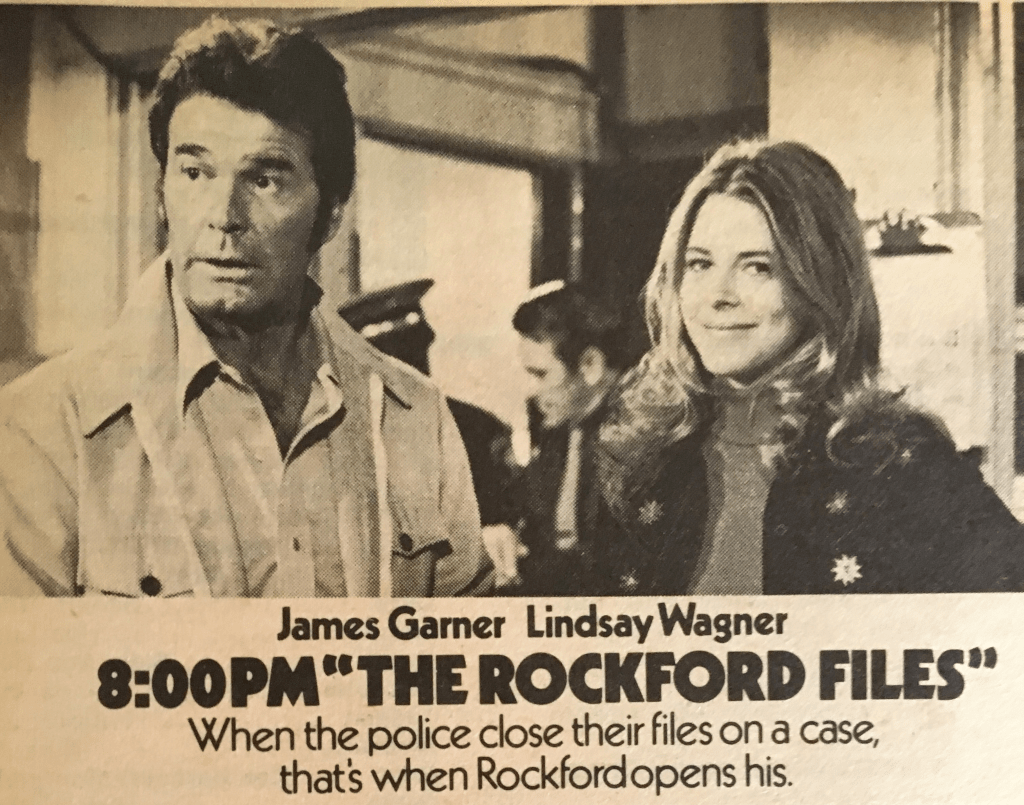
As we are taking a look back at some favorite crime shows, The Rockford Files with its memorable answering machine message opening and fun theme song, is one that definitely is worth exploring. The show was on NBC from 1974-1980.
Photo: thetvprofessor.com
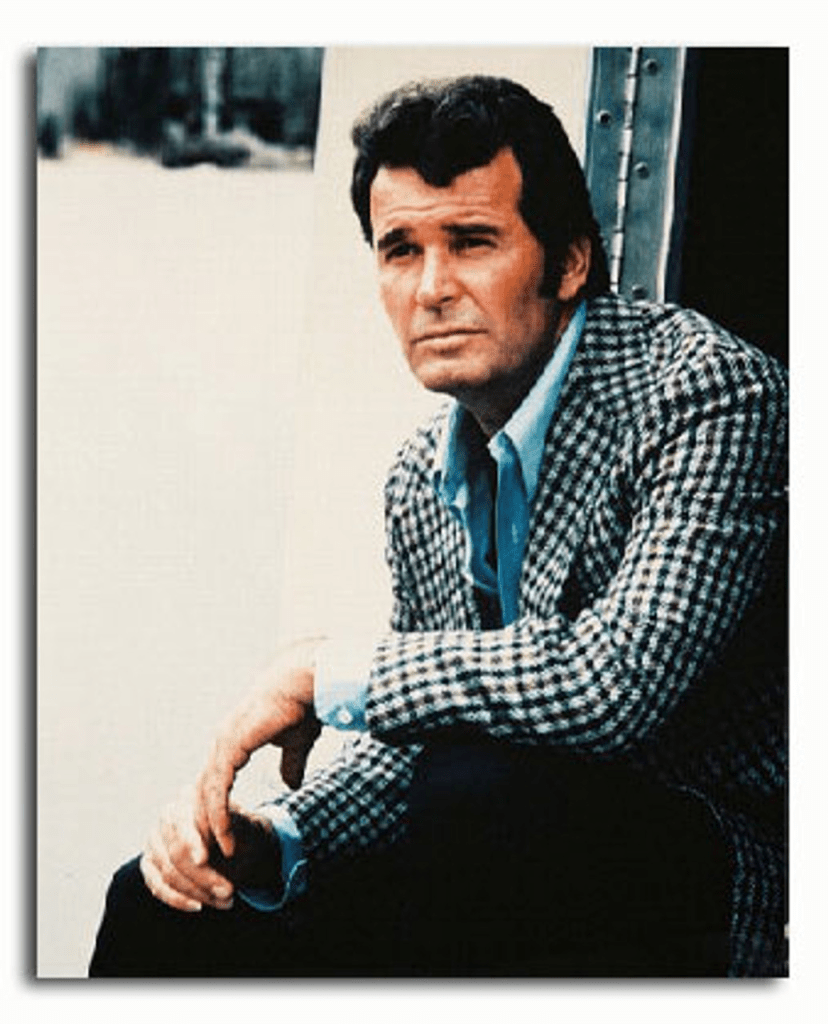
Jim Rockford (James Garner) is not the average TV detective of the seventies. He does not have an elegant apartment; his clothes come off the rack, not a designer’s showroom; and he doesn’t have a sexy assistant, just his dad, a former truck driver who sometimes helps him out. He lives in a small mobile home in a parking lot; the home also serves as his office.
Creators Roy Huggins and Stephen J. Cannell created the show. Huggins had also been the force behind Maverick which also starred Garner from 1957-1962. Robert Blake was also considered for this role, but Huggins cast him in Baretta, another one of his shows.
Rockford has a gun, but no permit for it. However, he prefers to talk his way out of most situations. He tends to work on cold cases, missing persons, and low-budget insurance scams.
The story was that Rockford was incarcerated in San Quentin for five years for a crime he did not commit. Eventually, he was pardoned, but now he is having a tough time making ends meet. He’s a private eye who charges $200 a day (about $1000 today) but he doesn’t get enough work to do more than pay the rent and incidentals.
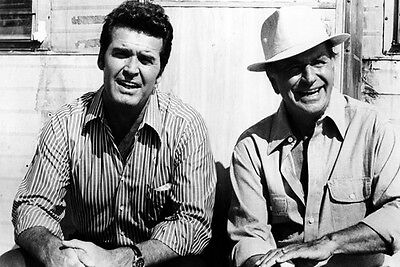
Garner with Noah Beery Jr. Photo: ebay.com
His father Joe (Noah Beery Jr.) nags Jim to find a more secure job and to settle down and get married. Jim’s friend Joe Santos (Dennis Becker), a sergeant for the LA Police Department, also helps him out from time to time.
Rounding out the cast were Evelyn “Angel” Martin (Stuart Margolin) who had been Jim’s friend in prison. His con artist schemes cause a lot of headaches for Jim. Beth Davenport (Gretchen Corbett) is Jim’s attorney and sometimes girlfriend. Lt Diehl (Tom Atkins) was on the first half of the show while Lt Doug Chapman (James Luisi) was on the final three seasons. Neither of them like Rockford much.
This show had an impressive list of guest stars, including Lou Gossett Jr., Isaac Hayes, Rita Moreno, Tom Selleck, and Dionne Warwick. Garner’s brother Jack also shows up in quite a few bit parts; you can see him as a policeman and gas station attendant, among other minor roles.
Photo: autoweek.com
Jim drove a gold Pontiac Firebird. Rockford was known for his “turn-around” to evade police and criminals, a procedure commonly taught to Secret Service agents. As Garner described it in his autobiography, “When you are going straight in reverse about 35 mph, you come off the gas pedal, go hard left, and pull on the emergency brake. That locks the wheels and throws the front end around.” Then you release everything, hit the gas, and off you go in the opposite direction.”
The theme song for the show was written by Mike Post and Pete Carpenter. It went through several versions over the years. It hit the Billboard Top Ten in 1975.
When I think of the show, the iconic answering machine introduction is what comes to mind. After two rings, you heard, “This is Jim Rockford. At the tone, leave your name and message. I’ll get back to you.” Typically, the message was its own little skit which help us get to know a little bit more about Rockford. The writers had to come up with 122 different messages during the run of the show.
Photo: travalanche.com
The show was popular with viewers throughout the four seasons. However, after being #12 in its first year, it fell to #58 by season five. In 1979, Garner was advised by his doctors to take some time off because he was suffering some knee and back problems, as well as dealing with an ulcer. Until then, he had performed many of his own stunts on the show. When the physical pain did not get dramatically better, Garner decided not to continue with the show, and the network canceled the program midseason.
It was also popular with critics. James Garner was nominated for Outstanding Lead Actor in a Drama in 1976, 1977, 1978, and 1979; he won in 1977. The show was nominated for Outstanding Drama Series from 1978-1980; the show won in 1978. There were an additional nine nominations with Margolin winning two and Rita Moreno winning two.
Photo: imdb.com
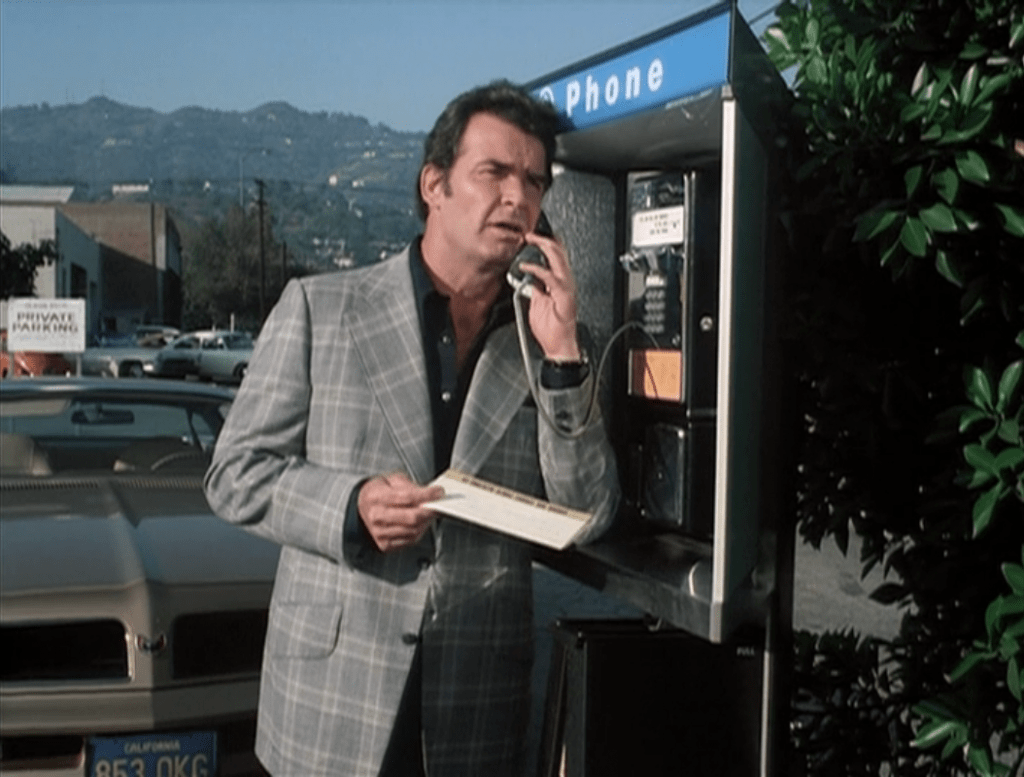
If you were a fan of the show, you will know a few of these fun facts about Rockford. One of his favorite foods was tacos, and he ate a lot of them on the show. When he needs an alias, he typically was Jim Taggert. Rockford’s full name is James Scott Rockford; the star of the show’s name is James Scott Garner. Rockford was a Korean vet, and one of his military friends was played by the great Hector Elizondo. He cares for a stray cat who lives near his home. And, last but not least, a running gag of the show is that even though Rockford’s job involves crucial details, he can never remember license plate numbers.
This show holds up well today. The show is on DVD and can be found on several cable channels. Check it out, even if you just want some inspiration for creative voice mails.
We are up close and personal this month with some of our favorite male television stars, and Pernell Roberts is definitely on that short list. Pernell Roberts was well known to television viewers in the early sixties and the early eighties. Some fans might not even realize the two characters he was best known for, Adam Cartwright on Bonanza and Dr. John McIntyre on Trapper John, MD were played by the same man.
The Family of Bonanza Photo: toledoblade.com
Pernell Elven Roberts Jr. was born an only child in 1928. He was named for his father who was a Dr. Pepper salesman. During high school, Roberts played the horn, acted in several school and church plays, played basketball, and sang in the local USO shows. He enrolled at Georgia Tech but then enlisted in the US Marine Corps. He played both the tuba and horn in the Marine Corps Band while sometimes tackling the sousaphone and percussion parts. After his time in the Marines, he enrolled at the University of Maryland where he enjoyed participating in classical theater. He left college to continue his acting career.
In 1949, he had his professional stage debut in “The Man Who Came to Dinner” with Moss Hart and Kitty Carlisle. He then took on several roles in Philadelphia.
In 1951, Roberts married Vera Mowry; she was a professor of theatre history at Washington State University. They divorced in 1959. They had one son who was killed in a motorcycle accident in 1989.
In 1952, Roberts made the big move to New York City appearing in off-Broadway shows. Several of his costars were Joanne Woodward and Robert Culp. He performed several Shakespeare roles.
In 1956, Roberts made his television debut in Kraft Theatre. In 1957, he signed with Columbia Pictures. His first big-screen role was as Burl Ives’ son in Desire Under the Elms. His second role was with Glenn Ford and Shirley MacLaine in The Sheepman.
Roberts continued to accept television roles with ten appearances in 1958 and six in 1959.
Photo: simple.wikipedia.org
From 1959-1965 he would portray Adam Cartwright, Ben’s oldest son on Bonanza. Each of the brothers had a different mother, and Adam was the only Cartwright to attend college, studying architectural engineering. After acting in classical theater for so much of his early career, the transition to a weekly series was a difficult one for Roberts. He thought it a bit ridiculous that the independent sons had to get their father’s permission for everything they did. He wanted to act in a show with greater social relevance. So, although the show would continue until 1973, he left in 1965 after appearing in 202 episodes. The storyline was that Adam was traveling in Europe or living on the east coast. Bonanza producer David Dortort said Roberts was “rebellious, outspoken . . . and aloof, but could make any scene he was in better.”
The Odd Couple Photo: sitcomsonline.com
During this time on the show, Roberts married again in 1962; he wed Judith Roberts and they would divorce in 1971.
After leaving Bonanza, Roberts returned to theater, playing a variety of roles. He toured with many musicals including “The King and I”, “Kiss Me Kate”, “Camelot”, and “The Music Man.”
Pernell also became involved in the civil rights movement, joining Dick Gregory, Joan Baez, and Harry Belafonte in the sixties demonstrations including the March on Selma.
On Mission Impossible Photo: ebay.com
From 1972-1996, Roberts was married to Kara Knack. They also divorced.
Throughout the late sixties and seventies, Pernell continued appearing in television series and made-for-tv movies. You’ll see him in westerns such as Gunsmoke, The Big Valley, and The Virginian; spy genres including Wild Wild West, Mission Impossible, and The Girl from U.N.C.L.E.; crime shows including Hawaii Five-0, Mannix, Police Story, Ironside, Cannon, and TheRockford Files; and several medical series—Marcus Welby, West SideMedical, and Quincy. He even showed up on The Twilight Zone and The OddCouple.
Photo: televisionacademy.com
Perhaps he enjoyed those medical shows because he returned to television to star in his own series in 1979, playing Trapper John, MD. The plot was featured Trapper John from M*A*S*H later in his career at San Francisco Memorial Hospital where he was Chief of Surgery. He worked with a young surgeon who had also served in a MASH unit, Alonzo “Gonzo” Gates (Gregory Harrison). The series lasted seven seasons.
In 1979, he told TV Guide that he chose to return to a weekly show because he had “seen his father age and realized it was a vulnerable time to be without financial security.” Roberts felt the role allowed him to use his dramatic range of acting skills and to address important social issues.
In the 1990s, Roberts took on very few television appearances; his last television performance was in Diagnosis: Murder in 1997.
Roberts would attempt marriage one last time in 1999 when he wed Eleanor Criswell. When Pernell passed away in 2010 from pancreatic cancer after being diagnosed in 2007, they were still together.
Photo: Facebook.com
Pernell also enjoyed golfing, swimming, playing tennis, running, reading, cooking, and singing. He appeared on two record albums during his career. The cast of Bonanza recorded an album in 1959 and he released a folk music album in 1962, titled “Come All Ye Fair and Tender Ladies.”
He certainly had a long and varied career: music, movies, Broadway, and television. He also used his fame to help causes he believed in. I don’t think he is remembered as well as he should be. Maybe it’s because he left Bonanza too early to be included on a lot of the memorabilia that came out of that show or because there was such a gap between his two series that he starred in. Whatever the reason, I hope this blog has helped recall some of our memories of the three decades he spent entertaining us.
This month we are taking a close-up of five famous television male stars. If you were a television fan in the sixties, you will remember Larry Hagman as Tony on I Dream of Jeannie. If you watched Dallas in the eighties, you will remember him as the cad J.R. Ewing. However, Hagman had more than 100 acting credits and several other television starring roles, as well as credits as a producer and director. We’ll learn more about his career and these forgotten shows in this blog.
Photo: Idreamoflarry.com
Hagman was born in 1931 in Texas. His father was an accountant and lawyer who became a DA. His mother was the famous actress, Mary Martin. His parents divorced when he was five. When his mother received a Paramount contract, he lived with his maternal grandmother in Texas and California.
When Larry was nine, his mother married Richard Halliday. The couple had a baby in 1941, but Larry was sent to an academy, Black Foxe Military Institute and later to Woodstock Country School in Vermont.
His mother resumed her Broadway career in New York City, so Larry lived with his grandmother in California until she passed away when he was sent to live with his mother.
Photo: hollywoodreporter.com
Larry moved to back to Weatherford, his home town, to attend high school, and he graduated from there. Larry’s father wanted him to become a lawyer and join his practice. Larry worked for an oilfield equipment manufacturer for a summer, but was drawn to the acting profession. In the fall of 1949, he enrolled in Bard College in New York to major in drama and dance but he dropped out after his freshman year.
In 1950, Larry took on acting roles at Margaret Webster’s school, The Woodstock Playhouse in New York. The summer after his freshman year, he worked in Dallas as a production assistant and did some acting in Margo Jones’s theater company. He then traveled a bit with the St. John Terrell’s Music Circus. From 1951-1952, he appeared in “South Pacific” with his mother in London.
The following year, Hagman received his draft notice and enlisted in the Air Force. He was stationed in London and spent most of his military service entertaining troops in Europe.
Photo: tvseriesfinale.com
In 1954, Larry married Maj Axelsson. She grew up in Sweden and they met in London. They had two children and were longtime residents of Malibu, California. They were married until his death.
When he left the Air Force in 1956, he returned to New York City, appearing in a couple of off-Broadway plays. His wife made costumes for a variety of productions. In 1957, Hagman received his first television roles, appearing in West Point, Goodyear Playhouse, Studio One, and Omnibus. His Broadway debut was in “Comes a Day” in 1958.
Larry continued his dual Broadway and television careers through the remainder of the fifties. One of his roles was on Decoy, which was the first crime drama to star a female police officer (Beverly Garland) and he portrayed three different characters on Sea Hunt.
Searching for Tomorrow Photo: pinterest.com
In 1960 he had his first recurring role as Cliff Williams on Search for Tomorrow.
In 1964, he made began receiving offers to act on the big screen. He appeared in The Cavern, Ensign Pulver, and Fail Safe that year.
Hagman had been a heavy smoker but quit in 1965. He later became the chairman of both the American Cancer Society and the Great American Smokeout.
The next year, he received the role that made him a household name: Captain Anthony Nelson on I Dream of Jeannie. He rejoined the Air Force, but this time in a fictional service. The show was on the air for five seasons.
Photo: amazon.com
Two reunion movies were made later (I Dream of Jeannie: 15 Years Later in 1985 and I Still Dream of Jeannie in 1991), but Hagman was not in the cast. I read that he was busy with Dallas and family vacations during the times the movies were filmed. They did not replace his character; they focused more on Roger, Jeannie, and Tony’s son with Tony being unavailable on assignment. However, Hagman did appear with Bill Daily and Barbara Eden in several reunion-type shows, and he and Eden remained good friends.
When the show ended, Hagman took on various guest spots on shows including Love American Style. A year later, he again tried a sitcom role. He was cast as Albert Miller in The Good Life. He starred with Donna Mills as a couple who pose as servants. The show lasted a season before being canceled.
A year later there was a repeat of the cycle when he starred in Here We Go Again with Diana Baker as a newlywed couple moves into a home located near both their former spouses’ homes. Again, it lasted one season.
I read that his mother was forced to kick him out of the house when he lived with her and his stepfather because of his heavy drinking. After the cancellation of this show, his father passed away and he reconciled with his mother.
For most of the seventies, he continued guest starring in television shows including Marcus Welby, Barnaby Jones, MacMillan and Wife, and TheRockford Files and big-screen movies including Harry and Tonto and Superman.
Photo: nytimes.com
An entire new group of fans began watching Larry from 1978-1991 when he appeared as one of the major characters on Dallas. Two of the most-watched television episodes were the cliffhanger episode, “A House Divided” from 1980 when JR was shot (but viewers did not know who did it) and “Who Done It” when it was revealed that the shooter was his sister-in-law and mistress, Kristin.
Hagman was nominated for two Emmy Awards for his portrayal of JR in 1980 and 1981. He was beat out by Ed Asner for Lou Grant in 1980 and Daniel J. Travanti for Hill Street Blues in 1981.
Unlike I Dream of Jeannie, when reunion Dallas movies were made in 1996 and 1998, Hagman was part of the cast and listed as producer.
Larry always said Dallas was his favorite show, and he loved being a part of it. Both his children appeared on the show. His old costar Barbara Eden joined the cast for the final season as Lee Ann, fittingly as a character from JR’s past. The show was filmed at Southfork Ranch in Texas and after his death, Larry’s ashes were scattered there.
In an unusual reboot, Hagman reprised his role of Ewing on a new Dallas from 2012-2013.
Between the original and reboot of Dallas, Hagman once again received offers to star in two new series. One was Orleans in 1997 when he played Judge Luther Charbonnet. Unfortunately, the series only lasted for eight episodes, but he received some of the best reviews of his career for the role. In 2006, he took on the role of Burt Landau on Nip and Tuck which lasted one season.
Photo: latimes.com
Hagman also wore a directing hat. He began directing three episodes of I Dream of Jeannie in 1967. He would also direct two episodes of The Good Life, 32 episodes of Dallas (he also was listed as producer for 74 episodes), seven episodes of In The Heat of the Night in the early nineties starring one of his best friends Carroll O’Connor, and one feature film: Beware! The Blob which was a sequel to the cult classic 1958 horror film, The Blob. He produced a made-for-tv movie in 1993 called Staying Afloat which he also starred in. The plot was that Alex, a millionaire’s son, has trouble managing money so his father cuts him off. The IRS is pursuing him, and he has a lot of debt when an FBI agent offers to help with his financial issues if Alex becomes a government informant to take down a man who once burned Alex and he happily agrees.
In 1995, Hagman had a liver transplant after being diagnosed with liver cancer. He also had cirrhosis of the liver which was a result of heavy drinking. He had stopped drinking earlier in his life, but the damage was done.
In 2001, Larry added author to his resume after writing Hello Darlin’: Tall (And Absolutely True) Tales About My Life. In 2007, he gave an interview, sharing his passion for alternative energy creation. He and his wife had a solar-powered, energy-efficient home named “Heaven” in Ojai, California, where they promoted a green lifestyle. The couple also owned a home in Sundsvall, Sweden, her hometown and they visited there often.
In 2008, Maj was diagnosed with Alzheimer’s disease. Hagman cared for her as long as possible, but she required 24-hour nursing care by 2010.
The following year, Hagman learned he had Stage 2 throat cancer. He had the tumor removed and went into remission. In 2012, he was diagnosed with myelodysplastic syndrome, a preleukemia condition. The actor died in November from acute myeloid leukemia.
Hagman with Eden Photo: startsat60.com
His friend Barbara Eden said, “Larry was one of the most intelligent actors I ever worked with.” Later she said that their on-screen chemistry on the set of Jeannie was not just work and their timing was right. She could not explain it; it was wonderful.
Two of his Dallas castmates were at his bedside when he passed away. Linda Gray who played his wife on the show said Larry was “her best friend for 35 years” and that “he brought joy to everyone he knew. He was creative, generous, funny, loving, and talented and I will miss him enormously. He was an original and lived life to the fullest.” His brother on the show was played by Patrick Duffy who said “Friday I lost one of the greatest friends to ever grace my life. The loneliness is only what is difficult, as Larry’s peace and comfort is always what is important to me.”
Hagman with Gray and Duffy Photo: huffpost.com
Fans reported that Hagman often had people who requested his autograph tell him a joke or sing him a song first.
Hagman said his idols were Jack Benny, John Wayne, Dick Powell, and his future Dallas castmates, Barbara Bel Geddes and Jim Davis. He credited his good friend Carrol O’Connor as his acting mentor, saying that, “Carroll is really my mentor. He knows more about show business than any other actor I know.” During his Dallas years, he paid that back by mentoring several coworkers including Charlene Tilton.
Hagman also enjoyed hunting, backpacking, fishing, skiing, sailing, golfing, and collecting canes, hats, flags, and art. I’m so glad that he was not typecast as Tony and was able to continue his career with several other sitcoms and that he truly enjoyed his many years associated with Dallas. When you love what you are doing, people love you for doing it.



















 thewritelife61