This month we are learning about sitcoms with one name, and today is Angie. Angie had a short run from February 1979 until September of 1980, producing 36 episodes. It was one of the few Garry Marshall shows not to be a long-running hit. He created it with Dale McRaven. We all know Marshall’s amazing career with Happy Days, Laverne and Shirley, The Odd Couple, not to mention all of his great movies. McRaven also had a prolific career as a producer and writer. He’s listed as producer for The Partridge Family, The Betty White Show, Mork and Mindy, and Perfect Strangers. His writing credits includes all of these shows, as well as The Dick Van Dyke Show, That Girl, Get Smart, The Odd Couple, and Room 222 among others.
📷ihearthollywood.com
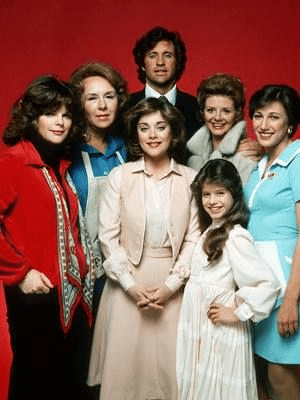
The cast was quite talented: Donna Pescow played Angie, Robert Hays was her boyfriend-later-husband, the amazing Doris Roberts was her mother Theresa before Raymond came along, and Debralee Scott played her sister Marie.
Bradley Benson is a young pediatrician who comes from a wealthy family comprised of his stuffy father Randall (John Randolph), his overbearing sister Joyce (Sharon Spelman), and her daughter Hillary (Tammy Lauren). The show is set in Philadelphia.
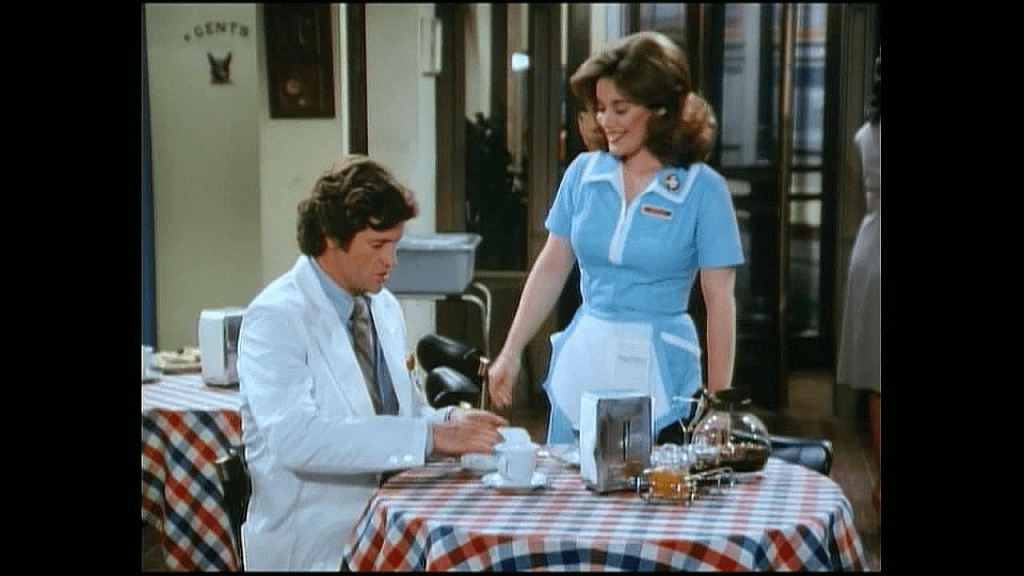
Angie is a coffee-shop waitress who falls in love with Brad. Many scenes are set in the diner with Angie’s friend and co-waitress Didi (Diane Robin). When their families argue about wedding plans, Brad and Angie elope. Later Angie’s mother plans a small family wedding for the two families to get to know each other, and Brad buys the coffee shop for Angie.
At the beginning of the second season, Angie sells the coffee shop to buy a salon with her mother.
📷imdb.com
The theme song was “Different Worlds,” written by Norman Gimbel and Charles Fox. Gimbel is still hard at work and has amassed 494 credits so far while Fox has 131 credits for many impressive television series and big-screen films. Maureen McGovern sang it; she’s best known for her top-forty hit “The Morning After.”
The show was sandwiched between Happy Days and Three’s Company on Tuesday nights, which ensured great ratings. This one was fifth its first week. The show just could not find its fan base. By the end of the season, the Nielsen ratings had fallen drastically, and the show had moved to Monday nights following Monday Night Football. Angie wasn’t the only show to struggle in this time slot. Once it was moved, three other shows—One in a Million, Goodtime Girls, and Laverne and Shirley—all tried this scheduling spot. I’m not sure if the shows were just not very good in 1979, if people were too busy to watch television, or the network heads were inexperienced, but when you look at the schedule from 1979 most prime times had a different show in the slot every season of the year. When it’s not only one show on a network moving, but many shows on a network moving and then all networks having a bunch of shows moving, how are viewers supposed to figure out where anything was? Out of the 54 new shows debuting in 1979, by the next season every network basically had one hit show out of the bunch: ABC-Hart to Hart, CBS-Trapper John MD, and NBC-The Facts of Life. While these are all decent shows, none of them were classics in my opinion. In 1980 another 30 shows were brand new.
📷rewatchclassictv.com
The show was put on hiatus. It did return in April on Saturday nights, but it was officially canceled in May.
When you look at this show on paper, it had all the right elements. First of all, we have Garry Marshall and Dale McRaven, very successful creators and writers. The cast was amazing. Even the theme song was composed and sung by extremely talented people. Then you have the fact that there were not a lot of great shows debuting this year; a decent show should have crushed it. So, what happened here?
I think I’m putting the blame for this one on the network. I watched the pilot and while pilots are meant to pull you back for the next one, most pilots aren’t the best of the series. Some of the pilots for shows I love are almost dreadful. This pilot was not dreadful. The characters were likable, the writing was funny, and the theme was not overdone over the years. It was similar to The Mothers-In-Law from a decade earlier but more of a Dharma and Greg (which came two decades later) where they fall in love despite their economic differences.
📷youtube.com
This series was better than a lot of shows that are currently on the air. I did watch another later episode where the couple elopes. Once again, the writing was good and the characters were a bit eccentric, but the writers knew how far to go to keep them likable and charming rather than odd. If ABC had kept it in a time slot for more than a month or two and given it a bit of time, it might have been a big hit.
If you want to check it out, let me know what you think. For a late seventies/early eighties show, it’s aged very well.
This month it’s all about one-named sitcoms and today it’s all about Arnie. Arnie is a series that isn’t talked about much anymore. It debuted in 1970 on CBS and was on the air for two years.
📷imdb.com
David Swift created this series. Swift was a successful director, producer, and writer. He created and wrote for Mister Peepers, The Interns, and Camp Runamuck before Arnie. He also wrote the screenplay for both the 1961 and 1998 version of The Parent Trap. Swift accumulated 51 credits for writing, 23 for directing including The Parent Trap from 1961, and 5 for producing.
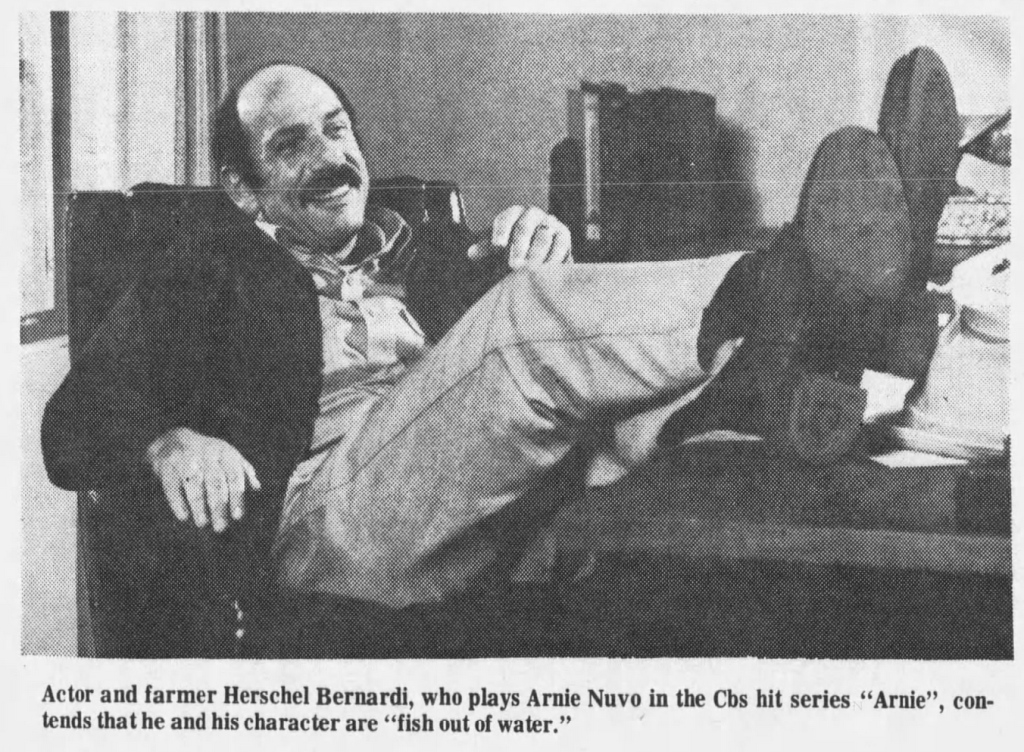
Arnie Nuvo (Herschel Bernardi) is a blue-collar employee at Continental Flange Co. who was promoted to an executive position out of the blue. Arnie tries has a difficult time related to his very wealthy boss and he still has a lot of friends outside of management. He still has a union card so he can mediate difficult labor situations and is respected by the workers.
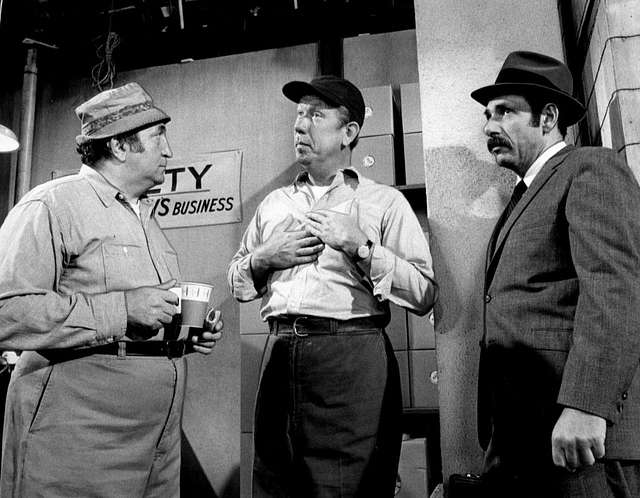
Sue Ane Langdon played his wife Lilian, Del Russel was his son Richard, and Stephanie Steele was his daughter Andre. Rounding out the cast was Elaine Shore, his secretary Felicia; Tom Pedi, his friend Julius, who still works on the dock; and Roger Bowen, his boss Hamilton Majors Jr.
📷pinterest.com
The show was scheduled before The Mary Tyler Moore show on Saturday nights. Surprisingly, it received an Emmy nomination for best comedy series, but it didn’t receive very high ratings. Getting an Emmy nomination was impressive for this year. Its competition was Love American Style, The Mary Tyler Moore Show, The Odd Couple, and the winner, All in the Family.
Like it typically did, the network (and I’m not picking on CBS, they all did it), decided immediately to turn things topsy turvy instead of giving it some time. Arnie’s neighbor played by Dick Van Patten was let go and Charles Nelson Reilly, a tv chef named The Giddyap Gourmet, moved next door.
The series was moved to Monday night following My Three Sons which was moved from Saturday nights to Tuesday nights as well. That probably didn’t help the ratings because this was the last season of My Three Sons. As much as I love that show, it should have stopped a year earlier than it did. To make it more confusing half-way through the second season, Arnie moved back to Saturday and My Three Sons ended up on the schedule Thursday nights. Both shows were canceled by spring.
📷tralfaz.com
In addition to all the moving around, when it returned for its second season it was up against Monday Night Football, so I’m guessing that spot didn’t help attract people after it moved. Saturday nights its competition was weak; it was primarily up against the movie of the week, The Pearl Bailey Show, and Cade’s County.
The Television Academy interviews included both Eddie Foy and Dick Van Patten discussing this show.
Foy talked about the casting and said Bowen was the best cast member. He said it was a bit of a bland show, not a break-through series, but he thought Herschel was a big star at the time after starring in Zorba. Foy said it was a great show to work on and everyone in the cast had fun.
📷en.wikipedia.com
Dick Van Patten also talked about his time on the show. He said he had come to California for a play and while he was performing, Shirley Booth approached him and said she wanted him to talk to someone about joining the cast of Arnie as the neighbor. Van Patten said he didn’t remember much about the show which supports Foy’s view of it being a bit bland.
It sounds like the network was trying to take advantage of Bernardi’s fame at the time and maybe didn’t take as much care as it should in designing the perfect show for him.
This month our blog series is “Life is Just a Game,” and we are looking back at some of the game shows that debuted in the fifties and sixties. Today we are taking a peek back at Password. A funny moment occurred that first year when one of the celebrities was Jack Benny. The word he had to describe was “miser,” and he said, “Me” which got a lot of laughs.
📷boomerjourney.com
The Goodson Todman partnership created many game shows over the years. One of their first was Password. It debuted in 1961 on CBS at 2pm ET. Allen Ludden, a former G.E. College Bowl host was chosen as the emcee. Ludden is also known as the husband of Betty White whom he met on the game show.
Ludden was born in Mineral Point, Wisconsin. After his father passed away from Spanish flu, his mother later remarried, and the family ended up in Texas. Ludden graduated from the University of Texas with honors in 1940, later returning for his Masters in English. He served in the US Army in charge of the Pacific theater entertainment district. In 1948, he became the program director for New York radio station WCBS and in 1959 was program coordinator for all CBS owned-and-operated stations. Ludden began hosting shows for teens and then College Bowl. His opening catch phrase while hosting Password became “Hi Doll” which he said was meant for his mother-in-law Tess White.
📷instagram.com Carol Burnett and Elizabeth Montgomery
The rules of the game were that teams were formed with one contestant and one celebrity. The word was given to one player on the team and the other player had to guess what the word was based on one-word clues. If the player failed to guess the word within the five-second time period, play passed to the opposing team. This continued until the word was guessed. The quicker the word was guessed, the more points a team received.
The first team to reach 25 points won $100 for the contestant. That partnership got to play the Lightning Round where the celebrity gave the clues, and the contestant got five passwords within a minute. They received $50 for each right answer.
On July 11, of 1966 Secretary of Defense Robert McNamara updated the country on the progress of the Vietnam War one afternoon. CBS went with the coverage of the live news while NBC aired its soap opera Days of Our Lives and ABC aired its new show which began the same day, The Newlywed Game. Quite a few people turned off CBS that day and during the next few months, Password continued to lose viewers to these two shows. The next spring, Password was cancelled.
After the show was canceled, reruns were sold to CBS which it placed in syndication in the late 1960s. It became so popular that the show began to be filmed again in Hollywood. In 1971, it was placed on the network schedule when Dark Shadows ended. It held its own until 1973 when The Young and the Restless took a huge share of the market, and both Password and Jeopardy saw deep declines in ratings. In 1973 Password won the first Daytime Emmy Award for Outstanding Game Show.
In 1974 the show became Password All-Stars; in 1978 it became Password Plus; and in 1984 it became Super Password. CBS revived the show in 2008 as Million DollarPassword, but it ended by 2010. Jimmy Fallon produced a new version beginning in 2022 with Keke Palmer as host.
📷people.com
Sadly, the episodes from the first version no longer exist. There were rumors that the videotapes were recycled and used for Family Feud.
The Milton Bradley Company introduced a home version of the game in 1962, releasing 24 editions from then until 1986 which they also did with Concentration.
I always enjoyed watching this game. One of my favorite portrayals of the show was when Oscar Madison and Felix Unger go on Password during an episode of The OddCouple. Since you can’t watch the original shows, check out the Odd Couple episode (season 3, episode 11) for some fun.
This month our blog series is titled “All About The Bill Dana Show.” The first week in March we learned about the show and now we have been spending time with some of the cast. We end our series with Don Adams.
Adams was born Donald James Yarmy in Manhattan in 1923. Don was a blend of cultures, Hungarian Jewish on his dad’s side and Irish-American on his mom’s. Don was raised Catholic while his brother Dick was raised Jewish. I could not find out what their sister decided to do. She later became a writer under the name Gloria Burton and wrote a script for Get Smart. His brother was also an actor. Dick has about 50 acting credits and appeared in many of the most popular sitcoms during the sixties and seventies, including three appearances on Get Smart.
Adams dropped out of high school and went to work as a theater usher. In 1941 he joined the US Marine Corp. At one point he was injured during a Japanese assault on Tulagi. He was the only survivor from his platoon. While recovering, he came down with blackwater fever, a side effect from malaria and was evacuated to New Zealand. He was not expected to recover, but when he did, he was sent back to the US as a Marine drill instructor.
After his discharge, he moved to Florida to work as a comedian. He refused to do material he considered “blue” and was fired.
In 1947 he married Adelaide Efantis, and her stage name was Adelaide Adams. Don decided to take the name Adams as well for his stage name. He worked as a commercial artist and cashier to support their family.
In 1954, Don was the winner of Arthur Godfrey’s Talent Scouts with a comedy act written by Bill Dana. He began making appearances on The Steve Allen Show, where Dana was a writer. In 1961 he became a regular on the Perry Como Show.
About this time, Don and Adelaide divorced, and Adams married Dorothy Bracken, another actress. They split up in 1977 when he married Judy Luciano, also an actress but that marriage also ended in divorce. (I could only find one credit for his last two wives; Bracken was on Get Smart, while Luciano appeared on The Love Boat.)
While discussing his marriages, Don said “I’m no longer independently wealthy. I guess it’s the result of too many wives, too many kids and too much alimony. I’ve been paying alimony since I was 14 and child support since 15. That’s a joke, but not by much. . . I like getting married, but I don’t like being married.”
In 1963 Adams was offered the role of Byron Glick, hotel detective on The Bill Dana Show. As we’ve discussed this month, the show was on the air for a season and a half. While working on the show, Don was also the voice of cartoon Tennessee Tuxedo which he continued doing until 1973.
During those years he also made an appearance on The Danny Thomas Show and on Pat Paulsen’s Comedy Hour.
In 1965 he was offered the role of Maxwell Smart in a new spy satire, Get Smart.
The sixties saw westerns being overtaken by spy shows such as The Man From U.N.C.L.E., I Spy, The Pink Panther, and The Avengers. Mel Brooks and Buck Henry decided to try their hand at writing a campy sitcom and Get Smart was born.
The role of Smart was created for Tom Poston, but ABC turned it down, and NBC said yes. They had Adams under contract, so he got the part. Rounding out the cast was Edward Platt as the Chief and Barbara Feldon as Agent 99.
Smart and 99 had great chemistry and married in a later season. Feldon and Adams remained life-long friends.
One of the most memorable parts of the show was all the catch phrases Adams created on the show including “Sorry about that Chief,” “Would you believe,” and “Missed it by that much.”
In addition to acting, Adams worked as a producer and director on the show. He was nominated for an Emmy from 1966-1969. He won three of those, losing to William Windom for the little-remembered one-season show, My World and Welcome to It. Lloyd Haynes from Room 222 and Bill Cosby for The Bill Cosby Show were also nominated that year.
The show moved to CBS for the final season, but the ratings never recovered, and the show was canceled after that year.
Like so many of our successful actors with unusual characters, Adams suffered from typecasting after the show ended. He did become part of two additional sitcom casts during his career.
In 1971 he was on The Partners. According to imdb.com, the plot is that “Lennie Crooke and George Robinson are inept detectives teamed up to solve crimes. Captain Andrews is their exasperated boss, Sgt. Higgenbottom is a smarmy co-worker, and Freddy confesses to most of the neighborhood crimes.” Adams played Crooke, but the show only produced 20 episodes.
In 1985, Adams tried a sitcom again on Check it Out. This one was about a grocery store and its employees. Adams played Howard Bannister. The show lasted three seasons, ending in 1988. The show was not very popular in the US but was a hit in Canada.
In between those two shows, Adams appeared in a handful of series including Fantasy Island, The Fall Guy, The Love Boat, Empty Nest, and Nick Freno: Licensed Teacher. He made most of his salary appearing in nightclubs. He also had his Smart character resurrected in several big screen films and television series.
Because of the typecasting, he returned to animation and found a lot of success, especially with Inspector Gadget which he voiced from 1983-1999.
He also tried his hand at a game show. Called Don Adams’ Screen Test, it had an interesting concept. The show was filmed in two 15-minute parts; Adams would randomly select an audience member to recreate a scene from a Hollywood movie such as From Here to Eternity with Adams as director. It ended after 26 episodes.
In his spare time, it sounds like he visited the racetracks, betting on horses. He also spent a night a week at the Playboy Mansion playing cards with Caan and Rickles. He loved history and studied Abraham Lincoln and Adolf Hitler in depth. He also wrote poetry and painted.
Don passed away in 2005 from a lung infection and lymphoma. The eulogists at his funeral included James Caan, Bill Dana, Barbara Feldon, and Don Rickles.
It’s hard to know what to make of Adams’ career. Obviously, he was hard working, an excellent Marine, and a man of many interests. He was fired for not performing blue material but then put horse racing and gambling above the needs of his family, according to several of his friends. He created the amazing role of Maxwell Smart, one of the best characters in television history, but that feat kept him from achieving other great roles in the following decades due to typecasting. It sounds like Check It Out was very popular in Canada, so maybe if he had been given a few chances to create characters different from Smart in a couple other sitcoms, it would have helped.
I feel bad for those actors who are so successful in the characters they help create that they are barred from future jobs, but then again, those characters are some of the best actors in television: George Reeves as Superman, Ray Walston as My Favorite Martian, Henry Winkler from HappyDays, Frank Cady from Green Acres, and Jack Klugman from The Odd Couple. I guess you trade being warmly remembered for fewer quality roles.
Apart from Get Smart, I knew little about Adams before writing this blog, so it was fun to get to know him a bit.
This month it’s all about The Bill Dana Show. After learning more about the show, we are taking a look at some of the cast members who were part of the series. Today we meet Maggie Peterson.
📷tvinsider.com
Maggie Peterson was born in Greeley, Colorado in 1941. Her father was a doctor, and her mom was a stay-at-home mom. She grew up in a musical family and always claimed some of her earliest memories included music. Peterson joined her brother Jim and two friends in the Ja-Da Quartet, and they would ride around in the back of a pickup truck singing.
When Dick Linke heard Peterson singing at a Capital Records convention in 1954, he encouraged her to come to New York after graduating, so in 1958 she did, and she brought the quartet with her. They were on the Perry Como and Pat Boone shows. In 1959 they released their only album, “It’s the Most Happy Sound.” Not longer after it came out, the band broke up.
For several years after that, Peterson joined The Ernie Mariani Trio (later known as Margaret Ann and Ernie Mariani Trio). They played in Las Vega, Lake Tahoe, and Reno. Bob Sweeny and Aaron Ruben, the director and producer for The Andy Griffith Show, spotted here there.
📷tagsrwc.com Charlene Darling
Originally, Peterson was brought in to read for the role of Ellie Walker, a love interest for Andy, but Elinor Donahue received that role. Then Maggie was offered the role of Charlene Darling.
Like her birth family, The Darlings were a musical group; however, Roscoe Darling and Maggie’s father were nothing alike. Because she had recurring roles on Andy Griffith, she also was cast on The Bill Dana Show and Gomer Pyle USMC during the same years.
Maggie kept busy in 1969, appearing in an episode of The Queen and I and in three big-screen movies. In 1970, she showed up on Love American Style, Green Acres, and Mayberry RFD. The seventies found her on an episode of Karen and The Odd Couple. During the eighties, she only did a few made-for-tv movies, including Return to Mayberry. Her last acting credit was in The Magical World of Disney in 1987.
In 1968, Peterson opened for Griffith at Lake Tahoe. While there, she met jazz musician Ronald Bernard Mancuso (Gus), and he and Maggie married ten years later. Gus was a well-known musician. He won Playboy Jazz Poll New Artist of the Year in the late fifties. He toured the world with Sarah Vaughn and Billie Eckstine. He also backed a lot of performers in Las Vegas.
📷facebook
The couple lived in Los Angeles for a bit before moving to Las Vegas where Maggie became a film and television location scout. At that time, Gus was working with Quincy Jones. Eventually the couple landed back in Las Vegas and Gus taught at the University of Nevada there.
Gus passed away from Alzheimers in 2021, and Maggie died in her sleep a year after her husband.
I wonder why Maggie switched from acting to location scout. I could not find that out. It seems like music was her real love and she got into acting to help pay bills. I’m glad music came back as a big part of her life with Gus. She seemed to have a fun career. It was interesting to learn a bit more about her since I only knew her as Charlene Darling before this blog.
As we wind up our What in the World? blog series this month, we end with Bracken’s World. Just like the other shows we covered, this one began in the sixties, 1969, and just like the others, it was on for less than two seasons.
Dorothy Kingsley created the series for NBC. This was her only foray into television; she was a screenplay writer for most of her career. Kingsley wanted to concentrate on the “little people” who work at the studio, rather than the executives. In one blog I read that props from Twentieth Century Fox where the show was filmed were often carted around in the background for authenticity. It would be fun to go back and make a list of the props that were shown around the set; specifically mentioned were props from Planet of the Apes and Land of the Giants.
Watch.plex.tv.com captures the essence of the show in its description “In the glitzy realm of Century Studios, powerful executive John Bracken shapes Hollywood’s fate, navigating ambition, romance, and betrayal through the eyes of his astute secretary Sylvia, who holds the key to both secrets and success.”
Century Studios was a movie studio. John Bracken owned the company, and he was never seen during the first season. Similarly to the way Charlie interacted with Charlie’s Angels, we only heard Bracken on the telephone, voiced by Warren Stevens. Sylvia Caldwell (Eleanor Parker) was his secretary. There were some impressive cast members in this show including stunt man Dennis Cole, Jeanne Cooper, Madlyn Rhue, Linda Harrison, Elizabeth Allen, Karen Jensen, and Laraine Stephens. Most of them played starlets waiting for their big break. Peter Haskell as producer Kevin Grant seemed to be responsible for a lot of the success of the show. Tom Selleck had a recurring role of Roger Haines during the first season. The characters dealt with the problems of the movie industry—drugs, sex, alcohol, and amoral executives.
Being a Hollywood studio, there were also a lot of great guest stars including Anne Baxter, Shelley Fabares, Sally Field, Lee Grant, Carolyn Jones, Ricardo Montalban, Edward G. Robinson, Martin Sheen, Richard Thomas, Forrest Tucker and Raquel Welch.
The series was on Friday nights in the hole filled when Star Trek was canceled. It was referred to as the “Friday night death slot.” The show’s competition was Love American Style and CBS Friday Night at the Movies, which started an hour before Bracken’s World did. I’m not sure when this death slot switched because at that same time, I recall loving Friday nights in the early seventies featuring The Brady Bunch, The Partridge Family, Room 222, The Odd Couple, and Love American Style.
The show’s ratings were not good, so for the second season, things were changed a bit. Parker left part way through season one because she didn’t like the scripts. We now got to see John Bracken in person, but he sounded like Leslie Nielsen who played him instead of John Warren. Dennis Cole was also shown out the door.
Jeanne Cooper had a very different view of the show than Parker. Cooper played one of the starlet’s mom who was also her agent. She said that it allowed viewers to go behind the scenes of a movie studio to get a realistic depiction of what happened when the cameras were off. She said that the cast can take much more time filming movies to discuss the script, but that is not the way television works, and Parker never understood the difference between the two mediums. Cooper felt the writing was much more sophisticated than shows had produced before and that it led the way for shows like LA Law and Boston Legal.
According to Cooper, there were two reasons for the demise of the show. One was that she said Bracken should never have been exposed. He should have stayed a voice who ran a studio like a Louis B. Mayer type. She also said the show was very expensive to produce. Often shows were ordered six at a time back then which gave the crew some wiggle room to have a few expensive shows and then cut back when it got viewers locked in to average out the cost. NBC would only buy two or three at a time. Finally, Stan Rubin, the executive producer, said NBC had to agree to a minimum of four-episode commitments at a time and they refused, so the show was canceled.
The show did seem to be a bit ahead of its time. Perhaps if it had debuted a few years later, it would have found more viewers.
This month we are right in the middle of one of my favorite blog series, What a Character. This week we are delving into the career of Noam Pitlik; in addition to his acting, he won an Emmy for his work as a director. Which show? Let’s find out.
Pitlik was born in Philadelphia in 1932. After graduating from high school, he enrolled at Gratz College and later was a theater major at Temple University in 1954. Pitlik had a two-year stunt in the Army and earned a master’s degree in theater at New York University.
He began his acting career on WCAU in a western. In 1951, he was hired for the set design and construction crew for the Philadelphia Experimental Theater. He carried a bit of his hometown with him when he was part of the Summer Theater Guild in Indiana, Pennsylvania in the “Philadelphia Story.” He was hired for his Broadway debut in an off-Broadway production of The Threepenny Opera.”
📷imdb.com
In 1961 he moved to Los Angeles and received his first television roles, appearing on Cain’s Hundred and Dr. Kildare. Cain’s Hundred was not a show I remembered hearing much about. It was about a former underworld lawyer who works with the federal government to bring the top 100 criminals to justice. The show lasted one season. Pitlik had a variety of offers for shows throughout the sixties. Most of them were dramas and westerns, but we also see him on My Favorite Martian, The Munsters, Gidget, The FlyingNun, The Monkees, The Andy Griffith Show, The Doris Day Show, Get Smart, That Girl, and I Dream of Jeannie.
During the sixties, he married for the first time. His marriage with Jesse Blostein in 1967 would only last three years.
Pitlik also appeared in fourteen films and eight made-for-tv movies. The most memorable films are The Graduate, Fitzwilly, and The Fortune Cookie.
📷famousfix.com
The seventies were his most prolific decade of acting. He appeared in 26 different series, often in 2-5 different episodes. You’ll see Pitlik in reruns in a variety of genres including Hogan’s Heroes, Room 222, Bewitched, LoveAmerican Style, All in the Family, The FBI, Cannon, Mannix, The PartridgeFamily, The Bob Newhart Show, The Odd Couple, and Barney Miller. His last acting appearance was in Becker in 1998.
The seventies were also when he tried the role of husband again, marrying Linda Hirsch in 1974; this marriage also lasted three years.
He began directing in the seventies and obtained 39 directing credits throughout the next two decades.
📷imdb.com
In an interview with Temple University for the Alumni Review in 1979, Pitlik said that the switch in his career was not “a case of my needing to change functions for economic reasons. I used to figure out what I made a day as an actor, and it was obscene. I changed for emotional reasons. I had become very frustrated by the kinds of things I was doing in acting, and I was looking for a change in my life that would be more challenging. I enjoyed acting, but I never seemed to get enough to do.” His first episode as director was on The New Dick Van Dyke Show. He directed 12 episodes for The Practice and 11 for Taxi.
However, Barney Miller was where he perfected his skill as director for 102 of its 171 episodes. In 1979, he won an Emmy as Director for the show. He beat out Paul Bogart for All in the Family, Alan Alda and Charles Dubin for M*A*S*H, and Jay Sandrich for Soap. He also received a Peabody Award and a Directors Guild of America Award for his work on Barney Miller. He lost the Emmy in 1981 to James Burrows for Taxi. His co-nominees included Jerry Paris for Happy Days, Linda Day for Archie Bunker’s Place, Burt Metcalfe and Alan Alda for M*A*S*H, and Rod Daniel for WKRP in Cincinnati.
📷tumblr.com Cast of Barney Miller
In the Temple interview, Pitlik said that his “main responsibility is to create an atmosphere in which each of the people involved in the production can conform to their best work. Although a director oversees all aspects of the production, there are many people involved, and he’s dependent on all of them. There’s no more collaborative business than the television business. Each person contributes to the success or failure of a show whether he or she is a writer, actor, cameraman, or whatever.”
In 1995 he began directing episodes of The Home Court and did so for 14 of the 20 episodes. I must admit I do not remember this show at all. The synopsis was Sydney Solomon was a family court judge who had to deal with the toughest prosecuting attorneys and repeat offenders. However, her biggest challenges came when dealing with her kids, four boys aged 11-19.
📷pinterest.com
Pitlik had better luck with his third marriage to Susan Whittaker which lasted from 1986 until his death in 1999. Whittaker was a television producer. Noam passed away from lung cancer at age 66.
Like Jerry Paris, Pitlik had a very successful acting career before finding his passion behind the camera. If you are responsible for directing a series, Barney Miller is a great accomplishment. It was fun to learn more about his career both in front of and behind the camera.
This month our blog series is Supportive Men. These actors were not the stars of the series, but they contributed a lot of fun to the show. First up is David White who we know best as Larry Tate from Bewitched.
White was born near Denver, Colorado, in 1916. His family moved around a bit. He lived in Pennsylvania and Missouri and graduated from Los Angeles City College. He worked at the Pasadena Playhouse before enlisting in the Marine Corps during WWII. After his four years in the military, he began acting again with the Cleveland Play House.
📷pinterest.com On The Phil Silvers Show
In 1949, White found himself living in New York where he made his Broadway debut in “Leaf and Bough.” The theater critics were not kind in their reviews, and the show closed after three performances. The following year, he tried the stage again in “The Birdcage” with Maureen Stapleton. He was then given a role in “The Anniversary Waltz,” co-starring Macdonald Carey and Kitty Carlisle which ran for 611 nights. He paid his dues, working in a variety of jobs while trying to establish his acting career. His resume included a farm laborer, a truck driver, a doorman at the Roxy Theater, and working at the J.H. Taylor Management Co.
In the 1950s, David began his long television career. His first appearance was in The Philco Playhouse production of “Rich Boy” with Grace Kelly. While most of his roles were in dramatic shows and westerns, he did a few comedies including Father Knows Best, My Favorite Martian, The Farmer’s Daughter, and My Three Sons. Most of his roles were as corrupt businessmen or arrogant politicians.
📷dvdizzy.com In The Apartment
In 1952, David married actress Mary Welch. Welch appeared in several successful plays on Broadway. She was a member of Lee Strasberg’s Actor’s Studio before opening her own school called The Welch Workshop. White and Welch worked together in only one production, at a regional theater, in “Tea and Sympathy.” In 1958 she died of complications from their second pregnancy. They had a son Jonathan and sadly, he died in 1988 in the bombing of the Pan Am Flight 103 over Lockerbie, Scotland. (This was a tragic incident when Libyan terrorists planted a bomb on a plane flying from London to New York. It exploded 35 minutes into the trip and killed all 259 people on board and 11 people in the neighborhood where it landed.)
After his wife died, White and his son moved to Hollywood where White launched a big-screen career. His film debut was in 1957 with Tony Curtis, Barbara Nichols and Burt Lancaster in The Sweet Smell of Success. He only had 16 movies in his credits, but they included The Apartment, Sunrise at Campbello, and Brewster’s Millons.
📷closerweekly.com On Bewitched
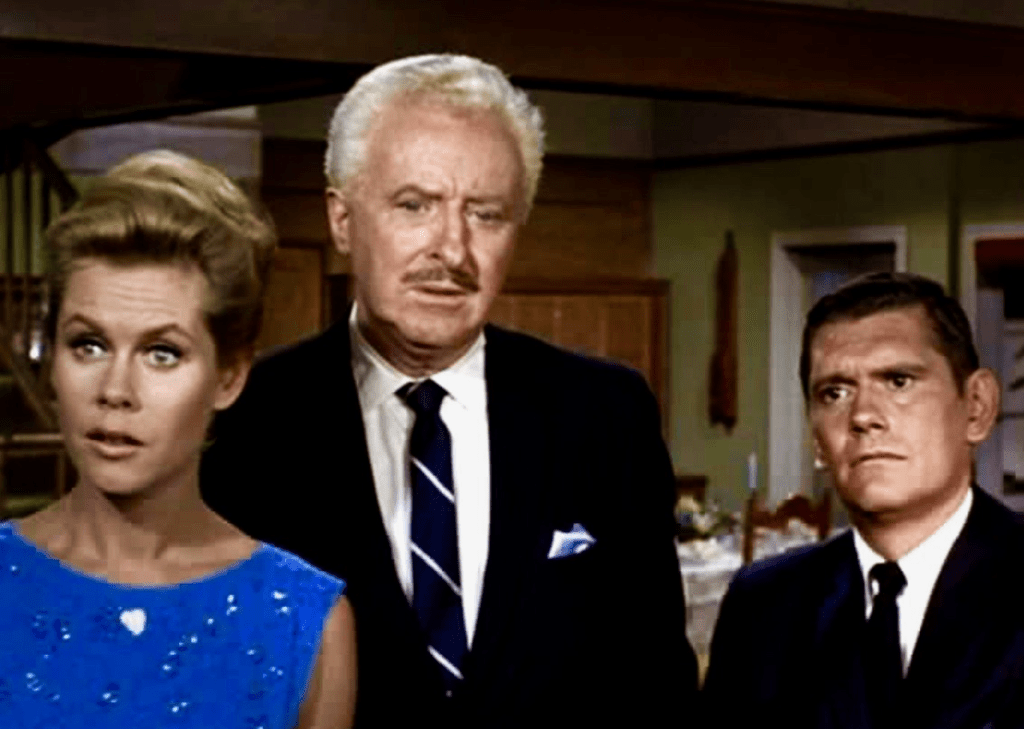
From 1964-1972, he perfected the comedic role of Larry Tate on Bewitched. As president of McMann & Tate, he was constantly firing Darrin for one reason or another, usually related to some circumstance caused by Samantha’s family. White also directed one episode of the series, “Sam’s Double Mother Trouble.”
During an interview with Herbie J. Pilato (author of Bewitched Forever), White said he “got the part because I was an honest man, and that’s how Larry and I were different. I’m not two-faced, and he was. I had more integrity than Larry ever had. I was smarter and had a deeper sense of values. I had to diminish who I was to play Larry, whom I viewed as a very insecure person who only had a certain brilliance in certain areas. He was smart enough to hire people who possessed the skills he did not—like Darrin. I wasn’t born to play Larry. I had to create him. He was a make-believe character of his own truth slated in a comedy series. When playing humor and farce you take that truth and stretch it as far as it will go. But not any farther. When I was playing Larry, though he was a funny character, I never tried to be funny. To me, acting has to do with fulfilling the needs of the character you’re playing, not the actor who’s playing him. Although the one thing the actor and the character have in common is that both have needs. A real heavy is a man who doesn’t have any moral structure whatsoever; one who ends up cheating or even killing someone. Larry was selfish, but he was never that extreme. If anything, he was still a little kid who never matured.”
📷x.com Bewitched
In that same interview, White said his favorite Bewitched episodes were “Moment of Truth” (Season 3, Episode 2 when Samantha has to tell Darrin Tabitha is also a witch and they try to keep the secret from the Tates), “Bewitched, Bothered and Infuriated” (Season 3, Episode 31 when Clara tells them about a future newspaper article that says Larry broke his leg on their trip, so Darrin and Samantha try to protect him while causing a lot of annoyance to Larry and Louise), and “Toys in Babeland” (Season 4, Episode 2 when Endora brings one of Tabitha’s toys to babysit her while she runs a quick errand which leads Tabitha to bring a lot of toys to life).
After the show ended, White continued both his television and film careers. He also continued in the theater, primarily with Theatre West and the Mark Taper Forum in Los Angeles.
📷imdb.com My Three Sons
During the seventies and eighties, he showed up in a variety of popular shows including Adam-12, Cagney and Lacey,Cannon, Columbo, Dallas, Dynasty, Love American Style, Mission Impossible, Qunicy M.E., Room 222,The Odd Couple, The LoveBoat, The Mary Tyler Moore Show, and The Rockford Files.
After his son’s death, White became a bit of a recluse. He had just begun working again when he passed away from a heart attack in 1990 at the age of 74. Certainly, David White had a successful career, amidst his personal heartbreaks, appearing on the stage, in films, and on television. It would have been wonderful if he had another chance to be part of the cast of another hit show, maybe a dramatic role. However, if you only costar in one show, the role of Larry Tate and the memories we have of him on Bewitched is a great one to have.
This month is our blog series is “Potpourri Month” and we have a sub-theme every day; today’s is Propourri” for the pro who handles props. When you think of your favorite shows, there are props included in those great memories: the couch at Central Perk, Fonzie’s leather jacket, or the cereal boxes on Seinfeld’s refrigerator. First let’s learn a little about the Props Master and then we’ll take a look at some of our most-loved props.
The Fonz’s jacket Photo: ebay.com
The Prop Master heads up the Props Department. They are charged with acquiring, organizing, and safely handling the props for the shows.
Each episode has a list of props that will be needed for the show. The props master reviews the scripts and has meetings with various department heads to ensure everything that is needed is on the list.
Sometimes the props master does research to see what would be appropriate for a specific era or place. Cars were quite different in the fifties than the eighties. A grocery store does not look the same in China as it does in Atlanta.
During filming, the props master has to keep track of props and make sure everything is put back in its place.
So, what are some of the props that have become synonymous with our favorite series? Let’s put together a prop list that includes props from our favorite shows.
Living rooms have a lot of cool furniture. When you think of comfortable places to sit, you have to think of Modern Family’s couch, Archie’s chair from All in the Family, Chandler and Joey’s Barcaloungers from Friends, and Martin Crane’s duct-taped, worn chair on Frasier.
The Bunkers’ Chairs Photo: comparativemediastudies.com
Many of the Modern Family characters are interviewed on their couch which sits in front of their stairs to the second floor right as you enter the front door. The walls are Benjamin Moore’s Labrador Blue. The couch itself is from Sofu-U-Love and the primary-colored striped pillows are from Pottery Barn just in case you want an interview sofa of your own.
Archie Bunker’s chair is from the 1940s. It’s covered in an orange and yellow woven fabric. The props master purchased the chair from a thrift store in Southern California. Whenever anyone but Archie sits in the chair, it is made obvious to them that they need to find another seat.
The barcaloungers Joey and Chandler use were originally made in Buffalo New York, named after the company that made them. They have moving parts to allow for footrests and reclining. Joey’s Barcalounger is brown leather and he calls it “Rosita.”
Martin Crane’s chair is in the same color family as Archie Bunker’s. The prop department made it, so it’s a one-of-a-kind piece. It’s striped and quite unattractive looking especially with Frasier’s expensive tastes echoing in the rest of the room, but Martin loves it and Frasier loves Martin so it stays. In the first episode, a guy carries in the chair when Martin and his dog Eddie move in with Frasier. On the last episode, the same guy carries the chair out when Martin gets married and moves out. The chair is really almost a character during the run of the series.
Jeannie in her bottle Photo: blazenfluff.com
There are a lot of fun accessories from our favorite living rooms. Just a couple include Jeanne’s bottle from I Dream of Jeanne, the “M” that was on the wall in Mary Richard’s apartment on The Mary Tyler Moore Show, and the Chihuly sculpture from Frasier. Who can remember The Dick Van Dyke Show without thinking about the ottoman Rob Petrie might trip over?
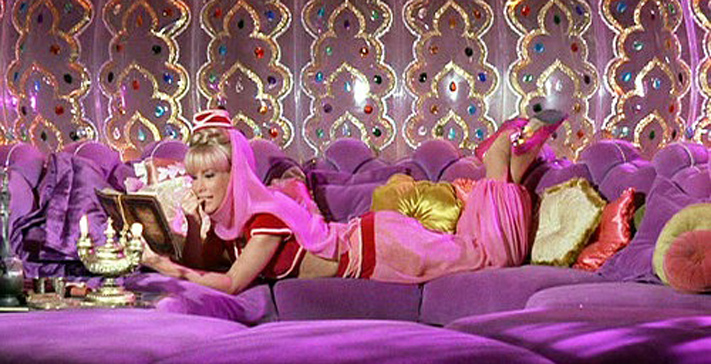
Jeannie uses her Arabian glass bottle to sleep in and to hide in when someone other than Tony and Roger is in the house. The bottle has a long, purple couch with her blankets and pillows. She also has an Arabian candle, a photo of Tony, a mirror, and her book about genies.
Mary’s “M” stood for so much more than her first name. We knew that an independent, smart woman lived in that apartment. Everyone wanted to grow up and be able to put their own initial on the wall just like the brass one Mary had. When she moved to her newer, more modern apartment, the M went with her.
Martin’s chair on Frasier Photo: jacksonville.com
In contrast to Martin’s puke-colored chair on Fraiser, Frasier had so many expensive items scattered around his home. One of them was Dale Chiuly’s Macchia. This blown-glass vase was green and brown. It was worth $30,000 at the time, and the props master locked it up after filming each episode.
We all recall the opening of The Dick Van Dyke Show. Will he or won’t he? I think most of us remember him falling over the ottoman, but do you know sometimes he walked around it? Reiner wanted a clever opening for the show and while talking with John Rich, the director, they decide Rob will fall. But then Reiner suggested a variation, so they filmed him not tripping. No one ever knew from episode to episode if he would fall or not.
Burns and Allen have their closet adjoining the living room. While Fibber McGee and Molly have a ton of items in their closet, whenever Gracie opens hers, we see a collection of hats that men have left when they are in a hurry to get out of the Burns house after dealing with Gracie’s logic.
When I think of some of my favorite kitchen items, I think about Jerry Seinfeld’s refrigerator with its revolving display of cereals. I know if I visited My Three Sons, I would get to sit around the kitchen table where all the action happens on the show. And Gracie would definitely take me into her kitchen to have some coffee from the pot she almost always kept full for her and Blanche to talk over.
Jerry always has cereal in his cupboard. Some sources say he had up to seventeen at a time. Knowing that cereal doesn’t last all that long, he ate a lot of cereal. I’m hoping Fruit Loops was one of those choices.
My Three Sons’ table Photo: pinterest.com
While as viewers we love that the kitchen was the heart of the Douglas home. From the first episode when Steve got Chip to help him with the dishes to talk to him about “love,” to the grown boys gulping down orange juice at the table to leave early for their busy day, we spent a lot of time in that room. Uncle Charlie’s bedroom was just off the area, so he could come and talk with someone getting warm milk in the middle of the night. The actors might not have had the same warm, fuzzy feelings. Barry Livingston discussed their filming schedule because Fred MacMurray did all his filming in two short groups of days. He said sometimes, “you would sit at the kitchen table all day long and they would do close-ups. You would be sitting in the same place at the same table and you would do a close-up from 12-15 different episodes. All you would do was change your shirt because they couldn’t see anything below.”
Burns and Allen Photo: pinterest.com
Gracie and Blanche always made time to have coffee to talk over things. Whether it was 7 am, 1 pm, or 7 pm, the coffee pot was always on. Burns and Allen also did coffee ads for Maxwell House, so I am assuming that it was Maxwell House the friends drank daily on Burns and Allen.
I know if I explained every item to you in detail, we would still be on this blog next week, so I’ll just some up the rest of the categories.
Bedrooms: Beds are definitely the focal point. We have the Petries’ twin beds that are not convenient for a married couple. Lisa and Oliver Douglas had a very large bed on Green Acres; unfortunately, it was open to the outside where anyone could come in or out. Oscar Madison had a bed on The Odd Couple, but no one knew it because his room was so messy. We definitely remember Bob and Emily Hartley’s bed because not only was it important in The Bob Newhart Show but it was in the finale of Newhart. It is also hard not to recall Alex Keaton’s Ronald Regan poster that took up one of his bedroom walls on Family Ties.
Batman with bust and phone Photo: batnews.com
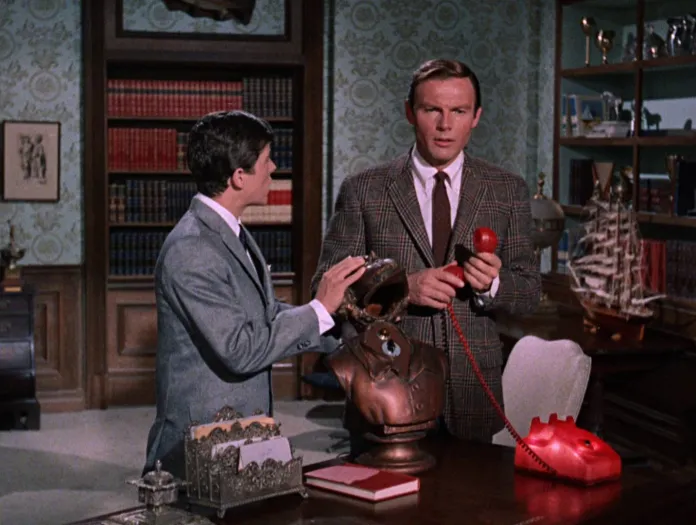
Libraries and Dens. Three specific rooms come to mind. On Batman, we had the Shakespeare bust that hid the bat phone in their library. We had George Burn’s television on Burns and Allen where he could watch was going on during the show without the other characters knowing he was listening in. Finally, we think back to The Brady Bunch where the six kids fought over what to watch on television and did their homework after school.
Garages: The Jetsons they kept their flying car in the garage, Last Man Standing where Tim kept his antique car, and The Adventures of Ozzie and Harriet, where they kept everything but the car. Ozzie was always out there looking for something.
Workplace: When characters go to work, we get a whole new scene full of fun props. Who would visit Dunder Mifflin without stopping by to see Pam at the front reception desk? Rob Petrie had a couch where the writers worked their magic. Central Perk featured the orange couch everyone remembers from Friends. The sofa was so beloved that replicas of it went on a world tour in 2019 for the shows’s 25th anniversary. The actual sofa used on the set was sold at auction in 2011 and it went for about $5000. Of course, Cheers would not have been the same without the stools for Norm and Cliff. Get Smart had so many fun props, it’s hard to choose; the Cone of Silence was certainly fun for everyone who could hear what was said inside by characters who thought they were speaking where no one could hear them. And Hogan’s Heroes also had a lot of fun items including the coffee pot that could relay anything said in Colonel Klink’s office.
Laverne Photo: pinterest.com
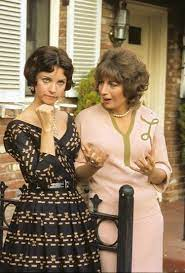
Clothing: While I love almost everything they wore on Burns and Allen, The Brady Bunch, and The Partridge Family, there are a few other pieces that really stand out. Who would not want to wear Fonzie’s leather jacket? Columbo’s coat might be a bit rumpled but it had been around to solve a lot of mysteries. Sally on McMillan and Wife had the San Francisco jersey that she wore to bed. And talk about special clothing, Laverne’s wardrobe with her iconic “L” on everything was a big part of Laverne and Shirley.
Unusual Items: Last, but definitely not least, we have those special objects that belong to specific characters. When you think about Radar on M*A*S*H, don’t you also think about his teddy bear? Barney Fife would never leave the house without his silver bullet. Half the plots would disappear if Gilligan’s Island did not have a radio for the Professor to try to repair and hear about the world outside the island. Buffy’s Mrs. Beasley on Family Affair was very popular; the doll was sold for decades after the show went off the air. Kojak’s lollipops had to be on the list. Also, if you are talking about “things,” how could we not include the “Thing” from The Addams Family?
I hope you enjoyed getting to know something about some of our favorite furniture and recalling special props from well-loved shows. If you want to see a couple of these items, visit The Smithsonian Museum in Washington D.C. where you can see Archie’s chair and Fonzie’s leather jacket. I’d love to hear your favorites.
We are up close and personal this month with some of our favorite male television stars, and Pernell Roberts is definitely on that short list. Pernell Roberts was well known to television viewers in the early sixties and the early eighties. Some fans might not even realize the two characters he was best known for, Adam Cartwright on Bonanza and Dr. John McIntyre on Trapper John, MD were played by the same man.
The Family of Bonanza Photo: toledoblade.com
Pernell Elven Roberts Jr. was born an only child in 1928. He was named for his father who was a Dr. Pepper salesman. During high school, Roberts played the horn, acted in several school and church plays, played basketball, and sang in the local USO shows. He enrolled at Georgia Tech but then enlisted in the US Marine Corps. He played both the tuba and horn in the Marine Corps Band while sometimes tackling the sousaphone and percussion parts. After his time in the Marines, he enrolled at the University of Maryland where he enjoyed participating in classical theater. He left college to continue his acting career.
In 1949, he had his professional stage debut in “The Man Who Came to Dinner” with Moss Hart and Kitty Carlisle. He then took on several roles in Philadelphia.
In 1951, Roberts married Vera Mowry; she was a professor of theatre history at Washington State University. They divorced in 1959. They had one son who was killed in a motorcycle accident in 1989.
In 1952, Roberts made the big move to New York City appearing in off-Broadway shows. Several of his costars were Joanne Woodward and Robert Culp. He performed several Shakespeare roles.
In 1956, Roberts made his television debut in Kraft Theatre. In 1957, he signed with Columbia Pictures. His first big-screen role was as Burl Ives’ son in Desire Under the Elms. His second role was with Glenn Ford and Shirley MacLaine in The Sheepman.
Roberts continued to accept television roles with ten appearances in 1958 and six in 1959.
Photo: simple.wikipedia.org
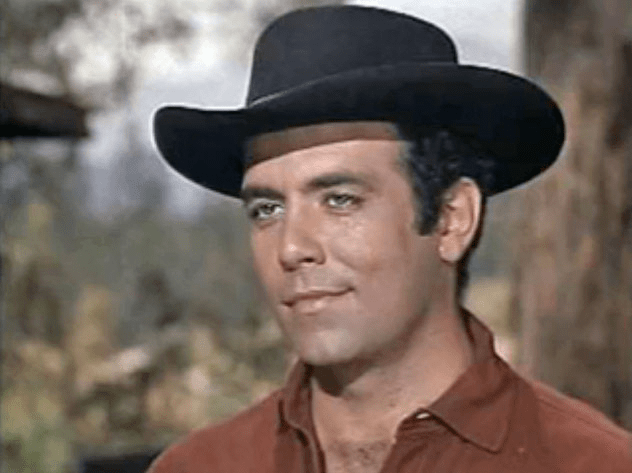
From 1959-1965 he would portray Adam Cartwright, Ben’s oldest son on Bonanza. Each of the brothers had a different mother, and Adam was the only Cartwright to attend college, studying architectural engineering. After acting in classical theater for so much of his early career, the transition to a weekly series was a difficult one for Roberts. He thought it a bit ridiculous that the independent sons had to get their father’s permission for everything they did. He wanted to act in a show with greater social relevance. So, although the show would continue until 1973, he left in 1965 after appearing in 202 episodes. The storyline was that Adam was traveling in Europe or living on the east coast. Bonanza producer David Dortort said Roberts was “rebellious, outspoken . . . and aloof, but could make any scene he was in better.”
The Odd Couple Photo: sitcomsonline.com
During this time on the show, Roberts married again in 1962; he wed Judith Roberts and they would divorce in 1971.
After leaving Bonanza, Roberts returned to theater, playing a variety of roles. He toured with many musicals including “The King and I”, “Kiss Me Kate”, “Camelot”, and “The Music Man.”
Pernell also became involved in the civil rights movement, joining Dick Gregory, Joan Baez, and Harry Belafonte in the sixties demonstrations including the March on Selma.
On Mission Impossible Photo: ebay.com
From 1972-1996, Roberts was married to Kara Knack. They also divorced.
Throughout the late sixties and seventies, Pernell continued appearing in television series and made-for-tv movies. You’ll see him in westerns such as Gunsmoke, The Big Valley, and The Virginian; spy genres including Wild Wild West, Mission Impossible, and The Girl from U.N.C.L.E.; crime shows including Hawaii Five-0, Mannix, Police Story, Ironside, Cannon, and TheRockford Files; and several medical series—Marcus Welby, West SideMedical, and Quincy. He even showed up on The Twilight Zone and The OddCouple.
Photo: televisionacademy.com
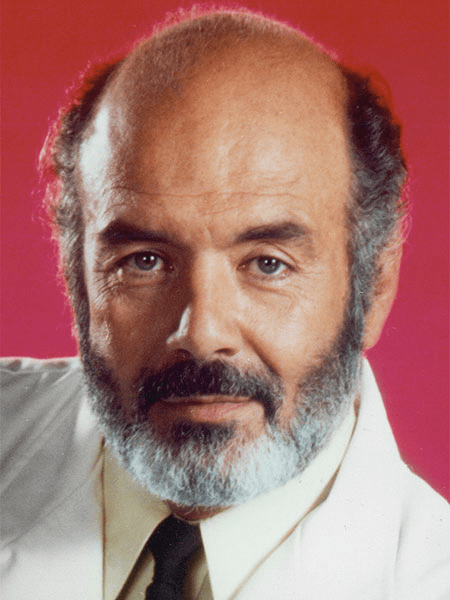
Perhaps he enjoyed those medical shows because he returned to television to star in his own series in 1979, playing Trapper John, MD. The plot was featured Trapper John from M*A*S*H later in his career at San Francisco Memorial Hospital where he was Chief of Surgery. He worked with a young surgeon who had also served in a MASH unit, Alonzo “Gonzo” Gates (Gregory Harrison). The series lasted seven seasons.
In 1979, he told TV Guide that he chose to return to a weekly show because he had “seen his father age and realized it was a vulnerable time to be without financial security.” Roberts felt the role allowed him to use his dramatic range of acting skills and to address important social issues.
In the 1990s, Roberts took on very few television appearances; his last television performance was in Diagnosis: Murder in 1997.
Roberts would attempt marriage one last time in 1999 when he wed Eleanor Criswell. When Pernell passed away in 2010 from pancreatic cancer after being diagnosed in 2007, they were still together.
Photo: Facebook.com
Pernell also enjoyed golfing, swimming, playing tennis, running, reading, cooking, and singing. He appeared on two record albums during his career. The cast of Bonanza recorded an album in 1959 and he released a folk music album in 1962, titled “Come All Ye Fair and Tender Ladies.”
He certainly had a long and varied career: music, movies, Broadway, and television. He also used his fame to help causes he believed in. I don’t think he is remembered as well as he should be. Maybe it’s because he left Bonanza too early to be included on a lot of the memorabilia that came out of that show or because there was such a gap between his two series that he starred in. Whatever the reason, I hope this blog has helped recall some of our memories of the three decades he spent entertaining us.

















 thewritelife61