This month we are taking a look at some of our favorite “Crime Solvers of the Past.” Today we wrap up the blog series with The Felony Squad which ran three seasons, debuting on ABC in 1966.
📷blu-ray.com
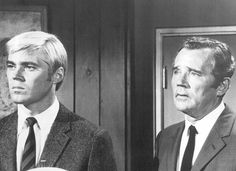
Originally titled “Men Against Evil,” the show was going to be more of a soap opera feel which was broadcast twice a week. However, by the time the show aired, most of the personal relationships had been taken out of the plot. The series focused on Sergeant Sam Stone (Howard Duff) and Rookie Detective Jim Briggs (Dennis Cole). Rounding out the cast was Desk Sergeant Dan Briggs (Ben Alexander), also known as Dad to Jim and District Attorney Adam Fisher (Len Wayland). The first seasons included Captain Frank Nye (Barney Phillips) while later seasons featured Captain Ed Franks (Robert DoQui).
The show was known for having some big names in directing, writing, and guest stars. Many of the directors racked up more than 75 credits each and included George McCowan who worked on The Mod Squad and Cannon, Allen Reisner known for Hawaii Five-0, Lee Katzin who directed Mission Impossible, Laslo Benedek known for work on Perry Mason, and Vincent McEveety who directed stars in Murder She Wrote,Heat of the Night, and Simon & Simon. Howard Duff jumped behind the camera in season two to direct “Deadly Abductors” after directing seven episodes of Camp Runamuck a couple of years earlier.
Crafting scripts for the show were writers such as Richard Murphy who was the creator of this show, Don Brinkley who worked on Trapper John and Medical Center, Jack Turley who wrote for Cannon and The Man from UNCLE, and John Kneubuhl who also wrote for the Wild Wild West.
📷pinterest.com
A handful of the guest stars included Ed Asner, Richard Dreyfuss, Robert Duvall, Roddy McDowell, Ricardo Montalban, George Takei, Vic Tayback, and Cicely Tyson.
The Felony Squad theme was composed by Pete Rugolo. Rugolo had 83 credits in the business including writing music for a wide variety of television genres including Leave It to Beaver, The Fugitive, and Family. This theme was an instrumental and very reminiscent of a sixties action movie.
I couldn’t find a lot of reviews, but the New York Times’ Jack Gould described it as “a very old-fashioned and conventional yarn about tight-lipped detectives doing a day’s work.”
The series was on Monday nights until 1968 when it was moved to Fridays. The first two seasons the show was up against The Andy Griffith Show which was in the top ten. For the final season, the show moved to the weekend where it was up against an Andy Griffith Show spinoff, Gomer Pyle USMC, which was also a top ten.
The show obviously did well to stay on the air three years when it faced such tough competition. I wonder if being a 30-minute show as opposed to an hour was part of its downfall. No matter how great the writers are, it’s tough to get sophisticated and detailed enough with a plot to wrap up in half an hour. The show certainly found talented directors, writers, cast members, and guest stars. The show was shot in color and had a different feel to it, more realistic. The action is right in your face like you’re on set instead of watching from far off. Considering it maintained decent ratings before it was moved, it would have been interesting to see what would have happened if this show had been the competition with a newer show to see how it fared. Fans loved it, so if you want to see something different, check out a few episodes. I’m not sure why this series isn’t seen more, but YouTube is your best bet to find the most available episodes. Also, as a fun aside, if you want to see Stone, check out Batman’s second season episode, “The Impractical Joker,” when Duff as Stone peers out the window while watching the Dynamic Duo climb the wall.
This month we are celebrating, “Go West Young Man” by taking a look at some of the westerns from the fifties and sixties. Up today is Wagon Train. This series debuted on NBC in 1957; in 1962 it moseyed over to ABC for its final three seasons. Lew Wasserman was involved with Universal which produced Wagon Train. When they sold the series to ABC, NBC was not happy, but Wasserman told them that he had a new show for them, The Virginian, which we’ll learn about in two weeks.
📷pinterest.com
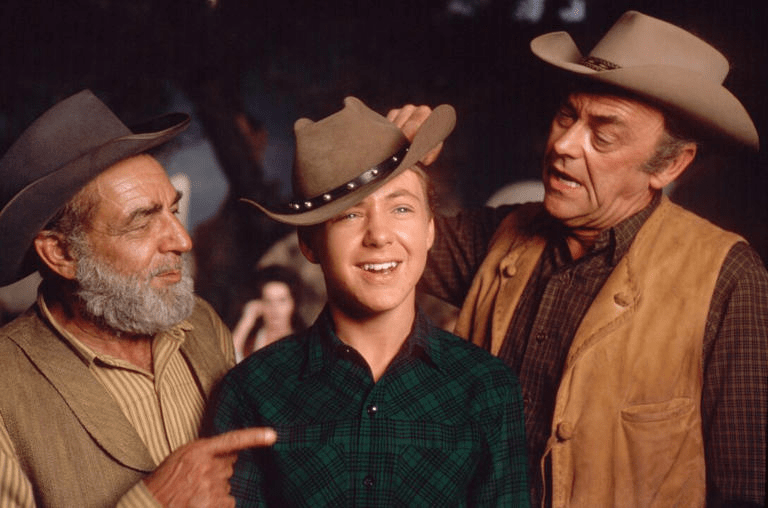
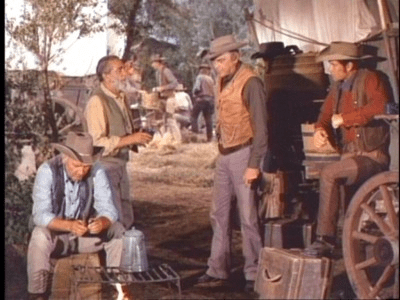
The series was very popular, jumping to number one immediately. The plot is that a large wagon train is traveling through the west from Missouri to California. Ward Bond starred as the wagon master Seth Adams (when he died in 1960, John McIntire took over). Robert Horton played scout Flint McCullough; eventually he opted to leave and was replaced by Robert Fuller. Oddly, Horton and Fuller shared a birthday and were six years apart in age.
If I listed all the guest stars during the eight seasons, you would still be reading this next Monday. Just know, there were a lot.
The show was adapted from a 1950 John Ford film titled Wagon Master. In a 1960 episode, John Ford stepped in to direct an episode, “The Colter Craven Story.” One guest star I have to mention in this one was John Wayne. He speaks from the shadows as General Sherman (Wayne’s real name was Marion Michael Morrison, so for this credit, he went by Michael Morris) in this episode.
The original theme song was written by Henri Rene and Bob Russell and conducted by Stanley Wilson. A more contemporary theme accompanied season two, and it changed a few more times during the run of the show.
📷msn.com
The show had a huge budget for the time: $100,000 (about a million in today’s world of television). It was about 40% more expensive than most westerns at the time, and that is part of why it was able to feature so many guest stars.
When Gene Roddenberry pitched Star Trek to the networks, he described it as “a Wagon Train traveling across the universe.” He also hired writer Gene L. Coon who wrote 23 episodes of Wagon Train.
While wagon trains are considered an icon from our history, so was the product of the series’ first sponsor, the Edsel Division of the Ford Motor Co.
The show was an hour long and shot in black and white for the first six seasons. For season seven, the network filmed the show in color and increased the length to 90 minutes. The ratings were still high but didn’t increase, so the network could not justify the changes, and the television show went back to an hour in black and white.
📷dvdtalk.com
The show was placed on Wednesday nights up against Leave it to Beaver and Disneyland. Even with that competition, it was in the top thirty and by its second season, had jumped to the top ten where it stayed until it was sold to ABC. ABC kept the show on Wednesday nights, and it ran against The Virginian, both being in the top thirty in 1962.
So many people have fond memories of this show. It was on six seasons, but I think it was finally cancelled even though it was in the top thirty because of the western overload, ushering in the shows like Get Smart, The Man From UNCLE, Lost in Space, and The Smothers Brothers Show. Check out your favorite guest stars who were on the show and watch those episodes to see what it was like.
This month our blog series is titled “All About The Bill Dana Show.” The first week in March we learned about the show and now we have been spending time with some of the cast. We end our series with Don Adams.
Adams was born Donald James Yarmy in Manhattan in 1923. Don was a blend of cultures, Hungarian Jewish on his dad’s side and Irish-American on his mom’s. Don was raised Catholic while his brother Dick was raised Jewish. I could not find out what their sister decided to do. She later became a writer under the name Gloria Burton and wrote a script for Get Smart. His brother was also an actor. Dick has about 50 acting credits and appeared in many of the most popular sitcoms during the sixties and seventies, including three appearances on Get Smart.
Adams dropped out of high school and went to work as a theater usher. In 1941 he joined the US Marine Corp. At one point he was injured during a Japanese assault on Tulagi. He was the only survivor from his platoon. While recovering, he came down with blackwater fever, a side effect from malaria and was evacuated to New Zealand. He was not expected to recover, but when he did, he was sent back to the US as a Marine drill instructor.
After his discharge, he moved to Florida to work as a comedian. He refused to do material he considered “blue” and was fired.
In 1947 he married Adelaide Efantis, and her stage name was Adelaide Adams. Don decided to take the name Adams as well for his stage name. He worked as a commercial artist and cashier to support their family.
In 1954, Don was the winner of Arthur Godfrey’s Talent Scouts with a comedy act written by Bill Dana. He began making appearances on The Steve Allen Show, where Dana was a writer. In 1961 he became a regular on the Perry Como Show.
About this time, Don and Adelaide divorced, and Adams married Dorothy Bracken, another actress. They split up in 1977 when he married Judy Luciano, also an actress but that marriage also ended in divorce. (I could only find one credit for his last two wives; Bracken was on Get Smart, while Luciano appeared on The Love Boat.)
While discussing his marriages, Don said “I’m no longer independently wealthy. I guess it’s the result of too many wives, too many kids and too much alimony. I’ve been paying alimony since I was 14 and child support since 15. That’s a joke, but not by much. . . I like getting married, but I don’t like being married.”
In 1963 Adams was offered the role of Byron Glick, hotel detective on The Bill Dana Show. As we’ve discussed this month, the show was on the air for a season and a half. While working on the show, Don was also the voice of cartoon Tennessee Tuxedo which he continued doing until 1973.
During those years he also made an appearance on The Danny Thomas Show and on Pat Paulsen’s Comedy Hour.
In 1965 he was offered the role of Maxwell Smart in a new spy satire, Get Smart.
The sixties saw westerns being overtaken by spy shows such as The Man From U.N.C.L.E., I Spy, The Pink Panther, and The Avengers. Mel Brooks and Buck Henry decided to try their hand at writing a campy sitcom and Get Smart was born.
The role of Smart was created for Tom Poston, but ABC turned it down, and NBC said yes. They had Adams under contract, so he got the part. Rounding out the cast was Edward Platt as the Chief and Barbara Feldon as Agent 99.
Smart and 99 had great chemistry and married in a later season. Feldon and Adams remained life-long friends.
One of the most memorable parts of the show was all the catch phrases Adams created on the show including “Sorry about that Chief,” “Would you believe,” and “Missed it by that much.”
In addition to acting, Adams worked as a producer and director on the show. He was nominated for an Emmy from 1966-1969. He won three of those, losing to William Windom for the little-remembered one-season show, My World and Welcome to It. Lloyd Haynes from Room 222 and Bill Cosby for The Bill Cosby Show were also nominated that year.
The show moved to CBS for the final season, but the ratings never recovered, and the show was canceled after that year.
Like so many of our successful actors with unusual characters, Adams suffered from typecasting after the show ended. He did become part of two additional sitcom casts during his career.
In 1971 he was on The Partners. According to imdb.com, the plot is that “Lennie Crooke and George Robinson are inept detectives teamed up to solve crimes. Captain Andrews is their exasperated boss, Sgt. Higgenbottom is a smarmy co-worker, and Freddy confesses to most of the neighborhood crimes.” Adams played Crooke, but the show only produced 20 episodes.
In 1985, Adams tried a sitcom again on Check it Out. This one was about a grocery store and its employees. Adams played Howard Bannister. The show lasted three seasons, ending in 1988. The show was not very popular in the US but was a hit in Canada.
In between those two shows, Adams appeared in a handful of series including Fantasy Island, The Fall Guy, The Love Boat, Empty Nest, and Nick Freno: Licensed Teacher. He made most of his salary appearing in nightclubs. He also had his Smart character resurrected in several big screen films and television series.
Because of the typecasting, he returned to animation and found a lot of success, especially with Inspector Gadget which he voiced from 1983-1999.
He also tried his hand at a game show. Called Don Adams’ Screen Test, it had an interesting concept. The show was filmed in two 15-minute parts; Adams would randomly select an audience member to recreate a scene from a Hollywood movie such as From Here to Eternity with Adams as director. It ended after 26 episodes.
In his spare time, it sounds like he visited the racetracks, betting on horses. He also spent a night a week at the Playboy Mansion playing cards with Caan and Rickles. He loved history and studied Abraham Lincoln and Adolf Hitler in depth. He also wrote poetry and painted.
Don passed away in 2005 from a lung infection and lymphoma. The eulogists at his funeral included James Caan, Bill Dana, Barbara Feldon, and Don Rickles.
It’s hard to know what to make of Adams’ career. Obviously, he was hard working, an excellent Marine, and a man of many interests. He was fired for not performing blue material but then put horse racing and gambling above the needs of his family, according to several of his friends. He created the amazing role of Maxwell Smart, one of the best characters in television history, but that feat kept him from achieving other great roles in the following decades due to typecasting. It sounds like Check It Out was very popular in Canada, so maybe if he had been given a few chances to create characters different from Smart in a couple other sitcoms, it would have helped.
I feel bad for those actors who are so successful in the characters they help create that they are barred from future jobs, but then again, those characters are some of the best actors in television: George Reeves as Superman, Ray Walston as My Favorite Martian, Henry Winkler from HappyDays, Frank Cady from Green Acres, and Jack Klugman from The Odd Couple. I guess you trade being warmly remembered for fewer quality roles.
Apart from Get Smart, I knew little about Adams before writing this blog, so it was fun to get to know him a bit.
During this month of Supportive Women, I am excited to learn more about Vera Miles. For four decades, Miles appeared in our homes as well as on the big screen. With 162 credits, she may have visited your living room more than most of your family members.
📷facts.net
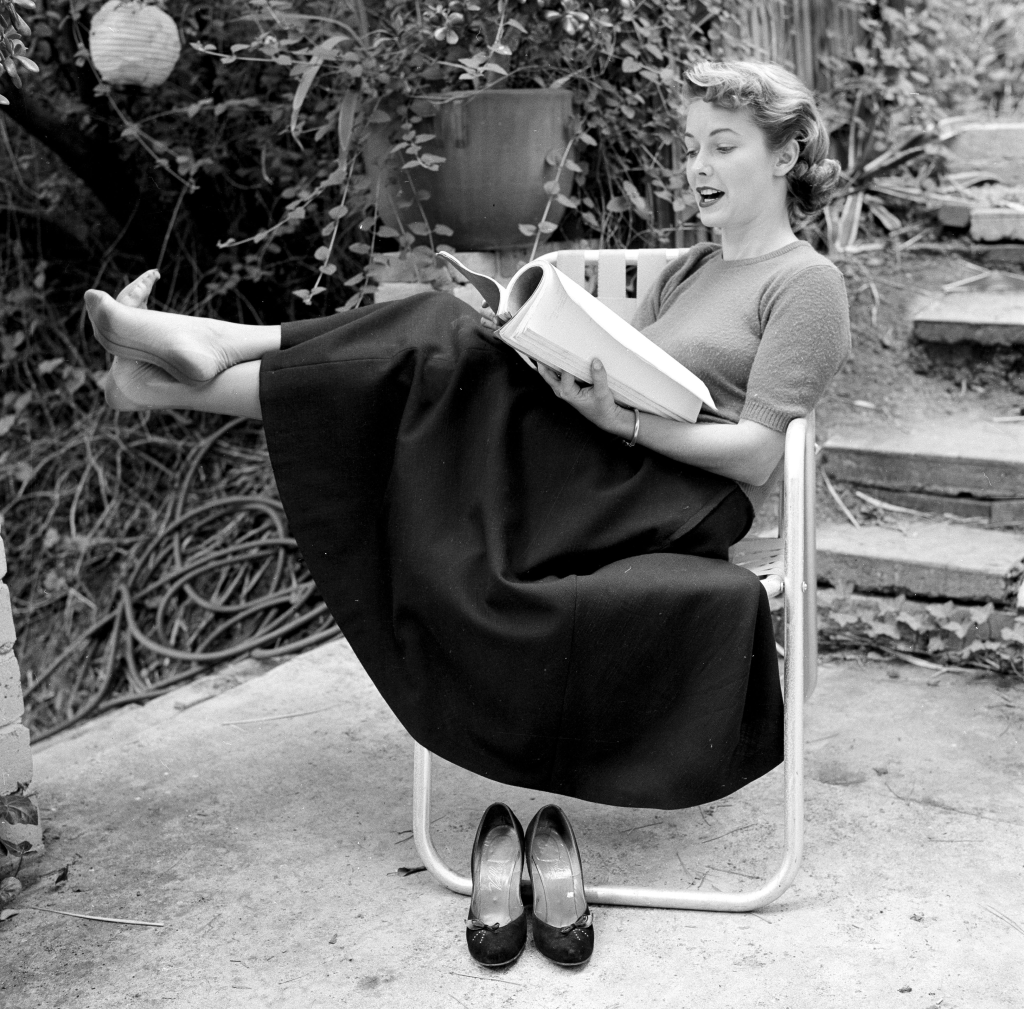
Vera Ralston was born in Boise City, Oklahoma in 1929. She grew up in Pratt, Kansas, and later she moved to Wichita where she graduated from high school and worked nights as a Western Union operator-typist. In 1948 she won the Miss Kansas pageant and was third runner-up in the Miss America contest that year. Miss Minnesota won the crown.
A year later she moved to Los Angeles to pursue a career in television and movies. Not long after arriving in Hollywood, Vera married photographer and stuntman Bob Miles. One source said that she enrolled at UCLA, hoping to become a teacher.
Bob Miles has 13 acting credits and 14 stuntman credits. The cast of Bonanza must have liked him because he appeared as a stuntman 99 times and as an actor on the show 76 times.
📷photos.com
After the birth of her children, she began doing some modeling and taking on a few roles to help provide income. Vera used her husband’s last name because there was already a Vera Ralston in the industry.
She appeared as a contestant in a 1951 episode of You Bet Your Life with Groucho Marx. Along with her partner, she won $8 in the quiz portion of the show but gave the wrong response to the De Soto-Plymouth question which was “Who was the first Chief Justice of the Supreme Court?” When Groucho asked her what titles she had held as a beauty contestant, in addition to Miss Kansas, she mentioned that she was Miss Chamber of Commerce, Miss Wichita, Miss Texas Grapefruit, and Miss New Maid Margarine.
She received her first movie role in 1950 and her first credit in 1952. In The Rose Bowl Story, a romantic comedy, she played a Tournament of Roses Queen. She would appear in about 40 additional movies during her career and quite a few made-for-television movies as well. She often worked with Alfred Hitchcock and was cast in Psycho.
In 1951 she appeared on Fireside Theater, her first television role. While she had more than 100 credits performing on television, surprisingly she never starred in a series. The only recurring character she had was Ernestine Coulter on My Three Sons.
📷fotogrammas.com
In 1956 she married Gordon Scott after divorcing Miles in 1954. They also divorced in 1960. Scott appeared to only work in Hollywood for a five-year period according to imdb.com. From 1960-1971 she tried marriage again with Keith Larsen, but their marriage also ended in divorce. Since the third time was not the charm, for two years in the mid-seventies, she wed Robert Jones but that ended in divorce as well.
During the fifties, she fit roles around her movie appearances, and you can see her in episodes of dramatic theater shows. In the sixties, she had no trouble finding work and she showed up on The Twilight Zone, Route 66, Wagon Train, I Spy, The Man from UNCLE, The FBI, and Mannix. Work did not slow down in the seventies, and you can spot her in a variety of shows including Gunsmoke, Hawaii 5-O, Bonanza, Cannon, Columbo, and Barnaby Jones. She might have taken thing a bit easier in the eighties, but she still worked on four or five shows a year, including Magnum, PI; Little House on the Prairie; TheLove Boat; Hotel; and Murder She Wrote. Her last credit was for a movie titled Separate Lives in 1995.
📷imdb.com
Miles was a member of the Church of Jesus Christ of Latter-Day Saints and visited Salt Lake City quite often.
Early in her career, Miles appeared to be almost a clone of Grace Kelly but that never materialized into a movie star career. Hitchcock hired her for Vertigo with Jimmy Stewart, but her pregnancy caused her to back out of the movie, and Kim Novak received the starring role. Perhaps, that movie would have changed the trajectory of her film career. I’m surprised that she was never given an opportunity to star in a television show. With 162 credits, she had a prolific and busy career. I will definitely try to spot her when I watch some of my favorite classic shows.
We are starting a blog about Supportive Women, great actresses who made classic television so much better. I’m beginning with Joan Tompkins.
📷tvtime.com
Tompkins was born in 1915 in Mount Vernon, NY. She began her career in stock theater companies in New York in the thirties before appearing on Broadway in several shows including “My Sister Eileen,” “Pride and Prejudice,” and “Fly Away Home.” Henry Fonda was in several the plays with Joan.
In 1936 she married actor Stephen Ker Appleby in New York, but five years later they divorced. Appleby was born in Wales and known best for his 1960s movies. He lived to be 100. From 1942-1951 she was married to Bruce MacFarlane before they divorced. McFarlane died in 1967 and had 28 acting credits in television and film. Joan would then marry a third actor in 1951, Karl Swenson, “the man of a thousand voices.” The two worked together on the radio. Many fans of Little House on the Prairie would recognize Karl as Lars Hanson. Swenson obtained an amazing 175 credits, primarily on television during the two decades before his death.
After WWII Joan became a foster parent for a crippled Polish boy, Tomasz Machcinski. He later became a photographer. In 1994, their story was made into a documentary, “Child from a Catalog.” Machcinski’s life story was very interesting. He was born in the Kampinos Forest in Gorki, Poland. He spent his childhood living in hospitals and orphanages. After developing a relationship with Joan, he graduated as a precision mechanic in 1963. In 1966, he took up photography and created thousands of self-portraits. Some were as historic characters. He chose the stories, make up, and costumes. He once said that he didn’t “use wigs, tricks, but I use everything that happens to my body, such as hair regrowth, tooth loss, diseases, aging, etc.” He has had exhibits in Copenhagen, Beverly Hills, Warsaw, New York, and Paris. Machcinski passed away in 2022.
📷wallofcelebrities.com
Tompkins had a long radio career. She was the voice of Nora Drake on “This is Nora Drake” which was on CBS radio until 1959.
She began her television career in 1954 on an episode of Ponds Theater. Almost all of her 93 acting credits were for television shows. She had a recurring role on a soap, Valiant Woman, appearing in 176 of the 1027 episodes of the show as Marion Walker. Throughout the fifties, she showed up in several dramas as well as The Donna Reed Show, Bachelor Father, and Father Knows Best.
During the sixties, she had two recurring roles. She played Mrs. Brahms on Occasional Wife in 1966-67. I remember her on My Three Sons; between 1967-1970, she appeared as Lorraine Miller, Katie’s mom, nine times.
You can catch glimpses of her on many of your favorite shows from the sixties and seventies, including Hazel; The Danny Thomas Show; Perry Mason; Gomer Pyle: USMC; Dr. Kildare; The Man From UNCLE; Bewitched; Bonanza; The Brady Bunch; MarcusWelby, MD; The Mary Tyler Moore Show; The Mod Squad; and The Bob Newhart Show.
📷imdb.com My Three Sons
Her last television appearances were in 1980. She played Grandma Gertie in an episode of Eight is Enough and a physician in a made-for-tv film, The Night the City Screamed.
Karl and Joan moved to Beverly Hills where they founded an acting company. Karl directed the plays Joan appeared in. After Karl’s death in 1978, Joan joined a writing group and wrote several books. She died at home in 89.
Joan Tompkins is another one of those actresses that made television better during the fifties, sixties, and seventies. I’m glad we could learn a bit more about her and her career.
This month we are “Examining Our Favorite Medical Series.” Beginning in 1969 and staying on the air for seven seasons, this show was a show that the entire family could agree to watch. In fact, on The Partridge Family, there is at least one episode where the Partridges are watching Marcus Welby, MD.
Marcus Welby (Robert Young) is a family doctor who truly likes and knows his patients. Sometimes he even made house calls. Dr. Steven Kiley (James Brolin) is his business partner and they both rely on Nurse/Office Manager Consuelo Lopez (Elena Verdugo).
Produced by David Victor and David J. O’Connell, the show aired on Thursday nights. Victor also produced episodes of Dr. Kildare as well as The Man from U.N.C.L.E., Owen Marshall, Counselor at Law, and Lucas Tanner, among others. O’Connell produced episodes from several series but he was kept busy in the Editorial Department for a slew of shows, including Tales of West Fargo, Bachelor Father, Leave It to Beaver, The Jack Benny Show, Wagon Train, McHale’s Navy, and The Munsters. (In the future, I will definitely look into a show about editors for a blog.)
Welby and Kiley were very different. Kiley rode a motorcycle to work while Welby drove a sedan. Welby was a widower; he started his career as a doctor in the US Navy during the war. He enjoyed sailing on the ocean. Welby often wanted to use more radical treatments than his younger partner who was more conservative in his patient care. A lot of ailments were tackled on the series including impotence, depression, brain damage, breast cancer, epilepsy, Alzheimer’s, rape, and abortion.
Photo: WorthPoint.com
The two doctors had a private practice with operating privileges at Lang Memorial Hospital. Both doctors had girlfriends, Myra (Anne Baxter) and Janet (Pamela Hensley). Welby’s daughter (Christine Belford) and grandson (Gavin Brendan) were often on the set as was Kathleen Faverty (Sharon Gless), an assistant program director.
In season two the show made it to number one for ABC. Both Young and Brolin won Emmys and the show won an Emmy for Outstanding Dramatic Series.
After seven seasons of medical storylines, the show’s viewership began to wane. Many of the medical series were running out of steam at that time. Once ratings continued on the decline, the show was canceled.
Photo: decider.com
However, eight years later, The Return of Marcus Welby, MD aired. Young and Verdugo continued their roles although Brolin was no longer available. It must have done well, because a second movie was filmed in 1988–Marcus Welby, MD – A Holiday Affair. This would be the last acting role Young would accept.
I have many fond memories of watching this show when I was young with my family. Marcus Welby reminded me of our family doctors; he was kind, gentle, smart, and had a great bedside manner. And he made house calls! Don’t get me wrong, there are still many doctors with his characteristics and they kind of make house calls now over the computer but it’s not the same. Thanks, Dr. Welby, for caring for all of us for seven years.
As we wind up our up close and personal blog series, we are focusing on Gavin MacLeod. I have mentioned Gavin MacLeod’s name a lot in my blogs, but I have never devoted an entire to blog to him, so today is the day. Gavin had an impressive career; he starred in three sitcoms but those three garnered him almost 500 episodes. In addition, he took on more than a hundred guest roles on both the small and big screen.
MacLeod was born Allan George See in 1931 in New York. His mother worked for Reader’s Digest, and his father was an electrician. In 1952, MacLeod graduated from Ithaca College with a bachelor’s degree in fine arts, studying acting.
On Perry Mason Photo: imdb.com
He served in the US Air Force where he wrote, produced, and directed plays. After his service, he moved to New York City. While tackling acting auditions, he worked at Radio City Music Hall. While working as an usher there, he met Joan Rootvik, a Rockette. They married in 1955 and had four children. About this time, he took on the name Gavin MacLeod. MacLeod was a tribute to his acting coach at Ithaca, Beatrice MacLeod.
His movie career began with three movies in 1958. He would make 20 more before 2005, including Operation Petticoat and The Gene Krupa Story.
His television appearances began in 1957 on The Walter Winchell File. He would make another lucky 13 performances during the fifties including The Thin Man and Whirlybirds.
On Hogan’s Heroes Photo: pinterest.com
The sixties kept him busy. He took on comedy in The Dick Van Dyke Show, The Munsters, Gomer Pyle USMC, The Andy Griffith Show, My Favorite Martian, The Flying Nun, and several different characters on Hogan’s Heroes. Westerns called him for Rawhide, The Iron Horse, Death Valley Days, and The Big Valley. He landed dramas including The Man from UNCLE, Perry Mason, Ironside, Hawaii Five-0, and Ben Casey.
From 1962-1964 he starred as Happy in McHale’s Navy. The show continued until 1966, but Gavin left the show halfway through. He was dealing with alcoholism, and he received an offer to make the movie The Sand Pebbles with Steve McQueen. However, he remained close friends with Ernest Borgnine, the star of the show, until his death in 2012. (He quit drinking in 1974.)
Murray and Mary Photo: showbizcheatsheet.com
During the 1970s, he appeared on Love American Style, Charlie’s Angels, and Wonder Woman, but the character we loved best during that decade was Murray Slaughter on The Mary Tyler Moore Show. From 1970-1977, Murray sat next to Mary, helping her through the ups and downs of life. Gavin was originally auditioning for the role of Lou Grant, but ended up reading for Murray. He and Ted Baxter were enemies on the show, but he and Ted Knight were dear friends in real life. They had lived near each other before being cast in the show.
During the run of the show, Gavin and his first wife divorced, and he married his second wife Patti Steele. That marriage also ended in divorce in 1982. Patti became part of a Bible Study group after their divorce and became a Christian. Gavin reached out to her, also became a Christian, and they remarried in 1985.
Photo: travelweekly.com
Upon the ending of Mary’s show, he was immediately hired as Captain Stubing on The Love Boat. This time he was in charge of his coworkers. One of his best friends was Bernie Kopell who played Dr. Adam Bricker on the show. Gavin was on the seas for a decade. His best friend Telly Savalas (the lollipop-loving Kojak star) popped up on The Love Boat; the two were very close until Telly’s death in 1994.
When the show ended in 1987, he got a well-deserved break, but he still managed to find time to tour with Michael Learned in “Love Letters.”
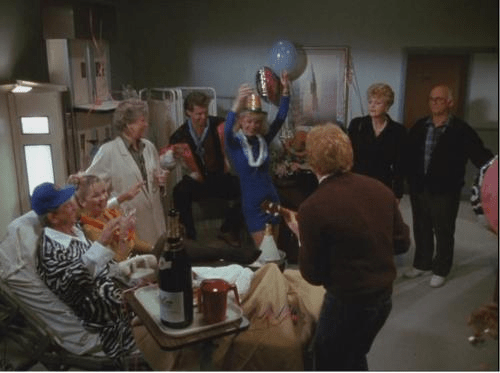
Celebrating on Murder She Wrote Photo: imdb.com
He landed a variety of television show appearances in the 1990s and 2000s, including Murder She Wrote, King of Queens, JAG, and That 70s Show. His final appearance was in 2014 on The Comeback Kids; then he decided to retire. He also did several musicals after The Love Boat including “Gypsy,” “Annie Get Your Gun,” and “Gigi.”
MacLeod and his wife hosted a show on marriage on Trinity Broadcasting Network for 17 years. He also served as the honorary mayor of Pacific Palisades from 2006-2011 when Sugar Ray Leonard took over.
The Love Boat was a big part of his life. Instead of being bitter about being typecast, he embraced the role. He celebrated his 80th birthday in 2011 aboard the Golden Princess with his family, celebrating with a 3D replica cake of The Pacific Princess, his boat on the show.
Photo: princesscruises.com
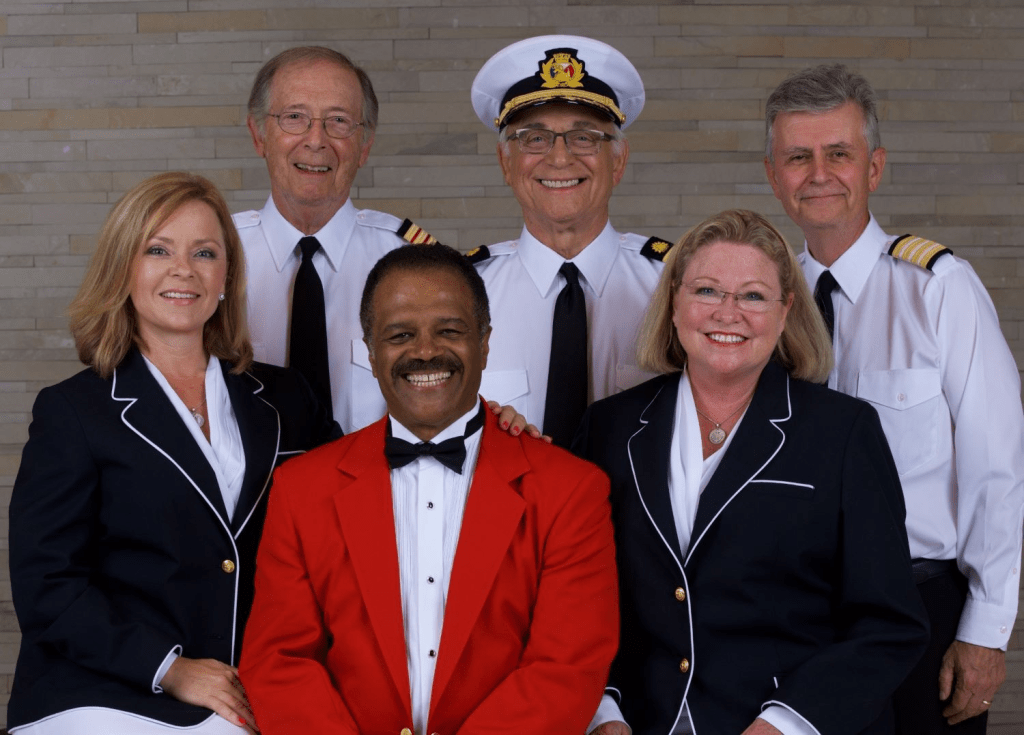
In 2013, MacLeod joined his former coworkers on The Talk for a cast reunion. Several members of the cast including Gavin took part in The Rose Bowl Parade in 2015.
The cast apparently was very close. Ted Lange who played bartender Isaac Washington mentioned the crew in an interview in 2017 with “The Wiseguyz Show,” saying “Oh yeah, sure, Gavin was wonderful. Gavin lives down here in Palm Springs and we’re still tight, all of us, Gavin and Bernie and Jill; we still see each other. Fred [who played Gopher] lives in a different state, we’re still close, we’re still good friends.”
In his spare time, Gavin enjoyed traveling, playing tennis, dancing, golfing, sailing, reading the Bible, and watching movies. Gavin passed away in May of 2021 at his home.
Photo: twitter.com
During the past decade, he released a memoir, This is Your Captain Speaking: My Fantastic Voyage Through Hollywood, Faith & Life. He explained his goal for writing this book: “My life has taken one incredible turn after another,” writes MacLeod. “I’ve gotten to do what I wanted to do. I’ve been a captain! I’ve been given this incredible gift of life and now I want to use it to give back. That’s why I’m sharing my story here, the fun parts and even some not-so-fun parts, in the hopes that maybe someone will take a nice walk down memory lane with me – and maybe I’ll even give someone a little bit of hope.”
Good memories and a little bit of hope is all we can ask for; thanks, Gavin, for giving that to us.
We are in the middle of our “What A Character” blog series. No overview of television character actors during the golden age would be complete without Bernard Fox.
As a young tyke, you still expect him to say, “Come along old chap.” Photo: tagswrc.com
Fox was meant to be an actor. He was born to Queenie and Gerald Lawson in Glamorgan, Wales. Both his parents were actors. Fox had his first film role at the age of 18 months. By 14 he was an apprentice assistant manager of a theater.
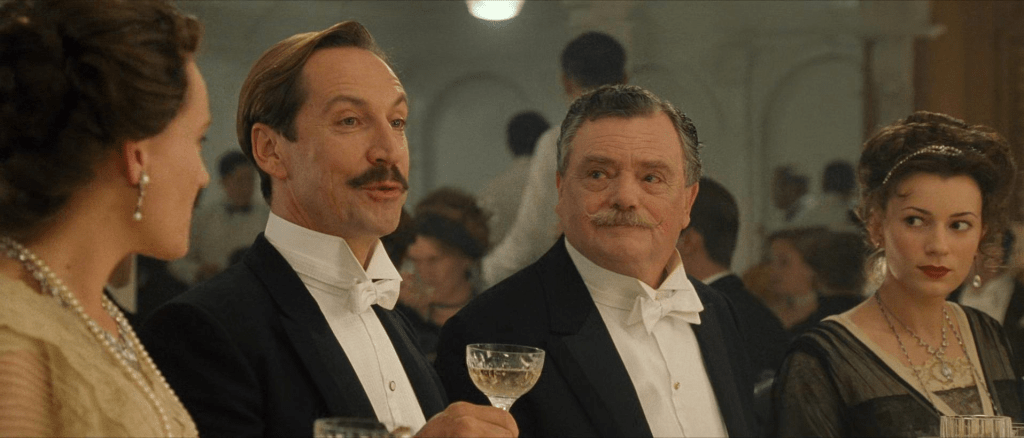
Bernard served with the Royal Navy during WWII as a minesweeper and then in the Korean War. From 1956-2004 he made more than 30 films. Ironically, he was in two different Titanic movies. In 1958 at the beginning of his career, he was in A Night to Remember and in 1997, at the end of his career, he was in the Oscar-nominated Titanic. He liked to say that he was the only person to survive the Titanic twice.
He began his television career in 1955 when he received a recurring role on the United Kingdom show Sixpenny Corner as Tom Norton. The show was centered around Bill and Sally Norton, a young married couple who ran a garage together. Fox played Bill’s youngest brother.
Titanic 1997 Photo: imdb.com
Eventually, he made his way to the United States. His first US show was in Wire Service in 1957, a show filmed at the Desilu studio. His next seven shows were filmed in the United Kingdom.
Fox mentioned that being a character actor was a mental strain. Early in his career, he had to worry about when the next job would be coming. He did post office work, logging, and other interesting jobs to get by. Once he got to America, he was able to rely on his acting career and didn’t have to moonlight anymore.
In 1962, he married his wife Jacqueline. They had two daughters. The same year he was back on US television with a regular role on The Danny Thomas Show. He played Danny’s English friend, Alfie Wingate. In 1963 he appeared on Ensign O’Toole, The Great Adventure, and General Hospital. The mid-sixties showed him in a variety of shows including McHale’s Navy, Perry Mason, The Dick Van Dyke Show, F-Troop, I Spy, I Dream of Jeannie, The Man From U.N.C.L.E., and The Farmer’s Daughter.
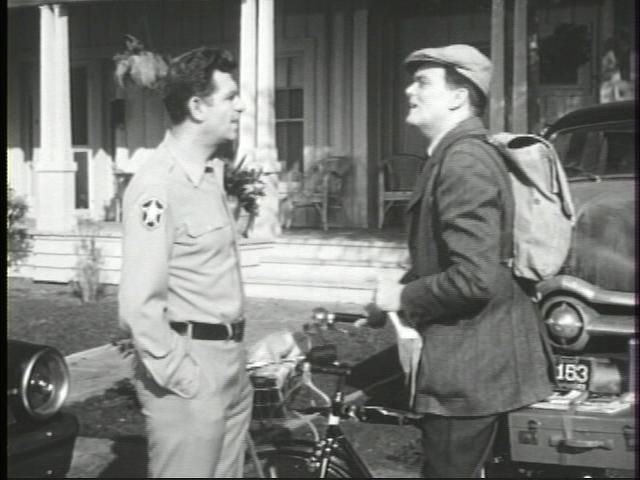
Hello Constable Photo: pinterest.com
He had another recurring role during this era on The Andy Griffith Show as Andy’s friend/valet Malcolm Merriweather. Fox appeared on the show in season three. We see him pedaling his bike next to Andy’s squad car at Andy’s house and says, “Excuse me, Constable.” When Andy understands what he is saying, he explains that he is the sheriff. With all the quirky characters in Mayberry, Malcolm fit right in and it’s a charming scene.
He continued receiving regular work in the late sixties for The Monkees; The Wild, Wild West; Here Come the Brides; and Daniel Boone.
Monkeeing Around Photo: sunshinefactory.com
Bernard did not enjoy his time on The Monkees set. He called them “an amateur bunch of rabble rousers . . . a bunch of unprofessional idiots.” He said that “they’d have cans of chocolates or something in the cupboards and in between shots, they’d be cramming chocolates in their mouths.” Fox was amazed, he said he got used to it but “professionally speaking, I expected a bit more.”
It was in the late sixties that he received the role he may be best known for: Dr. Bombay on Bewitched.
In an interview on bewitched.net, Fox was asked about his popular character, Dr. Bombay. He said that the spin he put on the doctor made him more interesting, saying, “If I’d just gone for an ordinary doctor, you wouldn’t have heard any more about it. But because I made him such a colorful character, that’s why they wanted him back.” He said the character was “easy to write for” and the writers had him being summoned from all over the world. He showed up in a variety of costumes including a wet suit, a football uniform, a toga, a towel, and a matador costume among others.
On Bewitched Photo: closerweekly.com
Bernard discussed the stars on Bewitched. He said Marion Lorne was a “dear lady.” When asked about Agnes Moorhead, he said she was a “thoroughly professional lady” and that praise from her was a thrilling thing to get. He said that he “liked Dick very much, a fine actor. He was a darling man.” And about Elizabeth, he said, “she was always very sweet and knew her lines.” She liked to bet on horses and whenever she won, she treated the cast to a party on the set. He also said once she found out he had a vegetable garden, she got him a subscription to Gourmet Magazine which she renewed every year.
He fondly recalled one episode where he was supposed to be squeezing a lemon into clam dip. When he squeezed it, it went in Elizabeth’s eye. The director yelled, “cut” and re-filmed it, but it happened again. The director said, “Bet you can’t do it a third time,” but he did, so they left it in the show.
Visiting MASH Photo: imdb.com
His career did not slow down in the seventies where you could watch him on The Partridge Family, Night Gallery, Love American Style, Columbo, Cannon, Soap, and MASH. When asked about his appearance on The Partridge Family, Fox said, “Oh, I loved Shirley, she’s a doll, she’s a really nice lady.”
Following the pattern, he also had a recurring role in this decade as Colonel Crittendon on Hogan’s Heroes. As Crittendon, he was incompetent and dense and drove Colonel Hogan crazy with his ineptness.
Colonel Crittendon Photo: pinterest.com
In his bewitched.net interview, Fox also discussed his role on Hogan’s Heroes a bit. He said that in one episode he had hidden some maps in a corn bin. When he lifted the lid, it came down on his head. He just put the lid up and carried on with the script. When the director asked about reshooting, Fox said it was fine, and they left it in the film. He did say when he was playing a role on Hogan’s Heroes and Bewitched at the same time, it could get a bit confusing. They typically worked it out. For example, he said one time the studios agreed that Fox would be on the Bewitched set Tuesday and Wednesday and on Hogan’s Heroes Thursday and Friday.
Offers did slow down a bit in the eighties and nineties, and he ventured into animation work during those two decades. However, he still accepted offers for Fantasy Island, Lou Grant, The Love Boat, Hart to Hart, The Jeffersons, Simon and Simon, and Murder She Wrote among others.
His last acting credit occurred in 2001 for Dharma and Greg.
Not only was Fox an actor but he was an expert in history of the theater. For fun, he enjoyed gardening, painting landscapes, and performing magic.
Photo: walmart.com
In 2016, Fox died from heart failure.
I’m so glad he was able to find a successful career on television in the United States. After learning in a previous blog what a legend Marion Lorne was in England where she lived much of her life, I like to think about Aunt Clara and Dr. Bombay sharing some time talking about the delightful English ways that they missed. Hopefully they served tea on the set once in a while.
As we check out some of my favorite actresses this month, this week we learn about one of the most prolific actresses on the small screen. With more than 170 credits between 1938 and 2004, June Lockhart had a very successful career.
Photo: ebay.com
Perhaps destiny planned for June to become an actress. Both her parents, Canadian-born Gene and English-born Kathleen Lockhart, were actors and she traveled with them as a young child while they performed. Although she was born in New York City in 1925, she was brought up in Beverly Hills.
June with her parents Photo: mesquitelocalnews.com
She was only 8 when she took the role of Mimsey in “Peter Ibbetson” at the Metropolitan Opera.
In 1938, at age 13, June made her film debut in A Christmas Carol with her parents. She appeared in more than thirty movies, including Meet Me in St. Louis, Sergeant York, All This and Heaven Too, and The Yearling.
Photo: pinterest.com Meet Me in St. Louis
In 1948, she won a Tony for Outstanding Performance by a Newcomer for her role in “For Love or Money.”
Although her appearances in film and on Broadway would have been a lucrative career n themselves, it was in television that she found most of her fame. In 1949 she accepted a role on The Ford Theater Hour. During the 1950s she would make 56 appearances on drama theater shows. In addition, she was in Gunsmoke, Have Gun Will Travel, Rawhide, and Wagon Train.
In 1951 she married John Maloney. In 1959 they divorced and that same year, she married John Lindsay whom she was married to until 1970.
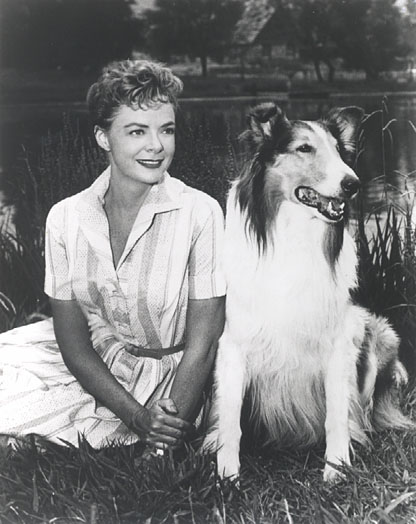
But it was in the television show, Lassie from 1958-1964 that she became a household name as Ruth Martin, Timmy’s (Jon Provost) mother. The show was about the Martin family’s life on the farm and the heroics of Timmy’s dog Lassie.
Photo: pinterest.com
The 1960s continued to be very productive for her as an actress. She appeared in a variety of television shows, including the dramas Perry Mason, The Man from UNCLE, and The Alfred Hitchcock Hour and the comedies Bewitched, Family Affair, and The Beverly Hillbillies.
Photo: thenewyorktimes.com
She also starred in two long-lasting sitcoms. From 1965-1968 she was Maureen Robinson on Lost in Space. On the show, a family with three children travel with Major Don West to colonize a new planet. Dr. Zach Smith is a stowaway who tried to sabotage their mission by throwing their ship off course and ends up having to live with the people he thought were his enemies.
With Bill Mumy Photo: uncleoldiescollectible.com
In an interview with Bill Mumy who played her son Will on Lost in Space, he said that Lockhart always made time for the kids on the set. He said she kept them occupied between takes which she didn’t need to do. He said “she spent a lot of time nurturing Angela’s and my developing thought processes. Teaching us.”
Photo: thedailyissue.com
In 1968 she was offered a role as Dr. Janet Craig for the final two seasons of Petticoat Junction. Bea Benaderet, the star, passed away in 1968, and Janet filled in as a “mother” to the girls.
Although she would not take on any additional regular roles for sitcoms, she continued to keep busy through the 1970s, 1980s, 1990s, and 2000s. During these decades , she could be seen on Love American Style, Marcus Welby, Adam-12, Police Story, ElleryQueen, Happy Days, Magnum PI, Falcon Crest, Quincy, Murder She Wrote, FullHouse, Roseanne, Drew Carey, Grey’s Anatomy, and in Beverly Hills 90210 where she had a recurring role, along with 33 other series.
On Happy Days Photo: sitcomsline.com
Her last acting role was an animation movie, Bongee Bear and the Kingdom of Rhythm, in 2016.
Photo: famousbirthdays.com
Lockhart is an interesting person as well as a successful actress. She hosted the Tournament of Roses parade for eight years and the Macy Thanksgiving parade for five years.
During my research, I learned several surprising things about her. She was an Ambassador for the California State Parks system. She won the NASA award for Exceptional Public Achievement Medal for inspiring the public about space exploration in 2013. She served as a panelist with several White House correspondents on a quiz show Who Said That in the fifties. That job provided her with an open invitation to attend White House briefings which she did and said were fun.
Photo: flickr.com
Her hobbies included gold mining, antique motorcars, lighter-than-air aircraft, and learning about the Old West. She kept medical texts near her bed for nighttime reading. She was a member of a kite-flying club. She also loved old steam engines.
Photo: blogspot.com
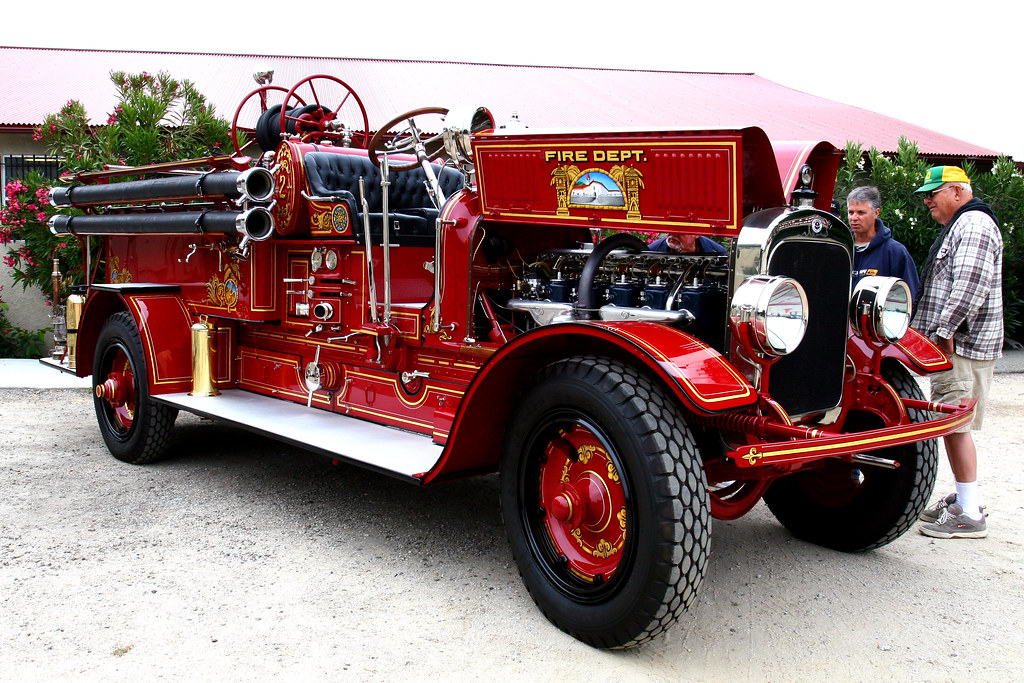
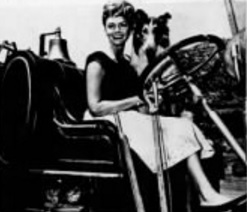
Her husband bought her a 1923 Seagrave pumper fire engine named “Cordelia Delilah Lindsay” which she drove around even though it got two miles to the gallon. She actually had the largest parking space at the studio.
If all those facts aren’t interesting enough, in an interview with Bill Mumy by the Archive of American Television, he relayed that she loved rock and roll. In 1967, she hired the Allman Brothers Band (then called Hour Glass) to play at her house. She took Angela Cartwright and Bill to the Whiskey-A-Go-Go. He also said that “in the 1980s she carried a picture of only one person in her wallet and it was David Bowie.”
Photo: pinterest.com
I’m truly impressed that with as busy as she was as an actress, she made time for both her two daughters and her television children, and enjoyed a ton of hobbies as well. It seems she had a joy for learning about new things and continued to add interests to her life. She is a great role model for all of us.
Ahoy matey. We are currently in the middle of the “We Salute You!” blog series. Today we go behind the scenes of one of the most popular military sitcoms: McHale’s Navy.
Photo: blogspot.com
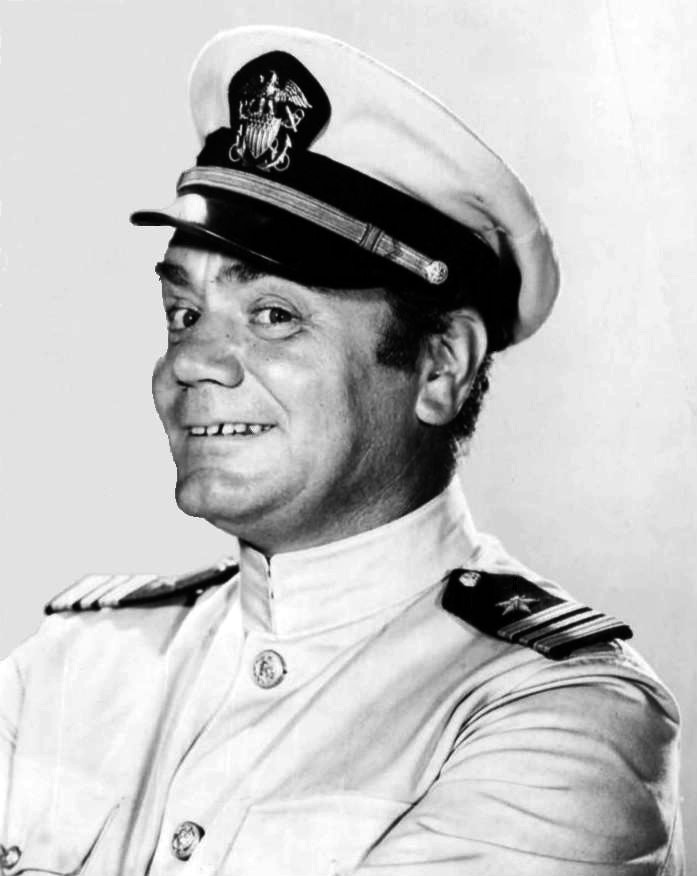
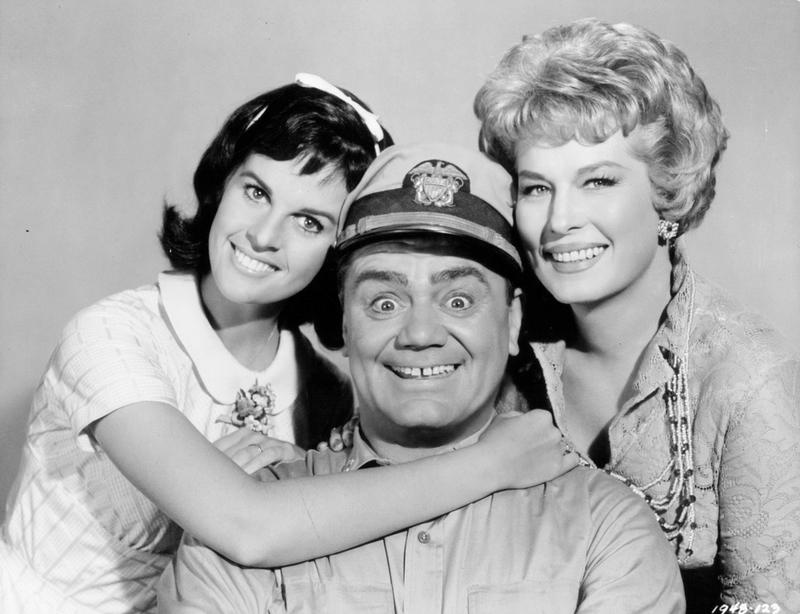
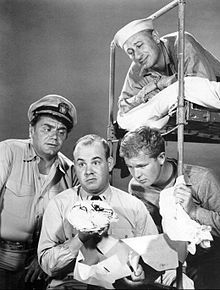
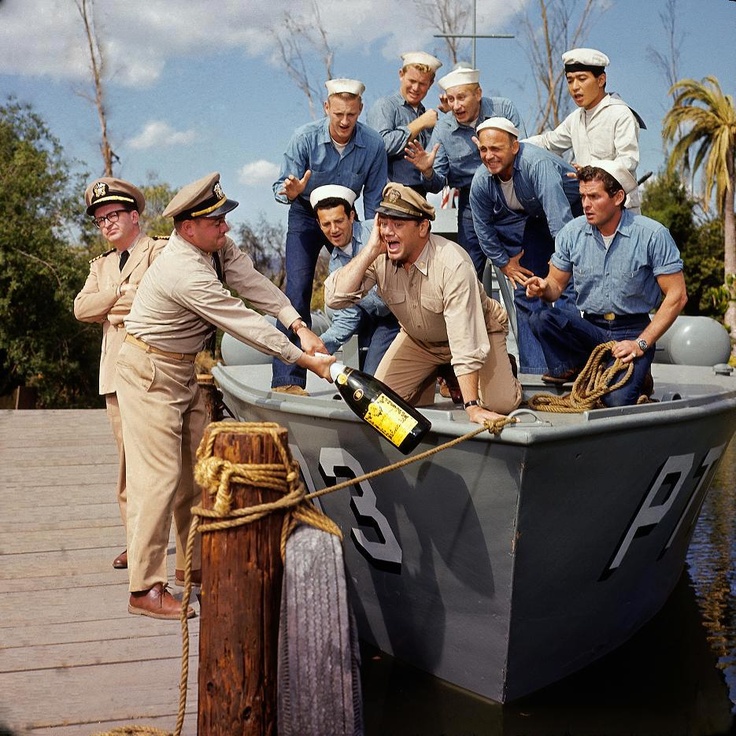
The series is centered around the adventures of a US Navy crew aboard the PT boat PT-73 during WWII. One of the best crews in the Navy, they often try to outwit Captain Binghamton (Joe Flynn) and his aide Lt. Carpenter (Bob Hastings). Stationed in the South Pacific, the crew often is involved in antics to make life more enjoyable during wartime. Quinton McHale (Ernest Borgnine) is fun-loving but sometimes has to reign his crew in when they go too far.
Debuting on ABC in 1962, the show sailed on for four seasons, producing 138 episodes. In April of 1962, a drama on Alcoa Premiere a/k/a Fred Astaire’s Premier Theatre aired that was titled Seven Against the Sea with Borgnine as the lead. It became the pilot for what would become McHale’s Navy.
Photo: thehollywoodreporter.com
Edward Montagne who was the producer of the new show had worked on The Phil Silvers Show. Montagne decided to turn the dramatic Seven Against the Sea into a “Bilko in the Navy” type of show. He recruited some of the actors and writers who had appeared on the prior series.
The basic plot of the show is that while these are respected, hard-working men when necessary, they have a lot of wacky schemes involving women, making money, and having fun. Captain Binghamton’s goal is to get rid of the entire bunch. The crew is said to live on an island across the bay from Taratupa, the fictional base. The geographic distance gives them extra time and more freedom to get into and out of their complicated situations.
Similar to The Phil Silvers Show, this sitcom also had a very large cast compared to most other shows.
Photo: wikiwand.com
McHale is a strong, competent leader and goes to great pains to protect his crew. He likes to wear Hawaiian type clothing when off duty. Sometimes the crew uses the PT boat to go deep-sea fishing or water skiing. When the crew has laundry, they put the clothes into a barrel with holes, add soap and drag it behind the boat. McHale speaks Japanese, Italian, and some of the local island dialects.
Photo: pauldavisoncrime.com
Ensign Charles Parker (Tim Conway) is McHale’s goofy second-in command. McHale calls him “Chuck.” Conway captured the lovable, naïve, bungler perfectly. He often refers to his home town Chagrin Falls, Ohio which was Conway’s hometown. Parker says he worked for the Chagrin Falls Gazette. Parker is too dizzy to get much respect, and his resume is full of errors and ineptitude. For example, it’s mentioned that he crashed a destroyer escort into a dock, and he called a naval airstrike on a gasoline dump. He has all the naval regulations memorized but can’t remember his serial number. From time to time, Parker is asked by the crew to impersonate President Roosevelt when calling Binghamton.
In the first episode, Parker is assigned to the crew. We learn that they have gone through several men already who could not put up with their insubordinate behavior and one of them even had a nervous breakdown. The men like Parker and treat him better than their previous ensigns.
Conway later stated that he and Ernest Borgnine had a wonderful working relationship both on and off the set. In the late 1990s, they would voice Mermaid Man and Barnacle Boy on SpongeBob SquarePants.
Photo: pinterest.com
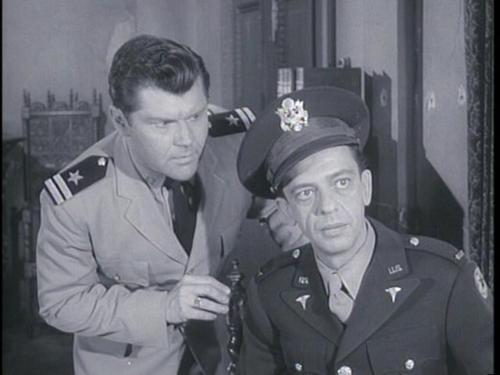
Captain Wallace Binghamton, who the crew calls “Old Leadbottom” because he once took a bullet in the butt, previously managed a yacht club, although at times it’s mentioned he was the editor of a yachting magazine. He is gruff and grumpy and dreams about being promoted. He spends much of his time trying to catch McHale and the boys in one of their schemes. He is blind without his glasses, so sometimes the crew knocks them off to prevent him from seeing something incriminating. One of his most-uttered lines is “Why me? Why is it always me?”
Photo: pinterest.com
A typical interaction between Binghamton and McHale follows:
Binghamton: Commander, how would you and your men like two weeks with nothing to do but play gin rummy, go surfing, have luaus with steel drum bands, dancing girls, hmm?
McHale: Two whole weeks? Woo hoo, oh that’d be a wonderful change sir. Yes sir.
Binghamton: Knock it off McHale. That’s what you do every week.
Photo: thewrap.com
Binghamton’s aide is Lt. Elroy Carpenter who is also inept. He talks too much and is clumsy. He often gets the brunt of Binghamton’s tirades.
Photo: pinterest.com
McHale’s crew is composed of Quartermaster George Christopher (Gary Vinson), Radioman Willy Moss (John Wright), Torpedoman’s Mate Lester Gruber (Carl Ballantine), Motor Machinist Mate Harrison Bell (Billy Sands), Gunner’s Mate Virgil Edwards (Edson Stroll), and Seaman Joseph Haines (Gavin MacLeod). Houseboy Fuji (Yoshido Yoda) was often found cavorting with the crew. He is boyish, fun loving, and loyal to McHale. Fuji was a deserter from the Japanese Navy, but the captain knows nothing about his existence. In exchange for not living in a POW section, he acts as houseboy for the crew.
Photo: groovyhistory.com
Although the crew is always chasing women and trying to throw parties that they can invite them to, McHale has several romantic relationships during the show. Nurse Molly Turner (Jane Dulo) from New Jersey is always trying to trap him in a serious relationship. Two other love interests are Kate O’Hara (Joyce Jameson) and Maggie Monohan (Jean Willes).
Photo: tumblr.com The great Don Knotts
A lot of guest stars dropped anchor on the show including Jerry Colonna, Bernard Fox, Pat Harrington Jr., Arte Johnson, Ted Knight, George Kennedy, Don Knotts, Bernie Kopell, Sue Ane Langdon, Marlo Thomas, and Raquel Welch.
Photo: lingerandlook.com
The PT-73 is almost like a character on the show. It was a 72-foot type II Vosper motor torpedo boat. The war ended before the boat (PT-694) could be sent to Russia, and it was then purchased by Howard Hughes. He loaned or sold it to Universal Pictures.
Photo: Wikipedia.com
The set of the Pacific Ocean naval base was built on the back lot of Universal Studios. After the show went off the air, it became an attraction on the studio tour.
In one episode, McHale replaces Binghamton temporarily during an inspection and learns what a hard job he actually has. While that gives him some respect for the captain, they still don’t see eye to eye. Sometimes Binghamton tries to get them legitimately transferred for a scheme and other times he is not above inventing a story such as the time he tried to get them sent away by telling a psychiatrist that they are suffering from combat fatigue.
Photo: pinterest.com
For the final season, the crew, including Fuji, is transferred to Italy to the coastal town of Voltafiore. Many plot twists come about from the crooked Mayor Lugatto and the quirky residents. The move probably came about to be able to add some additional plot lines but it was perhaps too far-fetched for viewers, and the show was cancelled.
The show had a consistent schedule for most of its run. The first season it was on Thursday night up against The Twilight Zone and Hazel. The second and remaining seasons it was on Tuesday nights against Red Skelton on CBS and a variety of shows on NBC, including the forgettable Redigo and You Don’t Say, as well as The Man from UNCLE, Hullabaloo, and Dr. Kildare.
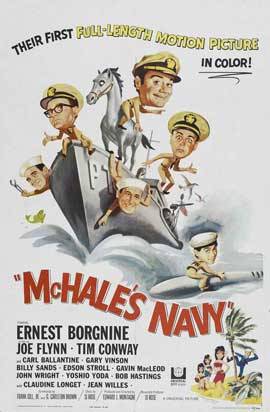
Photo: moviepostershop.com
During the run of the show, two big-screen movies were made based on the series: McHale’s Navy in 1964 and McHale’s Navy Joins the Air Force in 1965. Borgnine was unavailable for the second film due to a schedule conflict. The first film brought in a respectable $2,250,000 and the second netted $1,500,000.
Photo: ebay.com
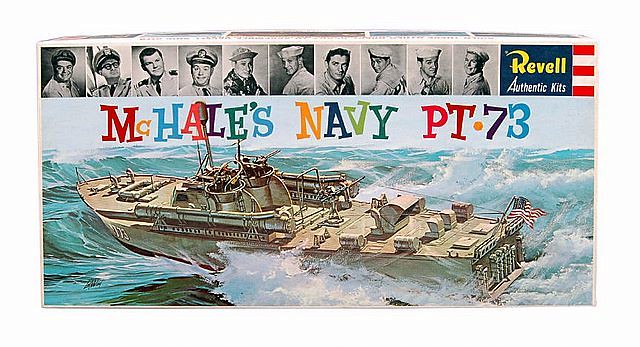
McHale’s Navy was a popular show both in the 1960s and in syndication. It may have been one of the first shows to produce related merchandise. Trading cards, comic books, a board game, 3-ring binders, and a model of the PT-73 were some of the items available to its fans. The show was well-written and the characters were fun and quirky. Unfortunately, a show like this can only sustain so many similar plots before it begins to feel like you’re watching repeats.
Photo: flickr.com Revell :: McHale’s Navy :: PT 73 Boat
The show is currently on Antenna TV Saturdays from 7-8 pm eastern time. It is also available on DVD. Take some time and enjoy getting to know McHale and his PT-73 crew.

























 thewritelife61