Leslie Nielsen: Always One to Let ‘er Rip

In this last blog in our series of Supportive Men, today’s actor might not be someone most people expect to see when talking about television. When most people think about Leslie Nielsen, they think of Airplane! and some of his other movies. While he did have a prolific movie career, he also has a well-deserved place in television. This guy amassed 259 (150 in television) acting credits during his six-decade long career.

📷tmdb.com

Nielsen was born in Saskatchewan, Canada in 1926. His mother was from Wales, and his father was a Royal Canadian Mounted Policeman. His older brother served in politics, being a Canadian Member of Parliament, a cabinet minister, and a Deputy Prime Minister of Canada. I read several sources that said his father was abusive, and Leslie wanted to move out as soon as possible.

Leslie enlisted in the Royal Canadian Air Force, serving until the end of WWII. He was legally deaf, wearing hearing aids most of his life, but he was able to train as an aerial gunner.

After the war, he worked as a disc jockey in Calgary, Alberta before enrolling at the Lorne Greene Academy of Radio Arts in Toronto. He was offered a scholarship at the Neighborhood Playhouse in New York.

📷wikipedia.com Bonanza

He made five television appearances in 1950 with the first being on The Actor’s Studio. He continued working in television, primarily on dramatic theater series, through the 1950s. In 1956, he had his first big-screen roles, appearing in four movies that year including Ransom, Forbidden Planet, The Vagabond King, (Nielsen later referred to this film as the “Vagabond Turkey”) and The Opposite Sex.

Leslie discussed his role in Forbidden Planet: “Supposedly a science fiction version of Shakespeare’s The Tempest . . . The Trekkies today regard it as the forerunner of Star Trek. I just had to wear a tight uniform and make eyes at Anne Francis. I was pretty thin back then.”

He became an American citizen in 1958 but continued to be proud of his Canadian citizenship as well.

While most of his credits for the late fifties were movies, he jumped back into television in the sixties, appearing in forty different shows. Many of them were dramatic theater roles, but you can spot him in Alfred Hitchcock Presents, Route 66, Wagon Train, Daniel Boone, The Wild Wild West, Dr. Kildare, Bonanza, The Man From U.N.C.L.E., and Gunsmoke. His only recurring role during this decade was on Peyton Place where he played Kenneth and Vincent Markham in 18 episodes.

📷pinterest.com on M*A*S*H

The seventies were almost a repeat of the sixties. His recurring role was on The Bold Ones. He also appeared in Medical Center, Mod Squad, M*A*S*H, Barnaby Jones, Hawaii Five-0, Kojak, Columbo, and The Love Boat.

1980 brought him the role of Dr. Rumack on Airplane!. Nelson’s deadpan delivery of lines in that movie is what most fans today remember about his career. Of course, his response to the line of “Surely you can’t be serious?” of “I am serious. And don’t call me Shirley” is still repeated today. Leslie said, “he was pleased and honored that he had a chance to deliver that line.” Film critic Roger Ebert once called him “the Laurence Olivier of spoofs.”
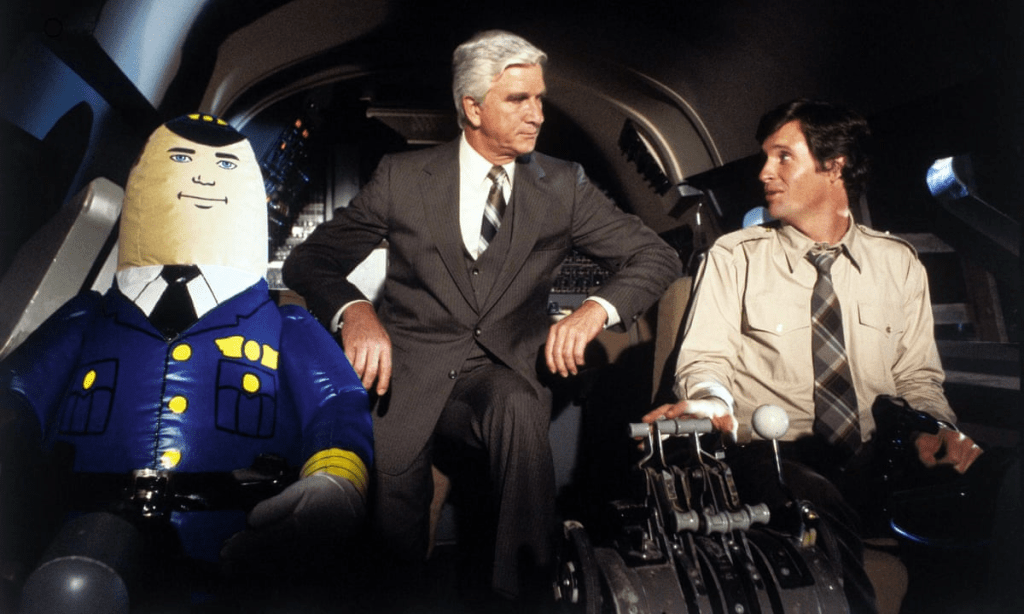
📷themoviebuff.com Airplane!

He continued in these types of roles in Police Squad and Naked Gun and the sequels. His movie roles increased in the eighties and nineties, but he continued to accept television roles off and on. You can catch him on Murder She Wrote, Highway to Heaven, Who’s the Boss, The Golden Girls, and Evening Shade.

His roles continued throughout the 2000s until his death, but the last decade included fewer memorable shows, although he worked less overall. When reflecting on this, Neilsen said that “I’m afraid if I don’t keep moving, they’re going to catch me . . . I am 81 years old, and I want to see what’s around the corner, and I don’t see any reason in the world not to keep working. But I am starting to value my down time a great deal because I am realizing there might be other things to do that I am overlooking.”
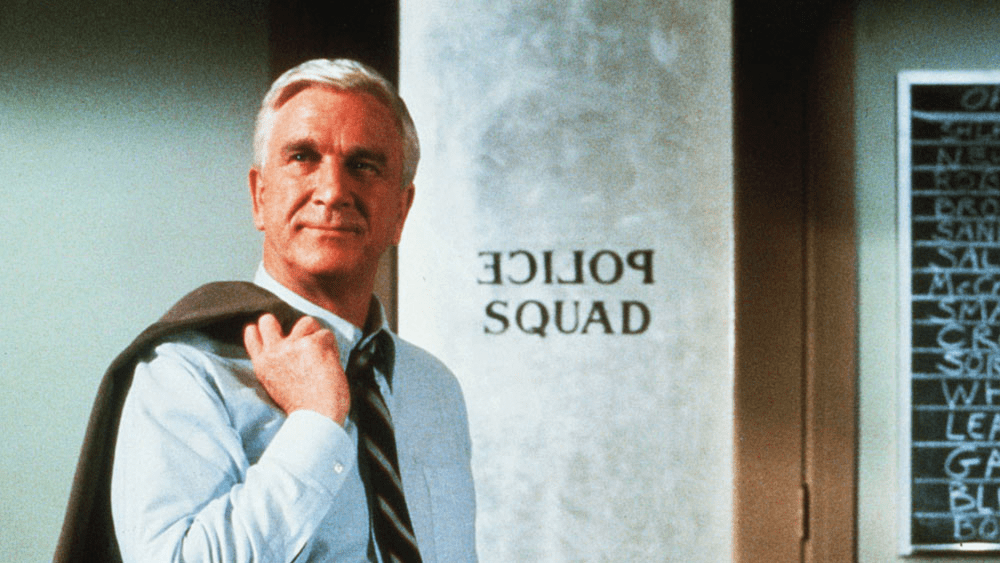
📷npr.org Police Squad

While Nielsen was very successful in his career, he was not as successful with his marriages. From 1950-56, he was married to Monica Boyar. His longest relationship was with wife Alisande Ullman from 1958-1973. He then married Brooks Oliver for two years from 1981-83 and then Barbaree Earl from 2001-2010.

One of his hobbies was golfing, and he later did some humorous instruction videos about the sport. He once said, “I have no goals or ambition. I do, however, wish to work enough to maintain whatever celebrity status I have so that they will continue to invite me to golf tournaments.”

Nielsen died in his sleep in 2010 from pneumonia.

He received two Walk of Fame stars: one in Hollywood in 1988 and one in Toronto in 2001. Nielsen was known for his flatulence gags, especially on movie sets, and his tombstone says “Let ‘er Rip.”

While Nielsen’s career is impressive, what I loved most about him is that he seemed to thoroughly enjoy life. That’s a great reminder for us all. Our best role should be enjoying life to the best of our ability.

Eddie Albert: The John Muir of Hollywood

This month we are looking at some of our favorite classic television actors. If you are a big fan of Oklahoma or Green Acres, you will be well acquainted with our star today, Eddie Albert. Let’s learn a bit more about his life and career.

Photo: imdb.com

Eddie was born Edward Albert Heimberger in 1906 in Illinois. When he was one, his family moved to Minneapolis. When he was six, he became a paper boy. He and his schoolmate, Harriet Lake, were in the drama club. Harriet would later change her name to Ann Sothern. After graduating in 1926, Albert enrolled at the University of Minnesota to major in business.

He began his career in earnest, but the stock market crash derailed his job search. He worked a variety of jobs including singer, trapeze artist, and insurance salesman.

Photo: closerweekly.com

In 1933 he moved to New York City and cohosted a radio show called “The Honeymooners-Grace and Eddie Show,” with costar Grace Bradt. He was on the show three years and then Warner Brothers offered him a contract.

Albert also had an early career on Broadway with lead roles in “Room Service” and The Boys From Syracuse.” He also began working on television. In 1936, NBC hosted a play of his “The Love Nest” on their experimental television station W2XBS, now WNBC.

His first movie role occurred in 1938 in Brother Rat. He would make 25 additional films during the next decade and then another 50 big-screen movies before his career ended, with his last one being the Narrator in Death Valley Days in 1995.

During his odd-job era, Albert had toured Mexico as a clown and trapeze artist with the Escalante Brother Circus while working for the US Army intelligence, photographing German boats in Mexican harbors. In 1942, he enlisted in the US Coast Guard. In 1943, he resigned in order to accept an offer as a lieutenant in the US Naval Reserve. He rescued 47 marines under heavy enemy fire in 1943 and was awarded a Bronze Star.

Eddie and Margo Photo: facebook.com

After returning from the War, Albert married Mexican actress, Margo. Their son also became an actor and their daughter took on the role of Eddie’s business manager. His son had more than 130 credits, the first being in 1963. You probably saw him on many of your favorite shows. Unfortunately, he passed away from lung cancer only a year after his father died.

During the late forties to the early sixties, Albert returned to Broadway for roles in “Miss Liberty,” “The Seven-Year Itch,” and “The Music Man.”

Albert had a long and active television career. During the fifty years that he was working in the industry, he appeared in almost 100 different shows. His first appearance was in the Ford Theater Hour in 1948.

Throughout the fifties, Eddie showed up in many of the early drama series on television. The sixties found him, along with most other actors of that decade, showing up on a variety of westerns, including Laramie, Tales of West Fargo, The Virginian, and Wagon Train. He was offered roles in several dramas as well, including Dr. Kildare, The Outer Limits, and The Man From U.N.C.L.E.

Photo: cinemacats.com

In 1965 he received the starring role of Oliver Douglas in Green Acres. For six seasons, he extolled the virtues of farming over the big city rat race. While Oliver had a harder time fitting into Hooterville life, his elegant wife Lisa was accepted immediately. If you have been reading my blog for a while, you know I love this show. I am more impressed with it now, fifty years later. There is so much sophisticated humor and wit in the show and I love getting to know the quirky characters who live in the Hooterville community. As Oliver Douglas, Albert was also on The Beverly Hillbillies and Petticoat Junction. The show was purged with the other rural comedies, even though the ratings were still quite high.

The seventies and eighties kept Albert busy on television and in films. He appeared on many shows including Columbo, McCloud, Here’s Lucy, Simon & Simon, Hotel, Murder She Wrote, and thirtysomething.

He opted to star in one more television series in Switch from 1975-78. He starred as ex-cop Frank McBride who started a detective agency with ex-con Pete Ryan (Robert Wagner).

Much of Eddie’s life was spent as an activist for social and environmental causes. He participated in the first Earth Day. He founded the Eddie Albert World Trees Foundation and was national chairman for the Boys Scouts of America’s conservation program. From 1985-1993, he was the spokesperson for the National Arbor Day Foundation. He was a trustee of the National Recreation and Park Association and became a member of the U.S. Department of Energy’s advisory board.

In addition, he was involved with Meals for Millions and was a consultant for the World Hunger Conference. Meals for Millions was a project that created nutritional meals for three cents each! They were sent to 129 different countries and added up to more than 6.5 million pounds of food. He and Albert Schweitzer participated in a documentary about malnutrition in Africa, and he often campaigned against DDT. He was also a director for the U.S. Council on Refugees and promoted organic gardening. Albert was also the founder of City Children’s Farms, a program to get inner-city kids involved in gardening.

I’m not sure when he had any other time for leisure and recreation, but he loved jogging, swimming, golfing, traveling, sculpting, beekeeping, sailing, reading, making wine, gardening, and playing guitar.

Photo: classicmoviehub.com

He 1995, Albert was diagnosed with Alzheimer’s disease. His son temporarily retired from acting to care for his father. In 2005, Eddie passed away from pneumonia.

When Albert passed away, we lost much more than an actor, although we did lose a great actor. I was so impressed with how much he did for the economy. He told a great story about his former costar Eva Gabor. She loved her fashion. They were great friends and like any couple, married or not, they had their differences. She never understood his passion for wildlife conservation. She asked him, “Every time you hear about a sick fish, you make a speech, vy?” And he patiently explained that we needed to preserve nature and save wild animals. A few days later she showed up in a gown made of feathers. He told her she should not be wearing it, and she said it was so chic. Albert told her that she was a role model, and when other women saw her gown, they would want one and many birds would die just to supply the feathers. Lisa just laughed and seriously said, “But Eddie, feathers don’t come from birds.” So he asked her where they did come from and she said, “Dahlink, Pillows! Feathers come from pillows.” In addition to being a great actor and an amazing activist, he was also a good and patient friend.

Not Anyone Can Pull a Stunt Like This

Since this month is a Potpourri Month, I thought it might be fun to look at the career of stuntmen on television. I’m calling this one “Propourri” because you have to be well trained to do these types of stunts.

Left to right: stuntmen Bob Miles, Bob Herron, Whitey Hughes, actor Michael Dunn, stuntman John Hudkins, Bill Shannon, and actor Quintin Sondergaard. Photo: famousfix.com

A stuntman or stuntwoman is a person who performs dangerous action sequences in a movie or television show. They have usually had extensive training to do these perilous moves safely. Sometimes they are hired as a team with a stunt crew, rigging coordinator, and special effects coordinator.

Stuntmen like Evel Knievel are daredevils who perform for a live audience. If someone fills in for a specific actor all the time, they are stunt doubles. So, what type of stunts do these professionals perform? Sometimes it’s car crashes, explosions, fights, or falls.

The first stuntmen to entertain audiences were performers who traveled around, often in circuses. Later these types of performers worked with Buffalo Bill and in shows that celebrated the Old West.

Today we are going to concentrate on television performers. Currently, stunt professionals must be certified to obtain the insurance producers need to obtain.

The Academy of Television Arts and Sciences now awards Emmys for stunt coordinators but there is no Oscar for this work.

Life-threatening injuries are not uncommon in this work and sadly, deaths do still occur. While most of my research found stuntmen killed in movies, I only found one relating to television. In 1985, Reid Rondell was killed in a helicopter explosion filming Airwolf.

I thought it would be fun to look at the careers of a few stuntmen from the golden age of television. Most of these men made their money in films, but all three of them had  successful careers working on television shows as well.

Whitey Hughes

Photo: findagrave.com

Whitey Hughes was born in 1920 in Arkoma, Oklahoma. He grew up on a farm, so in addition to working with plows and horse teams, he learned to break horses with his father. When he was sixteen, the family moved to Los Angeles. After graduating from high school, Whitey became a Screen Actors Guild member in 1947.

Whitey began his movie career in 1946. During the fifties, he worked on a lot of western films. Hughes said that in the early part of his career, he often had to be a double for the leading lady. (We’ll come back to this subject later in the blog.) He did stunt work for a variety of actresses including Anne Baxter, Rita Hayworth, Barbara Hershey, Virginia Mayo, Stephanie Powers, and Lana Turner.

Photo: westernclippings.com

Speaking of women, one of the roles, Whitey loved best was being the husband of Dotti; they were married for seventy years.

During the fifties, Whitey worked on a lot of westerns including Cheyenne. In the sixties, you would see him on Rawhide or as Kurt Russell’s double on The Magical World of Disney. If you want to see him in action, the best show to watch would be The Wild Wild West; his crew did some amazing things on that show and Whitey coordinated the stunt work for 1965-1968.

The eighties found him in Fantasy Island, Wonder Woman, and BJ and the Bear while in the nineties he was part of Little House on the Prairie and The Fall Guy. His last work was in a movie in 1998. In 2009, Whitey died in his sleep. It is good he died peacefully; I can’t imagine the toll that this type of work took on his body for fifty years.

Hal Needham

Photo: themoviedatabase.com

Hal Needham was born in 1931 in Memphis, Tennessee. He served as a paratrooper in the US Army during the Korean War. After the war, he worked as an arborist doing tree-topping services. He was also the billboard model for Viceroy Cigarettes while he was trying to establish his career in Hollywood.

Hal’s first big job was the stunt double for Richard Boone on Have Gun, Will Travel. From 1957-63 he was in 225 episodes. During the sixties, he would show up in many television series including Laramie, Wagon Train, Laredo, The Wild, Wild West, Star Trek, Gunsmoke, Big Valley, and Mannix.

Hal was the highest-paid stuntman in the world. That seems fitting because during his career he broke 56 bones, broke his back twice, punctured a lung, and lost a few teeth.

Needham was responsible for wrecking hundreds of cars, fell from many buildings, was dragged by horses, perfected boat stunts and was the first human to test the car airbag.

He revolutionized the work of stuntmen and worked to get his craft recognized and appreciated. He mentored up-and-coming professionals.

With Burt Reynolds Photo: youtube.com

His career transitioned from a stuntman to a stunt coordinator to a second unit director to a director. In all, he would work on 4500 television episodes and in 310 films, according to imdb.com. He made his directing debut on a movie he wrote called Smokey and the Bandit with Burt Reynolds and would go on to direct Hooper and The Cannonball Run for Reynolds among other series and films.

In 1977 Gabriel Toys debuted the Hal Needham Western Movie Stunt Set with a cardboard saloon movie set, lights, props, a movie camera, and an action figure that could break through a balcony railing, break a table and crash through the window. They have become highly collectible.

Photo: pinterest.com

Needham owned a NASCAR race team. He also set a Guinness World Record as the financier and owner of the Budweiser Rocket Car which is now on display at the Smithsonian’s National Air and Space Museum.

He also managed to win both an Emmy and an Oscar. Reynolds and Needham were close friends; Needham lived in Reynold’s guest house for 12 years and their relationship was used as the basis for the plot in Once Upon a Time in Hollywood.

Bob Herron

Bob Herron was born in 1924 in California. When his parents divorced, he moved to Hawaii with his father. The swimming and high diving he did there was a boost to his stunt career. His mother married Ace Hudkins who was a supplier of horses to the movie industry. Herron helped his stepfather in this business before enlisting in the Navy.

Photo: imdb.com

In 1950 he began doing stunt work. His first job was on Rocky Mountain with Errol Flynn and he was shot off horses. This would be a piece of cake compared to his role in Oklahoma Crude where he fell 55 feet from the top of an oil derrick into a stack of boxes.

In the sixties, he began his stunt work on television. He was in Gunsmoke, I Spy, I Dream of Jeannie, The Man from UNCLE, The Girl from UNCLE, Star Trek, Mission Impossible, Get Smart, and Bonanza. He doubled for Ross Martin in The Wild, Wild West. During the seventies, he appeared on Petrocelli, Little House on the Prairie, Marcus Welby, The Mary Tyler Moore Show, The Rockford Files, Kojak, and Charlie’s Angels among other shows. He was still going in the eighties doing his stunts on Hart to Hart, Magnum PI, Remington Steele, the Dukes of Hazzard, Matt Houston, Airwolf, The A-Team, and MacGyver. Despite being almost seventy, he continued in the nineties on shows like Father Dowling’s Murder Mysteries, The Wonder Years, and Murder She Wrote.

I did smile a bit to see shows like I Dream of Jeannie and The Mary Tyler Moore Show on this list. The Jeannie episode is one where she brings her great-grandfather to Cocoa Beach to show Tony how to desalinate water and the Mary episode is one where Sue Anne falls in love with someone who doesn’t return the feelings. I guess it proves you never know where a stunt person will show up.

I don’t know how he managed to survive sixty years performing dangerous stunts but he must have been in amazing physical shape.

I did promise to come back to men having to double for women in the forties and fifties. Thankfully, that is no longer the case, and women’s numbers are increasing among the 3400 stunt performers in SAG.

Former gymnast Shauna Duggins did the hard fighting work in Jennifer Garner’s show Alias. Because pay is determined by union contracts, stuntwomen do not suffer from the pay discrimination that sometimes shows up in the industry. Stunt performers are paid a minimum of $1005 for one day of work and they can negotiate higher pay based on their experience.

Shauna Duggins and Jennifer Garner
Photo: broadwayworld.com

Duggins was at the University of California Davis when she first thought about being a stuntwoman. She learned more about martial arts and spent hours working out in gyms after graduation. In 2000 she auditioned for stunt work in The X Files as Krista Allen’s double and got the job. Then she was in Charlie’s Angels for Kelly Lynch and Cameron Diaz.

It was after that movie that she got the role on Alias where she worked for five years. To protect these women, SAG has a 24/7 hotline for performers to phone if they feel they have been the victim of sexual abuse.

In 2018 Duggins won an Emmy after twenty years in the business. Her advice to young women who decide to make this their career: “train as much as you can in various skills. Go to different gyms with stunt performers, train with all of them and just learn from each other.”

I’m glad we took some time to learn about the tough and dangerous job these performers do. It was so interesting to learn a little bit about some of these industry stars.

Barbara Feldon Did Not Have to Get Smart: She Was Born That Way

This month’s blog is taking a look at some Supportive Women. First up is Barbara Feldon, costar with Don Adams in Get Smart.

Photo: getsmartwikifandom.com

Feldon was born Barbara Anne Hall in 1933 in Pennsylvania, near Pittsburgh. During an interview with Emerson College, Barbara talked about the ecstasy of performing in a little band in first grade. When things stopped, she got to play her triangle, and the thought that everyone was watching her, and her mother’s pride in seeing her made her want to perform more. In sixth grade she went into the gym to watch her friend doing her ballet lessons. The teacher invited Barbara to join them and played Tchaikovsky’s Nutcracker music; that combination of music and movement took her away to another place. She was hooked at that point, and she knew that she wanted to dance.

She trained at the Pittsburgh Playhouse and then graduated from Carnegie Mellon University with a BA in drama in 1955. They didn’t have a dance program, and her mother thought Bennington, where she wanted to go for dance, was too expensive and too liberal. While she enjoyed acting, it never had the enchantment for her that dance did.

Feldon made her way to New York and studied at the HB Studio. She briefly had a career as a showgirl at the Copacabana. She said “that was my first professional job in New York and it was probably the highlight of my whole career. We got to dance with Jimmy Durante. Oh, my God, it was a thrill.” They replaced the girls every three months so, then she went on to appear in The Ziegfield Follies. She landed one job that never made it to Broadway. A friend of hers who was a model talked her into exploring a modeling career.

Photo: punkglobe.com

She worked as a model and was in a Revlon commercial about a hair pomade for men, Top Brass. Feldon said commercials were excellent training to get experience in acting. You do the same scene over and over, maybe more than forty times, but you have to keep that spontaneity. “You must remember to stress each word properly and come in on a split-second when that camera rolls.”

Like several actresses that we have discussed in this blog, before Feldon got her first big break, she appeared on a game show. In this instance, she was on The $64,000 Question in 1955, and she won the grand prize of $64,000 in the category of Shakespeare.

She didn’t use her winnings to buy a mansion or live the typical party life. She opened an art gallery with a man who was a photographer and ad man who was no longer interested in advertising named Lucien Verdoux Feldon. Barbara would be the subject of a Warhol pop art painting in 1965.

In 1958 Barbara married Lucien Feldon. They divorced nine years later. She had a longer relationship with one of the Get Smart producers, Burt Nodella and when that ended, she moved back to New York City.

After her commercial debut, she received offers for several television roles in the early sixties including The Man From U.N.C.L.E. and Flipper. She was also offered a chance to appear on East Side/West Side with George C. Scott. Colleen Dewhurst was her mentor and Scott’s wife. He asked her to play his girlfriend in the next episode. Talent Associates which produced the show was working with Mel Brooks and Buck Henry on a potential spy spoof called Get Smart. Her second television role was as a spy. So, when Talent Associates was casting for a spy on Get Smart, she was an obvious choice.

Photo: facebook.com

She turned down the role at first because she didn’t want to move from New York to California, but she did love the script. They agreed to offer her a two-year contract instead of a five-year contract, and she accepted. Her first review was in TV Guide which compared her to the dog and concluded that the dog came off better. She was devastated and humiliated. In later years, the reviewer rated her performance much better.

From 1965 till 1970, Feldon was known as Agent 99 working with Maxwell Smart for CONTROL. In both 1968 and 1969, she was nominated for an Emmy for Outstanding Lead Actress in a Comedy Series. Lucille Ball won for The Lucy Show in 1968 and Hope Lange won for The Ghost and Mrs. Muir in 1969.

Women at the time looked at Feldon as an example of a powerful woman; Feldon commented that young women said “she was a role model for them because she was smart and always got the right answer.” If you look closely in the early seasons, you will typically see Feldon sitting and Adams standing because she was taller than he was. Once she even had to bury her feet in the sand. While Adams was the blundering, awkward Smart, it was Agent 99 who was really the “smart” one, getting him out of trouble during their spy missions.

Feldon said that she is not a comedienne; she is an actress who can play comedy. She said that she is the worst person to tell a joke to because she doesn’t always get it. She never enjoyed drama much because the actual acting on camera was wonderful but the long, boring hours waiting were very tedious, and if you have a tearful scene, you have to be able to keep the momentum.

During the run of Get Smart, Feldon also appeared on Rowan & Martin’s Laugh In and The Dean Martin Show.

Photo: imdb.com

After the show ended, she would appear on 20 additional television series including Cheers and Mad About You. She made fifteen made-for-tv movies, one of which was a 1989 movie, Get Smart, Again. She also could be found in six big-screen films including The Last Request, her last acting role, in 2006.

During my research, I read an article where pop culture historian Geoffre Mark commented on one of her movies, Fitzwilly, which I admit I have never seen. He said that it was a gem of a movie and that “Dick Van Dyke is brilliant in it and Barbara plays his love interest and she’s brilliant in it. She was playing a version of herself: a beautiful, sensual, highly intelligent woman with a strong moral compass and a loving heart. That’s what the character is and that’s who Barbara is.” According to imdb.com, the plot of the 1967 movie is that a butler and the staff of an eccentric aged philanthropist whose family wealth is exhausted engage in larceny and crimes to maintain her lifestyle and provide funds for her charitable activities.

Feldon was offered a cameo in the Get Smart movie with Anne Hathaway and Steve Carrell in 2008, but she declined. She said that “times have changed too much. The psychology of the writers and the audience has changed radically. Get Smart belongs in the 1960s, or it’s not going to be Get Smart.”

Despite her comment of Get Smart staying in the sixties, in 1995 Feldon took on the role of Agent 99 again in a brief reboot of Get Smart. Feldon discussed that series with The (Westchester County NY) Journal News reporter Karen Croke in 2017. She said that she and Adams never became friends after the original Get Smart. She said he was a lovely man and very funny, but they had their jobs to do and did their acting and then parted ways for the day. After they worked together on this series, they became very close friends in a way they could not have in their original show. She said once Don Adams died, Max also died and she can’t do any work as 99 without Max now. That might be the real reason she turned down the cameo in the Carrell-Hathaway film.

Photo: imdb.com

Barbara said it’s hard to make friendships on a set because it’s more like a factory and when you’re not acting, you might be resting or talking to your agent. The only person she said she was able to maintain a good relationship with after acting with him, was Alan Alda.

Apparently, she still enjoyed games shows and she appeared regularly in several of them including Hollywood Squares and The $20,000 Pyramid.

Feldon lost interest in acting, but she did numerous television and radio commercials and documentaries. In 1977, Barbara hosted a news show called Special Edition. In the 1990s she had a one-woman show she took around the country. She has also taken up writing and had two of her pieces published in Metropolitan Magazine. She wrote a book about living as a single person in 2003 called Living Alone and Loving It. She also enjoys writing poetry. In talking about her book, Barbara said, “I had been in relationships my whole life. I’d been married, then had lived with someone for several years. After those, I just assumed I would find another relationship. But it didn’t happen. As time went on with some good guidance, I learned how to live alone really happily. I’ve met a number of people—men and women—who feel living by themselves is a second-rate life. I thought that was sad, and since I had this technique of living alone, I decided to write a book. And I’m really glad I did.”

Photo: pixels.com

Feldon said that she has nothing but gratitude for Get Smart. She said acting is not a kind career and you only have a few years to be able to find your place, and she is grateful for being in the right place at the right time. I think after learning about Barbara Feldon, she manages to put herself in the right place at the right time often.

Now, her life sounds almost perfect. She lives where she wants to, is open to meeting a lot of people, attends concerts, advocates for the arts, and travels and writes whenever she wants to. During her life, she has managed to learn from so many experiences and during her life journey she definitely “got smart.”