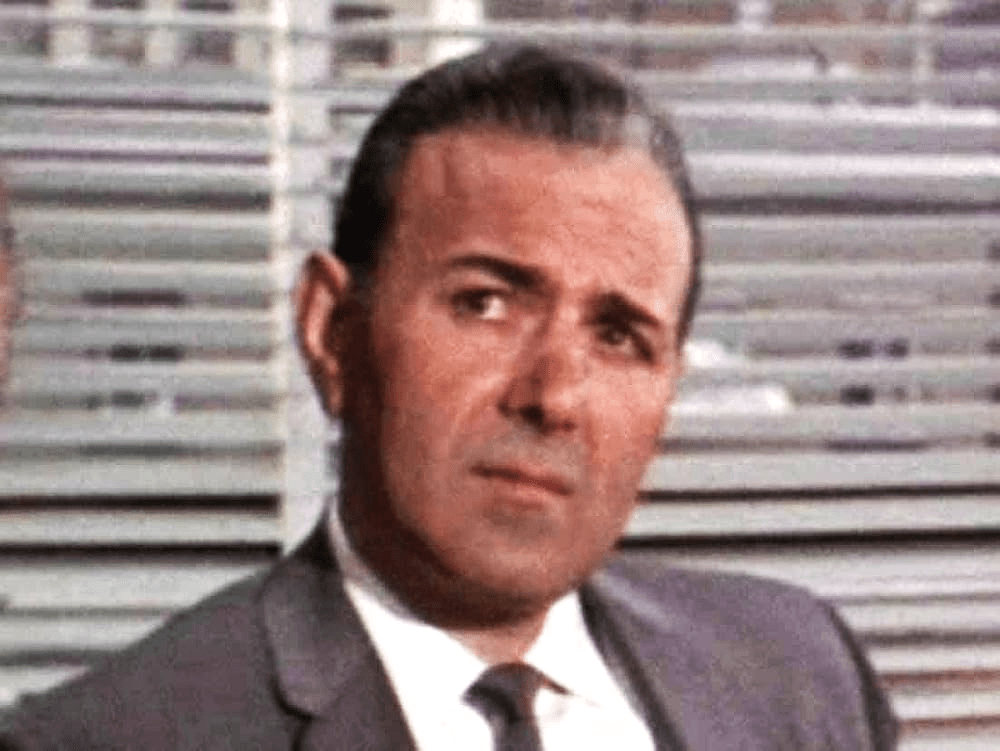
It’s November and it’s time for one of my favorite blog series, “What a Character.” Up today is Cosmo Sardo. Born in 1909 in Boston, he was lucky to keep his foot after an accident at age 14 when a car hit his bike and ran over his foot. After high school he majored in theatrical arts at the University of Massachusetts. Sardo began his career as a model in print ads for many companies including Sears Roebuck, Eddie Bauer, and Pepsi Cola.
📷imdb.com
Sardo made a reputation for himself in Boston theatrical circles before being cast in Oscar Wilde’s “The Importance of Being Earnest” in a downtown Los Angeles Theater in 1934.
In 1939 he made his way to Hollywood where he began a career in the film industry. If you can think of a profession, he probably played it: bartenders, retail clerks, postmen, bankers, waiters, detectives, reporters, businessmen, con artists, butlers, tailors, military men, cosmetologists, and barbers, which he perfected in real life. He even played a corpse in The Corpse Came COD.
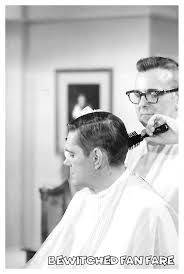
Sardo’s father told him if he moved to Hollywood, he had to have a trade to fall back on. He got a job at John’s Barbershop which just happened to be located under Central Casting. And one day it paid off when he was offered a job. Sardo had always wanted to be an actor, so he left his barbershop to take acting classes. He said that his wife thought he was crazy and left him, but I could never find any source showing his marriage. I’m guessing this is one of those articles publicists made up. He signed with Warner Brothers in 1946 to play a barber in Humoresque because they knew he had owned a barber shop.
📷facebook.com Cosmo cutting Dick York’s hair
Later, he opened Cosmo’s Hairstyling Salon of Hollywood where so many famous clients were taken good care of. It was around the corner from Schwab’s Drugstore, the famous spot where so many careers were apparently launched. He would cut hair between his acting assignments. In an interview in the sixties, he said that most actors “usually don’t want their hair cut. They want it trimmed. I can make a man look like he never had a haircut at all.” Sardo also offered massage, face contouring, and mud packs.
This guy had an amazing 578 acting credits. His first job was the big-screen film Brother Orchard in 1940. His last was as a priest in Hill Street Blues in 1984.
His first television appearance was in 1952 in The Adventures of Superman. He would go on to make tons of appearances on shows. He never was a regular cast member for a show, but he often starred as many different characters on many episodes for the most popular shows. For example, he appeared on Charlie’s Angels 6 times, Columbo 7 times, The Love Boat 10 times, Bewitched 13 times, Batman and Man from UNCLE 14 times, The Untouchables and Have Gun Will Travel 15 times, and a whopping 81 Bonanza appearances where he often portrayed a bartender.
📷wikipedia.com
When he wasn’t cutting hair or making movies or television episodes, he could be found instructing at the Pasadena Playhouse, worshiping at his Catholic church, working for the Democratic party, and dining or golfing at the Los Angeles Country Club.
After his death, his biography said that he never married, so he devoted his retirement to help charitable and religious organizations. He passed away in 1989.
It is frustrating trying to tell the stories of these great character actors. There is almost no personal information about them apart from their birth, their death, and their career. As a barber, I’m sure Cosmo had a lot of great stories he could share.
I don’t know how many haircuts he gave, but with 578 acting credits which translated into 878 individual appearances, this was one busy man. How fun that he had a trade and attained his dream job and kept doing both successfully until his retirement.
This month our blog series is titled “All About The Bill Dana Show.” The first week in March we learned about the show and now we have been spending time with some of the cast. We end our series with Don Adams.
Adams was born Donald James Yarmy in Manhattan in 1923. Don was a blend of cultures, Hungarian Jewish on his dad’s side and Irish-American on his mom’s. Don was raised Catholic while his brother Dick was raised Jewish. I could not find out what their sister decided to do. She later became a writer under the name Gloria Burton and wrote a script for Get Smart. His brother was also an actor. Dick has about 50 acting credits and appeared in many of the most popular sitcoms during the sixties and seventies, including three appearances on Get Smart.
Adams dropped out of high school and went to work as a theater usher. In 1941 he joined the US Marine Corp. At one point he was injured during a Japanese assault on Tulagi. He was the only survivor from his platoon. While recovering, he came down with blackwater fever, a side effect from malaria and was evacuated to New Zealand. He was not expected to recover, but when he did, he was sent back to the US as a Marine drill instructor.
After his discharge, he moved to Florida to work as a comedian. He refused to do material he considered “blue” and was fired.
In 1947 he married Adelaide Efantis, and her stage name was Adelaide Adams. Don decided to take the name Adams as well for his stage name. He worked as a commercial artist and cashier to support their family.
In 1954, Don was the winner of Arthur Godfrey’s Talent Scouts with a comedy act written by Bill Dana. He began making appearances on The Steve Allen Show, where Dana was a writer. In 1961 he became a regular on the Perry Como Show.
About this time, Don and Adelaide divorced, and Adams married Dorothy Bracken, another actress. They split up in 1977 when he married Judy Luciano, also an actress but that marriage also ended in divorce. (I could only find one credit for his last two wives; Bracken was on Get Smart, while Luciano appeared on The Love Boat.)
While discussing his marriages, Don said “I’m no longer independently wealthy. I guess it’s the result of too many wives, too many kids and too much alimony. I’ve been paying alimony since I was 14 and child support since 15. That’s a joke, but not by much. . . I like getting married, but I don’t like being married.”
In 1963 Adams was offered the role of Byron Glick, hotel detective on The Bill Dana Show. As we’ve discussed this month, the show was on the air for a season and a half. While working on the show, Don was also the voice of cartoon Tennessee Tuxedo which he continued doing until 1973.
During those years he also made an appearance on The Danny Thomas Show and on Pat Paulsen’s Comedy Hour.
In 1965 he was offered the role of Maxwell Smart in a new spy satire, Get Smart.
The sixties saw westerns being overtaken by spy shows such as The Man From U.N.C.L.E., I Spy, The Pink Panther, and The Avengers. Mel Brooks and Buck Henry decided to try their hand at writing a campy sitcom and Get Smart was born.
The role of Smart was created for Tom Poston, but ABC turned it down, and NBC said yes. They had Adams under contract, so he got the part. Rounding out the cast was Edward Platt as the Chief and Barbara Feldon as Agent 99.
Smart and 99 had great chemistry and married in a later season. Feldon and Adams remained life-long friends.
One of the most memorable parts of the show was all the catch phrases Adams created on the show including “Sorry about that Chief,” “Would you believe,” and “Missed it by that much.”
In addition to acting, Adams worked as a producer and director on the show. He was nominated for an Emmy from 1966-1969. He won three of those, losing to William Windom for the little-remembered one-season show, My World and Welcome to It. Lloyd Haynes from Room 222 and Bill Cosby for The Bill Cosby Show were also nominated that year.
The show moved to CBS for the final season, but the ratings never recovered, and the show was canceled after that year.
Like so many of our successful actors with unusual characters, Adams suffered from typecasting after the show ended. He did become part of two additional sitcom casts during his career.
In 1971 he was on The Partners. According to imdb.com, the plot is that “Lennie Crooke and George Robinson are inept detectives teamed up to solve crimes. Captain Andrews is their exasperated boss, Sgt. Higgenbottom is a smarmy co-worker, and Freddy confesses to most of the neighborhood crimes.” Adams played Crooke, but the show only produced 20 episodes.
In 1985, Adams tried a sitcom again on Check it Out. This one was about a grocery store and its employees. Adams played Howard Bannister. The show lasted three seasons, ending in 1988. The show was not very popular in the US but was a hit in Canada.
In between those two shows, Adams appeared in a handful of series including Fantasy Island, The Fall Guy, The Love Boat, Empty Nest, and Nick Freno: Licensed Teacher. He made most of his salary appearing in nightclubs. He also had his Smart character resurrected in several big screen films and television series.
Because of the typecasting, he returned to animation and found a lot of success, especially with Inspector Gadget which he voiced from 1983-1999.
He also tried his hand at a game show. Called Don Adams’ Screen Test, it had an interesting concept. The show was filmed in two 15-minute parts; Adams would randomly select an audience member to recreate a scene from a Hollywood movie such as From Here to Eternity with Adams as director. It ended after 26 episodes.
In his spare time, it sounds like he visited the racetracks, betting on horses. He also spent a night a week at the Playboy Mansion playing cards with Caan and Rickles. He loved history and studied Abraham Lincoln and Adolf Hitler in depth. He also wrote poetry and painted.
Don passed away in 2005 from a lung infection and lymphoma. The eulogists at his funeral included James Caan, Bill Dana, Barbara Feldon, and Don Rickles.
It’s hard to know what to make of Adams’ career. Obviously, he was hard working, an excellent Marine, and a man of many interests. He was fired for not performing blue material but then put horse racing and gambling above the needs of his family, according to several of his friends. He created the amazing role of Maxwell Smart, one of the best characters in television history, but that feat kept him from achieving other great roles in the following decades due to typecasting. It sounds like Check It Out was very popular in Canada, so maybe if he had been given a few chances to create characters different from Smart in a couple other sitcoms, it would have helped.
I feel bad for those actors who are so successful in the characters they help create that they are barred from future jobs, but then again, those characters are some of the best actors in television: George Reeves as Superman, Ray Walston as My Favorite Martian, Henry Winkler from HappyDays, Frank Cady from Green Acres, and Jack Klugman from The Odd Couple. I guess you trade being warmly remembered for fewer quality roles.
Apart from Get Smart, I knew little about Adams before writing this blog, so it was fun to get to know him a bit.
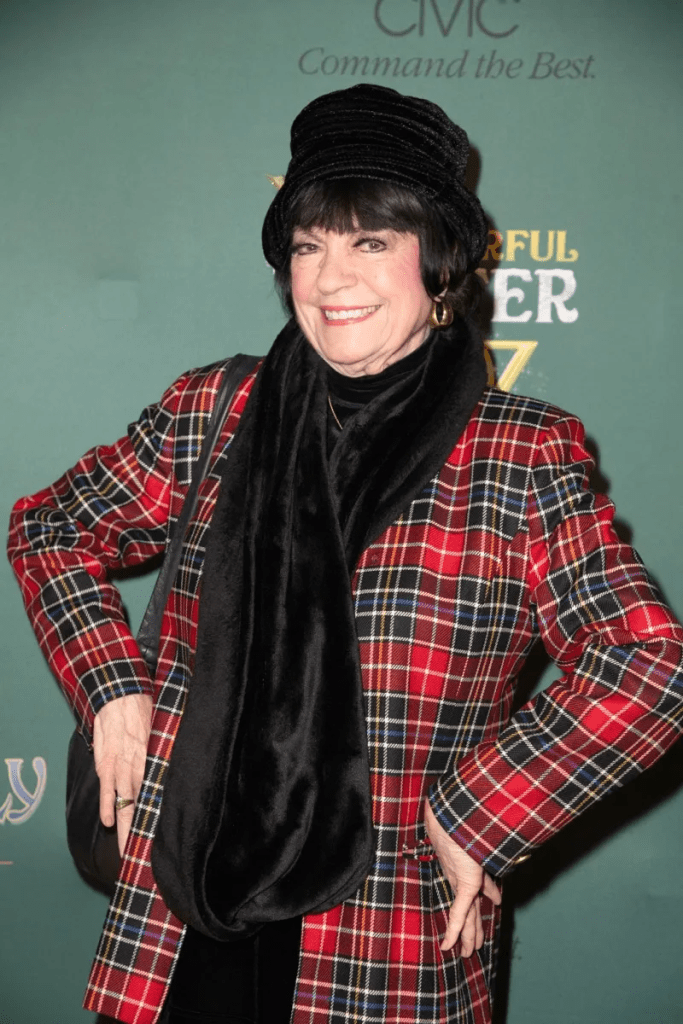
We are winding up a blog series about Supportive Women. One of the women I wanted to include was Jo Anne Worley. I didn’t know much about her apart from her appearances on Rowan & Martin’s Laugh-In and being in my favorite made-for-television movie, The Feminist and the Fuzz.
Jo Anne was born in 1937 in Lowell, Indiana. Her loud voice was not an acting tool. She always felt she was loud. She said, “I have a big mouth, and I’m sorry to say I’ve always had one. When I was young, in church, I never sang with everybody else. I only mouthed the hymns, so I wouldn’t drown anyone else out. I have my quiet moments. But I don’t have many.” She was named school comedienne at her high school.
In one interview with a Lowell reporter, she said “I’ll never forget the place I’d work every summer while in high school. It was called Robert’s Hotel, Gas and Café, and it was at the intersection of US 41 and Highway 2. They had an old juke box in the café where I worked, and I’d sing and joke around whenever the business was slow, which seemed like most of the time.”
After graduation, Worley moved to Blauvelt, New York to work with the Pickwick Players. She was later offered a scholarship to Midwestern State University in Wichita Falls, Texas. After two years at the school, she moved to Los Angeles City College and enrolled at the Pasadena Playhouse. Her first musical role was in “Wonderful Town.”
📷hellodolly.com
In 1961 she was in the off-Broadway musical show “Billy Barnes Revue” with Charles Nelson Reilly and Larry Hovis (who was Carter on Hogan’s Heroes). The original show in 1959 featured Bert Convy, Joyce Jameson, Patti Regan, Ken Berry, Ann Guilbert, Jackie Joseph, and Len Weinrib.
Jo Anne was in two episodes of The Many Loves of Dobie Gillis in 1961-2. During the rest of the sixties, she was offered several big-screen roles.
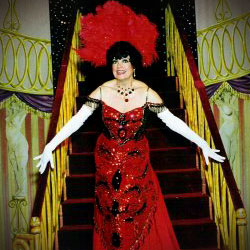
In 1964 she was given a role in “Hello, Dolly.” A year later she developed her own comedy and singing act in Greenwich Village where she was discovered there by Merv Griffin.
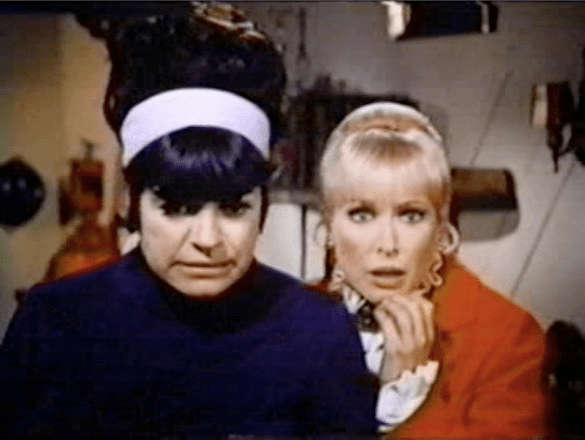
📷palmspringslife.com Laugh-In
Griffin encouraged her to appear on his show which she did forty times. Like Marcia Wallace, who we learned about last week, her appearance on Merv Griffin was seen by someone who recommended her for a new show. In this case, George Schlatter cast her in Rowan & Martin’s Laugh-In.
Worley left the show in 1970. She made guest appearances on The Tonight Show Starring Johnny Carson. She also appeared on several game shows, including SuperPassword, HollywoodSquares, and many versions of Pyramid.
In 1971 she made the television movie I discussed above, The Feminist and the Fuzz. It starred David Hartman, Barbara Eden, Farrah Fawcett, Worley, Julie Newmar, and Henry Morgan. I would love to see it again.
For most of her career, Worley would be providing voices for animation. However, she appeared in a handful of shows during the seventies and eighties, including Adam 12, Love American Style, Hawaii Five-0, CHiPs, Murder She Wrote, The Love Boat, MadAbout You, Curb Your Enthusiasm, and The Middle.
📷modcinema.com Feminist and the Fuzz
In 1975, Worley married Roger Perry. They would stay together for 25 years, divorcing in 2000. Perry has 95 acting credits and appeared in many popular shows in the seventies, eighties, and nineties. He was also in The Feminist and The Fuzz. After divorcing Worley, he would marry actress Joyce Bulifant.
During the seventies and eighties, Worley did a lot of regional theater in Milwaukee and several cities in California.
In the 1990s she got involved with Disney and provided her voice for Beauty and the Beast and A Goofy Movie. She also was on several Disney series including Kim Possible and the Wizards of Waverly Place.
📷bestlife.com
She was in a limited run of a musical production of “The Wizard of Oz,” playing the wicked witch of the west in 1999. In 2007, she appeared on Broadway as Mrs. Tottendale in “The Drowsy Chaperone,” and she reprised the role in 2015 at The Cape Playhouse. She was also cast in “Wicked” as Madame Morrible in 2008.
Jo Anne Worley once said, “my goal in life is to be the kind of person my dog thinks I am.” That seems to be good advice for all of us. It was fun getting to know a little more about this funny woman. We love her as much as her dog did.
When trying to decide who to include in our Supportive Women blog series this month, Marcia Wallace was a no-brainer. Carol was one of my favorite characters on television on The Bob Newhart Show, and I love the fact that her role carried over into an episode of Murphy Brown.
Marcia Wallace was born in 1942 in Iowa. Her father owned a general store where she and her siblings often worked. After performing in a school play, one of her teachers encouraged her to pursue an acting career. After graduation, Marcia enrolled in Parsons College in Fairfield, Iowa where she received a full scholarship. She majored in English and Theater.
Upon her college graduation, Marcia decided to move to New York. The country gal had $148 in her savings. When she arrived in the Big Apple, she took on a variety of part-time jobs including typing scripts and substitute teaching. She joined a summer stock company and did a few commercials. She worked in a Greenwich Village nightclub for a year before creating an improv group, The Fourth Wall, with several friends. While she kept the friends, she lost 100 pounds.
Eventually, Wallace was offered a job with The Merv Griffin Show. When Merv decided to move to LA, he asked Wallace to move with them. She was able to obtain a few roles in series after moving to California. During the sixties and early seventies, she was on Bewitched, The Brady Bunch, Columbo, and Love American Style.
📷tvinsider.com
After Bill Paley had seen her on Merv Griffin, Grant Tinker (producer) called her to offer her a role on a new sitcom, The Bob Newhart Show. The role of Carol was written specifically for her.
Marcia loved her time on the sitcom. She said Bob was the Fred Astaire of comedy, making it look so easy. She also praised Bob for being a treasure. Because of the way the scripts were written, the show doesn’t date itself. It was about human relationships and people struggling to make them work and make life better.
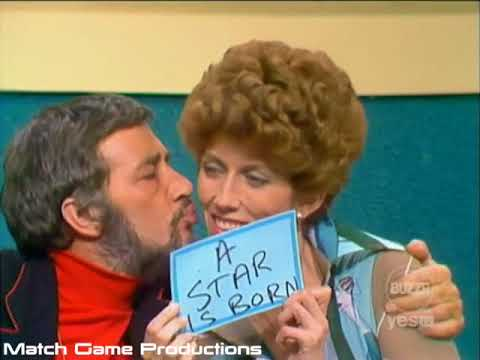
When The Bob NewhartShow went off the air six years later, Marcia jumped on the game show circuit. Shecould be seen on Password Plus; Super Password; Hollywood Squares; Crosswits; Hot Potato; The $25,000 Pyramid; Win, Lose, or Draw; Tattletales; To Tell the Truth; Family Feud; Card Sharks; and my favorite, Match Game.
📷youtube.com
Like so many actresses and actors who perform their role so well, Marcia was typecast after the show ended. In an interview, she said that “I have heard ‘You’re too recognizable for this part.’ I remember once, I desperately wanted to be on the series Nine to Five and they just weren’t going to see me because of that. Every once in a while, something would break my heart.”
Wallace also made appearances on The Love Boat and Fantasy Island in the seventies. During the eighties she would show up on CHiPs, Magnum PI, Taxi, Murder She Wrote, Night Court, and ALF, among other shows.
One of my favorite appearances of Wallace’s occurred in the mid-nineties on Murphy Brown. If you were a fan of that show, you know Murphy could not keep a secretary. There was even a support group that started of her former secretaries. However, when Carol Kester came to work for her, she was overjoyed. Carol was the role Wallace played on The Bob Newhart Show. Unfortunately for Murphy, at one point during the show, Bob Newhart shows up and convinces Carol to return to work for him and Jerry and Murphy lost her perfect assistant.
Most of Wallace’s work after 2000 was for voice work with one exception. In 2009, she had a recurring role on The Young and the Restless as Annie Wilkes for 14 episodes.
In 1985 Marcia was diagnosed with breast cancer. She survived it and became an activist and lecturer on the topic. In 2007, she won the Gilda Radner Courage Award for her work in this area.
In 1986 Marcia married Dennis Hawley in a Buddhist ceremony. Dennis renovated and managed hotels. The couple adopted a little boy, but Dennis passed away three years later.
📷imdb.com
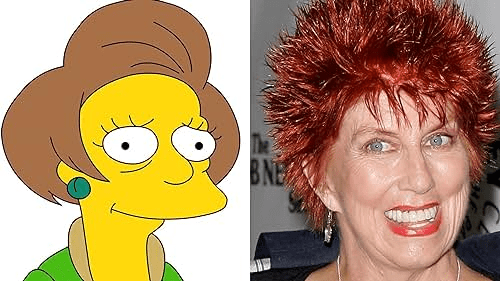
In 1989, a new type of show debuted called The Simpsons. Marcia was asked to provide the voice of Edna Krabappel, school teacher. She probably did not realize she would be associated with that role for another 24 years. Her role as Edna did not end until her passing.
In addition to her television work, Wallace performed on stage. She produced and starred in “An Almost Perfect Person,” a female version of “The Odd Couple,” “Same Time, Next Year” and many others.
In 2004, Wallace published an autobiography, Don’t Look Back, We’re Not Going That Way. She honestly discussed her breast cancer, the loss of her husband, her nervous breakdown, being a single mother, and the ups and downs of her career.
Marcia died from pneumonia and sepsis in 2013. Her coworkers commented on her passing. Yeardley Smith, who voices Lisa on The Simpsons, said “Heaven is now a much funnier place because of you, Marcia.” Bob Newhart said that “Marcia’s death came as quite a shock, she left us too early. She was a talented actress and dear friend.”
📷onceuponascreen.com
I’m so sad that Marcia was typecast and unable to get the roles that she wanted. The networks were very shortsighted during those decades. They didn’t give television fans enough credit for being resilient enough to love the character of Carol while being able to love another character played by Wallace. You saw the same things happen to Adam West, Alan Alda, and Henry Winkler. If that perspective had continued, we never would have had Mary Richards on The Mary Tyler Moore Show or Jay Pritchett from ModernFamily. If someone could be a hit as Al Bundy and then go on to star in another show, anyone can get beyond being stereotyped. Marcia Wallace proved that anyone could survive life’s disappointments with determination and a sense of humor, and perhaps that was her greatest role for us.
During this month of Supportive Women, I am excited to learn more about Vera Miles. For four decades, Miles appeared in our homes as well as on the big screen. With 162 credits, she may have visited your living room more than most of your family members.
📷facts.net
Vera Ralston was born in Boise City, Oklahoma in 1929. She grew up in Pratt, Kansas, and later she moved to Wichita where she graduated from high school and worked nights as a Western Union operator-typist. In 1948 she won the Miss Kansas pageant and was third runner-up in the Miss America contest that year. Miss Minnesota won the crown.
A year later she moved to Los Angeles to pursue a career in television and movies. Not long after arriving in Hollywood, Vera married photographer and stuntman Bob Miles. One source said that she enrolled at UCLA, hoping to become a teacher.
Bob Miles has 13 acting credits and 14 stuntman credits. The cast of Bonanza must have liked him because he appeared as a stuntman 99 times and as an actor on the show 76 times.
📷photos.com
After the birth of her children, she began doing some modeling and taking on a few roles to help provide income. Vera used her husband’s last name because there was already a Vera Ralston in the industry.
She appeared as a contestant in a 1951 episode of You Bet Your Life with Groucho Marx. Along with her partner, she won $8 in the quiz portion of the show but gave the wrong response to the De Soto-Plymouth question which was “Who was the first Chief Justice of the Supreme Court?” When Groucho asked her what titles she had held as a beauty contestant, in addition to Miss Kansas, she mentioned that she was Miss Chamber of Commerce, Miss Wichita, Miss Texas Grapefruit, and Miss New Maid Margarine.
She received her first movie role in 1950 and her first credit in 1952. In The Rose Bowl Story, a romantic comedy, she played a Tournament of Roses Queen. She would appear in about 40 additional movies during her career and quite a few made-for-television movies as well. She often worked with Alfred Hitchcock and was cast in Psycho.
In 1951 she appeared on Fireside Theater, her first television role. While she had more than 100 credits performing on television, surprisingly she never starred in a series. The only recurring character she had was Ernestine Coulter on My Three Sons.
📷fotogrammas.com
In 1956 she married Gordon Scott after divorcing Miles in 1954. They also divorced in 1960. Scott appeared to only work in Hollywood for a five-year period according to imdb.com. From 1960-1971 she tried marriage again with Keith Larsen, but their marriage also ended in divorce. Since the third time was not the charm, for two years in the mid-seventies, she wed Robert Jones but that ended in divorce as well.
During the fifties, she fit roles around her movie appearances, and you can see her in episodes of dramatic theater shows. In the sixties, she had no trouble finding work and she showed up on The Twilight Zone, Route 66, Wagon Train, I Spy, The Man from UNCLE, The FBI, and Mannix. Work did not slow down in the seventies, and you can spot her in a variety of shows including Gunsmoke, Hawaii 5-O, Bonanza, Cannon, Columbo, and Barnaby Jones. She might have taken thing a bit easier in the eighties, but she still worked on four or five shows a year, including Magnum, PI; Little House on the Prairie; TheLove Boat; Hotel; and Murder She Wrote. Her last credit was for a movie titled Separate Lives in 1995.
📷imdb.com
Miles was a member of the Church of Jesus Christ of Latter-Day Saints and visited Salt Lake City quite often.
Early in her career, Miles appeared to be almost a clone of Grace Kelly but that never materialized into a movie star career. Hitchcock hired her for Vertigo with Jimmy Stewart, but her pregnancy caused her to back out of the movie, and Kim Novak received the starring role. Perhaps, that movie would have changed the trajectory of her film career. I’m surprised that she was never given an opportunity to star in a television show. With 162 credits, she had a prolific and busy career. I will definitely try to spot her when I watch some of my favorite classic shows.
We are winding up our series, Casting Celebrities. This month we have looked at several shows that relied on stars for their characters every week. We’ve checked out Love American Style, Fantasy Island, and The Love Boat. If you don’t remember today’s show, don’t beat yourself up about it. It was on the air for less than three months. That said, they still had a lot of stars show up. While Love American Style had 109 episodes, Fantasy Island claims 154, and The Love Boat includes 250, this show had 9!
Supertrain debuted on NBC in February of 1979. Here is part of the problem: it was described as a science fiction-adventure-drama. Sounds like a show that isn’t sure what it is.
📷imdb.com
Instead of an exotic island or a cruise ship, this show takes place aboard a nuclear-powered high-speed super train. However, it might as well have been a cruise ship. You could swim in the pool, go to the gym, or the library. There was plenty of shopping and nightlife including a discotheque. It ran between New York City and Los Angeles, with stops in Chicago, Denver, and for some strange reason, a fictional town of Desert Junction in Texas.
Problem number two for the show: it was the most expensive series to be produced at that time. NBC paid $10 million for three trains. There was a full-size train with passenger cars and two model trains for exterior shots.
Ned Parsons was brought on as art director to build the train. Parsons moved from his home in Newport Beach to the MGM studio lot for three months. He was on call 24 hours a day, supervising 200 construction workers who covered three shifts. The costs to do this averaged $60,000 a day for building materials. The lumber used for the set could have built 22 homes.
📷thehollywoodreporter.com
Before the show even aired, it was reported that the network had spent $12 million dollars. And despite the high cost of the train, there were a lot of complaints about it being unattractive and unrealistic. It was described as dark and dingy; one article said it was more of a superbus than a supertrain. Although they publicized this train as a high-speed one, viewers asked if it goes 200 mph, why does it take so long to go from New York to Los Angeles?
Problem number three: it was heavily advertised but received poor reviews and low ratings. More people tuned in to watch a 2-hour episode of Charlie’s Angels than the 2-hour debut of this show.
Problem number four: to help the quality and ratings, the producer was replaced, the cast was cut in half and some of them switched jobs, and it became more of a sitcom , and it was moved from Wednesdays to Saturdays. What? Remember this show only lasted nine episodes.
Once the cast shake up took place, five remaining characters were left. Dr. Dan Lewis (Robert Alda), nurse Rose Casey (Nita Talbot), conductor Harry Flood (Edward Andrews), relations officer Dave Noonan (Patrick Collins), and chief porter George Boone (Harrison Page). Seems like an experienced and quality cast, so I don’t think any of the blame falls on them.
The BBC bought the show for $25,000 an episode before it was shown on American television. Their plan was to begin airing the show in the fall of 1979, but remember by May of 1979 the show was off the network so BBC never aired any of the episodes.
One bright spot coming through the tunnel for the show was the music, with the exception of the second theme song which was listed as blah. Bob Cobert provided the primarily disco music. Cobert won an Emmy for his music in War and Remembrance.
Supertrain has been called one of the greatest television flops ever and that’s not an exaggeration. Here are a few of the reactions critics had to the show in 1979. A Variety review said “it’s a Love Boat on wheels which has yet to get on track.”
📷imdb.com
TV Guide reviewer Robert MacKenzie said that “in the long two-hour premiere, Steve Lawrence was a talent agent and gambling addict in debt to a gangster named Big Ed. Aboard the Supertrain, someone kept trying to put Lawrence away by planting a suitcase bomb in his room, dumping him into a pool when he was unconscious, and locking him in a steam room with friend Don Meredith. Our attention was called to several suspects . . . sometime in the second hour I wanted to get off and catch a bus home.”
Telefilm Review shared that “NBC’s highly promoted show Supertrain features a slick new train of tomorrow, with a script from yesterday . . . it seeks to overwhelm but underwhelms instead.”
Nothing I read gives me any reason to contradict any of these reviews. One fun story I could take away from this debacle was building the train and then what happened to such a behemoth and the model trains? We know one of the model trains crashed and was ruined during the show’s production. Were the others scrapped to recoup at least a small cost? Nope.
📷theherald-mail.com
According to a Herald-Mail article from July of 2018, Ben Thoburn went to Hagerstown to pick up a jukebox he purchased and saw an old train in the guy’s barn. It was much bigger than a typical model railroad set. Plexiglass served as windows and it had a futuristic design.
Thoburn bought the train and then set about researching it. Jack Morrissey was a LA film producer who bought the train from Thoburn. According to Thoburn, NBC sold the model train to a manufacturer in Philadelphia. When the company went bankrupt (maybe the train is cursed), the train was left in its headquarters. A cabinet maker eventually bought the building and sold the train to the man Thorburn bought it from. Because some other items were stacked on some of the cars, there was a little bit of damage. Morissey didn’t have specific plans for the train; he just wanted a piece of television history. At least something good was salvaged from this otherwise not-good show.
📷losangelestimes.com bill barty
While we are finished with our exploration of the four shows that featured stars in their casts, I did promise to provide one more fun fact. There are a lot of stars who were on Fantasy Island and The Love Boat. When you add in Love American Style, that number is still quite high. However, remember Supertrain was only one the air for nine episodes. So what stars appeared on all four of these series? Let’s find out.
elaine joyce
That roster includes eleven stars. None of the crew or staff appeared on all four shows. Regular cast members Edward Andrews and Nita Talbot both appeared on all four shows. Henry Jones shows up on all of them, but I do have a disclaimer that he was on The New Love American Style, a reboot that happened in 1985. We are left with Billy Barty, Hans Conried, Steve Franken, Elaine Joyce, Bernie Kopell, Roddy McDowell, Abe Vigoda, and Keenan Wynn as the remaining stars who can be found on all four shows. Equally as fascinating was the fact that Ron Delaney, Al Hansen, Disco Flo, Michael Minor, Chris Moriana, Bob Shaw, and Annie Starr only appeared on Supertrain and they have no other acting credits at all. Was their affiliation with the show so bad they quit acting? Who knows without a lot more research.
I hope you enjoyed learning more about these celebrity shows and learning which stars managed to get jobs on all four of these shows.
This month in Casting for Celebrities, we are looking at some of the shows that used television and movie stars in their casts every week. The Love Boat was on the water from 1977 until 1986. An extension of the show, The Love Boat: The Next Wave, was on from 1998-1999 with many of the original characters. There were also four three-hour specials aired in 1986, 1987, and 1990.
If you are one of the five people in America that have never seen the show, it aired on ABC on Saturday nights. It was another Aaron Spelling production like Fantasy Island which we discussed last week.
A book, The Love Boats, by Jeraldine Saunders who was a cruise director for a passenger cruise line was used as the basis for the original made-for-tv movie in 1976.
The stars on this show played guests (and occasionally themselves) on the MS Pacific Princess run by Captain Merrill Stubing (Gavin MacLeod). His crew included Dr. Adam Bricker (Bernie Kopell), Purser Gopher Smith (Fred Grandy), bartender Isaac Washington (Ted Lange), and cruise director Julie McCoy (Lauren Tewes). In season three, Stubing’s daughter Vickie (Jill Whelan) came aboard. During the last three seasons, photographer Ace Covington Evans (Ted McGinley) joined the group and Judy McCoy (Patricia Klous) who was Julie’s sister took her place for the final two seasons.
📷julienslive.com
Lucky crew, this series was sometimes set on board the Pacific Princess or the Island Princess, depending on their schedules. A handful of other boats were used in several episodes and movies as well. Many of the shows were filmed in California. Unfortunately, both the Pacific Princess and the Island Princess were sold for scrap in 2013 and 2015 respectively.
Each episode contained several stories and all three titles are combined in one series title; for example “Captain & the Lady/Centerfold/One If by Land.”
Jack Jones sang The Love Boat theme. (Note: Dionne Warwick recorded the song for the final season, but I never learned why.) The lyrics were written by Paul Williams and the music was composed by Charles Fox. The words were:
Love, exciting and new Come aboard, we’re expecting you Love, life’s sweetest reward Let it flow, it floats back to you
Love Boat soon will be making another run The Love Boat promises something for everyone Set a course for adventure Your mind on a new romance
Love won’t hurt anymore It’s an open smile on a friendly shore Yes, love It’s love
Love Boat soon will be making another run The Love Boat promises something for everyone Set a course for adventure Your mind on a new romance
Love won’t hurt anymore It’s an open smile on a friendly shore It’s love, it’s love, it’s love It’s the Love Boat, it’s the Love Boat
📷reddit.com
For its first seven seasons, the show was very successful. It usually ranked in the top twenty. However, after falling out of the top thirty and then the top fifty the next year, the show was canceled after nine years.
Spelling offered McLeod the role of Captain Stubing. Ted Lange did not have to audition. He was offered the role after being seen on a previous show, That’s My Mama. Spelling’s first choice for Dr. Bricker was Dick Van Patten but because he was involved with Eight is Enough, Kopell got the role. Lauren Tewes was chosen from a group of more than a hundred actresses auditioning for the role.
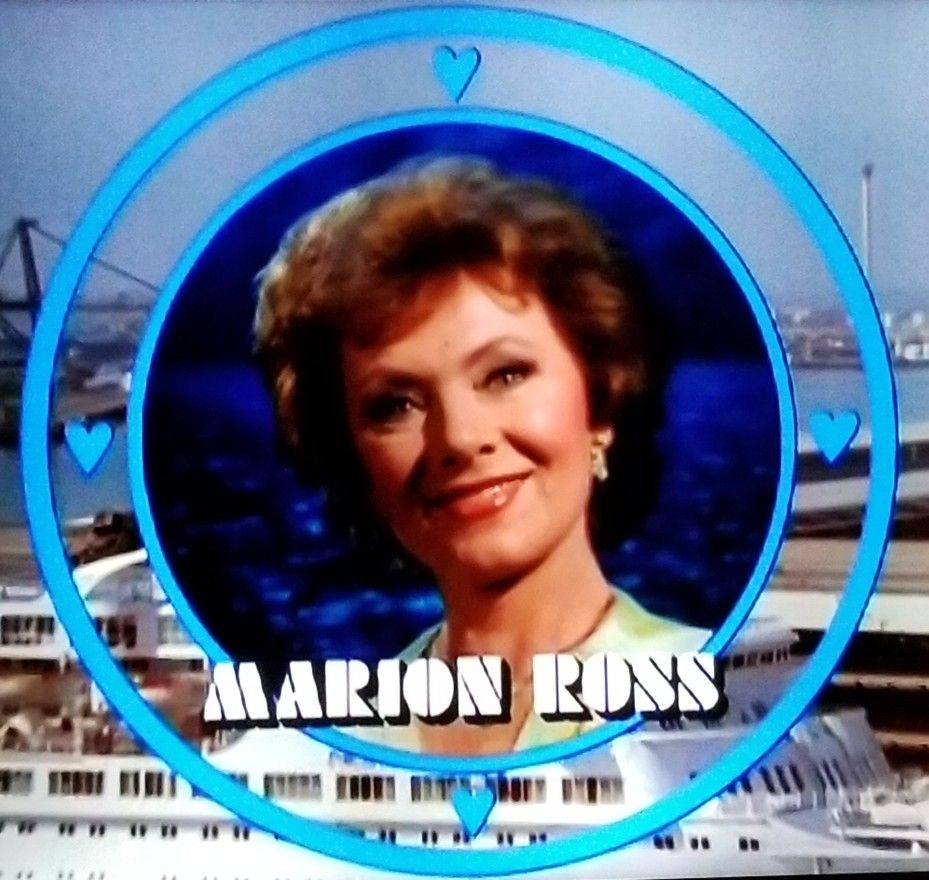
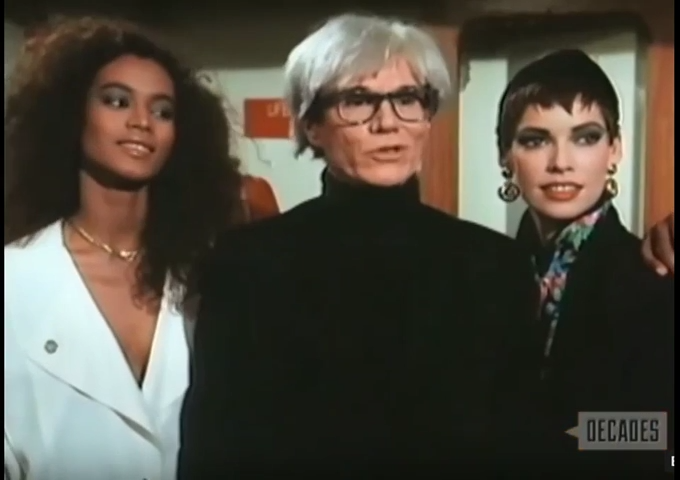
More than 550 guest stars appeared on the show during its run. There were movie stars like Gene Kelly, Ginger Rogers, and Joan Fontaine. There were Broadway stars including Ethel Merman and Robert Goulet. TV stars abounded like Don Adams, Lorne Greene, Florence Henderson, and Eve Arden. Music was represented by The Pointer Sisters, Cab Calloway, and Janet Jackson. Sports stars were on board including Dick Butkus and Joe Namath. And then there were the celebrities like Bob Mackie and Andy Warhol. Marion Ross holds the record with 14 appearances.
📷boingboing.com
For some reason, The Love Boat does not have the same “time warp” problems as Fantasy Island. It’s been translated into more than 29 different languages and appeared in more than 93 countries. It’s very popular in syndication.
Before the Hallmark Channel debuted, this is where you went to watch people fall in love every week. It’s hard to remember how many people just happened to run into an ex on the ship or meet the perfect soul mate after being mistreated.
Apparently, the cast is still close. In a recent interview, Lange said his experience on The Love Boat was life changing. He also said that the beauty of the show was that they are all still friends. “I just directed Fred in ‘Give ‘em Hell Harry’ in Indiana and I’m going to New York to stay with Bernie and his wife. . . . Bernie is more like my brother, and Fred is like my best friend.”
Whelan described McLeod as an “incredible, protective man. He was just like a dad.”
If you need a reminder that love is still alive and well, you can check out the show on DVD or on ME TV on Sundays.
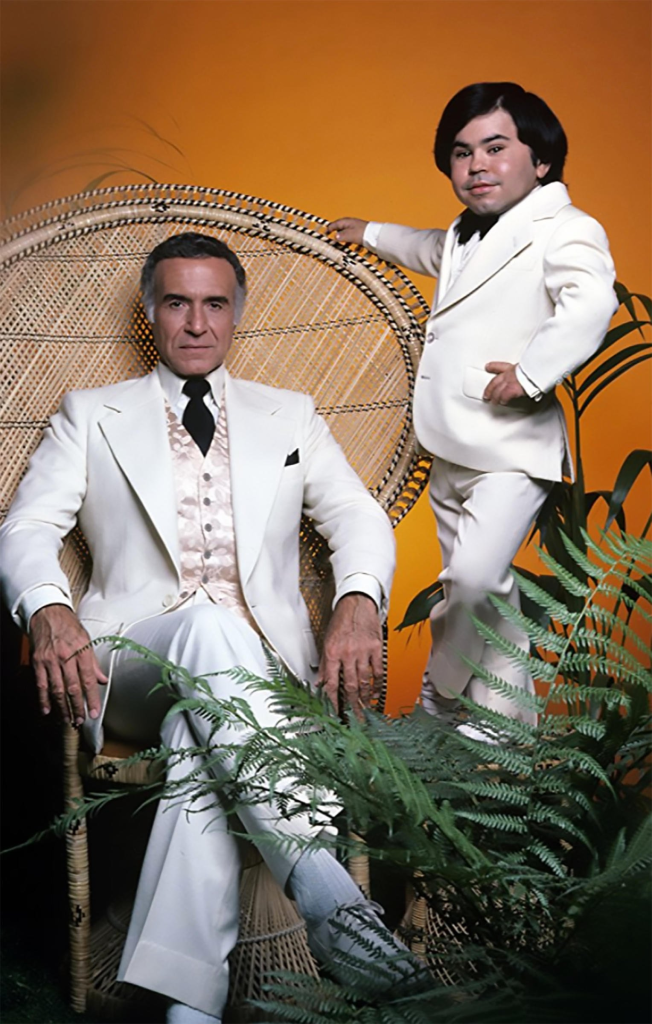
This month our theme is Casting Celebrities. We are looking at a few shows that relied on a cast of famous stars for their weekly episodes. The world of island drama with Mr. Roarke and Tattoo was on television from 1977 to 1984 on Fantasy Island. Ricardo Montalban was Mr. Roarke and Herve Villechaize was his assistant Tattoo.
Instead of a vacation cruise, guests paid to travel to the island for their fantasy of choice.
Before airing as a regular series, the plot was developed for two made-for-tv movies in 1977 and 1978. The show was put on the fall schedule in 1978. All we knew about the island is that it was a mysterious place located somewhere near Devil’s Island in the Atlantic Ocean. (Most descriptions locate it in the Pacific Ocean but the show references being near Devil’s Island which is in the Atlantic.)
Even if you did not watch the show, you probably quoted Tattoo’s weekly comment, “De plane! De plane!” which is what he shouted when he rang the bell to indicate that the guests arrived. In 1981 Wendy Schaal joined the cast as Roarke’s assistant Julie, and we later learned she was his goddaughter. Villechaize was replaced in the fifth season by Lawrence (Christopher Hewett from Mr. Belvedere) who took on the role of an English butler type of character. Apparently Villechaize caused problems for the producers. He continually propositioned women and quarrelled with the staff. When he demanded the same salary as Montalban, he was fired.
📷imdb.com
Once the guests departed the plane, Roarke gathered them around and explained to his assistant what the nature of their fantasy was. He then lifted his glass and said, “My dear guests, I am Mr. Roarke, your host. Welcome to Fantasy Island.”
The writers were a bit secretive about Roarke’s age. Some episodes mention he was friends with Helen of Troy and Cleopatra; others discuss the fact that he knew mermaids, ghosts, genies and even the devil (played by Roddy McDowall).
Most of the time, the guests’ fantasies did not work out quite the way they had planned. Roarke tried to use this as a life lesson. However, Roarke did make it clear that he had no way of interfering in a fantasy once it began, and the guests had to finish out the story.
According to the first television movie, guests paid $50,000 to live out their fantasy which would be about $175,000 today. Somehow a few people who were not well off won trips or Roarke accepted much less money, even $10, from one young girl.
📷womensworld.com
The plots of these fantasies varied quite a bit. Sometimes, someone was reunited with an old love. Sometimes they tracked down someone who had hurt, or even killed, a family member. Some had a tinge or more of supernatural elements.
The executive producer was Aaron Spelling. Spelling related a story that he and Leonard Goldberg were pitching some series ideas to ABC’s Brandon Stoddard. When he rejected all their ideas, a frustrated Spelling said, “What do you want? An island that people can go to for all their sexual fantasies will be realized?” Stoddard surprised them by saying yes.
The show was aired Saturday nights after The Love Boat for its entire run another Spelling show, which we’ll talk about next week.
📷giggster.com
Despite the exotic location, most of the series was filmed in Burbank, California.
The theme song behind the show was composed by Laurence Rosenthal.
The part of Roarke was first offered to Orson Wells, but Spelling put the kibosh on that because he knew Wells could be temperamental.
Like Love American Style, rather than each episode having a title, each individual fantasy story had its own title, which made for a lot of confusion.
📷dailymail.com
Unfortunately, the show doesn’t hold up as well today as Love American Style or The Love Boat. It screams 1980s with the fashions and content echoing other shows of the era like Dynasty. Often lines were insensitive to specific people groups and cultural standards.
If I had to rate the four shows we are learning about this month, I have to admit that Fantasy Island would be the last one I would opt for. But if you have never seen the show, you should check out at least a couple episodes.
This month we are starting a new blog series, Casting Celebrities. We’re going to take a look at four shows that featured a group of celebrities every week. We’ll learn more about Love, American Style; Fantasy Island; The Love Boat, and Supertrain. When we discuss Supertrain, we’ll also look at the small number of stars who appeared on all four shows.
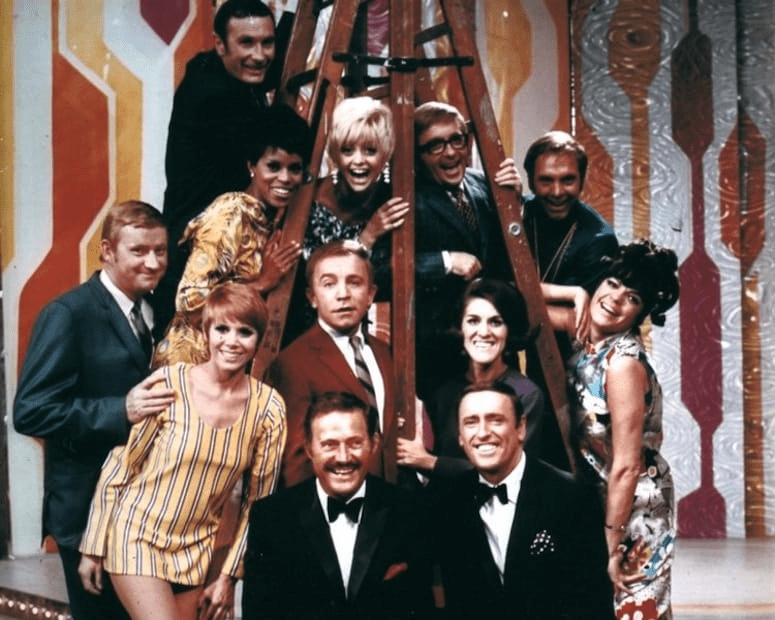
Today we begin with Love, American Style. This show was an iconic 1970s show. Like Laugh In, the clothing, furnishings, and vocabulary do not make it timeless. But it was a lot of fun. This fast-paced anthology series featured two to four mini episodes each week, and between them were quick skits, often featuring a brass bed. Each smaller episode is titled “Love and the _______.”
📷gms.com The regular cast
A troupe of players was featured on each show for the in-between skits. These regulars included William Callaway, Buzz Cooper, Phyllis Davis, Mary Grover, James Hampton, Stuart Margolin, Lynn Marta, Barbara Minkus, and Tracy Reed. Margolin went on to a regular role in TheRockford Files; Tracy Reed was featured in McCloud and Knot’s Landing; Phyllis Davis was part of the cast of Vega$ and Magnum PI, and James Hampton will be familiar if you watched The Doris Day Show or F-Troop.
The show had a memorable and catchy theme song. Written by Arnold Margolin, the first year it was performed by The Cowsills. The snappy melody was set to the following words:
Love, Love, Love
Love, American Style, Truer than the Red, White and Blue. Love, American Style, That’s me and you.
And on a star-spangled night my love,
My love come to me. You can rest you head on my shoulder. Out by the dawn’s early light, my love I will defend your right to try.
Love, American Style, That’s me and you.
📷imdb.com
During the second and subsequent years that Love, American Style was on the air, the theme song was performed by the Ron Hicklin Group. The Ron Hicklin Group could be heard in a variety of motion pictures and commercials, and they also appeared on recordings with stars such as Paul Revere and the Raiders and Cher. John and Tom Bahler, brothers who sang under The Charles Fox Singers were also part of this group. The band provided television theme song recordings including Batman, That Girl, Happy Days, and Laverne and Shirley. They also did the singing for The Partridge Family theme and songs performed on the show as well as the Brady Bunch Kids. Ron retired in the early 2000s, and Tom does a variety of things. He is also known for writing Bobby Sherman’s hit, “Julie Do You Love Me?”. John married Janet Lennon, one of the Lennon sisters who performed on The Lawrence Welk Show. He currently lives in Branson and conducts the “new” Lawrence Welk orchestra.
Paramount Television developed the show. The executive producer of the show was Arnold Margolin, Stuart’s brother. There were 53 different directors during the four-year run. The series received Emmy nominations for Outstanding Comedy Series in 1970 and 1971; Best Music Composition in 1971, 1972, and 1973, winning in 1973; and winning the Emmy in 1970 for Outstanding Original Music and Lyrics.
📷rewatchclassictv.com
Many people wrote for the show, but Garry Marshall and Jerry Belson received the most credits. One of the writers, Peggy Elliott, was interviewed by the Huffington Post in May of 2013, and she talked about her time writing for the show.
“But the show I loved writing the most, was Love, American Style. For every other show, I was writing for characters created out of someone else’s head. Sure, we could create the occasional guest-star role, and we had been told to make every role, no matter how small, a real person. ‘Think of the actor who’s playing that delivery boy,’ I can hear Billy Persky, the co-creator or That Girl, say: ‘This is a big break for him — it’s the biggest role he’s had so far. Give him something to work with.’
But with Love, American Style, every character was our very own; every situation came out of our heads. Each segment of the hour the show ran each week was a one-act play created entirely by us. Added to the attraction was the fact that we could say and do things that were taboo on every other TV show in the early ‘70s. Arnold Margolin, co-creator of the show with Jim Parker, told me recently that the creative side of the network wanted the show to be more daring, while the censors kept their red pencils ready. There was a full-time position on the show just to run interference.
We must have put both sides through the hoops with one episode we wrote: ‘Love and The Hand-Maiden.’ A young guy was dating a centerfold model. As their relationship developed, he discovered that she had no problem with shedding her clothes, but she always kept her hands covered — with artful poses in magazines, and with gloves in real life. He became obsessed with seeing her hands and came up with one ruse after another to get her to take off her gloves. We had a ball writing it, with one double-entendre after another.”
📷imdb.com
If you were a star of any kind in the early 1970s, you most likely were on Love, American Style. The show produced 108 episodes, and those shows featured 1112 different actors. Some of the famous names showing up in the credits include Milton Berle, Sid Caesar, Phyllis Diller, Arte Johnson, Ozzie and Harriet Nelson, Regis Philbin, Burt Reynolds, Sonny and Cher, Flip Wilson, and Jo Anne Worley.
Brad Duke wrote a biography about Harrison Ford, and he said Ford had fond memories of appearing on Love, American Style. “He recalled that he had been given little time to prepare his wardrobe for the role of a philosophical hippie in the November 1969 episode, “Love and the Former Marriage.” He appeared on set with long hair and a beard thinking they were appropriate for the role. He was surprised when he was told he needed a haircut and trim and then was given a navy blue dress shirt and vinyl burgundy jeans with a large belt. They even had a scarf with a little ring to put around my neck. And I thought, someone has made a mistake here. So, rather than argue with the wardrobe people, I put on the clothes and went to find the producer. I walked on the set and he was pointed out. I tapped his shoulder and when he turned around he had on the same clothes I did. He was a hippie producer I guess. At least the check went through, and I got paid.”
The best way to get a good understanding of what the show was like is to look at a couple of the episodes.
January 23, 1970: Love and the Big Night
📷facebook.com
Starring Ann Elder, Buddy Lester, Frank Maxwell, Julie Newmar, and Tony Randall, this episode is often listed as a favorite of viewers. Randall is a married businessman who escorts his voluptuous secretary (Newmar) to her apartment after a late night at the office. Eager to get home to his wife, Randall hurriedly tries to open a stubborn jar of mayonnaise and winds up covered with mayo. Newmar cleans his suit, but while it’s drying, it’s stolen. After a series of amusing mishaps, Randall finally gets back to his own apartment and creeps into bed with his wife–only to find out she’s not there.
February 25, 1972: Love and the Television Set
📷that’s entertainment.com
It starred Harold Gould, Marion Ross, Ron Howard, and Anson Williams. Reading this list of names might give you a hint about what happened to this episode after it aired. Garry Marshall had written a pilot about a 1950s family that did not sell. He turned it into an episode for Love, American Style. George Lucas caught the episode and was impressed with Ron Howard and offered him a role in his new movie American Graffiti about 1950s teens. The movie was so popular that the network decided to put Marshall’s pilot in the fall line-up as Happy Days. Harold Gould’s role was given to Tom Bosley for the series. When Love, American Style went into syndication, this episode was retitled “Love and the Happy Days.”
October 22, 1970: Love and the Bashful Groom
📷listral.com
This is the episode I recall when I think of the series. When I watched it originally, I was staying overnight at my grandparents’ house and my grandmother was shocked at the “vulgarity.” It really seems quite tame today, but back then it probably was unexpected. She would approve of Tom Bahler marrying Janet Lennon though because I watched Lawrence Welk with her and my grandfather whenever I was at their house.
In this episode, Paul Petersen, Christopher Stone, Meredith MacRae, Jeff Donnell, and Dick Wilson are featured. Harold (Petersen) and Linda (MacRae) are getting married. He learns that she grew up in a nudist colony and is not comfortable being naked for his wedding. After a soul-searching talk with his best friend, and realizing he loves Linda enough to be uncomfortable, he decides to go through with the ceremony. He gets to the church a bit late and walks in, only to see that everyone else is dressed in their Sunday best. His bride informs him that they always dress up for weddings. One of the congregation members says something like “Let’s not make him uncomfortable,” and they all begin to undress. Of course, you see nothing improper, no naked bodies, only clothes flying. This was probably not the best episode to “expose” my grandmother to as a first glimpse of the show.
The show lasted for four years and was cancelled in 1973. In 1985, a reboot was created, but it was on in the mornings and only lasted a few months. The show was on at the same time as everyone’s favorite game show, The Price is Right. For the 1998 fall season, a pilot was created for prime time, but it was never ordered. While doing my research for this blog, I noticed that there was a Love, American Style project in production, so we may see it resurface again. I’m not sure I would want to watch a contemporary version of the show though. It was such a product of its time, and I fear what a current version would be like after seeing the reboot of Match Game which has been airing the past few years.
In this last blog in our series of Supportive Men, today’s actor might not be someone most people expect to see when talking about television. When most people think about Leslie Nielsen, they think of Airplane! and some of his other movies. While he did have a prolific movie career, he also has a well-deserved place in television. This guy amassed 259 (150 in television) acting credits during his six-decade long career.
📷tmdb.com
Nielsen was born in Saskatchewan, Canada in 1926. His mother was from Wales, and his father was a Royal Canadian Mounted Policeman. His older brother served in politics, being a Canadian Member of Parliament, a cabinet minister, and a Deputy Prime Minister of Canada. I read several sources that said his father was abusive, and Leslie wanted to move out as soon as possible.
Leslie enlisted in the Royal Canadian Air Force, serving until the end of WWII. He was legally deaf, wearing hearing aids most of his life, but he was able to train as an aerial gunner.
After the war, he worked as a disc jockey in Calgary, Alberta before enrolling at the Lorne Greene Academy of Radio Arts in Toronto. He was offered a scholarship at the Neighborhood Playhouse in New York.
📷wikipedia.com Bonanza
He made five television appearances in 1950 with the first being on The Actor’s Studio. He continued working in television, primarily on dramatic theater series, through the 1950s. In 1956, he had his first big-screen roles, appearing in four movies that year including Ransom, Forbidden Planet,The Vagabond King, (Nielsen later referred to this film as the “Vagabond Turkey”) and The Opposite Sex.
Leslie discussed his role in Forbidden Planet: “Supposedly a science fiction version of Shakespeare’s The Tempest . . . The Trekkies today regard it as the forerunner of StarTrek. I just had to wear a tight uniform and make eyes at Anne Francis. I was pretty thin back then.”
He became an American citizen in 1958 but continued to be proud of his Canadian citizenship as well.
While most of his credits for the late fifties were movies, he jumped back into television in the sixties, appearing in forty different shows. Many of them were dramatic theater roles, but you can spot him in Alfred Hitchcock Presents, Route 66, Wagon Train, DanielBoone, The Wild Wild West, Dr. Kildare, Bonanza, The Man From U.N.C.L.E., and Gunsmoke. His only recurring role during this decade was on Peyton Place where he played Kenneth and Vincent Markham in 18 episodes.
📷pinterest.com on M*A*S*H
The seventies were almost a repeat of the sixties. His recurring role was on The Bold Ones. He also appeared in Medical Center, Mod Squad, M*A*S*H, Barnaby Jones, Hawaii Five-0, Kojak, Columbo, and The Love Boat.
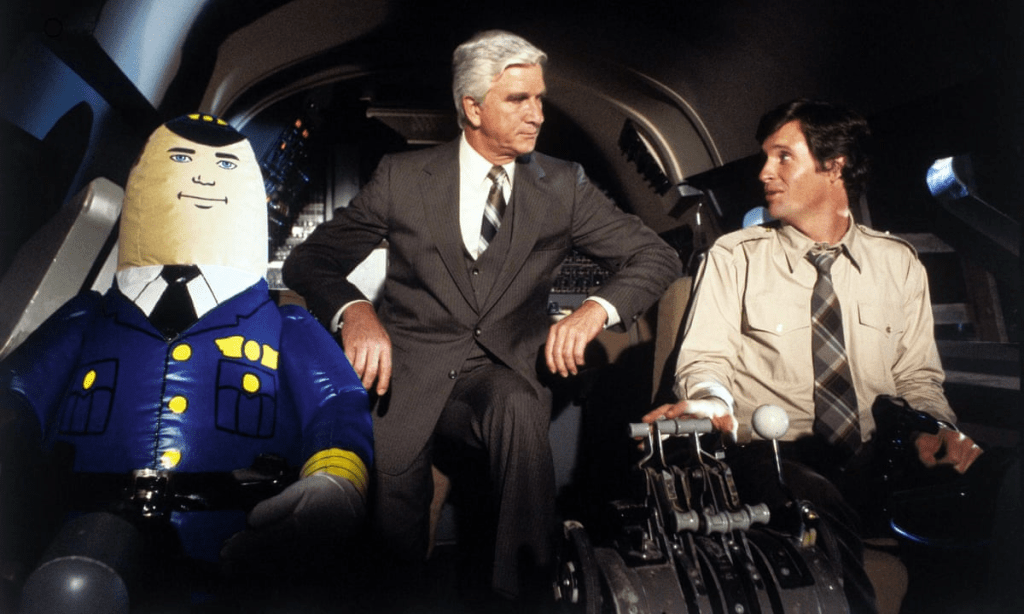
1980 brought him the role of Dr. Rumack on Airplane!. Nelson’s deadpan delivery of lines in that movie is what most fans today remember about his career. Of course, his response to the line of “Surely you can’t be serious?” of “I am serious. And don’t call me Shirley” is still repeated today. Leslie said, “he was pleased and honored that he had a chance to deliver that line.” Film critic Roger Ebert once called him “the Laurence Olivier of spoofs.”
📷themoviebuff.com Airplane!
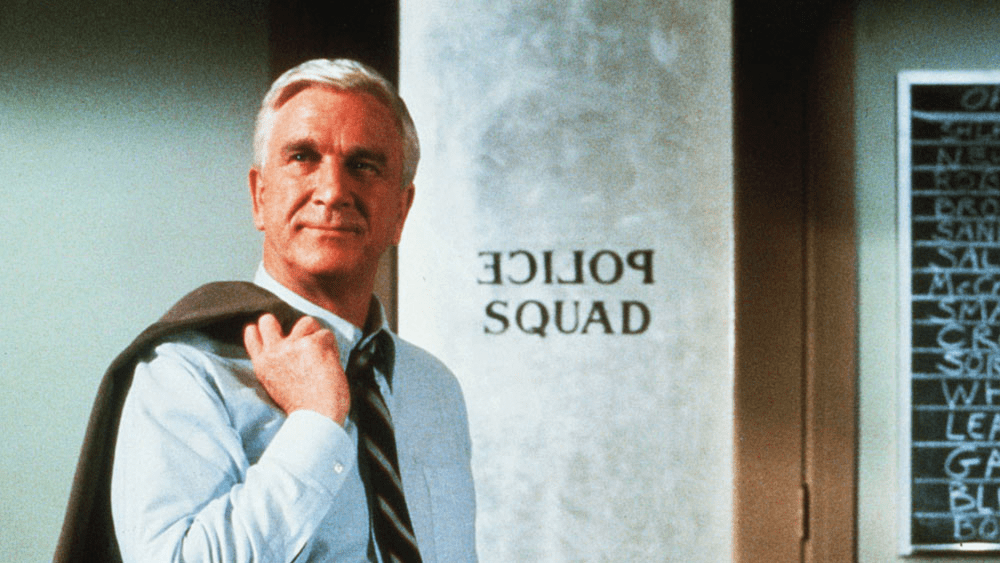
He continued in these types of roles in Police Squad and Naked Gun and the sequels. His movie roles increased in the eighties and nineties, but he continued to accept television roles off and on. You can catch him on Murder She Wrote, Highway to Heaven, Who’sthe Boss, The Golden Girls, and Evening Shade.
His roles continued throughout the 2000s until his death, but the last decade included fewer memorable shows, although he worked less overall. When reflecting on this, Neilsen said that “I’m afraid if I don’t keep moving, they’re going to catch me . . . I am 81 years old, and I want to see what’s around the corner, and I don’t see any reason in the world not to keep working. But I am starting to value my down time a great deal because I am realizing there might be other things to do that I am overlooking.”
📷npr.org Police Squad
While Nielsen was very successful in his career, he was not as successful with his marriages. From 1950-56, he was married to Monica Boyar. His longest relationship was with wife Alisande Ullman from 1958-1973. He then married Brooks Oliver for two years from 1981-83 and then Barbaree Earl from 2001-2010.
One of his hobbies was golfing, and he later did some humorous instruction videos about the sport. He once said, “I have no goals or ambition. I do, however, wish to work enough to maintain whatever celebrity status I have so that they will continue to invite me to golf tournaments.”
Nielsen died in his sleep in 2010 from pneumonia.
He received two Walk of Fame stars: one in Hollywood in 1988 and one in Toronto in 2001. Nielsen was known for his flatulence gags, especially on movie sets, and his tombstone says “Let ‘er Rip.”
While Nielsen’s career is impressive, what I loved most about him is that he seemed to thoroughly enjoy life. That’s a great reminder for us all. Our best role should be enjoying life to the best of our ability.

















 thewritelife61