Camp Runamuck: Campers Loved It More than Viewers

This month we are checking out a few sitcoms that are rarely remembered anymore. Today we are exploring the show Camp Runamuck. It debuted on NBC in 1965 and featured campers for 26 weeks before being cancelled.

📷imdb.com

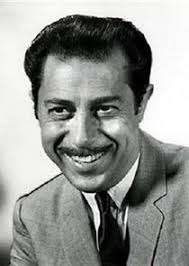
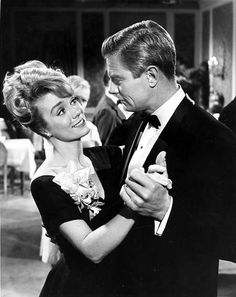
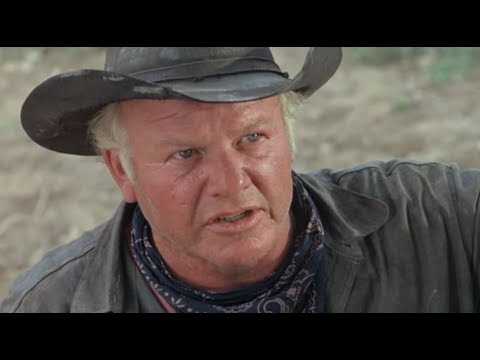
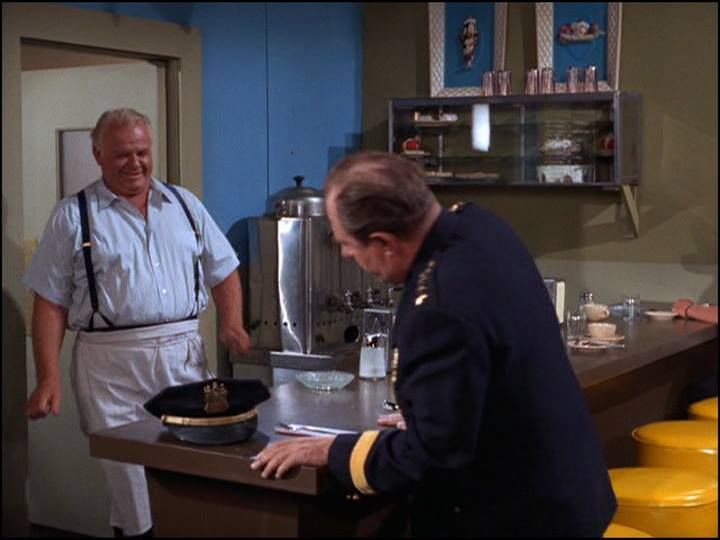
Dave Madden was counselor Pruett; Commander Wivenhoe was played by Arch Johnson, and senior counselor Spiffy was played by David Ketchum. In the pilot, one of my favorites, Frank DeVol, played Doc Joslyn but illness forced him to hand over the part to Leonard Stone. Bobby Darrin sang the theme song.

If you are a fan of The Partridge Family, you will appreciate that this show was the introduction of actor Dave Madden, later Rueben who would manage the Partridges. Johnson began on television in the fifties, but this was his first cast role. Ketchum started his career a decade after Johnson and this was his second starring role after being in I’m Dickens, He’s Fenster in 1962. One camper who is featured in two of the 26 episodes is Maureen McCormick. This was the year she started her acting career, also appearing in Bewitched, The Farmer’s Daughter, and Honey West. Before becoming Marcia Brady, she would also show up in My Three Sons and I Dream of Jeannie.

Wivenhoe was an interesting camp leader. He didn’t like kids, didn’t like to part with his money, and didn’t appreciate the 6am morning wake-up song sung by the girls across the lake accompanied by a bugle. He did like playing golf and enjoying a quince for breakfast.

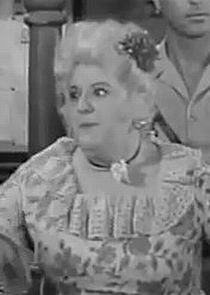
Across the lake was Camp Divine owned by Eulalia (Hermione Baddeley) who was helped by counselors Mahalia May (Alice Nunn) and Caprice Yeudleman (Nina Wayne).

The opening featured a peppy tune with fifes and you see the lake and hear the music before you see the camp counselors leading the campers (all in white; the poor laundry crew) marching down the road.

📷youtube.com

Most of the plots featured the counselors as opposed to the campers. Typical plots were the female campers being ordered to steal Wivenhoe’s bathtub so they could take a real bath and the boys getting it back. In another episode, the campers learn a civics lesson. They are given the task of electing a camp commander. However, the candidate who gets in becomes a dictator and tries to put everyone who had been in charge, namely the adults, in jail. This sounds vaguely familiar from the recent news.

In the credits I learned Cal Howard was in charge of visual gags. I never had seen that designation before in a sitcom. Howard, who was born in 1911 and passed away in 1993, had a long career as an actor and writer. He received 178 writing credits, mostly in animation. He worked for Walter Lanz and Walt Disney and wrote a few Bugs Bunny and Alvin and the Chipmunks episodes.

Just to add a sense of weirdness and whimsy to the series, two bears named Irving and Virginia would share their opinions of what was going on around the camp.

The series was up against The Wild Wild West and The Flintstones, pretty tough competition for the time. First of all it was on Friday nights when many viewers might be starting their weekend celebrations. The Flintstones was originally written for adults, but by 1965 families were watching the show together. The Wild Wild West was new, but immediately hit the top 30, and it was followed by another new CBS show, Hogan’s Heroes, and then Gomer Pyle, USMC, so most television fans were glued to that network Friday nights. Other new NBC shows included Get Smart, I Dream of Jeannie, and I Spy so competition was tough to retain a schedule spot. ABC didn’t have a lot of hits that year but they did debut three shows that I liked but all faded away within two seasons: Batman, Honey West, and Gidget.

Camp Runamuck might have gotten a second season if it didn’t have so much competition to deal with. If you loved camp as a kid, or hated camp as a kid, it might be worthwhile to watch a few shows and see what you think.

The Bill Dana Show: Really It Was The Jose Jimenez Show

This month our blog is devoted to The Bill Dana Show which was on the air for two seasons in the early sixties.

📷dvdplanetstore.com

Bill Dana is not a name remembered much anymore but, in the sixties, he was a huge celebrity. There is some tough talk about why he was so famous. During the late fifties and early sixties, especially as so many radio shows transitioned to television, there were some politically incorrect shows. This one teetered on the edge of it, in the same ways the show Life with Luigi did.

Bill Dana’s alter ego, Jose Jimenez, debuted on The Steve Allen Show in the late fifties. Jimenez was a Mexican immigrant. He saw the United States through a different lens than people who grew up here. He often was amused by what he saw going on around him. However, he was not the lazy stereotype Mexican. Jimenez was hard working and wise in many ways. He was not offensive in the way Amos and Andy were. Dana was a Hungarian Jewish man playing a Hispanic man so that was not well received either.

While I still love so many programs from the fifties and sixties that hold up well today and have delightful characters, many programs from this time make us cringe and we are embarrassed for the television industry at that time.

There are also many performers that may have bordered on sexual and ethnic political incorrectness, many of their characterizations may not be offensive, but I sure don’t find any humor in them.

📷 Jose Jimenez televisoinacademyawards.com

Remember this was during the Civil Rights Movement era, so things were beginning to get examined more closely in pop culture. Even if Jose was a good guy, his exaggerated accent set him up more of a caricature than a character.

While there was some blowback from the Latino community, many fans adored Jimenez. Danny Thomas and Sheldon Leonard decided to give Jose his own show after he made a few appearances on The Danny Thomas Show. NBC put the show on its schedule without even seeing a pilot because he was so popular.

While the quick sketches with Jose were in your face humor, putting the character in his own television series gave the writers time to develop him more and make him more dimensional. Leonard made this a workplace sitcom which was different for him since so many of their shows—The Dick Van Dyke Show, The Danny Thomas Show, That Girl, Good Morning World—were all balancing personal and work life. Earl Hagen, who wrote so many great tunes for the Leonard group, wrote this one as well.

The show aired September 22, 1963, and ran for a season and a half, ending January of 1965.

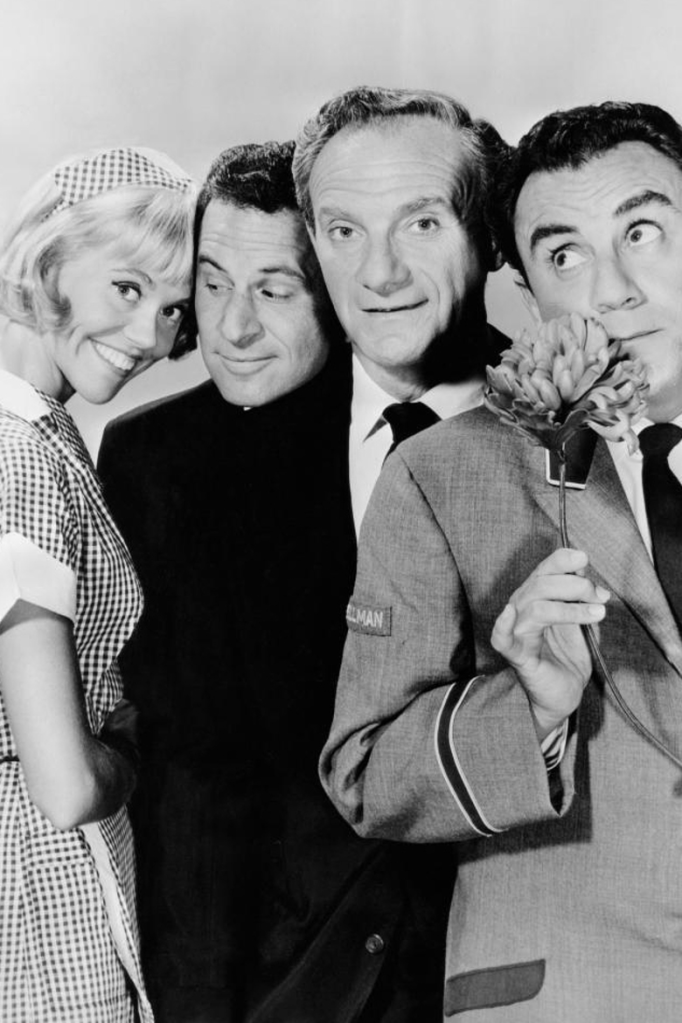
Jimenez is a bellhop at a luxury New York hotel. He lives in a special staff apartment, eats in the hotel kitchen, and interacts with most of the guests. He is surrounded by a great cast which we’ll get to know in more detail this month. Don Adams was Byron Glick, house detective. Jonathan Harris took on the role of Mr. Phillips, the hotel manager. Fellow bellhop Eddie (Gary Crosby) is always trying to get Jose to lose his rose-colored view of life. For season 2. Maggie Peterson plays waitress Susie.

The ratings were not great. Perhaps viewers had a harder time connecting this Jose to the caricature Jose. Certainly, more criticism came from the Latino community as the show went on. In addition to Jose, there was feedback on other shows that used stereotypical Mexican characters and in commercials like the Frito Bandito.

📷washingtonpost.com

Jose had one cameo role in Batman when he meets the duo and introduces himself as “My name—Jose Jimenez” in 1966. That was the final appearance of the character and a few years afterward, Dana read an obituary that he wrote for Jose at a Latino civil rights meeting in Los Angeles, and he became an activist for the Latino community, so there was some good coming out of the situation.

The show was canceled partway through season two. Another factor in the show’s ratings was the fact that it was on Sunday nights up against Lassie, a family favorite. However, the show did somehow receive an Emmy nomination for outstanding sitcom. No surprise it didn’t win. Despite being a mediocre show with some nugget of greatness here and there, it was up against McHale’s Navy, The Farmer’s Daughter, and the show that won, The Dick Van Dyke Show.

If The Bill Dana Show had just been a show about “a guy” who arrives from Mexico to work in a posh hotel, and we saw life through his eyes, good and bad in America, the concept could have been fun and more accepted. It appears that the writing was pretty good and it had a great cast. Jose was just not the character to build the show around.

Bernard Fox: What a Character – Calling Dr. Bombay

We are in the middle of our “What A Character” blog series. No overview of television character actors during the golden age would be complete without Bernard Fox.

As a young tyke, you still expect him to say, “Come along old chap.” Photo: tagswrc.com

Fox was meant to be an actor. He was born to Queenie and Gerald Lawson in Glamorgan, Wales. Both his parents were actors. Fox had his first film role at the age of 18 months. By 14 he was an apprentice assistant manager of a theater.

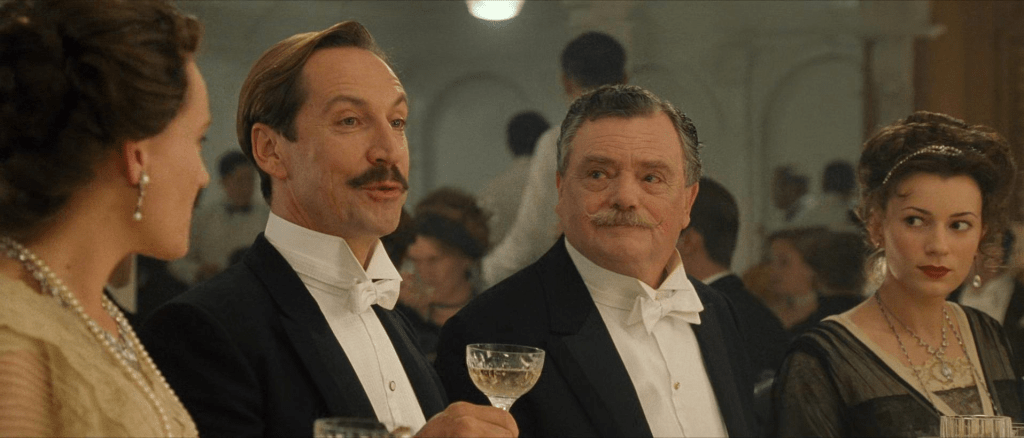
Bernard served with the Royal Navy during WWII as a minesweeper and then in the Korean War. From 1956-2004 he made more than 30 films. Ironically, he was in two different Titanic movies. In 1958 at the beginning of his career, he was in A Night to Remember and in 1997, at the end of his career, he was in the Oscar-nominated Titanic. He liked to say that he was the only person to survive the Titanic twice.

He began his television career in 1955 when he received a recurring role on the United Kingdom show Sixpenny Corner as Tom Norton. The show was centered around Bill and Sally Norton, a young married couple who ran a garage together. Fox played Bill’s youngest brother.

Titanic 1997 Photo: imdb.com

Eventually, he made his way to the United States. His first US show was in Wire Service in 1957, a show filmed at the Desilu studio. His next seven shows were filmed in the United Kingdom.

Fox mentioned that being a character actor was a mental strain. Early in his career, he had to worry about when the next job would be coming. He did post office work, logging, and other interesting jobs to get by. Once he got to America, he was able to rely on his acting career and didn’t have to moonlight anymore.

In 1962, he married his wife Jacqueline. They had two daughters. The same year he was back on US television with a regular role on The Danny Thomas Show. He played Danny’s English friend, Alfie Wingate. In 1963 he appeared on Ensign O’Toole, The Great Adventure, and General Hospital. The mid-sixties showed him in a variety of shows including McHale’s Navy, Perry Mason, The Dick Van Dyke Show, F-Troop, I Spy, I Dream of Jeannie, The Man From U.N.C.L.E., and The Farmer’s Daughter.

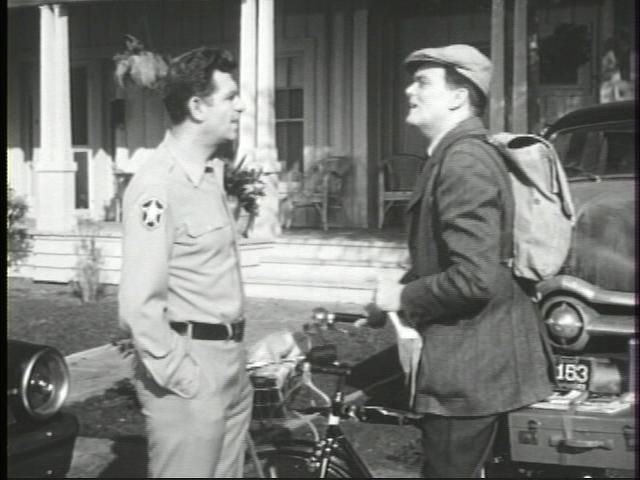
Hello Constable Photo: pinterest.com

He had another recurring role during this era on The Andy Griffith Show as Andy’s friend/valet Malcolm Merriweather. Fox appeared on the show in season three. We see him pedaling his bike next to Andy’s squad car at Andy’s house and says, “Excuse me, Constable.” When Andy understands what he is saying, he explains that he is the sheriff. With all the quirky characters in Mayberry, Malcolm fit right in and it’s a charming scene.

He continued receiving regular work in the late sixties for The Monkees; The Wild, Wild West; Here Come the Brides; and Daniel Boone.

Monkeeing Around Photo: sunshinefactory.com

Bernard did not enjoy his time on The Monkees set. He called them “an amateur bunch of rabble rousers . . . a bunch of unprofessional idiots.” He said that “they’d have cans of chocolates or something in the cupboards and in between shots, they’d be cramming chocolates in their mouths.” Fox was amazed, he said he got used to it but “professionally speaking, I expected a bit more.”

It was in the late sixties that he received the role he may be best known for: Dr. Bombay on Bewitched.

In an interview on bewitched.net, Fox was asked about his popular character, Dr. Bombay. He said that the spin he put on the doctor made him more interesting, saying, “If I’d just gone for an ordinary doctor, you wouldn’t have heard any more about it. But because I made him such a colorful character, that’s why they wanted him back.” He said the character was “easy to write for” and the writers had him being summoned from all over the world. He showed up in a variety of costumes including a wet suit, a football uniform, a toga, a towel, and a matador costume among others.

On Bewitched Photo: closerweekly.com

Bernard discussed the stars on Bewitched. He said Marion Lorne was a “dear lady.” When asked about Agnes Moorhead, he said she was a “thoroughly professional lady” and that praise from her was a thrilling thing to get. He said that he “liked Dick very much, a fine actor. He was a darling man.” And about Elizabeth, he said, “she was always very sweet and knew her lines.” She liked to bet on horses and whenever she won, she treated the cast to a party on the set. He also said once she found out he had a vegetable garden, she got him a subscription to Gourmet Magazine which she renewed every year.

He fondly recalled one episode where he was supposed to be squeezing a lemon into clam dip. When he squeezed it, it went in Elizabeth’s eye. The director yelled, “cut” and re-filmed it, but it happened again. The director said, “Bet you can’t do it a third time,” but he did, so they left it in the show.

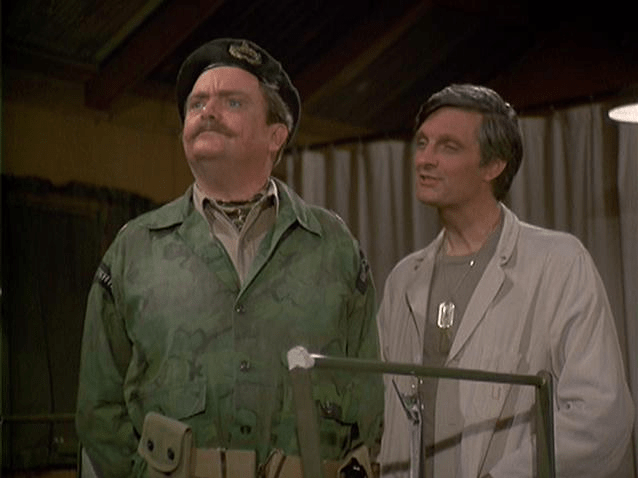
Visiting MASH Photo: imdb.com

His career did not slow down in the seventies where you could watch him on The Partridge Family, Night Gallery, Love American Style, Columbo, Cannon, Soap, and MASH. When asked about his appearance on The Partridge Family, Fox said, “Oh, I loved Shirley, she’s a doll, she’s a really nice lady.”

Following the pattern, he also had a recurring role in this decade as Colonel Crittendon on Hogan’s Heroes. As Crittendon, he was incompetent and dense and drove Colonel Hogan crazy with his ineptness.

Colonel Crittendon Photo: pinterest.com

In his bewitched.net interview, Fox also discussed his role on Hogan’s Heroes a bit. He said that in one episode he had hidden some maps in a corn bin. When he lifted the lid, it came down on his head. He just put the lid up and carried on with the script. When the director asked about reshooting, Fox said it was fine, and they left it in the film. He did say when he was playing a role on Hogan’s Heroes and Bewitched at the same time, it could get a bit confusing. They typically worked it out. For example, he said one time the studios agreed that Fox would be on the Bewitched set Tuesday and Wednesday and on Hogan’s Heroes Thursday and Friday.

Offers did slow down a bit in the eighties and nineties, and he ventured into animation work during those two decades. However, he still accepted offers for Fantasy Island, Lou Grant, The Love Boat, Hart to Hart, The Jeffersons, Simon and Simon, and Murder She Wrote among others.

His last acting credit occurred in 2001 for Dharma and Greg.

Not only was Fox an actor but he was an expert in history of the theater. For fun, he enjoyed gardening, painting landscapes, and performing magic.

Photo: walmart.com

In 2016, Fox died from heart failure.

I’m so glad he was able to find a successful career on television in the United States. After learning in a previous blog what a legend Marion Lorne was in England where she lived much of her life, I like to think about Aunt Clara and Dr. Bombay sharing some time talking about the delightful English ways that they missed. Hopefully they served tea on the set once in a while.

Mary Grace Canfield Nails Her Performance

We are devoting this month to some of our favorite television actresses.  If you ever watched Green Acres, you will have fond memories of Ralph Monroe, played by Mary Grace Canfield.

Vale: Mary Grace Canfield | TV Tonight
Photo: tvtonight.com

Canfield was born in Rochester, NY in 1924. In her late twenties, she began acting with regional theater companies. She appeared in a few Broadway plays, but they were not big successes. In 1950 she married Charles Carey Jr, but they divorced five years later.

While she continued to appear on stage until 1964, she tried her hand on television in 1954 on an episode of Goodyear Playhouse.  

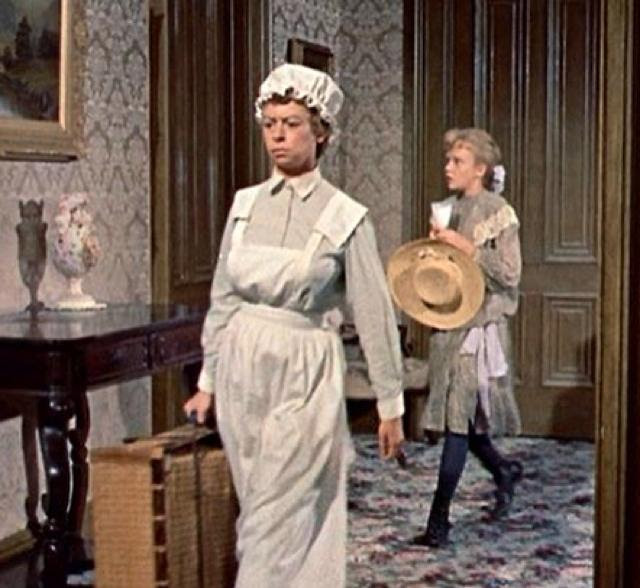
During the fifties, Canfield continued appearing in a variety of televised drama series and several big-screen movies, including Pollyanna.

12+ Mary Grace Canfield Pictures
Pollyanna Photo: femaleartswallpaper.com

From 1961-62 she was part of the cast of The Hathaways. She played Amanda Allison, the housekeeper, on the show. Starring Peggy Cass and Jack Weston, the series was about a couple who were raising three chimps: Candy, Charlie, and Enoch.

During the early sixties, Canfield appeared on many of our favorite shows including Hazel, The Interns, The Andy Griffith Show, The Joey Bishop Show, The Farmer’s Daughter, and General Hospital. Mary Grace showed up on Bewitched as Harriet Kravitz, Abner’s sister.

Andy Griffith Show Cast Members | Mary Grace Canfield/"A Date for Gomer" -  Sitcoms Online Photo ... | The andy griffith show, Funny people, Andy  griffith
Gomer’s date in Mayberry Photo: pinterest.com

From 1965-71, she played Ralph Monroe, handyman to her brother Alf on Green Acres. Canfield appeared in forty of the episodes of the show’s run. Ralph always showed up in bib overalls with her baseball cap on backwards, a somewhat better carpenter than her inept brother. The brother and sister team could not finish a project on time or in an acceptable condition. In one episode, Lisa gave her a makeover. In later shows, Ralph admits she is in love with farm agent Hank Kimble.

In a 2006 interview in the Bangor Daily News, she said she felt a bit bad about being remembered for Ralph, not because she didn’t appreciate the character but “only in the sense that it was so easy and undemanding. It’s being known for something easy to do instead of something you worked hard to achieve.”

The Ten Best GREEN ACRES Episodes of Season Six | THAT'S ENTERTAINMENT!
Photo: thatsentertainment.com With Oliver and
Louie The Movie Buff: MARY GRACE CANFIELD
with Lisa Photo: louisthemoviebuff.com

In the seventies and eighties, Mary Grace made a handful of appearances on shows including Love American Style, The Love Boat, Family, and Cagney and Lacey.

About this time, she moved to Sedgwick, Maine which she fell in love with while performing in the area. Surprisingly, after more than three decades of being single, Canfield tried marriage again when she wed John Theodore Bischof; they were together until she passed away from lung cancer at age 89. Canfield had to move back to California when her health became an issue.

New COZI TV Schedule Starts Feb. 24 with Make Room for Daddy; Remembering Mary  Grace Canfield of Green Acres - SitcomsOnline.com News Blog
Photo: sitcomsonline.com

Although I tried, I could not find much information about Mary Grace which made me sad.  I could not learn anything about her personal life other than that she had two children, so I don’t know what her hobbies were, what dreams she did not achieve in her career, or what her favorite role was.  I would have loved to have seen Canfield get a part in another sitcom after life on Green Acres. However, I thoroughly enjoyed Green Acres and part of that enjoyment came from the quirky but lovable characters who inhabited Hooterville.  Ralph Monroe was one of the best.

Who’s the Boss? On This Show Everyone Acts Like a Boss

As I finish 1980s Rewind today, I chose a heart-warming show that followed the typical formula by standing it on its head, Who’s the Boss. The show was created by Martin Cohan and Blake Hunter. Cohan was a producer and writer for The Bob Newhart Show and wrote for many other shows including The Mary Tyler Moore Show. Hunter wrote and produced episodes of WKRP in Cincinnati.

Photo: cbsnews.com

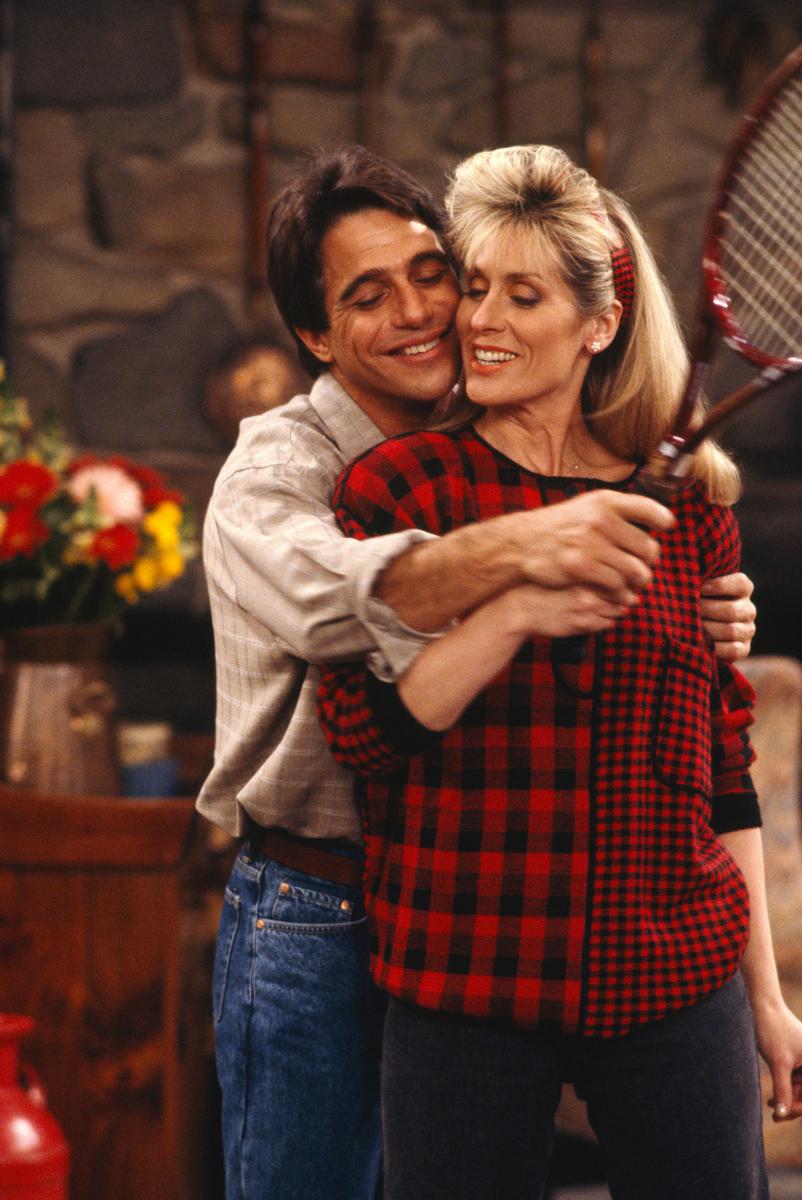
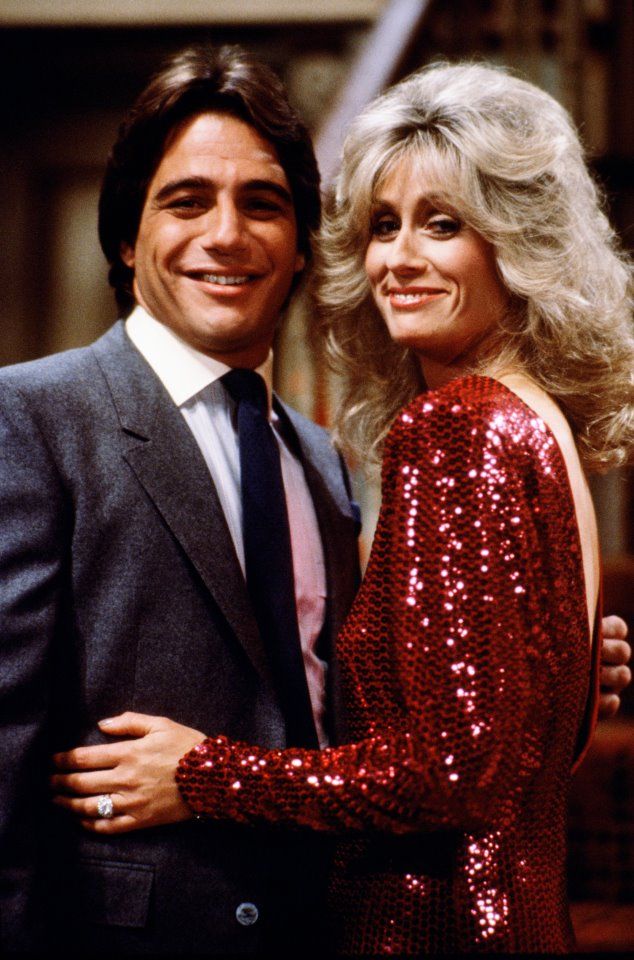
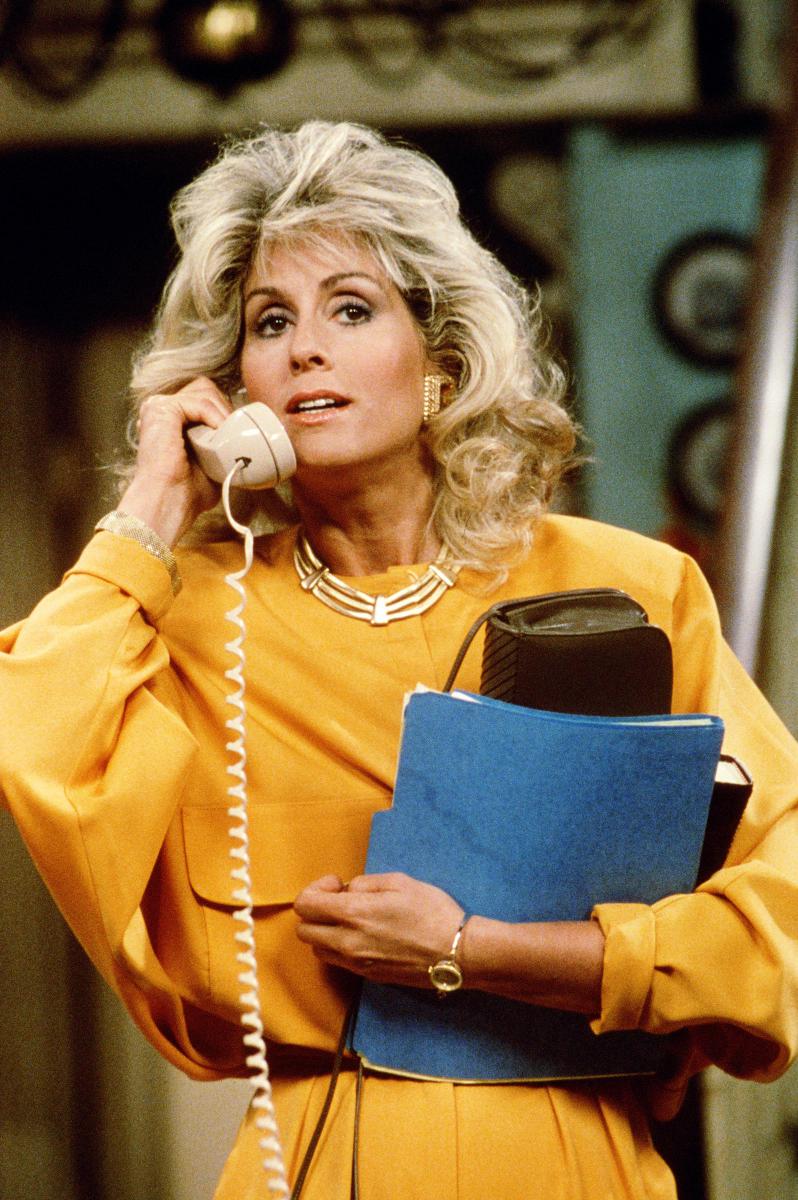
Instead of the successful senator who hires a housekeeper like The Farmer’s Daughter, on this show Angela Bower (Judith Light), an advertising executive, hires Tony Micelli (Tony Danza), a former baseball player (St. Louis Cardinals) to be her housekeeper. Instead of Uncle Charlie like My Three Sons, the show has Mona (Katherine Helmond), Angela’s mother giving wise advice and sarcastic comments. Tony has a daughter Samantha (Alyssa Milano) and Angela has a son Jonathan (Danny Pintauro). All together they form one typical family unit. The show was on ABC for eight years from 1984-1992, so viewers literally watched the kids grow up. Tony is laid back and flexible, while Angela is a bit more uptight and organized. Angela and Tony functioned as parents on the show, but they also had the possibility of a romance between them.

Photo: imdb.com

After a shoulder injury, Tony is forced to change careers. He wants his daughter to experience a better life. The Bowers live in Connecticut in an upscale neighborhood. Originally, the show was titled “You’re the Boss,” but it was changed to plant a question of who really ran the house. However, viewers all realized that the kids were really the bosses.

WHO’S THE BOSS? – “Angela Gets Fired: Part II” – Airdate: September 30, 1986. (Photo by ABC Photo Archives/ABC via Getty Images)ALYSSA MILANO;DANNY PINTAURO;KATHERINE HELMOND

The cast jelled very well together. They had their differences of opinion, but they grew close and experienced the normal family ups and downs when five very different people spend so much time together. Mona’s wit and targeted observations kept things light and funny.

Photo: sonypicturesmuseum.com
Photo: pinterest.com

During most of the series, Tony and Angela try to avoid the romance developing between them. They both date other people. They also become best friends, relying on each other as a husband and wife would. They often discuss issues the kids are having. They both “parent” each of the kids. They both grow and change during the course of the series. Angela becomes less tense and risks opening her own firm. Tony enrolls in college. Producers always seem to waiver “between should they get together or not.” Shows like Castle, That Girl, and Friends struggled with keeping the magic alive and keeping the show realistic. Somehow the producers and writers for Who’s the Boss kept the tension and potential romance alive for seven years. During the last season, they realize they are in love with each other.

Photo: mentalfloss.com

There were many stars who appeared on the show during the years including Frank Sinatra, Ray Charles, Mike Tyson, and Leslie Nielsen. One of the episodes was when Robert Mandan appeared on a few episodes as Mona’s love interest. Mandan had played her husband on the show Soap.

Photo: eonline.com

The theme song lyrics were written by creators Cohan and Hunter. Titled “Brand New Life,” the music was composed by Larry Carlton and Robert Kraft. Three different versions were used over the years: Larry Weiss sang it from 1984-1986; Steve Wariner from 1986-1989; and Jonathan Wolff from 1989-1992.

WHO’S THE BOSS? – “Samantha’s Growing Up” – Season One – Airdate: January 8, 1985. (American Broadcasting Companies, Inc.) ALYSSA MILANO, JUDITH LIGHT, KATHERINE HELMOND, TONY DANZA

Early reviews were lukewarm. Critics liked it but they were a bit dismissive of it being a real hit. Viewers didn’t agree. They loved the show. During its tenure, the show was nominated for more than forty awards, including ten Primetime Emmys and five Golden Globes. From 1985-1989, it ranked in the top ten.

Photo: fatsaloon.com
Photo: eonline.com

The show aired on Tuesday nights for the first seven years. In the fall of 1991, the network moved the show to Saturday nights against The Golden Girls. The ratings went down after the move and the network decided to cancel the show. There was a great debate about whether Tony and Angela should marry in the finale. Sam had married earlier in the season and Tony and Angela admitted they were in love. However, Danza was opposed to the marriage and there was a concern that if a wedding took place, it might affect the syndication options. Instead of a wedding, Tony and Angela break up. But in the last scene, Tony is at Angela’s house applying for the job of housekeeper, very similar to the very first episode of the show.

The show created a spinoff but in a far-reaching definition of spinoff. In one episode, Leah Remini was a friend of Sam’s, a homeless model. Beginning and ending in 1989, the show Living Dolls starred Remini, Michael Learned, and Halle Berry.

Photo: cbsnews.com

While Tony went back to school during the series, Danza emulated him in real life. He graduated with an education degree. He wrote a book, I’d Like to Apologize to Every Teacher I Ever Had: My Year as a Rookie Teacher at Northeast High. He taught English at a school in Philadelphia.

Photo: celebritynooz.com
Photo: etcanada.com

The cast of Who’s the Boss was a close-knit one, and they still keep in touch almost twenty years later. Light commented that they are all still close and she said she probably kept in touch with Tony the most. “He checks in all the time just to see how the kids are doing, he’s very sweet.” Danza once discussed how emotional it was for him to give Milano away as a bride on the show. “She was like my little girl, you know. She started on this show when she was 10. Now she’s 19, we married her off. I mean, it’s easy to get emotional, it really is.”

Photo: people.com
Photo: imdb.com

Milano was also very close to Light. A couple of years ago, the two stars ran into each other for an event, and Milano tweeted, “Nothing makes me happier than seeing Judith Light. Nothing.”

Photo: pinterest.com

They were all saddened by the death of Katherine Helmond in March of 2019. Danza also discussed Helmond in an interview. “Katherine Helmond was a remarkable human being and an extraordinary artist; generous, gracious, charming and profoundly funny.” After her death, he commented that “She was such an influence on me. No matter what problem I had, I could go to her. Very few people could match her. She was a consummate professional. She never made a mistake and she always got the laugh. She was the sexy older lady who could keep up with the young people. She just had a way about her.”

Editorial use only. No book cover usage. Mandatory Credit: Photo by Moviestore/REX/Shutterstock (1646629a) Who’s The Boss , Katherine Helmond, Tony Danza Film and Television

Light also discussed Helmond. “She taught me so much about life and inspired me indelibly by watching her work. Katherine was a gift to our business and to the world and will be deeply missed.”

Photo: spm.com

Her television grandchildren also remembered her fondly. Milano paid the following tribute to her: “My beautiful, kind, funny, gracious, compassionate rock. You were an instrumental part of my life. You taught me to hold my head above the marsh! You taught me to do anything for a laugh! What an example you were!” Pintauro said she was “the best TV grandmother a boy could ask for. Even still, I’m just as devastated as I was when I lost my real grandma. A beautiful soul has left us for the next chapter, may you make them laugh Katherine!”

Photo: youtube.com

This is another one of those undervalued shows. Although there were some really great shows on television during the mid and late 1980s, some of the top-rated shows on in this decade included Knot’s Landing, Charles in Charge, Diff’rent Strokes, Silver Spoons, and Facts of Life. Who’s the Boss was a much better written and acted show than any of these. The show combined the best elements of sitcoms and created a fresh approach to a family comedy.

Did You Know Shirley Partridge, Samantha Stephens, Jeannie, Donna Reed, and Hazel Lived in the Same Neighborhood?

As we proceed with our Behind the Scenes series this month, today we are thinking about set designers. Before the interior designs are done, the production team needs to find the perfect home for our television friends.

Did you ever daydream about places you might want to live in, even if you never would actually consider leaving your home?  Perhaps it’s a small rose-covered cottage in the English countryside, maybe a ski chalet in the Swiss alps, or a house on the Maine coast with green shutters and a widow’s walk. I’ve thought about all of these places, but now I have another one to consider. It’s an historic neighborhood where some of my favorite television friends lived. Today we learn a bit about the Columbia Ranch.

Photo: columbiaranch.net

Now called Warner Brothers Ranch, the former Columbia Ranch was in Burbank, CA. In addition to dozens of television shows, it was the setting for many movies as well such as Mr. Deeds Goes to Town, High Noon, and Lost Horizon. The neighborhood interiors were typically shot at other studio locations.

In 1934, Harry Cohn, head of Columbia Pictures, purchased 40 acres in Burbank. In 1948, Columbia got into the television business under Screen Gems.

Photo: pinterest.com

During the 1950s, Captain Midnight, Father Knows Best, The Donna Reed Show, and Dennis the Menace were filmed here. By the 1960s, the ranch was used continuously for television and movies. The set was about six blocks but looked much larger on camera shots. Shows during the 1960s included My Sister Eileen, Hazel, Our Man Higgins, The Farmer’s Daughter, Bewitched, Gidget, I Dream of Jeannie, The Monkees, and The Flying Nun.

In 1970, a fire destroyed a quarter of the neighborhood, including many buildings on Blondie Street. After rebuilding, taping continued on the set. During the next three decades, shows included The Partridge Family, Bridget Loves Bernie, Apples Way, The Scarecrow and Mrs. King, and Life Goes On.

In 1971, Columbia and Warner Brothers combined their companies and merged into The Burbank Studios. The Ranch then was relegated to a back backlot.

Photo: columbiaranch.net

When Columbia Pictures moved its production facilities to Culver City in 1990, Warner Brothers gained ownership of the Ranch.

Photo: pinterest

Photo: pinterest

It’s continued to be a busy spot for filming. The fountain in the park was the one shown in the opening credits in Friends.

Nearby is also a swimming pool used on a variety of shows, including The Partridge Family.

The most famous street in the Ranch was Blondie Street. Blondie Street was named for Blondie Bumstead because the Blondie movies of the 1940s were filmed here. Walking down Blondie Street reveals homes that we were all familiar with growing up in the sixties and seventies.

Photo: columbiaranch.net

It’s a curved residential street with twelve different houses, surrounding a large, central park. There is also a brick church and paved sidewalks. Three of the buildings—the Lindsay House, the Little Egbert House, and the Oliver House—were original to the 1935 set production.

The Blondie House

Photo: columbiaranch.net

This set, constructed in 1941, was the home for Major Nelson on I Dream of Jeannie, Mr. Wilson on Dennis the Menace, and the Andersons on Father Knows Best, in addition to the Blondie movies. Later it housed the operations office for the Warner Ranch. Of course, Jeannie’s house was not here, it was a Jim Beam decanter that was sold during Christmas of 1964.

The Corner Church

Photo: columbiaranch.net

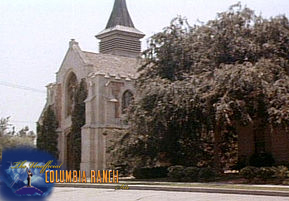
When thePartridge Family drives off for a show in their bus, you can often spot the church which is just down the road from their home, across from The Stephens’ home on Bewitched. It was moved here in 1953. When any of the series needed a church, this was the one. It can be seen on an episode of Hazel when the family attends church.

The Deeds Home

Photo: columbiaranch.net

Originally built for Frank Capra’s movie, Mr. Deeds Goes to Town in 1936, the house is only seen briefly in the movie. The Three Stooges filmed there in the thirties and forties. In the sixties it was seen in Batman. Both Gidget and The Partridge Family used the house as the high school and Bewitched used it as a civic building. In 1989, the original house was demolished. In its place, The Chester House and the Griswold House were built. The Griswold House was built for National Lampoon’s Christmas Vacation.

The Lindsay House

Photo: columbiaranch.net

Constructed in 1936, this house was best known as the Baxter home on Hazel. It also served as the Lawrence home on Gidget.

The Higgins House

Photo: columbiaranch.net

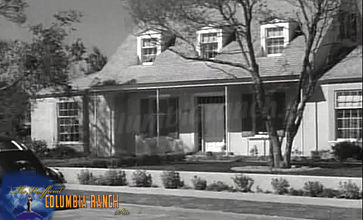
This structure was constructed for the show Our Man Higgins in 1962. It was later the home of Darrin and Samantha Stephens on Bewitched from 1964-1972. On I Dream of Jeannie, it was the home of Alfred and Amanda Bellows.

Photo: pinterest.com

For Bewitched, the interior and backyard scenes were filmed on a sound stage. The stairs ended in a hallway, but the doors only led to small closets, not the master bedroom.  A modular first floor served as a setting for all the rooms. The den doubled as the nursery. A fake wall was put up to hide the view to the kitchen. When the den was needed, brown paneling was put over the nursery walls and the window was covered with a wall near the fireplace.

Photo: darkershadows.com

If you look closely, you’ll notice the avocado and gold flowered sofa in the Stephens’ living room was the same one used by Alfred and Amanda Bellows in their living room. But the shows shared well.  On one episode of Bewitched, Louise and Larry Tate are seen at their kitchen table, but the kitchen looks identical to Major Nelsons’s. Roger Healey’s bedroom eerily resembled Darrin and Samantha’s.

Photo: youtube.com
Photo: pinterest.com

I guess I was too busy crying to notice that this house was also Brian Piccolo’s home in Brian’s Song.

The Partridge Family House

Photo: pinterest.com

The house across the street from the Stephens’ house was home to Abner and Gladys Kravitz. During the filming of Dennis the Menace, it was Mrs. Elkins’ house. It was also the home of The Partridge Family. In 1989 it became the Thatcher home on Life Goes On.

The home was built in 1953, modeled after a Sears, Roebuck & Co. plan. The modest two-story home was a perfect fit for the Partridges with its white, picket fence. The interiors were filmed at the Ranch as well. Located next door to the Blondie House, there were shrubs between the homes that were featured several times on the Partridge Family. In an episode where Keith shoots a movie, Shirley is clipping the hedges and begins dancing for the film, not realizing her neighbor is watching her. We see the hedges again when Keith moves into the room above the garage next door and gets free rent in return for yard work.

Photo: flickr.com
Photo: flickr.com

Because they were filming the show when the infamous fire broke out, some of the structure had to be rebuilt for the remainder of the series. From season 1 to 2, Danny and Keith’s bedrooms switch back and forth a couple times, and I wonder if this is the reason.

The Oliver House

Photo: columbiaranch.net

Constructed in 1935 for a movie, the Oliver house was moved to Blondie Street for the home of the Stone family in The Donna Reed Show. It was also the Mitchell home where Dennis resided with his parents.

The Little Egbert House

Photo: columbiaranch.net

Technically, Little Egbert is not on Blondie Street but on its own, Little Egbert Street, basically an alley. Fortunately, the 1970 fire did not damage any of the original structure. The house was also used in Minding the Mint and as The Shaggy Dog, the hangout for Gidget and her friends.

Photo: retrospace.org

For sentimental reasons, I would choose the Partridge Family home to live in. However, I would have to remodel the kitchen. I could live with the red breakfast table set. The avocado and gold flowered wall paper may have been very chic in its day, but even I am not that sentimental!

While John Forsythe Chose “To Rome with Love,” The Network Let the Show Roam Without Much Love

We continue our series with a salute to fathers looking at one of my favorite actors, John Forsythe in a little-remembered show, To Rome with Love.

Photo: en.wikipedia.org

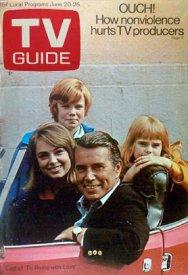
The show debuted on CBS in September of 1969 and aired until spring of 1971. In 1967 Forsythe had starred in The John Forsythe Show and in the successful sitcom, Bachelor Father, seven years before that.

Photo: pinterest.com
The John Forsythe Show

After the acclaim of Bachelor Father, The John Forsythe Show was a big disappointment. The premise of the show was that Forsythe as retired US Air Force Major John Foster inherits a private girls’ school in San Francisco. A buddy of his and former sergeant helps him run the school and they have conflicts with the principal Miss Culver. Forsythe once commented on it, saying “I choose to froget about that one. It was a disaster from the start. I hope the world forgets it too, especially the name.”

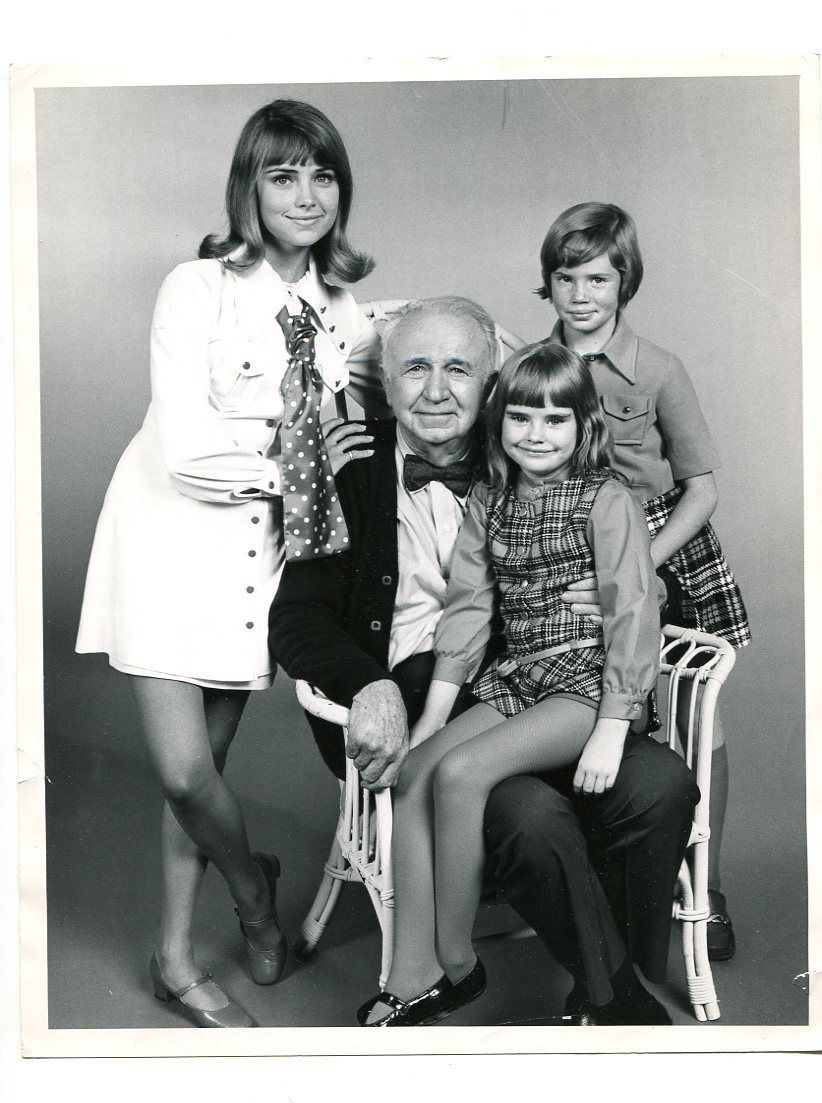
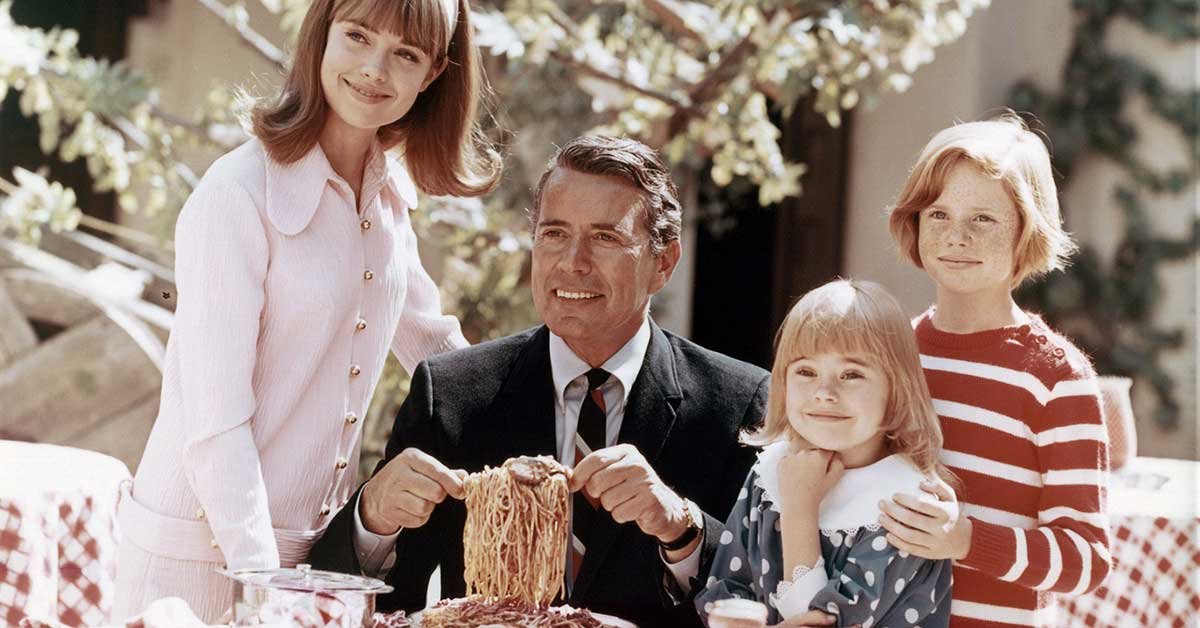
To Rome with Love also had a school setting. Forsythe played Michael Endicott, a widow with three daughters. He accepts a teaching position at an American school in Rome and relocates his family there from Iowa. His sister Harriet (Kay Medford) comes with the family for season one to help out. Endicott’s father-in-law, Andy Pruitt (Walter Brennan), comes to Rome to visit and ends up moving there during the second season.

Photo: nndb.com

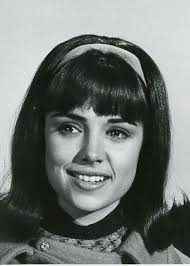
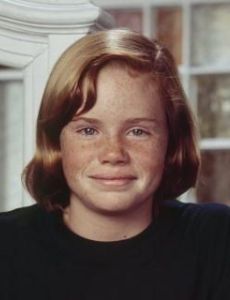
The oldest daughter is Alison (Joyce Menges), the middle is tomboy Penny (Susan Neher) and the youngest is Mary Jane, nicknamed Pokey (Melanie Fullterton). None of the girls continued in television past 1974. Menges had been a former tv and magazine model.  She appeared in two films, one before (1967) and one after (1972) the show. Fullerton made an appearance on High Chaparral before this show and appeared in two movies (1972 and 1974). Neher had the most productive acting career. She was cast on Accidental Family before appearing on To Rome with Love. After the show, she would guest star on Young Lawyers, Getting Together, Love American Style, The Partridge Family, with her last appearance was on Paul Sand in Friends and Lovers in 1974.

Photo: allstarpic.famousfix.com
Photo: famousfix.com


Photo: famousfix.com
Photo: pinterest.com

Rounding out the cast was Vito Scotti who played Mr. Mancini and Peggy Mondo who was Mama Vitale in Rome.

Photo: tvmaze.com

Photo: tvmaze.com

The show was on Sunday nights at 7:30 for the first year. It was up against Land of the Giants and The Wonderful World of Disney. The second year it switched to Tuesdays at 9:30 for the first half of the year on against movies of the week and then was moved to Wednesdays at 8:30 for the rest of the season. On Wednesdays it was up against The Smith Family and the Men from Shiloh. They were one-hour shows and To Rome with Love was on during the second half of both shows. The show never received the ratings the network had hoped for.

Photo: metv.com

Jack Gould reviewed the show before its debut. His comment was “the personable John Forsythe is the main asset of the series, but it is doubtful if he alone can overcome the handicap of imposing Hollywood nonsense on a city rich in drama and laughter and yet to be explored with understanding by TV. For the viewer, one solution is to turn off the sound and settle for incidental scenic background.” Donald Freeman from the San Diego Union called the show “all stereotyped and unfailingly pleasant.” Terrence O’Flaherty of the San Francisco Chronicle described it as a “giant pizza which appears to be filled with every situation comedy cliché in TV history and every Italian character actor south of San Luis Obispo. Dwight Newton of the San Francisco Examiner said it was “another little innocuous comedy drama series.” Apparently, viewers agreed with their opinions.

The combination of bad reviews and going up against Disney before moving to two different nights almost guaranteed its failure.

Photo: incredibleinman.com

Don Fedderson and Edmond Hartman produced the show. They were also the creative forces behind My Three Sons and Family Affair. An interesting concept was the cross-over episode. In season two, Anissa Jones and Johnnie Whitaker from Family Affair appear on the show on episode 4, “Roman Affair.” Episode 6 featured William Demarest, Don Grady, and Tina Cole from My Three Sons in “Rome is Where You Find It.”

After the show ended, Forsythe commented that his “fate is to be surrounded by ladies at home and at work which is not at all painful. I have a wife and two daughters at home. But on the television, I’ve always been unmarried. We might have started the single-parent trend with ‘Bachelor Father.’ Now the air is filed with widows and widowers raising children alone. There’s a reason for it. One unqualified parent dealing with children is more amusing because of the difficulty it presents.”

This sounded a bit exaggerated to me, so I went back to take a closer look at the shows that were on during the 1960s, and he was right. I always think of the typical sitcom as a nuclear family like the Donna Reed Show or Leave It To Beaver, but during this decade many shows were about adults. Think of Get Smart, The Joey Bishop Show, That Girl, The Odd Couple, The Mary Tyler Moore Show, or The Flying Nun. When shows were about families, the norm was almost to have a single parent. In addition to Bachelor Father, My Three Sons, and Family Affair, we had The Farmer’s Daughter, The Ghost and Mrs. Muir, The Doris Day Show, The Andy Griffith Show, Petticoat Junction, Gidget, and Julia. It wasn’t confined to sitcoms either; consider The Rifleman, Bonanza, and The Big Valley. The genre would continue into future decades as well. Some of the most popular shows featured single parents: The Partridge Family, The Courtship of Eddie’s Father, Nanny and the Professor, Diff’rent Strokes, One Day at a Time, Eight is Enough, and Alice.

Photo: dailymail.co.uk

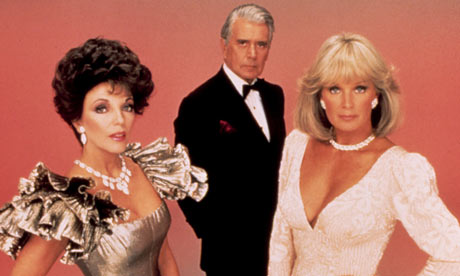
Fortunately for viewers, Forsythe did not throw in the towel and retire into obscurity. Forsythe would go on to star as Blake Carrington on Dynasty.

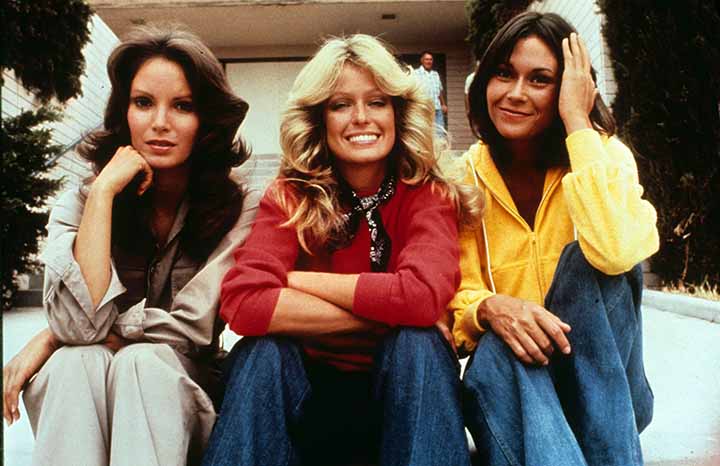
DNX6N3 Jan. 1, 1976 – F3353.”Charlie’s Angels”.FARRAH FAWCETT, KATE JACKSON, & JACLYN SMITH. 1976(Credit Image: © Globe Photos/ZUMAPRESS.com)

The show he is best remembered for is Charlie’s Angels, continuing his tradition of being surrounded by beautiful women on television.

Did I Tell You The One About The Farmer’s Daughter: The Chemistry of Inger Stevens and William Windom

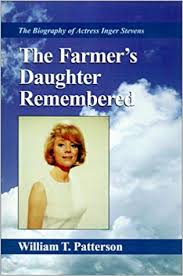
Photo: abebooks.coom

This blog takes a look at a show that is beginning to fade from viewers’ memories. The Farmer’s Daughter debuted in the fall of 1963, starring Inger Stevens as Katy Holstrum and William Windom as Glen Morley.

The show was based on the 1947 movie of the same name starring Loretta Young and Joseph Cotten in the lead roles.

Katy was a student who needed to earn some money and became a governess/housekeeper for Morley’s boys, Steve (Mickey Sholdar), age 14 and Danny (Rory O’Brien), age 8. Morley is a congressman. While Morley is sophisticated and refined, Katy is a no-nonsense type of girl from Minnesota. Morley’s mother Agatha (Cathleen Nesbitt) also lives with the family. The cast is rounded out by Philip Coolidge as Cooper, the family’s butler. In the early seasons, it is obvious that Glen and Katy are falling for each other, and many of the plots are one of them being jealous of the other. In the movie, Katy runs for Congress, but she is not as involved in politics in the television show.

Photo: worthpoint.com

Screen Gems produced the show which aired on ABC. The show was sponsored by Lark Cigarettes and Clairol. The two stars often promoted the products at the end of the episode. In season one, the show was on Friday nights against Burke’s Law on CBS and The Fight of the Week on NBC. Season two found the show opposite The Flintstones and The Addams Family. The show moved to Tuesday nights for season three against A Man Called Shenandoah and Ben Casey. The show was never in the top 25 but, it had respectable ratings. The critics liked the show, and it was nominated for an Emmy for outstanding comedy in 1964 but lost to Mary Tyler Moore for The Dick Van Dyke Show. It was also nominated for Emmys for writing, directing, and best actress. Stevens won the Golden Globe for best female tv star. TV Guide conducted a popularity poll, and she won the female performer of the year with David Janssen of The Fugitive, winning male performer.

At the end of season two, Katy and Glen become engaged. The third season brought full-color episodes. Early in the third season, they marry. After that ratings fell significantly, and the show was not renewed for a fourth season. In the finale, Katy adopts Danny and Steve. The chemistry between Glen and Katie and waiting to see if they got together or not kept viewers tuning in.  Once they married, viewers were not as invested.

Photo: en.wikipedia.org

In 1957, Inger was signed to a seven-picture contract with Paramount. In 1959, she survived after swallowing an overdose of pills and she seemed to recover with a renewed zeal to work on her career and life situation.

Stevens became a favorite actress of many viewers after The Farmer’s Daughter. The cast and crew liked her very much and she was easy to work with. She never got upset when filming ran long or had complications. She and Windom often played practical jokes on each other to bring fun to the workplace. She recalled eating an onion sandwich one day right before they filmed a kissing scene.

After the show was cancelled, she was cast in the movie, A Guide for the Married Man in1967. She then starred in films with Jimmy Stewart, Dean Martin, and Clint Eastwood. She appeared in the made-for-tv film, Run Simon Run with Burt Reynolds in 1970. After seeing the film, Aaron Spelling cast her in an upcoming series, Zig Zag to air in the fall. The show was about a trio who work on hard-to-solve murders. When the show went on the air in 1970, Yvette Mimieux had to take over Inger’s role.

Photo: commons.wikimedia.org

Unfortunately, the sunny disposition Stevens portrayed to the world hid a sad and tragic life and she committed suicide before the show aired. Her housekeeper found her in April; she was semi-conscious and died on the way to the hospital. The cause of death was determined to be acute barbiturate intoxication. The public was saddened and surprised to learn how unhappy she was.

In 2000, William Patterson published the book, The Farmer’s Daughter Remembered. He dove into her life and tried to determine whether she meant to commit suicide or not.

Photo: pinterest.com

Windom also starred in the series, My World and Welcome to It as cartoonist John Monroe and as Dr. Seth Hazzlett on Murder She Wrote in 1985. His first movie role was in To Kill a Mockingbird in 1962. In addition to other films and Broadway, he traveled performing one-man shows of both James Thurber and Ernie Pyle. He passed away of congestive heart failure in 2012 at 88.

Cathleen Nesbitt would continue appearing in television series until 1982 when she passed away at age 93. Although she had appeared in many films, The Farmer’s Daughter was the only series she was featured in regularly.

Photo: en.wikipedia.org
Cathleen Nesbitt

Mickey Sholdar only appeared in five other shows after The Farmer’s Daughter. His last acting appearance was in the movie Babe. I could not verify how he spent his life up to now.

Photo: sitcomsonline.com
Mickey Sholdar and Rory O’Brien

Rory O’Brien, like Sholdar, only appeared in a few shows after the series ended. He was also in one film afterward, Little Big Man. O’Brien left the acting profession in the early 1970s. I could not find any other information on him either.

Photo: famousfix.com
Phillip Coolidge

Philip Coolidge was in many acclaimed movies before he took the role on The Farmer’s Daughter. Like most of his cast mates, he only appeared in a few shows in the mid-1960s, and he passed away in 1967.

Photo: pinterest.com

The show was aired in syndication on CBN, but I cannot find any other channels that carried it, and I cannot find any evidence that it was ever released on DVD. It’s too bad because the show featured a couple with great chemistry and the quick pace of the story and well-written dialogue that made the show memorable will be lost if no one is able to see the show in the future.

Who Writes The Songs?: Good Question–Lots of People Including Frank De Vol, Jay Livingston, and Ray Evans.

At this time of year, we tend to watch a lot of football bowl games. Most of the attention centers on the coaches, the quarterbacks, and a handful of other star players like running backs, wide receivers, and occasionally kickers. While these positions influence the games, there is an entire team behind them which determines whether they get a win or a loss. This year I will be trying to look at some of the behind-the-scenes players in the television industry.

Today we look at three composers who often influenced shows, even though many viewers never heard of the song writers.
devol1

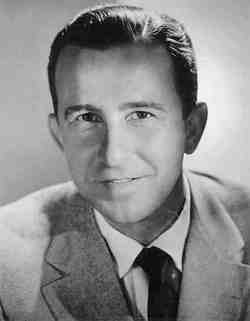
Frank Denny De Vol was born in West Virginia in 1911. His family moved to Canton, Ohio where he grew up. His mother owned a sewing shop, and his father was in charge of the pit orchestra at a local movie theater. He graduated from McKinley High School in 1929 and started at Miami of Ohio University but quit after six weeks. His parents were hoping he would pursue his law degree, but he was set on a career in music.

This wasn’t surprising because he had become a member of the musicians’ union at age 14. He worked for his father at the theater and played the saxophone and violin.

Once he left college, he joined Emerson Gill’s orchestra and traveled around Ohio. Later he became a musician with Horace Heidt’s band, and Horace let him try his hand at arranging. He would then travel with Alvino Rey’s band which led to a long-life friendship with the King Family.

During his career as a traveling musician he married his wife, Grayce McGinty in 1935. The couple’s 54-year-long marriage would produce two daughters.

During the 1940s, he would write arrangements for many of the country’s top performers including Tony Bennett, Nat King Cole, Vic Damone, Doris Day, Ella Fitzgerald, Dinah Shore, and Sarah Vaughn. His version of “Nature Boy” for Nat King Cole went to number 1 in 1948.

In 1943 he moved to California and started his own band. He appeared on the radio on KHJ and accompanied many stars including Jack Carson.
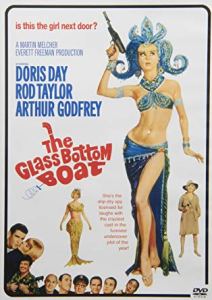
 

In the 1950s, he moved into movie composing and worked on more than 50 film scores including What Ever Happened to Baby Jane, The Glass Bottom Boat, The Dirty Dozen, and several Herbie movies. He received Academy Award nominations for his work on Pillow Talk (1959), Hush . . . Hush Sweet Charlotte (1964), Cat Ballou (1965), and Guess Who’s Coming to Dinner (1967).


During the 1950s, his orchestra also was frequently seen at the Hollywood Palladium as “Music of the Century.”
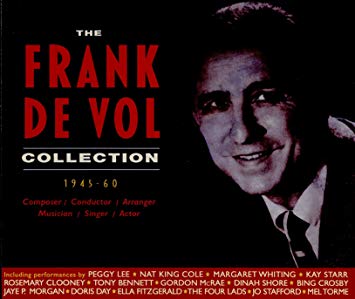
devol3


It seems natural that De Vol would ease into television work as well. He composed the jingle for Screen Gems’ “Dancing Sticks,” which appeared on all television series produced by Columbia Pictures.


devol26

Photo: pinterest.com

Frank became the musical director on Edgar Bergen’s game show Do You Trust Your Wife? His orchestra was featured on a variety of musical shows including The Lux Show Starring Rosemary Clooney.


devol21

Today De Vol might be best known for his work as a composer for television series. He wrote the music for My Three Sons, Family Affair, The Brady Bunch, and The Smith Family. My Three Sons theme song was a hit single in 1961 by Lawrence Welk, more musically complex than many sitcom themes of the time. He would continue his work for My Three Sons for all 380 episodes.
 

devol23

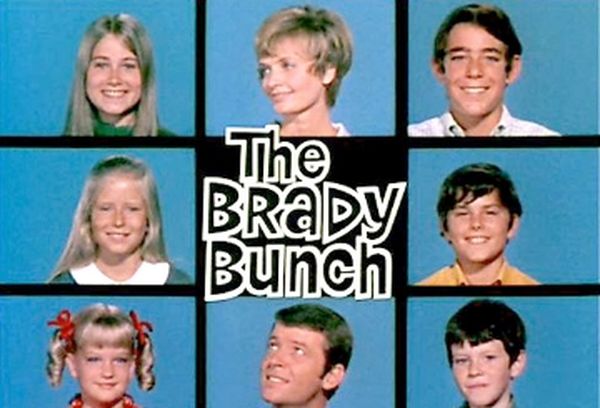
Sherwood Schwartz, the creator of The Brady Bunch, first turned to George Wyle to create the Brady theme. Wyle and Schwartz had composed the theme for Gilligan’s Island. With Wyle already committed to The Andy Williams Show, he approached De Vol. De Vol would provide music for 117 episodes of the original show, as well as music for The Brady Girls Get Married, The Brady Brides, The Bradys, and A Very Brady Sequel.

Frank was credited as composer for 37 movies and television series and listed as part of the music department for 87 total.
 

devol25

Photo: sitcomsonline.com

Not only was he musical composer for these shows, but you can see him acting in many of the shows he worked on as well. His first acting appearances were on Betty White’s Show, Life with Elizabeth where he played a variety of roles.
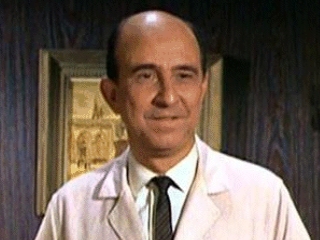


devol28

Photo: aveleyman.com

He then appeared on several television series including State Trooper, My Favorite Martian, The Farmer’s Daughter, Gidget, Please Don’t Eat the Daisies, Bonanza, Petticoat Junction, Get Smart, That Girl, and I Dream of Jeannie (37 different shows in all).

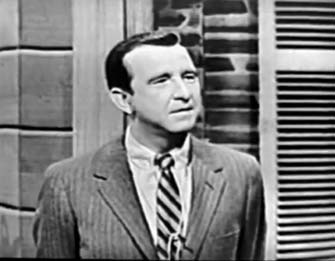
While composing on My Three Sons, he would actually portray a bandleader on the show and a father on The Brady Bunch.


devol2imagenesmy.coom

Photo: imagenesmy.com

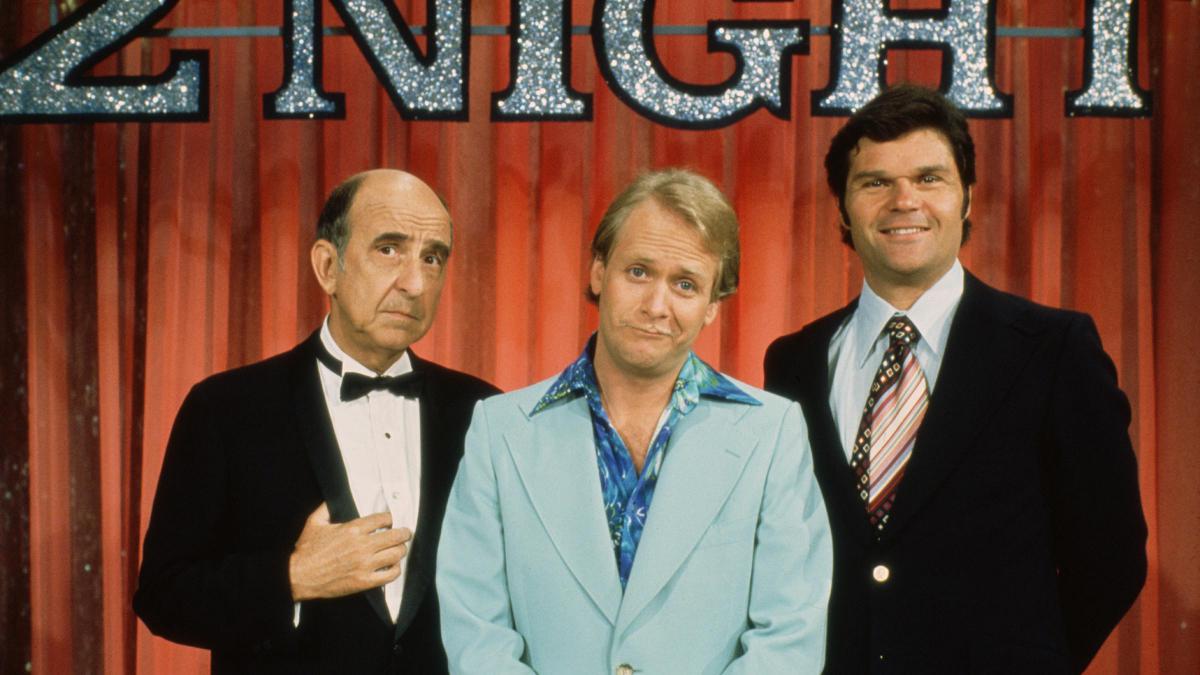
Many people will remember him as the dour-faced band leader Happy Kyne on Fernwood Tonight and America 2-Night, shows starring Martin Mull in the late 1970s.


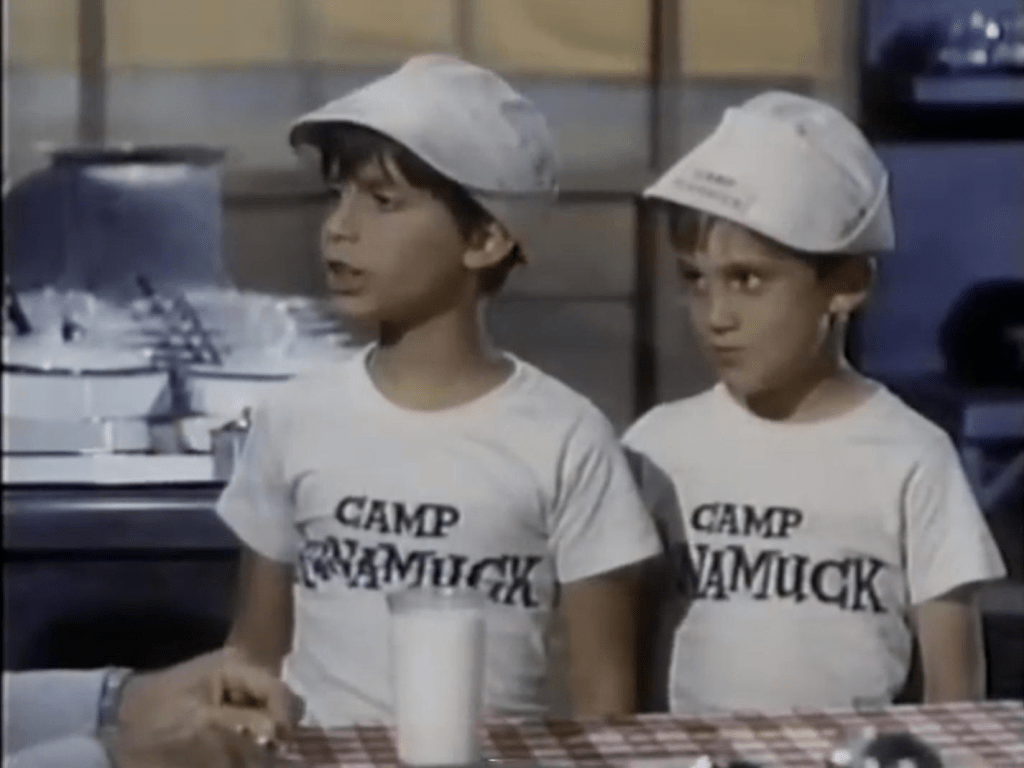
One of my favorite roles of his was the head of the boys’ camp on the original Parent Trap.

devol27

Photo: tcm.com

His last acting role would be on Charles in Charge, the Scott Baio comedy from 1990.

When he was in his 80s, Frank was still active with the Big Band Academy of America. About this time, he married Helen O’Connell who had been a big band singer and actress. (His first wife passed away in 1989.)

Helen passed away in 1993, and Frank died from congestive heart failure in 1999.


devol24

Photo: pinterest.com

Like so many of these stars of the classic television era, he was a multi-talented guy. He could sing, he could play instruments, he could compose, he could arrange, and he could act. Sadly, when he does his job right, the music is so attuned to the shows that we almost don’t realize it’s there but try listening to a show with no background noise. Thank you Frank De Vol for not becoming an attorney.


We also take a look at a song-writing team of the golden age, Jay Livingston and Ray Evans.

living4


Livingston was born in McDonald, Pennsylvania in 1915. After studying piano with Harry Archer in Pittsburgh, he attended the University of Pennsylvania, majoring in journalism but also studying composition and orchestration.

Ray Evans was born in Salamanca, New York the same year. He also ended up at the University of Pennsylvania, receiving a degree in Economics.

Livingston organized a dance band at the University that played on campus as well as at local nightclubs and even cruise ships during their summer breaks.  One of those band mates was Ray Evans. Evans and Livingston became a partnership and they wrote some of the most iconic songs from film and television.


evans1

Photo: filmmusicsociety.org

After their graduation in 1937, the duo moved to New York City to work in Tin Pan Alley. They wrote for Broadway productions, including special material for Ole Olsen and Chic Johnson.
 

evans8

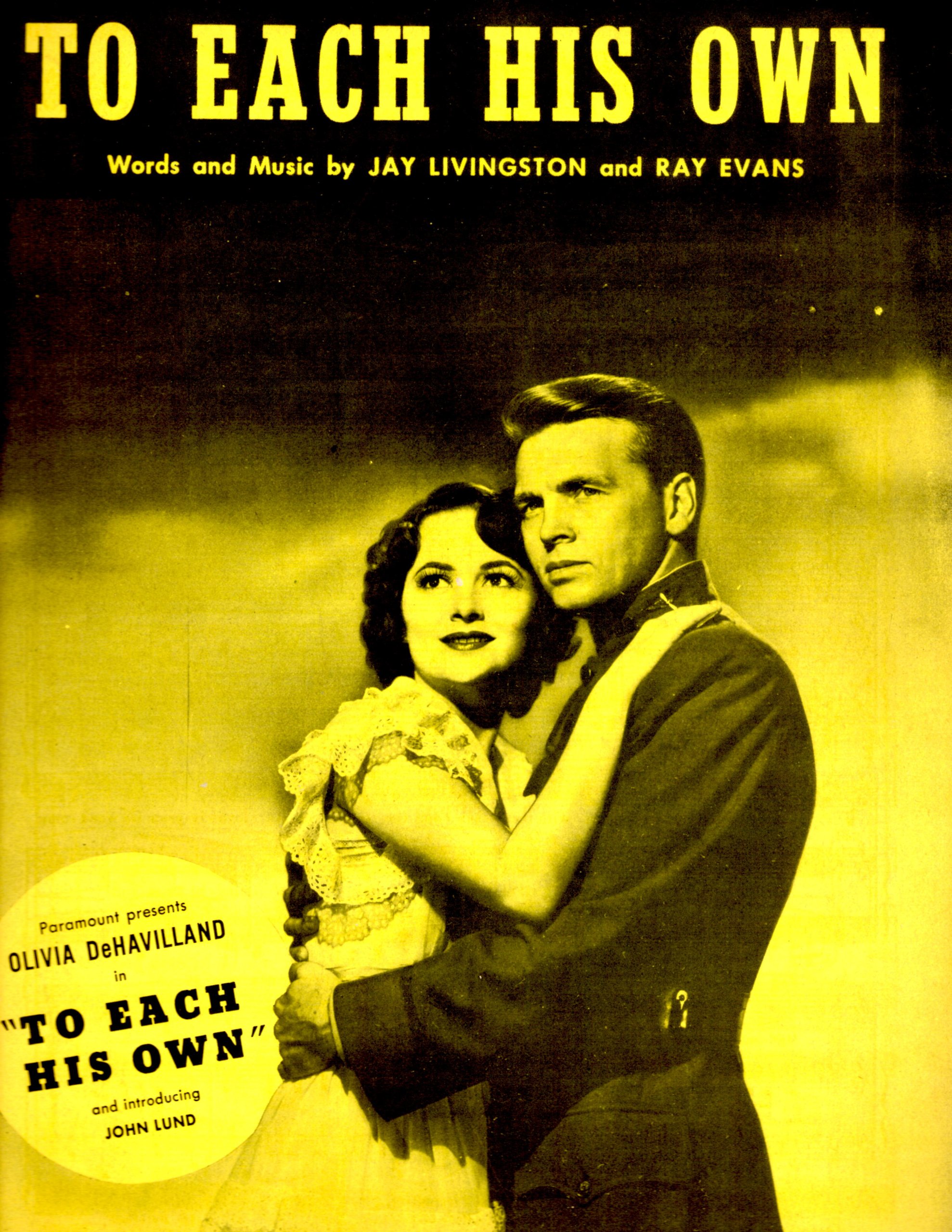
Livingston joined the Army when World War II began while Evans went to work for an aircraft company. When Jay came back home in 1945, he and Evans decided to try their luck in Hollywood. They received a contract from Paramount Pictures, and the team would stay with the company for a decade. Their first film was To Each His Own, starring Olivia DeHaviland, and they were nominated for an Academy Award.

During this time at Paramount, Livingston married Lynne Gordon. It must have been a happy marriage because they were married until 1991 when she passed away.

The exact same year, Evans married Wyn Ritchie. They were married until her death in 2003.

In 1947 the team began writing for Bob Hope for his personal appearances. Throughout the 1940s and 1950s, they would write many tunes that became jukebox favorites and popular songs. In Warren Craig’s book The Greatest Songwriters of Hollywood, he called them “the last of the great songwriters in Hollywood.”
 

evans2

Photo: pinterest.com

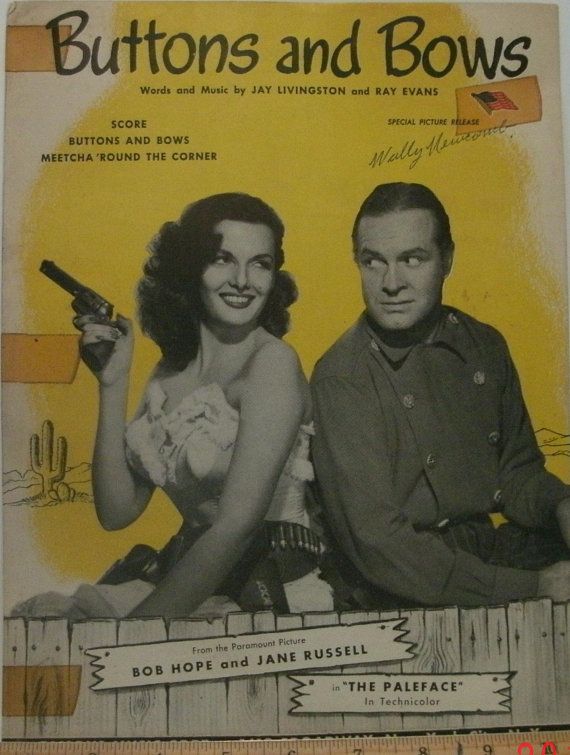
The year 1948 brought them their first Oscar win for “Buttons and Bows,” from Bob Hope’s western comedy, The Paleface. The jukebox version was recorded by Dinah Shore.


evans7

In 1950, they scored their second Academy Award for “Mona Lisa,” written for the movie Captain Carey, USA but made famous by Nat King Cole.


evans10

Photo: moviemovieblogblog.wordpress.com

Evans and Livingston would appear in Sunset Boulevard this same year at the New Year’s Eve party scene.

 

evans3

We can all smile and thing of Livingston and Evans each Christmas when we hear “Silver Bells.” The song, originally titled “Tinkle Bells” was written for The Lemon Drop Kid in 1951, also starring Bob Hope. Thankfully, they decided “tinkle” had other connotations and “Silver Bells” it became. (Some sources credits Jay’s wife Lynne with the name change.)

When their Paramount contract ended in 1955, they became free lancers and wrote both individual songs and complete scores for a variety of movies. They would receive ten additional Oscar nominations during their career.


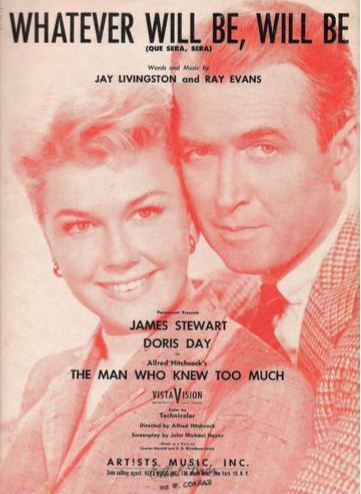
Doris Day had a huge hit in 1956 with “Que Sera, Sera” from The Man Who Knew Too Much with Jimmy Stewart and that hit would win them a third Oscar. The song would also become Doris’s theme song for her television show in 1968.
evans5


In 1957 they began writing the music for the Tammy movies that would be a staple of that era, beginning with Tammy and the Bachelor.

Jay and Ray would return to Broadway in 1958. They were nominated for a Tony for Oh, Captain! They also wrote songs for Let It Ride in 1961, a musical comedy adaptation of Three Men On a Horse, and Sugar Babies in 1979.

 

evans6

Photo: tidal.com

Though most of their work was in the film industry, the team is probably best known for their television compositions. In 1959, they were asked by Desi Arnaz to write a song for a Western show being developed. The show, thought likely to last a year, didn’t have money for a weekly salary, but he allowed them to keep the rights to the song. Luckily for them, that show, Bonanza, made them millions, and would be on television until 1973.

In 1960 they composed the theme song for The Bugs Bunny Show, “This is it.”


evans4

Photo: deezer.com

In 1961, Mister Ed debuted. Livingston and Evans not only wrote the well-known song, but Livingston is the one singing the line “I am Mister Ed.”

After Lynne’s passing, Jay would marry Shirley Mitchell in 1992.

Livingston and Evans were presented with a star on the Hollywood Boulevard Walk of Fame in 1995.

In 2001, at the age of 86, Jay Livingston died from pnuemonia. Ray Evans lived until 2007 when he passed away from heart failure.


evans9

Photo: rayevans.com

It’s fun to see a friendship and partnership span six decades and be so successful. Although they were born in the same year in the same area of the country and married the same year and their marriages would last decades until the death of a spouse, the two men were very different. In an interview with the Los Angeles Times in 1985, Evans said “I’m nuts about sports, play baseball and tennis every weekend. Jay couldn’t care less. He’s restrained and quiet. I’m more outward going. Jay is a marvelous musician. I have a tin ear. But our tastes are similar, and we both like good music and song.” The duo had 26 songs that sold more than a million records and their total record sales has exceeded 400 million dollars.

Michael Feinstein released an album in 2002 devoted to the team. He said, “they had a strong work ethic and they wrote a lot of plays that have wonderful and sophisticated songs that are quite different from movie songs.”

Like Frank De Vol, most viewers today have probably never heard of Jay Livingston and Ray Evans, although they recognize much of their work. It’s good to look behind the scenes of and dig deeper into the television industry to learn more about all the pioneers who made the era so great.

 

The Skipper and His Little Buddy: Alan Hale Jr. and Bob Denver

We continue our month-long exploration of the actors who appeared on Gilligan’s Island. Today we look at the two biggest stars: Alan Hale Jr. and Bob Denver.

Alan Hale Jr.

hale1

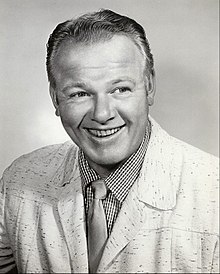
Alan Hale Jr. (Alan Hale Mackahan, Jr.) was born in 1921 in Los Angeles, California.  He looked exactly like his father, Alan Hale Sr. who was a well-known movie actor acting with legends like Douglas Fairbanks and Errol Flynn. His mother, Gretchen Hartman, was also a silent film star.

Hale’s first screen role was when he was 12 in Wild Boys of the Road.

hale3

He appeared in more movies and television series than any of the other Gilligan’s Island cast.  In all he would appear in 92 movies and 123 different tv shows.
In 1943 he married Bettina Reed Doerr. They would be married for twenty years and have four children. During World War II, Hale served in the US Coast Guard.

In the 1950s, he could be seen in many westerns as well as The Loretta Young Show and The Adventures of Ozzie and Harriet. He had regular roles on two sitcoms in that decade: Biff Baker USA and Casey Jones. Biff Baker is a businessman who becomes involved in espionage.  He and his wife travel around the world, working behind the scenes to solve problems. Although it was a serious show, there was some humor in the episodes also. As Casey Jones, Hale drove his train, The Cannonball Express, around the country.

hale4

The early 1960s was a prolific time for Alan Hale. The majority of his television credits came during this decade. You can see him in reruns of Jack Benny, The Lucy Show, Perry Mason, My Favorite Martian, and The Andy Griffith Show.

The year 1964 was a momentous one for Alan. He married Naomi and remained with her till his death. He also tackled the role he would become famous for.

hale5

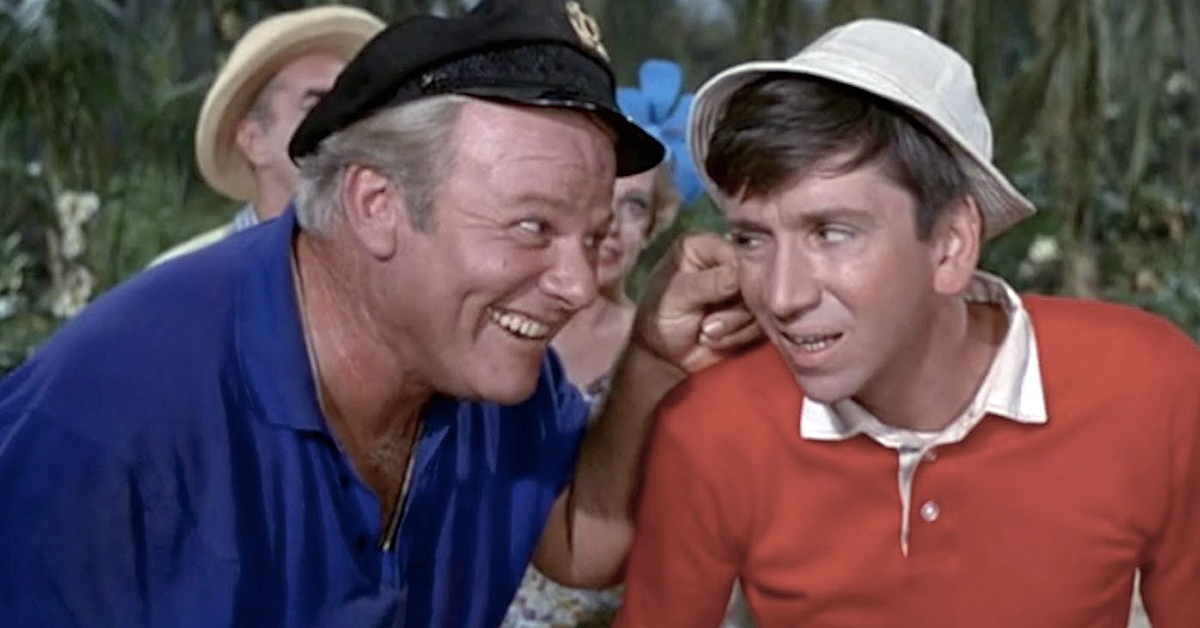
Sherwood Schwartz said he was having trouble finding the right person to play Jonas Grumby. He auditioned a lot of people, including Carroll O’Connor. One night while having dinner at a local restaurant he saw Hale dressed in a Civil War costume and decided he might be the one. Although the Skipper often became frustrated with Gilligan, they had a father and son relationship. Hale and Denver managed to pull that off. They were close friends in their personal lives as well.

hale3

Unlike some of the cast who felt typecast after they left the show, Hale embraced the role he had played. He would later own and manage a popular restaurant in Los Angeles called “Alan Hale’s Lobster Barrel” and could be seen greeting guests as the Skipper. Both he and Jim Backus appeared on Bob Denver’s sitcom Good Guys in 1968.

hale4

After Gilligan, Hale’s career did not slow down. Until his death he would continue to appear in a variety of series including Batman, Green Acres, The Flying Nun, The Wild, Wild West, Here’s Lucy, Marcus Welby, The Doris Day Show, Gunsmoke, McMillan and Wife, Simon and Simon, Growing Pains, The Love Boat, and Magnum PI.

In addition to acting and his restaurant business, Alan enjoyed fishing, golfing, cooking, traveling, storytelling, spending time with his family, and philanthropy. In 1990, Hale died after suffering from thymus cancer at the young age of 68.

Alan Hale had a long and prosperous career.  From all accounts, he liked acting and enjoyed life. Perhaps we should leave the last word to his costars who knew him best.

hale2

Bob Denver said, “He was a big, lovable man who made everyone feel good. He had a great time with his life.”

Dawn Wells described him: “What a dear man . . . what a dear, dear man . . I never saw him disgruntled, having a temper tantrum or depressed. He was so jovial and so sweet and so strong. . . He was a nice man.”


Bob Denver

denver7

Bob Denver was born in New York in 1935. He went to college at Loyola University in Los Angeles, majoring in political science. He worked as a mailman and a teacher before deciding to go into acting full time.  His first appearance was on Silent Service in 1957.

While Alan Hale was in more shows and movies than any of the other crew members, Bob Denver was easily in the fewest.  While he appeared in seven movies, he was only in 21 television shows, and on six of them he had regular roles.

denver5

His sister suggested him for the part of Maynard G. Krebs on The Many Loves of Dobie Gillis. His role as Dobie Gillis’s best friend propelled him into stardom. Dobie Gillis was on the air for four years, producing 144 shows.

denver8

In the 1960s he would appear on Dr. Kildare, The Farmer’s Daughter, The Andy Griffith Show, Make Room for Daddy, and I Dream of Jeannie. In the mid-1960s, Bob was offered the role of Gilligan on a new show, Gilligan’s Island.  In 1966 he married Maggie Ryan. They would have two children during the six years before they divorced.

Schwartz wanted to cast Jerry Van Dyke in the role who turned it down to play Dave Crabtree in My Mother the Car. Denver was perfect in the role of the inept Gilligan who caused many mishaps on the island but was the center of affection of the rest of the castaways, especially the Skipper.

The same year Gilligan was cancelled, Denver remarried. Like many sitcoms, the relationship with Jean Webber lasted three years before the couple cancelled it.

denver2

Although Denver was given a lead role in three more sitcoms, most of his work after 1967 cashed in on his character of Gilligan. In 1968, he starred in Good Guys. He played the role of Rufus Butterworth who opens a diner with his best friend from childhood.  The show only lasted for 42 episodes. Like Gilligan’s Island, Sherwood Schwartz produced this show. In an interview in 1994 with Peter Anthony Holder on Montreal radio station CJAD 800 AM, Denver discussed Schwartz. “Oh yeah, sure. Sherwood, as a producer, he was one of the best writer producers. It’s amazing. That man was just amazing. We never knew there were any problems when we were shooting. He kept all the network craziness away from us. He was writing scripts literally four months in advance, so that special effects and props always got them in plenty of time. . . you just memorized your words and went down there and had a great time. It wasn’t until afterwards when I left that I realized that not everybody was in the same situation. So every time I had a chance to work with him I did.”

At this time, Bob was also involved with Broadway and dinner theater plays after 1970.

denver3

In 1972 Denver tried marriage a third time. He and Carole Abrahams made it three years and produced one child before divorcing. In 1973, he took the lead on Dusty’s Trail. As Dusty, he manages to get a wagon and stage separated from the rest of the wagon train heading west, and the lost group of travelers try to catch up with the rest of their party.  This one only lasted 26 shows.

In 1975, Denver appeared in his weirdest sitcom yet, Far Out Space Nuts. Lasting only 12 episodes, Denver played a maintenance man in a space company who is accidentally launched into space with a co-worker. Apparently, television producers decided Denver looked like someone who was always lost.

denver4

In 1979, Bob tried the marriage ride one more time. This time he would stay married to Dreama Perry until his death.  The couple would have a child, making a total of four children for him.

denver6

Like many of the other castaways, Denver published a book of memoirs.  It was called Gilligan, Maynard, & Me.

In 2005, Denver passed away from complications following throat cancer surgery, leaving Dawn Wells and Tina Louise as the only surviving actors from the show.

denver1

While Denver is obviously the most-recognized character from Gilligan’s Island, he also had the most difficult situation to work with in being typecast. He was never able to shake the traits that were part of Gilligan to explore other roles.  He mentioned he would have liked to be in Northern Exposure. I wonder if he would have been happier being a teacher or if he enjoyed his career.

hale7

Next week we will discover more about our last regular member of the show, Russell Johnson.