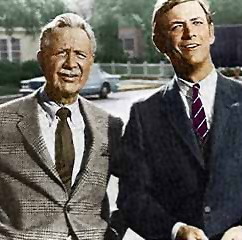
Don Adams: Always Smart

This month our blog series is titled “All About The Bill Dana Show.” The first week in March we learned about the show and now we have been spending time with some of the cast. We end our series with Don Adams.

Adams was born Donald James Yarmy in Manhattan in 1923. Don was a blend of cultures, Hungarian Jewish on his dad’s side and Irish-American on his mom’s. Don was raised Catholic while his brother Dick was raised Jewish. I could not find out what their sister decided to do. She later became a writer under the name Gloria Burton and wrote a script for Get Smart. His brother was also an actor. Dick has about 50 acting credits and appeared in many of the most popular sitcoms during the sixties and seventies, including three appearances on Get Smart.

Adams dropped out of high school and went to work as a theater usher. In 1941 he joined the US Marine Corp. At one point he was injured during a Japanese assault on Tulagi. He was the only survivor from his platoon. While recovering, he came down with blackwater fever, a side effect from malaria and was evacuated to New Zealand. He was not expected to recover, but when he did, he was sent back to the US as a Marine drill instructor.

After his discharge, he moved to Florida to work as a comedian. He refused to do material he considered “blue” and was fired.

In 1947 he married Adelaide Efantis, and her stage name was Adelaide Adams. Don decided to take the name Adams as well for his stage name. He worked as a commercial artist and cashier to support their family.

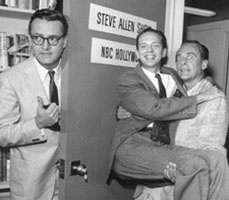
In 1954, Don was the winner of Arthur Godfrey’s Talent Scouts with a comedy act written by Bill Dana. He began making appearances on The Steve Allen Show, where Dana was a writer. In 1961 he became a regular on the Perry Como Show.

About this time, Don and Adelaide divorced, and Adams married Dorothy Bracken, another actress. They split up in 1977 when he married Judy Luciano, also an actress but that marriage also ended in divorce. (I could only find one credit for his last two wives; Bracken was on Get Smart, while Luciano appeared on The Love Boat.)

While discussing his marriages, Don said “I’m no longer independently wealthy. I guess it’s the result of too many wives, too many kids and too much alimony. I’ve been paying alimony since I was 14 and child support since 15. That’s a joke, but not by much. . . I like getting married, but I don’t like being married.”

In 1963 Adams was offered the role of Byron Glick, hotel detective on The Bill Dana Show. As we’ve discussed this month, the show was on the air for a season and a half. While working on the show, Don was also the voice of cartoon Tennessee Tuxedo which he continued doing until 1973.

During those years he also made an appearance on The Danny Thomas Show and on Pat Paulsen’s Comedy Hour.

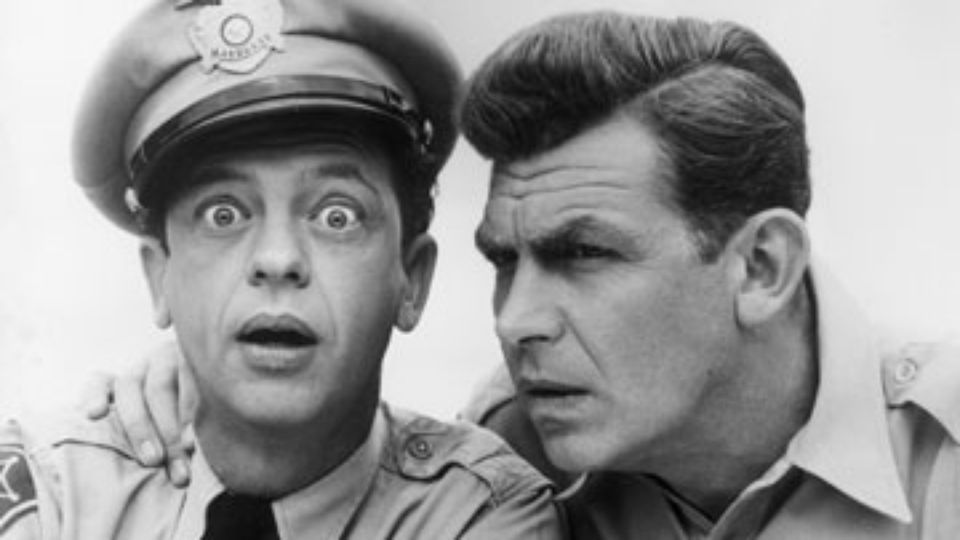
In 1965 he was offered the role of Maxwell Smart in a new spy satire, Get Smart.

The sixties saw westerns being overtaken by spy shows such as The Man From U.N.C.L.E., I Spy, The Pink Panther, and The Avengers. Mel Brooks and Buck Henry decided to try their hand at writing a campy sitcom and Get Smart was born.

The role of Smart was created for Tom Poston, but ABC turned it down, and NBC said yes. They had Adams under contract, so he got the part. Rounding out the cast was Edward Platt as the Chief and Barbara Feldon as Agent 99.

Smart and 99 had great chemistry and married in a later season. Feldon and Adams remained life-long friends.

One of the most memorable parts of the show was all the catch phrases Adams created on the show including “Sorry about that Chief,” “Would you believe,” and “Missed it by that much.”

In addition to acting, Adams worked as a producer and director on the show. He was nominated for an Emmy from 1966-1969. He won three of those, losing to William Windom for the little-remembered one-season show, My World and Welcome to It. Lloyd Haynes from Room 222 and Bill Cosby for The Bill Cosby Show were also nominated that year.

The show moved to CBS for the final season, but the ratings never recovered, and the show was canceled after that year.

Like so many of our successful actors with unusual characters, Adams suffered from typecasting after the show ended. He did become part of two additional sitcom casts during his career.

In 1971 he was on The Partners. According to imdb.com, the plot is that “Lennie Crooke and George Robinson are inept detectives teamed up to solve crimes. Captain Andrews is their exasperated boss, Sgt. Higgenbottom is a smarmy co-worker, and Freddy confesses to most of the neighborhood crimes.” Adams played Crooke, but the show only produced 20 episodes.

In 1985, Adams tried a sitcom again on Check it Out. This one was about a grocery store and its employees. Adams played Howard Bannister. The show lasted three seasons, ending in 1988. The show was not very popular in the US but was a hit in Canada.

In between those two shows, Adams appeared in a handful of series including Fantasy Island, The Fall Guy, The Love Boat, Empty Nest, and Nick Freno: Licensed Teacher. He made most of his salary appearing in nightclubs. He also had his Smart character resurrected in several big screen films and television series.

Because of the typecasting, he returned to animation and found a lot of success, especially with Inspector Gadget which he voiced from 1983-1999.

He also tried his hand at a game show. Called Don Adams’ Screen Test, it had an interesting concept. The show was filmed in two 15-minute parts; Adams would randomly select an audience member to recreate a scene from a Hollywood movie such as From Here to Eternity with Adams as director. It ended after 26 episodes.

In his spare time, it sounds like he visited the racetracks, betting on horses. He also spent a night a week at the Playboy Mansion playing cards with Caan and Rickles. He loved history and studied Abraham Lincoln and Adolf Hitler in depth. He also wrote poetry and painted.

Don passed away in 2005 from a lung infection and lymphoma. The eulogists at his funeral included James Caan, Bill Dana, Barbara Feldon, and Don Rickles.

It’s hard to know what to make of Adams’ career. Obviously, he was hard working, an excellent Marine, and a man of many interests. He was fired for not performing blue material but then put horse racing and gambling above the needs of his family, according to several of his friends. He created the amazing role of Maxwell Smart, one of the best characters in television history, but that feat kept him from achieving other great roles in the following decades due to typecasting. It sounds like Check It Out was very popular in Canada, so maybe if he had been given a few chances to create characters different from Smart in a couple other sitcoms, it would have helped.

I feel bad for those actors who are so successful in the characters they help create that they are barred from future jobs, but then again, those characters are some of the best actors in television: George Reeves as Superman, Ray Walston as My Favorite Martian, Henry Winkler from Happy Days, Frank Cady from Green Acres, and Jack Klugman from The Odd Couple. I guess you trade being warmly remembered for fewer quality roles.

Apart from Get Smart, I knew little about Adams before writing this blog, so it was fun to get to know him a bit.
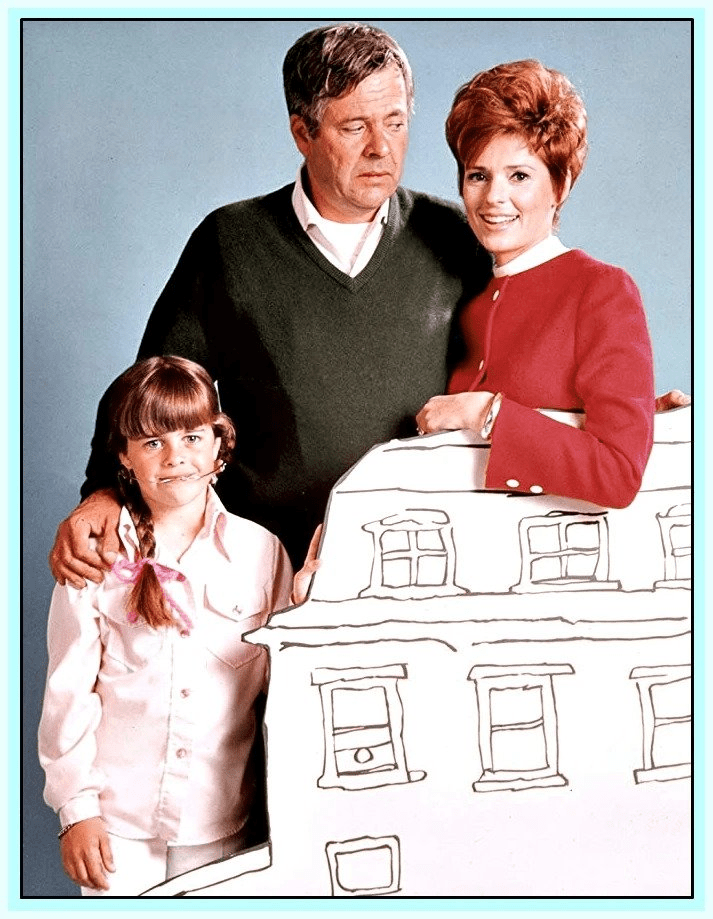
My World . . . And Welcome To It: Just a Fantasy

This month we are in the midst of What in the World? Every sitcom has the word “world” in it. On deck today is My World . . . and Welcome to It. This half-hour show was based on the cartoons of James Thurber. It debuted in 1969 and was on the air for a year.

📷martin crookall- wordpress.com

William Windom played John Monroe a cartoonist who works for a magazine similar to the New Yorker called The Manhattanite. Monroe lives with his wife Ellen (Joan Hotchkis) and their daughter Lydia (Lisa Gerritsen). John often daydreams about his daughter’s future and the “older” Lydias were played by Talia Shire and Cindy Williams.

The name John Monroe was Thurber’s alto-ego in his book Owl in the Attic. He frequently daydreams and those are cleverly incorporated into the series.

The episodes opened with John observing different aspects of his life. The use of the cartoons created a fantasy life dream world where he escaped life situations he could not process.

Mel Shavelson created the show for NBC. He wrote and directed the pilot with one of my all-time favorites Sheldon Leonard as executive producer. The animation in the series was done by DePattie-Freleng Enterprises.

Rounding out the cast was Henry Morgan as Philip Jensen, a magazine writer based on Robert Benchley and Harold J. Stone as editor Hamilton.

📷moviedatabase.com

The show was on Monday nights at 7:30 and was up against Gunsmoke. While it had a lot of great reviews from the critics, the viewers were not there in droves. Percy Shain of the Boston Globe referred to the show as “a joy and treasure.” Bob Williams of the New York Post wrote that it was “it’s warm, it’s witty, and it’s a sophisticated cut above the best of the TV network situation comedies.”

Not every critic treated it so kindly, however. Jack Gould of the New York Times felt it was “hackneyed gibberish relieved only by an occasional Thurber drawing” and Norman Mark of the Chicago Daily News decided that it “tried to appeal to all parts of the TV audience and failed.”

Perhaps Barry Harrison of the Washington Evening Star understood the show better than the other critics and had “an uneasy feeling [that] it is not long for TV.” His prediction came true when the series was canceled after one season.

According to Howard Anderson Jr. in his Television Academy interview, one of the major reasons for the cancellation was that it was so expensive to do the filming with a blue screen behind Windom for all the animation.

And then after it was canceled, it won the Emmy for Outstanding Comedy and Windom picked up the Emmy for Leading Role in a Comedy. The series it was up against included Love American Style, Room 222, The Bill Cosby Show, and The Courtship of Eddie’s Father. Windom won over Lloyd Haynes in Room 222 and Bill Cosby of The Bill Cosby Show.

📷billmadison.blogspot.com

The fans did send a lot of mail to the network, but with the so-so ratings and the fact that the animation made this one an expensive show to create, NBC did not put it back on the schedule.

After the show ended, Windom created a one-man play based on Thurber’s works and toured the country throughout the seventies. Perhaps if the network had given it some time after winning the Emmys, this show might have been more successful. It sounds like an interesting concept, although I also get the feeling that it might not have appealed to women; many of the descriptions I read discussed John’s fantasies that his wife and daughter were things to escape from. It’s worth taking a look at and seeing how it has fared over the last sixty years.

Honoring National West Virginia Day with Don Knotts

As we continue with our National State Day Celebrations, this week finds us in West Virginia. Who else can we pick but Don Knotts?

See the source image
Photo: amazon.com

Born in 1924 in Morgantown, WV, Don Knotts was the youngest of four boys. Don had a rough youth. His parents were farmers and his mother was 40 when he was born. His father suffered from mental illness, and Don’s birth led to a nervous breakdown. His father died when he was 13 and his mother made her living running a boarding house after that. At an early age, Don began performing as a ventriloquist and comedian at church and school functions.

After graduation, Knotts began college but then enlisted in the army, serving during WWII from 1943-1946. He toured the Pacific Islands entertaining the GIs as a comedian. In 1948 he graduated from West Virginia University with a major in education, a member of the honor society.

See the source image
Photo: pinterest.com

Before graduating, Knotts married Kathryn Metz. They would remain married until 1964 when they divorced. After college, the couple moved to New York to pursue a career in the entertainment industry.

See the source image
Steve Allen, Knotts, and Louis Nye–Photo: ebay.com

Believe it or not, his first role was in the soap opera Search for Tomorrow, and he would become part of the cast from 1953-1955. In 1956, he got his big break on the Steve Allen Show, playing a nervous man. He stayed with the show until 1959. The Tonight Show relocated to Hollywood with Jack Paar as host in 1959, and Don went with him. However, during his time on the show, he had a role in the play “No Time for Sergeants” and then in the film version with Andy Griffith.

See the source image
Andy Griffith and Knotts-Photo: tvseriesfinales.com

In 1960 Andy Griffith was putting together his own sitcom, The Andy Griffith Show, and he offered Knotts the role of Barney Fife, deputy. During his time as Barney, Knotts received five Emmy awards (three during his first five years).

See the source image
Photo: bobshideout.com

The Museum of Broadcast Communications sums up Barney’s character perfectly:

“Self-important, romantic, and nearly always wrong, Barney dreamed of the day he could use the one bullet Andy had issued to him, though he did fire his gun on a few occasions. He always fired his pistol accidentally while still in his holster or in the ceiling of the court house, at which point he would sadly hand his pistol to Andy. This is why Barney kept his one very shiny bullet in his shirt pocket. In episode #196, Andy gave Barney more bullets so that he would have a loaded gun to go after a bad guy that Barney unintentionally helped escape. While Barney was forever frustrated that Mayberry was too small for the delusional ideas that he had of himself, viewers got the sense that he couldn’t have survived anywhere else. Don Knotts played the comic and pathetic sides of the character with equal aplomb.”

See the source image
Mayberry Family: Knotts, Ron Howard, Griffith, Frances Bauvier–
Photo: tvtropes.com

Originally, Don was supposed to be the straight man to Andy’s character, but Griffith quickly realized the reverse would make the show more successful. Andy always said he wanted to be done after five years. During that fifth year, Knotts began to search for his next job. He signed a five-film contract with Universal Studios. Then, Andy decided not to quit after season five, but since Knotts was already committed, he left the show in 1965.

See the source image
Knotts with Betty Lynn–Photo: mesquitelocalnews.com

From everything I’ve read, it seems like the cast of TAGS got along very well. Although Frances Bavier seemed to take things more personally than others, the actors seemed to enjoy working together. Betty Lynn who played Barney’s girlfriend Thelma Lou described Knotts as “a very quiet man. Very sweet. Nothing like Barney Fife.” Mark Evanier, a television writer, called him “the most beloved person in all of show business.”

See the source image

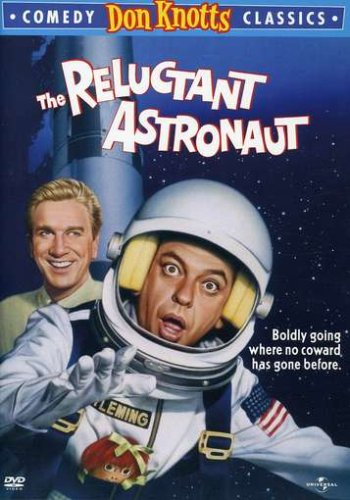
Knotts family-viewable films were very popular including It’s a Mad, Mad, Mad, Mad World; The Incredible Mr. Limpet; The Ghost and Mr. Chicken; The Reluctant Astronaut; The Shakiest Gun in the West; The Love God?; and How to Frame a Figg.

One of my favorite roles of Don’s was as the shoe salesman in the Doris Day-James Garner movie, Move Over Darling.

He also returned to Mayberry for several episodes. (Two of his Emmys came from these guest spots.)

See the source image
Doris Day and Knotts–
Photo: pinterest.com

Knotts also kept busy on other television shows including appearances on The Bill Cosby Show, Here’s Lucy, Fantasy Island, The Love Boat, Newhart, and That Seventies Show.

Also, during these years, Knotts tried marriage again wedding Loralee Czuchna in 1974. The couple called it quits in 1983.

He received his second starring role in 1979 as Mr. Furley on Three’s Company. Knotts replaced Stanley and Helen Roper (Norman Fell and Audra Lindley) who left for their own spin-off show.

See the source image
Suzanne Somers and Knotts–
Photo: history garage.com

He became the new landlord for the trio upstairs. He would stay with the show until it ended in 1984, racking up 115 episodes. I will admit that I did not enjoy the show, and I felt Knott’s performance was over the top and too stereotyped; I felt that way about the other characters also.

Don and Andy remained close friends throughout their lives. When Andy returned to television as Matlock, Knotts also received a role on the show as Les Calhoun, Matlock’s neighbor from 1988-1992.

See the source image
Knotts and Griffith in later years–
Photo: sitcomsonline.com

Don suffered from macular degeneration, and eventually it caused him to become virtually blind. In 2002 Don married a third time when Frances Yarborough became his wife.

Knotts died in 2006 from pulmonary and respiratory complications from pneumonia related to lung cancer.

Off screen, Knotts seemed to be a very funny guy. His daughter Karen said, “Here’s the thing about my dad. He had this funniness that was just completely, insanely natural.”

See the source image
Photo: directexpose.com

He told his daughter his high school years were some of his happiest. His home town loved him too, and a statue honoring him was unveiled in 2006 in front of the Metropolitan Theatre. The statue was designed by local artist Jamie Lester, another West Virginia native.

See the source image
Photo: guardianlv.com

Don Knotts had a spectacular career. As a young man, he got a job in a chicken factory and spent his days pulling feathers off dead chickens because he was told he had no future in the acting profession. It would have been hard for him to imagine at the time the legacy of performances he would leave—television shows and movies that generations of fans would watch. More than sixty years after Barney Fife put that bullet in his pocket for the first time, viewers continue to watch and love the Mayberry residents as they go about life in their small town. And the fact that the place where he first learned about life cared enough to fundraise and build a memorial to honor him says a lot. Thank you Don Knotts for showing us the importance of humor and following your dreams!


Just When You Think It Can’t Get Any Weirder, It Does

Although I love The Big Bang Theory and Modern Family, there are a lot of shows on television today that make me shake my head.  It’s amazing what is airing when you scroll through the channels:  Vanilla Ice Goes Amish, I Cloned My Pet, Doomsday Preppers, and these are some of the best reality shows out there.  However, when I researched sitcoms from the classic era, I also found a lot of weird concepts there also.  Let’s take some time to look at a few of them.


unusual1

Boss Lady (1951)

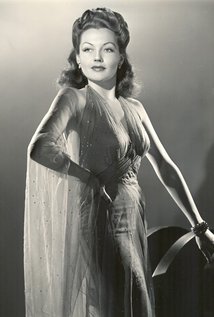
Lynn Bari was Gwen Allen, owner and operator of Hillendale Homes Construction Co. which was owned by her father.  While this show would not seem unusual at all today, back in 1951 it was not common to see a woman the boss of a construction crew. This show began on the Dumont network and then switched to NBC for twelve episodes, running as a summer replacement from July to September 1952.


Where’s Raymond? (1953)

Believe it or not, this was a musical sitcom.  Ray Bolger (who had sang and danced as The Scarecrow in The Wizard of Oz) was a song and dance man named Ray Wallace living in Pelham, New York. He had a girlfriend named Susan (Marjie Millar) and a business partner Peter (Richard Erdman). Verna Felton from December Bride was his understudy’s mother-in-law. The show lasted 2 ½ years on ABC.


The People’s Choice (1955)

Ok, pay attention, because the basis of this show is confusing. Socrates (Sock) Miller played by Jackie Cooper is a Bureau of Fish and Wildlife Orinthologist studying to be a lawyer.  Honestly! He has car trouble one day and is picked up (and picked up) by the mayor’s daughter Mandy who thinks he should be on the city council. Sock decides to be a lawyer to support Mandy.   In the finale to year one, the two elope and conceal their marriage for the entire second season.  When the show came back for a third year, the mayor finds out about the marriage, Sock gets his law license, and Sock’s free-loading pal Rollo (Dick Wesson) moves in with the couple.  Now Sock is managing a real estate development. Just when you thought it could not get more confusing, Sock’s basset hound Cleo would do tricks and comment directly to the audience about situations occurring on the show. LSD had not even become a social problem yet, so it was not responsible for this show, so I’m not sure how this crazy mess stayed on the air for 104 episodes.


TSDDIAN EC004

Dick and the Duchess (1957)

Dick Starrett (Patrick O’Neal) is a claims adjuster in London.  There are some exciting scenarios to provide interest. He meets and marries Jane (Hazel Court) a duchess. She becomes his wife and assistant, although she still expects to live in the manner she has become accustomed to.  She humorously gets involved in his investigations. The network must not have thought she was that funny helping out because  CBS cancelled it after 25 episodes.


Mr. Ed (1961)

Let me say, I do not put Mr. Ed in the same category as Dick Van Dyke Show, That Girl, or Bachelor Father, but I don’t mind catching an episode or two now and then.  When looking at strange concepts for show, this one does have to go into the mix.

When the creator asked Young to appear in the show, he turned him down twice. A pilot was made without him. It did not sell, so producers Arthur Luben and Al Simon decided to enter it directly into syndication, and Young then agreed to take on the role. It was very successful, so CBS bought it.

Wilbur Post (Alan Young) is a married architect. Wilbur and his wife Winnie (Connie Hines) bought their house with a horse included. Their neighbors were played by Edna Skinner and Larry Keating. What no one else realized (including his wife), was that Wilbur was the only human who could understand Ed and talk with him.  Ed was quite the character; he was a hypochondriac; a voracious reader; a playboy, or play horse; loved Carl Bernstein and wanted to decorate his stable in Chinese modern.

The voice of Ed was a highly guarded secret until the show ended in 1967 when it was revealed to be Rocky Lane. Ed was played by Bamboo Harvester, a palomino. One interesting fact about this show is that it has been seen in 57 different countries.


My Mother the Car (1965)

This is another one of those shows you roll your eyes about.  Dave Crabtree (Jerry Van Dyke) lives in LA.  He wants to buy a new station wagon, and when he goes shopping, he realizes his mother’s voice is coming through the radio of a 1928 Porter.  Ann Sothern provides his mother’s voice. Of course, he buys the car which irritates his family, but they don’t know his secret. He also has to deal with a car connoisseur who wants to buy the car for his collection. Maybe it’s a Freudian slip, but I’m a bit offended that a mother is portrayed as an old jalopy as opposed to a new, sleek car, but I digress. This show was only on the air for a year and then the radio was turned off.


unusual11

The Second Hundred Years (1967)

Here is the premise of this one:  In 1900, 33-year-old Luke Carpenter (Monte Markham) is prospecting for gold in Alaska.  An avalanche occurs, and he is buried alive and frozen.

In 1967, Luke’s son Edwin, who is 67, is told that his father has been found alive.  Dad looks 33, but his identity and past has become a top-government secret.  He is released into the custody of Edwin (Arthur O’Connell) and grandson Ken (also Monte Markham). Luke has a hard time adjusting to life in the 1960s. I know you are surprised, but the show was cancelled after 30 episodes.


My World and Welcome to It (1969)

This show was based on James Thurber’s writings. The show was set in Connecticut where John Monroe (William Windom) was a cartoonist for Manhattanite Magazine. He was intimidated by his wife Ellen (Joan Hotchkiss). To escape his boring and nagging life, he escapes into a secret world where his cartoons come alive and he is a king. He drifted between real and fantasy lives. NBC cancelled the show after a year, but CBS picked it up and aired it from May-September of 1972. So, the presence of LSD does explain the writing on this one. What it doesn’t explain is that this show won two Emmys in 1970 : Outstanding Continued Performance by and Actor in a Leading Role in a Comedy Series and Outstanding Comedy Series. The competition for comedy included Love American Style, Room 222, The Bill Cosby Show, and The Courtship of Eddie’s Father.


The Roller Girls (1977)

Meet the Pittsburgh Pitts, an all-women roller derby team, owned and managed by Don Mitchell (Terry Kiser). The Pitts were pretty but useless when it came to roller derby. James Murtaugh played the team’s announcer Howie Devine. After four episodes, the network agreed this really was the pits and it was cancelled.


unusual14

Apple Pie (1978)

This show aired for one episode – I thought they used to call that a movie. (A couple sources say 2 episodes, perhaps a mini-series.) The show is set in Kansas City, Missouri. A hairdresser named Ginger Nell Hollyhock (Rue McLanahan) is lonely and decides to advertise in the local paper for a family. She ended up with a con artist, Fast Eddie (Dabney Coleman), a tap-dancer daughter, a son who wanted to fly just like birds do, and a grandfather figure (Jack  Guilford).


So, when you think you’ve seen it all before, you probably have. I would not be the least surprised to read that in the fall there will be a reality show that features a roller derby team, or a woman who advertised for a family in the personal ads, or an insurance adjustor married to royalty.

I do have to say that both Dick and the Duchess and My World and Welcome To It  seem to have some die-hard fans who appreciate the shows  I guess I should watch a few more episodes.

Listen up you sitcom developers; if you think you have a concept that’s a bit too far out there, it will probably be a big hit. After all, who would have guessed a show about an alien from Ork who traveled in an egg, and gave birth to a 79-year old man would score high ratings?