Welcome to 2026! Our blog theme this month is “Worth a Million.” We are learning about the careers of several cast members from How to Marry a Millionaire. This show debuted in 1957 and aired for two years.
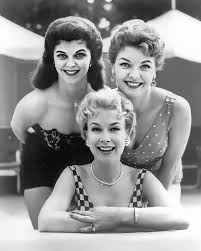
📷instagram Cast of season 2
The show was based on a movie that came out in 1953 starring Marilyn Monroe. The stars were Merry Anders, Barbara Eden, and Lori Nelson. Nelson was not happy with her role. She felt Anders got all the wisecrack comments as the smart girl and Eden got all the funny lines as the bombshell, while she was overlooked. There is a discrepancy whether she quit or was fired, but either way, she did not return for season two. Lisa Gaye was the new roommate Gwen Kirby, but hopefully she did not pay too much to sublet, because after thirteen episodes, the show was cancelled.
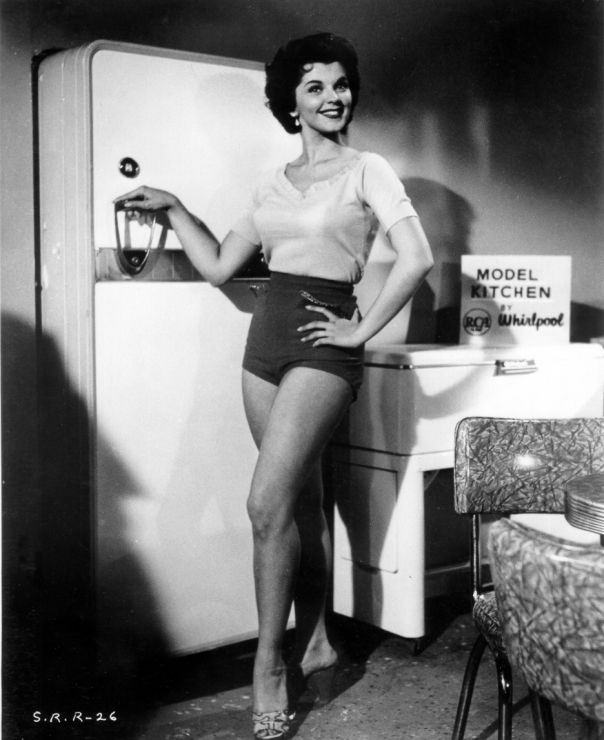
Like Jimmy Cross, who we learned about last week, Gaye never was part of another cast again, but she was busy during the sixties, amassing almost 100 credits. Her last appearance was on The Mod Squad in 1970, her only seventies appearance.
Gaye was born in Colorado in 1935. I’m sure she was influenced by both parents—her mother was an actress, and her father was an artist. In the late thirties, the family moved to Los Angeles. Gaye’s mother was determined to get all of her children an acting career after their daughter Teala was signed by Paramount. (Her siblings include Teala Loring (32 credits), Debra Paget (45 credits), and Frank Griffin (78 credits primarily for make-up).
Gaye made her first appearance at age 7, and by age 17, she was offered a seven-year contract with Universal. She jumped back and forth from movies to television during her career.
📷pinterest.com
Her other recurring role was as a model in Love That Bob. Lisa did an interview (http://www.westernclippings.com/interview/lisagaye) and she was asked about her favorite directors. I was surprised to read that she chose Bob Cummings. She said Bob not only starred in the show but often directed episodes. She said “He had terrific timing for comedy; he understood comedy. He knew what he wanted and sometimes there would be take after take until he got it right. He taught me a lot.” It surprised me because typically when I read comments about Cummings, they are more negative than positive.
For example, Julie Newmar didn’t feel that Cummings was the right actor for her costar on My Living Doll. She said that “They originally wanted Efrem Zimbalist Jr. It was not a flip part—it needed a straight actor who could play opposite this bizarre creature so the comedy would come off. That quality was lost when they hired Bob. The show could have been wonderful. I think it would have run for many seasons had they hired Efrem because he had the right qualities.”
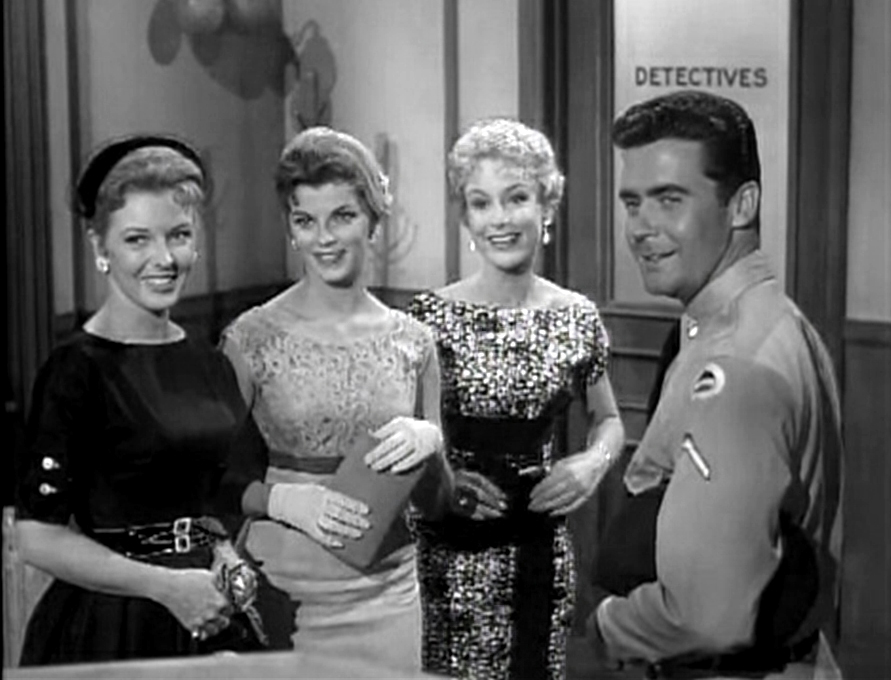
I couldn’t find much about Gaye’s thoughts on How to Marry a Millionaire. She did mention that in the early days of television there often weren’t hairdressers or make-up artists, and the actors had to do that themselves.
📷imdb.com
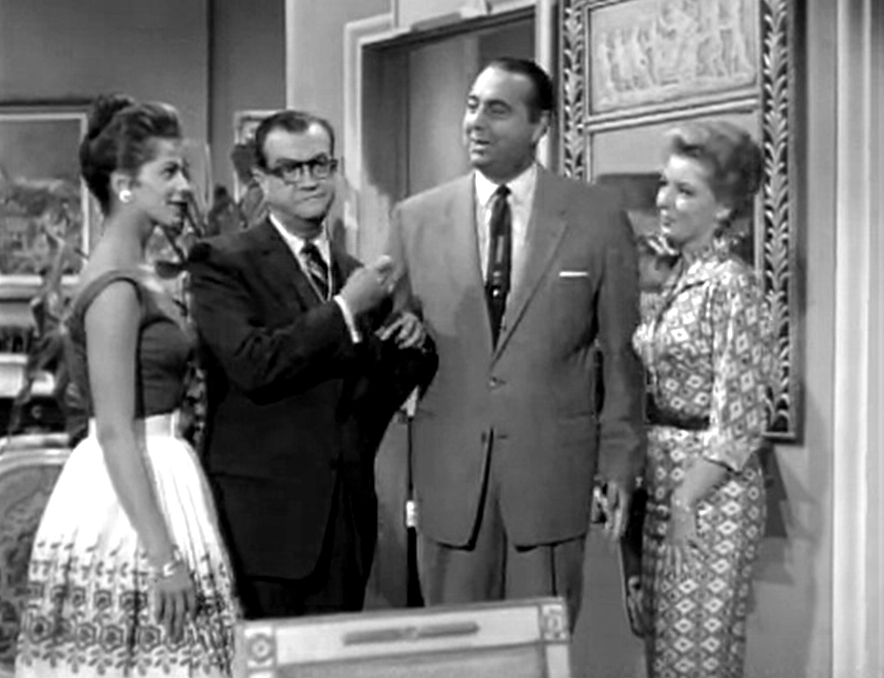
In an interview for the Television Academy, Everett Greenbaum said How to Marry a Millionaire was the worst collaboration he ever did. He inherited a writing partner, Milt Pascal, and said they did not work the same way at all. For example, if there was a horse in the scene, Milt would say, “Let’s come up with three horse jokes to write the scene around.” Greenbaum then wrote his own script for the show. Since Spencer Tracy and Katherine Hepburn had just done Desk Set and had a computer available, Greenbaum wrote an episode about the computer choosing dates for the girls.
Barbara Eden talked a bit about the show in her interview with the Academy also. She said it was her finishing school. She mentioned that she liked Lisa Gaye very much. She said it was a hard job though. They had to wear very high-heeled shoes and be on the set for thirteen hours a day.
Eden was asked why the series was cancelled. She thought it was because it was a syndicated show that was being filmed to transition to a fourth television network that Fox was trying to establish at the time. When it became obvious that there wasn’t going to be a fourth network, all those shows were canceled.
In 1955 Gaye married Bently Ware and they were together until his death in 1977.
📷imdb.com
Gaye’s career might have been much different in 1961. She auditioned for the role of Anita in the film version of West Side Story and was seriously considered for the part, but the role eventually went to Rita Moreno. She did have a film career, but her roles were not major ones and the movies were good, but not necessarily Oscar quality. She was in The Glenn Miller Story, Rock Around the Clock, and Shake, Rattle & Roll. In the Miller biopic, she was part of a screaming crowd, but she was able to use more skills in other movies. Gaye loved dancing and originally wanted to be a ballerina.
Gaye described what it was like to be at Universal at that time. She said it was the only studio where you were given lessons in drama, singing, dancing, fencing, horseback riding. She said, “it was awesome . . . and you got paid to learn.”
If Gaye wanted to talk about a day that might have changed her life, she might have mentioned a day in 1958. She said she was working with Steve McQueen on Wanted: Dead or Alive. As she tells the story, “We were shooting on the back lot and he asked me if I’d like a ride back to the soundstage, on his motorcycle. So, I certainly said ‘Sure.’ I made a big mistake by getting on his motorcycle. We went all over that lot, and not at a slow pace! He didn’t slow down—he was always on the cutting edge. We zoomed right up to the soundstage where the doors were closed. He had it arranged that someone inside would open them at the last minute, but I thought we were goners for sure. After that ride, I said, ‘Thank you,’ and never rode with him again.”
📷westernclippings.com
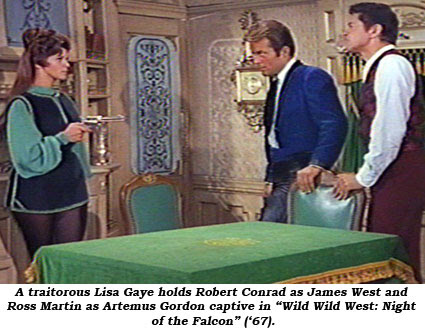
She also discussed another close call when she was appearing on The Wild Wild West in an episode titled “The Night of the Falcon.” She was supposed to ride a horse with the falcon. She declined. She said she would ride the horse or handle the falcon but not both. So, her stunt double was given the task. Gaye had to sit on a ladder, so it looked like she was on a horse. When she was sitting up there, she noticed the trainer looked rough and she assumed he had gone through a windshield because he had stitches all over his face. Her double was riding the horse with the bird when it screeched, causing the horse to rear up and throw her double. She later learned that the falcon attacked his trainer, chewing up his face.
While Gaye didn’t have a recurring role on Death Valley Days, she was on it more than any other actor, nine times. She said she liked the fact that the stories were all true. She had another close call on that series as well. She was on a horse when it was spooked and was dragged for some distance. There was a wrangler who was supposed to catch the horse if it took off, but the horse ran over the wrangler; luckily, she was full of mud but okay.
Lisa said in the late sixties her career seemed to hit a rock. She didn’t know why, but she never worked again. She said after her husband passed away, she went to Houston to help her daughter who had six kids. She said she became a receptionist at the local religious TV station for 19 years.
It’s too bad that Lisa’s career hit a wall, but it sounds like she enjoyed being able to help raise her grandchildren. After such a successful couple of decades, it’s hard to know why she suddenly was not receiving any offers.
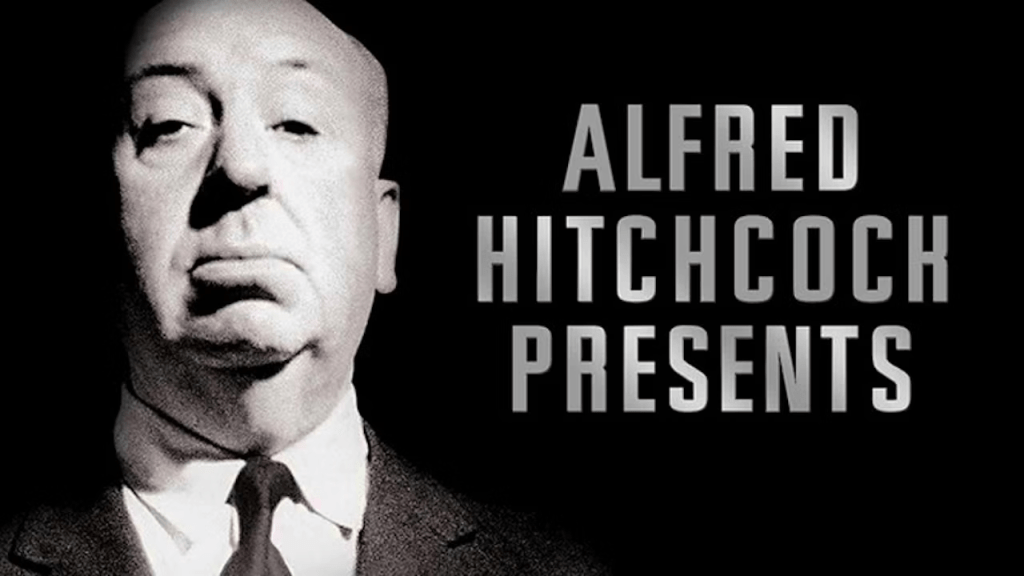
In October, we are tackling a blog series on Eerie Shows. It would be almost impossible to not include Alfred Hitchcock Presents which was on television for a decade.
The show premiered in 1955. Hitchcock had been directing films for more than three decades at that time. The series experienced several changes. It began as Alfred Hitchcock Presents on CBS but would switch both nights and networks during its run. In 1962 it became an hour-long show and was called The Alfred Hitchcock Hour.
Many fans recall the opening. There is a line-drawing of Hitchcock’s profile with the “Funeral March of a Marionette” playing in the background. Hitchcock appears at the edge of the screen and walks to the center where he fades into the caricature line drawing. Then he said, “Good evening.” The silhouette was one that Alfred drew. He began his entertainment career illustrating title cards for silent movies.
📷peacock.com
Hitchcock himself directed 17 of the episodes of the series. Two of those were nominated for Emmy awards: “The Case of Mr. Pelham” in 1955 with Tom Ewell and “Lamb to the Slaughter” in 1958 with Barbara Bel Geddes.
Hitchcock’s job during this series was to introduce the story and then to wrap it up at the end. Both the openings and closings were written by James B. Allardice. Allardice wrote for 38 different shows, many of them very popular series in the fifties and sixties. Norman Lloyd, who produced the show and appeared in five episodes, said Hitchcock respected Allardice so much that he never even changed a comma that he wrote.
The network demanded that if a character got away with murder during the show, then Hitchcock would let them know during the closing that he was eventually brought to justice; in the TV Guide, Hitch described this as “a necessary gesture to morality.” Lloyd gave an example of this in a Television Academy interview. In one episode, a woman kills her husband with a frozen lamb’s leg and gets away with it. At the end of the show, Alfred explains that she later remarried and tried the same trick again but when she took out the leg and hit her husband with it, it was not frozen enough, so he caught her in the act and turned her in.
📷genresnaps.com
The episodes were not your average thriller shows. They included drama, suspense, and humor. Audiences never knew just “who done it” till the end.
The show debuted on CBS on Sunday nights for five years, up against drama anthologies for two years and then competing with The Dinah Shore Show for three years. For the next two seasons it moved to NBC on Tuesday nights. It aired against The Many Loves of Dobie Gillis on CBS those years and against Wyatt Earp on ABC. For three months it went back to CBS on Thursdays before moving to Fridays on CBS the next season with The Price is Right and 77 Sunset Strip. The ninth year found it on CBS on Fridays with little competition and the final year it showed up on NBC’s schedule on Mondays against Ben Casey. I could never find the reason for cancelling the show. I’m assuming ratings began to decline but if anyone knows, I’d love to hear it.
NBC chose not to air a 1962 episode called “The Sorcerer’s Apprentice” because the sponsor felt the ending was too gruesome. In the episode, a magician’s helper is supposed to help in a trick where he “sawed” a woman in half, but he doesn’t realize he truly saws her in half.
📷thecompletehitchcock.com
As you might guess, with a new story every week, many celebrities appeared on the show including Charles Bronson, Bette Davis, Bruce Dern, Robert Duvall, Clint Eastwood, Peter Falk, Joan Fontaine, Peter Lorre, Walter Matthau, Steve McQueen, Vera Miles, Claude Rains, Robert Redford, Burt Reynolds, Thelma Ritter, George Segal, and Jessica Tandy.
In addition to the Hitchcock-directed episodes, the show received Emmy nominations for Best Series four times. In 1956 it was up for Best Action or Adventure Series, but it lost to Disneyland. The following year found the show in the Best Series – Half Hour or Less category, but it lost to The Phil Silvers Show. 1958 found it in the category of Best Dramatic Anthology Series. You would think that would be a no-brainer win for this show, but it lost to Playhouse 90. It had its fourth category nomination in 1959 as Best Dramatic Series – Less Than One Hour and lost to Alcoa Theatre. I guess the Emmy committee had a hard time determining categories for a few years.
In a different twist, NBC tried to air the show again in 1985. Hitchcock had passed away five years earlier from renal failure. A made-for-TV-movie combined new stories with colorized segments from the original show. It lasted a year before NBC canceled it. USA picked it up for three more seasons.
📷screentunes.com
The original show can still be seen on a few different networks including MeTV.
With Hitchcock’s popularity in 1955, it’s no wonder that this show was a successful series for a decade. The episodes were well written, and they had a wonderful cast of actors. Many people probably tuned in just to see Hitchcock, and his personality was larger than life, even if his behavior was a bit despicable at times. One of Alfred’s quotes about the show was that “television has brought murder back into the home – where it belongs.”
This month we are Riding the Range, exploring some of the westerns from the fifties and sixties. One of those shows that was on the air from 1957-1962 was Tales of Wells Fargo.
The show was produced by Revue Productions and set in the 1870s and 1880s. Gene Reynolds was one of the creators of the show, along with Frank Gruber and James Brooks. Reynolds would go on to great success as a director, producer and writer, and my favorite of his was M*A*S*H. Although this show was set in the same time as Daniel Boone, it was better at getting history correct. The show featured special agent Jim Hardie (Dale Robertson) with his horse Jubilee. It was loosely based on the life of real detective Fred J. Dodge. Sometimes Hardie ran into characters from history including Jesse James and Belle Starr.
📷pinterest.com Fred J. Dodge
Fred Dodge was born in California in 1854. He went to work as an undercover agent for Wells Fargo, working in California, Nevada, and Arizona. In 1979 he was in Tombstone and recommended hiring Wyatt Earp as guard for the stage line. He became great friends with Earp. Later Dodge became constable of Tombstone while working undercover. In 1890 he left his undercover work and became a known employee of Wells Fargo in Texas. He purchased a 2,000-acre ranch near Boerne, Texas and when he retired in 1917, he lived there with his family. Dodge was described as an intelligent and successful investigator. He wrote 27 journals during his career, noting his activities and travels in them. Some of these were used for Tales of West Fargo.
I had always assumed this show was about stagecoach travel, but it was not, although stage coaches played a part. In the mid-1800s, the Wells Fargo stage line was the primary connection between the East and West coasts. Wells Fargo did not operate a stage coach line, but they did use that form of transportation for money, gold and other valuables to be delivered. Trains are involved in many of the plots. One of the trains used in the show would eventually travel to Hooterville and be renamed the Cannonball.
📷imdb.com
The first five seasons were black and white half-hour shows, while the final season switched to a color, hour-long show. During the last season, Hardie settles on a ranch near San Francisco and several recurring characters (Jack Ging, William Demarest, Virginia Christine, Lory Patrick, and Mary Jayne Saunders) were added to the series. Earle Lyon replaced Nat Holt as producer in 1960.
The theme song was written by Stanley Wilson and Mort Greene. Wilson was a prolific composer, amassing 147 credits for composing and 278 for music department credit on television and in movies. Mort Greene was best known as a writer for The Red Skelton Show and for his musical role for Leave it to Beaver.
The number of well-known actors who appeared on the show was surprising. Here are just a few of the huge number: Claude Akins, Eddie Albert, Hugh Beaumont, Dan Blocker, Charles Bronson, Edgar Buchanan, Harry Carey Jr., Chuck Connors, Buddy Ebsen, Beverly Garland, George Kennedy, Tina Louise, Steve McQueen, Jack Nicholson, Leonard Nimoy, Denver Pyle, Jason Robards, Vito Scotti, Dawn Wells, and Adam West.
📷mysteryfile.com
It was an NBC show. The pilot premiered on Schlitz Playhouse of Stars. Its biggest competition was Father Knows Best in seasons two and three. It was very popular with the viewers. The show was in the top ten during seasons one through four. For the sixth season, with an entire new cast, new theme song, and color, it was almost like a new show. NBC moved it to Saturday nights against Perry Mason and ratings declined drastically, costs went up significantly, and it was canceled.
Robertson thought the key to the popularity of the show was because it was not geared specifically to adults or kids. It was a family show. When Robertson first read the script, it was terrible, but he owed Nat Holt a favor, so he accepted the role, assuming that it would never make it. Robertson received a 50% ownership in the show, so he said of course it made him want the show to be better and he convinced them to replace most of the original script. He said that he enjoyed his time on the show a lot and that the crew was close and professional. They never went over schedule or over budget during the entire run.
📷thehollywoodreporter.com
The first two seasons were released on DVD in 2011 if you want to check them out. It sounds like this was a solid show. The network supported them, the cast was close, the production team was on top of things, and they all enjoyed their time with the show. That is a rare thing to hear in the television business. They took a gamble in the last season, and it didn’t work out, but perhaps it was for the best. It sounds like the actual show ended the season before because the last season things changed so much it was a completely new production. I would like to read more about Fred Dodge. His life sounds fascinating.
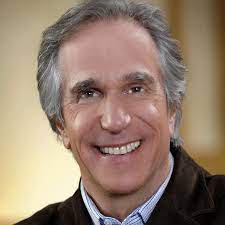
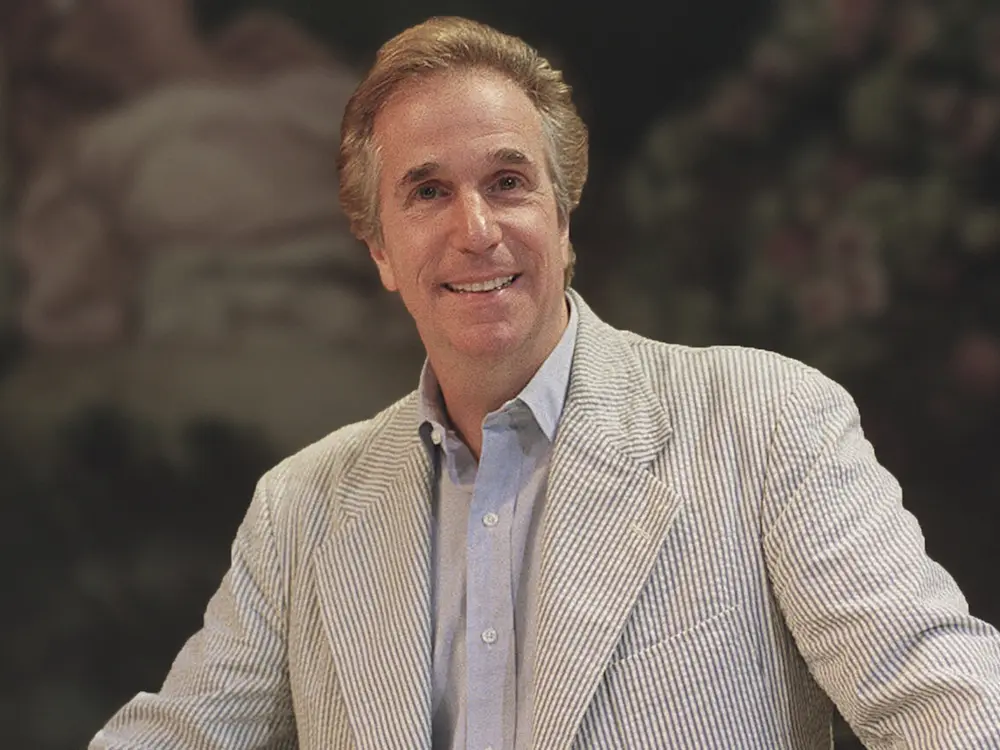
Today we are learning about the career of Henry Winkler. Although he was typecast for many years following Happy Days, he managed to continue his career with a variety of roles.
Photo: wikifandom.com
His parents were German Jews who lived in Berlin during the occupation of Nazi Germany. His father knew they would not be safe there and left in 1939. Winkler described what happened in an interview with Terry Gross on NPR in 2019: “My father knew that it was time. He got a six-week visa from Germany to come and do work in New York but was expected to come right back. I have told this story–that he took his mother’s jewelry, bought a box of chocolate, melted the chocolate down, put the pieces of jewelry in the chocolate box, melted–poured the chocolate over the jewelry, put the box under his arm, so when he was stopped by the Nazis and they said, are you taking anything of value out of Germany, he said, no, you can open every bag; we’ve got nothing. And the jewelry that he encased in chocolate, he sold when he came out of Ellis Island into New York and was able to start a new life here, slowly but surely. I have the actual letters from the government each time my father requested to stay a little longer, and they would say yes. And I was born.”
Photo: goodhousekeeping.com
Although his family did not keep kosher, Henry and his sister Beatrice were raised with the traditions of Conservative Judaism.
Winkler struggled with his studies but he was popular and very funny. His parents were frustrated by his inability to learn. Apparently, his father spoke eleven languages and could easily do math in his head. Henry’s self-esteem began to suffer during these years. Because his grades weren’t better, he was banned from most theater productions, which was what he was most interested in. He was able to appear in “Billy Budd” in eighth grade and in “Of Thee I Sing” in high school.
Photo: imdb.com
When Winkler gave a talk at the Yale Center for Dyslexia and Creativity, he tried to describe what it had been like for him in school: “You want so badly to be able to do it and you can’t. And no matter how hard you try, it’s not working . . . I would study my words. I would know them cold. I would know them backwards and forwards. I would go to class. I would pray that I had retained them. Then I would get the test and spend a lot of time thinking about where the hell those words went. I knew them. They must have fallen out of my head. Did I lose them on the street? Did I lose them in the stairwell? Did I lose them walking through the classroom doorway? I didn’t have the slightest idea of how to spell the words that I knew a block and a half away in my apartment the night before.”
Photo: understood.org
After high school, he attended Emerson College to study theater. He applied to 28 colleges but his grades kept him from being accepted at 26 of them. He majored in theater and minored in child psychology. During his time there he was a member of the Alph Pi Theta fraternity. He had a role in “Peer Gynt” as Peer Gynt. Although he also struggled with college courses, he stayed the course for four years and graduated in 1967. He was admitted to the Yale School of Drama in 1967. He appeared in a number of productions there. He received his MFA in 1970. Twenty-six years later he spoke at Graduation Day at Yale.
He began doing commercials in New York after graduation and starred in TheLords of Flatbush and Crazy Joe, two independent films. He appeared one day on Broadway; the show opened and closed on the same day. He also performed with an improv group, Off the Wall in New York.
Photo: usajacket.com
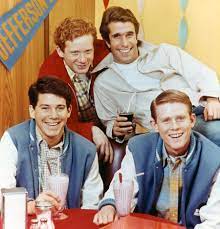
In 1973 he moved to California. His first role there was on The Mary Tyler Moore Show. Although he paid his dues in New York, he was hired as Arthur Fonzarelli on Happy Days his second week in Hollywood. He would portray the Fonz for a decade. The part was originally written a minor role on the show. Winkler did not want to portray the character as a stereotyped role which is probably why he became so popular. He was allowed to wear a black leather jacket only on his motorcycle the first year. Winkler never drove the cycle because the first time he tried, he crashed. His motorcycle on the show was the same one Steve McQueen used in the last scene of The Great Escape in 1963.
During his time on the show, he was diagnosed with dyslexia, explaining his tough time at school.
During the middle of season two, his character became a regular cast member. Many fans attribute to his performance in the episode “Guess Who’s Coming to Christmas.” By season three, he was considered one of the leads in the show.
Both Ron Howard who played Richie and Winkler told writer Stephanie Nolasco of Fox News how they felt about each other and their time on Happy Days. Winkler had a hard time dealing with his sudden fame, and Howard was able to provide some grounding for him. Winkler described this time, “It’s unnatural—the human condition does not prepare you for stardom. That’s just the way it is. So, you have to hold on to yourself and then you’ve got friends like Ron who doesn’t take it all seriously. I learned from him; he was my teacher. And Garry Marshall never took bad behavior from anybody. He was a father figure. He was very funny and very idiosyncratic, and then he was very strict.”
With Ron Howard Photo: decider.com
Winkler also discussed his friendship with Howard. “I think people gravitate to the Fonzie/Richie relationship because Ron and I are ten years apart. He was 19 and I was 27. We had a connection that you cannot describe in real life, and it was similar off-camera. He gave me my first mitt; I’d never played baseball before. He’s my brother.”
Howard echoed the sentiments. “We were fast friends from the beginning. It continues all these years later. It was exciting for me to work with Henry because he was really a trained actor who attended Yale Drama School; just a trained New York actor. And, I’d grown up sort of through the Hollywood television system, so for me to work with this guy who was so thoughtful, so creative, and yet so hilarious, was really an opportunity for me to learn and grow and we just clicked, you know.”
Happy Days Photo: ew.com
The sudden fame for Fonzie might have damaged the friendship Winkler had with Ron Howard, but they were both professionals and never had their egos inflated. They honestly discussed what was happening and while Howard had a harder transition with the show, he understood that Fonz had become a national icon. Even now decades after the show ended, people recognize his “Ayyy” and “correctamundo” catch phrases and his thumb’s up gesture.
After the show was canceled, his leather jacket was acquired by the Smithsonian Institution for the National Museum of American History. A bronze statue of the Fonz was erected in Milwaukee in 2008 along the Milwaukee Riverwalk.
Photo: ew.com
Fonzie was adored by many kids, especially kids who needed some extra help or attention. Marshall was asked if the show could do something to help kids realize how important reading was. In one of the episodes, The Fonz went to the library and checked out a book, saying “Everybody is allowed to read.” That week, library card registrations increased by 500%. In another situation, one day a call came to Paramount Studios. It was from a teenage boy who was contemplating suicide. He wanted to talk to Fonzie. Winkler picked up the call and gave the boy hope, convincing him not to take his life.
Tom Bosley and Marion Ross Photo: ebay.com
He received 50,000 letters a week. He also received $50,000 an episode. Winkler described The Fonz as his alter ego; he said that Fonz was everything he had always wanted to be: in charge, confident, and adored by others. Winkler credits Marion Ross and Tom Bosley, Mr. and Mrs. Cunningham on Happy Days, with being his acting mentors. He loved them for what they taught him and for being great people. When Bosley died, Winkler said “Tom was a family member, both on and off the sound stage. We acted together, traveled together, and played charades together. He was a loving husband, a doting father, and a fantastic grandfather.”
During his years on Happy Days, Winkler was able to tackle several other roles in the off season. He was a Vietnam War vet with PTDS in Heroes for which he received a Golden Globe nomination. He was in Carl Reiner’s The One and Only and in Ron Howard’s Night Shift.
Henry and Stacey Photo: wideopencountry.com
He also tackled the role of husband, when he married Stacey in 1978. After two years of dating, they married in the same synagogue where Winkler had his bar mitzvah. Together they raised three children, and they have been involved with a variety of children’s charities including the Children’s Action Network, the Annual Cerebal Palsy Telethon, the Epilepsy Foundation of America, the Toys for Tots, the National Committee for Arts for the Handicapped, and Special Olympics.
Even with these roles and several other television appearances under his belt, when Happy Days ended, Winkler was typecast and could not get quality roles. Winkler went the route of producer and director. He was one of the developers of MacGyver and produced and directed Sabrina the Teenage Witch. He worked on two movies: Memories of Me with Billy Crystal and Cop and a Half with Burt Reynolds. He also had appearances in Scream in 1996 and The Waterboy in 1998 and on television in The Practice in 1997 and Arrested Development in 2003.
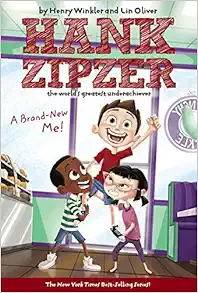
In 2003, he added writer to his resume, creating a new series of children’s books, Hank Zipzer about a dyslexic boy, with co-author Lin Oliver. The BBC televised the series, and Winkler appeared as Mr. Rock in the show. Winkler and Oliver went on to create Here’s Hank, the Ghost Buddy series and the Alien Superstar series. Queen Elizabeth appointed him Honorary Officer of the Order of the British Empire in 2011, and he was named one of the United Kingdom’s Top Ten Literary Heroes in 2013. In 2019, he was awarded the Bill Rosendahl Public Service Award for Contributions to the Public Good for his book series. In 2016, the award was renamed after Bill Rosendahl, a progressive political leader, Los Angeles’ first openly gay City Council member, an educator, a Vietnam veteran, an award-winning host of thousands of public affairs programs, and president of the Los Angeles Press Club.
In 2016 he joined the ranks of actors participating in reality shows on Better Late Than Never. During season two, Winkler traveled to Berlin and shared his family’s story. This was a quirky 12-episode reality show. NBC described it as: “This hilarious fish-out-of-water comedy/reality show follows cultural icons Henry Winkler, William Shatner, Terry Bradshaw and George Foreman on their greatest adventure yet. Deciding it’s Better Late Than Never, these four national treasures embark on the journey of a lifetime, traveling across Asia on their own with no schedule and no itinerary. The only “help” will come from Jeff Dye, a young, strong, tech-savvy comedian with an agenda of his own – who isn’t above leading the men off track. Each stop is packed with hilarious cultural experiences, heartwarming spectacles and unexpected twists as our legends take on this unforgettable adventure.”
Photo: entertainmentweekly.com
Photo: vanityfair.com
In 2018, Winkler starred in the show Barry and won his first Outstanding Supporting Actor in a Comedy Series Emmy. The plot features a hit man from the Midwest who moves to Los Angeles and becomes fascinated with the city’s theater life.
The show was on HBO for two seasons and Bill Hader, one of the creators and star of the show, wanted Henry for the part of acting teacher Gene Cousineau. Winkler mentioned he was 27 when he got the regular role on Happy Days and 72 when he got the role on Barry. Stage 19 of Paramount was where Barry was filmed; it was also the same sound stage used for Happy Days. Hader wrote Cousineau as a dark, cold character and while he could humiliate his students, Winkler brought some warmth to the character as well.
Winkler is a loyal Democrat and has campaigned for, and financially supported, Jimmy Carter, Bill Clinton, Al Gore, John Kerry, and Barack Obama.
With Friend John Ritter Photo: outsider.com
In addition to being lifelong friends with Ron Howard, Winkler was a close friend of John Ritter. They met at an ABC party in 1978 and became close friends. Winkler was actually on the set of John’s show when he collapsed and had to be taken to the hospital shortly before his death.
I do like to add some personal stories to my blogs when possible. I found a fun article in New York Magazine that looked at what famous people like to buy. One of the pieces was about Henry Winkler from October 2021. So, what did the famous Mr. Winkler purchase?:
Penn Ultra-Blue racquetballs to play with his dog Sadie. ($4); A Sony Alpha a6000 Mirrorless Camera ($650); Landmark Theatre Gift Cards ($5); Katz’s Pastrami and Rye food boxes ($155), a reminder of his youth; Munster Cheese from The Cheese Store of Beverly Hills ($15); Winston Boron fly fishing rod ($825); Knudsen’s heavy whipping cream ($4); Gotham Coffee Roasters Brooklyn Blend Coffee ($18) which needs the above cream, no half ‘n half for Henry; and Lavley I’d Rather Be Fly Fishing socks ($12), because no one likes the socks where the elastic stops working after two wash cycles. A bit of fun trivia about an icon’s shopping list.
Perhaps one of the best stories that displays the importance of Henry Winkler comes from journalist Anderson Cooper. Cooper is also dyslexic and said that one of the books that influenced his life was The Fonz: The Henry Winkler Story. He keeps it in his office at CNN. He also mentioned that in meeting Winkler in person as an adult, he realized what a kind and gracious person he is. That is something I read over and over; everyone described Winkler as kind, level-headed, grounded, unbelievably nice, and many other similar sentiments.
Photo: sandiegocountynews.com
Henry Winkler would be amazing just based on what he did with the character of The Fonz. He would be amazing just based on what he has done for his children’s charity work. He would be amazing just based on how seriously he takes his roles as husband and father. He would be amazing just based on his directing and producing work. He would be amazing just based on his later roles on Arrested Development and Barry. He would be amazing just based on his friendships with coworkers including Ron Howard, Marion Ross, Tom Bosley, Adam Sandler, and John Ritter. He would be amazing just based on his book series as an author. And he would be amazing just based on the work he has done to help others understand dyslexia. Put them all together and add the fact that no one can talk about him without describing what a genuine and kind person he is, and he is well, just simply amazing. Thank you, Henry Winkler, for all the ways you have amazed us over the decades.
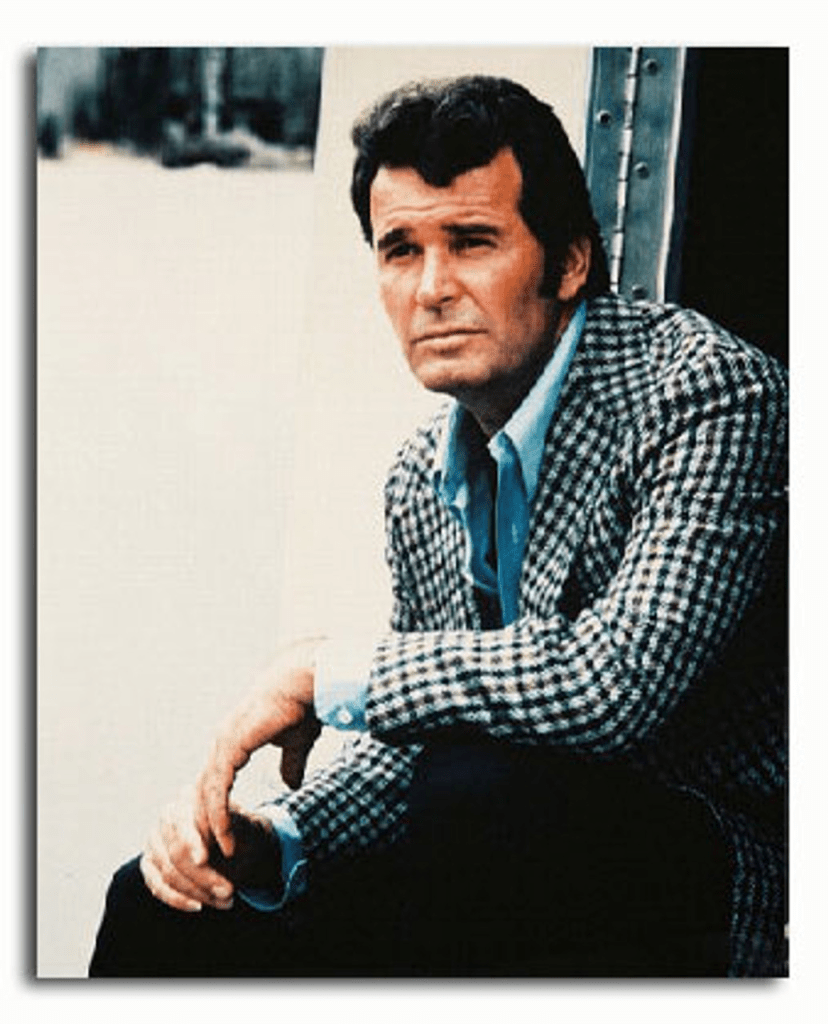
Today we are winding up our blog series about some of our favorite actors. We finish today with one of my favorites who had a dual big-screen and small-screen career, James Garner.
Garner was born in Norman, Oklahoma as James Scott Bumgarner in 1928. His mother died when he was 4, and his father ran a small store and the family lived above it. When James was 7 the store burned down and his father left the boys and gave them to relatives to raise. Later he moved to Los Angeles and became a carpet layer. James’ first stepmom was very abusive, and they finally had a fight when he hit her and she took off. His second stepmother was a total opposite of the first. He called her Mama Grace and said she was a real mother to him.
At 16 James dropped out of high school to join the Merchant Marines. He liked his shipmates but could never get over his chronic seasickness. In 1945 Garner moved to Los Angeles and enrolled in high school. He was a popular student and played both football and basketball, but he was a terrible student. He moved back to Norman the next year to try high school there again. He dropped out before graduating.
He then joined the California Army National Guard where he served his first seven months in Los Angeles. Then he went to Korea for 14 months as a rifleman in the 5th Regimental Combat Team. He was wounded twice and received two Purple Hearts. He also received his diploma from high school.
After he left the military, he had a variety of odd jobs including laying carpet with his father, pumping gas, installing telephones, chauffeur, dishwasher, janitor, lifeguard, grocery clerk, salesman, oil field worker, and modeling men’s clothing. His entry into the entertainment business is a bit different than most people’s. He was supposed to read lines to lead actors for Broadway production, “The Caine Mutiny Court Martial” in 1954. He was also given a minor, non-speaking role. As he was on the stage, he began to learn about the art of acting.
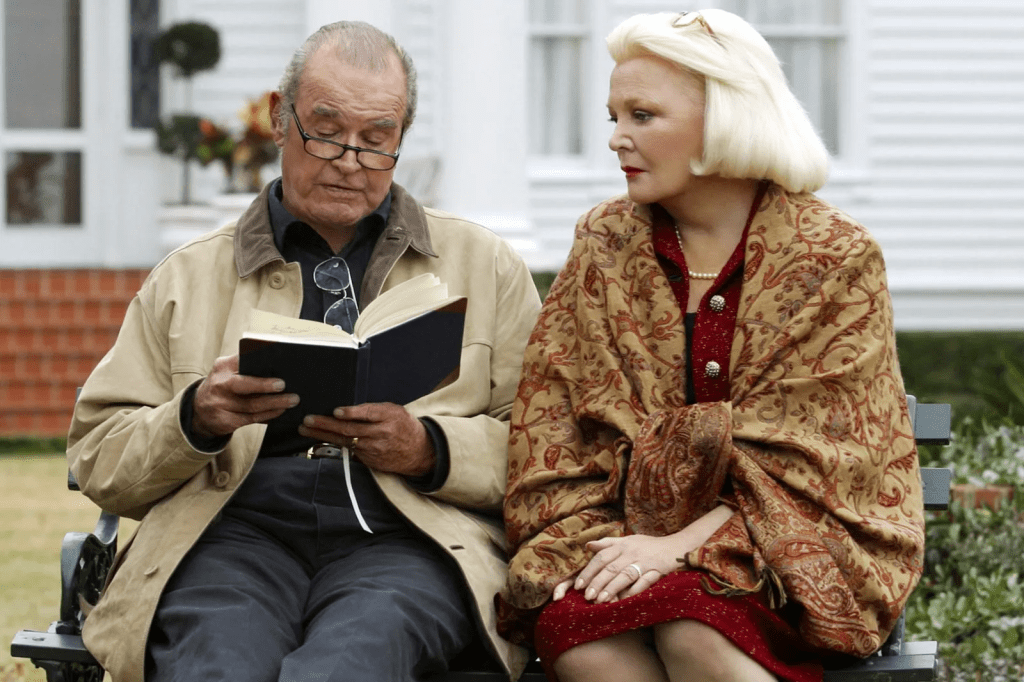
The Notebook Photo: GlamourUK.com
In 1955 he received a bit part on Cheyenne on television. He was also in Warner Brothers Presents. These small parts led to several offers to act in commercials and a larger offer from Warner Brothers to sign a contract for $200 a week. Garner began his big-screen career with Toward the Unknown in 1956. His film career included 46 additional movies with his last being The Notebook.
It was also 1956, when he married his wife Lois Fleishman Clarke; they would remain married until his death, and the couple had two daughters. They had a very short courtship. They met at the Beverly Hills Courthouse at a political rally for Adlai Stevenson and were a married couple two weeks later.
The couple bought a house in the Los Angeles neighborhood of Brentwood where their neighbors were Steve McQueen, O.J. Simpson, Arnold Schwarzenegger, Maria Shriver, and Mark Harmon. They were still living there when James passed away.
Maverick Photo: wikimediacommons.com
His successful movie career did not halt his television career. From 1957 to 1962, Garner starred as Bret Maverick on Maverick. Garner developed the type of role he would be known for as the calm, good-natured, likable, smart guy who gets out of trouble using his wit and street smarts. The show was not canceled by the network; unfortunately, Garner and the producers had a dispute over money, and he decided not to come back for the next season.
In August of 1963, Garner was one of several stars who accompanied Martin Luther King Jr. in his March on Washington. He later also recalled sitting in the third row while listening to King’s “I Have a Dream” speech.
In 1964 he made what he called his favorite film, The Americanization of Emily with Julie Andrews. He played the personal attendant of a Navy admiral and he said it contained the most impassioned speech of his career.
During the sixties and seventies, he continued making movies and showing up in a few places on television, shows like Rowan and Martin’s Laugh In, The Tonight Show, and several tv movies, one about Bret Maverick.
In 1974 he accepted his second role as star of a television series on The Rockford Files. He played Jim Rockford until 1980. Again, the network did not cancel the show which was still very popular but Garner had been having back pain and did not feel that he should continue the weekly series. He probably made the right choice because he was hospitalized with a bleeding ulcer during 1979; he would have quintuple heart bypass surgery in 1988; and both knees replaced in 2000.
Rockford Files Photo: starstills.com
In 1977 Garner began making commercials for Polaroid with Mariette Hartley. They were so convincing of being a married couple, that Hartley had a shirt made that said “I am not James Garner’s wife!” The couple filmed more than 300 commercials together.
After John Ritter passed away in 2003, Garner joined the cast of 8 Simple Rules as Cate’s father Joe and was on the show for the final three seasons.
Garner worked with several charities and foundations during his career. In 2003, he gave $500,000 to the James Garner Chair in the School of Drama for the University of Oklahoma to fund the first-endowed position at that school. He also volunteered with Save the Children.
In 2011, Garner wrote an autobiography called The Garner Files: A Memoir, cowritten with Jon Winokur.
Some of Garner’s hobbies included spending time with his family and political activism. However, his biggest passion was sports. He was a big fan of the Oakland Raiders and could often be seen on the sidelines with the team. He loved golfing. He was inducted into the Off Road Motorsports Hall of Fame in 1978. He owned the American International Racing team in the late sixties and he drove the pace cars for the Indianapolis 500 in 1975, 1977, and 1986.
Photo: flickr.com
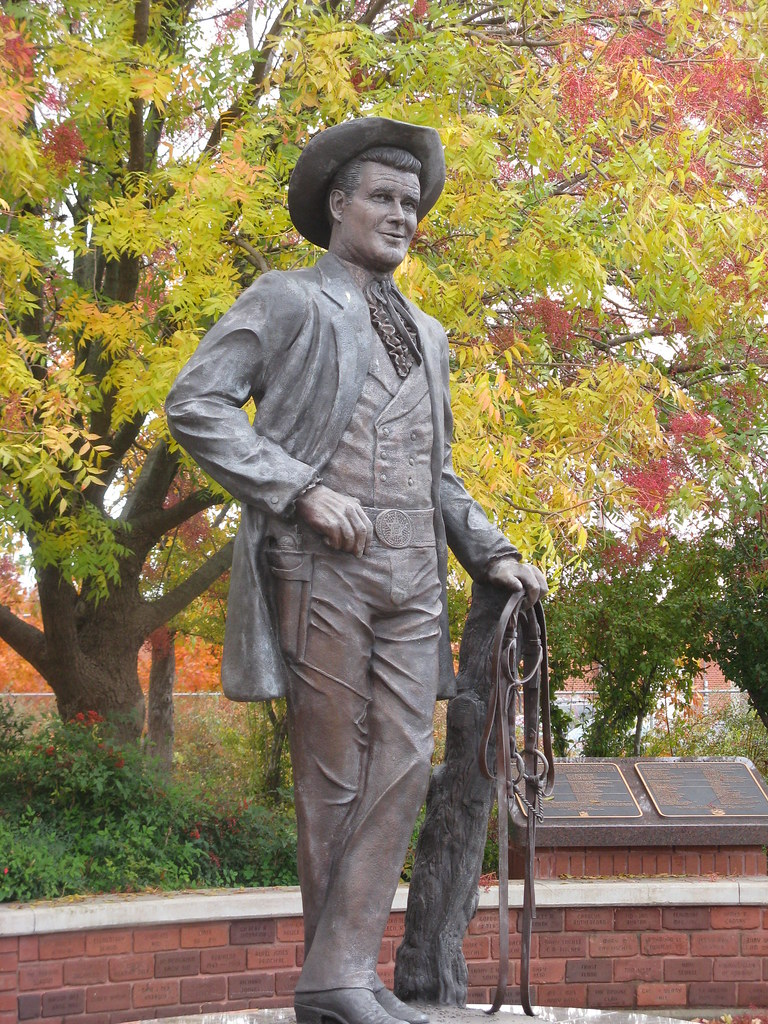
He was also honored by his hometown of Norman, Oklahoma. He has a street named after him there and in 2006, a ten-foot bronze statue as Bret Maverick was erected there.
He was also loved by his coworkers. In 1973, John Wayne named Garner the best American actor in an interview. He was also close friends with Tom Selleck, Sally Field, and Clint Eastwood. When he passed away in 2014 from a heart attack, Sally Field said “My heart just broke. There are few people on this planet I have adored as much as Jimmy Garner. I cherish every moment I spent with him and relive them over and over in my head. He was a diamond.” He was nominated for 15 Emmy awards during his television career, winning in 1977 as Outstanding Lead Actor in a Drama Series for The Rockford Files.
He didn’t do a lot of comedy but I think he was a funny guy. When he was asked if he would ever consider a nude scene, he said “No, I don’t do horror films.”
James always said he was not concerned with fame; he just wanted to make a good living at something he enjoyed. That comes across as something he truly believed in, not just talking the talk. He lived in the same house and was married to the same woman for most of his life. He did work he was proud of and was very successful in both film and television. He loved sports and his career allowed him to participate in more of those activities that he loved. He was also a generous man, giving to causes that he thought were important.
Move Over Darling Photo: moviescene.com
Although not the most important films in his portfolio, I always think of him acting with Doris Day in The Thrill of it All and Move Over Darling. I enjoyed learning about his life and respect him as a person. He never complained about the terrible childhood he had or used it to make excuses when he did make a poor choice; he said you have to just keep moving forward and he moved forward in an honorable way. Thanks for sharing your life with us and letting us travel forward with you, James Garner.
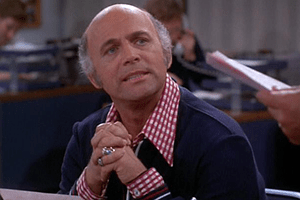
As we wind up our up close and personal blog series, we are focusing on Gavin MacLeod. I have mentioned Gavin MacLeod’s name a lot in my blogs, but I have never devoted an entire to blog to him, so today is the day. Gavin had an impressive career; he starred in three sitcoms but those three garnered him almost 500 episodes. In addition, he took on more than a hundred guest roles on both the small and big screen.
MacLeod was born Allan George See in 1931 in New York. His mother worked for Reader’s Digest, and his father was an electrician. In 1952, MacLeod graduated from Ithaca College with a bachelor’s degree in fine arts, studying acting.
On Perry Mason Photo: imdb.com
He served in the US Air Force where he wrote, produced, and directed plays. After his service, he moved to New York City. While tackling acting auditions, he worked at Radio City Music Hall. While working as an usher there, he met Joan Rootvik, a Rockette. They married in 1955 and had four children. About this time, he took on the name Gavin MacLeod. MacLeod was a tribute to his acting coach at Ithaca, Beatrice MacLeod.
His movie career began with three movies in 1958. He would make 20 more before 2005, including Operation Petticoat and The Gene Krupa Story.
His television appearances began in 1957 on The Walter Winchell File. He would make another lucky 13 performances during the fifties including The Thin Man and Whirlybirds.
On Hogan’s Heroes Photo: pinterest.com
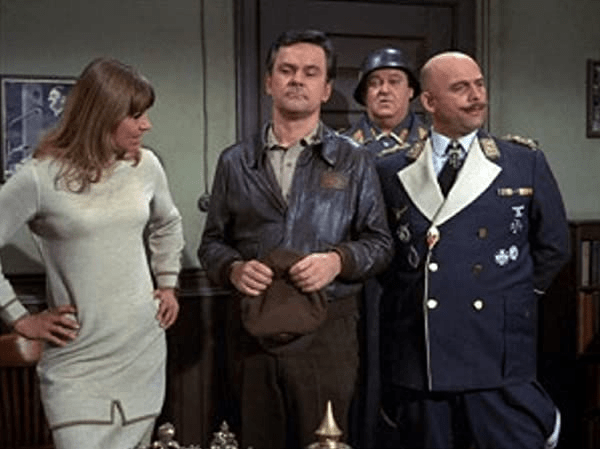
The sixties kept him busy. He took on comedy in The Dick Van Dyke Show, The Munsters, Gomer Pyle USMC, The Andy Griffith Show, My Favorite Martian, The Flying Nun, and several different characters on Hogan’s Heroes. Westerns called him for Rawhide, The Iron Horse, Death Valley Days, and The Big Valley. He landed dramas including The Man from UNCLE, Perry Mason, Ironside, Hawaii Five-0, and Ben Casey.
From 1962-1964 he starred as Happy in McHale’s Navy. The show continued until 1966, but Gavin left the show halfway through. He was dealing with alcoholism, and he received an offer to make the movie The Sand Pebbles with Steve McQueen. However, he remained close friends with Ernest Borgnine, the star of the show, until his death in 2012. (He quit drinking in 1974.)
Murray and Mary Photo: showbizcheatsheet.com
During the 1970s, he appeared on Love American Style, Charlie’s Angels, and Wonder Woman, but the character we loved best during that decade was Murray Slaughter on The Mary Tyler Moore Show. From 1970-1977, Murray sat next to Mary, helping her through the ups and downs of life. Gavin was originally auditioning for the role of Lou Grant, but ended up reading for Murray. He and Ted Baxter were enemies on the show, but he and Ted Knight were dear friends in real life. They had lived near each other before being cast in the show.
During the run of the show, Gavin and his first wife divorced, and he married his second wife Patti Steele. That marriage also ended in divorce in 1982. Patti became part of a Bible Study group after their divorce and became a Christian. Gavin reached out to her, also became a Christian, and they remarried in 1985.
Photo: travelweekly.com
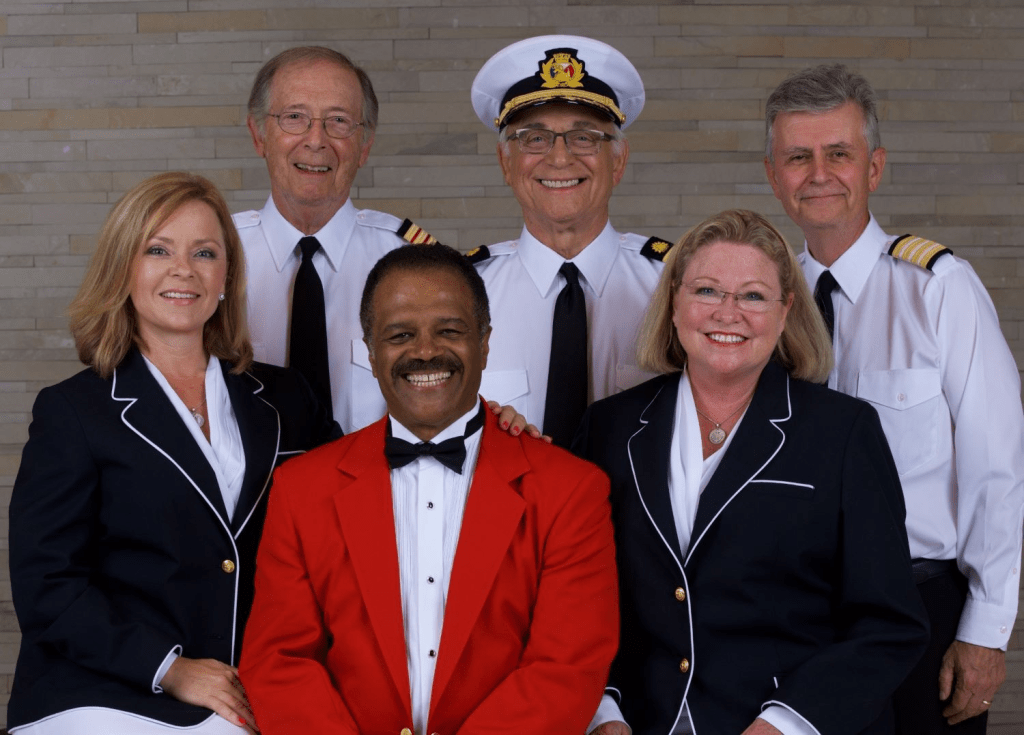
Upon the ending of Mary’s show, he was immediately hired as Captain Stubing on The Love Boat. This time he was in charge of his coworkers. One of his best friends was Bernie Kopell who played Dr. Adam Bricker on the show. Gavin was on the seas for a decade. His best friend Telly Savalas (the lollipop-loving Kojak star) popped up on The Love Boat; the two were very close until Telly’s death in 1994.
When the show ended in 1987, he got a well-deserved break, but he still managed to find time to tour with Michael Learned in “Love Letters.”
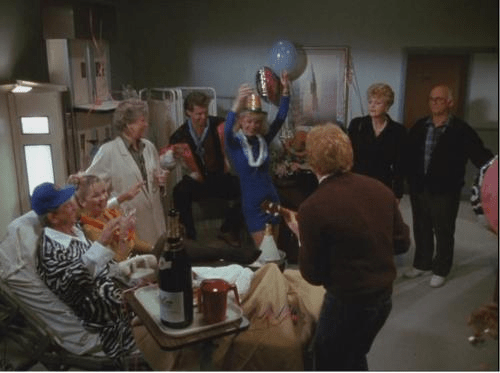
Celebrating on Murder She Wrote Photo: imdb.com
He landed a variety of television show appearances in the 1990s and 2000s, including Murder She Wrote, King of Queens, JAG, and That 70s Show. His final appearance was in 2014 on The Comeback Kids; then he decided to retire. He also did several musicals after The Love Boat including “Gypsy,” “Annie Get Your Gun,” and “Gigi.”
MacLeod and his wife hosted a show on marriage on Trinity Broadcasting Network for 17 years. He also served as the honorary mayor of Pacific Palisades from 2006-2011 when Sugar Ray Leonard took over.
The Love Boat was a big part of his life. Instead of being bitter about being typecast, he embraced the role. He celebrated his 80th birthday in 2011 aboard the Golden Princess with his family, celebrating with a 3D replica cake of The Pacific Princess, his boat on the show.
Photo: princesscruises.com
In 2013, MacLeod joined his former coworkers on The Talk for a cast reunion. Several members of the cast including Gavin took part in The Rose Bowl Parade in 2015.
The cast apparently was very close. Ted Lange who played bartender Isaac Washington mentioned the crew in an interview in 2017 with “The Wiseguyz Show,” saying “Oh yeah, sure, Gavin was wonderful. Gavin lives down here in Palm Springs and we’re still tight, all of us, Gavin and Bernie and Jill; we still see each other. Fred [who played Gopher] lives in a different state, we’re still close, we’re still good friends.”
In his spare time, Gavin enjoyed traveling, playing tennis, dancing, golfing, sailing, reading the Bible, and watching movies. Gavin passed away in May of 2021 at his home.
Photo: twitter.com
During the past decade, he released a memoir, This is Your Captain Speaking: My Fantastic Voyage Through Hollywood, Faith & Life. He explained his goal for writing this book: “My life has taken one incredible turn after another,” writes MacLeod. “I’ve gotten to do what I wanted to do. I’ve been a captain! I’ve been given this incredible gift of life and now I want to use it to give back. That’s why I’m sharing my story here, the fun parts and even some not-so-fun parts, in the hopes that maybe someone will take a nice walk down memory lane with me – and maybe I’ll even give someone a little bit of hope.”
Good memories and a little bit of hope is all we can ask for; thanks, Gavin, for giving that to us.
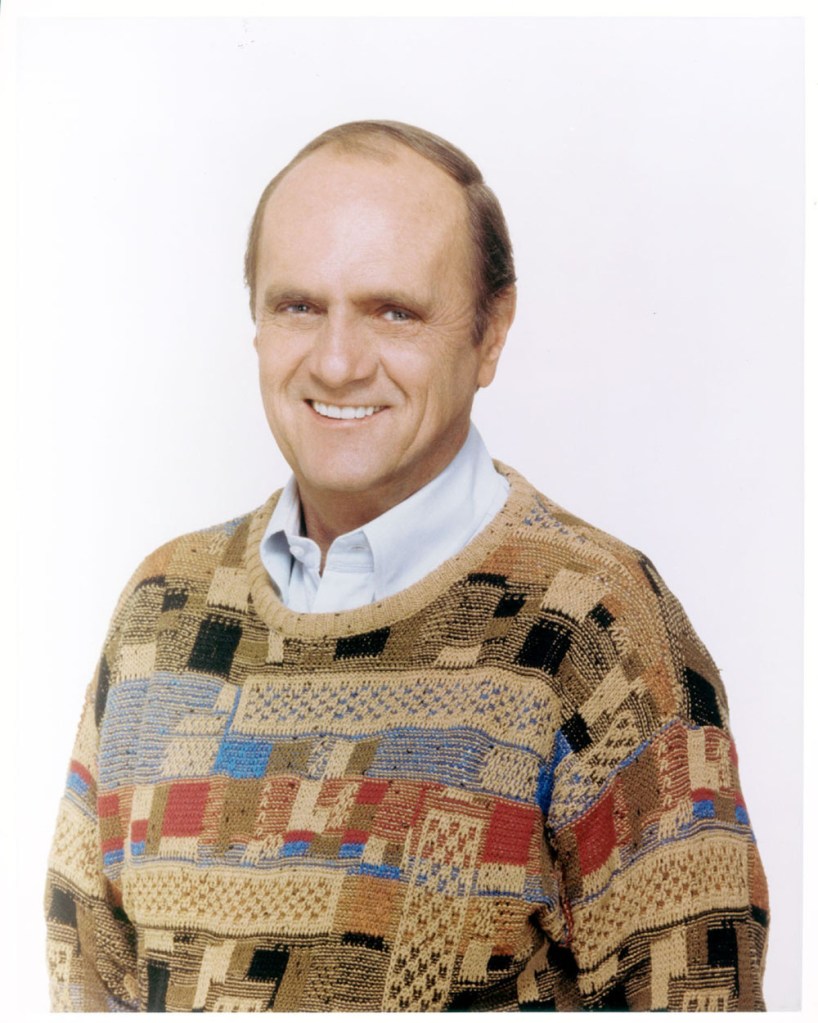
This month I wanted to honor one of our most beloved television comedians: Bob Newhart. Next week we’ll spend some time learning more about The Bob Newhart Show.
Photo: spotify.com
Newhart was born George Robert Newhart in 1929 in Oak Park, IL. He grew up in a typical midwestern family where his father was part owner of a plumbing and heating supply company, and his mom was a housewife. As a young boy, he always wanted to be called Bob. He had a Catholic education and went on to Loyola University of Chicago in 1947. Graduating in 1952 with a business degree, he was soon drafted into the US Army in the Korean war where he stayed until 1954. He considered getting a law degree and went back to Loyola. He decided not to pursue that; some sources site that he was asked to behave unethically during an internship which led him down a different career path.
He worked as an accountant and as an unemployment office clerk. In 1958 he was hired as a copywriter for Fred Niles who was a television producer in Chicago. It was while working here that Newhart and a colleague began entertaining each other by making telephone calls about absurd scenarios. They sent these to radio stations as audition tapes. A radio station disc jockey Dan Sorkin introduced Newhart to a Warner Brothers Records executive who signed him in 1959 based on those recordings. Bob then began creating stand-up routines which he performed at nightclubs.
Photo: discogs.com
He released an album in 1960 which changed his life. Titled, The Button-Down Mind of Bob Newhart, the comedy album made number one on the Billboard charts, and he won a Grammy for best new artist. A follow-up album, The Button-Down Mind Strikes Back was released soon thereafter. He would continue releasing comedy albums in 1961, 1962, 1964, 1965, 1967, 1971, and 1973.
During a 2005 interview for American Masters on public television, Bob stated that his favorite routine was Abe Lincoln vs Madison Avenue which was on his first album. A promoter for Abraham Lincoln has to deal with his reluctance to boost his image. A tv director named Bill Daily suggested the routine to him. Daily would be known later as Howard Borden on The Bob Newhart Show (as well as Roger Healey on I Dream of Jeannie).
The success of that first album led to a variety show titled The Bob Newhart Show. It only lasted a year, but it did receive both an Emmy nomination and a Peabody award. Apparently, he didn’t enjoy his time during the show so much. Halfway through the season he wanted to quit, but his agent explained that being under contract meant that was not possible. At a later date, he referred to his first show, saying “It won an Emmy, a Peabody Award, and a pink slip from NBC. All in the same year.”
He began making the rounds on television shows, appearing on The Dean Martin Show 24 times and The Ed Sullivan Show 8 times. He guest hosted The Tonight Show Starring Johnny Carson 87 times. When discussing his appearances on Johnny’s show, he stated “I remember once when I emceed The Tonight Show in New York, I arrived with my manager’s son. After a while, they asked, ‘When are the rest of your people coming?’ I had to say, ‘This is it.’”
Photo: huffingtonpost.com
In 1962 Newhart accepted his first movie role, Hell is for Heroes, starring Steve McQueen. He would continue to do movie roles throughout his career including the Christmas classic Elf, but the small screen would make him famous.
In 1963 Buddy Hackett introduced Bob to Virginia Quinn, whose father was character actor Bill Quinn. They wed in January of 1963 and 57 years later are still happily married.
Photo: zimbio.com
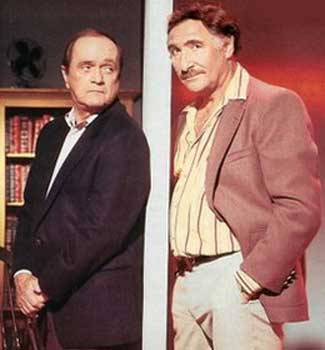
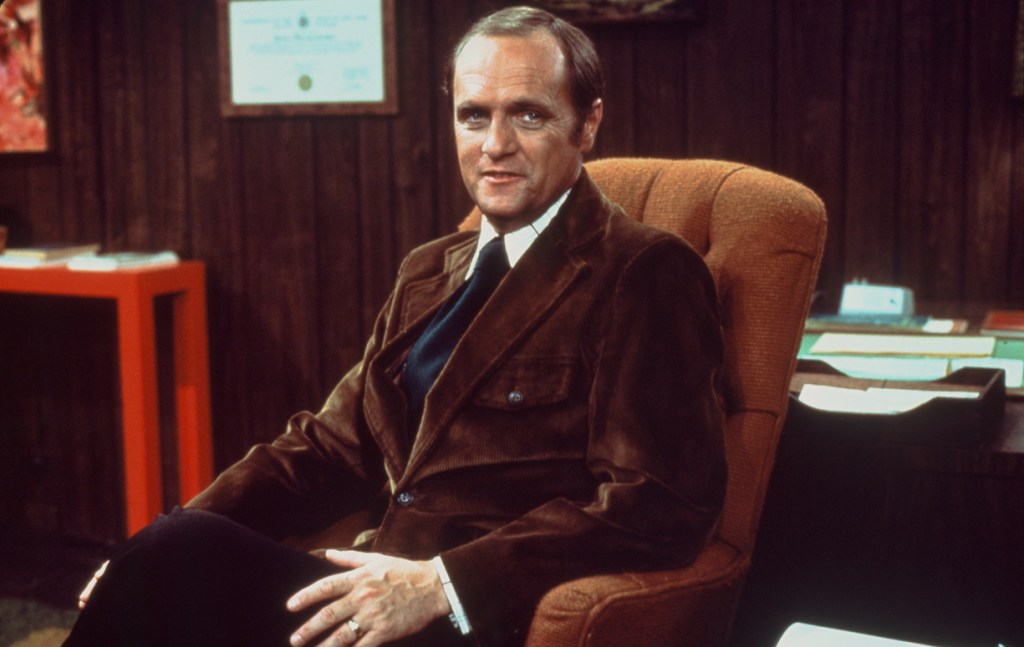
For the next decade, he continued to accept movie and television roles. In 1972, television history was made when The Bob Newhart Show debuted. Until 1978, Newhart played Bob Hartley, psychologist, and we got to know his unusual patients, quirky co-workers, and eccentric friends, including neighbor Howard Borden. Bob chose a psychologist based partly on his old telephone routines. As he said, “Much of my humor comes out of reaction to what other people are saying. A psychologist is a man who listens, who is sympathetic.”
Photo:epiguides.com
In 1982, Bob gave television another go for another eight years. Simply titled Newhart, the show featured Bob as Dick Loudon, an innkeeper and author from Vermont. He still had quirky co-workers and eccentric friends.
Photo: austenauthors.net
On cue a decade later in 1992, Bob showed up in a new show even more simply titled, Bob as Bob McKay a comic book writer and artist who had retired long ago and was trying to get back into the workplace. Unfortunately, after 33 episodes the show was canceled due to low ratings.
Photo: imdb.com
In 1997, Newhart starred in his last sitcom, George and Leo. As George Stoody, a bookstore owner, Newhart offers a temporary home to a full-time magician and part-time criminal who recently robbed a Mafia-owned casino. The series failed to catch on with viewers, and it was canceled after a season as well.
Photo: listosaur.com
Though he never took on another sitcom, Newhart has made appearances with recurring characters in several shows. In 2003, he showed up on ER as Ben Hollander. In 2005, he was Morty on Desperate Housewives. As Judson, he guest starred on The Librarians.
Photo: thewrap.com
Perhaps, younger audiences know him best as Arthur Jeffries or Professor Proton on The Big Bang Theory. He had been Sheldon’s boyhood hero who played the professor on television. Sheldon idolized the professor while the professor tolerated Sheldon.
Photo: upi.com
It’s hard to believe with all of his years being a successful television comedian, but Newhart won his first Emmy in 2013 for his role of Professor Proton. I can’t argue with the nominees for most of the 1970s during the airing of The Bob Newhart Show–names like Tony Randall, Jack Klugman, Alan Alda, and Hal Linden. Even with my bias of Norman Lear shows, I get nominating Carroll O’Connor every single one of those years. I understand the tough competition. What I don’t understand is the fact that he was never nominated during that eight-year period. When Jack Albertson wins, and Bob Newhart is not even nominated that is wrong. During the Newhart years, he was at least nominated three times. But I don’t understand it when John Ritter wins for Three’s Company or Richard Mulligan for Soap and no nomination for Bob Newhart. What especially appalls me is the fact that The Bob Newhart Show was only nominated one year; I can accept the fact that it got beat out by The Mary Tyler Moore Show. I cannot accept is that during this same time, Three’s Company, Mork and Mindy, and Welcome Back Kotter received nominations, and The Bob Newhart Show did not. Anyway, this blog is not about the television academy and its procedures, so let’s move on.
Photo: flickr.com
Even though he was never awarded with an Emmy for his time as Bob Hartley, TV Land placed a life-sized statue of Newhart in front of Navy Pier, complete with an empty couch. He was best friends with Suzanne Pleshette, his wife from the show, and spoke at her funeral. He remembered their time together, “Her laugh. Her laugh. We just laughed. We just had a great time. We all loved each other and respected each other and we got paid for it.” Bob also remains close friends with Marcia Wallace who played his receptionist Carol on the show.
Photo: sitcomsonline.com
While Bob has appeared as different characters throughout his career, he has also remained the same character. With his deadpan delivery and slight stammer, he perfected the straight-man role, surrounding himself with wacky castmates. He has often cited George Gobel and Bob and Ray as influences in his comedy career. When discussing his career choice, he explained “I like the humor to come out of character. When you’re going for a joke, you’re stuck out there if it doesn’t work. There’s nowhere to go. You’ve done the drum role and the cymbal clash and you’re out on the end of the plank.”
Photo: barnesandnoble.com
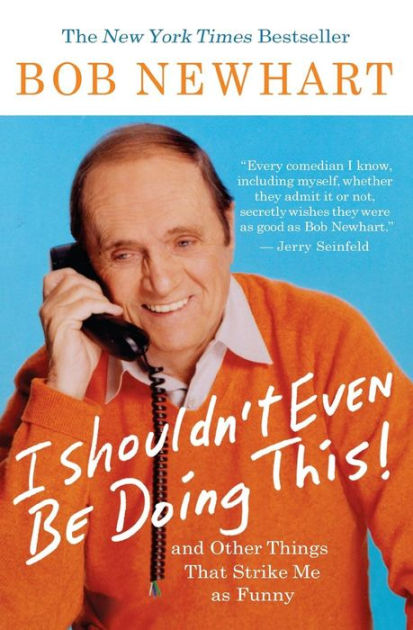
In 2006, he released a book I Shouldn’t Even Be Doing This. It’s a memoir with some of his classic comedy routines. Actor David Hyde Pierce reported that “the only difference between Bob Newhart on stage and Bob Newhart offstage is that there is no stage.”
Photo: parade.com
I am so appreciative of those stars who agree to entertain us for our entire life, such as Betty White, Carol Burnett, and Bob Newhart. They are classic comedians who can make us laugh no matter what. Bob’s view on comedy was that “laughter gives us distance. It allows us to step back from an event, deal with it and then move on.” What an amazing career and what an amazing man. With all its negatives and sometimes destructive tendencies, television can be a harmful place, but a comedian like Bob Newhart demonstrates what a positive and uplifting experience television can be when done right. Thanks for doing it right for sixty years.
As another year comes to a close, I wanted to take the month of December to remember some of the amazing television stars who passed away in 2019. In previous blogs during 2019, we discussed Tim Conway, Katherine Helmond, Peggy Lipton, and Peter Tork. We’ll be learning about Valerie Harper’s career in January.
Photo: flashbackdallas.com
We start our tributes with Rip Torn, born Elmore Rual Torn Jr. in 1931 in Texas. Rip was a name that many men in his family used. Torn had an unlikely acting career path. He attended Texas A&M and the University of Texas where he majored in animal husbandry. During his time there, he did study acting with Shakespeare professor B. Iden Payne. His not-well-thought-out plan was to hitchhike to Hollywood, become a movie star, and retire after making enough money to buy a ranch. Although it was a dubious beginning, he would go on to a sixty-year career in the acting profession.
Photo: listal.com The Cincinnati Kid
He made his movie debut in 1956 in Elia Kazan’s Baby Doll. In the same year, he married Ann Wedgeworth. They would remain married for five years until he divorced her to marry Geraldine Page. He and Geraldine were married until her death in 1987.
He worked a number of odd jobs and took several television roles. When he got serious about his acting, he moved to New York City to study under Lee Strasberg. Later a relative of his, cousin Sissy Spacek, would also study under Strasberg. Along with acting, Torn studied dance with Martha Graham during his early years in New York. He made his Broadway debut in “Sweet Bird of Youth” in 1959 and was nominated for a Tony. He would continue to weave in and out of Broadway and Off-Broadway for the rest of his career. He didn’t limit himself, continuing to star in Broadway, movies, and television, winning two Obie awards for “The Deer Park” and “The Beard.” He later opened a stage company.
Photo: tumblr.com The Man Who Fell to Earth
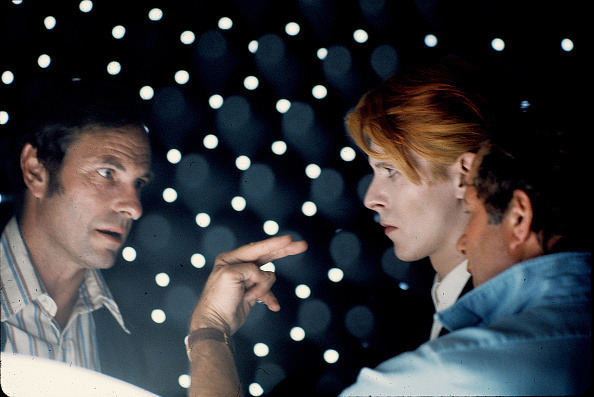
Torn never lacked work. His roles varied as lead, second lead, supporting, and character. He took on a variety of roles in his movies. In 1965 he was Slade in The Cincinnati Kid with Steve McQueen. The part of George Hanson in Easy Rider, which was released in 1969, was written for Torn by Terry Southern. However, Rip did not get along with Dennis Hopper and withdrew from the film. Jack Nicholson took over the role, propelling his rise to stardom. Rip portrayed a country and western singer in Payday in 1972. In 1976, he joined David Bowie in The Man Who Fell to Earth. He was a politician 1979 in The Seduction of Joe Tynan with Alan Alda and Meryl Streep. In 1983 he was nominated for a best supporting Oscar for Cross Creek, the true story of how Marjorie Rawlings wrote The Yearling.
Photo: pinterest.com Airplane II: The Sequel
Most of his performances were in dramas, but he could also tackle comedy. Torn accepted the role of airline executive in Airplane II: The Sequel (1982) and as a tourist with John Candy in Summer Rental (1985).
In 1989 Torn would marry Amy Wright whom he was married to until his death this year when he passed away in July.
Photo: comicbook.com Men in Black
Many younger fans associate him with his role in Men in Black and Men in Black II in the late ‘90s and early 2000s where he worked with Will Smith and Tommy Lee Jones.
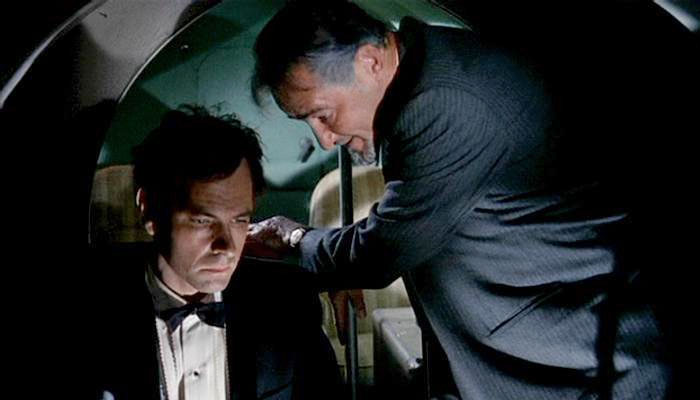
Photo: myneatstuff.ca The Man From UNCLE
Although Torn may be best known for his movie roles, he had a long and prolific television career. In the 1950s he appeared on the small screen eleven times, primarily in the drama and theater series so prevalent at that time. The 1960s found him in twenty series including The Man from UNCLE, Dr. Kildare, and Rawhide. In the 1970s, his television roles were primarily in crime shows with one appearance on Bonanza. While he did not appear in any series in the 1980s, he did show up in many made-for-tv-movies. During his career, he would appear in 32 tv movies and about a dozen mini-series.
Photo: newyorktimes.com The Larry Sanders Show
As Artie, the television producer on The Larry Sanders Show, he was nominated six years in a row (1992-1998) for an Emmy, winning in 1996.In addition to his time on The Larry Sanders Show, he also accepted eight other tv roles in the 1990s, including an appearance on Columbo. After 2000, he would show up on television six more times, including a recurring role on Will and Grace. He had a recurring role on 30 Rock as the Chief Executive Officer of General Electric from 2007-2009.
Photo: usatoday.com On 30 Rock
Unfortunately, he got into some trouble in 2010. He claimed that got him fired from 30 Rock, but no one at the show ever confirmed that. He was arrested after breaking into a bank office close to his residence. He was charged with carrying a firearm without a permit, carrying a firearm while intoxicated, trespassing, and criminal mischief. He said he broke in thinking the bank was his home. His lawyer told the judge Torn had a severe alcohol abuse problem. Torn was given a $100,000 bail and began treatment. One article I read cited that Torn was arrested three times for driving while intoxicated before this arrest.
I don’t know if he ever bought that ranch, but he earned the respect of generations of actors. He chose roles that interested him and didn’t worry if his part was the lead actor or a secondary role. He was not focused on whether a part would lead to a financial payday, choosing roles that were interesting or challenging to play. RIP Rip.































 thewritelife61