Good Morning World: Tune In

As we are in the middle of our What in the World? blog series, today it’s a forgotten sitcom from the sixties: Good Morning World.

📷wikipedia.com

This series was created by Sam Denoff and Bill Persky, the team behind That Girl. The concept was based on Persky and Denoff’s time as writers for a New York radio station in the fifties.

In fact, William B. Williams, a WNEW DJ was given screen credit because the title was based on his daily greeting, “Hello, World.” William B. Williams was quite a character and an icon in the world of music. He was born in 1923 and after attending the University of Syracuse, he got a job with WAAT in New Jersey. He filled in for a DJ who failed to come to work but then was fired for, believe it or not, wearing red socks to work. He was hired by WNEW in New York City. He became a beloved radio icon. The radio station said at his funeral there was a huge crowd outside which included taxi drivers, sanitation workers, bookies, waitresses, singers, songwriters, politicians, housewives, first responders, and even the Rockettes.

📷radiohalloffame.com William B. Williams

According to the radio station’s website, “William B. Williams respected singers and songwriters, music and musicians, and it showed. He had a permanent, perhaps profound, effect on the lexicon of pop music.

He bestowed the ‘Count’ on Basie and the ‘Duke’ on Ellington. Billie Holiday was ‘Lady Day.’ Ella Fitzgerald was the ‘First Lady of Song.’ Louis Armstrong was ‘Pops.’ Sinatra was ‘Francis Albert,’ the ‘Chairman of the Board.’ Nat ‘King’ Cole was simply ‘Nathaniel.’”

The show was produced by Sheldon Leonard and Carl Reiner. Looking at that alone and you would expect it to be a hit.

The premise was two radio disc jockeys who have a morning show, “Lewis and Clarke,” in Los Angeles. Dave Lewis is happily married, and Larry is a lady’s man and party boy.

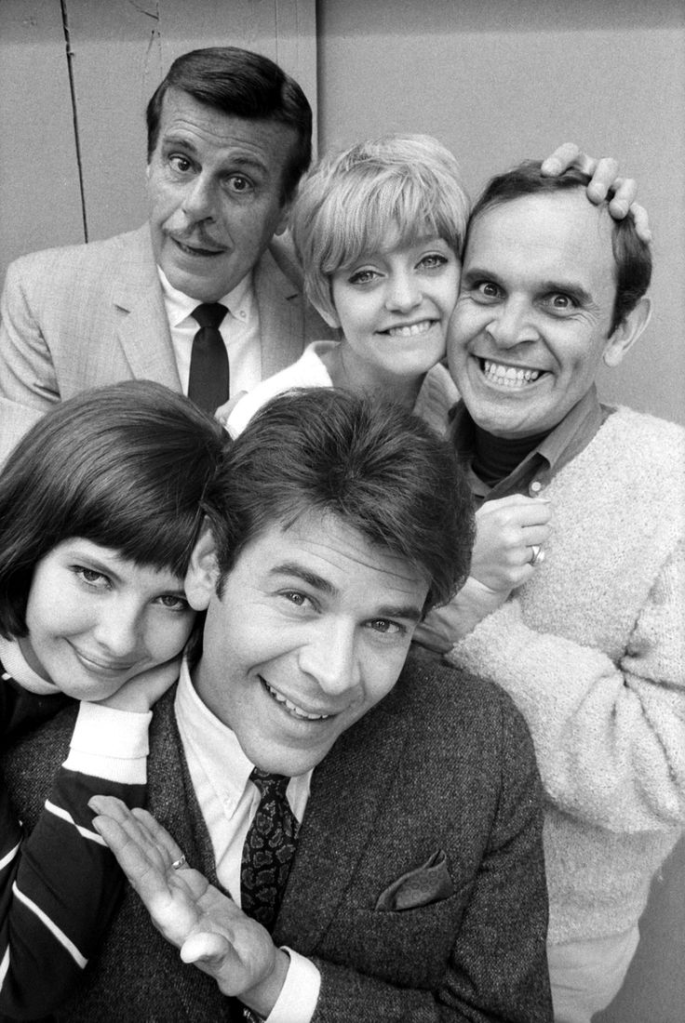
They had some problems casting this show. Roddy McDowell and Sharon Farrell were cast as the married couple. Then Ron Rifkin replaced McDowell. Then they were both let go and David Lewis was played by Joby Baker, his wife Linda was played by Julie Parrish, and Ronnie Schell was cast as Larry Clarke.
📷pinterest

Billy de Wolfe and Goldie Hawn were fun additions to the cast. De Wolfe played Roland Hutton, the stuffy station manager. Hawn was Linda’s best friend Sandy Kramer.

The series debuted on CBS in 1967. It was on Tuesday nights, sponsored by Procter and Gamble. It was competing with N.Y.P.D., a police crime show and Tuesday Night at the Movies which began half an hour before Good Morning World.

Given that the talent behind The Dick Van Dyke Show was contributing to this show as well, it’s not surprising that it seems to be a mixture of The Dick Van Dyke Show and the later Mary Tyler Moore Show. Like Dick Van Dyke, the show features the DJs’ home and work life; like Mary Tyler Moore, you have a Lou Grant-type manager, and we learn about life at a radio station.

The theme music was by David Grusin. The opening was a different look for a sitcom. It’s a bouncy theme that begins with an alarm clock ticking, the guys quickly getting ready, morning traffic, life in LA, and the two DJs barely getting into their chairs before the show started.

The show was not awful in ratings, but the network had two concerns. They still were not sure Baker and Parrish were the right actors to play the married couple, and Parrish had some health concerns that affected the show. They were also concerned that the show did not pull in more of the viewers who were watching The Red Skelton Show which was on before Good Morning World. I don’t think that is surprising. I’m guessing people who enjoyed watching Red Skelton would not love this show as much and vice versa. Full disclosure, I am not a Red Skelton fan. I didn’t find his humor funny, and I have read too many stories shared by actors and writers who experienced his ego and lack of respect dealing with coworkers.

📷imdb.com

The network made the decision not to renew the show for a second season. Schell, who had been playing a private on Gomer Pyle: USMC, another Leonard/Reiner show, returned to military life with a promotion to corporal.

Goldie Hawn was free to accept an offer to appear on Martin and Rowan’s Laugh In which was a turning point for her career. De Wolfe became part of the cast of his close friend Doris Day’s show.

Baker never starred in another show, but he was a busy character actor. Parrish was later cast in Return to Peyton Place and also stayed busy in television; she later had a recurring role on Beverly Hills 90210.

This would be an easy series to binge watch with 26 episodes available. S’more Entertainment released the series on DVD in 2006 and its’ on Roku, so viewers can check it out for free.

Peyton Place: Where Television Soap Opera Began

I admit that this month I may be a bit out of my element. We are going to learn about the soap opera genre in a series called “I Met My Twin When I Married My Mother’s Neighbor’s Uncle’s Grocer’s Best Friend’s Attorney Who is Also My Fourth Cousin Once Removed.” While my best friend Bonnie and I eagerly tuned in to The Young and the Restless when it began in seventh grade, and I popped in and out for a decade or so afterward, most of my soap opera memories involve my mother. I remember her ironing in the living room while watching As the World Turns. She also kept up with the events on Days of Our Lives and may have watched a few others off and on.

Photo: mubi.com

First in our series is one of the earliest television operas: we are traveling to Peyton Place.

This soap began on ABC in September of 1964 and was on the air for five years.

It was based on the novel Peyton Place by Grace Metalious. The first couple of years were in black and white and the second half of the shows were in full color.

A lot of the cast went on to be very active in television: Mia Farrow, Ryan O’Neal, Barbara Parkins, Christopher Connelly, David Canary, Mariette Hartley, and Lana Wood.

The show had a rocky beginning. Producer Paul Monash wanted to bring the show to prime time based on the success that the show Coronation Street had in England. He refused to call it a soap opera, preferring the term “high-class anthology drama.” A pilot was shot in 1962; after several changes, the pilot finally aired in 1964. The early episodes were taken from the novel and the 1957 film that was also based on the book. However, eventually, new stories had to be created. The setting was changed from an unknown location in the 1940s to present-day Massachusetts.

Peyton Place Archives, Camden ME Photo: camdenpubliclibrary.com

The opening credit included a photo of a church steeple and the words “Peyton Place” on screen while the bells rang. Announcer Dick Tufeld said, “This is the continuing story of Peyton Place.” Suddenly we see the town square, a rolling stream, and cast members while a summary of the previous episode is related.

Peyton Place was an immediate hit. It began life airing twice a week but then increased to three episodes in June of 1965. Dorothy Malone, one of the stars, had emergency surgery, so she was replaced with Lola Albright until she fully recovered.

In the first season, Dr. Michael Rossi (Ed Nelson) arrives in town from New York City to open his medical practice. Newspaper editor Matthew Swain (Warner Anderson) is a new friend. Matthew’s cousin Allison MacKenzie (Mia Farrow) is in love with his older brother Rodney (Ryan O’Neal). We understand that her mother Constance (Dorothy Malone) highly disapproves of the relationship. The town was named for Martin Peyton, the Peyton Mill owner, who was Rodney’s grandfather.

Rodney disapproves of his father Leslie’s (Paul Langton) relationship when he catches him with his secretary Julie (Kasey Rogers). Rodney has been dating her daughter Betty (Barbara Parkins). He breaks up with Betty and begins seeing Allison. Betty discovers that she is pregnant and then miscarries. Rodney marries her not knowing about the miscarriage. We also learn that Elizabeth Carson was murdered in a beachfront home.

The movie version 1957 Photo: dailymotion.com

Dr. Rossi becomes closer to Constance although he butts heads with Dr. Morton (Kent Smith). Dr. Morton threatens to destroy Rossi’s career when Catherine, Rodney’s mother, dies; then he learns that the pathologist made a huge error which actually caused the death. Betty decides to become a nurse and is hired as an aide at the hospital. Her father George (Henry Beckman) has a nervous breakdown and is admitted to a local sanitarium. Barbara Parkins told a reporter that when she met Bette Davis, the famous actress asked her, “When are you going to let go of Rodney Harrington?”

Elliot Carson (Tim O’Connor), Alison’s birth father who had been in prison for 18 years, returns to Peyton Place. He had been accused of murdering his wife Elizabeth, but we know that Catherine had been responsible. Once Elliott’s name is cleared he marries Constance and they explain to Allison that he is her father. Norman falls in love with a local girl Rita (Patricia Morrow) whose mother owns a local tavern.

Photo: pinterest.com

Steven Cord (James Douglas) is an attorney who moves to town. Dr. Morton’s daughter Claire (Mariette Hartley) gets divorced and returns to Peyton Place to practice medicine. She becomes interested in Dr. Rossi. When Matt decides to retire, he sells the local paper to Elliot.

If you are confused after reading these plots, don’t despair. I read through numerous times and still feel like I’m reading War and Peace. There are other subplots as well; these were just the major ones. Whew! I guess we know when someone says their life is like a soap opera, we know now what that means.

I won’t get into all the plot twists that happen during the rest of the series, but rest assured that there are murders, accidents, affairs, betrayals, addictions, and financial shenanigans.

When Mia Farrow became more popular, Dorothy Malone was written off the show after complaining about Farrow getting a bigger role, She sued 20th Century Fox for breach of contract; the case was settled out of court.

They didn’t have the only feud however. Ruth Warwick did not care for working with Ryan O’Neal. She said he was someone “who was so in love with himself it was pitiable.”

Mia Farrow left in 1966 and ratings began to decrease. In her memoir, Farrow said that she never expected this show to succeed. Once it became popular, she tried to get out of her contract. Her husband, Frank Sinatra, used his clout to get her out of it two years later, so she could travel with him.

The writers’ script had Allison run away from the town; two years later a new character showed up with a baby she claimed was Allison’s.

The Miles Family Photo: pinterest.com

The show went back to two episodes a week. By 1968 most of the original characters had left the show. Today it is not unusual for soap opera characters to come and go, but that was not the original plan.

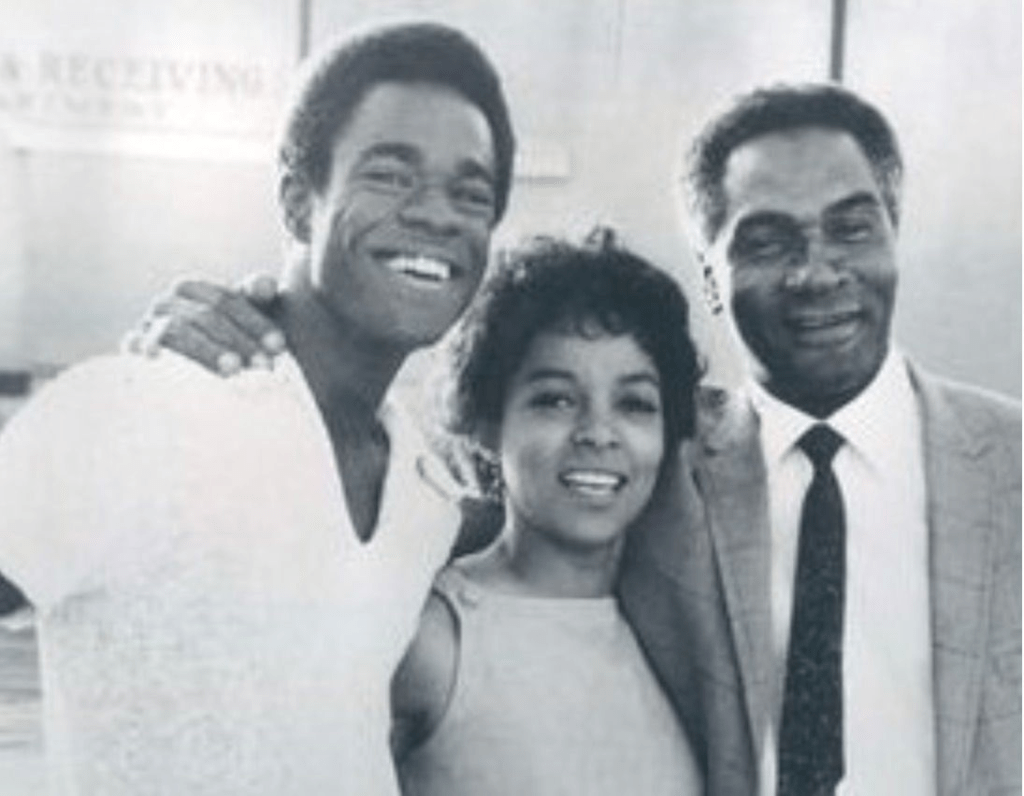
In the same year, the show developed several non-white characters played by Ruby Dee, Percy Rodriguez, and Glynn Turman. The series brought several black writers aboard as well as Ruby’s husband Ossie Davis as a consultant.

In an effort to increase ratings, new characters were brought on board and new subjects were added to scripts like the war, the draft, riots, music, and belief in God. The ratings never recovered, and the show was canceled in June of 1969.

The series was revived as a daytime serial in 1972 but after less than a year, Return to Peyton Place was also canceled.

In 1977 NBC aired Murder in Peyton Place. It was advertised as a reunion movie and it focused on the deaths of Rodney and Allison. In 1985, Peyton Place: The Next Generation was produced to stir up interest for a new series, but that never happened.

Author Grace Metalious Photo:providencejournal.com

I’m not sure why people were so enthralled with Peyton Place. I guess it’s the same reasons we have Fifty Shades of Gray decades later. Metalious, the author of the original novel, explained the genesis of her book: “To a tourist, these towns look as peaceful as a postcard picture. But if you go beneath that picture, it’s like turning over a rock with your foot-all kinds of strange things crawl out.”

During the five years it was on the air, Peyton Place had more than 100 actors on the show and 20 writers. The set expanded from a few homes around a town square to a more vibrant town with shops, a factory, a hospital, a fire station, and a wharf. Plots got more complex.

The show was eventually sold to fifty different countries with eight million viewers in Great Britain. Apparently, many Europeans based their idea of what an American town was like on this show.

Soap operas certainly had a spot in America’s hearts for decades. Just this past year, the last daytime soap opera moved to a streaming service and people were up in arms. I don’t know about you, but when I want to walk in nature it is to see the trees, listen to the birds, and smell the flowers. I tend to leave rocks alone. Maybe I am focusing on a fake façade, but I’m content not to see what is crawling around beneath the surface.