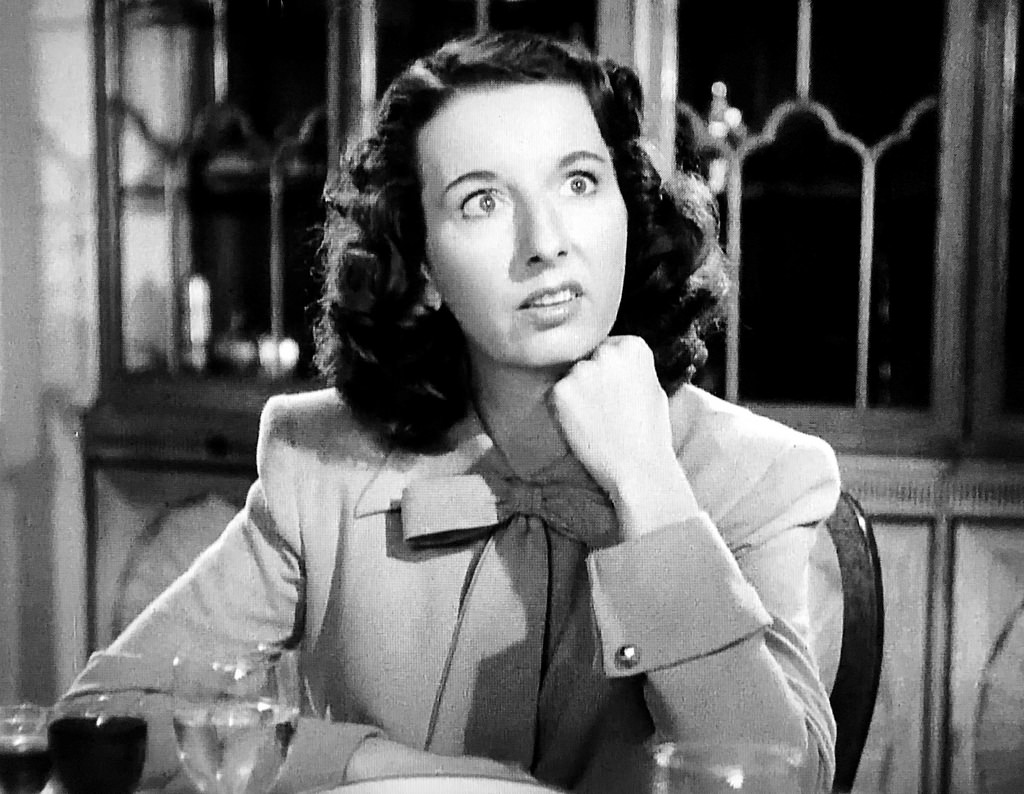
As we continue our What a Character blog series, today we get to talk about the woman behind one of my favorite characters, Lillian Bakerman from The Bob Newhart Show. That woman is Florida Friebus.
Friebus was born in Massachusetts in 1909. She was named for her mother’s favorite aunt, not the southern state. Weirdly, her paternal grandmother was also named Florida. Her family was involved in the theater. Her father Theodore was a leading stage actor with Boston’s Castle Square Players and a silent film star. Her mom’s mother, Georgine Flagg, was part of the Augustin Daly stock company in Manhattan.
When she was only eight years old, Florida’s father passed away. Her mother had studied at the Dana Hall Schools and applied for a position of housemother there. Florida was able to study at Tenacre during this time. She participated in the first Christmas pageant in 1921. Florida not only learned a lot about acting, but she also was presented with classes in political history, music, art, languages, and literature.
📷facebook.com with Richard Waring
Friebus moved to New York to study at the Theater Guild School. She began her acting career in 1929 in when she appeared with the Civic Repertory Theater in “The Cradle Song.” In 1932, she worked on an adaptation of “Alice in Wonderland” with Eva Le Gallienne, and she took on the role of the Cheshire Cat.
In 1934, Friebus married Richard Waring. They would divorce in 1952, and she never remarried.
Friebus was elected to the Council of the Actors’ Equity Association in 1949, and she spent 16 years on the board.
Florida read stories to children on her KNXT show, Look and Listen, in Los Angeles.
📷imdb.com
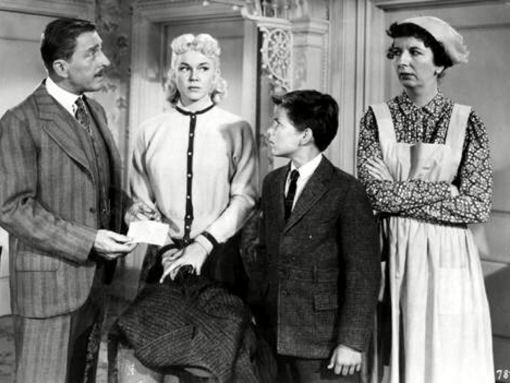
Her first television role was in 1948 on The Ford Theater Hour. Her television drama appearances continued into the 1950s and she also appeared on several sitcoms, including The Goldbergs, Father Knows Best, Bachelor Father, and The Donna Reed Show. In 1959 she accepted a role that made her a household name: Winnie Gillis on The Many Loves of Dobie Gillis. For four seasons she tried to defend Dobie and his crazy dilemmas when his father became exasperated with him.
The show was based on a 1951 book, The Many Loves of Dobie Gillis by Max Shulman about the romantic adventures of a student at the University of Minnesota. Shulman wrote for the series. He would also write The Tender Trap which became a movie in 1955 and House Calls which became a 1978 movie; Shulman became head writer for the television series based on House Calls.
The sixties and seventies found Florida in a variety of both dramas and sitcoms. A few of these series included Ben Casey, Peyton Place, The Doris Day Show, The Mary TylerMoore Show, The Partridge Family, Gunsmoke, Room 222, and Barnaby Jones.
📷sitcomsonline.com
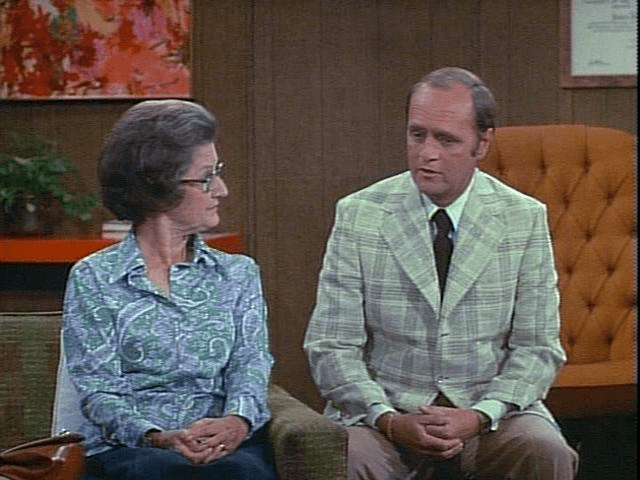
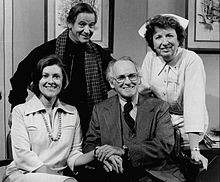
In 1972 she accepted the role of Lillian Bakerman on The Bob Newhart Show. During the show’s run, she made 19 appearances trying to encourage the other patients in her therapy group. She is often seen knitting while the group talks. One of her fears is flying, and her catchphrase is “Isn’t that nice.”
Her last appearance was in 1982 on The New Odd Couple as, who else but Mrs. Bakerman.
In 1988, Friebus passed away from cancer at 78 years old.
In this last blog in our series of Supportive Men, today’s actor might not be someone most people expect to see when talking about television. When most people think about Leslie Nielsen, they think of Airplane! and some of his other movies. While he did have a prolific movie career, he also has a well-deserved place in television. This guy amassed 259 (150 in television) acting credits during his six-decade long career.
📷tmdb.com
Nielsen was born in Saskatchewan, Canada in 1926. His mother was from Wales, and his father was a Royal Canadian Mounted Policeman. His older brother served in politics, being a Canadian Member of Parliament, a cabinet minister, and a Deputy Prime Minister of Canada. I read several sources that said his father was abusive, and Leslie wanted to move out as soon as possible.
Leslie enlisted in the Royal Canadian Air Force, serving until the end of WWII. He was legally deaf, wearing hearing aids most of his life, but he was able to train as an aerial gunner.
After the war, he worked as a disc jockey in Calgary, Alberta before enrolling at the Lorne Greene Academy of Radio Arts in Toronto. He was offered a scholarship at the Neighborhood Playhouse in New York.
📷wikipedia.com Bonanza
He made five television appearances in 1950 with the first being on The Actor’s Studio. He continued working in television, primarily on dramatic theater series, through the 1950s. In 1956, he had his first big-screen roles, appearing in four movies that year including Ransom, Forbidden Planet,The Vagabond King, (Nielsen later referred to this film as the “Vagabond Turkey”) and The Opposite Sex.
Leslie discussed his role in Forbidden Planet: “Supposedly a science fiction version of Shakespeare’s The Tempest . . . The Trekkies today regard it as the forerunner of StarTrek. I just had to wear a tight uniform and make eyes at Anne Francis. I was pretty thin back then.”
He became an American citizen in 1958 but continued to be proud of his Canadian citizenship as well.
While most of his credits for the late fifties were movies, he jumped back into television in the sixties, appearing in forty different shows. Many of them were dramatic theater roles, but you can spot him in Alfred Hitchcock Presents, Route 66, Wagon Train, DanielBoone, The Wild Wild West, Dr. Kildare, Bonanza, The Man From U.N.C.L.E., and Gunsmoke. His only recurring role during this decade was on Peyton Place where he played Kenneth and Vincent Markham in 18 episodes.
📷pinterest.com on M*A*S*H
The seventies were almost a repeat of the sixties. His recurring role was on The Bold Ones. He also appeared in Medical Center, Mod Squad, M*A*S*H, Barnaby Jones, Hawaii Five-0, Kojak, Columbo, and The Love Boat.
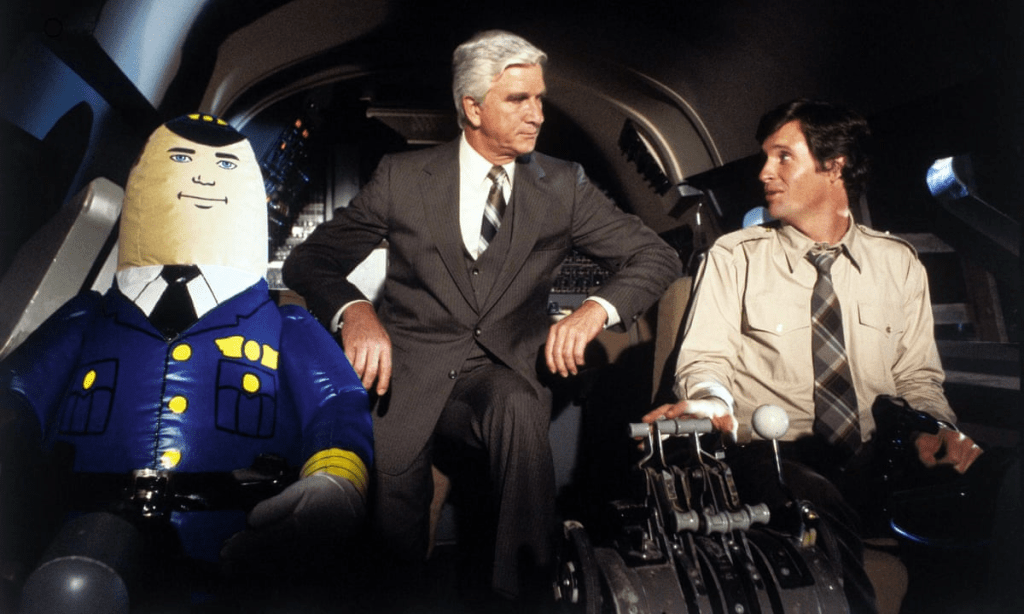
1980 brought him the role of Dr. Rumack on Airplane!. Nelson’s deadpan delivery of lines in that movie is what most fans today remember about his career. Of course, his response to the line of “Surely you can’t be serious?” of “I am serious. And don’t call me Shirley” is still repeated today. Leslie said, “he was pleased and honored that he had a chance to deliver that line.” Film critic Roger Ebert once called him “the Laurence Olivier of spoofs.”
📷themoviebuff.com Airplane!
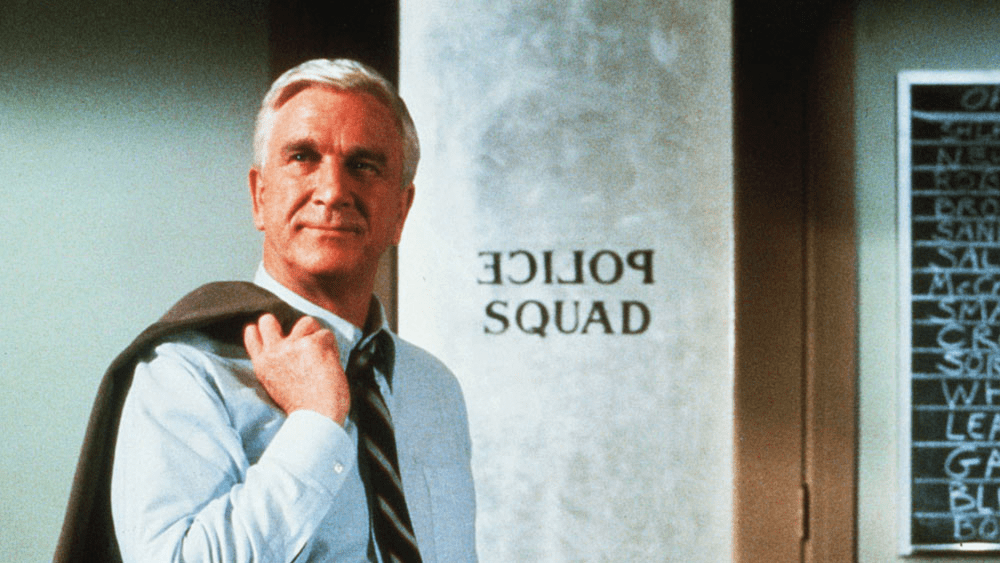
He continued in these types of roles in Police Squad and Naked Gun and the sequels. His movie roles increased in the eighties and nineties, but he continued to accept television roles off and on. You can catch him on Murder She Wrote, Highway to Heaven, Who’sthe Boss, The Golden Girls, and Evening Shade.
His roles continued throughout the 2000s until his death, but the last decade included fewer memorable shows, although he worked less overall. When reflecting on this, Neilsen said that “I’m afraid if I don’t keep moving, they’re going to catch me . . . I am 81 years old, and I want to see what’s around the corner, and I don’t see any reason in the world not to keep working. But I am starting to value my down time a great deal because I am realizing there might be other things to do that I am overlooking.”
📷npr.org Police Squad
While Nielsen was very successful in his career, he was not as successful with his marriages. From 1950-56, he was married to Monica Boyar. His longest relationship was with wife Alisande Ullman from 1958-1973. He then married Brooks Oliver for two years from 1981-83 and then Barbaree Earl from 2001-2010.
One of his hobbies was golfing, and he later did some humorous instruction videos about the sport. He once said, “I have no goals or ambition. I do, however, wish to work enough to maintain whatever celebrity status I have so that they will continue to invite me to golf tournaments.”
Nielsen died in his sleep in 2010 from pneumonia.
He received two Walk of Fame stars: one in Hollywood in 1988 and one in Toronto in 2001. Nielsen was known for his flatulence gags, especially on movie sets, and his tombstone says “Let ‘er Rip.”
While Nielsen’s career is impressive, what I loved most about him is that he seemed to thoroughly enjoy life. That’s a great reminder for us all. Our best role should be enjoying life to the best of our ability.
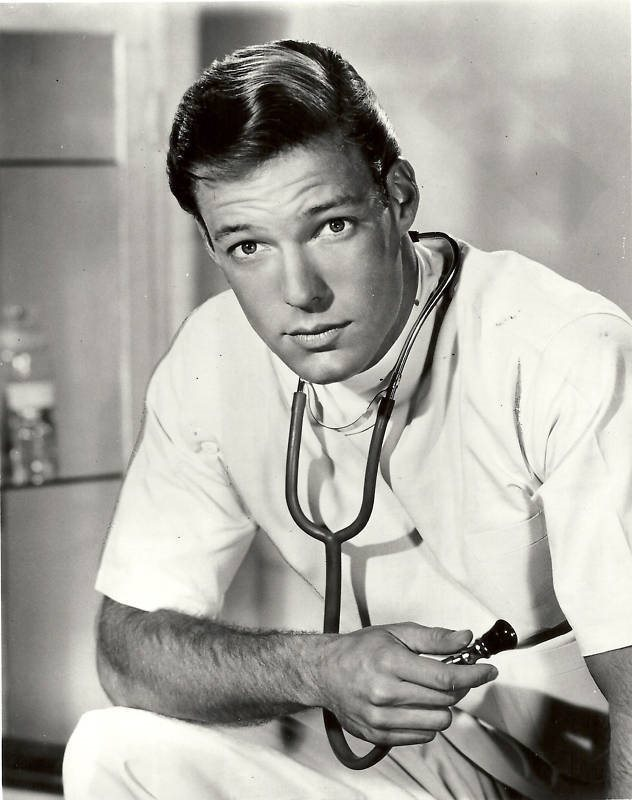
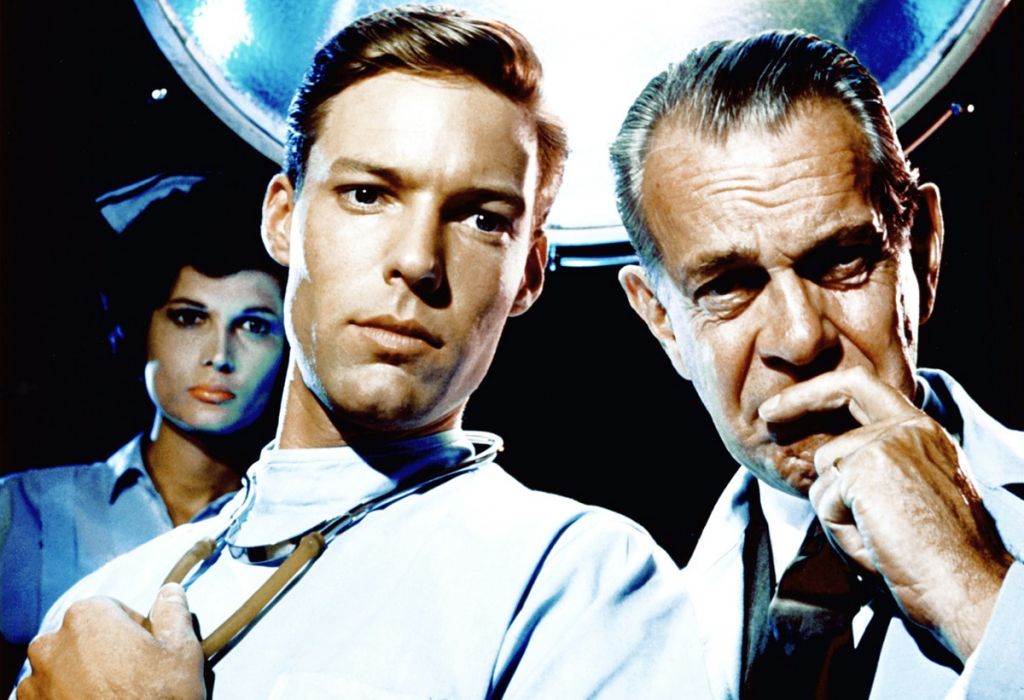
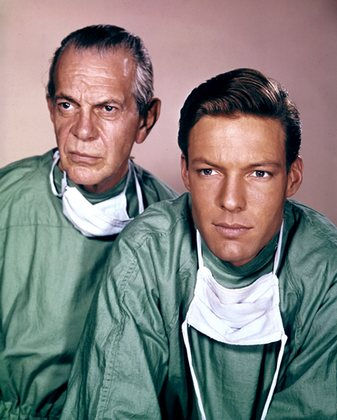
This month we are checking out a few favorites in a blog series: “Examining Our Favorite Medical Shows.” Last week we learned a bit about Ben Casey. Today we are looking at a similar show to Ben Casey, although in many ways it was very different: Dr. Kildare.Dr. Kildare was also on the air from 1961-66. MGM produced this show created by Max Brand in the 1930s. The show had previously been a movie and a radio series. Unlike Ben Casey who seemed to argue with everyone, Dr. Kildare (Richard Chamberlain) was a respectful intern at Blair General Hospital. He wants to help his patients and listens to his mentor, Dr. Leonard Gillespie (Raymond Massey). In season three, Kildare became a resident, and the episodes focused more on the stories about the patients.
In 1960 a pilot was filmed with Joseph Cronin in the Kildare role and Lew Ayres as Gillespie which did not sell. The role of Kildare was offered to William Shatner and James Franciscus who both turned it down. In 1961, a new pilot was produced with Chamberlin and Massey. One of the reasons Massey accepted the role is because he was certain the show would only last one season, and he wanted to continue with his movie career. The popularity of the show put his film career on hold for five years.
Photo: medium.com
Other cast members who appeared on the show included Dr. John Kapish (Ken Berry), Nurse Fain (Jean Inness), Dr. Agurski (Eddie Ryder), Dr. Gerson (Jud Taylor), Dr. Lowry (Steve Bell) Nurse Conant (Jo Helton), and Nurse Lawton (Lee Kurty).
The guest stars on this show were amazing. I feel like this should be read in auctioneer mode but here goes: Eddie Albert, Jack Albertson, Fred Astaire, Ed Asner, Lauren Bacall, Ed Begley, Joan Blondell, Tom Bosley, Beau Bridges, Charles Bronson, James Caan, Robert Culp, Ossie Davis, Ruby Dee, Angie Dickinson, Olympia Dukakis, Barbara Eden, Linda Evans, Douglas Fairbanks Jr., Peter Falk, Beverly Garland, Ron Howard, Kim Hunter, Celeste Holm, Carolyn Jones, James Earl Jones, Brian Keith, Ted Knight, Harvey Korman, Cloris Leachman, Jack Lord, Walter Matthau, Gavin McLeod, Ricardo Montalban, Harry Morgan, Jack Nicholson, Leonard Nimoy, Carroll O’Connor, Suzanne Pleshette, Basil Rathbone, Robert Redford, Robert Reed, Cesar Romero, Gena Rowlands, William Shatner, Jean Stapleton, Gloria Swanson, Rip Torn, Sam Waterston, Dennis Weaver, and Robert Young. For a show that was only on five years, it was an impressive guest cast.
Photo: imdb.com
To add more realism to the show, writer E. Jack Neuman spent several months working with interns in a large hospital. Technical advice was provided by the American Medical Association.
The show was realistic in portraying all the drama that is truly found in a city hospital. The plots involved a lot of medical and social issues including smallpox, physician competency, drug addiction, malpractice, and euthanasia. Neuman definitely captured what life in a large, city hospital was like. Kildare makes about $60 a month, or $500 in today’s terms, works long hours, rotates through the various medical departments and has senior physicians overrule his diagnoses.
Just like Ben Casey, the first seasons produced stand-alone episodes and after the success of Peyton Place, storylines carried over from one show to another to entice the audience to tune in again the next week.
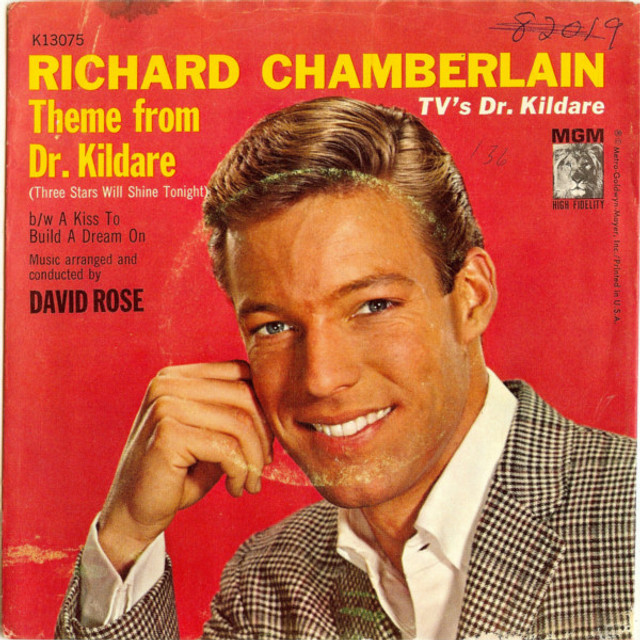
The theme music for the series was composed by Jerry Goldsmith. A CD set was released in 2009 which included the theme, the original music from the 1960 pilot, Richard Chamberlain’s recording of “Three Stars Will Shine Tonight,” and musical scores from the five seasons by Hurr Sukman, Richard Markowitz, Morton Stevens, Lalo Schifrin, John Green, and Burt Bacharach.
Airing on Thursday nights, the show was in the top ten during season one and the top twenty for seasons two and three. The show received about 12000 fan letters weekly, and, in addition, Chamberlain received letters personally asking for medical advice.
The network moved the show to Tuesday nights against Red Skelton and McHale’s Navy for season five and the viewers did not follow. The ratings declined, and the show was canceled.
This show really changed Chamberlain’s career. He had always been a small-role guy before this show, but he suddenly became a teen idol. He received more than 35,000 fan letters a month. Onscreen the idealistic Kildare and the wise, sometimes cantankerous, Gillespie don’t always agree but they had great chemistry on the set and apparently off the set as well. Unlike BenCasey, the cast on this show did get along and Chamberlain mentioned that he always enjoyed working with Massey.
Richard said he grew up in a family where they all pretended to be perfect. So, he went through life trying to be perfect too. He said that philosophy did not work well for his life, but it did work well for Dr. Kildare.
Following the show he would take a turn on Broadway, in big-screen movies, and back on television where he specialized in mini-series like Shogun and The Thorn Birds, both in the 1980s.
One fact I found interesting was that the DVD release of the show included a never-aired pilot from a different medical show, The Eleventh Hour in 1962. The episode originally was written for Dr. Kildare. Drs. Kildare and Gillespie assist Dr. Bassett (Wendell Corey), a psychiatrist diagnosing one of his patients Ann (Vera Miles). Instead of airing on Dr. Kildare, Chamberlain and Massey were cut out of the film and it was submitted as a pilot for the show, with the title “Ann Costigan: a Duel on a Field of White.”
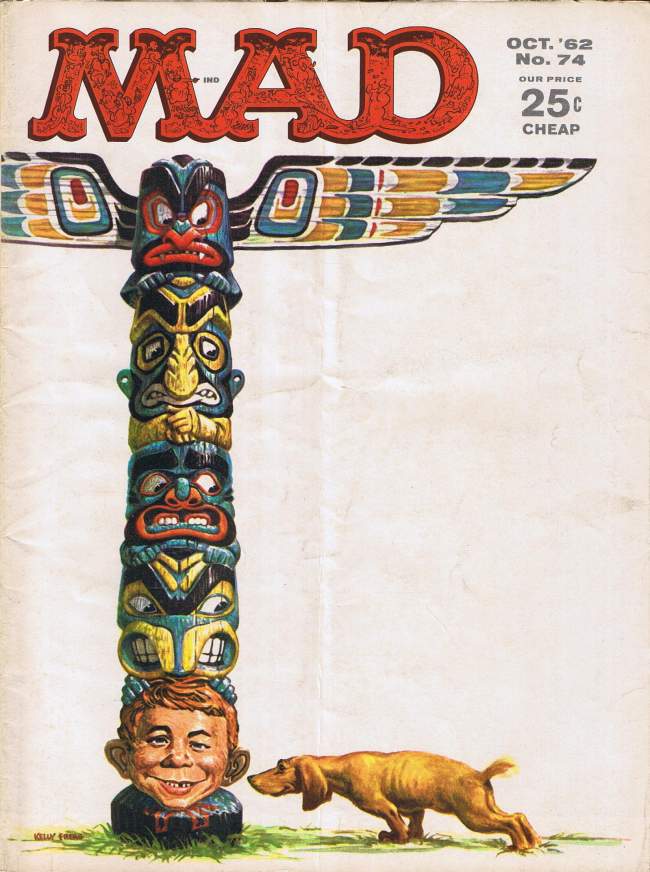
Even Mad Magazine got on the Kildare bandwagon. The 1962, #74 issue, featured “Dr. Killjoy,” a parody of the show.
Everyone seemed to like this show. Then again, what is not to like? You have a handsome doctor, exhilarating drama, a fun guest star every week, and realistic stories. The show would go on to inspire the talents behind a variety of medical series including Marcus Welby MD, ER, House, and Grey’sAnatomy.
I admit that this month I may be a bit out of my element. We are going to learn about the soap opera genre in a series called “I Met My Twin When I Married My Mother’s Neighbor’s Uncle’s Grocer’s Best Friend’s Attorney Who is Also My Fourth Cousin Once Removed.” While my best friend Bonnie and I eagerly tuned in to The Young and the Restless when it began in seventh grade, and I popped in and out for a decade or so afterward, most of my soap opera memories involve my mother. I remember her ironing in the living room while watching As the World Turns. She also kept up with the events on Days of Our Lives and may have watched a few others off and on.
Photo: mubi.com
First in our series is one of the earliest television operas: we are traveling to Peyton Place.
This soap began on ABC in September of 1964 and was on the air for five years.
It was based on the novel Peyton Place by Grace Metalious. The first couple of years were in black and white and the second half of the shows were in full color.
A lot of the cast went on to be very active in television: Mia Farrow, Ryan O’Neal, Barbara Parkins, Christopher Connelly, David Canary, Mariette Hartley, and Lana Wood.
The show had a rocky beginning. Producer Paul Monash wanted to bring the show to prime time based on the success that the show Coronation Street had in England. He refused to call it a soap opera, preferring the term “high-class anthology drama.” A pilot was shot in 1962; after several changes, the pilot finally aired in 1964. The early episodes were taken from the novel and the 1957 film that was also based on the book. However, eventually, new stories had to be created. The setting was changed from an unknown location in the 1940s to present-day Massachusetts.
Peyton Place Archives, Camden ME Photo: camdenpubliclibrary.com
The opening credit included a photo of a church steeple and the words “Peyton Place” on screen while the bells rang. Announcer Dick Tufeld said, “This is the continuing story of Peyton Place.” Suddenly we see the town square, a rolling stream, and cast members while a summary of the previous episode is related.
Peyton Place was an immediate hit. It began life airing twice a week but then increased to three episodes in June of 1965. Dorothy Malone, one of the stars, had emergency surgery, so she was replaced with Lola Albright until she fully recovered.
In the first season, Dr. Michael Rossi (Ed Nelson) arrives in town from New York City to open his medical practice. Newspaper editor Matthew Swain (Warner Anderson) is a new friend. Matthew’s cousin Allison MacKenzie (Mia Farrow) is in love with his older brother Rodney (Ryan O’Neal). We understand that her mother Constance (Dorothy Malone) highly disapproves of the relationship. The town was named for Martin Peyton, the Peyton Mill owner, who was Rodney’s grandfather.
Rodney disapproves of his father Leslie’s (Paul Langton) relationship when he catches him with his secretary Julie (Kasey Rogers). Rodney has been dating her daughter Betty (Barbara Parkins). He breaks up with Betty and begins seeing Allison. Betty discovers that she is pregnant and then miscarries. Rodney marries her not knowing about the miscarriage. We also learn that Elizabeth Carson was murdered in a beachfront home.
The movie version 1957 Photo: dailymotion.com
Dr. Rossi becomes closer to Constance although he butts heads with Dr. Morton (Kent Smith). Dr. Morton threatens to destroy Rossi’s career when Catherine, Rodney’s mother, dies; then he learns that the pathologist made a huge error which actually caused the death. Betty decides to become a nurse and is hired as an aide at the hospital. Her father George (Henry Beckman) has a nervous breakdown and is admitted to a local sanitarium. Barbara Parkins told a reporter that when she met Bette Davis, the famous actress asked her, “When are you going to let go of Rodney Harrington?”
Elliot Carson (Tim O’Connor), Alison’s birth father who had been in prison for 18 years, returns to Peyton Place. He had been accused of murdering his wife Elizabeth, but we know that Catherine had been responsible. Once Elliott’s name is cleared he marries Constance and they explain to Allison that he is her father. Norman falls in love with a local girl Rita (Patricia Morrow) whose mother owns a local tavern.
Photo: pinterest.com
Steven Cord (James Douglas) is an attorney who moves to town. Dr. Morton’s daughter Claire (Mariette Hartley) gets divorced and returns to Peyton Place to practice medicine. She becomes interested in Dr. Rossi. When Matt decides to retire, he sells the local paper to Elliot.
If you are confused after reading these plots, don’t despair. I read through numerous times and still feel like I’m reading War and Peace. There are other subplots as well; these were just the major ones. Whew! I guess we know when someone says their life is like a soap opera, we know now what that means.
I won’t get into all the plot twists that happen during the rest of the series, but rest assured that there are murders, accidents, affairs, betrayals, addictions, and financial shenanigans.
When Mia Farrow became more popular, Dorothy Malone was written off the show after complaining about Farrow getting a bigger role, She sued 20th Century Fox for breach of contract; the case was settled out of court.
They didn’t have the only feud however. Ruth Warwick did not care for working with Ryan O’Neal. She said he was someone “who was so in love with himself it was pitiable.”
Mia Farrow left in 1966 and ratings began to decrease. In her memoir, Farrow said that she never expected this show to succeed. Once it became popular, she tried to get out of her contract. Her husband, Frank Sinatra, used his clout to get her out of it two years later, so she could travel with him.
The writers’ script had Allison run away from the town; two years later a new character showed up with a baby she claimed was Allison’s.
The Miles Family Photo: pinterest.com
The show went back to two episodes a week. By 1968 most of the original characters had left the show. Today it is not unusual for soap opera characters to come and go, but that was not the original plan.
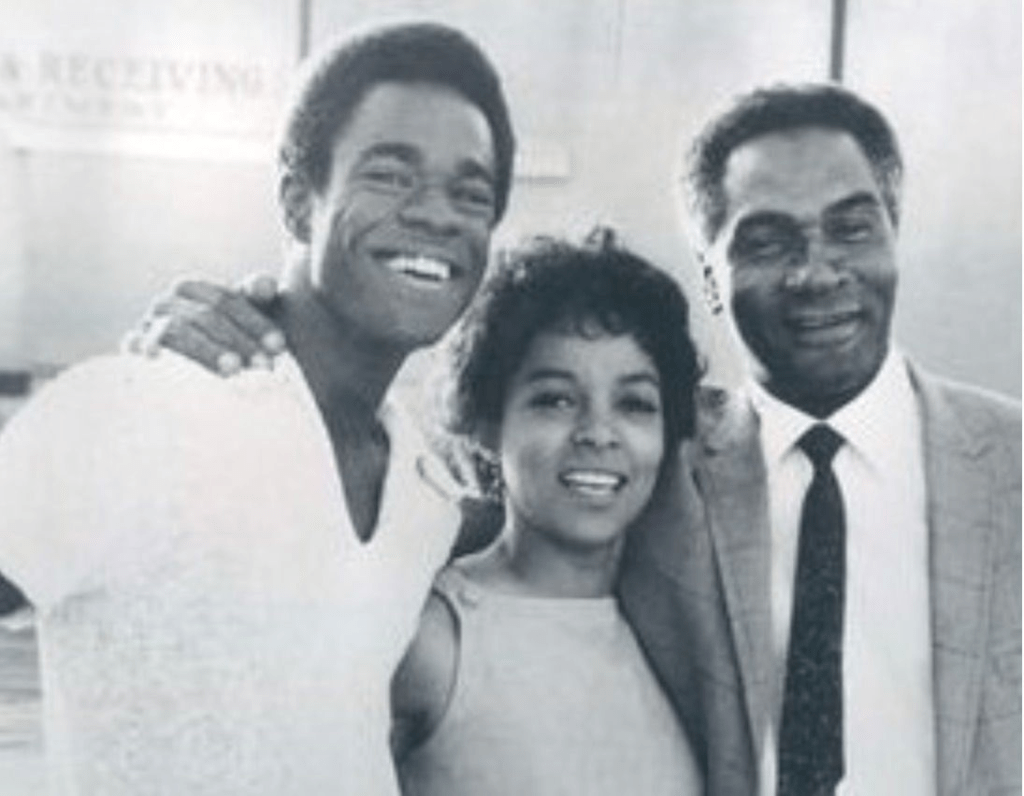
In the same year, the show developed several non-white characters played by Ruby Dee, Percy Rodriguez, and Glynn Turman. The series brought several black writers aboard as well as Ruby’s husband Ossie Davis as a consultant.
In an effort to increase ratings, new characters were brought on board and new subjects were added to scripts like the war, the draft, riots, music, and belief in God. The ratings never recovered, and the show was canceled in June of 1969.
The series was revived as a daytime serial in 1972 but after less than a year, Return to Peyton Place was also canceled.
In 1977 NBC aired Murder in Peyton Place. It was advertised as a reunion movie and it focused on the deaths of Rodney and Allison. In 1985, Peyton Place: The Next Generation was produced to stir up interest for a new series, but that never happened.
I’m not sure why people were so enthralled with Peyton Place. I guess it’s the same reasons we have Fifty Shades of Gray decades later. Metalious, the author of the original novel, explained the genesis of her book: “To a tourist, these towns look as peaceful as a postcard picture. But if you go beneath that picture, it’s like turning over a rock with your foot-all kinds of strange things crawl out.”
During the five years it was on the air, Peyton Place had more than 100 actors on the show and 20 writers. The set expanded from a few homes around a town square to a more vibrant town with shops, a factory, a hospital, a fire station, and a wharf. Plots got more complex.
The show was eventually sold to fifty different countries with eight million viewers in Great Britain. Apparently, many Europeans based their idea of what an American town was like on this show.
Soap operas certainly had a spot in America’s hearts for decades. Just this past year, the last daytime soap opera moved to a streaming service and people were up in arms. I don’t know about you, but when I want to walk in nature it is to see the trees, listen to the birds, and smell the flowers. I tend to leave rocks alone. Maybe I am focusing on a fake façade, but I’m content not to see what is crawling around beneath the surface.
Today starts a fun, new blog series, “The Movie Came First.” For the month of December, we’ll be learning about shows that began life as a big-screen movie. Our first sitcom is How to Marry a Millionaire.
In 1953, Betty Grable, Marilyn Monroe, and Lauren Bacall starred in a comedy romance about three women who make a pact to help each other find millionaires to marry but end up finding love instead. Their love interests are played by Cameron Mitchell, David Wayne, and Rory Calhoun.
An interesting fact about this movie is that it was the first one filmed in Cinemascope. In order to highlight the incredible sound, the movie begins with an orchestra performance. It was a bit awkward because it has nothing whatsoever to do with the movie, but is an interesting intro. It was also the first movie to air on television when it appeared on NBC Saturday Night at the Movies in September of 1961.
Another fun fact about the movie is that Merry Anders who would appear in the television show had a bit part as a model in the film.
Photo: filmaffinity.com
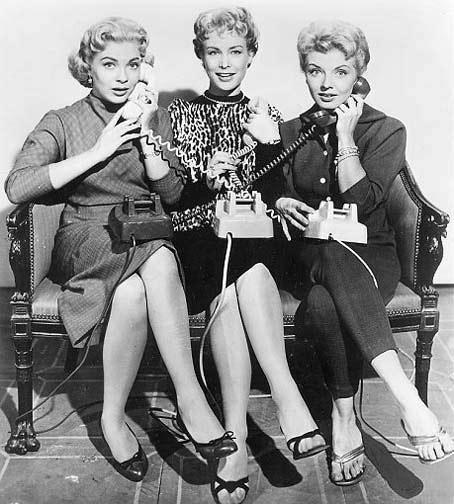
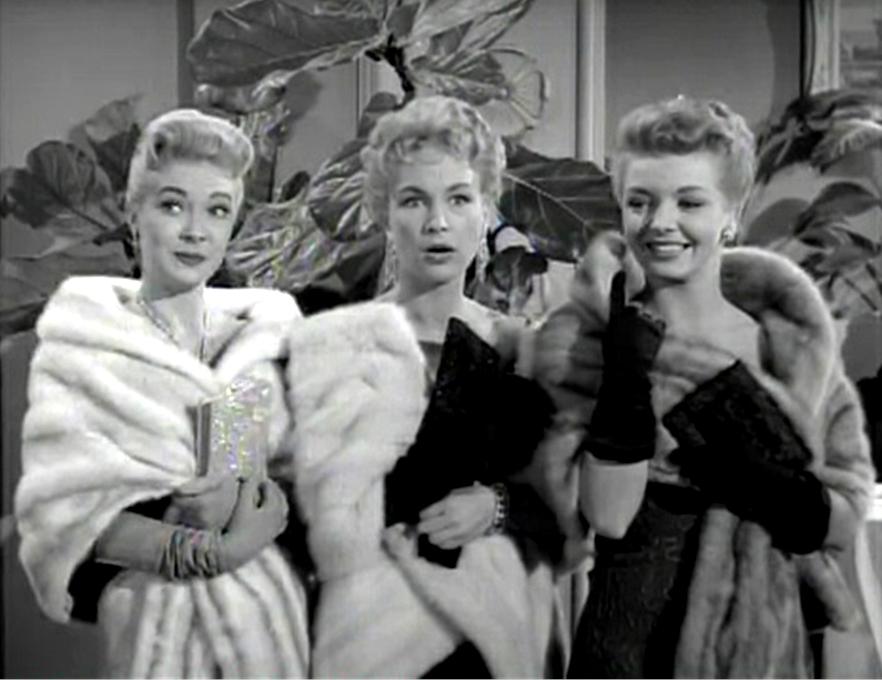
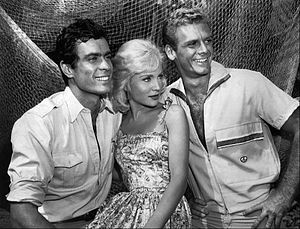
In 1958, the movie came to the small screen with Merry Anders (Mike) filling Lauren Bacall’s role, Barbara Eden (Loco) is the sexy bombshell Monroe played, and Lori Nelson (Greta) is the neutral one in between played by Grable. Greta is the co-host of a quiz show, Go for Broke. Mike, whose real name is Michelle, works as a secretary on Wall Street, and Loco is a fashion model. One of the weekly gags is that Loco has terrible eyesight, but thinks men don’t like girls in glasses, so she often has mishaps not seeing correctly.
In order to find a wealthy husband, they found a chic penthouse apartment while wearing designer clothing even if they could not afford to eat. I guess that’s why they went on a lot of dinner dates.
Photo: imdb.com
The girls are often short of money and have trouble paying the rent on time. Mr. Blandish (Dabbs Greer), their landlord, is always threatening to evict them. The elevator operator Jesse (Jimmy Cross) sometimes helps and sometimes hinders the trio with their get-rich-husbands schemes.
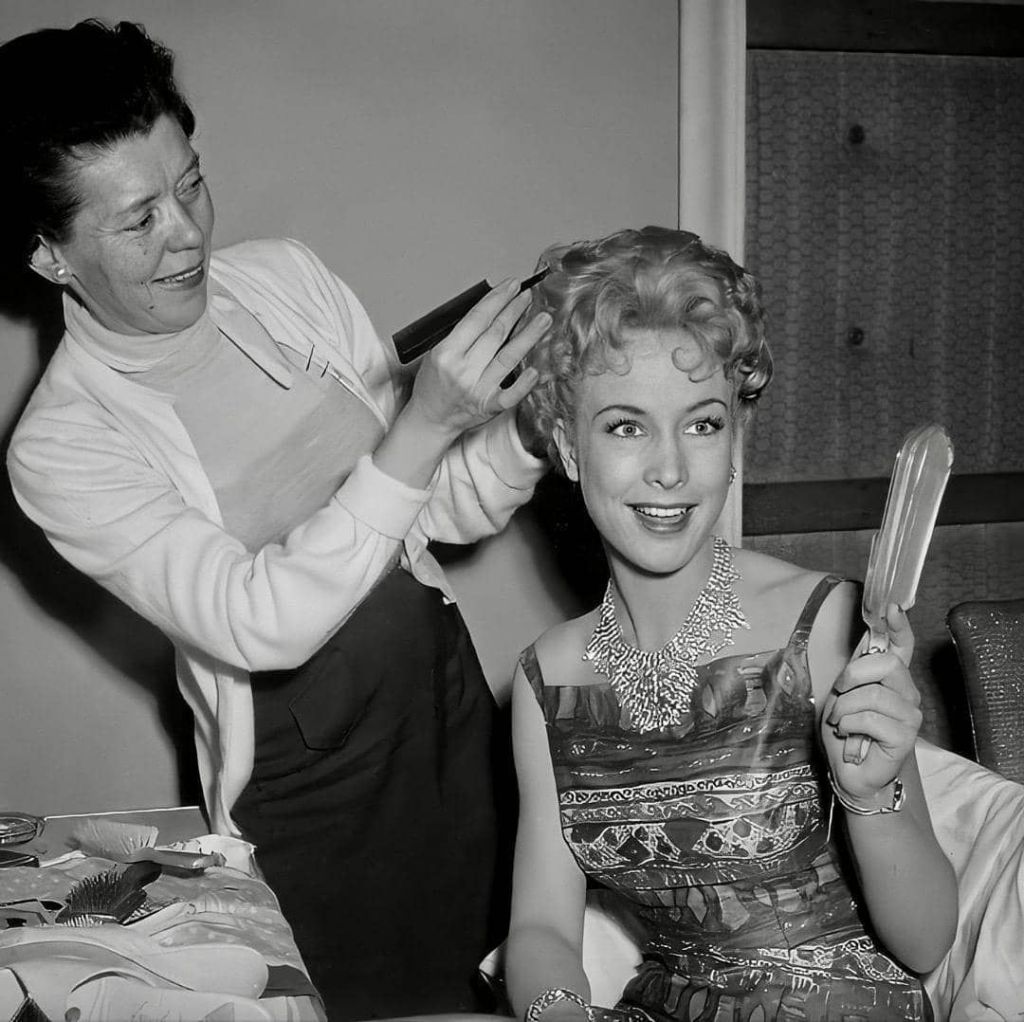
The pilot was filmed in 1957 with Lori Nelson as Greta but her roommates at the time were played by Charlotte Austin (Loco) and Doe Avedon (Mike, who had been married to photographer Richard Avedon). By the time the show was sold in 1958, the roles had been recast and after looking at more than seventy auditions, the producers picked Eden and Anders.
Photo: sitcomsonline.com
Anders discussed the camaraderie of the three stars. She said they were amazingly similar. She said they all wore size 8, all drove Thunderbirds, and all had French poodles and this was before they met. Anders had tested for the role of Mike and Loco because she had been playing a lot of ditzy blonde roles. When she was given the role of Mike, Eden was brought on board as Loco. Anders said the cast worked hard. After filming all week, they did late night interviews and early morning shows. One weekend they were sent to New York for a personal appearance. They got back late Sunday night and still had to be at work early Monday morning.
Photo: wundaba.ne
The second season found Nelson out with Lisa Gaye as Gwen in. Nelson claims she was the best actress and that she decided to move on, disliking her character’s development. Other sources say she was fired because she gave an interview criticizing her role. Nelson said her role wasn’t defined well with Anders getting the “Eve Arden wisecracks” and Eden being the sexy, bubbly personality. Greta supposedly married a gas station owner and then moved to California. Only thirteen episodes were aired for season two and then the show was cancelled.
Photo: imdb.com
Barbara Eden was interviewed for the Television Academy and discussed her time on the show. She said she was doing a play in LA when director Mark Robson saw her. He offered her a role in his new movie Peyton Place. However, the studio gave the part to another actress who was under contract at the time; but because of Robeson’s interest, they brought Eden in for a test at Fox. One of the television executives called her and said he had seen the test and read her notices for the LA play and was wondering if she was interested in doing a television series. He asked her to go to the Fox Western studios for some still shots. When she got there, she thought the part was still in the process of being cast, but realized the stills were being taken because she had the part and the other girls were her costars.
Photo: amazon.com
Eden said she was a huge fan of Marilyn Monroe and had seen the original movie. She felt trying to take on the part by imitating Marilyn would have ended badly because she could never compete with Marilyn’s version, so she took the part and made it her own. Like Anders, she also said the three costars were close and became good friends.
Eden said the time on the show was her “finishing school.” She learned so much about filming before the cameras, lighting details, and building stamina. The stars sometimes filmed up to thirteen hours a day in three-inch heels which she said was painful. After long days, they would be given new dialogue to learn for the next day’s shooting. It was a very tough job but prepared her for film work.
Photo: etsy.com
If you like cultural history, the show is fun to watch just to see the wardrobes and settings. The clothing was provided by Mr. Mort. Mortimer Goldman owned his design business in 1952, producing mid-priced stylish dresses. During the run of the show, Stan Herman came on board as a designer. Throughout the sixties, Herman’s designs were the height of fashion. Stan Herman later opened his own design studio, producing items under his label as well as for other companies. In the 1990s he began appearing on QVC with his design line of comfortable clothing and sleep ware.
The show was pitched to the three major networks, but they all passed on the series. So, in 1958, NTA Film Network sold the show into syndication to 115 stations. It packaged a three-series deal including Man Without a Gun and This is Alice.
Photo: imdb.com
Both critics and fans liked the show, but it had some tough competition. The show aired Friday nights against The Adventures of Ellery Queen, The Wide World of Disney, and Rawhide. Eden said she never knew exactly why the show was cancelled. She assumes that because Fox was trying to be the fourth network and it didn’t work out at the time, all the Fox shows were just dropped.
So, what happened to the NTA network? The company that referred to itself as the fourth network launched in 1956 with 100 affiliate stations. Twentieth Century Fox bought half of the company with the intention of producing original programming. The shows were filmed and then mailed to each station. By 1961, the network was losing money and the flagship station was sold to the Educational Broadcasting Corporation which later became National Educational Television and eventually PBS. One of their largest stations, KTTV in Los Angeles became part of the Fox television network, co-owned by Twentieth Century Fox, part of 21st Century Fox.
Photo: boomtownamerica.com
I was able to watch a few of these shows online. I’m not sure how the fourth network’s ownership affected syndication. Youtube has four episodes available. For this blog, I watched the first episode again. The jokes were a bit overdone and the laugh track was annoying, but I’ve seen worse. There were some charming moments in the show, and Barbara Eden’s comic ability was obvious with some funny scenes about her failure to wear glasses. Take some time to check out one of these four episodes to see what tv looked like in the mid fifties.
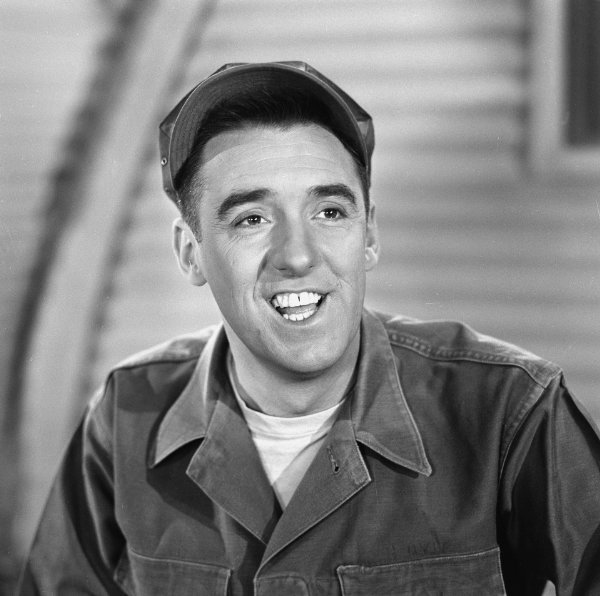
Continuing my “We Salute You!” blog series, today we look at one of the most-loved television characters, Gomer Pyle.
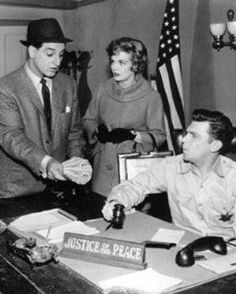
Photo: pinterest.com Danny Thomas in Mayberry
In the late 1950s Make Room for Daddy was one of the most popular sitcoms. On one episode in February of 1960, Danny found himself in Mayberry, picked up for going through a stop sign. Although Sheriff Taylor came off a bit of a country bumpkin, viewers enjoyed the episode and the following fall, The Andy Griffith Show (TAGS) aired on CBS. When the series debuted, Andy was portrayed more of a wise sage and the folks of Mayberry were a quirky but lovable bunch. The show was in the top ten every year it was on the air. In fact, it seemed to get better as it went, making #3 in 1966-1967 and #1 in 1967-68. Andy left the show the following year, and it turned into Mayberry RFD which continued for three more seasons. The first two it was also in the top 10 and the third year it slipped a bit into the top 15. Although it was one of the most successful shows on CBS’s schedule, it was eliminated with a lot of other popular shows in the famous rural purging in the early seventies.
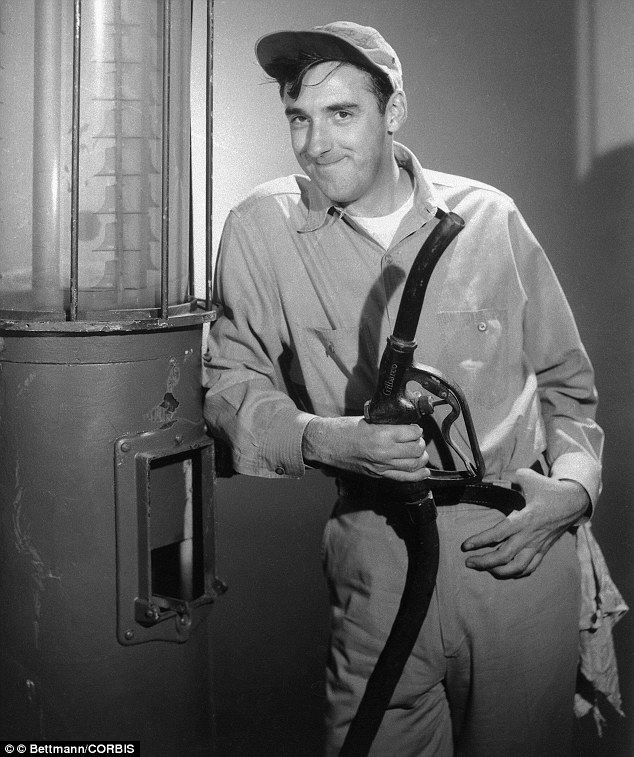
One night, Andy Griffith saw Jim Nabors performing at The Horn in Santa Monica and decided he would be a perfect fit for Mayberry. He offered him a job, and Gomer Pyle began working at Wally’s gas station.
Two writers, Everett Greenbaum and Jim Fritzell were said to have created the character. Greenbaum had dealt with an incompetent gas station attendant. He stopped by a station with motor trouble. The man could not think of any way to fix it except to keep adding gas to the tank, so Greenbaum thought a character based on him should be part of an episode on TAGS. He derived the name from Gomer Cool, a writer and Denver Pyle, the actor. Everett and Greenbaum (along with many TAGS writers) would continue to write for TAGS as well as Pyle episodes.
Gomer was one of the most popular characters on the show. Surprisingly he was only in 23 episodes in the two years he was with the show. Traveling around the country, you would be able to hear people repeating his “gawwwleee,” “surprise, surprise, surprise,” or “shazzam” which all became part of our language at the time.
Photo: dailymailreporter.com Gomer at Wally’s Gas Station
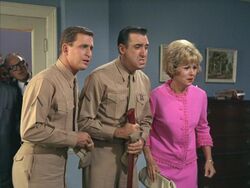
Because Gomer Pyle was so popular, Andy, Aaron Ruben, and Sheldon Leonard decided to give him his own show and Gomer Pyle USMC was created. In this show, Gomer who is naïve, kind-hearted and morally upright has to deal with life in the marine corps and his gruff Sergeant Carter (Frank Sutton). Although Carter gets driven to distraction by Pyle and his “do-gooding,” we all realize he has a soft spot for Pyle and his main concern is protecting him.
Photo: pinterest.com Carter and Pyle
The show was on the air from 1964-69 and had a solid supporting cast. Like TAGS, Gomer Pyle USMC was in the top ten for its entire run.
Photo: mayberrywikia.com With Ted Bessell
The show was on Friday nights, except for season three when it moved to Wednesdays. I was a bit surprised it stayed in the top ten, because it had some competition at times. Season one it was opposite Jack Benny and Twelve O’Clock High. Season two it went up against Honey West on one network and a variety of music shows on the other. Season three it was at the same time as Peyton Place and season four it was on opposite Star Trek.
Although the show depicted military life on base, war was never discussed. The series began at Camp Wilson in North Carolina and was moved to the fictional Camp Henderson in California. The actual show was filmed at Camp Pendleton and, along with TAGS, at Desilu’s Cahuenga studio and the RKO Forty Acres backlot. Unlike TAGS, Pyle used a single-camera setup because much of the shooting was outside.
Photo: pinterest.com Don Rickles, Guest Star
The US Marine Corps worked with Leonard, giving the show unlimited access to their equipment because they felt the series was good for their image. The opening scene of the show was that of marching recruits from the Marine Corps Recruit Depot in San Diego. Nabors commented that it was very difficult for him to see that footage because so many of those service men were killed in Vietnam. In real life, Frank Sutton could not pass the Marine Corps physical for WWII but was able to serve in the US Army, taking part in 14 assault landings including Luzon and Bataan.
Photo: wikipedia.com
I had heard of universities bestowing honorary degrees to actors even if they did not attend the school, but I did not realize the military could do something similar. During the show, Gomer’s highest rank was Private First Class. In 2001, the US Marine Corps gave Nabors an honorary promotion to Lance Corporal, and in 2007 he was raised to Corporal.
Obviously, there were a lot of military vehicles used in the filming of the show. Chrysler Corporation provided them. Jeeps were also prominent in the show, but Jeep did not become part of Chrysler until 1987. As an aside, the vehicles for TAGS were provided by Ford.
Photo: sitcomsonline.com Gomer and his friend Duke Slater
Pyle’s loyalty and good-natured attitude made him a favorite of both his platoon members and many of the women whom he came in contact with. One of Pyle’s friends was Duke Slater played by Ronnie Schell. Schell was written off after the third season when he left to star in Good Morning World. When that sitcom did not get renewed, he returned to Pyle. Some of the other platoon members included Roy Stuart as Corporal Boyle, Forrest Compton as Colonel Edward Gray, Ted Bessell as Frankie, and William Christopher as Lester.
Gomer gets to meet a lot of people when he goes to town. He especially loves movies and one of his favorite all-time pictures was Godzilla.
Photo: pinterest.com Sergeant Carter and his girlfriend Bunny
As mentioned, Sergeant Carter eventually becomes a father figure to Gomer. Carter’s girlfriend Bunny (Barbara Stuart) also tried to help Gomer (I could not find anything to indicate that Roy and Barbara Stuart are related). Gomer often causes trouble between Carter and Bunny by trying to “help” Carter. In season three, Gomer also got a girlfriend in Lou-Ann Poovie (Elizabeth MacRae). She is a singer in a local nightclub, but eventually Gomer talks her into returning to Turtle Creek, NC to marry her old beau Monroe. She leaves but returns, informing Gomer she wants him for her boyfriend, and she gets a new job as a clerk at a record store.
Photo: sitcomsonline.com Gomer and Lou-Ann
Several TAGS alumni made appearances on the show. Allan Melvin was part of the cast as Staff Sergeant Hacker for four years, Carter’s rival on the show. Denver Pyle who was Briscoe Darling on TAGS showed up on Gomer Pyle as a farmer. Andy, Aunt Bee, Goober and Opie all were seen at the base at one time or another, including when Opie ran away from home.
With a show on the air so long, many well-known guest stars showed up at Camp Henderson as well, including Carol Burnett, Ted Knight, Rob Reiner, Don Rickles, and Jerry Van Dyke.
Photo: directexpose.com
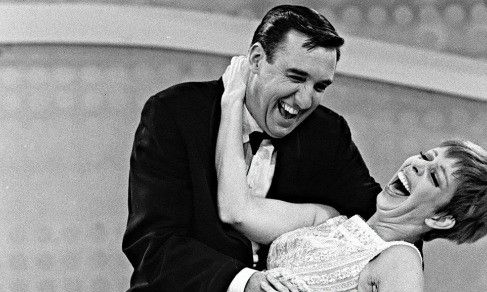
After the fifth season, Nabors expressed an interest to do a variety show, so Gomer Pyle was not renewed. He brought Ronnie Schell and Frank Sutton along for his new show which was on the air for two seasons. Carol Burnett called Nabors her good luck charm. He was one of her best friends and he was always on her season opener each year.
Photo: pinterest.com Best Friends
In an interview with Jim for American Profile, writer Paulette Cohn (Jim Nabors Lives Happily in Hawaii, January 13, 2008) quoted Carol Burnett’s perspective of Nabors vs Pyle: “ ‘The one thing Jim has in common with Gomer is his kindness,’ says actress and comedienne Carol Burnett, Nabors’ long-time friend, who named him godfather to her daughter Jody. ‘He loves people and is very gregarious. But he is also very smart. Not that Gomer wasn’t, but Jim isn’t naïve. He keeps his eye on things.’ ”
Considering how popular Gomer Pyle USMC has been in reruns, I was surprised to learn it wasn’t until 2006 that CBS Home Entertainment released the show on DVD. By 2008, all the seasons were available.
Photo: blogspot.com
Let’s end with a few quotes that captures the essence of the show’s characters.
Carter: I don’t get it Pyle, how come you can knock that Phillips flat, yet you can’t handle that little Lombardi guy?
Gomer: Well sir, you see the big feller needed a lesson, the little feller didn’t.
Photo: abcnews.com
Although Gomer Pyle USMC might not be everyone’s cup of tea, it was a well-done and popular show. I think its success, like TAGS and many of the other shows considered classics, comes from the fact that it’s a character-driven show. We start to consider the characters our friends and enjoy spending time with them. The show can currently be seen on MeTV nightly at 9 pm EST.
We wrap up
our series Just a Couple of Characters this week with Mary Wickes and Susan
Oliver. Mary and Susan are very different character actors, but you will
immediately recognize them. Let’s learn a bit more.
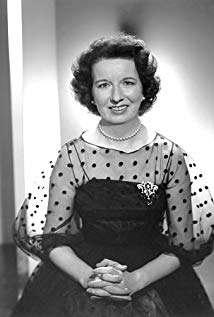
Mary Wickes
Photo: imdb.com
It’s not surprising that Mary shortened her last name to “Wickes” after being born Mary Wickenhauser in 1910 in St. Louis. Her father was a banker, and the family had plenty of money. After high school, Mary attended Washington University in St. Louis, majoring in political science, planning a career in law. One of her professors suggested she try theater, and she dipped her toe into it doing summer theater in Stockbridge, Massachusetts.
Photo: flickr.com
After deciding a career in acting was for her, she moved to New York. She quickly found a role in “The Farmer Takes a Wife” on Broadway in 1934. In this show, which starred Henry Fonda, Mary was Margaret Hamilton’s understudy. Mary had a chance to perform during the run and received excellent reviews.
Photo: tcm.com The Man Who Came to Dinner
Mary understood that comedy was the field she needed to pursue. She was lucky enough to continue getting roles on Broadway, appearing in several shows throughout the 1930s, including “Stage Door” in 1936 and “Hitch Your Wagon” in 1937. She also was cast in “The Man Who Came to Dinner” as Nurse Preen with Monty Woolley. She continued to receive encouraging reviews. When Warner Brothers decide to turn the play into a movie, both Mary and Woolley were part of the cast. Mary became known for being a bit sarcastic and witty. She was given roles in the film, Now Voyager with Bette Davis, again playing a nurse.
Photo: viennasclassichollywood.com By the Light of the Silvery Moon
Mary flip flopped from Broadway to Hollywood, taking roles that interested her. She would appear in both Moonlight Bay (1951) and By the Light of the Silvery Moon (1953) with Doris Day; White Christmas (1954), and The Music Man (1962).
Mary had cornered the market in roles of smart-alecky teachers, nurses, and housekeepers in film. When she transitioned to television, she often continued in these roles. Her first two recurring roles were housekeepers named Alice on Halls of Ivy from 1954-55 and Katie on Annette in 1958. From 1956-1958, she played Liz O’Neill, Danny Thomas’s press agent on Make Room for Daddy. Throughout the 1950s she also appeared on numerous shows including Zorro.
Photo: pinterest.com
One of my favorite episodes with Mary was the 1952 episode “The Ballet” on I Love Lucy where Wickes played Madame Lamond, a formidable ballet teacher who taught Lucy. Wickes and Lucy would remain life-long friends. After Mary’s death, Lucie Arnez talked about her relationship with their family: “For my brother and me, Mary was just like one of the family. If any of us were sick or even in bed with a cold, Mary would show up at the backdoor with a kettle of chicken soup. She could be loud and boisterous and as demanding as any of the characters she played, but she was also very loving and giving. What a lady.” Mary would appear on numerous episodes of Lucille Ball’s other shows in the 1960s and 1970s.
Photo: aurorasginjoint.com
In the 1960s, Mary continued to show up on a variety of shows. We see her on My Three Sons, Bonanza, F-Troop, The Doris Day Show, The Donna ReedShow, and I Spy. She also had recurring roles on three shows during the decade: TheGertrude Berg Show, Dennis the Menace, and Temple Houston. In the Gertrude Berg Show, Mary was landlady, Winona Maxfield. She was hilarious on Dennis the Menace, playing Miss Cathcart, an older neighbor looking for a man. On Temple Houston, she played Ida Goff. Temple was Sam Houston’s real son who was a circuit-riding lawyer.
Photo: en.wikipedia.org The cast of Doc
As Mary aged, she progressed to the cranky relative or nosy neighbor type of character. In the 1970s she was a regular on Julia, Doc, and The Jimmy Stewart Show. On Julia, she was Dr. Chegley’s wife, Melba. She went back to her role as a nurse on Doc. On the Jimmy Stewart Show, she is Mrs. Bullard. Two of my favorite episodes of her from the 1970s were her roles on Columbo and M*A*S*H. On Columbo, Mary plays a landlady of a victim who’s been murdered. She and Columbo have a priceless conversation during the show, “Suitable for Framing” in 1971. On M*A*S*H, Mary played Colonel Reese who is observing Margaret and the nurses.
Photo: aurorasginjoint.com
In the 1980s, Mary’s schedule slowed down a bit. She did revive her role as a maid on The Love Boat in 1981. From 1989-1991, she took another regular role as housekeeper Marie Murkin on Father Dowling Mysteries.
Photo: hometheaterforum.com
In the 1990s, Mary was doing more voice overs. She taped five episodes of Life with Louie which aired from 1995-1997 and was Laverne in The Hunchback of Notre Dame in 1996. Unfortunately, she would not live to see them on the big screen. In 1995, she passed away after having respiratory problems. While a patient in the hospital, she fell and broke her hip. She died of complications caused by the surgery.
Mary never married or had children and as part of her legacy, she left a $2 million donation in memory of her parents to the Television, Film and Theater Arts at Washington University.
Susan Oliver
Photo: amazon.com
More than twenty years younger than Wickes, Susan Oliver was born in 1932 in New York City. Her real name as Charlotte Gercke. Her father was a political reporter for the New York World. Her parents divorced when she was quite young, and she grew up in boarding schools. She traveled with her father to Japan when he took a post there. She studied at the Tokyo International College, studying American pop culture. While Wickes was the wise-cracking comedic foil, Oliver was often the leading lady character with blue eyes, blonde hair and heart-shaped face.
Photo: trekdivos79.blogspot.com on The Wild Wild West
In 1949, she
traveled to LA to see her mother who had found her niche as “astrologer to the
stars.” Susan then enrolled at Swarthmore College. After graduation, she
continued acting courses at New York City’s Neighborhood Playhouse.
Her first Broadway part came in 1957 as the daughter or a Revolutionary veteran, “Small War on Murray Hill.”
Photo: manfuncle2014.blogspot.com The Man from U.N.C.L.E.
Returning to LA, she started a film career. Though she would appear in 15 big-screen movies, television is where she spent most of her time. She put in her due diligence in the 1950s and 1960s. Her first job was on The Goodyear Playhouse in 1955. She continued with a lot of drama and theater for the first few years of her career. She took roles in a variety of shows including: Father Knows Best, Suspicion, The David Niven Show, Bonanza, The Twilight Zone, The Adventures of Ozzie and Harriet, The Alfred Hitchcock Hour, Wagon Train, Route 66, The Fugitive, The Andy Griffith Show, Ben Casey, Mannix, Dr. Kildare, The Man from UNCLE, I Spy, Gomer Pyle, My Three Sons, and the Wild, Wild West.
Photo: imdb.com
I read several times that she turned down lead roles in series to retain her independence, but I never read any specific roles she turned down. In 1966 she accepted a recurring role of Ann Howard in Peyton Place. She had signed a contract for a year, but after five months, her character was killed on the show. She made a pilot for a show titled, “Apartment in Rome” that did not sell.
Photo: en.wikipedia.com on Peyton Place
Oliver never did get another show of her own, but she continued to guest on shows throughout the 1970s and 1980s, including Love American Style, Gunsmoke, The FBI, Streets of San Francisco, The Love Boat, Magnum PI, Murder She Wrote, and Simon and Simon.
Photo: flickr.com on Murder She Wrote
One of the reasons, she didn’t want to be tied down was her interest in flying. In 1959, a Boeing 707 she was a passenger on plummeted 30,000 feet for the Atlantic Ocean before leveling out. After that scare, she decided to learn to become a pilot. In 1964, she started flying single-engine planes. Bill Lear brought her on board to become the first woman to train on his new Lear Jet. She would star in a movie about Amelia Earhart. She also later wrote about her flying experiences in an autobiography, Odyssey: A Daring Transatlantic Journey in 1983.
Photo: imdb.com
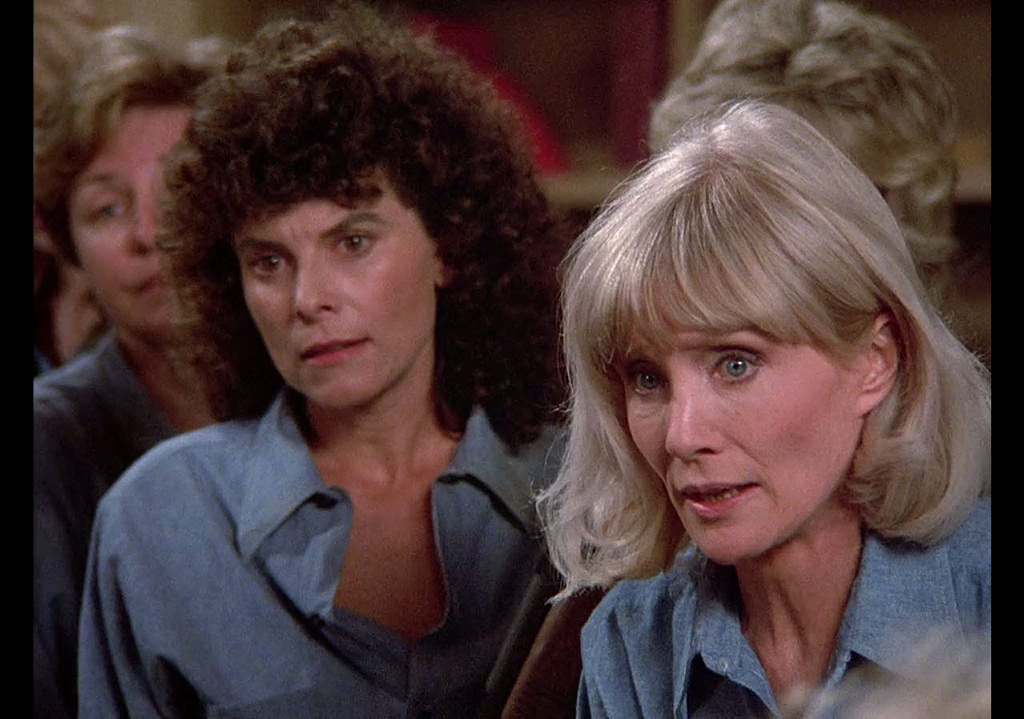
In the mid-1970s, she stopped accepting most acting roles and quit flying. She enrolled at the 1974 AFI Directing Workshop for Women with peers Lily Tomlin, Margot Kidder, Kathleen Nolan, and Maya Angelou. During the final season of M*A*S*H she directed an episode of the show. She would later direct an episode of Trapper John, MD.
At age 58, Oliver was diagnosed with colorectal, and eventually lung, cancer. She died in 1990.
Oliver was an
interesting actress. Apparently, she loved acting, but never wanted to be tied
down. She not only was a aviator and director but a writer. She was a practicing
Buddhist and a baseball expert as well.
Wickes and Oliver were very different women with very different interests and acting roles. They both remained single and devoted themselves to their careers. But they were both women who were always in demand for their acting ability.






















 thewritelife61