Blondie: Some Shows Are Better Being Forgotten

This month we are taking a look at some classic sitcoms that many people don’t remember anymore.

Blondie is one of those shows. It was based on the Chic Young comic strip and debuted on NBC in 1957, lasting one year. The series was resurrected in 1968 and the reboot also lasted a season.

📷wikipedia.com The 1957 version

Blondie had become very popular with fans. Beginning in 1938, 28 movies were made starring Penny Singleton and Arthur Lake. Blondie also showed up on the radio from 1939 to 1950.  Many products had been based on the characters including comic books, coloring books, lunch boxes, and board games.

The 1957 series starred half the movie duo. Lake took on his role of Dagwood Bumstead, but Pamela Britton was offered the role of Blondie Bumstead. Their kids, Cookie and Alexander, were played by Ann Barnes and Stuffy Singer. Florenz Ames was boss J.C. Dithers with Elvia Allmana as his wife Cora. Rounding out the cast was Harold Peary as neighbor Herb Woodley.

📷imdb.com The 1968 version

A decade later Will Hutchins and Patricia Harty play Dagwood and Blondie, Jim and Henny Backus play the Dithers, and Pamelyn Ferdin and Peter Robbins are their kids. The only advantage this series had over the original was color.

The comic strip, movies, radio show and both sitcoms all encompassed the familiar Bumstead elements: Dagwood being physically and socially awkward; their dog Daisy, and Dagwood’s love of napping and huge sandwiches.

The reboot was produced by Joe Connelly and Bob Mosher, the faces behind Leave It to Beaver and The Munsters. There was room in the schedule after the network cancelled He and She, a sitcom starring real life spouses Paula Prentiss and Richard Benjamin. The show is described on imdb.com as “Dick and Paula Hollister are a couple living in New York. Dick is a comic-book artist who has become famous for creating a superhero called Jetman, which has been turned into a TV show starring egocentric actor Oscar North.” During its one season of 26 episodes, the show received seven Emmy nominations, including a win for writing. It’s too bad that show was given the axe and Blondie moved in because the Prentiss-Benjamin show was much more creative and felt new, while Blondie felt extremely old.

No surprise, the ratings were not great. This is even worse when you see what the show was in competition with: The Ugliest Girl in Town, which would also be gone by 1969, and Daniel Boone. The one new 1968 show to return on CBS was Hawaii Five-0 which seems so much more sophisticated than Blondie; it’s hard to believe they both debuted the same year.

📷yahoo.com Hawaii Five-0

Perhaps the fans didn’t tune in because the critics panned the show before it aired. The Milwaukee Journal’s Wade Mosby said it was “a horrendously contrived piece of fluff that should have never been snatched from the comic pages.” Don Page of the Los Angeles Times called it “an unmitigated disaster,” and Cynthia Lowry of the Associated Press described it as “dismal.”

By November, rumors were that the show was already cancelled, and its last episode aired in January. The show probably relied too much on slapstick and unsophisticated humor; things that might have been fine in the 1930s but were passe by the 1960s. Sometimes a show is cancelled just because it’s a badly written and executed show. It seems Blondie fell into this category not once but twice.
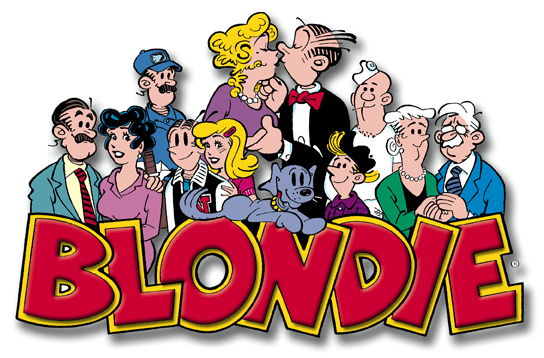
Off the top of my head, I can only recall two comic strips becoming popular television shows: The Archies and The Addams Family. Because the Blondie characters were not very dimensional and got into the same situations over and over, they just never were able to translate into sustainable television characters. I think there’s a good reason that many people don’t remember this show and perhaps it’s better that way.

Today We Take a Peek at the Future by Looking at the Past

Building on the popularity of The Flintstones, in 1962 ABC and Hanna-Barbera decided to debut another new animation show aimed at adults. Instead of the prehistoric past, this show would be set in the far-off future. It aired Sunday nights.  It was also the first show on ABC to air in color. It was The Jetsons. The Flintstones had been recorded in color, but the first two years it aired in black and white. However, it was up to the affiliates to decide if they wanted to broadcast both of these shows in color or black and white. Often they chose black and white because only 3% of the population had color televisions in 1962 which increased to 50% by 1972.

jetson2

Hoyt Curtin created the theme song. This show featured the typical 1950s sitcom plots. It was adult oriented and used a laugh track.

jetson17

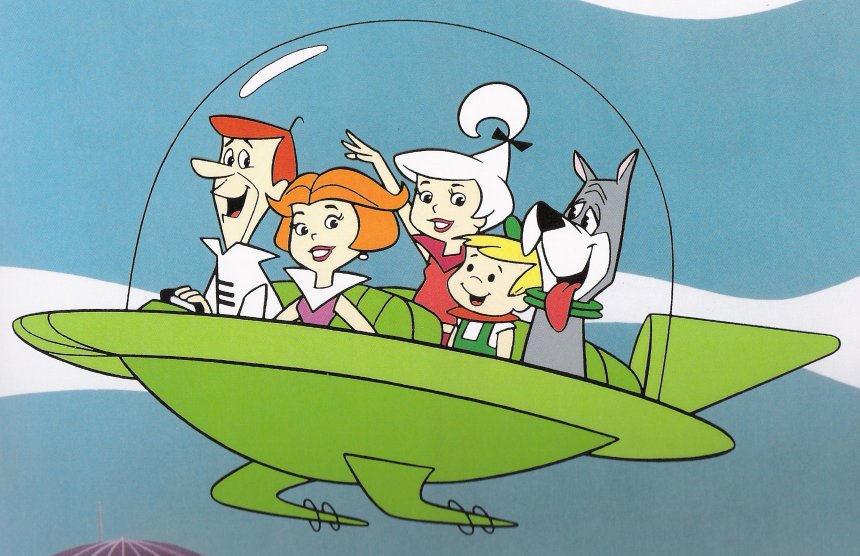
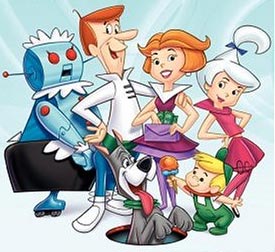
The Jetsons live in Orbit City in the Skypad Apartments, high in the sky. George is a family man.  George is not Fred Flintstone.  However, he does get into many predicaments like Fred, and his boss fires him often.  George works for Spacely Space Sprockets, and his boss is Cosmo Spacely. Their competitor is Mr. Cogswell who runs Cogswell Cogs. Mr. Spacely is easily angered and hard to work for. He and George were childhood friends. George’s work computer was RUDI – Referential Universal Differential Indexer.  He has a human personality. George was voiced by George O’Hanlon. Mr. Spacely was voiced by Mel Blanc.


jetson10

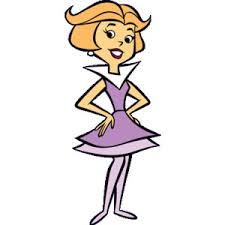
George is married to Jane, a homemaker like Wilma.  Jane is a member of the Galaxy Women’s Historical Society.  Her favorite store is Mooning Dales.  Penny Singleton, the original Blondie of the movies, plays Jane.


They have two children, Judy, a 16-year-old, who attends Orbit High School and Elroy, 6, who attends the Little Dipper School.  Judy likes clothes, boys, and her diary, much like teens in the 1960s.  Elroy is quiet, easy going, and highly intelligent, and he studies space history, astrophysics, and star geometry. Janet Waldo was the voice of Judy, while Daws Butler provided the voices of Elroy and Spencer Cogswell.


Rosie is their robot maid and Astro is their dog. Rosie is an outdated robot, but the family loves her. She performs all the housework and does some parenting of Elroy. Surprisingly, Rosie was only in 2 of the 24 episodes that aired in 1962. Astro precedes Scooby Doo but talks like him and looks very much like a gray Scooby. Jean Vander Pyl and Don Messick from The Flintstones take on the voices of Rosie and Astro.


Two other characters who make appearances are George’s eccentric grandfather, Montague Jetson voiced by Howard Morris.  Stella/Petunia Spacely, Cosmo’s wife, is overbearing and snobby and she was voiced by Jean Vander Pyl.


In 1963, Morey Amsterdam and Pat Carroll sued H-B for breach of contract.  Apparently, they were signed to a 24-episode contract to voice George and Jane.  They were guaranteed $500 per episode. According to the network, they had to be replaced because of sponsor conflicts with their other shows, The Dick Van Dyke Show and Make Room for Daddy. I believe the suit was dropped; however, I couldn’t find proof of that.


The show did not get very good ratings.  Part of the problem was that so many people were watching it in black and white. Another problem is that it was up against Car 54, Where Are You and, ironically, Walt Disney’s Wonderful World of Color. After the first year, the network moved it to Saturday morning. In 1985, 41 episodes were made and 10 additional shows were created in 1987. It’s hard to believe, but those of us who grew up in the 1960s and 1970s watched the same 24 episodes over and over since new ones weren’t made for 23 years after the debut.

Although it was only on the air in prime time for one year, marketing certainly did not suffer.  Many Jetson toys, games, and figures were sold.


The Jetsons endorsed Electrasol, Tums, and Radio Shack. Many comic books were based on the series. Gold Key printed 36 from 1963-1970, Charlton created 20 between 1970-1973, Harvey published 5 in 1992-1993, and Archie Comics produced 17 from 1995-1996.

In addition, two tv films, a tv special, and a movie were created.

The show was on Boomerang from 2000-2014 and again from 2016-2017. It was aired on The Cartoon Network from 1992-2004 and again in 2012. It is available now on Comcast’s video-on-demand service.


Many of the inventions the Jetsons used are currently being produced today. A flying car will most likely debut in 2018. There are several start-up companies developing jetpacks to allow people to fly. Robot butlers exist at some hotels (Japan and California). Holograms have existed for a few years. 3-D printers can make food, and our current drones are similar to the pods the Jetsons used. Smart watches were also shown on the series; in one episode a student in Elroy’s class watches a Flintstones episode on his watch instead of paying attention to the teacher. Although The Jetsons was set in 2062, they featured moving walkways and smart homes which we have used for some time.


What is so surprising about The Jetsons is its current popularity.  A Jetson big-screen film is in the works and, in August of 2017, ABC ordered a live-action sitcom of The Jetsons. It will be interesting to see if they rely on the same technology used in 1962 on the show or if they project into our future.

jetson1

While many of the popular shows from the early 1960s are only remembered by baby boomers, The Flintstones and The Jetsons are still well known to kids of every generation. They have truly survived the test of time. By this time next year, The Jetsons could once again be a hit television show. Like the Bewitched-I Dream of Jeannie debate, or the Mary Ann vs Ginger question, most people prefer watching the past or the future.  I am in The Jetsons camp, but enjoy watching Fred and Wilma from time to time also.  Next week we’ll look at my favorite adult animation show, and no, it’s not The Simpsons.