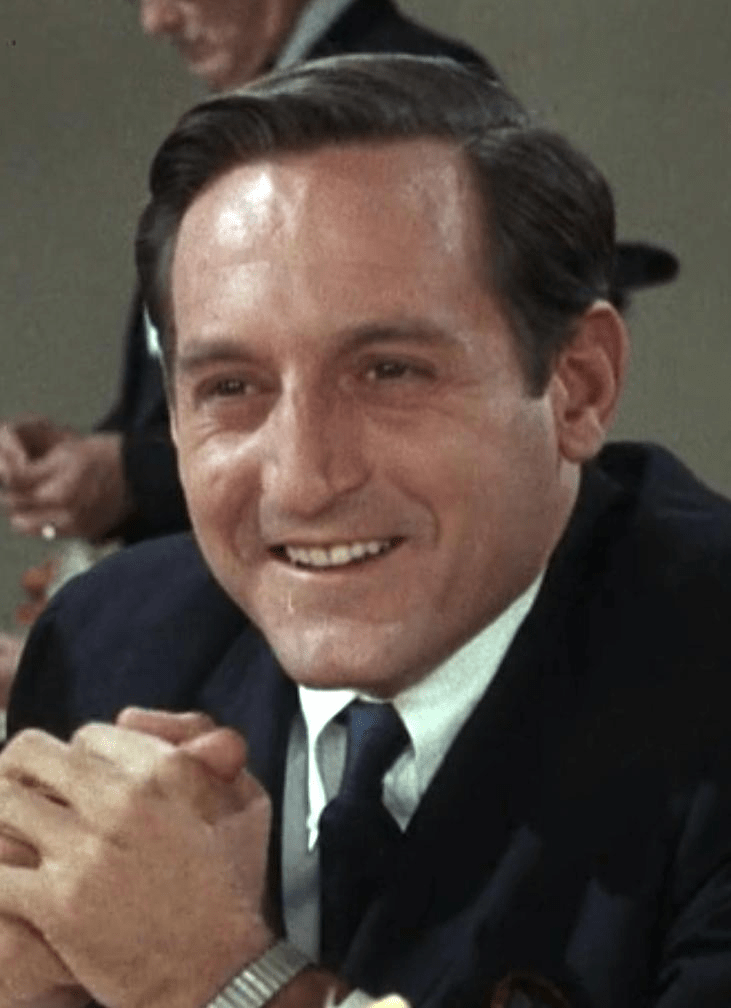
This month we are right in the middle of one of my favorite blog series, What a Character. This week we are delving into the career of Noam Pitlik; in addition to his acting, he won an Emmy for his work as a director. Which show? Let’s find out.
Pitlik was born in Philadelphia in 1932. After graduating from high school, he enrolled at Gratz College and later was a theater major at Temple University in 1954. Pitlik had a two-year stunt in the Army and earned a master’s degree in theater at New York University.
He began his acting career on WCAU in a western. In 1951, he was hired for the set design and construction crew for the Philadelphia Experimental Theater. He carried a bit of his hometown with him when he was part of the Summer Theater Guild in Indiana, Pennsylvania in the “Philadelphia Story.” He was hired for his Broadway debut in an off-Broadway production of The Threepenny Opera.”
📷imdb.com
In 1961 he moved to Los Angeles and received his first television roles, appearing on Cain’s Hundred and Dr. Kildare. Cain’s Hundred was not a show I remembered hearing much about. It was about a former underworld lawyer who works with the federal government to bring the top 100 criminals to justice. The show lasted one season. Pitlik had a variety of offers for shows throughout the sixties. Most of them were dramas and westerns, but we also see him on My Favorite Martian, The Munsters, Gidget, The FlyingNun, The Monkees, The Andy Griffith Show, The Doris Day Show, Get Smart, That Girl, and I Dream of Jeannie.
During the sixties, he married for the first time. His marriage with Jesse Blostein in 1967 would only last three years.
Pitlik also appeared in fourteen films and eight made-for-tv movies. The most memorable films are The Graduate, Fitzwilly, and The Fortune Cookie.
📷famousfix.com
The seventies were his most prolific decade of acting. He appeared in 26 different series, often in 2-5 different episodes. You’ll see Pitlik in reruns in a variety of genres including Hogan’s Heroes, Room 222, Bewitched, LoveAmerican Style, All in the Family, The FBI, Cannon, Mannix, The PartridgeFamily, The Bob Newhart Show, The Odd Couple, and Barney Miller. His last acting appearance was in Becker in 1998.
The seventies were also when he tried the role of husband again, marrying Linda Hirsch in 1974; this marriage also lasted three years.
He began directing in the seventies and obtained 39 directing credits throughout the next two decades.
📷imdb.com
In an interview with Temple University for the Alumni Review in 1979, Pitlik said that the switch in his career was not “a case of my needing to change functions for economic reasons. I used to figure out what I made a day as an actor, and it was obscene. I changed for emotional reasons. I had become very frustrated by the kinds of things I was doing in acting, and I was looking for a change in my life that would be more challenging. I enjoyed acting, but I never seemed to get enough to do.” His first episode as director was on The New Dick Van Dyke Show. He directed 12 episodes for The Practice and 11 for Taxi.
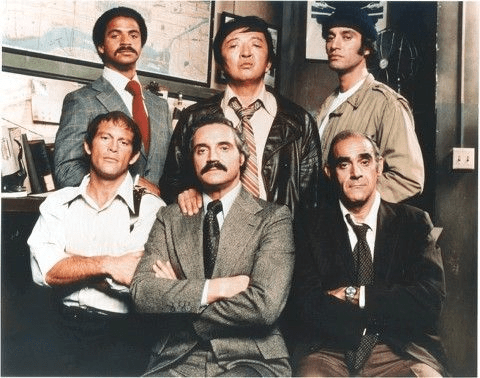
However, Barney Miller was where he perfected his skill as director for 102 of its 171 episodes. In 1979, he won an Emmy as Director for the show. He beat out Paul Bogart for All in the Family, Alan Alda and Charles Dubin for M*A*S*H, and Jay Sandrich for Soap. He also received a Peabody Award and a Directors Guild of America Award for his work on Barney Miller. He lost the Emmy in 1981 to James Burrows for Taxi. His co-nominees included Jerry Paris for Happy Days, Linda Day for Archie Bunker’s Place, Burt Metcalfe and Alan Alda for M*A*S*H, and Rod Daniel for WKRP in Cincinnati.
📷tumblr.com Cast of Barney Miller
In the Temple interview, Pitlik said that his “main responsibility is to create an atmosphere in which each of the people involved in the production can conform to their best work. Although a director oversees all aspects of the production, there are many people involved, and he’s dependent on all of them. There’s no more collaborative business than the television business. Each person contributes to the success or failure of a show whether he or she is a writer, actor, cameraman, or whatever.”
In 1995 he began directing episodes of The Home Court and did so for 14 of the 20 episodes. I must admit I do not remember this show at all. The synopsis was Sydney Solomon was a family court judge who had to deal with the toughest prosecuting attorneys and repeat offenders. However, her biggest challenges came when dealing with her kids, four boys aged 11-19.
📷pinterest.com
Pitlik had better luck with his third marriage to Susan Whittaker which lasted from 1986 until his death in 1999. Whittaker was a television producer. Noam passed away from lung cancer at age 66.
Like Jerry Paris, Pitlik had a very successful acting career before finding his passion behind the camera. If you are responsible for directing a series, Barney Miller is a great accomplishment. It was fun to learn more about his career both in front of and behind the camera.
We are wrapping up our series, “Girls, Girls, Girls.” At the beginning of the month, we learned about a show that featured four women who spent much of their life together for seven years (Designing Women). Today we end our series with another show that featured a quartet of women that also ran for seven years.
In September of 1985, a new type of sitcom debuted. This show featured four retired women who lived life together, relying on humor to make things work. The show, Golden Girls, was on the air seven years, ending in 1992 and producing 177 episodes. The show was always on Saturday nights with the seventh season moving to an earlier hour.
Photo: tvseriesfinale.com
I read two different versions about the creation of the show, so take your pick. Maybe the truth is somewhere in the middle. One version is that the idea came from Brandon Tartikoff, an NBC executive. When he was visiting his aunt one day, he noticed that she and her next-door neighbor who was her best friend, argued a lot but loved each other. He thought the concept would make a great show.
The other version
credits NBC senior vice president Warren Littlefield. He was in the audience
when Selma Diamond and Doris Roberts acted in a skit called “Miami Nice,” a parody
of the popular Miami Vice. The skit featured old people living in Miami.
Either way, Susan Harris created the show itself, and it was produced by Witt/Thomas/Harris Productions, with Tony Thomas and Harris serving as original executive producers. After the first year, Harris was not as involved with the show, but still oversaw the scripts.
Photo: housebeautiful.com
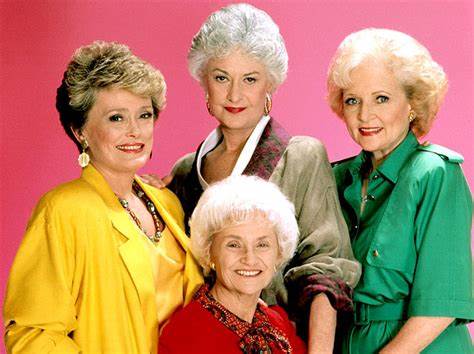
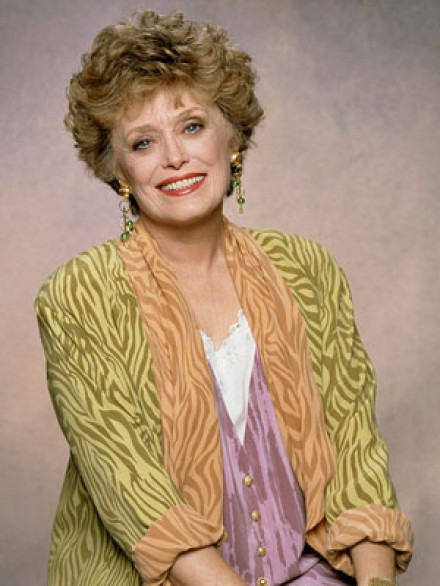
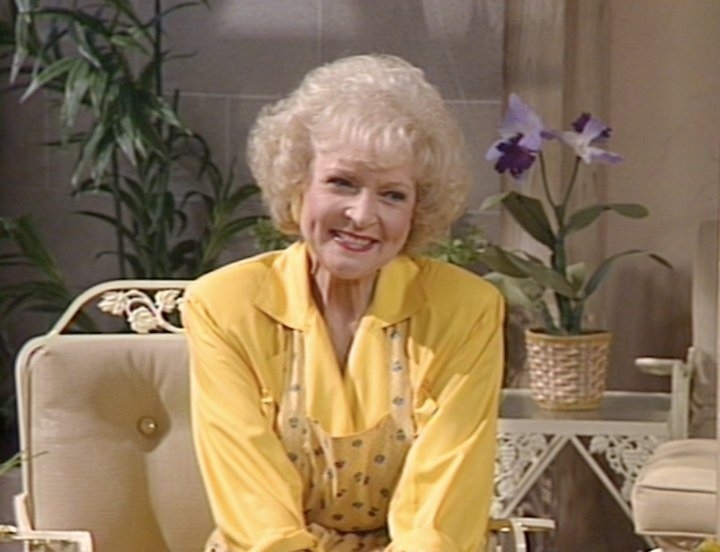
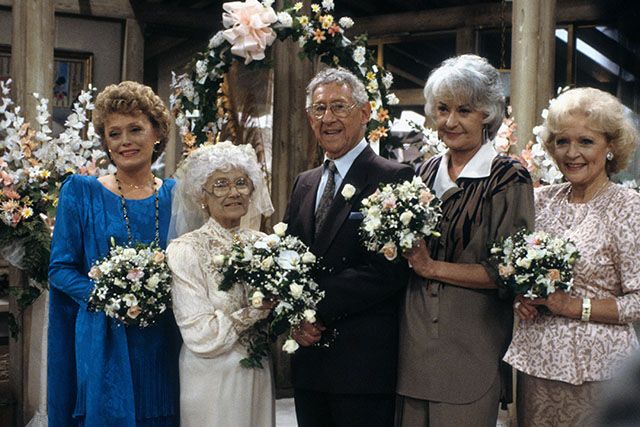
The four main characters are quite different which is probably why the series was so successful. Blanche (Rue McLanahan) owns the house in Miami. Two women, widow Rose Nylund (Betty White) and divorcee Dorothy Zbornak (Bea Arthur) respond to an ad on a grocery store bulletin board to become Blanche’s roommates. In the pilot episode, the retirement home where Dorothy’s 80-year-old mother Sophia (Estelle Getty) lives burns down, so she joins the trio. All four of the characters appeared in every episode.
Photo: marginallyhuman@wordpress.com
Blanche worked for an art museum. She grew up in a wealthy family, living on a plantation outside Atlanta. When she married her husband George, they moved to Miami. With six kids, Blanche should be a busy family matriarch, but she was man-hungry and always involved in some romantic entanglement much to the chagrin of Rose.
Photo: goldengirls.wikia.com
Dorothy was a substitute teacher. She became pregnant in high school and married the father, Stanley. Stan and Dorothy moved to Miami but after 38 years of marriage, he had an affair with an airline stewardess and left Dorothy.
Photo: buzzfeed.com
Rose lived most of her life in a small farming town, St. Olaf, Minnesota. She and husband Charlie were happily married with five children. After he passes away, she moves to Florida and works at a counseling center. At one point she works for a consumer reporter at a local television station. Rose had an on-again, off-again relationship with a college professor, Miles Webber, during the run of the show.
Photo: thebettergoldengirls.wikia.com
Sophia left Italy to get out of an arranged marriage and ended up in New York where she met Salvadore Petrillo. Sophia also has a variety of jobs on the show, including a fast-food worker and a developer of a spaghetti sauce and sandwich business. Sophia is the only character to marry during the seven seasons. She married Max Weinstock, but they separated soon after the wedding.
The role of Sophia was the first one cast. Estelle Getty had received rave reviews for her performance in Torch Song Trilogy. Although Getty played Dorothy’s mother, in reality she was a year younger than Arthur. It took Getty three hours in make-up to transform into the older Sophia, donning a white wig, heavy make-up and thick glasses. Apparently, even though she was an experienced actress, she suffered from stage fright and often froze on camera. This affliction got worse as the show continued, and by the fifth season, she was reading her lines from cue cards. McClanahan tried to describe what Getty suffered with, “She’d panic. She would start getting under a dark cloud the day before tape day . . . you could see a big difference in her that day. She’d be walking around like Pig-Pen under a black cloud. By tape day, she was unreachable. She was just as uptight as a human being could get. When your brain is frozen like that, you can’t remember lines.”
Photo: refinery29.com
Originally McClanahan
was cast as Rose and White as Blanche. White had portrayed Sue Ann Nivens, a
man-crazy woman, on the Mary Tyler Moore Show. Director Paul Bogart felt
they should switch roles.
McClanahan came
up with the idea that Blanche should have a southern accent which she exaggerated
to make the character more interesting. Apparently, one of the set jokes was
where Rue McClanahan might be sleeping on the set. She was often found napping
in different places.
Although Harris created Dorothy as a “Bea Arthur type,” the producers originally wanted Elaine Stritch for the part, but her audition did not go well. Arthur didn’t want to do the show because she didn’t want her and McClanahan to be portrayed as Maude and Vivian as they were in the show Maude. After reading the script and learning about the role switch of her coworkers, she came on board.
Costume designer Judy Evans created a different look for each of the cast members. Rose was down home and Midwestern. Sophia relied on comfortable clothing. Dorothy had a “pulled-together, no nonsense” look. Blanche was sexy with flowing outfits. Rue had a clause written into her contract that she be allowed to keep all Blanche’s clothing, which was custom made. By the end of the series, she filled thirteen closets with the designer wardrobe. Late McClanahan would create a more affordable line of clothing for QVC, “A Touch of Rue” based on Blanche’s show wardrobe.
(Left to right) The cast of television series The Golden Girls Rue McClanahan, Betty White, Estelle Getty and Beatrice Arthur are shown in a scene from the show in this undated publicity handout photo. Photo: sydneymorningherald.com
While the characters argued from time to time, you knew they loved and cared about each other and were a family, even if they made each other crazy at times. In reality, Arthur was very difficult to get along with. Betty White, who seems to love everyone, admits she did not have a good relationship with Arthur. Apparently, White’s positive and perky manner irritated Bea. McClanahan said Bea was very eccentric and hard to be friendly with. However, White, always the professional, never revealed their difficulties until after Arthur passed away. White and McClanahan became close friends during the show’s run. White always loved game shows and she found a kindred spirit in Rue. They frequently played games between takes.
Photo: entertainmentweekly.com
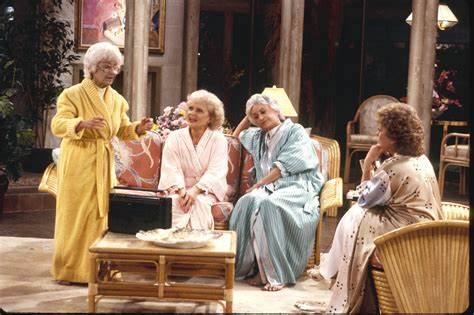
The house was
often a fifth character on the show. The exterior of the home, which was supposed
to be at 6151 Richmond Street, was part of the backstage studio tour ride at
Disney’s Hollywood Studios for the first two seasons. Designer Ed Stephenson
used a “Florida look” for the home with wooden accents, columns, cypress doors,
rattan furniture, and tropical prints. Of course, Blanche’s bedroom featured pink
carpeting and a vanity table. Dorothy’s room was filled with books and
intricate wallpaper. Rose’s walls are covered with clouds, and her room contained
a lot of ruffles and chintz. Sophia’s room was also modern with dainty floral
wallpaper and mahogany furniture covered by bedding with a satin trim.
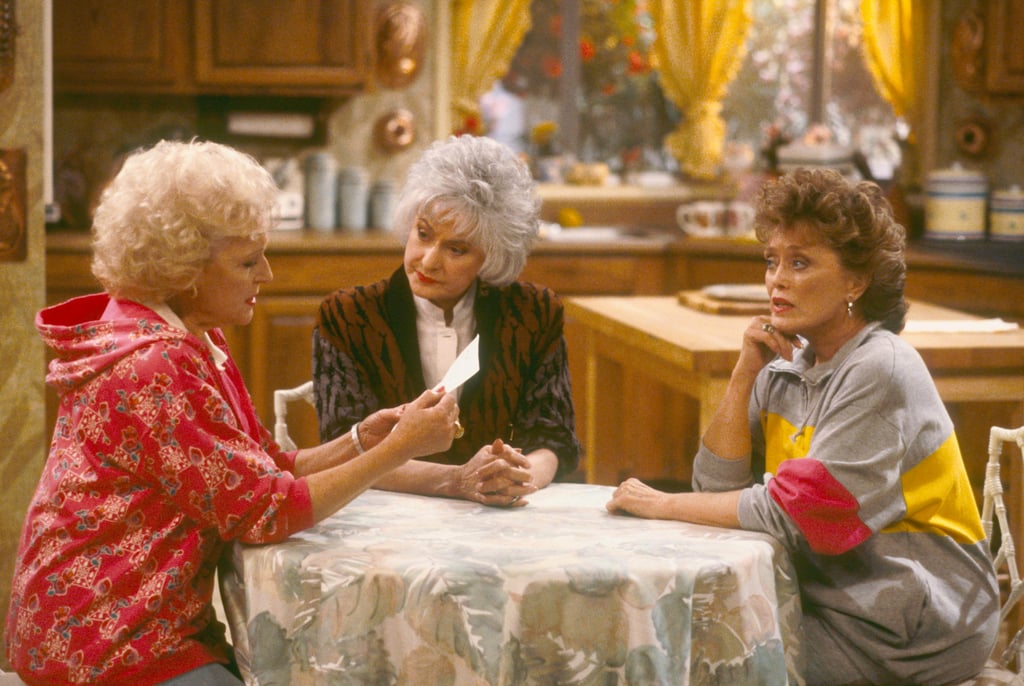
If you watch the scenes in the kitchen, you will notice that although four people live there, there are only three chairs at the table. If all four girls were sitting there, someone had their back to the camera, so the director solved the problem by only having three of them in the scene at a time.
Photo: popsugar.co.uk
Often the
plots would feature one of the characters mired in a problem, typically
involving their family, their love life, or ethical dilemmas. When they gathered
around the table to talk, the stories they told would help each other, even
though Rose’s stories from her youth typically had no connection to the current
problem and Sophia’s stories were often made up. Many controversial issues were
covered during the show including same-sex marriage, elder care, homelessness,
HIV/AIDS, immigration, death, assisted suicide, and discrimination whether racial,
sexual or gender.
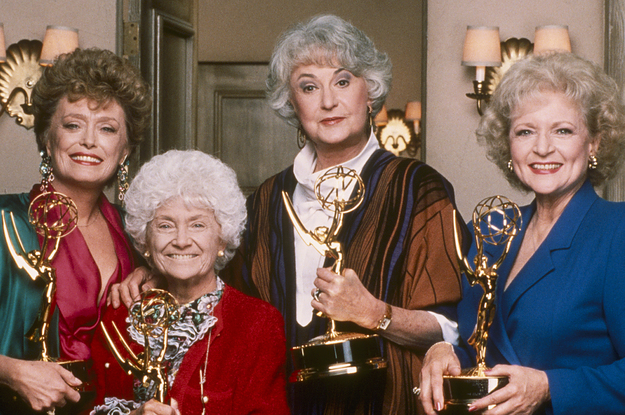
The critics praised the show, and the public adored it. For six of the seven seasons, the show ranked in the top ten. Both Betty White and Estelle Getty received seven Emmy nominations during the seven-year period, while Bea Arthur and Rue McClanahan each received four. Fun fact, all of them won an Emmy during the run of the show. Overall, the show received 68 Emmy nominations.
Photo: aarp.com
The Queen
Mother loved the show so much that she asked the quartet to come to England and
perform for her personally. When the cast assembled in London, they appeared in
an episode about the visit to the Queen.
After the
seventh season, when the show had dropped into the top 30, Bea Arthur decided
to leave the show. In the finale, Dorothy finally meets the man for her, who
happens to be Blanche’s uncle Lucas (Leslie Nielsen), and they move to Atlanta.
Sophia is uncertain whether she should move with them or stay in Miami and, in
the end, decides to stay in Florida.
When the
series ended, White, McClanahan, and Getty reprised their Golden Girls roles
and starred in The Golden Palace about a hotel. The series ended after
the first year and never enjoyed the rankings of the original, coming in 57th
for the year.
Harris developed two spinoffs from the original series. Empty Nest starred Richard Mulligan as pediatrician Harry Weston who lives next to the women with his two grown daughters. The show was also very popular and lasted seven years as well.
The Cast of Empty Nest Photo: 123movie.care
Empty Nest then launched a show about some of the nurses who worked in Weston’s hospital, simply titled Nurses. While this series was never as popular as Golden Girls or Empty Nest, it did last three years.
The cast of Nurses Photo: tvseriesfinale.com
Although I
enjoyed The Golden Girls, I actually did not watch it often. I think maybe because it was on Saturday
nights during a time that I was not likely home in the evening. I did enjoy it
when I caught an episode but was never the fanatic many of my friends were. I
think I should let the “Girls” have the last words about their series:
Dorothy: You know, sometimes I can’t believe my ears. Sophia: I know. I should’ve taped them back when you were seven.
UNITED STATES – MAY 13: THE GOLDEN GIRLS – 9/24/85 – 9/24/92, ESTELLE GETTY, BEA ARTHUR, (Photo by ABC Photo Archives/ABC via Getty Images)
[Dorothy and
Sophia come home after Sophia’s best friend’s funeral]
Sophia: Well,
I guess Phyllis Glutman will be my new best friend.
Dorothy: I thought you hated Phyllis Glutman.
Sophia: I do, but at the rate my friends are going, I won’t have to spend too much time with her.










 thewritelife61