Occasional Wife: Occasionally Watched by Viewers

We are in the midst of a month of blogs that feature sitcoms we don’t hear much about anymore. Today’s series is Occasional Wife.

In September 1966, the show debuted on Tuesday nights on NBC.

📷wikipedia.com

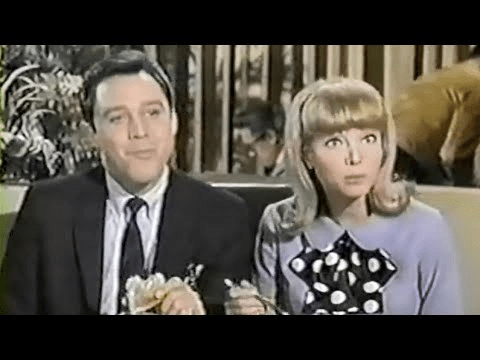
The show was about Peter, a junior New York business executive (Michael Callahan). When he realized married men are more likely to be promoted at his company, Brahms Baby Food, he asks hat check girl Greta (Patricia Harty) to pose as his wife for company functions. When he offers to pay for her rent and art lessons, she agrees, thinking it will be an occasional performance, but every time someone from the office drops by, Peter runs upstairs to bring her down to his apartment until they leave. One of the funniest parts of the show was the tenant played by Bryan O’Byrne who watches Peter and Greta running up and down the fire escape.

If you wondered if the name Patricia Harty sounds familiar, yes it does. She was Blondie and we talked about her in the first blog of this series.

📷imdb.com

The opening is reminiscent of Dragnet with its introduction “There are eight million stories in the Naked City. Some are violent, some sad, but one of them is just plain cuckoo. This is a modern fable about two young people who make a bargain only to find out they were going to get a lot more than they bargained for. We call our fable Occasional Wife and it stars Michael Callan and Patricia Harty.”

The series was created by Lawrence J. Cohen and Fred Freeman. Vin Scully, legendary sportscaster, provided the narration for the show. It started off ranked 18th but by the end of the season, it had dropped to 64th and was cancelled.

The show was up against The Red Skelton Hour and The Rounders. If you have been reading my blog any amount of time, you probably have heard me complaining about Red Skelton. I honestly could not stand watching the show and did not find it at all funny, but I also have read way too many accounts of what a jerk he was to his writers, cast members, and anyone else who he worked with. However, at this time, his show was in the top ten. The Rounders on the other hand, probably didn’t take many viewers away from this sitcom. The premise of the show, according to imdb.com, was that Howdy Lewis and Ben Jones are in debt to Jim Ed Love, second richest man in the state. They find some happiness with girlfriends Ada and Sally at the Longhorn Cafe.

📷popculturereferences.com

It sounds like Peter and Greta were flat characters and the comedy only relied on the situation of the fake marriage. Viewers would probably have liked to see some chemistry between the two and allow them to struggle with getting closer instead of both being happily single. There must have been some chemistry there because the actors married after the show ended. Just like their sitcom, their marriage failed to last two years.

This sitcom was one of the first series to eliminate the use of a laugh track. Now canned laughter is an industry standard, but they decided to can the canned laughter and not invite a live audience. I wonder if this might have affected viewers whether they knew it or not.
📷youtube.com

Bob Claver discussed his time producing this show in a Television Academy interview. Claver thought the show was funny and peppy, but he said they couldn’t make it a hit, even with Harry Ackerman as executive producer.

As with the other two series we discussed this month, Blondie and My Sister Eileen, you might be better off to run up or down your own fire escape and skip watching the show to get in a few extra steps.

Blondie: Some Shows Are Better Being Forgotten

This month we are taking a look at some classic sitcoms that many people don’t remember anymore.

Blondie is one of those shows. It was based on the Chic Young comic strip and debuted on NBC in 1957, lasting one year. The series was resurrected in 1968 and the reboot also lasted a season.

📷wikipedia.com The 1957 version

Blondie had become very popular with fans. Beginning in 1938, 28 movies were made starring Penny Singleton and Arthur Lake. Blondie also showed up on the radio from 1939 to 1950.  Many products had been based on the characters including comic books, coloring books, lunch boxes, and board games.

The 1957 series starred half the movie duo. Lake took on his role of Dagwood Bumstead, but Pamela Britton was offered the role of Blondie Bumstead. Their kids, Cookie and Alexander, were played by Ann Barnes and Stuffy Singer. Florenz Ames was boss J.C. Dithers with Elvia Allmana as his wife Cora. Rounding out the cast was Harold Peary as neighbor Herb Woodley.

📷imdb.com The 1968 version

A decade later Will Hutchins and Patricia Harty play Dagwood and Blondie, Jim and Henny Backus play the Dithers, and Pamelyn Ferdin and Peter Robbins are their kids. The only advantage this series had over the original was color.

The comic strip, movies, radio show and both sitcoms all encompassed the familiar Bumstead elements: Dagwood being physically and socially awkward; their dog Daisy, and Dagwood’s love of napping and huge sandwiches.

The reboot was produced by Joe Connelly and Bob Mosher, the faces behind Leave It to Beaver and The Munsters. There was room in the schedule after the network cancelled He and She, a sitcom starring real life spouses Paula Prentiss and Richard Benjamin. The show is described on imdb.com as “Dick and Paula Hollister are a couple living in New York. Dick is a comic-book artist who has become famous for creating a superhero called Jetman, which has been turned into a TV show starring egocentric actor Oscar North.” During its one season of 26 episodes, the show received seven Emmy nominations, including a win for writing. It’s too bad that show was given the axe and Blondie moved in because the Prentiss-Benjamin show was much more creative and felt new, while Blondie felt extremely old.

No surprise, the ratings were not great. This is even worse when you see what the show was in competition with: The Ugliest Girl in Town, which would also be gone by 1969, and Daniel Boone. The one new 1968 show to return on CBS was Hawaii Five-0 which seems so much more sophisticated than Blondie; it’s hard to believe they both debuted the same year.

📷yahoo.com Hawaii Five-0

Perhaps the fans didn’t tune in because the critics panned the show before it aired. The Milwaukee Journal’s Wade Mosby said it was “a horrendously contrived piece of fluff that should have never been snatched from the comic pages.” Don Page of the Los Angeles Times called it “an unmitigated disaster,” and Cynthia Lowry of the Associated Press described it as “dismal.”

By November, rumors were that the show was already cancelled, and its last episode aired in January. The show probably relied too much on slapstick and unsophisticated humor; things that might have been fine in the 1930s but were passe by the 1960s. Sometimes a show is cancelled just because it’s a badly written and executed show. It seems Blondie fell into this category not once but twice.

Off the top of my head, I can only recall two comic strips becoming popular television shows: The Archies and The Addams Family. Because the Blondie characters were not very dimensional and got into the same situations over and over, they just never were able to translate into sustainable television characters. I think there’s a good reason that many people don’t remember this show and perhaps it’s better that way.