The Jim Backus Show: It Was Hot Off the Wire

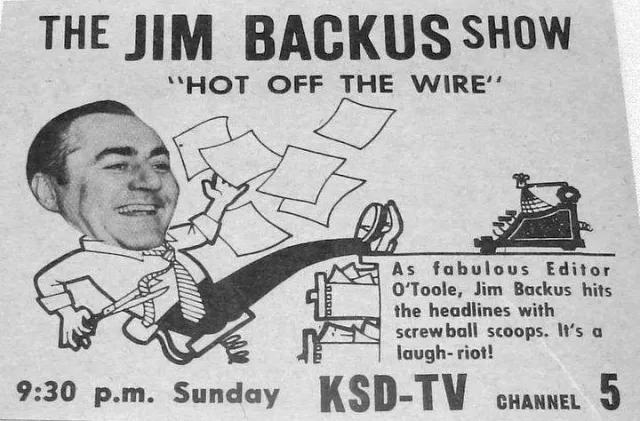
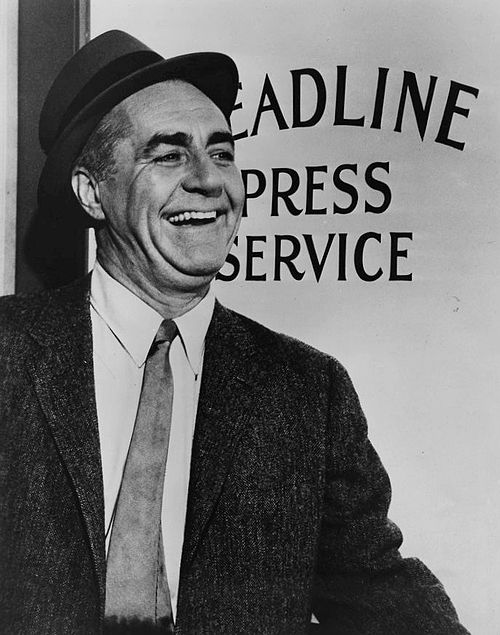
This month we are in a blog series, “It’s Their Show.” Today we are taking a closer look at The Jim Backus Show. Most people know Backus today as Mr. Howell on Gilligan’s Island. While he did show up on several television series, cartoons, and made-for-tv movies for Gilligan’s Island, Backus had a long and successful career without any Gilligan appearances. He started in the movies in 1948 and wound up his career with an amazing 253 credits.
📷thrillingdaysofyesteryear.com

In addition to being the voice of Mr. Magoo, Backus starred in several other series including I Married Joan and Blondie.

In 1960, The Jim Backus Show debuted.  It was one of the first syndicated shows, so it’s hard to gauge how it did against its competition. However, I will say what I can tell you is that there were still 13 westerns on the air during the week, so while the influence of the Plains was waning, it was still very popular. It was also a year that lots of stars had made the plunge to dip their toe into the television industry. There were 11 stars with their own shows that year in addition to Backus, including Jack Benny, Ann Sothern, Danny Thomas, Andy Griffith, and Donna Reed. 

The series had a great cast. They had several good directors, including Gene Reynolds who produced MASH and Lou Grant and a lot of good writers, including Jay Somers who would go on to create and write Green Acres. However, they had 14 directors and more than 40 writers to produce those 39 episodes. They also had a great line up of guest stars including Ken Berry, Charles Lane, Jayne Meadows, Zasu Pitts, Tom Poston, and Bill Quinn.
📷youtube.com

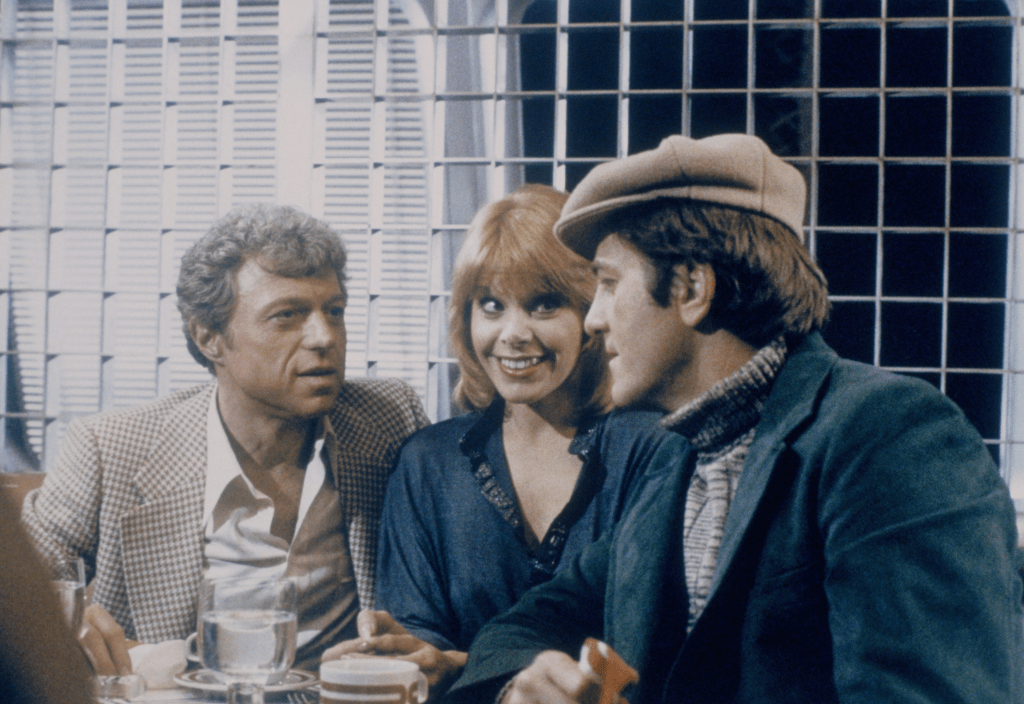
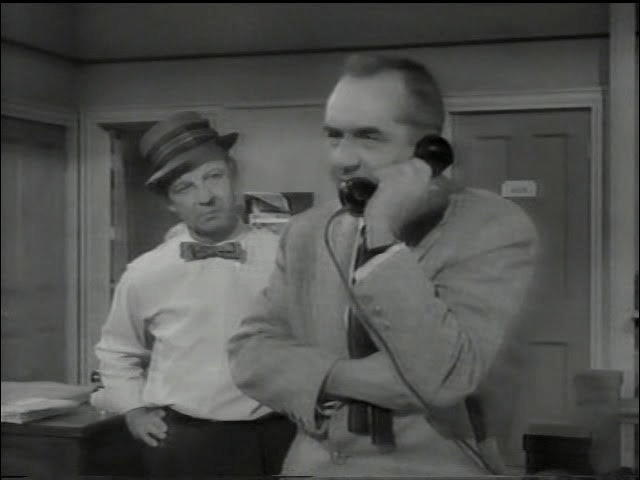
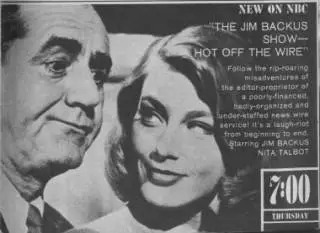
Backus is Mike O’Toole, the editor and owner of a news service struggling to make a go of it. He often doesn’t have the money to pay his rent or his staff’s salaries. Working with O’Toole are reporters Dora (Nita Talbot) and Dave (Bill McLean) as well as Sidney (Bobs Watson), their office boy. When they weren’t working, they spent some time at Heartless Harry’s, a bar downstairs that was popular with newspaper people. He truly was heartless, because he wouldn’t let anyone from Mike’s company in the bar unless they put down a $10 deposit.

One of the episodes I watched for this blog was #5, “No Help Wanted.” The opening pans the big city before moving down to the office of the wire service with Mike in the window joined by Dora.

The episode begins with Mike and Dora’s car breaking down in the middle of nowhere. There’s a large estate in the distance, but Mike won’t let Dora ask them for help until he’s tried to fix the problem himself.
Directed by Gene Reynolds and written by Dick Chevillat and Jay Sommers, the plot is that a retired stage actress, Catherine Lyden (Linda Watkins), has lots of money and loves living a normal life. Her former agent keeps trying to lure her back into show business. She decides to clean the maid’s house so she can hire someone, but when Dora and Mike meet her, they recognize her, and they think she is destitute and try to help her. After they get back to the office, they buy her some groceries and clothes. She tries to tell them that she has plenty of things and she doesn’t need their help. O’Toole writes a story about her having to work as a maid to make ends meet and puts a photo in the paper with her holding a pail and looking disheveled. When the article appears, several people contact her to try to help her out. When Mike and Dora get her contract from the playwright who is trying to hire her, they tell her that it’s a form to get a retraction from the paper.

After she signs it,  they tell her the truth, that it’s a five-year contract and she begins to cry. Surprisingly they never do find out she wasn’t down and out. They think she is crying from gratitude, and they leave.

📷internetarchive.com

There were some fun bits of dialogue especially between Dora and Mike, and the filming was very different from most sitcoms, but I was drawn in by it. One of the things that I found most interesting about this episode is the soundtrack. There is some laughter in the background, but you hear birds, the office machinery running, and the sounds of the city. It’s like you’re right in the location with the cast and hear what they would hear.

This was a tough episode for me though. First of all, I kept waiting for Lyden to be touched by the fact that they were trying to help her and maybe that made her realize the public missed her. However, she never cared that they were spending their hard-earned money on her. She truly was upset when they tricked her, and I found it tough to watch because they never learn she was not destitute and truly was happy and they have now made her miserable for five years. It just didn’t have that feel-good ambiance we expect our sitcoms to feature.
📷wikipedia.com

The series produced 39 episodes before being canceled. I’m guessing the fact that it didn’t make it had something to do with the fact that it was on different nights and times across the country.

Sometimes these shows are hard to find. They all had two names. The Tom Ewell Show was known as The Trouble with Tom, The Phyllis Diller Show was known as The Pruitts of South Hampton, and The Jim Backus Show went by Hot Off the Wire.  With so much competition from other stars trying to vie for their spot on the schedule and being a syndicated show, I’m guessing it was hard to lure enough fans to make it worthwhile to produce a second season of the show.

Supertrain: The Show That Derailed Before It Got Going

📷letsgetoutofhere.com

We are winding up our series, Casting Celebrities. This month we have looked at several shows that relied on stars for their characters every week. We’ve checked out Love American Style, Fantasy Island, and The Love Boat. If you don’t remember today’s show, don’t beat yourself up about it. It was on the air for less than three months. That said, they still had a lot of stars show up. While Love American Style had 109 episodes, Fantasy Island claims 154, and The Love Boat includes 250, this show had 9!

Supertrain debuted on NBC in February of 1979. Here is part of the problem: it was described as a science fiction-adventure-drama. Sounds like a show that isn’t sure what it is.

📷imdb.com

Instead of an exotic island or a cruise ship, this show takes place aboard a nuclear-powered high-speed super train. However, it might as well have been a cruise ship. You could swim in the pool, go to the gym, or the library. There was plenty of shopping and nightlife including a discotheque. It ran between New York City and Los Angeles, with stops in Chicago, Denver, and for some strange reason, a fictional town of Desert Junction in Texas.

Problem number two for the show: it was the most expensive series to be produced at that time. NBC paid $10 million for three trains. There was a full-size train with passenger cars and two model trains for exterior shots.

Ned Parsons was brought on as art director to build the train. Parsons moved from his home in Newport Beach to the MGM studio lot for three months. He was on call 24 hours a day, supervising 200 construction workers who covered three shifts. The costs to do this averaged $60,000 a day for building materials. The lumber used for the set could have built 22 homes.

📷thehollywoodreporter.com

Before the show even aired, it was reported that the network had spent $12 million dollars. And despite the high cost of the train, there were a lot of complaints about it being unattractive and unrealistic. It was described as dark and dingy; one article said it was more of a superbus than a supertrain. Although they publicized this train as a high-speed one, viewers asked if it goes 200 mph, why does it take so long to go from New York to Los Angeles?

Problem number three: it was heavily advertised but received poor reviews and low ratings. More people tuned in to watch a 2-hour episode of Charlie’s Angels than the 2-hour debut of this show.

Problem number four: to help the quality and ratings, the producer was replaced, the cast was cut in half and some of them switched jobs, and it became more of a sitcom , and it was moved from Wednesdays to Saturdays. What? Remember this show only lasted nine episodes.

Once the cast shake up took place, five remaining characters were left. Dr. Dan Lewis (Robert Alda), nurse Rose Casey (Nita Talbot), conductor Harry Flood (Edward Andrews), relations officer Dave Noonan (Patrick Collins), and chief porter George Boone (Harrison Page).  Seems like an experienced and quality cast, so I don’t think any of the blame falls on them.

The BBC bought the show for $25,000 an episode before it was shown on American television. Their plan was to begin airing the show in the fall of 1979, but remember by May of 1979 the show was off the network so BBC never aired any of the episodes.

One bright spot coming through the tunnel for the show was the music, with the exception of the second theme song which was listed as blah. Bob Cobert provided the primarily disco music. Cobert won an Emmy for his music in War and Remembrance.

Supertrain has been called one of the greatest television flops ever and that’s not an exaggeration. Here are a few of the reactions critics had to the show in 1979. A Variety review said “it’s a Love Boat on wheels which has yet to get on track.”

📷imdb.com

TV Guide reviewer Robert MacKenzie said that “in the long two-hour premiere, Steve Lawrence was a talent agent and gambling addict in debt to a gangster named Big Ed. Aboard the Supertrain, someone kept trying to put Lawrence away by planting a suitcase bomb in his room, dumping him into a pool when he was unconscious, and locking him in a steam room with friend Don Meredith. Our attention was called to several suspects . . . sometime in the second hour I wanted to get off and catch a bus home.”

Telefilm Review shared that “NBC’s highly promoted show Supertrain features a slick new train of tomorrow, with a script from yesterday . . . it seeks to overwhelm but underwhelms instead.”

Nothing I read gives me any reason to contradict any of these reviews. One fun story I could take away from this debacle was building the train and then what happened to such a behemoth and the model trains? We know one of the model trains crashed and was ruined during the show’s production. Were the others scrapped to recoup at least a small cost? Nope.

📷theherald-mail.com

According to a Herald-Mail article from July of 2018, Ben Thoburn went to Hagerstown to pick up a jukebox he purchased and saw an old train in the guy’s barn. It was much bigger than a typical model railroad set. Plexiglass served as windows and it had a futuristic design.

Thoburn bought the train and then set about researching it. Jack Morrissey was a LA film producer who bought the train from Thoburn.  According to Thoburn, NBC sold the model train to a manufacturer in Philadelphia. When the company went bankrupt (maybe the train is cursed), the train was left in its headquarters. A cabinet maker eventually bought the building and sold the train to the man Thorburn bought it from. Because some other items were stacked on some of the cars, there was a little bit of damage. Morissey didn’t have specific plans for the train; he just wanted a piece of television history. At least something good was salvaged from this otherwise not-good show.

📷losangelestimes.com bill barty

While we are finished with our exploration of the four shows that featured stars in their casts, I did promise to provide one more fun fact. There are a lot of stars who were on Fantasy Island and The Love Boat. When you add in Love American Style, that number is still quite high. However, remember Supertrain was only one the air for nine episodes. So what stars appeared on all four of these series? Let’s find out.

elaine joyce

That roster includes eleven stars. None of the crew or staff appeared on all four shows. Regular cast members Edward Andrews and Nita Talbot both appeared on all four shows. Henry Jones shows up on all of them, but I do have a disclaimer that he was on The New Love American Style, a reboot that happened in 1985. We are left with Billy Barty, Hans Conried, Steve Franken, Elaine Joyce, Bernie Kopell, Roddy McDowell, Abe Vigoda, and Keenan Wynn as the remaining stars who can be found on all four shows. Equally as fascinating was the fact that Ron Delaney, Al Hansen, Disco Flo, Michael Minor, Chris Moriana, Bob Shaw, and Annie Starr only appeared on Supertrain and they have no other acting credits at all. Was their affiliation with the show so bad they quit acting? Who knows without a lot more research.

I hope you enjoyed learning more about these celebrity shows and learning which stars managed to get jobs on all four of these shows.

The Thin Man, Minus the Witty Banter

This month we are discussing Classic TV Shows. Many of our series this month were adapted from books, movies, or radio. Today’s show is no exception. Join me as we learn about the television series, The Thin Man.

📷rogerebert.com The original Nick and Nora

The Thin Man was introduced in 1933 by Dashiell Hammett. It became a big-screen film feature in 1934 starring Myrna Loy and William Powell. In 1957, it showed up on television where it would air for two years on NBC. The show was a half-hour show scheduled on Friday nights, producing 72 episodes.

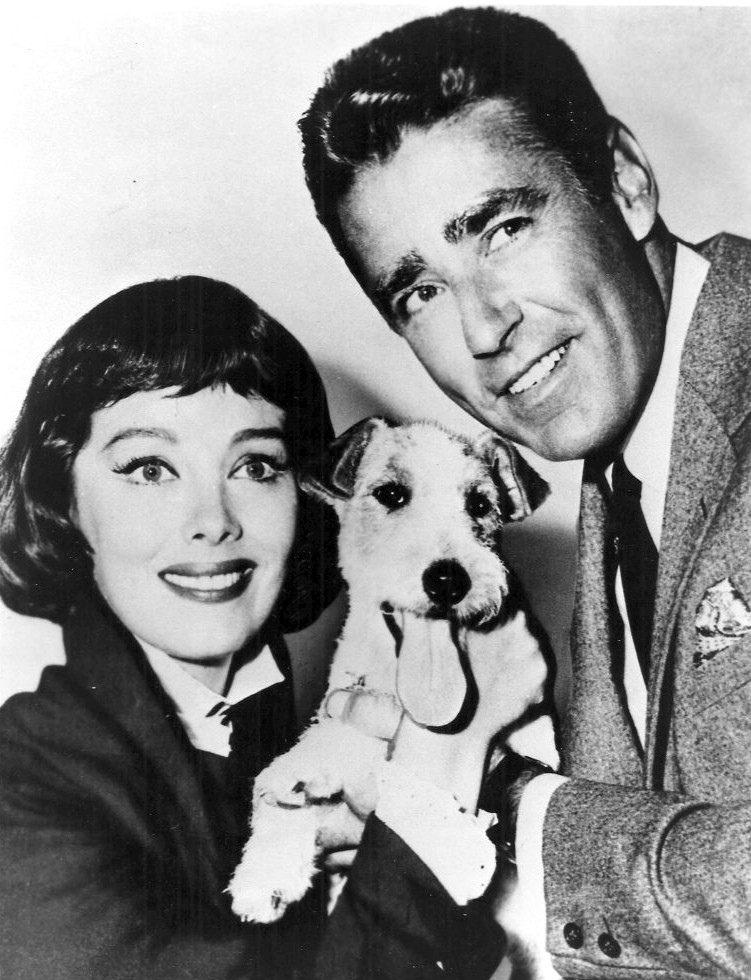
Peter Lawford took over Powell’s role of Nick Charles with Phyllis Kirk stepping in for Myrna Loy as Nora. (In the years after this show, Kirk only had five other acting credits; Lawford, on the other hand, was known for his friends, The Rat Pack and would go on to act in more than sixty additional shows during his career.) Their famous dog Asta was played by three different dogs during the run of the show.

📷wikipedia.com Lawford and Kirk

Rounding out the cast was Jack Albertson as Lt. Harry Evans of the NYPD, Patricia Donahue played the Charles’ neighbor Hazel, and Nita Talbot was Beatrice Dane, a criminal who often got Nick and Nora involved in awkward or criminal situations. Before he was Chief O’Hara on Batman, Stafford Repp showed up in NY as Lt. Ralph Raines.

Nick was a former private detective who got out of crime and became a mystery editor in Manhattan. He has an eye for the ladies, and the ladies definitely have an eye for him. Hazel and Beatrice both hit on Nick often much to Nora’s chagrin. Nora is heir to a family fortune. The couple seems to get pulled into crimes and can never resist solving the mystery. Both Raines and Evans agree to help the duo out. Unfortunately for Lawford and Kirk, the show just could not compete with the Powell-Loy banter and wit. After two seasons, the show was canceled.

One of the directors on this show was William Asher. Asher would go on to direct many shows, including I Love Lucy and Bewitched.

📷bryanRxm.com

By the early fifties, most of the movie studios had realized that television was here for good, and they began creating quality shows for the industry. However, MGM refused to believe that television would cause any threat to the film world. In order to prove that, they resisted getting into television until the very last minute. As television continued to grow, and big-screen films lost their domination in the entertainment business, the drowning company finally began searching for a life preserver. However, it was too little too late. By recycling a movie series that had been loved by millions and starred actors who were still alive, and then not putting the quality into the new series that would make it a hit, MGM almost guaranteed that the show would fail. However, the concept would be recycled several times during television history, most notably in Hart to Hart where the glamorous couple solved crimes that seemed to draw them like a magnet.

Apparently, the episodes have never been released on DVD, and I could not find out why. However, even if they existed, I would advise you to watch the Powell-Loy films instead. Most of our television recollections are about shows we love, but there are plenty of shows that did not work, and I like to reflect on those shows as well, and why they did not fare so well. Sometimes it’s just the timing of their introduction; other times, it was just because the shows lacked quality and that seems the case here.

Nita Talbot: What A Character!

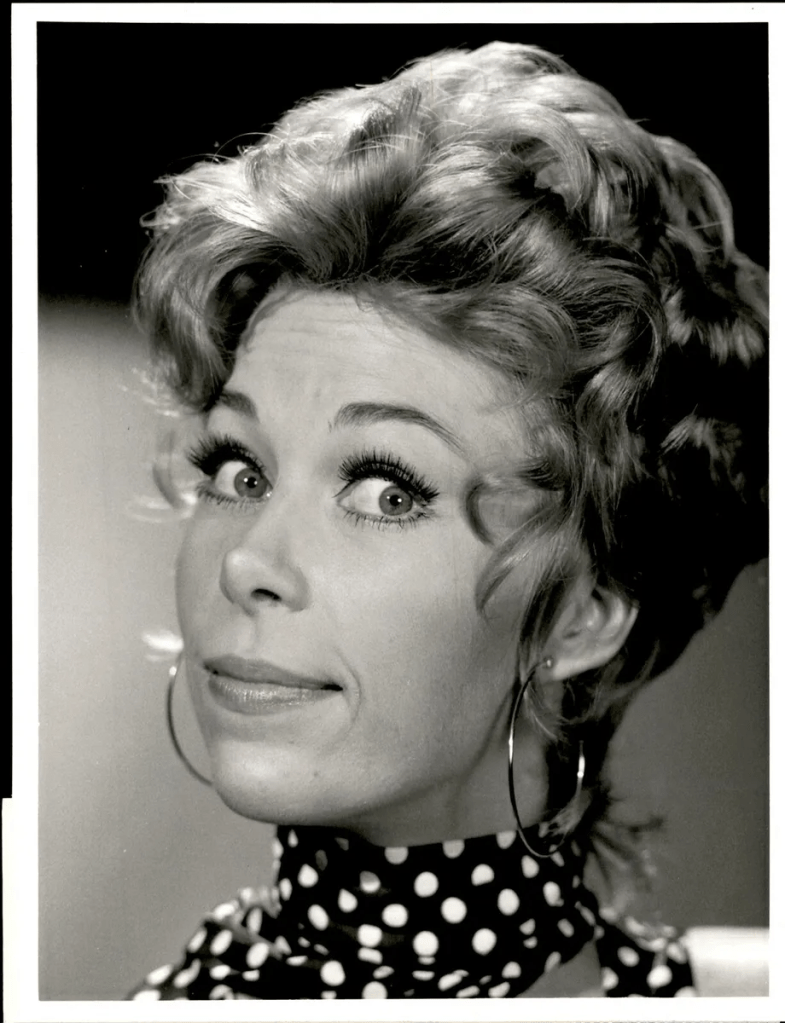
Continuing the “What a Character” series, today we look at the career of Nita Talbot. Born in 1930 in New York as Anita Sokol, Talbot had an almost fifty-year-long career. She began appearing in films in 1949 with It’s a Great Feeling (and would go on to make another 30), but it was in television that she had her greatest success. It’s a Great Feeling starred Doris Day and Jack Carson in a parody of what goes on behind the scenes of the making of a Hollywood movie.

Photo: pinterest.com

She was married to Don Gordon from 1954-1958 and to Thomas Geas from 1961 until sometime in the 1970s.  I could not narrow it down to any specific year. Both of her husbands were also actors. Her sister Gloria was the wife of Carl Betz who co-starred as Alex Stone on The Donna Reed Show.

Photo: pinterest.com
Joe and Mabel

Talbot began her television career in 1950 on Repertory Theater. Appearing in 32 different shows throughout the fifties, many of her appearances were in dramas, primarily shows with different plays weekly. Talbot had a recurring role on Man Against Crime starring Ralph Bellamy, appearing in 9 of the 123 episodes. Later in the decade she was cast in Joe and Mabel in 1956. Nita played the role of Mabel, a manicurist who was dating cab driver Joe. The show only lasted four episodes. At the end of the decade, she would have a recurring role on The Thin Man as Beatrice/Blondie Dane a con artist.

Photo: pinterest.com
Gomer Pyle

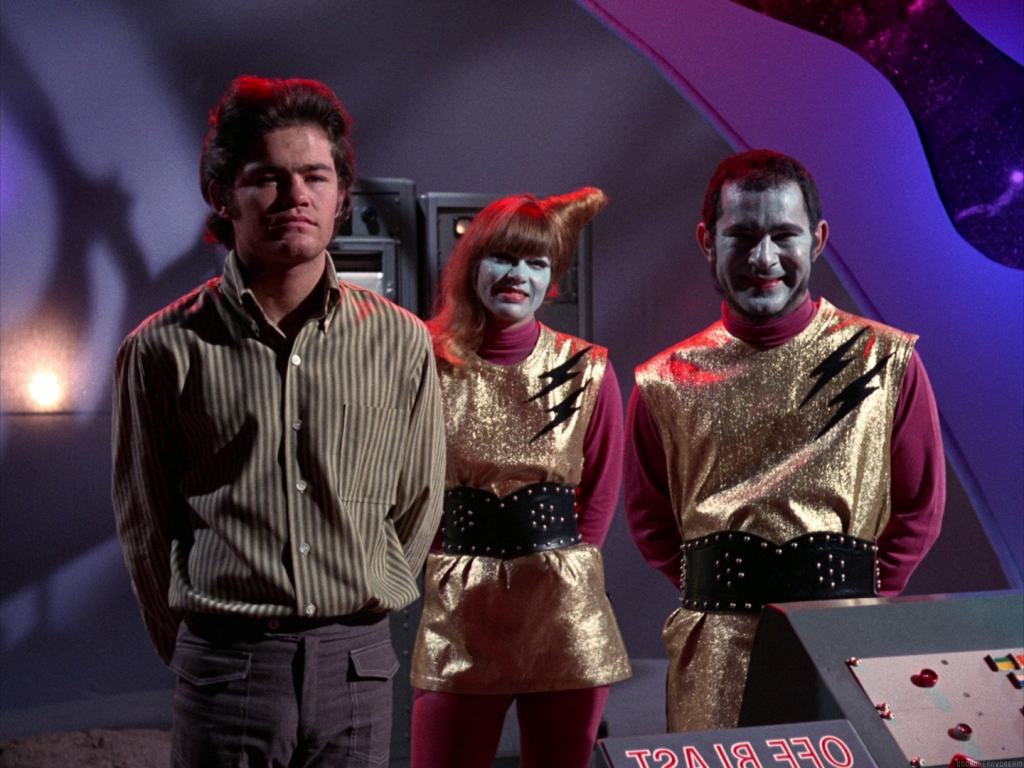
Nita would take on roles in 29 different shows in the sixties. This decade was her “western” season. She did appear in Gomer Pyle and The Monkees, but most of her roles were in westerns, including Gunsmoke, Maverick, The Man from Blackhawk, Rawhide, The Virginian, Daniel Boone, and Bonanza.

Photo: pinterest.com

During this ten-year period, she would be cast in three shows, one drama, and two comedies. In 1960, she could be seen in Bourbon Street Beat about a New Orleans detective agency where she played Lusti Weather. She co-starred in one sitcom this decade with Jim Backus in The Jim Backus Show. Backus plays Mike O’Toole, who struggles to keep his news service business afloat. Talbot played the role of Dora, one of O’Toole’s reporters. The show only lasted for one season.

At the end of the decade, Talbot was offered the role that she would become best known for. Although she only appeared in seven episodes of Hogan’s Heroes, she earned an Emmy nomination for Best Supporting Actress in a Comedy Series in 1967-68 season for her role of Marya, a Russian spy.

Photo: pinterest.com
Hogan’s Heroes

One of her taglines was “Hogahn darlink.” While Hogan could charm most women, he never was certain when he could or couldn’t trust Marya, but he was often coerced to join forces with her against the Germans.

She continued her thriving television career during the seventies with another 26 shows; four of those would be permanent or recurring roles; however, none of them lasted very long.

In 1971, she was offered the role of Maggie Prescott in Funny Face starring Sandy Duncan. Duncan played a college student who worked part time as an actress and Talbot was her agent. When CBS picked up the pilot, they made several changes which resulted in Talbot’s role being dropped.

Photo: blogspot.com
Here We Go Again

1973 found her as part of the cast of Here We Go Again. The show portrayed life after divorce for two couples. It should have been renamed, There We Went because the show only lasted for 13 episodes before being canceled.

Photo: rebeatmag.com
The Monkees

In 1977 she joined the cast of Soap, playing Sheila Fine, who has an affair with Burt Campbell’s son Peter.

In 1979, Supertrain debuted. It was supposedly the most expensive show ever made. It was a “Love Boat” on the rails.  The supertrain traveled across the country and every week passengers found love and solved life problems on their journeys. The show was derailed after nine episodes.

In between these roles, she tended to appear primarily in crime shows in the 1970s such as Mannix, McCloud, Columbo, Police Story, The Rockford Files, Charlie’s Angels, and Police Woman.

Photo: pinterest.com
The Partridge Family

Her roles diminished a bit in the eighties with 13 appearances and 9 in the 1990s. She would be cast in one additional sitcom in 1988, Starting from Scratch. This show starred Bill Daily and Connie Stevens as a divorced couple. Stevens leaves her second husband to come back to her ex-spouse and two sons. Talbot played Rose. The show seemed to get good ratings and currently people are rating them 4.5-4.8 out of 5.0, so I’m not sure why it was canceled after a year.

Photo: pinterest.com

Talbot retired in the late 1990s and is hopefully enjoying a less-busy life. She had a long and successful career and certainly was a character!