Today starts a fun, new blog series, “The Movie Came First.” For the month of December, we’ll be learning about shows that began life as a big-screen movie. Our first sitcom is How to Marry a Millionaire.

In 1953, Betty Grable, Marilyn Monroe, and Lauren Bacall starred in a comedy romance about three women who make a pact to help each other find millionaires to marry but end up finding love instead. Their love interests are played by Cameron Mitchell, David Wayne, and Rory Calhoun.
An interesting fact about this movie is that it was the first one filmed in Cinemascope. In order to highlight the incredible sound, the movie begins with an orchestra performance. It was a bit awkward because it has nothing whatsoever to do with the movie, but is an interesting intro. It was also the first movie to air on television when it appeared on NBC Saturday Night at the Movies in September of 1961.
Another fun fact about the movie is that Merry Anders who would appear in the television show had a bit part as a model in the film.
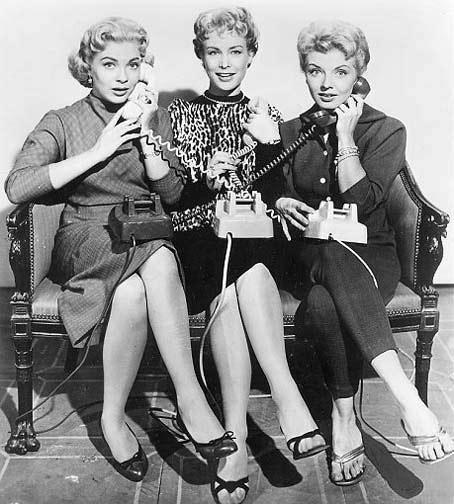
In 1958, the movie came to the small screen with Merry Anders (Mike) filling Lauren Bacall’s role, Barbara Eden (Loco) is the sexy bombshell Monroe played, and Lori Nelson (Greta) is the neutral one in between played by Grable. Greta is the co-host of a quiz show, Go for Broke. Mike, whose real name is Michelle, works as a secretary on Wall Street, and Loco is a fashion model. One of the weekly gags is that Loco has terrible eyesight, but thinks men don’t like girls in glasses, so she often has mishaps not seeing correctly.
In order to find a wealthy husband, they found a chic penthouse apartment while wearing designer clothing even if they could not afford to eat. I guess that’s why they went on a lot of dinner dates.
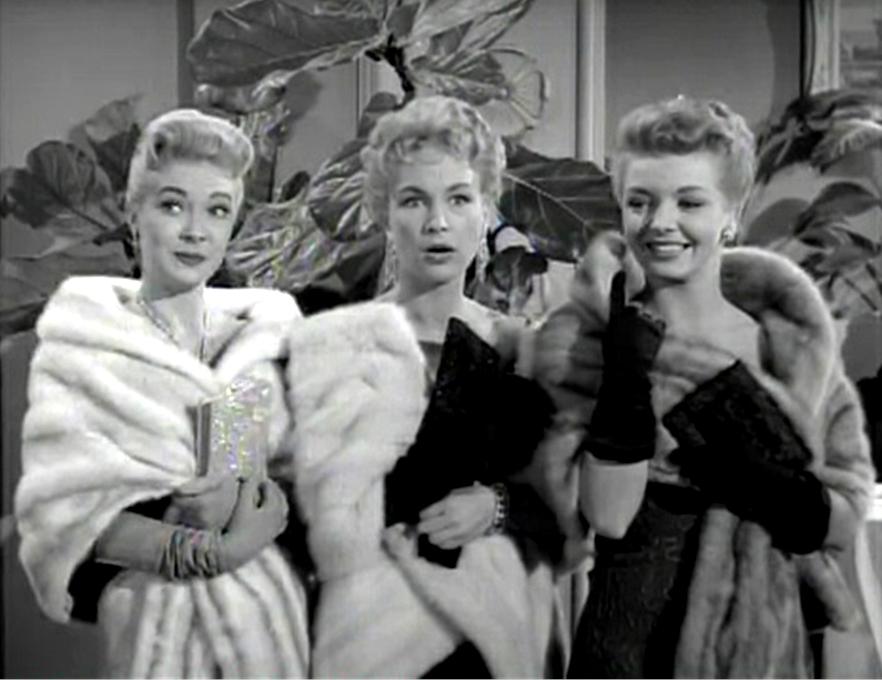
The girls are often short of money and have trouble paying the rent on time. Mr. Blandish (Dabbs Greer), their landlord, is always threatening to evict them. The elevator operator Jesse (Jimmy Cross) sometimes helps and sometimes hinders the trio with their get-rich-husbands schemes.
The pilot was filmed in 1957 with Lori Nelson as Greta but her roommates at the time were played by Charlotte Austin (Loco) and Doe Avedon (Mike, who had been married to photographer Richard Avedon). By the time the show was sold in 1958, the roles had been recast and after looking at more than seventy auditions, the producers picked Eden and Anders.

Anders discussed the camaraderie of the three stars. She said they were amazingly similar. She said they all wore size 8, all drove Thunderbirds, and all had French poodles and this was before they met. Anders had tested for the role of Mike and Loco because she had been playing a lot of ditzy blonde roles. When she was given the role of Mike, Eden was brought on board as Loco. Anders said the cast worked hard. After filming all week, they did late night interviews and early morning shows. One weekend they were sent to New York for a personal appearance. They got back late Sunday night and still had to be at work early Monday morning.

The second season found Nelson out with Lisa Gaye as Gwen in. Nelson claims she was the best actress and that she decided to move on, disliking her character’s development. Other sources say she was fired because she gave an interview criticizing her role. Nelson said her role wasn’t defined well with Anders getting the “Eve Arden wisecracks” and Eden being the sexy, bubbly personality. Greta supposedly married a gas station owner and then moved to California. Only thirteen episodes were aired for season two and then the show was cancelled.

Barbara Eden was interviewed for the Television Academy and discussed her time on the show. She said she was doing a play in LA when director Mark Robson saw her. He offered her a role in his new movie Peyton Place. However, the studio gave the part to another actress who was under contract at the time; but because of Robeson’s interest, they brought Eden in for a test at Fox. One of the television executives called her and said he had seen the test and read her notices for the LA play and was wondering if she was interested in doing a television series. He asked her to go to the Fox Western studios for some still shots. When she got there, she thought the part was still in the process of being cast, but realized the stills were being taken because she had the part and the other girls were her costars.
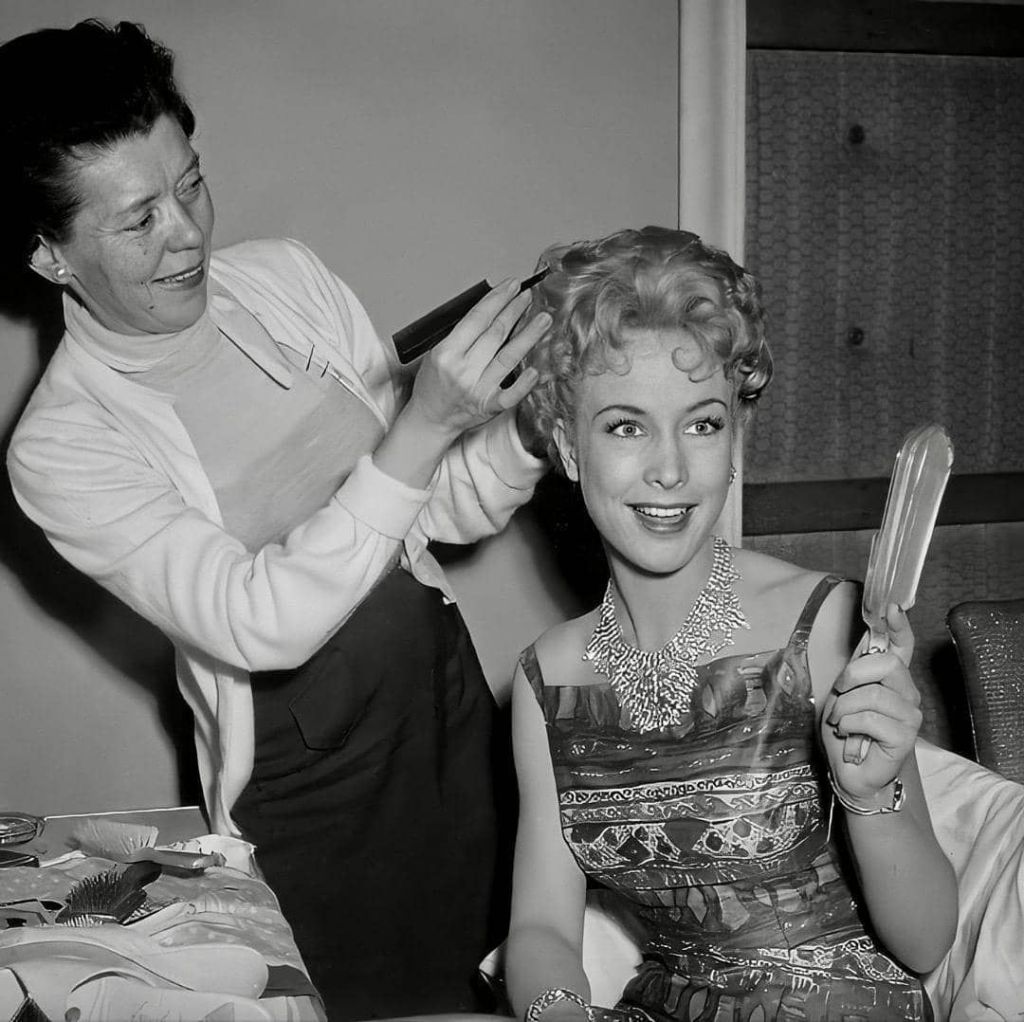
Eden said she was a huge fan of Marilyn Monroe and had seen the original movie. She felt trying to take on the part by imitating Marilyn would have ended badly because she could never compete with Marilyn’s version, so she took the part and made it her own. Like Anders, she also said the three costars were close and became good friends.
Eden said the time on the show was her “finishing school.” She learned so much about filming before the cameras, lighting details, and building stamina. The stars sometimes filmed up to thirteen hours a day in three-inch heels which she said was painful. After long days, they would be given new dialogue to learn for the next day’s shooting. It was a very tough job but prepared her for film work.

If you like cultural history, the show is fun to watch just to see the wardrobes and settings. The clothing was provided by Mr. Mort. Mortimer Goldman owned his design business in 1952, producing mid-priced stylish dresses. During the run of the show, Stan Herman came on board as a designer. Throughout the sixties, Herman’s designs were the height of fashion. Stan Herman later opened his own design studio, producing items under his label as well as for other companies. In the 1990s he began appearing on QVC with his design line of comfortable clothing and sleep ware.
The show was pitched to the three major networks, but they all passed on the series. So, in 1958, NTA Film Network sold the show into syndication to 115 stations. It packaged a three-series deal including Man Without a Gun and This is Alice.

Both critics and fans liked the show, but it had some tough competition. The show aired Friday nights against The Adventures of Ellery Queen, The Wide World of Disney, and Rawhide. Eden said she never knew exactly why the show was cancelled. She assumes that because Fox was trying to be the fourth network and it didn’t work out at the time, all the Fox shows were just dropped.
So, what happened to the NTA network? The company that referred to itself as the fourth network launched in 1956 with 100 affiliate stations. Twentieth Century Fox bought half of the company with the intention of producing original programming. The shows were filmed and then mailed to each station. By 1961, the network was losing money and the flagship station was sold to the Educational Broadcasting Corporation which later became National Educational Television and eventually PBS. One of their largest stations, KTTV in Los Angeles became part of the Fox television network, co-owned by Twentieth Century Fox, part of 21st Century Fox.

I was able to watch a few of these shows online. I’m not sure how the fourth network’s ownership affected syndication. Youtube has four episodes available. For this blog, I watched the first episode again. The jokes were a bit overdone and the laugh track was annoying, but I’ve seen worse. There were some charming moments in the show, and Barbara Eden’s comic ability was obvious with some funny scenes about her failure to wear glasses. Take some time to check out one of these four episodes to see what tv looked like in the mid fifties.


 thewritelife61